Monday, April 27, 2026

Ursula von der Leyen’s big gamble with borrowed money

0

It’s Ursula von der Leyen’s €750 billion bet: that economic damage from the coronavirus crisis is so devastating, EU countries will take a huge leap of faith and effectively sign up for a joint credit card.

By proposing a €750 billion recovery fund, using borrowed money to be repaid over 30 years, the European Commission president is wagering that national capitals will put aside any misgivings, and not only agree to the novel financing mechanism to get EU economies back on their feet, but also cut a fast deal on a €1.1 trillion, seven-year budget that will secure resources for her priorities, including fighting climate change and promoting digital transformation.

Skeptics of her plan — especially the leaders of Austria, Denmark, the Netherlands and Sweden — argue von der Leyen is welcome to gamble her presidency as she likes, but not using their taxpayers’ money. Fierce negotiations now lie ahead.

Much of von der Leyen’s presentations on Wednesday, as well as briefings by commissioners and other officials, seemed tailored to convincing those skeptics, the so-called frugal four, that there is not as much to fear in her proposals as they anticipated.

Appearing first in the European Parliament, where she arrived wearing a white face mask and spoke to a largely empty chamber with MEPs scattered for social distancing, then at the Commission where she fielded questions from reporters connected via an interactive videoconference platform, von der Leyen insisted that the drastic economic downturn required an extraordinary response. But she said it would not permanently change how the EU manages member countries’ money.

“This is a completely new concept and a new step forward … The crisis is so huge, we have to take unusual steps” — Ursula von der Leyen, European Commission president

The result, at times, was a series of seemingly contradictory statements.

She billed her plan, called Next Generation EU, as revolutionary, but insisted it was not a new normal.

The Commission proposed help for business and industries, such as the aviation sector, but also proposed levying a new tax on big companies.

Von der Leyen presented her proposal as the best possible package — €500 billion in grants; €250 billion in loans — but admitted those amounts, and even the overall size of the recovery fund, will be up for negotiation with the EU’s 27 heads of state and government. The entire EU would issue bonds, guaranteed by national commitments to the bloc’s budget, and would repay the debt jointly, but this should not be viewed as “debt mutualization.”

“This is a completely new concept and a new step forward,” von der Leyen said at one point, adding: “The crisis is so huge, we have to take unusual steps.”

But in response to questions, she also said: “This would allow EU member states to contribute to the next budget at the same level as they currently do.” And she said of the unprecedented borrowing program, “I want to be clear, this is one-off and this is an exception.”

At least some of her message appeared to be well-received in the capitals it was aimed at.

“What we find positive — not just myself, but the Netherlands, Sweden and Denmark — is that there is a time limit and that the fund will be a one-time emergency measure and not the first step toward a debt union,” Austrian Chancellor Sebastian Kurz said in an interview with POLITICO. “Considering that there are many in Europe who want such a debt union, it’s important to us that this be clarified in writing once and for all.”

Banking on Merkel and Macron

Von der Leyen and her team are clearly counting on supporters, especially German Chancellor Angela Merkel and French President Emmanuel Macron, to wield the political muscle needed to bring all 27 EU countries on board.

Merkel and Macron last week put forward their own joint proposal for the EU to borrow €500 billion and use it to distribute grants to member countries hit hardest by the pandemic. But while von der Leyen proposed that same amount in grants and another €250 billion in loans, she conceded the figure could very well change.

“I think especially in this exceptional situation where we really need a clear and strong and united answer to this crisis, this was and is a big step forward,” von der Leyen said, noting that the EU had long used the same approach in the past to borrow far more modest sums.

Enzo Amendola, Italy’s minister for European affairs, praised the proposal, calling it “a solid basis for a successful conclusion to the negotiations.”

And in a sign that efforts are underway to foster goodwill between north and south heading into the budget talks, Dutch Prime Minister Mark Rutte tweeted that he had spoken with his Italian counterpart, Giuseppe Conte, on Tuesday, and he praised Italy’s recovery efforts.

Von der Leyen said EU members were already in agreement on broad principles. But some of the items that are yet to be agreed are hardly trivial.

“To raise money on the capital market and to channel this through the European budget is accepted,” von der Leyen said. “The discussion is about the size, and the discussion is about grants and loans.”

She added, “What part is loans? What part is grants, or do we have only grants or only loans? That will have to be discussed, and I think it’s positive that we are now starting to work with the solution. It will change. In any negotiation, a concept is partly changed. But I am deeply convinced that is the sound answer we should give.”

Across the street from the Commission headquarters, Council President Charles Michel and his team immediately set to work, phoning capitals to gauge reactions to the proposal, and announcing that EU leaders would hold a summit on June 19, possibly their first in-person gathering since the pandemic forced countries into lockdown back in March.

“Everything should be done to reach an agreement before the summer break,” Michel said in a statement. “Our citizens and businesses have been heavily impacted by the pandemic. They need targeted relief without delay.”

Council officials said they are analyzing the Commission’s proposed recovery fund, as well as the revised €1.1 trillion core budget plan, in an effort to understand what they will mean for each of the 27 EU countries.

“We need to make sure the allocation is fair,” a senior Council official said, noting that while Italy and Spain suffered the most from the coronavirus, the economic hit was felt across the entire Continent.

“We can’t just say Italy and Spain and that’s it, full stop,” the official said. “It’s a psychological issue as well. We have all seen deaths. It’s emotion. You won’t be able to avoid that.”

According to figures provided by a Commission official, Italy and Spain would receive by far the most from the new fund. Rome would be in line for nearly €82 billion in grants and almost another €91 billion in loans. Madrid is forecast to receive more than €77 billion in grants and over €63 billion in loans.

For the Council, and the 27 member countries, numerous technical questions remain to be answered, including exactly how the Commission has calculated its allocations, and precisely what cuts have been made to various programs in order to accommodate some of the new spending.

Quick analysis suggests that some programs von der Leyen identified as sacred priorities would in fact end up with budgetary allocations smaller than those originally proposed, including the Erasmus student exchange program, and many security and defense initiatives.

Cohesion programs, for example, which are meant to foster regional development, would be allocated €323 billion from the EU budget over seven years — less than the €330 billion proposed in 2018 — but would get a top-up of €50 billion from borrowed funding. Similarly, the Commission is proposing to reduce the EU budget allocation for the research and innovation program Horizon Europe, but add €13.5 billion of borrowed money.

Taxing questions

The Commission stressed that all the borrowing it has envisioned for the recovery fund could theoretically be repaid by creating new revenue streams that would flow directly into EU coffers. National capitals have long resisted allowing the Commission to create such new “own resources” but von der Leyen suggested they are more palatable than the alternatives — future spending cuts or higher national contributions to the EU budget.

Among the ideas floated were a digital tax, as well as a carbon border tax, or expanding the EU’s Emissions Trading System to increase fees on the aviation and maritime sectors. The Commission also raised a new idea of a tax on operations of “large enterprises” but did not provide details of how it might work.

One key change in the Commission’s proposal is its approach to rebates — reductions to the amount of money some relatively wealthy member countries, such as the Netherlands, contribute to the bloc’s budget. The Commission has backed down on plans to phase them out in the near term — a clear part of its effort to win over the frugal four.

A Dutch diplomat said it is too soon to fully evaluate the Commission’s complex proposal. The Netherlands is still firmly opposed to sharing debt with other EU nations but wants to find other ways to help with the recovery effort, the diplomat said.

“Our position is well known: The starting point is that the Netherlands is willing to help and wants to cooperate on a European level to fight the crisis,” said the diplomat. “We want to do this in a way that strengthens member states and the EU as a whole.” But the diplomat pointed to a joint paper issued by the four frugal countries calling for “loans for loans, no mutualization of debt, reforms.”

Commission officials insisted that the scale and scope of the economic damage from the pandemic — financial contraction at levels unseen since the Great Depression — called for extraordinary measures. And they said that a key advantage of von der Leyen’s proposal is that the money borrowed by the EU and distributed as grants would not add to the national debt load of countries struggling to recover.

Von der Leyen herself urged everyone to recognize the historic need for solidarity. “The current crisis,” she said, “is the greatest collective challenge we have faced since the beginning of the EU.”

Matthew Karnitschnig, Jacopo Barigazzi and Maïa de La Baume contributed reporting.


Source by [author_name]

Countries reopening even as virus toll continues to climb

The United Nations secretary-general says support for his March 23 call for a global cease-fire to tackle the COVID-19 pandemic has not been translated into “concrete action,” and in some cases warring parties have exploited the crisis to step up military action.

UN warns of ‘deadly threat’ from virus during war

Antonio Guterres warned the UN Security Council on Wednesday that “civilians caught up in violence now face a new and deadly threat from COVID-19.”

He pointed to conflict-torn Libya where the UN mission documented at least 58 civilians killed and 190 injured between April 1 and May 18.

The UN chief told the council meeting on the protection of civilians in conflict that as the pandemic “rages on, causing enormous human suffering and additional stress to health systems,” people already weakened by years of fighting “are particularly vulnerable.”

Italy’s death toll passes 33,000

Italy’s known death toll in the COVID-19 pandemic topped 33,000 on Wednesday, with 117 more deaths registered nationwide since the previous day.

But authorities acknowledge that the real number of deaths will probably never be known since many with coronavirus symptoms in care residences or in their own homes died without being tested in the past few months.

Lombardy, the northern region, which has registered more than a third of the entire nation’s known cases, confirmed 384 new coronavirus infections on Wednesday, considerably more than the 73 registered in the next heaviest-hit region, Piedmont, also in the north.

Carabinieri officers patrol the city trendy Navigli district in Milan, Italy, May 26, 2020. (AP)

Health Ministry and other government officials are closely monitoring regions for any jump in new cases following the May 18 easing of many lockdown restrictions, including allowing all retail stores to re-open and cafes and restaurants to resume in-house service.

Italians are waiting to learn if they will be able to freely travel among all regions starting on June 3, or only among some of them, in view of contagion rates.

Currently travel between regions is limited to strict necessity.

Italy registered 584 confirmed new cases on Wednesday, raising to 231,139 the total number of known coronavirus infections in the country, according to Health Ministry figures.

Spike in South Korea shows perils of reopening

In South Korea, 40 newly confirmed cases – the biggest daily jump in nearly 50 days – raised alarms as millions of children returned to school yesterday.

All but four of the new cases were in the densely populated Seoul region, where officials are scrambling to stop transmissions linked to nightclubs, karaoke rooms and a massive e-commerce warehouse. All were reopened last month when social distancing measures were relaxed.

The country’s top infectious disease expert said South Korea may need to reimpose social distancing restrictions because it’s becoming increasingly difficult for health workers to track the spread of COVID-19 amid warmer weather and eased attitudes on distancing.

“We will do our best to trace contacts and implement preventive measures, but there’s a limit to such efforts,” said Jeong Eun-kyeong, director of South Korea’s Centres for Disease Control and Prevention.

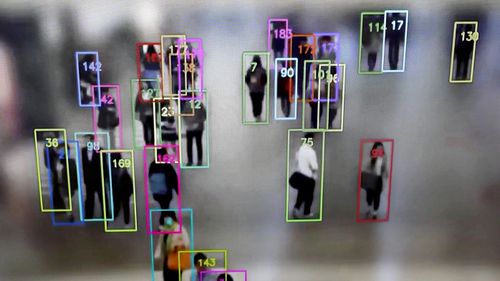
Object detection and tracking technology for people not wearing masks, developed by SK Telecom, is displayed on a screen at the company headquarters in Seoul, South Korea. (Getty)

“Young people have a very broad range of activity, so at the point of diagnosis, there’s already a lot of exposure… the number of people or locations we have to trace are increasing geometrically,” he added.

Seoul and nearby cities had restored some control in recent weeks by reclosing thousands of bars, karaoke rooms and other entertainment venues to slow the spread of the virus.

SeaWorld and Walt Disney World will reopen in Orlando, Florida, in June and July after months of being closed because of the coronavirus pandemic, according to plans a city task force approved Wednesday.

The proposals will now be sent to Florida Gov. Ron DeSantis for final approval.

The plan calls for SeaWorld to open to the public on June 11. Disney plans a tiered reopening, with Magic Kingdom and Animal Kingdom opening on July 11, followed by Epcot and Hollywood Studios on July 15.

Last week, Universal Orlando presented its plan to reopen on June 5. That plan also has been approved by the Orlando task force, which sent its recommendation to the governor.

Disney’s senior vice president of operations, Jim McPhee told the task force the parks would open with limited capacity, but he didn’t specify the number of guests who would be allowed in initially.

Disney World also plans smaller, soft openings prior to July 11, but no specifics were provided.

SeaWorld is planning an employee appreciation event on June 10 before opening to the public the next day, said Interim CEO Marc Swanson.

Mexico confirms record death toll, new infections

Just hours after Mexican health officials reported record numbers of deaths and new coronavirus infections, President Andrés Manuel López Obrador said Wednesday he will resume his travel schedule next week, flying commercial to the beach destination of Cancun.

Prior to the pandemic, the president, who has yet to leave Mexico on an international trip, effectively operated as if he was still on the campaign trail, crisscrossing the country each week to hug and shake hands with his admirers.

Mexico City
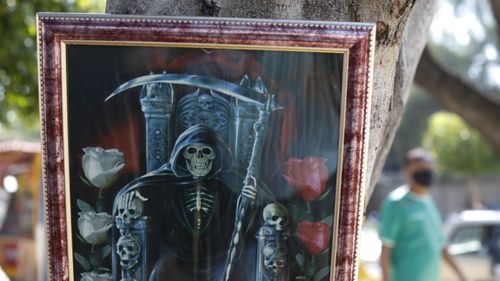
An image of Santa Muerte, or Sacred Death, hangs on a tree on a block where family members typically wait for news of their loved ones outside Balbuena General Hospital, which is treating both patients with COVID-19 and those with other conditions, in Mexico City, May 25, 2020. (AP)

Throughout two months of social distancing measures, López Obrador has fretted about the impact on the economy and stubbornly refused to halt his key infrastructure projects. One of the those, the Mayan Train, which is supposed to whisk tourists around the Yucatan Peninsula, will be the objective of his first scheduled trip since March.

“I’m going to be careful,” López Obrador said. “If the airline requires you to use a mask, I’m going to use it.” He said doctors are recommending that he limit his flying and travel more by car, so he planned to drive back to the capital from the Caribbean coast with stops in epidemic hotspots, including Veracruz and his home state of Tabasco.

He said he would restrict his events to no more than 50 people and maintain a healthy distance. It will be a dramatic change from his usual events, where crowds press close to him to pass letters or shout requests.

Greece decides who can fly in

Greece says the United States is unlikely to be on a list of countries that will be allowed to resume direct flights to Greece in the coming weeks but could be added later in the summer.

Prime Minister Kyriakos Mitsotakis said Wednesday that Greece’s government was finalising the list of countries that will be allowed to resume flights to Athens on June 15 and regional airports on July 1 and has already stated that Germany will be included.

“It is unlikely that the (US) will be on our list, given the data that we currently have,” Mitsotakis told a web event hosted by the Brookings Institution and Miller Center of Public Affairs at the University of Virginia.

“We will start with countries that have similar epidemiological data with Greece. And we expect to gradually ramp up direct flights to our islands.”

Spain reckons with its losses

A scientific study says Spain has registered 43,000 deaths more than average while it has been in the grip of the new coronavirus pandemic.

The hard-hit country’s official COVID-19 death toll stood at 27,118 on Wednesday, one more than the previous day, according to Health Ministry statistics.

The higher death toll is based on averages of recent years between March 15 and May 24, ascertained by Spain’s Carlos III University, which monitors Spain’s mortality rate. The data it provides is based on numbers of deaths submitted by public records offices around the country. The data does not include the cause of death.

Spanish royal family
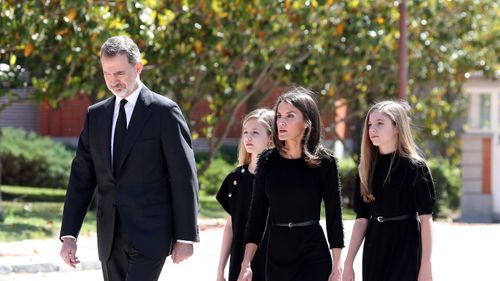
In this handout provide by Casa de S.M. el Rey Spanish Royal Household, (L-R) King Felipe VI of Spain, Princess Leonor of Spain, Queen Letizia of Spain and Princess Sofia of Spain take a minute of silence for the COVID 19 victims at the Zarzuela Palace on May 27, 2020 in Madrid, Spain. (Getty)

As well as the roughly official coronavirus 27,000 deaths, experts estimate some 9,000 suspected but unconfirmed deaths from COVID-19 have occurred at nursing homes. That leaves around 7000 excess deaths as unexplained.

Fernando Simón, the head of Spain’s emergency medical response, said Wednesday that many of the extra deaths likely can be put down to people who died at home or hospitals without having been tested, or who died of other illnesses, or people who did not go for treatment because hospitals were overwhelmed.

Spain officially recorded 231 new infections from Tuesday, 37 more than the previous day, to reach almost 237,000. Madrid and Barcelona accounted for about 75 per cent of the new cases.

Brazil reopening despite increasing crisis

Sao Paulo state, the epicentre of the coronavirus outbreak in Brazil, will reopen some of its closed businesses starting June 1 despite a growing number of confirmed COVID-19 cases.

Governor João Doria said Wednesday that stay-at-home recommendations will remain in effect until June 15 for the state that’s home to 46 million people, but some economic activity will resume in less affected regions, including Sao Paulo city, as long as social distancing guidelines are respected.

More than 6400 people have died because of the new coronavirus in Sao Paulo state, about one-fourth of all of Brazil’s deaths. Experts and even some authorities have said that represents a significant undercount because of insufficient testing.

Doria said Sao Paulo regions that reduce daily increases in their COVID-19 cases and have enough available intensive care beds can partially reopen stores, shopping malls, offices, car dealerships and real estate brokerages. Sao Paulo never imposed a lockdown, so non-essential industries and civil construction were never closed. Doria said the decision is based on scientific guidelines.

Doria has been frequently singled out for criticism by Brazil’s President Jair Bolsonaro, who has opposed governors’ restrictions on activity.

– Reported with Associated Press

For breaking news alerts and livestreams straight to your smartphone sign up to the 9News app and set notifications to on at the App Store or Google Play.

Source by [author_name]

Taiwan to Offer Effective Asylum to People Fleeing Hong Kong

0

Taiwan president Tsai Ing-wen on Wednesday doubled down on offers of help for Hong Kong with effective asylum for residents fleeing an ‘anti-terrorism’ crackdown on the city.

Tsai said she and Premier Su Tseng-chang would launch an assistance program helping people arriving from Hong Kong — where the authorities are targeting anti-Beijing protesters as “terrorists” — to gain residency rights, accommodation and other forms of support.

“We are proposing a humanitarian rescue action plan for our Hong Kong friends, to be drawn up by the Executive Yuan,” Tsai said.

“This project will also include relevant resources, a complete plan for the residency, resettlement, and care of Hong Kong people,” Tsai said. “It includes a budget formulation, and clear assistance mechanisms.”

The Mainland Affairs Council (MAC), the executive department in charge of relations with China, will draft and coordinate the plan among different government departments, Tsai said.

She called on the MAC to formulate and implement the plan as soon as possible, with funding from the government.

Taiwan — which for decades was concerned it could be overwhelmed by refugees from China — has no refugee law, so has no formal asylum process. The democratic island says it responds to asylum requests on a case-by-case basis, using humanitarian principles.

Tsai said there would be no need for a new law to help people fleeing political retaliation in Hong Kong, however.

“Our current laws … are sufficient,” Tsai told journalists. “Regardless of how the regulations may change in future … I can assure of one thing: of our determination to take care of the people of Hong Kong will not change.”

“We will provide them with the necessary assistance to allow them to live and work in Taiwan,” Tsai said.

China’s announcement it will bypass Hong Kong’s legislature to impose draconian security laws on the city to quell “subversion” and “foreign interference” during the year-long protest movement has sparked international criticism and concern.

Tsai said on May 26 that the proposed law “seriously threatens Hong Kong’s future” and erodes its core values of democratic freedoms and judicial independence.

Taiwan last year saw a sudden spike in the number of Hong Kong residents moving to the country, fleeing the possibility of political arrests, amid months of social unrest and growing uncertainty about the city’s future under Chinese rule.

A total of 5,858 Hongkongers were granted temporary or permanent residency in 2019, a rise of 41.12 percent compared with the previous year.

There was also a 35 percent rise in the number of Hong Kong residents gaining permanent residency in Taiwan, which has never been ruled by the Chinese Communist Party, nor formed part of the People’s Republic of China.

Rights groups in Taiwan said on Wednesday that the imposition of the national security legislation on Hong Kong meant that last year’s stand-off over plans to allow extradition to mainland China was now obsolete, as Hong Kong law enforcement would be run along similar lines to that of the rest of China.

But they called on Tsai’s administration to press ahead with a fully fledged Refugee Bill to better serve asylum-seekers.

Reported by Hwang Chun-mei for RFA’s Mandarin Service. Translated and edited by Luisetta Mudie.


Source link

EU’s diplomatic service launches probe over China disinformation leak

0

Josep Borrell appeared to blame a member of his own staff for leaking s sensitive email | Pool photo/Getty Images

MEP asks foreign policy chief to provide evidence for claims against EEAS staffer.

The EU’s diplomatic service has launched an investigation into the leaking of an internal email criticizing how a report on Chinese disinformation was edited.

The investigation follows criticism by the EU’s foreign policy chief Josep Borrell, who appeared to blame a member of his own staff for leaking the sensitive email, which was at the heart of a scandal about the EU allegedly bowing to Chinese pressure.

The European External Action Service (EEAS) last month published a report on “narratives and disinformation” around the coronavirus pandemic that was notably softer than a previous, leaked version reported by POLITICO. Most strikingly, references to China running a “global disinformation” campaign and Chinese criticism of France’s reaction to the pandemic were absent from the later version — prompting accusations that Brussels watered down its criticism in response to Chinese diplomatic pressure.

The EEAS denied that it had given in to Chinese pressure and said it had always intended to produce two versions of the report, one for internal use and one for the public.

But accusations of bowing to pressure were fed by an email from an EEAS staffer, leaked to the New York Times, which warned that the softening of the report would “set a terrible precedent and encourage similar coercion in the future.” The staffer also said that EU diplomats were “self-censoring to appease the Chinese Communist Party.”

EEAS spokesperson Peter Stano said Wednesday that the institution was now investigating who was responsible for leaking the delicate email.

“The EEAS is in the process of an internal follow up to the leaks,” Stano told POLITICO. He declined to say how many staffers are being investigated, when the investigation is supposed to be finalized or whether the EEAS was considering disciplinary measures. “Such internal processes are handled in a strictly internal way, hence we do not comment on them publicly,” he said.

Stano also declined to say whether the EEAS was investigating who leaked the first, internal version of the disinformation report to media.

During a European Parliament debate at the end of last month, Borrell expressed frustration over the leaked email, saying that it undermined the credibility of the EEAS. Borrell also appeared to lash out at his own staff, saying that “the personal belief” of a staffer — “maybe being written to be leaked” — had caused “damage to the credibility of the institution.”

During another Parliament hearing on Tuesday, Czech MEP Markéta Gregorová asked Borrell to provide evidence for his allegations or apologize to the staffer. Gregorová did not get an answer as the video connection of Borrell, who was taking part in the hearing remotely, was interrupted.

Gregorová told POLITICO she will now send her questions in writing to the foreign policy chief, and said Borrell’s reaction to the scandal should have been to stand behind his staff and not spread accusations unless he had clear evidence for them.

“The presumption of innocence has to apply,” she said, calling on Borrell to “be the vanguard for all people working in the EEAS … He must protect them against any undue interference and from self-censorship.”

Jacopo Barigazzi contributed reporting.


Source by [author_name]

Pompeo Says Hong Kong No Longer Has Autonomy Under China

0

WASHINGTON — Secretary of State Mike Pompeo announced on Wednesday that the State Department no longer considered Hong Kong to have significant autonomy under Chinese rule, a move that indicated that the Trump administration was likely to end some or all of the United States government’s special trade and economic relations with the territory in southern China.

Such actions have been discussed for days by foreign policy aides, and they would be among the harshest punishments imposed by the administration over the last three years on China. They could have far-reaching consequences for global commerce and transform the ways that Chinese and foreign companies operate, as well as upend the lives of many residents of the territory, who have already been under enormous pressure from years of the Chinese Communist Party’s political crackdowns.

Hong Kong has been a global financial and commercial hub since late last century. China relies on the bustling metropolis of ports and skyscrapers on the edge of the South China Sea for transactions with other countries. Many Chinese and foreign firms use Hong Kong as an international or regional base, and members of elite Chinese Communist Party families or executives with ties to them do business and own property there. Many companies also raise capital by listing on the Hong Kong Stock Exchange.

Mr. Pompeo’s announcement came the day before Beijing was expected to pass a national security law that would allow Chinese security agencies to severely limit civil liberties in Hong Kong. Mr. Pompeo has said that would be a “death knell” for Hong Kong, which has had liberties under a semiautonomous system of governance that does not exist in mainland China, including freedoms of speech, the press and assembly, as well as an independent judiciary.

For days, protesters in Hong Kong have taken to the streets to voice outrage at the national security law proposed by Beijing, only to be beaten back by police officers clad in riot gear and firing tear gas.

If it proceeds with punishments, the Trump administration could impose the same tariffs on exports from Hong Kong that it puts on goods from mainland China, according to officials with knowledge of the discussions. That could happen soon after the Chinese government approves the national security law on Thursday. Other trade restrictions that apply to China, including bans or limits on what American companies can sell to Chinese companies because of national security or human rights concerns, may be imposed on Hong Kong as well.

“I certified to Congress today that Hong Kong does not continue to warrant treatment under United States laws in the same manner as U.S. laws were applied to Hong Kong before July 1997,” Mr. Pompeo said Wednesday. “No reasonable person can assert today that Hong Kong maintains a high degree of autonomy from China, given facts on the ground.”

Mr. Pompeo said that “Hong Kong and its dynamic, enterprising and free people have flourished for decades as a bastion of liberty, and this decision gives me no pleasure.” He added: “But sound policymaking requires a recognition of reality. While the United States once hoped that free and prosperous Hong Kong would provide a model for authoritarian China, it is now clear that China is modeling Hong Kong after itself.”

Mr. Pompeo is the most vocal of a group of national security officials who advocate tough policies on China. Some of Mr. Trump’s top economic advisers prefer a more conciliatory approach to dealing with the world’s second-largest economy, and they will likely urge caution as Mr. Trump reviews his options. American corporate executives have already said the administration should act with care.

Mr. Trump has rarely made any strong comments on the situation in Hong Kong, and he has praised Xi Jinping, the president of China, throughout his time in office, even insisting that they have a strong friendship. Mr. Trump has also been eager to promote a trade agreement he signed with China in January as an economic win for the United States and wants to avoid jeopardizing that deal, even though Beijing is not meeting purchasing quotas outlined in it.

But on Tuesday, when asked by reporters about China’s proposed national security law, Mr. Trump said he planned to take action before the end of the week. “I think you’ll find it very interesting,” he said, adding that his response would come “very powerfully.”

The certification by the State Department is a recommendation on policy direction and does not itself catalyze any actions immediately. American officials, including Mr. Trump, will now weigh what steps to take.

The United States is likely to choose specific areas in which to break off cooperation first with Hong Kong, including on trade. The president would need to issue an executive order to end the special relationship entirely, according to people familiar with the discussions.

Britain handed Hong Kong to China in 1997, after the two nations reached an agreement on the colony 13 years earlier. In 1992, the United States passed a law that said the American government would continue to treat Hong Kong under the same conditions that applied when Britain ruled the territory.

In November, after months of pro-democracy protests and crackdowns by the police in Hong Kong, Mr. Trump signed into law a bill with bipartisan support that said the State Department would have to provide an annual certification to Congress on whether the United States should continue the special relationship with Hong Kong.

That certification depends on a judgment by State Department officials of whether the Chinese government was ceding enough autonomy to Hong Kong.

The announcement by Mr. Pompeo is certain to draw condemnation from Beijing, where the government is holding its annual legislative session this week. Officials announced details of the proposed national security law on Friday, at the start of the session.

“If anyone insists on harming China’s interests, China is determined to take all necessary countermeasures,” Zhao Lijian, a Chinese Foreign Ministry spokesman, said at a regularly scheduled news conference earlier Wednesday in Beijing. “The national security law for Hong Kong is purely China’s internal affair that allows no foreign interference.”

Some American business executives are advising the Trump administration to tread carefully on changes to the economic relationship with Hong Kong.

The U.S. Chamber of Commerce, which represents American companies in Hong Kong, said in a statement Tuesday that it was “deeply concerned” about the proposed national security law. It asked the Chinese government to “peacefully de-escalate” the situation and preserve the semi-autonomy of the “one country, two systems” framework that, under the 1984 treaty between Beijing and London, is supposed to exist until 2047.

“We likewise urge the Trump administration to continue to prioritize the maintenance of a positive and constructive relationship between the United States and Hong Kong,” the group said.

It added that “far-reaching changes” to Hong Kong’s status “in economic and trade matters would have serious implications for Hong Kong and for U.S. business, particularly those with business operations located there who exercise a positive influence in favor of Hong Kong’s core values.”

Julian Ku, a law professor at Hofstra University, said the Trump administration has flexibility on what options to exercise in changing the relationship with Hong Kong.

“I would expect the president would act on some agreements, but not on others,” Mr. Ku said. For example, he noted, the administration might terminate the extradition treaty with Hong Kong, since the national security law makes fair adjudication less credible, or it could extend to Hong Kong the controls that limit American technology exports to China.

“But he might leave the visa waiver treatment that Hong Kong residents currently receive when coming to the U.S. alone for now,” he added.

Mark Williams, the chief Asia economist at Capital Economics, said Mr. Trump’s tariffs on imports from mainland China — which are paid by American companies — would not automatically extend to Hong Kong despite the new State Department determination. But the cumulative effect of various actions would erode Hong Kong’s status as an international business center, Mr. Williams wrote in a note to clients.

“The irony is that in punishing Hong Kong, we wind up martyring it rather than saving it,” said Daniel Russel, an assistant secretary of state for East Asia and the Pacific in the Obama administration. As for diplomacy between Washington and Beijing, he said: “The brake pads in the relationship have worn very, very thin. And it’s hard to see this confrontation going anywhere except escalation.”

In Congress, Senator Marco Rubio, Republican of Florida and a sponsor of the bill on Hong Kong that passed last fall, cheered Mr. Pompeo’s announcement.

“For years, the Chinese government and Communist Party have walked back on its commitment to ensure autonomy and freedom for Hong Kong,” Mr. Rubio said. “We cannot let Beijing profit from breaking the Sino-British Joint Declaration and trying to crush the spirit of Hong Kong’s people.”

Michael Crowley and Ana Swanson contributed reporting.

Source link

It’ll take teachers with a can-do attitude to pick up the school year – The Mail & Guardian

COMMENT

When schools reopen, teachers will need to bring with them more than their files, books and sandwiches. They will need to bring an attitude and frame of mind that equips them to manage schools that will be fundamentally different. 

They will need to support learners and families through the uncertainty of the weeks and months ahead. It’s going to take empathy, agency, resilience and a willingness to evolve through change and uncertainty. It’s going to take can-do teachers to make things work. 

Before lockdown, I visited 16 teachers across the length and breadth of South Africa to characterise the makeup of a can-do teacher as described in my book Where Light Shines Through: Tales of Can-do Teachers in South Africa’s No-fee Public Schools. 

More than anything can-do teachers care; they harness their resilience and willingness to evolve to make things happen despite the circumstances. This agency drives them to do the best for those in their care as they guide children to imagine and realise their greatest possible selves. 

I spoke to some of these teachers again to hear how they are preparing for going back to school during the lockdown. 

Olga Motshwanedi-Marimo is the recently appointed principal of Kitsong School, a low-fee private school in Rustenburg under the administration of the Royal Bafokeng. 

“Going back to school is a good thing,” she says. “Our life has to work around the virus — the virus is not going to go back anytime soon.” 

She believes that before she can begin to think about academic catch-up, she will need to invest in understanding the emotional state of learners and teachers and providing support where needed. 

“When you have a learner or a teacher who is traumatised or who has anxiety, it becomes difficult to reach the person,” she says.

 Motshwanedi-Marimo is aware that, over and above the anxiety about health and wellbeing, many learners will return to schools with their economic circumstances changed, given the closing down of businesses and the job losses that have been reported during lockdown. 

“It is important to ground people so that they can be equipped to meet the challenges ahead,” she says. “When we start teaching it will not be easy. It will be fast paced and learners will be under pressure. We will need to motivate them to catch up and pass matric this year.” 

Azhar Rajah, a life sciences teacher at Ahmed Timol Secondary School in Azaadville near Krugersdorp, agrees that schools will need to offer psychosocial support. Teachers will also need to rely on their sense of agency to educate themselves about the disease and to teach learners about health and safety practices before they can even think about returning to the curriculum. 

“There is a lot of wrong information out there and conspiracy theories,” Rajah says. “There are people who strongly believe in them. We need people who will learn the scientific facts. We need to educate the learners to do the right thing.” 

Tracey Naidoo, lead grade 6 social sciences and maths teacher at Brenthurst Primary in Brakpan, is anxious about returning to school but she believes that teachers with agency and resilience will make it work. 

“A lot of pressure has been placed on SMTs [school management teams],” she says. “We have to come up with a concrete plan. It’s a bit scary having all these decisions to make and people’s lives in your hands. But the minute those kids walk in, teacher mode will kick in for us. If we don’t stress, if we give them the practical steps, our kids will follow the example,” she says.

Ameera Khan, English home language teacher at Promosa Primary on the outskirts of Potchefstroom, believes that teachers should not fall victim to negativity and should be strong for themselves and their learners. 

“We need to make the new normal for these kids. We need to encourage a new way of life around hygiene practices and so on and show kids that we can beat this virus,” Khan says. “We need to be the pillar of strength once again. It’s going to take resilience.” 

Many educators — like Freddy Marubini, the head of mathematics at Thengwe High in Tshandama, Limpopo — set ambitious academic targets this year and have been working through lockdown to achieve them. He is in a hurry to get back into the classroom and is driven to make things work. 

“One thing I have learned in this life is that there are some people who are happy to have an apology for not doing the work. But if we get educators who are committed, who feel the need to teach their learners, I think we will make it,” he says. 


This is a list of resources that will help schools with planning and the development of Covid-19 protocols.   

Schools can access Covid-19 guidelines and protocol templates from the Department of Basic Education and other sources on the Section 27 website. 

Supporting Learners at Home:  A Guide for Caregivers. 

A Covid-19 research bootcamp hosted by JET Education Services offers valuable insights for school management teams and policy makers.   


Kimon Phitidis is a director of Social Innovations, a social investment agency that delivers academic support programmes into public schools


Source link

Action against 1,300 migrants for breaching quarantine

0

By: Express News Service | Jaipur |

Published: May 28, 2020 12:27:20 am


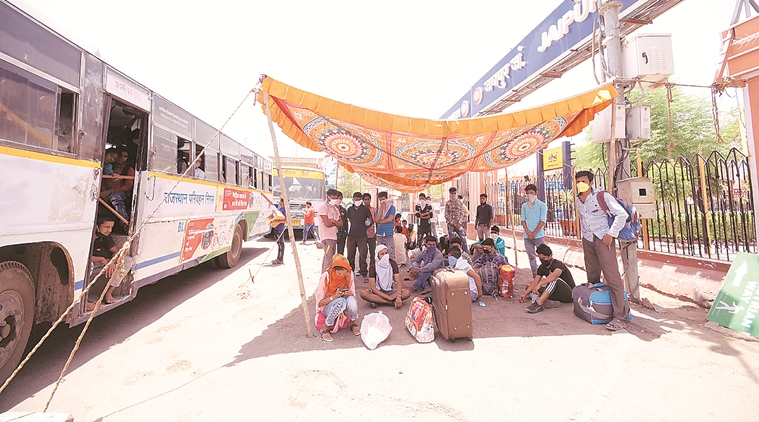
Migrants in Jaipur wait for buses to take them to the railway station to catch trains for their home states. (Express photo by Rohit Jain Paras)
Action has been taken against as many as 1,306 migrants for violating the mandatory 14-day quarantine, officials said Wednesday.

Public Works Department Additional Chief Secretary Veenu Gupta, who is also the head of the state-level quarantine management committee, said that at present, more than 21,000 people are in institutional quarantine, while more than 4.75 lakh people are in home quarantine. It is compulsory for migrant labourers and others returning to the state to be in a 14-day quarantine, and action has been taken against those who have breached the same, she said.

The ACS said that people who are in home quarantine are strictly monitored and those who violate it are first counselled and then sent to institutional quarantine. Monitoring of people in home quarantine is done through Covid Quarantine Alert System (CQAS) application by Department of Information and Technology (DoIT). If any person breaches the quarantine, then information is received on CQAS and immediate action is taken.

Gupta said that 1,306 people breached quarantine, of which 604 people were sent to institutional quarantine from home quarantine, while notice was served or penalty was imposed or an FIR was lodged against 702 people for violating quarantine.

She said that all migrant labourers returning to the state are screened while entering, and if no symptoms are found, then they are asked to remain in home quarantine. If symptoms are found, then that person is sent to an institutional quarantine.

Moreover, if a migrant has little space in their house for proper home quarantine, then he or she is sent to institutional quarantine. Gram Panchayat buildings, hostels, schools and other such buildings, which are being used as institutional quarantine, add up to a total of 10,212 quarantine centres across the state.

📣 The Indian Express is now on Telegram. Click here to join our channel (@indianexpress) and stay updated with the latest headlines

For all the latest India News, download Indian Express App.

Source link

MLB Owners Want To Use The Pandemic To Bust Baseball’s Players Union

The 2020 Major League Baseball season, already on hiatus due to the coronavirus pandemic, is now at risk of not happening at all, thanks to team owners’ demands that players accept draconian salary cuts in order for the season to begin, whenever that might happen.

The league and its owners insist that the proposal they unveiled Tuesday, which would require some players to forgo more than half of their salary, is a serious pitch meant to stave off further hardships. But the plan’s details make it clear what owners are really after: They want to use the pandemic to finally break the MLB Players’ Association, long regarded as the most powerful union in American professional sports.

That has been the owners’ goal since the day the union was recognized in 1966, and they have continued to wage covert war against players throughout the period of relative labor peace that followed the fall-less 1994 season, when players staged a 232-day strike ― and even canceled the World Series ― over owners’ demands that they agree to a hard cap on salaries. 

Now, the owners are essentially making a big bet against a union that has withered over the past quarter-century into a body that rarely exerts itself beyond a tersely worded press release. The owners are gambling the 2020 season, and the game’s future, on the idea that the MLBPA won’t fight back the way it did 26 years ago ― and that fans will take the billionaires’ side if players do. 

This time, the MLBPA ought to call their bluff, even if it means there’s no baseball this summer, and even if it means 2020 becomes as ugly a memory in baseball history as the strike-shortened season of 1994 is often portrayed.


MLB owners’ plan to divide rank-and-file players from the league’s superstars would cost Los Angeles Angels outfielder Mike Trout ― the game’s best player ― two-thirds of his 2020 salary.

The owners’ demands are patently ridiculous, and have been for weeks. They initially asked players to agree to a temporary (so they said) revenue model that would act as a de facto salary cap. After players rejected that idea, the league came back Tuesday with a proposal to cut salaries on a sliding scale, with the top-paid athletes taking a bigger hit than their lesser-paid teammates.

The proposal would require Los Angeles Angels outfielder Mike Trout, the game’s best current player, to take a roughly 70% pay cut while still assuming the health risk of playing baseball in a pandemic, according to ESPN’s Jeff Passan. Other players would face smaller cuts under a plan that’s obviously meant to split the union’s rank-and-file from its superstars.

But the details don’t matter as much as the overarching truth: Players overall would transfer significant amounts of the money they are contractually owed to the billionaires who own baseball teams.

There is no reason to believe the owners’ cries of poverty. The MLB has refused to open its books to support its assertions of imminent financial devastation, and the league’s owners have a deep history of hiding the books and producing blue ribbon reports to support their specious money claims. (Baseball still exists all these years later, despite owners‘ alarmism throughout the 1990s about what would happen if they had to actually pay players what they’re worth.) 

There is no reason to take the owners’ side. Despite common misconceptions, lower salaries for players will not mean cheaper tickets, beers, hot dogs or souvenirs for fans. They’ll just mean fatter pockets for owners.

The players have already agreed to prorate salaries for whatever portion of the season they are able to play, a more generous concession than they had to make. Owners never go back to under-contract players after revenues exceed expectations to offer them more money. Why should players who signed contractual agreements not demand that owners uphold their end of those deals now? The players have every right to tell the owners that they’ll only play if owners honor the prorated salary agreement the two sides reached in March.

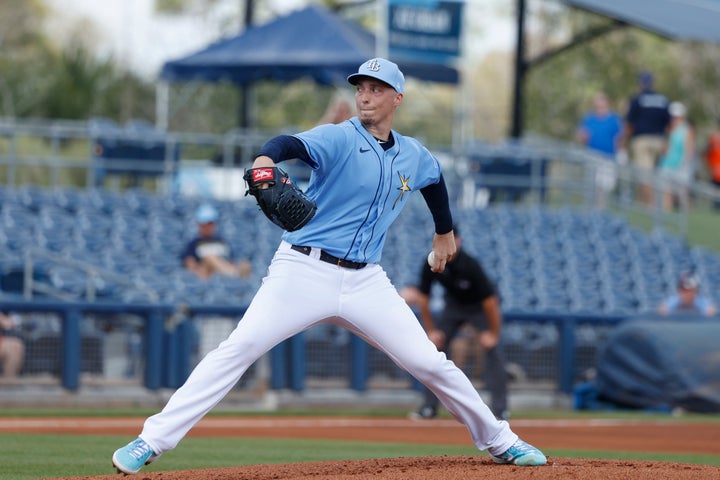
Players seem increasingly fed up. Two weeks ago, Tampa Bay Rays pitcher Blake Snell said that restarting the season wasn’t “worth it” if players had to take big pay cuts, and New York Mets pitcher Marcus Stroman tweeted, then quickly deleted, that the Tuesday plan made a 2020 season unlikely. The union, for its part, said it’s “extremely disappointed” in the offer. 

Owners, though, are confident that half-baked pitches like this one will ultimately work because the antagonistic version of the MLBPA is mostly a relic of the past.

Over the last decade, MLB owners have succeeded in steadily eroding the option of free agency and the bigger salaries that come with it. They have weaponized baseball’s statistical revolution to prioritize ruthless efficiency ― which has proven how undervalued many players are while also contributing to management’s obsession with younger, cheaper talent. They’ve manipulated rules governing younger players and league-wide revenue sharing to further control costs, and they’ve diversified revenue streams by pouring cash into digital media ventures and ballpark villages, giving themselves even less incentive to spend money trying to win. 

The union and its collective bargaining agreement have done little to prevent owners from squeezing players at the top, bottom and each side. As a result, the share of league revenues that goes toward player salaries has fallen to modern lows, even without the dreaded salary cap that players once walked off the field to prevent. In 2018, the average MLB salary dropped for only the fourth time in 50 years.

Tampa Bay Rays ace Blake Snell said in early May that it wouldn't be "worth it" for MLB players to take the field in 2020 if


Tampa Bay Rays ace Blake Snell said in early May that it wouldn’t be “worth it” for MLB players to take the field in 2020 if owners continued to insist on massive salary cuts.

Baseball, in other words, has become something of a microcosm of the American economy, with an ownership class rewriting some rules and bending others in order to hoard as much money as possible at the top. The MLB’s obsession with efficiency came straight from Wall Street and elite business schools whose big data fixation helped create an economy that has benefited the wealthy but “hollowed out” the middle class ― a dynamic that probably sounds familiar to the free agents who’ve had to stomach endless excuses for why they can’t find jobs.

Faced with the sudden financial crunch caused by the pandemic, massive companies that wasted excess cash on stock buybacks and senseless acquisitions, instead of preparing for an inevitable downturn, have forced their workers back on the job with little regard for their health or well-being, sometimes twisting the definition of “essential” beyond all logic to do so. 

MLB owners, whose relentless short-termism created their own sustainability problems, now sense an opportunity to do the same, especially as President Donald Trump pushes the idea that professional sports are “essential.” 

The MLBPA’s reluctance to fight stems largely from the 1994-95 strike, the blame for which wrongly fell on the athletes, who were up against the perception that they were spoiled rich guys playing a kid’s game, not workers in a labor system that left unchecked would have treated them the same way it does workers everywhere else. And the union is right that it will never win a public relations battle with the league office, especially at a time when 40 million Americans are newly unemployed. 

But it also doesn’t have to. Instead of trying to win over the public, the MLBPA ought to take lessons from other workers who are as fed up with their bosses as baseball players should be. 

The last two years have seen a surge in union drives and strikes, a wave of activism that has now intensified during a crisis that further exposes how little big business cares for its most vital employees. 

From McDonald’s to the media, workers have decided they have to fight, and many of them have won. At some point, whether it realizes it yet or not, baseball’s union is going to have to do the same. And if there’s no 2020 season, it won’t be the players’ fault. 


Source by [author_name]

The ending to ‘Mortal Kombat 11’ Aftermath explained

By now, Mortal Kombat fans are playing through the Aftermath DLC, an expanded story of NetherRealm Studio’s latest game.

Aftermath continues the narrative set by Mortal Kombat 11 and expands upon it to show what could happen in this time-bending story. However, what many Mortal Kombat players may not expect is that there are two endings to the Aftermath story, and each one has major implications to the franchise.

Of course, we’re going to be delving into major spoilers for the Mortal Kombat 11 Aftermath story so if you haven’t completed already do so and return.


NetherRealm Studios/Warner Bros

MORTAL KOMBAT 11 AFTERMATH ENDING EXPLAINED

The story of Mortal Kombat 11 Aftermath sees Shang Tsung, Nightwolf and Fujin emerge from “The Void” that Kronika put them in during the events of the main story. The titan of time tried to recruit the three men to help her reshape history, but when they refused they were put in this special prison.

When Kronika was defeated and killed by Thunder Fire God Liu Kang at the end of the main story, they were released. In Aftermath, Shang Tsung warns our heroes that they need Kronika’s crown–which was destroyed in the final battle–to reshape history once again.

Liu Kang decides to trust Shang Tsung to go back to the past and retrieve the crown. Through the course of the Aftermath story we see betrayal after betrayal, as one would expect when Shang Tsung is at the center of the plot, which leads to the final battle.

Just as Shang Tsung has taken the crown for himself, defeated Kronika and absorbed her powers Liu Kang returns from the future to face him. Liu Kang knew this would happen all along, but he needed Shang Tsung to defeat Kronika.

This leads to the final battle between Shang Tsung and Liu Kang, a match both men have been looking forward to for years and brings the Mortal Kombat story full circle.

Here is where, players will have to decide whether to fight as Shang Tsung or Liu Kang. Each choice comes with its own ending, but don’t worry you can replay this final battle to see both.

SHANG TSUNG ENDING

The Shang Tsung ending as it’s the most straightforward and predictable.

Choosing the evil sorcerer and defeating Liu Kang will have Shang Tsung absorb Kang’s soul and gain the power needed to run Kronika’s hourglass.

Shang Tsung uses the hourglass to create a new era in his image where he’s a deity and Raiden and Fujin are seen reporting to him. They inform him that Outrealm, Earthrealm and NetherRealm are under his rule, and the rest of the realms will soon follow.

A pleased Shang Tsung laughs and utters, “it has begun.”

This ending is way more cynical in terms of the fate of the world, but it could be what unites the realms in the next Mortal Kombat. As every fighting game needs a villain for the characters to stand up against, and a god-like Shang Tsung would do the trick.

LIU KANG ENDING

Choosing the side of good will have Liu Kang defeat Shang Tsung and take Kronika’s crown to restart history. Players are transported to the Shaolin temple where Liu Kang appears before one of the monks.

He introduces himself to the monk whose name is Kung Lao the descendent of Liu Kang and the present day Kung Lao. Liu Kang even quips about this Kung Lao being more humble than the one he knew. He tells Kung Lao that he has chosen him as his champion and must be trained.

When Kung Lao asks what he needs to be trained for, Kung Lao simply smirks as the credits roll. Liu Kang has restarted history and is likely bringing back the Mortal Kombat tournament. If NetherRealm Studios chooses this ending to pick up where MK 11 left off, then it’s like a reboot of the franchise similar to how MK 9 was.

What did you think of both endings to Aftermath? Which did you prefer? Let us know in the comments section.

Source link

5 takeaways as Boris Johnson faced MP supergroup

0

LONDON — It took Boris Johnson 10 months to pluck up the courage to face the House of Commons’ liaison committee. He may not return any time soon.

The committee, made up of the chairpeople of the cross-party select committees, (which scrutinize government) is effectively a supergroup for MPs — “a sort of parliamentary Traveling Wilburys,” as the Times newspaper’s sketch writer Patrick Kidd put it.

Prime ministers typically appear before it three times a year, but Johnson, in office since July 2019, made his first appearance Wednesday.

Often a drab affair, this session — conducted in the midst of immense pressure on Johnson over alleged breaches of coronavirus lockdown rules by his chief adviser Dominic Cummings — yielded plenty of memorable moments.

Johnson was immoveable on Cummings, and had a good news story to tell on the government’s new testing and tracing regime, but otherwise seemed off-color and short on detail. The team in Downing Street will likely be pleased things other than Cummings will make headlines, though with Tory MPs still coming out against his adviser, the prime minister has by no means put that episode to bed.

Here are five takeaways from Johnson’s committee showing:

Cummings not going 

To no one’s surprise, the first thing MPs wanted to talk about was Cummings.

Johnson didn’t budge from his support for his top aide — he called the affair “a political ding-dong about what one adviser may or may not have done” — but couldn’t satisfy MPs’ questions on what that means for parents with symptoms of COVID-19 concerned about securing child care locally.

Can they travel for family support like Cummings did, Labour’s Yvette Cooper asked. “If you have exceptional problems with child care then that may cause you to vary your arrangements, that’s clear,” Johnson said, not very clearly.

He added that he understands “public indignation” but insisted it is “time to move on” and indicated there will be no inquiry as this would not be “a very good use of official time.” No. 10 are still very much determined to tough this one out.

Unlock lockdown 

Johnson also came prepared with a big announcement — the launch of England’s “NHS Test and Trace” system of contact tracers, which will go live on Thursday morning.

The prime minister called it “the tool that other nations have used to unlock the prison.” It will be combined with close monitoring of the spread of the virus at a local level and the potential for localized lockdowns, a process Johnson compared to a game of “whack-a-mole.”

Admission time

He also came with a big admission — or was it more of an accusation?

Johnson told health committee Chair Jeremy Hunt the U.K. should have learned more from Asian nations that have dealt with coronavirus epidemics in the recent past and ramped up its disease testing capacity long ago.

“To be absolutely blunt, we didn’t have the enzymes, we didn’t have the test kits, we just didn’t have the volume, nor did we have enough experienced trackers ready to mount the kind of operation they did in some other East Asian countries, for instance,” he told Hunt. “And I think the brutal reality is this country didn’t learn the lessons of SARS or MERS and we didn’t have a test operation ready to go on the scale that we needed.”

Indeed, Britain began the coronavirus pandemic with a test and trace program but was quickly forced to abandon it because it could not process enough tests each day. The new regime will be rolled out on Thursday after the nation spent months building its testing capacity up to more than 100,000 each day.

But the admission felt particularly pointed, because it was made to Hunt — Johnson’s former leadership rival — who, until 2018, served for six years as health secretary, at a time when, Johnson seemed to imply, the country could have done some groundwork.

A big to-do

The prime minister came away from the session with a sizeable to-do list.

On the economy, he promised to put forward a recovery package for the post-coronavirus period and talk to Chancellor Rishi Sunak about self-employed people registered as limited companies who are unable to access sufficient support.

He also suggested the government could overhaul the “no recourse to public funds” rule — a visa stipulation many non-EEA citizens face as a condition of their “temporary right to remain” immigration status, which prevents them claiming benefits.

Johnson had to have the issue explained to him by work and pensions committee Chair Stephen Timms. This was a surprise all round after opposition MPs — including former Labour leader Jeremy Corbyn — have raised it regularly with ministers over the past months.

The PM promised to act. “Clearly people who have worked hard for this country, who live and work here, should have support of some kind or another,” Johnson said, pledging to look into the issue.

But he was careful to avoid too much homework. Asked by Hunt when the government would set a target of producing coronavirus test results within 24 hours, he said: “I’ve been forbidden from announcing any more targets and deadlines.”

Mind the gap

Johnson gave other hints about how the nation will squeeze its way out of the coronavirus prison, noting that the rule that people must remain 2 meters apart will be reviewed by scientific advisers. “My own hope is that, as we make progress in getting the virus down, in reducing the incidence, we will be able to reduce that distance,” he explained.

Reducing the distance will be particularly useful for the transport and hospitality sectors, he said — meaning getting more people on trains and buses and allowing them back into restaurants, cafés and pubs.

Asked more specifically about hospitality, Johnson suggested the light at the end of the tunnel might be approaching at pace. Currently, the government says some cafés and restaurants might be able to open at the start of July as long as they adhere to social-distancing rules, but the classic Johnsonian optimism came out to play.

“It is very difficult to bring forward hospitality measures in a way that involves social distancing, but I am much more optimistic about that than I was and I think we may be able to do things faster than I previously thought,” he said.

Is an announcement looming that British pubs might be open again soon? That would knock even Dominic Cummings out of the headlines for a day or two.


Source by [author_name]