The Coronavirus Pandemic Has Disrupted Big Agriculture. Here’s What That Means for the Planet

0

On April 12, a meat-processing plant in Sioux Falls, S.D., owned by Smithfield Foods shut down after hundreds of employees contracted coronavirus. The closure was hardly unique. Food-processing plants are tinderboxes for infection because employees work in close proximity and often need to shout, spraying droplets that can be laced with the virus. Cargill, Tyson and other major industry players closed about two dozen poultry-, pork- and beef-processing centers over the following weeks as workers fell ill. In April and May, more than 17,000 industry workers tested positive for COVID-19 and 91 died, according to the U.S. Centers for Disease Control and Prevention.

The impact rippled to grocers, who struggled to stock certain items, and to restaurants like Wendy’s, which temporarily changed its menu at some locations to compensate for beef shortages. At the same time, farmers were forced to kill animals that couldn’t be slaughtered. The U.S. Department of Agriculture (USDA) estimates that beef and pork production in April was down 20% and 10%, respectively, compared with a year earlier.

Emily Barone and Lon Tweeten for TIME

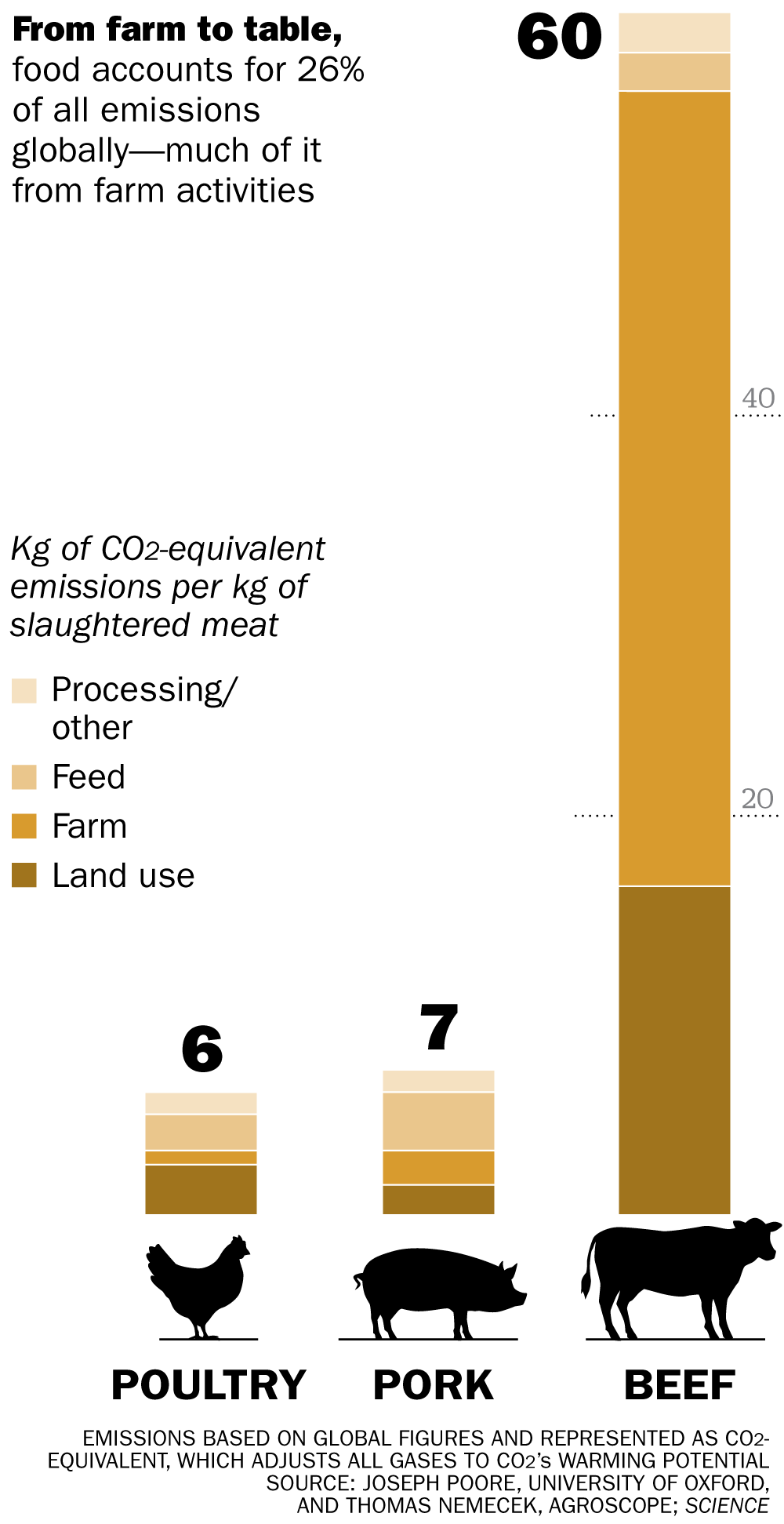
Processing plants emit carbon dioxide, and when their operations slow down, so do emissions. But the real climate benefit from slowing the agriculture industry is reducing the methane from livestock and nitrous oxide from treating fields with fertilizers. When you add it all up, about 10% of all U.S. greenhouse-gas emissions come from the agriculture industry.
Emily Barone and Lon Tweeten for TIME

Americans too often don’t think about where the milk or ground beef in their shopping carts originated, let alone the carbon footprint of those products. That’s because the U.S. food system is so robust that shortages or price spikes—two conditions that might trigger consumers to take a closer look at the supply chain— are rare. The pandemic might be an exception, but even that, experts say, isn’t likely to have a lasting impact. “COVID-19 has slowed us down a little bit and forces us to think about some of these things,” says Teng Lim, an associate professor at the University of Missouri’s commercial- agriculture program. “But when we get back to what we do normally, we forget how things were before.”

Meat processing has already started to recover since April, and consumers are ready to buy. In June, the USDA forecast that not only will red meat and poultry production bounce back from the coronavirus dip, it’ll keep growing and hit a record 107 billion lb. in 2021.

To boost margins, farms and processors have streamlined and specialized operations in every way possible in recent decades. They use techniques that yield more for each animal, ranging from vaccinating the animals and improving their feed, to more controversial practices like breeding animals to be larger, packing them into confined spaces and slaughtering them inhumanely. For example, in 1950 there were 25 million dairy cows in the U.S. Today there are 9 million but they produce 60% more milk.

Such efficiency improves the farmer’s bottom line and lowers the emissions per glass of milk. However, farm emissions overall continue to rise, in part because today’s larger animals eat more. In the case of cattle and dairy cows, that means more belching and more cow pies, two major sources of methane gas.

Emily Barone and Lon Tweeten for TIME

“We have optimized our efficiencies,” says Frank Mitloehner, a professor in the animal-science department at the University of California, Davis. “That has benefits, but it’s also a problem. We have very few processing plants, and if one or two have a problem, it runs through the whole supply chain. It’s very painful to watch.”

Related Stories

With foundations like these, the system was bound to wobble when the pandemic hit. So far, it has mostly held up to the pandemic, but as the number of COVID-19 cases continues to rise in the U.S., there’s no certainty that it will do so forever. Arguably, what makes the agriculture industry vulnerable in a pandemic is also what puts it in a good position to tackle emissions. Larger farms are more suited to comply with government regulations—and the more land and livestock under their control, the greater the impact their actions have. But so far, there hasn’t been nearly enough progress.

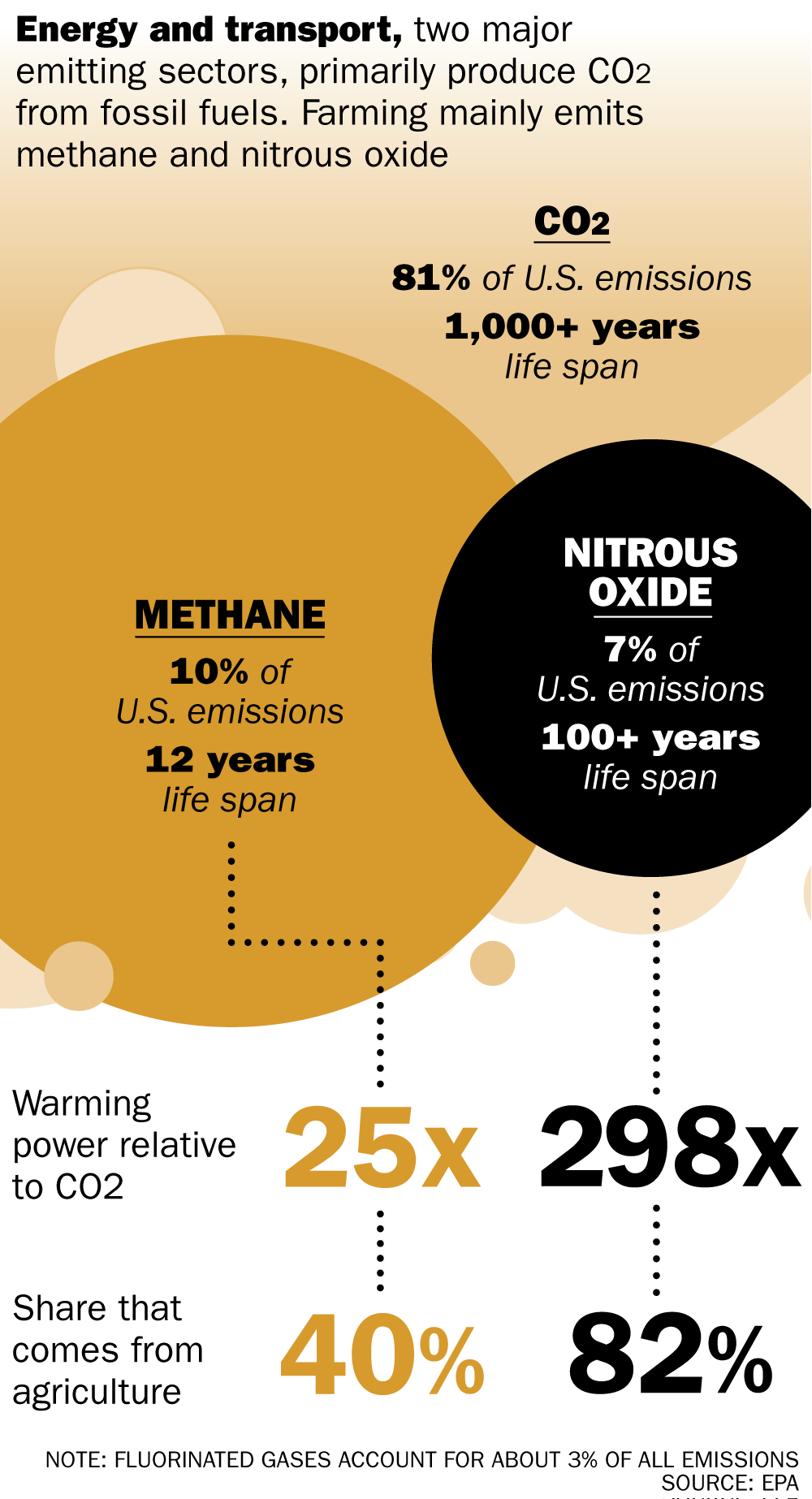
Methane is distinctly different from other greenhouse gases. It’s about 25 times better at trapping and emitting heat than CO2. But animal-produced methane is part of a natural cycle, unlike CO2 from fossil fuels, which rides a one-way street from beneath the earth’s surface to the atmosphere. After it’s belched out of the cow, methane breaks down after about 10 years; CO2, on the other hand, sticks around for centuries.
Emily Barone and Lon Tweeten for TIME

Even so, reducing methane emissions is important to the globally agreed-to goals to keep planetary warming well below 2°C above preindustrial levels. The best way to eliminate agricultural methane emissions would be to stop farming cows. But dietary patterns change slowly, and in the interim, the U.S. farming industry is working on ways to limit methane emissions while still providing the public the meat products it expects. The industry is poised to apply science that can both improve the health of livestock and reduce their emissions, says Sara Place, chief sustainability officer at animal-health giant Elanco. For example, U.S. farms are increasingly adopting technologies that capture methane that comes off of ponds of cow poop. The method—already widely used in Canada and Europe—involves capping the ponds with a liner to trap the gas, which then gets piped to a facility called a digester system several miles away, where it is converted into biogas that can be used as fuel to run delivery trucks.

To combat emissions from the other end of the cow, feed additives like seaweed that inhibit the methane-producing enzymes in the cow’s digestive system may do the trick. Other additives have been shown in trials to change the fermentation process in the cow’s digestive tract so that the cow burps up hydrogen, a harmless gas, instead of methane. There’s also ongoing research in genetics. If cows can be bred to produce more meat or milk, it might also be possible to breed them to emit less methane. Some industry researchers and consultants, like Place and Mitloehner, are excited about these technologies. But there are plenty of critics.

“Rather than continually engineer our way out of problems with animals, there’s a simpler solution: eat more plants,” says Josh Balk, vice president of farm animal protection at the Humane Society of the U.S. Balk doesn’t think the country can rely on consumers to make such a massive dietary shift. Instead, he says, the food industry can help elevate plant-based foods, by selling them alongside animal products in grocery stores, and offering them as menu items, as White Castle, Burger King and other restaurant chains have started to do with plant-based meat alternatives.

Overall, the agriculture industry has a major stake in lowering emissions. If emissions continue to rise, plants bred and crossbred over decades to optimize the food system may not withstand rising global temperatures. Industry changes that address both emissions and the welfare of animals may also reduce the risk of the next pandemic. COVID-19 didn’t start at farms, but animals packed into confined spaces can easily spread infection. Poultry, for example, has been known to make people sick with avian flu.

There’s no one point in the food system solely responsible for making the necessary changes. At the end of the day, we all have to eat, and consumers, processors, distributors and producers alike have a role in ensuring that food is available to all—and produced in a way that is sustainable for the planet and humanity.

Contact us at editors@time.com.

Source link

Sjögren’s research explores genetic link to dry mouth, other saliva issues | NIH MedlinePlus Magazine

0

Blake Warner, D.D.S., Ph.D., M.P.H., studies disorders that affect our salivary glands, including Sjögren’s syndrome. Sjögren’s syndrome is an autoimmune disease, which means that it causes your immune system to attack healthy cells in your body by mistake.

The condition can damage glands that make saliva, or spit. It can also cause dry mouth, loss of taste, swollen glands, and more.  

Dr. Warner works at the National Institute of Dental and Craniofacial Research (NIDCR), where he helps oversee research on Sjögren’s syndrome. He and his research team at NIDCR want to better understand what causes this disease so they can improve the quality of life of people who have it.

Why did you decide to study Sjögren’s syndrome?

During my residency, I worked in a clinic with patients with Sjögren’s syndrome and other complications. Despite helping patients understand their condition, I felt compelled to find ways to better treat or prevent this condition. By pursuing clinical research, I could play a more active role in improving the lives of people with Sjögren’s syndrome.

What led to your current research on the topic?

“Living with Sjögren’s syndrome can be easier if you maintain good health habits.”

– Blake Warner, D.D.S., Ph.D., M.P.H.

Years of development and testing of therapies have led to few successes in the management of the main symptoms of Sjögren’s syndrome. These setbacks may be due in part to the variability of Sjögren’s syndrome.

At NIDCR, we have a more than 35-year history of Sjögren’s syndrome research in patients. Studying patients both at baseline and over long periods of follow-up can help us better understand distinct groups of patients with the disease and understand the underlying cause of the disease, with the goal of discovering better treatments.

Could you talk about the research you’re conducting?

Our research team strives to discern factors which may be influencing the salivary inflammation seen in Sjögren’s syndrome. To do this, there are two main projects that I am very excited about. First, we are working to see if we can turn off specific types of inflammation that damage salivary glands in Sjögren’s syndrome patients. Second, we’re working to identify how salivary damage in Sjögren’s syndrome may be passed on through genetics.

It’s clear that there can be overlap among Sjögren’s syndrome, some autoimmune diseases, and other conditions that cause issues in the salivary glands.

What do you wish more people knew?

A diagnosis can take time. It’s not easily diagnosed because it affects people differently. At least one-third of patients don’t have the classic blood markers for Sjögren’s syndrome. Don’t be afraid to speak up and inform your medical providers of your symptoms.

Also, living with Sjögren’s syndrome can be easier if you maintain good health habits. These include eating a balanced diet, drinking enough water, and having a consistent exercise routine. Manage your symptoms by regularly visiting your primary care providers, dentists, and ophthalmologists [doctors who focus on eye health]. Support groups and foundations focused on Sjögren’s syndrome and other autoimmune diseases can provide additional information and social networks to help people cope with symptoms.

Where do you see research on Sjögren’s syndrome going in the future?

I think we will recognize early symptoms prior to the development of dry eyes and dry mouth. The identification of risk factors may help people better understand the disease course, the development of autoimmunity, and the development of drugs that may prevent damage to target organs such as the salivary glands.

Source link

5 arrested in shooting death of rapper Pop Smoke in Hollywood Hills

Rapper Pop Smoke performs Dec. 15 at the Rolling Loud Festival in Los Angeles. (Scott Dudelson / Getty Images)

Los Angeles police on Thursday arrested five people in connection with the February slaying of Brooklyn rapper Pop Smoke, who was gunned down in a rented Hollywood Hills home.

Detectives say the crime started out as home invasion robbery, but during a confrontation inside the house, it turned deadly.

The suspects — three adults and two juveniles — were taken into custody during early morning searches after a lengthy investigation by the LAPD’s Robbery-Homicide Division.

On Feb. 19, Los Angeles police responded after someone calling from the East Coast reported that several people had entered their friend’s home shortly before 5 a.m. When officers arrived at the $2.5-million luxury home in the 2000 block of Hercules Drive, they found the 20-year-old rapper born Bashar Barakah Jackson with gunshot wounds.

He was taken to a hospital, where he was pronounced dead. Officers detained several people inside the house, but they were later released. At least four suspects fled the scene, authorities said at the time.

Investigators suspected the house where the rapper was staying was targeted by assailants. In recent years, Los Angeles homes being rented by musicians have been the targets of several home invasions, according to law enforcement sources.

Investigators say the rapper may have inadvertently posted an image with the home’s address on social media before he was killed.

Photos and videos on Pop Smoke’s Instagram story showed him in L.A. getting a haircut the day before he was killed and posing by the infinity pool in the backyard of the Hollywood Hills home where he was staying. Later that evening, he posted a photo of the Los Angeles skyline from what appeared to be the home’s backyard.

The home is owned by Teddi Mellencamp of “The Real Housewives of Beverly Hills” and her husband, Edwin Arroyave, according to property records.

“We are confident we have the five individuals responsible for the killing of Bashar Jackson — Pop Smoke,” LAPD Capt. Jon Tippet said Thursday.

Although authorities said the assailants did not know the rapper personally, “we believe that Pop Smoke posted his location on social media and that is how they found him,” Tippet said.

Pop Smoke had previously been tied to the Crips street gang, and detectives suspected his killers were probably gang members. Tippet said the people in custody are associated with a Los Angeles gang.

The rapper’s death came days after his second mixtape, “Meet the Woo 2,” debuted at No. 7 on the Billboard Top 200 list. His breakthrough mixtape, “Meet the Woo,” released last year, has 280 million streams globally.

Pop Smoke was signed to Republic Records through Victor Victor Worldwide, according to the label. His posthumous LP, “Shoot for the Stars, Aim for the Moon,” was released over the July 4 weekend.

Times staff writers Hannah Fry and August Brown contributed to this report.

Source link

Autopsy Shows Police Shot Latinx Teen In The Back Five Times

Andres Guardado, 18, was shot five times in the back by a Los Angeles sheriff’s deputy last month, according to an independent autopsy report his family released Wednesday. 

“Our son did not deserve to die this way,” the teen’s parents said in a statement, per NBC News. They said the autopsy report confirmed “what we have known all along, which is that Andres was unjustifiably killed by a Los Angeles County sheriff’s deputy.” 

The family is demanding that the sheriff’s department release the official medical examiner’s report, which the sheriff’s department has put under a “security hold.”

LA County Sheriff’s Department Cmdr. Chris Marks said in a press conference Wednesday that the hold will stay in place until the investigation concludes. Marks said sheriff’s investigators have not yet interviewed the officer who shot Guardado, but the officer is “scheduled to be” interviewed.

“Andres was a good boy, he was our son and he had so much life ahead of him,” his parents said in the statement. “We want answers.” 


Jennifer Guardado, sister of Andres Guardado, and other relatives of speak at a rally seeking justice for the 18-year-old on June 28, 2020 in Gardena, California.

Police shot and killed Guardado on June 18 near an auto body shop in Gardena, a city in LA County. The sheriff’s department claimed Guardado “produced a firearm” and ran away from police, who then ran after him and shot him dead.

The teen’s family disputes that account. Their attorney told reporters last week that they do not believe Guardado had a gun and don’t know “how and why” police found a handgun at the scene or “who it belonged to.”

Guardado was a student at Los Angeles Trade-Technical College and was working two jobs while dreaming of becoming a registered nurse.

Last month, California Democratic Reps. Maxine Waters and Nanette Diaz Barragán urged California Attorney General Xavier Becerra to investigate Guardado’s shooting. 

“Another day, and another Black or Brown kid has been shot in the back by police,” the congresswomen wrote. “These killings must stop. We demand it. The American people demand it.” 

Becerra’s office did not immediately respond to HuffPost’s request for comment. 

Guardado’s autopsy report was released amid nationwide protests against racism and police brutality that have been ongoing since police killed George Floyd in Minneapolis in May. 

Last week, the families of two other young Latino men — Sean Monterrosa, 22, and Erik Salgado, 23 — demanded justice after law enforcement shot the men dead in the San Francisco Bay Area just days apart in June. The men’s loved ones rallied to demand legal consequences for the officers involved. Both families also called for Becerra to investigate the shootings.  

“We are sick and tired of murderers being on the force and still getting paid, yet no convictions,” Michelle Monterrosa, Sean’s sister, said in a video after the rally that was provided to HuffPost. 

“We want justice. We want convictions, too,” said Amanda Majail-Blanco, Salgado’s sister. “They robbed them of their future.” 


Source by [author_name]

How fashion designer Liz Lange beat cervical cancer | NIH MedlinePlus Magazine

0

Designer Liz Lange helped reinvent maternity fashion, bringing more style and versatility to clothing for pregnant women. But in addition to building her business and brand, Lange faced another major challenge at the height of her career: a cervical cancer diagnosis.

Now a long-term survivor, she spoke about her experience and how regular Pap smears and early diagnosis helped her beat cancer.

Can you tell us about your diagnosis?

Getting diagnosed with cervical cancer at age 35 was a complete and utter shock. I considered myself very healthy. I was busy, happy, energetic, and had two young kids. I was running a very successful business.

“What I learned from having cervical cancer is that one of the keys to surviving is early detection.”

– Liz Lange

But when I went in for a regular checkup with my gynecologist following the birth of my second child, my Pap smear indicated I had dysplasia. They said that it was no big deal and that I could wait to have it removed until after a fashion show I was doing. I thought nothing of it at the time. In fact, I didn’t even know what dysplasia was.

But when they did follow-up tests on the dysplasia, things were different. I will never forget the day I got the news. I got two messages from my doctor. The first words were, “Well, we don’t have good news. You have cervical cancer.” It was so surreal. I definitely thought I was going to die. I spent the whole night going into my kids’ bedrooms thinking I would never see them grow up.  

What was your treatment like?

I didn’t know anything about cervical cancer at the time; however, I soon found out that cervical cancer is one of the more curable cancers if caught early. I had a hysterectomy [removal of the uterus], followed by rounds of chemotherapy and radiation. At the time, for someone my age, that was considered the gold standard of treatment. It was pretty grueling and very exhausting. But I have met women who had more severe forms of cancer and feel extremely lucky that I caught it in time.

You didn’t talk publicly about your cancer for quite a few years after your diagnosis.

It is such a personal decision. I was a public figure at the time with a popular clothing line for women and a growing business. Frankly, I was very concerned then about the perception that it could hurt my business. Also, I didn’t want every interaction I had with people to be about cancer. To say it was terrifying and horrifying is an understatement. And I was really afraid the cancer would come back. It was something I didn’t want to focus on. I felt that if I didn’t tell a lot of people, I wouldn’t have to talk about it. For me, that was a relief.

But 10 years later, the odds of it coming back dropped considerably, so I felt that I did have a platform and I could use my platform to be helpful by talking publicly about my story. Also, when the news came out that there was a new [human papillomavirus, or HPV] vaccine, I wanted to speak out about it as an important new way to prevent cervical cancer.

How has being a cancer survivor impacted your life?

Our knowledge about cancer has changed so much, even in the past 10 years. But when I was growing up, I linked cancer to death. I was feeling I had gotten a death sentence, even though I hadn’t. When you have cancer, you are always waiting for results. And the feeling is overwhelming. It puts things in perspective. Especially in the early years after the diagnosis, I said I would never worry about the little things and that nothing is more important than good health.

Can you speak to the importance of prevention and early detection?

There is nothing more important. What I learned from having cervical cancer is that one of the keys to surviving is early detection. It is essential. Make sure you are getting all the screening and tests that are recommended. I am also a strong advocate for the HPV vaccine. That is a great advance.  

Is there anything else you’d like to share with our readers?

Since I’ve sold my maternity business, I now spend my time investing in early-stage, high-growth businesses. I love helping new entrepreneurs start new ventures.

Source link

Study Suggests Pregnant Women Can Pass The Coronavirus To Their Fetus

0

A small study strengthens evidence that a pregnant woman infected with the coronavirus might be able to spread it to her fetus.

Researchers from Italy said Thursday that they studied 31 women with COVID-19 who delivered babies in March and April. They found signs of the virus in several samples of umbilical cord blood, the placenta and, in one case, breast milk.

Women shouldn’t panic. This doesn’t mean there’s a viable virus in those places and “it’s too early to make guidelines” or to change care, said the study leader, Dr. Claudio Fenizia, an immunology specialist at the University of Milan.

But it does merit more study, especially of women who are infected earlier in their pregnancies than these women, said Fenizia, who discussed the results at a medical conference being held online because of the pandemic.


A pregnant woman wearing a face mask and gloves holds her belly as she waits in line for groceries at a food pantry in Waltham, Mass. A small study in Italy strengthens evidence that pregnant women infected with the coronavirus might be able to spread it to a fetus before birth.

Since the start of the pandemic, doctors have wondered whether in-the-womb infection could occur. HIV, Zika and some other viruses can infect a fetus this way. Several early reports from China suggested the coronavirus might, too, although doctors suspect those women may have spread the virus to their babies during or after birth.

The new study involved women at three hospitals during the height of the outbreak in northern Italy. The virus’s genetic material was found in one umbilical cord blood sample, two vaginal swabs and one breast milk sample. Researchers also found specific, anti-coronavirus antibodies in umbilical cord blood and in milk.

In one case, “there’s strong evidence suggesting that the newborn was born already positive because we found the virus in the umblilical cord blood and in the placenta,” Fenizia said.

In another case, a newborn had antibodies to the coronavirus that do not cross the placenta, so they did not come from the mother and were “due to direct exposure of the fetus to the virus,” Fenizia said.

In any case, the possibility of fetal infection seems relatively rare, he said. Only two of the newborns tested positive for the coronavirus at birth and neither became ill from it.

Dr. Ashley Roman, a pregnancy specialist at NYU Langone Health, said she and colleagues also detected viral particles on the fetal side of the placenta in several of the 11 cases they examined. The new report adds evidence that in-womb transmission is possible, but it seems rare and to not cause serious problems in the infants, she said.

“The most important thing that pregnant women need to know is it’s important to socially distance. It’s important to wear a mask, wash their hands,” Roman said. “Women don’t need to be cut off from society entirely, but they should be concerned about the impact of getting COVID on their own health during pregnancy.”

Dr. Anton Pozniak, a conference leader and virus expert at the Chelsea and Westminster Hospital in London, said the implications of the Italian research “have to be worked out.”

Children under age 3 rarely get seriously ill from coronavirus, and “I would suspect that even if there was transmission to babies, it was not harmful,” he said.

UNICEF, the United Nations’ children’s agency, recommends that new moms with COVID-19 wear a mask while breastfeeding, he added.


Source link

Americans are rapidly shrinking their credit card debt during the pandemic

0

The amount of consumer revolving credit, which is mostly credit cards, plunged by another $24 billion in May, the Federal Reserve said Wednesday. This costly form of debt is down more than $100 billion since hitting a record high in February and is now below $1 trillion for the first time in nearly three years.

In many ways, it makes perfect sense that Americans are swiping the plastic less. The health crisis, forced the widespread shutdown of restaurants, bars and professional sports. That was especially true during the March-May period captured by the Fed data.

“Consumers had no choice but to spend less on their credit cards,” Danielle DiMartino Booth, CEO and chief strategist at Quill Intelligence, wrote in a note to clients Thursday.

Not surprisingly, spending at restaurants imploded during the spring when health restrictions made eating out impossible in many parts of the nation.

The seven-day average of spending (including on credit cards) at big chain restaurants was down by as much as 40% in April from the year before, according to Bank of America. That metric has since recovered in June to normal levels, Bank of America said.

Mass unemployment, wave of bankruptcies

At the same time, Americans are wisely paying down outstanding credit card balances and avoiding racking up new debt during this economically tumultuous period.

“Americans are behaving in an eminently rational fashion,” said Joe Brusuelas, chief economist at RSM International.

In just the past few weeks, major companies including Brooks Brothers, Neiman Marcus and Chesapeake Energy (CHK) have all filed for bankruptcy. United Airlines (UAL) announced plans this week to furlough up to 36,000 employees, while Levi Strauss (LEVI) and Harley Davidson (HOG) detailed hundreds of job cuts.
Unemployment claims are falling. But 1.3 million still applied for assistance last week
The unemployment rate surged to 14.7% in April. It has since dipped to 11.1% due to blockbuster job gains, though that unemployment rate is still higher than at any point during the Great Recession.

Given that backdrop, it’s little surprise that Americans are pulling back on debt. The March-May period marked the first time in a decade that overall consumer credit declined for three months in a row, according to Oxford Economics.

However, some types of debt are showing signs of life. Specifically, the amount of nonrevolving credit, which is mostly student debt and auto loans, actually rose by $6 billion in May.

Signals consumers are hunkering down

Credit card debt typically carries punishing interest rates — even for borrowers with the strongest credit scores. The fact that this type of pricey debt is shrinking is encouraging given the economic uncertainty.

However, this trend, along with the surging saving rate, also reflects a broader hunkering down among Americans that is problematic for an economy that is two-thirds driven by consumer spending.

The debate over $600 payments could dictate the US recovery

“That’s bad news for the economy,” Brusuelas said. “You want a confident consumer to expense her income. We’re just not seeing that right now.”

Shrinking credit card debt also highlights the unprecedented support being provided by Uncle Sam right now.

More so than during the onset of the past two recessions, Congress and the White House have taken bold steps to provide emergency relief to households and businesses via the CARES Act.

Specifically, stimulus checks of up to $1,200 per household were sent out in the spring. And the federal government is providing $600 of extra weekly unemployment benefits for people who lost their jobs during the pandemic.

Stimulus cliff

Taken together, those emergency moves have lessened the reliance on swiping the plastic.

“The need for credit cards as a smoothing mechanism has been greatly diminished,” according to Booth, the Quill Intelligence CEO. “The credit cycle that would have begun to emerge has been frozen by the CARES Act.”

But the problem is the $600 of enhanced unemployment benefits expires at the end of July. And there is a heated debate among economists and politicians about whether extending them at the current level — or at all — will discourage Americans to look for new jobs.

What is clear, however, is that letting this benefit lapse will force some unemployed Americans, particularly those in lower-income households, to rely on expensive credit card debt to make ends meet.

That means the recent plunge in credit card debt may prove to be short-lived — but potentially for the wrong reasons.

Source link

UN warns world could hit 1.5-degree warming threshold by 2024

The world could see annual global temperatures pass a key threshold for the first time in the coming five years, the UN weather agency said on Thursday.

The World Meteorological Organisation said forecasts suggest there’s a 20 per cent chance that global temperatures will be 1.5 degrees Celsius higher than the pre-industrial average in at least one year between 2020 and 2024.

The 1.5C mark is the level countries agreed to cap global warming at in the 2015 Paris accord. While a new annual high might be followed by several years with lower average temperatures, breaking that threshold would be seen as further evidence that international efforts to curb climate change aren’t working.

“It shows how close we’re getting to what the Paris Agreement is trying to prevent,” said Maxx Dilley, director of climate services at the World Meteorological Organisation.

Dilley said it’s not impossible that countries will manage to achieve the target set in Paris, of keeping global warming well below 2 degrees Celsius, ideally no more than 1.5C, by the end of the century.

“But any delay just diminishes the window within which there will still be time to reverse these trends and to bring the temperature back down into those limits,” he told The Associated Press.

Scientists say average temperatures around the world are already at least 1C higher now than from 1850-1900 because of man-made greenhouse emissions.

The Geneva-based WMO said there’s a 70 per cent chance that the 1.5-degree mark will be exceeded in a single month between 2020 and 2024. The five-year period is expected to see annual average temperatures that are 0.91C to 1.59C higher than pre-industrial averages, it said.

The forecast is contained in an annual climate outlook based on several long-term computer models compiled under the leadership of the United Kingdom’s Met Office.

Climate models have proven accurate in the past because they are based on well-understood physical equations about the effect of greenhouse gases in the atmosphere, said Anders Levermann, a scientist at the Potsdam Institute for Climate Impact Research near Berlin who was not involved in the report.

“We can make more accurate predictions about the climate than about the weather,” he said. “The physics behind it is solid as a rock.”

Leverman said that while hitting the 1.5-degree threshold was “a screaming warning signal” it should not become a distraction from efforts to reduce man-made greenhouse gas emissions to zero by 2050.

The world could see annual global temperatures pass a key threshold for the first time in the coming five years. (AP)

WMO noted that the models used for the forecast don’t consider the impact that the coronavirus pandemic might have on reducing emissions of planet-warming gases such as carbon dioxide. But experts say any pandemic-related dip in emissions is likely to be short-lived and could actually hurt efforts to end the use of fossil fuels.

“The impact of the coronavirus is a partial shutdown of the economy worldwide,” said Levermann. “But changing the way we do things can only be done with a healthy economy.”

Dilley, the WMO official, said record temperatures such as those currently seen in the Arctic are the effect of emissions pumped into the atmosphere decades ago, so attempts to alter the future course of the climate need to happen soon.

“This is not something that can be stopped on a dime,” he said. “It’s like an ocean liner that takes a long, long time to turn.”

“This is the message that people in their daily lives and how they vote and every other way they should be concerned about,” he added.

– Reported with Associated Press

For breaking news alerts and livestreams straight to your smartphone sign up to the 9News app and set notifications to on at the App Store or Google Play.

Source by [author_name]

Six-month report card: India’s share in global Covid-19 deaths on the rise

0


There have been more than half-a-million deaths in the six months after the first death was reported in in the second week of January.


Growth rates vary, but every country has struggled to contain the pandemic, shows an analysis of the numbers. India’s first death was around two months after the first one in But its share in the global toll is now at a new high (chart 1).


The number of cases in India has outstripped most other countries. Only Brazil and the US have more cases. The US has three million cases while Brazil has 1.7 million, even as growth rates remain challenging for the rest of the world (chart 2).


chart


The silver lining for India has been a relatively lower case fatality rate. This metric gives the number of people who died on account of the disease as a proportion of the total number of confirmed cases. There are around 4.6 deaths for every 100 confirmed cases in the world. The number for India is lower at 2.75. This is better than most other countries in the top five (chart 3).


chart


Source link

Mira Nair to adapt New York Times article ‘The Jungle Prince of Delhi’ in a series

Image Source : INSTAGRAM/GAURAVKATARIA.HONESTLY

Mira Nair

New York, July 9 (PTI) Director Mira Nair is set to adapt the 2020 Pulitzer Prize finalist New York Times story and podcast “The Jungle Prince of Delhi” as a drama series for Amazon.

Written by Ellen Barry, the article reveals the truth about the history of royal family of Oudh, who lived in a ruined palace in Delhi and claimed to be the heirs to the fallen kingdom, according to Variety.
“Exciting News: The Jungle Prince, my piece about one of Delhi’s great legends, a mysterious family who lived in a ruined palace in the forest, will be adapted by @MiraPagliNair, Amazon & Sister Pictures, the producers of Chernobyl,” Barry tweeted with a link to the story.
Nair, best known for her films “Salam Bombay!”, “Monsoon Wedding”, “The Namesake” and “The Reluctant Fundamentalist”, is attached as a director and executive producer on the project.
She also adapted Vikram Seth’s novel “A Suitable Boy” for BBC.
The story of “The Jungle Prince of Delhi” will also be executive produced by Stacey Snider, Jane Featherstone, Kate Fenske of SISTER, Gary Foster and Russ Krasnoff of Krasnoff/Foster Entertainment, Christina Lurie of Fourth and Twenty Eight Films, and Barry and Caitlin Roper, head of scripted entertainment for The New York Times, Variety added.
“Pulitzer Prize winning journalist Ellen Barry’s beautifully written tale of the Oudh family revealed deeper truths rooted in the violence and trauma of the partition of India…” Roper said.
“Since its publication, The Times has been searching for the right partners to expand the story’s reach and we are thrilled to work with the incomparable Mira Nair, and to be producing ‘The Jungle Prince’ series with Amazon Studios alongside Krasnoff/Foster Entertainment, SISTER and Fourth and Twenty Eight Films,” Roper added. PTI BK BK
BK

Fight against Coronavirus: Full coverage


Source link