Tuesday, April 28, 2026

Costa Rica becomes the first Central American country to legalize same-sex marriage

0

The country on Tuesday became the first in Central America to legally recognize same-sex marriage.

“Today, Costa Rica officially recognizes same-sex marriage,” President Carlos Alvarado Quesada wrote on Twitter.

“Today we celebrate liberty, equality and our democratic institutions. May empathy and love be the compass that guide us forward and allow us to move forward and build a country that has room for everyone.”

The move to marriage equality follows an August 2018 ruling by the country’s Constitutional Court, which ruled that laws preventing same-sex marriage were unconstitutional.

The court gave the legislature 18 months to enact marriage equality, or have the ruling recognizing same-sex marriages automatically go into effect once the deadline expired.

Costa Rica’s decision also follows an opinion issued by the Inter-American Court of Human Rights in January 2018. The Central American country had asked the court to determine whether it was obligated to extend property rights to same-sex couples.

Couples celebrated the country’s decision by holding weddings overnight.

Alexandra Quiros and Dunia Araya were among the lovebirds who tied the knot on Tuesday, holding a marriage ceremony in Heredia.

LGBTQ advocacy organizations also celebrated the move.

“Costa Rica is celebrating today: marriage equality has become a reality in the country – the first one in Central America!” the International Lesbian, Gay, Bisexual, Trans and Intersex Association (ILGA World) said. “We rejoice with you: congratulations to all those who worked so hard to make it happen!”

The Human Rights Campaign also cheered the decision, though it added that more work needed to be done to achieve marriage equality around the world.

“Today, Costa Rica has made history, bringing marriage equality to Central America for the first time,” HRC President Alphonso David said in a statement. “Costa Rica’s LGBTQ community has worked tirelessly for years to make today a reality. This victory is theirs, and it inspires the entire global LGBTQ community to continue fighting to move equality forward.”

CNN’s Maija Ehlinger, Tatiana Arias and Gerardo Lemos contributed to this report.


Source link

First in, last out: Why Lombardy is still Italy’s coronavirus hotspot

0

MILAN — Since the start of the coronavirus pandemic, the Italian region of Lombardy has made headlines for all the wrong reasons: overwhelmed hospitals, health care workers performing wartime-like triage, caretakers struggling to bury the dead.

The richest region in Italy, vaunted for its state-of-the-art health care system, has recorded more than 15,500 deaths within its borders since February 21 — half the number of total fatalities country-wide.

And now, as the country starts lifting lockdown restrictions, it still counts the highest number of cases per capita.

Why has the region performed so badly in comparison to others? The question of what went wrong — and continues to go wrong — in Lombardy has become a source of major political controversy and a potential stumbling block on the way to opening the entire country back up to a new normal.

Faced with mounting criticism, regional governor Attilio Fontana insists there is nothing he would have done differently.

“Those who irresponsibly celebrate nightlife are betraying the sacrifices made by millions of Italians.” — Francesco Boccia, Italy’s minister for regional affairs

“I got thrown into a hurricane that no one had prepared us for, and made choices aimed at securing our citizens’ health,” Fontana said in an interview.

“Unlike other places, we had an immediate exponential increase — after 10 days we had almost 1,000 positive cases, of which about half were hospitalized.”

The public health catastrophe and human tragedy that followed could not have been avoided, according to Fontana, a member of the far-right League party.

Critics disagree, saying a difficult situation was made worse by poor decision-making. In recent days, a series of political gaffes have exacerbated the lack of trust in the regional government’s abilities and increased fears that official incompetence could lead to a second wave of infections and undermine efforts to contain the virus elsewhere.

Over the weekend, the region’s health and welfare minister Giulio Gallera attracted widespread mockery after claiming in an interview that — with the virus’ reproduction rate now at 0.5 in Italy — a person would need to come into contact with two infected people at the same time to fall ill themselves. “It’s not that easy,” he said.

Gallera’s lack of understanding of the so-called R rate prompted a flurry of criticism on social media from people concerned that the official coordinating the region’s health response did not grasp the science behind the virus’ transmission.

On Sunday, Fontana added fuel to the fire when he announced there were no new COVID-19 deaths, but it later emerged his report was flawed as a result of a miscommunication between hospitals and regional authorities.

Meanwhile, images of the streets of Milan and other cities full of people flouting social distancing rules as they gathered outside bars and restaurants also drew condemnation.

“If this continues, we risk not being able to open the borders between regions,” Francesco Boccia, Italy’s minister for regional affairs, said in an interview with La Stampa.

“We must not forget that we are still in the COVID-19 pandemic, and those who irresponsibly celebrate nightlife are betraying the sacrifices made by millions of Italians.”

 * * *

There’s no easy answer for why Lombardy became a hotspot of the coronavirus in Italy. Some have pointed to factors that may have made it particularly vulnerable: It is densely populated (with more than 10 million inhabitants) and its high level of economic activity means residents — who also skew older than in the rest of the country — are exceptionally mobile.

Still, critics argue that the catastrophe that struck the region could have been avoided had it not been for errors of judgment, government incompetence and failures in the health care system.

The biggest mistake was Lombardy’s management of health care resources, said Massimo Galli, the head of the infectious diseases department of the Sacco hospital in Milan.

“All attention was focused on hospitals, which became breeding grounds for the virus, and primary care physicians were left behind without proper help to treat people at home,” he said. That meant that many people died at home without being tested, as the virus spread through families uncontroled.

Health care is a regional competency in Italy, meaning there is no unified system. In Lombardy, which has been governed for the past 25 years by either the far-right League or the center-right Forza Italia, authorities focused on building private health care institutions that deliver profitable services such as complex surgical operations and specialist treatments.

A man does kayaking as people stroll along a canal in the Navigli district of Milan on May 21, 2020 | Miguel Medina/AFP via Getty Images

Less attention was paid to the broader public health system, which dealt with the unprofitable side of things: emergency services, general care and geriatrics.

Weakened by years of cuts and staff shortages, the public system was quickly overwhelmed by the treatment required for COVID-19 patients, which fell under “standard administration,” rather than specialized services offered at the region’s wealthy clinics.

To Stefania Carrara, whose stepfather died of COVID-19 in hospital in March, the region’s reputation for “excellence” in health care increasingly seems like a bad joke.

“We are so excellent that almost two months after Carlo’s death, I am the only one in my family that has had a serological test, and that’s thanks to my employer,” according to Carrara, who said that although everyone in her family fell ill, nobody was able to get tested for the virus.

In Bergamo, one of the cities hardest hit by the health crisis, a Facebook page for families of deceased COVID-19 patients called “Noi denunceremo” (“We will sue you”) garnered likes from some 54,000 people.

A lack of testing has been a persistent problem. In the region of Veneto, authorities were successful in slowing the spread of the virus by rolling out blanket testing, which enabled them to better trace infections.

Lombardy started at a disadvantage — with a higher population density and more initial cases than in Veneto — Galli conceded, but its lack of testing at the start of the epidemic had a substantial effect on the virus’ spread.

“The problem with the swab tests is that the government sent us 3.5 million, but it did not send the necessary chemicals to process them,” said Fontana.

The region has increased its number of laboratories able to process the tests from three to 45 since the start of the epidemic, according to Fontana. But even so, “it is not possible to process more than 15,000-16,000 a day, due to the lack of chemical supplies.”

 * * *

The dramatic course the virus took in Lombardy and the mixed messages coming from governor’s office has made people fearful of plans to reopen the region to economic activity.

“It hit us very hard here,” said Chiara Filicetti, who owns a bistro in Treviglio, a town in the province of Bergamo, one of the hardest hit parts of Lombardy. “Many of our customers have lost their parents and grandparents. We’re not in sunny skies yet.”

Milan, the region’s economic center, is eager to reopen, Giuseppe Sala, the city’s mayor said. He expects authorities to shed light on what happened in nursing homes and to issue clear guidance on swab tests and antibody tests in order to make sure the region can resume economic activity safely, he said.

People relax and have a drink by a canal in the Navigli district of Milan | Miguel Medina/AFP via Getty Images

The biggest mistake, according to Sala, was “an initial lack of clarity” that has to be corrected if the region is going to resume its activities along with the rest of Italy.

“It led to all of us, including myself, to underestimate the danger and created a lot of confusion, which helped fuel the pandemic.”

Fontana, in response to the criticism that followed images of people gathering in Milan, insisted he was ready to tighten the rules again if need be.

In the meantime, the rest of Italy is watching the region nervously. The southern regions, starting with Sicily and Sardinia, have pushed for a health passport for those who want to travel to the islands this summer, aimed mainly at tourists from northern Italy.

Unless numbers improve, people in Lombardy — along with residents of Piedmont and possibly Emilia-Romagna — also risk finding themselves confined to their home turf beyond June 3, when the government is set to allow travel between regions.

A postponed reopening would be yet another headache for the beleaguered local government, already straining under heavy criticism from residents increasingly worried about the future — and how they’ll rejoin the rest of Italy on its road to recovery.


Source by [author_name]

Twitter Applies Fact-Check Labels To Trump Tweets For First Time

Twitter labeled two of President Donald Trump’s tweets with a fact-check label on Tuesday for the first time.

The social media platform applied the label on two of Trump’s tweets that made claims, without evidence, that voting with mail-in ballots would be “substantially fraudulent.” The Twitter labels say “Get the facts about mail-in ballots” and direct users to a collection of news reports and articles debunking the tweets.

Near the top of Twitter’s fact-check page, a statement reads: “Trump falsely claimed that mail-in ballots would lead to ‘a Rigged Election.’ However, fact-checkers say there is no evidence that mail-in ballots are linked to voter fraud.”

The president has ramped up his attacks to discredit the integrity of mail-in voting in recent weeks, despite substantial evidence to the contrary.

Twitter spokesperson Katie Rosborough said the tweets were labeled because they contain “potentially misleading information about voting processes and have been labeled to provide additional context around mail-in ballots.”


Twitter applied fact-check labels to two of Trump’s tweets about mail-in ballots.

The platform rolled out a new policy earlier this month that it would label misleading information about COVID-19. The company said at the time it would potentially expand this effort to other areas.

“Moving forward, we may use these labels and warning messages to provide additional explanations or clarifications in situations where the risks of harm associated with a Tweet are less severe but where people may still be confused or misled by the content,” a company post read at the time.

Twitter said this would make it easier for users to “find facts and make informed decisions” about what they see on the platform.

Rosborough said Tuesday’s move was in line with the new policy.


Source by [author_name]

Twitter adds fact-check warnings to Trump tweets

A shock new Twitter strategy is threatening to nullify one of Donald Trump’s most potent weapons.

For the first time, Twitter has flagged some of Mr Trump’s tweets with a fact-check warning.

The move by Twitter, Mr Trump’s preferred way to speak with his base, comes just five months out from the US election.

The new warning labels appeared under two of Donald Trump’s tweets today, signalling Twitter will be fact-checking the president’s claims on the social media platform. (Twitter)

Two unusual warnings appeared underneath two of Mr Trump’s tweets today, signalling Twitter’s new tactic.

The two tweets from Mr Trump called mail-in ballots “fraudulent” and predicted that “mail boxes will be robbed”, among other things.

Under the tweets, there is now a link reading “Get the facts about mail-in ballots” that guides users to a Twitter “moments” page with fact checks and news stories about Mr Trump’s unsubstantiated claims.

The move comes after years in which Twitter has declined to apply its community guidelines and other rules of the road to the 45th US president.

It’s too soon to tell whether this action represents a turning point for Twitter in its treatment of Mr Trump.

But the warning labels suggest that the president has finally crossed a line that the company was not willing to move for him.

Earlier today, Mr Trump had drawn intense criticism over a barrage of baseless tweets suggesting that a television host he has feuded with committed murder.

The husband of a woman who died by accident two decades ago in an office of then-GOP Rep. Joe Scarborough is demanding that Twitter remove the president’s tweets suggesting Scarborough, now a fierce Trump critic, killed her.

“My request is simple: Please delete these tweets,” Timothy J. Klausutis wrote to Twitter CEO Jack Dorsey.

President Donald Trump answers questions from reporters in the Rose Garden at the White House.
President Donald Trump answers questions from reporters in the Rose Garden at the White House. (AP / Evan Vucci)

The body of Lori Kaye Klausutis, 28, was found in Scarborough’s Fort Walton Beach, Florida, congressional office on July 20, 2001.

Mr Trump has repeatedly tried to implicate Scarborough, a host of MSNBC’s Morning Joe show, in the death even though Scarborough was in Washington, not Florida, at the time.

Mr Klausutis wrote in his letter that he has struggled to move on with his life due to the ongoing “bile and misinformation” spread about his wife on the platform, most recently by Mr Trump.

His wife continues to be the subject of conspiracy theories 20 years after her death.

Mr Klausutis said in the letter, sent last week, that his wife had an undiagnosed heart condition, fell and hit her head on her desk at work.

He called her death “the single most painful thing that I have ever had to deal with” and said he feels a marital obligation to protect her memory amid “a constant barrage of falsehoods, half-truths, innuendo and conspiracy theories since the day she died.”

Mr Trump’s tweets violate Twitter’s community rules and terms of service, he said.

“An ordinary user like me would be banished,” he wrote.

There is no mystery to the death of Lori Klausutis.

Medical officials ruled that the aide, who had a heart condition and told friends hours earlier that she wasn’t feeling well, had fainted and hit her head. Foul play was not suspected.

Mr Trump, however tweeted this month: “When will they open a Cold Case on the Psycho Joe Scarborough matter in Florida. Did he get away with murder? Some people think so. Why did he leave Congress so quietly and quickly? Isn’t it obvious? What’s happening now? A total nut job!”

He echoed that “cold case” allegation in a new tweet on Tuesday.

Mr Trump also has asked via Twitter if NBC would fire the political talk show host based on the “unsolved mystery” years ago in Florida. “Investigate!” he tweeted in 2017.

Scarborough has urged the president to stop his baseless attacks.

Source by [author_name]

Free daily horoscope, celeb gossip and lucky numbers for 27 May, 2020

CELEBRITIES BORN ON THIS DAY: Adam Carolla, Joseph Fiennes, Vincent Price, Henry Kissinger, Louis Gossett Jr., Todd Bridges, Isadora Duncan.

ARIES (March 21-April 19): Watch the spending today; a ‘who-cares’ attitude is likely to cause more trouble than it’s worth. Whatever it is that has caught your eye will still be there tomorrow. By resisting temptation and by drawing on all your reserves of willpower you’re likely to spare yourself unnecessary worry!

Want to know what the future holds? Get a FREE tarot card reading.

TAURUS (April 20-May 20): If you plan the day well, then you should be able to get the best of both worlds! But the moon suggests that you’ll need to be pretty firm with yourself when a chance to visit the mall comes your way, because it’s likely to come at an inconvenient or bad time. Postpone or reschedule any plans to spend your cash!

GEMINI (May 21-June 20): Don’t rely too much on your instinct or intuition over a certain matter today, because minor but unhelpful aspects from the moon are likely to misguide you. Getting too involved in the matter will complicate things even more, while trying to remain detached will actually help clarify the facts!

CANCER (June 21-July 22): Don’t put off today what you think you can leave until tomorrow. Today the signs are looking good for getting ahead of yourself in terms of work or school, so take advantage, because tomorrow it looks as though there’ll be an unforeseen increase in your workload. Don’t rest on your laurels today!

LEO (July 23-Aug. 22): You’re likely to have one of those incredibly brisk and efficient days, where you’ll manage to achieve more than you set out to do. If you’re facing a mountain of work don’t despair; you’ll get through it with no problem, but don’t forget to take some time to recharge your batteries this evening!

VIRGO (Aug. 23-Sept. 22): Romance is likely to dominate the day, thanks to the moon, but don’t allow it to obscure other possibilities and opportunities, because your relationships in general are very well aspected. You can afford to grasp the nettle over an emotional matter, but it’s important you keep your cool!

LIBRA (Sept. 23-Oct. 22): Communications are very favorably aspected through the first half of the day, which is just as well, because a confusing matter is likely to require a lot of concentration to unravel. Driving you forward will be your boundless fiery enthusiasm, but holding you back will be a short attention span!

SCORPIO (Oct. 23-Nov. 21): A couple of challenging influences suggests that you’ll either get the wrong end of the stick, or you’ll get some disappointing news today. Generally communications aren’t well aspected, but someone’s utter faith or trust in you will be the thing to make you feel good again!

SAGITTARIUS (Nov. 22-Dec. 21): The minor but taxing planetary aspect that disrupted your finances will shift by the late afternoon. So you may wake up feeling a little low and listless, but decide that you will accept any invitations out anyway, because by the time the evening comes you’ll be primed and ready for a fun time!

CAPRICORN (Dec. 22-Jan. 19): A slow, sluggish mood is not what anyone might expect from an agile, sure-footed Goat, but when people look to you for results, solutions, or answers they might need to perhaps consider whether their expectations are a little too much. Don’t feel bad: it won’t hurt others to do the legwork!

AQUARIUS (Jan. 20-Feb. 18): Good news on the financial front is more likely to come in the morning rather than the afternoon. Conversely, minor calculation errors in your budget, or a surge of spending, is more likely to occur in the afternoon. It’s easy to avoid being slightly down on the deal by the end of the day – just avoid the mall!

PISCES (Feb. 19-March 20): Watch the cash-flow today; if you’re tempted to borrow a little from a friend or relative to see you through a lean week, then make sure you’re able to pay it back! On the other hand it won’t hurt to be a little cautious if someone asks you for some financial help, because business transactions aren’t favorably aspected!

FOR THOSE OF US BORN ON THIS DAY: Happy Birthday! The months ahead are likely to start with a surge of energy, which will motivate you nicely in any new projects or assignments. June will be an excellent time for starting new interests or activities. July, on the other hand, could be a more complicated month, with both your finances and your love-life in need of an overhaul. August will most likely see a change of career or school plan, while September looks sizzling in terms of a new romance. September also offers a boost or reward in terms of work or school! There will be a definite focus on the home in October, with some positive changes on the horizon, while the run up to Christmas will be fun, but you’ll need to watch the spending! Planetary shifts after the New Year indicates a whole new avenue opening up for you!

CELEBRITY GOSSIP: Joanna Krupa has made a name for herself as the most popular of the ‘real’ housewives of Miami, but the planets tell us that she is now keen to try and find a more substantial basis for her fame. Unfortunately, they also suggest that she is unlikely to succeed!

Today’s lucky numbers

ARIES  3, 5, 17, 21, 30, 49

TAURUS  4, 18, 22, 26, 34, 43

GEMINI  1, 8, 13, 25, 35, 42

CANCER  7, 12, 23, 31, 38, 45

LEO  6, 14, 21, 32, 41, 47

VIRGO  3, 11, 26, 34, 39, 43

LIBRA  7, 12, 25, 32, 38, 41

SCORPIO  9, 14, 26, 34, 43, 47

SAGITTARIUS  2, 7, 15, 25, 32, 48

CAPRICORN  3, 11, 20, 32, 39, 43

AQUARIUS  7, 15, 24, 26, 38, 40

PISCES  9, 14, 17, 28, 33, 47

TODAY’S CHINESE PROVERB: To see and listen to the wicked is already the beginning of wickedness.

TODAY’S MOTIVATIONAL QUOTE: If your house is on fire, warm yourself by it. – Spanish Proverb.

TODAY’S WISDOM FROM AROUND THE WORLD: Two watermelons can not be held under one arm. – Turkish proverb.


Source link

Study: White Supremacist Groups Are ‘Thriving’ On Facebook, Despite Extremist Ban

A new study reported that white supremacist groups are “thriving” on Facebook, despite repeated assurances from the company that it doesn’t allow extremists on its platform.

The watchdog group Tech Transparency Project released a study Thursday that found more than 100 white supremacist groups had a presence on Facebook.  

Project researchers identified 221 white supremacist groups — using information collected by Southern Poverty Law Center and the Anti-Defamation League, two of America’s most prominent anti-hate organisations — and searched for those groups on Facebook. 

About 50% of the groups were present on the platform, the study said. 

Of the 113 white supremacist groups the project found on Facebook, 36% had pages or groups created by active users. The remaining 64% had a page auto-generated by Facebook itself. 

“With millions of people now quarantining at home and vulnerable to ideologies that seek to exploit people’s fears and resentments about COVID-19, Facebook’s failure to remove white supremacist groups could give these organisations fertile new ground to attract followers,” TTP’s study said.  

The study comes after years of rising white nationalism in the US and heightened scrutiny over social media companies’ role in providing online spaces for hate groups to spread their propaganda, to organize and to recruit.  

There was a Facebook event page, after all, for the deadly 2017 white supremacist rally in Charlottesville, Virginia. And a white supremacist gunman live-streamed on Facebook as he massacred 51 people at two New Zealand mosques early last year. (The company later said it had removed 1.5 million videos of the mass shooting.) 

Facebook has since taken a more aggressive stance in banning white supremacist activity but has been criticised for what extremism researchers describe as a whack-a-mole approach to hate on the platform. The company often takes down content only after inquiries from journalists. 

After HuffPost emailed a Facebook spokesperson about TTP’s report this week, project researchers noticed the company had removed pages for 55 white supremacist groups identified in its report.

“We are making progress keeping this activity off our platform and are reviewing content in this report,” a Facebook spokesperson said in a statement to HuffPost, adding that the company has “banned over 250 white supremacist organisations and removed 4.7 million pieces of content tied to organised hate globally in the first quarter of 2020, over 96% of which we found before someone reported it.” 

Facebook has a team of 350 people working to develop and enforce its Dangerous Individual and Organisations policy, under which hate and terror groups are banned, the spokesperson added. 

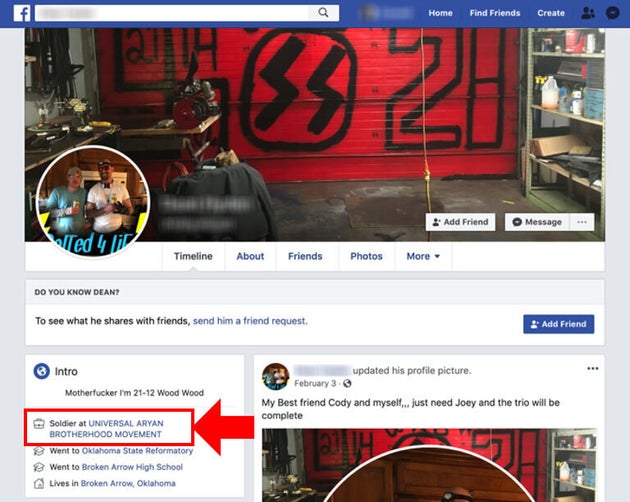
Of the 113 white supremacist organisations that the project found on Facebook, 64% had pages that had been created by Facebook itself. Such auto-generated pages occur when an individual user lists a job in his or her profile that doesn’t have a corresponding business page. If one or more users list the Universal Aryan Brotherhood Movement as an employer, Facebook creates a page for the neo-Nazi group. 

Auto-generated pages don’t have administrators who can use the pages to communicate with followers, Facebook’s spokesperson said.

An anonymous whistleblower filed a complaint with the Securities and Exchange Commission about Facebook auto-generating pages for hate and terror groups. Sometimes such pages earn thousands of likes, offering hate groups a ready-made recruiting pool, the whistleblower argued.

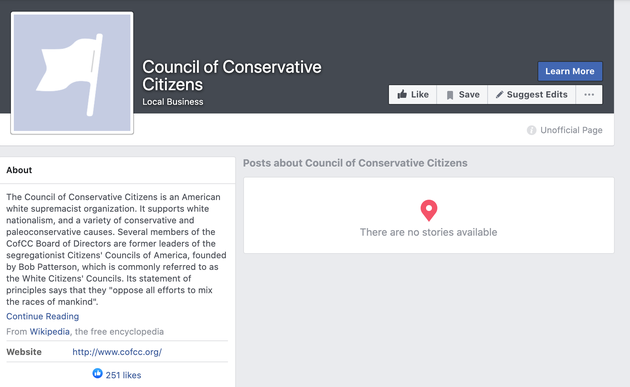
More than 250 people liked the auto-generated page for the Council on Conservative Citizens — whose white supremacist propaganda inspired Dylann Roof to massacre nine black parishioners at a Charleston, South Carolina, church in 2015. 

That page, which included a link to the group’s website, appeared to have been removed by Facebook on Friday. 

Facebook also appeared Friday to have removed auto-generated pages for the white nationalist website VDare and the violent neo-Nazi group Northwest Front, both of which were mentioned in TTP’s report. 

A user-created page for the neo-Nazi group Aryan Nations, which had been active for just over 10 years, was also removed on Friday. 

Still, many white supremacist organisations identified in TTP’s report remain on Facebook. One user-created page for Arktos Media  — the fascist European publishing house with close ties to American white supremacist Richard Spencer — is still active. More than 42,000 people have liked the page. 

A page for the hate group Fight White Genocide, which has more than 1,000 likes, is still active. A trio of years-old pages or groups called Right Wing Death Squad are also still online. 

Facebook has an extensive process — including consultations with academics and various organisations — for developing criteria to determine which groups are considered hate groups, the company’s spokesperson told HuffPost.

But the company does not follow any one organisation’s list of hate groups and so may not always agree with hate group identifications made by the Southern Poverty Law Center, the Anti-Defamation League or TTP, the spokesperson added.

TTP’s report raises an alarm about the function of so-called related pages on Facebook, which it said can push users into a white supremacist echo chamber. 

“TTP’s investigation found that among the 113 hate groups that had a Facebook presence, 77 of them had Pages that displayed Related Pages, often pointing people to other extremist or right-wing content,” the report said. “In some cases, the Related Pages directed users to additional SPLC- or ADL-designated hate groups.” 

The user-created Facebook page for American Freedom Union, for example, included a link to a page for the book “White Identity: Racial Consciousness in the 21st Century,” by Jared Taylor, another prominent US – based white supremacist. 

In 2019, Facebook announced that it would redirect users who searched white supremacist terms to a page for a group that works to rehabilitate extremists. 

“Searches for terms associated with white supremacy will surface a link to Life After Hate’s page, where people can find support in the form of education, interventions, academic research and outreach,” the company said at the time.

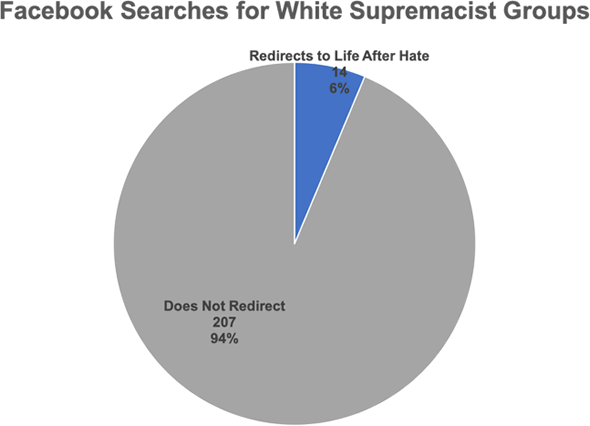
But TTP’s study found that the Life After Hate link only surfaced in 6% of its 221 searches for white supremacist groups. 

“One factor may be that not all of the hate groups listed by SPLC and ADL make their ideologies obvious in their names,” the TTP report conceded, a reference to how fascist groups sometimes use coded language to hide their true motives. 

But the project said its researchers were rarely redirected to Life After Hate even when searching obvious white supremacist terms.   

“Of 25 groups with ‘Ku Klux Klan’ in their official name, only one triggered the link to anti-hate resources,” the report found. 


Source by [author_name]

How the Taliban Outlasted a Superpower: Tenacity and Carnage

ALINGAR, Afghanistan — Under the shade of a mulberry tree, near grave sites dotted with Taliban flags, a top insurgent military leader in eastern Afghanistan acknowledged that the group had suffered devastating losses from American strikes and government operations over the past decade.

But those losses have changed little on the ground: The Taliban keep replacing their dead and wounded and delivering brutal violence.

“We see this fight as worship,” said Mawlawi Mohammed Qais, the head of the Taliban’s military commission in Laghman Province, as dozens of his fighters waited nearby on a hillside. “So if a brother is killed, the second brother won’t disappoint God’s wish — he’ll step into the brother’s shoes.”

The Taliban have outlasted a superpower through nearly 19 years of grinding war. And dozens of interviews with Taliban officials and fighters in three countries, as well as with Afghan and Western officials, illuminated the melding of old and new approaches and generations that helped them do it.

After 2001, the Taliban reorganized as a decentralized network of fighters and low-level commanders empowered to recruit and find resources locally while the senior leadership remained sheltered in neighboring Pakistan.

The insurgency came to embrace a system of terrorism planning and attacks that kept the Afghan government under withering pressure, and to expand an illicit funding engine built on crime and drugs despite its roots in austere Islamic ideology.

At the same time, the Taliban have officially changed little of their harsh founding ideology as they prepare to start direct talks about power-sharing with the Afghan government.

They have never explicitly renounced their past of harboring international terrorists, nor the oppressive practices toward women and minorities that defined their term in power in the 1990s. And the insurgents remain deeply opposed to the vast majority of the Western-supported changes in the country over the past two decades.

“We prefer the agreement to be fully implemented so we can have an all-encompassing peace,” Amir Khan Mutaqi, the chief of staff to the Taliban’s supreme leader, said in a rare interview in Doha, Qatar’s capital, with The New York Times. “But we also can’t just sit here when the prisons are filled with our people, when the system of government is the same Western system, and the Taliban should just go sit at home.”

“No logic accepts that — that everything stays the same after all this sacrifice,” he said, adding, “The current government stands on foreign money, foreign weapons, on foreign funding.”

A grim history looms. The last time an occupying power left Afghanistan — when the U.S.-backed mujahedeen insurgency helped push the Soviets to withdraw in 1989 — guerrillas toppled the remaining government and then fought each other over its remains, with the Taliban coming out on top.

Now, even as United States forces and the insurgents have stopped attacking each other, the Taliban intensified their assaults against the Afghan forces before a rare three-day truce this week for the Eid holiday. Their tactics appear aimed at striking fear.

Many Afghans fear the insurgents will bully negotiators into giving them a dominant stake in the government — whose institutions they have undermined and whose officials they continue to kill with truck bombs and ambushes.

Taliban field commanders made clear that they were holding fire only on American troops to give them safe passage — “so they dust off their buttocks and depart,” as one senior Taliban commander in the south said. But there was no reserve about continuing to attack the Afghan Security Forces.

“Our fight started before America — against corruption. The corrupt begged America to come because they couldn’t fight,” a young commander of the Taliban elite “Red Unit” in Alingar said. He was a toddler when the United States invasion began, and met up with a Times reporting team in the area where government control gives way to the Taliban.

“Until an Islamic system is established,” said the commander, who spoke on the condition of anonymity, “our jihad will continue until doomsday.”

The Taliban now have somewhere between 50,000 and 60,000 active fighters and tens of thousands of part-time armed men and facilitators, according to Afghan and American estimates.

It is not, however, a monolithic organization. The insurgency’s leadership built a war machine out of disparate and far-flung parts, and pushed each cell to try to be locally self-sufficient. In areas they control, or at least influence, the Taliban also try to administer some services and resolve disputes, continuously positioning themselves as a shadow government.

“This is a network insurgency — it’s very decentralized, it has the ability for the commanders at the district level to mobilize resources, and be able to logistically prepare,” said Timor Sharan, an Afghan researcher and former senior government official. “But at the top, they gained legitimacy from a single source, a single leader.”

Over the years, the group’s top leadership has mostly remained in Pakistan, where the insurgency’s reconstitution was supported by Inter-Services Intelligence, the Pakistani military spy agency. Those havens have offered continuity even as the rank and file suffer heavy casualties in Afghanistan.

At times, the casualty rates went so high — losing up to hundreds of fighters a week as the Americans carried out an airstrike campaign in which they dropped nearly 27,000 bombs since 2013 — that the Taliban developed a system of reserve forces to keep applying pressure where it had taken losses, according to the group’s regional commanders. Last year was particularly devastating, with Afghan officials claiming they were killing Taliban at unprecedented rates: more than 1,000 a month, perhaps a quarter of their estimated forces by year’s end. In addition to airstrikes by Afghan forces, the U.S. dropped about 7,400 bombs, perhaps the most in a decade.

Even at the peak of the long American military presence and the coordinating effort to help the Afghan government win hearts and minds in the countryside, the Taliban were able to keep recruiting enough young men to keep fighting. Families keep answering the Taliban’s call, and booming profits help hold it all together.

Mawlawi Qais explained how his military commission in Laghman Province, where Alingar is, has an active “Guidance and Invite” committee whose members go to mosques and Quranic lessons to recruit new fighters. But he noted that most recruits come from current fighters working to enlist friends and relatives.

There has been a constant need for new blood, particularly over the past decade. “In our immediate dilgai alone,” he said, referring to a unit of 100 to 150 fighters, “we have lost 80 men.”

Still, fighters keep signing up, he said, in part because of deep loathing for the Western institutions and values the Afghan government has taken up from its allies.

“Our problem isn’t with their flesh and bones,” Mawlawi Qais said. “It is with the system.”

Afghan officials say that in places where the Taliban don’t have stable control for local recruitment, they still draw heavily on the approximately two million Afghan refugees who live in Pakistan, and on the seminaries there, to recruit fighters for front-line fighting.

Taliban recruitment officials and commanders say they don’t pay regular salaries. Instead, they cover the expenses of the fighters. What has helped in recent years was giving their commanders a freer hand in how they used their local resources — and war booty.

Some revenue collection, such as taxing goods, was centralized. But increasingly, the movement became deeply intertwined with local crime and narcotics concerns, adding to the financial incentives to keep up their holy war.

“The friends who are with us in the front lines of jihad, they don’t get exact salaries,” said Mullah Baaqi Zarawar, a unit commander in Helmand Province. “But we take care of their pocket money, the gas for their motorcycle, their trip expenses. And if they capture spoils, that is their earning.”

In areas where they are comfortably in control, many Taliban fighters, and even the leaders, keep other jobs.

During his interview, Mawlawi Qais paused to apologize for his dusty clothes — he said he had been milling flour all morning, which is his day job. Many of his fighters also have second jobs when not fighting.

To help ensure that recruitment streams would not dry up, the insurgency prioritized an increasingly sophisticated information operation, shaping the Taliban’s narrative through slick video productions and an aggressive social media brigade.

Instances of U.S. or Afghan forces causing civilian casualties, whether real cases or made up, are splashed across social media in conjunction with Taliban training videos of their fighters jumping through fiery rings and drilling with their weapons. The message has been consistent: To join us is to take up a life of heroism and sacrifice.

They had powerful symbols to draw on: They were fighting for a supreme leader, Mawlawi Haibatullah Akhundzada, who sent his own son as a suicide bomber for the cause, against a government propped up by an invading military and led by officials who often keep their families abroad.

After their deal with the Americans, the Taliban’s propaganda has only intensified, and has taken on an ominously triumphal note. In his annual message for the Eid al-Fitr holiday, released last Wednesday, the Taliban’s supreme leader issued a promise of amnesty for enemies who renounced their loyalty to the Afghan government.

Alingar is also an example of how the Taliban have figured out local arrangements to act like a shadow government in areas where they have established control. The insurgents collect taxes, sending around 20 percent to the central leadership while keeping the rest for the fighters locally, Taliban leaders in the district said. They have committees overseeing basic services to the public, including health, education and running local bazaars.

Supplies and salaries for health clinics and schools are still paid for by the Afghan government and its international donors. But the Taliban administer it all in their way — a compromise reluctantly agreed to by aid organizations since the alternative would be no services. And the insurgents’ approach to schooling is giving the strongest evidence yet that the movement is clinging to its old ways of repressing women, art and culture.

Out of the 57 schools in Alingar, 17 are girls schools, according to Mawlawi Ahmadi Haqmal, the head of the education committee in Alingar. But the local Taliban insist that girls’ education must end after sixth grade, at odds with international requirements for education aid. In the curriculum, the Taliban have also slashed culture as a subject because it promoted “vulgarities such as music,” Mawlawi Haqmal said.

After the Taliban swept to power in the 1990s, defeating other factions in the vacuum left behind by the Soviet withdrawal, the United States seemed mostly indifferent to the group’s oppressive rule. But that changed in 2001, when Al Qaeda leaders taking shelter in Afghanistan carried out the Sept. 11 terrorist attacks on American soil.

Al Qaeda’s Saudi leader, Osama bin Laden, had spent a long time in Afghanistan, and once even fought on the American side against the Soviets at the end of the Cold War. The Taliban’s leader, Mullah Muhammad Omar, allowed him to stay in Afghanistan and the two had grown close, with Bin Laden pledging allegiance to him as an Islamic emir.

Wounded and seeking immediate revenge, the Bush administration had no patience for the Taliban’s proposals to find a way to get rid of Bin Laden without directly handing him to the Americans. The United States began a military invasion.

A group that had found success against Afghan factions withered quickly in the face of the U.S. airstrikes. The Taliban’s fighters went home as the Islamic Emirate disintegrated. Their leaders crossed the border into Pakistan or ended up in American prisons.

Many Taliban commanders interviewed for this article said that in the initial months after the invasion, they could scarcely even dream of a day they might be able to fight off the U.S. military. But that changed once their leadership regrouped in safe havens provided by Pakistan’s military — even as the Pakistanis were receiving hundreds of millions of dollars in American aid.

From that safety, the Taliban planned a longer war of attrition against U.S. and NATO troops. Starting with more serious territorial assaults in 2007, the insurgents revived and refined an old blueprint the United States had funded against the Soviets in the same mountains and terrain — but now it was deployed against the American military.

“Most of our leaders were part of that anti-Soviet war. This was our land, our territory, and our colleagues had familiarity,” said Mr. Mutaqi, the Taliban chief of staff. “Afghanistan’s history was in front of us — when the British came, their force was bigger than the Afghans, when the Soviets came, their force was bigger, and the same was true with the Americans — their force was much larger than ours. So that gave us hope that, eventually, the Americans, too, would leave.”

From the start, the insurgents seized on the corruption and abuses of the Afghan government put in place by the United States, and cast themselves as arbiters of justice and Afghan tradition — a powerful part of their continued appeal with many rural Afghans in particular. With the United States mostly distracted with the war in Iraq, the insurgency widened its ambitions and territory.

By the time President Barack Obama took office in 2009, the Taliban had spread so far that he raised the number of American troops on the ground to about 100,000. In addition to an Afghan Army and police that eventually grew to about 300,000 fighters, the U.S. military also propped up local Afghan militias as urgent measures. The war had entered a vicious cycle of killing and being killed.

In the second decade of the insurgency, the Taliban have been defined by the ruthlessness of their violence — and by their ability to strike at will even in the most guarded parts of the Afghan capital, Kabul.

The Taliban revived the old fund-raising networks in Arab states that had helped finance the U.S.-supported mujahedeen movement against the Soviets.

A prime example of how the Taliban took old guerrilla experiences to new brutality was the development of the Haqqani network and its integration into the leadership.

The network’s patriarch, Jalaluddin Haqqani, was seen as an effective and cooperative American ally in the fight against the Soviets. But in the war against the Americans, the Haqqanis ended up as the only arm of the Taliban to be designated by the United States as a foreign terrorist group.

The Haqqanis turned their old smuggling routes and networks into a pipeline for suicide bombers and well-trained fighters who struck American targets and assaulted critical Afghan government agencies.

Jalaluddin’s son, Sirajuddin, was promoted to be the Taliban’s deputy leader and a senior operations commander in 2015. The younger Mr. Haqqani — originally from eastern Afghanistan — often sent his elite trainers to embed with Taliban units in the insurgency’s southern heartland, Afghan and Western officials said, cranking up the lethality of their violence.

When the United States began negotiating in 2018 with a delegation of the Taliban in Doha, across the table were architects of the insurgency — and the survivors of it. Nearly half of the Taliban negotiating delegation had spent a decade each in Guantánamo.

Mullah Abdul Ghani Baradar, the lead Taliban negotiator, had just been released after 10 years in Pakistani prison, detained because he had made contacts for peace talks with the Afghan government without the blessing of the Pakistani military establishment that had nurtured the insurgency.

Each session, Mullah Baradar would arrive at the venue of talks, a posh diplomatic club, in a pair of black Chevrolet Impala sedans. Half a dozen guards in white robes would rush between the American-made vehicles and the gate, one holding open the car door, ushering the frail, turbaned leader up the stairs into the marble hall where the Americans were impatient to end the war.

As the two sides talked, car bombs rammed into military bases back in Afghanistan, and Taliban suicide squads continued attacking government offices, often causing mass civilian casualties. Several times the violence complicated or even derailed the delicate talks.

One main concern among American and Afghan officials was whether the Taliban’s political wing and the likes of Mullah Baradar had true influence among the insurgency’s military commanders.

Another question was whether the Taliban would truly turn against terrorist groups like the Islamic State and Al Qaeda once the Americans left.

During one session last spring, the commander of U.S. and NATO forces, Gen. Austin S. Miller, appealed to the Taliban to find common cause with the American counterterrorism mission.

“Our guys could continue killing each other,” he said, “or we could kill ISIS together.”

American officials say that President Trump’s negative view of the talks improved dramatically when the Taliban began delivering on that front. The insurgents intensified pressure on the Islamic State foothold in the east just as the United States bombed them from the sky and Afghan commandos squeezed from another direction.

Still, when it came to Al Qaeda, the group walked a fine line in the agreement with the United States — refusing the descriptor of “terrorist,” a word that bogged down the negotiations for several emotional days. The Taliban showed no remorse for its past cooperation with Al Qaeda, promising only to not allow Afghan soil be used for launching attacks in the future.

About two weeks after the Taliban signed their deal with the United States, Al Qaeda in a statement hailed it as a “great victory” against America.

The Taliban demonstrated their ability to control their ranks through one more test. When the two sides conditioned the signing of their agreement on a week of partial truce, violence levels dropped by as much as 80 percent, Afghan and American officials said.

That had not been a sure thing. Mullah Baradar steadfastly refused to make the seven days a complete cease-fire — a move that many Afghan and Western observers believe gave the Taliban leadership some space to not lose face in case any rogue cells disobeyed the order to stop fighting.

There were other signs that Mullah Baradar was having to keep up a sophisticated juggling act behind the scenes. Some Afghan officials said they had intelligence that Mullah Baradar had issued an ultimatum to the Taliban’s military wing, saying that if it insisted on trying to win by force, there was no need for him to keep spending his days arguing with the Americans word by word, comma by comma.

When the week of violence reduction began, Taliban commanders were scrambling — on WhatsApp groups and on military radio channels — to bring their fighters and units into line. Victory is close and this is what the leadership wants and we need to deliver, they would tell their fighters, according to intelligence intercepts shared with The New York Times by Afghan officials.

One thing that slowed down the negotiations with the United States was that the Taliban’s political leaders wanted to take every small issue down to their commanders, bringing them on board to avoid rebellions and breakaways.

For weeks, the turbaned negotiators would sit across from the Americans in conference rooms in Doha and then send delegations back to Pakistan, for consultations with the leadership.

In between, there was always WhatsApp. When the insurgent negotiators took punctual breaks from talks for prayer, they would pick up their phones from the locker box on the way. The incoming messages beeped throughout the prayer in the mosque, and the scrolling would begin as soon as hands touched the face in culmination of worship.

Taliban officials say what sets them apart from the factions that fought against the Soviet Union and then broke into anarchy over power is that their allegiance was divided to more than a dozen leaders. The Taliban began their insurgency under the authority of a single emir, Mullah Omar. But the insurgency reached its greatest heights more recently, with a leadership structure that depends on consensus and then strikes with a heavy fist against any who disobey from within.

Even as new commanders emerged in recent years, much of the leadership council is made up of the older crew that established the insurgency in the years after the U.S. invasion. The old political leaders acknowledge the balancing act they face is like no challenge the insurgency has faced before. They have made sure to tightly control the rationale for their violence — it is a holy war for as long as their supreme leader and clerics decree it to be.

Mr. Sharan, the analyst, said that unity has been easier to maintain with a common enemy, the U.S. military, to fight. But if the Taliban eventually win their dream of an Afghanistan without the Americans, he said, they will face many of the challenges that once dragged the country into anarchy.

“The relationship between the political leaders and the military commanders who have monopoly over resources and violence will be tested,” he said. “The 1990s civil war in Kabul happened not because the political leaders couldn’t agree among each other — it happened because the commanders who had monopoly of violence at the bottom wanted to expand on their resources. The political leaders were hopeless in controlling them.”

Taimoor Shah contributed reporting from Kandahar, and Zabihullah Ghazi from Jalalabad, Afghanistan.

Source link

She was tricked as a teen into prostitution. A decade on, she has no work and faces starvation

0

Daulatdia, Bangladesh — Nodi was 14 years old when she says she was deceived and sold into one of the world’s biggest brothels.

Already married with a young baby, she had gone to look for her husband, who was known to gamble in the area in eastern Bangladesh. Nodi says she met a driver who offered to help, but he turned out to be a broker, who sold her to a madam in the Daulatdia brothel complex.

“I was tricked,” said Nodi, who only wants to be identified by the first name that she uses with clients. “Then I got trapped here.”

Once her husband and family found out what had happened, she says they refused to rescue her, due to the shame associated with the brothel.

More than a decade after she was sold and abandoned — and with Bangladesh under lockdown to prevent spread of the Covid-19 virus — the 25-year-old is facing a new problem: hunger.

“Because of this coronavirus pandemic, we are now in trouble,” said Nodi. “We have no work.”

In late March, Bangladesh imposed a nationwide lockdown to prevent the spread of Covid-19, which has infected more than 36,000 people in the country, including more than 520 who died, John Hopkins University figures show.

As businesses and transport networks were shut down across Bangladesh, government-sanctioned brothels were also closed, with no clients allowed to enter. Since 2000, prostitution has been legal in Bangladesh, but it is regarded by many as immoral.

“Our brothel has been locked down,” said Morjina Begum, executive director of Bangladeshi charity Mukti Mohila Samity (‘Free Woman Union’ in English). “We do not allow any outside customers. Now sex workers do not have any income.”

Begum, who is a former sex worker from the brothel, added that the government, police and local NGOs including her organization are supplying relief to the women.

But several women in the brothel told CNN that the aid is not nearly enough.

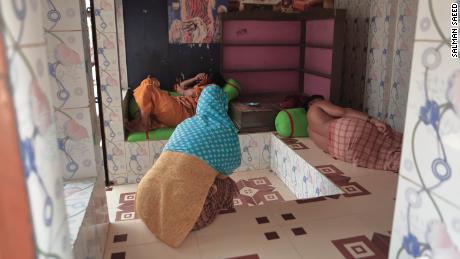
Nearly 1,500 women and girls are packed inside the 12-acre site, which resembles an overcrowded slum, with densely packed alleyways lined with corrugated iron shacks, small shops and open sewers.

Many of the women have given birth to children inside the brothel, and researchers say there are currently 500 children in there, including 300 under the age of six.

“We are not getting any (food),” Nodi said. “If it continues, children will die from starvation. We pray that the virus will go away.”

Some women send their children to live with family members or at charity shelters outside the brothel, because they don’t want them to be part of this life. Nodi says she has no contact with her son, now 11, who is growing up with her former in-laws in Dhaka. It’s better that way, she says.

“We want our children to be away from us so that they can become good human beings,” Nodi said.

Usually, around 3,000 men visit the brothel every day, many of them truck drivers or day laborers who stop off at Daulatdia due to its prime location next to a train station and a ferry terminal on the Padma River, a major channel running from the Ganges.

“If it continues, children will die from starvation. We pray that the virus will go away.”

Nodi

From late afternoon onwards, the women and girls stand around in the narrow lanes as the men walk through. Once a negotiation is complete, the clients enter one of the small rooms, which usually consist of a brightly-colored bed, and a small cupboard or wardrobe. The men pay as little as $2 for sex, and around $20 for an overnight stay.

“Earlier I could have earned ($60) per day. Some days it could be ($20) and some days I would earn nothing,” Nodi said. “Now, everything is dependent on God.”

Each sex worker in the brothel has to pay daily rent to the madams, who act as a go-between for more than a dozen landlords which own this area of land. When the girls arrive via a broker, often for a sum of around $200-300, they are forced to pay off this debt to the madams.

A 2018 study conducted by the non-profit research organization, the Society for Environment and Human Development (SEHD), found that around 80% of the 135 sex workers surveyed said they had been trafficked or tricked into going to a brothel, said Philip Gain, the SEHD director.

“The conditions in the brothel are so horrible,” said Gain, the director of SEHD. “No-one would come unless they had been tortured or abused.”

Gain said there is a country-wide network of traffickers who find girls for the brothels, who are often persuaded with promises of well-paid work in a factory, or brought by force.

“Once a girl is sold into a brothel, she is trapped, it is very hard to get out,” Gain added.

More than 200 girls have arrived in Daulatdia in the past five or six years after being trafficked by a broker, says Sipra Goswami, coordinator for the charity BLAST, Bangladesh Legal Aid and Services Trust, which helps to rescue underage girls from the brothels. The organization also offers the girls legal aid and accommodation in shelters, or helps them to reintegrate with their families. Most of the underage girls they rescue are aged 12-16, Goswami adds.

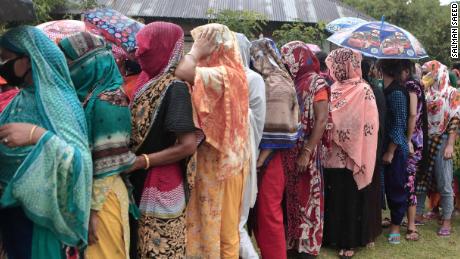
Women queue up to receive an aid delivery at the Daulatdia brothel in Bangladesh on May 14.

“They are socially excluded and vulnerable,” Goswami said. “Nowadays their condition is (at the) very worst (because of Covid-19). The after effects will be awful for them.”

Local police chief Ashiqur Rahman denied there are any underage sex workers in the brothel.

Rahman said that since he took the post in January, there have been three trafficking cases reported, adding that he tries to personally interview the women that arrive to make sure they were not forced.

Bangladesh’s Home Minister, Asaduzzaman Khan, said via text message “the law of the land prohibits trafficking in persons and there are severe penalties for the culprits. Our law enforcement agencies are vigilant and they act immediately on any such culpable crimes. Even during these extraordinary circumstances of the pandemic, we are in full alert.”

During a charity aid delivery at the brothel on May 14, hundreds of women jostled in the rain as they tried to secure one of the bags of rice being handed out; their desperation occasionally turning to frustration as tempers frayed in the crowd.

While there are no reported Covid-19 cases in Daulatdia, there was no social distancing during the distribution, although many of the women wore masks.

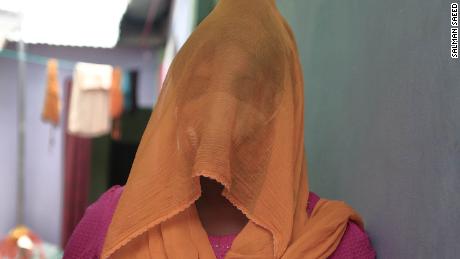
There are around 500 children in the brothel, most of them fathered by the men who visit the complex. This woman, who did not want to give a name, says she is eight months pregnant.

The local government also made an aid delivery to the brothel on March 28, which included 10kg of rice, hand sanitizer and other items for more than 1,300 women, according to Rubayet Hayat, executive officer of the local sub-district of Goalanda. He added that the country’s Prime Minister, Sheikh Hasina, also arranged for 200 of the poorest women to receive a $30 cash handout via mobile payment transfer.

The local police force — which is guarding the brothel’s entrance to stop customers entering during the lockdown — has also made multiple deliveries of rice in the past few months, according to Rahman.

“Firstly, we need to save their lives from the Covid,” he added. “Then, we try to help with the other things.

“We support them as much as possible, but this is not sufficient I think,” Rahman said. “They are in a critical situation.”

Nodi says the relief is sometimes unfairly distributed, meaning some women are left hungry.

“Now we are facing a lot of problems here, with the relief, some of us are getting it, and others are not,” she said. “If everyone gets relief, everyone will be happy.”

Shurovi, 22, was born in Daulatdia to a mother who worked there.

She was raised in a nearby safe home run by a charity, and received a good education before getting married and moving to Dhaka. But after four years, the couple separated when her husband found another wife.

Shurovi, who only wants to be identified by her first name she uses with clients, had been doing some part-time work as an actress in Bangladeshi TV soaps — a “dream job,” she said. But when the work ran out, and she was left homeless after the separation, her economic situation deteriorated and she reluctantly returned to Daulatdia, a place she thought she had escaped.

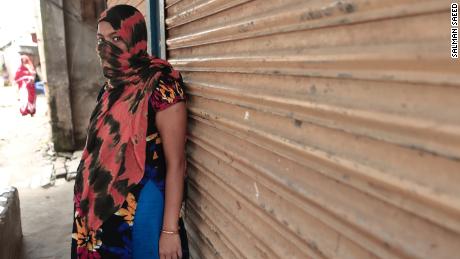
Shurovi, 22, was born in the Daulatdia brothel to a sex worker mother. She was brought up outside by a charity, but ended up returning after her marriage fell apart and she was left homeless.

She came back with a target: to be out of there within two years with enough money to buy some land.

But that aim started fading after she got pregnant with her son, fathered by a client. She also had to take out a large loan to pay for an emergency C-section during the birth. And now, her exit strategy is looking more out of reach, as she spends what little she has put aside just to survive.

“I am facing a financial crisis which threatens our survival,” Shurovi said. “If I do not have any income, I cannot support my child. I cannot manage to feed myself as well as my family.”

Shurovi says she can no longer afford diapers or baby milk, which is more than $7 for a carton.

“The support we are getting from the government is not enough,” she said. “They are not providing anything for children or any cash for our family.”

“If I do not have any income, I cannot support my child. I cannot manage to feed myself as well as my family.”

Shurovi

Shurovi’s son is 10 months old, and he lives most of the time with her mother in another room within the brothel complex.

“People who are born in these brothels, it is not their choice, they should always get a chance to live normally in society,” Shurovi said.

But the key to getting out — and staying out — is opportunity and support, she adds.

“It seems like we have died before death,” Shurovi said. “If the government does not think about us, we will be in great trouble.”

Salman Saeed reported from Daulatdia, Bangladesh and Rebecca Wright wrote from Hong Kong.

Source link

Weather forecast, alerts and UVB index for all South African provinces, 27 May 2020

Weather data provided by the South African Weather Service. For a detailed forecast of your province, click here.

Warnings: None.

Watches: None.

Special weather advisories: Very cold conditions are expected over the southern parts of Free State and Northern Cape on Wednesday, as well Chris Hani, Joe Gqabi districts and northern parts of Dr Beyers Naude local municipality in the Eastern Cape today.

Frost is expected over the extreme eastern and eastern Northern Cape as well as over the Free State on Wednesday, as well as the Chris Hani, Joe Gqabi districts and northern parts of Dr Beyers Naude local municipality in the Eastern Cape and in places in Gauteng.

Gauteng: Fine and cool, becoming cold from the south in the afternoon

UVB sunburn index: Low.

Mpumalanga: Fine and cool, becoming cloudy with evening drizzle and fog along the escarpment

Limpopo: Fine and warm, becoming partly cloudy with evening fog along the escarpment

North-West Province: Partly cloudy, windy and cool to warm.

Free State: Partly cloudy, windy and cool.

Northern Cape: Cloudy, windy and cold to cool with isolated showers and rain in the west and south but scattered in the extreme south-west. It will be fine and cool in the east where it will become partly cloudy from afternoon. Light to moderate snow can be expected over the southern high ground from the evening where it will be very cold. The wind along the coast will be light to moderate north-westerly becoming fresh south-westerly in the afternoon.

Western Cape: Cloudy and cold to cool with scattered showers and rain in the west spreading to the east from late morning but widespread in the south-west. Light snow can be expected over the western high ground in the afternoon spreading to the eastern high ground in the evening. It will be very windy. The wind along the coast will be strong to gale north-westerly south of Cape Columbine becoming strong to gale westerly to south-westerly in the afternoon, otherwise light to moderate north-westerly becoming fresh to strong south westerly in the afternoon.

UVB sunburn index: Low.

Western half of the Eastern Cape: Fine, cool and windy, becoming cloudy from the south west with isolated showers and rain spreading eastwards but scattered along the coast. Snowfall is expected in the evening and overnight on the mountains. The wind along the coast will be strong to gale force westerly to south-westerly.

Eastern half of the Eastern Cape: Fine, warm and windy. It will become cloudy from the west in the evening, with isolated showers, spreading to the Lesotho border overnight. Light evening snowfall is expected over the northern mountains. The wind along the coast will be moderate north-westerly, becoming strong south-westerly, but gale force late in the day west of Kei River.

Kwazulu-Natal: Fine and warm but cool on the western high-ground. The wind along the coast will be moderate north-easterly, becoming moderate to fresh south-westerly in the evening from the south.

UVB sunburn index: High.


Source link

Tibetan Students, State Workers Barred From Religious Events in Lhasa

Chinese authorities are closely watching government employees and students in Tibet’s regional capital Lhasa during the Buddhist holy month of Saga Dawa, forbidding them from participating in traditional religious gatherings, according to sources in Tibet.

Saga Dawa, which falls on the fourth month of the Tibetan lunar calendar and began this year on May 23, commemorates the Buddha’s birth, death, and enlightenment, and is traditionally celebrated in Buddhist countries around the world.

Though Lhasa’s famous Jokhang Temple and other religious sites are now open to the public, “students, government workers, and persons drawing a state pension are not allowed to take part in religious events,” one resident of the city told RFA’s Tibetan Service.

Parents of Tibetan schoolchildren have likewise been warned in meetings with Chinese officials not to permit their children to attend religious ceremonies during Saga Dawa, RFA’s source said, speaking on condition of anonymity.

“Authorities have warned that Communist Party members, government workers, and students who are found to have attended religious ceremonies will face severe consequences,” the source said.

“Police activity in Lhasa is also increasing at this time,” he added.

“During the initial outbreak of coronavirus in Lhasa, the schools in Tibet were all closed for a considerable time,” a second source in Lhasa said.

Lhasa area schools have meanwhile finally opened following a long period of shut-down owing to fears of the spread of coronavirus in the city, another source in Lhasa told RFA.

“During the initial outbreak of coronavirus in Lhasa, the schools in Tibet were all closed for a considerable time,” the source, a parent of schoolchildren said, also speaking on condition he not be named.

“Gradually, the schools reopened, but the kindergartens and day care centers mostly stayed closed, opening again only on May 25,” he said.

Authorities in Tibetan-populated areas of China have long sought to restrict the influence on children of Tibetan Buddhist religion, traditionally a focus of Tibetan cultural and national identity, sources in the region say.

Reported by Yangdon Demo for RFA’s Tibetan Service. Translated by Dorjee Damdul. Written in English by Richard Finney.


Source link