Wednesday, April 29, 2026

Iran arrests man over ‘honor killing’ of 14-year-old daughter

May 28, 2020

The murder of a 14-year-old girl in Iran who ran off with an older man has renewed calls for the government to impose harsher punishments on so-called honor killings. 

In mid-May, Romina Ashrafi fled the town of Talesh with her 34-year-old boyfriend, Bahamn Khavari. They were apprehended by police less than a week later. 

Under Iranian law, girls as young as 13 can marry, although the average age is 23.  

Police turned Ashrafi over to her father, even though the teenager said she feared for her life, Iranian state media reported.  

Her father, Reza Ashrafi, is accused of beheading his daughter while she was sleeping May 21. Local media reported he used a farming sickle in the slaying. 

He is currently in custody and faces up to 10 years in prison if convicted of murder.  

The killing has prompted outrage nationwide, and Iranian President Hassan Rouhani has reportedly urged his Cabinet to fast-track legislation that would impose harsher punishments for honor killings. 

There are no government statistics on the number of women and girls who die in honor killings each year in Iran. The US State Department notes the practice occurs most often among rural and tribal populations.

In a statement, Amnesty International wrote it was “appalled that the Iranian authorities repeatedly ignored Romina’s pleas for protection from her violent and abusive father.”

The rights group called on Iran’s authorities to criminalize domestic violence and to ensure accountability that doesn’t resort to the death penalty. 

Reza Pahlavi, the exiled son of Iran’s last shah, wrote on Twitter that the country’s regressive laws enabled Ashrafi’s murder. 

“Laws that permit domestic violence, honor killings, child abuse & child marriage do not belong in the 21st century,” he wrote. “The solution is a return to secular law.” 


Source link

Spain’s government lashes out at Nissan over Barcelona factory closure

0

The closure of the Nissan factory in Barcelona is hardly a surprise | Lluis Gene/AFP via Getty Images

The government thought the factory’s future was ‘guaranteed.’

Nissan said Thursday it would close its plant at Barcelona’s Zona Franca, threatening about 3,000 jobs and triggering a scramble among politicians to figure out a contingency plan.

Nissan’s Chief Executive Makoto Uchida confirmed the closure during a video press conference on Thursday in which he announced sweeping restructuring. That’s a major blow for Spain’s Prime Minister Pedro Sánchez, who had insisted earlier this year that the factory’s future was “guaranteed.”

“We considered various measures in Barcelona and although it was a very difficult decision we intend to close the plant,” said Uchida.

On Wednesday, Nissan agreed a new cooperation program with Renault that will see the French carmaker take the lead in Europe as the whole auto industry grapples with expensive shifts in electromobility and autonomous driving systems, as well as the impact of the pandemic.

The closure of the Barcelona factory, which dates back to 1920 but has only been owned by Nissan since 1980, is hardly a surprise. The site had been operating far below its maximum capacity since 2012 and concerns over its viability increased months ago when Nissan cut 600 jobs to reduce costs.

However, Nissan said it will keep open its Sunderland factory in the U.K., despite fears that Brexit could lead to its closure. Its peer Honda last year announced plans to close its Swindon plant in the U.K. by 2022, costing 3,500 jobs.

Auto failure

In its announcement on Thursday, Nissan said it will now redirect its resources toward Japan, China and the United States, giving ground to Renault in Continental Europe.

The production of vans will be shifted from Barcelona to Renault’s French factories.

The decision is a big blow to manufacturing and employment in Spain’s northeastern region of Catalonia, where carmaking has been a crucial sector for decades. About 3,000 direct jobs and between 25,000 and 30,000 indirect jobs depend on Barcelona’s Zona Franca factory.

The decision also represents a failure for Sánchez after months of intense negotiations to persuade Nissan to keep the factory open.

“We regret this decision by Nissan … despite the enormous efforts by the government to keep the business going,” Spain’s Foreign Minister Arancha González said.

Spain insists that saving the Barcelona site is still possible if Nissan were to apply a viability plan developed jointly with the Spanish Ministry of Industry and the Catalan regional government. Spain and Catalonia had offered an injection of up to €100 million — about a third of what Nissan needed to invest to build a new electric vehicle at the Barcelona factory that would ensure its long-term viability.

Spain is determined not to make Nissan’s exit easy. The government argues that closing the factory would cost the company more than €1 billion in compensation to workers and suppliers, as well as the repayment of €25 million in taxpayer money handed to Nissan over the last 12 years. Madrid says that it would be cheaper for Nissan to invest and save the site.

The government also warned that leaving Barcelona and Spain equals “abandoning the European Union, with the consequent reputational damage in a market of more than 500 million people.”

Economic Affairs Minister Nadia Calviño said Thursday the government wants to discuss “an alternative solution” for the Zona Franca site with Nissan and has proposed the creation of a working group.

Unions plan street protests after weeks of being banned from doing so because of Barcelona’s lockdown restrictions. A strike that began on May 4 is set to continue.

“Nissan’s workers will not rest until they persuade the multinational to keep industrial operations in Spain,” said the CCOO union.

Nissan’s decision does not directly affect the future of the company’s other sites in northern Spain, including Ávila, where it produces spare parts, and Cantabria, where it manufactures electric vans.

Aitor Hernández-Morales contributed reporting.


Source by [author_name]

Coronavirus Outbreak: Goa National Games postponed indefinitely due to COVID-19 pandemic – Firstpost

0

The much-delayed 36th National Games, scheduled for October-November in Goa, was on Thursday postponed indefinitely due to the COVID-19 pandemic.

The Indian Olympic Association (IOA) recently asked the Goa government that it must host the National Games as scheduled from 20 October to 4 November this year.

However, a spurt in the number of novel coronavirus cases has led to a postponement.

Representational image. Reuters

“The National Games organising committee has decided to postpone National Games due to COVID-19 pandemic,” Goa’s deputy chief minister Manohar (Babu) Ajgaonkar, who also holds the sports portfolio, said in a statement shared by IOA President Narinder Batra.

“… Committee to hold meeting in September end and decide on fixing dates for National Games. (Goa) Government to take advice from Union Sports Ministry, need four months advance notice to organise games,” he added.
The previous edition of the Games was held back in 2011 in Jharkhand.

Updated Date: May 28, 2020 18:56:31 IST

Tags :

36th National Games,

Coronavirus Outbreak,

Indian Olympic Association,

Jharkhand,

Manohar Ajgaonkar,

Sports Ministry,

SportsTracker


Source link

Zuma turns on judiciary as trial nears – The Mail & Guardian

Former president Jacob Zuma has again turned his sights on the judiciary ahead of his corruption trial, claiming that the National Prosecuting Authority (NPA) has been holding secret discussions with KwaZulu-Natal judge president Achmat Jappie.

Zuma’s lawyer, Eric Mabuza, has threatened action against Jappie and prosecutor Advocate Billy Downer SC over correspondence between the two about the trial date for the corruption case — which will sit briefly on June 23 —  and the addition of more charges to the indictment.

Although the prosecuting authority has described the correspondence as routine and part of the usual process of preparing for court, Zuma’s team says it believes otherwise. They question why Downer wrote to Jappie and not KwaZulu-Natal deputy judge president Mjabuliseni Madondo, who is on the bench for the trial, and with whom both the defence and the state had previously been corresponding.

Mabuza has also objected to the state’s suggestion that Zuma’s trial on charges of accepting bribes from French arms dealer Thales and his former financial advisor, Schabir Shaik, begin in February. Zuma, who is standing trial along with Thales, prefers a trial date of October, according to Mabuza.

In his letter, Mabuza, who was appointed as Zuma’s new lawyer in April, said that they had not been copied in any of the correspondence between Downer and Jappie and were not privy to the reasons why Downer had corresponded with him and not Madondo.

Mabuza said he and his legal team had not held ex parte discussions with either Madondo or Jappie as “we would consider it inappropriate to do so unless it was with consent or knowledge of all the parties involved”.

“Having consulted with our client, we are instructed to register his and our concern that such ex parte and indeed parallel communications were apparently initiated by the honourable judge president,” Mabuza said.

Mabuza said they did not suggest that Jappie’s actions were inappropriate, but objected to the discussions about the case, which included a possible amendment of the indictment by the state.

“Our client is seriously concerned about why the honourable judge president has seen it fit to run a separate parallel process which excluded him and his legal representatives,” Mabuza said.

Mabuza said it was of “grave concern” that Downer and Jappie had discussed the amendments to the indictment, which include the addition of new charges discovered in the forensic report by auditors KPMG relating to further payments from the Nkobi group.

Mabuza said the discussions implied a “lobbying exercise” by the state in an attempt to secure a postponement until 2021.

He added that it was difficult not to believe that his exclusion from the discussions between Downer and Jappie “was not deliberate and initiated to gain some strategic advantage over the accused”.

Zuma, he said, was suspicious about the discussions and would be left with the impression that there was an attempt to manipulate the composition of the bench, unless he was given a “satisfactory” explanation.

“Given the history of this matter and how he believes he has been persecuted by the system, he remains apprehensive and concerned by what appears to be secret and inappropriate discussions,” Mabuza said.

Should Zuma not be satisfied by the explanation and any “proposed remedial measures”, he would consider escalating the matter to the Judicial Services Commission, the office of the chief justice and the NPA integrity division.

Mabuza said Zuma would not accept a postponement of the trial until 2021.

KwaZulu-Natal director of public prosecutions, Advocate Elaine Zungu, said that the correspondence “was conducted in the normal course”’ of business. “Any issues arising will be dealt with during proceedings, the merits of which are not discussed as they are sub judice,” she said.

At the time of writing no complaint had been laid by Zuma’s legal team.


Source link

Get Republicans to Vote Against Trump? This Group Will Spend $10 Million to Try

But the collective voice of former cabinet officials and top aides to Republican presidents denouncing their party’s nominee did little to move the needle with regular Republican voters across the country, who were not swayed by opposition from the establishment.

Now, a new effort called Republican Voters Against Trump is hoping to chip away at Mr. Trump’s support from white, college-educated Republican voters in the suburbs, hoping a more surgical approach will help to elect Joseph R. Biden Jr., his expected Democratic opponent.

The new group is set to begin a $10 million digital and television advertising campaign that will use personal stories of conservative voters giving voice to their deep — and sometimes brand-new — dissatisfaction with the president.

The group will test the premise of whether there are really any persuadable voters left in a deeply tribal moment in American politics, in which views of Mr. Trump, both positive and negative, have only been hardened over the past four years.

“What was missing in 2016 was a real concerted effort to take the voices of real people who have deep reservations about Trump, but who identify as Republicans, and allow them to be the messengers,” said Sarah Longwell, a lifelong conservative and a prominent Never Trump Republican.

The new initiative is the brainchild of Ms. Longwell; Bill Kristol, the conservative writer; and Tim Miller, a former top aide to former Gov. Jeb Bush of Florida. Together, Ms. Longwell and Mr. Kristol have also worked on an initiative called Republicans for the Rule of Law, which has begun its own ad blitz against Mr. Trump.

After almost three years of conducting focus groups and intensive research on messages that would work with persuadable voters, the founders have created a cache of 100 testimonial videos, most shot on smartphones, with voters explaining why they are making the sometimes painful choice to break with their political party.

Some of the videos are hardly rousing endorsements for Mr. Biden. In one testimonial, Wayne from Dallas says to the camera, “I could not bring myself to vote for Hillary, so I voted for President Trump.” But he said he believed the president had “gotten worse” and that “everything he’s done has been to enrich himself.” With a note of resignation, he says: “I will not be voting for him here in 2020. I suppose I’ll be voting for Biden.”

Sitting on his couch in Brooklyn, Dan Eckman, a self-described lifelong conservative, says of Mr. Biden: “This guy has one term written all over him. Let him win. We’ll have four years to rebuild the base, re-educate the party, bleach out the Trump cult stain and then come back.” He adds, “I wouldn’t vote for Donald Trump with a gun to my head and neither should you.”

Some of the testimonials, like one from Gary, a lifelong Republican from Florida, describe Mr. Biden as “not a perfect candidate” but a “decent man.”

Ms. Longwell said the expression of lukewarm feelings about Mr. Biden made for a more authentic pitch for a Republican audience than a rousing endorsement.

“People who have been Republicans their entire lives aren’t super excited about voting for a Democrat,” she said. “The way they talk about it is more in sorrow than enthusiasm.”

But she said a Biden candidacy, and the lack of a well-known third-party candidate where voters can park their ballots, had created a bigger opportunity to persuade Republican voters to switch parties than there was in 2016.

“You can’t overstate what the Clintons represent for Republicans,” Ms. Longwell said. “Donald Trump’s corruption was offset by what they saw as her corruption.”

Tim Murtaugh, a spokesman for the Trump campaign, dismissed the effort in a one-word email: “irrelevant.”

Kevin Madden, a former top adviser to Senator Mitt Romney of Utah, said the universe of Republican voters who might be opposed to Mr. Trump — who consistently has approval ratings in the high 80s or better from his own party — was too small to make a difference.

“Given the razor-thin margins in several key battleground states in 2016, it’s easy to convince yourself that Republican nose-holders will make or break 2020,” Mr. Madden said. “But they are a smaller universe of voters when compared to Democrats over 60 who voted for Trump in 2016. Same with women voters with high school degrees who previously supported Obama but voted for Trump in 2016. Political operatives getting together to run a few ads targeted at that smaller sliver of voters won’t have much of an impact.”

The ad campaign, set to blitz the swing states of Pennsylvania, Wisconsin, Michigan, Florida, North Carolina and Arizona through the summer, is primarily aimed at college-educated white voters in suburbs.

Ms. Longwell said her focus groups had shown that there were still persuadable voters out there.

“I was surprised by how many people had just decided because of the coronavirus response,” Ms. Longwell said. “They for the first time started watching the press conferences.”

Source link

Finding Beauty in a New Routine

The day before the governor of California announced a statewide shelter-in-place order, Adrienne Bailon-Houghton, 36, a daytime talk show host on “The Real” and a YouTuber, and her husband of almost four years, Israel Houghton, 48, a gospel singer, songwriter and producer, moved to a new house in Calabasas, Calif. They were quarantined without much furniture. Renovation and décor projects were put on hold with contractors and designers. And, they were both expected to be on camera for their work, especially Ms. Bailon-Houghton, who films up to three episodes a day for “The Real.”

“We hate the reason why we’re quarantined, but we’ve really been enjoying and loving this time at home together,” she said. Mr. Houghton, who regularly travels for work added: “We both realized that we love to just wake up in the morning and have a routine.”

They jumped into action for both professional and personal projects. The couple skipped the kitchen remodel and instead painted the cabinets white themselves. They also started building the furniture they purchased online. Mr. Houghton worked on his cooking game while Ms. Bailon-Houghton has tapped her interior design skills.

For their entire relationship, each has been wrapped up in various businesses. In addition to the on-camera work, Ms. Bailon-Houghton is an entrepreneur and owns two product lines — a jewelry company XIXI and a vegan handbag line La Voûte. Mr. Houghton writes and produces his own music, but also streams worship services for various churches. Mr. Houghton said he enjoys their daily guided meditation and working out on their Peloton bike. At dinner, they concoct their own cooking competitions as if they are on the popular Food Network show, “Chopped,” pulling out a random collection of items from their pantry to create a delicious, or at the least edible, meal. Now, Mr. Houghton wants to become a chef.

The time at home hasn’t been without its challenging moments, namely how to film each other’s professional obligations. Ms. Bailon-Houghton set up the equipment sent to her by the producers on “The Real” to film from home in the only room they have furnished. The backdrop? The bed. The camera operator, production assistant, lighting technician and sound engineer? Mr. Houghton. He also films her episodes for her YouTube channel, “All Things Adrienne.”

The couple swaps roles to make videos of Mr. Houghton performing his music, footage he produces for various churches across the country. Here’s what they’ve learned since working while quarantined, and a few tips on how they make production at home work for them.

Learn to improvise.

The couple admits it’s all trial and error, because they have never done so much of their own production. Ms. Bailon-Houghton has found a knack for the aesthetics, whether it’s strategically placing a plant in the background or covering Mr. Houghton’s piano with pillar candles. “We put the whole piece together, and he’s like, ‘the sound is terrible,’” she said. They invested in gear to run an audio rig through the iPhone — not an easy task — but anyone can enhance the sound with a well-placed microphone.

Learn what works for you.

Practice makes perfect is Ms. Bailon-Houghton’s best advice. Surprisingly, she has done her own makeup for the show for the past three seasons, but never even attempted to style her own naturally curly hair. Shelter-in-place restrictions kept her from getting a professional blowout so she spent time in the bathroom embracing her “corona curls” as she calls them. The trick, she added, is to learn what works for you and what does not. Then, take time to do it yourself when you’re not in a rush.

[Sign up for Love Letter and always get the latest in Modern Love, weddings, and relationships in the news by email.]

Laugh through it all.

If there is one consistent thread to the couple’s approach to handling their new normal, it’s humor. They try to keep it lighthearted around the house, even when things go astray. Ms. Bailon-Houghton has pretended to be a yoga instructor for their workouts, and Mr. Houghton has tried to make a meal of disparate ingredients, like a banana, beans, and a keto tortilla. If things get too frustrating, they jump in their pool and relax before going back to the project.

Transparency is OK.

Mr. Houghton laughing in the background of “All Things Adrienne” is now par for the course, and Ms. Bailon-Houghton said that her audience has given her positive feedback. They prefer the unpolished footage, she said, and they respect it’s her husband behind the camera rather than a 15-person crew. “Not laughing at her jokes was virtually impossible,” Mr. Houghton said of working the camera for the show. “There’s three or four times where I couldn’t get around it. I find her so entertaining and hysterical.”

Continue following our fashion and lifestyle coverage on Facebook (Styles and Modern Love), Twitter (Styles, Fashion and Weddings) and Instagram.


Source link

#Kazakhstan managed to stay one step ahead of #COVID-19 epidemic

0

#Kazakhstan managed to stay one step ahead of #COVID-19 epidemic

#Kazakhstan managed to stay one step ahead of #COVID-19 epidemicItalian politician and MEP Fulvio Martusciello praised the measures taken in Kazakhstan to combat the spread of coronavirus, Kazinform reports.

Martusciello stressed that the measures were timely and absolutely correct. Kazakhstan managed to stay one step ahead of the epidemic and avoid the terrible consequences that we see in some European countries. According to the MEP, strict but necessary restrictions have helped save the lives and health of thousands of citizens of Kazakhstan. Acting ahead of the curve has reduced the pressure on the health system, and doctors have time to build up their capabilities.

“In this regard, your country is acting in accordance with the recommendations of the World Health Organization. Recently, the Director of the World Health Organization European regional office, Hans Kluge, set Kazakhstan as an example in the fight against coronavirus,” Martusciello emphasized. It is also important that the government, having taken preventive measures of deterrence, has allocated significant resources both to support the health system and the social sphere, and Kazakhstanis have rallied under the onslaught of a common threat, he added.

“The presence of unique scientific institutions in the region in the field of biotechnologies and dangerous infections in the country made it possible to develop test systems for coronavirus in a short time, as well as to start testing a vaccine against it. All this demonstrates the high competitiveness of Kazakhstan’s biomedical industry,” the Italian politician pointed out.

“Speaking about coronavirus, I would like to recall the traditionally friendly relations between Kazakhstan and the European Union. Any crisis ends and now is the time to look to the future, where relations between the EU and Kazakhstan will become even stronger,” Martusciello said of the future of the EU-Kazakhstan relations.

“In March, the European Union and Kazakhstan began an exciting new chapter in their relations after the EU-Kazakhstan Enhanced partnership and cooperation Agreement came into full force. With the entry into force of the agreement, we can fully take advantage of its benefits – from deepening comprehensive ties in the energy and transport sectors to joint actions in the field of climate, education and science,” the MEP said in conclusion.

Source by [author_name]

Big UK, Japan fears over China’s HK laws

Japan is seriously concerned about the move by China’s parliament to go forward with national security legislation for Hong Kong which observers fear might endanger its special autonomy and freedoms.

In a rare statement issued minutes after the security bill was approved, Japan’s foreign ministry on Thursday called Hong Kong an extremely important partner, underscoring close economic ties and people-to-people exchanges.

“Japan is seriously concerned about the (Chinese parliament’s) decision,” the ministry statement said.

“It is the long-standing policy of Japan to attach great importance to upholding a free and open system which Hong Kong has been enjoying and the democratic and stable development of Hong Kong under the ‘One Country Two System’ framework.”

Japan’s foreign ministry summoned Beijing’s ambassador to Tokyo to convey its concern over the situation and said it would carefully observe further developments in Hong Kong.

The Chinese government’s security law for the city is fuelling fears Beijing is imposing its authority and eroding the high degree of autonomy the former British colony has enjoyed under the framework since it returned in 1997 to Chinese rule.

China says the legislation is aimed at tackling secession, subversion, terrorism and foreign interference in the city, but the plan – unveiled in Beijing last week – has triggered the first big protests for months in Hong Kong.

Tokyo says it has conveyed its views to Beijing and it will carefully observe further developments in Hong Kong.

In London, Britain’s government has also expressed extreme concerned about China’s legislation on national security for Hong Kong,, a spokesman for Prime Minister Boris Johnson said on Thursday.

“We are deeply concerned about China’s legislation relating to national security … We have been very clear that the security legislation risks undermining the principle of one nation, two systems,” the spokesman said, adding that foreign minister Dominic Raab had spoken late on Wednesday to US Secretary of State Mike Pompeo.

“The steps taken by the Chinese government place the joint declaration under direct threat,” he added, referring to the 1984 agreement between the UK and China that Hong Kong’s high degree of autonomy would remain unchanged for 50 years.

Source by [author_name]

George Floyd protests in Minneapolis turn violent as man shot dead, rioting and looting breaks out

Minneapolis was rocked by a second night of violent protests following the death of George Floyd, a black man who was seen in a video struggling to breathe as a white police officer knelt on his neck.

Protesters clashed with riot police on Wednesday for a second consecutive day over the killing of 46-year-old Floyd, shortly after Minneapolis Mayor Jacob Frey called for the officer involved to face criminal charges.

In a tweet early on Thursday, Frey called for calm after a man was shot dead during a night of rioting and looting.

“Please, Minneapolis, we cannot let tragedy beget more tragedy,” he said. “The area along Lake has become unsafe. We are asking for your help in keeping the peace tonight.”


A fire burns inside of an AutoZone store near the Third Police Precinct on May 27, 2020 in Minneapolis, Minnesota.
Stephen Maturen/Getty Images

A large crowd of protesters—some in masks—gathered on Wednesday outside the 3rd Precinct station, chanting Floyd’s name and slogans including “I can’t breathe.”

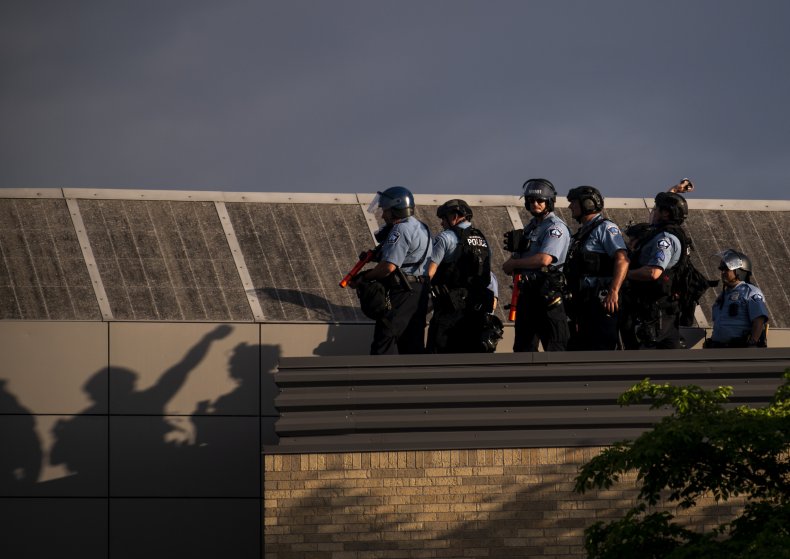
Riot police, including officers stationed on rooftops, used tear gas and rubber bullets in a bid to disperse protesters who smashed windows at the precinct and threw objects at police vehicles and officers.

In an interview with Fox9 as the protests raged on, Police Chief Medaria Arradondo said some demonstrators had been peaceful, but others had thrown Molotov cocktails.

As night fell, a number of nearby stores were looted and large fires were set in the street.

News footage from the area showed people running out of a Target store with clothing and carts full of stolen goods while other businesses, including an auto parts store, were set ablaze.

Police said officers had responded to a reported stabbing in the vicinity of Bloomington Avenue and Lake Street shortly after 9 p.m. on Wednesday and found a wounded man lying on the sidewalk.

“Officers checked and found that the man had trauma present and he was not breathing, nor did he have a heartbeat,” Minneapolis police spokesman John Elder said in a statement provided to Newsweek.

Officers began life-saving measures and the man was transported to Hennepin County Medical Center, where he was pronounced dead on arrival, Elder said.

An examination of his body revealed he had actually been shot, not stabbed as originally thought, he said. One man has been taken into custody in connection with the incident.

“The circumstances surrounding this death are currently being looked into and the Minneapolis Police Department has initiated a death investigation,” Elder added.

The fatal shooting took place during the looting of a nearby pawn shop and the shots were fired by the store’s owner, according to the Star Tribune.

A Cub Foods and a Dollar Tree were also among the stores damaged by looters. Videos on social media showed the ransacked, smoky interior of the Target store, where people were seen trying to break into cash registers.

According to Reuters, a smaller, peaceful protest was held outside the home of one of the police officers who was present at the scene of Floyd’s death.

The anger over Floyd’s death also fueled a protest that turned violent in downtown Los Angeles on Wednesday afternoon. A crowd marched onto a nearby freeway and blocked traffic, then attacked two California Highway Patrol cruisers and shattered their windows, according to local media reports.

The Minneapolis Police Department and Target have been contacted for additional comment.

Riot police
Police officers stand on the roof of the Third Police Precinct as one launches an explosive projectile down on the protesters below on May 27, 2020 in Minneapolis, Minnesota.
Stephen Maturen/Getty Images


Source link

The T List: Five Things We Recommend This Week

Welcome to the T List, a newsletter from the editors of T Magazine. Each week, we’re sharing things we’re eating, wearing, listening to or coveting now. Sign up here to find us in your inbox every Wednesday. You can always reach us at tlist@nytimes.com.

Use This

In my never-ending quest to reduce the environmental impact of my own existence, I’ve spent countless afternoons assessing the shelves of my local grocery, asking myself which among the various household cleaners, from dish soap to laundry detergent, is the least bad. “‘Least bad’ is a term I use a lot myself,” the New York-based entrepreneur Amanda Weeks told me recently. Weeks is the founder of Ambrosia, a new company that aims to repurpose food waste into useful items — its debut product, an all-purpose surface cleaner called Veles, might even be considered, well, good. Made through a fermentation process that extracts the active ingredients (alcohol, acetic acid, lactic acid, water), each bottle diverts roughly two pounds of waste; for context, as of 2018, a single waste treatment plant in Brooklyn processed about 250 tons daily. In addition to its sustainable production, Veles, with its terra-cotta-hued aluminum bottle (aluminum can be recycled over and over without degrading) and scent of bergamot, peppermint and lavender, is made with the design-focused customer in mind. And it works. $20, veles.com.


Regard This

While quarantining in London, the artist and photographer Mert Alas started thinking about the parallels between this time and the trying period preceding the Renaissance. “We haven’t had hundreds of years of plague and war, but we’ve had four interesting, difficult and sad months,” he says. The spell made him consider what might come next, and whether we’ll land on a new way of approaching art and fashion. To explore those questions, Alas put out a call to his Instagram followers in April for self-created images celebrating the human form, a major point of focus for Renaissance artists. He then whittled down the 2,000-some submissions to 50 before editing them to reflect his own point of view, changing colors, adding backgrounds and collaging. The resulting images, in which a Michelangelo-like nude might wear contemporary kicks, are a timeless celebration of the individual. Alas was also struck by how many of the original pictures showed ingenious ways of finding light, which can be hard to come by in quarantine. Yet this was also very fitting: “It’s about the world coming from dark to light,” Alas says. “The Quarantine Days Renaissance Project” launches on @mertalas today.

The Los Angeles-based jewelry designer Anna Sheffield has been vegetarian ever since she was 16. Which means that over the years, she’s learned how to be as creative in the kitchen with her own meals as she is with her designs. “Your standard dragon bowl is such a classic vegetarian macrobiotic meal,” Sheffield says of her favorite dish, which combines vegetables, protein and sauce. But, she adds, “once you’ve eaten it for 20 years, you’re a little bored with the basic brown-rice version.” Recently, she transformed the healthy staple into one inspired by the juxtapositions often seen in her necklaces, rings or earrings — pieces in which she often mixes metals and stones in unusual ways, embracing imperfection or intentionally setting gems upside down. “I like playing with rule-breaking techniques,” she says. “It’s still beautiful. It’s still precious. It still makes sense. But you’ve done it in a way that no one else would.” Her dragon bowl follows the same conceit, except she combines ingredients in a spectrum of flavors and hues. “You have the sweetness of the orange-yellow squash. And then you have the herbaceousness of the jade rice and the fresh fennel; that’s green-tasting. And then you get a little bit of sour and funky with both the purple beet kraut and the cabbage slaw.” For the recipe, visit tmagazine.com.


Read This

There’s an added aura of intensity to images made by photographers who died young, as if their short lives were brewed stronger, as if there were more life in each frame. In the case of the photographer Andy Sweet, add to that the aura of his long-unresolved murder at the age of 28, of his contact sheets rediscovered in a storage unit decades later, and you might barely be able to see his pictures at all. But Sweet, whose talent was recognized even in his youth, never needed the trappings of tragedy to make visible his vibrancy. Born in 1953 to a prominent Miami Beach family, the photographer captured the community’s seniors, many of them Holocaust survivors, in all their colorful splendor. A book of those images, “Shtetl in the Sun” (2019), serves as a companion to a new one, out this month, called “Hello Muddah, Hello Faddah,” in which the pendulum swings the other way, to the gawky angles of puberty. Taken over the course of the ’70s at Camp Mountain Lake in North Carolina, where Sweet was camper, then counselor, then photography teacher, the smell of sunscreen and wood cabins wafts from the pages. High socks and short shorts, amber sunglasses and halos of curly hair — the nostalgia is for all summers, including this one, the summer we may never have. $34.95, letter16press.com.


At a time when most of us are thinking about everything and anything but getting dressed, I’ve found myself wondering if clothing really matters to me at all anymore. If I’m being honest, I barely make it out of my (at this point threadbare) pajamas every day. What I’ve settled on, at least for now, is that wearing something soft, well-made and maybe a little bit indulgent is as good a way of lifting one’s spirits as a roughly shaken margarita, a pan of gooey brownies or a brisk walk outside. To that end, the Row has created a capsule collection with the German shopping website MyTheresa, which recently donated 10 percent of its profits from the month of March (350,000 euros) to the Red Cross’s Covid-19 relief efforts. As investment pieces that are made to offer comfort this summer and for many to come, the seven separates come in all shades of cream, and include a few shirt dresses, a cozy fishnet-knit sweater, some stretchy ’70s-style flared trousers and a really lovely silk and cashmere ribbed twin set. It will be available June 3, just after you’re officially allowed to wear white pants out (or in). mytheresa.com.


From T’s Instagram


Source link