Rich Phone Brokers Caught in North Korean Crackdown Escape Harsh Sentences

0

Authorities in North Korea have unexpectedly released several brokers who facilitate remittance payments from abroad after a crackdown on illegal phone use last month, letting the well-connected brokers off lightly despite government warnings that violators would be severely punished with no exceptions, sources told RFA.

North Korea allows domestic cellphones, but North Korean smartphones all run an application called “Red Flag” that keeps a log of webpages visited by users and randomly takes screenshots. These can be viewed, but not deleted with another app called “Trace Viewer.”

To avoid monitoring and to reach the outside world, people along North Korea’s border rely on smuggled Chinese cellphones that can access the Chinese mobile network. The illegal phones are a necessity for the families of refugees to keep in contact with loved ones who have left the country.

The brokers typically use the phones to coordinate transfers of money between North Korean refugees in South Korea and their families remaining in the North, usually through China. According figures from the South Korean Ministry of Unification, tens of millions of dollars are sent into North Korea this way each year.

After catching a large number of illegal phone users, authorities declared they would all face harsh punishment.

But sources in the country told RFA’s Korean Service that among approximately 10 phone brokers arrested in the area of Hyesan city, three were released this month with the relatively light sentence of reeducation.

“They were classified as subject to reeducation, and released early at the beginning of this month. Other people, including the family members of North Korean defectors, are still being held,” a resident of Ryanggang province told RFA July 3.

“Only a few of the phone brokers have been released and the residents are arguing back and forth over what the reason for the release could be,” the source said.

The source, who requested anonymity for security reasons, identified by surname one of the brokers caught in the crackdown.

“Kim, a man in his 40s living in Yeokjeon-dong, Hyesan city, made money by being an illegal phone broker for a long time, but he was caught in a joint crackdown by the Provincial Security Department and the police last month,” the source said.

“The law enforcement authorities threatened that if caught, the brokers would not be released even if they bribed them as usual. But somehow they were able to send some of the brokers to reeducation and released them,” the source said.

The source said that in the recent crackdown 10 phone brokers from Hyesan were arrested, “but only two or three people, including the man named Kim, were released for reeducation.”

According to the source, those released had been caught for the same infraction before.

“All of them are known to have given a large amount of money to the provincial investigation agency in exchange for their release [from previous arrests],” the source said.

“Even though the authorities said they would punish them with no exception, people suspect that bribery may have worked this time again,” the source said. RFA was unable to confirm if the brokers had again offered bribes.

A resident of neighboring North Hamgyong province, who requested anonymity to speak freely, told RFA that the crackdown and suspicious releases had happened there as well, raising the same bribery suspicions.

“Two of the residents who were arrested last month in a crackdown on money transfer brokers and illegal phone users were released a few days ago,” the second source said.

“A 35-year-old woman, identified only by her surname Park, and a man in his 40s, were released after being classified for reeducation,” the second source added.

The second source said the brokers’ wealth was a major factor in securing their releases.

“It is difficult for law enforcement to punish the rich brokers,” the North Hamgyong source said.

“Law enforcement agencies also need operating funds and must set aside some funds to the party, and high-ranking officials need their cut, too, to support their lifestyles,” the second source said.

“If they punish [the brokers] as part of the crackdown, where would such funds come from?” the second source said.

“After all these crackdowns and warnings of severe punishment, it is only the poor and powerless residents that are subject to said punishment,” said the second source.

“Those who have a lot of money always have someone who has their back, so they can get away with only being subject to reeducation,” the second source said.

“Ordinary people who have no cash to pay to the authorities have no choice but to go through all the hardships at correctional camps, so they are mortified and resentful, but alas, it is our reality.”

While there is no way to know exactly how many illegal phone users there are in North Korea, the Database Center for North Korean Human Rights, which interviewed 414 North Koreans in the South reported that 47 percent of them were in constant contact with their families in the North in 2018. Of those, about 93 percent said they called their families on the phone.

In the same survey 62 percent said they had sent money to North Korea. Based on their answers, the database center estimated that refugees in the South who send money to North Korea do it about twice per year, sending around 2.7 million South Korean won (U.S. $2,260) each time.

Each time they had to pay an average broker fee of almost 30 percent.

According to South Korea’s Ministry of Unification, 32,000 North Koreans have settled in South Korea since 1998, including 1,047 last year.

Reported by Jieun Kim for RFA’s Korean Service. Translated by Leejin Jun. Written in English by Eugene Whong.



Source link

Rose Ladies Series: Gemma Dryburgh wins again at Royal St George’s

0

Last Updated: 09/07/20 7:26pm


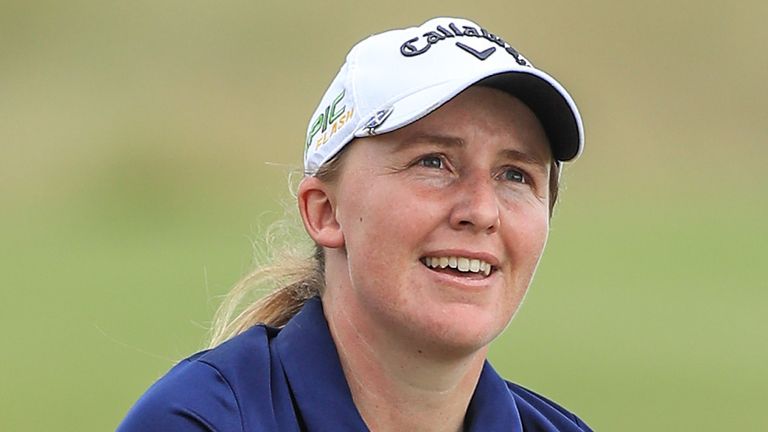
Gemma Dryburgh won her second Rose Ladies Series event in as many weeks

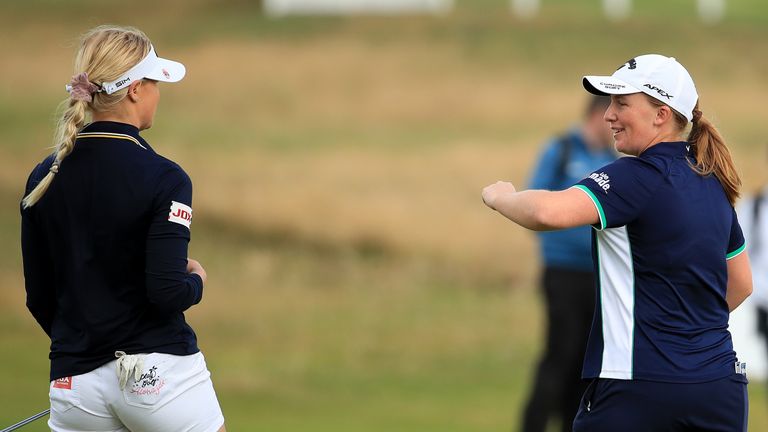
Gemma Dryburgh made it back-to-back wins on the Rose Ladies Series after a dramatic one-shot victory at Royal St George’s.

The Scot followed last week’s success at The Buckinghamshire with another impressive display on a historic day at Royal St George’s, where the event became the first professional female tournament ever held at the iconic Kent venue.

Dryburgh mixed three birdies with two bogeys to post a one-under 69 in windy conditions, which was enough to top the leaderboard and take the £5,000 first prize after playing partner Charley Hull bogeyed her final two holes.

Hull and Georgia Hall both carded level-par 70s

Hull and Georgia Hall both carded level-par 70s

Hull finished a shot back in a share of second alongside Georgia Hall, who completed the marquee threeball, with Annabel Dimmock a further two strokes adrift in tied-fourth with amateur Emily Toy.

“I bogeyed the first unfortunately, but after that I was really consistent,” Dryburgh told Sky Sports News. “The last two holes were playing very long and I was hitting 3-wood into the last two, so it was playing very tough and I was glad to get the win in the end.”

Rose Ladies Series headlines

Latest news and reports from the Rose Ladies Series.

After bogeying her opening hole of the day, Dryburgh birdied the par-five seventh and holed a 40-footer from the fringe at the 10th to edge ahead of the 57-player field.

Dryburgh got up and down from off the green to salvage a par at the 11th, where Hull rolled in from five feet to briefly move into a share of the lead, before regaining her advantage by draining a 20-foot birdie at the par-four 13th.

Dryburgh played alongside Hull and Hall on Thursday

Dryburgh played alongside Hull and Hall on Thursday

Hall moved back within one by picking up a shot at the long par-five 14th, as Hull made a 15-footer to salvage a par, before Dryburgh bogeyed the next to leave the trio tied at the top with three to play.

Hull grabbed the outright lead with a 10-foot birdie at the 16th, where Dryburgh holed from a similar distance for par and Hall scrambled a great bogey from the sand, only to pull her drive at the par-four 17th on her way to a bogey.

Rose Ladies Series: Jbc Country Club 22.07

July 22, 2020, 2:00pm

Live on

Dryburgh finished short of the final green but holed a five-footer to complete a solid two-putt from the fringe and end the day in red figures, with the par-save securing the win after Hull missed from a similar distance on her way to a closing bogey.

A second successive win moves Dryburgh top of the Order of Merit, ahead of events at JCB Golf and Country Club, Bearwood Lakes and The Shire over the next three Thursdays. The 54-hole Grand Final, being played across three venues, takes place from August 5-7.


Source link

Asad Umar says load-shedding in Karachi to ‘end’ in March 2022

The PML-N’s Khawaja Asif or the PPP’s Raja Pervaiz Ashraf ‘should be asked to respond because the Opposition was strongly criticising the K-Electric and claiming that the privitisation of the KE was a major injustice’, Umar said. AFP/Aamir Qureshi/Files

ISLAMABAD: March 2022 has been announced by Planning Minister Asad Umar as the final date for the power woes of Karachi to be resolved once and for all.

Speaking to talk show host and political analyst Hamid Mir in Geo News programme “Capital Talk”, Umar spoke about the metropolis’ sole power supplier, the K-Electric, and why he named politicians of the former governments during a heated debate in the National Assembly earlier today.

The minister’s remarks in the NA were made in response to the PPP’s call attention notice whereby members of Sindh’s ruling party had drawn Energy Minister Omar Ayub’s attention to the “unprecedented and unscheduled” load-shedding in Karachi at the hands of the K-Electric as well the National Electric Power Regulatory Authority’s (NEPRA) failure to hold the K-Electric accountable.

The minister explained that the reason why he took the names of the PML-N’s Khawaja Asif or the PPP’s Raja Pervaiz Ashraf was that both had been in relevant ministries during the parties’ respective tenures, but were criticising the K-Electric during the debate today.

“Let me tell you why I took their names. They should be asked to respond because the Opposition was strongly criticising K-Electric and claiming that the privitisation of the KE was a major injustice.

“I was just reminding them that the privitisation was not carried out by the PTI but during the PML-Q’s tenure. The new owner [of the K-Electric] came in about 10 years ago. Then, there were five years of the PPP and another five years of the PML-N.

“So when all of them were talking about how ‘dangerous’ the KE situation was, I just mentioned that they should be asked why they themselves did not do anything” to resolve Karachi’s load-shedding issues.

Umar said the technical reason why Pakistan’s economic hub continuously faced power outages was because the demand was higher than the supply.

“Either there should be enough capacity in the city to fulfill its power needs or we set up a system where additional power generated elsewhere in the country may be supplied to Karachi.

“At the moment, we have neither,” he noted. However, he explained that there was another solution, though no one in the prior governments had cared to implement or work towards it.

“While power manufacturing units have been set up across the country overall, no one attempted to ramp up the overall [electricity] distribution in Karachi to allow extra power to be imported from elsewhere in Pakistan if Karachi was facing shortages.

“On an emergency basis, we sat down with the KE and signed an agreement in principal and agreed on timelines. I can give you the technical details as to what changes we plan to bring and, after the implementation, this issue will be resolved forever,” the minister said.

In response to Mir’s question as to when would Karachi’s load-shedding woes be completely resolved, he said there are two different issues. First, he noted, was the severe load-shedding going on right now and the second was power shortage in general, considering the metropolis’ demand.

“At the moment, there’s severe load-shedding going on and that should be controlled in the next few days — not weeks but days. […] Currently, the demand for electricity is a little more than the supply; therefore, some load-shedding will continue but it will not be like what was seen over the past week.

“The deadline for our project — through which changes would be made in the distribution system to allow power to be imported into Karachi to fulfill its needs of 800-1,000MW power — is March 2022,” Umar said.

Source link

Who is Naya Rivera? Glee star missing at lake Piru in California

Image Source : INSTAGRAM/NAYA RIVERIA

Who is Naya Rivera? Glee star missing at lake Piru in California

Hollywood actress Naya Rivera, best known for playing Santana Lopez on hit TV musical drama Glee, has been missing after a trip to Lake Piru, California. As per reports,  the authorities launched a search and rescue operation using helicopters, drones, and dive teams for the actor on Wednesday after her four-year-old son Josey was found floating alone in a rented boat. It was reported that Rivera rented the boat in the afternoon. About three hours later, the child was spotted in the boat by himself. He was reportedly unharmed and he told the police investigators that he and his mother were swimming, but she never returned to the boat.

On Tuesday, Naya Rivera had tweeted a photo of her kissing Josey with the caption, “just the two of us”.

Who is Naya Rivera?

Naya Riveria is an American actress, model, and singer. She began her career as a child actress and model, appearing in national television commercials before landing the role of Hillary Winston on the short-lived CBS sitcom The Royal Family at the age of 4 (1991–1992), for which she received a nomination for a Young Artist Award.

Naya Rivera received her breakthrough role as an adult as Santana Lopez on the Fox television series Glee (2009–2015), for which she received nominations for numerous accolades.

She was signed to Columbia Records as a solo artist in 2011 and released a single in 2013, “Sorry”, featuring rapper Big Sean.

the 33-year-old actress married actor Ryan Dorsey in 2014 and they had a son, Josey Hollis, in September 2015. The couple divorced in 2018.

Fight against Coronavirus: Full coverage


Source link

Michael Holding breaks down on camera discussing racism his parents faced

0

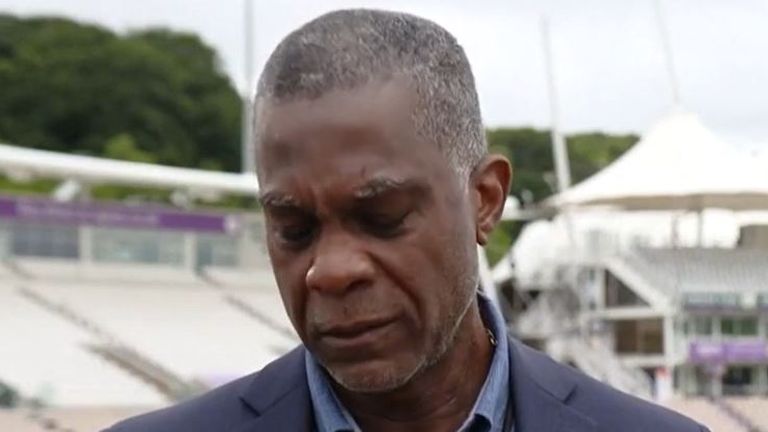
Former West Indies cricketer Michael Holding broke down in tears live on camera while discussing racism his parents faced in the past.

Yesterday the ex-fast bowler made an impassioned plea for society to change on the first day of England’s test match against West Indies in Southampton.

In an interview with Sky News’ Mark Austin today, the former cricketer, 66, revealed he was thinking about his parents when he became emotional on TV.


Wednesday: Holding’s incredibly moving speech about racism

When Austin asked him about how he felt in that moment, Holding’s voice began to break.

“To be honest, that emotional part came when I started thinking of my parents. And it’s coming again now.”


Former cricketer Michael Holding cried as he recalled the racism his parents had experienced.


In full: Ex-West Indies cricketer and Sky Sports commentator discusses racism

Holding paused, before continuing: “Mark, I know what my parents went through.

“My mother’s family stopped talking to her because her husband was too dark.

“I know what they went through, and that came back to me immediately,” Holding said, wiping tears from his eyes.

He also spoke about times he faced racism over the years, including when he and his white friend were assumed to not be booking into a hotel together in South Africa.

“We laugh about it when not living in that society, and sometimes I grimace in my head and I move on. But I cannot keep on laughing, grimacing and moving on,” he said.

“It’s time for change.”

He added he hoped tackling institutional racism would not be “brushed under the carpet” and again urged for better education on black history.

He said: “I hope people understand exactly what I’m saying, and exactly where I’m coming from. I’m 66 years old. I have seen it, I have been through it and I have experienced it with other people.

“It cannot continue like this – we have to understand that people are people.”

Yesterday during a delay for rain Holding revealed he had attended Black Lives Matter protests, and referred to the case of Amy Cooper, who called police after arguing with a black man in New York’s Central Park.

He said: “She threatened this black man with her whiteness, saying that she was going to call the police and tell them there was a black man threatening her.

“If the society in which she was living did not empower her or get her to think that she had that power of being white and being able to call the police on a black man, she would not have done it.

He went on to highlight the case of Lewis Howard Latimer, the black man who perfected the carbon filament that made the lightbulb possible, but is virtually unknown compared to its white inventor, Thomas Edison.

Source link

Bill Nye: Wearing A Mask Is ‘Literally A Matter Of Life And Death’

Bill Nye is sick and tired of people not wearing masks.

In two videos uploaded to TikTok mimicking the “Consider the Following” segment of his hit 1990s kids show “Bill Nye the Science Guy,” Nye demonstrated why masks are absolutely vital in the era of COVID-19.

“Why do people in the scientific community want you to wear a face mask when you’re out in public?” Nye asked in the first video, answering: “Face masks … prevent particles from my respiratory system from getting into the air and then into your respiratory system. Blocking the movement of air is an old trick.”

Nye went on to hold a scarf, a homemade face mask and an N95 mask in front of his face as he attempted to blow out a candle. The N95 mask was the most effective at restricting airflow and the scarf the least. See that video below:

“The reason we want you to wear a mask is to protect you, sure,” Nye said in the second video, which appears below. “But the main reason we want you to wear a mask is to protect me from you and the particles from your respiratory system from getting into my respiratory system.”

He then concluded with an urgent plea: “Everybody, this is a matter literally of life and death. And when I use the word ‘literally,’ I mean literally a matter of life and death. So when you’re out in public, please wear a mask.”

Nye has been a vocal proponent of masks since the coronavirus pandemic began, predicting that “five years from now, it will be common for city dwellers to wear face masks in public,” and that “like other articles of clothing, these masks will be washable and reusable, but still effective.”

“Intuitively, if both people — that is to say, the infector or infectrix and the infectee — are both wearing masks, you’ve got to think you’re coming out ahead,” Nye said in an early June interview with The Washington Post.

A HuffPost Guide To Coronavirus


Source by [author_name]

Joy Reid Takes Nightly Anchor Slot at MSNBC

Ms. Reid apologized for writing mocking claims that Charlie Crist, the former Florida governor, was gay. But additional offensive posts emerged. Along with opposing gay marriage, she opined that “most straight people cringe at the sight of two men kissing” and that “a lot of heterosexuals, especially men, find the idea of homosexual sex to be … well … gross.” She said Rachel Maddow, who was not yet her colleague, held views “at the left-most end of the political spectrum.”

Ms. Reid initially claimed those posts had been fabricated and inserted into the archives of her blog by hackers intending to defame her. She even hired a cybersecurity expert. Later, she acknowledged that there was little evidence that the posts had been faked.

“I genuinely do not believe I wrote those hateful things because they are completely alien to me,” she told viewers in April 2018 in a lengthy apology, saying she had grown up “in a household that, like many in America, had conservative views on L.G.B.T.Q. issues.”

“The person I am now is not the person I was then,” Ms. Reid told viewers. Many liberal pundits defended her, including Jonathan Capehart, Jeffrey Toobin and Joan Walsh.

Asked on Wednesday if she still believed she had not written the posts, Ms. Reid said: “It’s two years ago, so I don’t spend a whole lot of time thinking about that old blog. What I genuinely believe is that I truly care about the L.G.B.T. people in my own life. I care about being a good ally, a good person, and making sure that my voice is authentic, that I can make a difference.”

NBC has pledged to improve its diversity, an area where its news networks have struggled. Mr. Conde, a former chairman of Telemundo who succeeded NBC News’s previous chairman, Andrew Lack, in May, said this week that he wanted a work force that was 50 percent nonwhite, with employees split evenly by gender.

“AM Joy” was created after a previous weekend host, Melissa Harris-Perry, left MSNBC, accusing the network of sidelining her. “I am not a token, mammy or little brown bobble head,” Ms. Harris-Perry, who is Black, wrote in an email to NBC staff at the time.


Source link

Female Soldier Set To Become First Woman To Join A Green Beret Team

WASHINGTON (AP) — For the first time, a female soldier has graduated from the Army’s elite Special Forces course and will join one of the all-male Green Beret teams, capping a years long campaign to move women into the military’s front-line combat jobs.

The unidentified woman is one of three female soldiers who have been going through the Army Special Forces qualification course at Fort Bragg, North Carolina. She graduated Thursday and donned her Green Beret, along with about 400 other soldiers. Defense officials, speaking on condition of anonymity to discuss personnel matters have confirmed that she is a member of the National Guard.

Lt. Gen. Fran Beaudette, commander of Army Special Operations Command, presided over the ceremony and was able to say, for the first time, that “our Green Beret men and women will forever stand in the hearts of free people everywhere.”

“From here, you will go forward and join the storied formation of the Green Berets where you will do what you are trained to do: challenge assumptions, break down barriers, smash through stereotypes, innovate, and achieve the impossible,” he said.

The Army does not release the identities of its commandos or disclose to which special forces group they will be assigned.

The more than 6,700 Army Green Berets are highly trained commandos who usually work in 12-person teams. They are often used for specialized combat and counterterrorism operations and to train other nations’ forces in battle skills. Many work with Afghan forces fighting the Taliban or are training troops in up to 60 countries.

The path to becoming a Green Beret consists of several phases, beginning with a grueling assessment and selection phase where commanders believe they can identify soldiers who cannot make the grade or do not belong. The bulk of those who try out fail. Some who get injured or fail are allowed to return and try again.


Source by [author_name]

Ziwe Fumudoh Asks: ‘How Many Black People Do You Know?’

“It’s kind of a racial high-wire act having that kind of conversation,” Mr. Wilmore said. “She seems generous in her approach too, which is nice, but yet there’s something else going on there. There’s a twinkle behind her eye that makes you go, ‘What is she doing here exactly?’”

Her interviews are more of a wink to people who expect Ms. Calloway and Ms. Roman to respond to the questions as they did, according to Mr. Wilmore. In 2016, when he hosted the White House Correspondents’ Association Dinner, he was criticized for calling President Obama a racist slur; that was a risky wink.

“I took a lot of blowback from that,” Mr. Wilmore said. “But the people who understood it, there was a lot of praise and support for it.”

Ms. Fumudoh’s wink is aimed more at Black women who feel awkward and uncomfortable all the time simply because they are navigating the world. She makes the discomfort visible and shareable by all.

“This is my way of seizing my authority and my autonomy,” she said, “and pushing that back onto society and saying, ‘Hey, I’m not going to be the only one who’s going through this life feeling discomfort.’”

The guests on the show do get uncomfortable, like when Ms. Fumudoh asks them how many Black friends they have, or when they fumble if they know who Marcus Garvey or Huey Newton are. Ms. Fumudoh, though, was quick on her feet when asked to name five white people in 10 seconds.

“Three of the Haim sisters, John F. Kennedy, shout out to him, and the fantastic actress Anne Hathaway,” she answered immediately. It’s not about naming five Black friends, or five Black authors you’ve read. Ms. Fumudoh simply does not want to be the lone carrier of the tension that she faces as a Black woman.

“I’m just trying to heal,” Ms. Fumudoh said. “I’m just trying to make people laugh and make people feel good.”

Source link

Boosting a liver protein may mimic the brain benefits of exercise

0

Exercise’s power to boost the brain might require a little help from the liver.

A chemical signal from the liver, triggered by exercise, helps elderly mice keep their brains sharp, suggests a study published in the July 10 Science. Understanding this liver-to-brain signal may help scientists develop a drug that benefits the brain the way exercise does.

Lots of studies have shown that exercise helps the brain, buffering the memory declines that come with old age, for instance. Scientists have long sought an “exercise pill” that could be useful for elderly people too frail to work out or for whom exercise is otherwise risky. “Can we somehow get people who can’t exercise to have the same benefits?” asks Saul Villeda, a neuroscientist at the University of California, San Francisco.

Villeda and colleagues took an approach similar to experiments that revealed the rejuvenating effects of blood from young mice (SN: 5/5/14).  But instead of youthfulness, the researchers focused on fitness. The researchers injected sedentary elderly mice with plasma from elderly mice that had voluntarily run on wheels over the course of six weeks. After eight injections over 24 days, the sedentary elderly mice performed better on memory tasks, such as remembering where a hidden platform was in a pool of water, than elderly mice that received injections from sedentary mice.

Comparing the plasma of exercised mice with that of sedentary mice showed an abundance of proteins produced by the liver in mice that ran on wheels.

The researchers closely studied one of these liver proteins produced in response to exercise, called GPLD1. GPLD1 is an enzyme, a type of molecular scissors. It snips other proteins off the outsides of cells, releasing those proteins to go do other jobs. Targeting these biological jobs with a molecule that behaves like GPLD1 might be a way to mimic the brain benefits of exercise, the researchers suspect.

Old mice that were genetically engineered to make more GPLD1 in their livers performed better on the memory tasks than other old sedentary mice, the researchers found. The genetically engineered sedentary mice did about as well in the pool of water as the mice that exercised. “Getting the liver to produce this one enzyme can actually recapitulate all these beneficial effects we see in the brain with exercise,” Villeda says. 

Blood samples from elderly people also hint that exercise raises GPLD1 levels. Elderly people who were physically active (defined as walking more than 7,100 steps a day) had more of the protein than elderly people who were more sedentary, data on step-counters showed.

GPLD1 seems to exert its effects from outside of the brain, perhaps by changing the composition of the blood in some way, the researchers suspect.

But the role of GPLD1 is far from settled, cautions Irina Conboy, a researcher at the University of California, Berkeley who studies aging. There’s evidence that GPLD1 levels are higher in people with diabetes, she points out, hinting that the protein may have negative effects. And different experiments suggest that GPLD1 levels might actually fall in response to certain kinds of exercise in rats with markers of diabetes.

“We know for sure that exercise is good for you,” Conboy says. “And we know that this protein is present in the blood.” But whether GPLD1 is good or bad, or whether it goes up or down with exercise, she says, “we don’t know yet.”

Source link