New phase of hotel quarantine must be managed safely – and fairly

0

Prime Minister Scott Morrison has acknowledged that the national cabinet’s decision on Friday to more than halve the number of international arrivals will make it harder for Australians to return home. He says the decision, which equates to 4000 fewer arrivals a week from Monday, was made in the national interest – “to protect the health of Australia and Australians first”.

Consideration will be given to expanding that capacity in coming weeks, but that will depend on how well the pandemic is being managed.

The surge of infections in Victoria shows that Australia, while doing better than most other countries in controlling the spread of the virus, is on the same roller-coaster ride when it comes to dramatic spikes in infections.

The mismanagement of the quarantining system in Victoria has not only delayed Australian citizens from returning home, it has also put plans on hold for the return of international students. Universities and the federal government had a plan in place to test the safety of bringing thousands of international students back on a trial basis. Delaying the start of that trial will cost the international student sector billions of dollars.

The NSW government is concerned about the optics of bringing in hundreds of international students a day at a time when thousands of Australian citizens are prevented from returning.

The use of police to enforce the quarantine of return travellers in Sydney has been effective in isolating COVID-19 infections. But the failures to manage the system in Victoria have led to a crisis, forcing the closure of Melbourne airport to overseas travellers.

Australian citizens living overseas have every right to come home, and they will be feeling frustrated and no doubt worried about further delays as the government tries to balance competing pressures on resources. Reports suggest that some people are also angry that they will be expected to pay for their own hotel quarantine when they return.

It is a double blow for those who face delays in coming home to also find themselves lumped with a hefty hotel bill as a result of government policy.

However, the normal state of affairs has been thrown out the window by the pandemic. Australians seeking to get home from overseas will need to be flexible in order to protect the effectiveness of the hotel quarantine system, which is paramount.

At the same time, all levels of government must ensure the pricing level for returning travellers is fair and equitable. They also need to know how their arrivals will be prioritised, given the new restraints.

With Melbourne’s international airport closed off, and Sydney attempting to fend off a second wave, other states must step up and ensure they share responsibility for receiving and quarantining international travellers.

Managing this new phase of hotel quarantine successfully will be essential. As acting Chief Medical Officer Paul Kelly points out, a single breach in quarantine, even if it is low risk, can lead to a catastrophic outcome.

Most Viewed in National

Loading

Source by [author_name]

SpaceX delays launch of Starlink, BlackSky satellites again due to rocket checks

0

CAPE CANAVERAL, Fla. — SpaceX postponed the latest launch of a new Starlink satellite fleet again Saturday (July 11) citing the need for more checks of the mission’s Falcon 9 rocket. 

The California-based rocket builder planned to launch 57 Starlink satellites andtwo BlackSky Global Earth-observing satellites from Florida at 10:54 a.m. EDT (1454 GMT) Saturday as part of a rideshare mission. But just over an hour before liftoff, SpaceX announced via Twitter that it was standing down. A new launch date and time still needs to be confirmed with the Eastern Range, the entity that oversees all launches along the East Coast. 


Source link

Belfast man in court accused of grooming child with intent

0

A man has appeared in court accused of grooming a child with intent to commit a sex offence.

orman Quinn faces two counts of communication with a person under the age of 17 with intent to commit and indictable offence, one of criminal damage and one of assault.

No details of the alleged offences were given as the 54-year-old appeared for the first time before Belfast Magistrates’ Court on Saturday.

District Judge Mark Hamill said Quinn, of Blythe Street in south Belfast, was to be released on his own bail of £400 on the condition that a suitable bail address is found.

He is due to appear in court again on August 3.

Belfast Telegraph

Source link

Hospitals approach crisis as US coronavirus cases soar to new records – live


Outrage is growing among opponents of Donald Trump’s decision to commute the prison sentence of his longtime friend and notorious Republican fixer Roger Stone despite the US attorney general having declared Stone’s conviction “righteous”.

Criticism on Saturday came from both sides of the political aisle.

Adam Schiff, a California Democrat and chairmen of the House intelligence committee – the congressional panel Stone was convicted of lying to about aspects of the Trump-Russia investigation – called the decision “destructive of the criminal justice system and the rule of law” on Saturday morning.

Senator Mitt Romney, a Republican of Utah, described the decision as “unprecedented, historic corruption”.

Mitt Romney
(@MittRomney)

Unprecedented, historic corruption: an American president commutes the sentence of a person convicted by a jury of lying to shield that very president.


July 11, 2020

Trump commuted the sentence of Stone on Friday night. He was a former campaign adviser to the president and was due on Tuesday to begin a sentence of three years and four months in jail.

Stone, 67, was convicted in November 2019 of obstructing a congressional investigation into whether the Trump campaign colluded with Russia to win the 2016 election.

Trump said that Stone was targeted in an “illegal witch-hunt”, prompting the global politics professor and political columnist Brian Klass to tweet on Saturday: “This is a complete lie. Roger Stone committed a series of well-documented crimes that are not seriously contested.”

He added: “This is what despots do: wield the law like a weapon to attack political opponents and protect loyal cronies. It’s a disgraceful, dark day for American democracy.”

Stone was convicted in November 2019 of seven crimes, including obstruction of justice, lying to Congress and witness tampering in the congressional investigation into Russian interference in the 2016 presidential election.

You can read the full article below:


Updated


Source link

As Kenya Keeps Schools Shut, Teen Pregnancies Are Rising

0

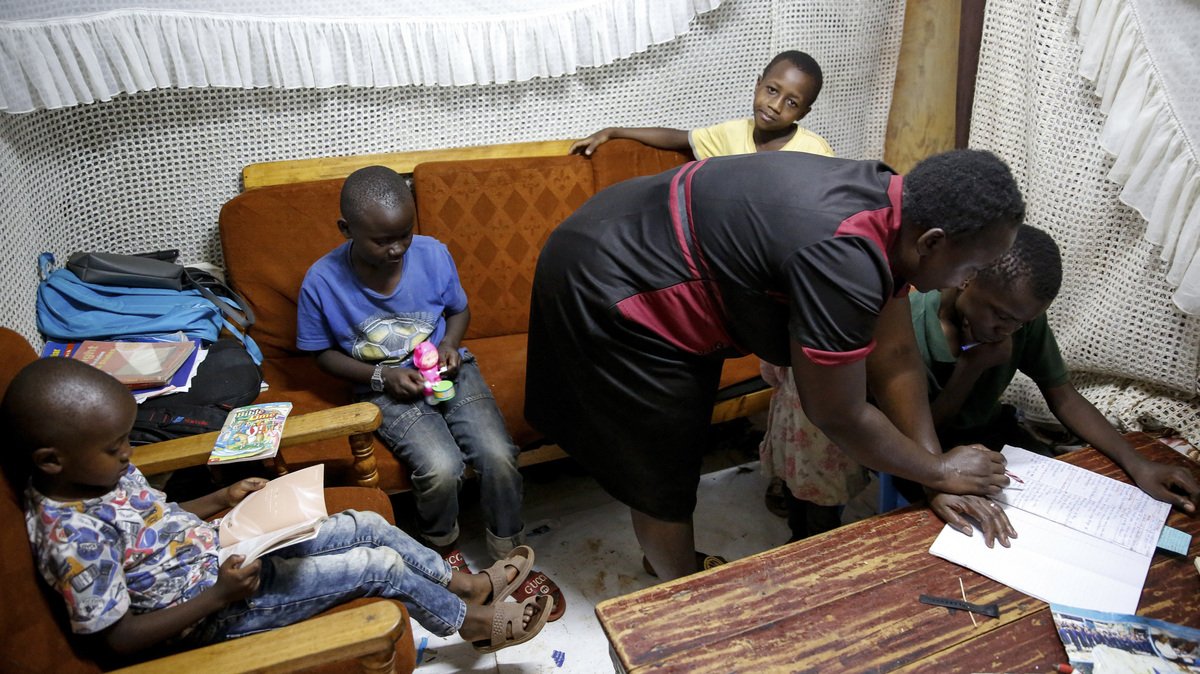
In Nairobi’s Kibera slum in April, Nancy Andeka, 45, teaches her and her neighbor’s children at home as schools are closed due to the coronavirus.

Brian Inganga/AP


hide caption

toggle caption

Brian Inganga/AP

In Nairobi’s Kibera slum in April, Nancy Andeka, 45, teaches her and her neighbor’s children at home as schools are closed due to the coronavirus.

Brian Inganga/AP

As Zuleika Yusuf Daffala walks across Kibera, one of the big informal settlements in Kenya’s capital, she greets dozens of kids on the streets. Some are jumping rope, others chasing each other through the alley and another group is trying to make a tiny cooking pan out of an aluminum can.

Daffala, a 37-year-old community activist, broke the news this week to many of the neighborhood kids that the Kenyan government had decided that the country’s more than 12 million grade school students would not be going back to classrooms until January 2021. Not only that, but the government considers the 2020 school year “lost,” so all kids will remain in the same grade for another year.

“They are still not believing it,” she says. “When you go to school, you have a target. So they have their plans already. They are not taking it easy.”

She says her son, a junior in high school, is resigned. Like most Kenyans, he doesn’t have a tablet or a laptop, so he’s trying to keep up with whatever books he can get his hands on. But mostly these days, he’s making bracelets with some beads his mother bought him.

Daffala says her kids are mostly OK. But in Kibera, many parents live on the dollar or two they make from whatever work they can find every day. So they cannot stay home with their kids.

More and more, she says, she’s getting calls from parents in the neighborhood that their teenage daughters are pregnant.

Kenya has long had one of the highest underage pregnancy rates in the world. But since early March, counties have reported thousands of cases. Citing an increase in teenage pregnancies, President Uhuru Kenyatta ordered his National Crime Research Center to investigate.

“Life has changed completely,” Daffala says. And chances are that many kids will never go back to school.

Children run down a street past an informational mural warning people about the dangers of the coronavirus in the Kibera settlement in Nairobi, Kenya, June 3.

Brian Inganga/AP


hide caption

toggle caption

Brian Inganga/AP

Children run down a street past an informational mural warning people about the dangers of the coronavirus in the Kibera settlement in Nairobi, Kenya, June 3.

Brian Inganga/AP

“Children alive at home”

Kenyan children have been out of school since March. But even as the coronavirus surges in the country, the government opened up hotels and restaurants and, beginning in August, Kenya will open up its international airspace. So there was hope that children could go back to school in September.

But on Tuesday, the government said schools are in no position to reopen, because many of them have more than 100 children per class.

At the announcement, government officials were flanked by teachers, who agreed with the plan.

“With children crowding, it will be impossible to think of opening schools,” Akello Misori, a leader for a big teachers’ union, said.

But Damaris Parsitau, an education scholar at Kenya’s Egerton University, says she is “conflicted” about the government decision. On the one hand, keeping kids out of school for that long will undoubtedly result in learning loss and will further marginalize vulnerable children. On the other hand, schools in Kenya are in a “horrible state,” she says, and there is no way to guarantee students’ safety.

“I would rather have children alive at home,” she says, “than go to school and risk getting infected and dying and taking it back to their families.”

All of this makes her angry, she says, because it points to a government that has failed to build more schools, hire more teachers and prioritize education.

“All this to me goes back to corruption and the fact that the government has never really taken it seriously to invest in educational infrastructure,” she says.

Underage sex

Back in Kibera, Jackline Bosibori, 17, has been spending almost all her days in a tiny room. It has a dirt floor and the walls and roof are made of corrugated metal.

Bosibori was going to a boarding school but like all Kenyan students, she was sent home in March.

“I was just idling here,” she says. “I didn’t have anything to do. Sometimes, I was just here reading alone. I don’t have anyone to be with … so I decided to just be at my boyfriend’s place.”

In late March, she found out she was pregnant. Her boyfriend is 21 and has stopped communicating with her. In Kenya, anyone under 18 cannot legally consent, so Bosibori was raped.

Her mom Annah Nyamoko, 35, can’t contain her tears when she talks about her daughter.

Nyamoko has six other daughters. She says her husband left her because they never had a son. She works sifting through trash to find recyclables, earning about $15 a week. But somehow she had always cobbled together enough money to pay her 17-year-old’s school fees.

The dream was that Bosibori would go to college, become a lawyer because she loves a good argument, and then help the family out of poverty.

“I’m feeling very bad,” her mom says. “I don’t know what I can do now.”

Bosibori says she wants to give birth and go back to school.

“If you don’t have [a high school diploma] here in Kenya, there is no work for you,” Bosibori says.

But a 2015 survey of out-of-school teenage girls in Kenya found that as few as 10% ever return to school.

Bosibori doesn’t even want to think about that possibility, but huge questions hang over her: Who will watch her baby if she goes to school? Can her mom feed her siblings if she can’t work because she has to care for the baby? How does she pay for school fees? Will she be shunned? As it is now, she says people on the streets already stigmatize her, telling her she’s a disappointment.

“If I can’t go back to school,” she says, “I know my life would be miserable.”

Source link

Business Leaders Urge Trump to Leave DACA Alone After Court Ruling

0

A group of prominent business leaders urged President Trump on Saturday to leave in place a program affecting roughly 800,000 young immigrants who are shielded from deportation, saying it would disrupt the economy and impact the battle against the coronavirus.

The letter, from members of the Coalition for the American Dream, an alliance of business and industry leaders, comes after the Supreme Court ruled last month that the Trump administration improperly wound down the Obama-era program known as Deferred Action for Childhood Arrivals, or DACA, a finding that was made on procedural grounds. The signers of the letter included executives with Amazon, General Motors, Hilton Worldwide, Target, Apple, Google and Facebook, as well as groups like the U.S. Chamber of Commerce and almost every sector of the manufacturing industry.

“As large American employers and employer organizations, we strongly urge you to leave the DACA program in place,” members of the group wrote about the program, which applies to people who were brought to the United States as children. “DACA recipients have been critical members of our work force, industries, and communities for years now, and they have abided by the laws and regulations of our country in order to maintain their DACA status.”

The letter went on to say that “their work and commitment to our companies, their families and communities are critical to our nation’s strength, especially since there are tens of thousands of DACA recipients working as front line doctors and nurses and in other critical industries fighting Covid-19.”

“This is no time to disrupt the economic recovery of our companies and communities, nor time to jeopardize the health and safety of these vulnerable individuals,” the letter said, noting that polls have consistently shown voters don’t want to see DACA recipients deported. “We ask that you leave DACA in place and refrain from taking any additional administrative actions that would negatively impact the DACA program.”

Mr. Trump has suggested he would try again to rescind the program, which he has alternately praised and criticized.

On Friday, in an interview with the Spanish-language network Telemundo, Mr. Trump gave a confusing statement about his plans to write an immigration-related executive order in about four weeks.

“DACA is going to be just fine,” Mr. Trump said, adding that he was going to issue a “big executive order. I have the power to do it as president and I’m going to make DACA a part of it.”

Then he immediately said, “But, we put it in, and we’ll probably going to then be taking it out.” At another point, he said that it would be a “very big bill” that would call for merit-based immigration and include a DACA provision. He then said there would be a “road to citizenship” in the executive order — which he repeatedly confused with a piece of legislation. Presidents cannot create a pathway to citizenship without congressional action.

Almost immediately after Mr. Trump’s interview, a White House spokesman issued a statement that was quite different from what the president said. The statement said that Mr. Trump was working on an executive order to “establish a merit-based immigration system to further protect U.S. workers,” something that the White House has been planning for weeks. The statement made clear it would not relate to DACA or a “road to citizenship.”

Source link

Do activists have the upper hand against US pipelines?

On Monday, July 13 at 19:30 GMT: 
Activists defending Indigenous and environmental rights in the United States are celebrating three important wins in their long-running fight to stop pipelines funnelling oil and gas through sensitive tribal lands. 

On July 6 a US federal judge ruled the Dakota Access Pipeline be shut down and emptied of oil, pending the outcome of an environmental review. It is a victory for the Standing Rock Sioux Tribe and other Native American and environmental defenders who have sought to block the pipeline since 2016, and who argue that spills from the pipeline would contaminate rivers and groundwater. The pipeline operator is appealing the decision.

That same day, the US Supreme Court upheld an order placing construction of the Keystone XL oil pipeline on hold for further regulation and an extended permitting process – a blow to US President Donald Trump, who used executive orders to help resurrect the once-abandoned project.

The Dakota Access and Keystone XL rulings came after Duke Energy and Dominion Energy announced the cancellation of plans to build the Atlantic Coast Pipeline between West Virginia and North Carolina. The companies say the high cost of fighting legal action swelled their costs, rendering the project unviable. 

As energy firms struggle with depressed revenue amid a global coronavirus pandemic that has throttled demand for oil and gas, anti-pipeline activists seek to maximise their advantage. But they still face challenges, with the Supreme Court allowing other projects such as Jordan Cove and Line 3 to continue under a fast-track permit process.

We will meet three Indigenous and environmental rights activists in the vanguard of efforts to protect their lands from big energy. Join the conversation.

Read/watch more:
US tribe objects to Dakota Access oil pipeline expansion – Al Jazeera
Criminalising Standing Rock – Al Jazeera

Source: Al Jazeera

Source link

Liverpool v Burnley: Premier League – live!

0

Liverpool: Alisson, Williams, Gomez, Van Dijk, Robertson, Fabinho, Wijnaldum, Jones, Firmino, Mane, Salah

Subs: Adrian, Lovren, Keita, Oxlade-Chamberlain, Minamino, Shaqiri, Origi, Alexander-Arnold, Elliott

Burnley: Pope, Bardsley, Tarkowski, Long, Taylor, Pieters, Brownhill, Westwood, McNeil, Rodriguez, Wood

Subs: Peacock-Farrell, Gudmundsson, Brady, Vydra, Thompson, Dunne, Benson, Goodridge, Driscoll-Glennon

Referee: David Coote

Source link

Brooklyn Beckham Is Engaged to Girlfriend Nicola Peltz — See Her Gorgeous Ring!


Brooklyn Beckham Is Engaged to Nicola Peltz | PEOPLE.com


this link is to an external site that may or may not meet accessibility guidelines.

Source link

To ‘Protect Young Minds,’ Hong Kong Moves to Overhaul Schools

0

Starting this fall, schools in Hong Kong will display colorful new government-issued posters declaring that “freedom comes with responsibilities.” Administrators may now call the police if anyone insults the Chinese national anthem on campus.

Students as young as kindergartners will be taught about a new national security law that gives the authorities the power to squelch opposition to Beijing with heavy prison sentences.

After months of antigovernment protests in Hong Kong, China’s ruling Communist Party is reaching into the semiautonomous territory to overhaul an education system that it sees as having given rise to a generation of rebellious youth. The sweeping law Beijing imposed earlier this month also targets Hong Kong’s students, who have been a galvanizing force behind the protests.

Carrie Lam, the city’s Beijing-backed leader, said at a forum on Saturday that the arrests of more than 3,000 children and teenagers at protests had exposed how the city’s campuses had been penetrated by forces hostile to the local and central governments.

“Faced with such a severe situation with our young people, we can’t help but ask, what is wrong with education in Hong Kong?” she said.

Mrs. Lam said the schools’ textbooks, classroom teaching and students’ extracurricular activities reflected negative news media reporting about China and the “wanton discrediting of the government and police.” Educating students about the new law, she said, would help them become more law-abiding.

The party’s goal for the territory is clear: to foster a new generation of loyal and patriotic Hong Kong youth. It is a strategy of ideological control that it has wielded to great effect in the mainland, but could rapidly erode Hong Kong’s reputation for academic freedom.

“Young kids will be brought up to understand and believe that without the Chinese Communist Party they have no future, that anything they have is because of the party,” said Steve Tsang, director of the China Institute at the School of Oriental and African Studies in London.

Over the last year, images of students in neatly pressed school uniforms joining hands to form human chains have become among the most evocative symbols of the protest movement.

But campuses have also been the site of some of the movement’s most violent scenes, such as at Polytechnic University, where protesters and police officers faced off in a prolonged fight with rubber bullets, firebombs and bows and arrows in November.

Now, in forcing through the security law, Beijing has signaled that it has seen enough. On Wednesday, Kevin Yeung, Hong Kong’s education secretary, barred students from singing “Glory to Hong Kong,” a popular protest song, displaying political slogans or forming human chains on campus.

Defenders of the law have argued that the city’s academic freedom would remain untouched. But, they say, students and teachers should know that freedom of speech comes with limitations.

“You can’t just allow teachers to talk, and impose their views, free for all,” said Regina Ip, a cabinet member who leads a pro-Beijing party in the legislature. “Critical thinking does not mean training people to criticize or attack.”

Even before the law was enacted, the transformation of Hong Kong’s education system was already underway.

The new school year had just started in September when Law Pei-lee, a teacher at a girls’ school, learned that a parent had filed a complaint about her conduct. She was accused of discussing the case of Lam Wing-kee, a local bookstore owner who was kidnapped by Chinese security officials in 2015.

Ms. Law, a veteran teacher, said she had mentioned the incident in passing. But she said the education bureau repeatedly demanded an explanation. Though she was never officially punished, she said the monthslong investigation felt like “psychological torture.”

Worse, Ms. Law said, she feared the law would stifle young minds. “Will our kids be able to think critically when they grow up?”

Both the education bureau and an employee at Ms. Law’s school, Sacred Heart Canossian School Private Section, said they could not comment on individual cases.

Some teachers and students say the investigations have created a climate of fear on campuses. A recent survey of more than 1,100 teachers found that around a third had been told by a supervisor to avoid discussing politics.

Some parents say they are only trying to keep their children out of harm’s way.

“What are the teachers afraid of?” said Ho Chiu Fai, a father of a fifth-grader and founder of Help Our Next Generation, a group of volunteers who investigate complaints against teachers. “We are all very worried that our kids will do something illegal, like go to illegal protests.”

Mr. Yeung, the education secretary, has vowed to “ferret out” problematic teachers. Leung Chun-ying, Hong Kong’s former top leader, has set up a fund to help investigate teachers.

“The Government have a duty to protect young minds from radicalization,” Mr. Leung wrote in an email.

Some teachers have lost their jobs for not taking a harder line against protest-related actions in school.

Lee Kwan-pui, a music teacher at Heung To Middle School, was fired in May after she let her students play “Glory to Hong Kong,” according to local media reports. Ms. Lee defended herself in an email she sent to the school’s staff and students, seen by The New York Times, saying she had reminded students to avoid social topics when choosing songs, but that ultimately it was their decision.

“I never brought up my political stance to students on campus,” she wrote.

After Ms. Lee’s firing, students formed human chains at the school in protest. Reached by telephone, an administrative employee at the school declined to comment.

The new national security law — which authorizes life imprisonment for secession, terrorism and other political offenses in the most serious cases — could make navigating classroom discussions even more difficult for teachers.

Liberal Studies, a mandatory civics course that has been blamed by some officials for radicalizing students, will likely come under much greater scrutiny. Chinese history has become a mandatory subject in middle schools, and some teachers have asked how they should discuss contentious events under the party’s rule.

Schools must review their library catalogs to remove books that “provoke any acts or activities which endanger national security,” the bureau said in a statement to The Times.

The law is already having a deterrent effect. At Ying Wa College, an elite boys’ school, a group of students who only last month chanted pro-independence slogans on the school’s sports field has now quickly disbanded and taken down its social media account.

Beijing’s broader push for control over the city’s schools and its sweeping interpretation of national security also raises questions about the future of Hong Kong’s status as a hub for higher education in the region.

The uncertainty over the law is driving concerns that scholars may be forced to censor themselves. Others fear that the vaguely defined crime of collusion could be applied to international academic collaborations.

Bruce Lui, a senior lecturer in journalism at Hong Kong Baptist University, pointed out the many topics that are covered by mainland China’s own national security law, ranging from the economy to outer space and, lately, biosecurity. Could researchers in Hong Kong, he asked, be punished for publishing data on the origins of the new coronavirus if their findings implicated China?

Some administrators are striking a defiant note. Kellee Tsai, the dean of the school of humanities and social science at the Hong Kong University of Science and Technology, encouraged her department to carry on their teaching and research as usual until further instructions were issued.

“There may well be non-obvious ‘red lines’ in Hong Kong’s higher education sector that cannot be crossed without severe legal consequences,” she told them in an email seen by The Times. “Let’s not draw those lines ourselves.”

Bella Huang contributed reporting.

Source link