Image Source : VIDEO GRAB TWITTER @SALLU KHAN RADHE
When Salman Khan offered his blazer to Wajid Khan on Bigg Boss 8 stage, watch throwback video
Ever since the shocking news of Wajid Khan’s death, the entire Bollywood fraternity is deeply saddened and mourning the loss of one of the popular music composers of Bollywood. Now, an old video from the reality show Bigg Boss 8 featuring Salman Khan and his dear friend and music composer Wajid Khan is going viral for all the emotional reasons. Wajid Khan’s brother Sajid Khan can also be seen in the throwback video.Superstar Salman Khan and Wajid Khan are known to have always shared a special bond and this video is proof.Â
The video showcases Sallman Khan offering his blazer to Wajid Khan who, in return kisses the actor’s hand. The video has been shared by one of the Salman Khan fan pages on Twitter. Take a look:
— Sallu Khan RADHE (@sallukhanbeing) June 1, 2020
Earlier, Salman Khan paid his tribute to Wajid Khan on social media saying, “”Wajid Vil always love, respect, remember n miss u as a person n ur talent, Love u n may your beautiful soul rest in peace”.
Wajid Khan reportedly died of kidney failure at the Suvarna hospital in Mumbai at the age of 42. He was believed to be suffering from COVID-19 as well. Recently, Sajid-Wajid also composed Salman Khan’s two songs, ‘Pyaar Karona’ and ‘Bhai Bhai’ amid the lockdown.
India fast bowler Jasprit Bumrah doesn’t mind passing on cricket’s standard high-fives, hugs and handshakes as the sport plots a way back.
Cricket South Africa are hopeful of hosting India in August for a T20I series, likely played behind closed doors and outside of the country’s so-called ‘hotspots’.
Bumrah unfazed by social distancing
Any cricket that does resume in the coming months will have to do so under slightly altered [playing conditions, while adhering to strict hygiene and social distancing protocols.
Generally cricket sees very little close contact between players with the most frequent cause for a ‘mass gathering’ being the fall of a wicket.
Bumrah isn’t too bothered about missing out on the warm embrace of his teammates, though.
“I was not much of a hugger anyway, and not a high-five person as well, so that doesn’t trouble me a lot,†Bumrah said in an ICC video with the former West Indies pace bowler Ian Bishop and the ex-captain of South Africa, Shaun Pollock.
Saliva ban bothers Bumrah
Bowlers have shown great concern that the new protocols will prohibit the use of saliva to shine the cricket ball. The powers that be will still allow players to use their sweat on the ball. The construction of the cricket ball makes it hard to sterilize without compromising its integrity.
There has been some suggestion that players might be given a small amount of polishing wax to apply to the ball to aid movement through the air.
Bumrah suggested that alternatives to saliva needed to be looked at before play returned.
“I don’t know what guidelines that we have to follow when we come back, but I feel there should be an alternative,†Bumrah said.Â
“If the ball is not well maintained, it’s difficult for the bowlers. The grounds are getting shorter and shorter, the wickets are becoming flatter and flatter. So we need something.â€
Wax on, wax off
Cricket ball manufacturer Kookaburra are developing a wax applicator that allows players to shine the ball without using saliva or sweat.
But the use of the Australian company’s product would require a change in the laws of cricket which forbid the use of any artificial substance to alter the ball.
There are in essence two ways to tamper with the ball according to the rulebook that is to either damage or scuff one side of the ball with a fingernail, zipper or another hard or rough surface (Sandpaper is most definitely against the rules). The other type of tampering is an attempt to preserve one side of the ball by applying an artificial substance, like sugary sweets mixed with saliva.Â
Many of these tampering methods have not been shown to have a demonstrable effect on how much the ball moves through the air. The wax may be much more effective than saliva, and trials would be needed before it would be approved for use in internationals. Â
The smoke is still rising from some of these Minneapolis businesses after protests over George Floyd’s death turned violent.
Wochit
MINNEAPOLIS – Brandy Moore likened the charred remains of her south Minneapolis clothing store and recording studio to the pangs for equality that minorities here feel.Â
Smoke continued to waft in the air 24 hours after people protesting the death of George Floyd burned Moore’s storefront and several others along Lake Street.
“My business burned down two days ago. You see the flames? It’s still going,” Moore, 41, said Sunday. “That flame down in people’s soul? It’s still going. They want justice.”
She is among dozens of Minneapolis and St. Paul business owners, small and large, trying to rebuild after fiery riots and demonstrations in the Twin Cities on Thursday and Friday. Her company, Levels, which she owns with business partner Daniel Johnson, also has a St. Paul location that remains undamaged. The venture is Moore’s “baby.”Â
Moore, a black woman, said she started the business from the trunk of her car once she left a job with Minneapolis Public Schools in 2011 to pursue her passion for fashion and music.
It had been opened for five years before people broke in Friday and started a fire that destroyed the business and several adjacent stores. When she was alerted to the break-in, Moore went to Lake Street and watched nearly a decade of work collapse into the concrete.Â
“I’m hurt that I lost this. But … I can’t cry right now,” she said. “I can’t go home and cry and be hurt because I lost businesses. George Floyd lost his life. He’ll never be here again.”
She’s confident she can recover but isn’t sure if she can rebuild at the same location – in the heart of a diverse southside neighborhood. A GoFundMe campaign has been started to help with those expenses. Other small businesses face similar uncertainty, but several fundraisers have been started to help support Minneapolis’ smallest companies.
As looters ransacked his St. Paul store, he hid in the bathroom and whispered to 911
In St. Paul’s Midway neighborhood, just blocks from where Moore’s second Levels location was protected by armed men standing on its porch, one business owner said he hid in his office as people ransacked, urinated in and damaged the building.
Jim Segal closed Ax-Man Surplus earlier than normal Thursday afternoon because daylight looting took hold at the nearby intersection of University and Snelling avenues. After sending customers and employees home and locking the front door, Segal said he continued to work in the office of the 6-decade-old company. Then he heard multiple glass windows break.Â
“Luckily, I have a steel door because they were trying to enter the office,” said Segal, who bought the surplus store about 20 years ago. “I don’t think they knew anybody was in there, but I basically barricaded myself within a bathroom inside the office.”
He felt as if he were in a movie, the St. Paul native said. As display cases were shattered and electronics taken from inside his store, he whispered to 911 dispatch asking for help.
“Police said, ‘Don’t even bother boarding up your store,'” Segal said Saturday. “‘There’s a 50/50 chance it won’t be here tomorrow.”
About 6:30 p.m. Thursday, he returned to the St. Paul Ax-Man location, one of three in the metro, in an unsuccessful effort to stop people running in and out of his store.
A company agreed to board up his windows, Segal said, but left quickly after arriving, not wanting to work among the crowd. He tried to get a license plate of someone stealing, but others tried to take his phone so he retreated to his car.Â
Segal sat in his vehicle for hours as rioters peed in his store and took items ranging from knickknacks and DVDs to a snowblower. He said coronavirus concerns forced him to close his business for the better part of two months. They’d been reopened a little more than a week when the building was ransacked.Â
“I don’t recall ever being in a situation where I was that panicked. I was petrified, actually,” he said. Ax-Man won’t reopen for at least a week or two, and Segal fears it may close permanently because of the lack of sales during the spring. That would mean a loss of livelihood for him and about 10 employees.
He sympathizes with those upset about Floyd’s death in police custody on Memorial Day, describing the video of Minneapolis police officers’ actions “horrific.”Â
“This is just stuff, no comparison (to a person dying),” said Segal, a white man. “But what I’m disappointed about is the lack of leadership in the government – Mayor (Melvin) Carter, Mayor (Jacob) Frey, Gov. (Tim) Walz – to just allow lawlessness.Â
“Indefensible what happened to Mr. Floyd, but this doesn’t make it better. And I don’t know what does.”Â
Insurance helps small business owners, but a full recovery is ‘a lot more complicated’
While Moore and Segal both said they are insured, they don’t believe insurance alone will enough to replace everything they’ve lost. People typically see business owner and think “wealth,” Segal said.Â
“That’s not true for me,” he said. “I’m the last one to get paid.”Â
Understanding insurance policies can be difficult for many small business owners, said Allison Sharkey, executive director of the Lake Street Council, which supports local companies. Lake Street has always been an area for Minneapolis’s immigrant entrepreneurs to start businesses, she said, and many of those folks may not be familiar with aid systems or insurance proceedings.Â
“There’s a lot of detail to go through in your contract that most people don’t really understand until a situation like this happens,” Sharkey said. “It’s a lot more complicated than just paying a $500 deductible and thinking the rest is going to be covered.”
Minority business owners may not have the credit or assets to withstand closures as long as white business owners with more resources, she said. The council, and other metro business associations like it, try to fill that gap and provide guidance, but insurance claims won’t stop some businesses from completely fading away.
For Moore, she’s frustrated when people bring up the fact she’s insured because it ignores the work she put into the building and the items she won’t get back.Â
“When you get it out the mud – meaning when you get it on your own, no handouts … someone just handing you money doesn’t equate,” she said. “It’s deeper than that.”
Financial support is coming for Twin Cities small businesses left in rubble amid George Floyd protests
When Segal returned to his business Friday, he found a person who lived nearby sweeping glass from the sidewalk, which raised his spirits.
Monetary support has begun, too. It’s especially vital, small business advocates say, because many companies were already running out of money because of closures due to COVID-19.Â
The Lake Street Council has received more than $1.5 million to help support the hundreds of businesses that line the heavily damaged area. Sharkey said companies owned by people of color and immigrants have been especially affected by the days of unrest. Several “big, beautiful” buildings on the southside have been replaced by rubble, which will be eventually replaced by vacant lots.Â
“($1.5 million) sounds like a big number, but we’re gonna need a lot more government and nonprofit support,” Sharkey said. “We have a long road ahead of us.”Â
She said her organization had already begun to save money to distribute to companies dealing with financial contractions from the coronavirus, but it has not been shifted to riot recovery. The council will request an aid package from the state, but Sharkey thinks they’ll need federal dollars as well.Â
“We’re headed toward a recession,” she said. “We’re really going to have to create a long-term strategy along with stakeholders, business owners, property owners business groups, elected officials.”
Fundraising has begun in Segal’s area, as well. The Hamline Midway Coalition has received more than $75,000 to help aid small businesses in their recovery from property damage and lost sales.Â
Kate Mudge, the coalition’s director, said the organization has been raising money to help small and minority business owners worried about gentrification and corporatization coming with the new U.S. soccer stadium built nearby.Â
“We already have been dealing with a pandemic, we’ve been dealing with some long-term issues in our community, and this is the icing on the cake. We hope that thisÂ
is gonna bring new people to Midway, new businesses,” she said. “We’ve dealt with worse.”
Despite the uncertainty, the organizations are confident many businesses will survive if community support keeps up.Â
“I’m not blaming people, you can’t judge anybody’s pain or anger. Everyone acts and reacts to things in different ways,” Moore said. “I have a black-owned business, it was burned down and we were protesting, for a black man’s life that was taken. So, I was just a little confused on where we’re going with this. But, at the end of the day, everything is about sacrifices.”
Tyler Davis can be contacted at tjdavis@dmreg.com or on Twitter @TDavisDMR.
The center of the Milky Way is a puzzle of invisible, interconnected blobs. There areswooping tendrils of energy visible only in radio wavelengths, hourglass-shaped scars of X-ray light and — towering over it all — the mysteriousFermi Bubbles.
These twin orbs of gas, dust and cosmic rays emerge from the galactic center like two wings of an enormous moth, one on either side of the galaxy’s central black hole. From tip to tip, the bubbles stretch about 50,000 light-years across (that’s about half the diameter of theMilky Way itself), yet are visible only in high-energygamma-ray light.
Where did they come from? Nobody really knows. But a study published May 14 inThe Astrophysical Journal argues that the Bubbles, along with the mysteriousX-ray and radio structures surrounding the galactic center, are all linked to the same series of black hole belches beginning around 6 million years ago.
Using several computer simulations, the researchers showed that both the Fermi Bubbles and the nearby X-ray structures could have been formed in one fell swoop by a massive shock wave blasting out of the galaxy’s central black hole, also known as Sagittarius A* (or Sgr A*). This shock wave may have begun when the black hole suddenly loosed two enormous jets of ionized matter, flying in opposite directions away from the galactic center at near light-speed. (Astronomers have observed jets like thisblasting out of galaxies with big black holes before, though they still aren’t sure why it happens.)
If the jets were wide enough and powerful enough, the researchers wrote, they could have created twin shock waves that blasted through the hot gas on either side of the galactic center. Where the shock waves compressed and heated the gas, the hourglass-shaped X-ray structures formed; the edges of the shock waves, expanding into intergalactic space for thousands oflight-years in either direction, formed the Fermi Bubbles. The whole process would have lasted about a million years, the team wrote.
A digram showing where the Fermi Bubbles (red) overlap with the hourglass-shaped X-ray structures (black) at the galaxy’s center. The edges of the two structures seem perfectly aligned, the authors of a new study say. (Image credit: Fox et al., 2018)
“A forward shock is generated as soon as the jet punches through the ambient halo gas,” the researchers wrote in the study. “[After] 1 million years, the jet is switched off. … After [5 million years], the bubble expands to its current size as observed.”
According to the researchers, the shock-wave hypothesis explains several features of the galactic center, including the extremely high temperatures of the Fermi Bubbles and the fact that the bottom edges of the Bubbles overlap perfectly with the X-ray structures. If a similar, less powerful shock-wave event occurred a few million years later, it could also explain the smaller, bubble-shapedradio structures recently observed at the galactic center, the team added. In other words: These three big, invisible puzzle pieces at the center of the galaxy may fit together much better than scientists previously thought.
It would be nice if all of the chaos and cruelty unleashed by police forces across the nation over the past week could be blamed on President Donald Trump.Â
It would be nice because it would be simple. One man’s cartoonish brutality would be responsible for a society falling apart. The solution would be straightforward: Remove him from office and let the world naturally return to stability and harmony.Â
Trump has indeed encouraged violence against protesters, and he cannot escape culpability for the vivid tragedy now unfolding in the United States. But we cannot pin all of this on the president, however grotesque his failures. On Saturday night, when Minneapolis police fired rubber bullets at journalists and New York law enforcement attempted to run down protesters in an SUV, they were acting under the authority of Democratic mayors and governors. New York Mayor Bill de Blasio’s full-throated defense of the violent excesses of his police force differed from Trump’s fevered strongmanism only in tone, not content.Â
“I do believe the NYPD has acted appropriately,†de Blasio said Saturday night. “I saw a lot of restraint under very, very difficult circumstances.â€
And so it has been throughout much of the country. The major policy choices that have led to this epidemic of police brutality ― from macroeconomic management to police procurement ― have been bipartisan. It is only at the margins that Democratic voters and Republican voters disagree. In Los Angeles, Democratic Mayor Eric Garcetti and a Democratic City Council approved $41 million in new bonuses for police officers amid a local budget crisis that has forced pay cuts for thousands of other city employees. New York City spends $6 billion a year on the NYPD, even as 100,000 children remain homeless.
For Black communities, the American policing crisis has always been obvious. It has been a part of everyday life for decades. Los Angeles police beat Rodney King within an inch of his life in 1991. New York police fired 41 shots at an unarmed Amadou Diallo in front of his own apartment in 1999. The militarized police occupation of Ferguson, Missouri, in 2014 should have presented both parties with an opportunity to rethink the armed control of low-income neighborhoods by agents of the state. Democratic leaders across the country have had nearly six years to grapple with the reality that U.S. police are largely at war with their communities, and they have generally responded by increasing law enforcement budgets and ignoring police violence. It took five years for the NYPD to fire the officer who killed Eric Garner. In the interim, both de Blasio and New York Gov. Andrew Cuomo were reelected.
Police brutality is the flashpoint of our current social unrest, but it is only one dimension of the crime against democracy that our national project has become. Our current uprising is taking place in the middle of an economic catastrophe in which roughly one-fourth of Americans are out of work. The distribution of this devastation has not been shared equally. Job losses have been concentrated among Black workers, and deaths related to the coronavirus have been concentrated among Black families. The legislative response from Washington to this crisis was not only bipartisan, but comprehensive: a 96-0 vote in the Senate for a bill that funnelled trillions of dollars to the richest people in the world and treated working people as an afterthought.
Similar outrages have been standard fare for decades. The racial wealth gap tripled between 1984 and 2009, and expanded still further during the recovery from the 2008 financial crisis, as then-President Barack Obama refused to rescue Black and brown homeowners and Republicans refused to fund relief programs for working people. The globalization project that began in the 1990s destroyed the foundations of the Black middle class in the United States by offshoring good-paying jobs and leaving minimum wage work in its wake. The foreclosure crisis of the Great Recession eliminated what was left. These were bipartisan pursuits.
Nationally, the Republican Party has become the party of white grievance, while the Democratic Party’s leadership remains more committed to beating back reforms from the party’s progressive bloc than it does to addressing economic justice or restoring civil rights. In an ABC News appearance Sunday morning, House Speaker Nancy Pelosi (D-Calif.) cited “a commission studying the social status of Black men and boys†and “a motion condemning police brutality†as examples of the work her caucus supports to correct racial and economic inequality. The House is currently in recess, and Pelosi has no plans to convene lawmakers to address the current crisis. Pelosi practices a different brand of leadership than the president does, but it is a failure nonetheless.
When failure is this broad and this deep, it is tempting to blame the nation itself. America was founded on slavery and genocide. Is it any wonder that it is descending into racist ruin in the 21st century?
But the fact is that the United States has beaten back its demons before. Between the 1930s and the 1960s, economic inequality plummeted along with the Black poverty rate, stalling out only when Democrats began to retreat from their commitments to civil rights and economic justice. We know what policies we can adopt to make this a nation of equals. Ours is the wealthiest nation in the history of wealthy nations. We can easily afford to provide all of our citizens with the fruits of a full life. And yet, we simply choose not to. We elect people in both parties who take pride in pursuing opposite agendas.
That work begins with defunding police forces across the country and reimagining community maintenance as an act of support, not an act of violence. But it cannot end there. Democracy assumes conditions of relative social equality. Until we reject an economic system that creates oligarchic winners and brutalized losers, our political system will continue to crumble.
Zach Carter is the author of “The Price of Peace: Money, Democracy, and the Life of John Maynard Keynes,†available now from Random House.
Calling all HuffPost superfans!
Sign up for membership to become a founding member and help shape HuffPost’s next chapter
The asteroid that slammed
into Earth 66 million years ago left behind more than a legacy of mass
destruction. That impact also sent superheated seawater swirling through the
crust below for more than a million years, chemically overhauling the rocks. Similar transformative hydrothermal systems, left in the wake of powerful impacts much earlier in
Earth’s history, may have been a crucible for early microbial life on Earth,
researchers report May 29 in Science Advances.
The massive Chicxulub crater
on Mexico’s Yucatán peninsula is the fingerprint of a killer, probably responsible for the destruction of more
than 75 percent of life on Earth, including all nonbird dinosaurs (SN: 1/25/17).
In 2016, a team of scientists made a historic trek to the partially submerged crater,
drilling deep into the rock to study the crime scene from numerous angles.
One of those researchers was
planetary scientist David Kring of the Lunar and Planetary Institute in
Houston. A dozen years earlier, Kring had found evidence at Chicxulub that the
layers of rock bearing the signs of impact — telltale features such as shocked
quartz and melted spherules — were subsequently cut through by veins of newer minerals
such as quartz and anhydrite. Such veins, Kring thought, suggest that hot
hydrothermal fluids had been circulating beneath Chicxulub some time after the
impact.
Hydrothermal systems can
occur where Earth is tectonically active, such as where tectonic plates pull the
seafloor apart, or where mantle plumes like the one beneath Yellowstone rise up
into the crust. The molten rock rising through the crust in these regions superheats
water already circulating within the crust.
Sign Up For the Latest from Science News
Headlines and summaries of the latest Science News articles, delivered to your inbox
But the Yucatán peninsula is
tectonically quiescent, and has been for 66 million years, Kring says. So, as
part of the International Ocean Discovery Program’s Expedition 364 to
Chicxulub, he and colleagues drilled 1,335 meters below the ring of the crater,
retrieving long cores of sediment and rock.
The team then analyzed the
minerals found in the cores. “It was immediately obvious that they had been
hydrothermally altered. It was pervasive and apparent,†Kring says. The intense
heat of the circulating seawater caused chemical reactions within the rock,
transforming some minerals into others. By identifying the different types of
minerals, the team determined that the initial temperature of the fluids was
more than 300° Celsius,
later cooling to about 90°
C. Â
The chemically altered rocks
beneath the crater extended down about four or five kilometers below the crater’s
peak ring, a circular, mountainous region within the vast crater. The
hydrothermally altered zone covers a volume more than nine times that of the Yellowstone
Caldera system, Kring says. Paleomagnetic data suggest that the hydrothermal system
lasted for more than a million years.
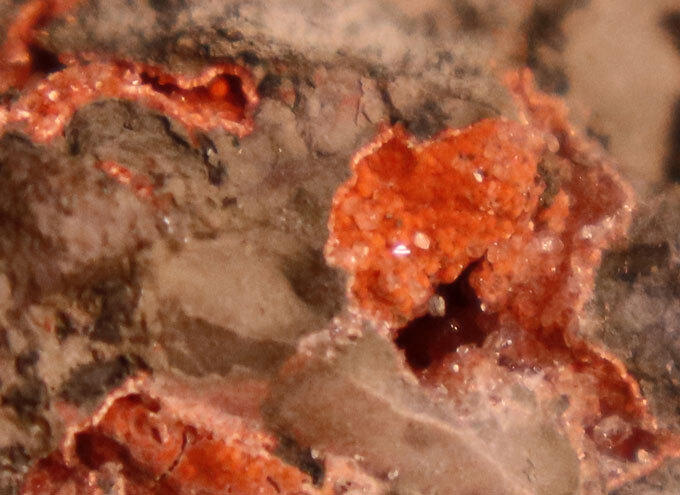
A core of rock and sediment extracted from within the Chicxulub impact crater revealed centimeter-sized cavities within the rocks containing hydrothermally altered minerals. Here, tiny cavities within impact breccia — a type of rock formed of broken fragments cemented together by fine-grained sediment — contain analcime (transparent crystals), which forms at temperatures around 200° Celsius and dachiardite (red crystals), which forms at temperatures around 250° C.D. Kring
Those conditions, the
researchers say, may have also been capable of fostering life akin to the
extremophiles that thrive in Yellowstone’s boiling pools. In addition to the
metal-rich fluids that could provide an energy source for microbes, the
Chicxulub cores revealed that the rocks were both porous and permeable — in
other words, filled with interconnected nooks and crannies that could have been
cozy shelters for microbes.
“It looks like a perfect
habitat,†Kring says.
Kring has previously
suggested that the very same destructive impacts that annihilate life may also
create appealing habitats — not just on Earth, but potentially on other
planetary bodies such as Mars. Even more tantalizing is the possibility that
hydrothermal systems, engendered beneath ancient impacts, may have been where life on Earth began (SN: 3/1/13).
Evidence from lunar craters
suggests that Earth was heavily bombarded by asteroids about 3.9 billion years ago (SN: 10/18/04). Most of those more ancient craters on Earth have long since vanished or been altered by
the constant tectonic recycling of Earth’s surface (SN: 12/18/18). So
the hydrothermal system beneath Chicxulub offers a window into what such
systems might have actually looked like much deeper in the past, says
geophysicist Norman Sleep of Stanford University, who was not involved in the
study. “It shows the reality of the process,†Sleep says.
The new study may set the
stage for the possibility of life thriving beneath an impact. But whether a
microbial cast of characters was actually present beneath Chicxulub is a
question for future studies, Kring says.
“Let me be clear: This paper
has no evidence of microbial life,†Kring says. “We just have all the
properties of hydrothermal systems that do support life elsewhere on Earth.â€
Ancient environments that
provided water, chemical building blocks and energy “are very promising
candidates for hosting [life’s] origins and early evolution,†says NASA
astrobiologist David Des Marais, who was not involved in the study.
Impact-generated hydrothermal systems aren’t the only such environments;
researchers have also made a compelling case for hot springs, Des Marais says.
That’s an ongoing debate, he
notes, adding “I consider hydrothermal systems to be highly promising
exploration targets for astrobiology.â€
WASHINGTON — President Donald Trump on Monday lashed out at governors during a White House videoconference, telling them that “most of you are weak†after states grappled with another night of anger and unrest following the killing of George Floyd last week.
According to a source on the call, Trump was “annoyed†with the governors for their response to the protests and urged law enforcement to crack down and make more arrests. “You’ve got to arrest people, you have to track people, you have to put them in jail for 10 years and you’ll never see this stuff again,†Trump said, according to the source.
Trump was described by one person on the call as “losing it,†with another saying the president called the governors “fools†and expressed anger with Democratic mayors in particular over the protests and unrest ravaging cities nationwide.
Trump said that other countries watching the situation unfold think Americans are pushovers.
Let our news meet your inbox. The news and stories that matters, delivered weekday mornings.
“You have to dominate. If you don’t dominate, you’re wasting your time,†the president said, according to a person listening in.
The president also called the initial response in Minneapolis “weak and pathetic†and said that protestors have likely spread out to other cities. The person said Trump seemed obsessed with “antifa,” or anti-fascists, and Occupy Wall Street, which he said was handled well by comparison and “just went away one day.â€
During the call, Trump claimed to have intelligence showing who the “bad actors†and professional instigators are, though he did not elaborate.
Trump also asked states to enact laws against flag burning in what the source described it as “a rant.”
The White House billed the event as a “video teleconference with governors, law enforcement, and national security officials on keeping American communities safe.â€
Several governors pushed back on Trump’s narrative, including J.B. Pritzker of Illinois, a Democrat, the source said. Maine Gov. Janet Mills, also a Democrat, said she was concerned about the president visiting her state this week “because of security.†Maine is home to Puritan Medical Products, the company the administration compelled through the Defense Production Act to produce coronavirus testing swabs.
Trump’s response to the unrest has been to call for stronger law enforcement rather than calling for calm or addressing the concerns about police brutality and racism that many protestors say drove them to come out. Critics say an escalation in force would exacerbate already high tensions between protestors and the police.
After another night of protests led to fires and vandalism blocks from the White House, Trump spent Monday morning on Twitter blaming the unrest on antifa and accusing staffers of former Vice President Joe Biden of “working to get the anarchists out of jail.â€
Trump had no public events scheduled for Monday, after not appearing in public on Sunday.
Trump’s advisers have been divided over what role the president should take in responding to the widest unrest the country has seen in decades. Some say the president should focus his message on Floyd, the black man who died last week at the hands of Minneapolis police, and urge calm.
Others say the top priority is stopping the violence and looting that have taken place in some areas, arguing that the best path to that end is strong police tactics, not presidential speeches.
Geoff Bennett
Geoff Bennett is a White House correspondent for NBC News.
Shannon Pettypiece
Shannon Pettypiece is the senior White House reporter for NBCNews.com.
Political leaders in the north-east of England have urged residents to disregard the government’s “reckless†relaxation of the lockdown amid concerns it will lead to a second spike of coronavirus in a region with the UK’s highest infection rate.
On the day that some primary schools reopened and people were allowed to meet more family and friends in England, council leaders and MPs warned that the easing of the measures had come “far too soon†in the north-east.
Martin Gannon, the leader of Gateshead council, which has the second-highest rate of infections in the UK, said: “The current approach from government is reckless and they haven’t put systems in place to keep it safe.
“Our advice is that [people] should be staying with the initial advice, which was lockdown, stay socially isolated within our homes until such time as we can have an effective testing, tracking and tracing system in place.â€
The north-east has the highest per-capita infection rate of any region in the UK. It is thought to be particularly vulnerable given its relatively high proportion of people with secondary illnesses linked to heavy industry, such as mining and shipbuilding. Of the 10 worst-affected local authorities, the top four are all in the north-east: Sunderland, Gateshead, South Tyneside and Middlesbrough.
The region’s current R value – the number of people an infected person will on average infect – is the highest in the UK, at 0.8, double the rate in London, according to analysis by Cambridge University scientists working with Public Health England. If the R value reaches 1, it means the virus is spreading.
R, or the ‘effective reproduction number’, is a way of rating a disease’s ability to spread. It’s the average number of people on to whom one infected person will pass the virus. For an R of anything above 1, an epidemic will grow exponentially. Anything below 1 and an outbreak will fizzle out – eventually.
At the start of the coronavirus pandemic, the estimated R for coronavirus was between 2 and 3 – higher than the value for seasonal flu, but lower than for measles. That means each person would pass it on to between two and three people on average, before either recovering or dying, and each of those people would pass it on to a further two to three others, causing the total number of cases to snowball over time.
The reproduction number is not fixed, though. It depends on the biology of the virus; people’s behaviour, such as social distancing; and a population’s immunity. A country may see regional variations in its R number, depending on local factors like population density and transport patterns.
In Sunderland, which has the highest infection rate in the country, the city council leader, Graeme Miller, said the council was still urging residents to “stay at home†– the government’s original message – and not encouraging people to meet with others. He said the lockdown had been “forgotten†at the weekend and that the city had been “full of people not socially distancingâ€.
“To open schools up, when we can’t guarantee safety and when you’ve now got the ability to meet in groups of six, is terribly reckless,†Miller said, adding that he accepted the need to get the economy back on its feet but that “the way they’re doing it at the moment is terribly dangerousâ€.
In South Tyneside, only one of 54 primary schools reopened its doors to more pupils on Monday. Most of the region’s local authorities have advised primary schools not to open before next Monday.
Iain Malcolm, the leader of South Tyneside council, said he would prefer schools not to reopen until September due to concerns over safety and potential second spike in cases.
Malcolm said the relaxation of the measures had come too soon for the north-east and that councils could take action collectively to impose some form of local lockdown if there was an increase in infections. “You’re gambling with people’s health here and there’s going to be a health consequence. I really fear that people are going to die because there’s going to be a spike here if we’re not careful,†he said.
“We have to keep making it clear to people that if you are going to meet with your family and your friends in small numbers, you must still maintain that social distance and regularly washing your hands.â€
Emma Lewell-Buck, the MP for South Shields, said people had “flooded†to the region’s coast in recent days and that “it was as if nothing had ever happenedâ€.
The new government guidance was “reckless and causing confusion,†she said: “I’m being more cautious than the government and saying that you need to stick to ‘stay at home’ measures and you need to stick to social distancing because we have high infection rates in the northeast. In South Tyneside, we’re a hotspot within that and I don’t want any more of my constituents to die from this.â€
On Friday morning, as dawn broke through the smoke hanging over Minneapolis, the Gandhi Mahal Restaurant was severely damaged by fire. Hafsa Islam, whose father owns the Bangladeshi-Indian restaurant with members of his family, woke at 6 a.m. to hear the news.
“At first, I was angry,†said Ms. Islam, 18. “This is my family’s main source of income.â€
But then she overheard her father, Ruhel Islam, speaking to a friend on the phone. “Let my building burn,†he said. “Justice needs to be served.â€
On Friday afternoon, after the fire stopped smoldering and the family came together, he repeated his support for the protests that had closed his restaurant. “We can rebuild a building, but we cannot rebuild a human,†said Mr. Islam, 42. “The community is still here, and we can work together to rebuild.â€
For days, the Islam family has watched the protests over the arrest and killing of George Floyd, the African-American man who died on Monday after a white police officer pinned him to the ground, a knee pressed against Mr. Floyd’s neck. The officer has been fired, and on Friday was arrested and charged with third-degree murder and manslaughter, the authorities said.
The restaurant is just a few doors away from the Third Precinct headquarters of the Minneapolis Police Department, which was set ablaze by protesters on Thursday night. Other buildings also burned, and fire eventually reached the restaurant.
Ms. Islam, who delivers food part time for Door Dash, said she had stopped her car at a red light on Monday as Mr. Floyd was arrested. She watched, horrified, from her car, she said. She learned only later that he had died.
“I understand why people did what they did,†she said of the demonstrators. “They had tried with the peaceful protesting, and it hasn’t been working.â€
Gandhi Mahal opened in 2008, during the Great Recession. Although Mr. Islam believes in nonviolent protest — he named his restaurant in honor of Mohandas K. Gandhi — he empathizes with the frustration of many Minneapolis residents.
“I am going to continuously promote peaceful ways and nonviolent movement,†he said. “But our younger generation is angry, and there’s reason to be angry.â€
So as mounted police fired tear gas into the crowd on Tuesday, the Islam family opened a room in their spacious restaurant to medics, who set up a makeshift field hospital. Ms. Islam said she saw at least 200 people come in and out on both Tuesday and Wednesday night.
Some needed to catch their breath after inhaling tear gas, she said. One woman had been hit in the eye by a rubber bullet, damaging her vision. A rubber bullet tore open the back of another man’s neck. When he fell unconscious, the medics laid him out on a table.
“We were just trying to do what we could to help our community,†said Ms. Islam, who helped treat wounded protesters. “Sure, we had our business. Sure, we were trying to keep our kitchen open. But more than anything, we were concerned for our people.â€
The tension in Mr. Islam’s adopted city reminds him of his childhood in Bangladesh, when he lived through a dictatorship. Two of his fellow students were killed by the police, he said. “We grew up in a traumatic police state, so I am familiar with this type of situation,†he said.
The restaurant has been a hub for interfaith efforts against climate change, and a related art collection was lost to the flames. In the basement, the family also cultivated a small aquaponics farm to supply the restaurant with fresh ingredients.
“Now probably, the whole basement is aquaponics with the water,†Mr. Islam said, laughing, joking about the sprinkler damage.
Both Tuesday and Wednesday night, before the medics had to relocate to a nearby church to protect their patients, Mr. Islam kept cooking. As wounds were bandaged and hands were held in the front room, he was in the kitchen, preparing daal, basmati rice and naan. Simple food, he said, but high in protein — just the thing to get his community through a long, dark night.
An international team of scientists, including a prominent researcher at the Wuhan Institute of Virology, has analyzed all known coronaviruses in Chinese bats and used genetic analysis to trace the likely origin of the novel coronavirus to horseshoe bats.
In their report, posted online Sunday, they also point to the great variety of these viruses in southern and southwestern China and urge closer monitoring of bat viruses in the area and greater efforts to change human behavior as ways of decreasing the chances of future pandemics.
The research was supported by a U.S. grant to EcoHealth Alliance, a New York-based nonprofit, that was recently canceled by the National Institutes of Health. The grant, for more than $3 million, was well on its way to renewal, and the sudden reversal prompted an outcry in the scientific community.
Thirty-one U.S. scientific societies signed a letter of protest on May 20 to the N.I.H., and 77 Nobel laureates sent another letter to the N.I.H. and the Department of Health and Human Services seeking an investigation of the grant denial. The Nobelists said the cancellation appeared to be based on politics rather than a consideration of scientific merit.
The report on the research, which has been accepted by the journal Nature Communications, was posted on the BioRxiv, (pronounced bio-archive), where scientific research is often released before publication.
The report gives a glimpse of the work the grant had supported.
The researchers, mostly Chinese and American, conducted an exhaustive search for and analysis of coronaviruses in bats, with an eye to identifying hot spots for potential spillovers of these viruses into humans, and resulting disease outbreaks.
The genetic evidence that the virus originated in bats was already overwhelming. Horseshoe bats, in particular, were considered likely hosts because other spillover diseases, like the SARS outbreak in 2003, came from viruses that originated in these bats, members of the genus Rhinolophus.
None of the bat viruses are close enough to the novel coronavirus to suggest that it jumped from bats to humans. The immediate progenitor of the new virus has not been found, and may have been present in bats or another animal. Pangolins were initially suspected, although more recent analysis of pangolin coronaviruses suggests that although they probably have played a part in the new virus’s evolution, there is no evidence that they were the immediate source.
The new research includes an analysis of bat and viral evolution that strongly supports the suspected origin of the virus in horseshoe bats, but isn’t definitive, largely because a vast amount about such viruses remains unknown.
The report also adds detail to what scientists know of coronaviruses in bats, how they have evolved and what kind of threat they pose. Renewal of the grant would have supported a continuation of this work.
N.I.H. canceled the grant shortly after President Trump was asked at a news conference about money erroneously described as going to the Wuhan institute. That lab has been the target of conspiracy theorists who promote the idea that the novel coronavirus was made in a lab. Scientists and U.S. intelligence agencies agree that the overwhelming likelihood is that the virus evolved in nature.
Richard Ebright, a microbiologist and biosafety expert at Rutgers University, has argued that there could have been an accidental leak of a naturally evolved virus that was present in the lab, and that lab safety should be investigated. Many scientists view the leak scenario as unlikely given the many opportunities for infection in the wildlife trade, markets and farming.
There is also no reported evidence that the new virus was ever present at the Wuhan Institute of Virology. It was first discovered after numerous human cases appeared in late December, most in people with connections to a wet market in Wuhan.
Zheng-Li Shi, the director of the Center for Emerging Infectious Diseases at the institute, known for work tracking down the source of the original SARS virus in bats and identifying SARS-CoV-2, as the novel coronavirus is known, is one of the authors of the new paper, along with Peter Daszak, the president of EcoHealth Alliance.
The researchers collected oral and rectal swabs, as well as fecal pellets from bats in caves across China from 2010 to 2015, and used genetic sequencing to derive 781 partial sequences of the viruses. They compared these to sequence information already documented in computer databases on bat and pangolin coronaviruses.
Updated June 1, 2020
How do we start exercising again without hurting ourselves after months of lockdown?
Exercise researchers and physicians have some blunt advice for those of us aiming to return to regular exercise now: Start slowly and then rev up your workouts, also slowly. American adults tended to be about 12 percent less active after the stay-at-home mandates began in March than they were in January. But there are steps you can take to ease your way back into regular exercise safely. First, “start at no more than 50 percent of the exercise you were doing before Covid,†says Dr. Monica Rho, the chief of musculoskeletal medicine at the Shirley Ryan AbilityLab in Chicago. Thread in some preparatory squats, too, she advises. “When you haven’t been exercising, you lose muscle mass.†Expect some muscle twinges after these preliminary, post-lockdown sessions, especially a day or two later. But sudden or increasing pain during exercise is a clarion call to stop and return home.
My state is reopening. Is it safe to go out?
States are reopening bit by bit. This means that more public spaces are available for use and more and more businesses are being allowed to open again. The federal government is largely leaving the decision up to states, and some state leaders are leaving the decision up to local authorities. Even if you aren’t being told to stay at home, it’s still a good idea to limit trips outside and your interaction with other people.
What’s the risk of catching coronavirus from a surface?
Touching contaminated objects and then infecting ourselves with the germs is not typically how the virus spreads. But it can happen. A number of studies of flu, rhinovirus, coronavirus and other microbes have shown that respiratory illnesses, including the new coronavirus, can spread by touching contaminated surfaces, particularly in places like day care centers, offices and hospitals. But a long chain of events has to happen for the disease to spread that way. The best way to protect yourself from coronavirus — whether it’s surface transmission or close human contact — is still social distancing, washing your hands, not touching your face and wearing masks.
What are the symptoms of coronavirus?
Common symptoms include fever, a dry cough, fatigue and difficulty breathing or shortness of breath. Some of these symptoms overlap with those of the flu, making detection difficult, but runny noses and stuffy sinuses are less common. The C.D.C. has also added chills, muscle pain, sore throat, headache and a new loss of the sense of taste or smell as symptoms to look out for. Most people fall ill five to seven days after exposure, but symptoms may appear in as few as two days or as many as 14 days.
How can I protect myself while flying?
If air travel is unavoidable, there are some steps you can take to protect yourself. Most important: Wash your hands often, and stop touching your face. If possible, choose a window seat. A study from Emory University found that during flu season, the safest place to sit on a plane is by a window, as people sitting in window seats had less contact with potentially sick people. Disinfect hard surfaces. When you get to your seat and your hands are clean, use disinfecting wipes to clean the hard surfaces at your seat like the head and arm rest, the seatbelt buckle, the remote, screen, seat back pocket and the tray table. If the seat is hard and nonporous or leather or pleather, you can wipe that down, too. (Using wipes on upholstered seats could lead to a wet seat and spreading of germs rather than killing them.)
How many people have lost their jobs due to coronavirus in the U.S.?
More than 40 million people — the equivalent of 1 in 4 U.S. workers — have filed for unemployment benefits since the pandemic took hold. One in five who were working in February reported losing a job or being furloughed in March or the beginning of April, data from a Federal Reserve survey released on May 14 showed, and that pain was highly concentrated among low earners. Fully 39 percent of former workers living in a household earning $40,000 or less lost work, compared with 13 percent in those making more than $100,000, a Fed official said.
Should I wear a mask?
The C.D.C. has recommended that all Americans wear cloth masks if they go out in public. This is a shift in federal guidance reflecting new concerns that the coronavirus is being spread by infected people who have no symptoms. Until now, the C.D.C., like the W.H.O., has advised that ordinary people don’t need to wear masks unless they are sick and coughing. Part of the reason was to preserve medical-grade masks for health care workers who desperately need them at a time when they are in continuously short supply. Masks don’t replace hand washing and social distancing.
What should I do if I feel sick?
If you’ve been exposed to the coronavirus or think you have, and have a fever or symptoms like a cough or difficulty breathing, call a doctor. They should give you advice on whether you should be tested, how to get tested, and how to seek medical treatment without potentially infecting or exposing others.
How can I help?
Charity Navigator, which evaluates charities using a numbers-based system, has a running list of nonprofits working in communities affected by the outbreak. You can give blood through the American Red Cross, and World Central Kitchen has stepped in to distribute meals in major cities.
They found evidence that the novel coronavirus may have evolved in Yunnan Province, but could not rule out an origin elsewhere in Southeast Asia outside China.
The family of bats that included the horseshoe genus, Rhinolophus, seems to have originated in China tens of millions of years ago. They have a long history of co-evolution with coronaviruses, which the report shows commonly jump from one bat species to another.
Dr. Daszak said that the region where China, Laos, Vietnam and Myanmar converge may be “the real hot spot for these viruses.â€
He said the region was characterized not only by bat and coronavirus diversity, but by urbanization, population growth and intense poultry and livestock farming, all of which could lead to viruses jumping from one species to another, and to the spread of human disease.
Not only bats should be monitored, Dr. Daszak said, but humans. “People are farming wildlife all across Southern China, tens of thousands of people involved in the industry, they should be getting regular tests, not just for Covid-19, but for what other viruses they are picking up.â€
He acknowledged that such an effort would be very costly, but said that compared to the cost of a pandemic, “You’re definitely getting a good return on investment.â€
We use cookies on our website to give you the most relevant experience by remembering your preferences and repeat visits. By clicking “Accept”, you consent to the use of ALL the cookies.
This website uses cookies to improve your experience while you navigate through the website. Out of these, the cookies that are categorized as necessary are stored on your browser as they are essential for the working of basic functionalities of the website. We also use third-party cookies that help us analyze and understand how you use this website. These cookies will be stored in your browser only with your consent. You also have the option to opt-out of these cookies. But opting out of some of these cookies may affect your browsing experience.
Necessary cookies are absolutely essential for the website to function properly. These cookies ensure basic functionalities and security features of the website, anonymously.
Cookie
Duration
Description
cookielawinfo-checbox-analytics
11 months
This cookie is set by GDPR Cookie Consent plugin. The cookie is used to store the user consent for the cookies in the category "Analytics".
cookielawinfo-checbox-functional
11 months
The cookie is set by GDPR cookie consent to record the user consent for the cookies in the category "Functional".
cookielawinfo-checbox-others
11 months
This cookie is set by GDPR Cookie Consent plugin. The cookie is used to store the user consent for the cookies in the category "Other.
cookielawinfo-checkbox-necessary
11 months
This cookie is set by GDPR Cookie Consent plugin. The cookies is used to store the user consent for the cookies in the category "Necessary".
cookielawinfo-checkbox-performance
11 months
This cookie is set by GDPR Cookie Consent plugin. The cookie is used to store the user consent for the cookies in the category "Performance".
viewed_cookie_policy
11 months
The cookie is set by the GDPR Cookie Consent plugin and is used to store whether or not user has consented to the use of cookies. It does not store any personal data.
Functional cookies help to perform certain functionalities like sharing the content of the website on social media platforms, collect feedbacks, and other third-party features.
Performance cookies are used to understand and analyze the key performance indexes of the website which helps in delivering a better user experience for the visitors.
Analytical cookies are used to understand how visitors interact with the website. These cookies help provide information on metrics the number of visitors, bounce rate, traffic source, etc.
Advertisement cookies are used to provide visitors with relevant ads and marketing campaigns. These cookies track visitors across websites and collect information to provide customized ads.