Sunday, May 3, 2026

Target Temporarily Closing or Shortening Hours at 200 Stores

Target is temporarily closing or shortening the hours of about 200 stores in the United States as protests and looting spread across country in the aftermath of the death of George Floyd.

The Target store on Lake Street in Minneapolis, the location nearest to where Mr. Floyd died, was engulfed by unrest, badly damaged and looted last week. Images of the battered store have featured prominently in news coverage of the unrest in Minneapolis, where Target has its headquarters.

In a statement on its website Saturday night, Target said: “We are heartbroken by the death of George Floyd and the pain it is causing communities across the country. At this time, we have made the decision to close a number of our stores.”

The site initially listed more than 170 affected stores — 70 in Minnesota and 104 in other states, including New York, California, Texas, Illinois, Georgia, Colorado, Oregon, Wisconsin and Pennsylvania.

In an interview on Sunday morning, Joshua Thomas, a Target spokesman, said the number of stores had grown to about 200. He said that total was a mix of temporary closings at some stores and shortened hours at others, though he did not supply a breakdown.

Mr. Thomas said the number was changing daily. On Sunday, the website had changed, dropping the detailed list of closings and no longer suggesting that all the stores listed were closings.

Target has nearly 1,900 stores in the United States. The decisions to temporarily shutter or shorten store hours at roughly 200 locations, Mr. Thomas said, were being made “out of an abundance of caution” to ensure “the safety of our teams.”

Target will continue to pay workers for 14 days of their regular pay at the affected stores, including a $2-an-hour Covid-19 premium. And workers at the shuttered stores will be able to work at nearby Target locations.

Six Target stores across the country have been closed because of damage. Nearly all of them should be ready to reopen soon, needing modest repairs, Mr. Thomas said. The exception is the Lake Street store in Minneapolis, which Target hopes to reopen by the end of the year.

In an open letter, Brian Cornell, Target’s chief executive, said the company remained committed to investing there and to “preserving jobs and economic opportunity by rebuilding and bringing back the store that has served as a community resource since 1976.”

Protests and violent unrest began last week in Minneapolis and spread to other cities. Mr. Floyd died last Monday after a police officer pressed his knee on Mr. Floyd’s neck for more than eight minutes during an arrest.

As unrest spread and some cities announced curfews, Amazon also Amazon made some changes. The company adjusted driver routes on Saturday and scaled back deliveries in a handful of cities. The company said some operations were still being affected, and it was monitoring the situation closely.

In Seattle, where Amazon is based, on Friday night protesters smashed the windows of the cashierless Amazon Go Grocery store in the Capitol Hill neighborhood, though it has since reopened.

Karen Weise contributed reporting.

Source link

NASSCOM teams up with IoT, AI startups to provide low-cost solutions to combat COVID-19 – Firstpost

0

The coronavirus pandemic and the shortage of important tools to combat it like testing kits, PPE kits, ventilators among a score of others has led many incubators, accelerators to mentor startups to pivot so as to get opportunities that would help them and also the larger majority with home-made, low-cost solutions. NASSCOM’s Center of Excellence IoT and AI has focussed on a few startups to leverage their solutions and provide them with the resources to scale in terms of access to manufacturing partners. It also wants to provide platform access from leading IT/ITES firms to be able to integrate the startups solution for a pan-India offering in the time of the virus crisis gripping the country.

“Considering the criticality of the situation, it was necessary to shortlist solutions that had a demonstrated experience of deploying these solutions and the design capability to manufacture at scale”, said Sanjeev Malhotra, CEO, NASSCOM, Center of Excellence IoT and AI.

The COVID-19 pandemic has disrupted supply chain network and made it imperative to look for indigenous solutions. So NASSCOM’s Centre of Excellence IoT and AI decided to focus on shortage of ventilators, paucity of testing kits, difficulties in enforcing social distancing and sanitisation as well as absence of authentic information regarding the pandemic.

Given the sudden onslaught of the pandemic, Malhotra and his team went through hours of elaborate discussions with several solution providers. “The idea was to be able to have as thorough understanding as possible of their solutions and their efficacy in the COVID-19 scenario. After this exercise spanning over a couple of weeks, we were able to come up with the list of the companies that presented their solutions to the Empowered Committee,” he said.

NASSCOM is also working with some grants and funds to help provide capital to these solution providers.

Firstpost spoke with some of the start-ups to understand the solutions they were offering:

Tracking COVID-19 hotspots

Utkarsh Singh and Ayushi Mishra were in Punjab for an active project (drone mapping the road network of the state) when the State was structuring its initial response to the coronavirus crisis. During a casual conversation the client mentioned the dashboard made by Johns Hopkins University to track the global spread of the crisis.

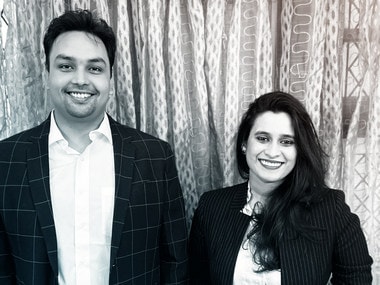
DronaMaps co-founders (l-r) Utkarsh Singh, Ayushi Mishra

Both–26 year-old Singh and 28 year-old Mishra are alumni of Johns Hopkins University where the former graduated in Computer Science, and Mishra is a biomedical engineer with an MS Engineering Management degree. The casual conversation soon turned to be the focus point for Singh and Mishra. “We embarked on this engagement with that brief and got a day to create a public facing dashboard for India and a district wise one for Punjab specifically. Over a course of time, the scope of work increased to include geofencing of quarantined patients, cluster analysis of the spread, location tracking with CDR (call records data), and predictive analysis for spatial spread based on these parameters,” said Singh.

Dashboards were always a part of our product, we adapted it to be helpful for the corona situation,” Mishra said, adding, “as we are dealing with highly sensitive data, the whole solution is built in-house in India.”

The solution is live in 5 states–Punjab, Rajasthan, Haryana, Chhattisgarh, and Meghalaya. As of now, they are providing the service pro bono to all states if they have existing infrastructure in place. But Mishra and Singh said, “In certain cases, the engagement could turn commercial. However, it would only cover our costs,” they said.

The duo’s startup, DronaMaps was launched in October 2016. It is a platform to create large-scale 3D maps from imagery collected through drones. Their maps are used for Smart Village and Smart City applications for planning Sustainable development initiatives.

When Singh and Mishra started working with Punjab, the product and the company was bootstrapped, however, the startup has now have received some initial funding from ACT, LightSpeed, Matrix, Sequoia among others.

IoT-enabled hand hygiene

Startup MicroGO has come out with an IoT-enabled device for hand hygiene while saving water.  It uses minimal resources and captures usage data. The startup has the capacity of producing 100 units a day, said Rachna Dave, the founder. This solution has already been installed at several airports operated by the Airports Authority of India (AAI) including Chennai, Hyderabad, Calicut, Guwahati, Baroda, Pune and Kolkata, in addition to a host of enterprises and companies like the Taj Group, Tata Capital, BigBasket, Waycool and IRCTC.

Working as a scientist (Ph.D Microbiology) at the Bhabha Atomic Research Centre (BARC), the now 39 year-old Dave decided to quit her job eight years ago to launch a startup in Chennai in 2016 with a focus on saving essential resources, direct and indirect costs. Her startup MicroGo is a R&D based manufacturing company that focuses on problems around ‘safe and save’ in water, food and hygiene.

MicroGO founder, Rachna Dave

MicroGRO founder, Rachna Dave

MicroGo has been working in the hygiene space for the past three years, especially hand hygiene. Dave reasoned that “it is the first line of defence in any industry or for an individual wellbeing. When COVID-19 situation started to develop, we were in the scale-up mode – thus, we could contribute at the right time,” she said.

The startup which is bootstrapped, has received angel investment, grants and revenues is proud to say it is ‘Made in India’. Multiple units of hand hygiene units have been installed at 100 locations in the past 45 days.

AI-enabled analysis of chest X-Rays

Headquartered in Mumbai, with US operations based in New York, Qure.ai taps deep learning technology to provide automated interpretation of radiology exams like X-rays, CTs and MRI. It was established in 2016 by Pooja Rao.

In 2016, Qure.ai had built and deployed a robust deep learning-based chest X-ray screening tool called qXR that classified chest X-rays as normal or abnormal and highlighted the abnormalities on the X-ray. Rao, Co-Founder, said, “When COVID-19 symptoms were being researched, we realized our solution could pinpoint these abnormalities. We trained our algorithm to go a step further to predict a COVID Risk score. The score shows the likelihood of the patient having Covid-19 from chest X-rays. As many nations are seeing a shortage of test kits, the score can prioritize those who need to be tested and those who need to be asked to self-isolate.”

The algorithms are equipped to run on cloud hardware, limiting the onsite hardware requirements to be as small as a $50 Raspberry Pi, and the cost of these scans are less than $1. The solution is vendor-agnostic and can be integrated with the medical center’s existing machines, Rao said.

Qure.ai’s COVID triaging and progression monitoring software is already deployed in 40+ sites across 7 countries, Rao said.

Incubated by Fractal Analytics, the startup has received funding from Sequoia Capital and Mass Mutual Ventures in February 2020. Besides, it has also has received funding from India Health Fund.

AI-enabled thermal imaging camera 

Staqu has developed an AI-enabled thermal imaging camera for screening body temperature and is used to generate e-pass for essential services and citizens in need.

Staqu co-founder, Atul Rai

Staqu co-founder, Atul Rai

Established in 2015 by four co-founders– Atul Rai (MS in AI from University of Manchester),  Anurag Saini, Chetan Rexwal-both B.Tech graduates from IP University), Pankaj Sharma (B Tech from Jamia Milia Islamia)

Staqu works in homeland security with JARVIS, one of its video analytics technology to automate security and safety monitoring. Post COVID -19, there was a huge use case for video analytics for automating the pre-screening of temperature, safety monitoring in terms of mask detection, mopping-cleaning detection, sneezing coughing detection, contact tracing etc. “We already were doing these in different form- for example mask detection is live with some of the security agencies i.e. if someone is wearing masks in highly sensitive areas, an alert goes to command centre but now the same mask detection technique is the new normal,” said Rai, CEO.

The video analytics technology is Live with customers both in private and public sector. All the technologies developed by Staqu are indigenous and has already received two patents for its products, Rai said.

Staqu raised seed round funding from Indian angel network in June 2016.

Updated Date: Jun 01, 2020 02:45:33 IST

Tags :

Act,

AI Startups,

Angel Investment,

Ayushi Mishra,

Chest X-Rays,

COVID Triaging,

COVID-19 Hotspots,

CTS,

Drone Mapping,

Fractal Analytics,

Hand Hygiene,

India Health Fund,

IoT Startups,

Jarvis,

Johns Hopkins University,

Lightspeed,

Mask Detection,

Matrix,

MRI,

Nasscom,

Pooja Rao,

Sequoia Capital,

Startup DronaMaps,

Startup MicroGO,

Startup Qure.Ai,

Startup Staqu,

Thermal Imaging Camera,

Utkarsh Singh


Source link

How divisive is politics in the United States?

Protests over the death of George Floyd have spread across dozens of US cities. In an attempt to contain the sometimes-violent demonstrations, governors have imposed curfews and dispatched the National Guard.

The Floyd case has reignited rage about the deaths of Black Americans at the hands of police and racial inequality. It has also opened a divisive political debate between Democrats and Republicans.

President Donald Trump has promised to put an end to what he calls “mob violence”. Trump has said healing is needed, but he has been accused of the oppositie – igniting tension.

So, can the US overcome its divisions?

Presenter: Kim Vinell

Guests:

Maurice Jackson – Associate professor in the history department and African American studies at Georgetown University

Kevin Powell – Author and civil rights activist

Sahar Aziz – Professor of law and Chancellor’s Social Justice Scholar at Rutgers University

Source: Al Jazeera

Source link

Dozens killed in separate Burkina Faso attacks

An armed group in Burkina Faso attacked a cattle market and a humanitarian convoy, killing at least 35 people, the government said on Sunday.

Twenty-five people were killed and more wounded in the attack on the market in the eastern village of Kompienga, while five civilians and five military police were killed near the northern village of Foube, the government said in a statement.

More:

Armed groups “targeted a humanitarian convoy returning from Foube after delivering supplies”, it said.

A further 20 people were wounded in the convoy attack, it said.

No group has claimed responsibility.

Saturday’s violence underscores deep instability in parts of Burkina Faso, which has been battling armed groups with links to al-Qaeda and ISIL (ISIS) since 2017.

Hundreds have been killed in the past year in the Sahel nation, and more than half a million people have fled their homes due to the violence, which has also raised ethnic and religious tensions.

The bloodshed follows the death of at least 15 people on Friday in an attack on a convoy transporting traders in northern Burkina Faso. That attack, in Loroum province, was also blamed on armed groups.

In the past five years, more than 900 people have been killed by armed groups, while some 860,000 people have fled their homes.

The Sahel country is part of a regional effort to battle an armed uprising along with Mali, Niger, Mauritania and Chad.
 
Their militaries, under-equipped and poorly trained, are supported by 5,000 French troops in the region.
 
Unrest in Burkina Faso, Mali and Niger killed approximately 4,000 people last year, according to UN figures.

Source link

Trump says US will designate Antifa ‘terrorist organisation’

President Donald Trump said on Sunday that the United States would designate Antifa as a “terrorist organisation”, despite concerns by legal experts, who say the president has no legal authority for such a designation and question how it would be implemented. 

Antifa, short for anti-fascists, is an umbrella term for a far-left-leaning movement with no designated leadership that is opposed to far-right ideologies. Some anti-fascists confront neo-Nazis and white supremacist groups at demonstrations.

Trump’s announcement came as he sought to place blame for angry protests – some that have turned violent – gripping the US over the death of George Floyd, an unarmed Black man, and other acts of police brutality. 

More:

Without evidence, Trump and several top officials from his administration, including US Attorney General William Barr, have blamed Antifa and groups it describes as “agitators” for taking over the protests in US cities.

“The violence instigated and carried out by Antifa and other similar groups in connection with the rioting is domestic terrorism and will be treated accordingly,” Barr said in a statement on Sunday following the president’s tweet. 

But legal scholars and analysts say Trump has no legal authority to designate a domestic group in the same way it does foreign entities.

“No current legal authority exists for designating domestic organisations as terrorist organisations,” said Mary McCord, a former senior Justice Department official. 

“Any attempt at such a designation would raise significant First Amendment concerns,” McCord, who previously served in the Trump administration, added. 

Experts note that Antifa is an amorphous movement, not an organisation, raising questions on how even a legal designation would be enforced and handled. 

“Terrorism is an inherently political label, easily abused and misused,” said ACLU National Security Project Director Hina Shamsi. 

It is unclear whether the Trump administration is seriously pursuing the designation through formal channels, which would typically require coordination across multiple federal agencies. Any attempt to do so would likely meet legal challenges. Trump and other Republicans have made similar calls before. 

Local governments, meanwhile, have largely blamed “outsiders” for the violence seen at protests nationwide. They say the “organised agitators” are flooding their cities not to call for justice but to cause destruction. 

But the state and federal officials offered differing assessments of who the outsiders were, blaming left-wing extremists, far-right white nationalists and even suggesting the involvement of drug cartels. They have also not elaborated on how they have come to those conclusions. 

The finger-pointing on both sides of the political spectrum is likely to deepen the political divide in the US, allowing politicians to advance the theory that aligns with their political view and distract from the underlying frustrations that triggered the protests.


Source link

Wajid Khan of the music composer duo Sajid-Wajid passes away due to COVID-19 : Bollywood News – Bollywood Hungama

0

The deadly coronavirus has spread like wildfire around the world. India has been in lockdown since March-end in order to contain the spread of the virus. Meanwhile, several celebrities have reported having recovered from COVID-19 including singer Kanika Kapoor, actor Kiran Kumar, actress Zoa Morani, her sister among others.

In the latest news, Wajid Khan of the music composer duo Sajid-Wajid has passed away due to COVID-19.  As per sources, the music composer had already pre-existing condition before he tested positive for COVID-19. The family is yet to confirm the news. Sonu Nigam took to his Instagram to announce the tragic news.

Wajid Khan and Sajid Khan, music director duo, are the sons of Ustad Sharafat Ali Khan, a tabla player. They first worked together for Salman Khan’s Pyar Kiya To Darna Kya in 1998. They worked as composers for Salman’s films like Hello Brother, Tumko Na Bhool Paayenge (2002), Tere Naam (2003), Garv (2004), Mujhse Shaadi Karogi (2004), Partner (2007), Hello (2008), God Tussi Great Ho (2008), Wanted (2009), Main Aur Mrs Khanna, (2009), Veer (2010), Dabangg (2010), No Problem (2010) among others.

BOLLYWOOD NEWS

Catch us for latest Bollywood News, Bollywood Movies update, Box office collection, New Movies Release & upcoming movies info only on Bollywood Hungama.


Source link

Anti-Racism Protesters Around The World Demand Justice For George Floyd

0

LONDON — Thousands of anti-racism campaigners around the world staged demonstrations on Sunday, acting in solidarity with Americans protesting police violence after George Floyd, a Black man, died after a white police officer kneeled on his neck for nearly nine minutes last week.

Demonstrators in London marched across the city after gathering in Trafalgar Square, where they kneeled en masse in honor of Floyd, before heading across the River Thames to protest near the U.S. embassy in the Battersea neighborhood.

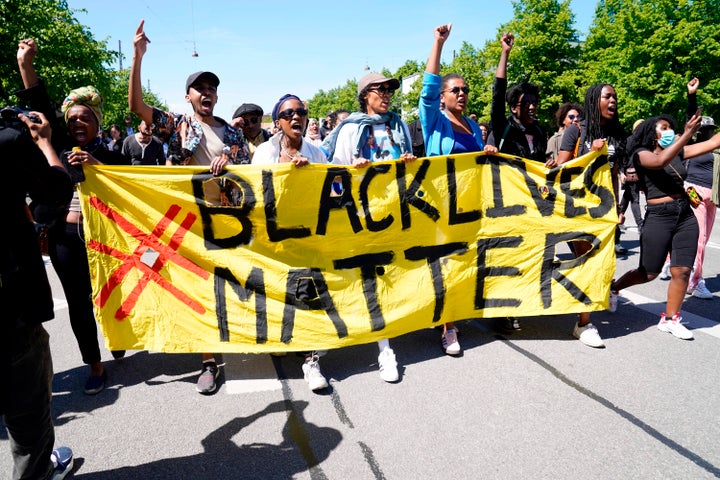
Onlookers cheered and drivers honked horns from passing cars as the protesters chanted “say his name” and “Black lives matter.” At one point, four men climbed on top of a bus stop to lead the chants, before getting down on one knee in silence and encouraging the others to do the same.


A Black Lives Matter march at Trafalgar Square in London on Sunday.

One demonstrator said the protests were “very important because it is sending a clear message that we have had enough racial injustice in our country.”

Isabelle Orsini, 20, is originally from New York and now lives in the Kensington area of London. She told the Press Association news agency: “The U.S. obviously has a much deeper and darker history of black discrimination compared to the U.K. The reason people are so angry is because this is reopening wounds that go back hundreds of years. It is very important that we do whatever it takes to tell our government that racism will not be tolerated.”

Protesters also marched to Grenfell Tower in the northwest of the city, where a blaze in the high-rise apartment building killed 72 residents in 2017, most of whom were non-white.

Hundreds of people gathered for a similar demonstration in Manchester, in the north of England, and chanted “Black lives matter.” 

Floyd’s death has also captured attention in Germany. On Sunday, the country’s top-selling Bild newspaper carried the headline “This killer-cop set America ablaze” and said that demonstrations in the U.S. looked like “scenes like out of a civil war.”

In Berlin, several hundred demonstrators staged a rally outside the U.S. Embassy, with posters bearing “Justice for George Floyd,” “Stop killing us” and “Who’s neckst.” 

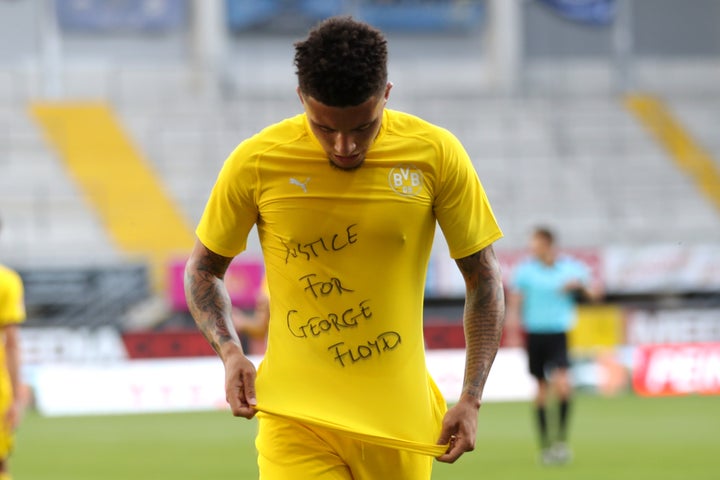
Dortmund's English midfielder Jadon Sancho shows a "Justice for George Floyd" shirt after scoring his team's second goal duri


Dortmund’s English midfielder Jadon Sancho shows a “Justice for George Floyd” shirt after scoring his team’s second goal during a Bundesliga match on Sunday.

Sports stars across Europe also joined the protests. Soccer player Jadon Sancho, who plays for Borussia Dortmund in Germany, as well as England’s national team, revealed a “Justice for George Floyd” T-shirt after scoring his first goal since Germany’s top soccer league, the Bundesliga, started up again after being halted due to coronavirus concerns. The south London-born player received a yellow card for taking his jersey off on the field. 

At a separate match, Borussia Monchengladbach’s Marcus Thuram took a knee after scoring in Sunday’s win against Union Berlin, echoing former NFL player Colin Kaepernick’s protest against police brutality. 

In a rare foray into U.S. domestic affairs, Canadian Prime Minister Justin Trudeau said Canadians were watching the events in America “with shock and with horror,” HuffPost Canada reported.

“Anti-Black racism, racism is real. It’s in the United States, but it’s also in Canada. And we know people are facing systemic discrimination, unconscious bias, and anti-Black racism every single day,” Trudeau said in a statement on Friday. 

“I call on all Canadians, whether it’s anti-Black racism or anti-Asian racism or racism discrimination of any type, to stand together in solidarity,” he continued, “to be there for each other and know just how deeply people are being affected by what we see on the news these past few days.”

British Foreign Secretary Dominic Raab, a Conservative, avoided responding to President Donald Trump’s incendiary reaction to the demonstrations that started in Minneapolis. Raab told the BBC’s Andrew Marr Show that he has “long kept to the self-imposed guidance not to comment on what President Trump says or indeed other world leaders, it is not really what my job is.” 

In Denmark, around 2,000 people gathered peacefully to protest outside the U.S. embassy in Copenhagen on Saturday. The Local reports the crowd then marched toward Christiansborg Palace, holding up signs emblazoned with “Justice for George Floyd.” 

A Black Lives Matter demonstration in front of the U.S. Embassy in Copenhagen on Saturday.


A Black Lives Matter demonstration in front of the U.S. Embassy in Copenhagen on Saturday.

Italy remains in a partial lockdown but protesters gathered outside the U.S. consulate in Milan on Thursday holding signs reading “I can’t breathe” and “stop killing black people.” Local media reported that the protesters simulated suffocation by gripping their hands around their necks. 

In Mexico, people left flowers at a display commemorating Floyd on a security barrier outside the U.S. Embassy in Mexico City on Saturday. In a similar scene, people lit candles in front of the U.S. consulate in Krakow, Poland, on Sunday.


Source link

Corporate Voices Get Behind ‘Black Lives Matter’ Cause

As tensions flared around the country after George Floyd’s death under a policeman’s knee, protesters received support from an unexpected corner: corporate America.

Companies like Nike, Twitter and Citigroup have aligned themselves with the Black Lives Matter movement.

As Netflix posted on Twitter on Saturday: “To be silent is to be complicit. Black lives matter. We have a platform, and we have a duty to our Black members, employees, creators and talent to speak up.”

Major companies are often wary of conflict, especially in a polarized time. They tend to be afraid of offending their customers and associating their brands with sensitive subjects.

American advertisements often shy away from addressing political issues, like impeachment, and also steer clear of news stories about violence, drugs and, recently, the coronavirus pandemic.

But after Mr. Floyd died on Monday in Minneapolis, a wide range of companies began to take much more public stances on racial injustice and police violence.

Speaking out on social issues is often a calculated decision, a form of “values and identity-driven targeted marketing,” said Americus Reed, a marketing professor at the Wharton School at the University of Pennsylvania. By aligning corporate values with what customers care about, companies are hoping to build a sense of loyalty and a deeper sense of personal connection, he said.

“There’s a general trend toward executives in the C-suite being called out and pressure-tested by consumers who want to know where they stand — there’s an opportunity to differentiate not just on function, on what’s a better mousetrap, but on values,” he said. “It’s smart — they’re taking a stand, hopefully, because it’s moral, but also because they understand the long-term economic game.”

Twitter, which spent much of last week battling President Trump over the warnings and fact-checks it placed on several of his tweets, changed its profile image on the platform to black and added “#BlackLivesMatter” to its description.

Mark Mason, the chief financial officer of Citigroup, wrote a public blog post on the company’s website that repeated Mr. Floyd’s pleas to the white officer kneeling on his neck: “I can’t breathe.” The advertising agency 72andSunny wrote on Instagram that “white people need to start carrying this burden” of combating racism. Reebok said in a message to “the black community” that it “stands in solidarity with you,” telling its social media followers: “We are not asking you to buy our shoes. We are asking you to walk in someone else’s.”

On Monday, Change.org will promote its largest petition ever — “Justice for George Floyd” — on taxi-top ads in New York and billboards there and in Minneapolis. The marketing campaign, funded by supporters, will be the most expensive effort of its kind for the company.

WarnerMedia brands, including HBO, TBS and the newly introduced HBO Max, changed their Twitter names to #BlackLivesMatter and quoted the black novelist James Baldwin: “Neither love nor terror makes one blind: indifference makes one blind.”

The hashtag also appeared in posts from retailers like Nordstrom, the ice cream maker Ben & Jerry’s and media companies like TikTok. YouTube promised to spend $1 million on social justice initiatives, but it quickly faced criticism that its moderation efforts against racist content have historically been weak.

“Your hypocrisy knows no bounds,” wrote Sleeping Giants, a media watchdog group, in a reply to YouTube that echoed a similar complaint against Twitter. “As a platform that has done its very best to avoid having to remove any videos from racists, white supremacists and hate mongers, you should be ashamed of even tweeting about this. Too little, too late.”

Some companies were more cautious in their approach. Target, which is based in Minneapolis and was hit by looting at a store there last week, described “a community in pain” in a blog post but never mentioned the word “black.”

Several of the businesses that expressed support have had complicated relationships with race in the past. Starbucks, which conducted sweeping anti-bias training after two black men were arrested in a store in 2018, posted a public letter on Saturday encouraging “courageous conversations.”

Nike, which has said that only 8 percent of its 353 vice presidents as of 2017 were black, released a new ad on Friday that was reposted by other shoe companies like Adidas and Converse. “For once, don’t do it,” the spot said, beseeching people to stop pretending “there’s not a problem in America.”

The company won awards for its 2018 marketing campaign, which featured the quarterback Colin Kaepernick telling viewers to “believe in something, even if it means sacrificing everything,”

To many people, the supportive corporate sentiments fell short without offering funding or other substantive resources. But some companies said nothing at all.

Jackie Aina, an influencer with more than three million subscribers on YouTube, posted a video to Instagram last week urging fashion brands like Fashion Nova to weigh in on the nationwide protests. The brand said in a post on a secondary Instagram account this weekend that it was “appalled, angered and deeply saddened” and was “talking to a number of community leaders to identify and explore ways to take a stand and help.”

In an interview, Ms. Aina said that she did not expect all companies to weigh in. But brands that borrow heavily from black culture and target black consumers have a responsibility, she said, to push for change, often by bringing more black employees into their ranks.

“When it comes to relevant things happening, things you can’t ignore like the Black Life Matters movement, police brutality or murders in our community, it’s crickets, and that’s unacceptable,” she said. “If you are capitalizing off of a culture, you’re morally obligated to help them.”


Source link

U.S. Cities Assess Protest Damage, Await Another Day Of Unrest

MINNEAPOLIS (AP) — America’s cities boarded up windows, swept up glass and covered graffiti Sunday as the country’s most significant night of protests in a half-century promised to spill into another day of unrest fueled by killings of black people at the hands of police.

The turbulence sparked by the death of George Floyd — a black man who died after being pinned under the knee of a white Minneapolis police officer — shook not only the streets of New York and Los Angeles, but dozens of smaller communities such as Fargo, North Dakota, and Lincoln, Nebraska. The damage extended even to buildings near the White House.

Peaceful protests involving tens of thousands of people on Saturday gave way, in some places, to rioting, looting and violence, with police vehicles torched, stores emptied and objects hurled at officers. The police response varied from restrained to aggressive, with officers at times firing tear gas and rubber bullets.

Police and peaceful protesters alike pleaded for a stop to violence, saying it only hindered calls for justice and reform.

“It only hurts the cause,” said Danielle Outlaw, head of the police force in Philadelphia, where more than 200 people were arrested as fires and looting engulfed Center City.

Disgust over generations of racism in a country founded by slaveholders combined with a string of recent high-profile killings to stoke the anger. Three months before Floyd’s death, Ahmaud Arbery was fatally shot as he jogged through a Georgia neighborhood. A white father and son are charged in the slaying. The month after Arbery was killed, an EMT named Breonna Taylor was shot eight times by Louisville, Kentucky, narcotics detectives who knocked down her front door. No drugs were found in her home.

Adding to that was angst from months of lockdowns brought on by the coronavirus pandemic, which has disproportionately hurt communities of color, not only in terms of infections but in job losses and economic stress.

The droves of people congregating in chanting demonstrations threatened to trigger new outbreaks, a fact overshadowed by the boiling tensions.

“We’re sick of it. The cops are out of control,” protester Olga Hall said in Washington, D.C. “They’re wild. There’s just been too many dead boys.”

The scale of the protests, sweeping from coast to coast and unfolding on a single night, rivaled the historic demonstrations of the civil rights and Vietnam War eras.

Curfews were imposed in major cities around the U.S., including Atlanta, Chicago, Denver, Los Angeles, San Francisco and Seattle. About 5,000 National Guard soldiers and airmen were activated in 15 states and Washington, D.C.

In Minneapolis, the city where the protests began, police, state troopers and National Guard members moved in soon after an 8 p.m. curfew took effect Saturday to break up demonstrations. The show of force came after three days in which police largely avoided engaging protesters, and after the state poured more than 4,000 National Guard troops into Minneapolis. Authorities said that number would soon rise to nearly 11,000.

President Donald Trump appeared to cheer on the tougher tactics, commending the National Guard deployment in Minneapolis and declaring “No games!” He said police in New York City “must be allowed to do their job!”

Presumptive Democratic presidential nominee Joe Biden condemned the violence as he continued to express common cause with those demonstrating after Floyd’s death.

“The act of protesting should never be allowed to overshadow the reason we protest,” Biden said in a late-night statement.

Dozens of additional protests were underway or expected on Sunday, from Miami to Kansas City to San Francisco. They went forth largely without incident, but sparks of crime continued.

In Philadelphia, looters robbed stores in broad daylight and at least one more police vehicle was set ablaze. Streets leading downtown were closed. Chicago likewise restricted downtown access and called in the National Guard.

At the Minneapolis intersection where Floyd was killed, people gathered with brooms and flowers, saying it was important to protect what they called a “sacred space.” The intersection was blocked with the traffic cones while a ring of flowers was laid out.

County Commissioner Angela Conley showed up shortly after the curfew lifted, saying that police had trampled flowers and photos of Floyd. “The community needs healing, and what happened last night only exacerbated the pain that’s been felt,” she said.

Conley said the demonstrations and confrontations with police would continue until the other three officers who were at the scene when Floyd was pinned down are arrested and prosecuted. The officer who put his knee on Floyd’s neck, Derek Chauvin, was charged last week with murder. All four officers have been fired.

“We’ll continue to have this militarized presence in our community until justice is done,” Conley said.

In tweets Sunday, Trump blamed anarchists and the media for fueling the violence. Attorney General William Barr pointed a finger at “far left extremist” groups. Police chiefs and politicians around the country accused outsiders of coming in and causing the problems.

Few parts of America were untouched. Protesters set fires inside Reno’s city hall, and police launched tear gas at rock-throwing demonstrators in Fargo, North Dakota. In Salt Lake City, demonstrators flipped a police car and lit it on fire. Police said six people were arrested and an officer was injured after being struck in the head with a baseball bat.

By Sunday, the fury had spread to Europe, where thousands gathered in London’s Trafalgar Square, clapping and waving placards despite government rules barring crowds because of the COVID-19 pandemic.

In New York, a video showed two police cruisers lurching into a crowd of demonstrators who were pushing a barricade against one of them and pelting it with objects. Several people were knocked to the ground. It was unclear if anyone was hurt.

“The mistakes that are happening are not mistakes. They’re repeated violent terrorist offenses, and people need to stop killing black people,” Brooklyn protester Meryl Makielski said.

In Indianapolis, two people were reported dead in bursts of downtown violence, adding to deaths reported in Detroit and Minneapolis in recent days.

Sites around the U.S. were defaced with spray-painted messages, from the facade of St. Patrick’s Cathedral in New York to the historic Hay-Adams hotel near the White House. Some of Floyd’s gasped last words — “I can’t breathe” — were repeated around the country, alongside anti-police messages.

On Sunday, maintenance crews near the White House worked to replace windows that had been shattered with large pieces of wood. Buildings for blocks were marked with graffiti, including curses about Trump. Shattered glass still covered the sidewalks. The damaged buildings included the Department of Veterans Affairs, directly across the street from the White House.

Some leaders prepared to put more soldiers in the streets. Georgia Gov. Brian Kemp authorized the deployment of up to 3,000 National Guard troops to Athens, Savannah and any other cities where more demonstrations were planned. Kemp had already approved up to 1,500 Guardsmen to help enforce a 9 p.m. Saturday curfew in Atlanta.

This week’s unrest recalled the riots in Los Angeles nearly 30 years ago after the acquittal of the white police officers who beat Rodney King, a black motorist who had led them on a high-speed chase. The protests of Floyd’s killing have gripped many more cities, but the losses have yet to approach the staggering totals LA saw during five days of rioting in 1992, when more than 60 people died, 2,000-plus were injured and thousands arrested, with property damage topping $1 billion.

Sedensky reported from Philadelphia. Associated Press journalists across the U.S. contributed to this report.


Source by [author_name]

George Floyd riots LIVE updates: Minneapolis National Guard deployed as police officer charged with murder

And this happened after Minnesota Governor Tim Walz promised that journalists would not be interfered with following the Friday arrest of a CNN crew on live television and other reports of violence against reporters, including freelance photographer Linda Tirado, who said she is blind in her left eye after being shot at by police.

Minneapolis Star Tribune reporter Chris Serres tweeted Sunday that he was twice ordered at gunpoint to hit the ground.

Serres wrote that he was, “Warned that if I moved ‘an inch’ I’d be shot. This after being teargassed and hit in groin area by rubber bullet. Waiving a Star Tribune press badge made no difference.”

His Star Tribune colleague Ryan Faircloth’s car was also hit by what were “likely rubber bullets,” which shattered his window and left him with cuts on his arm and brow.

Los Angeles Times reporter Molly Hennessey-Fiske said in a video message on Twitter that she and about a dozen other press had identified themselves as such and that Minnesota State Patrol officers still “fired tear gun cannisters on us at point blank range”.

It wasn’t just Minneapolis where reporters found themselves in harm’s way. Saturday there were journalist injuries reported in cities like New York, Chicago, Washington D.C., Pittsburgh, Los Angeles, Philadelphia, San Diego, Detroit and Denver. Although the situation is fluid and developing, the RTDNA has counted more than 60 incidents across the country in the past 48 hours in which reporters have been, “injured, assaulted or harassed by either protesters or police officers.”

In Chicago, Vice reporter Michael Adams had a similar interaction to Velshi and Hennessey-Fiske when police raided the gas station he and his crew were sheltering at and said they “didn’t care” that they were press.

“After shouting press multiple times and raising my press card in the air, I was thrown to the ground,” Adams wrote on Twitter. “Then another cop came up and peppered sprayed me in the face while I was being held down.”

In Washington D.C., Huffington Post reporter Philip Lewis tweeted that he was hit in the leg with rubber bullets.

Detroit Free Press news director Jim Schaefer said several of their journalists showing their media badges were pepper-sprayed by Detroit police.

And in Denver, 9NEWS reporter Jeremy Jojola tweeted that he got hit with “something fired by police” even though he was holding a camera and lights.

Since the protests began, eight AP journalists have been hurt, though none seriously. Three have been hit by rubber bullets, one was punched, another was knocked down and others fell.

-AP

Source by [author_name]