Darren Gough joins Darren Sammy, Lydia Greenway and Mark Butcher for The Cricket Debate podcast – listen below
Last Updated: 08/07/20 9:47pm
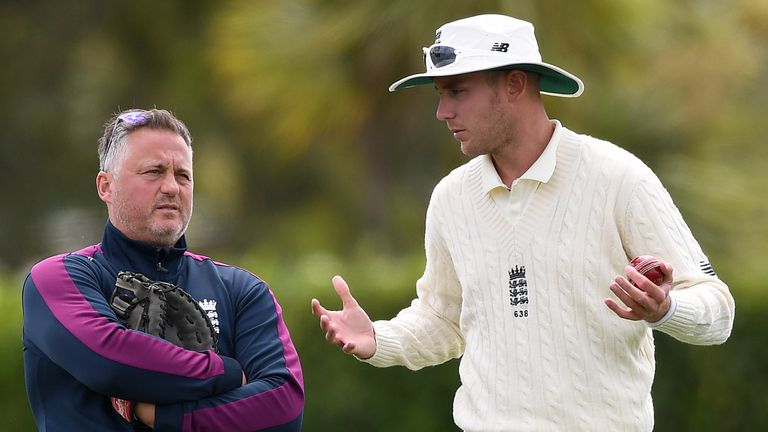
Darren Gough worked with Stuart Broad during a stint as an England bowling consultant over the winter
Former England fast bowler Darren Gough says he was “really surprised” to see Stuart Broad left out of England’s team for the first #raisethebat Test against West Indies at The Ageas Bowl.
Broad – England’s second-leading wicket-taker of all time, with 485 Test wickets – had not missed a home Test match in eight years, since being left out of a dead rubber against the West Indies at Edgbaston in 2012.
But he was omitted from England’s team for the first Test, with James Anderson, Mark Wood and Jofra Archer picked for the three seam-bowling berths alongside stand-in captain Ben Stokes and spinner Dom Bess.
“[I’m] really surprised,” Gough said on The Cricket Debate, which you can listen to as a podcast in the player below.
“Because when you talk about sticking with players, I thought with the Broad situation, he has stood up and been counted for England over the past few years, when Jimmy (Anderson) has been limping out of games with injury.
“I would’ve played both Broad and Anderson in this game – I think they deserved that respect – and then I would’ve gone for one of Wood or Archer.
“In typical English conditions, the way I would’ve done it is, rotated Anderson, Broad and (Chris) Woakes – always two out of the three – and then have one of Wood or Archer.
“I think they saw, in St Lucia in the West Indies, the pace of Wood bowling against the West Indian batsmen, when he gets it right, he frightens them.”
England’s bowlers will have to wait a bit longer before being let loose on the West Indian batsmen, as Stokes elected to bat first after winning the toss and then only 17.4 overs of play were possible on a frustrating, rain-affected first day.
0:53 England and the West Indies took a knee in support of the Black Lives Matter movement ahead of the first Test
England and the West Indies took a knee in support of the Black Lives Matter movement ahead of the first Test
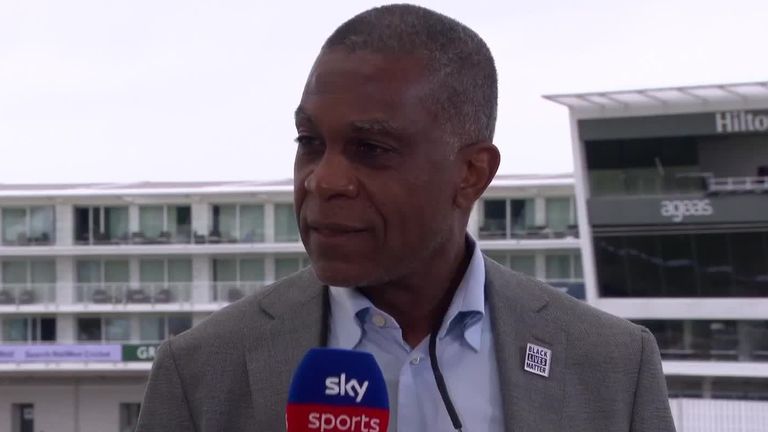
Before proceedings got underway in Southampton, players and squad members from England and the West Indies took a knee in support of the Black Lives Matter movement, while Michael Holding and Ebony Rainford-Brent both spoke powerfully on the subject – which you can hear again on the podcast.
Darren Sammy, a former West Indies captain, called for change from the top down, saying: “It’s sad to hear the constant stories and know what is reality; what black people have had to face for hundreds of years.
“I’m a person of colour, a black man, and a proud one. Every time you hear a successful story of a black man, it’s always against the odds.
“We live in a never-ending exam, where you have to try to pass it – but you don’t get the tools to pass that exam.
“For things to change, it needs our leaders – the people in power, like Ebony said, have to be the ones to start implementing that change.
“The system has failed us for too long.”
4:37 Michael Holding says education is key to eradicating the problem of racism and ensuring that this becomes a moment of genuine change in society
Michael Holding says education is key to eradicating the problem of racism and ensuring that this becomes a moment of genuine change in society
Former England Women’s cricketer, and former team-mate of Ebony’s, Lydia Greenway, also spoke on the BLM subject, adding that people “can’t turn away anymore”.
“I didn’t expect to be blown away with the amount of emotion I was,” said Greenway. “The way Ebony and Mikey spoke was really admirable; people talking from genuine experiences, with raw emotion.
“What we saw was the best way that sport can use a platform to promote positive change.
“The first place that we have to start is people need to listen. Nasser Hussain said, ‘we can’t turn away anymore’. We have to start engaging.”
Watch day two of the first #raisethebat Test between England and West Indies live on Sky Sports Cricket from 10.30am on Thursday.
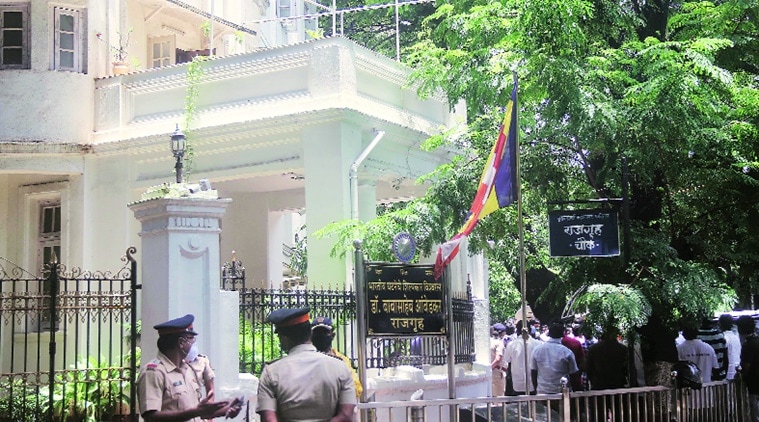
Police deputed outside Rajgruha at Dadar in Mumbai. (Photo by Ganesh Shirsekar)
Chief Minister Uddhav Thackeray on Wednesday expressed shock over reports of vandalism at Rajgruha, Dr Babasaheb Ambedkar’s residence at Dadar in Mumbai, and said those responsible for it would not be spared. The state government also announced that the structure would henceforth be under round-the-clock police security.
On Tuesday, an unidentified person had trespassed into the three-story residence at Hindu Colony and damaged some flower pots and window panes. Police have registered an FIR on charges of criminal trespass and causing damage under sections of the Indian Penal Code at Matunga police station Wednesday on the complaint of Bhimrao Ambedkar, grandson of Dr Ambedkar. A man has also been detained in the case, police said.
Calling Rajgruha a place of reverence for all, Thackeray said he has instructed the police to take strict action against the offender. In a tweet on Wednesday, the CM said, “It is a place of pilgrimage for every person in Maharashtra.â€
— CMO Maharashtra (@CMOMaharashtra) July 8, 2020
Dr B R Ambedkar had completed the construction of Rajgruha in 1933 and stayed there with his family. After his death in 1956, the house was converted into a memorial. The ground-floor museum, which houses over 50,000 books that Dr Ambedkar had collected in his lifetime, has been closed to the public ever since the lockdown was announced.
Currently, Dr Ambedkar’s grandsons — Anandrao, Bhimrao and Prakash — and his daughter-in-law stay in the heritage building.
In the police complaint, Bhimrao had told police that on Monday he had noticed a mentally unstable person loitering on the pavement outside his residence. Having also noticed the man outside his home once before, Bhimrao had asked him what he was doing there. On being questioned, Bhimrao told police, the man had walked away in anger. In his complaint, Bhimrao had described the suspect to be aged between 25 and 30 years, of a slim physique and dark complexion and wearing a blue T-shirt and jeans.
According to police, CCTV footage obtained from the spot shows a man entering the building’s main gate between 5 pm and 5.30 pm on Tuesday and upending eight-10 large flower pots. The man is purportedly seen walking out of the gate and then returning with stones that he hurls at the windows before fleeing, police said.
Soon after the incident, several Ambedkarites, activists, politicians and senior police officials rushed to the spot. On Tuesday night, Prakash Ambedkar released a video message appealing for calm. “The police are carrying out a thorough investigation. Please remain calm and do not gather at the building,†he told supporters.
On Wednesday, state Home Minister Anil Deshmukh said the government had taken serious note of the incident. Following a meeting with Cabinet ministers on Wednesday afternoon, he said, “We have decided in the Cabinet meeting that Rajgurha will henceforth be given round-the-clock police security.â€
Police in Cambodia’s capital Phnom Penh on Wednesday dispersed a group of supporters marking the anniversary of the murder of political commentator and social activist Kem Ley at the site where he was gunned down four years ago.
Kem Ley was shot to death in broad daylight on July 10, 2016 while having a morning coffee at a Caltex gas station mini market, days after publicly criticizing Prime Minister Hun Sen and his family for abuse of power and unexplained wealth. A trained physician who also held a doctorate, he was 45 and left behind four children and a pregnant widow.
On Wednesday, activists and monks gathered at the Caltex station to hold a Buddhist ceremony in his honor when police arrived and scuffled with those in attendance, briefly detaining at least one young man, a campaigner with environmental watchdog Mother Nature named Thun Rotha told RFA’s Khmer Service.
“Police were pushing us away from the minimart and threatening to arrest us, claiming that we hadn’t requested permission to gather and were trespassing,†he said. “The police action violated our freedom as Cambodians.â€
Sar Mory, program director of the Cambodian Youth Network (CYN), who monitored the gathering, said police were wrong to disperse nonviolent supporters honoring the fallen commentator.
“This was a restriction on a peaceful gathering—the police didn’t allow them to pay their respects to the late Kem Ley,†he said.
After supporters were dispersed from the minimart, they gathered on a nearby street to hold the Buddhist ceremony and then walked to neighboring Takeo province, where Kem Ley’s body was laid to rest in an unfinished stupa. The activists plan to hold a separate ceremony at Kem Ley’s house on Friday.
A monk who walked from Phnom Penh to Takeo named Koeurt Saray said police continued to monitor supporters as they traveled to the stupa.
“We commemorate Kem Ley because [his murder] is a historic event and doing so will strengthen the national spirit,†he said.
During the fray at the Caltex station, police had arrested a young man named Khan Chanthorn who was wearing a T-shirt bearing Kem Ley’s portrait and a slogan which read: “Wipe your tears and continue your journey.â€
Khan Chanthorn told RFA that he had been arrested for wearing the shirt but was released from the local station after being questioned and signing a document which said he would not take part in the memorial service for Kem Ley.
“I told the authorities I volunteered to come [today] because I believed in Kem Ley,†he said.
Khan Chanthorn said that despite signing the document, “I will continue to participate in the commemoration ceremony going forward.â€
RFA was unable to reach Phnom Penh Municipal Governor Khuong Sreng for comment on Wednesday.
‘Its’ a coverup’
Authorities charged a former soldier named Oeuth Ang with Kem Ley’s murder and sentenced him to life in prison in March 2017. In May last year, court authorities rejected his appeal and upheld his sentence, but many in Cambodia do not believe the government’s story that Kem Ley was killed by the man over a debt.
Phil Robertson, deputy director of New York-based Human Rights Watch’s Asia Division, called Oeuth Ang a “scapegoat,†and questioned why several aspects of the case had not been investigated further, including closed camera footage that appeared to show the convicted killer “running along with the encouragement of the police who were chasing him.â€
“The whole thing stinks—it’s a coverup,†he said. “It’s quite clearly a political killing because Dr. Kem Ley dared question the illicit wealth of Hun Sen and his family.â€
Robertson said that past statements by Hun Sen that he was committed to finding Kem Ley’s killer were only a reaction to an outpouring of anger in Cambodia over the commentator’s death.
“I think if he was looking for the killers, he would find the masterminds in his own political circle,†he said.
“I think that it is quite clear that there is some high-level government involvement in this case and that’s why I’m saying that they don’t want to investigate, because if they did, they’d be arresting themselves,†he added.
“This was a killing of a very popular man who was forming a grassroots movement based on human rights and community development. Someone who had a vision and had a growing following. He was going to be a political threat to [Hun Sen’s ruling Cambodian People’s Party] CPP and so they eliminated him.â€
Sam Rainsy, acting president of the banned opposition Cambodia National Rescue Party (CNRP), told RFA that Kem Ley’s murder demonstrates the need for a campaign to end impunity in the country.
“We are working on getting an independent court at the national and international level to conduct an investigation into the murder and bring its perpetrators to justice,†he said, speaking from self-imposed exile in Paris, where he has lived since 2015 to avoid a slew of what he says are politically motivated charges and convictions.
Seeking justice
In response to the comments, Ministry of Justice spokesman Chhin Malin told RFA that “justice has already been served†for Kem Ley, according to Cambodian law, and said the government can’t reopen a case “based on the emotions of the people.â€
He dismissed claims that the case was not resolved properly, suggesting that the CNRP and Human Rights Watch sought to “exploit Kem Ley’s murder†as a way to stoke public anger against the government.
National Police spokesman Chhay Kim Khoeun told RFA that authorities had ended their investigation into Kem Ley’s murder because of Oueth Ang’s conviction, although he said police would honor any court-ordered warrant to question new suspects.
“We are judicial police, so if there is no warrant, we can’t do anything,†he said.
Meanwhile, Kem Ley’s mother Phok Se said that pursuing justice for her son had put her family members at risk and cost them nearly all of their savings.
“[Kem Ley’s brothers] want justice but they have had to stay quiet,†she said. “We want security, and we barely have enough money to survive.â€
“My sorrow has not faded—now I am getting older, but my son is not with me.â€
Reported by RFA’s Khmer Service. Translated by Samean Yun. Written in English by Joshua Lipes.
Startup funding activity decreased by 29 per cent in the first six month of this year to $4.2 billion compared to $5.9 billion in the same period last year, due to the impact created by the coronavirus pandemic, according to data analytics firm Tracxn. Only 443 companies were funded in the January-June period this year against 725 in H1, 2019, according to ‘India Tech Semi-Annual Factsheet’, compiled by Tracxn.
In the same period, three unicorns or startups valued at more than $1 billion (each) emerged compared to six last year. These were kids and baby products online retailer FirstCry, fintech company Pine Labs and online beauty and wellness retailer Nykaa. Also, there were 17 soonicorns or companies which hold the potential to become a unicorn in the near future against 28 last year.
Some startups managed to raise huge funding, even as the economic situation was worsening. This includes edtech company Byju’s raising $300 million from Tiger Global Management and $200 million from General Atlantic.FirstCry received $300 million from SoftBank Vision Fund. Another edtech company Unacademy raised $110 million from investors including Facebook and scooter-sharing firm Bounce received $105 funding.
Tracxn report said alternative lending and test preparation tech were the most popular business models(BMs) of H1 2020. These generated the most interest, as indicated by the funding that went into them, accompanied by the percentage change in funding when compared to H1 2019.
Byju’s, Unacademy and Vedantu received most of the funding in the test preparation technology space. This area saw a major spike in funding with companies in this space raising a total of $666.2 million, up 538 per cent, according to Tracxn.
Byju’s recently crossed $10.5 billion valuation after raising new funding of less than $100 million from Silicon Valley investor and analyst Mary Meeker’s Bond Capital. It is rapidly narrowing the gap to become the most valuable startup in the country after digital payments firms Paytm, which is valued at around $16 billion.
In the lending space, companies such as Navi, Lendingkart and InCred attracted most of the funding. In this area, companies raised a total of $704.5 million, up 67 per cent, according to Tracxn.
Some of the key acquisitions that took place in the first half of this year included the purchase of digital credit firm Paysense by fintech firm PayU for $185 million and the acquisition of delivery firm Daily Ninja by online grocery firm Bigbasket.
Sequoia Capital and Accel were the top VCs, while Steadview Capital and FMO were the top PEs in H1’20, according to Tracxn. This week Silicon Valley-based venture capital firm Sequoia said it has raised $1.35 billion to invest in firms in India and Southeast Asia.
California, New York, Texas, Massachusetts, Illinois, Pennsylvania and Florida would be most affected by the policy, which would force students on F-1 or M-1 visas to either depart the country or transfer to a school with in-person instruction.
The seven states, which are among those with the most four-year colleges, had approximately half the international college student enrollment in the 2018-19 school year, according to data from the nonprofit NAFSA: Association of International Educators.
China said on Wednesday it plans to implement visa restrictions on U.S. citizens, a day after the U.S. issued travel bans on Chinese officials who restrict foreign access to Tibet.
The tit-for-tat moves by Beijing and Washington are the latest spat in deteriorating relations over trade, the coronavirus, the treatment of detained Uyghurs in Xinjiang, Beijing’s displays of military might in the South China Sea and what the U.S. and others see as China’s overreach in Hong Kong.
China’s visa measures would go into effect for “U.S. individuals with egregious conduct related to Tibet issues,†said Chinese Foreign Ministry spokesman Zhao Lijian, but he did not elaborate on the threat.
“We urge the U.S. to stop interfering in China’s internal affairs with Tibet-related issues … so as to avoid further damage to China-U.S. relations,†Zhao told reporters at a daily news briefing.
Beijing’s move followed Secretary of State Mike Pompeo’s announcement of U.S. restrictions on selected Chinese officials a day earlier in Washington.
“Unfortunately, Beijing has continued systematically to obstruct travel to the Tibetan Autonomous Region (TAR) and other Tibetan areas by U.S. diplomats and other officials, journalists, and tourists, while PRC officials and other citizens enjoy far greater access to the United States,†Pompeo said in a statement Tuesday.
“Therefore, today I am announcing visa restrictions on PRC government and Chinese Communist Party officials determined to be substantially involved in the formulation or execution of policies related to access for foreigners to Tibetan areas,†he added.
The U.S. move is in accordance with the Reciprocal Access to Tibet Act, which was passed unanimously in both houses of Congress in 2018.
Washington has long complained that Chinese diplomats, scholars and journalists enjoy unrestricted travel in the United States, while China tightly restricts the access of U.S. counterparts to Tibet and other areas.
Foreigners wishing to travel to Tibet must apply for special permits from the Chinese government. Limiting travel makes getting information out of the remote western region more difficult, which human rights activists say enables a campaign by Beijing’s to eliminate Tibet’s indigenous culture and religion.
“Access to Tibetan areas is increasingly vital to regional stability, given the PRC’s human rights abuses there, as well as Beijing’s failure to prevent environmental degradation near the headwaters of Asia’s major rivers,†Pompeo said.
A message to China
The Central Tibetan Administration (CTA), the Dharamsala, India-based Tibetan government in exile, suggested other governments could enact similar moves.
“The US government’s strong position on Tibet access could also influence many foreign countries to follow the same footsteps, and that could be a great victory for Tibetans if that takes place,†CTA spokesman Tsewang Gyalpo Arya told RFA Wednesday.
“China claims that the living conditions inside Tibet have drastically improved and Tibetans are living happily, but foreign diplomats, UN delegations, foreign journalists, visitors have been barred from visiting Tibet,†he added.
With the Tibet visa policy, “the U.S. is sending Beijing a clear message that it will face consequences for its human rights abuses and continued isolation of Tibet from the outside world,†said Matteo Mecacci, president of the Washington-based International Campaign for Tibet.
“The Chinese government has for a long time taken advantage of the freedoms—and access to markets—provided by democracies, without reciprocating, while building an Orwellian system of control. It is now critically important for the U.S. and like-minded countries to demand China provide the same openness it receives from others,†he added.
Sophie Richardson, the China director at Human Rights Watch, said the visa sanctions are “a way of sending a message to the Chinese government that other governments are frustrated by the impediments Beijing throws up to accessing Tibet.â€
“It’s an interesting experiment and it will be very interesting to see how Chinese authorities respond to it, and how it plays into the thinking on Capitol Hill about other legislative approaches to certain kinds of rights abuses in China.â€
Reported by Tashi Wangchuk for RFA’s Tibetan Service.
Liz Truss wrote to Chancellor Rishi Sunak and Cabinet Office Minister Michael Gove to set out four concerns about plans to manage the border with the EU | Leon Neal/Getty Images
International trade secretary’s letter shows the tension between government departments over the plans.
LONDON — Britain could face a legal challenge from the World Trade Organization about its post-Brexit border plans, International Trade Secretary Liz Truss warned Cabinet colleagues.
Truss wrote to Chancellor Rishi Sunak and Cabinet Office Minister Michael Gove to set out four concerns about plans to manage the border with the EU once the Brexit transition period ends in December.
Her letter reveals the tensions in government over the post-Brexit border plan and the implications any hiccups could have for Britain as it seeks to forge new trading relationships around the world.
In the letter, first reported by Business Insider and seen by POLITICO, Truss said her “key areas of concern on border policy risks†were a possible WTO challenge, a lack of sufficient border controls, failures in tariff management and differences in the Northern Ireland regime.
Britain has agreed to waive border checks on imports from the EU for the first six months after the transition period but the EU has not agreed the same for U.K. exports. This means the U.K. could be deemed as giving the bloc preferential treatment, which is against WTO rules.
“When we exit the transition period the U.K. will be vulnerable to a WTO challenge regarding its border regime,†Truss wrote.
She said any difference in tariff controls between Great Britain and Northern Ireland could “have political, legal and reputational risks†and warned that insufficient controls at the borders could lead to smuggling. She demanded full control plans by January 2021.
Elsewhere, she said issues with the collection of tariffs could “undermine the effective operation of our trade policy, as well as create significant handling difficulties with negotiating partners†on future trade deals.
Truss concluded: “As we fast approach the end of the transition period, we need to ensure that the U.K. border is effective and compliant with international rules, maintaining our credibility with trading partners, the WTO and with business.”
Labour’s Shadow Cabinet Office Minister Rachel Reeves said the correspondence “confirms fears that several ministers have been making things up as they go with a lack of awareness of the real world consequences of border policies they’ve had four years to develop.”
Anti-Brexit group Best for Britain called for the full letter to be made public and for any responses from the ministers addressed to be published.
The Department for International Trade said it would not comment on leaks but insisted the U.K. continues its border preparations by hiring more customs agents and developing an IT system to handle paperwork. The full border control plan is set to be published on July 13.
The letter also suggests Britain has reversed a plan to waive export declarations on goods going to the EU.
Want more analysis from POLITICO? POLITICO Pro is our premium intelligence service for professionals. From financial services to trade, technology, cybersecurity and more, Pro delivers real time intelligence, deep insight and breaking scoops you need to keep one step ahead. Email pro@politico.eu to request a complimentary trial.
On Twitter Wednesday, President Alassane Ouattara said: “I pay tribute to my young brother, my son, Amadou Gon Coulibaly, who was, for 30 years, my closest collaborator.”
“I salute the memory of a statesman, of great loyalty, devotion and love for the homeland. He embodied this young generation of Ivorian leaders of great skill and extreme loyalty to the Nation.”
Coulibaly, 61, had been chosen to run as the ruling party’s candidate in this year’s October presidential election.
According to his official biography, he leaves behind a wife and five children.
Shepard Smith, the former Fox News anchor who abruptly left his longtime network last year after tensions with colleagues over coverage, is set to join CNBC, the cable station known for Wall Street and business news, as the host of a new nightly newscast.
His 7 p.m. program, “The News with Shepard Smith,†is expected to start in the fall, the network said on Wednesday, part of a broader overhaul of CNBC’s lineup. The channel carries live programming during the business day, but its evening hours are often filled with reruns of “Shark Tank†and original episodes of “Jay Leno’s Garage.â€
The next job for Mr. Smith, 56, has been a topic of speculation for months in media circles. A genial Mississippian, Mr. Smith had worked at Fox News for 23 years, most recently as chief news anchor, where he often stood out for reporting that countered the conservative views of the channel’s prime-time stars.
His departure, last October, left colleagues stunned. Friends said Mr. Smith had been dismayed by some of the pro-Trump cheerleading by Fox News commentators, and he had been the subject of on-air mockery from the star pundit Tucker Carlson.
“I am honored to continue to pursue the truth, both for CNBC’s loyal viewers and for those who have been following my reporting for decades in good times and in bad,†Mr. Smith said in a statement. The Wall Street Journal first reported his hiring.
At CNBC, Mr. Smith will serve as chief general news anchor, and his newscast will compete with “Lou Dobbs Tonight†on Fox Business.
Mr. Smith’s move to CNBC may be the first concrete sign of a strategy shift by Jeff Shell, the new chief executive of NBCUniversal, CNBC’s parent company. Mr. Shell, along with the new chairman of NBC’s news networks, Cesar Conde, is considering a variety of changes to CNBC’s programming outside of market hours.
Although Mr. Smith, whose last show on Fox News aired at 3 p.m., will be moving closer to prime time, he will need to build an audience: the 7 p.m. hour at CNBC is seen by about one-fifth of the viewers that tuned in for Mr. Smith on Fox News.
The last time CNBC broadcast a live news program in the time slot, it was anchored by a future White House official: “The Kudlow Report,†hosted by Larry Kudlow, now President Trump’s chief economic adviser, ran at 7 p.m. until the program ended in March 2014.
Anyone who met George Hallett, the South African photographer who passed away on July 1, at the age of 77, knows he was a born performer and raconteur, who relished the spotlight at any gathering.
Yet, he was also a trickster figure — a chameleon who knew how to blend in with the background, and observe his photographic subjects’ burdens and most vulnerable states. Hallett’s iconic portraits reveal his shaman’s ability — his ceremonial performances with the camera that created openings into his subjects, especially those who had a lot to hide.
One would not necessarily realise that the slim, lanky man with a small camera, standing unobtrusively in a crowd, had taken photographs that broke through the reserve of seasoned charmers and politicians — including Nelson Mandela — and those, like Eugene de Kock, who had been responsible for the torture and deaths of hundreds, if not thousands, of South Africans who fought for freedom.Â
Hallett was notoriously economical with his film — times were tough, and film expensive — taking only one or two frames. Yet each portrait that Hallett took is extraordinary — be they of those history has now marked as villain or hero; or the countless South African exiles in Europe with whom he forged close bonds, and whose loneliness, hardships and pain were invisible to a larger public.Â
Perhaps, as a man who used performance and a loud persona to mask his own difficult experiences of exclusion, and maintained the effects of that damage behind tall tales of grand exploits, he knew how to read beyond what others, too, projected onto the screen. He understood how to look for the tucked-away spaces that were the sources of both light and dark.Â
George Hallett was born on December 30, 1942, in Cape Town’s District Six. He grew up with his grandparents in Hout Bay Village — a small fishing community about 30 minutes south of Cape Town. Nearby lived his uncle and aunt, who had a library full of magazines and books that George was free to pore over — this was his first introduction to literature and art, in which he found solace, inspiration and escape.Â
Westminster Restaurant, District Six, 1968
Shoe Shine Fantasy, 1983
Dancers, 1967
He also speaks about the thrill of going to the Saturday movie nights organised and shown at his school hall — including many black and white films from the United States. His friends focused their attention on the plot, action and favourite actors. But he was interested in the mechanics of making the film. Although he had no idea that “the camera was … on wheels and was moving on railsâ€, he situated himself as the mechanism that directed viewers’ eyes. “I became the camera,†he told Paul Weinberg, in a 2007 interview towards the exhibition and book project Then and Now.
He later left to live with his mother in Athlone, an area outside Cape Town designated for the city’s forcibly removed “coloured†population. In his interview with Weinberg, Hallett recounts how he first began his career as a portraitist. A friend of his worked at Mr Halim’s photography studio — Palm Tree studios — which specialised in portraits, weddings, ID photographs and the like. Every time his friend showed Hallett his work, Hallett was critical of it; he could see that overusing the flash interfered with the portrait, or that the angle of the photograph could be done differently. Irritated, Hallett’s friend challenged him: “If you know so much about photography why the fuck don’t you take pictures?†Until then, the idea of being a photographer had never occurred to him.Â
Because he had no money to buy a camera, Hallett recalls, he went to Mr Halim’s studio on Hanover Street in District Six, and asked to work for him. He was given a Japanese Rangefinder camera, and unceremoniously told to “go and photograph people in the streets, forty cents a popâ€. Mr Halim also told Hallett to “put [his subjects] in the sunâ€, and not to change the F-stop or the aperture; to leave “the speed just … as it is.â€Â
It was an encounter with a gangster — who sat next to Hallet in a pub, smoke curling up from a cigarette, demanding a photo — that pushed the photographer to explore the settings of his camera. The photo soon landed him a steady skollie clientele, who all “wanted pictures with smoke in their faces, each pleading, ‘Dit lyk soos Humphry Bogart, man, broer’!â€
But Hallett’s most influential educators were not solely the streets: his English teacher, the novelist Richard Rive, introduced him to a larger variety of literature and a circle of writers and artists, including James Matthews and Peter Clarke. It was they who persuaded him to photograph his old birthplace, District Six, after it was declared a whites-only area in 1966, under the Group Areas Acts.Â
Hallett took his camera to District Six every Saturday, and photographed the ordinary and the unremarkable: everyday scenes, devoid of romanticism or pity. Today, his images remain essential for recreating a shared identity and memory for descendants of those forcibly removed from District Six.Â
I first met Hallett was when he was invited by Chimurenga to give a talk at the Cape Town Library. There, he spoke about his work as a book cover designer for the Heinemann African Writers Series (AWS). At first, he was formal, but, as he became more comfortable with the audience, he stepped into the role of raconteur-uncle, relishing the laughter of his audience of youngsters, eager to hear the photographer’s exploits.Â
Hallett recounted what it was like when he arrived in London in 1970 — having found South Africa “too much and not enoughâ€, as he recounted to photography scholar and historian, John Edwin Mason, in an interview published in Social Dynamics: A Journal of African Studies in 2014. There were many ANC exiles in London — including Alex La Guma, Pallo Jordan, Dudu Pukwana and Dumile Feni, among others, Hallett told our small group. He felt at home among them, but needed work.
South Africans in Exile
Woman Matador
Pleading with Debt Collector, 1968
 He took his portfolio around to press offices, and was hired as a photographer for the Times Higher Education Supplement. Josiah Steyn, a more established exile, introduced Hallett to James Curry, who was the editor of the Heinemann African Writers Series. Curry invited Hallett to lunch. He was thrilled and nervous — he’d never before had lunch with someone of Curry’s professional stature. But he had a great time; there was “a lot of beer and cottage pie, all very British.â€Â
Curry asked Hallett if he had experience designing book covers. “Of course, I lied and said ‘yes, but I can’t show you [samples] … because I couldn’t bring [them] with me when I left South Africa’.†During that boozy lunch, Hallett was charged with designing the cover for Tongue of the Dumb (1971), by Zambian writer Dominic Mulaisho. He used collage techniques to fashion a cover that sported an African mask — “There was no photoshop those days†— and “Bob’s your uncle! I delivered a cover the next day.†For the next 12 years, he produced book covers for the series.Â
Hallett’s work for Heinemann took him to African writers’ conferences in Berlin, Frankfurt, and Paris, where he became comfortable hanging out with writers — and musicians, painters and poets.Â
Hallett downplayed the artistry of the covers he designed, but Josh MacPhee notes, in Judged by Its Covers: Looking back at the design of the African Writers Series,that Hallett brought “a sea change to the overall aesthetic of the AWS … Under Currey, photography dominated the AWS covers in a wide range of uses, with Hallett and others moving from powerful arranged scenes (see the cover of DM Zwelonke’s Robben Island) and photomontage (Kofi Awoonor’s This Earth, My Brother…) to abstraction (AW Kayper-Mensah’s The Drummer in Our Time).â€
He photographed many authors, and sometimes these images were used as inset images on back covers, which, according to MacPhee, “became a powerful statement in and of themselves, [redefining] diversity on bookshelves across the English-speaking worldâ€. Hallett’s connections with writers also led to a rich collection of portraits, which he later published in Portraits of African Writers (2006).
Birds in Signal Street, 1996.
Hallett lived as an itinerant exile for 24 years. In 1974, he moved to France. As he recounted to Mason, he decided to leave London after an inspector at Scotland Yard phoned him, accusing him of being a part of a terrorist organisation that was planning to kill South African spies. He lived in a small village, Boule d’Amont, near Perpignan, with his partner of many years, Lilli. His daughter, Mymoena, was born on the farm — Mas Domingo — where they lived.Â
Mymoena remembers many South African exiles came through, and George, whom she calls “Papa Gâ€, made great, performative feats of cooking, preparing feasts of curries and tandoori. For Mymoena, laughter, a little bit of Papa G’s chaos, and photography surrounded her life. Her mother photographed, too, and many of the youngsters around them were, inspired and — unintentionally, perhaps — mentored by her father.
Hallett began making brief returns to South Africa — first, between 1980 and 1981, when he worked in the newly independent Zimbabwe teaching photojournalism — as a way of being closer to his ailing father, and to be present at his father’s eventual death. In 1990, he was commissioned by a news agency in France to photograph the violence stirred up by Mangosuthu Buthelezi and the Inkatha Freedom Party, using well-trained, armed militias. Hallett found it unbearable to photograph this level of violence day to day, and returned to France.Â
But then he had a prophetic dream. In a 2012 email, he told me: “I had a dream in Paris in early 1994 that I was going to meet Mandela and have lunch with him. The strange thing about the dream was that we were all sitting on chairs that were balanced precariously on the hind legs. When I consulted a dream interpreter in Paris at the time, she told me that I will be meeting Madiba and the reason that the chairs were so precariously balanced on their hind legs was because of the unsteady state of the nation caused by third-force violence. Three weeks later Pallo Jordan [at the time, a key advisor to Mandela; and later elected as MP and the minister of communications, telecommunications and postal services] called me to [ask me] to come and photograph the election process for the ANC. [He said] that I must make my way to [Johannesburg].â€
Hallett left for Johannesburg soon after, to take his position as the official photographer of the ANC, commissioned to document Mandela, the electoral process and, eventually, the first democratic government. He got to have that predestined lunch with Mandela, just as his dream had foretold. And just as his dream interpreter had announced, there were shadowy forces conspiring to use violence to roadblock Mandela from fulfilling his destiny.
The Wedding (George Hallett)
Hallett’s images — under the auspices of the ANC’s direction — filled the empty image spaces created by a 27-year ban on Mandela’s image. Although much of the iconography around Mandela reduced his visual biography to hagiography — manufacturing Mandela into a smiling, unidimensional commodity in the global marketplace, “beguil[ing] the outside world into trumpeting the ‘miracle’ of the South African transitionâ€, as Adam Habib contends (in Myth of the Rainbow Nation, 1996) — Hallett’s body of work during this period presents a multifaceted figure, a complex nation and a fluid, amorphous political process that had unclear outcomes.Â
Although it is the ANC’s “royalty†he was commissioned to photograph, Hallett’s work during this period and others often focuses on domestic workers. In FirstEncounter, Johannesburg, 1994, three women — two of them wearing the iconic uniforms of “tea ladiesâ€, and, in many ways, figures as iconic as Mandela in apartheid history — run open-armed towards a receptive, welcoming Mandela. His face is not visible to the photograph’s audience: we only recognise him from his height, slim physique, the greying hair, the impeccable — if loose-fitting — dark suit. The women, their joy so nakedly expressed, are the public who waited decades for the promise of liberation — an impossibility now embodied as possibility by the stately man now in front of them.
Hallett’s memory of this moment characterises his deft hand as a photographer: “That picture with the women running towards Mandela, which I call ‘First Encounter’ — this was the first time they had actually seen him close up. And it was an incredible experience, because for the first time I saw the whole country, and the joy and the hope that people had.â€
Hallett’s photographs were later published in a book, titled Images of Change, by Nolwazi Educational Publishers in Braamfontein, Johannesburg, under the auspices of the ANC’s department of information and publicity. The book appeared in landscape format, with 140 pages of captioned, black and white photographs, and an introduction by Pallo Jordan. On the cover of the book is a photograph of Mandela, deep in conversation on a cellphone — his face turned away from the camera — as an aproned woman, instantly recognisable in the landscape of domestic labour in South Africa, walks past him nonchalantly on her way to one of her many daily tasks: to put a full toilet roll in a bathroom.
Mandela speaking on a cellphone with then president FW de Klerk discussing the violence in the country just before the elections, Johannesburg, 1994. (Photo: George Hallett)
In the latter part of the 1990s, Hallett was tasked with being the official photographer of the Truth and Reconciliation Commission (TRC) in 1997. The intensity of this work took a toll on him, just as it did others who worked with the commission. He would return home, shattered, hoping to find some relief, remembers Rashid Lombard, fellow photographer, director of the Cape Town International Jazz Festival and Hallett’s caretaker during the final years of his life.Â
“I saw the dark side of Hallett while he was documenting the TRC and especially during the session with former Vlakplaas commander Eugene de Kock [who was] nicknamed “Prime Evil†by the press. I spent a few nights with George listening to loud jazz and lots to drink to calm his anger. I understood the feelings. Music was [our] therapy. Yet he went ahead and captured the most sensitive portrait of Eugene de Kock and Jann Turner, daughter of activist Rick Turner, who was assassinated by de Kock’s hit-squad.â€
Captain Jeff Benzine, a former Special Branch detective, demonstrates his ‘wet bag’ torture method to the Truth and Reconciliation Commission, Cape Town, Western Cape.
1997
Hallett is remembered by many people as a mentor who influenced their careers as photographers, curators, and writers. Hallett took his craft very seriously. Lombard remembers, “He shot film, using a rangefinder camera. But you wouldn’t see a light meter anywhere near him because he could read his settings just by looking at the light. Sometimes I thought he smelt the light settings.†Christine Eyene, a curator and photographer based in France, cites Hallett as especially significant to her life and work. Others have anecdotes that reveal Hallett’s characteristic no-nonsense style. The journalist Yazeed Kamaldien recalls how, during an interview, Hallett informed “a security guard at the Cape Town International Convention Centre not to tell him that he can’t take photos because this wasn’t apartheidâ€. Many more remember how he generously housed them in London and Paris while in exile, the meals he cooked and shared, and how he took their portrait, so that they could send a photo to their families at Christmas time.Â
It is also important to say, at this point in our history, when we are reckoning with the multitude of ways in which misogyny and violence towards women have derailed their careers — or at least robbed them of professional opportunities — that Hallett did not always behave ethically towards those who approached him as a mentor, or for other professional reasons.Â
I, too, have an experience that speaks to the ways Hallett’s unwanted physical advances were deeply uncomfortable, and created a great deal of dissonance. At the time, I was just finding my way as a scholar and writer. I stepped back, and did not publish the material in the interviews on which I had spent days, and many more hours transcribing. Male colleagues who later interviewed him produced brilliant writing on Hallett’s work. I appreciate that work, without reservation.Â
I am able, today, to write respectfully of Hallett. Perhaps it is because I had a strong sense of respectful boundaries, and I was already employed as an academic. I know that others may not have had the choices I had. It still rankles that a man accosted me, physically, in the presence of two women, who did nothing. One blamed me for not being “kind†to a man who “only liked†me. Looking back, this is a conversation not just about one person’s conduct, but a far more difficult and involved reckoning that those of us in the arts must face.Â
In 2014, the Iziko South African National Gallery organised a retrospective of Hallett’s work, titled ANomad’sHarvest. The exhibition showed the remarkable breadth of his work. It included photographs of District Six, images of his life and those he encountered in France and England — the down-and-out and ordinary figures with whom he’d spent his life — his famous portraits of writers and artists. Each section of the gallery was a sensitive volume, containing several lifetimes’ worth of stories. But it was Hallett’s iconic work after the ANC and Nelson Mandela’s road to victory in 1994, and images from the TRC, that stole the show.
In the photograph of Jann Turner, daughter of the dissident academic Rick Turner, she is pictured looking down on the seated figure of Eugene de Kock. Turner’s father was fatally shot, through a window of his home in a suburb of Durban, and died in her arms shortly after midnight, in January 1978. She was 13 years old. At the time, police turned up no clues. But the TRC hearings determined, after an “examination of the police investigation into Turner’s death, as well as new information which surfaced during the commission’s investigations … that the police themselves suspected the involvement of the state apparatus†— that is, the police knew that the Bureau of State Security (BOSS), was responsible for Turner’s death.
For that reason, the police obstructed the investigation. Eugene de Kock — although he had been the Commander of Vlakplaas, a secret location of torture — always claimed that he had solely carried out his superiors’ orders; in Turner’s case, he said that one of his informants had told him that a BOSS operative, Martin Dolinchek, had killed Turner and that Dolinchek’s brother-in-law had driven the getaway vehicle.Â
Journalist Jann Turner with former police colonel and assassin, Eugene de Kock, at the Truth and Reconciliation Headquarters, Cape Town, Western Cape.
1997
In Hallett’s photograph of Turner and de Kock, Jann Turner, then in her early thirties, looks at de Kock askance. Neither truth nor reconciliation is present in that room. Turner’s set mouth, her downturned eyes, are directed at de Kock, who continues to evade inquiry by facing the camera. His eyes are obscured behind large, bottle-bottom thick eyeglasses. But Turner’s demeanour also tells us that she no longer depends on or awaits release through any utterance de Kock makes.Â
Hallett leaves us with many loose ends — unsettled. He also leaves an enormous gallery of photographic work. It will be up to those who are now responsible for his archive to treat it with honour, and to make sure that the history he documented — often at great psychological cost — is available to all.Â
We use cookies on our website to give you the most relevant experience by remembering your preferences and repeat visits. By clicking “Accept”, you consent to the use of ALL the cookies.
This website uses cookies to improve your experience while you navigate through the website. Out of these, the cookies that are categorized as necessary are stored on your browser as they are essential for the working of basic functionalities of the website. We also use third-party cookies that help us analyze and understand how you use this website. These cookies will be stored in your browser only with your consent. You also have the option to opt-out of these cookies. But opting out of some of these cookies may affect your browsing experience.
Necessary cookies are absolutely essential for the website to function properly. These cookies ensure basic functionalities and security features of the website, anonymously.
Cookie
Duration
Description
cookielawinfo-checbox-analytics
11 months
This cookie is set by GDPR Cookie Consent plugin. The cookie is used to store the user consent for the cookies in the category "Analytics".
cookielawinfo-checbox-functional
11 months
The cookie is set by GDPR cookie consent to record the user consent for the cookies in the category "Functional".
cookielawinfo-checbox-others
11 months
This cookie is set by GDPR Cookie Consent plugin. The cookie is used to store the user consent for the cookies in the category "Other.
cookielawinfo-checkbox-necessary
11 months
This cookie is set by GDPR Cookie Consent plugin. The cookies is used to store the user consent for the cookies in the category "Necessary".
cookielawinfo-checkbox-performance
11 months
This cookie is set by GDPR Cookie Consent plugin. The cookie is used to store the user consent for the cookies in the category "Performance".
viewed_cookie_policy
11 months
The cookie is set by the GDPR Cookie Consent plugin and is used to store whether or not user has consented to the use of cookies. It does not store any personal data.
Functional cookies help to perform certain functionalities like sharing the content of the website on social media platforms, collect feedbacks, and other third-party features.
Performance cookies are used to understand and analyze the key performance indexes of the website which helps in delivering a better user experience for the visitors.
Analytical cookies are used to understand how visitors interact with the website. These cookies help provide information on metrics the number of visitors, bounce rate, traffic source, etc.
Advertisement cookies are used to provide visitors with relevant ads and marketing campaigns. These cookies track visitors across websites and collect information to provide customized ads.

 Police deputed outside Rajgruha at Dadar in Mumbai. (Photo by Ganesh Shirsekar)


