The Buck moon rises over London seen from Primrose Hill (Alamy Live News)
Over the weekend astronomy fans were treated to the spectacular view of a full moon lighting up the night sky.
July’s full moon is known as the ‘Buck moon’ – because it occurs during the season when young male deer grow their antlers.
Hitting its peak on the nights of July 4/5, this year’s Buck moon was also a partial lunar eclipse, known as a penumbral eclipse.
During a lunar eclipse, the Earth comes between the sun and the moon, causing a shadow over the lunar surface. A total lunar eclipse will darken the entire moon but a penumbral eclipse leaves some of it still visible because only the outer shadow of the Earth (the prenumbra) falls across the moon.
This can also result in turning a shade of orange as it hangs low in the sky.
It was only very partially visible in the UK in the early hours of this morning – but that hasn’t stopped plenty of photographers from around the world capturing some stunning pictures of the event as it happened.
In New York the moon took on a deep red hue (Gary Hershorn/Getty Images)
The Buck moon rising over Roker Lighthouse in Sunderland (Simon Woodley / SWNS)
The full moon behind Kreuzenstein castle in Leobendorf, Austria (EPA)
Fireworks go off on the top of the Empire State Building with the full moon beneath them to mark July 4 (Photo by Gary Hershorn/Getty Images)
The full moon, know as the Buck Moon or the Thunder Moon rises behind cruise ship Oceana on The Solent with the Isle of Wight in the background. (Alamy Live News.)
As well as the Buck moon, July’s full moon is sometimes known as the ‘Thunder moon’ because of the summer storms that can take place at this time of year.
The next full moon taking place in August is known as the Sturgeon Moon.
An elated Lando Norris jumped out of the MCL35, ran over towards his team and embraced boss Zac Brown. A maiden podium for the Englishman and a second in three races for McLaren. It was a brilliant moment.
Although no fans were present to take in a spectacular season-opening Austrian Grand Prix, won by Valtteri Bottas, McLaren continue to make positive strides after a number of disappointing campaigns.
The Woking outfit have climbed from ninth, sixth and fourth in the constructors’ championship since 2017, and Norris’ stunning result at the Red Bull Ring maintains this upward trajectory.
The 20-year-old crossed the line in fourth, however, a stunning final lap saw him leapfrog Lewis Hamilton into third after the world champion picked up a five-second penalty for contact with Alex Albon 10 laps earlier.
Pulling out the fastest lap of the race – finishing within 4.8 secs of Hamilton – was enough to clinch a first podium in his short 22-race career.
Of course, strategy and the safety cars did play into his hands during the race, but the Guildford man showed excellent racecraft to surge past Sergio Perez late on and set a stunning quali-esque fastest, final lap.
It is now McLaren’s second podium in three races, with Carlos Sainz having ended a barren run of five years without a top-three finish at the Brazilian GP in November.
Excellent defensive driving and a mix of aggression, McLaren have a strong foundation to build on their fourth-place finish from 2019 – their strongest showing since 2012.
The driver pairing have struck up a great friendship, yet there could be extra spice in it this campaign.
Norris nipped at the heels of Sainz last term, shading the qualifying head-to-head (11-10). However, the Spaniard finished 47 points and five places (6th) ahead of the Briton in the drivers’ championship.
With Sainz joining Ferrari for 2021, Norris will no doubt be determined to push his teammate again over the coming months.
Achieving more formidable results against the imminent Scuderia man is the platform Norris needs to showcase his innate potential.
It is encouraging times ahead, nevertheless, as Daniel Ricciardo’s impending switch to McLaren next year makes for the most exciting driver line-up on the grid.
The Australian is a top notch driver, with aggression and a sheer appetite for victory. His experience will unearth the best from a rising star 11 years his junior.
Rekindling the flame with Mercedes engines brings back one of F1’s iconic partnerships, which yielded huge success in the late 1980s and early 1990s.
Behind the big three, the improving MCL35 is more stable, quick and attacks the corners to perfection in comparison to previous seasons.
With no change in the regulations for 2020, the battle for midfield supremacy is expected to be even closer, with the new-look Racing Point particularly strong.
Confident to continue an upward trend, McLaren are trying to discover the right balance and maintain their position at the head of the midfield.
A return to the front of the grid may well be achievable in the future, but for now, they need to turn their focus to the year ahead and try to extract the most from the MCL35.
With young Norris showing his class and Sainz keen to impress ahead of his Scuderia switch, Brown certainly has two charging drivers purring with dominance.
Consistent results and another podium could make for another promising season.
French President Emmanuel Macron | Pool photo by Ludovic Marin/AFP via Getty Images
Foreign, finance and defense ministers remain in post but interior ministry gets new chief.
PARIS — After promising reinvention for the rest of his term, French President Emmanuel Macron opted for a limited government reshuffle that kept key figures in place while aiming to beef up ministries to revive the economy.
In recent months, Macron and his officials had talked about resetting the government for the final two years of his first presidential term, with some suggesting a pivot to focus more on environmental and social policies. But the new ministerial team announced on Monday has familiar faces in many of the top jobs.
Jean-Yves Le Drian will continue to lead the Ministry of Europe and Foreign Affairs while Bruno Le Maire retains his position as finance minister, with a slight amendment to his title to make clear he is responsible for the economic recovery from the coronavirus crisis. Florence Parly remains defense minister.
The line-up does not suggest a major political reinvention. Its most notable innovation is the importance given to managing economic recovery across the board, by expanding several ministries like the Finance Ministry, the Ministry of Labor and the Ministry of Environment.
Unlike in his two previous government line-ups, Macron has not recruited new, high-profile figures from the traditional parties. Instead, the new Cabinet attempts to maintain Macron’s tenuous balance of combining left- and right-wing policies, though some of its highest-profile ministers are former conservative party members.
The new Cabinet also includes at least two ministers with ongoing court cases despite an initial promise by Macron that members of his government would be above reproach.
Darmanin, the new interior minister, is under investigation over an allegation of rape, which he denies. He replaces Christophe Castaner, a close Macron ally who has been embattled for many months, most recently losing the trust of police unions.
The new justice minister is a firebrand high-profile lawyer, Eric Dupond-Moretti, who has a difficult relationship with the judiciary, and is currently suing for what he alleges was illegal snooping into his communications.
Castex, the new prime minister, replaced Edouard Philippe, who served as Macron’s head of government for the first three years of his term.
Macron and Castex spent much of the weekend making calls and meeting to put together the new government. They will announce additional secretaries of state, the most junior ministerial rank in the Cabinet, in the coming days.
In another sign of the even more assertive role Macron intends to play for the rest of his term, he will lay out his coming priorities on July 14 — a few days before the new prime minister outlines the government’s guiding policies. Castex had said on Friday that he would deliver that speech this week.
Please note: these are government figures on numbers of confirmed cases – some people who report symptoms are not being tested, and are not included in these counts.
Update 3 July: Public Health England is now including “pillar 1†and “pillar 2†cases for local authorities in England. Many places will have seen an apparent rise in cases, which is chiefly due to this adjustment in the way the data is published. PHE explains the nature of the change here.
These figures come from data published by Public Health England, working with the Department for Health and Social Care and Health Protection Scotland. Some of the numbers are updated daily, though others may be updated more regularly.
About Covid-19
Since first being identified as a new coronavirus strain in patients from the city of Wuhan in Hubei province, China, late last year, Covid-19 has spread around the globe.
The virus can cause pneumonia. Those who have fallen ill are reported to suffer coughs, fever and breathing difficulties. You can find out more about the symptoms here.
Due to the unprecedented and ongoing nature of the coronavirus outbreak, this article is being regularly updated to ensure that it reflects the current situation as best as possible. Any significant corrections made to this or previous versions of the article will continue to be footnoted in line with Guardian editorial policy.
ROME, July 6 – Ennio Morricone, whose scores for movies such as “The Good, the Bad and the Ugly,†“The Mission†and “Cinema Paradiso†made him one of the world’s most famous and prolific screen composers, has died, ANSA news agency said on Monday. He was 91.
ANSA said Morricone, who won two Oscars and dozens of others awards including Golden Globes, Grammys and BAFTAs, broke his femur some days ago and died during the night in a clinic in Rome.
His last Oscar was in 2016 for best original score for Quentin Tarantino’s “The Hateful Eight.â€
He first declined the job, but then relented, demanding that Tarantino allow him a “total break with the style of Western films I wrote 50 years ago.â€
ASSOCIATED PRESS
Italian composer Ennio Morricone in this 2018 file photo. The Oscar-winner, who produced more than 400 original scores for feature films, has died.
Morricone wrote for hundreds of films, television programs, popular songs and orchestras, but it was his friendship with Italian director Sergio Leone that brought him fame, with scores for Spaghetti Westerns starring Clint Eastwood in the 1960s.
They include the so-called “Dollars Trilogy†– “A Fistful of Dollars,†“For a Few Dollars More,†and “The Good, the Bad and the Ugly.â€
Morricone used unconventional instruments such as the Jew’s harp, amplified harmonica, mariachi trumpets, cor anglais and the ocarina – an ancient Chinese instrument shaped like an egg.
The music was accompanied by real sounds such as whistling, cracking of whips, gunshots and sounds inspired by wild animals including coyotes.
He always tried to shake off the association with the Spaghetti Westerns, reminding people, particularly outside Italy, that he had a very creative and productive life before and after the films he made with Leone.
STRAIT-JACKET
“It’s a strait-jacket. I just don’t understand how, after all the films I have done, people keep thinking about ‘A Fistful of Dollars’. People are stuck back in time, 30 years ago,†the Maestro, as he was known in Italy, told Reuters in 2007.
“My production for Westerns is maybe 7-1/2 or 8 percent of what I have done overall.â€
One of Morricone’s most evocative soundtracks was for the 1986 film “The Mission,†by Roland Joffe, for which he was nominated for an Oscar and won a Golden Globe.
To accompany the story of the Jesuit missions in 18th century South America, Morricone used European style liturgical chorales and native drums to convey the mix of the old and new worlds.
Another non-Western classic was Leone’s “Once Upon a Time in America,†in 1984, which told the story of poor Jewish children in New York who grow up to become Prohibition-era mobsters.
In Italy, Morricone developed a close friendship with director Giuseppe Tornatore, whose “Cinema Paradiso†won the Oscar for best foreign film in 1989.
Morricone also composed for Brian De Palma’s “The Untouchables,†Barry Levinson’s “Bugsy,†and Margarethe von Trotta’s “The Long Silence.â€
PRECOCIOUS TALENT
Born in Rome in 1928 while Italy was headed by Fascist dictator Benito Mussolini, Morricone learned music from his father, a trumpeter in small orchestras.
He entered Rome’s conservatory at the age of 12, studying trumpet, choral music and composition, and later was chosen to join the orchestra of the prestigious Academy of Santa Cecilia.
He first wrote music for theater and radio programs and later was a studio arranger for record labels, working with some of Italy’s best-known pop stars of the 1950s and 1960s.
He ghost-composed several film scores before he received his first credit for a feature film for Luciano Salce’s “Il Federale†in 1961.
His success with director Leone, a former schoolmate, made him one of the most desired composers for the screen, with directors around the world beating a path to his door: John Huston, John Boorman, Terrence Malick, Bernardo Bertolucci, Barry Levinson, Warren Beatty, Oliver Stone, Barry Levinson, Roman Polanski and Franco Zeffirelli.
Morricone said his one big regret was never having worked with Stanley Kubrick.
“He did call me to do the score for ‘A Clockwork Orange’ and I said ‘yes’. He did not want to come to Rome, he did not like flying. And then he called (Sergio) Leone, who told him I was busy working with him. He never called again,†he said.
One of few Italians to have become a Hollywood legend without living there, Morricone said a studio had once offered him a luxurious villa in California, but he turned it down.
“All my friends are here, as well as plenty of directors who love me and appreciate my work,†he said. “Rome is my home.â€
Morricone married Maria Travia in 1956. They had four children, three sons and a daughter.
Colleagues and fans took to social media to share their tributes to the legendary composer:
RIP Ennio Morricone. Thank you for hundreds of unforgettable moments in the theater — and thousands of hours of some of the best writing music there is.
Ennio Morricone. You always know when it’s a Morricone score, even before you see his name. With just a few notes he evokes images of a whole genre. There aren’t any others like him. One of the titans is gone.
I don’t envy those who will be writing an obituary for Ennio Morricone, whose professional accomplishments, alone, are impossible to properly capture in less than 1,000 words.
— Charlotte Clymer 🏳️🌈 (@cmclymer) July 6, 2020
RIP Ennio Morricone, who I have drunk in across all forms from a 10 CD boxset to my ringtone, and whose influence is in so many things I love, from Cinerama to The Mandalorian.
Reflecting on a potential Covid-19 vaccine trial during a television interview in April, a French doctor stated, “If I can be provocative, shouldn’t we be doing this study in Africa, where there are no masks, no treatments, no resuscitation?†These remarks reflect a colonial view of Africa, reinforcing the idea that Africans are non-humans whose black bodies can be experimented on.
This colonial perspective is also clearly articulated in the alliance between France, The Netherlands, Germany and Italy to negotiate priority access to the Covid-19 vaccine for themselves and the rest of Europe. In the Dutch government’s announcement of the European vaccine coalition, they indicate that, “… the alliance is also working to make a portion of vaccines available to low-income countries, including in Africa.â€
In the collective imagination of these European nations, Africa is portrayed as a site of redemption—a place where you can absolve yourself from the sins of “vaccine sovereignty,†by offering a “portion of the vaccines†to the continent. Vaccine sovereignty reflects how European and American governments use public funding, supported by the pharmaceutical industry and research universities, to obtain priority access to potential Covid-19 vaccines. The concept symbolises the Covid-19 vaccine (when it eventually becomes available) as an instrument of power deployed to exercise control over who will live and who must die.
In order to counter vaccine sovereignty, we must decolonise the vaccine. Africans have a particular role to play in leading this decolonisation process as subjects of colonialism and as objects of domination through coloniality. Colonialism, as an expansion of territorial dominance, and coloniality, as the continued expression of Western imperialism after colonisation, play out in the vaccine development space, most notably on the African continent.
So what does decolonising the vaccine look like? And how do we decolonise something that does not yet exist? For Frantz Fanon, “Decolonisation, which sets out to change the order of the world, is, obviously, a program of complete disorder.â€
Acknowledging that the Covid-19 vaccine has been weaponised as an instrument of power by wealthy nations, decolonisation requires a Fanonian program of radical re-ordering. In the context of vaccine sovereignty, this re-ordering necessitates the dismantling of the profit-driven biomedical system.
This program starts with de-linking from Euro-American constructions of knowledge and power that reinforce vaccine sovereignty through the profit-driven biomedical system. Advocacy campaigns such as the “People’s Vaccineâ€, which calls for guaranteed free access to Covid-19 vaccines, diagnostics and treatments to everyone, everywhere, are a good start. Other mechanisms, such as the World Health Organisation’s Covid-19 Technology Access Pool, similarly supports universal access to Covid-19 health technologies as global public goods.
The opportunity for disorder is paradoxically enabled by the Covid-19 pandemic, which has permitted moments of existential reflection in the midst of the crisis. A few months ago, a press release announcing the distribution of “a portion of the vaccines†to Africans, may have been lauded as European benevolence. But in the context of a pandemic that is more likely to kill black people, Africa’s reliance on Europe for vaccine handouts is untenable, necessitating a re-examination of the systems of power that hold this colonial relationship in place.
The Black African body appears to be good enough to be experimented on, but not worthy of receiving simultaneous access to the Covid-19 vaccine as Europeans. Consequently, Africans continue to feel the effects of colonialism and white supremacy, and understand the pernicious nature of European altruism.
By reinforcing the current system of vaccine research, development and manufacturing, it has become apparent that European governments want to retain their colonial power over life and death in Africa through the Covid-19 vaccine.
Resistance to this colonial power requires the decolonisation of the vaccine.
The link between hot weather and aggressive crime is well established. But can the same be said for online aggression, such as angry tweets? And is online anger a predictor of assaults?
Our study just published suggests the answer is a clear “no.†We found angry tweet counts actually increased in cooler weather. And as daily maximum temperatures rose, angry tweet counts decreased.
We also found the incidence of angry tweets is highest on Mondays, and perhaps unsurprisingly, angry Twitter posts are most prevalent after big news events such as a leadership spill.
This is the first study to compare patterns of assault and social media anger with temperature. Given anger spreads through online communities faster than any other emotion, the findings have broad implications – especially under climate change.
A caricature of US President Donald Trump, who’s been known to fire off an angry tweet. Shutterstock
Algorithms are watching you
Of Australia’s 24.6 million people, 18 million, or 73%, are active social media users. Some 4.7 million Australians, or 19%, use Twitter. This widespread social media use provides researchers with valuable opportunities to gather information.
When you publicly post, comment , or even upload a selfie, an algorithm can scan it to estimate your mood (positive or negative) or your emotion (such as anger, joy, fear, or surprise).
This information can be linked with the date, time of day, location, or even your age and sex, to determine the “mood†of a city or country in near real-time.
Our study involved 74.2 million English-language Twitter posts – or tweets – from 2015 to 2017 in New South Wales.
We analyzed them using the publicly available We Feel tool, developed by the CSIRO and the Black Dog Institute, to see if social media can accurately map our emotions.
Some 2.87 million tweets (or 3.87%) contained words or phrases considered angry, such as “vicious,†“hated,†“irritated,†“disgusted,†and the very popular “f*ckedâ€
Hot-headed when it’s cold outside
On average, the number of angry tweets were highest when the temperature was below 15℃, and lowest in warm temperatures (25-30℃).
The number of angry tweets slightly increased again in very high temperatures (above 35℃), although with fewer days in that range there was less certainty about the trend.
On the ten days with the highest daily maximum temperatures, the average angry tweet count was 2,482 per day. Of the ten coldest days, the average angry tweet count was higher at 3,354 per day.
The pattern of angry tweets was opposite to that of physical assaults, which are more prevalent in hotter weather – with some evidence of a decline in extreme heat.
So why the opposite patterns? We propose two possible explanations.
First, hot and cold weather triggers a physiological response in humans. Temperature affects our heart rate, the amount of oxygen to our brain, hormone regulation (including testosterone) and our ability to sleep. In some people, this in turn affects physical aggression levels.
Hot weather means more socializing, and potentially less time for tweeting. Shutterstock
Second, weather triggers changes to our routine. Research suggests aggressive crimes increase because warmer weather encourages behavior that fosters assaults. This includes more time outdoors, increased socializing, and drinking alcohol.
Those same factors – time outdoors and more socializing – may reduce the opportunity or motivation to tweet. And the effects of alcohol (such as reduced mental clarity and physical precision) make composing a tweet harder, and therefore less likely.
This theory is supported by our finding that both angry tweet counts, as well as overall tweet counts, were lowest on weekends, holidays and the hottest days,
It’s possible that as people vent their frustrations online, they feel better and are then less inclined to commit an assault. However, this theory isn’t well supported.
The relationship is more likely due to the vastly different demographics of Twitter users and assault offenders.
Assault offenders are most likely to be young men from low socio-economic backgrounds. In contrast, about half of Twitter users are female, and they’re more likely to be middle-aged and in a higher income bracket compared with other social media users.
Our study did not consider why these two groups differ in response to temperature. However, we are currently researching how age, sex, and other social and demographic factors influence the relationships between temperature and aggression.
Twitter users are more likely to be middle-aged. Shutterstock
The Monday blues
Our study primarily set out to see whether temperatures and angry tweet counts were related. But we also uncovered other interesting trends.
Average angry tweet counts were highest on a Monday (2,759 per day) and lowest on weekends (Saturdays, 2,373; Sundays, 2,499). This supports research that found an online mood slump on weekdays.
We determined that major news events correlated with the ten days where the angry tweet count was highest. These events included:
the federal leadership spill in 2015 when Malcolm Turnbull replaced Tony Abbott as prime minister
a severe storm front in NSW in 2015, then a major cold front a few months later
two mass shootings in the United States: Orlando in 2016 and Las Vegas in 2017
sporting events including the Cricket World Cup in 2015.
Days with high angry tweet counts correlated with major news events. Shutterstock
Twitter in a warming world
Our study was limited in that Twitter users are not necessarily representative of the broader population. For example, Twitter is a preferred medium for politicians, academics, and journalists. These users may express different emotions, or less emotion, in their posts than other social media users.
However, the influence of temperature on social media anger has broad implications. Of all the emotions, anger spreads through online communities the fastest. So temperature changes and corresponding social media anger can affect the wider population.
We hope our research helps health and justice services develop more targeted measures based on temperature.
And with climate change likely to affect assault rates and mood, more research in this field is needed.
From a farmer’s son to Chief Minister of Uttar Pradesh, Amyth Sethi is portraying a legend that wrestled and found his way among the other giants in M S Films and Productions upcoming movie Main Mulayam Singh Yadav. Portraying Mulayam Singh Ji as a farmer’s son, as a wrestler, as a teacher, and most importantly as a reputed politician in the debut film must be exciting and terrifying at the same time. We got in touch with Amyth to hear about his experience and preparation for the role.
For the Wrestling sequences He went to Guru Mehar Singh Akhada in Rohtak because they wanted him to have a body of a wrestler, he took 2 months extensive training in the gurukul. Amyth said, “When I was approached and selected, I was thrilled and I asked my Director Suvendu Raj Ghosh, about the changes in my physique. I thought l would have to gain weight to portray Mulayam Singh Ji but because I also had to portray him as a young wrestler, I had to lose weight to look lean and thin. My Diet and workout style was changed and for months I had to undergo extensive training. Later when we shot for the Wrestling sequence, I fought with a real wrestler for authenticity and audiences will be amazed with the results.â€
When asked about adapting the style of Mulayam Singh Ji Amyth said, “I went through many videos to understand the style. I observed the way he walks, waves his hand and Moves so that while portraying him in the film it doesn’t look caricaturish. I also noticed that Mulayam Singh Ji’s Rate of speech is high so I took training to talk like him. For physical appearance I didn’t use any prosthetics during the makeup because our Makeup designer and whole team thought that I have some facial similarities with him. We all were very happy with the final look test and it brought us a step closer to making the best political biopic Bollywood has ever seen.â€
Director Suvendu Raj Ghosh and Producer Meena Sethi Mondal have come together to deliver this inspiring tale with Amyth Sethi in the lead role as Mulayam Singh Yadav. Produced by M S Films and Productions. Slated to release on October 2, 2020.
The forecourt of a recently re-opened Vauxhall car dealership in north London last month Photograph: Justin Tallis/AFP/Getty Images
Good morning, and welcome to our rolling coverage of the world economy, the financial markets, the eurozone and business.
Car sales are a decent barometer of economic conditions – showing whether people are happy to make big purchases, and whether firms are confident enough to expand their fleets.
The latest industry data, due at 9am, are likely to show that sales picked up in June after a drastic slump in April and May during the downturn. However, sales are still much weaker than a year ago, as Covid-19 pushed the UK into a painful recession.
Preliminary data from the Society of Motor Manufacturers and Traders show that sales fell by a third in June, compared with a year ago. Roughly 145,000 units were registered last month, according to Reuters, down from 223,421 in June 2019.
That’s quite a tumble, showing that demand remains weak even though forecourts are now open for business again. With millions of people working from home, and millions more still furloughed, demand for a new motor is clearly still weak.
But it would also be an improvement on the 90% tumble in May, when a mere 20,000 cars were registered. In April, sales virtually evaporated with just 4,321 changing hands as the nation hunkered down.
As Reuters points out, the auto industry is still struggling:
Not all British car factories have reopened and many are operating at reduced capacity as manufacturers try to balance demand and supply.
While car showrooms were allowed to reopen from June 1 in England, dealers in Wales and Scotland had to wait until June 22 and June 29 respectively.
The big picture is that UK car sales have fallen roughly 50% in the first five months of this year, with diesel worst hit. We get the full report from the SMMT at 9am.
New Construction PMI surveys from the UK and the eurozone will show how Europe’s builders coped with social distancing restrictions and supply shortages.
The latest eurozone sales figures may also show that spending picked up in May, as shops reopened.
Global markets are expected to rally today, as the battle between optimism over better-than-expected economic data, and concern over the surge in coronavirus infections continues.
Britain’s FTSE 100 is being called up around 80 points, or 1.4%, at 6240, which would recover all Friday’s losses.
Shares in Asia have already rallied, even though Covid-19 cases have hit a record high in India, with global cases near 11.5m.
David Madden of CMC Markets explains:
According to the WHO, on 4 July over 212,000 new Covid-19 cases were registered – a daily record. The US, Brazil and India were the largest contributors to the tally. The US’s reading on Saturday was over 53,000, which was a retreat from Friday’s level of more than 57,000. Some hard hit US states such as Florida are experiencing a drop-off in the rate of new cases, which is probably down to a pausing of the reopening of its economy. As of yesterday, 34 states saw an increase in new cases on the week.
Stocks in mainland China and Hong Kong are showing impressive gains. There has been a jump in trading volumes in China, and European equity benchmarks are tipped to open higher as a result.
The agenda
9am BST: UK new car sales for June
9am BST: Eurozone construction PMI for June
9.30am BST: UK construction PMI for June – expected to rise from 28.9 to 47, showing a small contraction
10am BST: Eurozone retail sales for May – expected to jump 15% month-on-month
2.45pm BST: US services PMI for June – expected to rise to
By: PTI | New Delhi |
Published: July 6, 2020 1:01:40 pm
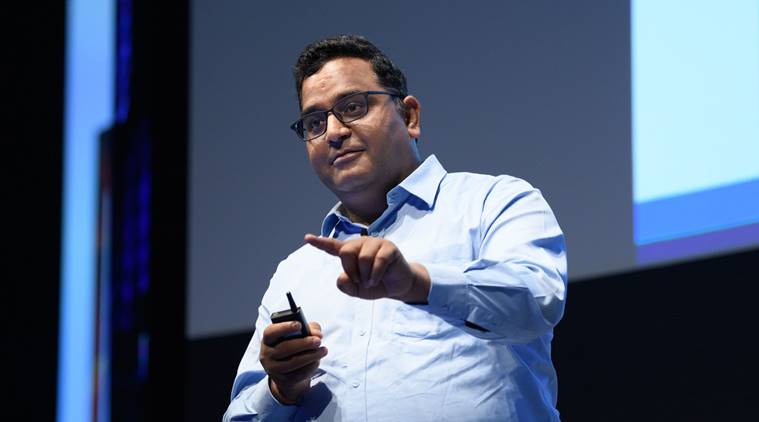
Vijay Shekhar Sharma, founder and chief executive officer of Paytm (Photographer: Akio Kon/Bloomberg)
Paytm, owned by One 97 Communications Ltd, along with its founder Vijay Shekhar Sharma will acquire Mumbai-based private sector general insurance company Raheja QBE, a company statement said.
“Raheja QBE is owned 51 per cent by Prism Johnson and 49 per cent by QBE Australia. Paytm is set to acquire both stakes and would own 100 per cent of the company,†Paytm said in a statement.
The company, however, did not disclose the financial details of the transactions.
The acquisition is subject to customary conditions, including approval from the Insurance Regulatory and Development Authority of India (IRDAI), the statement added.
Meanwhile, Prism Johnson Ltd, formerly Prism Cement Ltd, in a separate statement said its board has approved selling its entire 51 per cent stake in its general insurance joint venture Raheja QBE General Insurance Company Ltd (RQBE) to Paytm and Vijay Shekhar Sharma for about Rs 290 crore.
In a regulatory filing Prism Johnson said its board has approved divestment of 51 per cent of the paid-up equity share capital in RQBE, a material subsidiary, to QORQL Pvt Ltd for an aggregate consideration of Rs 289.68 crore.
QORQL Pvt Ltd, is a technology company with majority shareholding of Vijay Shekhar Sharma and remaining held by Paytm.
“It is an important milestone in Paytm’s financial services journey, and we are very excited to welcome Raheja QBE General Insurance into the Paytm family.
“Its strong management team will help us accelerate our journey of taking insurance to the large population of India with the aim to create a tech-driven, multi-channel general insurance company with innovative and affordable insurance products,†said Amit Nayyar, President at Paytm.
Commenting on the development, QBE Australia Pacific Chief Executive Officer, Vivek Bhatia said, “today’s announcement marks both a continuation of QBE’s strategy to simplify our business and the beginning of a new & exciting chapter for our strong team at Raheja QBE.â€
Prism Johnson said the consideration to be received by the company for the divestment is subject to certain adjustments which may be carried out between the date of execution of definitive agreement and closure of the sale, and other customary terms for a sale of such nature.
The divestment will result in the termination of the company’s joint-venture with Australia’s QBE in the general insurance business in India. Post the Divestment, RQBE will also cease to be a subsidiary of the company,†Prism Johnson added.
Raheja QBE which started operations in 2009, is a joint venture between Prism Johnson Ltd and QBE Insurance Group, one of Australia’s largest insurers.
We use cookies on our website to give you the most relevant experience by remembering your preferences and repeat visits. By clicking “Accept”, you consent to the use of ALL the cookies.
This website uses cookies to improve your experience while you navigate through the website. Out of these, the cookies that are categorized as necessary are stored on your browser as they are essential for the working of basic functionalities of the website. We also use third-party cookies that help us analyze and understand how you use this website. These cookies will be stored in your browser only with your consent. You also have the option to opt-out of these cookies. But opting out of some of these cookies may affect your browsing experience.
Necessary cookies are absolutely essential for the website to function properly. These cookies ensure basic functionalities and security features of the website, anonymously.
Cookie
Duration
Description
cookielawinfo-checbox-analytics
11 months
This cookie is set by GDPR Cookie Consent plugin. The cookie is used to store the user consent for the cookies in the category "Analytics".
cookielawinfo-checbox-functional
11 months
The cookie is set by GDPR cookie consent to record the user consent for the cookies in the category "Functional".
cookielawinfo-checbox-others
11 months
This cookie is set by GDPR Cookie Consent plugin. The cookie is used to store the user consent for the cookies in the category "Other.
cookielawinfo-checkbox-necessary
11 months
This cookie is set by GDPR Cookie Consent plugin. The cookies is used to store the user consent for the cookies in the category "Necessary".
cookielawinfo-checkbox-performance
11 months
This cookie is set by GDPR Cookie Consent plugin. The cookie is used to store the user consent for the cookies in the category "Performance".
viewed_cookie_policy
11 months
The cookie is set by the GDPR Cookie Consent plugin and is used to store whether or not user has consented to the use of cookies. It does not store any personal data.
Functional cookies help to perform certain functionalities like sharing the content of the website on social media platforms, collect feedbacks, and other third-party features.
Performance cookies are used to understand and analyze the key performance indexes of the website which helps in delivering a better user experience for the visitors.
Analytical cookies are used to understand how visitors interact with the website. These cookies help provide information on metrics the number of visitors, bounce rate, traffic source, etc.
Advertisement cookies are used to provide visitors with relevant ads and marketing campaigns. These cookies track visitors across websites and collect information to provide customized ads.






 Vijay Shekhar Sharma, founder and chief executive officer of Paytm (Photographer: Akio Kon/Bloomberg)