Germany, France, Egypt and Jordan released a joint statement today criticizing Israel’s planned annexation of the West Bank.
In the statement, the countries said annexing the Palestinian territory that Israel has controlled since 1967 would undermine peace.
“We concur that any annexation of Palestinian territories occupied in 1967 would be a violation of international law and imperil the foundations of the peace process,†the countries said in the statement released by the German Foreign Office.
Israel planned to start annexing parts of the West Bank on July 1, but a series of political roadblocks in the Israeli government and with the United States led to the date coming and going without any moves. Israeli Prime Minister Benjamin Netanyahu wants to annex the Jordan Valley and Jewish settlements in the territory, but there is some disagreement in the unity government he heads. Palestinians and much of the international community oppose the move, while the United States conditionally supports it.
Israel is under increasing pressure from regional and international actors as annexation appears to falter. Jordan, which has a peace treaty with Israel, is adamantly against annexation and was relieved nothing happened on July 1. Last week, British Prime Minister Boris Johnson, who is friendly to Israel, wrote an op-ed in an Israeli newspaper urging against annexation. Politicians in the United Arab Emirates, who have warmed up to Israel over the conflict with Iran, have also come out against the move.
The statement is significant because it gives Jordan backing for its position. Jordan controlled the West Bank before Israel, and its population is largely descended from Palestinians who left during the first Arab-Israeli war from 1947-48.
The letter also indicates opposition from Egypt, which is an important neighbor for Israel. The Egyptian government shares Israel’s concerns over the Muslim Brotherhood and Hamas, and is the only other Arab country besides Jordan to have full diplomatic relations with Israel.
The letter did not specify any actions that would be taken should Israel move forward with annexation, but it did say “it could also have consequences for the relationship with Israel.†It also called on a two-state solution to the conflict.
The Trump administration is terminating plans to reintroduce grizzly bears in the North Cascades region of northern Washington, citing concerns from cattle ranchers and other locals.
The move is the latest is a years-long fight over the prospect of returning the iconic apex predator to this part of its historic range. The plan, first launched by the Obama administration in 2015, called for eventually reintroducing some 200 grizzlies to ecosystem. There has not been a sighting of a grizzly in the U.S. portion of the Cascades since 1996, and it is estimated that fewer than 10 bears remain in the 9,800-square-mile ecosystem. It is considered the most imperiled grizzly population in North America.Â
Interior Secretary David Bernhardt announced the agency’s decision during a roundtable in Omak, Washington. It will halt preparation of an environmental review related to the species restoration plan.
“The Trump Administration is committed to being a good neighbor, and the people who live and work in north central Washington have made their voices clear that they do not want grizzly bears reintroduced into the North Cascades,†Bernhardt said in a press statement. “Grizzly bears are not in danger of extinction, and Interior will continue to build on its conservation successes managing healthy grizzly bear populations across their existing range.â€
Bernhardt’s predecessor, former Interior chief Ryan Zinke, had revived the Obama-era effort in March 2018, saying at the time that “restoring the grizzly bear to the North Cascades ecosystem is the American conservation ethic come to life†and its disappearance from the area “would disturb the ecosystem and rob the region of an icon.†His surprise support outraged local cattle ranchers who argue the existence of the animal (which is native to the region) would pose a devastating threat to their livelihood, as NPR reported.
Rep. Dan Newhouse (R-Wash.), a longtime opponent of the grizzly reintroduction effort, was present at Tuesday’s roundtable and applauded the administration’s final decision.Â
“Homeowners, farmers, ranchers and small business owners in our rural communities were loud and clear: We do not want grizzly bears in north central Washington,†he said in a statement.Â
Tens of thousands of grizzlies once roamed the Lower 48, from California to the Great Plains, but their populations plummeted due to hunting, development and habitat loss. Today, an estimated 1,500 bears are spread across portions of Montana, Idaho, Washington and Wyoming. The North Cascades is considered prime grizzly habitat and it is one of the largest contiguous swaths of federal land outside of Alaska.
Andrea Zaccardi, a senior attorney with the Center for Biological Diversity, called Tuesday’s announcement “truly disappointing.â€Â
“Grizzly bears only occupy less than 5% of their historic range, and the North Cascades presents prime habitat for grizzly bears,†she said. “Their recovery there is critical to the overall recovery of grizzly bears in the U.S.â€
Tuesday’s action comes two years after the grizzly bear population in and around Yellowstone National Park lost federal protection under the Endangered Species Act. At the time, federal authorities estimated the population there to be around 700 bears ― up from as few as 136 in 1975 ― and said multiple factors indicate it “is healthy and will be sustained into the future.â€Â In its final rule, the Fish and Wildlife Service concluded that “the effects of climate change do not constitute a threat to the [Yellowstone] grizzly bear [population] now, nor are they anticipated to in the foreseeable future.â€Â But the seeds of white bark pine, a high-elevation tree that has been severely impacted by disease, insects and climate change, are an important food source for Yellowstone grizzlies.
Last month, the Trump administration finalized new rules to lift an Obama-era ban on extreme predator control tactics in national preserves in Alaska ― a move that once again allows hunters to, among other things, lure brown and black bears with bait and shoot bear cubs and wolf pups in their dens.
Calling all HuffPost superfans!
Sign up for membership to become a founding member and help shape HuffPost’s next chapter
An agreement to pay more than $10 billion to settle thousands of claims that the popular weedkiller Roundup causes cancer is at risk of unraveling.
Although the bulk of the complex deal between Roundup’s manufacturer, the German conglomerate Bayer, and a raft of plaintiff lawyers does not require court approval, one crucial piece does: a plan for handling future claims from customers who develop the form of cancer known as non-Hodgkin’s lymphoma.
And that approval is in doubt, Judge Vince Chhabria of U.S. District Court in San Francisco warned in a filing on Monday, saying he “is skeptical of the propriety and fairness of the proposed settlement, and is tentatively inclined to deny the motion.†He raised concerns about the creation of a scientific panel to decide whether the key ingredient, glyphosate, causes cancer and whether the agreement unfairly limits potential plaintiffs from suing.
Bayer has been eager to put its legal troubles with Roundup to rest, particularly after losing three multimillion-dollar verdicts, but it has insisted that any settlement largely resolve the issue of future litigation. Failure to address that key condition could threaten the entire deal.
Bayer said Tuesday that it would address the judge’s concerns at the preliminary approval hearing, scheduled for July 24.
The settlement, announced two weeks ago after months of effort with the help of the veteran mediator Kenneth R. Feinberg, includes $8.8 billion to $9.6 billion to cover about 95,000 cases. In addition, $1.25 billion was set aside to finance the scientific panel and assist impoverished Roundup users with non-Hodgkin’s lymphoma.
The panel would assess whether glyphosate caused cancer and, if so, what exposure level was dangerous. Both Bayer and claimants would be bound to accept the findings in future litigation.
At least 30,000 people have contacted lawyers about a claim but have not yet agreed to settle.
Bayer, which added Roundup to its lineup when it bought Monsanto for $63 billion in 2018, has maintained that the product is safe, and the settlement included no admission of liability or wrongdoing. Government regulators around the world, including the U.S. Environmental Protection Agency, have said glyphosate does not cause cancer.
But a groundswell against the chemical gathered momentum in 2015 when the International Agency for Research on Cancer, an arm of the World Health Organization, announced that glyphosate could “probably†cause cancer.
Judge Chhabria asked in his filing whether it was lawful to shift the question of whether Roundup caused cancer to a panel of scientists and away from judges and juries.
He also pointed to the three previous multimillion-dollar verdicts and asked, “Why would a potential class member want to replace a jury trial and the right to seek punitive damages with the process contemplated by the settlement agreement?â€
Nicole Pavier says she became “terrified” she would put on weight
Nicole Pavier says an eating disorder still “plagues” her life. A former England gymnast, she says she was weighed every day during her career.
Pavier, 24, told BBC Sport how she developed bulimia when she was 14 and that she retired three years later after becoming “a shell of a person”.
She is one of several gymnasts to speak to BBC Sport about what they called a “culture of fear” within the “mentally and emotionally abusive” sport of gymnastics.
British Gymnastics has announced an independent review will take place following allegations of mistreatment from a number of athletes in recent days.
“It is clear that gymnasts did not feel they could raise their concerns to British Gymnastics and it is vital that an independent review helps us better understand why so we can remove any barriers as quickly as possible,” said chief executive Jane Allen.
Pavier said she became “terrified” she would put on weight, and would find “mechanisms” to try to prevent her from doing so.
“Being an adult now, you really realise how much it has affected you, from the eating disorders, the chronic pain, waking up having nightmares every night, never feeling good enough,” Pavier said.
“It has such a long-term implication.”
She alleges gymnasts were weighed twice a day sometimes, and claims her coach, Claire Barbieri, would “discuss people’s weights in front of the whole group” and display their weights on a whiteboard.
Barbieri told BBC Sport she has “never, to date, ever had any formal complaint raised against me by a gymnast”.
“I acknowledge that the regime for training elite gymnasts can at times be a tough one,” she said in a statement. “However, throughout my career I have followed British Gymnastics best practice and I continue to treat the welfare of the gymnasts I coach as my top priority.”
She added: “In line with standard practice at the time, the club had a system of weighing and measuring the elite gymnasts daily. Following advice from the GB medical team this was reduced to twice a week.
“I am fully aware of the risks of eating disorders amongst gymnasts and ensured that professional advice was obtained and followed where potential issues had been flagged.
“Although a whiteboard was used initially, I acknowledged some gymnasts’ concerns with this and changed the practice – introducing a system where the gymnasts had more privacy and kept their own records.”
British Gymnastics’ independent review will be conducted by Jane Mulcahy QC.
Allen said: “The behaviours we have heard about in recent days are completely contrary to our standards of safe coaching and have no place in our sport. The British Gymnastics integrity unit is set up to investigate all allegations when reported or identified by our national network of club and regional welfare officers.
“There is nothing more important for British Gymnastics than the welfare of our gymnasts at every level of our sport and we will continually strive to create a culture where people feel they can raise any concerns that they may have.”
Pavier says she was 21 when she gained control of her eating disorder, but admits she is still “picking up the pieces”.
“I still hate the way I look, I still feel like I’m overweight, I still wake up and don’t want to eat breakfast some days or won’t eat anything,” she says.
“There is no day where I’ll wake up and look in the mirror and be happy with what I see.”
Athletes ‘sat on and made to sit in cupboards’
BBC Sport also heard testimonies from several other gymnasts – at all levels of the sport, who had several different coaches and trained at several different clubs – as well as some parents.
From their testimonies, BBC Sport has learned how some gymnasts were allegedly:
Made to sit in store cupboards if they cried or refused to perform a skill in training;
Hit by one coach on the legs with a wooden stick;
Sat on if they were not fully on the ground while performing the splits.
It was claimed one coach made their gymnasts do three hours of conditioning after seeing some of them eating chips.
Another coach is said to have made theirs line up and watch as they ordered cleaners to search through bins to find discarded snack wrappers.
Other gymnasts also said they trained through injuries. A parent told BBC Sport her daughter broke her wrist during training. As soon as her daughter was out of a splint, she says she was made to use the wrist in moves, once causing her so much pain she vomited.
One gymnast says she broke a rib in training but chose not tell her coach, with the injury eventually causing a punctured lung that prevented her competing and training for a year.
Many of the gymnasts BBC Sport spoke to say they still suffer psychological effects, including anxiety and depression, for which some remain on medication and others are receiving therapy.
One says she continues to have night terrors, years after retiring, while a parent told of young gymnasts she knew of whose hair had fallen out because of the stress they felt.
Coaches would frequently “scream” at gymnasts and their parents, with one parent saying they had been “groomed” as well as their children, who they knew would be “punished” if training methods were not accepted.
Many of the athletes spoken to said they would not want any children they may have in the future to do gymnastics.
British Gymnastics declined to comment on any individual cases but told BBC Sport in a statement: “British Gymnastics condemns any behaviour which is harmful to the wellbeing of our gymnasts. Such behaviours are completely contrary to our standards of safe coaching.
“Our integrity unit investigates all allegations reported to us or identified by our national network of club welfare officers and takes disciplinary action to prevent recurrence.
“We have worked particularly hard in recent years to ensure that our athlete and coaching culture is transparent, fair and inclusive.
“British Gymnastics is reaching out to any gymnast, either current or past, that has concerns around specific incidents or behaviours and encourages them to contact our integrity unit.”
‘We want to show support’
Last week, British former gymnast Jennifer Pinches, who competed at the London 2012 Olympics, reached out to fellow gymnasts on social media.
“We wanted to come together and just show our support for anyone that has been mistreated,” the 26-year-old told BBC Sport.
“It’s about gymnasts and a support network coming together.
“Unfortunately, certain types of behaviour have become a bit normalised in gymnastics, unacceptable behaviour – and it’s not just Britain, it’s across the world.
“There’s a better way, we know that, so we want to take a stand against any kind of damaging behaviour and support those who have experienced mistreatment. We want a safe happy and healthy environment for gymnasts.”
The latest controversy to swirl around the Chinese telecoms company Huawei has shone a spotlight on the murky world of Chinese espionage, agent-recruitment and an ambitious programme of extending its influence across the globe.
So how extensive is it, how does it work and who runs it?
A dossier reportedly compiled with the help of a former MI6 spy has accused China of trying to manipulate key UK figures, including politicians, to back the telecom giant’s business in Britain.
Every major Chinese enterprise anywhere in the world allegedly has an internal “cell” answerable to the ruling Chinese Communist Party (CCP) to drive the political agenda and ensure that the company is compliant with political directives.
This is why China experts assert that the CCP does operate here in Britain, often under the natural cover of business. “The Party machine is everywhere”, says one, adding: “For China, business is inseparable from politics.”
The CCP has 93 million members, with many of them placed or hidden in organisations abroad. This allows them to be tasked with gathering secrets, especially in the technology sphere, including telecoms.
Experts say these “agents”, as well as targeted individuals in important positions in foreign companies, can be recruited or persuaded using a number of different methods.
Setting honeytraps
The first approach is usually what is known as “a positive incentive”, especially if the targeted individual is a non-Chinese national.
In the West this can take the form of a tempting invitation to an important business meeting in China, an offer of financial help for a company facing difficulties, or the offer of a (sometimes meaningless) seat on a board as a non-executive director or even in some cases a life-changing sum of money.
In the last 10 to 15 years there has been an increasing readiness to target well-placed foreigners with positive incentives.
Image copyright Getty Images
Inside China though, recruitment methods can, according to people familiar with them, take on a far more sinister form. This can include putting pressure on Chinese family members – essentially blackmail – to honeytraps set for unwary western businessmen.
This usually entails a “chance” encounter with an attractive woman which is then covertly recorded and used as “kompromat” – compromising material to be used as a lever.
“The Chinese state is very good at setting honeytraps on their own territory,” says a British businessman who has worked in China. These are normally run by China’s Ministry of State Security.
Rather than being run centrally, these targeting operations tend to be run out of provincial State Security bureau, each of which deals with a different geographic area of the world. So the Shanghai bureau, for example, covers the US, Beijing covers Russia and the former Soviet republics, Tianjin covers Japan and Korea, and so on.
“The Chinese state uses the full spectrum of government levers to acquire information,” says someone very familiar with its operations. “This ranges from targeted and large-scale cyber espionage and theft to co-opting industry experts, both knowingly and unknowingly.”
“Along with Russia,” he adds, “China is the biggest espionage threat to the UK”.
The Consumer Financial Protection Bureau on Tuesday formally rescinded a plan to impose new limits on payday lending, handing the industry a major victory by killing off tighter rules that it spent years lobbying to overturn.
The proposed rules would have been the first significant federal regulations on an industry that makes $30 billion a year in high-interest, short-term loans, often to already struggling borrowers. Those loans can leave borrowers trapped in cycles of debt, incurring fees every few weeks to replenish loans they cannot afford to pay off.
The change would have limited how many loans borrowers could take in a row and required lenders to verify that they had the means to pay back their debt. According to the consumer bureau’s estimates, the rules would have saved consumers — and cost lenders — some $7 billion a year in fees.
Lenders fought hard against the rules, which were one of the bureau’s signature efforts during the Obama administration, arguing that the changes would harm consumers by depriving them of access to emergency credit.
That argument resonated with the agency since it has taken a more business-friendly approach under President Trump.
Ms. Kraninger defending the decision on Tuesday, saying the proposed restrictions had been based on insufficient evidence to justify the harm it would have caused lenders.
Although she left in place minor provisions, including one preventing lenders from trying to repeatedly take funds from a borrower’s overdrawn bank account, Ms. Kraninger said scrapping the rest of the rule would “ensure that consumers have access to credit from a competitive marketplace.â€
The Community Financial Services Association of America, an industry trade group that lobbied heavily against the planned restrictions, said Ms. Kraninger’s decision would “benefit millions of American consumers.â€
Critics, including more than a dozen consumer advocacy groups, said the agency had prioritized financial companies over the people it was supposed to be protecting.
“In the middle of an economic and public health crisis, the C.F.P.B.’s director chose to put a bunch of time and energy into undoing a protection that would have saved borrowers billions in fees,†said Linda Jun, a senior policy counsel for Americans for Financial Reform, a consumer advocacy group.
The Pew Charitable Trusts, which has long pushed for curbs on high-interest loans, called the decision “a grave error†that exposes millions of Americans to unaffordable payments with triple-digit interest rates.
Senator Sherrod Brown of Ohio, the ranking Democrat on the banking committee, said the rule’s elimination rewarded the industry’s intense lobbying efforts to fend off regulation.
Payday lenders have contributed $16 million to congressional candidates, mostly Republicans, since 2010, according to the Center for Responsive Politics. The Community Financial Services Association of America held its 2018 and 2019 annual conferences at the Trump National Doral golf club.
The bureau “gave payday lenders exactly what they paid for by gutting a rule that would have protected American families from predatory loans,†Mr. Brown said.
The Trump administration has formally notified the United Nations of its withdrawal from the World Health Organization, although the pullout won’t take effect until next year, meaning it could be rescinded under a new administration of if circumstances change.
The withdrawal notification, delivered on Monday, makes good on President Donald Trump’s vow in late May to terminate US participation in the WHO, which he has harshly criticized for its response to the coronavirus pandemic and accused of bowing to Chinese influence. The move was immediately assailed by health officials and critics of the administration.
The withdrawal notice was sent to UN Secretary-General Antonio Guterres on Monday and will take effect in a year, on July 6, 2021, the State Department and the United Nations said on Tuesday.
Guterres, in his capacity as depositary of the 1946 WHO constitution, “is in the process of verifying with the World Health Organization whether all the conditions for such withdrawal are met,†his spokesman, Stephane Dujarric, said.
Under the terms of the withdrawal, the US must meet its financial obligations to the WHO before it can be finalized. The US, which is the agency’s largest donor and provides it with more than $ 400 million per year, currently owes the WHO some $ 200 million in current and past dues.
In late May, less than two weeks after warning the WHO that it had 30 days to reform or lose US support, Trump announced his administration was leaving the organization due to what he said was its inadequate response to the initial outbreak of the coronavirus in China’s Wuhan province late last year.
The president said in a White House announcement that Chinese officials “ignored†their reporting obligations to the WHO and pressured the organization to mislead the public about an outbreak that has now killed more than 130,000 Americans.
“We have detailed the reforms that it must make and engaged with them directly, but they have refused to act,†Trump said at the time. “Because they have failed to make the requested and greatly needed reforms, we will be today terminating the relationship.†The withdrawal notification was widely denounced as misguided, certain to undermine an important institution that is leading vaccine development efforts and drug trials to address the Covid-19 outbreak.
“The administration’s move to formally withdraw from WHO amid the greatest public health crisis that Americans and the world have faced in a century is short-sighted, unnecessary, and unequivocally dangerous,” said UN Foundation President Elizabeth Cousens. “WHO is the only body capable of leading and coordinating the global response to Covid-19. Terminating the US relationship would undermine the global effort to beat this virus — putting all of us at risk.†The ONE Campaign, which supports international health projects, called it an “astounding action†that jeopardizes global health.
“Withdrawing from the World Health Organization amidst an unprecedented global pandemic is an astounding action that puts the safety of all Americans and the world at risk. The US should use its influence to strengthen and reform the WHO, not abandon it at a time when the world needs it most,” ONE president Gayle Smith said.
Adam Armstrong’s 45-yard wonder goal dented Cardiff’s play-off hopes as Blackburn took the spoils with a thrilling 3-2 victory.
​​​​​Tony Mowbray’s Rovers twice came from behind thanks to goals from Danny Graham and Dominic Samuel before Armstrong produced one of the goals of the Sky Bet Championship season.
Cardiff’s Will Vaulks had opened the scoring with another superb strike and Robert Glatzel put the Bluebirds back ahead after Graham’s equaliser but they had not banked on Armstrong’s effort.
The Welsh side still remain in sixth place going into Wednesday’s fixtures. Both teams wore black armbands and held a minute’s silence in memory of Cardiff great Peter Whittingham, who died in March. Whittingham ended his career with Rovers.
Cardiff passed the ball nicely in wet conditions early on but it was Rovers who should have opened the scoring when Armstrong’s cross from the left reached the far post, but visiting right-back Ryan Nyambe could only hook over.
Cardiff’s Vaulks responded by putting his side ahead with a moment of magic. Racing on to a Joe Ralls pass down the left, Vaulks looked totally bereft of options in the box.
He opted for an outrageous lobbed attempt on goal with the outside of his right foot as a result and his technique was perfect as the ball cleared Christian Walton in the Rovers goal.
Image: Adam Armstrong celebrates his match-winning goal
Blackburn were not behind for long. Graham was the scorer after Darragh Lenihan’s header from a corner hit the post and then Cardiff goalkeeper Alex Smithies, with the striker tapping in.
Junior Hoilett volleyed just wide as Cardiff looked for a response and Josh Murphy also worked Walton from range before Glatzel came up trumps.
Ralls looked to get a shot away but did well to stay patient. The ball went to Murphy and then Joe Bennett, whose cross was turned in by the German striker.
Cardiff kept Blackburn waiting in the rain at the start of the second half and it proved to be a mistake. Curtis Nelson made a hash of a cross and then fell Samuel in the box.
It looked a clear penalty and although the shouts were waved away by referee Matt Donohue, it mattered little to Rovers as Armstrong put the ball straight back in and Samuel converted.
The goal gave Blackburn belief and both teams had chances in an open second half. Smithies was forced into a fine save to stop Samuel from putting Rovers ahead for the first time.
Armstrong then topped Vaulks’ effort in the 70th minute. Cardiff’s Leandro Bacuna gave the ball away in midfield and Armstrong struck the ball first time.
The ball sailed over Smithies to leave Cardiff shell-shocked and they could not respond despite Lee Tomlin and Callum Paterson appearing off the bench.
The videoconference was held as Israeli Prime Minister Benjamin Netanyahu has recently mulled extending his country’s oversight over parts of the West Bank containing Jewish settlements — deliberations that have angered the Palestinian side.
The four foreign ministers instead offered their help in finding “a constructive new beginning” in the region, adding they would not recognize any change to the 1967 borders unless it was agreed to by both parties to the conflict.
Netanyahu spoke to U.K. Prime Minister Boris Johnson about the issue on Monday evening.
“Israel is prepared to conduct negotiations on the basis of President Trump’s peace plan which is both creative and realistic and will not return to the failed formulas of the past,” the Israeli government said in a statement.
This is the first time Mexico’s President has left the country since taking office in December of 2018. The fact that he’s headed to the White House speaks volumes, both practically and symbolically. Both leaders are looking for victories beyond their losing battles with the coronavirus pandemic.
Trump said last month that López Obrador was “a really great guy,” and López Obrador said he was going to Washington, DC, “to thank Trump for his support and solidarity.” They still have plenty to disagree over, but there also seems to be a lot of common ground — not the least of which could be their similar governing styles as two populists who’ve built political brands on a cult of personality.
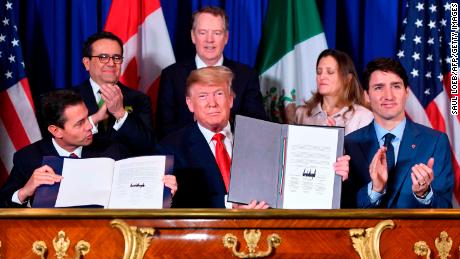
Their meeting centers on the USMCA, a deal that passed after months of difficult negotiations.
The timing of the meeting amid the rampant spread of the coronavirus in both countries has questioned by critics. But for two men who’ve seen their approval ratings consistently drop during the outbreak, the meeting presents an opportunity to talk about something else.
“Right now, neither is getting high marks for their handling of the health crisis, making the visit a welcome distraction,” said Christopher Wilson, deputy director of the Wilson Center’s Mexico Institute.
The USMCA’s implementation represents one of the biggest foreign policy wins of the Trump administration — and arguably one of the only major examples of the President creating new, lasting agreements with foreign countries rather than tearing up existing ones.
Trump will promote this deal as a win and a follow-through on a 2016 campaign promise to rework previous free trade deals, even as Democrats say the only reason they voted to pass the USMCA is because they overhauled the original framework during negotiations.
“López Obrador’s visit will allow [Trump] to showcase how he has bent Mexico to his will by reminding voters that this is a ‘very good deal’ for the US while signaling his achievements at strong-arming Mexico on immigration policies,” said Gladys McCormick, an expert on US-Mexico affairs at Syracuse University.
Meanwhile, López Obrador has also staked a lot of political capital in the USMCA and likely wants to make sure the Trump administration is invested in ironing out any issues that arise during its implementation.
Mexico’s economy was sputtering even before the pandemic hit. Now, with the IMF predicting a 10.5% GDP contraction in 2020 and his party facing critical midterm elections next summer, shoring up Mexico’s most important economic relationship is probably top of mind for López Obrador.
“Almost 85%of all [Mexican] exports go to the [United States], which is obviously a huge number,” said Larry Rubin, president of the American Society of Mexico. “Mexico is highly dependent on trade with the United States.”
“Mexico will benefit more by sending very clear and positive messages that if investors want to come and invest in Mexico, their investment will be protected,” Rubin said.
A calculated strategy for AMLO
Critics of the Mexican President have urged him not to travel to the White House, saying it follows a trend of AMLO wilting in the face of Trump’s economic bullying and racist rhetoric.
Consider that in 2019, when Trump expressed anger over the flow of Central American migrants traveling to the US border through Mexico, he threatened tariffs on Mexican imports if Mexico didn’t crack down.
López Obrador quickly complied. He deployed Mexico’s National Guard, a newly created force supposedly dedicated to fighting Mexico’s horrific levels of violence, to the northern and southern borders, significantly slowing migrant flows.
Critics have said that while Trump’s vaunted border wall hasn’t actually been built or paid for by Mexico as Trump promised, AMLO’s National Guard deployment essentially did just that.
AMLO also signed onto the so-called Remain in Mexico policy, under which the Trump administration forces asylum seekers to wait in Mexico while their paperwork is processed, exposing them to dangerous conditions in Mexican border cities where levels of violence are sky high.
AMLO has also largely refrained from criticizing the provocative language sometimes used by Trump and his supporters when describing people crossing from Mexico into the United States.
“How do you stop these people?” Trump asked of immigrants at a May 2019 rally in Florida. When an audience member shouted, “Shoot them!” Trump smiled and said, “Only in the [Florida] Panhandle can you get away with a statement like that.” The exchange continues to be referenced in Mexican political commentary today.
AMLO agreed to step up his country’s immigration enforcement just a few weeks later.
“We Mexican democrats will not forget Mr. López Obrador’s reverence to the man who has maligned us,” wrote Mexican historian Enrique Krauze this week in a New York Times op-ed.
But López Obrador’s approach to the United States is a calculated one. Next to nothing should get in the way of Mexico capitalizing on its relationship with the world’s largest economic power. Some might call it appeasement. Others call it smart.
“If we have a good relationship with the US, we will avoid bad treatments, and we’ve accomplished this,” he said in his daily press conference on Monday. “My critics say, ‘How am I going to the US if they have offended the Mexicans?’I want to tell the people of my country that since we took office, there’s been a respectful relationship, not only to the Mexican government but also to the Mexicans.”
“Notwithstanding some of President Trump’s derogatory remarks about Mexico and Mexicans, President López Obrador is placing Mexican national interest first and conducting himself like a statesman,” said Armand Peschard-Sverdrup, a senior associate at the Center for Strategic and International Studies.
Whatever the strategy, it has led to the US President taking a kind view of López Obrador, with Trump even tweeting in June of 2019, “Mexico is doing a far better job than the Democrats on the border. Thank you Mexico!”
Two sides of the same coin?
And although the two presidents come from very different political backgrounds — Trump the right-wing former television star, AMLO the decades-long politician, self-declared leftist and former mayor of Mexico City — experts note they have very similar approaches to governing.
“Both presidents are populists and economic nationalists,” said Wilson. “Both came to power on a message of empowering the disenchanted and disaffected. Both see institutions and bureaucracy as unnecessary checks on their power and obstacles in their direct relationship with voters.”
And the presidents have taken a remarkably similar track in their handling of the coronavirus pandemic.
Both presidents downplayed the initial threat. Trump promised back in February it would just disappear while AMLO famously held up two amulets and said, while smiling, that they would “protect” him from the virus.
They also routinely ignore public health experts’ advice to socially distance and wear masks in public, and neither man is in favor of mass testing.
Most crucially, Trump and AMLO are both aggressively pushing for their economies to reopen. So perhaps it’s no surprise that, of all the reasons to meet, they would find time this week to tout a new economic deal.
We use cookies on our website to give you the most relevant experience by remembering your preferences and repeat visits. By clicking “Accept”, you consent to the use of ALL the cookies.
This website uses cookies to improve your experience while you navigate through the website. Out of these, the cookies that are categorized as necessary are stored on your browser as they are essential for the working of basic functionalities of the website. We also use third-party cookies that help us analyze and understand how you use this website. These cookies will be stored in your browser only with your consent. You also have the option to opt-out of these cookies. But opting out of some of these cookies may affect your browsing experience.
Necessary cookies are absolutely essential for the website to function properly. These cookies ensure basic functionalities and security features of the website, anonymously.
Cookie
Duration
Description
cookielawinfo-checbox-analytics
11 months
This cookie is set by GDPR Cookie Consent plugin. The cookie is used to store the user consent for the cookies in the category "Analytics".
cookielawinfo-checbox-functional
11 months
The cookie is set by GDPR cookie consent to record the user consent for the cookies in the category "Functional".
cookielawinfo-checbox-others
11 months
This cookie is set by GDPR Cookie Consent plugin. The cookie is used to store the user consent for the cookies in the category "Other.
cookielawinfo-checkbox-necessary
11 months
This cookie is set by GDPR Cookie Consent plugin. The cookies is used to store the user consent for the cookies in the category "Necessary".
cookielawinfo-checkbox-performance
11 months
This cookie is set by GDPR Cookie Consent plugin. The cookie is used to store the user consent for the cookies in the category "Performance".
viewed_cookie_policy
11 months
The cookie is set by the GDPR Cookie Consent plugin and is used to store whether or not user has consented to the use of cookies. It does not store any personal data.
Functional cookies help to perform certain functionalities like sharing the content of the website on social media platforms, collect feedbacks, and other third-party features.
Performance cookies are used to understand and analyze the key performance indexes of the website which helps in delivering a better user experience for the visitors.
Analytical cookies are used to understand how visitors interact with the website. These cookies help provide information on metrics the number of visitors, bounce rate, traffic source, etc.
Advertisement cookies are used to provide visitors with relevant ads and marketing campaigns. These cookies track visitors across websites and collect information to provide customized ads.