Tuesday, May 5, 2026

Minnesota attorney general warns residents who break curfew that it will become difficult to separate them “from the bad people”

During a press conference on Saturday, Minnesota Attorney General Keith Ellison gave a warning to protesters that they need to follow curfew–or else they may be mistaken for wrongdoers.

On Friday, Minnesota Governor Tim Walz tweeted that a nighttime curfew would be put in place from 8 p.m. to 6 a.m. Friday and Saturday night in Minneapolis and St. Paul. “in order to restore peace. “I urge Minnesotans to comply – It’s time to rebuild our community,” he wrote.

As many citizens continue to protest over the death of George Floyd, Ellison asked people to respect the curfew, because some people were trying to tarnish the protest. He said that if Minnesotans stayed out after curfew, it may create confusion.

“To be on the street after eight, means that we can’t get you separated from the bad people,” Ellison said during the press conference.

“We need your help to comply with the curfew,” he began his statement. “The people who are trying to tarnish the reputation of the noble protest for justice are out there, trying to mix in with the crowd. So that people will say, ‘Oh look at all those protesters are bad. Their cause can’t be just. They’re just out there causing trouble.’ We know that’s not what’s happening.”

He also explained that he understood that the protests were just, but outside forces were trying to interfere with the demonstrations to sabotage the protesters’ efforts.

“We know that the noble, just aims of the protesters are righteous and goods, but we also know that some evil elements are literally interfusing themselves with the protesters to destroy and cause arson, so that the whole community will have a low opinion of the protest, because they’re not for justice for Mr. Floyd, they’re against it. And they know that if we protest righteously and peacefully and justly people will — public sentiment will rise up to support our demands. So, they want to stop that.”

Ellison also encouraged people to protest over social media after 8 p.m. so that they could focus on outside agitators. “We know you’re brave. We know you’re strong. We know you never compromise on justice. We know you’re righteous, and we believe in what you’re doing, but we need to be able to stop the burning and the looting and the destruction,” he said.

Ellison also said that many protesters wanted to join in the press conference but were trying to raise awareness about Floyd’s death.

The attorney general closed his address by saying that the officer that was arrested had received “preliminary complaint” which can change to possibly add charges or charge others. “The wheels of justice are moving, and now they’re moving swiftly” he said. “What in the world does burning down Migizi and Juxtaposition Arts in the Northside have to do with justice for George Floyd? Nothing.” Before bringing up the next speaker, he once again asked protesters to respect the curfew to “restore order and build justice.”

The press conference was held by Minnesota Governor Tim Walz. Other speakers included Lieutenant Governor Peggy Flanagan, Senator Amy Klobuchar and more.

On May 26, Ellison’s office released a statement regarding Floyd’s death. He offered his condolences to his family and loved ones. The statement spoke about the investigation that would take place, looking into Floyd’s death. “The issue of police-community relations has been a point of controversy and pain for the whole of American history. It involves centuries of trauma. In the past several years alone, almost every part of Minnesota has lived through a fatal encounter with law enforcement. George Floyd’s death raises that trauma yet again for so many people,” he wrote, before telling those who planned to protest to do so safely, especially amidst the COVID-19 pandemic.

Newsweek attempted to contact the attorney general’s office for this story but was unsuccessful.

In a series of tweets, Minneapolis Mayor Jacob Frey also asked people to follow the curfews. “We are now confronting white supremacists, members of organized crime, out of state instigators, and possibly even foreign actors to destroy and destabilize our city and our region,” he wrote in one tweet.


U.S. Rep. Keith Ellison (D-MN) holds a town hall meeting at the Church of the New Covenant-Baptist on December 22, 2016 in Detroit, Michigan.
Sarah Rice/Getty


Source link

The real life … or just fantasy? How coronavirus sparked a cottagecore revolution

It was bang in the middle of the pandemic and Elfy Scott lived “in a dank house” in Sydney’s inner west with housemates. “We were locked down and having to look at those same four mouldy walls,” she says.

The lease was coming to an end, and Scott, 27, and her partner were planning their next move – to Bondi where rentals were about $600 to $700 a week. 

But really, they wondered, what was keeping them in Sydney?

“We made the decision to leave because Sydney had shut down and there would be so few social outlets,” she says. “It was a good time to leave, especially since we weren’t sure what would happen with our jobs.”

For now, Scott is working from home as a podcast producer and presenter for Junkee media.

Scott and her partner made the leap and moved to Austinmer – about 70km south of Sydney – and for $480 a week, got a house with absolute beachfront. 

Now, six weeks into her new regional life, Scott is loving the change. 

She is getting to know her neighbours and says, “I feel as though being surrounded by nature is so much better for my mental health. In Sydney the quality of the housing is so bad.”

Will a pandemic that thrives in urban density combined with ridiculous house prices in Melbourne and Sydney and a revolution in working from home result in a surge of people moving to Australia’s regions?

Instagram says yes!

This season’s favoured aesthetic on visual-based platforms such as Instagram and Pinterest is #cottagecore: think cute little houses in the country, walks in the woods, collecting flowers and making jam.

But the data in Australia is not backing up the cottagecore trend – yet. 

John Daley, the chief executive of the Grattan Institute, says it’s too early to know whether the pandemic and a shift towards working from home will create a population boom in regional areas. 

“The housing market is frozen but it’s absolutely inevitable that more people are going to work from home, more oftenm” he says. “People have set themselves up and got a second screen. They have got Zoom and learnt how to use that. Now that we have done it for three months, we can see that it works.”

But more people working from home doesn’t necessarily translate as more people leaving cities. 

“There are not that many jobs that are true freelance jobs – your clients are disproportionately in the big cities,” he says.

If many offices move to a hybrid mix of working-from-home and in the office, “the regions that will do well out of this are within striking distance of major cities – because companies will want a presence in the office some of the time”. 

Cameron Kusher, head of economic research at REA Group – which includes realestate.com.au – says that although anecdotally he has heard of people wanting to move to the country, “it’s not showing up much in the data in Victoria and New South Wales”. 

Searches for regional properties jumped 11% in Victoria for April compared with March and there was a 16% jump in searches in regional NSW for the corresponding period. But this is down on a year ago, with a 2% fall in Victoria and 1%.

Bucking this trend is an overall increase in searches for properties in rural Queensland and Tasmania. 

“It’s too early to tell but it’s logical that people will start to look for houses in regional areas,” Kusher says. “However, most businesses will still want people to come into offices a couple of days a week.”

That means that towns up to 90 minutes from the CBD with good connections will be more popular than regions such as Warrnambool in Victoria and Orange in NSW, which are both around three hours from capital cities. 

“In Sydney, people will push out to outer areas such as the Blue Mountains and Central Coast. In Victoria, Ballarat, Geelong and Mornington Peninsula could be popular.

“People from Sydney and Melbourne might also start considering Brisbane and Adelaide because they get on a plane pretty quickly to offices in Melbourne and Sydney.” 

Rebecca Andrews, 40, of Collingwood, will trial regional living with her boyfriend when overnight stay restrictions lift in Victoria. They have short stays lined up in the Dandenongs, Yarra Valley and Castlemaine – all places within 90 minutes of the Melbourne CBD. If it works, they’ll move out of the city. 

Andrews runs a popular events newsletter called The Sprinkler and works as a freelance journalist. She is usually out at several events around Melbourne five or more times a week but the pandemic brought on a major life shift for her.

“Covid has definitely influenced my decision to live in the country,” she says. “Having spent three months in isolation, I’ve been winding down and not feeling the pressure of having to go to social functions and catch up with mates. Since I’ve been at home all the time and slowing down, I’ve found there’s not much need to get energy from huge social things.”

Now she wants to spend more time in nature. “There’s a huge difference between being in a city park and out in the wilderness. You can’t even compare. What’s a city got that I need anymore? I mean I’m 40, I’m not in my 20s – and although I’m still an extrovert, I’m getting really nice benefits from iso.”

In isolation she has transformed her inner-Melbourne house to resemble the nature she’s starting to crave. 

“My house is full of plants, it’s like a nursery.”

For Andrews and her boyfriend, the “pandemic was a circuit breaker. We are using the next few months as a trial in various country towns to see what will work best.”

As Andrew’s boyfriend still works in the city, any move will have to be commutable. 

Daley says one of the common problems with relocation is that it has to work for everyone in the household.

“Problems that most households face is that they need to solve two people’s employment and that’s why we have seen much faster growth in major cities than regional centres.”

The bulk of households with two people working are more likely to move to the more convenient outer suburbs than a country town, he says. 

Daley isn’t convinced that regional areas will see a big boost post-pandemic, due in part to migration growth, which is currently negative.

Overall , he says, “if regions even held their share of population, they are doing better than they are doing for a long time”. 

Those who do move will do so out of financial distress: the unemployed or under-employed who cannot afford to live in a big city. 

“The one thing that may mitigate this [stagnation in regional areas] is unemployment. People live in regions because money goes further. We may see these people either staying in regions – or perhaps people will move from city to regions because they have less money to spend on rent. And when the economy comes back, they move back to the cities.”

So is #cottagecore largely an online fantasy? Daley thinks it’s a normal reaction to an old problem.

“In every plague in human history, the impetus was to escape to the country where there’s lots of space,” he says.

Ultimately while some people will be tempted by country life, the numbers will be small “compared to population growth in Melbourne, which has been huge”.

Instead, “we are seeing the resurgence of villages of Melbourne – suburban hubs have come back pretty quickly”.

As people have worked from home over these past few months, they have developed a loyalty to their village, including local cafes and parks, Daley says. 

“If anything, links between people and the CBD have become much weaker and the links between people and their local areas are stronger.” 

Kusher, who lives in an apartment with his partner and small child, predicts there will be a move instead away from inner city apartments and towards townhouses with a bit of space and a backyard.

In all this uncertainty, it’s not surprising to see people having a bet both ways. 


Source link

Activist Rachel Cargle Unpacks Racism in America

0


Activist Rachel Cargle Unpacks Racism in America | InStyle


this link is to an external site that may or may not meet accessibility guidelines.

Source link

Tablet interactive: Coronavirus outbreak

The coronavirus pandemic is proving to be one of the toughest challenges of our generation. Visit our special coronavirus homepage to find important news updates, a link to our coronavirus newsletter, clear, useful information and tips for your wellbeing through this emergency. Visit our coronavirus data centre to see the latest data from your local area, across Australia and around the world.

Tap below to follow our daily live blog.

Source by [author_name]

A cute stuffed dinosaur hitched a ride on SpaceX’s historic launch

0

Astronauts Bob Behnken and Doug Hurley had some company on their historic flight to space today: a stuffed dinosaur tucked into one of the seats on SpaceX’s Crew Dragon.

Behnken and Hurley each have a son, and both boys are dinosaur enthusiasts. Before the flight, the boys gathered all their dinosaur toys together, and Tremor, a sparkly apatosaurus was selected to accompany Behnken and Hurley to space. “That was a super cool thing for us to get a chance to do for both of our sons who I hope are super excited to see their toys floating around with us on board,” Behnken said during an tour of the capsule in orbit. “I’m sure they would rather be here, given the opportunity, but hopefully they’re proud of this as well.”

The toy was spotted during preparations for launch on Wednesday and Saturday, and geophysicist Mika McKinnon quickly identified it on Twitter as a TY Flippables Tremor Dinosaur. On Saturday shortly after the astronauts entered orbit, SpaceX’s store featured a new item called a ‘Demo 2 Dinosaur Plush Toy’ for $25.

Toys like this have flown with astronauts and cosmonauts for years. When the toy starts floating, it indicates to the buckled-in passengers that they’ve reached zero-g and are experiencing weightlessness. A plush Earth flew on the uncrewed test flight of Crew Dragon to the ISS back in March 2019. Just before launch, SpaceX CEO Elon Musk tweeted a picture, calling the plush a “super high tech zero-g indicator.”

Little Earth, or “Earthy,” was a huge hit with the ISS crew and ended up staying aboard even after the Crew Dragon returned home. Last year, Behnken said that he expected Earthy to welcome him and Hurley aboard. “Hopefully he can walk us through the emergency brief and he’s a full-fledged station crew member by the time that we get there,” Behnken said in an interview last March.

Dinosaur toys have flown on the ISS before. In 2013, astronaut Karen Nyberg (who happens to be married to Hurley) sewed a toy dinosaur for her son Jack while on the ISS.

The dinosaur created by astronaut Karen Nyberg on the ISS.
Photo: NASA

The dinosaur, Behnken, and Hurley are expected to join Earthy on the ISS tomorrow, May 31st, after 19 hours in orbit. Docking is scheduled for 10:29AM ET and will be live-streamed on NASA TV.

Update 5:15PM ET: This post has been updated to include information about the dinosaur posted to SpaceX’s website.

Update 7:00PM ET: This post has been updated with information about Tremor the dinosaur, from a tour of the capsule given by the astronauts.


Source link

Liftoff! SpaceX launches 1st astronauts for NASA on historic test flight

0

CAPE CANAVERAL, Fla. — SpaceX launched astronauts for the first time ever today, making history and opening a new age of commercial spaceflight.

A shiny white Falcon 9 rocket lifted off from historic Pad 39A at NASA’s Kennedy Space Center here today (May 30) at 3:22 p.m. EDT (1922 GMT), carrying SpaceX’s Crew Dragon capsule into orbit.


Source link

Divert weapons funding to research to prevent next pandemic, pope says – Firstpost

0

By Philip Pullella

VATICAN CITY (Reuters) – Pope Francis on Saturday urged politicians to divert funds spent on weapons to research to prevent another pandemic, as he led the largest gathering in the Vatican in nearly three months.

Francis presided at an outdoor prayer service with about 130 people, including many directly affected by the pandemic.

They prayed the rosary in the Vatican gardens as tens of thousands of people in about 50 Catholic shrines around the world joined in. A large screen in the gardens showed video links with about 25 locations.

Among those who prayed were Italian doctors, nurses, and ambulance drivers, as well as people who had recovered from coronavirus or lost family members. More than 33,000 have died in Italy.

Most wore masks except for when they led prayers at the microphone. Francis, 83, sat several metres away from most people during most of the service and did not wear a mask.

In his closing prayer, Francis said national leaders should take a far-sighted attitude, helping the most needy now and putting in place long-term economic and social solutions.

He prayed that the Madonna would “touch (leaders’) consciences so that enormous sums spent to possess more armaments and to perfect them be instead destined to the promotion of sufficient research to prevent such catastrophes in the future”.

Earlier this month, Francis called for international scientific cooperation to develop a vaccine and said any successful one should be shared globally.

For nearly three months, Francis has led televised Masses, general audiences and Sunday addresses from inside the Vatican with no public.

St. Peter’s Basilica and St. Peter’s Square were fully reopened on May 18 as Italy entered the second phase of easing restrictions.

On Sunday, Francis will say a Mass with only about 50 people inside the basilica but will later deliver his Sunday message from his window overlooking the square for the first time since early March.

(Reporting By Philip Pullella; Editing by Nick Macfie)

This story has not been edited by Firstpost staff and is generated by auto-feed.


Source link

Why is coronavirus killing BAME Britons?

On Monday, 1 June at 19:30GMT:
Ethnic minorities make up less than 20 percent of the UK population but the outsized impact of coronavirus on their communities is startling.

According to the UK’s Office for National Statistics black people are four times more likely to die from COVID-19 than white people. Ethnic Bangladeshi and Pakistani men are 1.8 times more likely to have a COVID-19-related death than white males. And ethnic minority women are 1.6 times more likely to die from the virus. 

The impact on frontline workers is similarly stark. Almost 100 black, Asian and ethnic minority (BAME) medical staff are now known to have died from COVID-19. 

Under growing political pressure, the British government and National Health Service have launched a public health inquiry with initial findings due at the end of May. The opposition Labour party has begun an independent investigation of its own. 

Research available so far suggests several factors are driving the high infection rates and death toll in socioeconomically disadvantaged groups – bigger households, higher rates of comorbidities such as diabetes and heart disease, large numbers of BAME workers in frontline services, and a lack of information in community languages.

Some scientists are examining whether a genetic component, alongside the other risk factors, may also predispose BAME populations to complications from COVID-19.

In this episode of The Stream, we look into the numbers and meet BAME community members to ask why the pandemic is having such a devastating impact on them.

Read more:
UK: Black Africans dying at much higher rate than white Britons – Al Jazeera
Third of critically ill COVID-19 UK patients from BME backgrounds – Al Jazeera

Source: Al Jazeera

Source link

Tory poll lead collapses as voters say Cummings should go

Boris Johnson is under fresh pressure to sack Dominic Cummings as a new poll shows that more than two-thirds of voters – including more than half of Tories – want him thrown out of Downing Street for breaching lockdown rules.

The survey by Opinium for the Observer shows a massive 81% think Cummings broke the rules. It also finds that support for the Conservatives is collapsing, with the party now just four points ahead of Labour, having had a commanding lead of 26 points just two months ago.

In the past week alone, the Tory lead has fallen by eight points, the largest weekly drop Opinium has recorded since 2017.

After several days in which the news has been dominated by the row over Cummings’ trip from London to Durham with his wife and child, and his refusal to apologise, public anger is laid bare by the poll. Some 68% think Cummings should resign. If he does not, 66% believe he should be sacked by Johnson.

As he stood by his adviser, Johnson said he would ultimately leave the public to make up their minds. The poll, and a petition calling for Cummings to be dismissed that has attracted over a million signatures, show where the balance of opinion lies.

Polli

Johnson also tried to blame the media for the story. But the poll finds that only 29% of people believe journalists have been unfair to Cummings.

By contrast, 67% do not believe Cummings’ explanation of what happened, spelt out in his unapologetic appearance in the Downing Street rose garden last week. People are particularly sceptical about the reasons he gave for a trip to Barnard Castle on 12 April after recovering from illness, with 72% saying they do not believe that he wanted a trial drive to see if his eyesight was good enough for the 250-mile trip back to London.

Just over half (52%) think Cummings’ actions will have damaged the fight against coronavirus, as the government tries to launch the track and trace system.

Opinium conducted its survey on Thursday and Friday after Johnson said he believed it was time for the country to “move on” from the the controversy: 41% agreed that the country should now “move on”, but a large minority (37%) said it should not – including almost a fifth (18%) of 2019 Conservative voters. Two-thirds (65%) said they believed Johnson was wrong to be still supporting Cummings – including almost half (48%) of 2019 Conservative voters. Just over two in five (43%) UK adults said they had lost respect for the government over its backing of Cummings – of which 45% voted Conservative in 2019.

The Tory lead of 4 points is the lowest since Johnson became prime minister. The Tories are down four points on last week, to 43% (two points below their figure at the general election). Labour is up 4 points, to 39%.

Source link

Five-month-old Brazilian baby survives coronavirus after 32 days in coma

0

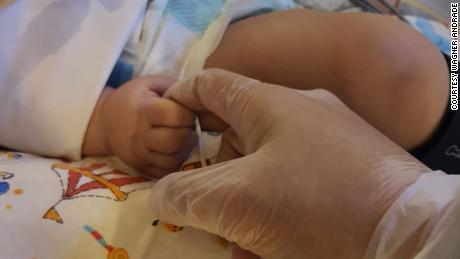
A few months after he was born, Dom was diagnosed with Covid-19 at the Pro-Cardiaco hospital in Rio de Janeiro.

He spent 54 days in the hospital — 32 of them in an induced coma and connected to a ventilator, Dom’s father, Wagner Andrade, told CNN.

“He had some difficulty breathing so the doctors thought it was a bacterial infection,” he said. “But the medication didn’t work and he got worse. Then me and my wife decided to take him to a second hospital and they tested him. It was coronavirus.”

It remains uncertain how Dom contracted coronavirus. He may have been exposed during a visit to a relative’s home, according to Andrade.

“My wife noticed this noise at the end of his breathing,” he said. “We called a few doctors and one of them told us to record a video. After she saw it, she ordered us to take him immediately to the hospital.”

Andrade and his wife, Viviane Monteiro, say it was a “miracle” that Dom recovered.

“First, I felt relieved, and then indescribable happiness,” Andrade said. “We were longing to get him back home for more than 50 days.”

Dom will celebrate his 6-month birthday on June 14 at home with his parents, surrounded virtually by relatives.

Brazil has reported at least 25 Covid-19-related deaths among babies up to 12 months of age, according to data from the country’s ministry of health.

In the last week, Latin America has become the epicenter of the global pandemic. With 465,166 confirmed cases of the virus and 27,878 deaths, according to Johns Hopkins University data, Brazil is the hardest hit country in the region.

CNN’s Tatiana Arias wrote in Atlanta and Journalist Rodrigo Pedroso reported from Sao Paulo, Brazil.

Source link