Only half of medical students at six undergraduate schools are from Ireland
Joe McHugh, TD
Irish students make up only half those studying medicine in the country’s six medical schools.
The latest figures show that of 1,298 medical students, a total of 665 were from Ireland, 579 were non-European Union (EU) students, and just over 50 were from other EU countries.
The highest number of medical students were studying at National University Ireland, Galway at 288, followed by Royal College of Surgeons in Ireland at 25; University College Dublin 227; University College Cork with 212 medical students; Trinity College Dublin at 172, and the University of Limerick 148.
The most recent figures are based on students enrolled in year 1 for the academic year 2017/18, which is the latest year for which full data is available, according to Joe McHugh, the Minister for Education and Skills.
Ombudsman intends to publish a special casebook this year which is to include HSE complaints
New figures show 23 of the 261 complaints made to the Ombudsman around general hospitals in 2019 have been upheld, another 14 were partially upheld.
While Ombudsman, Peter Tyndall, received 79 complaints involving medical and GP cards under the Health Service Executive (HSE), a total 10 were upheld. “Primary and Community Care†complaints for 2019 totalled 71 and eight were upheld.
His latest annual report records 34 complaints relating to psychiatric hospitals, with one complaint upheld and another partially upheld.
In addition, 33 complaints received by his office related to the Cross-Border Healthcare Directive and the statistics show that three were upheld.
Just over 700 complaints were lodged and completed in relation to the Health and Social Care sector.
Seven complaints were received in relation to the Department of Health and two were upheld.
The 2019 report highlights a case which led to improvement in a northwest hospital’s records management, following confusion over woman’s medical file.
A patient complained to the Ombudsman after a doctor at Letterkenny University Hospital had discussed a medical history with her, but she realised it was not hers. She then discovered a letter on her file belonging to a different patient but with the same name as hers.
The woman had attended the hospital for a surgical procedure, but she cancelled the procedure after the mistakes. The patient complained to the hospital but was unhappy with how it responded to her complaint, according to the annual report.
The report adds that the doctor had quoted the wrong medical history as he had read it from another patient’s record, which was misfiled on the patient’s medical chart.
The Ombudsman stated a ‘General Incident/Near Miss form’, which should have been completed immediately after the incident, had not been completed until after the patient had complained to the hospital.
In addition, the details on the form were not entirely accurate.
The General Manager of the hospital had apologised to the patient for the distress she had suffered.
In order to avoid a similar incident occurring, the hospital delivered refresher training to hospital staff on the correct filing of documents in medical record charts, reviewed its policies in relation to medical records management, and is to deliver training on the policies to staff.
The Ombudsman stated he would follow-up with the hospital in mid-2020.
In 2019, Learning to Get Better action plans were rolled out by the HSE and modified to encompass all areas of the Executive, Hospital Groups and Community Healthcare Organisations (CHOs).The plans arose following an investigation by the Ombudsman into how public hospitals handle complaints.
The Ombudsman intends to publish a special casebook this year which is to include HSE complaints, and a progress report on the actions taken under each of the recommendations of his report.
Romina Ashrafi’s father is suspected of killing her with a farming sickle after she ran away from her family home in northern Iran’s Talesh county with a 29-year-old man, the semi-official Fars news agency reported.
Police have arrested the teenager’s father. Ashrafi’s death has been widely covered by Iranian media across reformist, moderate and pro-government news outlets.
It is unclear whether the 29-year-old man will face criminal charges.
Amnesty International condemned the killing and called on authorities to ensure full “accountability” for the crime.
“We call on Iran’s authorities & lawmakers to end the impunity for violence against women/girls & criminalize domestic violence. They must amend Article 301 of the Penal Code to ensure accountability proportionate to the severity of the crime, without resort to the death penalty,” Amnesty said in a statement on Twitter, Thursday.
According to the UN High Commissioner for Human Rights, Article 301 reduces punitive measures for fathers involved in so-called “honor killings.”
Rouhani has expressed “regret” over Ashrafi’s death. During a cabinet meeting in Tehran, the President “ordered accelerated study and ratification” of a bill that protects women against violence, Fars reported Thursday.
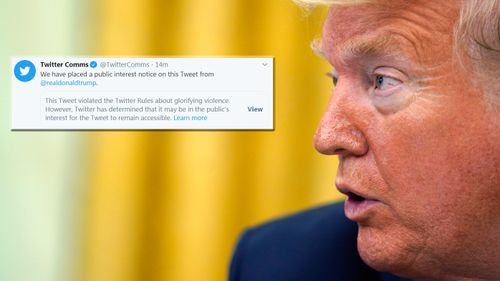
Twitter added a warning label early Friday to a tweet from President Trump implying that protesters in Minneapolis could be shot, in a move likely to escalate tensions between Mr. Trump and his favorite social media megaphone.
The company said Mr. Trump’s post violated its rules against glorifying violence, and it prevented users from viewing the tweet without reading a brief notice, the first time it has restricted one of the president’s messages in this way. Twitter also blocked users from liking or replying to Mr. Trump’s post, though they were still allowed to retweet it if they added a comment of their own.
But Twitter did not take the tweet down, saying it was in the public’s interest that the message remain accessible.
In the tweet, posted early Friday morning, Mr. Trump called the protesters “thugs†and said he had told Minnesota’s governor that the military was “with him all the way.â€
“Any difficulty and we will assume control but, when the looting starts, the shooting starts,†the president wrote. “Thank you!â€
Twitter said it had decided to restrict the tweet “based on the historical context of the last line, its connection to violence, and the risk it could inspire similar actions today.â€
The company’s decision comes a day after Mr. Trump signed an executive order that seeks to limit the legal protections shielding social media companies from liability for the content posted on their platforms. The president had fulminated over Twitter’s decision earlier this week to add fact-checking labels for the first time to two of his tweets. In response, he accused Twitter of stifling speech and said that he would end the interference.
Hours after the warning label was added to Mr. Trump’s Friday tweet, he posted another that accused Twitter of targeting “Republicans, Conservatives & the President of the United States.â€
Mr. Trump’s tweet about the Minneapolis protests echoed a comment by Walter E. Headley, the Miami police chief who attracted national attention in the late 1960s for using shotguns, dogs and a heavy-handed “stop-and-frisk†policy to fight crime in the city’s black neighborhoods.
Mr. Headley announced a “get tough†campaign in a December 1967 news conference that prompted anger among black leaders, The New York Times reported at the time.
“We haven’t had any serious problems with civil uprising and looting,†he said, “because I’ve let the word filter down that when the looting starts, the shooting starts.â€
“We don’t mind being accused of police brutality,†Mr. Headley also said at that news conference. “They haven’t seen anything yet.â€
Twitter has for years faced criticism over Mr. Trump’s posts on the platform, which he has used to issue threats, bully critics and spread falsehoods. The company has said repeatedly that the president did not violate its terms of service, however much he appeared to skirt the line.
The company has also said that blocking world leaders from the service or removing their tweets would hinder public debate around their words and actions. Twitter did announce last year, however, that it would in certain cases place warning labels on posts from political figures that broke its rules, the feature it used with Mr. Trump’s tweet about Minneapolis.
Twitter’s attitude appeared to shift this week after Mr. Trump posted about Lori Klausutis, a woman who died in 2001 from complications of an undiagnosed heart condition while working for Joe Scarborough, a Florida congressman at the time. The president has long feuded with Mr. Scarborough, now a host for MSNBC, and in recent days, Mr. Trump had posted conspiracy theories about Ms. Klausutis’s death, suggesting that Mr. Scarborough was involved.
Her widower wrote a letter to Twitter’s chief executive, Jack Dorsey, asking to have the false tweets removed. “I’m asking you to intervene in this instance because the president of the United States has taken something that does not belong to him — the memory of my dead wife — and perverted it for perceived political gain,†Timothy Klausutis wrote.
Twitter did not honor the request. Instead, it placed links and warning labels on other tweets Tuesday in which Mr. Trump said mail-in ballots would cause the November presidential election to be “rigged.†That led him to sign the executive order, which he framed as an effort to fight social platforms’ biases.
Facebook appears to be trying to forestall such criticism. Mark Zuckerberg, the company’s chief executive, told Fox News this week that he was uncomfortable with Facebook’s being “the arbiter of truth of everything that people say online.â€
Frederike Kaltheuner, a tech policy fellow at the Mozilla Foundation, said that Twitter’s confrontation with Mr. Trump raised questions about how the platform would treat other world leaders. In March, the company deleted posts by the presidents of Brazil and Venezuela that contained unproven information about Covid-19 treatments.
“I doubt that Twitter has the resources to consistently apply rules to all heads of states that use their platform in all sorts of languages,†Ms. Kaltheuner said. “From all we know about the many inconsistent ways in which other policies are being enforced, my guess is that places that rarely make U.S. news will likely be overlooked.â€
In Mr. Trump’s tweets about Minneapolis on Friday, he also criticized Mayor Jacob Frey’s response.
“I can’t stand back & watch this happen to a great American City,†the president wrote. Mr. Trump said Mr. Frey, a Democrat, must “get his act together and bring the City under control, or I will send in the National Guard & get the job done right.â€
It was unclear if the president intended to send additional troops after Gov. Tim Walz activated the Minnesota National Guard to help restore order in the Twin Cities. Protests have raged there over the death on Monday of George Floyd, a black man who had been pinned down by a white police officer who pressed his knee on Mr. Floyd’s neck.
Mr. Trump had previously described the video of Mr. Floyd’s death as a “very shocking sight†and “a very very sad event,†saying he had asked the F.B.I.’s investigation to be expedited.
Mr. Frey did not know about Mr. Trump’s tweets until a reporter read them aloud during a news conference early on Friday. The mayor shook his head and then gave a fiery retort, slamming a podium for emphasis.
“Weakness is refusing to take responsibility for your own actions,†he said. “Weakness is pointing your finger at somebody else during a time of crisis.â€
“Donald Trump knows nothing about the strength of Minneapolis,†he continued. “We are strong as hell. Is this a difficult time period? Yes. But you better be damn sure that we’re going to get through this.â€
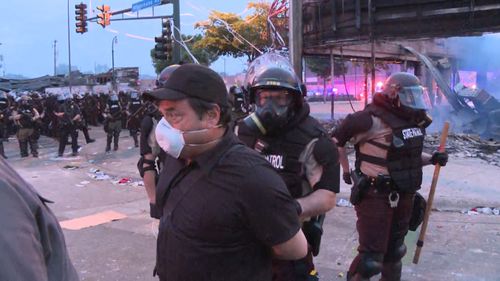
A CNN reporter and camera crew were arrested live on TV by police in Minneapolis on Friday morning near the scene of Thursday night’s protests.
They were released after more than an hour in custody, after the head of CNN spoke to Minnesota Gov. Tim Walz, who apologized and said the arrests should not have happened, the network reported.
Let our news meet your inbox. The news and stories that matters, delivered weekday mornings.
CNN correspondent Omar Jimenez and the crew could be seen being taken into custody around 5:15 a.m. local time, although what appeared to be Jimenez’s media credentials were visible on him.
The reason for their arrests was not clear. Police did not immediately respond to NBC News’ request for comment.
“A CNN reporter & his production team were arrested this morning in Minneapolis for doing their jobs, despite identifying themselves – a clear violation of their First Amendment rights. The authorities in Minnesota, incl. the Governor, must release the 3 CNN employees immediately,” said a statement from CNN after the arrest.
Wow. Police in Minneapolis just arrested @OmarJimenez live on CNN. What is going on?? Our camera crew and Omar’s producer also now being arrested.
A CNN correspondent and two members of his crew have been arrested live on air while broadcasting from protests in Minneapolis over George Floyd’s death.
Omar Jimenez, who was covering the demonstrations that have erupted in the city, was handcuffed and taken away after telling officers the crew would go wherever they wanted them to.
HONG KONG — Pro-China canvassers are pressing wary Hong Kong residents for signatures. The city’s business tycoons are declaring their faith in the Chinese government. Local officials, senior and junior alike, are stepping up to pledge their support, mimicking wooden displays of fealty that are a staple of Communist Party politics in the mainland.
The Chinese government has mounted an aggressive campaign to cast a more positive light on its treatment of Hong Kong, where residents have pushed back sharply against Beijing’s increasingly heavy hand. The new drive is intended to demonstrate a broad level of support among civil servants, business leaders and the city’s more than seven million residents for a new national security law that Beijing is forcing the former British colony to adopt.
“They are doing everything they can to drum up a welcoming vibe about this new law,†said Claudia Mo, a pro-democracy lawmaker. “It’s simply sickening. Who are you trying to fool?â€
The campaign represents a brazen attempt by China’s leader, Xi Jinping, to drown out critics at a time when China is facing a global outcry over its plan for Hong Kong. With the United States threatening economic punishment in retaliation, Chinese officials are promoting the idea that they are responding to the will of the Hong Kong people and that their authoritarian policies enjoy broad public support.
The law has not yet been drafted, though China’s top legislative body on Thursday approved the plan to enact one, perhaps by September. The plan reflects Beijing’s frustration with pro-democracy protests that have roiled Hong Kong since last year. Critics worry that any law would undermine the territory’s liberties, including its tradition of free speech and an independent judiciary, allowing Beijing to stamp out dissent.
On Friday, China’s Ministry of Public Security, the national police and border control, promised in a statement on its website to apply “all of our efforts to direct and support the Hong Kong police to stop violence and restore order.†Hong Kong has its own police force, and the ministry does not currently have any legal enforcement authority in the territory.
Polling data on the new law is limited, but recent events suggest it will not be well received. Officials have avoided pushing such legislation since 2003 because it was seen as deeply unpopular. Pro-democracy candidates won 57 percent of the vote in district-level elections in November, trouncing their pro-Beijing rivals.
To counter that narrative, Mr. Xi, China’s most powerful leader in decades, is deploying the same political playbook in Hong Kong that he has used to consolidate his power in the mainland, using public displays of loyalty to project confidence at vulnerable moments.
Chinese officials use such shows of allegiance — known as biao tai, or expressing one’s position — to uphold Mr. Xi’s decisions to sideline political opponents and to tighten control of the media.
“They want this kind of well-orchestrated drama to present the picture that they have the people behind them, when clearly the majority of Hong Kong people are against the new law,†said Willy Lam, a political analyst at the Chinese University of Hong Kong. “The message to the opposition is: ‘We have already garnered the support of so many people, so it is futile to oppose it.’ â€
More than a dozen Hong Kong officials, including the leaders of the police, fire and immigration departments, have offered strikingly similar endorsements of a new law.
They have denounced the antigovernment protesters as rioters. They have warned about the threat posed by terrorism and argued that stricter laws are necessary for long-term prosperity.
The statements are a jarring display of conformity in a city known for impassioned debate, and they reflect Beijing’s growing influence in the territory, experts say.
“The civil service used to be more politically neutral,†said Mr. Lam, the analyst. “Hong Kong is increasingly following the Communist Party’s customs.â€
Carrie Lam, Hong Kong’s chief executive, has helped lead the charge. She has said the law has drawn a “positive response†from citizens and that foreign investors are eager for a safe environment. On Thursday, she stood alongside residents of a pro-Beijing neighborhood and signed a petition in support.
Mr. Xi recently dispatched a top deputy to meet members of the city’s business elite who had traveled to Beijing for the annual meeting of China’s legislature. The deputy, Han Zheng, who oversees Hong Kong policy, praised them for their diligence and reminded them of their duties as party members to publicly support the law.
Then came the talking points. Growing unrest forced Beijing to push through legislation, Mr. Han said, according to a video of the meeting released by the Chinese government. Social stability was important for Hong Kong’s economy, he said.
Hong Kong’s business community once served as a buffer to Beijing’s hard-line policies. But the party has brought many business leaders to its side in recent years, turning to them for support during crucial moments of political instability.
Hong Kong’s tycoons and business elite control about one third of the seats of the Legislative Council, the city’s lawmaking body. Their support is rewarded by lucrative deals on the mainland.
“They fall into line when they need to because they hold the balance of power in the chief executive elections and in return their business is looked after on the mainland and here,†said David Webb, a longtime Hong Kong investor.
Beijing’s campaign has prompted even moderate members of the establishment to change their tone.
Michael Tien, a pro-Beijing lawmaker who had called for compromise during last year’s protests, said stricter laws were necessary. After attending legislative meetings over the last week in Beijing, he said he had become convinced that China intended to use the law to go after a “small majority of people in Hong Kong who are instigating conflict.â€
“The radicals are coming back,†Mr. Tien said of the protests. “It has gone beyond my tolerance and patience.â€
The party has also activated its network of supporters in Hong Kong.
A group affiliated with the pro-Beijing establishment has set up booths with red, white and blue banners to gather signatures in support of the law. The group, known as the United Front Supporting National Security Legislation, has collected more than 1.8 million signatures, according to Chinese state media.
The group’s advisers include Starry Lee and Regina Ip, two pro-Beijing politicians. During her time as Hong Kong’s top security official two decades ago, Ms. Ip tried and failed to pass a law against subversion and treason known as Article 23.
Ms. Ip said the petition drives were organized by “dyed-in-the-wool patriots.†She said that while she was an adviser, she had not been taking part in the street activities because of “scheduling conflicts.â€
“In principle of course we support it but I haven’t seen the details,†Ms. Ip said of the security law. But, she added, “it needs to be consistent with common-law principles so that our judges and police can enforce it.â€
At lunchtime on Thursday, several volunteers for the group held clipboards on a crowded walkway in Hong Kong’s bustling Causeway Bay neighborhood.
While the group’s website required people to provide names, the last four digits of their government identification numbers and their phone numbers, passers-by in Causeway Bay were asked to sign without providing any other personal information. Signatures ranged from full names and English first names to illegible scribbles.
Peggy Lau, 40, offered her signature. She said the protests have “made the environment really bad and unsettling.â€
“Marches that express people’s demands are fine, but not violence,†said Ms. Lau, who works in finance. “It affects our livelihoods so much.â€
In mainland China, the state-run news media has provided heavy coverage of statements of support from Hong Kong officials, business leaders and workers. China Central Television, the state broadcaster, said the petition drive showed that “all walks of life in Hong Kong fully support Hong Kong to defend the national security law.â€
Ms. Mo, the lawmaker, said the campaign showed that the party viewed Hong Kong as a regular Chinese city and that it would demand the same ideological conformity that it imposes in the mainland.
“When I was young I was taught you do not get harmony if everyone sings the same note,†she said. “That pluralism, that diversity, is supposed to be good. Now there’s no such thing.â€
Javier C. Hernández reported from Taipei, Taiwan, and Alexandra Stevenson from Hong Kong. Elaine Yu contributed reporting from Hong Kong. Cao Li and Albee Zhang contributed research.
A CNN reporter has been arrested live on television in Minneapolis while reporting on widespread looting and riots throughout the city.
Reporter Omar Jimenez was live on air speaking about the situation when police in riot gear arrested Mr Jimenez, placing him in handcuffs.
The police then led him to a waiting patrol car.
The reason for his arrest is unclear. Prior to the arrest police could be overheard asking Mr Jimenez and his television crew to step backwards.
Jimenez could be seen holding his CNN badge while reporting, identifying himself as a reporter, and telling the officers the crew would move wherever officers needed them to.
An officer gripped his arm as Jimenez talked, then put him in handcuffs.
CNN Reporter Omar Jimenez is led away in handcuffs. (CNN)
“We can move back to where you like. We are live on the air here. … Put us back where you want us. We are getting out of your way — wherever you want us (we’ll) get out of your way,” Jimenez said before he was led away.
“We were just getting out of your way when you were advancing through the intersection,” Jimenez said.
Jimenez and the crew had been reporting from the site — near a city police department precinct that protesters had burned and officers had abandoned overnight.
A CNN producer is led away in handcuffs soon after Mr Jimenez’s arrest. (CNN)
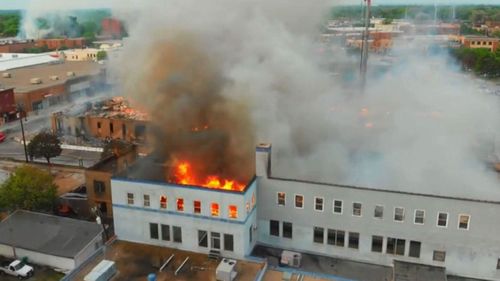
About a block away, a fire was burning at a different, four-story building that had contained restaurants.
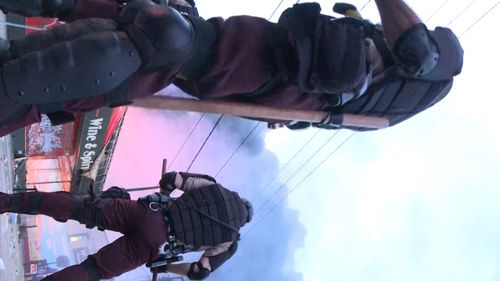
Over 100 state police officers in body armor and riot gear had arrived and lined up near the area where the CNN crew was, near the precinct building on East Lake Street.
After the photographer was arrested, his camera was set on the ground and continued to transmit live images.
A spokesperson for CNN demanded that the three employees of the network be released immediately.
Police seized the CNN camera – which was still recording live on air – and placed it on the ground. (CNN)
“A CNN reporter and his production team were arrested this morning in Minneapolis for doing their jobs, despite identifying themselves – a clear violation of their First Amendment rights,” CNN said in a statement.
“The authorities in Minnesota, including the Governor, must release the 3 CNN employees immediately.”
The Governor of Minnesota has apologised to CNN and said the crew and reporter will be released.
RIOTS EXPLODE AFTER GEORGE FLOYD DEATH
The arrest comes after days of looting following the death of George Floyd.
The 46-year-old was handcuffed and unarmed.
George Floyd, 46, died in the city he moved to for a better life, his last moments caught on video. (Courtesy Ben Crump Law Firm)
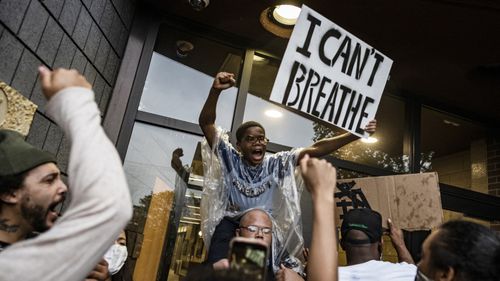
Protests continue to escalate
A state of emergency was earlier called as the city of Minneapolis boils over into total mayhem and more rioting over the death of Mr Floyd.
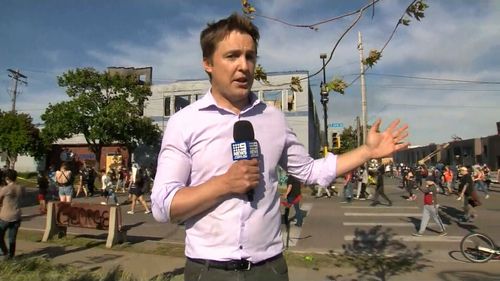
9News reporter Tim Arvier was on the scene as police vehicles were attacked by rocks and projectiles were aimed at officers amid chaotic and alarming scenes.
One man appeared to be stabbed, with his alleged attacker arrested by heavily protected police and the victim rushed away for treatment.
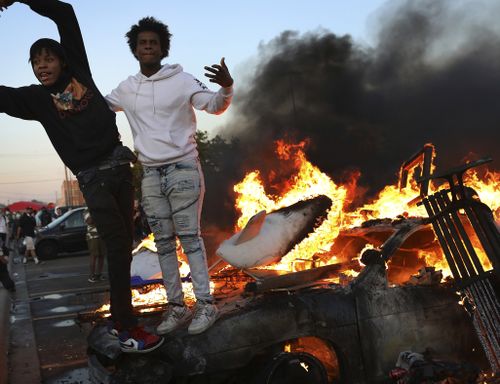
Protestors demonstrate outside of a burning Minneapolis 3rd Police Precinct in Minneapolis. (AP)Young men stand atop a burning car in the Target parking lot E. Lake St. during a third night of unrest following the death of George Floyd while in Minneapolis police custody. (Edward Washington,cq/Star Tribune via AP)
As the chaos unfolded, Minnesota prosecutor Michael Freeman told reporters while the video showing Mr Floyd’s death was “terrible”, there was other evidence that “does not support a criminal charge”.
He later withdrew that statement and said he misspoke about “other evidence”.
9News reporter Tim Arvier in Minneapolis at violent clashes erupted between protesters and police. (9News)
US President responds to Minneapolis riots
Livestream video showed the protesters entering the building, where fire alarms blared and sprinklers ran as blazes were set.
Nine News US correspondent Tim Arvier shot video of a group of men attempting to break into a Minneapolis bank during the mayhem.
Arvier says everywhere he and the camera crew drove, they passed flaming wrecks of burnt-out cars and shells of buildings that have burnt to the ground.
(Supplied)
In Columbus, Ohio a crowd of at least 300 outraged people were hit with pepper spary after refusing to move on from blocking the street.
No arrests have been confirmed in Ohio, however there are reports protestors have used smoke bombs against police and at least one officer was allegedly punched during the violence.
A building burns after another night of violence in the US city. (Nine)People gather at a police precinct during a protest for George Floyd in Minneapolis on Tuesday, May 26, 2020. (AP/AAP)
As riots raged, President Donald Trump called the protesters “thugs” and insinuated that looters would be shot in a series of tweets.
In the tweets, President Trump threatened to bring in the National Guard to “get the job done right”.
“When the looting starts, the shooting starts,” he said.
The tweets have since been hidden by Twitter with a notice that they incite violence and go against Twitter’s rules about violence.
For breaking news alerts and livestreams straight to your smartphone sign up to the 9News app and set notifications to on at the App Store or Google Play.
STOCKHOLM — Sweden doesn’t want to be left out in the cold when its neighbors lift travel restrictions, even though its rising coronavirus death rate continues to cause concern in the region.
“I think it is absolutely vital that we try to open up the borders in a coordinated way,†Anna Hallberg, Sweden’s minister for trade and Nordic affairs, told POLITICO in an interview on Tuesday. “We are conducting intense discussions with our Nordic colleagues about this.â€
When coronavirus first hit the Nordics in March, Norway, Denmark and Finland quickly imposed stringent lockdowns, closing their borders and shutting schools and most businesses.
Sweden’s approach was more light-touch: its borders remained open, its businesses kept trading and its children went to class as normal.
Since March, Sweden’s death rate from COVID-19 has spiked to as much as eight times that of its neighbors (taking into account population size).
“If it is not justifiable on health grounds to open the border with Sweden, then the Swedes can stay where they are and the Germans can come up†— Jakob Ellemann-Jensen, leader of Denmark’s largest opposition party
Now, as lawmakers in Denmark, Finland and Norway mull whether to extend or relax regional travel restrictions, there have been mutterings that perhaps Sweden shouldn’t be included.
Finland’s Interior Minister Maria Ohisalo raised the issue at a recent press conference, calling the Swedish situation “a concern.â€
Ohisalo declined a request for interview for this piece, but her special adviser Jarno Lappalainen told POLITICO that Finland would make a decision about border restrictions with Sweden before June 15 and would take into account the “epidemiological situation†as well as economic and social factors and recommendations from the European Commission.
Meanwhile in Denmark, opposition lawmakers are pushing the government to consider continuing to shut out Swedes while letting in other nationalities. The Danish government has said it will announce a decision by June 1.
“If it is not justifiable on health grounds to open the border with Sweden, then the Swedes can stay where they are and the Germans can come up,†the leader of Denmark’s largest opposition party, Jakob Ellemann-Jensen of the Liberals, said during a recent parliamentary debate.
The EU’s latest guidance is for places with similar rates of coronavirus infection to open borders with each other in a first phase before a wider reopening of Europe’s free-travel Schengen zone is carried out.
The situation in the Nordics reflects the kind of problems European states are likely to face as they negotiate that first phase.
The three Baltic states have opened their borders with each other, but elsewhere things have been trickier: Spain and Greece are keen to allow travelers in to support their tourism industries, but some of the most popular countries for such tourists, including the U.K., are still seeing high rates of coronavirus infection.
Sweden is keen to see a Nordic-wide relaxation of rules for economic and social reasons, Hallberg said.
“There is a lot of frustration on both sides of the borders, in the business community, but also among private citizens,†she said. “They are so used to being able to visit friends and family and go to work and go shopping over the border.â€
On a recent weekday at the ferry terminal in Stockholm, where boats normally depart for destinations around the Baltic Sea and beyond, the effect of the border closures was obvious.
“It is clear that what happens will depend on the situation with the virus in Sweden†— Jan Hanses, chief executive of Viking Line
Shipping operator Viking Line’s modern departure center was closed and signs stuck to the door said it would open for around an hour each morning and each evening to cater for the limited traffic. There wasn’t a single vehicle in its large parking lot.
Chief Executive Jan Hanses told POLITICO that passenger numbers were down to about 10 percent of normal and the company was relying mostly on its freight business to survive.
He said the company was waiting for the June 15 announcement from the Finnish government in the hope that there would be a relaxation of the rules on passenger movement to Sweden, which now only allow business travel and not tourism.
“It is clear that what happens will depend on the situation with the virus in Sweden,†Hanses said.
At a press conference on Thursday, Sweden’s Public Health Agency said that 4,266 people have now died of COVID-19 in the country, but the agency’s view is that falling death rates and falling rates of admission to intensive care units show the situation is improving.
In Finland, 313 people have died with the virus.
Swedish minister Hallberg said she was in regular contact with Nordic counterparts ahead of the summer and was “optimistic†that the Nordic states’ traditionally tight working relationship could help them agree on a coordinated and “simultaneous†relaxation of border controls.
“In the coming days and weeks, we will try and find a common solution,†she said.
Malaysia’s former Prime Minister Mahathir Mohamad and four other former members have promised to challenge their removal from the Bersatu party.
Mahathir, 94, along with his son and three other senior members, were expelled from the Bersatu party on Thursday in the latest twist in a power struggle with his successor.
More:
“The unilateral action by Bersatu’s president to sack us without valid reason is due to his own fears in facing party elections as well as his unsafe position as the most unstable prime minister in the history of the country’s administration,” a joint statement by Mahathir and the four others said.
The party has been split into two camps since intense political wrangling led Mahathir to resign as prime minister in February and the king to appoint fellow party member Muhyiddin Yassin as his replacement despite Mahathir’s objections.
Mahathir’s son, Mukhriz Mahathir, has since challenged Muhyiddin as party president in a vote that has been postponed due to the coronavirus pandemic.Â
Mahathir co-founded Bersatu with Muhyiddin in 2016, and the party joined an alliance that claimed a stunning victory in the 2018 polls, leading to the first change of government since independence.
The ruling alliance collapsed after Muhyiddin pulled Bersatu out to work with the former government, which has been accused of massive corruption. Mahathir, a two-time prime minister, resigned in protest.
Mahathir said he still has the majority support of legislators and has called for a no-confidence vote against Muhyiddin.
In their statement, Mahathir and the other expelled members said they may take legal action to challenge their termination and ensure Bersatu is not used as a vehicle for those crazy for power.
Party letters sent to the five said their membership had ceased as they sat with the opposition bloc during a half-day parliament sitting on May 18. But the letter was signed by a lower official who Mahathir’s group and others said had no power to remove them.
Muhyiddin had earlier unsuccessfully tried to reconcile with Mahathir.Â
The current government includes the party of ex-Prime Minister Najib Razak, who is on trial on charges related to an enormous financial scandal.
We use cookies on our website to give you the most relevant experience by remembering your preferences and repeat visits. By clicking “Accept”, you consent to the use of ALL the cookies.
This website uses cookies to improve your experience while you navigate through the website. Out of these, the cookies that are categorized as necessary are stored on your browser as they are essential for the working of basic functionalities of the website. We also use third-party cookies that help us analyze and understand how you use this website. These cookies will be stored in your browser only with your consent. You also have the option to opt-out of these cookies. But opting out of some of these cookies may affect your browsing experience.
Necessary cookies are absolutely essential for the website to function properly. These cookies ensure basic functionalities and security features of the website, anonymously.
Cookie
Duration
Description
cookielawinfo-checbox-analytics
11 months
This cookie is set by GDPR Cookie Consent plugin. The cookie is used to store the user consent for the cookies in the category "Analytics".
cookielawinfo-checbox-functional
11 months
The cookie is set by GDPR cookie consent to record the user consent for the cookies in the category "Functional".
cookielawinfo-checbox-others
11 months
This cookie is set by GDPR Cookie Consent plugin. The cookie is used to store the user consent for the cookies in the category "Other.
cookielawinfo-checkbox-necessary
11 months
This cookie is set by GDPR Cookie Consent plugin. The cookies is used to store the user consent for the cookies in the category "Necessary".
cookielawinfo-checkbox-performance
11 months
This cookie is set by GDPR Cookie Consent plugin. The cookie is used to store the user consent for the cookies in the category "Performance".
viewed_cookie_policy
11 months
The cookie is set by the GDPR Cookie Consent plugin and is used to store whether or not user has consented to the use of cookies. It does not store any personal data.
Functional cookies help to perform certain functionalities like sharing the content of the website on social media platforms, collect feedbacks, and other third-party features.
Performance cookies are used to understand and analyze the key performance indexes of the website which helps in delivering a better user experience for the visitors.
Analytical cookies are used to understand how visitors interact with the website. These cookies help provide information on metrics the number of visitors, bounce rate, traffic source, etc.
Advertisement cookies are used to provide visitors with relevant ads and marketing campaigns. These cookies track visitors across websites and collect information to provide customized ads.