Thursday, May 14, 2026

Scant Evidence For Trump Claim That Antifa Is Behind Protest Violence

WASHINGTON (AP) — Scott Nichols, a balloon artist, was riding home on his scooter from the protests engulfing Minneapolis last weekend when he was struck by a rubber bullet fired from a cluster of police officers in riot gear.

“I just pulled over and put my hands up, because I didn’t want to get killed,” said Nichols, 40. “Anybody that knows me knows I wasn’t out there to cause problems.”

Nichols, who before the coronavirus pandemic made his living performing at children’s birthday parties under the stage name “Amazing Scott,” spent two days in jail before being released on criminal charges of riot and curfew violation.

President Donald Trump has characterized those clashing with law enforcement after George Floyd’s death under the knee of a Minneapolis police officer as organized, radical-left thugs engaging in domestic terrorism, an assertion repeated by Attorney General William Barr. Some Democrats, including Minnesota Gov. Tim Walz and Minneapolis Mayor Jacob Frey, initially tried to blame out-of-state far-right infiltrators for the unrest before walking back those statements.

There is scant evidence either is true.

The Associated Press analyzed court records, employment histories, social media posts and other sources of information for 217 people arrested last weekend in Minneapolis and the District of Columbia, two cities at the epicenter of the protests across the United States.

Rather than outside agitators, more than 85% of those arrested by police were local residents. Of those charged with such offenses as curfew violations, rioting and failure to obey law enforcement, only a handful appeared to have any affiliation with organized groups.

Those charged with more serious offenses related to looting and property destruction – such as arson, burglary and theft – often had past criminal records. But they, too, were overwhelmingly local residents taking advantage of the chaos.

Social media posts indicate only a few of those arrested are left-leaning activists, including a self-described anarchist. But others had indications of being on the political right, including some Trump supporters.

The president has tried to portray the protesters and looters with a broad brush as “radical-left, bad people,” ominously invoking the name “antifa,” an umbrella term for leftist militants bound more by belief than organizational structure. Trump tweeted last Sunday that he planned to designate antifa as a terrorist organization.

“These are acts of domestic terror,” Trump said in a Rose Garden speech Monday, moments before heavily armed troops and riot police advanced without warning on the largely peaceful protesters across the street from the White House.

Barr, put in charge of organizing the police and military response, activated the FBI’s Joint Terrorism Task Force last weekend to target protest organizers.

“The violence instigated and carried out by Antifa and other similar groups in connection with the rioting is domestic terrorism and will be treated accordingly,” Barr said in a statement issued Sunday.

There have been violent acts, including property destruction and theft. Police officers and protesters have been seriously injured and killed. But federal law enforcement officials have offered little evidence that antifa-aligned protesters could be behind a movement that has appeared nearly simultaneously in hundreds of cities and towns in all 50 states since Floyd’s death.

The AP obtained copies of daily confidential “Intelligence Notes” distributed this past week to local enforcement by the Department of Homeland Security that repeat, without citing evidence, that “organized violent opportunists — including suspected anarchist extremists — could increasingly perpetrate nationwide targeting of law enforcement and critical infrastructure.”

“We lack detailed reporting indicating the level of organization and planning by some violent opportunists and assess that most of the violence to date has been loosely organized on a level seen with previous widespread outbreaks of violence at lawful protests,” the assessment for Monday says.

The following day, the assessment noted “several uncorroborated reports of bricks being pre-staged at planned protest venues nationwide.”


Law enforcement officers stand in formation along Lake Street near Hiawatha Ave. as fires burned after a night of unrest and protests in the death of George Floyd early Friday, May 29, 2020 in Minneapolis. Floyd died after being restrained by Minneapolis police officers on Memorial Day. (David Joles/Star Tribune via AP)

“Although we have been unable to verify the reporting through official channels, the staging of improvised weapons at planned events is a common tactic used by violent opportunists,” the Tuesday assessment says.

But social media posts warning that stacks of bricks have been left at protest sites in Atlanta, Boston and Los Angeles have been debunked by local officials who have explained that the masonry was out in the open before the protests or was for use in construction projects.

Nichols, the balloon artist, hardly fits the portrait of a radical.

He recently gained local notice for a giant balloon rabbit and other sculptures displayed in his front yard for Easter. He laughed when asked if he had any ties to antifa or other militant groups. A white man who lives less than a half mile from where Floyd was killed on May 25, Nichols said he protested to support of his neighbors, many of whom are black.

“It was the most insane thing I’ve seen in my life,” he said. “The city was going crazy.”

Nichols said he and a friend helped douse a dumpster fire that near a laundromat. He remembers getting a text from his mother saying that Minneapolis had set an 8 p.m. curfew, but he thought it would be enforced loosely.

“Had I known that being out after curfew would be such a severe penalty, I would have never done it,” Nichols said, adding that he missed his son’s high school graduation while he was in jail.

Lars Ortiz, a 35-year-old classical musician, said he was driving just blocks from his Minneapolis home on May 29 after visiting a friend recovering from COVID-19 when officers pulled him out of his car at gunpoint. He said he had been unaware of the 8 p.m. curfew enacted that night.

Ortiz and another friend in the car with him were put in zip-tie restraints and forced to wait on a bus for hours before police took them to jail, where he would spend the weekend.

“It was scary. It was confusing. I felt violated,” said Ortiz, a cellist who identifies as a biracial Mexican American.

Ortiz was held on a riot charge and curfew violation. He said he was told when he was released from jail on Monday the more serious rioting charge was dropped.

Lt. Andy Knotz of the Anoka County Sheriff’s Office, whose deputies were deployed from the suburban county north of Minneapolis into the city to help with the unrest, said it was a “chaotic scene” and that Ortiz was coming from the direction of the protests. Knotz said Ortiz was removed from his car by the Minnesota State Patrol, and an Anoka deputy took him to the police station.

“In chaos like that you can’t determine who is legit and who isn’t,” Knotz said.

Natalie Cook, 43, who’s white, said she had never before participated in a protest, but wanted to be there to support and protect her 24-year-old son, who’s black.

“Not only did I want to go to be an ally to black people, but I wanted to go to support my son,” Cook said. “Also, I was afraid to send him out by himself.”

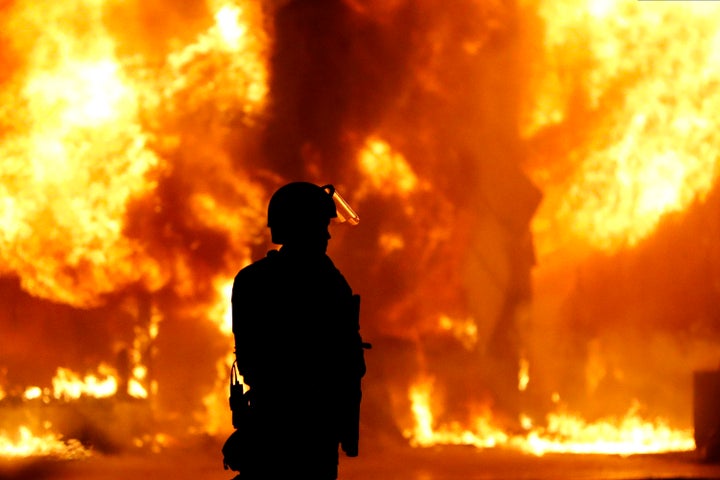
A Minneapolis Police officer stands near a structure fire, Saturday, May 30, 2020, in Minneapolis. Protests continued followi


A Minneapolis Police officer stands near a structure fire, Saturday, May 30, 2020, in Minneapolis. Protests continued following the death of George Floyd, who died after being restrained by Minneapolis police officers on Memorial Day. (AP Photo/Julio Cortez)

Cook said they were marching peacefully with about 100 protesters for hours when police started using tear gas and shooting rubber bullets. As they tried to get away, they were pepper sprayed and her son was hit at close range by a rubber bullet, she said. They were both jailed and released on Monday, charged with riot and violating curfew.

Cook said her son was deeply affected by Floyd’s death and she doesn’t have any regrets about going out to make their voices heard.

“My son was really struggling with it,” she said. “We couldn’t just sit by and watch.”

AP filed public records requests seeking arrest reports and other documents that might show what evidence law enforcement officers have against Nichols, Ortiz the Cooks and others arrested in Minneapolis. Those records have not yet been provided.

In Washington, the D.C. Metropolitan Police arrested at least 81 people last weekend, including some as young as 13. Most were charged with curfew violations and felony rioting, which could result in up to 180 days in jail and $5,000 in fines.

Among the highest profile arrests made by federal authorities in the last week was Matthew Lee Rupert. Prosecutors allege the 28-year-old Illinois man traveled to Minneapolis to participate in riots and then posted videos on a Facebook page showing him looting stores and handing out explosives.

In one video, Rupert, a convicted felon, says: “We come to riot, boy! This is what we came for!”

Though Rupert is alleged to have targeted police officers, there is no evidence cited in his indictment he is affiliated with any organized group. Among the few indicators of his political beliefs was a series of Facebook posts celebrating Trump’s 2017 inauguration. “Trump is my president but I’m not racist,” he wrote, adding that he loves Mexican food.

Rupert, who made an initial court appearance Friday, remains in federal custody. A federal public defender assigned to represent him did not respond to a voicemail message seeking comment.

Michael German, a former FBI agent and fellow with the Brennan Center for Justice at New York University, said people often travel and cross state lines to participate in protests and that not all of them have peaceful intent. He said politicians and law enforcement often cite the presence of out-of-towners to justify greater police force against protesters.

“It’s an old tactic for law enforcement policing protests to suggest that the problems are being caused by outside agitators,” German said. “It opens up the opportunity for greater police violence in response.”

Among those who traveled to Minneapolis to protest Floyd’s killing was Tara Houska, a 36-year-old attorney and member of the Couchiching First Nation from northern Minnesota. An activist for indigenous rights, she was arrested in Minneapolis last Saturday night and charged with not complying with a peace officer.

Houska, who attended college and law school in the city, said she was with a group a couple blocks from where Floyd died when police told them they were breaking curfew. They replied they were going home, she said, and then the officers hit them with pepper spray and zip-tied their hands.

“Almost everyone that was in our holding tank with us was from Minnesota,” Houska said.

Sierra West, 29, of Kansas City, Missouri, said she drove to Minneapolis with a friend because she is “so angry about what is happening” with police brutality and wanted to peacefully protest.

After marching for hours, West she broke away from the crowds and was walking back to her car through an alley alone when police arrested her early Saturday on riot and curfew violation charges. She said she did nothing to provoke the four officers who confronted her.

“They were hiding, and they literally jumped out of the shadows with guns drawn on me,” she said. “The street was completely empty.”

West, who is white and describes herself as a strong supporter of the Black Lives Movement, was freed from jail on Monday afternoon.

University of Minnesota Law School student Santana Boulton, 23, said a police officer pepper-sprayed her in the face on May 28 before she was tear-gassed two days later and then arrested on Sunday, charged with unlawful assembly and violating a curfew.

About 15 minutes before the 8 p.m. curfew, Boulton said she and her boyfriend joined a large crowd of marchers on Interstate 35. People linked arms and kneeled before two lines of police officers formed near the protesters. She said she never heard any orders to disperse.

“It was nothing like a riot. It was a sit-in,” she said.

Boulton, a white woman who moved from Michigan to Minneapolis to attend law school, was arrested and spent 16 hours in custody. She described herself as “philosophically an anarchist,” but “not a revolutionary.”

“Antifa isn’t even real,” Boulton said. “As an actual person who identifies with the political label of anarchist, the only thing anarchists do is have meetings where they argue for five hours and get nothing done.”

Kunzelman reported from Silver Spring, Maryland, Bleiberg from Dallas and Durkin Richer from West Harwich, Massachusetts. Associated Press writers Brian Slodysko and Ashraf Khalil in Washington, Amanda Seitz and Don Babwin in Chicago, and Lori Hinnant in Paris contributed to this report.


Source link

Coronavirus official UK death toll rises by 204 amid call for inquiry

Another 204 people have died in the UK after testing positive for coronavirus as of 5pm on Friday, taking the official death toll to 40,465.

This number does not include all deaths involving Covid-19 across the UK, which is thought to have passed 50,000.

So far, a total of 284,868 people in the UK have tested positive for coronavirus.

The Department of Health and Social Care said that as of 9am on Saturday, there had been 5,438,712 tests, including 218,187 tests on 5 June, of which 1,557 were positive.

Among the dead were 75 people in England who died in hospital after testing positive for coronavirus, bringing the total number in England to 27,359.

The patients were aged between 43 and 100 and all had underlying health conditions, NHS England announced on Saturday.

Six of the deaths occurred in Scotland, where the number of deaths among people who have tested positive for coronavirus rose to 2,415.

Scottish government figures show 15,603 people have now tested positive for Covid-19 across the country, an increase of 21.

As of Friday evening, 1,019 patients were in hospital with confirmed or suspected coronavirus, with 20 in intensive care.

Friday also had the highest number of NHS workers in Scotland being absent in June, with 5,317 staff off for reasons related to Covid-19. And 406 Scottish adult care homes, 38 per cent of the total, were reported to have a current case of suspected Covid-19 – where a resident has shown symptoms within the past fortnight.

One more person with coronavirus has died in Northern Ireland, taking the total number recorded by the Department of Health, primarily accounting for hospital deaths, to 537.

Anne Glover, Scotland’s former chief scientific adviser, said an inquiry into government failures must be delivered within months to prepare for a second wave of the disease. Photograph: Posztos Janos/PA

Another 14 cases of the virus were confirmed in Northern Ireland, bringing the total since the outbreak began to 4,790.

The figures came as Scotland’s former chief scientific adviser, Anne Glover, called for an inquiry identifying failures around the UK government’s handling of the Covid-19 pandemic. Glover said the inquiry must be delivered within months to prepare for a second wave of the disease.

She said it would be “inexcusable” for ministers to repeat “mistakes that have already been made” should there be a second spike of coronavirus cases this winter.

On Friday, 27 medical and scientific experts signed a letter published in the Guardian warning that many more Britons may die if the government does not come up with solutions to “some of the structural problems that have made implementing an effective response so difficult”.

Glover, who is now president of the Royal Society of Edinburgh, told the PA news agency: “Given that second wave is likely to come at a time that is likely to coincide with seasonal influenza, and that would give us serious problems, we really need to understand what the failings have been in our apparent inability to be able to deal with this pandemic appropriately.”

Source link

OPEC and Russia Agree to Extend Oil Production Cuts

Many of the world’s major oil producers agreed on Saturday to extend the record oil production cuts that have helped bolster oil prices since their collapse in April in the depths of the coronavirus pandemic.

Oil ministers from the Organization of the Petroleum Exporting Countries, as well as other producers led by Russia, met by video conference on Saturday and reached an agreement to continue cutting 9.7 million barrels a day — or about 10 percent of global output in normal times — through July, OPEC said in a news release.

Under the original agreement reached on April 12 by the combined producers’ group, known as OPEC Plus, production was set to increase in steps after June.

The recognition that the deep cuts need to continue for a month or perhaps longer shows that despite the recent surge in oil prices, the large producers remain worried that the oil market could fall apart again.

Prince Abdulaziz bin Salman, the Saudi oil minister, noted that concern in a speech to the OPEC Plus meeting, which he headed.

“Demand is returning as big oil-consuming economies emerge from pandemic lockdown,” he said. “But we are not out of the woods yet.”

One risk is that reviving the world economy after the worst of the pandemic passes will prove more difficult than investors are now anticipating. While production cuts and voluntary closings of oil wells have helped bring demand and supply closer to balance, there are still huge stocks of oil in tank farms and on ships that could flood the market.

“Warning flags are still flying here,” said Robert McNally, president of Rapidan Energy Group, a market research firm.

Mr. McNally noted that the April price crash dramatically altered the dynamic between Saudi Arabia and Russia, which engaged in an ill-timed price war after a failed OPEC meeting in early March. The Saudis sharply boosted production in April, just as the effects of global shutdowns were hitting oil demand hardest.

That contributed to the crash in oil prices in late April, with West Texas Intermediate crude, the American standard, falling into negative territory, while Brent crude, the international benchmark, briefly dropped below $20 a barrel.

With traders anticipating a new deal, both Brent crude and West Texas Intermediate crude soared by nearly 6 percent on Friday, to $42.30 a barrel for Brent crude and $39.55 a barrel for the West Texas crude. The markets were closed on Saturday.

  • Updated June 5, 2020

    • How many people have lost their jobs due to coronavirus in the U.S.?

      The unemployment rate fell to 13.3 percent in May, the Labor Department said on June 5, an unexpected improvement in the nation’s job market as hiring rebounded faster than economists expected. Economists had forecast the unemployment rate to increase to as much as 20 percent, after it hit 14.7 percent in April, which was the highest since the government began keeping official statistics after World War II. But the unemployment rate dipped instead, with employers adding 2.5 million jobs, after more than 20 million jobs were lost in April.

    • Will protests set off a second viral wave of coronavirus?

      Mass protests against police brutality that have brought thousands of people onto the streets in cities across America are raising the specter of new coronavirus outbreaks, prompting political leaders, physicians and public health experts to warn that the crowds could cause a surge in cases. While many political leaders affirmed the right of protesters to express themselves, they urged the demonstrators to wear face masks and maintain social distancing, both to protect themselves and to prevent further community spread of the virus. Some infectious disease experts were reassured by the fact that the protests were held outdoors, saying the open air settings could mitigate the risk of transmission.

    • How do we start exercising again without hurting ourselves after months of lockdown?

      Exercise researchers and physicians have some blunt advice for those of us aiming to return to regular exercise now: Start slowly and then rev up your workouts, also slowly. American adults tended to be about 12 percent less active after the stay-at-home mandates began in March than they were in January. But there are steps you can take to ease your way back into regular exercise safely. First, “start at no more than 50 percent of the exercise you were doing before Covid,” says Dr. Monica Rho, the chief of musculoskeletal medicine at the Shirley Ryan AbilityLab in Chicago. Thread in some preparatory squats, too, she advises. “When you haven’t been exercising, you lose muscle mass.” Expect some muscle twinges after these preliminary, post-lockdown sessions, especially a day or two later. But sudden or increasing pain during exercise is a clarion call to stop and return home.

    • My state is reopening. Is it safe to go out?

      States are reopening bit by bit. This means that more public spaces are available for use and more and more businesses are being allowed to open again. The federal government is largely leaving the decision up to states, and some state leaders are leaving the decision up to local authorities. Even if you aren’t being told to stay at home, it’s still a good idea to limit trips outside and your interaction with other people.

    • What’s the risk of catching coronavirus from a surface?

      Touching contaminated objects and then infecting ourselves with the germs is not typically how the virus spreads. But it can happen. A number of studies of flu, rhinovirus, coronavirus and other microbes have shown that respiratory illnesses, including the new coronavirus, can spread by touching contaminated surfaces, particularly in places like day care centers, offices and hospitals. But a long chain of events has to happen for the disease to spread that way. The best way to protect yourself from coronavirus — whether it’s surface transmission or close human contact — is still social distancing, washing your hands, not touching your face and wearing masks.

    • What are the symptoms of coronavirus?

      Common symptoms include fever, a dry cough, fatigue and difficulty breathing or shortness of breath. Some of these symptoms overlap with those of the flu, making detection difficult, but runny noses and stuffy sinuses are less common. The C.D.C. has also added chills, muscle pain, sore throat, headache and a new loss of the sense of taste or smell as symptoms to look out for. Most people fall ill five to seven days after exposure, but symptoms may appear in as few as two days or as many as 14 days.

    • How can I protect myself while flying?

      If air travel is unavoidable, there are some steps you can take to protect yourself. Most important: Wash your hands often, and stop touching your face. If possible, choose a window seat. A study from Emory University found that during flu season, the safest place to sit on a plane is by a window, as people sitting in window seats had less contact with potentially sick people. Disinfect hard surfaces. When you get to your seat and your hands are clean, use disinfecting wipes to clean the hard surfaces at your seat like the head and arm rest, the seatbelt buckle, the remote, screen, seat back pocket and the tray table. If the seat is hard and nonporous or leather or pleather, you can wipe that down, too. (Using wipes on upholstered seats could lead to a wet seat and spreading of germs rather than killing them.)

    • Should I wear a mask?

      The C.D.C. has recommended that all Americans wear cloth masks if they go out in public. This is a shift in federal guidance reflecting new concerns that the coronavirus is being spread by infected people who have no symptoms. Until now, the C.D.C., like the W.H.O., has advised that ordinary people don’t need to wear masks unless they are sick and coughing. Part of the reason was to preserve medical-grade masks for health care workers who desperately need them at a time when they are in continuously short supply. Masks don’t replace hand washing and social distancing.

    • What should I do if I feel sick?

      If you’ve been exposed to the coronavirus or think you have, and have a fever or symptoms like a cough or difficulty breathing, call a doctor. They should give you advice on whether you should be tested, how to get tested, and how to seek medical treatment without potentially infecting or exposing others.


The shocking price falls coupled with pressure from President Trump, who was worried about job losses in the oil industry in the United States, led Riyadh and Moscow to abruptly change their approach and resume their cooperation.

The two oil giants worked together to orchestrate the extension agreed on Saturday, and they also pressured Iraq, the second largest producer in OPEC, to state publicly that it would comply with its commitment to cut production by about 1 million barrels a day. Analysts have estimated that Iraq has been missing that target by hundreds of thousands of barrels a day.

“Despite the economic and financial circumstances that Iraq is facing, the country remains committed to the agreement,” a news release posted by OPEC on Saturday quoted Assem Jihad, a spokesman for the Iraqi oil ministry, as saying.

The Saudi minister underlined that message.

“Each of the 23 countries represented here must be on guard for any signs of backsliding from their commitments,” he said at the second meeting. And he warned that production would be closely monitored.

Source link

Democrats to Propose Broad Bill to Target Police Misconduct and Racial Bias

Democrats in Congress plan to unveil expansive legislation on Monday that would make it easier to prosecute police misconduct and recover damages from officers found to have violated the constitutional rights of civilians, and step up pressure on the Justice Department to address systemic racial discrimination by law enforcement.

The bill, which House and Senate Democrats have named the Justice in Policing Act of 2020, is a direct response to the recent killings of three black Americans by white civilians and officers that have prompted protests across the country, but it includes policies that civil rights activists have been pushing for decades to combat racial bias and excessive use of force by law enforcement. The New York Times obtained a copy of a section-by-section summary of its contents, circulated privately on Capitol Hill late Friday.

It would be the most aggressive intervention into policing by Congress in recent memory, and elements of it are certain to meet with staunch opposition from politically powerful police unions and other law enforcement groups that have fought against such efforts in the past. It is not clear whether President Trump, who often aligns himself with law enforcement and has advocated the use of brutal police tactics, will embrace such measures now.

As currently proposed, it would significantly change federal law and require states and localities to make modifications of their own, such as instituting mandatory bias training, to receive federal funds. It would create a national registry to track police misconduct and require that law enforcement agencies report data on the use of force, as well as ban certain chokeholds and other practices that were used in confrontations with the police that left black Americans dead.

“Persistent, unchecked bias in policing and a history of lack of accountability is wreaking havoc on the black community,” House and Senate Democrats who assembled the package wrote in an email to colleagues on Friday accompanying the summary. “Cities are literally on fire with the pain and anguish wrought by the violence visited upon black and brown bodies.”

The effort is being led by Representative Karen Bass of California, the chairwoman of the Congressional Black Caucus, Representative Jerrold Nadler of New York, the House Judiciary Committee chairman, and Senators Cory Booker of New Jersey and Kamala Harris of California, the only two black Democrats in the Senate. They cited the deaths of George Floyd in Minnesota and Breonna Taylor in Kentucky that have inspired protests across the country, as well as other well-known victims of such force in recent years.

“While there is no single policy prescription that will erase the decades of systemic racism and excessive policing — it’s time we create structural change with meaningful reforms,” the lawmakers wrote.

The text of the bill was still being drafted on Saturday and could change before Monday’s unveiling, as could the legislation’s title.

Individual lawmakers in both parties have introduced their own proposals in recent days that the House and Senate could still consider going forward, but the bill by Ms. Bass and the others has the imprimatur of Democratic leadership in the House and Senate, as well as the influential black caucus. Democrats believe they will be able to swiftly pass it in the House, but prospects are less clear in the Senate, where the Republican majority is likely to pursue a narrower set of changes.

Because most police departments are under state and local control, there are limits to the kinds of changes Congress can mandate from Washington. Calls from activists to break up or drastically restructure police departments, for instance, are more likely to be answered at the state and local level.

Still, the changes Democrats are proposing would be significant.

If adopted, the bill would rewrite key elements of the federal criminal code related to police misconduct to make it easier to prosecute law enforcement officers and for individuals who are victims of such practices to recover damages.

The federal police misconduct statute currently makes it a crime for an officer to “willfully” violate an individuals’s constitutional rights, meaning prosecutors must prove an officer acted with the intention of depriving the person of their rights. Democrats plan to propose lowering that standard of criminal intent to “knowingly or with reckless disregard.” The change is likely to face opposition from police unions and their allies.

The legislation would also alter the legal doctrine known as qualified immunity that shields police officers from being held legally liable for damages sought by citizens whose constitutional rights were violated.

In addition, Democrats are proposing to change the federal standard for the use of force by officers from “reasonableness” to only when it is “necessary to prevent death or serious bodily injury.” The bill would require that federal officers use de-escalation tactics and use deadly force only as a last resort. Grants to state and local agencies would require them to do the same.

In federal drug cases, lawmakers intend to propose banning “no knock” warrants, which allow police to enter a residence without warning or identifying themselves, and incentivize states to do the same. Ms. Taylor was shot and killed in her home during such a raid.

The legislation would also ban chokeholds or other carotid holds, and condition law enforcement funds on states and other agencies doing the same. The technique led to Mr. Floyd’s death, prosecutors have said, and the high-profile death in 2014 of Eric Garner in New York.

It would also limit the transfer of military weaponry to state and local departments.

It would give new power to Justice Department investigators conducting inquiries into patterns or practices of behavior by police departments that violate the Constitution and incentivize state attorneys general to conduct such investigations on their own.

Lawmakers would require all uniformed federal officers to wear body cameras and use dashboard cameras, which have been crucial tools to holding officers accountable in many cases, and they would mandate that state and local agencies use federal funds to “ensure” their use.

Democrats would also try to prod state and local law enforcement agencies to undertake a new effort to end discrimination in their practices, by conditioning federal funding on the adoption of policies and training to combat racial and other discriminatory profiling.

The bill would also impose new requirements on the Justice Department to assemble and promulgate new policing standards for state and local agencies and collect reams of data on police actions all over the country that could inform more changes in the future, particularly when a Democratic administration controls the department.

The bill would also include a provision, held up in the Senate, that would make lynching a new federal hate crime for the first time in American history.

Source link

Lockdown impact: Bank credit growth plunges 50% in fortnight to May 22

0


credit grew 6.5 per cent year-on-year in the fortnight ended May 22, down almost 50 per cent from a year ago, reflecting the impact of the nationwide imposed at the end of March.


Credit grew at a similar pace — 6.5 per cent — in the previous fortnight, while it expanded 12.7 per cent a year ago (as of May 24, 2019), according to rating agency


Senior bankers said severe demand destruction during the was one of the reasons behind the fall in credit growth. The use of sanctioned credit would see a gradual rise as businesses begin activities during the unlocking phase, they said.


Also, the first quarter of the financial year is usually lean as units and service sector enterprises are engaged in finalising accounts for the year gone by.


The deposit accretion activity has remained steady in the current financial year compared to the same period last year. Deposits grew 10.6 per cent (as of May 22, 2020) over the previous fortnight, and improved marginally on a YoY basis (10.1 per cent as of May 24, 2020).


The coronavirus-induced has destroyed the demand for money, leading to banks sitting on surplus liquidity, said a public sector banker. The customers, too, have enough cash in their accounts as there’s no spending.


ALSO READ: Covid-19: Bank NPAs may worsen to 11.6 per cent by FY21 end, says Icra


During the week ended May 22, the had surplus liquidity of over Rs 4.5 trillion, said CARE Ratings, leading to banks slashing interest rate on deposits.


State Bank of India (SBI) reduced the fixed deposit (FD) rates to 4.4 per cent from 4.8 per cent earlier on deposits with tenures between 180 days and 210 days. The rate for FDs maturing between five years and 10 years was cut to 5.4 per cent from 5.7 per cent.


Liquidity in the is expected to remain surplus, with the growth in bank deposits expected to be higher than the growth in the bank credit offtake.


In the previous financial year, the pace of had fallen sharply to 6.1 per cent, from13.3 per cent in FY19.


Deposit accretion activity had also moderated in FY20 to 7.9 per cent from 10 per cent in FY19, according to the Reserve Bank of India (RBI) data. While banks faced the slowdown impact throughout the year, the Covid-19 blow came in the final month of the financial year.


Source link

New Jobs Report Diminishes GOP Appetite For More Virus Aid

WASHINGTON (AP) — A stronger than expected jobs report could further scramble an already uncertain picture for passing a fifth and possibly final coronavirus aid bill. The positive statistics are feeding the wait-and-see approach of the White House and its GOP allies in Congress.

Republicans say the numbers vindicate their decision to take a pause and assess the almost $3 trillion in assistance they already have approved. The White House was already showing little urgency about pursing another trillion-dollar response bill, much less the $3.5 trillion measure passed by the House last month, and prefers to concentrate on reopening the economy.

The coming weeks are expected to bring difficult negotiations over what the package should contain, just months before an election where the White House and control of Congress are at stake.


Senate Majority Leader Mitch McConnell of Kentucky, arrives for a Republican luncheon on Capitol Hill in Washington on June 4.

For lawmakers, tough decisions loom about how much money to allocate to states, how to extend unemployment benefits for millions of people and whether to create lawsuit protections for businesses and schools as they reopen during the pandemic.

Friday’s jobs report showed a 2.5 million gain instead of an expected loss of millions more, complicating prospects for the aid talks. Trump is difficult to gauge, but talks often of pursing public works spending and a payroll tax cut, which is a nonstarter on Capitol Hill.

“They are less than urgent, less than inclined for another package,” said Rep. Patrick McHenry, R-N.C., a GOP leader when his party was in the majority. “There is less urgency to go strike a hard deal — and this one would be a hard deal. Doesn’t mean it won’t happen, I just think the urgency is far lessened.”

Democrats looked at the jobs report and saw job losses for 600,000 public employees that are likely to worsen if Washington doesn’t help cash-starved state and local governments. Despite the positive jobs news, unemployment nationwide is at 13%, so the looming expiration of a supplemental $600 per week jobless benefit promises to provide a catalyst for action.

Top Democrats such as Speaker Nancy Pelosi of California and Senate Minority Leader Chuck Schumer of New York are united behind the $3.5 trillion “HEROES Act,” which contains party priorities such as jobless aid, another round of $1,200 checks and money for essential workers, local schools, colleges and people missing mortgages and rent payments.

Senate Majority Leader Mitch McConnell of Kentucky and other Republicans are opposed to the Democratic plan. But they are struggling with their own divisions, with more pragmatic lawmakers favoring aid to states and local governments and recognizing that additional jobless aid is inevitable if there is to be an agreement.

GOP Sens. Mitt Romney of Utah, Susan Collins of Maine and Cory Gardner of Colorado back a significant state aid package, and there’s strong support across Congress for help for smaller municipalities. But concerns about piling additional trillions of dollars onto the national debt have risen, and some Republicans believe Congress has done enough.

McConnell has already said Republicans won’t extend the $600 per week supplemental unemployment benefit, which they say is taking away incentive for people to return to the job market. A recent Congressional Budget Office report estimated that 5 out of 6 people would earn more by continuing to receive the higher benefits than returning to work and that extending the benefit would harm the economy next year.

What is plain is that the enormous sense of urgency that produced the first four aid bills has faded, along with the freewheeling dynamic that inflated the price tags. That dynamic helped Democrats to win gains in the $2 trillion CARES Act in March that they might not have gotten through a more deliberate process.

“Unlike the CARES Act, where we really did need to act in a matter of days, here we have a little bit of luxury of time, but that time is not indefinite,” said Neil Bradley, chief policy officer at the U.S Chamber of Commerce. “We don’t have months.”

Now, Republicans have set a goal of keeping the cost of the next bill below $1 trillion. That’s going to be a hard sell for Pelosi, who devoted almost $1 trillion just to states and localities.

Supporters of a deal had hoped to reach an agreement this month, but acknowledge the annual August recess is now looking more like the informal deadline. For starters, leadership aides in both parties acknowledge there have been virtually no bipartisan talks so far, with Pelosi and McConnell communicating through their public statements.

“Future efforts must be laser-focused on helping schools reopen safely in the fall, helping American workers continue to get back on the job, and helping employers reopen and grow,” McConnell said Friday.


Source link

A brief history of bad logo redesigns — and what designers can learn from them

0

Did you know we have an online conference about product design coming up? SPRINT will cover how designers and product owners can stay ahead of the curve in these unprecedented times.

Logo redesigns are a lot like a tightrope act—on a windy day, in a pouring rain, no nifty balancing pole or safety net below. The risks are high, and the margin for error is thin. What’s at stake?

Confusion.

Outrage.

Social media “shame-on-you”s.

We form deep, emotional ties with logos. The shock of change has the power to trigger a disproportionate reaction regardless of a redesign’s quality.

Social media logo reviews can be brutal. Studies show that people with a strong sense of commitment to a brand are also more likely to react negatively to a logo redesign. (Penn State University)

Sometimes, a new logo is an obvious step in the wrong direction. Maybe it’s lacking character or misrepresents the mood of the brand. Other times, a redesign is a definite upgrade, but because it’s different, it takes a while to win us over.

Either way, there are lessons to be learned from high-profile logo updates gone awry, and the takeaway isn’t always “Do better.”

Whether it’s telling the perfect backstory, nailing the unveiling, or simply embracing the reality that it’s impossible to make everyone happy, there are uncomplicated strategies that can favorably influence the public’s perception of logo redesigns.

It cost how much?

Logos aren’t cheap. They shouldn’t be. They’re enduring tokens of trust and quality that embody brand values in a single expression of visual clarity. That said, there’s a running list of exorbitantly priced logos that people love to loathe:

  • Pepsi—$1 million (2008)
  • BP—$5.9 million (2000)
  • Citibank—$1.5 million (1998)
  • BBC—$1.8 million (1997)

Bad logos

The Pepsi logo, redesigned in 2008 (right), is a popular punching bag. Whether the criticism is fair or not, the logo has been called massively overpriced, bloated, and…hard to swallow.

Rather than highlight one unlucky logo to criticize, let’s dig a bit deeper.

[Read: How to avoid stereotypes when designing for global markets]

When a dollar sign is followed by six or seven digits, something in our brain malfunctions and all expectations become instantly unrealistic. Expensive logos aren’t impartially judged for design quality. They’re weighed against their extravagant price tags and almost always found wanting.

What can we learn?

Logos are a long play. They require time to create, time to implement, time to be trusted—and time ain’t cheap.

That said, paying hundreds of thousands of dollars for a logo will never make sense to a vast majority of the population. No amount of editorializing the intricacies of the design process will help because the public’s perception of value isn’t business-centric.

Many don’t realize that design is an investment. One without risks? No, but case after case has proven that it powers profits. Big-budget businesses agree, but the average Joe scrolling headlines might choke on his morning muffin when he reads how much ACME paid for its new anvil logo. “My house, car, degree, and wedding cost less—combined!”

For those facing negative feedback from a high-priced logo project, there’s a helpful parallel to be drawn from civic art installations, an arena where criticism and public outcry are in ample supply. Here’s the progression:

  • First, installations disrupt the known environment, and we wonder how such an intrusion could ever be commissioned.
  • Then, they become familiar landmarks used to orient our everyday activities.
  • At last, they mature into cherished symbols, crowning jewels of community and culture.

Logo fails

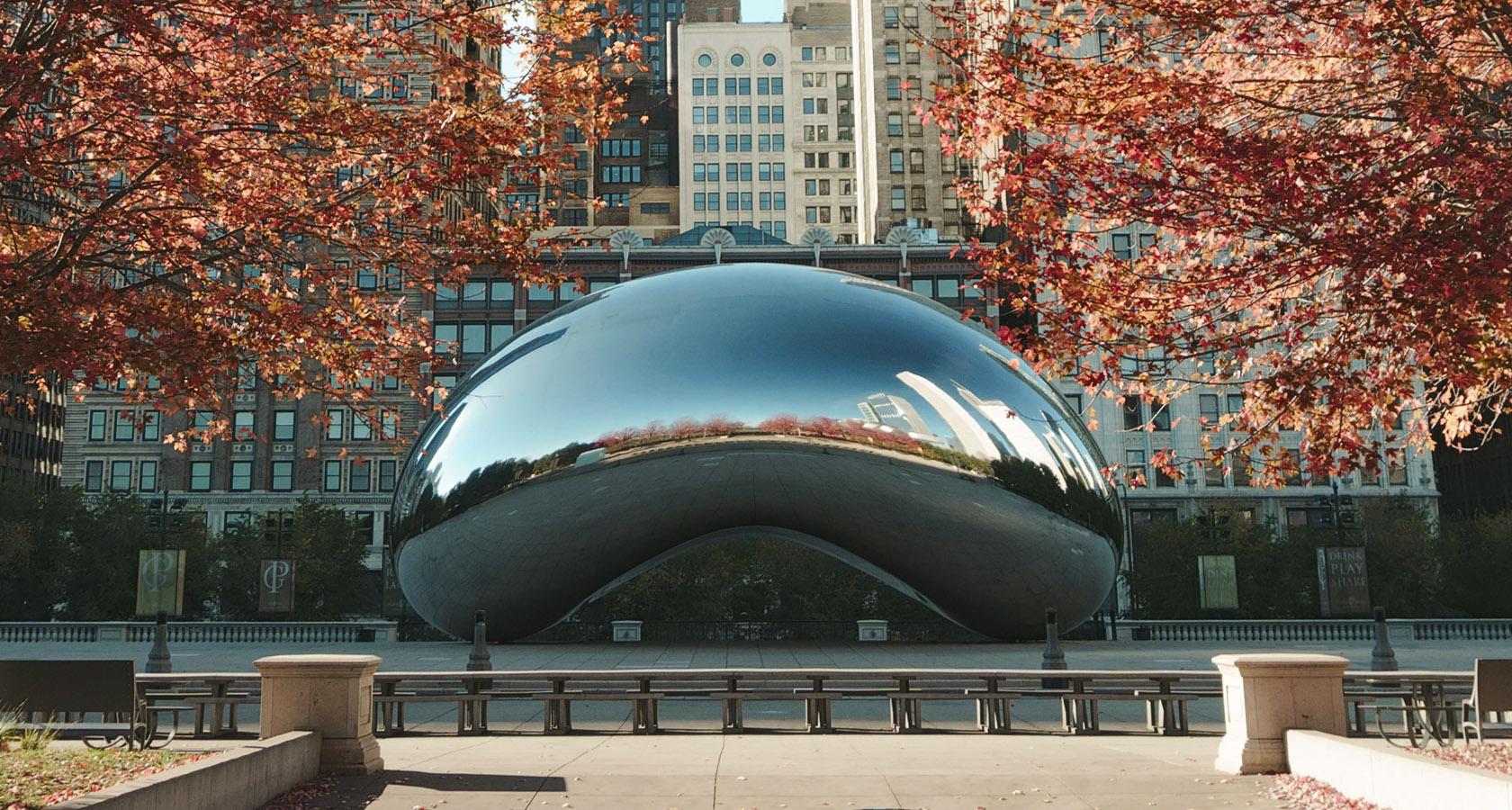
When the public art installation “Cloud Gate,” a.k.a. “The Bean,” was announced, critics said it was uninspiring, impractical, and way too expensive. Worse, it was unveiled two years before being finished. Today, however, it’s one of Chicago’s most prized possessions and a symbol of its standing as an international city of art and culture. (Antonio Gabola)

Kinda looks like they’re…

Chess is a game of purpose. It has a way of permeating one’s mind and becoming a lens through which to view life. Engrossing? Yes.

But is it…sensual? As we’ll see, that’s open to interpretation.

Every other year, the world’s two best players engage in a 12-game match, and the winner is crowned World Chess Champion. The event, run by FIDE and World Chess, is typically surrounded by some level of controversy, and for good reason.

Chess, while loved by many, doesn’t necessarily attract a massive viewership or high-level sponsors, so FIDE and World Chess have had to find ways to infuse the World Chess Championship with entertainment value.

In 2016, the identity for the championship mirrored its host city, New York, with visuals full of bustling bravado.

Worst logos

Branding for the 2016 World Chess Championship was exceptionally crafted but not necessarily newsworthy. (Shuka)

The bar for 2018’s branding was set high, and Shuka, the firm hired for the job, didn’t balk at boldness.

Primary visuals are comprised of complex arrangements of interwoven shapes and patterns. Typography is clean and sophisticated. The system is flexible and full of character. It’s everything one would expect from an Avante-Garde identity for an international event.

Except…

One element, an alternate logo, started feeling frisky and ended up adding a whole new layer of meaning to the phrase “opening moves.”

Bad logo design

Reactions to the 2018 World Chess logo were mixed. Some felt it was done in poor taste while others said it captured the passion and intensity of high-level chess.

The pretzeling pawn stars ignited a spark of rage within the chess community and fueled a firestorm of debate on social media and major news networks. The campaign certainly grabbed attention, but did it go too far?

What can we learn?

Designing a memorable logo requires a measure of fearlessness, a willingness to push boundaries, but there’s also a degree of conceptual balance needed or else the logo’s core audience may be alienated. These are the people that carry a brand through thick and thin. Beware of straining their loyalty, specifically when the goal of a redesign is little more than a ratings boost from a wider audience only interested in the sugar-rush of controversy.

FIDE’s 2018 championship logo was a brazen move, but more than a desperate grab for attention, it was a calculated play made in alignment with the organization’s overarching mission to increase the appeal of chess globally. The takeaway? Don’t be scared to prod customers in new stylistic directions, but do so with intentionality and strategic vision.

Good and bad logo

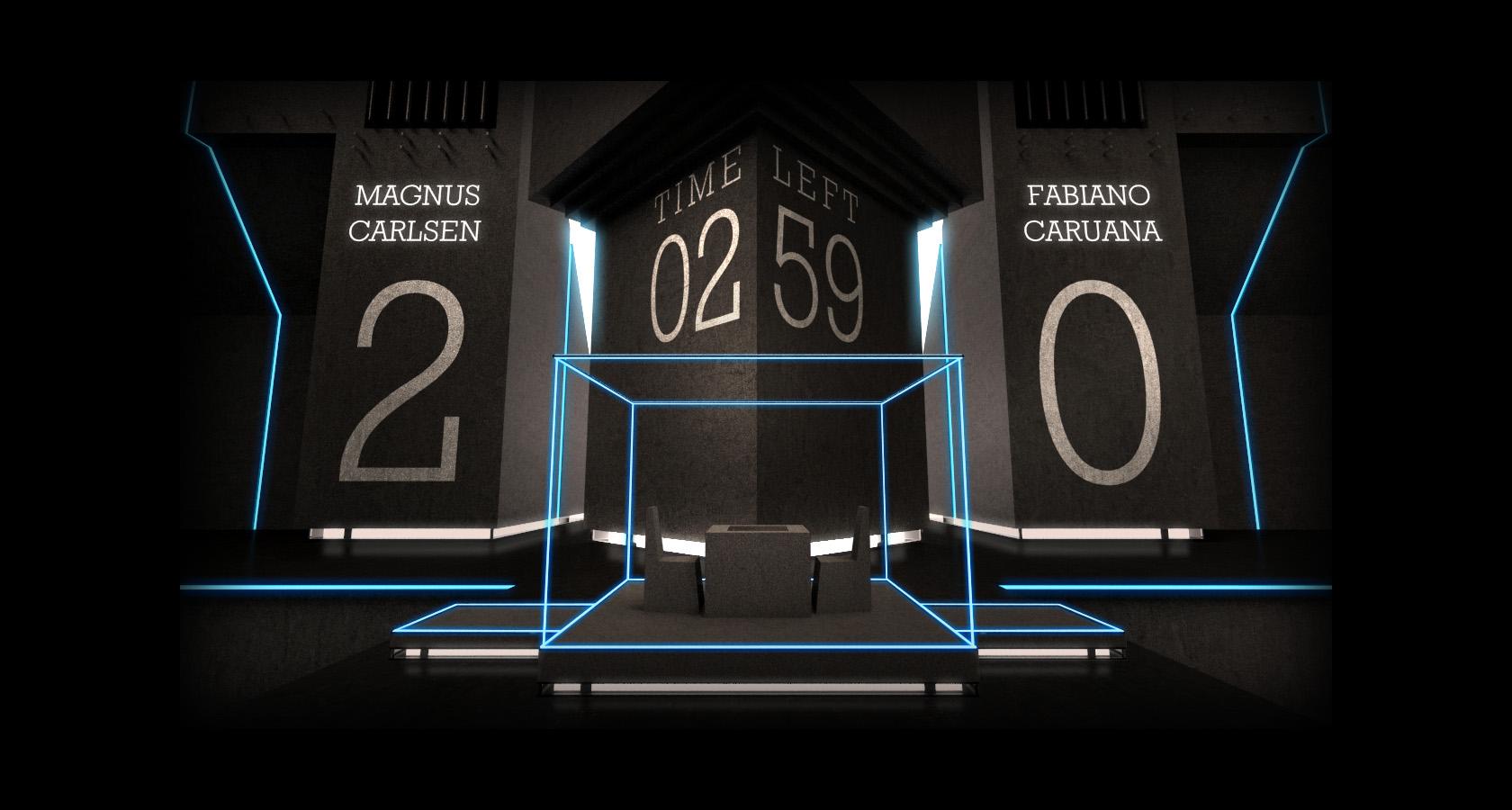
With its high-octane Armageddon format (three-minute games, biometric readings, mixed reality environments) FIDE aims to make chess a mass-media phenomenon. Viewed in that context, its decision to sign off on the 2018 World Chess logo makes perfect sense.

The medal for mediocrity

The Olympic Games are a shrine to human potential—unrivaled displays of pageantry, spectacle, and willpower—but there’s a long streak of Olympic futility that few people know about.

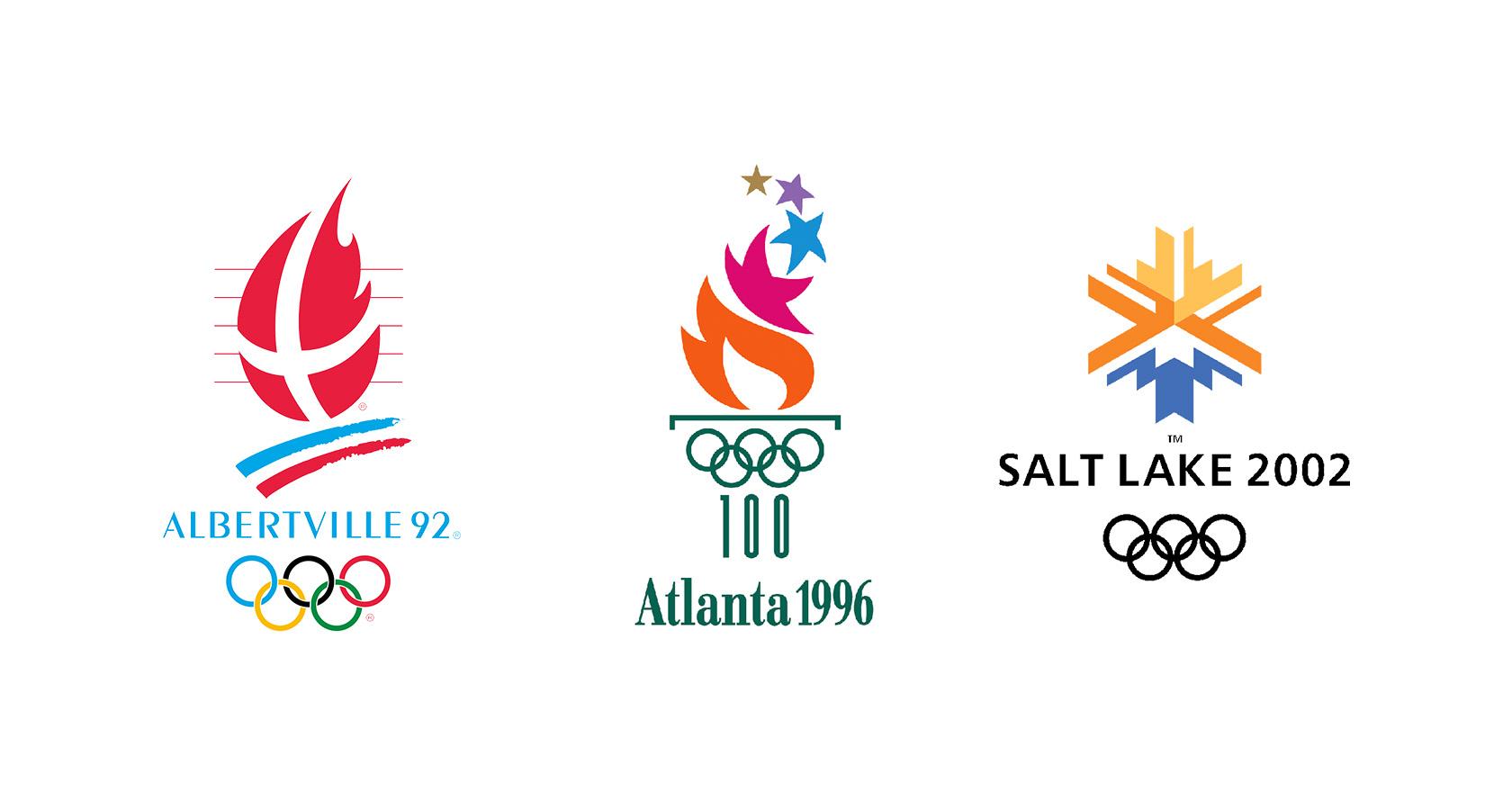
Barring one exception, the modern games have never seen a host-city logo make it to the medal stand of public approval. Not in summer, not in winter, and judging by the reactions to the logos revealed for the next four games (2020-2028), not any time soon.

How to create a logo

The eternal flame carried by torchbearers in the lead-up to the games is an oft-repeated Olympic logo element.

Designing an identity for the Olympics is an epic challenge. How does one visually capture the spirit of a global event and the uniqueness of a single city while acknowledging multiple cultures and ages of athletic tradition?

And how do we make that identity engaging, fresh, and flexible enough to flourish within an expansive list of use cases?

Most importantly, can that identity, which surely starts with the best intentions, withstand the onslaught of nitpicking by planning committees, city officials, and governing bodies and still manage to emerge in its final form with some degree of design integrity?

What can we learn?

Big, multinational events are a difficult design ask.

Err on the safe side? “Generic!”

Dare to go bold? “Rubbish!”

Ask the public for creative input? “Cop out!”

Logo case study

The 2012 logo for the London Olympics was launched with very little visual context, a tough challenge for any logo, but especially one of such experimental ambitions. (Wolff Olins)

Olympic identities are more than a logo. They’re visual systems built for numerous touchpoints. The system is the hero. The logo is a facet of its powers.

But when a logo is the first (and only) element that the public is introduced to, sitting there all awkward and isolated on a blank white background, it’s understandable if people aren’t receptive.

There’s no frame of reference to judge by, no story to latch onto, and no way to imagine a world where the logo struts its stuff.

Whenever possible, present logos within the context of a system. Show how the elements of the system play off one another—how colors enliven typography, how icons invigorate signage, and how the logo ties them all together.

Logo design best practices

Viewed retrospectively, the 2012 London Olympics logo, with all its unexpected angles and bright colors, turned out to be an indispensable source of visual inspiration for the larger identity system of the games.

AI ain’t all that

Neural networks. Generative design. Machines are learning!

With the unbridled upswing of artificial intelligence, the day is coming when a high-profile company will choose to entrust the entirety of its logo refresh project to a robot, and we don’t mean one of those freebie logo generators sitting unused on the interwebs.

Logo design elements

Today’s AI logo generators are fully capable of cranking out off-brand imagery, but they shouldn’t be entirely dismissed because their underlying tech continues to evolve.

No, we’re talking highly advanced tech developed by some of the world’s most intelligent people. All involved will be supremely confident, and they’ll unveil their AI-designed logo with much self-importance, and everyone who witnesses their creation will be…

Profoundly underwhelmed?

It’s inevitable. Really smart people with state-of-the-art equipment and lots of money love to hype the hell out of their achievements, but at the end of the day, we’re talking about a logo, not a Mona Lisa. There’s bound to be a disconnect when people see said logo and realize—it’s still a logo.

What can we learn?

Soon, AI will be a prominent part of the logo design process, but it will be most beneficial as a tool. Like all tools, those who spend the time to learn its capabilities and how to harness is peculiarities will create the most interesting work.

Two words sum up everything we need to know about the future of AI and design:

Curate and communicate.

Humans aren’t giving up image creation. It’s a highly complex, profitable, and fulfilling line of work, but we’ll be more than happy to invite AI to assist, even extend, our design efforts. When we do, we’ll need to learn how to intelligently define constraints and curate the output.

Then, we’ll need to communicate AI’s role. No matter how ubiquitous the tech becomes, people will want to know “Is it real? Or is it AI?” and we’d better have a more enlightening answer than “Uh, both.”

Logo design principles

Autodesk is making waves in the world of manufacturing with generative design software that can explore thousands of variations in the time it would normally take to create one original concept.

Learn from logo redesigns, even ‘bad’ ones

Maybe “bad” logo redesigns aren’t that bad after all. Maybe they’re simply “different” or “misunderstood,” but those descriptors require patience—a willingness to wait and watch as a new logo spreads roots and solidifies its place in the public’s mind.

We don’t like patience.

We like lighting up that little blue bird with sick burns and clever comments, but it doesn’t take an ounce of talent or taste to make a snap judgment, and inner-industry sniping on social doesn’t further design or designers.

It makes us cautious, risk-averse, and bland.

We design not to be criticized, nor to be different, and strive to meet a shifting standard of approval in hopes of hearing other designers say, “So inspired by your work!” Before long, we arrive at some goofy trend that everyone copies until it becomes absolutely unbearable.

Are we being shortsighted? How do we know that today’s ridiculed redesign won’t become the standard by which all of tomorrow’s logos are judged?

Logo design samples

When the Google logotype was refreshed in 2015 (right), hands were wrung, ears steamed, and eyes bulged as people wondered how such a “generic” concept was chosen. Four years in the future and all is well as Google has seamlessly rolled its simple (yet distinct) aesthetic into all of its products and marketing.

The next time a popular logo gets made over, resist the impulse to join the online judgment posse and ask, “Why?”

“Why did the designer choose those shapes?”

“Why did they use that typeface?”

“Why did the logo need to be redesigned in the first place?”

And perhaps, “Why do I dislike it so much?”

There’s more to learn than personal taste and public opinion can teach. Logo redesigns that stir controversy or inspire ridicule are treasure troves of professional wisdom. They can help us grow and become better designers—but only when we’re willing to swim against the frenzied currents of mock indignation and groupthink.

The Toptal Design Blog is a hub for advanced design studies by professional designers in the Toptal network on all facets of digital design, ranging from detailed design tutorials to in-depth coverage of new design trends, tools, and techniques. You can read the original piece written by Micah Bowers here. Follow the Toptal Design Blog on Twitter, Dribbble, Behance, LinkedIn, Facebook, and Instagram. 

Corona coverage

Read our daily coverage on how the tech industry is responding to the coronavirus and subscribe to our weekly newsletter Coronavirus in Context.

For tips and tricks on working remotely, check out our Growth Quarters articles here or follow us on Twitter.


Source link

Rani Mukerji raises her voice against child abuse

Image Source : INDIA TV

Rani Mukerji will feature in ‘I For India’ concert on Star Bharat on Sunday.

‘I for India’ concert will be screen on your television screens on Sunday. The artists in this concert range from Bollywood superstars to sportsperson and to musicians, who came together for a noble cause. Bollywood actor Rani Mukerji is set to grace the event. Rani’s stardom boomed again with her recent success Mardani, a film that highlighted heinous crimes. Being a proud mother of a daughter, Rani said she always wanted to create awareness about child abuse.

The talented actress commented on the child abuse, saying: “Instances of child abuse have increased during the lockdown. I urge you all to stay more vigilant. If you see or hear anything suspicious or odd please report it to the authorities immediately. My daughter Adira calls this coronavirus an invisible monster lurking in the streets, she tells me, mamma, this monster will surely go away one day.”

I for India concert is much more than entertainment. It has lessons and experiences shared from Bollywood’s greatest legends. The world’s biggest digital concert ‘I For India’ will be premiered on Star Bharat on Sunday at 9 pm.

Fight against Coronavirus: Full coverage


Source link

What is it like to be a Black journalist in the US right now?

On Monday, June 8 at 19:30 GMT

The video documenting the killing of George Floyd by police officers could not be more disturbing. He is handcuffed and pinned down by a Minneapolis police officer while three others look on. The officer’s knee digs deep into Floyd’s neck as he cries that he cannot breathe. He calls out for his mother, and then, he dies. 

The event may prove a watershed moment in US history.

But for Black journalists covering this story, it is nothing new. It is the latest in a long line of such videos that grab headlines for a time and are then largely forgotten as the news cycle moves on and nothing changes. 

Journalists are trained to shed light on stories and to report the experiences of people. But when Black journalists are watching videos of Black people being killed at the hands of white police officers, when they are telling stories of people being accosted for driving while Black, walking while Black and jogging while Black, they are telling their own stories.

Black journalists have said that doing their jobs at this time is “exhausting“, that they are “carrying a unique burden”, living in a “special kind of hell” and “covering a storm that never passes”. Ultimately, one said, what they are doing every day amounts to “screaming into the void”. 

In this episode of The Stream, we discuss the emotional toll of being a Black journalist in the US and the impact of covering viral videos of Black death.

On this episode of The Stream, we are joined by:

Patrice Peck, @SpeakPatrice – journalist

Soledad O’Brien, @soledadobrien – journalist

Quincy J Walters, @quincyjwalters – reporter, WBUR Boston

More:

WATCH: Why was Black CNN reporter detained while covering protests? - Al Jazeera

Black Journalists Are Exhausted – New York Times

Source: Al Jazeera


Source link

Russian Diesel Spill That Stained Rivers Red May Have Been Due To Melting Permafrost

0

Melting permafrost may have caused the spill of about 20,000 tons of diesel in northern Siberia that turned rivers deep red last week, an ominous sign as the Earth warms.

The disaster happened on May 29 at a power plant in the remote Russian industrial city of Norilsk, about 200 miles north of the Arctic Circle. A collapsed fuel tank began spilling diesel into nearby rivers and a reservoir, ABC News reported. Two rivers, the Ambarnaya and Daldykan, turned shades of red.

Norilsk Nickel, the mining conglomerate that owns the plant, said melting permafrost ― in the wake of Russia’s warmest winter since temperatures have been recorded ― may have been to blame: The thaw made the ground unstable beneath the diesel storage tank.

“What we can suggest is that as a result of the abnormally mild temperatures, a melting of the permafrost could have happened that led to the partial subsiding of the support on which the tank sits,” according to a company statement reported by ABC.


A European Space Agency photo taken on Sunday shows the extent of the diesel spill, in red.

Permafrost is ground that has been continuously frozen for at least two years, and much permafrost has been frozen for tens or hundreds of thousands of years.

“Entire cities and roads were built on permafrost,” Guido Grosse, a permafrost expert at Germany’s Alfred Wegener Institute, told Bloomberg Green. “When permafrost thaws, the ice deep in the ground that has been there for thousands of years melts, and you lose stability. That has an impact on infrastructure.”

Arctic permafrost has been melting at an alarming rate in recent years, threatening human communities, wildlife and potentially releasing millions of tons of additional carbon into the air as it thaws.

Russian President Vladimir Putin ordered a state of emergency to clean up the spill this week and criticized Norilsk Nickel, saying it did not alert government officials about what happened soon enough.

“Why did government agencies only find out about this two days after the fact?” Putin said in a video conference, as widely translated. “Are we going to learn about emergency situations from social media?”

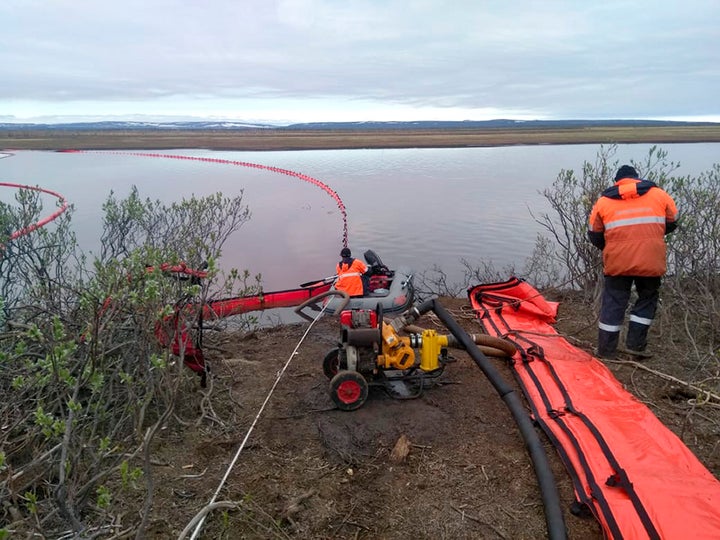
Workers attempt to prevent the spread of the spill.


Workers attempt to prevent the spread of the spill.

Vyacheslav Starostin, the power plant’s manager, has been detained in a criminal investigation.

The region “will be seeing the repercussions for years to come,” Sergey Verkhovets of WWF Russia said in a statement translated by The New York Times. “We are talking about dead fish, polluted plumage of birds and poisoned animals.”

A full cleanup could take five to 10 years. 

Norilsk Nickel was also responsible for turning the Daldykan blood red, apparently from pollution, in 2016, and the sulfur dioxide the plant emits has resulted in a “dead zone” around it that’s twice the size of Rhode Island.


Source link