Tuesday, May 19, 2026

Millions Of Taxpayer Dollars Are Going To Schools That Push Conversion Therapy

0

NEW YORK ― Megan Mishkin was drawing a still-life in art class when she heard her name called over the loudspeaker. She packed up her belongings and headed to the main office, where the school secretary was waiting for her. “Everything is going to be OK, sweetie,” the secretary told the 16-year-old high school sophomore when she walked in.

Mishkin, a student at Calvary Christian Academy in Fort Lauderdale, Florida, at the time, tried to remain calm and brace for bad news. The secretary directed her to a room where school leaders waited. The group made about five excruciating minutes of small talk before staff members got down to business. 

They suggested Mishkin was broken and in need of fixing. They hoped anti-gay counseling could be the solution.  

Calvary Christian Academy is one of at least nine private schools that participate in voucher or tax credit programs and appear to push LGBTQ students to attend a form of conversion therapy, HuffPost has discovered. A 2017 HuffPost investigation found that at least 14% of religious schools in voucher programs advertised anti-gay policies or barred LGBTQ students and staff from admission and employment. Now HuffPost has found that some of these schools go so far as to push a medically discredited and often harmful treatment on their students in an attempt to change their sexual orientation. 

Mishkin looked around the room and knew she was outmatched. Only a few days earlier, she had been told she was banned from attending an overnight school trip to a statewide theater competition. Stories of Mishkin’s sexuality had spread ― she had a girlfriend from another school ― and administrators said her classmates’ mothers had complained about their daughters having to share a room with her. It was a crushing, humiliating blow. She had spent months preparing for the competition only to be told that her peers and their families were afraid of her. She cried and tried to explain that she would never have done anything inappropriate with another student. 

This time, as school administrators laid out her options, Mishkin tried not to react. The group reminded her they believe the Bible says homosexuality is wrong. Then they told her she would have to attend counseling to discuss her sexuality if she wanted to remain enrolled at Calvary Christian Academy.  

“I’m 16. I had just moved and had nobody,” Mishkin, who is now 21 and just finished her junior year at New York University, recalled over coffee in February. “I felt defeated.” 

Jason Rachels, the head of school at Calvary Christian Academy, told HuffPost that “‘anti-gay therapy’ is not a process we use or a part of a policy at our school.” However, he did not dispute any specific part of Mishkin’s account.

“We exist to serve families with similar values that align with our school’s statement of faith. We don’t hide our beliefs or encourage anyone to enroll who does not desire the same for their family,” wrote Rachels, who was a Calvary administrator but not head of school when Mishkin was a student there.

Calvary Christian Academy, though private and religious, received just over $3 million in public funding last year through a variety of state voucher and tax credit programs that help funnel taxpayer dollars to scholarships for private schools. The school has participated in such state programs since at least 2012, according to archived versions of the school’s website. Voucher programs use taxpayer money to fund scholarships for lower- or middle-income students, while tax credit programs give individuals and corporations incentives for donating to organizations that distribute private school scholarships. 

Advocates of these programs, which exist in 29 states and the District of Columbia, say they help level the playing field by giving poorer students the ability to choose the school that works best for them, an option more affluent students have always had. 

But HuffPost’s findings raise questions about what it means to have taxpayer dollars supporting institutions that not only openly discriminate against LGBTQ children but also push them toward programs that have long been debunked by mainstream medical and mental health institutions, and often cause severe harm. One study from 2018 found that LGBTQ people who had received interventions from religious leaders, therapists and parents trying to change their sexual orientation were three times more likely to attempt suicide than other LGBTQ people. Twenty states and the District of Columbia ban licensed health professionals from practicing conversion therapy on minors; Florida is not among those states.

“Schools are places where youth should feel safe and have the opportunity to grow and mature into their best selves. Instead, they find themselves under threat from a practice that has no basis in science and is tied to potentially significant harms,” said Casey Pick, senior fellow for advocacy and government affairs at the Trevor Project, a nonprofit focused on suicide prevention for LGBTQ youth.  

Indeed, the number of public dollars going to private schools ― even potentially ones with discriminatory anti-LGBTQ policies ― may increase in the near future. Education Secretary Betsy DeVos has always used her position to try to increase private school choice, but she’s had more success during the COVID-19 pandemic: A new program allows states to apply for federal coronavirus relief dollars to help families cover school expenses ranging from technology services to private school tuition. Public school advocates say it’s part of DeVos’s larger agenda to shift funding away from the public school system ― which serves 90% of kids in the country ― to private, often religious, institutions.

Mishkin had only just started attending Calvary earlier that school year, in 2014, after moving from Venezuela. She knew she was gay and that she wouldn’t change. But she was also depressed, tired and afraid of what getting kicked out of school midyear would mean for her college applications and her future. She had endured months of homophobic bullying. She could barely stay awake in class. When she ate, she had trouble keeping food down.  

Mishkin’s family ― with whom she says she has a rocky relationship ― thought she should remain enrolled in the school. At this point, her only goal was survival. She agreed to the counseling. 


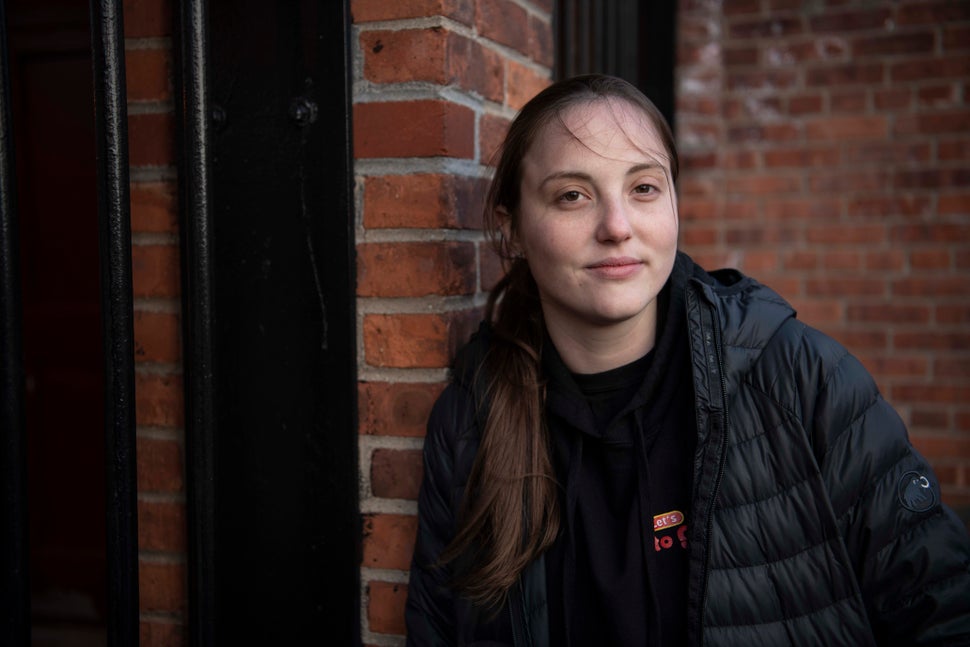
Megan Mishkin agreed to school-mandated counseling when she was 16.

The Human Rights Campaign, a leading LGBTQ civil rights group, defines conversion therapy, also sometimes known as reparative therapy, as “a range of dangerous and discredited practices that falsely claim to change a person’s sexual orientation or gender identity or expression.” It comes in many forms, including aversion therapy, in which a patient is taught to associate a thought or behavior with an unpleasant physical stimulus (like an electrical shock or chemically induced nausea) to talk therapy, which resembles typical mainstream therapy but in service of changing one’s sexual identity. There is no evidence ― per consensus in the medical community ― that conversion therapy of any form can change a person’s sexual orientation or gender identity. 

For this investigation, HuffPost combed through the handbooks, statements of faith and prospective student application forms of more than 500 schools we had previously identified as having anti-gay policies. (More than 7,500 private schools around the country received public funding through voucher or tax credit programs in 2017, and HuffPost examined their websites, handbooks, statements of faith and applications that year to identify which of those schools were religiously affiliated, as well as which had advertised anti-LGBTQ views.) 

We found at least eight schools with handbooks that seemed to openly require or encourage some form of counseling for kids experiencing same-sex attraction, which experts say often acts as a euphemistic term for conversion therapy. HuffPost reached out to each of these schools with questions about what this counseling looks like. Only one responded, noting the pastor or trained professional providing the counseling decides what type of “help” to provide to students. 

We also found four additional schools whose handbooks had vaguer policies, indicating but not explicitly stating that anti-LGBTQ counseling could be a consequence for same-sex attraction or gender nonconformity. 

These policies are typically intentionally vague, according to Pick. That way, schools have a great amount of discretion and can also avoid scrutiny from the outside world.

“Conversion therapists, as a whole, are being very proactive about rebranding. They recognize that public opinion is turning against sexual reorientation or gender identity change efforts,” Pick said. “Many will try to say we’re not engaging in conversion therapy ― we’re just trying to get people to live consistent with their religious values. Some of these school policies that adopt this same framework of requiring students to live consistent with religious values may well be concealing what is in practical effect conversion therapy.”

Our numbers likely represent a bare minimum. Calvary Christian Academy’s website, for example, says the school believes “acceptable sexual behavior is exclusively reserved to occur within the confines of a monogamous marriage union of a consenting man and woman,” but it doesn’t publicly promote support for conversion therapy. It’s likely that many other schools quietly promote conversion therapy without stating so in public materials. Additionally, more states have adopted or expanded their school voucher or tax credit program since HuffPost created its database in 2017, and any schools that have benefited from these programs for the first time over the last three years are not reflected in our count. 

But some schools make their policies clear. For example, Westwood Christian School in Miami, which received nearly $1.3 million this year via voucher and tax credit programs, outlines its policy in its handbook. It makes parents promise that if their child “believes that he/she is gay, homosexual, lesbian, or bisexual, I/we will encourage such child to disclose the situation to the Senior Pastor or Administrator and seek guidance and counseling through the Church.” It says a child will be asked to withdraw if administrators learn a child has not sought counseling, has refused counseling, or has participated in homosexual activity after church counseling. The school did not respond to multiple requests for comment. 

The schools that maintain these policies are all across the country, including in Wisconsin, Arizona and Virginia. Collectively, all of the schools HuffPost found to push conversion therapy received over $8 million in public funding during the last school year for which public information was available. 

Another Student Speaks Out

Andrew LaFontaine, who attended Calvary Christian Academy at the same time as Mishkin, said school administrators also pressured him to attend conversion therapy after he reported to them that he had been sexually harassed by another male student. Instead of focusing on the trauma of the alleged harassment, they pushed him to attend counseling to talk about his sexual orientation, which they perceived to be a problem. LaFontaine ― who was mostly closeted at the time but is now an out gay man ― vehemently denied that he was gay until the school backed off. Still, school leaders then made him meet with a teacher to go over Scripture and talk about his life.

“I honestly think that was the beginning of me spiraling into depression,” said LaFontaine, 20, who is now a veterinarian’s assistant and student in New York City. “It was an easy decision to decide to deny [my sexuality] because I knew the implications.”

Rachels, the head of school, told HuffPost that “we care for [LaFontaine and Mishkin] deeply and pray that they are doing well.”

“Bullying is something we take seriously at CCA. Regardless of where a student is in their personal journey, we do not tolerate bullying, and have strong policies around that,” he wrote in an email. 

After the administrators’ meeting with Mishkin, the man who was Calvary’s assistant principal at the time sent an email to one of her family members outlining her options. The email confirms the account Mishkin provided to HuffPost. Calvary did not respond to a question about whether that assistant principal is still employed by the school.  

“When we met, Megan was very upset and defensive about her sexual preferences,” read the email, which HuffPost has reviewed. “We decided that [Megan and her mom] could take until Monday to decide if CCA is the best place for her to be. They would decide either to pull her out of CCA because Megan didn’t want to be responsible for her sexual preferences and influencing others, or repent and ask to continue at CCA thus allowing us to set her up with a counselor/mentor and begin discussing these issues of sexuality that she is wrestling with.” 

The whole meeting lasted about 30 minutes, Mishkin said. Afterward, she got to work finding a counselor who she hoped would understand her dilemma. She texted a former student, whom the school had also pushed to go to counseling but for reasons unrelated to sexuality.

The student told Mishkin about a sympathetic therapist who was part of a Christian counseling service and approved by the school. Rachels told HuffPost that Calvary does “not have therapists on staff or a relationship with an organization that offers those services,” referring to “anti-gay therapy,” but he did not refute the specifics of Mishkin’s account. Indeed, Mishkin did not use a therapist employed by the school and found her counselor independently.

A few weeks later, she had her first session. 

Megan Mishkin, now 21, is a student at New York University.


Megan Mishkin, now 21, is a student at New York University.

An estimated 16,000 youth will receive conversion therapy from a mental health professional before they turn 18, according to a 2019 study from the Williams Institute at UCLA. An estimated 57,000 more will receive it from a religious der. 

“It is not therapy. It is not helpful. It is harmful, and it needs to be stopped,” Pick said. 

But administrators at evangelical schools with anti-LGBTQ policies maintain they have a right to educate children however they see fit.

“Parents who choose to enroll their children in a private, Christian school using voucher funds have chosen to do so with full knowledge of the school’s positions regarding philosophy of education, admissions, biblical worldview integration into academics, morality, and positions on a variety of cultural topics including marriage and sexuality as defined in Scripture,” Wesley Scott, executive director of the National Alliance of Christian Schools, wrote in an email to HuffPost.

“Private, Christian schools are autonomous [and] have the right to apply these positions within their admissions process, faculty and student handbooks, disciplinary and biblical counseling procedures,” he said. 

Mishkin sees it differently. Her school may have thought it was putting her on a path to salvation, but she felt abandoned when she was screaming out for help. 

She was depressed and self-harming. She wished school leaders could see the sadness that was eating her alive. Instead, she says she only heard from them when other students brought up her sexuality or called her an atheist.  

“No one was standing up for me. There were no teachers showing interest in me,” she says. 

But in some ways, Mishkin got incredibly lucky with her therapist, a selection that made all the difference.

Secretly Getting ‘Normal’ Therapy  

Mishkin’s counseling sessions took place in a nearby church’s office. The counselor was a woman in her early 30s with a kind demeanor. 

She asked Mishkin about her faith. She asked her about her sexuality. When she realized Mishkin was at peace with it, Mishkin says she backed off. 

“She was like, ‘You’re not here to stop being gay, are you?’ And I was like, ‘No, not at all,’” Mishkin recalled. “She really saved my life back then.”

Mishkin was relieved. The counselor asked her if she had other issues she wanted to unpack, so the teen started attending regular therapy while her school thought she was trying to become straight. 

At the end of the school year, Mishkin applied for a spot at a secular private school. The admissions process took months, so she asked Calvary if she would be allowed to return for her junior year, just in case. They asked her if she still had a girlfriend. She told them she had found the way of the Lord and was no longer gay ― a “ridiculous lie,” she says now. Over the summer, she found out she had gotten into the other school. 

Mishkin looks back on that year as if she was in a dissociative state, going through the motions without much thought or agency. To survive, she muted her personality until she would fit into the mold her school had created for her. 

“I think back on Calvary, and I just remember various offices, and crying, and various doctors, and throwing up,” she says matter-of-factly, sadness in her eyes. “[Calvary] just really made me not take care of myself. I was so hated. So oppressed. … Even when it was like in third person, it’s not fun to hear people use the Bible to talk about hating you.”

Mishkin is now studying sound production and living in the East Village of New York with a roommate. She likes NYU and the friends she has made there. After muting herself for so long, she’s trying to figure out her actual interests, who she wants to spend her time with, what she truly thinks. She tries to imagine her life is just starting. 

“Since I was born, I always felt uncomfortable, out of place,” Mishkin says. “When I got here, it was like I could breathe.” 


Source link

Why has my Sonos app changed? ‘S2’ controller app launches

0

The new Sonos S2 app (L) and the older Sonos S1 app (R) (Sonos)

Sonos users will have noticed a change on their smartphone screens recently as the company has made some big changes to its software platform.

In line with the new Arc soundbar and updated speakers, Sonos has launched a new controller app called the S2 Controller app. It’s designed for the newer equipment and will be required for feature updates or to work with upcoming products.

However, the company hasn’t abandoned older devices – which is why some user may see the original black Sonos app tile replaced with a new, grey ‘Sonos S1 Controller App’ tile.

At the moment, you’ll only need the S2 app if you own the new Arc soundbar, any Sonos Five speakers or a third-generation Sonos Sub.

However, the S2 app also works with most of Sonos existing product line-up so it’s probably worth upgrading to the new app unless you have several of the older products.

Sonos breaks down which app is compatible with which product (Sonos)

You can use both the S1 and S2 app on the same phone, network and in the same house – but you can’t pair them together.

‘For music services with single stream limitations, like Spotify, playback can only be initiated on one system at a time using the same music service. For example, if you begin playing Spotify on your S2 system, playing from the same Spotify account on your S1 system will stop playback on your S2 system,’ explains Sonos on its help page.

The new Sonos app is designed to support new and future speakers from the company (Sonos)

‘Music from the same service can be played to both Sonos systems if you add separate accounts to each one. For some services, this includes different users under one account, like a family plan,’

Sonos does have a trade-in program (that hasn’t been without criticism) so you could offset some of the cost of replacing the older gear with new models. The reason you may consider doing so is because after May 2020 all new Sonos products will require the S2 app to function.

The S1 app will continue to be supported for security patches and fixes, but Sonos won’t be bringing any new features to the older products.


Source link

Global economy to suffer worst peacetime slump in 100 years, OECD says – business live

China was ground-zero for the outbreak of the coronavirus crisis, but it also appears to be leading the global recovery. Auto sales data looks to be strengthening, and with some factory levels almost back to pre-pandemic levels there is a real hope that the worst is in the rear-view mirror.

Its role at the heart of the global economy has meant that Chinese inflation has historically acted as an indicator for other countries. It remains to be seen whether that’s still the case in this new environment, where local effects will play a more prominent role in the basket of goods.

Hurdles remain for the global recovery, with recent reports that logjams could be on the horizon for the shipping industry and emerging economies projected to shrink for the first time in sixty years. But as the US shows signs of greater bouncebackability, governments and central banks around the world will have their fingers crossed that a v-shaped recovery could be on the cards.”

Source link

Stock Markets Brace for a Forecast From the Fed

0

The global economy faces a severe downturn, O.E.C.D. says.

The world economy is facing the most severe recession in a century and could experience a halting recovery as policymakers brace for a potential second wave of the coronavirus and as countries embrace protectionist policies, the Organization for Economic Cooperation and Development warned in a new report.

A grim economic outlook released by the O.E.C.D. on Wednesday depicted a world economy that is walking on a “tightrope” as countries seek to reopen after three months of lockdowns. Considerable uncertainty remains, however, as the prospects and timing of a vaccine remain unknown. Health experts fear that the spread of the virus could accelerate again later this year.

“Extraordinary policies will be needed to walk the tightrope towards recovery,” said Laurence Boone, the O.E.C.D.’s chief economist.

The O.E.C.D., which comprises 37 of the world’s leading economies, predicts that the global economy will contract by 6 percent this year if a second wave of the virus is avoided. If a second wave does occur, world economic output would fall 7.6 percent, before rebounding by 2.8 percent in 2021. The two scenarios are viewed as equally plausible.

Barring a second wave, the O.E.C.D. expects the United States economy to shrink by 7.3 percent and the Euro Area to shrink by 9 percent. Emerging economies, such as Brazil, Russia and South Africa, will be hit harder given the strain on their already fragile health systems.

The report is slightly more ominous than other recent forecasts from the World Bank and the International Monetary Fund.

The O.E.C.D. said that after initial rebounds in economic activity, long-lasting scars will be evident as high rates of unemployment persist and income inequality is exacerbated. The virus is already showing signs of a “great fragmentation” in global trade that could blunt growth.

European markets are flat as investors await a signal from the Fed.

European markets were flat in early Wednesday trading as investors awaited a forecast from the U.S. Federal Reserve.

Markets in Britain, Germany and France were up about one half of 1 percent in morning trading before giving up their gains. Futures markets were predicting a modest fall on Wall Street later in the day. Asian markets ended mixed.

Prices for U.S. Treasury bonds rose, though also by a modest amount, signaling some investor wariness.

Investors in Europe and the United States alike were awaiting word on the thinking of their respective central bankers. Conflicting comments from officials at the European Central Bank left investors with little guidance, according to FactSet, a data provider. In the United States, the Federal Reserve was widely expected to keep rates extremely low, but investors will be keenly interested in its economic forecast for the coming years.

Investors offered a muted reaction to a pessimistic forecast from the Organization for Economic Cooperation and Development that warned governments to prepare for a second coronavirus wave.

Federal Reserve is set to release the first economic projections of 2020.

The Federal Reserve is widely expected to leave interest rates near zero on Wednesday while pledging to continue buying bonds, but economists are watching for any hint about how the central bank might adjust policy in the longer run.

Officials are set to release their first set of economic projections of 2020, having skipped the quarterly summary in March as the pandemic gripped the United States, sowing uncertainty. The forecasts will show how they expect unemployment, inflation and growth to shape up in the years ahead.

The economic forecasts will be a major focus given that the last time they were released — December 2019 — Fed officials were projecting 2020 unemployment to close out at 3.5 percent with 1.9 percent inflation and 2 percent growth.

The coronavirus most likely upended those expectations. Now the major question is how quickly the country can recover — and Wednesday’s release will offer a sense of how the Fed is thinking about that.

Many Fed watchers expect officials to use the interest rate projections and their post-meeting statement, released at 2 p.m., to clearly signal that borrowing costs will remain at rock-bottom for some time. Policymakers could also use the statement to make clear they will try to goose the economy through their bond-buying program. The Fed has been snapping up government-backed bonds to keep markets functioning normally, but conditions have calmed, so they could make that program explicitly focused on stimulating the economy.

But the more significant moment may come when Fed Chair Jerome H. Powell holds a web-based news conference at 2:30 p.m. While he has sounded wary about the path ahead, analysts are curious to hear his take on the economy as states gradually open and the job market stages an early rebound.

Wall Street retreats a day after S&P 500 returned to break-even for the year.

Stocks fell on Tuesday, pulling back after a string of gains that had lifted Wall Street by 6 percent this month.

The S&P 500 closed down less than 1 percent. Stocks in Britain, Germany and France were nearly 2 percent lower after a mostly positive day in Asia.

The S&P 500 erased its losses for this year on Monday. Investors have taken heart in signs that the global economy is on the mend, particularly in China, Europe and the United States. They have also been cheered by government and central bank efforts to use money to fight the global freeze.

Stocks that had fared the best in the rally, like those of airlines and cruise companies, pulled back on Tuesday. Shares of Delta Air Lines fell about 8 percent, and American Airlines was down about 9 percent, while the cruise line operator Carnival Corporation was down more than 7 percent.

Tuesday brought reminders that the global situation remained tenuous. Tensions on the Korean Peninsula rose, while prospects for a quick batch of new stimulus spending in the United States looked uncertain.

In Germany, new data showed exports had plunged in April by 24 percent, much more than expected, which cast doubt over how quickly Europe’s largest economy could bounce back.

And investors are wary of a second wave of the coronavirus outbreak that could force economic activity to halt once more. Infections are still rising in many U.S. states and public health officials are concerned that the nationwide protests over police brutality may lead to new cases of the virus.

AMC Theaters, the world’s largest cineplex operator, announced on Tuesday that “almost all” of its locations in the United States and Britain would reopen next month. Over all, theaters in 90 percent of overseas markets will be running again by mid-July, according to the National Association of Theater Owners, a trade organization for movie exhibitors in 98 countries.

In just three weeks, Hollywood is scheduled to restart its supply pipeline of new films. “Unhinged,” a $33 million Russell Crowe thriller, will arrive in theaters on July 1, followed in mid-July by Christopher Nolan’s “Tenet,” a $200 million-plus mind bender.

Theater owners are desperate to start selling tickets again. AMC, based in Leawood, Kan., lost $2.18 billion in the first quarter, compared with a loss of $130 million a year earlier. Revenue totaled $942 million, a 22 percent decline. As of April 30, AMC had $718 million in cash, enough to stave off bankruptcy through the end of the year, even if theaters remain closed.

What an Amazon warehouse looks like now.

The question, however, is whether moviegoers — even while watching movies in well-sanitized theaters with limited capacity — will feel safe from the coronavirus, the spread of which rose to a record high worldwide on Sunday, as measured by new cases.

After months of being embattled over its response to the coronavirus, Amazon is working to convince the public that its workplaces — specifically, the warehouses where it stores everything from toys to hand sanitizer — are safe during the pandemic.

The giant internet retailer has started running television ads that show that its warehouse and delivery employees have masks and other protective gear. It has pushed out segments to local news stations touting its safety improvements. It has asked journalists to visit its warehouses to see for themselves.

Amazon is spreading its safety message after a period that Jeff Bezos, the company’s chief executive, has called “the hardest time we’ve ever faced.” As the coronavirus swept through the United States, Amazon struggled to balance a surge of orders with the health concerns of the one million workers and contractors at its warehouses and delivery operations.

Catch up: Here’s what else is happening.

  • Shares of Chesapeake Energy, a pioneer in extracting natural gas from shale rock, went on a wild ride on Tuesday amid reports that it was preparing a bankruptcy filing. Trading was halted for more than three hours in the morning. When buying and selling resumed, the trading was quickly interrupted again by circuit breakers. The company’s shares closed just below $24 for a loss of about 66 percent for the day.

Reporting was contributed by Mohammed Hadi, Brooks Barnes, Karen Weise and Clifford Krauss.

Source link

West Virginia Elects Its First Out Transgender Official

0

West Virginia elected its first out transgender official on Tuesday, a victory civil rights groups said would help bolster representation and political power for LGBTQ Americans.

Rosemary Ketchum won her bid for the Wheeling City Council on Tuesday and will represent the city’s Ward 3. When she assumes her role on July 1, Ketchum will be one of just four out LGBTQ officials in the state to hold public office. 

“I’m incredibly excited and grateful. I know this was a close race,” Ketchum told The Wheeling News-Register on Tuesday, noting that while she didn’t campaign on her identity, the win “matters a lot.”

Ketchum works at the National Alliance for Mental Illness and is an active community organizer.

“I believe that we must work WITH our community members to solve problems rather than without them or worse – against them,” she wrote on her campaign site. “But all too often, what we have seen is a lack of focus, a lack of drive, and most notably, a lack of presence regarding our elected community leaders.”

The LGBTQ Victory Fund, which backed Ketchum’s bid, noted her win is a landmark moment in the fight for representation. There are just 26 out transgender officials in the United States, and the group said Ketchum’s victory “will resonate well beyond her state.”

“Rosemary has shattered a lavender ceiling in West Virginia and will join the growing number of out trans elected officials serving nationwide,” the group’s president, Annise Parker, said in a statement. “We know Rosemary’s race will inspire other trans people from conservative states to consider a run for office in their communities – and then those candidates will inspire others as well. That virtuous cycle is the key to building trans acceptance and political power long-term.”


Source link

#Kazakhstan President Tokayev’s first year in office a success says EU

0

What happens in Kazakhstan also matters for the EU because the 27-member bloc is the number one investor in Kazakhstan.

Kazakhstan’s new president, Kassym-Jomart Tokayev (pictured), has marked his first year in office, with a pledge to forge ahead with more reforms. Tokayev won the presidential election on 9 June 2019 with 70% of the votes, running against six other candidate.  He is widely praised for introducing far-reaching reforms in the country, the ninth largest in the world though with a population of just 19 million.

In his first major speech, the president defined his policies in all fields of the economy and society.

In the state-of-the-nation address he promised to oppose ‘unsystematic political liberalisation’ and instead carry reforms ‘without running ahead’. Crucially, a large part of his one-hour speech was devoted to improving living standards for the Kazakh people.

He also emphasised his goal of having a strong president, an influential parliament, and an accountable government. This reflects the government’s continued focus on reducing inequality in Kazakhstan and improving Kazakh citizens’ quality of life.

At the same time, the president also focused on political and economic development, including supporting micro, small and medium-sized businesses.

While much of President Tokayev’s first year in office has focused on – successfully – delivering on these promises  prioritised domestic reforms, he has also paid heed to several foreign policy priorities for Kazakhstan.

Most recently, of course, the focus has been very much on combating the ongoing health pandemic.

Last month, he admitted that this “has not been easy for our country.”  He also warned, “the crisis has not yet been completely overcome. The epidemic has not completely disappeared. A pandemic is still dangerous to public health.”

Several key issues, he believes, still need to be resolved in the near future.

First. Improving the self-sufficiency of the Kazakh economy.

Second. Kazakhstan has allocated around 1 trillion tenge for the implementation of the president’s Employment Roadmap and, following the implementation of the projects, an analysis of their socio-economic efficiency will be carried out.

Third. the construction of affordable housing will give a powerful incentive for economic development, employment growth and social support.

Fourth. the time has come, he insists, to work out the issue of introducing a progressive scale of individual income tax in respect of wages and other types of income.

Fifth. Support for national business.

Sixth. The country should switch to working directly with each capital holder to boost increased competition for foreign capital.

So, what is the verdict on his first year?

Mukhtar Tileuberdi, the minister of foreign affairs of Kazakhstan, says, “The President has been quick to implement his ideas. In his first few months in office, he has shown his commitment to promoting the development of a multi-party system, increased political competition, and pluralism of opinions in the country”.

High Representative of the European Union for Foreign Affairs and Security Policy/Vice-President of the European Commission, Josep Borrell, said that in recent months “the breadth and depth of our relationship has progressed immeasurably.”

This is partly due to the fact that in 2015 Kazakhstan signed an Enhanced Partnership and Cooperation Agreement with the European Union which came into force  in March 2020, he said.  In doing so, Borrell notes it became the first country in Central Asia.

The Spanish official, a former president of the European parliament, adds “The European Union is the country’s biggest trade and investment partner, while Kazakhstan is by far the EU’s largest trade partner in Central Asia. What is more, we have invested heavily in strengthening governance, supporting its justice, social and economic reforms.”

Borrell says that, under the president’s tutelage, “We are turning the page and beginning an exciting new chapter.”

Polish MEP Ryszard Czarnecki, the Chair of the EU-Kazakhstan Friendship group in the European parliament, is equally enthusiastic, saying “In Europe, the prevailing opinion is that Kassym-Jomart Tokayev, in fact, is building a social welfare state, where special attention is paid to reducing inequality, improving the quality of life of every Kazakh, and where priority is given to solving the day-to-day problems of the people.”

The ECR deputy adds, “In the field of foreign policy, Kazakhstan, as has been the case before, pays special attention to its partnership with the European Union. On 1 March 2020, the European Union-Kazakhstan Enhanced Partnership and Cooperation Agreement came into force. On the basis of this document, we expect that the parties will be able to fully reap the benefits of their partnership. As EU-Kazakhstan Friendship group chair I will do my utmost to further our relations to our mutual benefit.”

But the president has also overseen a whole raft of other changes, including abolishing the death penalty and reaffirming the need to strengthen the role of the Kazakh language as a state language.

He is spearheading a rapprochement between the EU and the Eurasian Economic Union and also promoted freedom of expression for his country’s 20m citizens.

The president is also intensifying efforts to attract foreign direct investment, support farmers to market their products to foreign markets and support the activities of the Astana International Finance Centre.

He has also pledged to continue to support micro, small and medium sized businesses.

Shavkat Sabirov, director of the Institute for security and cooperation in Central Asia, says there has been a damaging lack of public confidence in political leadership around the world in recent time and this has many causes.

“But,” he notes,” perhaps none is more important than the widespread belief – fairly or unfairly – of citizens that their wishes, concerns and hopes are being ignored or taken for granted by those they have put in power.

It is a charge that Kazakhstan Tokayev has shown in his first months in office that he is determined to avoid.

Since his election last year, he has made his main priority reforming state and government services so they are more responsive to the needs and ambitions of its citizens.

Kazakhstan adopted the new law on peaceful assemblies, continuing its path of “controlled democratisation” with more liberal legislation that analysts said is helping to develop strong multi-party democracy.

The Deputies of the Mazhilis – the lower house of the Kazakh parliament – adopted a bill titled “On the procedure for organising and holding peaceful assemblies in Kazakhstan”, as well as an accompanying draft law on the organisation and holding of peaceful assemblies.

The bill which was signed by President Kassym-Jomart Tokayev on 25 May has now legal force and will become, as some independent experts have stated, a new step towards the democratisation of the land-locked Central Asian country.

This bill was developed upon the initiative of Tokayev, who promoted the need for liberalisation of the legislation on peaceful assemblies and the implementation of the concept of a “state that listens” to its citizens.

Kirill Petrov, a political scientist and head of the analytical department of Minchenko Consulting, called the new law a continuation by Tokayev of the work of his predecessor, Nursultan Nazarbayev.

“This is a step towards the development of a highly competitive multi-party system, and the continuation of the political development of the republic in the direction of collegial management, which is a requirement of our times”, Petrov said.

He has wasted no time, either, in extending as he promised opportunity to all and increasing support to those who need it most.

It is a packed agenda – and President Tokayev is promising there will be no slow-up in reforms.

Fraser Cameron, director of the Brussels-based EU/Asia Centre, is a vastly experienced and respected expert on Asian affairs and gives a decidedly upbeat assessment of the country’s new head of state.

“President Tokayev’s ambitious reforms,” says Cameron, a former senior European Commission official,”should provide a solid basis to deepen cooperation between the EU and Kazhakstan.”

According to Willy Fautre, director of Human Rights Without Frontiers, there is still room for improvement. He says, “In the field of human rights, the legacy of President Tokayev’s predecessor is very heavy and a lot of progress needs to be quickly achieved. Freedom of religion is one of those areas where some controversial laws should be revised and aligned to international standards as quite a number of peaceful Sunni Muslims have been unduly sentenced to very long prison terms. The US is putting in place a constructive policy in this regard with the establishment of the US-Kazakhstan Religious Freedom Working Group.

“Washington is also developing an Enhanced Strategic Partnership Dialogue (ESPD) and has engaged Kazakhstan on a range of issues, such as human rights, labor and religious freedom. President Tokayev should not miss this opportunity to restore the image of his country.”

Looking to the future, there is still much more to do if the shared ambition of First President Nazarbayev and his successor of Kazakhstan joining the ranks of the world’s most developed 30 countries is to be achieved.


Kazakhstan/EU Factfile

  • The EU is Kazakhstan’s biggest trade partner, with almost 40% share in its total external trade.
  • Kazakhstan’s exports to the EU are heavily dominated by oil and gas which account for more than 80% of the country’s total exports.
  • Exports from the EU are dominated by machinery and transport equipment, as well as products within the manufacturing and chemicals sectors.
  • Imports from Kazakhstan greatly exceed EU exports to Kazakhstan.
  • Kazakhstan has a growing importance as an oil and gas supplier to the EU. Kazakhstan has benefited from strong foreign direct investment in recent years, largely to its oil and gas sector. Almost half of the foreign direct investment inflow comes from the EU.


Source by [author_name]

Colbert Imagines Trump Attack On ‘Radical Lefty’ Jesus In Scathing Monologue

0

“Late Show” host Stephen Colbert is among the many people who were horrified by President Donald Trump’s attack on a 75-year-old protester injured by police in Buffalo last week. 

The protester, Martin Gugino, is in serious but stable condition with a head injury from the assault. Rather than wish him a quick recovery, Trump on Tuesday claimed without evidence that Gugino “could be an ANTIFA provocateur” trying to “scan” and “black out” police communications equipment. 

In reality, Gugino is a peace activist and member of the nonviolent Catholic Worker Movement, which aims to help the poor and protests for social justice. 

Trump’s tweet inspired Colbert to envision how the president would attack “radical lefty” Jesus Christ.

Check it out in the clip below. His impression of Trump slamming Jesus happens about 10 minutes in:


Source by [author_name]

Violent protest reflects the violence of the system

The death of George Floyd at the hands of police officers in Minneapolis has upended the United States and has resulted in a civil uprising not seen in over half a century. This has come as the nation is reeling from a deadly pandemic that has taken the lives of 100,000 people and an economic crisis not witnessed since the Great Depression.

While most protests since the killing of George Floyd have been non-violent and have enjoyed majority support in the US, there have been some that have turned violent, with incidents of vandalism and looting.

Some Black public figures and the authorities in various US cities with sizeable Black communities have condemned the property damage resulting from some of the protests, including Mayor Keisha Lance Bottoms of Atlanta, Georgia and Mayor Melvin Carter of St Paul, Minnesota.  

But the real problem the country is facing is by far not these material losses. Mass protest action that sometimes leads to looting and property damage is a natural and logical response to decades of police brutality and impunity.

Focusing on these limited violent acts takes attention away from the real issue at hand here: the systematic impoverishment and socioeconomic marginalisation under a racially unjust system and the long history of abuse by law enforcement in communities of colour – which has continued during these protests.

Whether in Minneapolis in 2020 or in any other social conflict, upheaval, rebellion or revolution in world history, the violence inherent in the oppression of a people, the subjugation of a group or the perpetration of injustice against them produces violent responses. The French Revolution, complete with guillotines, was violent, as were the Haitian and Algerian struggles for liberation from France, and the anti-colonial revolts in Latin America, Africa and Asia.

Similarly, enslaved Black people in the US sought their liberation through insurrection and fighting in the Civil War, which were not tame or subdued affairs, but rather inherently violent. When people – through pain and suffering, frustration and trauma – have been denied their rights and deprived of their humanity, and believe they have no recourse, they are left to feel they must take matters into their own hands.      

As Malcolm X said, “A revolution is bloody. Revolution is hostile. Revolution knows no compromise. Revolution overturns and destroys everything that gets in its way.”  

The American civil rights movement, for all its purportedly non-violent underpinnings, relied on the Deacons for Defence and Justice, an armed self-defence group that protected activists from Ku Klux Klan extremists. Similarly, the Black Panther Party sought to keep their community safe from police violence and racism through militant self-defence, community-based empowerment programmes, and multiracial working-class solidarity.

Further, the urban rebellions of the 1960s – triggered by acts of police violence similar to the killing of George Floyd – were also violent and came in response to institutional racism and poverty.

Martin Luther King understood what gives rise to riots, the social and economic deprivation existing in marginalised communities, and the priority that some white people placed on tranquillity over justice. “A riot is the language of the unheard. And what is it that America has failed to hear?” he asked, noting that postponing justice would guarantee recurring violence and riots. “It has failed to hear that the plight of the Negro poor has worsened over the last few years. It has failed to hear that the promises of freedom and justice have not been met.”

Similarly, the current unrest is not just a reaction to the police killing of George Floyd. This moment is far greater than a Black man who suffered the ultimate injustice of losing his life at the hand of the police.

The protests in the streets of many American cities are in response to decades of systemic racism and state-sponsored violence, which have persisted despite the achievements of the civil rights movement.

They are a reflection of pent-up anger, frustration, grief and trauma in communities seeking justice for racialised oppression, which today is not only embodied in the tragic death of George Floyd but also in the deaths of tens of thousands of Black people from COVID-19 due to decades of severe health inequities  and socioeconomic precarity.

Over five decades since the passage of the Civil Rights Act of 1964, white average wealth is 6.7 times greater than Black average wealth. Black people are 12 percent of the population but 26.4 percent of people killed by the police. Black drivers are 20 percent more likely to be stopped by the police than white drivers; Black students from kindergarten through the 12th grade are 3.8 times more likely to receive suspensions from school than their white counterparts.

While facing continuing socioeconomic marginalisation and police harassment and violence, Black people are also prevented from addressing many of the issues that plague their communities through the ballot because of raging voter discrimination.

For example, since a 2013 US Supreme Court ruling weakened the provisions of the Voting Rights Act of 1965, at least 17 million voters were purged from voter rolls between 2016 and 2018 alone, and typically these voters are disproportionately Black and poor. This, in addition to various local and state legal barriers, has resulted in high levels of disenfranchisement of Black voters.

In a country that wages racial violence against Black people daily, it is no wonder that some – feeling powerless to change the system that oppresses them – would consider resorting to destruction of property.

While the media has extensively covered damage that businesses have suffered, it is important to point out that protesters have also attacked what they see as symbols of oppression, including the statue of Frank Rizzo, the former mayor of Philadelphia, Pennsylvani – a racist known for his brutal police tactics against the Black community – and the statue of Confederate General Robert E Lee and the headquarters of the United Daughters of the Confederacy in Richmond, Virginia.

The overwhelming media focus on looting and “rioting” across the US has taken attention away not only from the realities that Black communities continue to face, but also from persisting police violence against the very demonstrations (including peaceful ones) condemning it.

The police have committed heinous acts of brutality and used excessive force against protesters across the country, from forcefully dispersing peaceful protests by using rubber bullets and tear gas to assaulting and arresting protesters.

In only a few cases, policemen have been held accountable. In Buffalo, New York, two police officers were charged after shoving a 75-year-old man to the ground, causing him head injuries. In Philadelphia, a police inspector was charged with assault for beating a protester with a metal baton on the head. The victim, a 21-year old Temple University engineering student, required 10 staples and 10 stitches in his head. In Louisville, Kentucky, the head of police was fired after officers opened fire while dispersing a gathering, shooting dead 53-year-old David McAtee.

In various cities, police officers have also targeted journalists even when they have clearly identified themselves as such, with some suffering injuries, including one photographer who lost vision in her left eye after being shot with a rubber bullet.

Meanwhile, more than 11,000 people have been arrested during protests across the country.

In their assault on protesters, the police have been backed by the deployment of the National Guard to a number of states. US President Donald Trump went even further and threatened to deploy the US military and shoot looters. 

The violent reactions of the police and the US presidency are rooted in the very same system of oppression that led to George Floyd’s death and the mass protests across the country.

As a purveyor of violence at home and abroad, America’s chickens have come home to roost. America is on fire, and the arsonists are agents of the state, stoking the flames with gasoline.  

The views expressed in this article are the author’s own and do not necessarily reflect Al Jazeera’s editorial stance.  

Source link

Police Treatment Of Aboriginal Teen ‘Disturbing’, Writes Mitch Tambo

0

The recent incident of a 17-year-old Aboriginal teenager’s legs being kicked from under him by a police officer left me upset. I could not believe that days after George Floyd was killed at the hands of police, an Australian young person would face this kind of treatment, which was also captured on camera. 

I’m not condoning the inappropriate language the teenager used. But at the same time, when we look at what’s currently happening in the world, the unnecessary brutal handling of this young person by police just reinforces the dominant discourse that minorities and people of colour are constantly at the mercy of the authorities.

It was really disturbing and disheartening to see a video of a police officer kick the legs out from under the teen, who I am sure was grappling with a lot of different emotions. This is a time when the whole world is protesting against injustices, meanwhile there is still the over incarceration of Aboriginal people, deaths in custody and constant mistreatment in our own country.

Indigenous Australians are the most incarcerated people in the world.

Despite making up about 2% of Australia’s population, they account for 28% of the adult prison population.

I’ve seen comments online that the teen was in the wrong so who cares. Yes, he was mouthy and was acting out, but if that was your teenager getting slammed into cement, I feel any of us would think differently. You could hear him squealing in absolute agony.  Thankfully, he was not more seriously injuredwhen you see the sheer force used.

While I completely appreciate the complex situations our law enforcement officers find themselves in on a daily basis, on this occasion, I feel the officer went too far.  This is a person who is trained with the skills to appropriately and safely restrain a young person who is a risk to themselves or others. If this officer isn’t able to diffuse the situation calmly and restrain the young person in an appropriate and safe manner, then he should not be employed as a police officer. 

The fact is, trans-generational trauma is very real and has been passed on from Aboriginal generation to generation. Our people have a very long history when it comes to police incarceration and the court system. Many of us are still carrying that trauma, still affected by what they’ve experienced or what others in their families or communities have told them. 

Aboriginal people are regularly subjected to racial hatred and victimisation as Australian society has been conditioned to look down on First Nations since the invasion of the Western settlers. Every time they hear statistics, read about someone like George Floyd, or see hateful comments on social media this perception is reinforced. 

I have worked in numerous settings with at-risk Aboriginal youth, where I have heard many heart-wrenching stories of young people threatened or inappropriately treated by police. Only last week it happened to someone in my own family. 

My teenage nephew was followed down the street by a police car for no reason after he’d just finished shopping at a supermarket. He got scared so hid in an alleyway until police lost sight of him. He asked me whether it was because he might have looked “gangster”. 

I replied, “No, you just look like any other youth in a Nike sweatshirt.” I suggested that he might have looked similar to someone they had their sights on. His sad response was, “Yeah, just like every other Black kid, eh?.” These kids are already aware of what others think of them – they don’t need to constantly get the message that the police are against them.

Lack of compassion from those in authority such as police officers is an ongoing issue. While I know many officers who are doing a remarkable job, there’s also a portion whose treatment of people change due to ethnicity. 

At the end of last year, I was fortunate to speak and engage with Aboriginal workers at the NSW Police Academy. Many of these employees know there’s a gap in the system and are committed to making a positive change for Aboriginal people and the wider community.  However there also needs to be more training and positive and meaningful conversations between the police and the Aboriginal community to develop further understanding and compassion. When it comes the Aboriginal community, a lot of our people don’t need to be attacked or locked up. They need to be empowered and given the tools to navigate our thwarted system. 

I feel the wider community needs to educate and empower. Education needs to start in the home.  Parents need to teach their children from a young age to love unconditionally. We need to discuss our history and implement change to create a brighter future. 

I recently released my latest single LOVE and the timing of that can’t be underestimated. I sing the song in Gamilaraay – my traditional Aboriginal language. The whole message is one of love, unity and acceptance, no matter what race, gender or religion you are. If the police and everyone in general could embrace this message more, we could actually create an amazing foundation for our Aboriginal and Torres Strait Islander youth, all Australian youth. Everyone needs to feel confident that they are safe to walk the streets.


Source by [author_name]

Sonam Kapoor gets birthday surprise from ‘the best team in the world’ | VIDEO

Image Source : INSTAGRAM/SONAM KAPOOR

Sonam Kapoor gets birthday surprise from ‘the best team in the world’ | VIDEO

Bollywood actress Sonam Kapoor celebrated her 35th birthday on Tuesday. The actress was flooded with wishes and heartfelt greeting on social media. From fans to celebrities, everyone wished the actress on her special day. However, it was the surprise birthday gift from her team that melted her heart. Sonam’s team recreated the actress’s film’s songs and made a video to wish her. In the clip, they are seen dancing to all her popular songs. Sharing the video, Sonam wrote, “My team made me an awesome birthday video! To the best team in the world.. I miss you guys so much.. thanks for making the best video ever. I can’t wait to see all of you and hug you tight. Hopefully soon! Love you guys so much.”

Reacting to the video, Sonam’s sister Rhea Kapoor commented, “Means this video should play on loop constantly it belongs in the hall of fame @vaishnavpraveen @kareenakapoorkhan has demanded a solo.” The actress’s mother Sunita Kapoor also shared the video and lauded the efforts of the team. She said, “What a fabulous effort made by the best team ever. You guys are too good.” father Anil Kapoor said, “It’s got repeat value Sonam … kudos to the.”

On Sonam’s birthday, Anil Kapoor shared a beautiful photo of the actress and showered her with love. He captioned the photo: “To a daughter like no other, the perfect partner to @anandahuja, a star on screen and an icon with an unimitable style. She’s my confidant, my joy, my pride, the most generous hearted soul I know, (the only person I am shit scared of) & now a bona fide master chef! Happy Birthday, @sonamkapoor! I’m so happy that you’re here with all of us today! ‬ ‪Love You, Always!”

Also, Sonam’s sister Rhea Kapoor had the cutest birthday wish for her as she called her the ‘Best Friend’. She wrote, “Happy birthday to my sister. There are countless things I wouldn’t have (a career) or be (a stylist/producer) without you but I think the most valuable gifts you have given me are your belief in me and that lurking idealism that comes so easily to you. The way you trust me has taught me that that kind of faith is possible and worth striving for and your idealism has become part of my conscience pushing me to be better every day no matter how cynical I want to get.”

“They say never judge a book by its cover and with you it’s a conflict- I’m styling that cover and most people seem to really like it. But what’s under is delightful beyond what people can comprehend until they get to know you. You deserve everything you hope for and have worked for. I love you the most. Best friends forever.”

On the work front, Sonam Kapoor was last seen in 2019 film The Zoya Factor opposite Dulquer Salmaan. She hasn’t announced her next film yet.

Fight against Coronavirus: Full coverage


Source link