Wednesday, May 20, 2026

Why Boris Johnson can’t let Cummings go

0

LONDON — Never mind whether Boris Johnson should get rid of Dominic Cummings, the real question is whether he can.

To the U.K. prime minister, his top aide — whose lockdown journey from London to Durham has dominated headlines for days — is more than just an effective political adviser. He is the lynchpin of the Downing Street operation; someone who — according to several people who have worked with the two men in and out of government — gives Johnson policy direction and operational grip, while commanding more loyalty among a number of key officials and ministers than the prime minister does himself.

The two men’s working relationship was forged in the victorious Vote Leave campaign of 2016, which Cummings orchestrated, with Johnson as his frontman. Many of the top team in Johnson’s government — both officials and ministers — are ex-Vote Leave, veterans of endless media firestorms whose modus operandi has always been to “tough it out.”

But with the British public firmly of the view that Cummings breached the coronavirus lockdown that millions had been dutifully abiding by, and a growing number of Tory MPs calling for his resignation, can they hold out?

And if Cummings won’t go of his own volition, will (or can) Johnson remove him? Don’t count on it, said one person who worked with both men at Vote Leave. “The whole operation is Dom. The whole of No. 10 is staffed by Dom protégés. Ministers, secretaries of state and special advisers are only in place if he says so … If he doesn’t want to go, it would be meltdown for Boris to try to make him.”

Vote Leave government

In the view of one seasoned commentator, the editor of the Reaction website Iain Martin, Johnson is “psychologically dependent” on Cummings, although the pair’s connection seems perplexing at first glance, their personalities strikingly different.

But, those who know them both say, they are complementary. “As a big picture person, Boris needs a details man. And as a frontman, he needs an ops guy,” said another senior figure from the Vote Leave campaign, speaking on condition of anonymity in order to freely discuss former colleagues. “Dom fills this skill set better than anyone else in Westminster, making him nearly (but not completely) irreplaceable.”

Johnson, the former Vote Leave figure said, would be loath to part company with Cummings even in ordinary times. In the midst of the worst public health crisis for a century, a collapsing economy and the imminent end of the post-Brexit transition period, he’ll hold him ever more tightly.

“In quieter times, it is conceivable that a more collegiate figure [than Cummings] might work,” they said. “[Now] the PM needs clarity and grit, so I don’t expect Dom to go anytime soon.”

Besides the operational impact of losing Cummings himself — he is the chief architect of the government’s policy agenda and the person who ensures, via relentless polling and focus groups, that No. 10 remains focused on what Johnson calls “the people’s priorities” — there is the risk of who might go with him.

Vote Leave veterans occupy several top jobs in No. 10 and the Cabinet: from communications director Lee Cain and Brexit adviser Oliver Lewis to Foreign Secretary Dominic Raab, Cabinet Office Minister Michael Gove and Home Secretary Priti Patel. Johnson may have been the frontman, but until very recently, some of the key figures who now answer to him aspired to the crown in their own right. Some of them owe more loyalty to Cummings than Johnson.

Gove, in particular, has a far deeper-rooted relationship with Cummings — his former special adviser — than Johnson does. Even the young and popular chancellor, Rishi Sunak, the first Vote Leave figure said, was “very much a Gove protégé” in the EU referendum days.

Parting company with Cummings might seem like a simple choice for Johnson, given the level of public anger about his alleged breach of rules he helped create, but unless he chooses to go, the prime minister risks upsetting the balance of power within the influential governing set of which he is the figurehead but not the spiritual leader.

Cummings himself, reluctant to come into government at all when Johnson sought him out last year and initially intending to stay in post only until Brexit was achieved, now seems determined to stick around, in his own words, to help the country through the crisis it faces. He is, colleagues say, loyal to his boss — and for Johnson the loyalty of such a figure matters a great deal.

“For any leader, the circle of people who they can completely trust is one that tends to narrow,” said a third former Vote Leave figure, the campaign chair Gisela Stuart. “And for Boris it started with a narrow core to begin with.”

Toughing it out

If Cummings does go, it therefore seems likely it will happen in consultation with Johnson, not under orders.

Cummings is famed for his ability to read and respond to public opinion, and if there is anything likely to make him think he must fall on his sword, it is emerging evidence of a free-fall in government support.

According to research firm Savanta, Johnson’s personal rating has fallen from +19 to -1 in just four days, while the government’s is down to -2, the London Evening Standard reported. Meanwhile, a YouGov poll on Tuesday found 59 percent of Brits think he should quit.

So far Cummings and Johnson show no sign of giving in to what they used to dub “the will of the people.”

“Dominic Cummings’ key strength during the referendum and election campaigns was understanding what it is the public does and doesn’t care about, and then focusing on the important things,” said Chris Curtis, political research manager at YouGov. “However, one of the reasons why the past few days have played particularly badly for the government is because on this occasion they have misjudged that calculation. They thought the story would move on but it hasn’t.”

“The prime minister — having decided to keep him — has got to keep him,” — Former Cabinet minister

Johnson may be conscious that, with criticism of the government’s coronavirus response already rife, giving in and losing his top adviser risks emboldening opposition parties and media critics — and leaving himself even more exposed.

“The prime minister — having decided to keep him — has got to keep him,” said one former Cabinet minister. “To lose him now would be a very great loss of prime ministerial authority. You either dig in or you don’t. The capital is spent now. If he got rid of him he would lose even more capital and he would be weakened. If he got rid of him now the blood would be in the water and the sharks would smell it.”

 Johnson has faced “trial by media” before, the ex-minister added, and has “stuck it out.”

“He doesn’t like the idea of people quitting if they haven’t done anything wrong. I expect he will sympathize with Dom over that and stand by him.”

However, public disapproval makes this episode different to some of the criticisms Cummings and his set have faced in the past, such as over their misleading use of figures during the Brexit referendum or apparent disdain for constitutional norms in battles with parliament over Brexit.

For Johnson, unless attitudes change, it increasingly looks like a problem with no good solutions: lose Cummings and with him the engine of his government or stick keep him and lose the public.


Source by [author_name]

HHS Watchdog Defends Report About Coronavirus Crisis In Hospitals

Christi Grimm, a Department of Health and Human Services official whose report revealing supply shortages in hospitals battling coronavirus across the United States angered President Donald Trump, defended her work during a House committee hearing on Tuesday. 

“The report provided quick and reliable data from the ground,” Grimm said during a teleconference with the House Committee on Oversight and Reform on Tuesday. “The goal of the work was to help provide comprehensive information from the front lines at a time of national crisis.”

Grimm, who currently serves as the principal deputy inspector general for HHS, released a report in April outlining the “substantial challenges” hospitals have faced in obtaining the supplies and funding needed to combat coronavirus. For example, the report found that “hospitals reported that they were unable to keep up with COVID-19 testing demands because they lacked complete kits and/or the individual components and supplies needed to complete tests.”

When the report was released, Trump, who has attempted to muzzle health officials and tamp down reports conveying the grim realities about the pandemic and its costs, called it “Another Fake Dossier!” in a Twitter rant. 

Grimm has served as the agency’s inspector general since the previous inspector general, Daniel Levinson, resigned in June 2019. On May 2, the White House announced Jason Weida, a U.S. attorney in Boston, as Trump’s nomination to replace Grimm as the lead watchdog at HHS.

Although Grimm noted Tuesday that she had been preparing for Trump to nominate a permanent replacement for Levinson, a number of health advocates and Democratic lawmakers see the move as Trump’s latest effort to purge an inspector general he deems disloyal to him personally.

Grimm is the fifth inspector general Trump has removed in the past two months.  

Speaking before the House Tuesday, she defended calls for inspectors general to remain independent from political influence. 

“It’s what allows us to bring our objective judgment to bear on problems without worrying whether those who run the programs are hearing what they want to hear,” she said.

“Anything that is done that could impair independence, I think, compromises the effectiveness of oversight of programs that are there to serve the American public.”


Source by [author_name]

Latin America is now the ‘epicenter of the outbreak,’ says health official

0

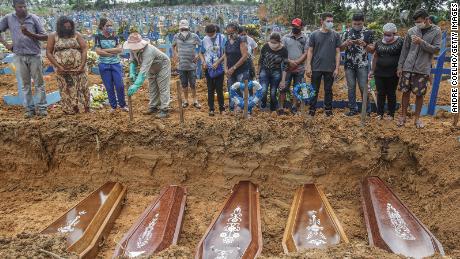
There have been more than 2.4 million cases and more than 143,000 deaths in all of the Americas, Dr. Carissa Etienne told a press briefing, adding the region “has become the epicenter of the Covid pandemic.”

PAHO is particularly concerned about Brazil, where the number of new cases reported last week “was the highest for a seven-day period since the outbreak began,” Etienne said.

Peru and Chile are also reporting a high number of cases, she added, warning that for countries in the region “now is not the time to relax restrictions or scale back preventive strategies.”

Peru and Chile are among the region’s worst hit. They now hold the world’s highest infection rates per capita over a seven-day rolling average, according to Our World in Data (OWID), an independent statistics website headquartered at Oxford University.

On Tuesday, Chile had 77,961 infections and 806 deaths since the outbreak began. Two members of its government, Minister of Energy Juan Carlos Jobet and Public Works Minister Alfredo Moreno, tested positive for the virus on Monday after showing mild symptoms.

Brazil overtook Russia over the weekend to become the country with the most confirmed cases of Covid-19 after the United States, according to Johns Hopkins University figures. By Monday, it had 374,898 infections in total and 23,473 deaths, according to the health ministry.

“Now is the time to stay strong, to remain vigilant, and to aggressively implement proven public health measures. We have learned from other regions, we have learned what works and what doesn’t and we must continue to apply this knowledge to our context,” Etienne said.

Brazil’s crisis

These grim milestones come hours before a US travel ban for Brazil comes into effect at 11:59 pm ET Tuesday night. It will limit the entry of any foreign nationals, including Brazilians, who were in the country within the past 14 days.

Sao Paulo governor Joao Doria told CNN that the ban may affect diplomatic and economic relations between both countries.

His city of 12 million is the worst-hit in the country, with more than 83,000 infections and 6,220 deaths, according to the latest data from the Brazilian health ministry.

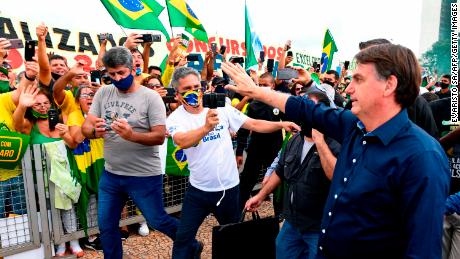
Doria told CNN that President Jair Bolsonaro had been undermining the preventative measures and messaging by the governors of the most impacted places in Brazil. “The behavior of President Bolsonaro is the wrong behavior. He is against social isolation. He’s against orientation of the science,” Doria said, adding that in his city, “we support social isolation, we recommend to the people to use masks and stay home.”

Brazil faces dark week as Covid-19 toll rises

Bolsonaro has referred to the virus as a “little flu” and frequently downplayed its risks. Two health ministers have left his cabinet in a 4-week period — one was fired and the other resigned — after disagreements over how to handle the pandemic.

A coronavirus model that has been cited by the White House, suggests the country’s trauma is far from over.

Analysis from the Institute for Health Metrics and Evaluation (IHME) at the University of Washington projects there will be 125,833 deaths by August 4, with a possible range as low as 68,311 and as high as 221,078.

Flora Charner, Anna Gorzkowska and Hira Humayun contributed to this report.

Source link

Germany extends social distancing rules until June 29

0

Guests enjoy the atmosphere of the Seehaus beer garden in Munich | Alexander Hassenstein/Getty Images

Regions can allow up to 10 people, or members of two households, to meet in public.

BERLIN — Germany on Tuesday extended its social distancing measures until June 29 as part of efforts to restrict the spread of the coronavirus, according to a deal between the federal government and regional authorities.

Under the extension, the governments of Germany’s 16 federal states can allow up to 10 people, or members of two households, to meet.

However, the government recommends that people still limit their number of social contacts and keep the size of their social group as constant as possible. It also suggests holding gatherings outdoors where the risk of infection is lower.

The current measures were set to end on June 5, pending discussions between Chancellor Angela Merkel and the leaders of the 16 regions, which ultimately have the power to impose restrictions.

Merkel initially announced restrictions on meetings of more than two people on March 22 in response to the deadly virus.


Source by [author_name]

Could our working lives have changed for the better?

Those who would’ve usually commuted into an office and sat at a desk for the best part of eight to 12 hours a day, five days a week, have had to navigate a very different working world for the last few months.

Working from home has undoubtedly been one of the biggest talking points of the coronavirus pandemic. On Instagram, it’s been mentioned 1.5million times. TikTok #wfh videos have amassed a staggering 248.8 million views.

Tune into your “peak energy hours.”Credit:iStock

But the end is nigh. In the next month, Australian businesses will drip-feed staff back into offices around the country. And it’s likely those who’ve missed coffee runs, attire other than casual-wear and even their colleagues will breathe a hearty sigh of relief.

But Melbourne-based productivity and life coach, Sandy Ewing, says to simply return back to the traditional working day is actually missing a unique opportunity. She believes this time, where businesses and staff have evolved to survive through a pandemic, has been a brilliant testing ground on productivity away from the working model we’ve followed for decades.

Source by [author_name]

If You’re Trump, You Can Tweet False Murder Allegations And Twitter Is Just ‘Sorry’

President Donald Trump and his oldest son can tweet unfounded murder accusations against his critics without consequence, at least not from tech giant Twitter.

Trump has repeatedly and without a shred of evidence suggested that MSNBC’s Joe Scarborough might have killed 28-year-old intern Lori Klausutis, who died in 2001 after she hit her head on a table. She had an undiagnosed heart condition and her tragic death was ruled an accident.

There should be “a long overdue Florida Cold Case against Psycho Joe Scarborough,” Trump tweeted earlier this month.

“Did he get away with murder? Some people think so,” Trump tweeted in another post.

Lori Klausutis’ widower, Timothy Klausutis, wrote a letter to Twitter CEO Jack Dorsey last week pleading for the company to remove Trump’s tweets:

The frequency, intensity, ugliness, and promulgation of these horrifying lies ever increases on the internet. These conspiracy theorists, including most recently the President of the United States, continue to spread their bile and misinformation on your platform disparaging the memory of my wife and our marriage. President Trump on Tuesday tweeted to his nearly 80 million followers alluding to the repeatedly debunked falsehood that my wife was murdered by her boss, former U.S. Rep. Joe Scarborough. The son of the president followed and more directly attacked my wife by tweeting to his followers as the means of spreading this vicious lie. 

“My request is simple: Please delete these tweets,” Klausutis said.

Following the letter, Twitter issued a tepid response skirting responsibility while making clear that the company wouldn’t be taking action against the president’s tweets.

“We are deeply sorry about the pain these statements, and the attention they are drawing, are causing the family,” a Twitter spokesperson said in a statement. “We’ve been working to expand existing product features and policies so we can more effectively address things like this going forward, and we hope to have those changes in place shortly.”

In answer to a followup email from HuffPost asking what those expanded “features and policies” will be, Twitter declined to comment. And when asked if the president’s tweets violate Twitter’s own rules against abuse and targeted harassment, a spokesperson said only that “we’ve nothing further to share at this time.” 

As Klausutis’ letter points out, it wasn’t just the president who spread the conspiracy theory but his son as well. Donald Trump Jr. has been instrumental in publicizing the fake allegation.

“What show is Joe going to go on to discuss Lori Klausutis?” Trump Jr. tweeted in April to his more than 5 million followers.

And following an opinion piece on Tuesday by New York Times contributing writer Kara Swisher ― who first reported Klausutis’ letter ― Trump Jr. used the widower’s grief to paint his father as a victim of censorship. 

“The NY Times is calling for Twitter to censor the Pesident [sic] of the United States,” Trump Jr. tweeted about Swisher’s call for Twitter to delete the president’s false tweets. “If they can push for that who won’t they try to censor next? Given silicon valley’s leftist tendencies you all better watch out, they are coming for all of you.”

The president, meanwhile, seems sure of his impunity. Hours after the letter became public, Trump again accused Scarborough of possibly being a murderer.

“The opening of a Cold Case against Psycho Joe Scarborough was not a Donald Trump original thought, this has been going on for years, long before I joined the chorus,” Trump said in one tweet.

“I would always be thinking about whether or not Joe could have done such a horrible thing? Maybe or maybe not, but I find Joe to be a total Nut Job, and I knew him well, far better than most,” Trump said in another tweet. “So many unanswered & obvious questions, but I won’t bring them up now! Law enforcement eventually will?”

Law enforcement likely won’t bring up “questions” because ― again ― there is no evidence of a crime. 


Source by [author_name]

Live blog: Commission presents EU recovery package

0

European Commission President Ursula von der Leyen on Wednesday unveils a revamped EU budget plan intended to power an economic recovery from the coronavirus crisis.

Von der Leyen presents her plan to the European Parliament in Brussels in the early afternoon before holding a press conference later in the day.

The plan will form the basis for negotiations between EU member countries, which have clashed over how much recovery funding the bloc should provide and whether it should be in the form of loans or grants.

Follow POLITICO’s live blog for news, reaction and analysis.


Source by [author_name]

Merkel and Macron need a Korean lesson

0

Christian Oliver is a senior policy editor at POLITICO and was based in Korea from 2008 to 2012.

Imagine a European Samsung, or a European Hyundai.

Wouldn’t it be great if Europe could take on China by emulating the industrial mojo of the South Koreans? If we focused our energies on building Korean-style corporate champions, surely EU economies would be awash with highly paid jobs making cars and ships, and we’d be able to kiss goodbye populist movements like France’s Yellow Jackets?

German Chancellor Angela Merkel and French President Emmanuel Macron are certainly thinking this way. Last week, Macron ramped up the Franco-German push to steamroller antitrust orthodoxy in Brussels to allow the creation of industrial heavyweights. Merkel specifically mentioned South Korea (along with China, Japan and the U.S.) as a country with the right answer. “We must not be afraid to have global champions,” she insisted.

The irony here is that Merkel is looking to Korea just as Koreans are fighting to be more like Germany. The Koreans have had a bellyful of their too-mighty national champions, the legendary chaebol conglomerates that rebuilt the nation from the rubble of its fratricidal 1950-1953 war, and are now pushing for a rapid reorientation to more innovative startups. In fact, Koreans often cite the small and medium-sized enterprises (SMEs) of the German Mittelstand as a far more desirable model to gain an edge over China.

Europe cannot, of course, afford to be naïve about China’s rise.

Koreans have a neat expression for such a paradoxical situation: “Even a passing dog would laugh.”

Rather than being a paradigm for Macron and Merkel, South Korea should serve as a cautionary tale about the limits of champions once an economy reaches a moderately prosperous plateau of development. Its family-run chaebols now stifle innovation, fatally erode SMEs (helping depress wages where 90 percent of jobs are located) and have undermined rule of law in the country’s polarized democracy.

These days, South Korea’s battle with its chaebols and their toxic political influence resembles a far-fetched soap opera. Since 2017, Koreans have grabbed the popcorn for a gripping series of trials centered on the corrupt nexus of chaebols and political favor. Former Presidents Park Geun-hye and Lee Myung-bak received jail sentences, along with Samsung boss Jay Y. Lee. Plot highlights include bribes paid in million-dollar horses, and President Park being exposed as in thrall to a Rasputinesque adviser, who just happened to be the daughter of a notorious shaman.

Past their prime

Let’s give the chaebols their due. After the Korean War, the country was in ruins. The gross domestic product per capita was less than Ghana’s, and the top exports included scrap, wigs and dried fruit. It was chaebols like Samsung, Hyundai, Daewoo and LG that pulled off the “miracle on the River Han” and forged a leading world economy. Between 1972 and 1979, exports increased nine-fold and income more than five-fold.

It is an epic, bittersweet story. Many older Koreans will regale you with anecdotes about Hyundai’s laconic founder Chung Ju-yung, whose journey from peasant to tycoon (via a humble car repair shop, and without buying new shoes) mirrors the nation’s rebirth. On the darker side, no one doubts the tragic human cost of the chaebol revolution. One haunting image was described to me by a Korean journalist, who grew up in the port of Ulsan where Hyundai built the world’s biggest shipyard. He said the soundtrack of his childhood was the wail of ambulance sirens racing to the docks. Safety came second to the national mission.

So, yes, the chaebols rebuilt a country, but they can’t conjure up another miracle to take it to the next level in the showdown with China. Korea now realizes that it needs to change tack to unleash the country’s bottled-up talent and pump more oxygen into SMEs in areas like gaming, fashion, music, biotech and medical services. The current left-wing administration of President Moon Jae-in founded a ministry for SMEs in 2017 and is trying to roll out a raft of incentives to rebalance the economy more to the little guy.

It’s going to be a long haul, though. Korean SMEs have a miserable time as the little fish, and their struggle to survive in the chaebols’ pond should show Merkel and Macron why tough competition policy on champions is so important. The conglomerates have such prodigious market clout in Korea that they can suffocate suppliers with bullying contracts and derisory payments. If you have a great idea or invention, the chaebol will buy you out, if only to kill you off as a rival. This is a very different situation from Japan, and Korean entrepreneurs look with envy to the city of Osaka, which prides itself on its SME culture.

Fears about Korea’s ability to innovate also loom large in Seoul’s attempts to steer away from chaebols. At heart, chaebols are fast-followers (or copycats, if you are less generous) with militaristically brilliant manufacturing. Apple invents the iPhone? No problem, Samsung can rustle up a Galaxy smartphone. But China can also play the fast-follower game. The sort of commercial DNA where Korea really does have a quirky, free-thinking edge over China is not really monetizable in old-school chaebols.

While Moon wants his agile front line against China to be composed of top-flight SMEs, that’s just not what Korea Inc. looks like. At least, not yet. The chaebols account for only 10 percent of jobs, but 80 percent of market capitalization and two-thirds of exports. Most crucially, wages in SMEs are 60 percent the level of those in the chaebols that squeeze them.

Political pressure cooker

Politically, this chaebol-SME divergence has fuelled a profound left-right schism. For such a sophisticated and well-educated society, the politics is bloody-mindedly binary. In short, there’s a belief that chaebol tycoons have been above the law and that is a red rag to the left.

In truth, chaebol untouchability was indeed shameless over the years before Moon. The chairmen of Samsung and SK (a telecommunications and energy conglomerate) received pardons for serious financial crimes from the two (now jailed) previous conservative presidents. Incredibly, the boss of the Hanwha explosives’ chaebol, involved in beating up some young barmen with a steel pipe, also received a presidential pardon.

This means many Koreans are angry over one rule for the chaebol royalty and another for everyone else. This is the gulf between haves and basement-dwelling have-nots that film fans will have seen in Bong Joon-ho’s Oscar-winning “Parasite.”

Koreans have a word — gapjil — that expresses the abusive power the haves exert over the have-nots. The word entered common currency after a dramatic air rage incident in New York in 2014, in which a Korean Air heiress exploded at cabin crew who did not serve her macadamia nuts in the way she wanted, and forced the plane to taxi back to the gate.

The skyline of the Yeouido district of Seoul | Ed Jones/AFP via Getty Images

To Koreans, the case epitomized how chaebol types behave with lesser mortals. This intimidatory gapjil lies at the very heart of the conglomerate culture — say, in relations with contractors — and is now, literally, on page one of the latest Korean antitrust mission statement.

If Macron and Merkel want to snuff out malcontents like the Yellow Jackets by relaxing competition rules for champions, all in the hope of creating good jobs in Europe, they could be in for a rude awakening. The lessons from Korea show that chaebols widened social divisions by sapping the potential for a successful SME sector. What’s more, chaebols increasingly create employment outside Korea. Korean car giants, for example, happily produce in the southern U.S. where they don’t have to deal with fiery Korean unions.

Moon’s government is zeroing in on competition law and fair contracts with suppliers as one of the ways to retilt the economy. Antitrust enforcement in Korea stumbled into a depressingly typical scandal in 2018 when it emerged there were (surprise, surprise) revolving doors with the authority and the chaebols. Moon is seeking to rebuild credibility by appointing antitrust chiefs like Kim Sang-jo, dubbed the “chaebol sniper,” and his successor, Joh Sung-wook, who is also seen as tough on conglomerates.

French President Emmanuel Macron with German Chancellor Angela Merkel | Pool photo by Frederic Scheiber/AFP via Getty Images

Europe cannot, of course, afford to be naïve about China’s rise, but the EU can use an arsenal of trade defense measures to deal with Beijing: investment screening, anti-subsidy instruments and reciprocity in public procurement.

The new Franco-German recipe of loosening competition rules to allow for more corporate titans clearly demands closer examination when Korea, a hardened competitor with China, wants to reduce reliance on champions and to toughen antitrust controls on them to give space to SMEs.

Merkel last week called the drive toward champions a “necessary response.” There’s a new generation of Koreans who are trying to speed off in the opposite direction.

Want more analysis from POLITICO? POLITICO Pro is our premium intelligence service for professionals. From financial services to trade, technology, cybersecurity and more, Pro delivers real time intelligence, deep insight and breaking scoops you need to keep one step ahead. Email pro@politico.eu to request a complimentary trial.


Source by [author_name]

Coronavirus live updates: Tasmanian premier warns against border one-upmanship

Tasmanian premier calls for an end to 'one-upmanship' on state border closures

Source by [author_name]

Poll of Polls: One year after the European election

0

If a week is a long time in politics, a year is a lifetime — particularly in the midst of a pandemic.

This time last year, voters across the EU were casting their final ballots in the European Parliament election. But what would happen if that election were (or even could be) held today?

POLITICO’s Poll of Polls has reactivated its European Parliament seat tracker, which uses an amalgamation of national opinion polling to estimate what the composition of the Strasbourg legislature would be after such a hypothetical election. In short: The result is a boost for the center-right European People’s Party, with voters flocking to incumbent ruling parties at a time of international crisis.

Before analyzing the details, first some methodology and caveats.

Poll of Polls combines all available high-quality public opinion polls in each country that ask about the voting intention. We aggregate the polls to smooth outlier results and gain a more robust estimate of the strength of each political party. The European Parliament seat tracker model translates that support into MEPs using the allocation system applied in each country.

The results are useful for interpreting the direction of Europe’s political winds, but we should be cautious about overinterpreting the figures. At this point in the European political cycle, polling firms are asking about national political sentiment, not specifically about European Parliament voting intention. Although the seat projection will therefore miss some quirks specific to European elections, voting behavior at the national and the European level are nonetheless strongly correlated. The fact that the U.K. is no longer included in the model is likely to improve its accuracy as the country was home to some of the largest polling upsets and very distinct voting behavior at the European level.

Also, for some countries such as Bulgaria, there are no recent polls available and we must revert to polls from several weeks back. In others, like Luxembourg, there have been no polls since the election so we have used the seat allocation from May last year. Naturally, we are comparing the hypothetical election result with the post-Brexit allocation of seats — so minus the MEPs elected form the United Kingdom that left the chamber at the end of January.

According to our analysis, if the European Parliament election was held today, the EPP would gain significantly, picking up 11 extra seats. The surge in support for Germany’s Christian Democrats, the party of Chancellor Angela Merkel, is the main driver of this trend. The CDU/CSU party union is currently at close to 40 percent in national polls, meaning it would pick up 10 seats in the European Parliament under our estimate. That would make it the largest party delegation by far with 39 seats, eclipsing Italy’s League party, led by Matteo Salvini, on 24. Currently, both party delegations hold 29 seats.

The League is still the strongest party in Italy’s national polls, but with significantly diminished support compared to the beginning of the year. Nonetheless, the Identity and Democracy group to which the League belongs would emerge from a hypothetical European election virtually unscathed with just one fewer seat, as they would pick up seats in Belgium and Slovakia to compensate for Italian losses.

POLLING TREND

Changes in the Poll of Polls’ European Parliament seat projection over time.

The projection is for the composition of the post-Brexit Parliament — that is, without U.K. MEPs elected in May 2019 — and is based on publicly available high-quality national polling. For more polling data from across Europe, visit POLITICO Poll of Polls.

Our projection suggests that the center-left S&D grouping would continue its long-term decline if an election were held tomorrow. It would drop from 146 seats to 143 with small losses across the EU, from Spain and Germany to Bulgaria and Greece. Liberals were among the big winners from last year’s election with 98 seats in the post-Brexit Parliament. But driven by poor polling trends for their national members in Spain and Germany, the Renew Europe group would lose 8 seats, according to our projection.

With the climate issue overshadowed by the coronavirus pandemic, green parties in several EU countries have suffered slight polling dips since the crisis hit. This is most clearly visible in Germany, where the party fell from 23 percent to 16 percent in national polls within a few weeks.

Meanwhile, the European Conservatives and Reformists (ECR) would overtake the Greens in the chamber. It has regrouped after it lost its founding party, the British Conservatives, due to Brexit, but with a strong showing for the Italian right-wing Brothers of Italy, the group would be projected to gain five more seats. The left-wing group European United Left–Nordic Green Left (GUE/NGL) would also make gains off the back of boosted support for Ireland’s Sinn Féin, among others.


Source by [author_name]