NEW YORK (AP) — More than 4,300 recovering coronavirus patients were sent to New York’s already vulnerable nursing homes under a controversial state directive that was ultimately scrapped amid criticisms it was accelerating the nation’s deadliest outbreaks, according to a count by The Associated Press.
AP compiled its own tally to find out how many COVID-19 patients were discharged from hospitals to nursing homes under the March 25 directive after New York’s Health Department declined to release its internal survey conducted two weeks ago. It says it is still verifying data that was incomplete.
Whatever the full number, nursing home administrators, residents’ advocates and relatives say it has added up to a big and indefensible problem for facilities that even Gov. Andrew Cuomo — the main proponent of the policy — called “the optimum feeding ground for this virus.â€
“It was the single dumbest decision anyone could make if they wanted to kill people,†Daniel Arbeeny said of the directive, which prompted him to pull his 88-year-old father out of a Brooklyn nursing home where more than 50 people have died. His father later died of COVID-19 at home.
“This isn’t rocket science,†Arbeeny said. “We knew the most vulnerable ― the elderly and compromised ― are in nursing homes and rehab centers.â€
Told of the AP’s tally, the Health Department said late Thursday it “can’t comment on data we haven’t had a chance to review, particularly while we’re still validating our own comprehensive survey of nursing homes admission and re-admission data in the middle of responding to this global pandemic.â€
Cuomo, a Democrat, on May 10 reversed the directive, which had been intended to help free up hospital beds for the sickest patients as cases surged. But he continued to defend it this week, saying he didn’t believe it contributed to the more than 5,800 nursing and adult care facility deaths in New York — more than in any other state — and that homes should have spoken up if it was a problem.
“Any nursing home could just say, ‘I can’t handle a COVID person in my facility,’†he said, although the March 25 order didn’t specify how homes could refuse, saying that â€no resident shall be denied re-admission or admission to the (nursing home) solely based†on confirmed or suspected COVID-19.
Over a month later, on April 29, the Health Department clarified that homes should not take any new residents if they were unable to meet their needs, including a checklist of standards for coronavirus care and prevention.
In the meantime, some nursing homes felt obligated and overwhelmed.
Gurwin Jewish, a 460-bed home on Long Island, seemed well-prepared for the coronavirus in early March, with movable walls to seal off hallways for the infected. But after the state order, a trickle of recovering COVID-19 patients from local hospitals turned into a flood of 58 people.
More walls were put up, but other residents nonetheless began falling sick and dying. In the end, 47 Gurwin residents died of confirmed or suspected COVID-19.
The state order “put staff and residents at great risk,†CEO Stuart Almer said. “We can’t draw a straight line from bringing in someone positive to someone catching the disease, but we’re talking about elderly, fragile and vulnerable residents.â€
The Society for Post-Acute and Long-Term Care Medicine, known as AMDA, had warned from the beginning that Cuomo’s order admitting infected patients posed a “clear and present danger†to nursing home residents. Now, Jeffrey N. Nichols, who serves on the executive committee of the group, said “the effect of that order was to contribute to 5,000 deaths.â€
Nationally, over 35,500 people have died from coronavirus outbreaks at nursing homes and long-term care facilities, about a third of the overall death toll, according to the AP’s running tally.
ASSOCIATED PRESS
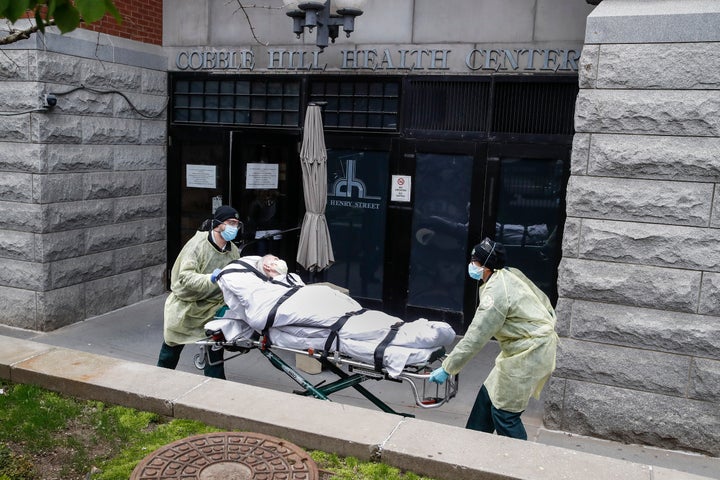
FILE – In this April 17, 2020, file photo, a patient is loaded into an ambulance by emergency medical workers outside Cobble Hill Health Center during the coronavirus in the Brooklyn borough of New York. (AP Photo/John Minchillo, File)
ASSOCIATED PRESS
New York Gov. Andrew Cuomo briefs the media during a coronavirus news conference at his office in New York City, Saturday, May 9, 2020. (John Roca/New York Post via AP, Pool)
Cuomo has deflected criticism over the nursing home directive by saying it stemmed from Trump administration guidance. Still, few states went as far as New York and neighboring New Jersey, which has the second-most care home deaths, in discharging hospitalized coronavirus patients to nursing homes. California followed suit but loosened its requirement following intense criticism.
Some states went in the opposite direction. Louisiana barred hospitals for 30 days from sending coronavirus patients to nursing homes with some exceptions. And while Louisiana reported about 1,000 coronavirus-related nursing home deaths, far fewer than New York, that was 40% of Louisiana’s statewide death toll, a higher proportion than in New York.
New York’s Health Department told the AP May 8 it was not tracking how many recovering COVID-19 patients were taken into nursing homes under the order. But it was at that very moment surveying administrators of the state’s over 1,150 nursing homes and long-term care facilities on just that question.
Those survey results have yet to be released. But regardless, the Health Department said, the survey had no bearing on Cuomo’s announcement May 10 that “we’re just not going to send a person who is positive to a nursing home after a hospital visit.â€
Cuomo said such patients would be accommodated elsewhere, such as sites originally set up as temporary hospitals.
To some, the governor’s reversal came too late.
“It infected a great number of people in nursing homes who had no business getting infected, including short-term residents who were there for rehabilitation after surgeries,†said John Dalli, a New York attorney who specializes in nursing home cases.
ASSOCIATED PRESS
FILE – In this Friday, April 17, 2020 file photo, a patient is wheeled out of the Cobble Hill Health Center by emergency medical workers in the Brooklyn borough of New York. The facility has listed dozens of deaths linked to the COVID-19 coronavirus pandemic. In New York state, the nation’s leader in nursing home deaths, the Greater New York Hospital Association lobbying group wrote the first draft of an emergency declaration making it the only state with protection from both civil lawsuits and criminal prosecution arising from the pandemic, with the order signed by Democratic Gov. Andrew Cuomo. (AP Photo/John Minchillo)
To be sure, incoming residents weren’t the only possible source of infection. Some homes believe a bigger contribution came from staffers and residents unaware they had the virus. And some say they would have taken on COVID-19 patients regardless of the state’s order.
“There were nursing homes that realized that there was a void,†said Sarah Colomello, a spokeswoman for Thompson House in Rhinebeck. The 100-bed facility set up an isolated unit where affiliated hospitals nearby have sent at least 21 patients. It has reported no deaths.
Cuomo administration officials say the original directive came when the governor feared the hospital system would be overwhelmed and was focused on creating as much hospital space as possible.
That was welcomed by one of the many hospital systems and nursing homes surveyed for AP’s count. Northwell Health said three of its medical centers were so overtaxed at one point they had to put some ICU patients in hallways. To relieve pressure, the company eventually sent more than 1,700 COVID-19 patients to nursing homes.
“Suffice it say, our hospitals were under stress,†spokesman Terence Lynam said.
Associated Press investigative researcher Randy Herschaft contributed to this report.
Calling all HuffPost superfans!
Sign up for membership to become a founding member and help shape HuffPost’s next chapter
FORT LAUDERDALE, Fla. (AP) — With forecasters predicting another intense Atlantic hurricane season with as many as 13 to 19 named storms, disaster preparedness experts say it’s critically important for people in evacuation zones to plan to stay with friends or family, rather than end up in shelters during the coronavirus pandemic.
“Shelters are meant to keep you safe, not make you comfortable,†said Carlos Castillo, acting deputy administrator for resilience at FEMA.
“Social distancing and other CDC guidance to keep you safe from COVID-19 may impact the disaster preparedness plan you had in place, including what is in your go-kit, evacuation routes, shelters, and more,†Castillo said. “With tornado season at its peak, hurricane season around the corner, and flooding, earthquakes and wildfires a risk year-round, it is time to revise and adjust your emergency plan now.â€
Six to 10 of these storms could develop into hurricanes, with winds of 74 mph or more, and three to six could even become major hurricanes, capable of inflicting devastating damage.
“It is not possible to predict how many will hit land,†said Neil Jacobs, acting administrator of the National Oceanic and Atmospheric Administration’s Climate Prediction Center. The agency will update the forecast in August as the Atlantic region heads into its most active months.
The region has been a “high activity era†since 1995, with warmer ocean temperatures and stronger West African monsoons causing above-average activity, NOAA forecaster Gerry Bell said.
An average Atlantic season has 12 named storms, but last year was the fourth consecutive season to have more, with 18 named storms, including three intense hurricanes — Dorian, Humberto and Lorenzo. The only other period on record that produced four consecutive above-normal seasons was 1998-2001.
The season officially extends from June through November, but Tropical Storm Arthur jumped the gun last week off the eastern U.S. coastline.
“As Americans focus their attention on a safe and healthy reopening of our country, it remains critically important that we also remember to make the necessary preparations for the upcoming hurricane season,†said Secretary of Commerce Wilbur Ross. “Just as in years past, NOAA experts will stay ahead of developing hurricanes and tropical storms and provide the forecasts and warnings we depend on to stay safe.â€
Calling all HuffPost superfans!
Sign up for membership to become a founding member and help shape HuffPost’s next chapter
Joe Biden reflected on his own grieving to empathize with Americans who’ve lost loved ones to the coronavirus in an emotional interview on Thursday’s broadcast of “The Late Show.â€
Biden also slammed the Trump White House’s fumbled response to the pandemic.
The de-facto Democratic 2020 nominee, toward the end of a 50-minute chat with host Stephen Colbert, urged people who have been sucked into the pandemic’s “big black hole†of grief to remember that those who died were “still part of you, they’re your heart, they’re your soul.â€
“It’s who you are, there’s this connection that is real, and the only way I know for me how to get through it is to find purpose,†he said. “What would the person you lost, what would they want you to doing? What can you do to make it better?â€
Biden, whose first wife, Neilia, and their 1-year-old daughter, Naomi, were killed in a 1972 car crash, later recalled a promise his son Beau made him make just months before he died of brain cancer at age 46 in 2015.
“He said, ‘Dad, I know no one in the world loves me more than you do,’†remembered Biden. “‘But, Dad, I promise you, I’m going to be OK. My word, I’m going to be OK. But, Dad, promise me you’re going to be OK.’â€Â
“He was worried I would withdraw,†Biden explained, appearing to get visibly emotional. “I would go inside, because mourning in public is a lot different than being able to mourn in private. And he made me promise to stay engaged.â€
“I’m sorry I get so personal,†Biden told Colbert after the candid discussion.
Earlier in the interview, Biden wondered why President Donald Trump wasn’t telling citizens the truth about the pandemic.
“They’re tough. They can handle it,†he said. “And tell them what’s going to happen and tell them how you’re going to get these things done. He’s done none of that.â€
Check out the full interview here:
A HuffPost Guide To Coronavirus
Calling all HuffPost superfans!
Sign up for membership to become a founding member and help shape HuffPost’s next chapter
Dr. Huchuan Xia and his partner, Erik Lorenz, put their makeshift nuptials into another gear.
Dr. Xia, who is known as Cedric, and Mr. Lorenz were married May 10 in a Quaker self-uniting ceremony in Philadelphia. The couple cycled a total of three hours across nine miles to seven outdoor locations around their adopted city that were both photogenic and personally meaningful to them.
At each of these locations — or stations, as they called it — the freewheeling couple were joined by one or two friends to celebrate in keeping with rules to avoid large crowds during the coronavirus pandemic.
“By deconstructing a traditional wedding, we performed one wedding ritual at each station, drawn from either the German or Chinese traditions,†said Dr. Xia, 29, a trainee in psychiatry at the University of Pennsylvania, where he received a Ph.D. in neuroscience. He graduated from Washington University in St. Louis.
Dr. Xia was born in Sichuan, China, and raised in Shanghai; Mr. Lorenz, born and raised in Berlin.
At their first station, in Clark Park in West Philadelphia, Dr. Xia and Mr. Lorenz, 32, enjoyed their first dance, to a violin version of Elvis Presley’s “Can’t Help Falling in Love,†provided by a friend from Dr. Xia’s Ph.D. program.
“It was a beautiful moment,†said Mr. Lorenz, the host and founder of Weltwach Podcast, and Unfolding Maps. He graduated from Fontys University of Applied Sciences in the Netherlands and received a master’s degree in business and management from University of Plymouth in Britain.
They were soon back on their rented, Indego city bikes, the baskets in the front and rear of each decorated with tulips, lilies and chrysanthemum. As they headed to the second station on the University of Pennsylvania campus, the “Just Married†cans tied to the backs of each bike began making a ruckus to the delight of passers-by.h
Upon arrival in front of the Benjamin Franklin statue, the couple jumped across a simulated flame they constructed from tissue paper, a ritual from a traditional Chinese wedding, symbolizing the passion of a new marriage.
At the third station, the Promenade, near the Fairmount Water Works with a splendid view of the Boathouse Row, the couple sawed a small log into halves together, symbolizing marriage as teamwork.
They made their way to the fourth station, at the top of what Mr. Lorenz called “the Rocky steps,†made famous in the first “Rocky†film, starring Sylvester Stallone. Mr. Lorenz, a huge fan of the movies growing up in Berlin, chose that station as the place to exchange vows with Dr. Xia.
“We had family and friends watching our wedding via Zoom,†Mr. Lorenz said. “We learned that when we pushed our bikes to the top of the steps, and raised our arms in triumph like Rocky did in the movie, that many viewers, who likely interpreted that as the two of us celebrating our perseverance through Covid-19, started crying.â€
The fifth station was the Love Park, situated under the big love sculpture of the City of Brotherly Love. There, the couple had to bite a dangling apple together, a popular wedding game in China.
The sixth station was at Independence Hall, where three pairs of friends lined up, at least six feet apart, and showered the newlyweds with rice.
When they arrived at the final station, the Race Street Pier by the Delaware River underneath the Benjamin Franklin Bridge, the couple enjoyed a champagne toast and home-baked cake. There, two of their friends, Sage Rush and Barbara Terzic signed as witnesses on the couple’s Quaker marriage license.
“In a world of uncertainty, we knew one thing for sure,†Dr. Xia said. “We knew that we wanted to be each other’s partner in life, for life.â€
There has been an outbreak of Hepatitis A in Victoria among drug users, particularly those who use needles, and people experiencing homelessness.
State Deputy Chief Health Officer Angie Bone advised on Friday there had been 56 confirmed cases since July 2019, with a further six cases yet to be confirmed by blood tests.
The Victorian government is offering free single-dose hepatitis A vaccinations to people who use drugs or are experiencing homelessness until 31 August 2020.
Vaccinations are available to GP clinics that provide a specialised service to these groups, as well as via a mobile outreach service.
OSLO — The Franco-German plan for a €500 billion “recovery fund†has been welcomed with superlatives such as “Hamiltonian,†“stunning,†“a game changer†and the somewhat slightly less hagiographic “surprisingly ambitious.†In actual fact, it is just a damp squib.
The appropriate criteria by which to judge such a proposal are 1) Is it big enough? 2) Is it timely? 3) Does it set a powerful new precedent? 4) How does it fare in the context of the times? and the 5) What is its long-term impact? Sadly, the recovery fund falls far short of even “adequate†on all five.
Let’s start with the fund’s size. The coronavirus has trigged a global economic crisis in which the economies of some EU countries could shrink by between 10 percent and 20 percent. The recovery fund’s €500 billion amounts to a mere 3.5 percent of EU GDP to be distributed over three to four years. That’s not a game changer.
Nor are the countries that were hardest hit by the crisis likely to get the most money. Resistance from Northern and Eastern Europe make it highly unlikely that hard-it southern countries such as Italy or Spain will get more than twice their quota of about 1 percent of GDP per year. Is a 2 percent of GDP grant to Spain and Italy helpful? Yes. Is it macroeconomically significant? No.
In truth, the idea that this is the first step in the creation of a “fiscal union†is nothing but hyperbole.
The fund also fails the test of timeliness with disbursements unlikely to reach countries before next year. To offset the permanent economic damage being done by lockdowns, governments need money now.
While Germany has been able to act decisively with more domestic economic support than all the other EU countries put together, Italy and Spain have been more hesitant to act, because of their heavy debt burdens. Further delays in getting aid will leave even deeper scars in their economies that could have been prevented.
The picture is no better when it comes to setting a precedent. Even commentators who acknowledge the fund is far too small have waxed lyrical about how it “crosses the Rubicon,†“breaks taboos†or change the game the way the U.S. Revolutionary War hero Alexander Hamilton did when he federalized the debts of the various U.S. states in 1790.
In truth, the idea that this is the first step in the creation of a “fiscal union†is nothing but hyperbole.
First of all, there’s little here that’s actually new. The European Commission already has €52 billion of bonds outstanding, and cohesion and structural funds already entail transfers between EU countries. The European Stability Mechanism and the European Financial Stability Facility already saw EU governments band together to borrow to aid troubled members, albeit in the form of loans, not grants.
What the recovery fund does not do is make provisions for a permanent increase in the EU’s meager budget or give the Commission the ability to raise its own funds. Nor will existing debt be subsumed into a fiscal union as Hamilton did. Not even the responsibility for the new debt being created will be shared jointly among all EU countries, as the now abandoned initiative for “coronabonds” proposed. The recovery fund is a step toward a dead-end, not a fiscal union.
Put in the context of the time, the recovery fund looks even worse. The initiative can be seen as the German establishment’s attempt to make up for the sins of its constitutional court, which threw a Molotov cocktail into the EU’s legal and economic order in early May by challenging the actions of the European Central Bank and the Court of Justice of the European Union.
However the German court’s decision finally plays out, its immediate impact is to put a de-facto political constraint on the size and asymmetry of the ECB’s quantitative easing programs, thereby limiting the ability of the most effective institution in the eurozone to respond to a crisis with appropriate size and timeliness. Italy and Spain would have been better off with an unconstrained ECB and no recovery fund.
The longer-term consequences of the fund itself may also prove to be negative. It has killed any genuine prospect of a true, much-needed eurobond for good, leaving any “Hamiltonian moment†for future, potentially weaker, leaders. Even worse, absent future political agreements, the need to repay the debt incurred by the recovery fund will hollow out the already scarce EU budget.
EU politics is becoming more, not less contentious. If we can’t set aside our petty, parochial politics amid a global pandemic to move toward a fiscal union now, we never will.
Like that of a story someone would eventually make into a movie – the opening scene is of a young fellow called Ajit Chambers standing in City Hall presenting his incredulous business plan to then London Mayor – Boris Johnson. A plan showing how to make £200 million by opening London’s Disused Tube Stations as tourist attractions.
I am Ajit Chambers, and whilst I am no blonde Jennifer Arcuri, my tale gets even more unbelievable as Boris Johnson leans across the table vigorously shouting ‘ Hurrah, I think you have something here, brilliant man’ and tasks Transport for London’s Commercial Director Graeme Craig to manage Mr Chambers project.
However every story has a culprit, two in this case. Instead of working with me as Boris had asked, like a devious school child, Graeme convinces TfL project manager Niall Brolly to pretend they have designed the project Mr Chambers presented to Boris.
Both Graeme and Niall now see dollar signs, Mercedes for their wives, posh schools for their kids, new houses all round and decide to present Mr Chambers complex plan to the Board of Transport for London pretending it was their own brainy idea.
Now at this point, I could use the word alleged or just wait for Transport for London to deny any of the above but instead I jump to the facts that I have seen.
Emails and phone calls from the Struengmann Brothers to Donald Trump, all offering investment to me. Large sums like the £20 million I showed Boris in City Hall or the offer of a cheque by the end of the day for the whole £200 million from a certain British Greek-Cypriot.
Meanwhile Dastardly and Mutley (aka Graeme and Niall ) busily start a public bidding competition for my project ( think Hanna-Barbera’s Wacky Races) and then boom – they claim to be the winner of the race and award the contract to themselves.
When Boris Johnson finds out that Graeme and Niall have been behind his back he authorises a meeting with Graeme to discuss a settlement to avoid the embarrassment, but I turned this meeting down with a bigger goal in mind.
Although many errors of judgement go unnoticed, like Monica Lewinsky I ‘kept the dress’ – diligently recording phone calls, emails and meetings with Graeme and Niall to collate all the proof necessary to enable his lawsuit, if timed right, to render Transport for London Bankrupt.
The real question is will it be Graeme Craig and Niall Brolly who cause Lady Justice to order TfL to close forever.
When asked for my opinion, I answer;
‘’The horse left the stable long ago. No one likes a thief, there will be no settlement. When the time is perfect the UK’s Highest Court will decide.’’
The opinions expressed in this article are those of the author alone, and do not represent the opinions of EU Reporter.
KARACHI, Pakistan (Reuters) — A Pakistan International Airlines (PIA) plane with around 100 passengers and crew crashed on Friday in a residential area of the southern city of Karachi, with many feared dead, officials said.
The state carrier said flight PK 8303 had crashed with 99 passengers and eight crew members on board, though civil aviation officials said the total for both may be 99.
“The last we heard from the pilot was that he has some technical problem,†PIA spokesman Abdullah H. Khan said in a video statement. “It is a very tragic incident.â€
A senior civil aviation official told Reuters it appeared the plane was unable to open its wheels due to a technical fault prior to landing, but it was to early to determine the cause.
Geo TV broadcaster showed crowds near the scene, which appeared to be a densely populated area, and ambulances trying to make their way through.
Black smoke billowed and several cars were on fire.
The Pakistani army said its quick reaction force and paramilitary troops had reached the site for relief and rescue efforts alongside civil administration bodies.
(Asif Shahzad reported from Islamabad; Editing by Toby Chopra and Andrew Cawthorne)
This is a developing story. Please check back for updates.
Calling all HuffPost superfans!
Sign up for membership to become a founding member and help shape HuffPost’s next chapter
It’s not uncommon for actors, singers or bands to have “ridersâ€, certain conditions that they write into their contracts which the hosting venue must fulfil. Queen once asked for a mud-wrestling ring outside the dressing-room to provide them with some post-show entertainment. Punk icon Iggy Pop once requested “somebody dressed as Bob Hope†to do impersonations of the dead comedian. Most famously, the rock band Van Halen demanded that at every show a bowl of M&Ms be provided in their dressing room, with the brown ones removed. Failure to do so would result in the show’s summary cancellation.
Filmmaker Warwick Thornton’s needs are more prosaic. “When I’m on location, I always ask the producer for a unit with a stove, or a house with a kitchen,†he says. Thornton is no diva – he’s not going to start smashing cameras if he doesn’t get access to a hotplate – it’s just that cooking makes him work better. On shoots, he has been known to make meals for the cast and crew as a sign of his appreciation. He cooks for people to engender familiarity, to foster creativity and, on a more personal level, as a reset, “a wayâ€, he says, “of erasing the day. If I don’t cook at the end of the day, I’ll lie awake worrying about what I’ve shot.†And we’re not talking about throwing together a French omelette or a 10-minute stir-fry. “I might go to bed at 11pm, because it’s taken three or four hours to cook a meal.â€
It seems to be working for him. Over the past decade or so, Thornton, who is 49, has emerged as one of the strongest voices in Australian film. His first feature, Samson and Delilah, a tough love tale set in a remote Aboriginal community, won the Camera d’Or at the Cannes Film Festival in 2009. His second major release, the brutal western Sweet Country, in 2017, won prizes at two of the world’s leading festivals, Venice and Toronto, and took best film at the Asia Pacific Screen Awards. Thornton has also made short films and major art installations, and is, to boot, a talented cinematographer, with a “warm, fresh eyeâ€, as actor Bryan Brown puts it, “and a gift for producing scenes of mesmerising beautyâ€.
He also has a gift for excess. “I live a pretty fortunate life through cinema and art, so I can have a rock ’n’ roll party every bloody night if I want to,†Thornton tells me. “I love the after-party, the bar stool, the pool table, the conversation. It’s all just too exciting.â€
We are sitting at a glass-topped table on the cracked concrete landing of a house that his older sister Erica rents in Annandale, a much sought-after suburb in Sydney’s inner west, where Thornton lives when he is not out making movies. I’d been expecting a tastefully appointed terrace house, boho meets Vogue Living, but this place looks more like a student bedsit, with blankets over the doors and garage-sale furniture. There’s a jumbo-sized packet of Coco Pops on top of the fridge, right next to a bottle of Tanqueray. “It’s not the anal-bleached version [of an Annandale home],†he says. “That’s not my thing.â€
Thornton is an intimidating figure, standing well over six feet tall and dressed almost entirely in black; black jeans, black cap, black boots, black cowboy shirt. The only exception is his T-shirt, which is brown. He is fearsomely hairy, with a beard and swarming neck growth that appears, at least from where I’m sitting, to have grown into and become part of his T-shirt, giving him the aspect of a chain-smoking grizzly bear. “I’m like the ogre under the bridge,†he says. “Sometimes they have to drag me out to have a shower, and then I go off to work.â€
His internal ogre is abetted, to some extent, by his encumbered lifestyle: he has three kids – Luka, 16, Rona, 23 and Dylan, 27 – by two different women, but he lives alone, providing him with ample latitude to over-indulge. “It’s drinking, mainly. I love it,†he says. “I’ve had little interventions, from mates and my two sisters. They were like, ‘Hey Warwick, I love you, and I want to grow old with you and for us both to be 80 and sitting on the verandah having a beer, but the way I see your life going, that ain’t going to f…en happen.’ â€
A reality check was required, a spiritual and physical detox, which is how he ended up making his latest project, The Beach. Part nature documentary, part memoir, part rehab chronicle, The Beach, filmed in May last year, follows Thornton’s transformation as he spends more than a month in a tin shack on a remote beach in Western Australia. In six half-hour episodes, we watch Thornton reckoning with his past, his time growing up as an Indigenous kid in Alice Springs, his flaws, his strengths and his many scars, both internal and external. “We didn’t really go out there with any preconceptions,†he says. “I just knew I wanted to do it, I had to do it.â€
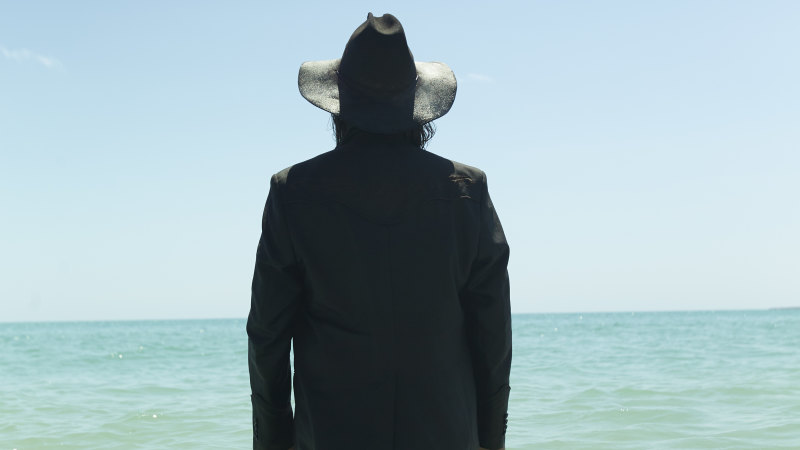
Warwick Thornton during the month-long filming of The Beach in Western Australia’s Dampier Peninsula.Credit:Susan Stitt
The Beach follows in a long tradition of wounded souls who seek redemption by submitting to the wilderness. In Thornton’s case, this meant a one-room shack on the tip of a sand spit surrounded by the dunes, mangroves and ocean of the Dampier Peninsula in the state’s north-west. As settings go, it’s outrageously beautiful. Viewers spend a lot of time in the hut, which was built with help from the local Indigenous community of Lombadina and which, despite the Robinson Crusoe conceit, is a minor- or masterpiece of scavenger chic, with wicker baskets propped against the walls, and coils of old rope hanging from the corner posts.
Those expecting the bare-knuckle narrative of Sweet Country will be disappointed. The Beach is slow television, with plenty of long takes and cryptic silences. The effect can be either meditative or maddening, depending on your mood. Not surprisingly, cooking is a big part of it. Thornton brought along three hens for eggs, not to mention an extensive collection of condiments and sauces, together with an array of vintage cooking implements – an iron griddle, some enamel tins and a blackened brazier.
He was, however, expected to catch all his other protein. “That shack didn’t have a fridge or any power,†he says. “So if I didn’t catch anything that day, then I’d have been having steamed rice.†We see his faltering, farcical attempts at spearfishing and cutting coconuts open. His patience wears thin, especially at the beginning, due to boredom and lack of booze. His only vice: cigarettes. “We were already struggling with there being no alcohol and me not being the great black hunter. If I hadn’t been able to smoke, I would have stabbed the whole crew to death.â€
When Thornton likes something, he calls it “rock ’n’ rollâ€. Even things that might not seem especially great, like depression, can turn out to be “rock ’n’ roll”.
After a time, the therapy worked. “I could see the transformation in Warwick,†says co-producer Michelle Parker. “He started to drop some weight. He became lighter, brighter, fitter, happier. His eyes were clear and twinkling. He was even doing yoga.â€
Parker was part of a skeleton crew, which included Thornton’s cinematographer son, Dylan River, who shot the whole series. The crew spent most of the day filming with Thornton, before returning at night to Lombadina, about half an hour’s drive away. “We didn’t know how Warwick would handle the whole experience,†says Parker. “Whether he would be angry, upset or have severe withdrawals. Sometimes he would just say, ‘I’ve had enough, just leave me alone,’ and we’d retreat.â€
The poise of River’s cinematography is a joy in itself. But among the most affecting elements are the stories, or impromptu soliloquies, that Thornton addresses to camera.
One of them concerns a man he calls Uncle Kingy. Kingy was a ngangkari, a traditional healer, whose job was to help people whose spirits had left them due to illness or accident. Kingy would go out, catch their soul and put it back in their body. When Thornton was growing up, Kingy was hugely respected and much in demand.
Years later, Thornton was driving down the main street of Alice Springs when he saw him walking along, drunk, yelling and screaming. Thornton thought he should offer him a lift, but he didn’t. “I thought, ‘I’ll leave him, because he’s pissed and he’ll want to bludge money off me, and then make me drive him around everywhere.’ †The next day, Thornton flew out to a shoot. The day after that, he heard that Kingy had died. Thornton was riven with guilt: “The last time I saw old Kingy, I didn’t want to pick him up.â€
Thornton became so angry with himself that he went and bought a “big knifeâ€, took it back to his hotel room, and started slashing at his upper arms. Every time he cut himself he thought of Kingy, “what an amazing man he was, and what a f…en dickhead I amâ€.
When I heard Thornton tell this story on The Beach, I thought it might have been embellished. So when I interview him, I ask to see his arms. The scars are there, all right, more than a dozen of them, thick and raised like lengths of cord buried in his skin.
Sweet Country, Thornton’s second feature film, received a five-minute ovation at the 2017 Venice Film Festival.Credit:
Thornton grew up the youngest of five children in Alice Springs, a notoriously tough town that sits like a blistered bullseye in the centre of the continent. “Alice in the 1970s was a small place with not a lot to do,†says his sister, Erica Glynn, who is also a filmmaker. “We’d swim in the town pool in summer. Mum took us to the drive-in cinema. There was also a walk-in cinema. Back then, and also now to an extent, it was a racist little town, and so it was a difficult place to be for Aboriginal people.â€
The family lived in a small single-storey fibro house, with a backyard that was so full of bindis you couldn’t play in it. For his seventh birthday Thornton asked for, and received, a huge pile of dirt. “It was the best present I ever had,†he says in The Beach. He played in the dirt pile for two years, making tunnels and fortresses in it, until it spread out and the bindis came back.
When he grew older Thornton rebelled, spending most of his time causing trouble and racing motorbikes with his mates on the claypans out of town. His mother, Freda Glynn, was a pioneer of Indigenous film, TV and radio, a co-founder of the Central Australian Aboriginal Media Association (CAAMA), which includes Imparja Television. In an effort to straighten her son out, she sent him, at the age of 13, to school in New Norcia, Australia’s only monastic town, 132 kilometres north of Perth.
When he returned, two years later, he got a gig as a DJ on Green Bush, one of CAAMA’s most popular radio programs. Green Bush played music, “a lot of requests, mostly from prisonersâ€, Thornton says. But it was more than a radio station. It broadcast to remote communities that might have had only one telephone box and where many people didn’t know how to read or write. Rather than simply playing music, then, the station became like a bulletin board or open telephone line. “You’d get requests like ‘G’day Warwick, can you play My Cheating Heart by Hank Williams, and can you tell my daughter that I’ll be out in three months and can she give me a call because I need to find a way of getting back to my community.’ â€
In 1983, CAAMA started a mobile video unit. By the late 1980s, Thornton had joined as a camera trainee, working alongside other future luminaries, including the sound recordist David Tranter, and Rachel Perkins, who would go on to direct hits such as Radiance and Bran Nue Dae. (Asked in an interview years later to describe what Thornton was like, Perkins said it was hard to say, since “he just used to grunt and not speak muchâ€.) CAAMA’s film teams travelled widely “to all sorts of obscure placesâ€, says Thornton. “We’d take swags, sleep by a campfire, getting bitten by scorpions and centipedes, and spend days filming as many stories as we could.â€
“Warwick is a grumpy bastard. He’s not into small-talking or pleasantries. He’s a deep river, and spends a lot of time in his own private story world.â€
David Jowsey, producer of Sweet Country.
Thornton and his colleagues often found themselves documenting vanishing worlds in real time. “You’d sit down with some old lady who’s living in a corrugated-iron humpy and she tells you her life story and then sings you a song that probably hasn’t changed in 30,000 years. And she’s got her great-granddaughter next to her, to teach her, ’cause she hasn’t sung that song in 30 years and she realises that she’s the last custodian. To see that happen, in front of you, that’s a privilege.†He says that filming in remote communities was a way of saying “You are worthyâ€. “You could see people’s eyes light up with the knowledge that someone had taken notice.â€
In 1993, Thornton went to Sydney to study cinematography at the Australian Film, Television and Radio School. While still a student, he made Payback, a short black and white film about a fictional inmate, Paddy (George Djilaynga), who emerges from a long stint behind bars only to face tribal law. The film, which screened at the prestigious Telluride Film Festival, was followed by his work as a cinematographer on the documentary, Marn Grook: An Aboriginal Perspective on Australian Rules Football. He also worked as the cinematographer on Perkins’s directorial debut, Radiance.
Then, as now, he had a reputation for gruffness. “Warwick is a grumpy bastard,†says David Jowsey, who produced Thornton’s feature film, Sweet Country, and who worked with him on the television series Mystery Road, three episodes of which Thornton directed last year. “He’s not into small-talking or pleasantries. He’s a deep river, and spends a lot of time in his own private story world.â€
Loading
Thornton’s range is unusually broad. His short films can be tender, even funny. Nana, a six-minute film he released in 2007, paints a whimsical portrait of a no-nonsense matriarch as seen through the eyes of her granddaughter. Mimi, in 2002, featured Sophie Lee as a clueless collector of Indigenous art. But his two feature films, Samson and Delilah, about a blighted love affair between two petrol-sniffing teenagers, and Sweet Country, about an Indigenous station hand who is put on trial for killing a white man, are so tough you could break your teeth on them. With its mix of bracing realism and a painterly aesthetic, Sweet Country made Thornton’s name. When the film was shown in Venice, it was lauded as a landmark for Indigenous filmmaking.
“I remember being in that cinema in Venice with Warwick when it was shown,†says Bryan Brown, who played Sergeant Fletcher in the film.
“When it ended, everyone turned around to where we were sitting and applauded for five minutes. I thought, ‘Wow, when Warwick was a young fellow running around Alice Springs in bare feet, we’d all have thought he had a 50/50 chance of being dead or in jail by the time he was 30. But here he was on one of the most sophisticated stages in the world.’ It was him saying, ‘You know what? I don’t have to give in to what everyone else expects. I can be different.’ â€
While filming The Beach, Thornton, who loves to cook, had three hens to supply eggs, but had to catch any other protein – a task he struggled with initially.Credit:Susan Stitt
When Thornton likes something, he calls it “rock ’n’ rollâ€. Making films is “rock ’n’ rollâ€. Cooking is “rock ’n’ rollâ€. His family is “rock ’n’ rollâ€. After-parties are, needless to say, “totally f…en rock ’n’ rollâ€. Even things that might not seem especially great, like depression, can turn out to be “rock ’n’ rollâ€. Winston Churchill called his depression the “black dogâ€. In The Beach, Thornton describes it as his “little black puppyâ€. He explains how every now and again, “sometimes it’s three years, sometimes it’s three times a yearâ€, he will hear that little black puppy outside, at the foot of his door, mewling and moaning, wanting to come in. But Thornton doesn’t answer it. The puppy gets hungrier and hungrier, and it scratches harder and harder. But still Thornton resists the urge to let it in. He has learnt that to accommodate that little puppy, to feed it, entertain its needs, would be inviting disaster. Better to lie in bed and wait until it stops scratching and crying.
“And when I know that’s happened,†he says in The Beach, “the puppy’s dead, and I can open the front door. And then I can go back out into the world.â€
Sitting in his sister’s backyard in Annandale, I suggest that the “little black puppy†might have something to do with booze. “No,†he says. “I don’t blame that on alcohol.â€
“But booze is a known depressant,†I say.
“Nah. [The depression] is just rock ’n’ roll, you know what I mean.â€
“No,†I say, “I don’t know what you mean.â€
“Well, it’s got nothing to do with alcohol. If I stopped drinking I’d be f…en eight times more depressed.â€
This might sound ridiculous coming from anyone else, but with Thornton it has a certain Hemingway-esque plausibility. At one stage he tells me that if “someone says anything bad about me … I just go punch them in the head. It’s horrific. We don’t live in that world any more. [But] that’s how I grew up.â€
“We’d all have thought he had a 50/50 chance of being dead or in jail by the time he was 30. But here he was on one of the most sophisticated stages in the world.â€
Bryan Brown
He has a similarly muscular, two-fisted approach to his work. In 2010, he told a journalist that he was concerned that the Southern Cross was becoming “the new swastikaâ€. The Nazis appropriated the swastika, which had for millennia been a Hindu symbol for good fortune, and made it synonymous with fascism. According to Thornton, right-wing nationalists in Australia had done the same thing with the Southern Cross, turning what for Indigenous people has long been a cosmological beacon into a racist emblem.
His comments, which came following his 2010 nomination for Australian of the Year, caused an uproar. “I went and hid in a cupboard for a while,†he later told the ABC. “And then over a couple of years, I got angry.†In 2017 he emerged with a documentary, called We Don’t Need a Map, that examined Australia’s fraught relationship with the Southern Cross and its use and abuse since colonisation.
“Warwick is very conscious of the history of Australia, and what has happened to his people,†says David Jowsey. “He also has an ironic, sardonic, witty take on White Australian culture.â€
Take Ned Kelly. “If Ned Kelly were alive today,†Thornton has said, “he’d be a meth-head holding up a 7-Eleven.†For this year’s Biennale of Sydney, Thornton made a film installation deconstructing the bushranger’s legend, showing Kelly robbing a 7-Eleven, overlaid with readings of jingoistic White Australia-era poetry and verse. (The installation was on show for 10 days before closing due to COVID-19.)
Making this kind of art takes a certain self-confidence, or at least a thick hide. “People say he’s got a big ego,†says his sister Erica, “but he’s a leader, and one of the requirements of that is that you have to self-sell. I want to run and hide from all that, but he’s really taken it on, and it’s one of the reasons he is where he is.†She mentions The Beach: “That’s courageous, exposing yourself like that, but probably more than that, exposing a little bit of arrogance thinking that people would care enough about it.â€
To an extent, whether audiences take note is beside the point. One of an artist’s chief obligations is to take risks, and Thornton has delivered on that. Besides, The Beach was always going to fall somewhere between art and therapy. “It’s important to slow down and look at your life,†he says. “To think about who you are – the empowering moments and the absolute f…ups that I’ve made, and how they are all part of who I am today. And The Beach gave me that space.â€
It also allowed him more clarity, and to be more honest with himself about what he can change and what he can’t. After a month in the wilds, Thornton returned to civilisation, which in this case meant Broome. One of the first things he did was go to the pub, put some trifectas on and order a beer.
“That’s the reality,†he says. “But you know what? I didn’t stay at the pub till I was maggotted, or until I’d had 12 beers. I stayed for three beers. I lost the trifecta, walked out of the pub, went to a restaurant and had something to eat with a glass of wine.†His internal ogre had found a degree of peace. “Maybe. It was just that I didn’t need to get f…ed up. I didn’t need it, and that was the most important thing.â€
The Beach airs on NITV and SBS on May 29 at 7.30pm.
Kampala, Uganda — When she heard the news of her abuser’s death, Hope said that she felt like her heart had stopped beating for a few seconds. “I didn’t know how to respond. I was broken, I shivered. I didn’t know whether to believe it or not, to cry or not,” she wrote to CNN.
Hope is one of the young women and girls who for the past year have been traveling to Ugandan courts ready to testify against German national Bernhard “Bery” Glaser, who is alleged to have sexually abused vulnerable girls like her, who were living in his care.
“I credit him for the good deeds he did but no one is perfect, there is also a dark side of him and that’s what people have failed to understand,” said Hope, whose name has been changed to protect her identity.
Glaser died in early May at Murchison Bay Hospital, a facility treating inmates of Luzira Prison in Kampala, Uganda. The day before his death, he had been granted bail, including international leave for medical treatment for stage four skin cancer.
He had been detained since last February, when he turned himself in, and charged with 19 counts of human trafficking, then formally charged and arrested in April with 19 counts of human trafficking, seven counts of aggravated defilement, one count of indecent assault and one count of operating an unauthorized children’s home, known as ‘Bery’s Place.’ He was first arrested in 2013, but the case was dismissed when survivors and their parents did not appear in court to testify.
“Obviously, Bery’s condition was serious and we feel for his family during this time. But, we also feel saddened for the victims in this case, and there are many,” said Rachel W. Bikhole, Uganda’s Assistant Director of Public Prosecutions, who described the evidence against the accused as “overwhelming.”
Bikhole told CNN that when a search of ‘Bery’s Place’ was carried out in February 2019, Glaser’s laptop was recovered and subjected to examination, during which naked videos and photos of the victims — some as young as five years old — were found on it. When questioned, Bikhole said Glaser claimed the material was used for fundraising purposes.
“These girls and young women will not see the day that Bery was held accountable for his crimes.”
Rachel W. Bikhole, Uganda’s Assistant Director of Public Prosecutions
Investigators also found email and Facebook messages on Glaser’s computer from him to a key witness in the 2013 case offering her money not to testify, according to Bikhole. CNN has reached out to his lawyer for response.
“These girls and young women will not see the day that Bery was held accountable for his crimes,” added Bikhole. “They will not get to tell of the terrible sexual abuse they endured for so many years and the lasting impact it has had and will have on them for the rest of their lives.”
Lawyers supporting the prosecution and a police source told CNN earlier this year that Glaser’s trial was postponed due to delaying tactics by the defense such as applying for a plea bargain deal and requesting a Flemish interpreter despite his demonstrated English proficiency. As a result, he did not make a plea before his death. Glaser’s lawyers have denied attempting to delay proceedings. In a February statement sent by WhatsApp to CNN, a lawyer representing Glaser denied that he had committed the alleged crimes.
Patricia, another survivor whose name has also been changed, told CNN that she had “never missed a court session,” traveling to testify in Kampala and Masaka eight times — only to be told again and again that the case would again be adjourned.
“We ended up performing poorly due to the trauma and endless journeys to court, resulting in us missing out on exams,” said Patricia, 20, who says she was abused from the age of 11 and is now at university.
Hope described the past year as a “very difficult year of abuse and accusations.” After speaking out about their experiences, survivors like Hope and Patricia have been victim-blamed and had their testimonies called into question, including in some Ugandan media reports and social media.
Before they had time to process the news of Glaser’s death, Hope said she and other witnesses started to receive calls and messages with threats and curses, labeling them “murderers.”
As reported in a CNN investigation into the case in February, Asia Namusoke Mbajja — a social worker with connections to Bery’s Place who eventually reported Glaser — has opened a police case of offensive communication and threatening violence following similar interactions.
The case is ongoing, with five phone numbers used to threaten to “injure or harm” Mbajja under investigation — including one registered in the name of Glaser’s wife, Ingrid Dilen, according to a preliminary police report see by CNN. Dilen told CNN she has not threatened anyone.
Mbajja too has received a fresh barrage of threats following Glaser’s death, and government prosecutor Bikhole also told CNN she has been “attacked a lot” and received threats on social media.
“I want to hide, I want to run, run far away so that no one will ever find me,” wrote Hope. “But is this the right thing? I’m just a witness,” she said, adding that even “a simple thing from him just to say sorry to us” would have meant so much. Hope also told CNN that she is struggling to support the other survivors, many younger than her, who she is currently living with at a shelter.
“I can’t lend them a shoulder to cry because I also need one to cry on,” she wrote.
“We will continue to find ways to help these victims,” said Bikhole. “And we will continue to fight against trafficking in persons in Uganda as there are still many cases and victims that require our attention.”
We use cookies on our website to give you the most relevant experience by remembering your preferences and repeat visits. By clicking “Accept”, you consent to the use of ALL the cookies.
This website uses cookies to improve your experience while you navigate through the website. Out of these, the cookies that are categorized as necessary are stored on your browser as they are essential for the working of basic functionalities of the website. We also use third-party cookies that help us analyze and understand how you use this website. These cookies will be stored in your browser only with your consent. You also have the option to opt-out of these cookies. But opting out of some of these cookies may affect your browsing experience.
Necessary cookies are absolutely essential for the website to function properly. These cookies ensure basic functionalities and security features of the website, anonymously.
Cookie
Duration
Description
cookielawinfo-checbox-analytics
11 months
This cookie is set by GDPR Cookie Consent plugin. The cookie is used to store the user consent for the cookies in the category "Analytics".
cookielawinfo-checbox-functional
11 months
The cookie is set by GDPR cookie consent to record the user consent for the cookies in the category "Functional".
cookielawinfo-checbox-others
11 months
This cookie is set by GDPR Cookie Consent plugin. The cookie is used to store the user consent for the cookies in the category "Other.
cookielawinfo-checkbox-necessary
11 months
This cookie is set by GDPR Cookie Consent plugin. The cookies is used to store the user consent for the cookies in the category "Necessary".
cookielawinfo-checkbox-performance
11 months
This cookie is set by GDPR Cookie Consent plugin. The cookie is used to store the user consent for the cookies in the category "Performance".
viewed_cookie_policy
11 months
The cookie is set by the GDPR Cookie Consent plugin and is used to store whether or not user has consented to the use of cookies. It does not store any personal data.
Functional cookies help to perform certain functionalities like sharing the content of the website on social media platforms, collect feedbacks, and other third-party features.
Performance cookies are used to understand and analyze the key performance indexes of the website which helps in delivering a better user experience for the visitors.
Analytical cookies are used to understand how visitors interact with the website. These cookies help provide information on metrics the number of visitors, bounce rate, traffic source, etc.
Advertisement cookies are used to provide visitors with relevant ads and marketing campaigns. These cookies track visitors across websites and collect information to provide customized ads.