MUZAFFARGARH – Another attack of locust at various areas damaged crops including cotton badly on Thursday. According to details, swarm of locust entered in Shah Jamal and Mohana areas and damaged cotton, fodder, vegetables and other crops. Ghulam Hussain, Allah Buksh, Afzal Shah, Rahim Buksh and others blamed that agriculture department didn’t made spray which caused locust attacks time to time. The agriculture department officials said that the teams were doing spray where locust spotted. It’s pertinent to mention here that the locust swarms had also attacked on crops at various areas of the district many times first.
A Policing Board member has urged loyalists organising Twelfth parades to listen to the message of the Orange Order leadership.
olores Kelly was speaking as more bands signalled their intention to march.
By Friday evening around 160 notifications had been lodged with the Parades Commission for parades between July 11 and 13.
All involve a single band with a maximum of 30 participants, in line with restrictions.
It comes amid growing demands from loyalists to celebrate Eleventh Night bonfires and the Twelfth following the attendance of Deputy First Minister Michelle O’Neill at the funeral of republican Bobby Storey.
Pressure mounted on the Sinn Fein vice-president to resign yesterday after her apology for the hurt she caused grieving families was branded a “half apology”.
Mrs O’Neill said she would “never apologise” for attending the funeral of a friend.
The PSNI said it is examining footage from the funeral for breaches of the regulations.
Loyalist activist Jamie Bryson warned that the PSNI risks harming its standing in loyalist and unionist communities if upcoming parades are not policed in the same way.
But SDLP MLA Mrs Kelly urged people not to gather on Monday week when most parades are scheduled.
The traditional parades were cancelled in April when the Covid-19 pandemic was at its height.
But since then restrictions have been relaxed, and up to 30 people are now allowed to meet outdoors while social distancing.
Notifications from bands have flooded in to the Parades Commission this week. It comes after the Belfast Telegraph revealed the Attorney General had informed the body that it had no power to prevent parades from taking place.
Mrs Kelly urged bands to heed the advice of Rev Mervyn Gibson, grand secretary of the Orange Order, who said this week: “Because someone else does wrong doesn’t mean we have to follow suit.”
The Order has also restated its position that Twelfth parades will not take place this year.
Mrs Kelly said: “The Orange Order has shown leadership and I think it is to be commended for staying strong in what happened in relation to Bobby Storey’s funeral.
“Rev Gibson’s message has remained consistent this year in the face of a pandemic and a health crisis in which we seek to protect the NHS.
“I would urge bands to follow the leadership in the Order.”
The PSNI said it is “aware of discussions taking place” in relation to the Twelfth and will work with partners and stakeholders to “put in place an appropriate and proportionate policing support in place for any events” in line with legislation at the time.
But Mr Bryson said that events this week in west Belfast have posed big questions for the police.
He said that given the PSNI approach when it came to Bobby Storey’s funeral, “clearly many in unionist and loyalist communities will be watching closely as to how the PSNI police small, localised band parades in our community”.
“If, for example, we were to see heavy PSNI presence… unionist confidence in fair and balanced policing will erode even further,” he claimed.
Just over a fortnight ago, Victorians were planning trips away as the school holidays approached, and looking forward to again being able to gather in pubs and restaurants with their friends – albeit with social distancing measures and hygiene protocols in place.
Now, the state is divided. While most people are enjoying these increased freedoms, 300,0000 residents across 10 postcodes – encompassing 36 suburbs – are back in lockdown, only allowed to leave their homes for exercise, healthcare, work and study if those activities can’t be done from home, and childcare.
When the prime minister, Scott Morrison, first announced border closures, social distancing and gathering restrictions across Australia in March, there was a sense everyone was in this together. Stories of community kindness emerged as neighbours checked on one another and brought supplies to the most vulnerable. Children drew positive messages in colourful chalk on footpaths and driveways. Times were tough, but everyone was playing their part to flatten the curve. Premiers and chief ministers worked with Morrison as part of a mostly unified national cabinet to implement consistent public health advice.
With the latest targeted lockdowns announced by the Victorian premier, Daniel Andrews, on Tuesday, which came into effect from Thursday, the messages of solidarity appeared to have diminished. Police would patrol suburb boundaries, carrying out checks on people travelling into and out of hotspots, Andrews said. He was stern.
“If we do not do this now then I won’t be locking down 10 postcodes, I will be locking down all postcodes,†he said. “Victoria police will not be mucking about. They will be there policing these rules.â€
Many in the affected suburbs expressed frustration, while those in surrounding suburbs urged their neighbours to stay away. Businesses asked customers in hotspots not to come. Those living in hotspots felt they had been adhering to social distancing measures, but were now being affected by a failure of infection control protocols by a security company, and by the careless actions of a few individuals who attended family gatherings despite being unwell and awaiting Covid-19 test results.
Quarantine failures
Andrews told reporters on Tuesday that a number of Victoria’s cases through late May and early June had been linked through genomic testing to an infection control breach in the hotel quarantine program, prompting him to call for a judicial inquiry. Security staff at the Stamford Plaza Hotel in Melbourne had breached infection control measures and had worked while infectious. They then spread the virus into suburbs.
“Clearly there has been a failure in the operation of this program,†Andrews said. “I have today ordered the establishment of an inquiry, led by a former judge, into the operation of the hotel quarantine program. A significant number, and potentially more, of the outbreaks in the north of the city are attributable via genomic sequencing to staff members in hotel quarantine breaching well-known and well understood infection control protocols. That is unacceptable to me.â€
The warnings of police patrols and postcode checks seemed jarring, when it was a lack of procedure in a hotel that sparked a significant cluster. Pressure has been placed on the state government to answer why hotel quarantine was being managed by security contractors rather than by police and defence force personnel, as is the case in New South Wales. Mary-Lousie McLaws, a professor of public health and adviser to the World Health Organisation, told the ABC on Thursday that quarantine hotels should be seen by governments as at high risk of outbreaks, and staff well-trained in hygiene and infection control were paramount.
Victorian premier Daniel Andrews announced police would patrol suburb boundaries, carrying out checks on people travelling into and out of hotspots. Photograph: James Ross/AAP
“[When travellers are] returning from the northern hemisphere, where often the outbreak is out of control, they pose an enormous risk to the rest of society,†she said. “So those that are in charge have to comply 100% of the time. That can be difficult when they have been skilled in security or skilled in hospitality, but not necessarily skilled in infection prevention and control. We really need to task that to the experts. If we’re going to task it to those that don’t have that expertise, there needs to be a champion on site every day to ensure that people who aren’t professionals in infection control can keep themselves safe and keep their compliance to 100%.â€
Meanwhile, other states and territories took aim at those facing lockdown with language that implied wrongdoing. The NSW health minister, Brad Hazzard, on Wednesday warned: “Victorians right now from those hotspots are not welcome in NSW. If you come to NSW you will be exposed to the possibility of six months’ jail and $11,000 fines.†NSW residents were also told not to visit the affected postcodes.
The Northern Territory chief minister, Michael Gunner, announced travellers from hotspots must stay out. The Northern Territory will push ahead with plans to lift border restrictions from 17 July but quarantine measures will remain in place for anyone travelling from designated coronavirus hotspots. People travelling to the territory will also need to sign a declaration that they have not been through a hotspot in the previous 28 days. Anyone found to have lied on a statutory declaration could face a jail term of up to three years.
The Queensland premier, Annastacia Palaszczuk, reiterated on Wednesday that the states borders were reopening from 10 July, except to Victorians. Travellers from elsewhere will be allowed into Queensland from 10 July so long as they sign a border declaration.
“This border declaration is to ensure that no one has travelled to Victoria in the past 14 days,†Palaszczuk said. “If you falsify a document, you will face strict penalties and fines up to $4,000. Our message to Queenslanders is please do not go there. Our message to Victorians is please do not come here.â€
‘Us against them’
Former national mental health commissioner Professor Ian Hickie of the University of Sydney, criticised the government’s “top-down†approach to lockdowns, suggesting it eroded the sense of community among Australians.
“If you are trying to treat this as a law and order issue, there becomes a conflict,†he said. “It’s us against them, ‘you are the problem’, ‘we have to lock you down’… that encourages a sense of civil disobedience and disorder. It really distracts from the sense of community, and if you destroy the community you destroy people’s mental health, and the more anxious and less trusting of the government and neighbours they become.â€
Hickie said rather than flooding streets with police the government should have worked with local community leaders, such as religious leaders, teachers, sports teams and trusted community groups, to ensure communities worked together. He also advocated for more information to be available to the public in order to build trust.
“I’m one of the people that said we should have had the appropriate apps and technology to let people know, at a community level, from that start, which suburbs, which place had cases. So they could act responsibly, so they can proactively engage … You have to trust people with that information.â€
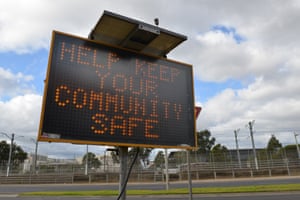
A sign in Melbourne after Victoria’s reimposition of lockdown in coronavirus hotspots. Photograph: Anadolu Agency/Getty Images
Prof Patrick McGorry, a psychiatrist and the executive director of Orygen youth mental health facility – where two staff members have been diagnosed with the virus in the past fortnight prompting a facility lockdown – said the “state v state†mentality that has grown over the past week has been destructive.
“I think some of the language used by some of the state ministers, not so much the premiers, but the state ministers in New South Wales was really disappointing,†he said.
“You know, ‘we don’t want you here’ – almost saying ‘we will hunt you down if you cross the border’. It’s really derisive actually. The messaging has got to be ‘we’re all in this together’ and the messaging yesterday was pretty deplorable, almost like Victorians were suddenly pariahs.â€
On an individual level, McGorry said this divisiveness could damage vulnerable people’s mental health.
“There will be a lot of people pushed a little bit more towards the edge of the cliff … That’s why it’s so important that the messaging is that this is a temporary setback.â€
Victorians were from Thursday met with police patrols at entry points into suburbs including Broadmeadows and Taylors Lakes. Flashing signs on highways urged: “Protect your home. Get testedâ€. Police patrolled on foot and on horses. Supermarkets reimposed restrictions on purchases of certain goods. Hundreds of public health staff knocked on doors in hotspots, urging people to take a Covid-19 test and supplying testing kits. It was a wake-up call: the virus is still here, and it is devastatingly infectious.
While earlier on in the outbreak Victoria escaped the devastation of outbreaks like the Ruby Princess Cruise ship debacle that left 22 people dead, there was a mood in Victoria and the rest of Australia at the time that the same could happen elsewhere. Now that Victoria is facing its disaster, the rest of the country seems to have moved on, firmly focused on returning to normal.
The challenge of lockdown
However, on Thursday, the first sign came that authorities were beginning to appreciate the impact a second lockdown was having on Victorians. Deputy chief medical officer Prof Michael Kidd held a press conference with no mention of keeping Victorians out or away, or of fines and patrols. Instead, he offered some compassion – even hope.
“We know this is a very worrying and challenging time for you all,†Kidd said. “The response in Victoria is a response that is not just protecting the health of you and your loved ones, but is protecting the entire population of Melbourne and Victoria and the entire population of Australia. They know that many people finding themselves back in lockdown today will be feeling anxious and fearful, many may be angry and frustrated and many may be feeling somewhat despondent.â€
He urged people who were struggling to reach out to services like Lifeline and Beyond Blue.
“It may help to recall that we all came to understand and … came to value during the first period of being in lockdown, the importance of staying connected with each other, even while we are physically distanced,†he said. “There are many challenges of going back into lockdown, but we have experienced this before. We have established our own ways to cope, so please remember the things that you learned the first time.â€
By Friday, there were signs that the Victorian government too were beginning to appreciate the need for compassion among the stern warnings. Victorians having to stay at home because of renewed coronavirus restrictions would receive extra mental health services, with an additional $1.9m to be allocated so opening hours of counselling clinics could be extended. Mental health response teams would also receive a boost.
“For these communities staying at home is vital right now, but we know it can be really difficult emotionally – particularly if you’re already struggling,†the premier said in a statement. But at his press conference the same day, the stern messaging was back, with 66 new cases of the virus identified overnight.
“Obviously, those that are in those hot spot postcodes , as well as every single person across the state, need to keep following the rules,†he said.
Major League Baseball is cancelling this year’s All-Star Game due to concerns over the coronavirus. The Los Angeles Dodgers, who were to host this year’s game, will instead play host to the Midsummer Classic in 2022.
Mario Tama/Getty Images
hide caption
toggle caption
Mario Tama/Getty Images
Major League Baseball is cancelling this year’s All-Star Game due to concerns over the coronavirus. The Los Angeles Dodgers, who were to host this year’s game, will instead play host to the Midsummer Classic in 2022.
Mario Tama/Getty Images
Major League Baseball is cancelling the 2020 All-Star game over concerns related to the COVID-19 pandemic and restricting on mass gatherings, the league says.
This year’s Mid Summer Classic, planned for July 14, is the first All-Star Game cancelled since World War II. A week of fan activities around the the American and National League exhibition match-up — including the Home Run Derby — will also be put on hold this year.
The Los Angeles Dodgers were set to host for the first time since 1980.
“Once it became clear we were unable to hold this year’s All-Star festivities, we wanted to award the Dodgers with the next available All-Star Game, which is 2022,” said baseball Commissioner Robert D. Manfred Jr said in a statement.
Cancelling the All-Star game is the latest hit the league has taken since the pandemic began. In March, the league put a stop to spring training, just two weeks shy of what would have been opening day. Disagreements between the player’s union and MLB over money and safety concerns further delayed the league’s shortened 60-game season.
Late last month, both sides agreed to have opening day on July 23 or 24, with players resuming training at the beginning of the month.
MLB recently introduced new rules to stem the spread of the virus among players, including a ban on spitting by players during the game.
First played in 1933, the All-Star Game has a been an annual event, save for 1945 when wartime travel restrictions interfered.
The 2021 edition is set to be played in Atlanta at the Braves’ Truist Park.
The easing of lockdown rules in England is the “biggest step yet on the road to recovery”, the prime minister has said.
Many businesses – including pubs, restaurants, hairdressers and cinemas – can reopen from Saturday.
Boris Johnson said the public “must not let them down” by being complacent about social distancing, and he would “not hesitate” to reimpose restrictions if the number of Covid-19 cases rises.
“Targeted local” measures would replace “blanket national” ones, he said.
‘Disciplined approach’
England’s chief medical officer, Prof Chris Whitty, who spoke alongside Mr Johnson at Friday’s Downing Street briefing, said no-one watching would think the easing was a risk-free step but that “there is no perfect, exact way of doing it”.
He also warned of the risk of coronavirus spreading in pubs.
“There’s no doubt these are environments whose principal job it is to bring people together. That’s a great thing to do socially, but it’s also a great thing from the virus’s point of view,” he said.
“And therefore we do have to have a really clear and really disciplined approach to try and maintain social distancing whilst also enjoying pubs.”
Mr Johnson said: “The success of these businesses, the livelihoods of those who rely on them and ultimately the economic health of the whole country is dependent on every single one of us acting responsibly.”
“We must not let them down,” he said, adding that he wanted people to “enjoy summer safely”.
Pubs have been told they must wait until 06:00 BST to reopen as a “precaution” to avoid midnight parties.
And pub-goers are being encouraged to book tables in advance, while live gigs and standing at the bar will not be allowed.
The 35,000 or so pubs and small bars trading in England have been closed since 20 March – a day when 645 positive coronavirus cases were announced.
On Friday, 544 new coronavirus cases were announced, the lowest daily figure since 17 March – while there were 137 further deaths confirmed, taking the UK total past 44,000.
As well as the easing of restrictions on the hospitality industry, social distancing rules will change from 2m to “one metre plus” – meaning you should take additional precautions when people are within less than 2m.
The rule changes come days after a local lockdown was put in place in Leicester because of a spike in cases, with residents advised not to travel and businesses and schools remaining closed.
Mr Johnson said “good progress” was being made towards the reopening of other businesses – such as gyms, nail salons and night clubs – and that a timetable will be set out next week.
Outbreaks of coronavirus are inevitable.
The virus is now at much lower levels, but it has not gone away and may never go away. Until we have a vaccine it will always pose a threat.
We have already seen outbreaks in Leicester, Weston-super-Mare and Kirklees. Relaxing lockdown will make them more common.
Remember, this is a virus that thrives on close contact – the more people we come into contact with, the more coronavirus will spread. It was true in March, when lockdown came in, and it is true now.
However, outbreaks are not a massive problem as long as they can be contained.
If they can be spotted and rapidly stopped then an outbreak may cause local disruption, but not “National Lockdown Two”. This will be the challenge for NHS test and trace.
However, some scientists are concerned lockdown is being lifted too quickly and that we are not yet able to stay on top of the virus.
The danger is failing to stop an outbreak could lead to coronavirus spreading widely and cases surging.
During the briefing, the prime minister laid out a five-step approach to tackling local outbreaks.
This will involve authorities monitoring data, engaging with local agencies and carrying out testing.
At the fourth stage, targeted restrictions, Mr Johnson said activities will be restricted “at particular locations” with “individual premises” made to close.
The final stage would be a local lockdown, which he said would be “carefully calibrated depending on the scientific circumstances of each outbreak”.
Media playback is unsupported on your device
Media captionEngland’s chief medical officer, Prof Chris Whitty: “Nobody believes this is a risk-free step”
Prof Whitty said the country would see both health and economic problems as a result of the pandemic and the government was trying to “walk this narrow path”.
“What this is is an attempt to balance, as best we can, in a way that makes it possible for society to be as close as possible to normal, whilst living alongside this virus – which we will have to continue to do,” he said.
He added that there is a “real possibility” of a second wave – which “goes up sharply” if people do not take social distancing measures seriously.
“This possibility will exist with us for a very long time, so we have to prepare for that,” he said.
“The best thing to do is to make that as unlikely as possible.”
What about the rest of the UK?
Each UK nation’s lockdown measures differ, including varying rules on the reopening of food and drink outlets.
The Department of Health and Social Care said 44,131 people had died in hospitals, care homes and the wider community after testing positive for coronavirus in the UK as of 17:00 on Thursday – a daily rise of 137.
Three Colorado officers with the Aurora Police Department have been fired and one has stepped down after a photo surfaced of three officers mocking the police killing of Elijah McClain.
Three officers staged a photo of the young Black man being choked by police.
Interim Police Chief Vanessa Wilson announced the termination on Friday, saying “they don’t deserve to wear a badge anymore.â€
Erica Marrero, Jaron Jones and Kyle Dittrich were identified as the officers in the photo, which was taken at a memorial site for McClain last year. Marrerro and Dittrich were fired and Jones resigned earlier this week. Wilson clarified that Jones’ file states he would have been terminated if he hadn’t resigned, which means he will not be able to become a police officer with another Colorado department.Â
Aurora Police Department
From left to right:Â Erica Marrero, Jaron Jones and Kyle Dittrich
The fourth fired officer, Jason Rosenblatt, replied  “haha†in a text message when he was sent the photo. The cops pictured in the photo said they were just trying to “cheer up a friend†by reenacting the chokehold, Wilson said.
McClain was walking home from a convenience store last August when he was stopped by the three white officers. McClain was tackled and at least one officer put the young man in a chokehold. Paramedics called to the scene injected him with ketamine to sedate him. The 23-year-old went into cardiac arrest on the way to the hospital and died days later after being pronounced brain-dead. He was never accused of a crime.
The officers involved in his death were all cleared of wrongdoing in February. But in June, following renewed outrage amid protests sparked by the police killing of George Floyd, Colorado Gov. Jared Polis (D) said he would have the case reexamined. Rosenblatt, who apparently found the chokehold reenactment funny, was involved in the fatal encounter of McClain.
Calling all HuffPost superfans!
Sign up for membership to become a founding member and help shape HuffPost’s next chapter
A 24-year-old man has been charged with planning to supply firearms, ammunition and drugs after police arrested hundreds of suspected criminals.
Alsi Vata, of Deptford, southeast London, has been charged with conspiracy to transfer prohibited weapons and ammunition, as well as conspiracy to supply class A and B drugs, the National Crime Agency (NCA) said.
He is due to appear at Leeds Crown Court on 17 July.
Vata was detained by NCA and Metropolitan Police officers on Thursday as part of an operation which saw more than 800 suspects arrested across Europe – including 132 by the Met – after messages on encrypted phone system Encrochat were intercepted and decoded.
Investigators said they seized £54m in cash, two tonnes of cocaine and 77 firearms including assault rifles, sub-machine guns and grenades.
Contract killings were stopped by the operation and some police officers and law enforcement officials were also arrested.
Many of the targets are said to have considered themselves “untouchable” – posing as respectable, wealthy tycoons with lifestyles built on the profits of legitimate businesses.
Thousands of NCA officers, regional crime squads and every police force in Britain was involved in Operation Venetic.
It was launched in April after analysts managed to infiltrate the secretive Encrochat mobile telephone system used by organised criminals around the world.
Image: £54m in cash was seized during the major operation
The system, which was hosted in France, was taken down during the police operation.
Users paid £1,600 a month for a bespoke Encrochat handset which offers a highly encrypted communication platform.
The NCA says there were 60,000 users around the world and 10,000 in the UK, all of them suspected criminals.
Watch Derby vs Nottingham Forest on Sky Sports Main Event and Football from midday on Saturday; kick-off 12.30pm
Last Updated: 03/07/20 9:46pm
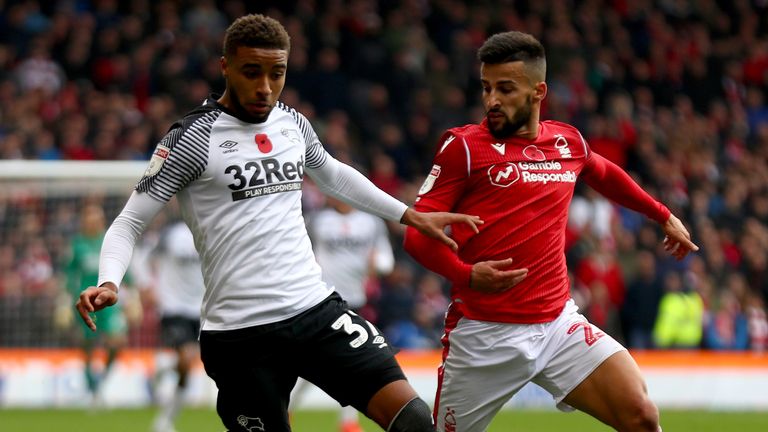
Nottingham Forest will be looking to do the double over local rivals Derby after winning 1-0 at the City Ground in November
Nottingham Forest head coach Sabri Lamouchi has urged his players to retain their focus as they look to move a step closer to the Premier League with victory over East Midlands rivals Derby.
Lamouchi’s side are progressing well themselves, however, and are fourth in the Sky Bet Championship table – seven points clear of Derby in seventh – having won their last two matches.
“It is important to keep our focus, but the players know what they have to do,” said Lamouchi ahead of the fixture at Pride Park.
2:02 Highlights from the Sky Bet Championship match between Nottingham Forest and Bristol City
Highlights from the Sky Bet Championship match between Nottingham Forest and Bristol City
“In the last game, [a 1-0 home win over Bristol City] I was really impressed because without fans and without the right intensity to keep the focus higher like that, it is not easy, especially when we played 16 minutes more.
“They know what they need to do because minute after minute, half after half, game after game they feel something good. They are working hard every day for that.
“There are important games, important points, important details and important minutes and we have started in a fantastic way, scored five goals with seven points out of nine and we have conceded two goals only in extra time.
“It is positive, so we have to keep focused and to continue to work hard with this atmosphere around the team, inside the dressing room, on the pitch and at the club every day.”
1:54 Highlights from the Sky Bet Championship match between Preston and Derby
Highlights from the Sky Bet Championship match between Preston and Derby
Derby boss Cocu is also looking for ‘more of the same’ from his players, as they look to force their way into the play-off shake-up.
The Rams have advanced to within a point of the top six with their impressive run of victories, with Wayne Rooney scoring the winner in their last two games, including a stunning free kick in the 1-0 win at Preston in midweek.
They must now face five of the teams currently above them in their remaining six fixtures, starting with the visit of Forest, but Cocu is confident they can remain in play-off contention.
He said: “Definitely, we’ll give it a go. We have come a long way and we have now put ourselves in a position where we are one point off Cardiff.
“We all know we have six games coming up against the top teams in the league, but it’s positive that we have this big challenge ahead of us in the final stages of the league. That’s why we play.”
Delhi recorded 2,520 fresh Covid-19 cases on Friday, taking the tally in the city to over the 94,000-mark, while the death toll from the disease mounted to 2,923, authorities said here.
On June 23, the national capital had reported its highest single-day spike so far of 3,947 case.
However, in the last five days, the number of fresh cases has oscillated, not showing a particular trend.
The number of fresh cases reported from June 28-July 1 are: June 28 (2,889), June 29 (2,084), June 30 (2,199) and July 1 (2,442), with a steady rise in fatalities.
With 59 more fatalities, the death toll due ro Covid-19 in Delhi stood at 2,923, the Health department said.
A bulletin issued by the department said the total number of cases stood at to 94,695.
Meanwhile, the department issued revised guidelines for home isolation on Friday.
Covid-19 patients suffering from immuno-compromised conditions such as cancer, HIV and who have undergone any transplant procedures are not eligible for home isolation, according to the revised guidelines.
The bulletin said an order has been issued for psychiatrists working in hospitals and medical institutions under the Delhi Health department to be deployed at dedicated Covid-19 hospitals to provide tele-consultancy to patients admitted at these facilities who require psychiatric consultancy.
According to the bulletin, 65,624 patients have recovered, been discharged or migrated so far, while the number of active cases stands at 26,148. It added that 5,96,695 tests have been conducted so far.
The number of containment zones in the city stood at 445 on Friday.
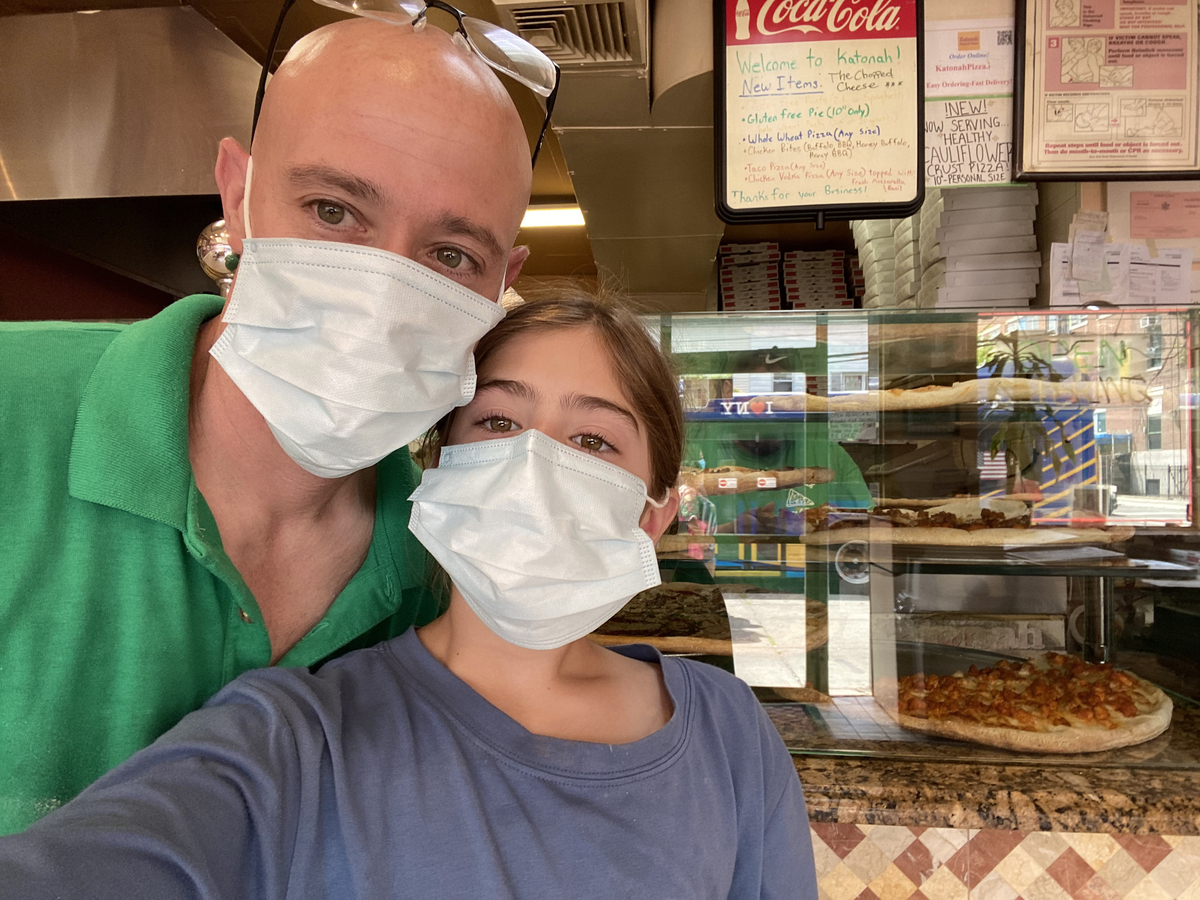
Paul and Francesca Montanaro at Katonah Pizza & Pasta in the Bronx borough of New York City.
Paul and Francesca Montanaro
hide caption
toggle caption
Paul and Francesca Montanaro
Paul and Francesca Montanaro at Katonah Pizza & Pasta in the Bronx borough of New York City.
Paul and Francesca Montanaro
In the middle of March, when the coronavirus forced schools to shutter around the country, Francesca Montanaro, 11, abruptly transferred from fifth grade to “pizza school.”
She started calling into her Zoom English class from a small table squeezed in the back of her father’s pizzeria, Katonah Pizza & Pasta in the Bronx borough of New York City. Surrounded by sacks of flour, she wrote an essay on A Midsummer Night’s Dream in a room filled with the aromas of tomato sauce and mozzarella cheese.
And she has also been helping out at the pizzeria: answering phones, assembling cardboard pizza boxes and learning to use the cash register. She’s there at least a few days a week, sometimes for 12-hour stretches.
Both of Francesca’s parents are essential workers. Her father, Paul, has been providing food to walk-in customers, as well as large orders to nurses, police officers and emergency medical services workers. Francesca’s mother, Jessica, is an intensive care unit nurse at Mount Sinai Morningside hospital, which has been inundated with COVID-19 patients. Under normal circumstances, Francesca’s grandparents would provide child care when both her parents are working, but the family doesn’t want to risk them getting exposed to the virus.
Hunker Down Diaries is a new series from Radio Diaries that shares short diaries and conversations between people thrown together by the pandemic. Stories about ordinary life in extraordinary times. To hear more stories from the Hunker Down Diaries series, subscribe to the Radio Diaries podcast.
At the pizzeria, Francesca enjoys joking around with her dad’s co-workers and the customers, but she does admit that being there all day can be a drag.
“Sometimes I feel bored, mostly because there’s nothing really to do there for an 11-year-old like me,” she said. “It’s not like it’s a jungle gym or anything like that. It’s a pizza shop.”
Recently, Francesca sat down with her dad to talk about life during the pandemic. She wanted to know if her being at the pizza shop bothered him.
“Well, to be honest with you, it does stress me out, only because I know for a kid, your patience is what it is, and sometimes I see that you’re bored,” Paul told her. It troubles him to see her cooped up in the shop all day. But, he said, “I want you to also know that you’re very calming and soothing to me. Having you there in my time of stress has calmed me down, because you’re built that way.”
Francesca said she gets frustrated that her dad is often so preoccupied at work, and she sometimes feels lonely.
“The hardest part for me is you’re usually busy. And I feel like some days I could just sit in the back without you even noticing me,” she told him.
Paul said he understood. Being together at the pizza shop hasn’t been exactly quality time for father and daughter. But the pandemic has given them no other option. “It is what it is,” he told her.
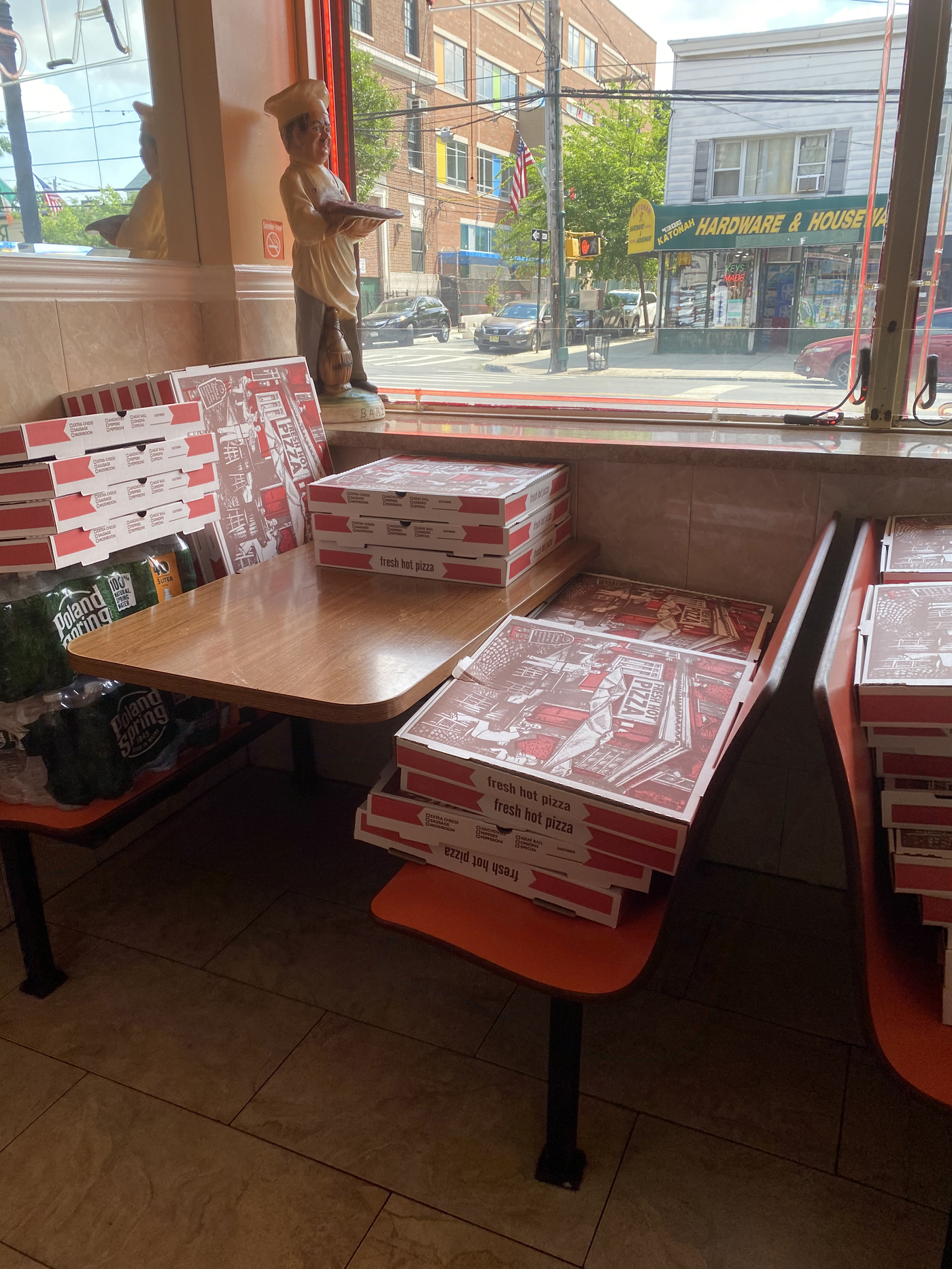
One of Francesca’s jobs at the pizzeria is assembling pizza boxes.
Paul and Francesca Montanaro
hide caption
toggle caption
Paul and Francesca Montanaro
One of Francesca’s jobs at the pizzeria is assembling pizza boxes.
Paul and Francesca Montanaro
“I do want you to know that sometimes I feel very guilty that you’re there with me so many hours, because sometimes mommy doesn’t pick you up until 7 o’clock at night or 8 o’clock at night,” he said.
Even though the situation isn’t ideal, Paul said, for his part, he loves seeing Francesca at the pizzeria. “I’ve seen you learning the register, and you know how to handle money now,” he said. And he recalled with pride the day Francesca made her first pizza.
“You made the perfect pie,” he said. “It was perfectly round. I couldn’t believe the amazing crust you made. Even my pizza guy was like, ‘Oh, my God, she is a natural!’ “
Francesca had one final question: “Do you think you’d want me to take over the pizza shop and run the business?”
“I wouldn’t want you to do what I do,” Paul said. It’s not an easy business, he said. He encouraged Francesca to model herself after her mother’s path into nursing. “Whereas I can feed people, mommy can save lives,” he said. “And not to say that I’m not intelligent, but I see how you are and I see what you can be, and I know that that would be a lot more than what I’ve been in my life and am. And I think you’re going to use that brain and do much better things than what I do.”
Francesca is hoping to become a nurse or a psychologist. In the meantime, she’s spending her summer scooping Italian ice at the pizzeria.
This story was produced by Sarah Kate Kramer of Radio Diaries, with help from Joe Richman and Nellie Gilles. The editors were Deborah George and Ben Shapiro. Thanks to Jessica Deahl and Andrea Hsu of NPR.
We use cookies on our website to give you the most relevant experience by remembering your preferences and repeat visits. By clicking “Accept”, you consent to the use of ALL the cookies.
This website uses cookies to improve your experience while you navigate through the website. Out of these, the cookies that are categorized as necessary are stored on your browser as they are essential for the working of basic functionalities of the website. We also use third-party cookies that help us analyze and understand how you use this website. These cookies will be stored in your browser only with your consent. You also have the option to opt-out of these cookies. But opting out of some of these cookies may affect your browsing experience.
Necessary cookies are absolutely essential for the website to function properly. These cookies ensure basic functionalities and security features of the website, anonymously.
Cookie
Duration
Description
cookielawinfo-checbox-analytics
11 months
This cookie is set by GDPR Cookie Consent plugin. The cookie is used to store the user consent for the cookies in the category "Analytics".
cookielawinfo-checbox-functional
11 months
The cookie is set by GDPR cookie consent to record the user consent for the cookies in the category "Functional".
cookielawinfo-checbox-others
11 months
This cookie is set by GDPR Cookie Consent plugin. The cookie is used to store the user consent for the cookies in the category "Other.
cookielawinfo-checkbox-necessary
11 months
This cookie is set by GDPR Cookie Consent plugin. The cookies is used to store the user consent for the cookies in the category "Necessary".
cookielawinfo-checkbox-performance
11 months
This cookie is set by GDPR Cookie Consent plugin. The cookie is used to store the user consent for the cookies in the category "Performance".
viewed_cookie_policy
11 months
The cookie is set by the GDPR Cookie Consent plugin and is used to store whether or not user has consented to the use of cookies. It does not store any personal data.
Functional cookies help to perform certain functionalities like sharing the content of the website on social media platforms, collect feedbacks, and other third-party features.
Performance cookies are used to understand and analyze the key performance indexes of the website which helps in delivering a better user experience for the visitors.
Analytical cookies are used to understand how visitors interact with the website. These cookies help provide information on metrics the number of visitors, bounce rate, traffic source, etc.
Advertisement cookies are used to provide visitors with relevant ads and marketing campaigns. These cookies track visitors across websites and collect information to provide customized ads.