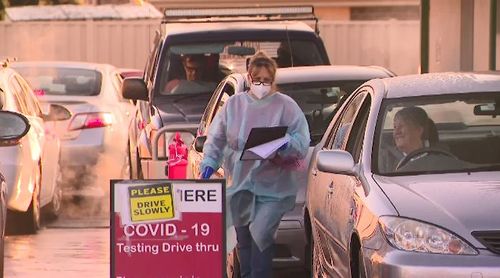
New testing centres have opened in Victoria today after a spike in coronavirus cases saw an influx of people flood sites across the state.
The drive-through site at Chadstone shopping centre was forced to close by 8.20am today following an onslaught of traffic queues “spilling out on the road”.
“My understanding is that it’s a traffic issue,” Victoria’s Chief Health Officer Professor Brett Sutton said.
“As soon as police can manage that traffic flow, they’ll be available for testing again.”
Testing centres, including Westfield Fountain Gate and Chadstone, were also forced to shut early yesterday due to being overwhelmed by people, with some reporting lengthy wait times of four hours.
The surge has prompted authorities to open new testing centres across the state, including the Melbourne Showgrounds from today.
The showgrounds will open at 1pm today to Keilor Downs College students, teachers and parents only, before opening to the public on Thursday. It comes as a second student from the school, believed to be in Year 10, tested positive to the virus.
A pop-up drive-through site has also been re-established at West Footscray Bunnings and another new pop-up at Craigieburn Central.
Victoria Premier Daniel Andrews yesterday apologised for the delays and vowed to consider opening even more testing sites if the surge in demand continued.
“I know there’s been some delays and that’s just a function of many, many people doing the right thing,” Mr Andrews said.
“Coming forward and getting tested, even with very mild symptoms really does give us the data and the evidence to do the contact tracing, to try to win this battle.”
Opposition Leader Michael O’Brien slammed the delays, claiming no one should have to wait hours to be tested and up to three days for results.
“You’ve got Victorians trying to do the right thing, trying to protect their families, themselves and their fellow Victorians and the government’s let them down by not making enough testing available,” he said.
Where to get tested for coronavirus in Victoria
Victorians have been urged to get tested for coronavirus if they have symptoms. There are a range of options available to people wanting to get tested for COVID-19, these include:
Going to your local GP: Call them beforehand, they may perform the test or refer you to a pathology provider
West Footscray Bunnings: 7 days: opening Wed 24 Jun, 10am-6pm, then 8am-6pm
When should I get tested for coronavirus?
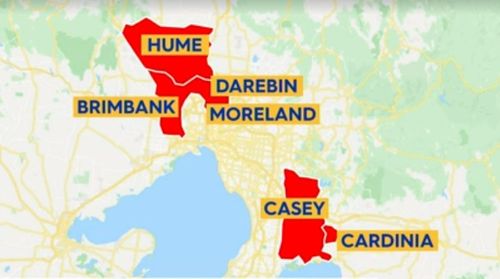
Anyone who is displaying symptoms of coronavirus, however mild, should seek advice and get tested. Residents in the state’s six virus hotspot areas including Brimbank, Hume, Casey, Cardinia, Moreland and Darebin, should particularly get tested.
The COVID-19 hotspots identified in Victoria. (TODAY Show)
What are the coronavirus symptoms?
The coronavirus symptoms to watch out for include fever, chills or sweats, cough, sore throat, shortness of breath, runny nose and loss of sense of smell or taste.
What do I need to do before I get tested?
Wear a mask (if you have one) when you go to get tested to help prevent spreading the infection to others.
Avoid using public transport, taxi or rideshare services. People who get tested should return home immediately after the test.
Bring your Medicare card, or if you don’t have one, another form of identification.
A medical worker places a sample from a person in a tube at a drive-through COVID-19 pop-up testing clinic at the Keilor Community Hub in Melbourne. (AAP Image/Scott Barbour)
How long does it take to get coronavirus test results?
Results usually come through between one to three days after you’re tested. But sometimes there are delays and it can take longer.
People who have questions about their results should contact the clinic or hospital where they were tested.
Those who were tested at a drive-through site and have been waiting more than five days for a result should call the dedicated Onsite Doctor Results Hotline on: 03 8669 0255.
How do they test for coronavirus?
The test takes about a minute and involves taking a sample swab from the back of your throat and nose.
Once the test is complete, your sample is sent to a laboratory and tested to see if you have COVID-19. You will be contacted by your doctor or the clinic who did the test with your results.
What happens if I test positive or negative?
The doctor or the clinic where you were tested will contact you by phone or SMS to tell you your results, regardless if it is positive or negative.
If you test positive you will need to immediately self-isolate. Those who get tested should already been isolating at home while waiting for these results. You will be then contacted by a public health worker from the Department of Health and Human Services (DHHS) for advice on the next steps.
(Reuters) – Former U.S. President Barack Obama on Tuesday made his first campaign appearance alongside Joe Biden since endorsing him for president in April, helping raise more than $11 million for his former No. 2 as he exhorted supporters to meet the “urgency” of the moment.
“I appreciate all of you being on this call,” Obama said at a virtual fundraiser. “But man, this is serious business. Whatever you’ve done so far is not enough.”
The virtual fundraiser collected $7.6 million from 175,000 grassroots contributors. Obama and Biden, the presumptive Democratic presidential nominee, also hosted a private online portion for high-dollar donors, which was not open to reporters and brought in more than $3.4 million.
The haul was the most for any Biden campaign event, coming on the heels of the Democratic Party and Biden’s campaign outraising Republican President Donald Trump in May for the first time.
Tuesday’s fundraiser showed the drawing power of Obama, who remains overwhelmingly popular among the Democratic base and who will be counted on as a key campaign figure this autumn.
It also highlighted the dramatic changes the coronavirus pandemic has wrought on traditional campaigning, with the two politicians sharing a split screen from their living rooms, while supporters tuned in via livestream.
Early in the 2020 campaign, Biden’s weak fundraising numbers compared with some of his Democratic competitors were a source of concern. But his fundraising from donors has picked up in recent weeks as his lead in national opinion polls grew and the country reacted to incidents of police brutality.
Trump, who has been campaigning for a second term since 2017, still has far more cash on hand ahead of the Nov. 3 presidential election.
His campaign noted in a statement that it raised more than $10 million last weekend, when the president appeared in Oklahoma for his first live campaign rally since the outbreak erupted.
“There is no enthusiasm for Joe Biden,” said Tim Murtaugh, a Trump campaign spokesman.
‘MEAN-SPIRITED’
Obama, who has only occasionally criticized Trump since leaving office in 2017, faulted his successor’s behavior several times on Tuesday, saying he “exploits” divisions among Americans and calling his approach to governing “mean-spirited.”
“There is no disconnect between the urgency of this election and the political moment and what has been happening on the streets,” said Obama, referring to the civil rights protests that have swept across major cities since George Floyd, a Black man, died last month after a white Minneapolis police officer kneeled on his neck for more than eight minutes.
Obama also criticized Trump for ignoring advice from public health experts on how to handle the coronavirus and for giving cover to authoritarian governments by attacking the free press and advocating military force against protesters.
“There’s a big contest, not just in this country but around the world, about who we are,” Obama said.
Biden, who has an extensive foreign policy record both as a U.S. senator and as vice president, said he would pick up the phone on his first day in office with a simple message to allies around the world: “America is back.”
As the event ended, Obama said: “Love you, Joe.”
“Love you too, pal,” Biden responded.
(Reporting by by Joseph Ax in Princeton, New Jersey, and Trevor Hunnicutt in New York; Editing by Colleen Jenkins, Jonathan Oatis and Peter Cooney)
This story has not been edited by Firstpost staff and is generated by auto-feed.
California’s getting hot, and today, we’ve got news of wildfires, cooling centers and heated politicking running the gamut from protests to corruption. Also, the sheer magnitude of the coronavirus pandemic’s economic impact is clear, but new, concerning details are emerging about losses in the state’s $50 billion agriculture industry.
Filling in for Arlene Martinez, I’m Mark Olalde, an environment reporter with The Desert Sun in Palm Springs. There’s never a shortage of news in this great state, so let’s get started.
But first, the Golden State is trending in the exact opposite direction it needs to in terms of controlling COVID-19. The number of new cases announced early this week shattered previous records, regardless of how exactly you count them. By one tally, Monday brought more than 6,000 new confirmed cases statewide as nearly every county has been given approval to move deep into Stage 3 reopening. Public health experts and state leadership are pleading with Californians to wear masks and maintain social distancing wherever possible.
The state Senate approved a new bill, now kicking it to the Assembly, that would require the Department of Justice and gun stores to scrutinize hunting licenses during a waiting period before selling firearms. The bill comes in response to a shooting last year at a synagogue near San Diego; the 19-year-old gunman used a hunting license to buy the weapon he is accused of using but his license wasn’t set to go into effect until about two months after the shooting, authorities said.
The Ventura-based outdoor gear company Patagonia announced that it will temporarily halt its advertising buys with Facebook and Instagram because the platforms have done little to stop “hateful lies and dangerous propaganda” from being shared. The North Face and REI, two other gear companies, have also pulled back from the social media sites.
Los Angeles Councilman Jose Huizar, who has been a mainstay in the city’s political scene for two decades, was arrested Tuesday on a racketeering charge. Prosecutors alleged that he shook down developers in exchange for bribes and campaign contributions. The arrest is just the latest in an ongoing probe of corruption among the city’s leadership, although prosecutors did say that Huizar was “the boss” in this alleged scheme.
Coronavirus hammering California
A new economic study commissioned by the California Farm Bureau Federation was released Tuesday and it said that the pandemic is wreaking havoc across the state’s roughly $50 billion agricultural industry. It predicted the pandemic will cost growers between $5.9 billion and $8.6 billion. The industry has already lost out on an estimated $2 billion, with the largest bite taken out of profits from dairy, grapes, flowers and nurseries.
Amazon has often made news for its workplace conditions, and it now refuses to release information about the number of its employees in Southern California who have tested positive for the coronavirus. So, workers have turned to crowdsourcing that information to learn more about potential outbreaks in their warehouses. The efforts have identified at least 60 positives in Riverside and San Bernardino counties.
Hundreds of thousands of “snowbirds” typically flock to the Palm Springs area every year to enjoy the desert’s beautiful winters. But, the mix of public and private health insurance packages Canadian travelers usually rely on likely won’t cover COVID-19-related costs. This might ground a large percentage of the annual pilgrimage, potentially throwing another wrench into the Coachella Valley’s important tourism industry.
Data have been a huge part of the coronavirus narrative, as public health officials, academics and journalists have raced to track the virus and outbreaks. But, confusion surrounding medical privacy laws and the speed of the pandemic’s progression have left individual counties making decisions on what data to release and how. It’s an issue that could complicate efforts to more effectively track the deadly virus, as it means data reporting practices aren’t standard across California.
A community group calling itself the Stockton Coalition for Shared Safety protested on Monday to call for the abolition of the school-specific police department. One former student described the “cradle-to-prison pipeline,” as he described why he opposed police in schools. On Tuesday, the school district was scheduled to hear more about the demands that have mirrored those brought elsewhere around the country.
A coalition of “Southern California community activists and labor organizers” was already organizing before Floyd’s death sparked international protests. But with renewed attention on issues in Black communities, the coalition launched a report confirming that Black people in the Inland Empire disproportionately hold low-income jobs.
When isn’t it wildfire season anymore?
Even if you’re mad at someone, don’t shoot a flare gun at them during wildfire season. At least that’s one lesson to take from this story. The California Department of Forestry and Fire Protection announced on Tuesday that a Shasta County woman had been arrested on suspicion of starting a small fire a few days earlier after discharging a flare during an argument.
A 1,100-acre brush fire in Tulare County is racking up statistics after it quadrupled in size on Monday. As of Tuesday, 225 firefighters had been dispatched to attack the blaze, and one landowner estimated that he was already facing $50,000 in property damage.
And finally, it’s getting hotter as we venture deeper into summer, but the cooling centers that are normally opened to help those without access to air conditioning are coming up against the need for social distancing. Check out this piece from the Record Searchlight to learn more about what this means in Redding and elsewhere around California.
That’s all for today. Thanks for reading, and stay cool and socially distanced out there.
In California is a roundup of news from across USA TODAY Network newsrooms. Also contributing: Associated Press, the Los Angeles Times and the Business Journal.
Read or Share this story: https://www.usatoday.com/story/news/nation/2020/06/23/california-surge-covid-19-cases-breaking-records-and-wildfires-heat-up/3245984001/
North Korea has announced it will suspend “military action plans” against South Korea, after a meeting of the governing party’s Central Military Commission presided over by  leader Kim Jong Un, the official KCNA news agency said on Wednesday.
The video conference meeting on Tuesday also discussed documents outlining measures for “further bolstering the war deterrent of the country”, KCNA reported.
The committee members “took stock of the prevailing situation” before deciding to suspend the plans, the report said, without elaborating.
Political tensions between the two Koreas have been rising over Pyongyang’s objections to plans by defector-led groups in South Korea to fly propaganda leaflets across the border. The country is also suffering under economic sanctions that it wants eased as part of denuclearisation talks that have been stalled for months.
North Korea claims the defectors’ campaigns violate an agreement between the two aimed at preventing military confrontation, and has accused them of insulting the dignity of North Korea‘s supreme leadership.
In recent weeks North Korea has blown up a joint liaison office on its side of the border, declared an end to dialogue with South Korea, and threatened military action.
Kim’s sister, Kim Yo Jong, warned last week of retaliatory measures against South Korea that could involve the military although she did not elaborate.
The General Staff of the Korean People’s Army later said it had been studying an “action plan” that included sending troops into joint tourism and economic zones, reoccupying border guard posts that had been abandoned under an inter-Korean pact, taking steps to “turn the front line into a fortress,” and supporting plans for North Korea to send its own propaganda leaflets into South Korea.
Older brother seems to have reversed sister’s plans. Echoing others in asking if this is good cop/bad cop? North Korea suspends plans for military action against the South https://t.co/jYkHenTTvI
North Korea‘s military was seen putting up loudspeakers near the Korean Demilitarized Zone, a military source told Reuters on Tuesday. Yonhap news agency reported on Wednesday that the loudspeakers were being removed.
Thursday marks 70 years since the start of the Korean War. The fighting ended in 1953 with an armistice. A formal peace treaty has never been signed.
As his political challenges have intensified, Mr. Trump is stepping up his focus on race and “heritage,†in references to totems like statues of Confederate generals. He has vowed to defend a statue of Jackson, the president who owned slaves and signed a law that led to the forcible removal of thousands of Native Americans from their lands.
On Monday night, Mr. Trump retweeted users who posted video featuring black people physically assaulting white people, including one that was a year old. Days earlier, Twitter affixed a “manipulated media†tag to a video Mr. Trump tweeted that portrayed a fabricated CNN segment in which Trump supporters were maligned as racist.
At his rally in Tulsa, which drew far fewer supporters than anticipated, Mr. Trump made no mention of the massacre of black residents in the city’s Greenwood section in 1921, or of the Juneteenth holiday a day earlier that celebrated the end of slavery. Instead, he again bemoaned the tearing down of statues.
In an interview on Fox News on Tuesday morning, Mr. Trump said that people who ignore history will repeat it, and then said: “You don’t want to take away our heritage and our history and the beauty.â€
As protesters try to tear down statues of a range of historical figures and spray paint buildings, including the St. John’s Church adjacent to the White House, some Democrats are beginning to cringe.
But Mr. Trump has been unwilling to spotlight the destruction of statues dedicated only to broadly popular figures, such as George Washington and Ulysses S. Grant. His inclination on race is always to reach for the most incendiary rhetoric, lest his supporters miss the point.
In some ways, his conduct recalls the period leading up to the 2016 Republican nomination, when he twice called for a ban on Muslims entering the United States and openly wielded race in a way that appealed to large segment s of the G.O.P., but also alienated many people in the party.
Speaking in a state where coronavirus cases are surging enough to repeatedly set new daily infection records, President Donald Trump told a crowd of young Arizona supporters that everything was under control.Â
“Someday it’ll be recognized by history,†he said of his pandemic response while speaking at a campaign-style event at Dream City Church, hosted by the conservative nonprofit Turning Point USA.
This is “hopefully the end of the pandemic,†Trump told an audience of about 3,000 college students, most of whom did not wear masks.Â
There’s little to indicate that. Arizona is one of several states that, with Trump’s urging, followed an aggressive reopening schedule. Now it’s averaging about 2,500 new cases daily, a 94% increase from last Monday. Infections are rising in more than half of the U.S. states, with other alarming surges in Texas and Florida.Â
Hours before Trump made that prediction, Dr. Anthony Fauci, the infectious diseases expert leading the country’s response to COVID-19, warned that “the next couple of weeks are going to be critical†in addressing surges in the worst-hit states.Â
But Trump didn’t acknowledge the surges during his Arizona rally and repeated his claims that ramped-up testing protocols are making the pandemic look worse than it is in the U.S. He then boasted of the low mortality rate, despite the U.S. currently having the fourth-highest coronavirus death rate in the world, according to data from Johns Hopkins University.
Trump also returned to the same racist jokes he’s made since the beginning of the pandemic, which has since claimed more than 120,000 lives in the U.S. so far.
“COVID-19, I said that’s an odd name,†Trump said after calling the virus “Wuhan,†the name of the province where the virus was first reported, and “kung flu,†sending the young supporters into cheers.Â
This was Trump’s second rally in the last week. On Saturday, his campaign proceeded with one in Tulsa, Oklahoma, despite six of his campaign staffers testing positive for the coronavirus the day before the rally.Â
A HuffPost Guide To Coronavirus
Calling all HuffPost superfans!
Sign up for membership to become a founding member and help shape HuffPost’s next chapter
Camila Mendes is condemning anyone who would falsely say they were the victim of sexual assault, after anonymous Twitter users accused several of her Riverdale costars — including Cole Sprouse, Lili Reinhart, KJ Apa and Vanessa Morgan — of sexual misconduct over the weekend.
“It’s so insane to me that somebody would do such a thing to prove a point,†she said Tuesday on SiriusXM’s The Jess Cagle Show. “It seems so trivial, like ‘Oh, really, you went to that extent? To damage not only the integrity of the #MeToo movement but also potentially damage the careers of these people and their lives?’ To do that in order to make a point about how easily people believe things is just so backwards to me, and I feel for my castmates who had to deal with that.”
She made a similar statement Monday on her Instagram Story, calling such actions “sickening†and “incredibly destructive.â€
Spouse and Reinhart denied the accusations. Kapa has not responded, while Morgan shared Sprouse and Reinhart’s words.
The person behind one of the accuser’s accounts reportedly also wrote, “Do you see how easy it is to lie and you guys will believe it? Vanessa Morgan and KJ Apa didn’t do jack s***. You will believe anything.â€
The allegations against the actors have since been deleted.
In Sprouse’s statement, he wrote that he’d been falsely accused.
Earlier today myself and three other cast mates were falsely accused of sexual offense by anonymous accounts on twitter. I take these accusations very seriously, and will be working with the right teams to get to the root of it. (1)
False accusations do tremendous damage to victims of actual assault. Furthermore, I would never seek to silence anybody. I encourage that people look into the accusations themselves, as the events detailed were factually untrue. 2
Reinhart said, in part, “I have always taken sexual assault allegations seriously. But it was proven that this account was created specifically to create false stories about me and my cast. I can’t think of something more twisted than lying about sexual assault.â€
She also spoke about the damage that any untrue allegations of sexual misconduct can have on actual victims.
I have always taken sexual assault allegations seriously. But it was proven that this account was created specifically to create false stories about me and my cast. I can’t think of something more twisted than lying about sexual assault. It invalidates the men and women who are- https://t.co/qcZMXYPNLQ
Brave enough to come forward with the truth. This kind of lie can ruin lives and careers- and I can call it a lie because the person who made the allegations already admitted that the stories were fabricated.
We are looking into taking legal action. This kind of sick behavior only harms true survivors. This was incredibly triggering for me and scary because I’ve always supported survivors and believed them.
Cast member Madelaine Petsch noted that, as a sexual assault survivor, she’s “deeply deeply disturbed that anyone thinks that it is okay to falsely accuse someone of sexual assault.†She called false accusations “disgusting.â€
As someone who has been sexually assaulted, I am deeply deeply disturbed that anyone thinks that it is okay to falsely accuse someone of sexual assault. This is why real assault allegations can sometimes not be taken seriously, you should be ashamed. This is disgusting. https://t.co/EX8mUIuFGJ
— Madelaine Petsch (@madelainepetsch) June 22, 2020
It is up to each state and territory to decide when and how far they will relax restrictions.
Here we try to answer some of the most common questions people have about the laws, based on the information current as of 22 June.
The federal government has said that by July all states and territories will remove attendance caps for indoor venues and instead abide by the four square metres per person rule. For venues with 40,000 seats or less, attendance must not exceed 25% of capacity.
These answers should not be treated as legal advice. This article will be updated as new restrictions are announced, implemented, or repealed.
New South Wales – Currently 20 people from different households can visit. There is no limit to the number of guests you can have over per day, as long as there are no more than 20 at a time and guests can stay overnight.
Victoria – You can have up to five guests in your home, reduced to a total in-home gathering size of 20. The Victorian health department says you can have more than one set of visitors over per day, but that you should “be considered and use common senseâ€. You are allowed to have people stay over at your home.
Queensland – Up to 20 adults from different households are allowed to visit another home. The state government has tentatively announced that, from 10 July, up to 100 people may be allowed to gather in your home (for those of you who have homes big enough to accommodate 100 guests).
Tasmania – You can have up to 20 visitors over.
Western Australia – Up to 100people are allowed to gather publicly and privately per single undivided space. Up to 300 people can gather together in total over multiple spaces. From 27 June, all gathering limits, along with the 100/300 rule, will be removed. Instead, gatherings will be governed by the one person per two square metres rule.
South Australia – Gatherings of up to 75 people are allowed indoors, as long as the four square metres per person rule is met.
Northern Territory – There is no limit on how many people can gather indoors or outdoors, but you must keep 1.5 metres between you and anyone with whom you don’t live.
New South Wales – Currently public gatherings of up to 20 people are allowed. From 1 July community sport for children and adults will return in full, including contact sports.Spectators and participants will have to abide by the 4 square metre rule (the NSW government amended the public health act on 12 June to abolish the 500-person upper limit). Sports organisations must adapt competitions to meet this rule, in line with local government guidelines.
Victoria – Up to 10 people can gather outside for recreational purposes, or to engage in activities like hiking, jogging and other non-contact sport.
Queensland – Up to 20people can gather outside. The plan is that from 10 July,up to 100 people will be allowed to gather inside and outside.
Tasmania – Gatherings of up to 80 people are allowed outsideOn 26 June, caps on public gatherings will no longer apply, though everyone must still maintain physical distancing.
Western Australia – Up to 100people are allowed to gather outside at the moment. From 27 June, all gathering limits will be removed.
South Australia – Up to 20 people can gather outside for non-work reasons. You must continue to practice physical distancing with anyone you don’t live with.
Northern Territory – There are no limits on gathering in the NT, but you should maintain physical distancing.
ACT – Up to 100 people can gather together outdoors.
Can I visit someone in an aged care facility?
Please note that in every state, all visitors must have received this year’s flu vaccination, unless they have a documented medical contraindication to receiving the vaccine. Visitors cannot enter an aged care facility if they have recently been overseas, been in recent contact with a confirmed case of Covid-19, or are feeling unwell.
New South Wales – NSW Health provides guidelines for residential aged care facilities. Residents should only have one daily visit with a maximum of two visitors (immediately family or close friends), no large group visits or gatherings, and all visits should be short and take place in the resident’s room, outdoors or a specified area (instead of a communal area).
Victoria – Residents of care facilities, including aged care, can have up to two support visits each day, for up to two hours. The two visitors can go together, or in separate visits that total two hours. Those under the age of 16 can only visit if the resident is receiving end-of-life care or if they are in the company of an adult.
Queensland – Residential aged care residents can have one visit per day, for up to two hours. A maximum of two people can visit for the purpose of providing care and support.
Tasmania – As of Monday 22 June,residents in aged care facilities can have multiple visits of two people, with no restrictions on the length of visits or the total number of visitors they receive in a day. Residents are permitted to go outside on trips, and hairdressers can be allowed in. Children under 16 will also be allowed in.Additional visitors are allowed for the purpose of end of life support, or if needed to reduce distress and confusion given a residents’ medical condition.
Western Australia – Each resident in an aged care facility can have one care and support visit a day, with up to two visitors at a time. Only immediate social supports, like family members and close friends, professional help or advocacy services can attend.
South Australia – Residents can have one visit per day. Up to two people can visit them at the same time for the purpose of providing care and support. Visits cannot take place in communal areas.
Northern Territory – Residents can have up to two visitors at a time, and visits should be kept short. Children aged 16 years and under are not allowed to visit those in aged care facilities, except for special circumstances.
ACT – Residents can have one visit per day, of up to two people, for the purposes of providing care and support. Visits cannot last more than two hours. Those aged 16 years or younger can only visit on compassionate grounds for the purpose of visiting a resident at the end of life.
Can I eat at a restaurant, cafe or pub?
New South Wales – Yes, up to 50people can dine-in at cafes, bistros, and restaurants, as long as there are four square metres of space allowed per person. Pubs, registered clubs and casinos, and cellar doors that serve food are also allowed to open their dining areas. However, alcohol can only be purchased with food, or to takeaway. A maximum of 10 people are allowed per booking. However, gatherings for or immediately after a wedding are allowed up to 20 guests. Gatherings immediately after a funeral or memorial service are allowed to book for up to 50 guests as long as the venue can accommodate that many people. All diners must provide their name and contact details, including a phone number or email address, to allow for contact tracing. Food courts can also reopen. From 1 July, the number of people allowed inside an indoor venue will be determined by the one person per four square metre rule.
Victoria – Yes,cafes, restaurants and other hospitality businesses like RSLs and bowling clubs are able to seat up to20 patrons in an enclosed space (find out what constitutes an enclosed space here). There canonly beone customer per four square metres and tables must bespaced at least 1.5 metres apart. Venues arealso required to keep the first name and phone number of every customer to help with contact tracing, if necessary. Alcohol will only be available to purchase with meals. From 12 July ,the number of diners allowed will increase to 50. Food courts will still only be able to offer delivery and takeaway. Under stage 3 rules, expected to be introduced in July, a venue’s attendance limit will require four square metres per person.
Queensland – Yes, restaurants, cafes, pubs, registered clubs, RSL clubs and hotels (with a Covid-Safe Checklist) can seat up to 20patrons at any one time, as long as they can allow four square metres per person. Places in the outback are allowed up to 50 locals (who must show proof of residence) at any one time. Casinos areallowed to seat diners, but bars and gaming will have to stay closed. From 10 July,up to 100 people will be allowed to dine in. Food courts will be allowed to reopen. Under stage 3 rules, expected to be introduced in July, a venue’s attendance limit will require four square metres per person.
Tasmania – Yes, restaurants, cafes, pubs, clubs, hotels and RSLs can seat up to 80 diners per dining room, as long as there is one person per four square metres. You can find out what constitutes a dining room here. Each dining area must also have separate waitstaff. Any alcohol must be purchased with a meal. Under stage 3 rules, brought forward to 26 June, there will be no cap on public gatherings. Venues will only be allowed one person per four square metres.
Western Australia – Yes, cafes and restaurants (including in pubs, bars, hotels, casinos, clubs) can open to up to seated diners, with one person per every two square metres. Alcohol may be served without a meal at licensed premises, as long as patrons are seated. Food courts can also reopen to seated patrons.From 27 June, venues will be allowed to serve food and alcohol to non-seated patrons. There will be no requirement to maintain a patron register.
South Australia – Yes.Up to 300 people will be allowed in venues, with up to 75 people per room/ enclosed area.There must be four square metres per person. Pubs, wineries and cellar doors are allowed to serve alcohol without food, but only to seated patrons. FUnder stage 3 rules, expected to be introduced in July, a venue’s attendance limit will require four square metres per person.
Northern Territory – Yes. All businesses areallowed to reopen as long as they have a Covid-19 plan. The two-hour limit hasbeen lifted, meaningnight clubs can reopen. You will be able to purchase alcohol from a bar. Licensed gaming activities, including TAB, will start again. Under stage 3 rules, expected to be introduced in July, a venue’s attendance limit will require four square metres per person.
ACT – Yes, restaurants, cafes and other hospitality venues offering seated dining can host up to 100 patrons in each indoor or outdoor space, as long as there is one person per four square metres. This limit excludes staff. Bars, pubs, and clubs can serve alcohol in groups of up to 10 seated patrons, without a meal. From 10 July, food courts will be allowed to open to seated patrons.
How far can I travel on holiday within my state?
New South Wales – There are no limitations on travelling within the state, including for a holiday.A number of caravan parks and camping grounds have also reopened.
Victoria – There are no restrictions on how far you can travel within the state. You are allowed to stay in a holiday home or private residence, and tourist accommodation, including caravan parks and camping grounds, where there are no shared communal facilities.
Queensland – You areallowed to travel anywhere in Queensland for recreational purposes, other than in certain designated remote communities. Camping and holiday accommodation sites, including caravan parks, are allowed to open.
Tasmania – There is no limit on where you can go within the state.
Western Australia – Residents are allowed to leave their homes for recreationalactivities including picnics, fishing, boating or camping. Recreationaltravel to mostnearby regions is now allowed, except to some remote Aboriginal communities.
South Australia – There are no restrictions on travel within South Australia. Some Aboriginal communities across the state have chosen to close access to their townships and lands to non-essential outside visitors. Non-essential visitors to these communities have to quarantine for 14 days and be granted permission.
Northern Territory – There are no restrictions on travel within the Northern Territory.
ACT – There is no limit on where you can travel.
Podcast: listen to our daily episodes on Apple Podcasts, Spotify or search “Full Story” in your favourite app
Can I holiday in another state?
New South Wales – Residents are allowed to leave NSW, and visitors don’t need to quarantine. Since 1 June, anyone in Australia has been able totravel to regional NSW for a holiday.
Victoria – There are no restrictions on leaving or entering Victoria. Since 1 June, overnight stays at tourist accommodation, caravan parks and camping grounds without communal facilities, have beenpermitted.
Queensland – No, entry into Queensland is prohibited unless you have applied for and been granted an exemption. But Queensland is set to open its borders from 10 July, as long as case numbers remain low.
Tasmania – All non-essential travellers to Tasmania, including returning residents, must quarantine for 14 days upon arrival. Non-Tasmanian residents must carry out their quarantine in government-provided accommodation.
Western Australia – You cannot enter Western Australia unless you are granted an exemption on application. There is no date for when the interstate border will reopen.
South Australia – People from Queensland, WA, the NT and Tasmania can enter South Australia without having to quarantine for 14 days. But people from NSW and Victoria will have to – until 20 July, whenthe quarantine requirement will be lifted for all domestictravellers.
Northern Territory – Unless you have been granted an exemption, anyone entering the Northern Territory must complete 14 days of mandatory self-quarantine. International arrivals still have to undertake a Government-mandated and supervised quarantine, and are required to pay $2,500 per person, or $5,000 for a family of two or more, to cover the cost. The NT will open its borders to domestic travellers on 17 July.
ACT – There are no border restrictions.
How many people can attend a wedding or funeral?
New South Wales – Up to 20 people are allowed at weddings in NSW. Those attending will have to provide their name and contact details for contact tracing, if necessary. There is now no limit on the number of people allowed to attend a funeral, as long as there are four square metres per person if held indoors.
Victoria – How many guests you can have depends on whether you are hosting the ceremony at home or elsewhere. If it is held at a venue, the celebrant, couple being married, and 20 people will be allowed to attend a wedding. Up to 50 people will be allowed to attend a funeral, in addition to the officiant and funeral staff, as long as there are four square metres allowed per person. But if a wedding or funeral is held in a home, only 20 people in total will be allowed to attend (including the celebrant and couple/ officiant and staff). Under stage 3 rules, expected to be introduced in July, attendance limits will require four square metres per person.
Queensland – Up to 20people can attend a wedding. Funerals can have up to 100 guests from 16 June. The next of kin at funeral services is required to collect contact information for all attendees and keep the list for at least eight weeks to facilitate contact tracing, if required. A maximum of 100 people should be allowed to attend weddings from 10 July.
Tasmania – Up to 80 guests, excluding the couple getting married and those facilitating, can attend a wedding. Up to 80 guests can attend a funeral.
Western Australia – Weddings and funerals can have up to 100 guests. From 27 June, all gathering limits will be removed.
South Australia – Weddings can have up to 75 attendees, not including the celebrant, venue staff or any other person required to facilitate the wedding. Up to75 can also attend a funeral. This excludes those officiating the funeral or any staff required to carry out the funeral. If the ceremony involves food or drinks, no shared utensils can be used. Social distancing must be observed.
Northern Territory – There is no limit on the number of attendees.
ACT – Up to 100 guests can attend weddings or funerals, as long as there is no more than one person per four square metres.Under stage 3 rules, expected to be introduced in July, attendance limits will require four square metres per person.
Can I go to church?
New South Wales – Yes, 50 people can attend religious gatherings and places of worship, as long as the four square metres physical distancing rule can be observed. The states chief health officer has urged congregations to reconsider activities that might spread the virus-like group singing and passing round of collection baskets.From 1 July, the number of people allowed inside indoor venues will be determined by the one person per four square metres rule.
Victoria – Yes, places of worship can open for private worship or small religious ceremonies of up to 20 people, plus the minimum number of people reasonably required for the service, is allowed in a single, undivided indoor space. There must be four square metres per person. At least one hour should be allowed between services or ceremonies to reduce the risk of crowds.
Queensland – Yes, up to 20people can visit a place of worship or attend a religious ceremony. This number will increase to 100 people from 10 July.
Tasmania – Yes, but only up to 80people can attend a religious ceremony or private worship. Under stage 3 rules, to be introduced on 26 June, attendance will only be limited to four square metres per person.
Western Australia – Yes, up to 300 patrons – 100 per enclosed area – can attend places of worship. From 27 June, all gathering limits, including the 100/300 rule, will be removed.
South Australia – Yes, up 75people can attend at a time for private worship or religious gatherings. Social distancing must be observed.
Northern Territory – Yes, but you can only be there for less than two hours. There is no limit on how many people can attend a place of worship at the same time.
ACT – Up to 100people, the four square metre rule permitting, can attend religious ceremonies and places of worship, not counting those conducting the ceremony.
Are schools back in session?
New South Wales – Yes, all students went back to school full-time on Monday 25 May.
Victoria – Yes, as of 9 June, all students have returned to the classroom.
Queensland – Yes, all students are back at school as of Monday 25 May.
Tasmania – Yes, as of 9 June, all students have returned to the classroom.
Western Australia – Yes, all students returned on 18 May. Parents and visitors are also now allowed on school grounds. Events and activities such as assemblies, excursions, choirs, exams, sports training and swimming classes can resume, in line with distancing requirements. School libraries can also open for up to 100 people in a shared space at a time. From 27 June, all gathering limits, including the 100/300 rule, will be removed.
South Australia – Yes, they reopened for term 2.
Northern Territory – Yes, since 20 Aprilall NT students have been expected to physically attend school.
ACT – Yes, all students have returned to school as of 2 June.
Can I shop for clothes and other ‘non-essential’ items?
New South Wales – Yes.
Victoria – You are only supposed to shop for necessary goods and services. Most businesses are also required to keep a record of names and contact details of customers in case contact tracing is later required.
Queensland – Yes, retail shopping for non-essential items is back on.
Tasmania – Yes, you are allowed to leave your home to use businesses or services that are allowed to operate, which includes retail stores.
Western Australia – Yes.
South Australia – Yes.
Northern Territory – Yes.
ACT – Yes.
Are salons, spas and other beauty services open?
New South Wales – Hairdressers and barbers can open, but must allow four square metres per person within the premises and should minimise personal contact with the customer. Nail, waxing, tanning, and beauty salons can open to 10 customers at a time. There can only one person per four square metres (including staff) on the premises, and providers must have a Covid-19 Safety Plan. Tattoo and massage parlours areallowed to reopen, with restricted numbers.
Victoria – Hairdressers and barbers are allowed to be open, but they are required to take your name and contact details should contact tracing become necessary. Beauty therapy, spray-tanning, waxing and nail salons, spas and massage parlours and tattoo and piercing services are able to reopen. Up to 20 customers areallowed on one premise, subject to the four square metre rule. Providers will still need to log customers’ contact details.
Queensland – Yes, beauty therapy and nail salons, tanning salons, tattoo parlours, spas, and non-therapeutic massage parlours (with a Covid-Safe checklist) can open to up to 100 people on site.
Tasmania – Yes, hairdressers and barbers can open. Beauty services and day spas can reopen withno cap on the number of people allowed inside, as long as there is one person per four square metres. Saunas and bathhouses will be allowed to open from 13 July.
Western Australia – Yes, all beauty services, including nail, tanning and waxing salons can resume for up to one person per two square metres. Saunas, bath houses, wellness centres, float centres, spas and massage centres may reopen to up to 100 people per room/ enclosed space, and up to 300 people across the entire venue. From 27 June, all gathering limits, including the 100/300 rule, will be removed.
South Australia – Yes, hairdressers and barbers, along with beauty salons, nail and tattoo parlours and non-therapeutic massage providers can open, as long as the total number of people on site doesn’t exceed one person per four square metres.
Northern Territory – Yes, hairdressers, and nail, massage and tanning salons, tattoo and piercing parlours and any other beauty services can open.
ACT – Yes, hairdressers and barbers are allowed. Beauty therapy businesses, including nail salons, tanning and waxing services, day spas, including massage parlous and tattoo businesses areallowed to reopen, but cannot exceed oneperson per four square metres, including staff, and must keep a record of customers to enable contact tracing, if needed.
What about cinemas, entertainment venues, museums and libraries?
New South Wales – Museums, galleries and libraries areallowed to reopen to guests, as long as four square metres is allowed per person and they have a Covid-19 safety plan. Groups and tours aren’tallowed to run, and all library returns will go through a 24-hour quarantine. National Trust and Historic Houses Trust properties can open, as long as they follow the four square metres rule (including staff). Indoor cinemas and theatres must stay closed. From 1 July, the number of people allowed inside indoor venues will be determined by the one person per four square metres rule. For venues with 40,000 seats or less, attendance must not exceed 25% of capacity.
Victoria – Galleries, museums, national institutions, historic sites, amusement parks, zoos and arcades are allowed to open up to 20 customers per separate space, with four square metres per person. Drive-in cinemas arealso allowed to recommence food and drink operations. From 12 July , the number of people allowed in these venues will increase to 50 per separate space. Up to 50 customers will be allowed to watch a film per cinema at movie theatres. Customers not from the same household will have to sit at least 1.5 metres apart, and the four square metre rule will apply. Concert venues and theatres will be able to reopen to 50 viewers per separate space. From 20 July, electronic gaming at pubs, clubs and casinos will restart, per social distancing requirements.
Queensland – Libraries, along with museums, art galleries, and historic sites, canhave 20 visitors at a time. Indoor cinemas, concert venues, theatres, arenas, auditoriums, stadiums, nightclubs, outdoor amusement parks, zoos and arcades are set to reopen on 10 July. All venues will be allowed to host up to 100 people at a time on site.
Tasmania – Up to 80 people can attend libraries, amusement parks, arcades, play centres, cinemas, museums, national institutions, historic sites and galleries. Up to 80 people are also allowed at concert venues, theatres arenas, auditoriums, with an additional number of people specified for performers. Under stage 3 rules, to be introduced on 26 June, there won’t be a cap on the number of people allowed in an indoor venue, as long as there are four square metres per person. Outdoor gathering limits will increase to 500.
Western Australia – Community facilities, libraries, galleries, museums, theatres, auditoriums, cinemas, and concert venues can all reopen, along with Perth Zoo, wildlife and amusement parks, arcades, skate rinks and indoor play centres. All venues can have up to 100 people per enclosed space, and up to 300 people across the entire venue. From 27 June, all gathering limits, including the 100/300 rule, will be replaced by the one person per two square metres rule. There will be a 50% capacity cap on major sport and entertainment venues, in venues like the Optus Stadium, HBF Park and RAC Arena. All events will be allowed, except for large scale, multi-stage music festivals. Unseated performances will be able to go ahead at concert halls, live music venues, bars, pubs and nightclubs, and the casino gaming floor will be allowed to reopen under temporary restrictions.
South Australia – Libraries, community and youth centres, cinemas, theatres, galleries and museums can have up to 300 people inside their venues at a time, with a maximum of 75 people per room/ enclosed space. Swimming in public pools is allowed.
Northern Territory – Public libraries, art galleries, museums, zoos, cinemas and theatres, music halls, nightclubs, amusement parks, community centres, stadiums, sporting facility and similar entertainment venues can open.
ACT – Up to 100 people are allowed at cinemas and movie theatres, indoor amusement centres, arcades, outdoor and indoor play centres, betting agencies, outdoor amusements and attractions, community and youth centres, galleries, museums, national institutions, libraries historic sites. There can only be one person per four square metres throughout the venue. Organised tour groups of up to 20 people (excluding staff) will be permitted.
Can I go to the gym? What else can I do for exercise?
New South Wales – Gyms, fitness centres and studios (like dance studios) are allowed to open for up to 10 people per class, and a maximum of 100 people per venue.Indoor pools and saunas will also be allowed to reopen, with restricted numbers. Up to 10 people can gather in public, meaning that outdoor boot camps and non-contact sports are allowed. You can use outdoor gym equipment in public places, with caution, and engage in recreational activities like fishing, hunting and boating. Up to 10 people can swim in outdoor pools at a time. You can contact your local council to see if parks and beaches are open in your area; most historic sites and some beaches in national parks have been closed.From 1 July, children’s community sport competitions will be allowed to restart.
Victoria – No: gyms, yoga studios, and fitness classes, and indoor personal training are prohibited. Up to 20people can gather outside for activities like hiking, jogging , bike riding, canoeing, kayaking and other non-contact sports. Outdoor boot camps of up to 20people plus the trainer are also allowed. Outdoor swimming pools can have 20 patrons per enclosed space and three swimmers per pool lane.Playgrounds, outdoor gums, and skateparks have also been open since 26 May. As of 22 June, indoor sports facilities, like gyms, can open up to 20 clients at a time, per separate enclosed space, as long as the four square metre rule is followed. Only 10 people areallowed per group per activity. Children areallowed to compete in contact sport, but non-contact sport will also be allowed for all ages. Skiing is also permitted now. . Adults can begin training for contact sport from 13 July and begin playing from 20 July.
Queensland – Yes, gyms, health clubs, yoga studios and community sports clubs can reopen to 20 people at a time. Up to 20 people can gather outside, play non-contact sport, and participate in outdoor group training and bot camps. Parks, playgrounds, skateparks and pools are open to up to 20 people at a time.The state government plans to increasethis number to 100 people from 10 July.
Tasmania – Yes, 80 people are allowed at gyms, sporting venues, health clubs, and fitness centres, with physical distancing and density rules applying. Contact sports are prohibited. Up to 80 people are also allowed to take part in outdoor sporting activities, such as boot camps, personal training, and swimming. Under Stage 3 rules, to be introduced on 26 June, there won’t be a cap on the number of people allowed in an indoor venue, as long as there are four square metres per person. Outdoor gathering limits will increase to 500.
Western Australia – Gyms, health clubs, and indoor sports centres can reopen for up to one person per two square metres. Gyms must be staffed at all times and undertake regular cleaning. Contact sport and training can also recommence, and playgrounds, outdoor gym equipment and skate parks can be used. Outdoor sporting venues may have up to 100 patrons per training zone at any one time, with a least two square metres allowed per person. There can be no more than 300 people across a venue. Large community sporting facilities that can accommodate more than 300 patrons, while allowing for at least two square metres per patron, can apply for an exemption. From 27 June, all gathering limits, including the 100/300 rule, will be replaced by the one person per two square metres rule. Gyms will be allowed to operate unstaffed, but will still have to undergo regular cleaning.
South Australia – Yes, gyms can open for up to75 people per enclosed area, subject to the one person per four square metres rule, but there remains a cap of 10 people per indoor fitness group class. Up to 20 people can play outdoor, non-contact sport, take part in an outdoor bootcamp, and use golf courses, tennis courts and public gym equipment. Contact outdoor sport competitions can commence, along with training for contact indoor sports.Under stage 3 rules, expected to be introduced 29 June, attendance limits for indoor venues will require four square metres per person, with the 20 person per venue cap lifted.
Northern Territory – Yes. Gyms, fitness studios, and indoor training activities like Cross Fit are allowed to operate. You can also officiate, participate and support team sports, like football, basketball, soccer and netball.
ACT – Yes. Indoor gyms and fitness centres are allowed to reopen to up to 100 people in any enclosed space, as long as there is only one person per four square metres. That includes yoga, barre, pilates, and spin facilities, boot camps, personal training, swimming pools, organised sport activities, and dance classes. Up to 20 people can take part in outdoor bootcamps and other non-contact training or sport. Full contact training for sport, dance and martial arts, as well as circuit training, will be allowed.
Who decides if I am breaking the new laws?
Generally, enforcement will be left up to the discretion of police officers.
States have expressed different approaches, for example, the ACT says it will be issuing a warning in the first instance, while Victoria has adopted a more hardline attitude to those break social distancing rules.
NSW police commissioner Mick Fuller said he would personally review all physical-distancing fines issued in the state.
“If I think it’s unreasonable, it will be withdrawn immediately and we’ll make personal contact with the individual,†he said.
What are my options for challenging a fine?
Not all states have specified this, however, it appears these fines can be appealed using the same process as other fines issued by police.
Information on how to lodge an appeal should be available on your state or territory’s government website.
• Due to the unprecedented and ongoing nature of the coronavirus outbreak, this article is being regularly updated to ensure that it reflects the current situation at the date of publication. Any significant corrections made to this or previous versions of the article will continue to be footnoted in line with Guardian editorial policy.
An Amazon warehouse in Minnesota was the site of a spike in COVID-19 cases, according to newly released data from the Minnesota Department of Health.
The warehouse in Shakopee, Minn., had 88 positive cases in about 70 days. It employs about 1,000 people, meaning about 1 in 12 employees contracted the virus.
The cases were reported from April 4 to June 14, with most occurring between late April and mid-May.
The Minnesota health department said the outbreak at the Shakopee warehouse is one of the biggest it has seen but not the worst. A meatpacking plant in Cold Spring, Minn., saw 194 cases in May.
Amazon’s situation has improved since implementing new state recommendations and were working to mitigate spread, according to state health officials.
Byers Market Newsletter
Get breaking news and insider analysis on the rapidly changing world of media and technology right to your inbox.
A total of 187 coronavirus cases have been confirmed among Amazon workers throughout Minnesota, according to the Minnesota Department of Health. However, it’s unclear whether the employees contracted the illness at work.
Amazon did not respond to request for comment from NBC News and has repeatedly declined to provide a full count of how many workers have tested positive or died from COVID-19.
According to an NBC News count, at least 10 Amazon warehouse workers have died from COVID-19 since the start of the pandemic. The deaths occurred among workers at warehouses in New York, Illinois, California, Indiana and Ohio.
Amazon isn’t alone in experiencing an increase in cases. Factories and warehouses across the country have frequently seen growing numbers, including numerous meatpacking plants, a beauty product manufacturer and a plant that makes wind turbine blades.
Amazon has said it conducts contact tracing every time there’s a positive test and utilizes video surveillance to track employees’ locations and proximity to one another.
One Minnesota worker, Jamal Omer, expressed his concerns about warehouse conditions to his manager before he tested positive last month.
“Every single day I was worried,” Omer said. “I’ve complained many times.”
His wife, two of his children and his 75-year-old mother-in-law also tested positive.
Amazon has said it began deep cleaning high-touch areas, such as elevator buttons, door handles and handrails, in late February and early March. Masks were made available and required of all workers starting April 15 and a couple weeks later started a process of disinfectant spraying called “fogging” in its warehouses, the company said.
Ahiza GarcÃa-Hodges
Ahiza GarcÃa-Hodges covers the intersection of media, tech, sports and business.
Jo Ling Kent
Jo Ling Kent is the business and technology correspondent for NBC News.
We use cookies on our website to give you the most relevant experience by remembering your preferences and repeat visits. By clicking “Accept”, you consent to the use of ALL the cookies.
This website uses cookies to improve your experience while you navigate through the website. Out of these, the cookies that are categorized as necessary are stored on your browser as they are essential for the working of basic functionalities of the website. We also use third-party cookies that help us analyze and understand how you use this website. These cookies will be stored in your browser only with your consent. You also have the option to opt-out of these cookies. But opting out of some of these cookies may affect your browsing experience.
Necessary cookies are absolutely essential for the website to function properly. These cookies ensure basic functionalities and security features of the website, anonymously.
Cookie
Duration
Description
cookielawinfo-checbox-analytics
11 months
This cookie is set by GDPR Cookie Consent plugin. The cookie is used to store the user consent for the cookies in the category "Analytics".
cookielawinfo-checbox-functional
11 months
The cookie is set by GDPR cookie consent to record the user consent for the cookies in the category "Functional".
cookielawinfo-checbox-others
11 months
This cookie is set by GDPR Cookie Consent plugin. The cookie is used to store the user consent for the cookies in the category "Other.
cookielawinfo-checkbox-necessary
11 months
This cookie is set by GDPR Cookie Consent plugin. The cookies is used to store the user consent for the cookies in the category "Necessary".
cookielawinfo-checkbox-performance
11 months
This cookie is set by GDPR Cookie Consent plugin. The cookie is used to store the user consent for the cookies in the category "Performance".
viewed_cookie_policy
11 months
The cookie is set by the GDPR Cookie Consent plugin and is used to store whether or not user has consented to the use of cookies. It does not store any personal data.
Functional cookies help to perform certain functionalities like sharing the content of the website on social media platforms, collect feedbacks, and other third-party features.
Performance cookies are used to understand and analyze the key performance indexes of the website which helps in delivering a better user experience for the visitors.
Analytical cookies are used to understand how visitors interact with the website. These cookies help provide information on metrics the number of visitors, bounce rate, traffic source, etc.
Advertisement cookies are used to provide visitors with relevant ads and marketing campaigns. These cookies track visitors across websites and collect information to provide customized ads.