An Amazon warehouse in Minnesota was the site of a spike in COVID-19 cases, according to newly released data from the Minnesota Department of Health.
The warehouse in Shakopee, Minn., had 88 positive cases in about 70 days. It employs about 1,000 people, meaning about 1 in 12 employees contracted the virus.
The cases were reported from April 4 to June 14, with most occurring between late April and mid-May.
The Minnesota health department said the outbreak at the Shakopee warehouse is one of the biggest it has seen but not the worst. A meatpacking plant in Cold Spring, Minn., saw 194 cases in May.
Amazon’s situation has improved since implementing new state recommendations and were working to mitigate spread, according to state health officials.
Byers Market Newsletter
Get breaking news and insider analysis on the rapidly changing world of media and technology right to your inbox.
A total of 187 coronavirus cases have been confirmed among Amazon workers throughout Minnesota, according to the Minnesota Department of Health. However, it’s unclear whether the employees contracted the illness at work.
Amazon did not respond to request for comment from NBC News and has repeatedly declined to provide a full count of how many workers have tested positive or died from COVID-19.
According to an NBC News count, at least 10 Amazon warehouse workers have died from COVID-19 since the start of the pandemic. The deaths occurred among workers at warehouses in New York, Illinois, California, Indiana and Ohio.
Amazon isn’t alone in experiencing an increase in cases. Factories and warehouses across the country have frequently seen growing numbers, including numerous meatpacking plants, a beauty product manufacturer and a plant that makes wind turbine blades.
Amazon has said it conducts contact tracing every time there’s a positive test and utilizes video surveillance to track employees’ locations and proximity to one another.
One Minnesota worker, Jamal Omer, expressed his concerns about warehouse conditions to his manager before he tested positive last month.
“Every single day I was worried,” Omer said. “I’ve complained many times.”
His wife, two of his children and his 75-year-old mother-in-law also tested positive.
Amazon has said it began deep cleaning high-touch areas, such as elevator buttons, door handles and handrails, in late February and early March. Masks were made available and required of all workers starting April 15 and a couple weeks later started a process of disinfectant spraying called “fogging” in its warehouses, the company said.
Ahiza GarcÃa-Hodges
Ahiza GarcÃa-Hodges covers the intersection of media, tech, sports and business.
Jo Ling Kent
Jo Ling Kent is the business and technology correspondent for NBC News.
RICHMOND, Va. (AP) — Democrat B. Cameron Webb won a primary election Tuesday and will face Republican Bob Good this fall to represent Virginia’s 5th Congressional District.
Webb defeated three other Democrats for the nomination. The mostly rural district stretches along the western part of the state from northern Virginia to the North Carolina border and went heavily for President Donald Trump four years ago.
But Democrats are bullish on their chances this year after Good defeated sitting incumbent U.S. Rep. Denver Riggleman in a convention earlier this month.
Riggleman lost despite having the backing of Trump and evangelical leader Jerry Falwell Jr., the president of Liberty University. Riggleman angered social conservatives in his district when he officiated a gay wedding last summer.
Good has pledged to restore “Judeo-Christian†values to Congress. He’s also a hardliner on immigration and wants English to be the official language of the U.S.
Webb is a Charlottesville physician who also holds a law degree.
Image caption
Some children have been taking part in Black Lives Matter protests like this one in Parliament Square
Support for the Black Lives Matter movement has swelled across the UK since the killing of George Floyd, but the focus has left many parents struggling to know how best to explain racism to their children.
“Why does it need to say that?” was the question Denis Adide’s five-year-old daughter asked when she spotted a Black Lives Matter banner.
“This is the reality for a black child, this is the reality for me as a black father,” Denis says. “You don’t get the luxury of childhood innocence for as long as other people do.”
“I know there are children engaging with black history for the first time in their lives,” he says.
He says that while his three children, all under five, are too young to have a direct discussion about George Floyd, he knows many other black children have been affected by it.
He cites his friend’s daughter, who was left in tears, wondering whether she was unsafe because of her skin and whether or not she should be worried for her life.
“It’s an awakening perhaps, for the children – but unfortunately a stressful one, really deeply stressful, because it’s a bodily experience. You can’t disembody yourself to escape it.”
Denis, from west London, says equipping his kids for what it’s like to grow up in the UK with darker skin is part of his job as a parent.
He says he has been stopped and searched many times by the police, both as an adult and a child, and says he will “sadly” have to prepare his four-year-old son for the same treatment.
He expects different conversations to crop up with his daughters, particularly around body image because of a lack of representation in society.
His eldest daughter was “thrilled”, he says, when she was taught one day by a gymnastics teacher at school who was also mixed heritage. She told her father, unprompted, “the teacher today had hair like mine, and skin that looked like mine”.
Image copyright Denis Adide
Georgena Clarke from Cheshire says she’s faced similar conversations with her seven-year-old twins.
The issue of skin colour was first raised by her daughter. She says the lack of diversity in her local area led to her going through a phase of waving to every black person on the street because “she saw them so rarely, she thought everyone who was black was related to us”.
She was the only black child in her class and one day, age five, she refused to get out of the car when they got to school, saying “mummy, I don’t want to be the only one that’s different”.
“I was absolutely floored,” says Georgena. “I didn’t know what to say in that moment in time, and I knew then that I hadn’t done a good enough job.
“I’d previously said ‘it’s because you’re special, you’re the only one who’s brown and you’re just different from everybody else’, but that wasn’t good enough for her now.”
Image copyright Georgena Clarke
Image caption
Georgena Clarke says she bought her daughter black dolls, but she wanted to play with the ones she sees in Disney films
Georgena explained to her daughter that her mummy’s parents were African and her daddy’s parents were from the West Indies, and everyone in those countries “looks like us”. She used YouTube videos to prove it.
“I’ve never seen someone grab a concept so much to the point where everyone she then met afterwards, she had to tell them where she was from. She was really proud of it.”
Georgena says she accepts their innocence will have to come “to a crashing end at some point”, but she wants them to stay children for as long as possible.
“I want them to be proud of the fact they’re black, and also not to feel that their difference is viewed negatively,” she says.
“If I tell them about racism, and bring into their world the fact that some people won’t like them because of their difference, that could affect their self esteem.”
Image copyright @SarpongPhotography
Image caption
Marvyn Harrison has a four-year-old son and two-year-old daughter
In Hackney, east London, father-of-two Marvyn Harrison, is worried about how his four-year-old son will be perceived when he starts school in the autumn.
“My son is very confident. This is a big challenge for a black male. My understanding of what confidence looks like to someone who isn’t black, is it can look like it’s intimidating, it’s overbearing, or it’s disobedient.”
He says he’s trying to teach his son a different code of behaviour for when he starts his new school. They walk past it every day, pausing for a few minutes as he tries to reinforce the message to his son.
Marvyn, who founded the Dope Black Dads online group, was scarred by his own experience of school, where he felt his skin colour meant he was singled out unfairly by teachers, as well as being given a message to have lower life aspirations.
“Quite often what happens with black children is that they start to question ‘why am I being treated differently – I feel like I talk as much as Sue who sits next to me but I’m somehow in more trouble’. Then you start living in your head and you start shrinking in school.”
He is determined not to let his children view being black as something negative and has taught his son to do daily positive affirmations.
“He looks in the mirror and says ‘I love my hair, I love my skin, I love my jumping, my running, I’m kind’. He says all those things every day so that’s what’s in his head if he is ever challenged.”
“It’s important to prepare them as early as possible – just do it at the level they can understand.”
How to talk to children about racism
Tips from Unicef, the United Nations children’s agency, gives this advice:
Under five years old:
Use language that’s age-appropriate and easy for them to understand. Recognise and celebrate differences
Be open – make it clear you are open to your children’s questions. If they point out people who look different avoid shushing them or they will start to believe that it’s a taboo topic
Use fairness – it’s a concept those around five tend to understand quite well. Talk about racism as unfair
Six to 11 years old:
They are also becoming more exposed to information they may find hard to process. Be curious. Listening and asking questions is the first step
Discuss the media together – social media and the internet may be one of your children’s main sources of information
Talk openly – having honest and open discussions about racism, diversity and inclusivity builds trust. It encourages them to come to you with questions and worries
12+ years:
Teenagers are able to understand abstract concepts more clearly and express their views. Find out what they know. What have they heard on the news, at school, from friends?
Ask questions about what they think about things such as news events and introduce different perspectives to help expand their understanding
Encourage action
Media playback is unsupported on your device
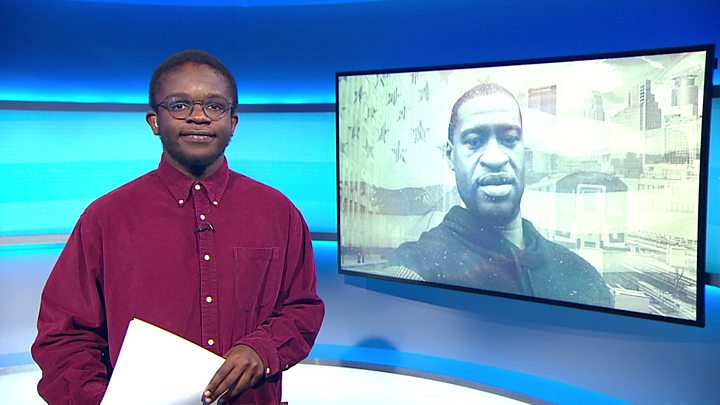
Media captionGeorge Floyd: Newsround special programme on US protests and racism
SEOUL, South Korea — North Korea’s leader, Kim Jong-un, has overruled his military’s plans to resume exercises and deploy more troops near the heavily armed border with South Korea, using his authority to de-escalate rising tensions on the Korean Peninsula, the North’s official news agency reported on Wednesday.
Switching back and forth between raising and easing tensions has long been part of the North’s way of gaining diplomatic leverage against its external foes.
Mr. Kim’s decision will most likely put ​at least ​a temporary brake on what appeared to be a rapid escalation of tensions in the peninsula in recent weeks. By staying the hand of hard-liners in Pyongyang, the North’s leader appeared to have left room for diplomatic negotiations.
Mr. Kim convened the ruling Workers’ Party​’s Central Military Commission, the highest decision-making body​ on military affairs, on Tuesday and “​took ​stock of the prevailing situation and suspended the military action plans against the South,†the North’s Korean Central News Agency said​.
The news agency did not offer details on Mr. Kim’s decision, but added that the meeting, which took place through video conferencing, studied “some documents carrying the state measures for further bolstering the war deterrent of the country,†an apparent reference to the North’s earlier threat to boost its nuclear weapons capabilities.
North Korea has been expressing increasingly growing frustration with South Korea and the United States, especially since the second summit between Mr. Kim and President Trump collapsed in Vietnam in February last year.
Last week the North’s Korean People’s Army said it had prepared plans that would undermine the agreement between Mr. Kim and Mr. Moon. Its plans included rebuilding some military ​guard ​posts within theDemilitarized Zone between the two Koreas that were demolished under the Kim-Moon agreement and resuming “all kinds of regular military exercises in the areas close to the boundary.â€
Most of the threats were made not in Mr. Kim’s name but orchestrated by his only sister, Kim Yo-jong, whose influence in her brother’s government has expanded in recent years. ​ Analysts have said that by placing his sister up front in North Korea’s growing confrontation with Seoul and Washington and by keeping himself out of the fray, Mr. Kim has kept ​diplomatic​ flexibility to de-escalate​.
The North’s sudden turn toward animosity with the South — and, by extension, the United States — reflected a desire to unify the country in the face of an economy further hobbled by the coronavirus pandemic and of a deepening need to push for concessions on international sanctions, the analysts said.
South Korea also moved quickly this month to placate the North, vowing to use the police to stop any attempt by the activists to send propaganda balloons to the North. The South said that the leaflets did little other than provoke the North and created trash in the South because many of the balloons never make it across the border. Seoul is also pushing to revise the domestic laws to ban the sending of such leaflets.
At the same time, South Korea expressed strong displeasure ​with the ​crude ​insults the North has hurled against its leader, Mr. Moon, and threatened retaliation if the North Korean military raised tensions. ​ Ms. Kim at one point called Mr. Moon “insane†and his speeches calling for peace on the peninsula “sickening.â€
The harsh rhetoric was a switch from the warm relations between Mr. Kim and Mr. Moon that peaked in September 2018, when Mr. Kim let Mr. Moon speak before a huge North Korean audience filling a stadium in Pyongyang and the two leaders climbed Mount Paekdu, ​ raising hands together at the top of the volcanic mountain on the border with China that Koreans consider the sacred birthplace of their nation.
Mr. ​Moon, a champion of political reconciliation between the two Koreas, helped arrange Mr. Kim’s historic summit meetings with Mr. Trump​​, which elevated Mr. Kim’s global status. But North Korea has repeatedly criticized both Seoul and Washington after Mr. Trump and Mr. Kim’s diplomacy failed to ease American-led sanctions. Mr. Kim himself has so far largely stopped short of attacking Mr. Trump and Mr. Moon in person.
Getty ImagesMELBOURNE, AUSTRALIA – JUNE 23: Victorian Premier Daniel Andrews speaks to the media on June 23, 2020 in Melbourne, Australia. (Photo by Darrian Traynor/Getty Images)
A man in his 80s has died in Victoria overnight after contracting COVID-19, as the state recorded 20 new cases.Â
Wednesday is the eighth straight day Victoria has recorded new cases in double digits. The state’s total now stands at 1884 while the death toll is 20.Â
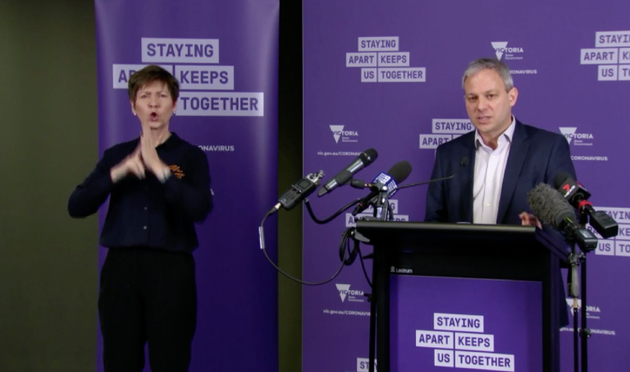
Victoria’s Chief Health Officer, Professor Brett Sutton said the family of the man has asked that no further information be made public.Â
“I’d like to respect that,†he told reporters on Wednesday.Â
“It does point to the fact that when we get additional cases, there will be a risk of people dying or be at risk of further cases being hospitalised and going to intensive care.
“That’s why we need to get on top of numbers in general.â€
SBS News Victoria’s Chief Health Officer, Professor Brett Sutton speaks to media on Wednesday.
Sutton added that eight of the most recent 20 COVID cases are the result of community transmission.Â
From today there will be “an army†of Victorian health professionals door knocking homes to further educate households on the dangers of COVID, with a focus on homes where English may be a second language. Â
When asked if the government let non-English speaking communities fall through the cracks on COVID messaging, Sutton said “it’s a complex process.â€Â
“We’re meeting with a whole number of ethnic community representatives and we have always advocated to engage with our intelligence team around where are our cases, what communities do they represent and to use all mechanisms to reach into them,†he said.
“It is not a simple case of pamphlets and campaign materials and banners to reach into communities. You do need that community leadership, community champions.â€
“There are people who use social media from their country of origin or amongst their work of friends as their primary source of information. A lot of that is information. A lot of it tells them that it’s all rubbish messaging from Government.â€
More #COVID19 drive-thru testing locations are coming this week. I ask Victorians for their patience & to consider other testing options https://t.co/TbzZBDFL9Z
The Melb Showgrounds will open tomorrow 1pm for Keilor Downs SC students only & for others from Thursday #springst
— Jenny Mikakos MP #StayHomeSaveLives (@JennyMikakos) June 23, 2020
Victoria’s Minister for Health Jenny Mikakos said more drive-thru testing would be set up in Victoria this week while Premier Daniel Andrews said a state-wide lockdown could be reintroduced to curb the new high numbers.Â
“It doesn’t matter how many people are doing the wrong thing – everybody, everybody will pay the price if we get to a point where restrictions either localised or across the state need to be re-introduced,†he told media on Tuesday.
Addressing households who haven’t been obeying the five-guest rule, he said, “We have seen many families, large families, who have gathered in numbers beyond the rules.
“That is just not on. It is not acceptable. Particularly if anybody in those family groupings has even mild symptoms – let alone if anybody in those family groupings has been told to quarantine as a close contact, or even a positive case.
Since Chinese officials locked down the city of Wuhan in January, there have been more than 9.1 million cases of COVID-19, the disease caused by the coronavirus, across the planet.
Since the coronavirus pandemic hit the Middle East, Gulf Cooperation Council (GCC) states have had to slash their budgets ruthlessly as oil prices fell drastically due to the lack of demand. As a result, masses of low-income migrant workers lost their jobs and returned to their countries, even though there was little chance of employment back home. Â
Now, as the outflow of educated professionals also begins, their exodus carries risks for Middle Eastern economies, as many lucrative economic sectors could virtually collapse. Having few locals with the experience or education needed to replace skilled professionals, serious management issues may arise in the days ahead.
The International Monetary Fund had already warned that the Middle East would face an economic downslide this year due to coronavirus-related lockdowns and dipping oil prices in tandem. Now, without enough skilled professionals, economic activities in the Gulf region may not remain sustainable — and a stark future lies ahead for the GCC if the exodus is not addressed.
Many highly educated expats have been working in the Middle East for decades, but with scant prospects of re-employment following the pandemic and the economic downturn, they are packing their bags. According to the International Labor Organization, foreigners in the GCC region account for more than 10% of migrants the world over, and Saudi Arabia and the UAE have been home to the third and fifth largest expat populations.
In the Kingdom of Saudi Arabia, it is estimated that expats constitute over 10Â million out of its total population of nearly 34.8 million. Meanwhile, nearly 90% of the population in the UAE, half in Oman and Bahrain, and two-thirds in Kuwait are foreigners. Mostly Indians, Pakistanis, Filipinos, Egyptians and some Westerners, tens of thousands of these foreign employees have already left or are waiting for flights back home.
Following are some of the main setbacks the GCC could face with the departure of skilled foreign nationals.
First, most of the GCC states have long-term economic policies known as “Visions.†To execute these long-term plans, highly skilled professionals are essential — and even as the larger Gulf states started getting involved in more development projects, the requirement shifted from low-skilled labor to a high-skilled foreign workforce. Nowadays, the focus is on attracting high-skilled expats while low-skilled migrants are being reduced to provide jobs for locals.
Large-scale economic policies like Saudi Arabia’s Vision 2030 cannot be implemented without adequately qualified staff. With the ongoing brain drain, the management of Vision policies in most Gulf states could come to a standstill as the private sector depends on foreign employees. This will have a serious impact on the long-term plan to diversify GCC economies away from oil revenues. As Jasim Husain, a former parliamentarian from Bahrain, said to Al-Monitor, “Governmental diversification reforms rely on the private sector, which is powered by foreign labor. Economic life in the GCC is simply ‘not sustainable’ without foreign labor.â€
Even futuristic megaprojects — like the $500 billion city of Neom in Saudi Arabia — might not take off anytime soon, as a highly professional, foreign staff was supposed to run the facilities.
Second, the Gulf states would face losses in taxation. Having introduced a 5% value-added tax (VAT) since 2018, countries like Saudi Arabia and the UAE would now lose precious non-oil revenue. In fact, VAT revenues now constitute a quarter of Riyadh’s total tax revenue, and the kingdom had been planning to triple value-added tax to 15% only recently. In addition, foreign migrants pay a monthly fee for each family member they sponsor, so further income will be lost.
A further 1.2 million expats will be leaving Saudi Arabia by the end of this year; 300,000 migrant workers have already left, and 178,000 more have applied to the Awdah (“Return”) initiative, which facilitates the return of expat workers to their home countries.
Third, employment levels would fall by at least 13%Â and cause a drastic consumer cut for those GCC states that depend on tourism, real estate, entertainment and the hospitality industry. In the UAE alone, 900,000 jobs would be lost, according to estimates by Oxford Economics. Considering that the country has a population of 9.6 million, this would be 10% of its residents. As high-earning expats leave, a large portion of consumers gets slashed.
Finally, the worst affected place will be Dubai, the business hub of the Middle East. According to survey by Dubai’s Chamber of Commerce, around 70% of the companies in the emirate expect to close within six months, while major global conferences and events like the Dubai Expo 2020 have also had to be canceled due to the global disruption caused by the pandemic.
Most hotels plan to cut 30% of staff, while the ride-hailing service Careem cut one-third of its jobs in May. Meanwhile, the world’s largest long-haul carrier, Emirates, started laying off employees after 30,000 jobs were slashed. Job losses in the Gulf aviation industry could go up to 800,000 in the days ahead, according to the International Air Transport Association, and those affected are mostly expats, as the Gulf airlines usually employ foreigners.
Sadly, expats who are losing their jobs cannot afford to stay and look for new employment for more than a couple of months, as affordability has become the main challenge in Dubai. Within the year, education, health, public administration and even the agriculture sector would find survival a challenge.
Consequently, Abu Dhabi is trying to lessen the impact. Automatic extensions are being granted to people with expiring work permits in the UAE, waiving work-permit fees and fines. Officially launching a permanent residency system, Golden Cards have been issued to 6,800 foreigners with investments exceeding $27 billion in the country.
However, in contrast, some states like Kuwait want to curtail their number of expats instead to make way for locals, but this is because they are not dependent on tourism and global trade for revenue. Seeking to reduce local unemployment, Kuwait would like to reduce expat numbers to 30% from its current 70% of the total population.
Basically, only foreigners who invest are welcome, and as Kuwaiti parliament member Safa al-Hashem said, expats should “pay even for the air they breathe.†Oman has also ordered state companies to speed up local employment under its “Omanisation” plan, while Jordan already gave its 800,000 migrants a deadline to leave the country under a “Jordanians first†bid.
Highly skilled expats are indispensable for Gulf economies, and replacing them in the short term is not possible. The reason is that local citizens have worked in the public sector on high salaries with flexible working conditions and had undemanding mediocre jobs, and mainly they lack the required education and expertise.
According to a study on migrant workers by the Gulf Research Centre Cambridge,  “Nationalization drives could help maintain the demographic balance in these countries, but they do not contribute much to the improvement of the economies. In theory, they intended to replace foreigners in these GCC countries with either equally or more qualified nationals, but in reality, these programs have had to acknowledge the low levels of qualifications of the national population, and the focus has been on numbers rather than quality.â€
Therefore, the demand for high-skilled expats will continue to increase, as it will take years of investment in education, professional skills and training for local citizens to replace them. Meanwhile, unskilled workers will not be required due to popular nationalization drives.
Houthi rebels in Yemen said they had fired missiles into Saudi Arabia early this morning that reached the capital, Riyadh.
However, Saudi Arabia said it “successfully intercepted and destroyed” the missiles, which it said were headed toward Riyadh. The spokesman for the Saudi-led coalition, Col. Turki al-Maliki, called the attack “a hostile, deliberate and systematic operation to target civilians and civilian objects,†according to the state-run Saudi Press Agency.
The Houthi movement, backed by Iran, has been embroiled in a civil war with the internationally recognized government, supported by a Saudi Arabia-led coalition, since 2015. The movement controls the capital, Sanaa, and other parts of the north and west. Violence between the internationally recognized government and Houthi forces has increased since a cease-fire expired last month.
The Houthi-affiliated Almasirah Media Network reported that Houthi forces launched “a barrage of ballistic, winged missiles and drones deep in Saudi Arabia,†saying the move was a response to the “Riyadh regime’s bloody military campaign.†The outlet said the forces hit Saudi military and intelligence targets in Riyadh and other parts of the country.
A Riyadh resident told Reuters there were two blasts and smoke in the sky early in the morning. There were no immediate reports of casualties or damage, according to the outlet.
The attack showcased the long-range missile capabilities of Houthi fighters. Riyadh is 990 kilometers, or 615 miles, from the Yemen border.
The attack comes at a difficult time for Yemen. Last week, Houthi rebels said a Saudi-led coalition airstrike killed 13 civilians; the coalition said the strike was aimed at armed Houthis and that civilians were not targeted. Recently, the COVID-19 pandemic has created additional misery in the war-torn country, and Houthi authorities have reportedly underreported virus cases. There is also discord in the Saudi-led coalition with the continued activity of United Arab Emirates-backed Southern Transitional Council separatists.
A British aid worker who lives and works in northern Syria was abducted by the militant group Hayat Tahrir al-Sham on Monday, his organization said.Â
The charity organization Live Updates From Syria wrote on its Instagram page that Tauqir Sharif was “kidnapped tonight around 9:30 p.m. by HTS and taken to an unknown location.â€Â
“Additionally, his wife and family are on house arrest and not allowed to leave — with militants standing outside of their home,†the group wrote.Â
Sharif was reportedly seized in Atmeh, a town near the Turkish border in northern Idlib province.Â
The war-torn enclave is the last major stretch of Syria still in the hands of the opposition after nine years of war. The United Nations has estimated that more than a million people have been displaced in the past year due to the regime’s assault on Idlib.Â
The region is home to a number of opposition groups, including Hayat Tahrir al-Sham, which is considered a terrorist organization by Russia, Turkey and the United States. The US Commission on International Religious Freedom has urged Washington to designate Hayat Tahrir al-Sham an “entity of particular concern.”
Originally from east London, Sharif and his wife moved to Syria seven years ago. In 2017, the British government revoked his citizenship, claiming he had ties to an al-Qaeda affiliated group in the region.Â
Sharif denied the UK Home Office’s allegations, which he described as racist. His lawyers have launched an appeal.Â
In a statement, the London-based advocacy organization CAGE called on Hayat Tahrir al-Sham to confirm Sharif is being treated humanely.
“Despite his immense sacrifices, Tox has endured assaults by the [Assad] regime, survived bombing attempts by ISIS [Islamic State] and had his nationality revoked by the British government without any evidence presented against him,†said CAGE’s Moazzam Begg, using Sharif’s nickname. “I hope they understand how much Tox has endured in his efforts to help the people of Syria.”
His organization, Live Updates From Syria, describes itself on Facebook as “a team of front-line Humanitarian aid workers working inside war-torn Syria†that delivers aid and raises awareness of the crisis. The group said that since Sharif’s capture, Hayat Tahrir al-Sham has taken over his projects, including a school and refugee housing.Â
His British wife, Racquell Hayden Best, described Sharif on Facebook as “a man who has given up everything to come here and help those who are oppressed.†Best said she had requested a formal statement from Hayat Tahrir al-Sham explaining why Sharif was taken, but has received no response.Â
The first patient to receive a special gene editing treatment for sickle cell disease is surviving ― and even thriving ― a year later.
Victoria Gray, 34, whose story has been chronicled by NPR for the past year, was the first person with a genetic disorder in the U.S. to receive the cutting-edge treatment known as CRISPR, which stands for Clustered Regularly Interspaced Short Palindromic Repeats.
CRISPR allows scientists to directly alter a cell’s genome, and a 2019 Wired guide to the technology called it “the genetic equivalent of Microsoft Word,†enabling scientists to “edit DNA almost as easily as software engineers modify code†― potentially leading to cures for diseases such as cancer.Â
For the estimated 100,000 Americans affected by sickle cell disease, which predominantly emerges in people with ancestry from sub-Saharan Africa, CRISPR holds the possibility of a new lease on life. The disease is caused by a mutation in hemoglobin, the protein in red blood cells that transports oxygen throughout the body and expels carbon dioxide. A sickle cell patient’s red blood cells deform into a “sickle†shape, limiting their ability to carry oxygen and leading to issues such as anemia and an increased risk of stroke. It can normally only be cured by a bone marrow transfusion, which requires a donor.
Nearly a year later, Gray, who lives in Forest, Mississippi, is responding well to the treatment, according to NPR’s latest update, and hasn’t suffered major pain or needed emergency room treatment or blood transfusions. Relapses may still be possible, and it is too early to tell if CRISPR can serve as a definitive treatment for sickle cell disease. Nevertheless, 2020 is a noticeable improvement for Gray compared to the previous two years, when she visited the hospital seven times on average and frequently took pain medication.
Gray told NPR that “it hasn’t been easy†caring for three children during a year shaken by COVID-19 as well as racial injustice protests throughout the United States, but she added that without CRISPR, she would have likely been hospitalized amid the pandemic and been unable to provide for her family.
“Since my treatment, I’ve been able to do everything for myself, everything for my kids. And so it’s been joy not only for me but for the people around me that’s in my life,†she said.
“High school graduations, college graduations, weddings, grandkids ― I thought I wouldn’t see none of that…. Now I’ll be there to help my daughters pick out their wedding dresses and we’ll be able to take family vacations, and they’ll have their mom every step of the way.â€
Calling all HuffPost superfans!
Sign up for membership to become a founding member and help shape HuffPost’s next chapter
Egyptian activist Sanaa Seif was abducted outside the public prosecutor’s office in Cairo, her sister said Tuesday.Â
“Sanaa was just abducted by a microbus from in front of general prosecutor office!” Mona Seif tweeted. “Sanaa was ABDUCTED, and her abduction was facilitated by the official guards of the general prosecutor’s office,†she added.
According to the family, authorities detained Sanaa and are charging her with “spreading false rumors, inciting terrorist crimes” and “misuse of social media.”
The 26-year-old activist was waiting outside the public prosecutor’s office on Tuesday to file a complaint related to an attack on her family the previous day. She, Mona and their mother say they were attacked by a group of armed women outside the Tora prison complex Monday while police looked the other way.
“We have been beaten up, dragged by the hair, clothes torn in front of Tora by women thugs on the watch of all police there,†Mona tweeted.Â
The three women were there to receive a letter from Sanaa’s older brother, activist Alaa Abdel Fatah, who has been detained since September 2019 over anti-government protests. He launched a hunger strike, and his family has sought his release amid the coronavirus outbreak in Egypt’s prisons.Â
In a statement Tuesday, Amnesty International called on Egypt’s authorities to “end their relentless harassment†of the family and immediately and unconditionally release both Sanaa and her brother.Â
“Sanaa Seif and her family have suffered years of harassment and intimidation for their human rights activism, but the events of the past two days mark another new low,†said Philip Luther, Amnesty International’s research and advocacy director for the Middle East and North Africa.Â
“The fact that Sanaa Seif was taken from right outside the public prosecutor’s office shows just how brazen the Egyptian security forces have become,†Luther said.
Acting under the authority of President Abdel Fattah al-Sisi, Egypt’s security forces have stepped up their crackdown on dissenting voices. In May, the editor-in-chief of a prominent independent newspaper was arrested while interviewing Sanaa’s mother, Laila, about her jailed son.  Â
Rights groups say a number of political activists and journalists have been forcibly disappeared or imprisoned for criticizing the Egyptian government’s handling of the coronavirus in recent months. Security forces recently arrested Mohamed Monir, a prominent journalist, after his interview with Qatari TV channel Al Jazeera, and charged him with joining a terrorist group and spreading false news.
We use cookies on our website to give you the most relevant experience by remembering your preferences and repeat visits. By clicking “Accept”, you consent to the use of ALL the cookies.
This website uses cookies to improve your experience while you navigate through the website. Out of these, the cookies that are categorized as necessary are stored on your browser as they are essential for the working of basic functionalities of the website. We also use third-party cookies that help us analyze and understand how you use this website. These cookies will be stored in your browser only with your consent. You also have the option to opt-out of these cookies. But opting out of some of these cookies may affect your browsing experience.
Necessary cookies are absolutely essential for the website to function properly. These cookies ensure basic functionalities and security features of the website, anonymously.
Cookie
Duration
Description
cookielawinfo-checbox-analytics
11 months
This cookie is set by GDPR Cookie Consent plugin. The cookie is used to store the user consent for the cookies in the category "Analytics".
cookielawinfo-checbox-functional
11 months
The cookie is set by GDPR cookie consent to record the user consent for the cookies in the category "Functional".
cookielawinfo-checbox-others
11 months
This cookie is set by GDPR Cookie Consent plugin. The cookie is used to store the user consent for the cookies in the category "Other.
cookielawinfo-checkbox-necessary
11 months
This cookie is set by GDPR Cookie Consent plugin. The cookies is used to store the user consent for the cookies in the category "Necessary".
cookielawinfo-checkbox-performance
11 months
This cookie is set by GDPR Cookie Consent plugin. The cookie is used to store the user consent for the cookies in the category "Performance".
viewed_cookie_policy
11 months
The cookie is set by the GDPR Cookie Consent plugin and is used to store whether or not user has consented to the use of cookies. It does not store any personal data.
Functional cookies help to perform certain functionalities like sharing the content of the website on social media platforms, collect feedbacks, and other third-party features.
Performance cookies are used to understand and analyze the key performance indexes of the website which helps in delivering a better user experience for the visitors.
Analytical cookies are used to understand how visitors interact with the website. These cookies help provide information on metrics the number of visitors, bounce rate, traffic source, etc.
Advertisement cookies are used to provide visitors with relevant ads and marketing campaigns. These cookies track visitors across websites and collect information to provide customized ads.