Angie Motshekga is facing an uphill battle to make her ‘back to school’ plan stick, after unions and educational activists cranked up the pressure on the embattled education minister.
Will children return to school on Monday 1 June?
Earlier this month, Motshekga revealed that children in Grade 7 and Grade 12 would be told to return to their classrooms on Monday 1 June, leading the way for the rest of South Africa’s schoolchildren. However, her plans faced an enormous backlash, and legal action has been taken against the minister to halt the proposals. According to the Sunday Times, reopening the schools tomorrow now seems ‘unlikely’.
Various dissenting voices, including the biggest teaching unions in the country and influential school governing bodies, have apparently expressed concerns about a general lack of preparedness across many facilities. The most common issues raised include a lack of PPE arriving at schools and fears over high infection rates putting the kids – as well as the teaching staff – at risk.
Maimane has been one of the leading voices against reopening schools at this point and was behind a widely-shared petition to keep the gates closed for the time being. The momentum is certainly swinging away from Motshekga and her team, but there could still be a surprise in store on Sunday.
We are preparing for battle, to ensure that our children are safe. Schools must be safe prior to opening. pic.twitter.com/cDt0JkSl2Z
‘Back to school’… or not? What time Angie Motshekga will address the nation
Angie Motshekga is set to make a public address later in the day, to give clarity on whether the first batch of students will be allowed to make their way into school, or if they will be told to stay at home. According to the deputy minister of Basic Education, we’re expecting the speech to start at 18:00.
The National Association of School Governing Bodies says they have met with Basic Education Minister, Angie Motshekga and agreed that schools that do not have the necessary equipment and protocols in place, must not reopen tomorrow. #sabcnews
However the current tussle between government, unions and teachers concludes, realistically there will be little or no “real†school before September, and none for my lads who, at 16 and 18, were supposed to be finishing exams and enjoying some kind of “legendary summer†(weeks in a dimly lit basement playing video games, sunburn at a festival and some kind of boring low-paid job, realistically).
This isn’t me having a controversial opinion about schools going back: I really don’t; it’s an impossible situation. I’m just desperately sad that we are where we are. It doesn’t inconvenience me personally, really. I barely see my boys for huge stretches of the day and I’m happy when I do. They’re lovely company, though the nine-meals-a-day regime is a drain on wallet and kitchen and I reflexively flinch now when I hear the words “What’s for lunch?†What makes me sad is that we are such a poor, inadequate substitute for what young people want and need: each other, the opportunity to do stupid stuff far from the parental gaze, and other adults.
A lot of those who are desperate for kids to get back to school aren’t just worried about their own livelihoods (or sanity, and with younger children this is much more of a consideration, I know). Parents know how valuable and how precious external influences can be; how skilled teachers are at giving young people the space and the tools to become who they want to be. Of course, this is doubly true for children for whom home isn’t particularly healthy or safe, but it holds for all kids. My elder son’s teachers in particular have got him excited about the future and his abilities in a way I could never have begun to do, because I’m just his mum.
Think back to your own teenage years and who shaped them. My parents felt like barely more than walk-ons in the drama of my life for much of that time. The people who mattered were my peers, my teachers and anyone who made me feel like I was an interesting and independent human being: Mrs Ainscough who made 1917 feel like it was happening in the room next door; Andrew, who took me to gigs and asked my opinion about music, or Jack, my mum’s first husband, who gave me books, bought me lunch and shared his love of beautiful things. They showed me different lives and fresh possibilities. Other adults – and most often that means teachers – bring oxygen into the sometimes airless atmosphere of even the most loving families.
Parents are simply not enough: we’ve always been told it takes a village to raise a child, but now the village is surrounded with hazard tape. But we’re all there is for now and we’ll manage as best we can. For anyone else contemplating a long, empty summer here’s what we have tried as a family so far, with varying degrees of success.
Games: we are not a collective fun family, but boredom has forced us to devise our own entertainment. We’ve tried “who does the dog like best†(my husband, unfairly), and the occasional round of “rat or bird†when the feeder in the yard starts moving. My sons prefer it to be rat, to my horror. “Leave him alone,†they say as I start to chase my nemesis away with a broom. “He’s just vibing!†But the best and most successful has been “Men’s Health spot the differenceâ€. In this game, the 18-year-old walks slowly towards us holding two copies of Men’s Health magazine and the first person to correctly identify if the topless muscle-bound cover stars are the same man or different wins. It’s surprisingly difficult.
Life-skill sessions: my sons’ school is offering life skills sessions – basic cooking, budgeting and nutrition, but we have devised an alternative curriculum of further study. Modules so far include “Drawers: shutting them and crumb prevention†and multiple practicals in carpet-stain removal (this house came with distressingly pale ones). Possibly their least favourite module is called “Yes, every dayâ€. In it, we introduce them to the tedious reality of adult life: yes, we fill the dishwasher every day, yes, the bin gets full every day. It’s awful, but necessary.
Finally, I have a secret weapon when they get despondent. And they do. I wasn’t always happy as a teenager, but the future shimmered with unknowable, thrilling possibility. For them, the future is definitely unknowable, but it’s an ominous set of weather fronts: pandemic, climate catastrophe, vicious recession. It’s no wonder they have bad days. When they do, I allow them to mansplain something to me. “There must be something in homeopathy,†I say, innocently. Or “I just don’t get viral load.†This weekend I showed them a picture of my mate’s frog bread – the latest corona craze – and let them tell me it was “more like a bull toad,†which is “evolutionarily the superior form of amphibianâ€. There’s frustratingly little I can offer them right now, but correcting your parents’ stupidity is the gift that keeps giving.
One more thing…
My ‘unprecedented times’ unsolicited emailers are an odd bunch. Anyone mentioning ‘lockdown style’, exhorting me to ‘make bermudas cool again’ or asking if I’m ready for ‘glowing, sculpted legs’ is binned instantly. I look like a haunted laundry basket these days. I’m baffled by the PR company trying to interest me in techniques to clean engagement rings: who cleans jewellery? I only clean my kitchen under extreme duress. But the top of the futile-yet-indefatigable-emailing pops is the company that seems to believe now is the ideal time to start a commemorative coin collection, tempting me in with such unmissable offers as ‘Discover Golden Ducats now!’ I haven’t unsubscribed yet, because I’m hoping they’ll offer me a Covid-19 commemorative coin eventually. But what would it look like? A coronavirus particle for tails, obviously, an anonymous masked face for heads, perhaps and ‘This is shit’ in Latin round the edge.
Linda Tirado, a freelance photographer, activist and author, was shot in the left eye Friday while covering the street protests in Minneapolis.
Tirado is one of a number of journalists around the country who were attacked, arrested or otherwise harassed — sometimes by police and sometimes by protesters — during their coverage of the uprisings that have erupted nationwide after the death of George Floyd in Minneapolis.
With trust in the news media lagging, journalists have found themselves targeted.
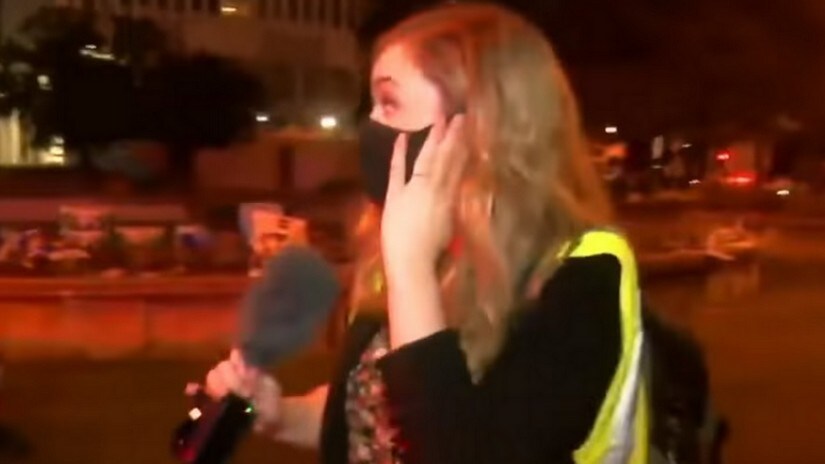
A television reporter in Louisville, Kentucky, was hit by a pepper ball on live television by an officer who appeared to be aiming at her, causing her to exclaim on the air: “I’m getting shot! I’m getting shot!â€
A television reporter in Louisville, Kentucky, was hit by a pepper ball on live television by an officer who appeared to be aiming at her. Image courtesy: YouTube
Outside the White House, protesters attacked a Fox News correspondent and his crew, taking the journalist’s microphone and striking him with it.
In Atlanta, masses of protesters Friday night converged on CNN headquarters, where they broke through the front door, lobbed fireworks and vandalised the building. Earlier in the day, Omar Jimenez, a reporter for the network, was detained as he reported live, despite calmly offering to move to the location of the police officer’s liking. On Saturday, he reported that his crew’s cameraman and producer were hit by rubber bullets.
Tirado, 37, drove to Minneapolis from Nashville to photograph the protests and donned goggles to protect her eyes. In the commotion of running from tear gas, they slipped off her face.
“I was aiming my next shot, put my camera down for a second, and then my face exploded,†she said in a telephone interview after being released from the hospital. “I immediately felt blood and was screaming, ‘I’m press! I’m press!’â€
Tirado said the shot, which she thought was a rubber bullet, came from the direction of the police. Protesters carried her out, and she had surgery within the hour. Although doctors told her that she is not likely to recover her vision, she is grateful for one thing: She shoots with her right eye.
“I would say there is no way that anyone had looked at me and not known that I am a working journalist,†she said. “That said, police have been pretty clear that they don’t care if you are working journalist.â€
John Elder, a spokesman for the Minneapolis Police, said he was unaware of the incident. He said the department had not used rubber bullets for decades.
“If someone believes that we have injured them, we encourage people to contact our Internal Affairs Unit or the Office of Police Conduct Review,†he said in an email.
In Louisville, police are investigating the circumstances behind the WAVE-3 reporter who was struck.
“We will identify the officer involved and review the video to determine what was going on at the time and if further action is needed,†Sgt. Lamont Washington, a spokesman, said.
The Reporters Committee for Freedom of the Press logged about 10 different incidents that ranged from assaults to menacing in Phoenix, Indianapolis, Atlanta and Minneapolis.
“With the unraveling of civil peace around the country, reporters are perceived as a target by both the police and the protesters,†said Bruce Brown, the executive director of the Reporters Committee, “and that is an extremely frightening place to be.â€
Leland Vittert, the Fox News journalist who was attacked near the White House, said a man in a hoodie and black bandanna kept hovering around his live shots asking: “Who are you with? Who do you work for?â€
When the man found a photo online that identified Vittert as an employee of Fox News, the heckler gathered other demonstrators around him.
As the journalists and their security guards tried to flee, they were pummeled with objects. The security guard was punched in the jaw, and Vittert was struck with his own microphone.
“My role as a journalist is to report and show what’s going on,†Vittert said in an interview. “If there’s some kind of thought that the reason I was targeted is because I work for Fox News, I would like to show them tweets where President Trump has gone after me personally.â€
As in many Afghan households, dinner at Dr. Yousuf Aryubi’s home meant the whole family — his mother, his siblings, their children — sitting on the floor together around a mat laid with food on the carpet.
During one recent dinner, Aryubi confided to his youngest brother that he was worried. A patient he’d seen that morning had a cough and high fever.
Within two weeks, Aryubi and two of his siblings were dead, and dozens of family members were infected with the coronavirus.
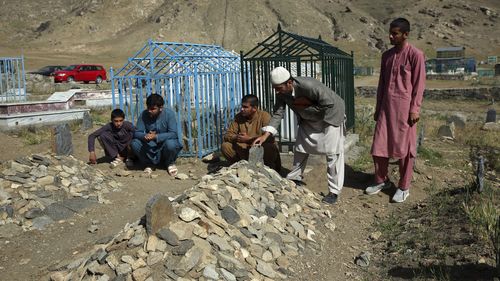
Aryubi family members morns over the graves of their two brothers and a sister who lost their lives after being infected by Coronavirus in Kabul, Afghanistan. (AP Photo/Rahmat Gul) (AP/AAP)
Most crushing for them: they assumed the symptoms spreading among them were just a bad flu because the hospital never told them the results of their coronavirus tests, Aryubi’s youngest brother, Behtarin Paktiawal told The Associated Press.
The trajectory of the family’s tragedy points to how a broken-down health system, slow government response and public attitudes have left Afghanistan deeply vulnerable to the global pandemic.
After billions of dollars in international money, much of it from the US, the Afghan capital barely has a hospital that works.
Amid the ongoing war, massive government corruption has left resources depleted, institutions dysfunctional, and the health care system ill-equipped to deal with even basic ailments.
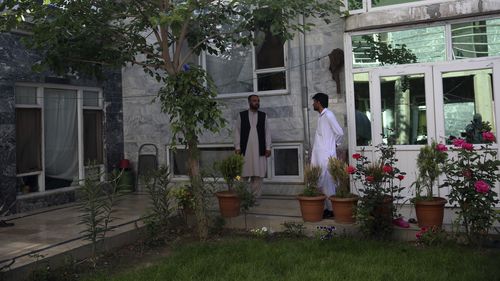
Dr. Aryubi’s family assumed they just had a bad cold, as one after another, they came down with fevers and coughs — all because one of the Afghan capital’s main hospitals never told them the results of his coronavirus test. (AP/AAP)
Afghans have become increasingly poor, with 54 per cent of the population earning less than $1.50 a day in 2019, a rate likely mounting amid the pandemic.
The country has had more than 11,000 confirmed coronavirus infections and more than 219 deaths, but the numbers are likely higher.
The Aryubi family lives in a single building in a middle-class district of Kabul — Dr. Aryubi, a 53-year-old pediatrician, with his wife and two of his four children; his four brothers and a sisters with their families; and their 70-year-old mother.
Three of the brothers work in the family company, importing cars and car parts from Dubai and Germany.
Aryubi felt a light fever on March 30, a Monday, a day after he met with the patient.
Behtarin Paktiawal, left, Behtarin Paktiawal, a brother of Dr. Yousuf Aryubi who along with two siblings died from COVID-19, stands in the courtyard of his house after recovering from the coronavirus. (AP/AAP)
By Wednesday, he was worse, and his youngest daughter, 21-year-old Mariam, also had a fever. Paktiawal drove him and Mariam — all three of them wearing masks and gloves — to the Afghan-Japan Communicable Disease Hospital, one of Kabul’s two facilities for coronavirus testing and treatment.
“The hospital promised to call us within 24 hours if the result comes positive and then to send an ambulance to isolate them,” Paktiawal said.
Thursday passed with no word from the hospital, so they assumed the tests were negative, Paktiawal said. Aryubi and Mariam went to a private clinic, where the doctor diagnosed them with the flu and gave them paracetamol.
At dinner, they were all together again, Aryubi, his mother and the male relatives around the carpet in one room, Mariam and the female relatives in the other, laughing and eating as normal.
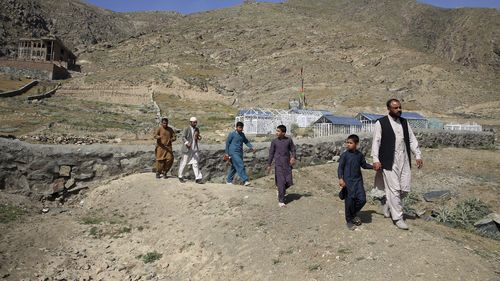
The family’s tragedy points to how a broken-down health system, slow government response and public attitudes have left Afghanistan deeply vulnerable to the global pandemic. (AP/AAP)
Over the next days, Aryubi’s sister, his brothers, his wife and his mother, one by one, started coughing or fell into fevers.
On Monday, April 6, with everyone in the family sick and Aryubi worsening, Paktiawal went back to the Afghan-Japan Hospital. After several hours of asking around in vain, he found a long list of test results tacked on a wall.
There on the list were his brother and niece, both positive.
“I was shocked, like doomsday struck,” he said.
“I didn’t know what to do. I had tears in my eyes.”
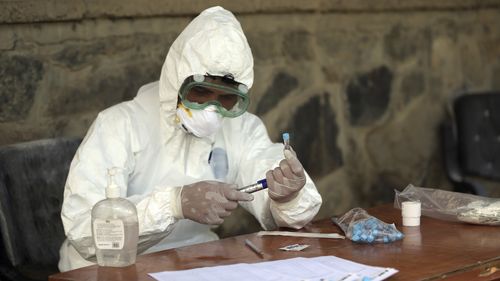
An Afghan lab technician processes a sample to test for the coronavirus at the Afghan-Japan Communicable Disease Hospital, Kabul’s main facility for coronavirus testing and treatment. (AP Photo/Rahmat Gul) (AP/AAP)
He called home and told everyone — all 34 family members — to come immediately to the hospital for testing.
They brought Aryubi and tried to admit him to the hospital, but the staff refused. In an ensuing argument, a doctor hit Aryubi in his face, breaking a tooth, Paktiawal and another brother said.
The Afghan-Japan Hospital, built in 2014 with funding from the Japanese government, typifies the health system’s woes, though it is better off than many other facilities.
In the early weeks of the pandemic, suspected coronavirus patients complained of being turned away or of tests lost. It took weeks for staff to get enough protective gear, leaving them afraid to treat patients.
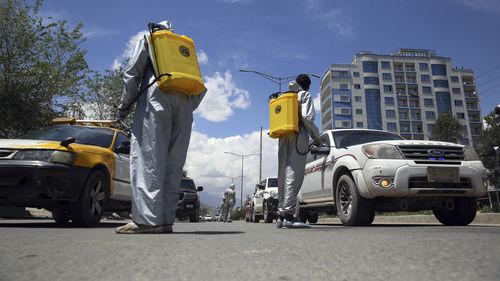
Volunteers in protective suits spray disinfectant on passing vehicles helping curb the spread of the coronavirus in Kabul, Afghanistan. (AP Photo/Rahmat Gul) (AP/AAP)
The hospital sees up to 600 patients a day for testing but can only analyse 150 tests a day.
With better gear, it has taken in more coronavirus patients — around 80 currently.
In the provinces, many under-supplied health workers still fear suspected virus patients, refusing to admit them and telling them to buy an oxygen tank in the market and stay home.
Sayed Massi Noori, a doctor in the Afghan-Japan Hospital’s public relations department, estimated 10-15 per cent of tested patients don’t receive their results on time.
He said inexperienced staffers sometimes write names incorrectly on tests or code samples wrong.
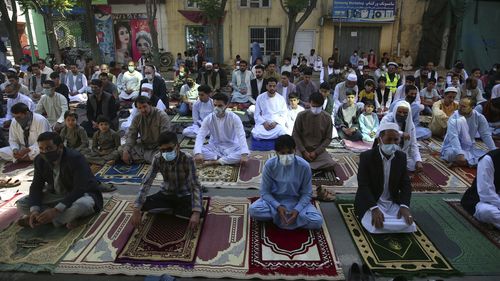
Men wait to attend Eid al-Fitr prayers outside a mosque in Kabul, Afghanistan. (AP Photo/Rahmat Gul) (AP/AAP)
“Medical workers on the front line in the fight against COVID-19 don’t have enough experience which causes us to face bigger challenges,” he said.
The hospital has gotten no new funding since it was dedicated to coronavirus treatment. Many of its staff have not been paid for the past two months, he said.
Just going to the hospital risks contagion.
The government’s response to the pandemic was slow, even as more than 200,000 Afghans flowed in from Iran, where the virus was raging.
Herat in western Afghanistan, which received the bulk of returnees, was not equipped with testing facilities until April.
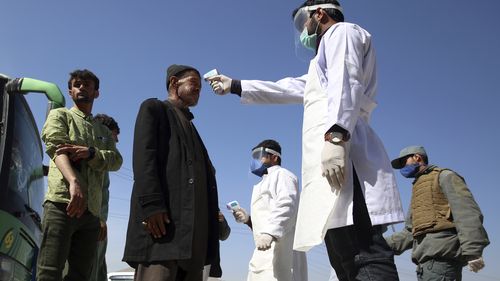
Health workers measure the temperature of Afghan passengers in an effort to prevent the spread of the coronavirus, as they enter Kabul trough Kabul’s western entrance gate, in the Paghman district of Kabul, Afghanistan. (AP/AAP)
Political infighting between President Ashraf Ghani and his rival Abdullah Abdullah, both of whom insist they won last year’s presidential polls, seemed to push pandemic measures to the back burner.
The government closed schools and universities on March 14, then put Kabul under lockdown two weeks later.
Residents are allowed to leave their homes only for medical needs or groceries. But the rules are widely flouted.
After being tested, the Aryubi family immediately quarantined themselves at home and another building. Their neighbours fled, moving out of their homes. Grocery stores refused to deliver to the Aryubis.
“People ran from us like we were monsters,” Paktiawal said.
Desperate for help, the family called relatives in Paktia province. Four cousins came with their wives and children and stayed with them. Soon they too were showing symptoms — bringing the total number infected in the family to 46.
On April 10, Aryubi’s sister Gul Khomar died. More relatives came from the village to attend her funeral at a Kabul graveyard. Police had to push them back, pleading with them to keep a distance from her body and the family.
On April 11, Dr. Aryubi died, followed three days later by one of his brothers, Fazil Rahman.
The rest of the family languished in quarantine. Paktiawal tried to be admitted to the Afghan-Japan Hospital, but the staff fled from him after he showed a high temperature, he said.
His brother Hayat Khan posted a YouTube video from inside the home, saying they had no help and accusing government corruption of wrecking services. “The government doesn’t give a damn about us. Everyone has forgotten us,” he said.
It took weeks but the family’s symptoms faded with no further deaths. Paktiawal now puts out YouTube videos to educate the public on how to deal with COVID-19.
“I never believed in this disease, I used to say, it is a lie, it is a propaganda,” he told the AP.
“We have realised… it’s a huge danger, and for those who neglect it, it can cost them their lives.”
Protesters continued to demand justice Saturday for George Floyd. Many demonstrations remained peaceful, but not all.
USA TODAY
MINNEAPOLIS — Police used tear gas, smoke grenades and nonlethal projectiles Saturday night in a coordinated effort to beak up groups gathering after the start of the Twin Cities’ curfew, aimed at preventing another night of violent protests after days of unrest following the death of George Floyd.Â
Several hours after the 8 p.m. curfew began, there were “no reported injuries of consequence,” Minnesota Department of Corrections Commissioner Paul Schnell told the media. He acknowledged that the situation could change as the night continued.
Minneapolis mayor Jacob Frey reported at least two dozen arrests were made Saturday night and said it was too early to say whether the curfew would be extended another night.
Earlier Frey said even peaceful protests weren’t welcome after the curfew. Highways were closed and officials urged all residents to stay home, saying it was necessary to separate peaceful protesters from those intending to cause further damage to a city reeling after days of fiery demonstrations.
“Don’t go out of your homes; don’t make things more difficult,†Minnesota governor Tim Walz said. Local officials’ increasingly strict stance comes after days of violence in the city, with Thursday night’s unrest being the most chaotic as protesters breached a police precinct building and set it on fire.
Floyd, a 46-year-old black man, died Monday after a white Minneapolis police officer kept his knee pressed into his neck for more than eight minutes, sparking dozens of protests against police brutality across the country.
Thousands of people took to the streets nationwide and hundreds were arrested Friday and into early Saturday morning, resulting in injuries to protesters and officers. By sunrise, at least three people had died amid the protests.
Demonstrations continued throughout the day Saturday in dozens of cities, and more protests were planned and curfews issued for Saturday evening.
Follow USA TODAY reporters Trevor Hughes and Tyler Davis for reports from the scene. Our live blog will be updated throughout the day. Here are the latest developments:
Minnesota Department of Transportation announced multiple highway closures in the Twin Cities, starting at 7 p.m. Saturday. “Routes will remain open for motorists to exit downtown areas,” the department tweeted.
Officials expected demonstrators to set fires, use deadly force and use “civilians as shields from law enforcement,” the Minnesota Department of Public Safety tweeted before and after curfew began.
As part of the state’s increased enforcement, the Minnesota National Guard said more than 4,100 service members had been deployed to the Twin Cities and projected more than 10,000 would soon be called up.
Tear gas, smoke bombs and explosions near Fifth Precinct
Hundreds of protesters sat to await the arrival of law enforcement as curfew approached near Fifth Precinct. One commented that police couldn’t arrest the whole group.
Soon, black-clad law enforcement approached to the sound of explosions. Some demonstrators chanted “Hands up, don’t shoot!â€
Police officers fired nonlethal projectiles toward masses of people, including a crowd of media gathered in an alley next to a looted store.
Protesters reported tear gas being used. Some people hobbled away from an intersection appearing to be injured.
“State Patrol troopers are moving in to secure the Fifth Precinct. Go home and obey the curfew order now,” Minnesota Department of Public Safety tweeted.
An empty street fills as curfew falls near Lake Street
Minneapolis’ Lake Street was the scene of running battles between protesters, law-enforcement and the Minnesota National Guard on Friday night. But as curfew began Saturday, it was nearly empty and eerily quiet.
Smoke still wafted from some of the burned-out buildings, including the Third Precinct police substation. Earlier in the day, hundreds of volunteers swept clean the debris that once clogged the streets.
Soon, the area was filled with people again as a crowd materialized.
A group headed across the Mississippi River bridge on Lake Street from Minneapolis toward Saint Paul, initially with no sign of law enforcement.
Moments later, police pushed back the large protest group. Under a heavy barrage of flash-bangs and smoke grenades, the group quickly retreated, chanting “We come in peace, we mean no harm.â€
Officials walk back claims about out-of-state arrests
Walz and Carter alleged early Saturday that many of the protesters inciting violence and causing destruction were from outside the state but later acknowledged current data does not support that claim.
A civil arrest list provided by the public information officer of the St. Paul Police Department shows 12 of the 18 people arrested from Thursday through 6 a.m. Saturday were from Minnesota. Five of them are from St. Paul, three are from Woodbury (part of the Twin Cities metropolitan area), two are from Minneapolis, one is from Mankato and one is from St. Louis Park. Four are from out of state and two did not have cities of residence listed.Â
Carter said his statements were based on data he later learned was inaccurate. Walz said arrests made Saturday night will give officials a “much bigger data set†of where protestors are from.
As grocery stores close in Minneapolis, volunteers offer help
Volunteers on the north side of Minneapolis on Saturday afternoon turned parking lots into makeshift markets to combat a dearth of grocery stores in the area.
At the intersection of West Broadway and Emerson avenues, about 250 people filled the lots at U.S. Bank and Episcopal Church in Minnesota to drop off and pick up donations from members of the community.
Amanda Kelli, 18, has relatives who live on the north side and said it’s been a struggle to find food the past few days.
“My family has been looking for somewhere to go grocery shopping — my mom, my dad my grandma,†she said, as she held her baby and chowed on pizza. “But we couldn’t find nothing so we came here.â€
All businesses along Broadway appeared to be closed as of Saturday afternoon due to violent protests the past two nights.
Breyonne Golding, a community planner, called the donation effort “healing†for a low-income area usually starved of resources, but even more so now.
“On the north side, there’s only three grocery stores. All of them are boarded up,†said Golding, a native of Connecticut. “It’s about to be the first of the month, where are they gonna get food?â€
Omar to Minneapolis residents: ‘Stay home tonight’
Rep. Ilhan Omar asked Minneapolis residents to stay home Saturday night in an effort to isolate “agitators” she says are destroying minority owned business during protests over the death of Floyd.
Omar, D-Minn., represents the district where Floyd was killed.
“Right now, our grief and pain is being exploited. People primarily from outside our city are destroying black and minority-owned businesses in our city,†Omar said. “We can’t let them. Let us all prioritize justice for George Floyd, police reform, alongside the safety of our community and the prevention of more violence. I urge people to stay home tonight so we can better target and isolate these agitators.â€
– Sean Rossman
Minnesota National Guard plans to deploy as many as 10,000 soldiersÂ
Meanwhile, the Pentagon offered to assist Minnesota with active-duty troops. So far, Walz has not sought help from federal troops, according to a statement from Jonathan Hoffman, a Defense Department spokesman.
Walz said this morning that he had spoken with the Secretary of Defense and the Chairman of the Joint Chiefs on Saturday, as well as with mayors across the country, and was “fully mobilizing” the state’s National Guard for the first time in Minnesota’s history.
Walz alleged that the protests were fueled by elements of domestic terrorism, ideological extremists and international destabilization.
‘Stay home tonight,’ officials and community leaders plead
In an afternoon news conference, Minnesota officials asked residents to forgo protests and stay home after 8 p.m. Saturday night so that law enforcement could “remove those folks who are harming us.” Community and faith leaders – including reverends, rabbis, imams and representatives of the state’s Latino, Asian, and Native American communities, as well as the uncle of Philando Castile – encouraged residents to observe the curfew.
“We need to create the space for people to be able to grieve, to come together, to mourn the loss of George Floyd,” Lt. Gov. Peggy Flanagan said in an afternoon news conference. “We cannot do that until community can gather safely … Stay home tonight so that we can remove those folks who are harming us.”
Flanagan said that some of the protesters were “detractors,” “white supremacists” and “anarchists.”
“They are not from our state, and they’re coming from the outside,” and Sen. Amy Klobuchar. “We cannot move forward when people are burning down our city.”
Volunteers begin cleaning up
Across Minneapolis, groups of volunteers spontaneously appeared to begin cleaning up the damage Saturday morning.
Leaning on her shovel while talking, social worker Kara Vangen, 58, said no one should mistake the cleanup as a criticism of the protests themselves.
“I’m supporting the protesting, completely. And this is my neighborhood, so this is part of the healing,” she said, over the scrape of shovels clearing rubble from a burned-out Walgreens.
Wearing face masks, Anton Reuter and Beno Boda, both 17, picked up trash strewn in the street.
The two, who live nearby, said they had heard reports that troublemakers from outside downtown Minneapolis have been flooding into the area last night causing damage. They wanted people to know that those who live here care about this neighborhood.
“It’s not going to get better waiting on the government,” Boda said.Â
Morning in Minneapolis: Firefighters put out blazes, clear rubble
As Saturday morning dawned in Minneapolis, authorities had moved back into some formerly contested areas, and firefighters with the Minneapolis Fire Department poured water onto a still-smoldering gas station in the Hiawatha area as a small crowd watched. No police were present.
Over on Lake Street at Columbus Avenue, members of the Minnesota National Guard controlled access to the streets, their Humvees and trucks blocking the road as firefighters and public works officials tried to shut off leaking gas lines and clear rubble from the road.
Because some areas lost power, drivers collided yesterday when speeding through stoplights that weren’t working, and their abandoned crashed cars were then set ablaze. Broken glass from shattered windows and bus stops crunched underfoot.
“This is sad. It’s very emotional right now. I just had to come down and see it,” said Brian Ledin, 58, who lives in a nearby suburb but was born in the area.
Smoke rose from an O’Reilly Auto Parts store and CenterPoint energy workers searched for broken gas lines.
Report: Military police could be dispatched to Minnesota
The Pentagon on Saturday ordered the Army to put military police units on alert to head to Minneapolis on short notice at President Donald Trump’s request, the Associated Press reports, according to three people with direct knowledge of the orders who did not want their names used because they were not authorized to discuss the preparations.
According to the AP report, soldiers from Fort Bragg in North Carolina and Fort Drum in New York have been ordered to be ready to deploy within four hours if called. Soldiers in Fort Carson in Colorado and Fort Riley in Kansas have been told to be ready within 24 hours.Â
Derek Michael Chauvin, 44, was arrested Friday and charged with third-degree murder and manslaughter in connection to Floyd’s death. He was booked into the Ramsey County Jail.Â
A criminal complaint that references body cameras worn by the four now-former officers involved in the incident sheds additional light on what happened on Memorial Day in the moments before and after Floyd’s death.Â
The Hennepin County Attorney’s complaint said Chauvin had his knee on Floyd’s neck for 8 minutes and 46 seconds, including two minutes and 53 seconds after Floyd was non-responsive. Read more.
Read or Share this story: https://www.usatoday.com/story/news/nation/2020/05/30/george-floyd-protests-updates-news-minneapolis-response-overnight/5288818002/
My father, who was of Irish extraction but hailed from County Durham, used to say: never kick a man when he is down. After the shambles of Mr Dominic Cummings’s recent excursion to Durham, one might be tempted to make an exception to the rule. But there is no need. The prime minister’s once-valued adviser has been kicking himself – but not in the colloquial sense of expressing regret for his actions.
Deeper and deeper he dug himself in, as one terminological inexactitude led to another, and the rule-breaker failed lamentably to justify breaking government lockdown instructions for which he was at least in part responsible.
Now, I have never, to my knowledge, met Mr Cummings. But what amazes me, and almost everyone I know, is how this first-class clown could have acquired a reputation for having anything resembling a brain. His snivelling appearance before the media in the garden of No 10 was a classic of its kind.
The eye test has made him an international laughing stock; and, while we are on the subject of sight, his supposed foresight in forecasting the outbreak of the plague must be making George Orwell laugh in his grave. In 1984, Big Brother’s team made forecasts once they knew the result. Cummings appears to have tried the same but was found out. The guru can, it seems, be sensationally incompetent. If only he had manifested such incompetence during the referendum campaign and the 2019 general election. In those days he was, alas, far more successful in distorting the truth.
Remain or leave No 10, he will no doubt continue to be locked down with his partner in crime, Boris Johnson, as they persist with their plan to rain no-deal hammer blows on an economy that is in enough trouble already.
It is difficult to know with which of the two conspirators one should be more disgusted – Cummings, who seems to have devoted half his shabby career to propelling this once-great country out of the EU; or Johnson, the solipsist who hitched himself to Cummings’s wagon as a route to No 10, the future of relations with our European partners being of secondary interest to him.
The interesting thing is that part of their success hitherto was attributable to their soi-disant revolt against the “metropolitan elite†and wooing the so-called “left-behind†– not least those left behind in places such as my father’s home county. But the pair of them have been found out. The denizens of Durham and elsewhere do not like being taken for mugs; they do not credit the story told by Johnson and Cummings to rationalise his breach of the rules, the observance of which has caused pain and sacrifice to millions of less fortunate and carefree citizens.
Although economically damaging, the lockdown was socially necessary. Britain was not alone: most other countries adopted lockdowns of one sort or another. Where the British government was exceptional was in being woefully unprepared for the onset of the virus, and criminally incompetent in the way it has handled it – to the point where, as I write, we have the highest percentage of excess deaths above the historical average of any country in Europe, the G20, or indeed most of the world, with the possible exception of Peru.
It seems to be widely recognised that from the economic point of view there are two scenarios. The short-term one of trying to minimise the damage as unemployment soars and plant closures multiply; and the longer-term one of accepting that there could be a parallel with the position in 1945, when the opportunity was taken to try and build a better society than had prevailed in the 1920s and 1930s.
With regard to the latter, there were hopes that Johnson had learned from his resurrection at the hands of immigrant doctors and nurses that essential workers should no longer be taken for granted. But such hopes were not encouraged when he told the Commons that immigrant NHS workers would have to pay for NHS treatment because of “the costâ€.
True, he was shamed into retreating from that heartless position, but it was not a good sign.
Indeed, the cost figure he cited was derisory by comparison with the billions that Chancellor Sunak is borrowing to alleviate the economic depression. And, since you ask, I am reasonably relaxed about this while interest rates are so low. As for the idea of imposing austerity on an economy that has already been hammered by official action in the interest of the nation’s health, don’t make me laugh. There will come a time when taxes may have to be raised, but not in the immediate future.
Pets have played a role in domestic life for centuries. Pet owners will tell you how much they love having pets in their homes, but did you know that there are health benefits to petting a pooch?
Incredible benefits of owning a pet
Pets seem to have an amazing effect on both our emotional as well as our physical wellbeing. Our pets make us laugh, comfort us when we are sad and offer companionship.
Stress reduction
The stress and anxiety in today’s world can sometimes be overwhelming and this can lead to various health problems. One of the major ways stress can influence your health is by affecting and raising blood pressure. There is a reason behind some hospitals and rehabilitation centres allowing pets.
Petting a cat or dog has proven to lighten the mood and lower stress levels. There are not only cats and dogs — think of fish in an aquarium and how relaxing it is to watch the fish swim around. Pets are also great listeners and offer unconditional love and support.
Owning pets and exercise
Owning a dog requires you to exercise. Not only does this get you outside and exercising, but it may also be a great way to socialise with others.
Immune booster
There have been studies that say that if you had pets early on in life, the chances of developing allergies are fewer. The happier you are and the less stress you have, the stronger your immune system.
Help kids develop
Pets are a great way to help kids who suffer from ADHD and calming to those who have autism. Having a household pet can help to improve a child’s emotional development and teach kids to express themselves more. Pets also teach responsibility, as somebody needs to care for them, walk them, feed them, and keep them clean.
This content has been created as part of our freelancer relief programme. We are supporting journalists and freelance writers impacted by the economic slowdown caused by #lockdownlife.
If you are a freelancer looking to contribute to The South African, read more here.
The first NASA astronauts to launch from the U.S. since the end of the space shuttle program have named their commercial spacecraft after one of the retired winged orbiters.
“I know most of you, at SpaceX especially, know it as ‘Capsule 206,’ but I think all of us thought that maybe we could do a little bit better than that,” Hurley said, in part addressing the team in SpaceX’s mission control at the company’s spacecraft and rocket assembly facility in Hawthorne, California. “So without further ado, we would like to welcome you aboard capsule ‘Endeavour.'”
SpaceX’s Crew Dragon “Endeavour” is seen at dawn on the launch pad on Sunday (May 24). The capsule lifted off May 30 with NASA astronauts Bob Behnken and Doug Hurley aboard. (Image credit: SpaceX)
Hurley said there were a couple of reasons why he and Behnken chose the name.
“One, because of this incredible endeavor [that] NASA, SpaceX and the United States has been on since the end of the space shuttle program back in 2011,” he said, referencing the space agency’s commercial crew program that led up to their orbital launch, the first in nine years from a U.S. launchpad and the first ever by a commercial company.
“The other reason we named it ‘Endeavour’ is a little more personal for Bob and I. We both had our first flights on shuttle Endeavour, and it just meant so much to us to carry on that name. So that is what we decided to go with,” he said.
Hurley’s first launch was as the pilot of the shuttle Endeavour’s 23rd mission, STS-127 in 2009. Behnken preceded him aboard the orbiter by two flights, launching as an STS-123 mission specialist the year earlier.
Behnken flew again on Endeavour on STS-130, the orbiter’s penultimate mission, in 2010. Hurley also flew a second time on the space shuttle, but aboard Atlantis, as the pilot of the final flight of the shuttle program, STS-135 in 2011.
The Crew Dragon Endeavour has little in common with the space shuttle, having been designed by SpaceX to be a 21st century vehicle.
“We’re doing [this] in a brand-new spaceship,” said Behnken, “that is a lot different than its namesake — Endeavour, the space shuttle — in that it has touch display screens that allow us to accomplish most of the interfacing requirements that we have.”
Although the shuttle orbiters, including Endeavour, were upgraded with “glass cockpits” that replaced many of their analog dials and gauges with digital displays, they were flown using buttons, switches and a physical hand controller (or stick). By comparison, SpaceX’s Dragon is outfitted with touchscreens and can fly autonomously, though it too has some buttons for key functions and commands.
NASA’s retired space shuttle Endeavour, seen here on display at the California Science Center in Los Angeles, is the namesake for SpaceX’s Demo-2 mission Crew Dragon capsule. (Image credit: collectSPACE.com)
The crew’s decision to christen their capsule continues a tradition that dates back to the early U.S. space program.
“[This] is a tradition that we have had over the years with spacecraft going way back to the Mercury era,” said Hurley, “a tradition that has been carried on ever since with all of our space vehicles.”
The original U.S. spacemen, the Mercury astronauts, were the first to give names to their capsules, beginning with Alan Shepard’s “Freedom 7” (the seven being in reference to the pilots being collectively known as the “Mercury 7”). Later, the Apollo astronauts chose names for their spacecraft, in part to serve as call signs for when they were flying their command modules and lunar modules separately.
The Apollo 15 command and service module “Endeavour” is seen from the lunar module “Falcon” in lunar orbit during NASA’s fourth moon landing mission in August 1971. (Image credit: NASA)
The first four space shuttle orbiters to launch into space were named by NASA for “sea vessels used in world exploration.” Endeavour, which was built to replace the ill-fated shuttle Challenger, was named in a national competition for schools after the HMS Endeavour, the ship that took Captain James Cook on his 18th century voyage of discovery.
The Crew Dragon Endeavour is now the third U.S. crewed spacecraft to bear the name, after the retired orbiter and the Apollo 15 command module Endeavour that orbited the moon during the fourth moon landing mission in 1971. It also is the second commercial crew capsule to be named after a historic ship (by way of the space shuttle’s namesake).
In December 2019, NASA astronaut Suni Williams was given the honor of picking the first name given to a CST-100 Starliner, Boeing’s commercial spacecraft that will also fly crews to the space station. Williams, who is assigned to launch on the first operational Starliner mission, chose “Calypso” to honor Jacques Cousteau’s ocean research vessel.
HONG KONG — China and its allies are using threats and pressure to get business to back Beijing’s increasingly hard-line stance toward Hong Kong, leading companies to muzzle or intimidate workers who speak out in protest.
Leung Chun-ying, Hong Kong’s former top leader, on Friday called for a boycott of HSBC, the London bank, because it had not publicly backed Beijing’s push to enact a new national security law covering the territory. “Neither China nor Hong Kong owes HSBC anything,†he wrote in a Facebook post. “HSBC’s businesses in China can be replaced overnight by banks from China and from other countries.â€
Days earlier, a union representing financial workers filed complaints with Hong Kong financial regulators alleging that two Chinese banks had pressured their employees to sign a petition supporting the law. “Such behavior by a supervisor to compel employees to take political sides could be considered abusive,†the union wrote in letters to local officials.
Lawyers, bankers, professors and other professionals interviewed by The New York Times described a growing culture of fear in offices across the city. Employees face pressure to support pro-Beijing candidates in local elections and echo the Chinese government’s official line. Those who speak out can be punished or even forced out.
China and the United States are clashing over the future of Hong Kong, and global businesses are caught in the middle. President Trump on Friday said he would begin rolling back the special trade and financial privileges that the United States extends to Hong Kong after Chinese leaders pushed through the plan to enact the national security law, which critics fear will curtail the city’s independent judicial system and civil liberties.
Hong Kong’s success as a global financial hub stems from its status as a bridge between China’s economic miracle and the rest of the world. Now that balance is looking increasingly precarious.
“We’ve seen a rapid deterioration in free expression in Hong Kong since the anti-government protests began,†said Jason Ng, a former lawyer for BNP Paribas, the French bank.
Mr. Ng was punished by his former employer for writing his political views on his Facebook page, using the phrase “monkey see, monkey do†to complain about pro-Chinese demonstrators. The comments, which were later taken down, were heavily criticized in China’s state media and on the Chinese internet. BNP apologized and pledged to take immediate action. Mr. Ng then left the bank.
“There is this awful environment now,†said Mr. Ng, who has co-authored a book about the pressure in Hong Kong called “Unfree Speech.†“The whole banking industry, at least Chinese-funded banks, they face quite a lot of pressure from China.â€
Something similar happened to Ka-chung Law, a high-profile economist at Bank of Communications, a state-backed Chinese bank. For two decades, Mr. Law said he never felt any topic was off limits.
Last summer, as violence flared, Mr. Law was told not to talk about the role that the political chaos was having on the local economy. It was a difficult proposition. He could see it was having a direct impact.
Then in early October, Mr. Law said, he emailed an article to his team that was critical of China and discussed ways in which the United States could punish Beijing economically. One of his bosses called him in.
The bank distanced itself from the article. Mr. Law’s note had come from his work email, therefore implicating the bank. “That day I was told, ‘This is your view,’†he said. “I was not the author of the article, but I didn’t want to argue.â€
Mr. Law said he was told to resign. He did. “I don’t want to stay in that kind of environment,†he said, “and I don’t think I deserve to stay in the position if I keep my mouth shut.†The bank declined to comment.
The silencing of views different from Beijing’s on the protests can be both subtle and overt.
Gios Choong works for a Chinese state-backed company doing quarantine checks and quality control inspection at the Hong Kong border. When he first started out more than two decades ago, most of his colleagues were Hong Kongers, and the atmosphere was more open, he said. But in recent years, resentment built up as Hong Kong employees like himself were replaced with mainlanders.
These days, when conversation at work turns to the protests, managers label them as riots. Mr. Choong, who is a supporter of the pro-democracy protests, said he found it alienating.
“My boss said to me, ‘Why do they go out?’†referring to the protesters. “‘You eat from China. Your food is from China. The water comes from China. So why?’â€
On the Friday before Hong Kong held district council elections in November, Mr. Choong’s manager approached him with a request. Vote No. 2, he was told. That was the number for the pro-Beijing candidate in his district. He voted for the pro-democracy candidate instead. The pro-democracy camp swept the election.
Increasingly, multinationals have found themselves in Beijing’s censorship cross hairs. The N.B.A. was thrust into the harsh spotlight last year after the general manager of the Houston Rockets wrote a message on Twitter in support of the Hong Kong protesters. State media acted swiftly in retaliation, canceling the broadcast of preseason games.
Coach, Givenchy and Versace have also been forced to apologize for selling clothes with designs that suggested Hong Kong was separate from China.
Ming-tak Ng, a professor at Hong Kong Baptist University, has witnessed firsthand the fury of ordinary Chinese citizens.
Until August, many of his weekends were devoted to teaching part-time M.B.A. students in the mainland. Then he was photographed at a protest with Jimmy Lai, the owner of a media group who is critical of China.
When his students saw it, they wrote to university officials to complain about Mr. Ng’s participation, requesting in a letter that the university delete “any information about him during the process of our study and in our graduation thesis†and threatening to boycott events where Mr. Ng was in attendance.
After discussing the situation with the university, Mr. Ng agreed to stop teaching at the Chinese campuses. “I don’t blame them,†Mr. Ng said. “In China, everyone is under a tightly controlled system. I appreciate that they did this to protect themselves politically.â€
Christina Wu, a spokeswoman for the university, confirmed Mr. Ng’s change of schedule but said it was done “purely based on academic considerations.†She said the university did not delete any information about Mr. Ng.
This week, as Beijing pushed on with plans to implement its national security law in Hong Kong, pro-Beijing groups fanned out across the city in search of support. According to some local workers, their bosses helped in the effort.
Managers at Chiyu Banking Corporation, a local bank owned by Xiamen International Bank, sent a WhatsApp message to employees asking them to sign a petition, according to a complaint filed by the Hong Kong Financial Industry Employees General Union. Once they had done so, the complaint said, they were told to screenshot their signature and share it.
Similar instructions were sent to employees at Wing Lung Bank, according to the union. Workers at other banks said they had received similar messages, said Ka-wing Kwok, the union’s chairman, but the union was unable to verify them.
Chiyu Banking and Wing Lung Bank did not respond to requests for comment. Hong Kong regulators declined to comment.
“Such behavior caused a chilling effect among employees,†the union wrote in letters to the Hong Kong authorities.
“Employees could not help worrying that if they do not obey the instructions of their superiors, they might either be singled out by the company or their personal work performance evaluation would be affected in the future.â€
As protests against police killings and inequality stretched into their fifth night in cities across the U.S., law enforcement officers geared up to go to battle with their own citizens. And in some cases, police brutality was on full display.
It was a weekend of violence between American authorities and the citizenry. Over the course of several days of protests ― prompted by the police killing of George Floyd in Minneapolis and other deaths and instances of injustice ― major cities burned as protesters lashed out at police and the government.
The authoritarian response to those demonstrations was often cruel.
Linda Tirado, a freelance writer in Minneapolis, says she’s “permanently blind†in her left eye after allegedly being hit by a rubber bullet or tracer round fired by authorities on Friday. Tirado said she’d identified herself as press but was shot with a projectile anyway.
Reports and videos have emerged from all over the country of police firing so-called “less-lethal†rounds at protesters, shoving them to the ground or otherwise beating them, and using other means of force.
On Saturday, the reports were similarly dire.
In Louisville, Kentucky ― where people have taken to the streets in memory of Breonna Taylor, the 26-year-old former EMT shot and killed by officers serving a warrant at her home ― reporters posted video of officers apparently confiscating and destroying water stores held by protesters.Â
— Natalie Neysa Alund (@nataliealund) May 30, 2020
The night before, Louisville police fired what appeared to be pepper balls directly at Kaitlin Rust, a journalist at WAVE 3, and her crew. The company caught the attack on camera.
In New York City on Saturday, an NYPD cruiser was caught on video careening into a crowd of protesters. It was unclear how many were injured. Mayor Bill de Blasio reportedly called the incident “troubling†in an interview with NY1, but it wasn’t clear whether there would be an internal investigation.
“NYPD officers just drove an SUV into a crowd of human beings. They could’ve killed them, & we don’t know how many they injured,†Rep. Alexandria Ocasio-Cortez (D-N.Y.) tweeted Saturday night. “NO ONE gets to slam an SUV through a crowd of human beings.â€
Officers in various places reportedly continued to target journalists on Saturday. HuffPost senior reporter Chris Mathias was detained amid protests in Brooklyn, New York, after reportedly identifying himself as a member of the press. Mathias, who covers the far right, disinformation and hate, had been reporting for days on the protests, and was wearing a press identification card around his neck at the time of his arrest.
In Minneapolis, police reportedly fired tear gas at reporters “at point blank range,†and a Vice News reporter says he was thrown to the ground, held down and pepper sprayed by police after identifying himself as press.
Police just raided the gas station we were sheltering at. After shouting press multiple times and raising my press card in the air, I was thrown to the ground. Then another cop came up and peppered sprayed me in the face while I was being held down. pic.twitter.com/23EkZIMAFC
— Michael Anthony Adams (@MichaelAdams317) May 31, 2020
Early Sunday morning, a reporter in Minneapolis said authorities shot out his car window with “live rounds,†and posted pictures of himself bleeding from his face and arm.
Calling all HuffPost superfans!
Sign up for membership to become a founding member and help shape HuffPost’s next chapter
We use cookies on our website to give you the most relevant experience by remembering your preferences and repeat visits. By clicking “Accept”, you consent to the use of ALL the cookies.
This website uses cookies to improve your experience while you navigate through the website. Out of these, the cookies that are categorized as necessary are stored on your browser as they are essential for the working of basic functionalities of the website. We also use third-party cookies that help us analyze and understand how you use this website. These cookies will be stored in your browser only with your consent. You also have the option to opt-out of these cookies. But opting out of some of these cookies may affect your browsing experience.
Necessary cookies are absolutely essential for the website to function properly. These cookies ensure basic functionalities and security features of the website, anonymously.
Cookie
Duration
Description
cookielawinfo-checbox-analytics
11 months
This cookie is set by GDPR Cookie Consent plugin. The cookie is used to store the user consent for the cookies in the category "Analytics".
cookielawinfo-checbox-functional
11 months
The cookie is set by GDPR cookie consent to record the user consent for the cookies in the category "Functional".
cookielawinfo-checbox-others
11 months
This cookie is set by GDPR Cookie Consent plugin. The cookie is used to store the user consent for the cookies in the category "Other.
cookielawinfo-checkbox-necessary
11 months
This cookie is set by GDPR Cookie Consent plugin. The cookies is used to store the user consent for the cookies in the category "Necessary".
cookielawinfo-checkbox-performance
11 months
This cookie is set by GDPR Cookie Consent plugin. The cookie is used to store the user consent for the cookies in the category "Performance".
viewed_cookie_policy
11 months
The cookie is set by the GDPR Cookie Consent plugin and is used to store whether or not user has consented to the use of cookies. It does not store any personal data.
Functional cookies help to perform certain functionalities like sharing the content of the website on social media platforms, collect feedbacks, and other third-party features.
Performance cookies are used to understand and analyze the key performance indexes of the website which helps in delivering a better user experience for the visitors.
Analytical cookies are used to understand how visitors interact with the website. These cookies help provide information on metrics the number of visitors, bounce rate, traffic source, etc.
Advertisement cookies are used to provide visitors with relevant ads and marketing campaigns. These cookies track visitors across websites and collect information to provide customized ads.