Sunday, May 17, 2026

Boris Johnson Won’t Sack His Top Aide For Breaking Lockdown. Here’s Why.

0

LONDON – Prime Minister Boris Johnson’s defense of the seemingly indefensible – his refusal to sack top aide Dominic Cummings after he traveled during lockdown – has left many people asking one question.

Why is a newly elected prime minister with an 80-seat majority, who is beginning to turn the tide on coronavirus, burning through so much political capital to save one senior adviser?

Cummings has helped deliver victory after improbable victory for Johnson – from winning the referendum on European Union membership with Vote Leave to surviving half a year of chaotic minority government before delivering a thumping election win and getting Brexit “done.”

But now the prime minister is facing open revolt from members of Parliament, with one even suggesting he should leave Downing Street himself if he needs a “svengali” to “tell him what to say.”

And insiders question whether Cummings, seen as one of those political figures who “gets” voters’ concerns, has in fact now “lost it” amid an extraordinary political backlash and tanking poll ratings.

Either way, Johnson is sticking by Cummings for now, perhaps in a belief that their fates are intertwined.

Here’s why that might be.

‘He’s a winner’ 

Cummings had been a relatively minor figure until the Brexit referendum of 2016, when he took charge of Vote Leave and won an underdog victory for the ages after coining the “take back control” slogan.

Of course, many derided his campaign for spreading disinformation about the cost of EU membership and the threat of mass Turkish immigration.

Cummings also had a trump card in Johnson, the flawed politician but ace campaigner who made an agonizing choice to back Brexit having written both pro-Leave and pro-Remain articles before deciding.

The faces of Johnson and ally Michael Gove the morning after the result told a story – they had not expected to win.

“Boris had a lot of trust in Cummings from that,” says a former colleague. “He saw someone who is steely, determined [and] focused, and he stayed in touch on and off after that point.”


Michael Gove (left) and Boris Johnson holding a press conference at Vote Leave HQ in Westminster, London, after David Cameron announced he would quit as prime minister following a humiliating defeat in the EU referendum. 

The “Dom” legend was born as he spent the next three years fighting allegations of wrongdoing in the referendum campaign, deriding the “thick as mince” government for failing to deliver Brexit, and being immortalized by Benedict Cumberbatch in a Channel 4 film.

Johnson, meanwhile, enjoyed a checkered stint as foreign secretary before quitting the government in protest at former Prime Minister Theresa May’s Brexit deal.

On the backbenches, it looked like he would struggle to realize his lifelong ambition to be prime minister.

But when May was finally ousted with the Tories in civil war, Johnson was perfectly placed to take over: the party feared an imminent election and needed to win.

There was little surprise when Johnson decided to get the Vote Leave campaign back together in Downing Street to fight a new insurgency against the EU (which was refusing to renegotiate the Brexit deal) and parliament (where May had lost the Tories’ majority).

From then on, the Johnson and Cummings team swept all aside and did not care who got in their way – from the Remainer Tory MPs they purged and the judges who overturned their decision to prorogue parliament, to their confidence and supply partners the DUP, who they sold out on Northern Ireland to get a Brexit deal over the line.

The end result was December’s election victory and Britain leaving the EU on Jan. 31.

“Forget everything that’s happening now, as hard as that is, and rewind,” the former colleague says.

“Put yourself in Boris’s position.

“You’re on the backbenches towards the end of Theresa May. It doesn’t look like it’s going anywhere. You’re not necessarily favorite for next leader even if there was a leadership election, which doesn’t look like it’s going to happen, and the Tories look in all kinds of trouble.

“You’ve got the best opposition leader you can hope for in Corbyn and the Tories still aren’t doing that well in the polls.

“You’re Boris in that position and this guy [Cummings] says to you: ’I can help you be prime minister. Not only that – if we get in, we can get Brexit done or get us into a place where it’s not such a wedge issue, and then we’re going to call an election and you’re going to be prime minister and you’re going to have a majority.” 

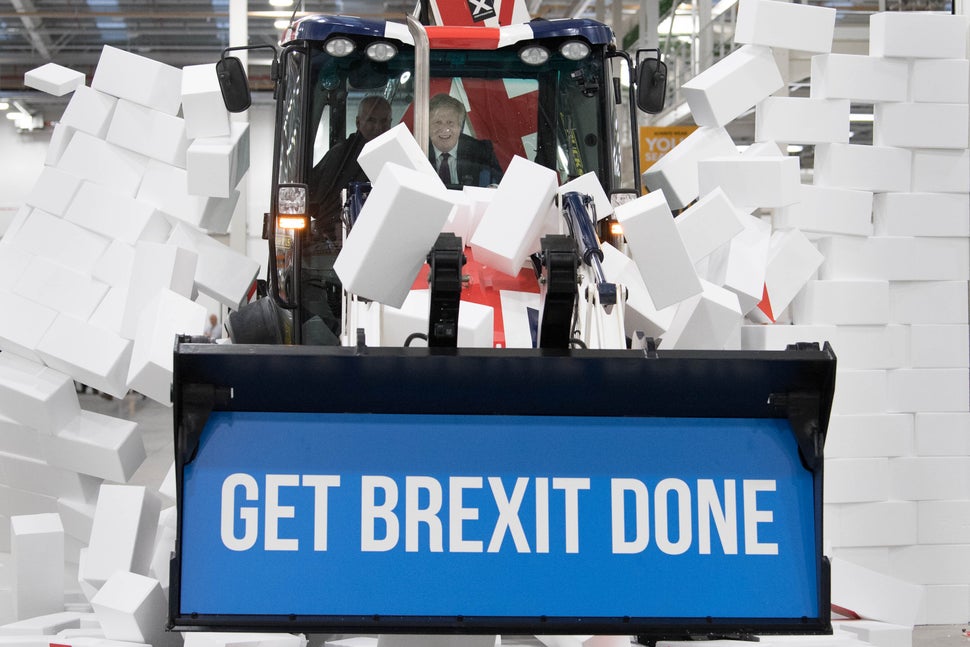
Johnson driving a Union flag-themed JCB, with the words "Get Brexit Done" inside the digger bucket, through a fake wall embla


Johnson driving a Union flag-themed JCB, with the words “Get Brexit Done” inside the digger bucket, through a fake wall emblazoned with the word “gridlock”, during a visit to JCB cab manufacturing centre in Uttoxeter, while on the general election campaign trail. 

One government source, meanwhile, believes Cummings’ winning record goes back even further – highlighting his past campaigns against devolution in his native north-east and against the UK joining the euro.

“He’s a winner,” they said.

“He’s always won – from North-East Says No to the euro campaign, and then Brexit.

“I know he didn’t work directly on the election but all the strategy setting it up almost as a sort of people-versus-parliament thing has his fingerprints all over it.

“That’s almost as important as the campaign, to be honest.”

‘Whatever the anti-zeitgeist is, you become that’

Since entering Downing Street, Cummings has no doubt ruffled feathers.

He has overseen a clear-out of special advisers, including having one frogmarched out of Downing Street, threatened to completely overhaul the civil service and other British institutions like the Supreme Court, and declared war on sections of the press.

But some of those who remain in government see his value to Johnson, designing and overseeing the “leveling up” agenda for Brexiteer voters in neglected parts of the country on behalf of a prime minister who likes to delegate.

“Cummings is incredibly productive – he gets a lot more out of a day than anyone else would,” the government source said.

“I’ve seen him be in two meetings at the same time, walking between them – he’s obviously got the brainpower to deal with two quite complicated policy meetings at the same time.

“He’s a massive driving force behind what happens – a lot of the long-term delivery, the project management stuff. He’s got a key role.”

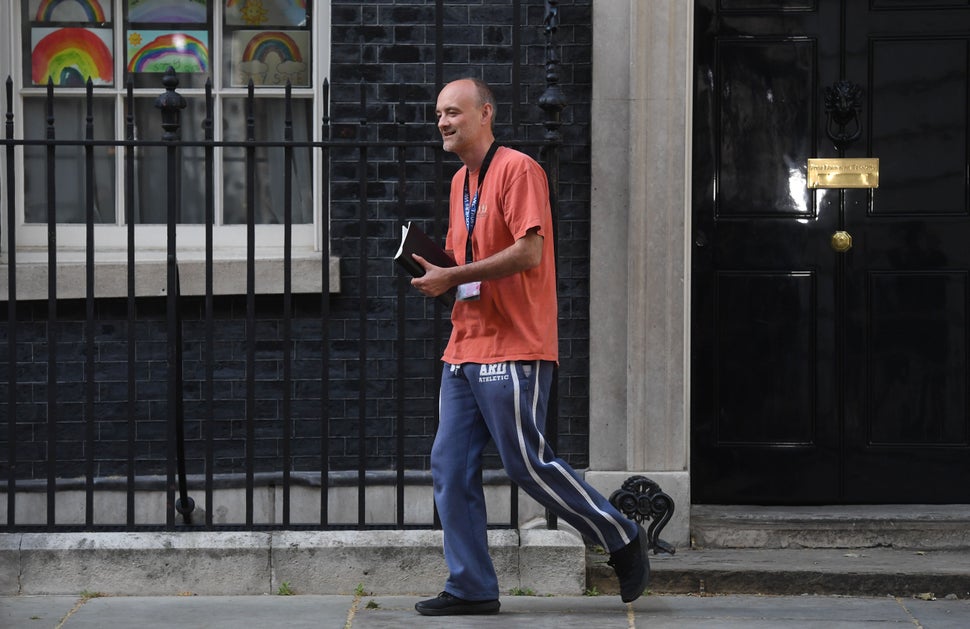
Cummings leaving 10 Downing Street, London, as lockdown questions continue to bombard the government after it emerged that he


Cummings leaving 10 Downing Street, London, as lockdown questions continue to bombard the government after it emerged that he travelled to his parents’ home during lockdown.

The former colleague meanwhile highlights Cummings’ “focus and balls,” his willingness to “keep going on what you think is right even in the face of intense opposition.”

“You’ve got MPs, donors, the cabinet, commentators, saying: ‘This is nuts – you can’t prorogue parliament.’

“Alastair Campbell had that. Thatcher had that.”

They also credit Campbell and Thatcher with basing their battles on a deep understanding of voters, just like Cummings – who “spends days and weeks going up and down the country, going to focus groups, listening to people and putting together ideas.”

But the ex-colleague questions whether his reaction in recent days has been a “mistake.”

“I think now his judgment’s off,” they said.

“I think you would find it hard to argue that even the comms [communications officers] over the last few days have understood what the public mood is on this – they haven’t.

“That doesn’t mean he’s lost it for good – it may be that it’s too personal.”

They added: “We know it happened with Thatcher and we know it happened with Campbell. You get to a point when you are not in sync with the public.

“Whatever the anti-zeitgeist is, you become that.

“It could just be a blip but there is clearly a point where that happens.”

‘He actively doesn’t like us’

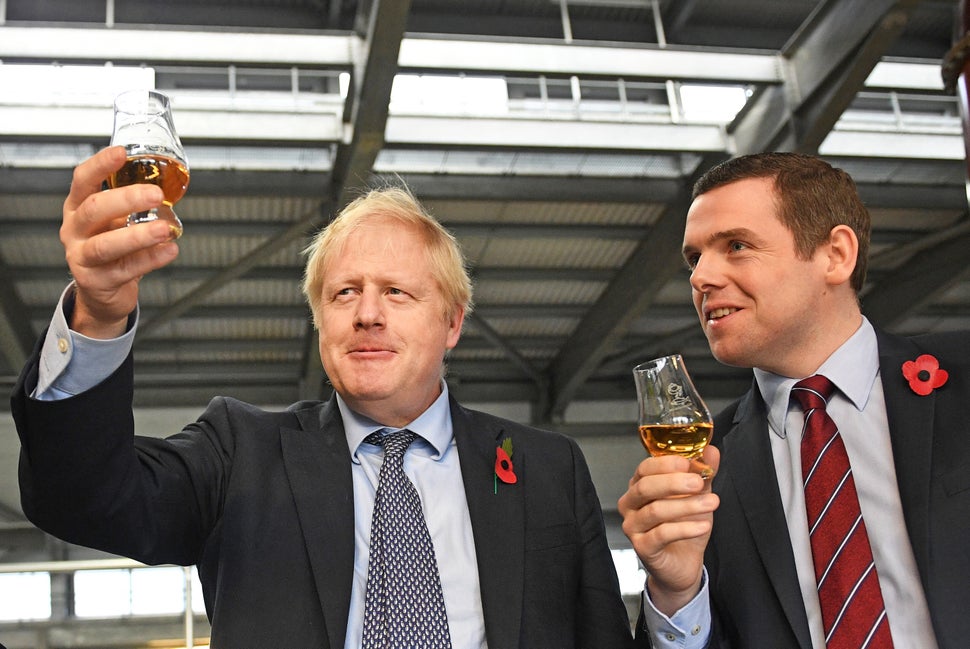
Johnson alongside Douglas Ross, who quit as a Scotland minister over Dominic Cummings' alleged breach of lockdown rules.


Johnson alongside Douglas Ross, who quit as a Scotland minister over Dominic Cummings’ alleged breach of lockdown rules.

There is one reason why Cummings is not yet out of the woods – and that’s the drip-drip of Tory MPs coming out calling for his head and the potential of further resignations to follow junior minister Douglas Ross.

The aide has always insisted he is not a Conservative and has often plowed ahead in the face of intense opposition from the party’s MPs, even managing to alienate arch Brexiteers like Steve Baker.

Asked why Johnson values him so much, one Tory says: “There is obviously something there in which people very much value what he does.

“I can’t really comment on that because they don’t spend any time explaining to us, and Cummings actively doesn’t like us in the parliamentary party. We just don’t get to see it so we have to take it on face value that he’s very useful.

“He’s obviously bright and he obviously knows what he’s doing in referendums.

“But we can’t answer that question, either.”

Another is damning: “I don’t know the bloke, all I know is he’s caused huge embarrassment on more than one occasion to the Conservative party.

“He’s not a Conservative and I don’t understand why the prime minister is so dependent on him unless the prime minister believes he’s got to have a svengali – someone to tell him what to say.

“And, if he has, he shouldn’t be prime minister.”

Johnson and Cummings may hold the media in utter contempt but they may not be able to ignore their own MPs and constituents.


Source link

Lessons need to be learned, admits Chief Medical Officer

The Chief Medical Officer (CMO) has admitted lessons need to be learned from Ireland’s response to the spread of Covid-19 in nursing homes.

Dr Tony Holohan was speaking after the Dáil heard that private nursing homes were left floundering during the pandemic due to a lack of knowledge within the Health Service Executive (HSE) – even though the vast majority of nursing homes were privately run.

In statement to the Special Committee on Covid-19 Response, Health Information and Quality Authority (HIQA) Chief Executive Phelim Quinn said they provided the HSE with “key information, such as the locations of nursing homes, the number of residential beds and staffing levels” as the crisis unfolded.

The HSE and the Department of Health, he added, also availed of HIQA’s online notification system to ensure the timely distribution of information to all nursing homes.

“Currently 80 per cent of nursing homes are operated by private providers,” Quinn said.

“Although funded through the Nursing Home Support Scheme (Fair Deal), the HSE did not know this sector. As a consequence, the infrastructure required by the HSE to support the private sector was under resourced and became increasingly challenged.”

Hours later, Dr Holohan admitted there were “lessons to be learned” regarding the State’s response to the impact the disease was having on the residential sector.

Latest figures show that 54 per cent (884) of Covid-19-related deaths in Ireland occurred in nursing homes.

Speaking at the National Public Health Emergency Team (NPHET) briefing last night (May 26), Dr Holohan said: “We’ll never get everything perfectly right. If there are things to be learned that will help us in terms of that environment, then they will be added to our response and that’s why we’ve proactively put that process in place, because we don’t believe we got it perfectly right.”

There have now been a total 1,615 Covid-19-related deaths in Ireland, after the Health Protection Surveillance Centre (HPSC) was informed yesterday that another nine people with the disease have died.

The HPSC also said that as of Monday midnight (May 25), the total number of confirmed cases of the virus had increased by 37 to 24,735.

Dr Holohan added NPHET plans to meet tomorrow to discuss the case definition used in testing.

“As of midnight Monday 25 May, 325,795 tests have been carried out,” he said.

“Over the past week, 30,169 tests were carried out and of these 633 were positive, giving a positivity rate of 2.1 per cent.”vSpecial Committee on Covid-19 Response

The latest HPSC data also revealed that as of midnight May 24, when there were 24,629 cases, 57 per cent of cases were female and 43 per cent male.

The median age of confirmed cases was 48 years, 3,233 cases (13%) have been hospitalised, and 7,852 cases were associated with healthcare workers.

Of those hospitalised, 395 cases have been admitted to intensive care.

Dublin has the highest number of cases at 11,894 (48% of all cases) followed by Cork with 1,440 cases (6%) and then Kildare with 1,395 cases (6%).

Of those for whom transmission status was known community transmission accounted for 59 per cent, close contact for 38 per cent, and travel abroad for 3 per cent.

peter.doyle@imt.ie

Source link

Caregiver Health: MedlinePlus

0

What is a caregiver?

A caregiver gives care to someone who needs help taking care of themselves. The person who needs help may be a child, an adult, or an older adult. They may need help because of an injury, chronic illness, or disability.

Some caregivers are informal caregivers. They are usually family members or friends. Other caregivers are paid professionals. Caregivers may give care at home or in a hospital or other health care setting. Sometimes they are caregiving from a distance. The types of tasks that caregivers do may include

  • Helping with daily tasks like bathing, eating, or taking medicine
  • Arranging activities and medical care
  • Making health and financial decisions

How does caregiving affect the caregiver?

Caregiving can be rewarding. It may help to strengthen connections to a loved one. You may feel fulfillment from helping someone else. But caregiving may also be stressful and sometimes even overwhelming. Caregiving may involve meeting complex demands without any training or help. You may also be working and have children or others to care for. To meet all of the demands, you might be putting your own needs and feelings aside. But that’s not good for your long-term health. But you need to make sure that you are also taking care of yourself.

What is caregiver stress?

Many caregivers are affected by caregiver stress. This is the stress that comes from the emotional and physical strain of caregiving. The signs include

  • Feeling overwhelmed
  • Feeling alone, isolated, or deserted by others
  • Sleeping too much or too little
  • Gaining or losing a lot of weight
  • Feeling tired most of the time
  • Losing interest in activities you used to enjoy
  • Becoming easily irritated or angered
  • Feeling worried or sad often
  • Having headaches or body aches often
  • Turning to unhealthy behaviors like smoking or drinking too much alcohol

How can caregiver stress affect my health?

Long-term caregiver stress may put you at risk for many different health problems. Some of these problems can be serious. They include

What can I do to prevent or relieve caregiver stress?

Taking steps to prevent or relieve caregiver stress may help prevent health problems. Remember that if you feel better, you can take better care of your loved one. It will also be easier to focus on the rewards of caregiving. Some ways to help yourself include

  • Learning better ways to help your loved one. For examples, hospitals offer classes that can teach you how to care for someone with an injury or illness.
  • Finding caregiving resources in your community to help you. Many communities have adult daycare services or respite services. Using one of these can give you a break from your caregiving duties.
  • Asking for and accepting help. Make a list of ways others can help you. Let helpers choose what they would like to do. For instance, someone might sit with the person you care for while you do an errand. Someone else might pick up groceries for you.
  • Joining a support group for caregivers. A support group can allow you to share stories, pick up caregiving tips, and get support from others who face the same challenges as you do.
  • Being organized to make caregiving more manageable. Make to-do lists and set a daily routine.
  • Staying in touch with family and friends. It’s important for you to have emotional support.
  • Taking care of your own health. Try to find time to be physically active on most days of the week, choose healthy foods, and get enough sleep. Make sure that you keep up with your medical care such as regular checkups and screenings.
  • Considering taking a break from your job, if you also work and are feeling overwhelmed. Under the federal Family and Medical Leave Act, eligible employees can take up to 12 weeks of unpaid leave per year to care for relatives. Check with your human resources office about your options.

Dept. of Health and Human Services Office on Women’s Health

Source link

Adidas donates 2 700 pairs of shoes and jerseys to WC healthcare workers

With our athletic heroes sidelined for the time being, healthcare workers have literally stepped into their shoes after Adidas South Africa donated 2 700 pairs of footwear and fleece tops to the real heroes of 2020. 

The activewear giant pledged to continue donating their products to nurses and frontline workers in Gauteng and Kwazulu-Natal after a handover ceremony in Cape Town on Monday 25 May. 

Adidas keeping healthcare workers warm

The ceremony included provincial government officials such as Premier Alan Winde, Minister of Health, Dr. Nomafrench Mbombo, Minister of Cultural Affairs and Sport, Anroux Marais and The Health Foundation SA. 

Healthcare workers were able to share their stories bout the trying times that have befallen South Africa and the difficult work they are tasked with, while Roddy van Breda, General Manager of Adidas South Africa said that the tireless work they put in deserves reward. 

“Aside from our global initiatives, we felt it important to contribute to COVID-19 relief efforts in South Africa as well, so it’s our privilege to give back to the healthcare professionals, who work tirelessly every day, protecting and caring for our people,” he said. 

“As winter approaches, we’re mindful of the conditions they work in, as well as their commute to work, which is why we’ve donated both footwear and fleece jackets, in an effort to keep these amazing women and men warm and comfortable as they go about their important work.”

He said that the company was also donating a share of their sales profits in May and June to Springbok Captain Siya Kolisi’s foundation, which supports humanitarian efforts in vulnerable communities, among other efforts to assist the needy during the pandemic. 

“Globally, Adidas has donated over $3 million to the World Health Organisation and recently launched the #HometeamHero Challenge – for every hour of accumulated exercise between 29 May and 7 June, adidas will donate $1 to the WHO, with the goal being to reach one million hours.”

‘Together, we will win the battle’

Mbombo said that the gesture was much appreciated as it acknowledged the incredible efforts of healthcare workers, especially in the Western Cape where the majority of cases can be found. 

“The COVID-19 pandemic has challenged and put substantial pressure on our healthcare system, but our healthcare workers continue to devote their time and energy to contain this pandemic,” she said.  What Adidas has done is to acknowledge their immense sacrifices, invaluable dedication, commitment and unwavering efforts in managing this pandemic.”

“This generous gesture serves as a way of thanking them for risking their own lives in order to save the nation. We cannot thank them enough for their noble contributions and sacrifices.” 

“I thank adidas for coming on board in helping us celebrate our healthcare workers. It is our fervent hope that we will continue to work together in creating better working conditions for them because it will take the whole of society to defeat this pandemic.” 

Together, we will win this battle against COVID-19.”


Source link

How Railways, Metro services plan to gather steam post lockdown 4.0?

0

By: Express Web Desk | New Delhi |

Updated: May 27, 2020 7:14:54 pm


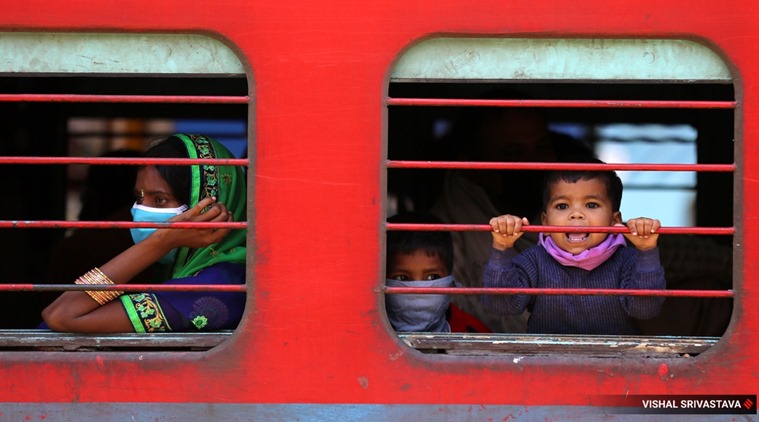
Migrant workers from Kerala reach at Charbagh railway station in Lucknow by a special train. (Express Photo by Vishal Srivastava/File 07.05.2020)
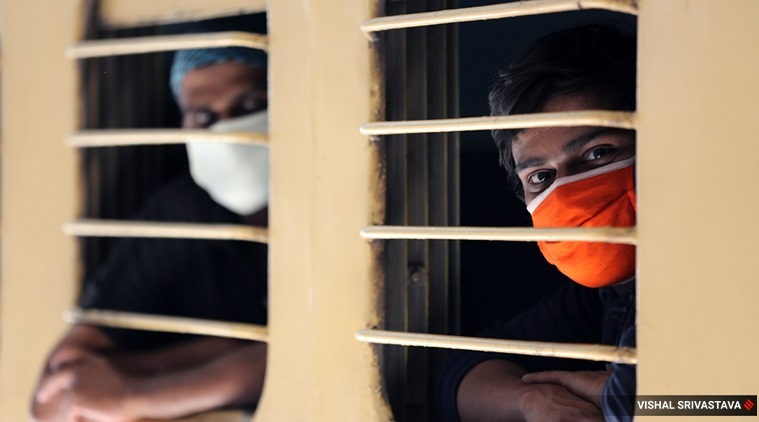
With the fourth phase of the nationwide lockdown due to the Covid-19 pandemic ending on May 31 and the Centre deliberating on the roadmap ahead, the Railways is gearing up for the graded resumption of passenger train operations from June 1. Metro rail services, on the other hand, are yet to get a green light from the Centre as they remain under the list of restricted activities across the country under the latest lockdown guidelines of the Ministry of Home Affairs.

Firstly, let’s take a look at how Railways is planning to restart its services

Seventeen Jan Shatabdis, five Durontos and a number of traditionally popular mail or express trains to various parts of India will be among the list of 100 pairs of trains—to and fro—to be reintroduced from June 1. These are in addition to the Shramik Special trains, which have been running since May 1. The Railways’ decision is in line with the resumption of domestic flight services in a ‘calibrated manner’.

The decision, as per the sources, has been taken with the twin objective of opening up the options for willing migrants to come back to the states of work from their home states in the interest of resumption of economic activity, along with giving the stranded and others willing to travel the option.

Migrant workers from Kerala reach at Charbagh railway station in Lucknow by a special train. (Express Photo by Vishal Srivastava/File 07.05.2020)
The bookings for these trains started on May 21. Tickets can only be booked from the website. These trains can be booked up to 30 days in advance. In a bid to restore some normalcy on railways stations, Railways also ordered that the food stalls and canteens at stations be opened.

List of trains to be run from June 1

Aside from the 17 Jan Shatabdis, which are seating-only trains for shorter distances, five Durontos will run from Howrah to Yesvantpur, Sealdah to Puri, Shalimar to Patna, Ernakulam to Nizamuddin and Secunderabad to Nizamuddin. These selected trains connect tier-two cities across India as well as metros and capital cities.

Additionally, regular mail/express long-distance trains will include popular ones like Shivgang, Shramjeevi, Goa Express, Andhra Pradesh Express, Golden Temple Mail, Karnataka Sampark Kranti, Howrah-Mumbai Mail, Ashram Express, Karambhumi Express, etc.

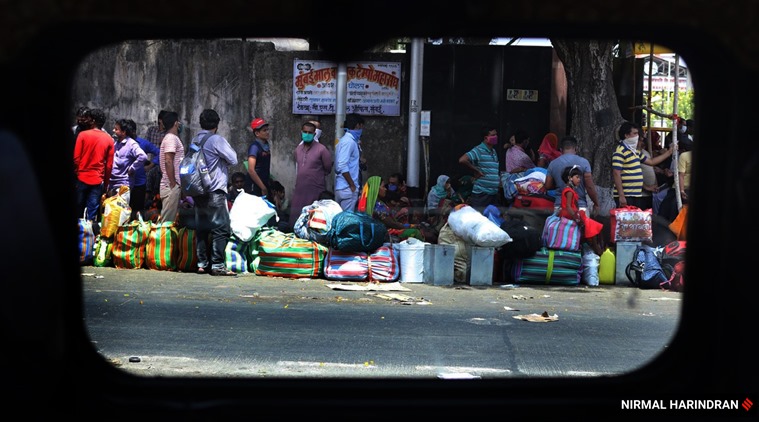
Migrant workers from West Bengal and Bihar wait for trains outside CSMT, Mumbai on Wednesday afternoon. (Express photo by Nirmal Harindran/27.05.2020)
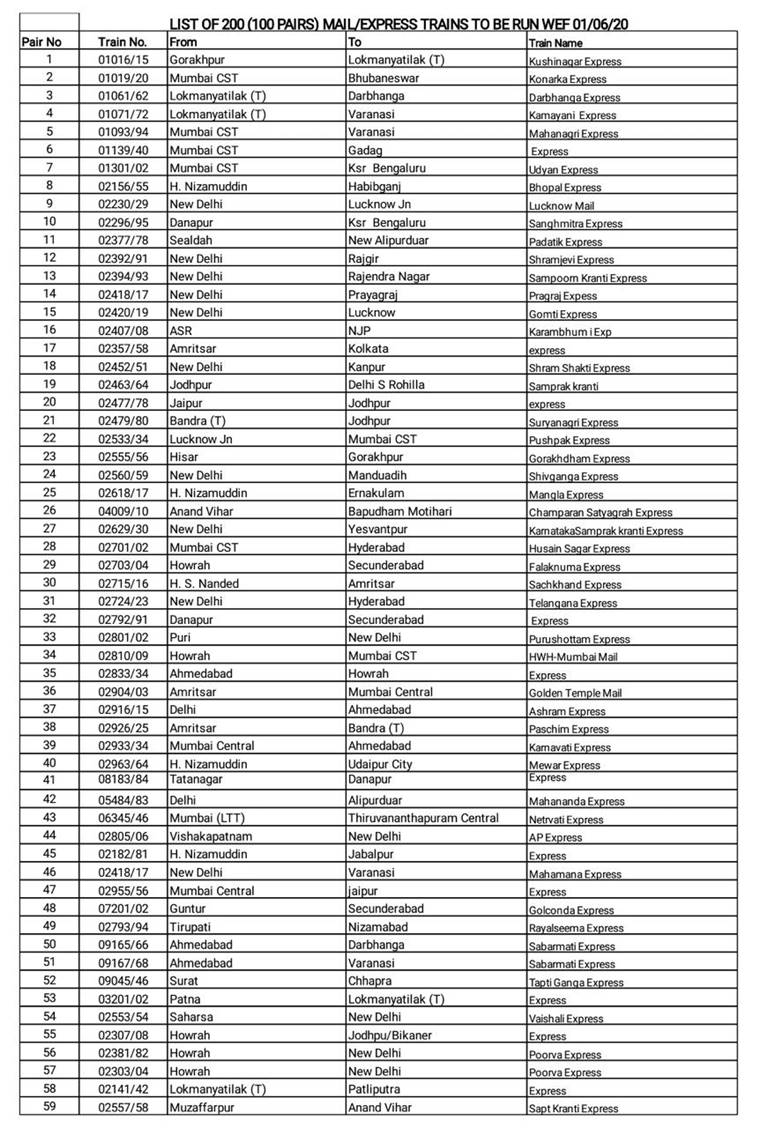
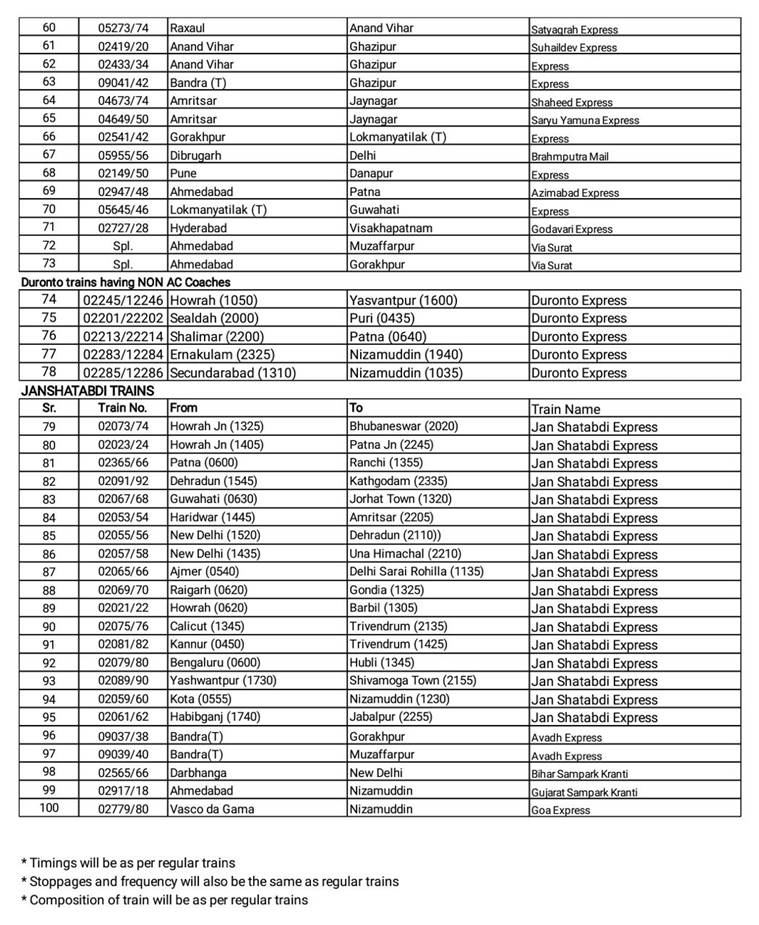
These will be fully reserved trains having both AC & Non AC classes. General coaches shall also have reserved seats for sitting. There will be no unreserved coach in the train. “Fare shall be as normal and for General (GS) coaches, being reserved, second seating(2S) fare shall be charged and seat will be provided to all the passengers,” Railways said.

The usual health protocol of screening and allowing only asymptomatic passengers to travel etc as applicable on the special Rajdhani type trains started earlier this month will continue, like having to reach station 90 minutes in advance. A limited number of booking counters will be opened for special passes and quotas but not for the general public.

Only four categories of Divyangjan concession and 11 categories of patient concessions are permitted in these special trains.

Railways’ next course of action: More trains, opening up of booking counters

After its decision to restart 100 pairs of trains from June 1, the government is also planning to restore around a similar number of more trains soon. While a large number of non-AC coaches already being used by Shramik Specials and a huge number consumed by the restoration of the 100 pairs of mail/express trains, it is expected that the next set of train services to be resumed will have the AC class services. Around 1,200 pairs of regular mail/express trains remain to be restored.

Last week, it had decided to open ticket booking counters across the country in a phased manner so that the sale of tickets offline can restart.

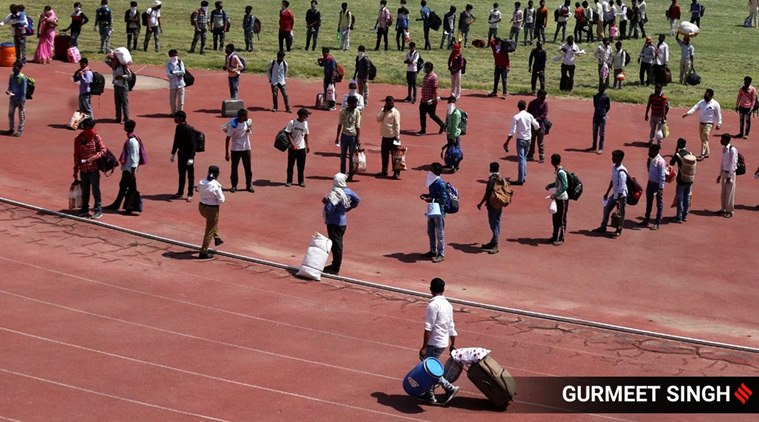
Migrants wait to board a train. Express Photo by Gurmeet Singh/File)
“We have to take India towards normalcy. We are developing a protocol to identify stations where counters can be opened. We have to ensure that there are no large crowds gathering at counters to book tickets, so we are studying the situation and devising a protocol towards it,” Railways Minister Piyush Goyal had said.

“We will also soon announce the resumption of more trains,” he had said during a conversation with BJP spokesperson Sambit Patra, adding that 1.7 lakh common service centres will start booking tickets.

How are Metro rail services are preparing for resumption?

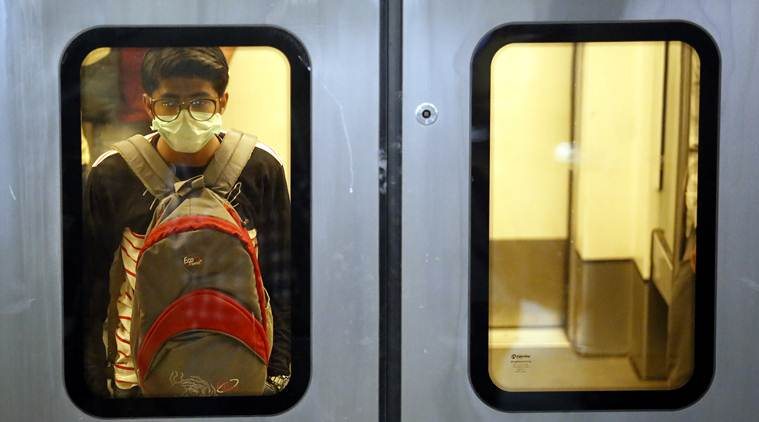
When it comes to the national capital, the Delhi Metro Rail Corporation (DMRC) has informed its staff that services may begin on a short notice of “24-48 hours”. As a first step towards resuming services, sources said, it has deployed full manpower, including station controllers and housekeeping staff, from Tuesday and begin preparations to run “double headway on all lines”, meaning the frequency of trains will be high.

The Indian Express has learnt that the Metro plans to deploy customer facilitation agents at the station gates for thermal scanning of commuters. Token vending machines (TVMs) are likely to be disabled to discourage cash transactions, except in “unavoidable circumstances”. Cleaning of stations has also started. Customer relations staffers have also been asked to show up for briefings on the new Standard Operating Procedure (SOP) that will govern services, as reported by The Indian Express on May 15.

Delhi Metro, Delhi Metro services, Delhi lockdown, Delhi coronavirus lockdown, Delhi news, city news, Indian Express Delhi metro services remain suspended since March 22 in view of the spreading coronavirus outbreak. (Express photo by Praveen Khanna/File)
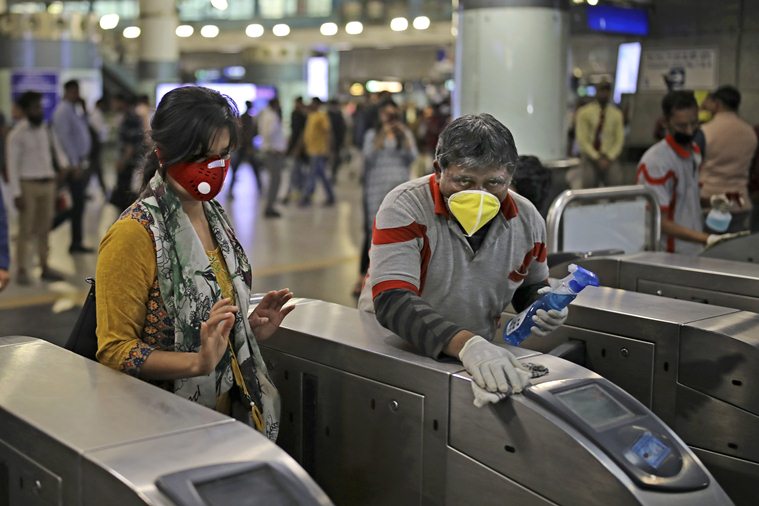
Though metro services remain under prohibited list as of now, the Centre has already shared with Metro operators across the country the SOP following which services will resume. As per the SOP, the trains will stop for up to 30 seconds more than usual at stations to ensure social distancing among passengers boarding or alighting.

Inside the trains, seating capacity will be limited, with ‘do not occupy’ stickers pasted on every alternate seat. Those standing will be expected to maintain a distance of at least a metre among themselves.

A passenger passes through a gate as a worker uses disinfectant to clean it as a precaution against COVID-19 at a metro station in New Delhi, India, Friday, March 13, 2020. (AP Photo/File)

The SOP also underlines that “only asymptomatic passengers shall be allowed to enter stations”. It adds that QR code-based tickets be linked with the Aarogya Setu app to ensure only “safe passengers” gain entry into stations once the restrictions on services are lifted. Metro operators have also been directed to make use of “Aarogya Setu App mandatory” for all passengers.

As per reports, other metro services like Chennai Metro Rail Limited (CMRL) and Kochi Metro Rail Ltd (KMRL) are set to start their regular operations once they get the nod from their state governments.

In Bengaluru, Namma Metro is all set to resume operations as the Bangalore Metro Rail Corporation is awaiting a final nod from the state government for the same. According to a senior BMRCL official, a plan has been made now to resume operations with 33 per cent passenger capacity. “Maintaining social distancing between passengers, wearing masks, and providing comprehensive sanitisation mechanism is the top priority for our preparations now,” the official said.

However, the state government is yet to take a call on the same as the Chief Minister’s Office confirmed that they are awaiting the Centre’s guidelines to resume operations. Namma Metro records an average ridership of 4.5 lakh daily.

With inputs from Avishek Dastidar, Sourav Barman, Ralph Alex Arakal

📣 The Indian Express is now on Telegram. Click here to join our channel (@indianexpress) and stay updated with the latest headlines

For all the latest India News, download Indian Express App.

© IE Online Media Services Pvt Ltd

Source link

Vidya Balan’s Natkhat to have its world premiere at Tribeca Enterprises’ ‘We Are One: A Global Film Festival’ on June 2 : Bollywood News – Bollywood Hungama

0

Versatile actress Vidya Balan created quite a stir recently when she dropped the intriguing first look poster of her debut short film, Natkhat. The hard-hitting film, which addresses patriarchy and toxic masculinity, while dealing with several issues such as gender inequality, rape culture, domestic violence etc., has now been selected by the Mumbai Film Festival to be world premiered at the one-of-a-kind, We Are One: A Global Film Festival on June 2, 2020. Produced and organized by New York’s Tribeca Enterprises, this 10-day digital film festival will be hosted on YouTube and will encompass programming from 20 festivals, including Mumbai Film Festival, Berlin, Cannes, Venice, Sundance, Toronto, New York, BFI London, Karlovy Vary, Locarno, and more.


While Vidya is also acting in the film, Natkhat marks her debut as a producer. Speaking about Natkhat’s world premiere on such a prestigious platform, Vidya said, “Due to this unimaginable and mind-numbing COVID-19 crisis, while film festivals across the globe have been cancelled, digital festivals such as We Are One come as a hope for viewers and filmmakers. I am really happy and excited to showcase our film on this platform. Natkhat is a very special film because it addresses something that is extremely pertinent in these times while also delivering a strong message.”

Echoing Vidya’s sentiments, the film’s co-producer Ronnie Screwvala said, “It’s initiatives like We Are One and platforms like Tribeca Enterprises that are truly making a difference by bringing people together even during these trying times. The donations from the festival will go to the World Health Organization and I am happy that our film is going to be screened on such a platform. It is an honour for us.”

Written by Annukampa Harsh and Shaan Vyaas with Associate Producer Sanaya Irani Zohrabi, Natkhat is directed by Shaan Vyas and produced by Vidya Balan and Ronnie Screwvala.

ALSO READ: Vidya Balan unveils the first look of her debut short film Natkhat 

BOLLYWOOD NEWS

Catch us for latest Bollywood News, Bollywood Movies update, Box office collection, New Movies Release & upcoming movies info only on Bollywood Hungama.

Source link

#Brexit – It takes two to tango – time for the UK to live up to ambitious timetableIt takes two to tango: Time for the UK to live up to ambitious timetable

0

“It takes two to tango. It is time for the UK to live up to the ambitious timetable. The clock is ticking even faster, while we are not seeing any signal from across the Channel of extending the transition period. Progress in the negotiations is not forthcoming. The outstanding workload is colossal, especially as regards the level playing field, cooperation on security, the governance of the future partnership and fisheries,” Hansen stressed.

“Regarding fisheries, the UK only put forward its proposal last week. I fail to see how this delay corresponds to the more than ambitious timetable imposed by the UK and to the joint commitment taken to use the best endeavours to conclude and ratify an agreement on fisheries by the 1st of July,” Hansen continued.

For Hansen, this is symptomatic of a larger problem: “The UK government’s reluctance over the implementation of the Withdrawal Agreement and the Political Declaration does not bode well for the negotiations on the future partnership. The true litmus test for the good faith of the UK remains the implementation of the Withdrawal Agreement. We need to see preparations start now, not only in December. The lack of progress combined with the refusal to extend the transition period lends credit to the idea that the UK has chosen to pass off the impact of a no-deal Brexit as collateral damage of the pandemic – a strategy that I have thus far thought too reckless to be real,” said Hansen.

Turning to the start of negotiations between the UK and the US, Hansen commented: “I wish the UK well in this endeavour. However, juggling several negotiations while dealing with the fall-out of a pandemic sounds ambitious. I hope that this won’t negatively impact the focus and resources the UK will be able to dedicate to the negotiations with its largest and closest market and neighbour.”

Source by [author_name]

Brits breaking UK lockdown defend breaches with government adviser’s actions

Jamieson told BBC Radio 4 that people were telling officers that “if it is okay for Cummings, it is okay for us” and “it looks like there is one rule for us and another rule for the people in No 10 Downing Street.

People in the UK are using the same reasoning special adviser Dominic Cummings did to break the nation’s coronavirus lockdown restrictions. (Getty Images,)

“Now you can’t … if the rules are flexible, and people seem to have interpreted them who are at the heart of government, then it is almost impossible then for police officers to be able to carry out their job effectively.

“What the police are now saying to me is they are getting quite a pushback, not just from some of the younger people who previously were saying why can’t I play football, why can’t I go out in the streets? They’re getting pushbacks from other generations of people as well,” Jamieson said.

“Now that is a bad sign, showing that confidence in the rules, confidence in government and thereby the police’s ability to enforce it has been undermined very much in the last few days.”

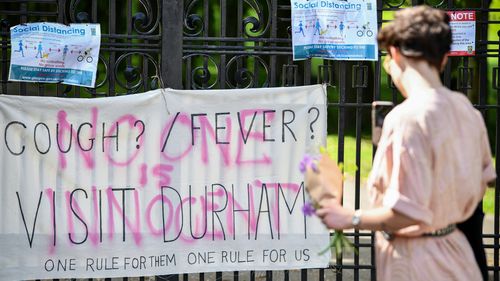
Members of the public view a sign referencing Cummings’ visit to Durham. (Photo by Jeff J Mitchell/Getty Images) (Getty)
Cummings yesterday defended his actions in an exceptionally rare public statement in the gardens of No.10 Downing Street, saying he believes he was in an “exceptional situation” and broke no rules.

Cummings he said he believed it was “the best thing to do” so that extended family could care for his four-year-old son if he and his wife, who were infected with the coronavirus, both fell seriously ill.

His trip came after the government imposed a strict “stay home” order, and Cummings is being accused of flouting the rules he helped impose on the rest of the country.

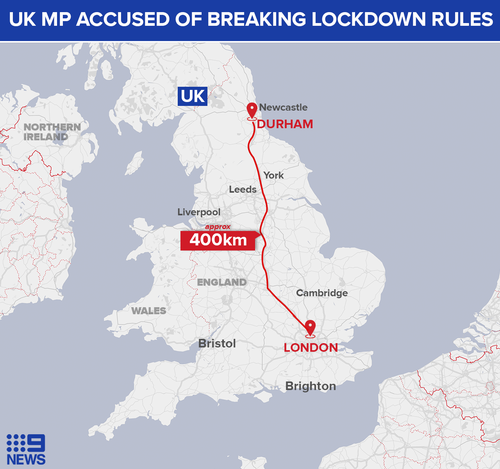
Dominic Cummings travelled from London to Durham.
Dominic Cummings travelled from London to Durham. (Nine)

Cummings insisted that “the rules … allowed me to exercise my judgment”.

He said “I don’t regret what I did,” though he acknowledged that “reasonable people” might disagree with his actions.

For breaking news alerts and livestreams straight to your smartphone sign up to the 9News app and set notifications to on at the App Store or Google Play.

Source by [author_name]

How Israel and the Arab world are making peace without a peace deal

0

WASHINGTON — Without much fanfare or notice, the first known commercial aircraft from the United Arab Emirates recently landed at Israel’s Ben Gurion airport. It was carrying COVID-19 supplies for the Palestinian Authority, which, out of pique, rejected them.

As unprecedented as the flight was, it really shouldn’t have come as much of a surprise. For the past five years, contacts between Israel and the Gulf states — especially Saudi Arabia, the UAE and Bahrain — have been booming. The examples of what amounts to a Great Thaw in an otherwise frozen political landscape are plentiful:

Prime Minister Benjamin Netanyahu, together with his wife and the director of Israel’s Mossad intelligence service, has been received in Oman by the late sultan. He has met the UAE and Omani foreign ministers in the U.S. Israel’s minister of culture has visited Dubai. Israelis, including Jerusalem’s chief rabbi, have been welcomed in Bahrain, and Bahrain has reached out to Israel for help battling COVID-19. Israeli athletes have competed in judo competitions in the UAE, where, for first time, the Israeli national anthem was played and the Israeli flag displayed. Trade between Israel and the Gulf states is now estimated at about $1 billion a year. One Israeli-owned company, AGT International, has reportedly concluded an $800 million deal with the UAE for border surveillance equipment. And this partial list comprises only the visible signs. Much more on the intelligence and security side is reportedly happening below the waterline.

Even more stunning, this putative détente is taking place on the watch of a right-wing Israeli prime minister who doesn’t even feign interest in a two-state solution and is doing everything he can to ensure one never emerges by keeping large parts of West Bank and all of Jerusalem. Contrary to the warnings from diplomats, analysts and peaceniks who predicted Israel would become a pariah if it didn’t settle up with the Palestinians, Israel seems to be making more progress toward normalization with Arab regimes without a credible peace process than with one.

Clearly the Gulf states aren’t on the verge of full normalization with Israel; nor is the Arab world willing to untether itself from the emotional pull of Palestinian issue or its hostile and all too often anti-Semitic views of Israel. But even the most skeptical observers would have to admit something has changed.

Netanyahu’s regional outreach to the Arab world is part of his broader campaign to project Israel’s political profile internationally.

So what explains this shift?

Three significant factors. The rise of Iran and Sunni jihadists spewing terror across the region has created a narrow but important coincidence of interests between Israel and the Arab world. Increasing exhaustion and frustration with the never-ending Palestinian cause has opened up more space for Arab states to follow their own interests. But behind it all, lay a White House enamored of Arab money for arms sales and investment in the U.S. and eager to marshal the Arabs in the service of its anti-Iranian and pro-Israeli agenda. Indeed, in an effort to court the Gulf Arabs, Trump and his Middle East envoy son-in-law Jared Kushner have given the Saudis carte blanche to pursue disastrous policies while holding their coats. And Arab nations, sensing opportunities with an autocrat-friendly U.S. president, have been only too happy to follow.

From the Israeli perspective, the reasons for the détente are not hard to divine. Netanyahu’s regional outreach to the Arab world is part of his broader campaign to project Israel’s political profile internationally with historic visits into Latin America, Asia, South Asia and Africa. Israel now has more diplomatic recognition in the international community than at any time since independence. In the Middle East, his outreach is aimed to demonstrate that Israel can do business with key Arab states without having to compromise on the Palestinian issue and of course to marshal Arab state support in his campaign against Iran.

Saudi Arabia and the UAE, in particular, see Iran — not a seemingly intractable Palestinian issue — as their most pressing national security challenge and see Israel as a powerful partner in containing Tehran’s regional designs. The partnership began to crystallize with the Obama administration’s 2015 nuclear deal with Iran and the perception that Washington was opening the door to legitimize the Islamic Republic as a potential regional partner.

One of the reasons the Israeli-Arab state détente has gained traction is because it’s home grown — emerging from the perception of common threat. But the Trump administration picked up the ball and ran with it. Determined to reverse the policies of his predecessor on Iran and the peace process that had alienated both Israel and Saudi Arabia, Trump made both countries key to his Middle East policies. In my first meeting with Jared Kushner in 2017, he made it unmistakably clear that his father-in-law was determined to establish strategic relationships with both countries.

It was certainly no coincidence that the president’s first foreign trip, in May 2017, was to Saudi Arabia, where, accompanied by a retinue of some of the biggest names in American business and finance, the president talked about Saudi investment, American jobs and billions in arms sales. Then it was on to Israel, where Trump became the first sitting president to pray at Jerusalem’s Western Wall. That trip — planned by Jared Kushner — would also give rise to his close relationship with the Saudi king’s son, Crown Prince Mohammed bin Salman, known as MBS. A reckless and impulsive 30-something reformer, MBS would figure prominently in many disasters, from the war in Yemen to the kidnapping of the Lebanese prime minister, to the murder of Saudi journalist Jamal Khashoggi, as well as in Kushner’s plans to promote Middle East peacemaking.

At the core of that vision were efforts to promote Israeli-Arab state cooperation, both to cement a common front against Iran and to build leverage to pressure the Palestinians to come to the negotiating table. And the Gulf Arab states played the Israeli card for all it was worth. Convinced the road to Washington lay through Jerusalem, the Saudis in particular cozied up to the Trump administration, which refused to abandon them even after bin Salman’s disastrous role in the murder of Jamal Khashoggi. For a few token appearances with the Israelis, such as the Warsaw Conference on Middle East Peace and Security in February 2019, where Netanyahu met with the Saudi foreign minister, Riyadh stayed on Trump’s good side, as it had in low-keying the Saudi reaction to Trump’s opening a U.S. Embassy in Jerusalem. And later that year in Manama, with Riyadh’s permission, Bahrain hosted a U.S.-orchestrated economic conference that brought together Arab and Israeli representatives from the private sector to discuss the economic aspects of Trump’s Vision for Middle East Peace.

Will the Israel-Arab state honeymoon last? The answer is probably yes, anchored as it is in self-interest.

The Iranian threat isn’t going to disappear. The U.S.-Saudi relationship is going through a bad patch now over oil prices. But as long as the Saudis and Emiratis think it’s in their interests to stay in Trump’s favor, their cooperation will continue. And why shouldn’t they? The Saudis have few friends in Washington other than the White House, which recently bypassed Congress, declaring a faux national emergency to facilitate billions of dollars in weapons sales to Saudi and the UAE Positioning themselves as being good on Israel certainly can’t hurt, though the talking points might not be as effective for a President Joe Biden who has labeled Saudi Arabia a pariah state.

As for Netanyahu, as long as he doesn’t expect too much from his new Arab friends and doesn’t break the bank by annexing wholesale the Jordan Valley and the whole West Bank (very unlikely), the Gulf Arabs will stay on board as they did when the U.S. Embassy opened in Jerusalem.

It ain’t peace. But then again that was never in the cards. In a broken, angry, dysfunctional Middle East, who could ask for more?


Source by [author_name]

7 Big Little Lies Of The Modi Government’s Coronavirus Economic Relief

0

NEW DELHI — The Narendra Modi government’s much-touted Aatma Nirbhar, or self-reliance, economic stimulus appears to be a rehashing of previously announced schemes, with very little additional spending, that is unlikely to prop up the faltering national economy, a close read of the package and interviews with economists reveal.

The Modi government announced a Rs 20 lakh crore stimulus package over five days in May this year to ameliorate the economic devastation caused by India’s punitive and unplanned coronavirus lockdown. At 10% of India’s GDP, the Aatma Nirbhar economic package was billed as one of the largest in the world. Yet, the opposition Congress Party says the stimulus in terms of actual additional government spending could be as little as between 1.6% to 0.91% of the GDP. 

Global Securities research firm Sanford Bernstein, which put the fiscal spending at 0.9% of the GDP, described the economic stimulus as “aimless,” “with several generic announcements which should ideally have been a part of a normal economic agenda.”

R. Ramakumar, an economics professor at the Tata Institute of Social Sciences in Mumbai, told Huffpost India that his calculations suggested actual additional government spending would be 1.5 to 2 lakh crores, or 0.87% of the GDP. 

“Given that the whole world is announcing government packages, the government of India wants to make it look like it has announced a huge package,” Ramakumar said. “The reality is that this package is extraordinarily insignificant in magnitude, and does not take into account the acuteness of the crisis that we are in the moment. Its impact on the economy is going to be insignificant.” 

Ramakumar said this was a time when the government should be transferring money to vulnerable workers, farmers, and the urban and landless poor; but “the government is holding on to its purse and it is not opening it up.”

Ramakumar said this could be because the government was reluctant to run a higher fiscal deficit. 

“There is an ideological opposition in the economic thinking  within the government that higher fiscal deficit is bad for the economy primarily because it will scare away foreign investors who come to India,” he said. Other countries however, “have temporarily kept aside such concerns and gone into increasingly fiscal deficits.”

Here are seven key reasons why the Modi government’s economic relief measures since March have left many unimpressed. 

The reality is that this package is extraordinarily insignificant in magnitude…

Pradhan Mantri Matsya Sampada Yojna 

One part of Rs 20 lakh crore Aatma Nirbhar package, Finance Minister Nirmala Sitharaman announced Rs 20,000 crores for the Pradhan Mantri Matsya Sampada Yojna to“integrate, sustainable, inclusive development of marine and inland fisheries to plug critical gaps in fisheries value chain,” and to provide employment to over 55 lakh persons and double exports to Rs. 1 lakh crore.

However, this scheme was first announced in July 2019 and approved in January 2020, well before the coronavirus pandemic struck India. 

Sitharaman announced the scheme in 2019 Budget in July, and the Expenditure Finance Committee in January 2020 approved the PMMSY at a total cost of  Rs 20,050.00 crores comprising a central government share of Rs 9,407 crores, a state share of Rs 4,880.00 crores and beneficiary share of Rs 5,763 crores for its implementation for a period of five years with effect from 2020-21 to 2024-25. This was exactly the same scheme approved by Cabinet on 20 May following Sitharaman’s announcement. 

Anil Tharayath Varghese from the secretariat of the National Fishermen Forum said the beneficiary share suggested this was an “investment-based scheme,” and in no way constituted coronavirus relief. 

“All they are saying is that this is a scheme for five years, and once you start fishing, you can take a loan. But people have not done fishing for the last two months. What about their relief?” he said. “There is no component for Covid-19. There is nothing here that says that we will give you financial assistance.”

National Animal Disease Control Program

As part of the Aatma Nirbhar package, Sitharaman announced Rs 13,343 crores for the National Animal Disease Control Program aimed at vaccinating India’s cattle, buffaloes, sheep, goats and pigs.  The same scheme was approved by the Cabinet in May, 2019 and launched by Prime Minister Narendra Modi in September that year. 

Micro, Small and Medium Enterprises

As part of the Aatma Nirbhar package, Sitharaman announced funding of Rs 3 lakh crores to Micro, Small and Medium Enterprises (MSMES) to guarantee loans from the National Credit Guarantee Trustee Company Limited, a Delhi-based private limited company, and the Pradhan Mantri Mudra Yojana that provides loans up to Rs 10 lakh, through a guaranteed emergency credit line facility. The government also announced 20% extra working capital for businesses with an outstanding debt of up to Rs 25 crore and sales of up to Rs 100 crores. 

There was, however, no fiscal spending to tide over the MSMES that were shuttered in the lockdown. 

A week before the Modi government announced the economic stimulus package, former Finance Secretary Subhash Chandra Garg wrote that 10 of the 15 crore workers employed in eight crore MSMES are without a job, and paying  50% of their normal wage for the period of the shutdown (capping it at Rs 10,000) would only cost the government Rs 1 lakh crores. A second package of 1 lakh crore, Garg wrote, should be extended to eight crore MSMES to cover for part of their fixed costs.  

Extending additional credit support through banks, Garg tells HuffPost India does not help MSMES because only about 45 to 50 lakh have some credit with the bank, which leaves out the bulk of the eight crore enterprises.

“They suffered income loss, turn over loss and massive unemployment loss. Their backs are literally broken,” said Garg. “I refuse to call it a stimulus package because they don’t need stimuli to grow further, they need support to survive and revive. The package that has come is unfortunately not a support package.” 

On the 20% additional loans guaranteed by the government, Garg said the MSMES loan growth has only been 4% to 5% in the past few years, which makes increasing to 20% a challenge. Garg also said that 10% to 15% of MSMES have large non performing loans that considerably reduces their chances of getting additional credits from banks. 

The Reserve Bank of India has since March cut the repo rate at which banks borrow twice (now at an all time low of 4%), to make it easier to give out more loans, but this has not led to higher lending — a trend that was persisting even before the coronavirus pandemic due to slower economic growth and mounting bad loans.

“The package does not seem to be addressing the core need of the MSMEs to get some support for the losses they have suffered so that they restart their business now that the lockdown has been largely lifted,” said Garg. 

I refuse to call it a stimulus package…

Agriculture Infrastructure Fund 

As part of the Aatma Nirbhar package, Sitharaman had announced that a 1 lakh crore Agriculture Infrastructure Fund would be created for small and marginal farmers, and financed by the National Bank for Agriculture and Rural Development (NABARD). Ramakumar, who teaches economics at TISS, said there was no additional spending on part of the government, and NABARD would have to borrow the money from the market. 

“It is not actually money spent by the government,” he said. “If you wanted to address the concerns in agriculture, you should have thought of increasing the cash transfers to farmers through a scheme like PM Kisan. If you wanted to address the concern of workers, you should have thought of a new cash transfer scheme for them at least or universalizing the Public Distribution System.”

Pradhan Mantri Kisan Samman Nidhi Yojna

As part of the Rs 1.7 lakh crore Garib Kalyan package unveiled in March, the Modi government had announced a payout of Rs 2,000 each to more than eight crore farmers under the PM Kisan Yojna. Reported by sections of the media as a “big relief” for farmers, the government had only fast tracked the first instalment of Rs 2,000 of a total of Rs 6,000 due to landholding farmers covered under the scheme every year. The money under this scheme, launched in February 2019, is meant to provide income support for landholding farmer families to meet their agricultural as well as domestic needs. 

Jean Dreze, an economist and activist, and visiting professor at Ranchi University, told HuffPost India, “For years there has been a pattern of creative accounting to reduce social expenditure, and this is visible again in the critical relief package.”

MGNREGA wages 

The Modi government in March had announced a hike of Rs 20 in wages given under the Mahatma Gandhi National Rural Employment Guarantee Scheme (MGNREGA), increasing the national average wage under the scheme from Rs 182 per person per day to Rs 202. This increase was a routine revision that is done twice a year by the Chief Labour Commissioner and calculated as per the Consumer Price Index for Agricultural Labourers. 

2020-2021 marked an 11% rise in the average wage rate, significantly higher than the 1.6% in 2019-2020, the highest since the 7% increase in 2015-16, but still 40% to 50% less than the state-notified minimum wages paid to unskilled agricultural workers. Labour rights activists also questioned how a rise in MGNREGA wages in the middle of a coronavirus lockdown would help rural families given that there was no work to be found and they too were under the lockdown. 

Reetika Khera, an economics professor at the Indian Institute of Management, Ahmedabad, said the month of April had seen the least work generated in the past five years under MGNREGA, a program that guarantees 100 days of work in a year for rural families. 

Sitharaman announced funding of Rs 40,000 crores for MGNREGA  in May, in addition to the Rs 61,500 announced in the Union Budget 2020-2021.

Khera has pointed out that Rs 11,000 of the Rs 61,500 announced in the budget was payment of pending arrears.

State Disaster Response Mitigation Fund (SDRMF)

The Modi government while releasing Rs 11,092 crores to the State Disaster Response Mitigation Fund of 28 states on 3 April called on them to use it for combating the coronavirus. A letter from the Disaster Management Division from the Ministry of Home Affairs to the Chief Secretaries all states said the money should be used for quarantine measures, sample collection, screening, and procurement of essential items and laboratories for response to Covid-19. 

Funds under the SDRMF are released every year in two instalments for state governments for responding to natural disasters. The Union Government contributes 75% of funds for general category states and 90% for special category states (Northeast states, Sikkim, Uttarakhand and Himachal Pradesh), and the rest of the money comes from the state government. 

The funds for each state released in the first allotment were calculated by the 15th Finance Commission in November, 2019, months before the coronavirus cases were reported in India, and its report tabled in Parliament in February. But no additional money specifically for tackling the coronavirus was released in the first allotment. 

The Commission says that it arrived at the final allotment for each state by weighing area, population and risk profile, with Maharashtra getting the most at Rs 4,296 crores and Rs 1,1611 crores in the first allotment  followed at a distant second by Uttar Pradesh with Rs 2,578 and Rs 966.50.

Data scientist Nilakantan R.S. has pointed out that this allotment does not correspond to how the coronavirus disaster is playing out in different states in the country. 

While Maharashtra has the highest number of coronavirus cases, the next worst-hit states ― Tamil Nadu and Gujarat ― only got half as much relief funds (Rs 510 crores and Rs 662 crores) in the first allotment. 

The Fifteenth Finance Commission formula was not designed for the coronavirus pandemic situation, and the vulnerability of states in the face of a public health emergency does not correspond with the disaster risk index, said Himanshu Upadhyay, who teaches development at the Bengaluru-based Azim Premji University. “So, when you use a formula which was not designed for the crisis situation, you will naturally be generating a fiscal prudence disaster,” he said. 

For the latest news and more, follow HuffPost India on Twitter, Facebook, and subscribe to our newsletter.


Source link