Sunday, May 17, 2026

Smart Contact Lenses Help Manage Diabetes

0

AsianScientist (May 26, 2020) – Scientists in South Korea have developed wireless smart contact lenses to help diabetic patients manage their disease. Not only is their wearable device able to monitor blood glucose levels, but it can also trigger the release of drugs that treat diabetic retinopathy, a medical complication that affects the eye. Their study was published in Science Advances.

In 2019, 463 million adults were reported to suffer from diabetes mellitus. People who develop diabetes have to make significant modifications to their lifestyle, such as dietary changes. Beyond that, they also need to actively monitor their blood glucose levels and receive medications to keep their condition under control. Often, these procedures, which include invasive blood tests or drug injections, can lead to a considerable amount of discomfort.

To help diabetics better manage their condition, researchers have been investigating the use of soft bioelectronics to develop wearable healthcare devices. For example, smart contact lenses present a convenient and non-invasive way to interface with the human body. However, no smart contact lenses to date have combined real-time biometric measurements with drug delivery.

Sensing an opportunity, a team of researchers at Pohang University of Science and Technology (POSTECH), South Korea, integrated the smart contact lenses with ultrathin, flexible electrical circuits and a microcontroller chip. The device, which is built on a biocompatible polymer, can perform real-time biosensing and be used for controlled drug delivery. The team was led by Professor Hahn Sei Kwang from POSTECH Department of Materials Science and Engineering, and Professor Sim Jae-Yoon from POSTECH’s Department of Electronics and Electrical Engineering.

To test the device’s feasibility, the researchers used the lenses to measure tear sugar levels in diabetic rabbit models. They then validated the results using measurements obtained from conventional blood sugar tests. In this study, the researchers also demonstrated that they could trigger the release of the drug for treating retinopathy in diabetic rabbit eyes from its reservoir.

With this study, the team at POSTECH hopes to further investigate the use of smart contact lenses as a next-generation wearable device for eye-related and other diseases.

“By being the first to develop wireless-powered smart contact lenses that are equipped to diagnose diabetes and treat retinopathy, we expect that our research will contribute greatly to the advancement of related industries,” Hahn said.

The article can be found at: Keum et al. (2020) Wireless Smart Contact Lens for Diabetic Diagnosis and Therapy.

———

Source: Pohang University of Science & Technology; Photo: Shutterstock.
Disclaimer: This article does not necessarily reflect the views of AsianScientist or its staff.


Source link

EU-Japan leaders’ video conference meeting to focus on the #Coronavirus pandemic and co-ordinated response – EU Reporter

0

Today (26 May), Commission President Ursula von der Leyen, Council President Charles Michel and the Prime Minister of Japan Shinzō Abe will hold a virtual leaders’ meeting to address matters related to the coronavirus pandemic, preparations for the upcoming G7 summit, and the implementation of the EU-Japan Strategic Partnership.

As G7, G20 and strategic, likeminded bilateral partners, the European Union and Japan are committed to ensuring a strong global response to the coronavirus outbreak through close cooperation and enhanced coordination of efforts. The leaders are expected to address the economic recovery, restoring international trade, assisting vulnerable populations, as well as the virus’ impact on geopolitical issues.

Presidents von der Leyen and Michel and Prime Minister Abe are also expected to look to strengthen bilateral co-operation in a number of areas, building on the EU-Japan Strategic Partnership Agreement and the Economic Partnership Agreement, as well as the Partnership on Sustainable Connectivity and Quality Infrastructure.

Following the end of the meeting, Presidents Michel and von der Leyen will present the outcome to the press. Audiovisual coverage will be available on EbS. For more information on EU-Japan relations, consult the website of the EU Delegation and the dedicated factsheet.

Comments

Facebook comments

Tags: , , , ,

Category: A Frontpage, coronavirus, Coronavirus face masks, Coronavirus Global Response, COVID-19, EU, European Commission, Health, Japan, PPE


Source by [author_name]

Melbourne teacher tests positive to coronavirus

The Keilor Downs College teacher returned a positive diagnosis last Friday amid the state’s COVID-19 testing blitz.

Education Minister James Merlino assured reporters today there was no “further risk”, with the school reopening again today.

“There was no exposure to the school site,” he said.

Keilor Downs College. (Google Maps)

“No close contacts were identified at the school. Because of the timing, there is no further action required at the school.”

Principal Linda Maxwell in a statement said the teacher would remain in isolation at home until the Department of Health permitted them to return to school.

“Please do not be alarmed but one of our staff has tested positive to COVID-19 in a community test,” she wrote on the school’s Facebook page.

“They have not been at school at all during this time so there is no action required at school.

“We have not been asked to close for cleaning and there are no contacts at school.”

Ms Maxwell said the Department of Health indicated the infection was contracted via community transmission, as the teacher had “very limited contact” outside of their home.

“They contracted the virus while they were on remote learning so there is no possibility of involvement from anyone at KDC,” she said.

“I really need your support to keep things calm and to ensure that students still feel confident to return to face-to-face teaching.”

Students are beginning to return to Victorian schools. (9News)

Victorian students from prep to year 2, year 11 and 12 and specialist schools have returned to school grounds today, after spending more than a month of term two learning from home.

About 10,000 school staff have been tested for coronavirus, with just the one teacher returning a positive test.

Mr Merlino stressed it was safe for students to return to face-to-face learning. But immunocompromised students would still be allowed to learn remotely.

“We have been very careful and cautious with how we have approached this pandemic,” he said.

“Our principals, teachers and support staff have done a brilliant job over the last seven weeks, engaging with their students through flexible and remote learning.

“Our teachers are raring to go. This is still going to be a challenging time. Schools will continue to look different.”

The state’s total has risen to 1610, three of those new cases being detected among returned overseas travellers and one through routine COVID-19 testing.

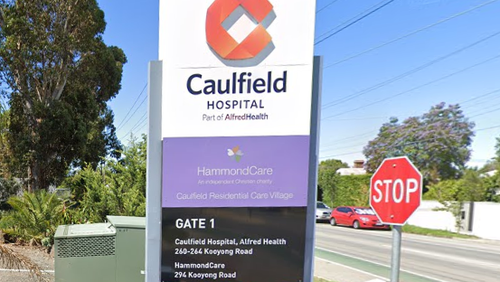
HammondCare in Caulfield. (Google Maps)

“The resident has been moved to a separate building at the facility and identified close contacts are already in quarantine,” Mr Merlino said.

“The source of acquisition for this case is still under investigation including looking at potential links to the pervious case at the facility.”

The facility’s coronavirus tally now sits at two, with an 84-year-old resident initially testing positive before returning two negative results to the virus last week.

HammondCare in a statement confirmed a second resident returned a positive test for coronavirus but has since tested negative.

Senior nurse and general manager Angela Raguz said the conflicting results were “odd and unusual”.

“The impact this has had on residents, family and friends, and staff is significant and is being taken seriously by HammondCare,” she said.

“Discussions continue with the Department of Health and Human Services so we can better understand why these conflicting results have occurred.”

There are eight people in hospitals across the state, including three patients in intensive care.

While 182 cases may indicate community transmission.

There are 56 active coronavirus cases in Victoria.

Source by [author_name]

White Woman Calls Cops On Black Man Over Dog Leash Dispute In Viral Footage

A white woman called the police and accused a Black man of threatening her and her dog in New York City’s Central Park, as seen in now-viral footage posted to social media on Monday. The man said the confrontation began when he asked her to put her dog on a leash.

The footage was published on Facebook by the man, Christian Cooper, and on Twitter by his sister, Melody Cooper. The video was viewed on Twitter more than 10 million times by late Monday night and sparked widespread outrage.

It begins with the dog walker dragging her dog by the collar toward the man and demanding that he stop filming.

“Please don’t come close to me,” the man is heard repeatedly saying as she approaches. 

She asks him to stop filming several times and then threatens to call the police. “I’m going to tell them there’s an African American man threatening my life,” she says.

“Please tell them whatever you like,” he responds.

Then, on her phone, the dog walker says: “I’m in the Ramble and there is a man ― African American, he has a bicycle helmet ― he is recording me and threatening me and my dog.”

A New York Police Department spokesperson said the NYPD were called to the Central Park Ramble for a report of an assault just after 8 a.m. Monday. On arrival, they determined two individuals had engaged in a verbal dispute. There was no crime and no arrests, the spokesperson said.

According to the Central Park website, dogs must be leashed at all times in the Ramble. The woman is also seen repeatedly dragging her struggling dog by its collar during the video and later attaches the leash.

Melody Cooper said her brother is an avid birder and had politely requested that the woman put her dog on a leash, in accordance with signs in the park. Christian Cooper said the dog was “tearing through the plantings in the Ramble” when he asked the woman to leash her pet.

Melody Cooper said she was grateful for the concern she and her brother received on social media.


Source by [author_name]

Furious Shoppers Boot Out Woman Buying Groceries Without A Face Mask

See the latest stories on the coronavirus outbreak.  

A group of customers in a grocery store went ballistic as a woman shopped without a face mask, yelling at her until she walked off with her cart full of groceries.

The heated confrontation was captured on a video posted Saturday to Facebook on Saturday and quickly went viral on Twitter. “What happens in Staten Island when you don’t wear a mask in ShopRite!” noted the poster, who said it had been filmed by a friend who sent it to her.

It was a surprising scene given all the media attention recently to maskless demonstrators protesting against health and safety measures to help stop the spread of COVID-19. The people yelling at the shopper were over-the-top angry, and several shouted obscenities and insults.

Comments on social media ranged from attacks on the yelling “savages” to “finally” people are standing up for safety.

The woman who posted the video noted: “I get ppl are anxious NO reason to act the way some of them are … especially guy following her to scream at her and call her a pig!”

No one reached at the ShopRite stores on Staten Island would comment on the incident to HuffPost. 

New York Governor Andrew Cuomo said Monday that he won’t allow Staten Island to reopen businesses ahead of the rest of the city, as local lawmakers have requested. They’ve argued that certain required safety parameters have already been met. But Cuomo said the city has to move at a unified pace because of travel among the boroughs.

Almost 800 residents in Staten Island’s Richmond County have died of COVID-19, making it 25th on the list of counties in the nation with the highest number of deaths.

“All New Yorkers must wear a face covering when they need to be outside their home and may not be able to maintain at least 6 feet of distance between themselves and others, according to the New York City Department of Health. “Examples include riding the subway, ferry, or bus; riding in a taxi or car service; walking on a busy street; going to pharmacies and grocery stores; and going to the doctor or a hospital.”


Source by [author_name]

Chinese city wants to score and rank its residents based on their health and lifestyle

0

That “health score” will be embedded in a digital QR code accessible on your phone, ready to be scanned whenever needed.

This is what the city government of Hangzhou in eastern China has envisioned for its more than 10 million residents, inspired by a “health code” system it adopted during the Covid-19 pandemic to profile people based on their risk of infection.
Across the globe, governments have stepped up the collection of personal data in their fight against the novel coronavirus, which has killed more than 345,000 people and infected close to 5.5 million, according to data collected by Johns Hopkins University.

But there are also fears that some of these extraordinary measures could be here to stay even after the public health crisis is over, posing a long-term threat to privacy.

That concern was amplified among Hangzhou residents when their municipal government announced Friday that it was planning to make permanent a version of the “health code” app used during the pandemic.

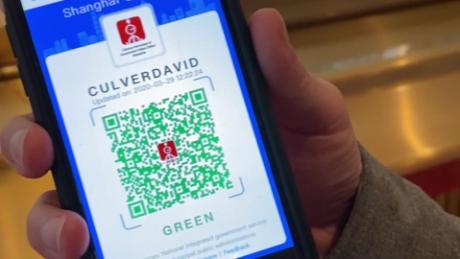
Since February, the Chinese government has used a color-based “health code” system to control people’s movements and curb the spread of the coronavirus. The automatically generated quick response codes, commonly abbreviated to QR codes, are assigned to citizens on their smartphones as an indicator of their health status. The color of these codes — in red, amber or green — decides whether users can leave home, use public transport and enter public places.

The health codes can also serve as a tracker for people’s movements, as residents have their QR codes scanned as they enter public places. Once a confirmed case is diagnosed, authorities are able to quickly trace where the patient has been and identify people who have been in contact with that individual.

Hangzhou, a coastal city about a hundred miles southwest of Shanghai, was among the first cities to use the health code system to decide which citizens should go into quarantine. But now, the city government says it wants the “health code” to be “normalized” — meaning it could be here to stay well beyond the pandemic.

At a meeting of the Hangzhou Municipal Health Commission on Friday, Sun Yongrong, the director of the commission, said they were looking to establish a system that can assign citizens a personal score, color and ranking based on the collected data on their medical history, health checkups and lifestyle habits.
An image demonstrating the design of the proposed system posted on the commission’s website shows the daily health score will range from 0 to 100, corresponding to a color in a gradient from red to green.

The score can be affected by your daily activities: 15,000 steps of daily exercise will increase your score by 5 points, 200 milliliters of baijiu — a sorghum-based Chinese liquor known for its high alcohol content — will lower your score by 1.5 points, five cigarettes will cost you 3 points, and 7.5 hours of sleep will add one point to your score, the demonstration shows.

There might also be a “group health score” for companies and residential committees, Sun said. A demonstration shows the health score for a company can be based on factors such as how much its employees exercise and sleep per day, how many employees have conducted annual health checkups, and how well chronic disease are controlled among its employees.

Sun did not give details on how the data will be collected, whether the app will be compulsory, or how the score will affect people’s daily life and business operations.

However, the proposal was already met with criticism and anger on Chinese social media, with many users raising privacy concerns.
“Medical history and health checkup reports are personal privacy, why should they be included in health codes to show others? Points will be deducted for smoking, drinking and not sleeping enough, does this mean our lives will be completely monitored?” said a user on Weibo, China’s Twitter-like platform.
“During the epidemic we had no choice, but I hope after the epidemic individuals will have the right to delete the app, instead of normalizing (its use),” another user said.
 A Chinese man and woman in Beijing show their local health QR codes to a security guard as he checks her temperature before entering a shopping area on May 3.
The proposal has also raised questions over its wider application. On Zhihu, China’s version of Quora, some users voiced concerns against its possible exploitation by insurance companies and marketing firms, while others worried that it could lead to employment discrimination against people with lower scores.
The proposed health code system bears similarities to China’s social credit system, an ambitious social-engineering style project that uses big data and a combination of rewards and punishments to incentivize good behavior. In Hangzhou’s pilot scheme of the social credit system, residents are assigned a score based on certain behaviors such as their ability to pay debts and fees on time and the amount of community volunteering work they’ve completed.

Hangzhou, home to China’s e-commerce and internet giant Alibaba, has been at the forefront of applying big data and digital technology to urban management. At the moment, it is unclear if the city’s health score proposal will be adopted and rolled out nationwide like the coronavirus QR codes.

Some Chinese internet users, however, are already questioning the feasibility of the plan, pointing to technical difficulties such as how to convert different medical conditions into scores and come up with a workable algorithm.

“This is too big a step. No matter how willing are Chinese people to sacrifice their privacy in exchange for conveniences, (the health score) will surely spark discontent from many users,” said a comment on Zhihu.

Source link

Justice Department Investigating Ahmaud Arbery Killing As Possible Hate Crime: Reports

The Department of Justice is investigating the death of Ahmaud Arbery as a possible hate crime after the man was shot and killed while jogging in Georgia earlier this year, according to multiple reports.

An attorney for Arbery’s family first told CBS News that the Justice Department would launch a federal hate crime investigation and look into why local officials took more than two months to file charges in the case.

The move comes amid nationwide outrage over the shooting death. Arbery, a 25-year-old Black man, was confronted by two white men while he was jogging in a coastal South Georgia neighborhood in late February. The pair, Gregory and Travis McMichael, said they believed he was a burglar before they confronted him with guns. Travis McMichael shot Arbery three times during a confrontation, killing him.

No one was arrested, however, until a graphic video of the encounter was released earlier this month. 

Attorneys for Arbery’s family said Monday they had met last week with Bobby Christine, the U.S. attorney for the Southern District of Georgia, noting that officials at the DOJ would investigate why it took months for charges to be filed. The lawyers also said the Justice Department was weighing civil and criminal charges against state officials.

“[Christine’s] office is investigating why it took so long to arrest the individuals responsible for Mr. Arbery’s death,” the Arberys’ attorneys said in a statement Monday. “This would involve the consideration of both civil and criminal charges against state officials and other conspirators involved in the murder of Ahmaud Arbery.”

They added: “We left that meeting feeling satisfied that the DOJ would do their part to fully investigate all players involved in this murder and that they would hold those responsible accountable.”

The Justice Department said earlier this month that it was weighing federal hate crime charges to determine if they were “appropriate” following the arrest of the men in Georgia. A third man who filmed the encounter was arrested last week on charges of felony murder and criminal attempt to commit false imprisonment.

Georgia does not have state-level hate crime statutes, but the DOJ is able to file federal charges in certain cases.


Source by [author_name]

Have reports of Bali’s death been greatly exaggerated? – New Mandala

0

There has been a lot of speculation about the impact of COVID-19 on the Indonesian island of Bali, which has seen tourist arrivals dry up amid border closures and the grounding of domestic flights. Some of the more balanced stories have focused on the devastating impact to locals employed in the tourism industry such as hotel staff, tour guides and restaurant workers. Others have highlighted the experience of foreigners hunkered down in Bali for the duration of the crisis. These analyses vary in their tone and content, but some of the more sensationalist tend to privilege the perspective of foreigners or use somewhat alarmist language to push a narrative of impending disaster. But how dire is the situation in Bali really? An immensely challenging road certainly lays ahead, but there are some misconceptions and narratives out there that I wanted to push back against a bit.

This story in the LA Times is a good starting point. The piece is rightly critical of the Indonesian government’s slow response to the crisis, but it then says the country’s economy has “been decimated by the lack of tourists to places like Bali.” In fact, tourism makes up a relatively small portion of Indonesia’s GDP – investment and household consumption have been doing the heavy lifting of late for this trillion-dollar economy. And if you totalled up the value of all of Bali’s economic activity in 2019 it would be 1.63% of Indonesia’s total output. Is Bali an important part of the Indonesian economy that brings in large amounts of foreign currency? Undoubtedly. But Bali is not Indonesia.

Yet even if its economic footprint is not quite as big as its outsized place in peoples’ imaginations, it is a very popular tourist destination. And clearly any businesses depending on tourism are in deep trouble right now, as are their employees. The West Australian ran this piece with the headline  “Bali economy collapses.” This story from Al Jazeera states that 80% of Bali’s GDP comes from tourism, while making the rather dramatic claim that “Without tourists, Bali will die.” But how accurate are these claims?

In 2019 according to the Central Statistics Agency (BPS), 45% of Bali’s GDP came from agriculture, education, manufacturing, health care, financial services and other industries that one would not expect to be directly tied to the tourism sector. 55% came from hotels, restaurants, retail, transportation, real estate and construction. The deputy governor has estimated that 60% of the island’s GDP is supported by tourism, while the head of Bali’s tourism department estimates half of the population has some connection to the industry. The loss of visitors is obviously a staggering blow to the economy, especially as service jobs supported by tourism tend to pay well – but the 80% figure still appears to be an over-estimation. It is also far from clear that this has caused the economy to collapse.

Only certain parts of Bali have really high and immediate exposure to tourism. Badung Regency, in which the tourist hot-spots of Kuta, Canggu and Seminyak are located, is the most exposed and is feeling the most immediate impact. Those areas are truly ghost towns already.  But Kuta and Seminyak are not Bali. Outside of Badung, agriculture is actually the dominant industry in the majority of Bali’s regencies, accounting for nearly 25% of output in Karangasem and 26.8% in Bangli. BPS estimated that in 2018 approximately 477,000 workers were employed in the agriculture sector.

While it is possible that the price of agricultural products will fall due to shrinking demand from hotels and restaurants, the state-owned logistics and commodity broker BULOG has already stated that if that happens they will step in to buy staple goods like rice produced by Balinese farmers in order to stabilize the price. This doesn’t mean that agriculture can offset the loss of jobs and revenue from tourism. But it underscores that Bali’s economy extends beyond the tourist resorts of Nusa Dua and the beaches of Kuta into less-seen areas where hardworking people, who have fairly limited direct exposure to the tourism sector, work in the sawah and run local warungs. And their world is still very much alive.

If you travel just a few kilometres outside of the tourist enclaves of Kuta or Seminyak, you will see people out and about. The government has shut the beaches, mandated that businesses close by 9pm, banned mass gatherings and recommended that people stay home if they can. Police in Sanur are forcing anyone caught not wearing a mask to do push-ups. Some shops have closed voluntarily; others have been ordered closed in an ad-hoc fashion by small administrative units called banjar. This patchwork system of closures is a less than ideal strategy, but it does allow some businesses to remain open and pay their staff for now.

In the provincial capital of Denpasar, traffic is noticeably lighter and many restaurants are doing takeout only. The police have set up checkpoints to ensure the rules are being observed, but people are still carrying on as best they can delivering food, selling phones, giving haircuts and otherwise trying to stay afloat. Bali might be on life support, but it’s far from dead. Those who can afford to stay home are doing so. But many do not have that luxury. They must work if they are able, as Indonesia’s weak and patchy social safety net – particularly for migrant labourers – will not catch them. And so life carries on. People buy gas. They get their motorbikes fixed at the bengkel. They show up at Pasar Badung and barter over the price of chickens. Is this risky? Maybe. But the alternative is likely worse.

Excluding Badung Regency and the capital city of Denpasar, 50% or more of all economic activity in Bali’s other seven regencies (home to 2.7 million people) comes from household consumption. That is, people buying the everyday things that they need. With tourism on ice, consumption must sustain the economy on fumes for now. But people can only buy things if they can work and earn income. That is why you see people on the streets of Denpasar every day, trying their best to make do. If they stopped doing that the economy of Bali really would collapse.


Can Indonesia’s fight against COVID-19 overcome troubled central-regional coordination?

The success of large-scale social restrictions is heavily reliant on effective coordination.


For me, this idea that Bali will die without tourists comes uncomfortably close to a White Saviour narrative, implying that local people have no choice but to hunker down and endure this crisis until foreigners start showing up again to rescue them. Such framing strips Indonesians of their agency in rising to meet this challenge, something they are quite capable of doing and have done many times before. Already you see local community efforts coming together to support workers who lost their jobs. Newly unemployed tour guides are trying to pivot toward retail.

Although I know many people are suffering, I have yet to speak to a single Go-Jek driver or restaurant worker or security guard who seemed defeated. Not a single store that I have gone to has had a run on supplies. And while no one can predict when overseas tourism will come back, domestic tourism actually accounts for a larger portion of inbound travel based on sheer volume. In 2018, just over 6 million tourists arrived in Bali from overseas. By comparison, 9.75 million came from other parts of Indonesia. This means the market that is likely to come back to life and provide some revenue the soonest is one driven by Indonesians, not foreigners.

Bali’s economy has taken a huge hit, and the evaporation of the predominant service sector that provided hundreds of thousands of well-paying jobs is a big loss. But it is not an insurmountable one. It will require a monumental effort by the people of Bali—hopefully with assistance from the government—to overcome these historically challenging circumstances. But it seems clear to me such an effort is already underway. Life doesn’t stop just because tourism stops – people find a way to keep going and to push through. It is unclear how long things can go on in this way, but at least for the moment there has been no meaningful supply chain disruption, no liquidity crisis, no social unrest. People are still going out every day buying and selling the things they need in order to keep the economy alive. All of which leads me to conclude that reports of the island’s imminent demise have indeed been greatly exaggerated.

Source link

The unequal epidemic

0

Muddassar Ahmed is a former adviser to the British government, a visiting fellow at German Marshall Fund and patron of the Faiths Forum for London.

LONDON — Several weeks into the lockdown that has ground life to a halt in London, I was confronted with a deeply troubling fact: My neighborhood of Newham, where most residents are, like me, minorities, has the highest COVID-19 death rate in all of Britain.

There is no conclusive answer as to why so many casualties in Western countries are ethnic and racial minorities, or why you would be four times likelier to die from coronavirus-related complications if you live in Newham rather than elsewhere in Britain. But recent studies have given us a sense of the factors responsible: decades of underfunding, discrimination, poverty and marginalization.

A survey by the U.K.’s Office for National Statistics showed that, in London, poverty-stricken inner communities are most at risk of coronavirus-related complications due to existing health inequalities.

It also found that black Britons are more than four times likelier to die from COVID-19 than white residents, and that people of Bangladeshi, Pakistani and Indian origin — as well as those from mixed ethnic backgrounds — also have statistically higher risks of death from COVID-19.

During a pandemic, poverty, already detrimental at the best of times, becomes deadly.

This is as outrageous as it is unacceptable. But, unfortunately, it is not surprising.

In Britain, people of color live in worse socio-economic circumstances, which in turn produce worse health outcomes, which in turn lead to higher death rates.

The poor, for example, live in crowded neighborhoods, where disease spreads faster. They also have fewer health care resources and are, as a result, more prone to the kinds of underlying health conditions that put them at a greater risk of COVID-19.

In diaspora immigrant communities, households are often multigenerational by tradition and circumstance, making it easier for the virus to spread through families. Immigrants also often work in industries with greater exposure to the virus, such as health care and public transport.

During a pandemic, poverty, already detrimental at the best of times, becomes deadly.

This is not a peculiarly British phenomenon. In progressive and enlightened Sweden, individuals of Somali ancestry were found to have higher COVID-19 infection rates than their white counterparts. In nearby, prosperous Norway, the Norwegian Institute of Public Health also found that Norwegians of Somali origin had infection rates 10 times higher than the national average. In the United States, lower-income communities of color have also been hit hard, particularly in New York City.

The needless loss of life makes me deeply angry, as does the unfairness of the virus’ predations. But I am also worried about the consequences of this higher infection rate on our perception of immigrant communities more broadly.

In times of crisis, people often search for scapegoats. If, for example, Muslims in Sweden have higher infection rates than white Swedes, there will no doubt be people who may attribute this not to comprehensible social factors but to cultural (or, worse, genetic and biological) factors.

Muslims, immigrants and people of color — already the target of xenophobic, far-right, white-supremacist anger — could become frightening disease vectors to the population at large. Post-Brexit Britain already saw an increase in hate crimes before the coronavirus pandemic. How will people react to data showing that immigrant communities are more likely to fall ill — and how will that data be manipulated by unscrupulous politicians and pundits?

The British government’s inexcusably delayed response to the pandemic has undeniably made things worse. As Shadow Minister for Mental Health, and medical doctor, Rosena Allin-Khan put it to Health Secretary Matt Hancock: All of these people did not have to die. Our government could and should have done better.

Rosena Allin-Khan, the Labour Party’s shadow minister for mental health in the U.K. | Will Oliver/EPA

Contrast the U.K.’s response with countries like New Zealand and Germany, where political leaders made tough decisions — enforcing an early lockdown, say, or conducting widespread national testing. We Britons did neither, and the resulting spread of the coronavirus, rather than being a so-called great leveler, revealed the glaring inequalities of our societies, disproportionately affecting minority and immigrant communities.

We must hold our leaders accountable for the mistakes they made. We must work harder to protect ethnic minorities, who are at greater risk of disease and of racist fear-mongering.

Higher death rates are the product of past and present discrimination. What a horror it would be if this crisis only extends that inequality far into the future.


Source by [author_name]

Coronavirus LIVE Queensland updates: Premier heads to the Gold Coast for talks ahead of an end-of-month review of border restrictions

Shoppers are heading back to the nation’s malls, with data showing a lift in spending on clothes, beauty products and haircuts in response to the easing of coronavirus lockdowns across the country.

Loading

Figures collated by ANZ and Commonwealth Bank from their debit and credit cards show the advent of winter has prompted consumers to get off their lounges and down to the local shops for some retail therapy.

ANZ reported that in the week to May 22, personal spending was in positive territory year-on-year driven by strong growth in the services and grocery sector.

Senior economists Adelaide Timbrell and David Plank said although the figures might be affected by many businesses requiring customers to use cards rather than cash, there was a clear improvement in shopping activity.

They said it appeared some consumers were tapping into their “household travel budget”, which, because of state and international border bans, had remained unused over recent months.

Source by [author_name]