AFL: Gold Coast rising star Matty Rowell is already showing flashes of magic – Sport360 News

0

When Matty Rowell arrived at the Metricon Stadium in early December, his Gold Coast coach Stuart Dew knew he had a special player to work with. Now the rest of the AFL is well aware after just two games.

The No1 draft pick was viewed by many last season as the most dominant junior footballer ever seen. However, few would have expected the Victorian to be the best on the ground in just his second professional match against an experienced West Coast midfield last weekend.

Rowell was exceptional as the Suns broke a 19-match losing streak with a shock 44-point win over the Eagles last Saturday. The 18-year-old showed maturity beyond his years to kick two goals from 26 disposals, 14 contested possessions, seven tackles and five clearances to inspire Gold Coast to victory.

It was a sparkling performance that drew praise from 2018 Brownlow medalist Tom Mitchell and Geelong captain Joel Selwood, a player Rowell idolised growing up.

“Going to enjoy watching Rowell for the next 15 years,” Selwood tweeted after the Suns’ win. Big praise indeed considering Selwood, a three-time Premiership winner, has enjoyed a stellar 13-year career to date.

Standing at 5ft 9 in and 75kg, Rowell may not cut a towering or bustling figure, but he looms as a long-term star in Queensland. And while the Suns have battled to retain their youngsters in the past, the Melbourne native is hoping to pen a new deal soon.

Normally when 18-year-olds come into the AFL, it takes time for them to build their bodies, adapt to the conditioning, the physicality and gain confidence around more experienced players.

For Rowell, he arrived with it all in place and has hit the ground running.

When a player comes into the game with Rowell’s talent, it is easy for fans to jump ahead and pile the pressure on him. However, this man has been destined for the big stage from a young age.

That passion and that armoury of skills were forged during his early years at Mont Albert. He grew up as a Carlton fan, idolising Eddie Betts. His family gave him no choice.

About five miles away, a young Noah Anderson was just taking up the sport. His father, Dean, was a two-time Premiership winner with Hawthorn. Another youngster blessed with talent.

The two played against each other at various underage grades. Both were stars on their respective teams. In the final year of primary school, they played together for the first time in an under-12s match. It was only when they went to Carey Baptist Grammar School the following year that a friendship blossomed.

They went on to become dominant forces at Oakleigh Chargers, Carey Grammar and Vic Metro for many years, winning multiple honours along the way. To underline their class, both were selected as the top two draft picks out of the 50 best U-18 players in Australia last year.

It’s mad to think that the top draft picks went to the same school, are best friends and now plying their trade at Gold Coast. As a youngster, the prospect of lining out against Rowell and Anderson in midfield must have been daunting. Two conductors of the orchestra.

While Anderson is a classy midfielder who can regularly impact the scoreboard, Rowell has had increasing hype surrounding him for many years.

Some players get overwhelmed with the constant snap of cameras, while others seem to love producing the magic when the pressure is on. Nothing seems to faze Rowell.

He stands in the middle of the ground and picks his moments to make an impact. Every player can have the engine and the searing pace, but it’s the ability to read the game and make the smart decisions in possession that sets him apart.

His workrate is impressive, and to rack up those numbers starts with being in immaculate physical shape. He plays like the traditional midfielder, standing in the middle of the park, and picking the right moment to skip out wide, or break forward. Similarly in defence, he sits waiting and retreats back before the ball sails in.

At 18, he is still young, still learning his craft. Life is only getting started. To get to that next level though, certain things must run in his favour.

Staying injury-free is a stroke of luck given the intensity of the AFL season, but it is also in the player’s hands with how well they look after their respective bodies. In a long career, there will be downs along the way. All great stories have those setbacks in between. It’s how you react that defines everything.

Watching Rowell over the weekend was a delight. A serious athlete. Hopefully, he can replicate that sizzling form versus Adelaide again this weekend. He is a young bull full of energy. If he can play at this level until his 30s, we are going to see a glittering career.

Know more about Sport360 Application


Source link

Privacy-savvy Germany launches coronavirus contact-tracing app

0

Helge Braun, leader of Angela Merkel’s chancellery | Hannibal Hanschke/AFP via Getty Images

Some EU countries have withdrawn apps over privacy concerns. Germany was determined to avoid that happening.

BERLIN — Better late than sorry.

That’s the spirit in which Germany — home to some of the world’s longest-standing privacy protections — launched a smartphone app on Tuesday that warns people if they have come into contact with someone infected with the coronavirus.

“The app we’re presenting today is unique,” said Helge Braun, who leads Angela Merkel’s chancellery and oversees Germany’s digital policy portfolio, as he presented the app. “Citizens can rest assured that we put high standards in place, both when it comes to data protection and cybersecurity.”

The German app, whose use is voluntary, analyzes short-range Bluetooth signals between cell phones to alert people who have been close to an infected person for more than 15 minutes.

The launch comes after governments around the world have rolled out similar tools to help contain the virus’ spread.

The promotional push aims to avoid a scenario like in neighboring France, where one week after Paris launched an application only 2 percent of all French people actively use it.

But Berlin, having watched similar efforts in other countries fall apart, has been determined to avoid such pitfalls by extensively testing its app for privacy and cybersecurity failings.

The government is also determined to convince Germans to download the app, with the country’s 30 largest companies on the Frankfurt Stock Exchange expected to publicly embrace it this week.

The promotional push aims to avoid a scenario like in neighboring France, where one week after Paris launched an application only 2 percent of all French people actively use it, according to French media reports.

Stress testing

In order to prevent backlash over privacy concerns — which led Norway to suspend the use of its app earlier this week — Berlin took far-reaching measures.

Tuesday’s launch follows a two-month delay after Merkel’s government decided in late April to overhaul initial plans over a warning from hundreds of experts warning about privacy and cybersecurity shortcomings.

As a result, Berlin commissioned home-grown technology companies Deutsche Telekom and SAP to develop a new app from scratch.

Based on an approach championed by U.S. tech giants Apple and Google, the app does not save information from all users in one place. Rather, the vast majority of information collected by the app is stored on users’ phones and automatically deleted after 14 days — a solution privacy experts say is more effective, albeit not perfect, in protecting sensitive information.

To add another layer of security, the app encrypts the data it collects.

This design, privacy experts say, makes the German software less invasive than apps launched in other countries, some of which also access and analyze location data, GPS movement data or data collected by fitness apps.

Germany’s effort also stems from an unprecedented open-source collaboration. SAP and Deutsche Telekom regularly published their source code online, leading to more than 2,100 submissions with feedback from technology experts how to improve it, which were incorporated in the final design.

Timotheus Hoettges, CEO of Deutsche Telekom, demonstrates Germany’s contact-tracing app on his phone | Hannibal Hanschke/AFP via Getty Images

“There has never been a public project giving outsiders as much insights into its development,” SAP Chief Technology Officer’s Jürgen Müller said.

The next big goal is to get to a point at which different apps across Europe will be able to communicate with each other and trace potential infections, German officials stressed Tuesday.

The European Union’s coordination group of national health authorities announced they had agreed on how national apps could exchange data with one another to allow people to use them across borders.

Prevention

Germany, with a population 83 million, has recorded about 188,000 cases of coronavirus and fewer than 8,900 deaths — a relatively low number which experts attribute to widespread testing, a robust health system and a lockdown introduced in mid-March.

But as many restrictions have been lifted and the rate of new infections is slowly climbing again, tracking cases will be one key factor in preventing another large-scale outbreak, experts say. Officials believe Germany’s new contact-tracing app will help in that respect.

“With the app we can identify, with a certain probability, additional potential infections that previously slipped through the cracks,” said Lothar Wieler, who leads the Robert Koch Institute, Germany’s national disease center.

Health Minister Jens Spahn added that the use of the app would significantly speed up the time it takes until people are informed they might have been exposed to the virus.

“The app can help warn those who have been in contact with infected individuals more quickly than previously possible — and every hour counts in the fight against the virus,” he said.

The great challenge is to convince Germans to download and use the voluntary app.

In a recent survey, over 40 percent of all Germans opposed to using the app said they wouldn’t use it over concerns what will happen to their data.

“We’ve done everything within our power to ease those doubts,” SAP’s Jürgen Müller said.

On Tuesday morning, the country’s chief privacy watchdog, Federal Data Protection Commissioner Ulrich Kelber, gave the app his blessing, releasing a statement in which he called the safeguards implemented in the app’s design “sufficient.”


Source by [author_name]

Retail Sales Rebound In May After Consumer Spending Collapse

0

WASHINGTON (Reuters) – U.S. retail sales increased by the most on record in May after two straight months of sharp declines as businesses reopened, offering more evidence that the recession triggered by the COVID-19 pandemic was over or drawing to an end.

The report from the Commerce Department on Tuesday followed news early this month that the economy created 2.5 million jobs in May. Layoffs are also ebbing and manufacturing activity is improving, though production remains at very low levels.

Still, the record jump in retail sales recouped only a fraction of March and April’s decreases, leaving consumer spending and the economy on track for their biggest contraction in the second quarter since the Great Depression. The economy slipped into recession in February.

“The economy and retail sales have hit the bottom in May and we have a V-shaped first stage of recovery,” said Sung Won Sohn, a business economics professor at Loyola Marymount University in Los Angeles. “However, it will take quite some time to get back to anywhere near the levels of retail sales and economic activity we enjoyed around the turn of the year.”

Retail sales jumped 17.7% last month, the biggest advance since the government started tracking the series in 1992. Data for April was revised to show a record 14.7% drop in sales instead of the previously reported 16.2%. Economists polled by Reuters had forecast retail sales would rise 8% in May.

Retail sales fell 6.1% on a year-on-year basis in May.

Even with May’s surge, sales were still about 8% below their February level. The reopening of nonessential businesses last month after being shuttered in mid-March to slow the spread of COVID-19, the respiratory illness caused by the novel coronavirus, has seen Americans flocking to car dealerships and spending more on gasoline, apparel and at restaurants.

Receipts at auto dealerships accelerated 44.1% last month after declining 12.3% in April. Sales at building material stores rose 10.9%. Receipts at service stations increased 12.8%. Sales at electronics and appliance stores soared 50.5%.

Receipts at clothing stores rebounded 188% last month. Sales at furniture stores soared 89.7%. Receipts at restaurants and bars advanced 29.1%. Spending at hobby, musical instrument and book stores vaulted 88.2%. All these categories had suffered record declines in sales in March and April.

Online and mail-order retail sales rose 9.0%.

U.S. stock index futures extended gains after the release of the report. The dollar .DXY slipped against a basket of currencies. Prices of U.S. Treasuries fell.

CONSUMER SPENDING COLLAPSE

Excluding automobiles, gasoline, building materials and food services, retail sales surged 11% in May after tumbling 12.4% in April. These so-called core retail sales correspond most closely with the consumer spending component of the gross domestic product report.

Economists expect consumer spending, which accounts for more than two-thirds of U.S. economic activity, could decline at as much as a 50% annualized rate in the second quarter. That could result in GDP plunging at around a 48.5% pace in that period.

Consumer spending contracted at a 6.8% rate in the first quarter, the sharpest drop since the second quarter of 1980. The economy contracted at a 5% pace in the January-March quarter, the deepest contraction since the 2007-2009 Great Recession.

Despite signs of recovery in retail sales, record savings and the government’s historic fiscal package of nearly $3 trillion providing a cushion for consumers through one-time $1,200 checks and generous unemployment benefits, economists caution that consumer spending is not out of the woods yet.

Some parts of the country are experiencing a resurgence of COVID-19 infections. The unprecedented economic upheaval saw personal savings increasing at a record $337 billion in April and the saving rate hitting an all-time high of 33%.

“We look for record household savings to help fuel the sharp pick-up in spending in the third quarter that might not be possible through monthly income alone,” said Tim Quinlan, a senior economist at Wells Fargo Securities in Charlotte, North Carolina. “Still, even after the extra savings have fueled spending for the next year and a half, we still anticipate that the real level of personal consumption expenditures will end 2021 about 2.5% below where it was at the end of 2019.”


Source link

How filmmaker Tommy Oliver captured Hollywood’s massive Black Lives Matters protest

Black filmmaker Tommy Oliver could not just sit back and watch the rallies for George Floyd. As a filmmaker, he knew the importance of his platform and the power of the media. “The power to inspire, the power to incite, the power to challenge,” is what Oliver says compelled him to go out and capture the power of the protests and document the images.

Without a press pass, he was on the frontlines taking photos of the June 7 protests, aware that he was putting himself in front of police and amidst crowds in the middle of a pandemic.

Oliver, producer of “The Perfect Guy,” and co-creator of “Black Love” talks about his widely-shared Hollywood Boulevard photo and what it was like being on the ground.

Tell me about capturing this photo and what that meant to you personally.

I had the good fortune to be on the truck leading the protest, which happened because Kendrick Sampson, co-founder of BLD PWR (one of the two groups that organized the protest), is a friend who was leading the rally from the truck and he was ok with me getting a ride.

Eventually, the truck stopped midway between Highland and Orange on Hollywood Blvd. as the sea of protesters literally ran for as far as the eye could see. Janaya “Future” Khan got on the mic and asked for signs to be lowered and fists raised in a show of solidarity unlike any I’ve ever seen in my life — 50,000-plus strong, all unified. I snapped a few pics from the bed of the truck and realizing the magnitude of what was happening, I climbed from the bed of the truck to the roof and quickly snapped a few from up there.

Source link

Police say no signs of foul play in Sushant Singh Rajput’s death  : Bollywood News – Bollywood Hungama

0

Actor Sushant Singh Rajput, known for his roles in Kai Po Che, Sonchiriya, MS Dhoni – The Untold Story, Byomkesh Bakshy among others, breathed his last on June 14, Sunday at his Bandra residence in Mumbai. According to the post mortem report that came out on Monday, the 34-year-old died of asphyxia due to hanging. 

The Police said an accidental death report was filed at the Bandra Police Station. Reportedly, the officials said that they had not found any indications of foul play. However, on Monday, Maharashtra home Minister Anil Deshmukh said that the police would probe if professional rivalry drove Sushant Singh Rajput to suicide.  “While the post mortem report says actor @itsSSR committed suicide by hanging himself, there are media reports that he allegedly suffered from clinical depression because of professional rivalry. @MumbaiPolice will probe this angle too,” Deshmukh tweeted.

So far the police have recorded the statement of six people including his sister who lives in Goregaon, Mumbai, his actor friend Mahesh Shetty, actress Rhea Chakraborty, his managers and cook. 

The officials said that no suicide note was found in the actor’s house. A police officer while talking to a daily revealed that Rajput’s sister used to frequently visit his apartment and stayed over. She said that the actor did not have any financial problems but was undergoing treatment for depression for the past six months. Meanwhile, Mahesh Shetty said that Sushant had called him on Sunday morning but he did not pick up the call. The actor feels that things would have been different if he had picked up his call. 

The doctors who conducted the postmortem have said that it is a clear case of suicide and that there were no other injuries on his body. The actor’s phone has been sent to the forensic laboratory to extract his call details and other information to find out what could have led to his death. The officials will also be checking for intoxication, poisoning, among other tests.   

ALSO READ: “I wish you hadn’t pushed the ones who loved you away,” writes Kriti Sanon as she pens an emotional note for Sushant Singh Rajput

BOLLYWOOD NEWS

Catch us for latest Bollywood News, Bollywood Movies update, Box office collection, New Movies Release & upcoming movies info only on Bollywood Hungama.

Source link

Coronavirus: Charles and Camilla carry out first face-to-face royal engagement since lockdown

0

The Prince of Wales and the Duchess of Cornwall have carried out the first face-to-face public royal engagement since the start of the coronavirus lockdown.

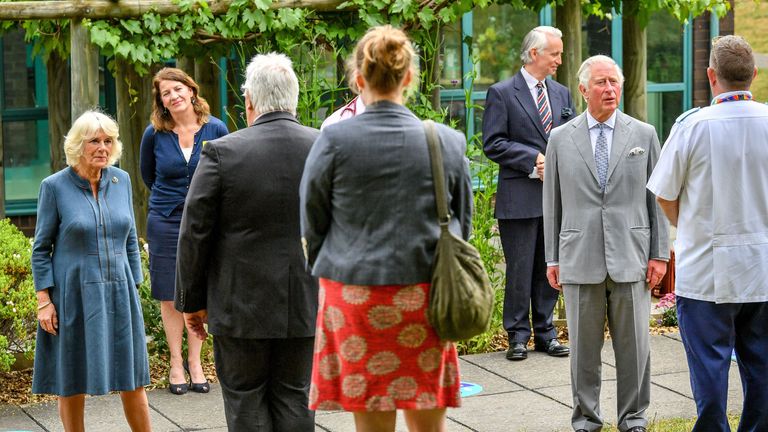
The couple visited Gloucestershire Royal Hospital to thank NHS staff in person for their efforts during the COVID-19 pandemic, and spent half an hour meeting around 20 key workers in the hospital grounds.

Prince Charles nodded to people and put his hands together in a namaste-style gesture, rather than shaking hands.

Image:
Prince Charles performs a namaste greeting to Professor Mark Pietroni upon arriving at Gloucestershire Royal Hospital

Talking to a member of staff who worked in A&E, Camilla was told that 12 members of staff were hospitalised, with five of them having to be treated in intensive care.

The duchess could be overheard saying how she felt the crisis had brought out the best in Britain as people have come together.

Charles and Camilla met frontline workers
Image:
Charles and Camilla met frontline workers

Talking about how important it was to make the visit, Prince Charles said: “It’s been a marvellous opportunity just to see people who I know have been doing so much on the frontline and having to endure a lot of stress and strain I think in their wonderful way.

“How they do it – I don’t know. But they’re delivering everything in the most effective way – and the great thing they’re all saying is it’s brought all the different departments together in a way that hasn’t always hasn’t before.

“There’s been a great deal of marvellous cooperation, I think.”

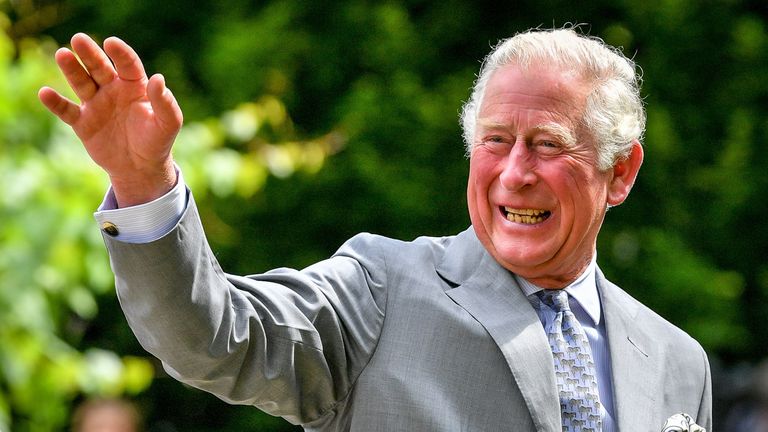
Charles waves to onlookers who came out to greet him
Image:
Charles waves to onlookers who came out to greet him
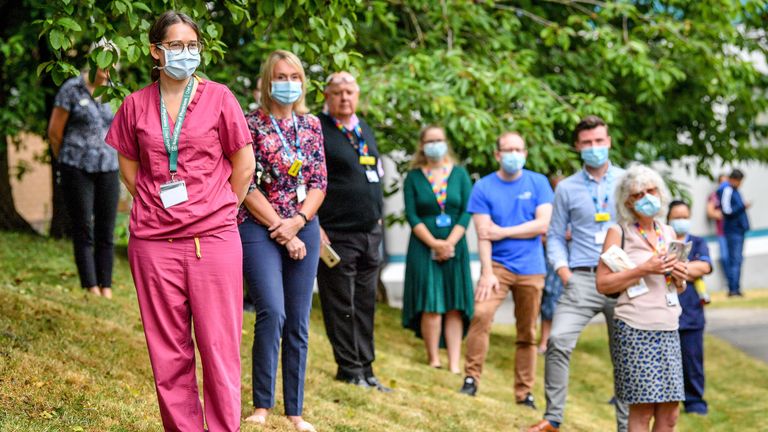
Hospital staff awaited the royals' arrival
Image:
Hospital staff awaited the royals’ arrival

It’s the first time any members of the royal family have carried out an official engagement or audience in person with members of the public since lockdown started in March.

The palace is aware that anything they do is potentially setting an example to the rest of the country when it comes to the current restrictions still in place due to coronavirus.

Reporting on the engagement wasn’t allowed until after the couple had left, to try to minimise the risk of crowds gathering to see them.


preview image


In Full: Prince Charles on life after the pandemic

:: Listen to the Daily podcast on Apple Podcasts, Google Podcasts, Spotify, Spreaker

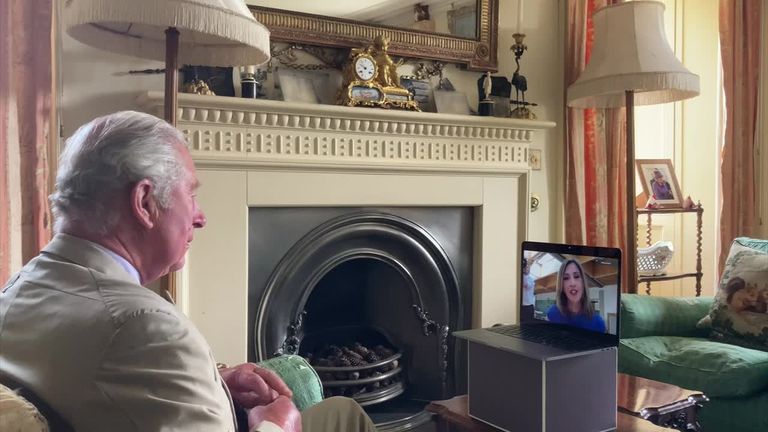
Prince Charles and Camilla have been at Birkhall, their home in Scotland, since the lockdown started – carrying out regular video calls and phone calls to keep in touch with their charity patronages and releasing video messages of support for community groups and key workers.

The prince caught the virus in March and this month told Sky News he knows he was “lucky” and “got away with it quite lightly”.

But he said it has made him even more determined to “push and shout and prod” to make sure that nature is at the centre of the post-COVID recovery.

On Thursday, Prince Charles and Camilla will welcome French President Emmanuel Macron to Clarence House on behalf of the UK government, to celebrate the 80th anniversary of General de Gaulle’s “Appel” to the French people.

Source link

UK U-turn on food vouchers after footballer Marcus Rashford’s campaign

0

Manchester United and England footballer Marcus Rashford pressured the government | Dan Istitene/Getty Images

Government says scheme will be extended over the summer.

By

Updated

U.K. Prime Minister Boris Johnson announced a £120 million scheme to provide food vouchers for children during the summer, following a campaign by England and Manchester United footballer Marcus Rashford.

The government had originally said the scheme would not be extended during the six-week summer break, but had come under increasing pressure to change course.

Rashford had spent several days urging politicians to make sure pupils could continue to access the national voucher scheme — which was introduced in March to help poorer families feed their children when schools were closed because of the coronavirus. In an open letter to MPs on Monday, the Manchester United striker spoke of his experience of relying on free school meals and food banks.

“Owing to the corona pandemic, the PM fully understands that children and parents face an entirely unprecedented situation over the summer,” Johnson’s spokesperson said when announcing the “Covid summer food fund” for pupils in England, the Guardian reported. The support works out at about £15 a week per recipient and the vouchers can be redeemed at supermarkets.

“The prime minister welcomes Marcus Rashford’s contribution to the debate around poverty, and respects the fact that he has been using his profile as a sportsman to highlight important issues,” the spokesperson said.

“Just look at what we can do when we come together,” Rashford, 22, wrote on Twitter in response.

Labour leader Keir Starmer said the move was a “welcome U-turn,” the BBC reported.


Source by [author_name]

‘Peace lies in service of mankind’

0

ISLAMABAD             -     Chaudhary Usman, a prominent social figure and Chairman Green Inspire Foundation(G.I.F) has said that peace of every kind lies in the service of humanity and our prime objective is also to serve the mankind round the clock.

Talking to this scribe, he said that initially I have started this welfare project in the Ghouri Town, a suburb of federal capital Islamabad. Later, it will be started in other areas like Ghouri Town phase 1 and Bagh, a district of Azad Jammu & Kashmir.  Responding to a question, ChaudhryUsman said that currently, G.I.F consists of 70 staff members including qualified doctors team, well-trained nurses and other paramedical staff which provide free treatment facilities to needy, poor and deprived persons of the area.

Talking abouthis family background, he said that he belongs to a middle-class family. I firmly believe on hard work and service of humanity. Allah Almighty would give you highest reward of this sacred duty in this world and hereafter. I have ever taken keen interest in welfare activities since my childhood adding that I want to eradicate the sense of deprivation in the society. I have observed that condition of healthcare facilities in our society is not satisfactory so I have decided to provide these facilities to poor and needy persons without any charges.

He further said that ambulance service of G.I.F have been registered under section 42 of Companies Act 2017.This ambulance service is provided to needy and poor people free of cost. ChaudhryUsman said that medical treatment of the people is totally free even the registration fee from patients is not received.Medicines prescribed by the doctors to patients are provided free. Every visitor/patient can utilise the services including ambulance service provided by the G.I.F.

It is worth-mentioning here that only C.N.I.C photocopy of the patient is received against all these facilities which include doctor consultancy, free medication and ambulance service (if needed). 

He added that currently G.I.F has six ambulances and the number is being increased with the passage of time. These ambulances are well-equipped with stat of the art facilities including first aid kit and oxygen cylinder to face any kind of emergency.

Talking about the precautionary measures initiated by the G.I.F regarding coronavirus, the chairman GIF said that our organisation has launched an awareness campaign about this virus on print, electronic and social media.

Besides this, the relief teams of G.I.F have distributed food bags among people during lockdown.

Responding to another question, he said that currently we are resolving the health-related issues adding that G.I.F has also signed memorandum of understanding with various government and private hospitals so that we may shift the critical patients in these hospitals for better treatment. 

Talking about the financial matters of the G.I.F, he said that our organisation does not receive any kind of donation. As chairman, I provide all funds to run the business of this foundation.

Highlighting the performance of the organisation, he said that we have provided free of cost treatment facilities to approximately 1 lac patients and more than 5000 critical patients were shifted to other hospitals for better treatment.

Replying to a question about future projects of G.I.F, he said that future plans of the G.I.F include extension of basic health centres in various areas of the city, extension of ambulance service and establishment of hospitals, schools and vocational training centres in all over the country.  The major objective of these projects is to create nice community and healthy society to face the future challenges with courage and boldness.

In his message for citizens of Pakistan, ChaudhryUsman said that everyone in the society should encourage and give moral support to persons who are engaged in welfare activities and try their best to promote their mission and activities to achieve the will of Allah Almighty.


Source link

The low-tech mobility solution we’ve long forgotten: our legs

0

There has been a lot of recent hype and attention given to ‘Mobility as a Service’ (MaaS). In January 2019 I posted on LinkedIn:

I just walked – past two days in London between multiple locations. No bus. No tube. No Uber. No bike. Thanks to a major new innovative collaboration between Google Maps and my new desert boots – called ‘Walking as a Service.’

It was a bit of fun. I’d coined a new phrase to have a dig at MaaS which was getting all the attention and yet not giving any attention to walking. The post got nearly 40,000 views, hundreds of likes, and many comments. Perhaps there was something in this?! Over the months that followed, I pursued the idea and it grew to become the focus of a paper that I’m delighted to say has now been published. Thanks to the support from Mott MacDonald, you don’t need to have a subscription to the journal to view the paper – it’s freely available.

The paper was written before the global pandemic and the lockdown prompted which brought about sharp reductions in motorized travelwhile thrusting active travel into the spotlight. As hopes are pinned on a ‘green recovery’ from COVID-19, the importance of walking as part of the future of mobility is greater than ever.

[Read: How coronavirus is reshaping the mobility industry, from EVs to supply chains]

In this article, I offer a summary of the published paper.

Paper highlights

  • Walking has substantial unrealized potential as a mode for short journeys
  • Walking as a Service (WaaS) represents a contributor to realizing this potential
  • WaaS can resolve the spatial and temporal cognition challenges of walking
  • WaaS has a business model founded upon selling geography not mobility
  • WaaS could support sustainability and profitability with a Circle of Virtue

Too dull to bother with?

Type ‘pedestrian’ into Google and it informs you that as an adjective it means “lacking inspiration or excitement; dull”. Perhaps this is why walking has not been center-stage (or even on the edge of the limelight) when it comes to talking of ‘smart mobility’ – an obsession with what technological possibility might be able to offer to the transport sector. Why would policymakers and tech bros want to get excited by walking when they are investing in what they call innovation, seduced by the dollar signs that big brand pundits promise will follow? Walking is low tech and doesn’t make money, right? Wrong.

Walking as a Service

Walking can be low tech of course – nearly everyone can do it, and it’s free. However, many people don’t walk, in part because they can’t navigate or judge distance (spatial cognition) and can’t judge time (temporal cognition). Silicon Valley – the home of technological innovation – has responded to this in the form of Google Maps Navigation for pedestrians (smartphone sat nav for those on foot). It puts confidence to get where you want to go on foot in the palm of your hand. But it also puts businesses ‘on the map’ to be discovered by prospective customers. And it generates income for Google.

MaaS and autonomous vehicles have had excessive recent attention when it comes to future mobility. For the most part they remain an aspiration – an invention rather than, as yet, a true innovation. WaaS is different – it is here now and already supporting and influencing mobility across the world. Whenever I’ve asked for a show of hands at a conference for people who use Google Maps to make a walking trip, the majority of hands have gone up.

I should say I’m not suggesting Google Maps is the only way of navigating on foot – but its use is widespread and hence became the focus of attention in my paper.

Walking as a mode

Could WaaS be partly responsible for a walking renaissance? The following summary points can be made about walking as a mode:

  • Walking in the UK remains a significant mode but has seen a decline over several years in the face of a car-dependent society, compounded by a relative lack of interest from (transport) planners and policymakers. It has been seen (implicitly) as an inferior mode.
  • A recent and seemingly significant upturn in walking has been observed (in line with an increase in trip rate overall and trip rate for short trips under one mile – see below). Between 2015 and 2018 in England the average number of walking trips under 1 mile per person per year (according to the National Travel Survey) increased by 30% (accounting in 2018 for 79% of all trips under 1 mile). This may or may not be a sign of things to come and is not yet explained.
  • A considerable proportion of journeys in urban environments are within reach of walking and indeed many individuals consider that such trips are walkable. There is unrealized potential.
  • Research and advocacy exist concerning the importance of improving the walkability of environments as an enabler of, and stimulus for, more walking.
  • The digital age has unlocked considerable opportunity to address matters of spatial and temporal cognition in the form of journey planning and navigation support – available on mobile devices.
  • In spite of an apparent disconnection in terms of their coverage in the literature, improved walkability and wayfinding together could help realize walking’s full potential to contribute to public health and tackling climate change.