Saturday, May 16, 2026

Most powerful cyclone in a decade kills at least 85 in India and Bangaldesh

Wide swathes of the coasts of India and Bangladesh have been flooded and millions of people remain without power, after the most powerful cyclone to hit the region in more than decade left dozens dead and a trail of destruction.

In the Indian city of Kolkata, home to more than 14 million people, large portions of the metropolis and its suburbs were underwater, including the city’s main airport. Roads were littered with uprooted trees and lamp posts and electricity and and communication lines were down.

Cyclone Amphan also badly damaged many centuries-old buildings when it tore through the city on Wednesday.

This Tuesday, May 19, 2020 satellite image released by NASA shows cyclone Amphan over the Bay of Bengal in India. (EOSDIS) via AP) (AP/AAP)
People make their way through damaged cables and a tree branch fallen in the middle of a road after Cyclone Amphan hit the region in Kolkata, India, Thursday, May 21, 2020. (AP Photo/Bikas Das) (AP/AAP)

“It feels like a dystopian Jurassic Park of sorts,” said Shuli Ghosh, who runs a cafe in Kolkata.

“The roofs of many homes have flown away and the streets are waterlogged.”

When the storm made landfall on Wednesday it lashed coastal areas in both India and Bangladesh with heavy rain, a battering storm surge and sustained winds of 170 kilometres per hour and gusts up to 190 km/h.

It devastated coastal villages in both countries, knocking down mud houses, ripping out electricity poles and uprooting trees.

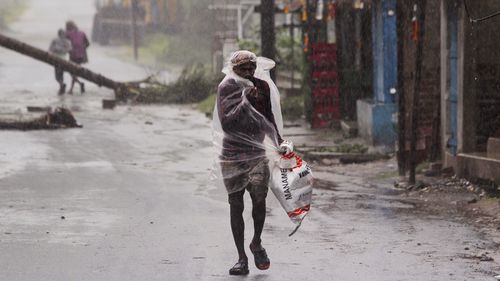
A man covers himself with a plastic sheet and walks in the rain ahead of Cyclone Amphan landfall, at Bhadrak district, in the eastern Indian state of Orissa, Wednesday, May 20, 2020. (AP Photo) (AP/AAP)

In Bangladesh, television stations reported 13 deaths, while 72 deaths were reported in India’s West Bengal state. Officials said two people were killed in India’s Odisha state.

Hundreds of villages in Bangladesh were flooded by tidal surges and more than a million people were without electricity.

Officials in both countries said the full extent of the damage remained to be seen as communication lines to many places remained down.

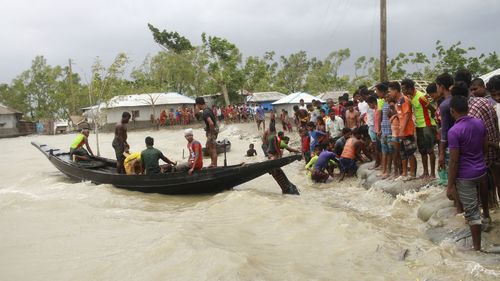
In this Wednesday, May 20, 2020 photo, people check an embankment before Cyclone Amphan made landfall, in Shyamnagar, Shatkhira, Bangladesh. (AP Photo/Abu Sufian Jewel) (AP/AAP)

India’s prime minister, Narendra Modi, said authorities were working on the ground to ensure all possible assistance to the those affected.

“No stone will be left unturned in helping the affected,” Modi tweeted on Thursday.

The ongoing coronavirus pandemic and social-distancing measures had made mass evacuations ahead of the storm difficult. Shelters were unable to run at full capacity in many places and some people were too scared of the risk of infection to mass there.

Likewise the pandemic will have and impact on relief efforts and the recovery. The damage caused by the storm is likely to have lasting repercussions for poor families already stretched to the limit by the economic impact of the pandemic.

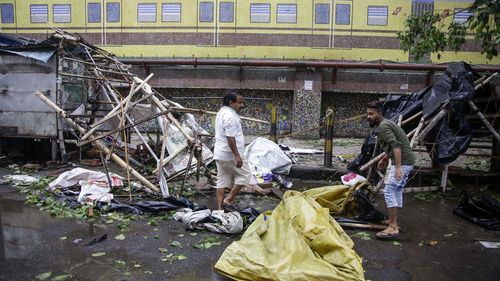
Roadside vendors along a metro station try to restore material from the debris of his stall due to a cyclonic storm Amphan in Kolkata, India. (AP Photo/Bikas Das) (AP/AAP)

In India’s Odisha state, the cyclone destroyed crops of Betel, a leaf used as a wrapper for chewing areca nut or tobacco. In Bangladesh’s southwestern district of Bagerhat, more than 500 fish farms were flooded.

Debashish Shyamal, who lives in a fishing village along the coast of West Bengal took shelter with his family in a government clinic. He said the wind blew open the windows and doors and for hours they sat huddled inside, drenched by the torrential rain.

On Thursday, he woke up to dangling electricity wires, waterlogged streets and an entirely uprooted forest next to his village.

“There is nothing left,” he said.

Source by [author_name]

Lori Loughlin To Plead Guilty In College Admissions Scandal, Agrees To Prison Time

“Full House” actor Lori Loughlin and her husband, the fashion designer Mossimo Giannulli, have agreed to plead guilty in connection with the college admissions bribery scandal.

Both will serve prison time and pay hundreds of thousands of dollars in fines under their plea deals for “securing the fraudulent admission” of their two daughters, Olivia Jade and Isabella Rose, to the University of Southern California crew team “as purported athletic recruits,” the U.S. Attorney’s Office in Massachusetts said in a statement Thursday.

Both daughters had never participated in the sport, according to court documents. The couple were accused of paying $500,000 to snag their places on the team so the girls would be admitted to the school.

Loughlin, 55, agreed to plead guilty to one count of conspiracy to commit wire and mail fraud, according to the deal she signed on Wednesday, and will be sentenced to two months in prison, a $150,000 fine and two years of supervised release with 100 hours of community service.

Giannulli, 56, will plead guilty to one count of conspiracy to commit wire and mail fraud and honest services wire and mail fraud, prosecutors said. He agreed to a sentence of five months in prison, a $250,000 fine and two years of supervised release with 250 hours of community service.

The couple will formally plead guilty and be sentenced at a hearing before U.S. District Judge Nathaniel M. Gorton that hasn’t yet been scheduled, the statement added.

Loughlin and Giannulli are among dozens of prominent public figures charged in the scandal that erupted in March 2019. The FBI called it a nationwide conspiracy that exposed how well-heeled parents bribed their children’s way into the nation’s most elite colleges.

Former “Desperate Housewives” star Felicity Huffman served 11 days in a low-security prison after she was found to have paid $15,000 to boost her daughter Sophia Macy’s SAT score so that she could secure a spot at Carnegie Mellon University in Pittsburgh.


Source by [author_name]

I tried to delete myself from the internet. Here’s what I learned

0

MyLife pulls together vast amounts of public data to create background reports and “reputation scores” on millions of people in the US, all available to those willing to pay for a monthly membership. On it, I found a sometimes inaccurate but eerie amount of personal information about, well, my life: my birthday and home city; my previous job title (though curiously not my current one); a list of people “Seth maintains relationships with,” including the names of both my parents, each linked to their own profile pages with still more data. All there in one place waiting to be discovered.

When I called the site, a customer service representative stressed that the information doesn’t come from MyLife, but rather from across the “interwebs.” Following some back and forth, the representative agreed to delete my profile page. I felt victorious — until two hours later when I received the first of many promotional emails from the company, one encouraging me to sign up for a membership, another talking about raising my credit score.

As I would learn through my brief, manic campaign in December to scrub as much of my personal data as possible and start the new year with a clean digital slate, it’s hard not to feel like you’re just scratching the surface of an impossibly large data industrial complex. By the end of my experiment, I felt even worse off about my ability to wrestle back control of my data than when I started.

Our data is out there. Now what?

In recent years, it’s become a truism in certain tech-savvy Twitter threads that much of our personal information is already out there somewhere thanks to an ever-growing list of hacks.

Banks, retailers, social networks — both popular and defunct — have all disclosed massive data breaches. In 2017 alone, Verizon (VZ) confirmed that every single Yahoo account — all 3 billion of them — had been affected by a massive breach and Equifax (EFX) disclosed that a breach had potentially exposed the names, Social Security numbers, birth dates, addresses and credit card numbers of as much as nearly half the US.
There are only two viable emotional reactions to such a total collapse of personal privacy: denial or helplessness. After trying the former for a time, I shifted to the latter, prompted, as with so many moments in my life, by belatedly listening to a sobering podcast about a hack. I followed the usual measures recommended in informational cybersecurity stories — implementing two-factor authentication; signing up for a password management app; freezing credit reports indefinitely — all with an overriding sense that none of these steps eliminated any of that personal information floating around in some dark corner of the web.
As cybersecurity expert Bruce Schneier recently put it to one of my colleagues: “So my password was stolen, is there any way I can go to every criminal on the planet, to their computers, and delete my name? No.”

But there had to be something more to be done, I thought. The fact of the matter is, the internet is already littered with information that could be used against us, much of it collected through entirely legal means. Mothers’ maiden names. Birthdays. Home addresses. I might not be able to prevent my favorite stores from getting hacked, or sweet talk a bunch of hackers after the fact, but I could make it just a little bit harder for a bad actor to find my personal information online — and in the process, regain some sense of control of my data and my life.

How to delete your personal information online

Deciding to delete your information online is the easy part. The hard part is figuring out where to start.

For many, the obvious answer would be focusing on consumer-facing services such as Facebook (FB) and Google (GOOGL), where we willingly — if not always consciously — hand over data about ourselves on a daily basis. Tech industry veteran Praveenkumar Venkatesan decided to launch DeleteMyData in late 2018 to help people do just that.

By offering a quick and easy guide for deleting a range of popular services. Venkatesan hopes to “simplify” the process of scrubbing our data. As he put it to CNN Business companies “make it so easy” for people to have their data collected, but much harder “for them to get out.” About 40,000 people now come to the site each month, he said. By comparison, Facebook has four platforms with more than 1 billion users each.

But as a tech journalist, I wasn’t looking to entirely delete the social networks and services I rely on regularly for work (though over the years I have tweaked my privacy settings for many and made certain accounts private). Instead, with the help of a few online resources, including guides from a cybercrime expert and Reputation Defender, an online reputation management service, I settled on a short list of lesser-known databases that are thought to be among the more prominent aggregators of personal information.

These included data brokers, who buy and sell our personal data, as well as “people search” services like Spokeo and Radaris and background check platforms like Infotracer and MyLife. They may not be household names, but these sites know an awful lot about many households. You might turn to these services if you were looking for information on a new neighbor, hire, client or, according to Spokeo CEO Harrison Tang, “long lost family members or friends.” You might also stumble across a link to these sites when Googling yourself, if you’re into that kind of thing.

“Different people have different feelings about privacy,” Tang said. In his telling of it, the pressing issue isn’t so much that data gets collected, but rather the need for greater transparency around how and why. “I don’t think consumers should be surprised.”

Unlike the data breaches that get far more attention for exposing our personal information, this data is aggregated legally. Spokeo, which says it does roughly $70 million a year in sales mostly from everyday users as well as some enterprise customers including law enforcement agencies, pulls data from dating websites, social networks, criminal records and “marketing databases” from retailers, Tang said.

Jenna Raymond, COO of Accucom Corporation, an information services company that counts Infotracer as one of its brands, told CNN Business in December that criminal records are also a “big” source of data for these sites, along with property records. “The minute you buy a house, that’s public information,” she said.

“You can opt out of Infotracer,” she said, “but it’s still out there.”

A game of whack-a-mole

Over the course of a few days, I did opt out of Infotracer — and many others.

Some, including Infotracer and Spokeo, I was able to delete almost immediately; others said it could take up to 72 hours before the information was pulled. A number of services required some new data in order to scrub the old, ranging from a phone number to confirm the removal to the email address MyLife asked for and later spammed me on.

On Radaris, before I was able to opt out I had to click through a page with instructions for how to “control your information,” which lists more than a dozen “premium data providers who aggregate, host and distribute personal and business information,” including Facebook, Google, Equifax and … the United States Patent and Trademark Office. Next, I saw a page listing dozens more data brokers and websites.

Representatives for Radaris and MyLife did not respond to requests for comment for this story. The USPTO did not immediately respond to questions.

“Unfortunately there is no centralized service to remove your information from all resources by a single request,” according to the Radaris page.

By the time I finally took control of my Radaris page, I felt more lost than before.

“I do believe that information is power,” Raymond said, echoing a slogan of her company. On this at least we agreed: information is power, and consumers — myself included — have given too much of ours away.


Source link

Mind and Body Practices for Older Adults

0

In 2012, the American College of Rheumatology issued recommendations for using pharmacologic and nonpharmacologic approaches for osteoarthritis (OA) of the hand, hip, and knee. The guidelines conditionally recommend tai chi, along with other non-drug approaches such as manual therapy, walking aids, and self-management programs, for managing knee OA. Acupuncture is also conditionally recommended for those who have chronic moderate-to-severe knee pain and are candidates for total knee replacement but are unwilling or unable to undergo surgical repair.

Current clinical practice guidelines from the American Academy of Sleep Medicine recommend psychological and behavioral interventions, such as stimulus control therapy or relaxation therapy, or cognitive behavioral therapy for insomnia (CBT-I), in the treatment of chronic primary and secondary insomnia for adults of all ages, including older adults. 

Overall, research suggests that some mind and body approaches, such as yoga, tai chi, and meditation-based programs may provide some benefit in reducing common menopausal symptoms.

There have only been a few studies on the effects of tai chi on cell-mediated immunity to varicella zoster virus following vaccination, but the results of these studies have shown some benefit.

There is evidence that tai chi may reduce the risk of falling in older adults. There is also some evidence that tai chi may improve balance and stability with normal aging and in people with neuro-degenerative conditions, including mild-to-moderate Parkinson’s disease and stroke.

There is some evidence that suggests mind-and-body exercise programs such as tai chi and yoga may have the potential to provide modest enhancements of cognitive function in older adults without cognitive impairment.

Source link

Canada Opens The Door To Virtual Citizenship Oath Ceremonies

0

MONTREAL ― Japjot Gill has dreamt of becoming a pilot since he first attended ground school as a teenager and the Canadian Armed Forces (CAF) promised to put him through flight school if he enlisted. It’s been a long journey for the now-21-year-old, who first needed to get Lasik eye surgery and become a Canadian citizen. And just as his dream was within reach, the COVID-19 pandemic snatched it away. His citizenship ceremony, scheduled for late March, was cancelled.. But he has a glimmer of hope, as the government now says some new Canadians will soon be able to take their oath online.

“Recognizing that some people may have urgent reasons to finish the citizenship process, including taking the citizenship oath during a ceremony, the Ministry will soon organize virtual ceremonies for persons and families who had already communicated with IRCC to notify that they needed to obtain citizenship for urgent reasons, such as satisfying work requirements,” Immigration, Refugees and Citizenship Canada (IRCC) spokesperson Shannon Ker told HuffPost in an email.

While the exceptional measure won’t be offered to applicants like Gill straight away, IRCC will offer it to a wider pool of applicants “as soon as possible,” Ker adds.

Gill arrived in Vancouver from India in 2011 when he was 11 years old. He has been eligible for citizenship for several years, but hadn’t applied for it until last year.

“I held off on it for a long time because the Lasik cost me all my savings and citizenship was also an expensive application,” he told HuffPost. It costs $630 for an adult to apply for citizenship. Now he doesn’t know when he’ll be able to take the oath, as IIRCC has cancelled all citizenship ceremonies, tests and interviews until further notice. 

The whole ordeal might make Gill reconsider his life plans if he has to wait much longer. “As soon as I came to Canada, I fell in love with the country, so I was always happy to serve. But I’m not as keen on joining the military at this point,” he says, noting he would be “a lot older than other people in the military.” For now, his enrollment remains in the cards, but a long pandemic-induced delay might convince him otherwise.

Watch: Canada rated No. 1 country in the world for quality of life. Story continues below. 

In April, IRCC exceptionally authorized its first virtual oath ceremony on videoconferencing platform Zoom. Adolf Ng, an academic whose research is linked to COVID-19, was allowed to take the oath online, without taking the citizenship test. 

Many wish to see the virtual process offered to all applicants. A petition asking that tests, interviews and oath ceremonies be done remotely has gathered more than 1,700 signatures since it went live on May 9th.

“This uncertainty creates a very stressful situation for hundreds of thousands of applicants who are seeking citizenship,” writes Hadi Rezvani, author of the petition. “At present, this is an extra burden on our mental health in addition to fear of the virus itself.”

Whoever wants to do the virtual ceremony should have a choice to do it.
Ji, citizenship applicant from Montreal

“Life doesn’t stop because of the virus,” adds Ji, a Montrealer who arrived from Vietnam as a foreign student in 2010. “Becoming a citizen has been a dream of mine for nearly 10 years.” 

His citizenship oath was scheduled for March 16 and he fears that delays will snowball if activities don’t resume soon. “The backlog is gonna be huge. It’ll create a bottleneck,” he says, asking to be identified only by his first name because he fears a backlash from seeming ungrateful. “Whoever wants to do the virtual ceremony should have a choice to do it.”

But others would rather wait to take the oath in person. “I had been waiting for that ceremony and it will be a special event with my loved ones celebrating with me and taking pictures together, a memory that will be cherished forever,” applicant Carlota Wilkins told HuffPost. She hopes she won’t be forced to partake in a virtual ceremony.

Japjot Gill is torn. “Half of me does say that I just really want to get it done, but a ceremony would really put a stamp on the fact that I became a Canadian,” he says. “Accepting my citizenship in person is something I’d be really proud of.”


Source link

National Health Interview Survey 2017

0

According to data from the 2017 National Health Interview Survey (NHIS) released in November 2018, the number of American adults and children using yoga and meditation has significantly increased over previous years and the use of chiropractic has increased modestly for adults and held steady for children.

See Press Release: More adults and children are using yoga and meditation: Nationwide survey reveals significant increases

Read Summaries:

Download and share NHIS 2017 graphics:

Source link

Her homeschooling rant went viral; now schools are back – CNN Video

0

As students in Israel return to school, CNN catches up with one mother whose frustration at homeschooling went viral.


Source link

Trump Gets Savage Reminder About ‘Lost Month’ Of Coronavirus Inaction In New Ad

President Donald Trump’s inaction in February as the coronavirus spread is the focus of a blistering new attack ad.

The video that Rep. Eric Swalwell’s (D-Calif.) Remedy PAC released online Wednesday features footage of Trump minimizing the threat of the virus, playing golf, holding campaign rallies and attending the Daytona 500 ― alongside an interview with Denise Jorgensen, whose father died after contracting COVID-19.

“By February, it was clear that COVID-19 would kill many Americans. It was clear to everyone ― except Donald Trump,” reads the on-screen text.

“In November, we are literally voting for our lives,” Jorgensen concludes in the clip.

It’s the latest spot to call out Trump’s halting response to the public health crisis, with anti-Trump GOP groups The Lincoln Project and Republicans for the Rule of Law also weighing in regularly.

More than 94,000 people in the U.S. have died from COVID-19, the disease caused by the virus. Members of the White House coronavirus task force have suggested it could kill up to 240,000.

A HuffPost Guide To Coronavirus


Source by [author_name]

Scotland’s lockdown to ease from May 28

0

Scottish First Minister Nicola Sturgeon | Pool photo by Fraser Bremner/Getty Images

Nicola Sturgeon sets out her ‘route map’ for easing lockdown in Scotland.

EDINBURGH — Some coronavirus lockdown restrictions are likely to be eased in Scotland from next week, First Minister Nicola Sturgeon announced Thursday.

Speaking to the Scottish parliament, Sturgeon unveiled her four-phase “route map” for easing restrictions while still suppressing the virus. Phase one measures will provisionally begin from May 28, though the first minister confirmed this is subject to “public health advice” and some steps could be postponed.

Scotland has been slower to lift lockdown measures than England and Sturgeon last week criticized Boris Johnson’s government in Westminster for its approach. Scottish Secretary Alister Jack later admitted Johnson’s address to the nation on his coronavirus exit plan did “cause some confusion” for people in Scotland, Wales and Northern Ireland because the changes only applied to England.

From May 28, people in Scotland will be allowed to meet people from outside their own household and play some sports such as tennis and golf, providing they practice social distancing. Traveling for exercise will also be permitted, though people are asked to stay as close to their own homes as possible.

Recycling and garden centers will reopen, and some outdoor work will also resume. Indoor cafés, restaurants and pubs will remain closed as part of phase one, and visiting other houses will also not be allowed.

“I hope that these steps will bring some improvements to people’s well-being and quality of life,” Sturgeon said, “as well as start to get our economy moving again.

“The message will still remain [that people should] stay at home as much as possible.”


Source by [author_name]

Meatpacking Coronavirus Guidelines Are Largely Unenforceable

MINNEAPOLIS (AP) — Federal recommendations meant to keep meatpacking workers safe as they return to plants that were shuttered by the coronavirus have little enforcement muscle behind them, fueling anxiety that working conditions could put employees’ lives at risk.

Extensive guidance issued last month by the Occupational Safety and Health Administration and the Centers for Disease Control and Prevention recommends that meatpacking companies erect physical barriers, enforce social distancing and install more hand-sanitizing stations, among other steps. But the guidance is not mandatory.

“It’s like, ‘Here’s what we’d like you to do. But if you don’t want to do it, you don’t have to,’” said Mark Lauritsen, international vice president and director of the food processing and meatpacking division for the United Food and Commercial Workers International Union.

The pandemic is “the most massive workers’ safety crisis in many decades, and OSHA is in the closet. OSHA is hiding,” said David Michaels, an epidemiologist who was the agency’s assistant secretary of labor under President Barack Obama. Michaels called on OSHA to make the guidelines mandatory and enforceable, which would include the threat of fines.

OSHA’s general guidance plainly says the recommendations are advisory and “not a standard or regulation,” and they create “no new legal obligations.”

But the guidance also says employers must follow a law known as the general duty clause, which requires companies to provide a workplace free of recognized hazards. Critics say that rule is unlikely to be enforced, especially after President Donald Trump signed an executive order in April aimed at keeping meat plants open.

Already, examples have emerged of questionable enforcement efforts and pressure to keeping plants running:

— Shortly before Trump’s order, state regulators in Iowa declined to inspect a Tyson Foods pork plant despite a complaint alleging workers had been exposed to the virus in crowded conditions. Documents obtained by The Associated Press show it took the Iowa division of OSHA nine days to seek a response from Tyson and eight more to get a reply. The state agency ultimately found Tyson’s voluntary efforts to improve social distancing at the Perry plant were “satisfactory” and closed the case without an inspection. A week later, 730 workers — almost 60% of the workforce — had tested positive.

— In Kansas, the state softened its quarantine guidelines after industry executives pushed to allow potentially exposed employees to continue going to work, according to emails and text messages obtained by The Kansas City Star and The Wichita Eagle. The state had previously advised such employees to quarantine for two weeks, before conforming to the more lenient CDC guideline, which allows employees to continue working if they have no symptoms and use precautions. The move came after Tyson raised a concern with the state of rising worker absenteeism.

After Trump’s executive order — developed with input from the industry — the Labor Department and OSHA said OSHA would use discretion and consider “good faith attempts” to follow safety recommendations. Employers would be given a chance to explain if some are not met. Agriculture Secretary Sonny Perdue made clear in letters earlier this month that the Department of Agriculture expected state and local officials to work with meat plants to keep them running. And he said any closed plants without a timetable to reopen had to submit protocols to the USDA.

The USDA did not respond to repeated requests to provide those company plans to the AP. When asked how guidelines would be enforced, a USDA spokesperson said enforcement was up to OSHA.

Major meatpackers JBS, Smithfield and Tyson have said worker safety is their highest priority. They provided the AP with summaries of their efforts to improve safety, but the plans themselves have not been made public. Tyson said because the temporary suspension of its operations was voluntary and the company was already meeting or exceeding federal guidance, it was not required to submit a reopening plan to the USDA.

One plan obtained by the AP, for the reopening of a JBS pork plant in Worthington, Minnesota, details multiple safety improvements, including installing physical barriers, increasing spacing between workers and requiring protective equipment. The plan includes photos. It says employees will be screened for health issues, but it makes no mention of requiring testing.

JBS spokesman Cameron Bruett said the plan “demonstrates the extraordinary measures” the plant has taken “to keep our team members safe as they provide food for the country.”

In an emailed response to questions about how guidance would be enforced and what role OSHA would play in protecting workers, the Department of Labor said OSHA received 55 complaints in the animal-processing industry and opened 22 inspections since Feb. 1.

Echoing language from the general duty clause, the agency also noted longstanding rules that require employers to provide a safe workplace.

“OSHA’s standards remain in place and enforceable, and they will continue to be as workers return to their workplaces,” a labor spokesperson said.

Michaels, the former OSHA official, said the clause has no preventive effect and is generally enforced only after a worker is injured. He said it’s effective only in cases in which OSHA conducts an inspection and issues citations and the employer agrees to fix the problem — so any impact is felt months or years later.

Michaels said OSHA will not issue citations if employers are doing their best to eliminate a hazard but find it’s not feasible.

Jeffrey Lancaster, founder and CEO of Lancaster Safety Consulting in Wexford, Pennsylvania, said violations of the general duty clause can get expensive, especially if companies are found to be repeat violators, have a willful violation, or fail to fix an issue.

“The laws have been in place,” he said. “It’s just a new ballgame – a new hazard.”

Minnesota is one of 22 states or territories with worker-protection agencies that cover private and government workers, and the state OSHA has the power to enforce the CDC and state Department of Health’s COVID-19 safety guidelines under the general duty clause, spokesman James Honerman said.

The agency has two open investigations into the meatpacking businesses — one at a JBS plant in Worthington and one at a Pilgrim’s Pride plant in Cold Spring, said Honerman, who could not discuss the investigations because they are pending.

Lauritsen, with the food workers’ union, said OSHA has not done enough to hold employers accountable. The union is advocating for access to daily testing for all meat-production workers, personal protective equipment if necessary and paid sick leave.

“By and large, if our members are healthy enough, if they are not sick or on quarantine, they are going to show up to do their job,” Lauritsen said. “But that doesn’t mean that they’re not anxious or not nervous.”

A HuffPost Guide To Coronavirus


Source by [author_name]