How the Pride March Made History

0

This article is part of our latest Pride special report, featuring L.G.B.T.Q. voices on the challenges and possibilities of these troubled times.

This month marks the 50th anniversary of the first Pride march, which was held in New York City on June 28, 1970. The event — officially known as the Christopher Street Liberation Day March — was spearheaded by Brenda Howard, a bisexual activist, for the first anniversary of the Stonewall uprising.

The march’s route covered about 50 blocks and drew just a few thousand participants. Though the numbers were small, marches in New York, Chicago, San Francisco and Los Angeles that year eventually led to hundreds of Pride parades. We asked organizers, activists and participants to recollect the evolution of events around the world. Interviews have been condensed and edited for length and clarity.

Early member of the Gay Liberation Front and marshal of the first Pride march

The Christopher Street Gay Liberation Day March was as revolutionary and chaotic as everything we did that first year after the Stonewall riots. The march was a reflection of us: out, loud and proud. We intended to march from Greenwich Village and up to Central Park. We didn’t have a police permit, so no one knew exactly what would happen — no one knew the type of force that might greet us. So we held self-defense classes and learned how to protect ourselves. As a marshal, I especially had to know how to react and control the marchers if we were attacked. When we reached 23rd Street, I climbed up a pole, looked back and saw a crowd stretch all the way to Christopher Street. Eventually we made it to Central Park, just like we had promised — and us activists transformed a movement from a few ragtag militants to thousand strong. As my friend Jerry Hoose used to say about that year, “we went from the shadows to sunlight.” Today, my original marshal’s badge is on display in the Smithsonian.

Early member of the Gay Liberation Front and Radicalesbians and co-organizer of the first marches in New York and Los Angeles

It was a near miracle that the first Christopher Street West Parade in Los Angeles kicked off at all on June 28, 1970. Edward M. Davis, the police chief and a man of antiquated views and diction, told our organizing committee in early June that a L.G.B.T. march would “discommode the public” and that he’d have to allow “thieves and burglars” to parade next. He then slapped on several seemingly insurmountable impediments, such as million-dollar liability bonds. Legal or not, Davis could not stop a new militant identity on the rise. With last-minute court approval, on June 28 at 7 p.m., a motley group clocking in at exactly 1,169 folks stepped off joyously from Hollywood and Vine. Chanting gay liberation slogans, we wore Halloween costumes, our best drag, tie-dye T-shirts, or almost nothing. Homemade floats featured Vaseline jars and a crucified queer man. Amazons rode on horseback. Crowds 10 deep cheered as we raucously urged them to join us. For one day, we were victorious against the Ed Davises of the world, and no one seemed “discommoded” in the least.

Early member of Boston’s Gay Liberation Front and an organizer of Boston’s first Pride Parade

We held our first march in Boston in 1971 — a year after New York. The march began at a cabaret bar called Jacques — which is still there and still gay — and made three additional stops along the route where we read a series of demands. At the Boston Police Headquarters (then on Berkeley Street in the Back Bay) we demanded an end to police harassment and the threat of imprisonment; at the State House on Beacon Hill, we demanded our legal rights; at St. Paul’s Episcopal Cathedral facing Boston Common, we demanded religious tolerance, and then we all headed to Boston Common itself where we held a small rally and a symbolic closet-bashing. Only about 200 showed up that first year and it just kept on growing bigger and bigger and bigger.

L.G.B.T. activist

I grew up in Jersey City close to the PATH train and was lucky to find my first boyfriend in my high school sophomore homeroom class. He and I began to venture into Greenwich Village in the early 1970s and found our way to the second Pride March in 1971. The march, and era, felt new and exciting and helped us learn about ourselves at a time before cellphones and the internet — when L.G.B.T.s were mostly met with hatred and disgust. As we marched up to Central Park for speeches in the afternoon — before returning downtown to dance all night on Christopher Street — this early Pride truly felt like a blessing.

Co-founder of OutRage, a British L.G.B.T. activist group

The first Pride Parade in Britain took place in London in July 1972. I helped organize it, with other members of the Gay Liberation Front. In those days, most L.G.B.T.s were closeted and much of the public were ignorant or hostile. It was a gamble. The fear of arrest and violent attacks deterred many, and made us nervous. Not surprisingly, less than 1,000 people joined the march. But it felt revolutionary. Our chant of “gay is good” challenged the orthodoxy that gay was bad, mad and sad. The police hemmed us in. Some officers openly abused us. Bystanders shouted insults. A few threw coins and the police refused to arrest them. Some bystanders were supportive, but most gaped with disbelief that “faggots” would dare show their faces. It was scary but we were determined to be out and proud — and to demand our liberation.

Former owner of Lambda Rising and organizer of Washington’s first Pride events in 1975

The first Pride event in Washington, D.C., actually took place in my front yard on the corner of 20th Street and S Street in Dupont Circle. We were living just around the corner from Lambda Rising, the city’s main L.G.B.T. bookstore and decided to hold a sort of block party that year. For weeks, we visited every business and resident on the street to get their permission, and all but one signed on. On Pride day, a local women’s group hauled in some amplifiers and set up a portable stage. We’d advertised in D.C. bars along with The Blade, a local L.G.B.T. newspaper. Two dozen organizations set up tables and then we waited. Come start time, only 24 people had shown up and we worried no one else would arrive. Eventually, 2,000 people were clogging the street, including a fair number of journalists who we made sure didn’t photograph the many closeted government workers in attendance. Within a few years, the event grew to three square blocks and 10,000 revelers, and eventually it moved to a nearby elementary school and was renamed the P Street Festival, which expanded Pride’s reach to ultimately include the city’s annual march and parade.

Co-organizer of Israel’s first LGBT Pride Parade in 1979

More than 40 years after what turned out to be the first Pride parade not only in Israel but in the entire Middle East, my abiding memory is of a woman screeching at us in disgust. “How can they allow this nauseating spectacle?” she shouted. “What will happen to our children?” The “parade” was actually more of a public demonstration — in order to comply with police regulations concerning organized events, we had to sing as much as march. Only about 75 participants showed up that day, but the local media took it all in. They were even quite polite. Today, Tel Aviv’s annual Pride parade is one of the country’s great summer attractions — with an estimated 250,000 participants each year. Jerusalem soon followed suit with its own Pride parade in 2002 — while other, smaller Israeli cities began to mount Pride events later on. All of this gives the word “pride” tremendous new meaning for me — especially since it seems that “our children” survived very nicely, thank you.

Founding member of Silence=Death Collective and Act Up

I was a member of Act Up’s march committee and we had discussed a number of things to make a statement about AIDS during the Pride March in 1987 — perhaps black T-shirts or black balloons. We ultimately embraced the idea of a float designed like a concentration camp. It was constructed in a day in the artist Mark Simon’s studio in Williamsburg. The materials we used were relatively simple — gray plastic, wire and pieces of wood — so I was surprised at how imposing and frightening it felt. On the day of the march, some of our members posed as guards with masks and rubber gloves, others — some unable to walk, some with H.I.V. — sat on the float as “prisoners.” We began the march with 50 protesters, but as we made our way down Fifth Avenue so many people joined us that our contingent stretched four blocks long. Exactly at noon, in the middle of Fifth Avenue, we staged a “die-in” — a moment of silence as we lay in the street. In that instant, we stole Fifth Avenue from the city for our own purposes and needs and fury. As I looked around, surrounded by “dead” bodies, I knew we would never be silent again. And we weren’t. The march marked a moment of transition for ACT UP and the following day’s meeting was packed with hundreds of people.

L.G.B.T. activist, former board member and chair of Stonewall 50

I was 17 when I attended my first march back in 1984 — and have been to every one since then. Things were a lot smaller in the beginning, but by the time the 1990s came around, the parade grew massively as people became more comfortable with who they were and being visible. The parade especially grew during the 1990s when, despite the AIDS crisis, it began to feel far more diverse. Groups that might previously have been left behind — folks with disabilities, people of color — found their place in the parade amid increasing media attention. Perhaps the biggest addition to the event was the arrival of the Pride Fest and Dance Pier. Dancing along the water might seem frivolous, but we often forget that dancing was illegal in bars up until just a few years ago.

Professor of modern Latin American history at Brown University and co-organizer of Brazil’s first Gay Pride march

I lived in São Paulo during the dictatorship of the late 1970s. I became a founding member of the Brazilian L.G.B.T. movement and participated in the country’s first demonstration against police repression in 1980. It was one of the most exhilarating experiences of my life. Earlier that year, when we thought how to commemorate Stonewall, we could hardly imagine the possibility of actually mobilizing 1,000 during the dictatorship. Fifteen years later, in Rio, L.G.B.T. groups hosted the 17th international conference of ILGA (The International Lesbian, Gay, Bisexual, Trans and Intersex Association), and the energy of the international delegates who attended and the excitement of hosting the gathering only added to the drama of the country’s first actual successful parade. A few years before, members of Argentina’s movement wore masks to shield their faces — and identities — during their parade in Buenos Aires. So we produced hundreds of colorful masks because we assumed that many of our people in Brazil would refuse to march openly. But on the day of the parade, 2,000 of us marched along the white sandy beaches of Avenida Atlântica in Copacabana — and no one wore a mask. The fear was gone.

Author of “Lives of Great: Living and Loving As an African Gay Man”

I came to the U.S. from Nigeria to study in 1989 but did not make my way to New York City until a few years later. But once there, I was lucky to find a community of other gay African immigrants. This was important because we were not always at ease with the general African immigrant communities in New York because of our sexuality, and as foreigners, we did not easily assimilate with our “cousins,” the African-Americans. Our little group would meet regularly and eventually we gave ourselves a name, Uhuru-Wazobia, which means “approaching strength” in mixed Swahili and a blend of Nigerian languages. For years, we’d all attended Pride marches together for fun and support, but in 2005 a group within our group chose to march in the Pride Parade holding the Uhuru-Wazobia banner, the first time an African L.G.B.T. contingent had ever participated in the event. Years later, I may no longer be at every Pride parade, but Uhuru-Wazobia certainly still is.

Executive director of NYC Pride, 2009-19

New York’s World Pride celebration was a decade in the making. In 2009, we began to focus on the 50th anniversary of the Stonewall Riots and put in a formal bid to hold World Pride here in 2015. Four years later, over five million people showed up from around the world to celebrate — including 100 pride groups from around the world. As I stood there and watched them all march, it felt like a homecoming of sorts because New York was where Pride was born and New York helped inspire so many movements across the globe. I probably didn’t sleep for a month before World Pride, but with my mother by my side watching it all unfold, it felt truly life-changing.

Director of LGBT Rights Advocacy China and a grand marshal for Pride 2020

I feel honored, surprised and privileged to be one of the grand marshals of this years’s parade because we are not allowed to have pride celebrations in China. Which is why I am so proud of all that the L.G.B.T. community has accomplished in my country. Along with launching the first legal campaign against conversion therapy in 2013, we’ve mounted nearly a dozen additional court actions advocating against employee discrimination, media censorship and H.I.V. discrimination, and for marriage equality. We help our community with legal aid and encourage them to take action to protect and advocate for their own rights. We have a network of more than 100 lawyers in our L.G.B.T.-friendly lawyers network and more than 150 journalists have joined our ally media network. Serving as grand marshal in the New York event helps China’s L.G.B.T. community to be seen all over the world — even if we’re rarely seen in China.

13-year-old transgender activist in Sussex County, N.J., and speaker at Youth Pride 2019

We spend so much of our year fighting for our rights, and Pride events give a chance to reflect on all that we’ve already accomplished and recognize the work that allowed us to get to where we are today. I remember when I participated in the Pride parade in Warwick, N.Y., in 2018 how amazing it felt to be in a space of light and joy. After months of protesting President Trump’s anti-transgender policies, the parade helped me realize that celebration can also be an act of resistance.


Source link

As Travel Starts Back Up, Wineries and Other Food-and-Drink Enclaves Get Creative

0

Creating a meaningful experience that still captures the spirit of his brand is front-of-mind for Bertony Faustin, the winemaker and owner of Abbey Creek Vineyard. Based in North Plains, Ore., Abbey Creek’s tasting room, The Crick, was never centered around traditional wine tasting, with its family-style dinners and brunches, and monthly art nights featuring D.J.s and hip-hop performers.

“The Crick has always been a community space where people connect with each other,” Mr. Faustin said. “We’re about hip-hop, wine and chill, in that order.” He said he hopes to do the same thing, with fewer people.

Making use of the Crick’s outdoor patio, Mr. Faustin is planning on offering three reservations-only seatings on Saturdays and Sundays, for 20 to 25 people each. There will be a half-hour window between seatings, allowing time to wipe down surfaces and sanitize restrooms. This approach will also apply to Abbey Creek’s new tasting room in downtown Portland, which Mr. Faustin is opening in July.

Jester King Brewery, just outside Austin, Texas, is utilizing a similar, staggered reservation model to safely get guests placed and seated at its 165-acre brewery and ranch; it reopened on May 29.

“We have tables in our hopyard and vineyard, even by our goat pen,” said Jeffrey Stuffings, the founder and owner.

Guests book online for one of three two-hour sessions. Food and beer orders are also placed online and picked up at one of two tents. Everyone is requested to wear masks when not eating or drinking; all cups, utensils and food service items are disposable and compostable. Between each session, the brewery sanitizes tables.

One thing that isn’t in the cards yet, said Mr. Stuffings, are tours of the brewing operation and farm.

Source link

Brown-Forman selling Canadian Mist, 2 other brands to Sazerac

0

Dive Brief:

  • Brown-Forman Corporation is selling its Early Times, Canadian Mist and Collingwood brands to the Sazerac Company. Terms of the deal were not disclosed. The sale is expected to close later this summer.
  • The Kentucky-based spirits manufacturer said the sale reflects the evolution of the company’s portfolio to prioritize premium brands that ensure a long-term growth strategy. The company’s portfolio includes Jack Daniel’s, Herradura tequila and Old Forester.
  • Brown-Forman previously sold its Southern Comfort and Tuaca brands to Sazerac in 2016, according to Beverage Daily.

Dive Insight:

Premium and craft spirits have grown in popularity in recent years. Mintel data from 2017, cited by Beverage Industry, noted spirits are expected to increase by 11% through 2022 to $68 billion. A large portion of this growth is attributable to the thriving market for American whiskey and bourbon. However, it is namely high-end whiskey brands that are growing.

In 2019, the Distilled Spirits Council reported high-end premium and super-premium spirits sales had increased 7.6% and 7.9%, respectively. Other spirits brands, although growing, lagged behind with overall sales up 5.3% in 2019. Brown-Forman is seeing these trends play out in its own portfolio and is restructuring to focus on high-growth categories. In the company’s latest earnings report last week, net sales of premium bourbons grew 21%, led by Woodford Reserve and Old Forester. Its other whiskeys, which include brands the company agreed to sell, grew by 9%.

While this strategy of targeting premium spirits is likely to drum-up growth for the company, it also will limit the audience that Brown-Forman can reach. It’s products may not have as big of an appeal among certain consumers or demographics.

Brown-Forman, however, is working to expand its audience through innovative offerings. Jack Daniel’s, which has the benefit of name recognition, has been in need of some revitalization. In Brown-Forman’s June earnings report, the company’s original Jack Daniel’s Tennessee Whiskey brand declined 4%. But recent innovations helped offset those declines. The Jack Daniel’s Distillery recently launched a line of Jack Daniel’s Canned Cocktails in time for the start of summer.

Although sales from this new line were not recorded in the earning release, other ready-to-drink beverages from the brand rose 7%, an indication this format is popular with consumers. Similarly, the brand launched its first new flavor in years last October, The Tennessee Apple, which saw elevated sales through the quarter. The money Brown-Forman receives from this sale to Sazerac could be invested in the other premium brands in its portfolio that it is turning to for growth.

Even Brown-Forman’s premium bourbons are becoming more specialized. Early last year, the company introduced a new rye formulation of its Old Forester brand, the distillery’s first grain recipe in almost 150 years. The formulation update was based on consumer, production and sales data.

This data-driven approach also likely helped the company decide to jettison some of its less-premium brands. Sazerac — one of the U.S.’s oldest family-owned distillers —  has shown an interest in lower-end brands. Not only did it previously take on some of Brown-Forman’s cast-offs, but in 2018 the company assumed responsibility for 19 of Diageo’s brands including Seagram’s whiskey, Romana Sambuca and Booth’s gin. 

Sazerac is not the only alcohol company interested in bucking the premium trend. E. & J. Gallo Winery is spending $1 billion to purchase wine and spirits brands from Constellation Brands, better know for its Modelo and Corona beers. 

Although many companies are letting go of lower-tier offerings, others are finding success peddling these affordable options. Both Sazerac and E.& J. Gallo are privately held, but the companies’ dedication to these less-than-premium liquors indicates the strategy is profitable. As big alcohol companies continue to prune their portfolios, at least for now, it appears they have willing buyers for the brands they are looking to unload.

Source link

Plant-based nutrition as an alternative to meat

0

Considering excellent nutritional facts about legumes, FAO and nutrition experts recommend increasing the consumption of legumes and pulses in the daily diet. Legumes are not just great for vegans and vegetarians, but they’re a great alternative to industrial snacks for everybody, particularly kids and seniors.

In fact, legumes are universally recognized as a sustainable and inexpensive alternative to meat, and are considered the second most important food source after cereals. In many countries, they are consumed on a regular or even daily basis.

They are a great source of proteins (20–45%) with essential amino acids, complex carbohydrates (±60%) and dietary fibre (5–37%), essential for supporting digestive health and helping to reduce the risks of cardiovascular diseases.

Low in sodium, they have no cholesterol and are generally low in fat – with ±5% energy from fat, except for peanuts (±45%), chickpeas (±15%) and soybeans (±47%)–which can also contribute to reducing the risk of cardiovascular diseases.

Legumes are also a good source of essential minerals (iron and potassium) and folate, a B-vitamin naturally present in many foods that is essential to the nervous system function and especially important during pregnancy to prevent fetal defects.

They are also a source of starch, that is broken down by bacteria in the large intestine to produce short-chain fatty acids (such as butyrate) used by intestinal cells for food energy.

Naturis‘ cereals- and legumes-based products are conceived to meet the increasing demand for plant-based nutrition.


Naturis is an Italian company specializing in the production of legume- and cereal-based foods.

After several years of research, and thanks to the expertise gained in the hydrothermal treatment of legumes and cereals, the company recently launched a new line of snacks–Impulses–meeting the increasing demand of plant-based nutrition.

Crunchy pulses and seeds feature a great nutritional profile and provide a balanced dose of proteins, carbohydrates, and fats, the majority of which are unsaturated. They are also a great source of fibers and minerals, such as iron, zinc, phosphorous, folate, and B vitamins.

Naturis‘ industrial process allows food products to be manufactured safely via a natural hydrothermal treatment process using only water and thermal energy. Thus, nutritional properties of legumes are preserved and even amplified, and proteins become more readily available for biological absorption. The process also improves the flavor of legumes by lightly roasting them to make them distinguishable and tasty.

The Impulses line includes lentils, yellow peas, green peas, chickpeas. They can be consumed instantly as snacks, but are also particularly suitable for the preparation of breakfast mixes or as a delicious addition to salads, allowing food companies to successfully use legumes in their most classic formulations and direct consumption.

They are also good for bakery products, in the production of bars with a high nutritional value. They are not fried and therefore very healthy.

However, to get an even tastier touch, they adapt well to a rapid passage in oil to obtain a golden color and an even crunchier and appetizing texture.

Naturis’ cereals are distributed on the North American market by Faravelli Inc, the US subsidiary of Faravelli. Faravelli began operating in its native Italy in 1926, before going on to establish a presence in North America in 2014.

Source link

Justice Department Sets New Dates To Begin Executing Federal Inmates On Death Row

0

WASHINGTON (AP) — The Justice Department has set new dates to begin executing federal death-row inmates following a monthslong legal battle over the plan to resume the executions for the first time since 2003.

Attorney General William Barr directed the federal Bureau of Prisons to schedule the executions, beginning in mid-July, of four inmates convicted of killing children. Three of the men had been scheduled to be put to death when Barr announced the federal government would resume executions last year, ending an informal moratorium on federal capital punishment as the issue receded from the public domain.

The Justice Department had scheduled five executions set to begin in December, but some of the inmates challenged the new procedures in court, arguing that the government was circumventing proper methods in order to wrongly execute inmates quickly.

The department wouldn’t say why the executions of two of the inmates scheduled in December hadn’t been rescheduled.

The move is likely to add a new front to the national conversation about criminal justice reform and raise interest in an issue that has largely lain dormant in recent years amid the culture battles that President Donald Trump already is waging on matters such as abortion and immigration in the lead-up to the 2020 elections.

The federal government’s initial effort was put on hold by a trial judge, and the federal appeals court in Washington and the Supreme Court both declined to step in late last year. But in April, the appeals court threw out the judge’s order. Lawyers for the inmates are asking the Supreme Court to order a halt to the process.

“The American people, acting through Congress and Presidents of both political parties, have long instructed that defendants convicted of the most heinous crimes should be subject to a sentence of death,” Barr said in a statement. “The four murderers whose executions are scheduled today have received full and fair proceedings under our Constitution and laws. We owe it to the victims of these horrific crimes, and to the families left behind, to carry forward the sentence imposed by our justice system.”

The resumption comes as the federal prison has struggled to combat the coronavirus pandemic behind bars, including at least one death at USP Terre Haute, where they will take place. One inmate there has died from COVID-19.

The inmates who will be executed are: Danny Lee, who was convicted in Arkansas of killing a family of three, including an 8-year-old; Wesley Ira Purkey, of Kansas, who raped and murdered a 16-year-old girl and killed an 80-year-old woman; Dustin Lee Honken, who killed five people in Iowa, including two children; and Keith Dwayne Nelson, who kidnapped a 10-year-old girl who was rollerblading in front of her Kansas home and raped her in a forest behind a church before strangling the young girl with a wire.

Three of the executions — for Lee, Purkley and Honken — are scheduled days apart beginning July 13. Nelson’s execution is scheduled for Aug. 28. The Justice Department said additional executions will be set at a later date.

Executions on the federal level have been rare and the government has put to death only three defendants since restoring the federal death penalty in 1988 — most recently in 2003, when Louis Jones was executed for the 1995 kidnapping, rape and murder of a young female soldier. Though there hasn’t been a federal execution since 2003, the Justice Department has continued to approve death penalty prosecutions and federal courts have sentenced defendants to death.

In 2014, following a botched state execution in Oklahoma, President Barack Obama directed the Justice Department to conduct a broad review of capital punishment and issues surrounding lethal injection drugs.

The attorney general said last July that the Obama-era review had been completed, clearing the way for executions to resume. He approved a new procedure for lethal injections that replaces the three-drug combination previously used in federal executions with one drug, pentobarbital. This is similar to the procedure used in several states, including Georgia, Missouri and Texas, but not all.

Barr told the AP in November that the federal Bureau of Prisons had been testing and conducting practice drills ahead of the first execution. He would not say where the drugs would come from.

Those chosen were among inmates who had exhausted their appeals, and the cases were forwarded to senior Justice Department officials who reviewed the cases and made recommendations to him, Barr said.

President Donald Trump has spoken often about capital punishment and his belief that executions serve as an effective deterrent and an appropriate punishment for some crimes, including mass shootings and the killings of police officers.

Lawyers for the men decried the Justice Department’s decision to move ahead with the executions.

Ruth Friedman, an attorney for Danny Lee, said the government relied on “junk science and false evidence” in his case and said he is trying to get a court to consider problems in his case. A federal judge denied Lee’s request for a new trial but noted that evidence presented by his attorneys “is reasonably likely” to have led to a different sentence.

“Given all of these circumstances, it would be unconscionable for the government to execute Danny Lee,” Friedman said.

Purkey’s attorney, Rebecca Woodman, said her client suffers from schizophrenia, Alzheimer’s disease and dementia and doesn’t understand why the government plans to execute him. “No execution should proceed unless and until the question of Wes’s competency is resolved,” she said.

And an attorney for Honken, Shawn Nolan, said Honken’s trial and sentencing proceeding were “plagued by misconduct and the ineffectiveness of counsel” and said he was been denied a full and fair review of the alleged defects in the case. Nolan described Honken as a “deeply remorseful and devout Catholic and loving father of two children.”

An attorney for Nelson did not immediately respond to a message seeking comment.


Source by [author_name]

Arsenal transfer news and rumours

0

Transfer news, rumours and gossip from the Emirates Stadium

Last Updated: 15/06/20 9:53am


The latest transfer news and gossip on the players linked with Arsenal – and those who could leave the club.

The latest players linked with a move to Arsenal…

Thomas Partey – Arsenal have received a major boost in their bid to sign Partey as Atletico Madrid have changed their stance and are willing to sell him (Daily Express, June 15)

Arsenal will hold crunch talks with Alexandre Lacazette amid the club’s interest in Atletico Madrid’s Partey (ESPN, June 14)

The player’s dad has told clubs they can sign the midfielder this summer if they trigger his £44.5m release clause – but says Arsenal are not the only club interested (Mirror, June 11); Atletico Madrid midfielder Partey has made it clear he would like to move to Arsenal and is hoping a deal can be struck between the clubs (Daily Telegraph, May 5); Arsenal have held talks with Atletico Madrid to sign Partey, but a £43m asking price is proving a stumbling block (Sunday Express, May 3).

Justin Kluivert – Arsenal are interested in signing Roma forward Kluivert as part of a deal that would see Henrikh Mkhitaryan move to the Italian capital permanently.

Arsenal could work with super-agent Mino Raiola to orchestrate a swap deal which would see Mkhitaryan leave for Roma and Kluivert arrive at the Emirates (Gazzetta dello Sport, June 15)

Roma's Justin Kluivert could be on his way to the Premier League

Roma’s Justin Kluivert could be on his way to the Premier League

Orkun Kokcu – Arsenal target Kokcu has admitted his agent is ‘busy’ as speculation mounts over a summer move to the Emirates for the Feyenoord midfielder (Mirror, June 11)

Daniele Rugani – Arsenal will rival Wolves for the signature of Juventus defender Rugani, with the Italian available for £23m in the summer transfer window (SportsMole, June 7)

Victor Osimhen – Arsenal and Tottenham target Osimhen has been the subject of multiple offers according to Lille president Gerard Lopez (Daily Mail, June 1); Arsenal are eyeing Osimhen as a potential replacement for Pierre-Emerick Aubameyang (Daily Express, May 29)

Odsonne Edouard – Arsenal are keen to sign young Celtic striker Edouard – but the recent hiatus may put paid to that (Football.London, June 1)

Federico Bernardeschi – Juventus winger Bernardeschi is eyeing a move to the Premier League this summer with Chelsea, Manchester United and Arsenal all monitoring the situation (Gazzetta dello Sport, June 1)

Philippe Coutinho – Arsenal boss Mikel Arteta wants to strengthen his squad this summer, but the club are unsure about a move for Barcelona star Coutinho as a replacement for Mesut Ozil due to the player’s wages (football.london, May 30).

Arsenal have been offered the chance to sign Coutinho with Bayern Munich unlikely to extend his loan spell (Sky Sports, May 26); Arsenal are set to begin talks with the Barcelona midfielder over the prospect of a move to the Emirates (Le10Sport, May 25)

Other players recently linked with a move to the Emirates Stadium…

Adrien Rabiot is reportedly seeking a move away from Juventus

Adrien Rabiot is reportedly seeking a move away from Juventus

  • Ryan Fraser (Daily Mail, May 29; Daily Star, May 27)
  • Adrien Rabiot (Mirror, May 22; CalcioMercarto, May 14)
  • Willian (Telegraph, May 27)
  • Raul Jimenez (Tuttosport, May 25)
  • Nicolas Tagliafico (The Sun, May 23)
  • Kaan Kurt (The Sun, May 23)
  • Domagoj Vida (Daily Express, May 22).
  • Manuel Akanji (The Sun, May 21).
  • Justin Kluivert (Corriere dello Sport, May 20).
  • Moussa Diaby (Daily Mirror, May 20).
  • Rafinha (Daily Star, May 28)
  • Neto (Metro, May 17)
  • Orkun Kokcu (The Sun, May 20).
  • Dayot Upamecano (Sport 1, May 11; Bleacher Report, May 5)
  • Dani Ceballos (AS, April 29; El Confidencial, May 12)
  • Mauro Icardi (The Sun, May 9)
  • George Lewis (Daily Mirror, May 9; Goal, May 8)
  • Angelo Stiller (Daily Star, May 6)
  • Sergio Reguilon (The Sun, May 4; Star, April 30)
  • Emmanuel Dennis (Daily Mail, May 18)
  • Eray Comert (The Sun, May 13)

The latest players linked with an Arsenal exit…

Hector Bellerin – Arsenal’s Bellerin is a target for Inter Milan this summer as their manager Antonio Conte looks to strengthen his squad (Daily Mirror, June 12)

Pierre-Emerick Aubameyang – Arsenal are hoping to sell Ainsley MaitlandNiles for £20m to fund a new contract for Aubameyang (Sun on Sunday, June 14); Arsenal are hoping their good relationship with Aubameyang’s father will lead to the striker signing a new deal at the Emirates (Daily Mirror, June 10);

Arsenal will keep Aubameyang until the end of his contract if they cannot get more than £20m for the striker (The Sun, June 3); Arsenal are yet to offer a new deal to Aubameyang as the club captain’s contract at the Emirates Stadium continues to tick down (ESPN, June 2)

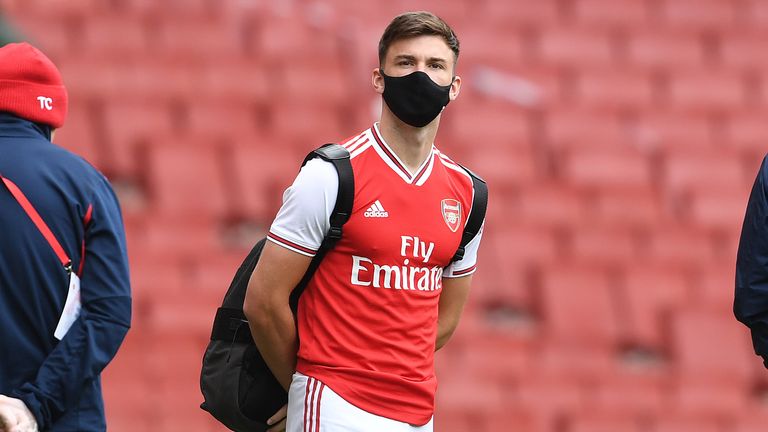
Kieran Tierney – Arsenal may be willing to sell Scottish defender Tierney to Leicester, just 12 months after he moved to the Emirates (Daily Express, June 5)

David Luiz – Arsenal are ready to offer Luiz a new one-year extension – but it could be on reduced terms (Daily Mirror, June 2); Luiz wants to extend his stay at Arsenal despite being out of contract and there is a “very high chance” it will happen, says his agent (Sky Sports News, June 1)

Arsenal are considering making a contract offer to David Luiz on reduced terms to his current deal (Sunday Telegraph, May 31); Luiz’s brief spell at Arsenal could be coming to an end with the Brazilian out of contract next month and no negotiations over a new deal planned. (Sky Sports News, May 27); The Brazilian defender has opened the door on a return to Benfica when his Arsenal contract ends next summer. (Daily Star, May 23)

Other players recently linked with a move away from the Gunners…

  • Alexandre Lacazette (The Sun, May 31; Express, May 21)
  • Ainsley Maitland-Miles (Daily Star Sunday, May 24)
  • Lucas Torreira (Daily Star, May 16)
  • Henrikh Mkhitaryan (The Sun, May 12).
  • Mesut Ozil (Fanatik, May 12; SportX, May 5)
  • Nicolas Pepe (Bleacher Report, May 5).
  • Bukayo Saka (Sunday Mirror, April 26; The Sun, March 9)
  • Emiliano Martinez (Daily Mirror, April 14)
  • Hector Bellerin (The Boot Room, April 7; Daily Mirror, April 10)

Transfer Centre – follow the latest news with our live blog

Domestic Super 6 IS BACK!

Do not miss your chance to land the £250,000 jackpot on Saturday. Play for free, entries by 12:30pm.


Source link

Swans want 10,000 at SCG in round five

0

Loading

Brisbane’s Suncorp Stadium is also due to host both a Queensland-NSW Super Rugby match on that Friday night and a Gold Coast-Cronulla NRL game on the Saturday of that weekend. Suncorp has a capacity of 52,000 and there is a push underway for a crowd of 10,000 to be allowed for the Friday night rugby derby. The Brisbane Lions are also due to meet Port Adelaide at the 42,000-capacity Gabba on that Saturday night.

The AFL, Melbourne Cricket Club and Marvel Stadium have been hopeful that Victoria’s two main AFL venues will be allowed to be up to a quarter-full for round five, with a 25,000 crowd for the Friday night clash of Essendon and Collingwood at the MCG.

But AFL sources have indicated that a recent spike in coronavirus cases in Victoria has tempered expectations about whether crowds of that magnitude will be feasible by the first week of July.

The Swans – as well as cross-town rivals Greater Western Sydney – were granted permission to host crowds of 350 in corporate boxes at their round two home matches on Sunday.

Sydney’s next home game is on Thursday week against the Western Bulldogs, but it is the round five date with Melbourne on July 5 that chief executive Tom Harley has earmarked for a possible crowd of 10,000.

“The 10,000 is obviously 25 per cent of 40,000. I’d focus more on the cap of 10,000, as opposed to the 25 per cent. We’re looking forward to working – as we did last week – in the lead-up to the game against the Bombers [on Sunday], continuing to work really closely with NSW government to fulfil that opportunity for our fans, to have 10,000 at the SCG on July the fifth,” Harley said.

Tom Harley. Credit:Steven Siewert

“At this stage, the restrictions are as they are and July 1 is the milestone day. And then we are constantly in conversations with the SCG and our landlord, and also the NSW government around opportunities to bring fans into the game. We’re in the process of completing a really thorough debrief of the game on the weekend, and really pleased that we’re able to accommodate the small number within the restrictions that were put in place, and comfortably satisfy the social distancing requirements under the exemption of pubs, cafes and restaurants.

“We will continue to have conversations with the NSW government.”

While Morrison’s announcement meant crowds of up to 10,000 are now permitted, he ultimately left it up to individuals states to determine whether they implement his advice.

One concern raised by a key stakeholder in Victoria is that social distancing would be challenging to implement when people look to take public transport to the MCG and Marvel.

Source by [author_name]

North Korea blows up liaison office in row over defectors’ leaflet campaign

0

North Korea has blown up a liaison office set up to improve communications with the South, media reports said, in a row over defectors’ plans to send anti-Pyongyang propaganda leaflets across the heavily armed border.

South Korea’s unification ministry said the North had set off an explosion at the joint liaison office at 2:49 pm, in the North Korean border town of Kaesong. The reports, from the Yonhap news agency, added that military sources had heard an explosion and seen smoke rising from the building.

Smoke rises in the North Korean border town of Kaesong. Photograph: AP

North Korea conformed in a statement carried by the official KCNA news agency that it had “tragically ruined” the office with a “terrific explosion”. It said the building’s destruction had come “in the wake of cutting off all communication liaison lines between the North and the South”.

The move reflected “the mindset of the enraged people to surely force human scum and those, who have sheltered the scum, to pay dearly for their crimes” KCNA added, in an apparent reference to North Korean defectors in the South.

North Korea appears to have acted on a warning by Kim Yo-jong, the increasingly influential sister of the country’s leader, Kim Jong-un, to destroy the “useless” office.

“Before long, a tragic scene of the useless North-South joint liaison office completely collapsed would be seen,” she said on Saturday.

The office opened in September 2018 to facilitate inter-Korean co-operation following successful talks between Kim Jong-un and the South Korean president, Moon Jae-in.

Earlier on Tuesday, Pyongyang had warned it was “fully ready” to send troops into the demilitarised zone separating it from South Korea if defectors went ahead with their leaflet plans.

Kim Yo-Jong
Kim Yo-Jong. Photograph: Jorge Silva/AP

The general staff of the Korean People’s Army [KPA] said on Tuesday it had been studying an “action plan” to re-enter zones that were demilitarised under a 2018 inter-Korean agreement and “turn the front line into a fortress and further heighten military vigilance against the South”.

“Our army will rapidly and thoroughly implement any decisions and orders of the party and government,” it said in a statement carried by the KCNA.

The KPA also said North Korea would send its own propaganda into the South as part of a “large-scale leaflet-scattering struggle against the enemy”.

Leaflets critical of Kim Jong-un and his regime’s record on human rights have become a source of tension between the two Koreas in recent weeks.

North Korea severed inter-Korean hotlines – an important point of contact between the two governments – and threatened to permanently close the Kaesong industrial complex, once a symbol of inter-Korean economic co-operation.

Some experts believe the North is using the leafleting campaigns to pressure the South into reviving joint economic projects amid reports of food shortages in Pyongyang, and to communicate its anger at the lack of progress in nuclear talks with the US.

These have stalled since a second summit between Kim and Donald Trump in March 2019 broke down over disagreements on sanctions relief.

“The leaflets are an excuse or justification to raise the ante, manufacture a crisis, and bully Seoul to get what it wants,” said Duyeon Kim, a senior adviser at the International Crisis Group.

Pyongyang feels betrayed by Seoul’s prediction that the US would lift some sanctions in exchange for North Korea closing its nuclear reactor site, and is angry that leaflets and US-South Korea military drills continue, Duyeon Kim said.

“They’re upset that Seoul has done nothing to change the environment and is again telling Seoul to stay out of its nuclear talks with Washington,” she added.

Tuesday’s warning suggests North Korea is prepared to send soldiers into border areas where Kim and Moon agreed to cease “all hostile acts” during their first summit in September 2018.

“I regret that North Korea-US and inter-Korean relations have not made progress as expected,” Moon said this week in a message to mark the 20th anniversary of the first inter-Korean summit, between Kim Jong-il and Kim Dae-jung. “But what’s most important is trust, which the South and North should build through constant dialogue.”

Several defector groups in South Korea regularly send flyers, along with food, $1 bills, mini radios and USB sticks containing South Korean dramas and news, usually by balloon over the heavily fortified border.

In response, South Korea’s government has filed a police complaint against two defector groups, saying their activities were not helping “efforts to achieve peace and prosperity of the Korean peninsula”.

Human Rights Watch accused Seoul of submitting to North Korean threats. “It is shameful how President Moon and his government are totally unwilling to stand up for the rights of North Koreans,” Phil Robertson, the group’s deputy Asia director, said in a statement.

“Instead of proposing a blanket ban on sending balloons with messages and materials to the North, President Moon should publicly demand that North Korea respect freedom of expression and stop censoring what North Koreans can see.”

The defector groups, however, said they would go ahead with plans to send leaflets across the demilitarised zone – which has divided the Korean peninsula since the end of the 1950-53 Korean war – later this week.

Source link

PM Imran to arrive in Karachi for two-day official visit today

0


Prime Minister Imran Khan will arrive in Karachi today [Tuesday] evening on his official two-day visit to discuss various issues, including the COVID-19 pandemic with political leaders in Sindh, Geo News reported.

According to Radio Pakistan,  Governor Sindh Imran Ismail and Chief Minister Sindh Murad Ali Shah will also call on the prime minister.

The premier will inspect the mobile hospital set up for coronavirus patients at the Governor’s House. He will also meet provincial lawmakers of Pakistan Tehreek-i-Insaf and coalition parties Muttahida Qaumi Movement – Pakistan and Grand Democratic Alliance.

Source link

SpaceX Starlink satellites pass over UK this week: when to spot them

0

A computer-generated image from several long-exposure images shows Starlink satellites in the sky above the concrete base of a former heating plant in Salgotarjan, Hungary (Credits: EPA)

Last weekend SpaceX successfully launched its latest batch of 58 Starlink satellites into orbit.

The small satellites are designed to daisy-chain together and beam internet signal down across the globe. At the moment, there are 538 up there in orbit.

If all goes to plan, SpaceX will eventually have 12,000 of them circling the planet.

Starlink satellites are joined together in ‘trains’ that can be seen from Earth on a clear night. This week, the satellites will pass over the UK giving eager skywatchers a perfect opportunity to spot them.

The satellites appear as a chain of lights moving swiftly across the sky. Spotting them can be tricky as you’ll need to let your eyes adjust to the darkness.

Here are the times to be outside looking up to see them pass over the UK this week.

  • Tuesday, 16th June: 10:45 pm
  • Wednesday, 17th June: 12.21am, 10.02pm, 11.21pm
  • Thursday, 18th June: 10:21 pm
Starlink satellites moving across the night sky (Astrit Spanca)

If you want to follow a live map of the Starlink satellites, you can do so on the Find Starlink website here.

You can also put in your location to find times of future passes to make sure you don’t miss them.

How do Starlink satellites work?

Each satellite has four antennas on board (Picture: Starlink)
The satellites draw their power from the sun (Picture: Starlink)

Starlink’s ultimate aim is to beam down internet signal across the planet.

SpaceX ultimately plans to put 12,000 of them in orbit.

Each Starlink satellite is equipped with four powerful phased array antennas that are capable of an enormous amount of throughput when it comes to radio waves. Therefore, internet signal can be communicated up to a satellite and spread out through the network before being fired back down again to any location on Earth.

Delivering internet via satellite is much more efficient because the signal travels 47% faster as a wave through the vacuum of space than it does being channelled along a fibre optic cable buried in the ground.

From an infrastructure perspective, it also means there’s no need to lay vast amounts of cabling across parts of the world.

Current satellites sending internet signals are around 22,236 miles (35,786 km) above the Earth. This results in a time delay in sending and receiving data. Starlink satellites are smaller and orbit closer, meaning they can carry and triangulate data much faster.

Elon Musk has said the Starlink network would be able to provide ‘minor’ internet coverage after 400 spacecraft were up and in orbit and ‘moderate’ coverage after about 800 satellites became operational.

On board each satellite is a powerful Ion propulsion system and a custom-built in-house navigation sensor.

An on-board sensor looks out for space junk (Picture: Starlink)
An ion propulsion system lets the satellite get into position (Picture: Starlink)

Together the two are able to automatically steer the satellites out of the way of space junk.

It also helps guide the satellites to the optimum position for delivering data transfer.

According to SpaceX, enough satellites may be in place by the end of 2020 to start supplying a limited amount of internet signal to some parts of the US and Canada.


Source link