Eating Thai Fruit Demands Serious Effort but Delivers Sublime Reward

0

BANGKOK — All across Bangkok, fruit juice is dripping off chins, dribbling down arms and splashing onto the city’s sidewalks.

This is peak fruit season in Thailand, when the rising mercury concentrates the sugars in the tropical bounty that is native to Southeast Asia.

The region’s fruits are like no other. There is a fruit encased in prickly armor that smells of a deep, dank rot. There is a fruit that emits a sticky sap when peeled and another that stains fingernails mauve for those craving its succulent flesh.

And there is the rambutan, which means “hairy thing” in Malay. With its crimson skin studded with green feelers, the egg-sized fruit bears more than a passing resemblance to a coronavirus. It is yummy.

With pandemic travel bans in place, Thailand’s economic mainstay, tourism, has been battered. The country of 70 million has had to rely even more on exports of its agricultural products, and a national fruit lobby group predicts that overseas fruit shipments will increase by at least 10 percent this year, despite the coronavirus.

Prime Minister Prayuth Chan-ocha has called Thailand “the Great Power nation of fruit.”

Last year, the country ranked as the world’s sixth biggest fruit exporter, most of it dispatched to China.

Less than 3 percent of Thailand’s fruit was exported to the United States. Distance is one obstacle. But the main reason for the low figure may be that Southeast Asia’s indigenous fruits have what Fuchsia Dunlop, a British author of Chinese cookbooks, calls a high “grapple factor.”

Many of the region’s fruits come with visceral reminders of the jungle that birthed them and require serious commitment to eat: laborious peeling, careful chewing and the frequent spitting out of seeds to which meat stubbornly adheres.

To snack during office hours on a langsat, a demure cousin of a lychee with a peel that oozes a kind of natural super glue, is to submit to sticky fingers and sticky keyboards. Soap doesn’t help.

The meat is perfumed but each bite is fraught, lest teeth accidentally penetrate the bitter seeds. The langsat is worth it, but only just.

Unlike a banana’s easy extraction, dissecting a jackfruit is to hack through a jagged sheath, then painstakingly pluck out rubbery polyps that taste like overripe Juicy Fruit gum.

The process can consume an afternoon, and there are fruit vendors whose careers are dedicated to peeling jackfruit — a single specimen can weigh up to 120 pounds — and other complicated fruits.

At Talad Thai, Bangkok’s wholesale fruit market and the largest in Southeast Asia, there is an entire building dedicated to citrus and a gymnasium-sized section only for the mango, of which there are more than 200 varieties in Thailand.

The fruits at Talad Thai are often transported and peeled by migrants from neighboring Cambodia or Myanmar.

“I was so poor that I had to look for work in Thailand,” said Sing Dy, who was unloading a truck of fruit as sweat drenched her coronavirus face mask.

She hasn’t seen her children back in Cambodia for six months because of the pandemic travel ban, but she still sends most of her $20 a day salary back home.

Each year, regional newspapers relate various jackfruit-related deaths, mostly involving someone lingering under a tree with fruit looming above. In May, a man in southern India was injured by a falling jackfruit and required spinal surgery, only to discover at the hospital that he also had the coronavirus. (He recovered.)

In terms of showiness, the rambutan jousts with the dragon fruit, a neon pink mini-football covered in acid-green tendrils. To some, the experience of eating a dragon fruit, which grows on a cactus indigenous to South America, is a letdown after all that dazzling packaging: It’s a bland mush with tiny seeds that can require floss to dislodge.

Thais tend to approach milder fruit as a canvas for the fermented, spicy flavors that dominate the country’s cuisine. So guavas, rose apples and pomelos, the world’s largest citrus, are often served with a chili, salt and sugar dip to enliven the experience. Tart fruits, like green mangoes, are balanced with a sweet condiment that includes fish sauce, dried shrimp and shallots.

If someone’s fingernails are dyed purple at the tips, it likely betrays a preference for the mangosteen, a palm-sized orb that looks like an extra in a Super Mario Bros. video game. Beneath its woody rind are juicy segments that strike a Socratic equilibrium between sweet and sour.

Even a peach has nothing on a mangosteen when it is perfect, but the mangosteen is rarely perfect. Many are afflicted with a blight that tarnishes the white flesh an ugly mustard hue. Which fruit is blemished is unknowable before peeling, and so to eat a pile of mangosteens is an exercise in disappointment.

The salak is also called the snakeskin fruit because its casing is undeniably reptilian. Inside is a not-quite-crunchy flesh that, like so many of Southeast Asia’s native fruits, hovers between delectable and decayed. Some scientists have theorized the smell attracts rainforest primates, whose consumption and dispersal of the seeds helps the fruit take root for another generation.

The most infamous fruit, which stinks of death, is the durian. Buildings and taxis in Thailand have no-durian signs next to no-smoking signs.

The durian’s flavor elicits passionate, and polarizing, responses, with few indifferent about the fruit’s appeal or repulsiveness.

  • Updated June 22, 2020

    • Is it harder to exercise while wearing a mask?

      A commentary published this month on the website of the British Journal of Sports Medicine points out that covering your face during exercise “comes with issues of potential breathing restriction and discomfort” and requires “balancing benefits versus possible adverse events.” Masks do alter exercise, says Cedric X. Bryant, the president and chief science officer of the American Council on Exercise, a nonprofit organization that funds exercise research and certifies fitness professionals. “In my personal experience,” he says, “heart rates are higher at the same relative intensity when you wear a mask.” Some people also could experience lightheadedness during familiar workouts while masked, says Len Kravitz, a professor of exercise science at the University of New Mexico.

    • I’ve heard about a treatment called dexamethasone. Does it work?

      The steroid, dexamethasone, is the first treatment shown to reduce mortality in severely ill patients, according to scientists in Britain. The drug appears to reduce inflammation caused by the immune system, protecting the tissues. In the study, dexamethasone reduced deaths of patients on ventilators by one-third, and deaths of patients on oxygen by one-fifth.

    • What is pandemic paid leave?

      The coronavirus emergency relief package gives many American workers paid leave if they need to take time off because of the virus. It gives qualified workers two weeks of paid sick leave if they are ill, quarantined or seeking diagnosis or preventive care for coronavirus, or if they are caring for sick family members. It gives 12 weeks of paid leave to people caring for children whose schools are closed or whose child care provider is unavailable because of the coronavirus. It is the first time the United States has had widespread federally mandated paid leave, and includes people who don’t typically get such benefits, like part-time and gig economy workers. But the measure excludes at least half of private-sector workers, including those at the country’s largest employers, and gives small employers significant leeway to deny leave.

    • Does asymptomatic transmission of Covid-19 happen?

      So far, the evidence seems to show it does. A widely cited paper published in April suggests that people are most infectious about two days before the onset of coronavirus symptoms and estimated that 44 percent of new infections were a result of transmission from people who were not yet showing symptoms. Recently, a top expert at the World Health Organization stated that transmission of the coronavirus by people who did not have symptoms was “very rare,” but she later walked back that statement.

    • What’s the risk of catching coronavirus from a surface?

      Touching contaminated objects and then infecting ourselves with the germs is not typically how the virus spreads. But it can happen. A number of studies of flu, rhinovirus, coronavirus and other microbes have shown that respiratory illnesses, including the new coronavirus, can spread by touching contaminated surfaces, particularly in places like day care centers, offices and hospitals. But a long chain of events has to happen for the disease to spread that way. The best way to protect yourself from coronavirus — whether it’s surface transmission or close human contact — is still social distancing, washing your hands, not touching your face and wearing masks.

    • How does blood type influence coronavirus?

      A study by European scientists is the first to document a strong statistical link between genetic variations and Covid-19, the illness caused by the coronavirus. Having Type A blood was linked to a 50 percent increase in the likelihood that a patient would need to get oxygen or to go on a ventilator, according to the new study.

    • How many people have lost their jobs due to coronavirus in the U.S.?

      The unemployment rate fell to 13.3 percent in May, the Labor Department said on June 5, an unexpected improvement in the nation’s job market as hiring rebounded faster than economists expected. Economists had forecast the unemployment rate to increase to as much as 20 percent, after it hit 14.7 percent in April, which was the highest since the government began keeping official statistics after World War II. But the unemployment rate dipped instead, with employers adding 2.5 million jobs, after more than 20 million jobs were lost in April.

    • My state is reopening. Is it safe to go out?

      States are reopening bit by bit. This means that more public spaces are available for use and more and more businesses are being allowed to open again. The federal government is largely leaving the decision up to states, and some state leaders are leaving the decision up to local authorities. Even if you aren’t being told to stay at home, it’s still a good idea to limit trips outside and your interaction with other people.

    • What are the symptoms of coronavirus?

      Common symptoms include fever, a dry cough, fatigue and difficulty breathing or shortness of breath. Some of these symptoms overlap with those of the flu, making detection difficult, but runny noses and stuffy sinuses are less common. The C.D.C. has also added chills, muscle pain, sore throat, headache and a new loss of the sense of taste or smell as symptoms to look out for. Most people fall ill five to seven days after exposure, but symptoms may appear in as few as two days or as many as 14 days.

    • How can I protect myself while flying?

      If air travel is unavoidable, there are some steps you can take to protect yourself. Most important: Wash your hands often, and stop touching your face. If possible, choose a window seat. A study from Emory University found that during flu season, the safest place to sit on a plane is by a window, as people sitting in window seats had less contact with potentially sick people. Disinfect hard surfaces. When you get to your seat and your hands are clean, use disinfecting wipes to clean the hard surfaces at your seat like the head and arm rest, the seatbelt buckle, the remote, screen, seat back pocket and the tray table. If the seat is hard and nonporous or leather or pleather, you can wipe that down, too. (Using wipes on upholstered seats could lead to a wet seat and spreading of germs rather than killing them.)

    • What should I do if I feel sick?

      If you’ve been exposed to the coronavirus or think you have, and have a fever or symptoms like a cough or difficulty breathing, call a doctor. They should give you advice on whether you should be tested, how to get tested, and how to seek medical treatment without potentially infecting or exposing others.


On the outside, the durian resembles a medieval torture device, all spikes and menace. Nestled inside the spiny shell are kidney-shaped lobes of custard. The flavor is somewhere between an off-peak Gorgonzola and a crème caramel, with a whiff of skunk.

Orangutans adore the durian. In Indonesia, where expanding palm oil plantations have destroyed the apes’ natural habitat, orangutans occasionally raid fruit orchards for sustenance. Farmers have responded by shooting them.

Even if the smell could be put aside — which is, frankly, impossible — the durian would still probably have the highest grapple factor among Southeast Asia’s endemic fruits. Thai exports of the fruit are mostly destined for China, where consumers tend to be more willing to work for their meals.

The durian’s greatest supporters hold out little hope that it will ever capture the United States market the way the kiwi charmed Americans in the 1970s, when marketers renamed the Chinese gooseberry after New Zealand’s national bird. It helps that the kiwi, with its fuzzy peel, is cute and easy to eat, and no one will mistake its aroma for that of raw sewage.

Ubolwan Wongchotsathit is a second-generation fruit magnate, and she used to fly her durian as far away as Dubai and Melbourne before the pandemic forced her to use land and sea routes instead.

“Americans say they hate the smell of durian,” she said. “I don’t understand. It is sweet love.”

Muktita Suhartono contributed reporting.
Source link

American Idol winner Laine Hardy diagnosed with coronavirus

0

Laine Hardy, the 2019 winner of American Idol, says he has been diagnosed with Covid-19 but his symptoms are mild and he is recovering under home quarantine.

This wasn’t what I expected on the first day of summer,” the 19-year-old singer from Livingston, Louisiana, wrote on his Facebook page and on Instagram. “My doctor confirmed I have Coronavirus, but my symptoms are mild.” He ended his message: “Y’all stay safe & healthy!”

This wasn’t what I expected on the first day of summer. My doctor confirmed I have Coronavirus, but my symptoms are mild and I’m home recovering in quarantine. Y’all stay safe & healthy!

Posted by Laine Hardy on Sunday, June 21, 2020

Hardy had performed on Friday, singing the national anthem at swearing-in ceremonies for Livingston Parish Sheriff Jason Ard’s third term, according to reports.

Hardy also recently completed a virtual tour that was watched by more than 2 million viewers. And his next livestream is scheduled for Thursday evening.

Acoustic versions of his new songs Ground I Grew Up On and Let There Be Country will debut on Friday.

PA


Source link

Florida Passes 100,000 COVID-19 Cases

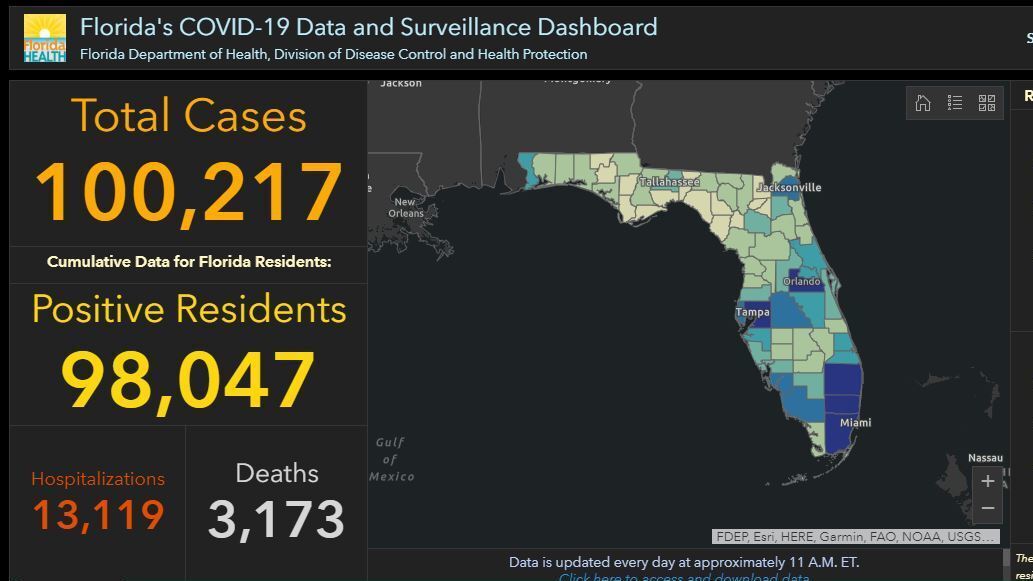
Florida’s COVID-19 dashboard, here in a snapshot Monday, shows the state has more than 100,000 confirmed coronavirus cases.

Florida Geographic Information Systems/Screenshot by NPR


hide caption

toggle caption

Florida Geographic Information Systems/Screenshot by NPR

Florida’s COVID-19 dashboard, here in a snapshot Monday, shows the state has more than 100,000 confirmed coronavirus cases.

Florida Geographic Information Systems/Screenshot by NPR

Florida has hit a grim milestone — passing 100,000 cases of the coronavirus. The latest report from the state’s Department of Health adds 2,926 new infections to the total number of COVID-19 cases, which now stands at 100,217 with 3,173 deaths.

Along with Florida, six other states have registered more than 100,000 cases: New York, California, New Jersey, Illinois, Texas and Massachusetts.

Like some other states, Florida has seen a surge of COVID-19 infections in recent weeks. A new record high of 4,049 new cases was set Saturday. Florida Gov. Ron DeSantis has linked the rising number of cases to increased testing.

In March and April, testing was limited mostly to older people who had symptoms of the coronavirus. Since then, testing has expanded and has been opened to people of all ages, whether they have coronavirus symptoms or not.

DeSantis said many of those testing positive for the coronavirus now don’t have any symptoms and many of them are young. “What we’ve seen now has been a really significant increase in positive test results for people in the 20s and 30s,” he said. The median age of those testing positive in Florida has declined rapidly, going from 65 in April to under 30 now in some counties. “Our cases are shifting in a radical direction younger,” DeSantis said.

The governor said he’s concerned about another trend — the rising percentage of people who are testing positive for the virus. “That’s evidence that there’s transmission within those communities, particularly (among people) in the 20s and 30s,” he said. A number of bars across the state closed temporarily last week after staff members and customers contracted COVID-19.

Over the weekend, Florida’s Department of Health reissued guidelines stressing the importance of social distancing and encouraging people to wear face coverings when social distancing isn’t possible.

Despite the surge in new cases, DeSantis said there are no plans to roll back guidelines allowing businesses to reopen. He said the number of people going to the hospital for COVID-19 remains far below what they were in March and April. And deaths from the coronavirus in Florida have trended steadily downward for seven weeks.

The governor said the coronavirus cases among people in their 20s and 30s are typically less acute than among those in older people. “If you had a thousand cases under the age of 30,” he said, “that would have (less) clinical significance than if you had 15 cases among residents of a long-term care facility.”

For months, DeSantis noted that there had been no deaths in Florida of anyone under age 18. With the death of a 17-year-old in Pasco County over the weekend, that’s no longer the case.

Source link

‘The biggest step forward’: NYC enters Phase 2 of reopening with outdoor dining, barbershops

More than 100 days after New York City was shuttered by the coronavirus, which decimated the once thriving metropolis with more than 21,000 deaths, the city faces a new challenging yet hopeful moment in the fight against the pandemic, phase two of reopening.

Starting Monday, New Yorkers can once again begin dining outdoors, barbershops and hair salons can tend to long overgrown hair, children kept indoors in cramped apartments can run around on playgrounds. Some 150,000 to 300,000 people will be returning to work, according to city estimates, while many others will continue to work from home or still face unemployment.

At New Generation barbershop in Sunnyside, Queens, men in masks sat outside in the nearly 90 degree heat on red chairs six feet apart for long-awaited hair cuts.

Inside, owner Steven Muratov was buzzing the sides of a customer’s head on one side of the shop while on the other side of the store two empty chairs away there was another customer getting a cut. Meanwhile, three men in masks sat in socially distanced chairs in a waiting area.

“Closing was sad and very upsetting, to come to work today, thank God. It’s a breakthrough,” Muratov, 51, said while cutting the man’s hair.

Muratov said customers had been calling him throughout the pandemic but interest had been “crazy” since the reopening was announced. Two more customers called to set up appointments as he spoke.

He said he had a cousin who became very sick with the coronavirus, suffering with a month of fevers up to 104 and 105 degrees.

“It was of course very scary for us but thank God he survived,” he said. “I’m very happy to come back to work, I hope we can get to normal pretty soon and forget about that problem completely, I wish.”

Still, it was critical for people to abide by hygiene rules, social distancing protocols and wear masks in order to avoid a new spike in cases. He and his employees took an online course on safety protocols, were disinfecting chairs in between customers, requiring masks, social distancing and practicing other frequent hygiene measures, he said.

“We’ve got to keep ourselves and our customers safe,” he said. “I wouldn’t want to be the one that starts a second wave.”

A stylist cuts a clients hair at Les Enfants Terribles hair salon in Brooklyn, N.Y., on June 22, 2020.Angela Weiss / AFP – Getty Images

Queens was one of the earliest and hardest hit boroughs from the crisis, especially parts of central queens. Elmhurst Hospital was one of the earliest facilities to become overwhelmed, with doctors in March desperately trying to get more ventilators and speaking out about patients waiting 60 hours for a bed.

Overall, the city has seen nearly 18,000 known coronavirus deaths, with 4,682 probable deaths.

But now the city’s positive test rate has been at around one percent, down significantly from a peak in April of 60 percent. And there were just 10 coronavirus deaths in the state on Sunday, New York Gov. Cuomo said on Monday, a stark contrast from a tragic week in early April when nearly 800 people died per day.

New York City Mayor Bill De Blasio said Monday was a “historic day” and a “huge step forward, the biggest step forward as we fight back from the coronavirus crisis and we once again become everything that New York City is and can be.”

Phase two in New York City, once the epicenter of coronavirus, comes two weeks after the first phase of reopening, which included construction, manufacturing and curbside pickup for retail.

New York began reopening in mid-May after reaching seven metrics including data ranging from COVID-19 hospitalizations, deaths, hospital capacity, the number of contact tracers a region has available, among others.

New daily cases are on the decline in states that were hit hard in the spring, such as New York and New Jersey in the Northeast. But case counts are soaring in certain states in the southern and western United States.

In Alabama, North Carolina, and the territory of Puerto Rico, the number of new cases in the last four weeks are up more than 80 percent compared to the four weeks before. In Montana, daily cases are up more than 300 percent.


Source link

Watch: Uzalo Season 6 Episode 76, Monday, 22 June 2020

0

On tonight’s episode:

Nkunzi’s failed heist blues place him in a position where he hears painful truths from his lover. MaZaza continues to make Gabisile’s life a living nightmare.

Fikile’s excitement forces Sbu to dig himself in a deeper hole with more lies.

Uzalo: Episode 76, Season 6 22 June 2020)

Tuesday, on Uzalo

Nkunzi takes a drastic decision. When Tsunami doesn’t get what he came for, he does the unthinkable and MaZaza becomes a thorn in Gabisile’s side.

Find out what else is going to happen during June in Uzalo here.

About Uzalo

The happenings around the Xulu family from KwaMashu have kept South Africans glued to their TV screens every weekday at 20:30 for the past five years since the show’s premiere in February 2015.

UZALO is a provocative, bold and authentic narrative that tells the story of two family dynasties, the Mdletshes and the Xulus, and the two young men who carry their hopes and legacy’s.

How to watch the latest episode of Uzalo

The soapie airs every weeknight on SABC 1 and you can watch on your TV or online. After the episode airs, the episodes are also made available on YouTube for seven days. Episodes are also posted right here on thesouthafrican.com as soon as they become available.

Uzalo production team

Executive Producer and creator: Duma Ndlovu
Executive Producer: Gugulethu Zuma-Ncube
Executive Producer: Pepsi Pokane
Series Producer: Mmamitse Thibedi
Head Writer: Phathutshedzo Aldrean Makwarela
Storyliners: Yolanda Mogatusi, Lehasa Moloi, Zolisa Singwanda
Head Director: Alex Yazbek
Directors: King Shaft Morapama, Bruce Molema


Source link

F.D.A. Warns of Potentially Toxic Hand Sanitizers

0

The Food and Drug Administration is warning consumers to avoid nine hand sanitizer products manufactured in Mexico because, it said, they may contain methanol, a substance that can be toxic if absorbed through the skin or ingested.

In an advisory dated Friday, the agency said it had tested samples of two products, Lavar Gel and CleanCare No Germ, and found they had 81 percent and 28 percent methanol, also known as wood alcohol.

“Methanol is not an acceptable ingredient for hand sanitizers and should not be used due to its toxic effects,” the agency said.

The F.D.A. said on June 17 that it had recommended that the manufacturer, Eskbiochem SA de CV of Mexico, remove its products from the market but that so far the company had not responded.

An Eskbiochem representative, Alexander Escamillo, said the manufacturer learned of the agency warning only on Monday.

Mr. Escamillo said another person who “had access to our company” registered it with the F.D.A. “He registered our labels and shipped sanitizers,” he said. “We did not register ourselves.”

He did not identify the person and said the company could not even log into its F.D.A. profile “because we don’t know how to.”

“We would never do that, send a toxic chemical maliciously,” Mr. Escamillo said, adding that the company would take action against the person, whom he referred to as a broker.

The F.D.A. recommended that anyone exposed to the hand sanitizers with methanol seek immediate treatment. Substantial methanol exposure can lead to nausea, vomiting, headaches, permanent blindness and seizures, among other harmful effects.

The agency said that it was unaware of any reports of “adverse events” associated with these products. It said consumers should dispose of sanitizers listed in the warning in appropriate hazardous waste containers and not flush them or pour them down the drain.

Among the other Eskbiochem products the agency flagged were CleanCare NoGerm Advanced Hand Sanitizer, with 75 or 80 percent alcohol; Saniderm Advanced Hand Sanitizer; and Good Gel Antibacterial Gel Hand Sanitizer.

  • Updated June 22, 2020

    • Is it harder to exercise while wearing a mask?

      A commentary published this month on the website of the British Journal of Sports Medicine points out that covering your face during exercise “comes with issues of potential breathing restriction and discomfort” and requires “balancing benefits versus possible adverse events.” Masks do alter exercise, says Cedric X. Bryant, the president and chief science officer of the American Council on Exercise, a nonprofit organization that funds exercise research and certifies fitness professionals. “In my personal experience,” he says, “heart rates are higher at the same relative intensity when you wear a mask.” Some people also could experience lightheadedness during familiar workouts while masked, says Len Kravitz, a professor of exercise science at the University of New Mexico.

    • I’ve heard about a treatment called dexamethasone. Does it work?

      The steroid, dexamethasone, is the first treatment shown to reduce mortality in severely ill patients, according to scientists in Britain. The drug appears to reduce inflammation caused by the immune system, protecting the tissues. In the study, dexamethasone reduced deaths of patients on ventilators by one-third, and deaths of patients on oxygen by one-fifth.

    • What is pandemic paid leave?

      The coronavirus emergency relief package gives many American workers paid leave if they need to take time off because of the virus. It gives qualified workers two weeks of paid sick leave if they are ill, quarantined or seeking diagnosis or preventive care for coronavirus, or if they are caring for sick family members. It gives 12 weeks of paid leave to people caring for children whose schools are closed or whose child care provider is unavailable because of the coronavirus. It is the first time the United States has had widespread federally mandated paid leave, and includes people who don’t typically get such benefits, like part-time and gig economy workers. But the measure excludes at least half of private-sector workers, including those at the country’s largest employers, and gives small employers significant leeway to deny leave.

    • Does asymptomatic transmission of Covid-19 happen?

      So far, the evidence seems to show it does. A widely cited paper published in April suggests that people are most infectious about two days before the onset of coronavirus symptoms and estimated that 44 percent of new infections were a result of transmission from people who were not yet showing symptoms. Recently, a top expert at the World Health Organization stated that transmission of the coronavirus by people who did not have symptoms was “very rare,” but she later walked back that statement.

    • What’s the risk of catching coronavirus from a surface?

      Touching contaminated objects and then infecting ourselves with the germs is not typically how the virus spreads. But it can happen. A number of studies of flu, rhinovirus, coronavirus and other microbes have shown that respiratory illnesses, including the new coronavirus, can spread by touching contaminated surfaces, particularly in places like day care centers, offices and hospitals. But a long chain of events has to happen for the disease to spread that way. The best way to protect yourself from coronavirus — whether it’s surface transmission or close human contact — is still social distancing, washing your hands, not touching your face and wearing masks.

    • How does blood type influence coronavirus?

      A study by European scientists is the first to document a strong statistical link between genetic variations and Covid-19, the illness caused by the coronavirus. Having Type A blood was linked to a 50 percent increase in the likelihood that a patient would need to get oxygen or to go on a ventilator, according to the new study.

    • How many people have lost their jobs due to coronavirus in the U.S.?

      The unemployment rate fell to 13.3 percent in May, the Labor Department said on June 5, an unexpected improvement in the nation’s job market as hiring rebounded faster than economists expected. Economists had forecast the unemployment rate to increase to as much as 20 percent, after it hit 14.7 percent in April, which was the highest since the government began keeping official statistics after World War II. But the unemployment rate dipped instead, with employers adding 2.5 million jobs, after more than 20 million jobs were lost in April.

    • My state is reopening. Is it safe to go out?

      States are reopening bit by bit. This means that more public spaces are available for use and more and more businesses are being allowed to open again. The federal government is largely leaving the decision up to states, and some state leaders are leaving the decision up to local authorities. Even if you aren’t being told to stay at home, it’s still a good idea to limit trips outside and your interaction with other people.

    • What are the symptoms of coronavirus?

      Common symptoms include fever, a dry cough, fatigue and difficulty breathing or shortness of breath. Some of these symptoms overlap with those of the flu, making detection difficult, but runny noses and stuffy sinuses are less common. The C.D.C. has also added chills, muscle pain, sore throat, headache and a new loss of the sense of taste or smell as symptoms to look out for. Most people fall ill five to seven days after exposure, but symptoms may appear in as few as two days or as many as 14 days.

    • How can I protect myself while flying?

      If air travel is unavoidable, there are some steps you can take to protect yourself. Most important: Wash your hands often, and stop touching your face. If possible, choose a window seat. A study from Emory University found that during flu season, the safest place to sit on a plane is by a window, as people sitting in window seats had less contact with potentially sick people. Disinfect hard surfaces. When you get to your seat and your hands are clean, use disinfecting wipes to clean the hard surfaces at your seat like the head and arm rest, the seatbelt buckle, the remote, screen, seat back pocket and the tray table. If the seat is hard and nonporous or leather or pleather, you can wipe that down, too. (Using wipes on upholstered seats could lead to a wet seat and spreading of germs rather than killing them.)

    • What should I do if I feel sick?

      If you’ve been exposed to the coronavirus or think you have, and have a fever or symptoms like a cough or difficulty breathing, call a doctor. They should give you advice on whether you should be tested, how to get tested, and how to seek medical treatment without potentially infecting or exposing others.


It was not immediately clear when they were released for sale in the United States.

Dr. Robert Glatter, an emergency physician at Lenox Hill Hospital in Manhattan, said methanol itself was not significantly toxic. Rather, he said, it was formaldehyde and formic acid — the metabolites produced by the breakdown of methanol in the body — that could prove deadly.

Exposure to the metabolites can lead to a condition known as “metabolic acidosis, a dangerous accumulation of acid in the bloodstream, which is toxic to the organs and tissues in the body, leading to seizures, kidney failure, blindness, low blood pressure and fatal cardiac arrhythmias,” Dr. Glatter said.

Children are most at risk if they ingest methanol, but it can also be harmful if they rub it on their skin or inhale it, he added.

Sales of hand sanitizer have boomed during the coronavirus pandemic as consumers have heeded the calls of health officials to wash or sanitize their hands to keep from contracting the virus.

Historically, methanol was once manufactured by the distillation of wood. Wood alcohol was a hidden danger for unwary drinkers during Prohibition. In New York in 1926, about 750 people died after drinking wood alcohol-laced bootlegged liquor, according to an account at the Mob Museum.

Sandra E. Garcia contributed reporting.

Source link

Syrian Kurds say Turkish charity dwarfed by stolen produce

Jun 22, 2020

Turkey’s state-run Anadolu news agency reported today that on Monday, two Turkish charities had sent six trucks carrying humanitarian aid to the rebel-held province of Idlib in northwest Syria.

“Truckloads of supplies including flour, clothing and dry food [donated] by the Adana Dosteller and Eskisehir Gunisigi charities entered Idlib through the Yayladagi border crossing in Turkey’s southern Hatay province. The aid will be distributed among families living in tents in Idlib,” Anadolu reported.

Turkey’s generosity to millions of displaced Syrians inside Syria and Turkey alike has been well documented. But critics of Ankara’s Syria policy charge that it’s giving with one hand and stealing with the other.

A report released today by Syrians for Truth and Justice, a non-partisan nonprofit documenting human rights violations in Syria, lays out in exhaustive detail how the Turkish government has facilitated commerce conducted by its Syrian National Army allies in looting grain. The grain is from eight silos that were confiscated in October during Turkey’s Operation Peace Spring, which resulted in Turkey’s occupation of a large swath of territory between the towns of Tell Abyad and Ras al-Ain formerly controlled by the United States’ Syrian Kurdish allies.

Based on interviews with a range of actors including National Army commanders as well as employees at the grain silos, Syrians for Truth and Justice unveiled a network of grain dealings conducted by a Turkish government company — the Turkish Grain Board, known as TMO for short — and “armed groups’ commanders who personally seized amounts of the grain storage” and “then sold them to either local or Turkish merchants” and kept the proceeds for themselves. The theft is documented by satellite imagery showing transportation trucks taking the grain away from the silos.

The allegations will further blot Turkey and the National Army’s image in northeast Syria. Ankara is accused of overseeing or directly participating in a panoply of abuses, including summary executions, abductions, looting, crop burning and weaponizing water against the Kurds.

The Kurdish-led administration in northeastern Syria told the authors of the report that it had left behind about 730,000 tons of wheat, barley, fertilizers, cotton and seed as it withdrew in the face of advancing Turkish forces. “This stock is the strategic reserve for the next three years and constitutes 11% of the total stock of Raqqa and Hasakah provinces,” said Salman Baroudo, the co-chair of the commerce committee of the autonomous administration.

A ton of wheat produces around 850 kilograms of flour, and a ton of flour produces 1.2 tons of bread, explained an autonomous administration official to illustrate the scale of the loss.

The Syrian National Army denied that it was engaged in any looting from grain silos but officials from the Istanbul-based Syrian Interim Government and employees of the local councils claimed the opposite.

Syrians for Truth and Justice executive director Bassam al-Ahmad told Al-Monitor in a telephone interview that the looting “fits a broader pattern of abuses as were perpetrated in Turkish-occupied Afrin. Turkey is buying looted wheat.” Afrin is the Kurdish-majority enclave that was occupied by Turkey in 2018. Crimes committed by Turkey’s Sunni rebel allies have been well documented. They include rape, arbitrary detentions and industrial-scale extortion of local olive farmers, with much of their oil finding its way to Turkey and exported to foreign markets under Turkish labels, Germany’s Deutsche Welle reported.

The TMO insists that it only imports surplus barley but no wheat from Syria. But the trade is driving up prices, noted Elizabeth Tsurkov, a Syria expert and fellow at the Foreign Policy Research Institute in Philadelphia. She told Al-Monitor, “It’s absolutely true that wheat and grain is being looted. I’ve confirmed it with the factions. They are selling the wheat and barley that is cultivated in large swaths of land between Ras al-Ain and Tell Abyad and selling it to Turkey.”

Tsurkov added that Turkey was offering more money for the commodities “than any other actor in Syria is offering to farmers. Therefore there is a clear incentive to sell to Turkey.”

But even as Turkey engages in such transactions, it continues to prevent any flow of humanitarian aid from its borders to the Kurdish-held areas. The COVID-19 pandemic has not softened Turkey’s stance while the collapse of the Syrian currency has compounded people’s misery across the country.

Protests erupted today in Tell Abyad and the town of Suluk, also under Turkish control, over deteriorating living conditions and rising food prices, especially that of bread. 

In Suluk, a crowed gathered outside the local Turkish-appointed council and called for its removal, reported the Violation Documentation Centre in North Syria in a tweet. It said in a separate call for action yesterday that Turkish soldiers were targeting farmers on the Turkish-Syrian border. Syrian Kurdish farmer Muhayuddin Abdurazak died after allegedly being shot by a Turkish border guard on May 17.

Thomas McClure, a researcher at the Rojava Information Center, which publishes reports on the Kurdish-controlled region for international audiences, told Al-Monitor that the area affected by Operation Peace Spring encompasses 440,000 hectares of arable land producing up to 763,000 tons of wheat. “Turkey’s instillation of proxy militias ın this once productive region has severely impacted the remainder of northeast Syria and those civilians who have remained in the zone of occupation. The loss of vital arable land places further pressure on the remainder of the northeast, where per UN figures 1.94 million people are in need of humanitarian aid,” he noted.

McClure backed up Syrians for Truth and Justice, saying, “Grain silos were rapidly looted, with tens of thousands of tons of wheat transferred to Turkey for sale or sold to local merchants at extortionate prices. Bread, the local staple, doubled in price in the months following the invasion, while other local essentials like cooking gas are now five times as expensive as elsewhere in northeast Syria.”

The governor of Turkey’s Sanliurfa province, where the occupation is administered from, told Anadolu last week that Turkey would be opening a new gate between Ras al-Ain and the Turkish border town of Ceylanpinar. Abdullah Erin said the gate would be “for both Ras al-Ain and Ceylanpinar,” much as the opening of a gate from Turkey’s nearby border town of Akcakale had been for Tell Abyad. The pro-government Daily Sabah reported, “Citizens frequently voice that daily life is getting better as a result of the reconstruction of infrastructure” in Tell Abyad and in Ras al-Ain. Today’s protest paints a different picture.


Source link

Bloem Celtic midfielder Given Mashikinya tests positive for COVID-19

0

Bloemfontein Celtic have confirmed that midfielder Given Mashikinya has tested positive for COVID-19.

The players becomes the latest in the PSL to contract the novel virus, bringing the number of publicised cases in the league to just two.

Bloemfontein Celtic confirm positive COVID-19 case

The Free State-based outfit revealed this via a statement issued out on Monday afternoon.

“Bloemfontein Celtic can confirm that after we have conducted COVID-19 tests on Friday, 19 June 2020, one player [Given Mashikinya] tested positive,” the club said.

“The player was and is asymptomatic and he is currently in isolation for the next 14 days. In accordance with the relevant protocols, NHI has been notified of the case by the club. We urge everybody to continue practising safe and healthy measures to contain and stop the spread of the virus.”

Bloemfontein Celtic

The news comes just days after Orlando Pirates confirmed that Ben Motshwari – the only other PSL player whose diagnosis had been publicised – has made a full recovery from the coronavirus.

The Bucs midfielder recalled how he felt after testing positive.

“My initial response to the news that I had contracted coronavirus, was complete shock,” recalls the 29-year old.

“It’s not something you expect especially being a young and healthy athlete. We tend to think these things happen to other people other than ourselves, but I learned very quickly that this isn’t necessarily the case. The coronavirus does not discriminate, it doesn’t care who you are.”

Ben Motshwari

How the virus has impacted the game in South Africa

Another South African player to have returned positive results was former youth international Sphephelo Sithole, who is in the books of Portuguese outfit Belenenses.

Like Motshwari, the young midfielder tested positive in early May and has since made a full recovery.

There has not been any live local soccer action since March, and it’s yet unclear when the game will resume.

However, under Level 3 lockdown, athletes in contact sports have been permitted to resume training.


Source link

Aunt Maggie’s One-pot Toffee Pudding with Sauce

0

My Aunt Maggie used to make this no-bake recipe. When we visited her family in Namibia as a child, the long journey’s reward came in the shape of this sticky toffee pudding.

It is essentially a self-saucing pudding made in a cast iron pot on the stove. Putting all your ingredients in one dish which means less washing up to do. Now that’s a bonus!

This content has been created as part of our freelancer relief programme. We are supporting journalists and freelance writers impacted by the economic slowdown caused by #lockdownlife.

If you are a freelancer looking to contribute to The South African, read more here.


Source link

Matt Hancock announces coronavirus shielding in England to end from 6 July – video

The health secretary said people with underlying health issues who were most at risk from Covid-19 would no longer have to shut themselves away in their homes and could shop and mix with other people from 6 July in England.

Continue reading…

Source link