Over the past 72 hours, people across the US have captured what may be the most comprehensive live picture of police brutality ever. Any one of the videos we’ve seen could have sparked a national discussion, with people picking apart their elements, searching for context to argue about, and digging through the pasts of everyone involved. But it’s not just one act of violence, it’s everywhere. On Saturday, the names of several police officers allegedly seen perpetrating violence in different cities began trending on Twitter as people worked to cross-reference faces from videos with personal information on the web.
Here is just a short list of the scenes that have played out this week:
The violence appears so widespread and consistent that you could be mistaken for thinking it’s coordinated at a national level. To some extent, it is: President Trump has cheered on police violence like a fan at a sports event, and police departments across the country have styled themselves as military forces after two decades of hand-me-downs from the War on Terror.
“US cities face toll of violent protests,†says a headline at the top of Fox News. “Fury in the streets as protests spread across the US,†says The New York Times. “Fire and fury spread across the US,†says The Washington Post. “Wave of rage and anguish sweeps dozens of US cities,†says CNN. But whose rage? Whose fury? Whose violence?
Here’s another: ABC local news in Utah runs a graphic saying “violent protests in Salt Lake City.†In the background of the video, police knock an elderly man with a cane to the ground. He was simply standing near a bus stop.
We can’t deny what we are seeing, and we must describe it accurately. Whose violence? Whose rage? It’s from American police.
CAPE CANAVERAL, Fla. (AP) — SpaceX delivered two astronauts to the International Space Station for NASA on Sunday, following up a historic liftoff with an equally smooth docking in yet another first for Elon Musk’s company.
With test pilots Doug Hurley and Bob Behnken poised to take over manual control if necessary, the SpaceX Dragon capsule pulled up to the station and docked automatically, no assistance needed.
It was the first time a privately built and owned spacecraft carried astronauts to the orbiting lab in its nearly 20 years. NASA considers this the opening volley in a business revolution encircling Earth and eventually stretching to the moon and Mars.
ASSOCIATED PRESS
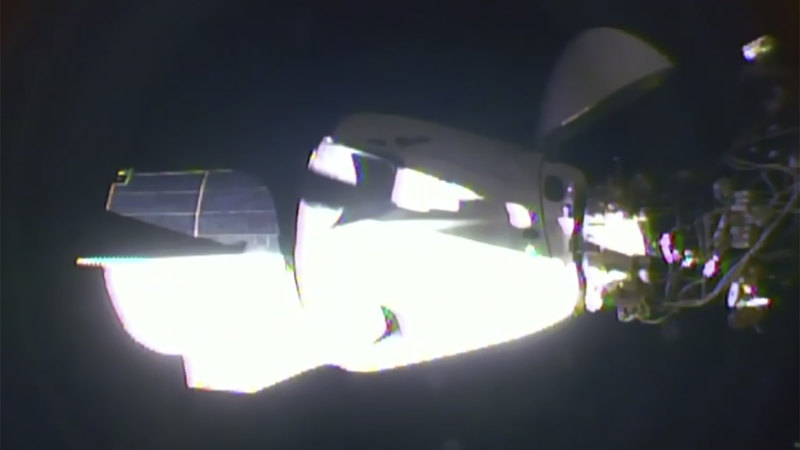
The SpaceX Dragon crew capsule, with NASA astronauts Doug Hurley, left, and Robert Behnken, docked with the International Space Station on Sunday.
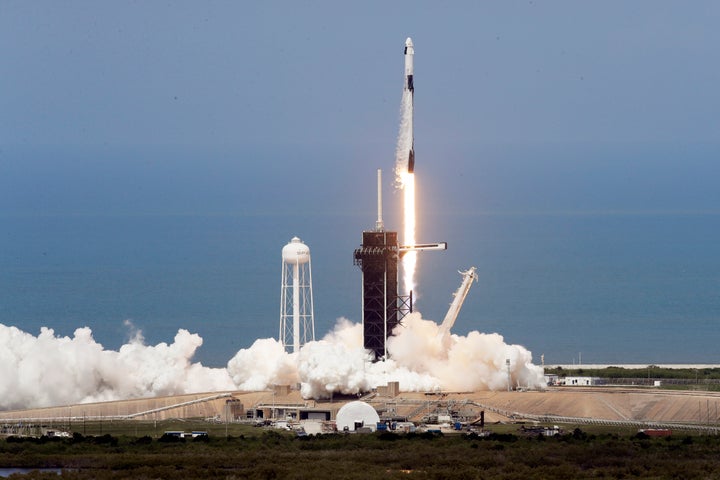
The docking occurred just 19 hours after a SpaceX Falcon 9 rocket blasted off Saturday afternoon from Kennedy Space Center, the nation’s first astronaut launch to orbit from home soil in nearly a decade.
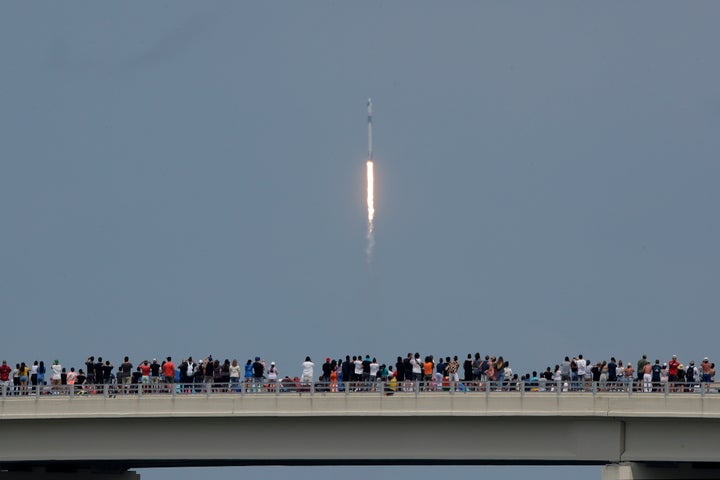
Thousands jammed surrounding beaches, bridges and towns to watch as SpaceX became the world’s first private company to send astronauts into orbit, and ended a nine-year launch drought for NASA.
A few hours before docking, the Dragon riders reported that the capsule was performing beautifully. Just in case, they slipped back into their pressurized launch suits and helmets for the rendezvous.
ASSOCIATED PRESS
The SpaceX Falcon 9 was the first privately built and owned spacecraft to carry astronauts to the orbiting lab.
The three space station residents kept cameras trained on the incoming capsule for the benefit of flight controllers at SpaceX headquarters in Hawthorne, California, and NASA’s Johnson Space Center in Houston.
Gleaming white in the sunlight, the Dragon was easily visible from a few miles out, its nose cone open and exposing its docking hook as well as a blinking light. The capsule loomed ever larger on live NASA TV as it closed the gap.
Hurley and Behnken took over the controls and did a little piloting less than a couple hundred yards (meters) out as part of the test flight, before putting it back into automatic for the final approach. Hurley said the capsule handled “really well, very crisp.â€
ASSOCIATED PRESS
Spectators watch from a bridge in Titusville, Fla. as SpaceX Falcon 9 lifts off with two NASA astronauts on Saturday.
SpaceX and NASA officials had held off on any celebrations until after Sunday morning’s docking — and possibly not until the two astronauts are back on Earth sometime this summer.
NASA has yet to decide how long Hurley and Behnken will spend at the space station, somewhere between one and four months. While they’re there, the Dragon test pilots will join the one U.S. and two Russian station residents in performing experiments and possibly spacewalks to install fresh station batteries.
In a show-and-tell earlier Sunday, the astronauts gave a quick tour of the Dragon’s sparkling clean insides, quite spacious for a capsule. They said the liftoff was pretty bumpy and dynamic, nothing the simulators could have mimicked.
ASSOCIATED PRESS
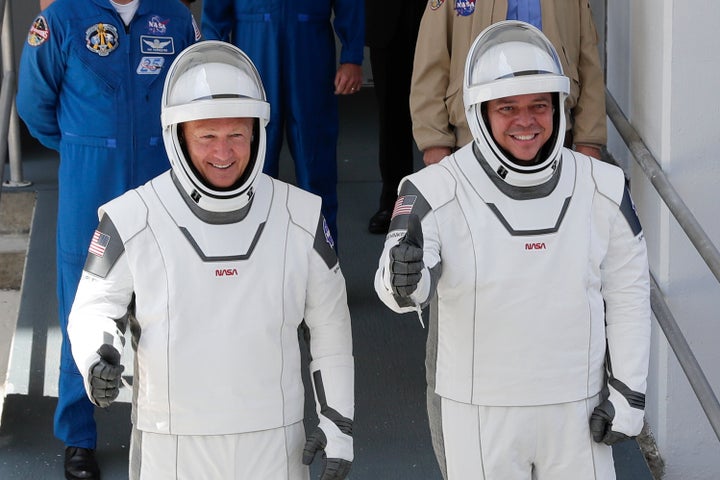
NASA astronauts Douglas Hurley, left, and Robert Behnken make their way to Pad 39-A, at the Kennedy Space Center in Cape Canaveral, Fla., on Saturday.
The blue sequined dinosaur accompanying them — their young sons’ toy, named Tremor — was also in good shape, Behnken assured viewers. Tremor was going to join Earthy, a plush globe delivered to the space station on last year’s test flight of a crew-less crew Dragon. Behnken said both toys would return to Earth with them at mission’s end.
An old-style capsule splashdown is planned.
After liftoff, Musk told reporters that the capsule’s return will be more dangerous in some ways than its launch. Even so, getting the two astronauts safely to orbit and then the space station had everyone breathing huge sighs of relief.
As always, Musk was looking ahead.
“This is hopefully the first step on a journey toward a civilization on Mars,†he said Saturday evening.
The Associated Press Health and Science Department receives support from the Howard Hughes Medical Institute’s Department of Science Education. The AP is solely responsible for all content.
Calling all HuffPost superfans!
Sign up for membership to become a founding member and help shape HuffPost’s next chapter
New videos: You can watch the SpaceX Dragon docking video replay below and tune into the live stream where the capsule will be opening its hatch to the ISS soon.
The hatch opening occurs at 12:45pm, roughly two hours after docking with the ISS (International Space Station). The SpaceX Dragon docking with the ISS was a success and happened autonomously, at first with a soft capture, then there were 12 latches around the docking ring that created a pressure-tight seal. An umbilical cord was then deployed to link the SpaceX Dragon and the ISS to share power and data – think of it has a giant USB-C cable in space.
It took a total of 19 hours for the SpaceX Dragon capsule to navigate to the ISS for docking on Sunday, following a successful SpaceX launch live stream. You can see a video replay of the liftoff below, along with four other can’t-miss highlight videos.
SpaceX docking live stream video
Here’s where you’re able to watch the NASA astronauts float around in space board the SpaceX Dragon capsule. The live stream commentary has been brilliant, insightful and inspiring regarding the future of commercial space travel.
SpaceX ISS docking video replay
You can see the ISS docking in this video below. It shows the SpaceX Dragon and ISS linking up in what’s called a ‘soft capture’. It happened autonomously, and then a set a 12 latches or hooks create a pressurized seal so that the two crafts orbit together.
Docking confirmed – Crew Dragon has arrived at the @space_station! pic.twitter.com/KiKBpZ8R2HMay 31, 2020
Best SpaceX video replays
All of the important SpaceX video replays are below.Â
Both SpaceX and NASA are providing a bunch of footage – both live video and video replays – to capture this space mission. Here are the best videos to check out.
1. SpaceX launch video replay – see the liftoff again
Liftoff happened at 3:22pm EDT Saturday, and it was spectacular, especially after a nine-year hiatus for NASA launches on US soil. You can rewatch the launch again.
Just beyond the T-0 countdown, we saw the SpaceX Falcon 9 booster return to Earth – and land successfully. Having a reusable rocket is a huge milestone for the future of space travel when it comes to cost.
Commentators on the SpaceX live stream compared the Space Shuttle era rockets falling into the ocean (and being scrapped) as throwing away an airplane engine every time a plane pulled into an airport gate. It’s a great analogy to explain why what SpaceX pulled off on Saturday was a huge deal for space exploration.
Falcon 9 booster has landed on the Of Course I Still Love You droneship! pic.twitter.com/96Nd3vsrT2May 30, 2020
3. Falcon 9 second stage separates from Dragon capsule
Here’s some great footage of the Falcon 9 second stage rocket separating from the Dragon Capsule and falling back to Earth.
Crew Dragon has separated from Falcon 9’s second stage and is on its way to the International Space Station with @Astro_Behnken and @AstroDoug! Autonomous docking at the @Space_Station will occur at ~10:30 a.m. EDT tomorrow, May 31 pic.twitter.com/bSZ6yZP2bDMay 30, 2020
4. NASA astronauts’ first video transmission
Right now, NASA astronauts are above Earth in the SpaceX-made Dragon capsule as you read this (they’ll be up there for 19 hours), and they’re wearing SpaceX-designed spacesuits. The US government’s Space Shuttle program ended nine years ago and the private SpaceX has picked up where NASA left off. It’s a giant step for space exploration.
5. Live views of the SpaceX Dragon orbiting the Earth
The SpaceX cameras were able to capture some amazing live views of Earth as the Dragon capsule orbited the planet on its way to dock with the ISS. Here’s a short clip of exactly that.Â
Tune in to hear @AstroBehnken and @Astro_Doug on Crew Dragon and for live views of Earth → https://t.co/bJFjLCzWdK pic.twitter.com/P5nxAyAJFnMay 31, 2020
The first hours of Saturday’s SpaceX livestream felt like deja vu if you watched the SpaceX live stream Wednesday. But unlike that first launch attempt, Saturday’s launch countdown didn’t stop at T-minus 17 minutes. Instead, history was made.
(Image credit: SpaceX)
It wasn’t always clear that Saturday’s launch would happen, even minutes before the launch window. “We are predicting a 50/50 shot of going this time,” said NASA administrator NASA administrator Jim Bridenstine at the top of the SpaceX live stream. “But given the fact that we are in late May – in Florida – we have to take every shot that we can get.” They’re glad that they did, despite the gloomy forecast.
Saturday’s SpaceX Demo-2 mission was a delayed and a second attempt, but it was always going to be historic, as it’s happening at NASA’s Kennedy Space Center in Cape Canaveral, Florida. It’s the first such launch on US soil in nearly a decade – since NASA retired the Space Shuttle nine years ago. It’s also the first time that a SpaceX reusable spacecraft has sent NASA astronauts into space. It’s the birth of commercially-backed human space travel.
It’s the birth of commercially-backed human space travel.
The destination of this SpaceX launch is the International Space Station (ISS) for a one- to four-month duration for NASA astronauts Doug Hurley and Bob Behnken, according to our friends over at Space.com.
(Image credit: SpaceX)
SpaceX launch – as it happened on Saturday, May 30
The official Demo-2 SpaceX launch time, Saturday, May 30 at 3:22pm EDT, so the times across the continental US were 2:22pm CDT / 1:22pm MDT / 12:22pm PDT.
The UK SpaceX launch time was 20:22 BST. In addition to tuning into the video live stream, you were able to go outside soon afterward and maybe catch a glimpse of the SpaceX-built spacecraft in the night sky at around 20:40 BST.
In Australia, it was already Sunday morning, with the new launch time occurring at 5:22am AEST.
(Image credit: SpaceX)
SpaceX launch weather concerns subsided
Up until the last few minutes of Saturday’s SpaceX launch, weather was a concern. It wouldn’t have been time, as we saw this play out on Wednesday: “The weather got us,” admitted NASA administrator Jim Bridenstine in a somber 30-second Twitter video on Wednesday. “I know there was a lot of disappointment today.”
Bridenstine went on to explain the reasoning behind what we all saw: the SpaceX launch was scrubbed just 17 minutes inside the launch window, with NASA hanging on until the last minutes in an effort to save its efforts. The weather didn’t cooperate.
NASA has strict weather rules for clearing spacecraft launches and noted that three weather violations existed, including the chance of the craft triggering ‘natural lightning’. If they would have been able to wait ten minutes beyond the countdown, they could have cleared those three violations, according to SpaceX and NASA officials.
Waiting even ten minutes wasn’t an option, though. Both Saturday’s successful launch and Wednesday’s scrubbed launch had what’s known as an ‘instantaneous launch window’, meaning due orbital mechanics a delay wasn’t possible if the crew wanted to get to the International Space Station (ISS) on time and lock in accurately. Blame Newtown’s law of universal gravity, if you’d like.
The good news is that everything technical with the SpaceX craft and NASA crew was ‘go for liftoff’ on both days when the hatch door successfully closed. Weather was the only concern, according to NASA during the live streams.
Even with all of the exceptional planning ahead of this SpaceX launch, NASA and SpaceX can’t control the weather (not yet anyway). Florida, while normally sunny, does have frequent quick-moving thunderstorms (anyone who has ever visited nearby Disney World knows that), and that’s what the crew faced Wednesday and most of Saturday until the final half-hour.
.@AstroBehnken and @Astro_Doug arrive at historic Launch Complex 39A → https://t.co/bJFjLCzWdK pic.twitter.com/EZATwbKWfAMay 30, 2020
Another weather variable is the fact that the weather conditions need to be good everywhere this spacecraft might be. For example, if the crew had to abort anywhere along their ascent and come down, recovery crews would need to access the capsule, so it’s more than just the immediate Florida launchpad that needs ideal weather.
What happened before the SpaceX launch
The live stream saw SpaceX founder Elon Musk visit suited-up astronauts Doug Hurley and Bob Behnken and exchange a few words before liftoff time. Sadly, there was no audio during this portion of the live stream on Wednesday.
Musk then greeted US Vice President Mike Pence, who is there to watch the launch, while President Donald Trump joined soon after. Hurley and Behnken traveled to the launch site in a Tesla Model X (Tesla being another company Musk founded). Both the President and Vice President returned to see the launch Saturday.Â
The moment @SpaceX founder @elonmusk gives NASA’s @AstroBehnken & @Astro_Doug the keys to the Dragon 2. #SpaceLaunchLIVE #SpaceXDragon pic.twitter.com/nHb1uCVR9uMay 27, 2020
NASA continued to monitor the weather via data sensors around the launch site in an effort to get everything into ‘the green position’ on their maps. At the time, NASA said, “the weather is trending in the right direction,” but as the countdown got to T-minus 17 minutes, favorability went the other direction.
This meant that the crew was seated in the capsule after crossing the crew access arm, and the crew arm had already retracted. Steam started to come off of the rocket before the launch was called off. It was that close to liftoff.
(Image credit: NASA)
SpaceX spacecraft, SpaceX suits and NASA astronauts
NASA astronauts Doug Hurley and Bob Behnken are inside the SpaceX Dragon capsule, which sat atop the SpaceX Falcon 9 rocket for liftoff. It was situated on a launch pad at legendary Launch Complex 39A at the Kennedy Space Center in Florida’s Cape Canaveral.Â
LC-39A was originally built for the Apollo missions and remodeled for the Space Shuttle program. Now it’s home to the first space flight to send astronauts into space using a private aerospace company.
Hurley (the spacecraft commander) and Behnken (the joint operations commander) are NASA astronauts, engineers and both former members of US military (Hurley is a former marine, while Behnken was in the US Air Force).
The two-man NASA crew are not only be flying in a SpaceX-built spacecraft, but also outfitted in SpaceX pressurized suits, first shown off in 2017.
According to NASA, SpaceX, along with Boeing, which is also developing rockets, will be able to launch crews to low-Earth orbit, allowing the government agency to focus on deep space missions – with an eye on Mars.
The Dragon capsule was designed to self-dock at the ISS, but the two veteran astronauts were able to assume control if necessary.
After docking, Behnken and Hurley will be stationed on the ISS for a undetermined amount of time, depending on “readiness of the next commercial crew launch,” NASA said.
The Dragon capsule is capable of staying in orbit for at least 210 days, NASA said, and will autonomously undock with the astronauts on board when the mission is complete.
US astronauts Doug Hurley and Bob Behnken have docked with the International Space Station (ISS), after a 19-hour journey.
The men will have to wait for leak and pressure checks to be completed before they can safely disembark and join the Russian and American crew already on the ISS.
LONDON — After violence erupted at demonstrations in U.S. cities over the death of George Floyd in Minnesota, several more peaceful protests have taken place in cities around the world.
Hundreds of people gathered in London’s Trafalgar Square on Sunday, following demonstrations in the German capital Berlin and Toronto, Canada.
“Say his name,” some shouted in London, while other held placards reading “I can’t breathe,” the last words uttered by Floyd, 46, before he died as former police officer Derek Chauvin kneeled on his neck on Monday.
Chauvin was charged with third-degree murder and manslaughter on Friday, but riots across the U.S. have continued over the weekend. The violent scenes have made the headlines in countries across the globe.
Demonstrators block a road near the U.S. Embassy in London in protest over the death of George Floyd on Sunday. Justin Tallis / AFP – Getty Images
In London, protesters defied laws banning large crowds gathering during the ongoing coronavirus pandemic and many protesters were not social distancing, although a large number were wearing protective facemasks.
The anger was palpable.
Let our news meet your inbox. The news and stories that matters, delivered weekday mornings.
At least three more solidarity protests have been planned in the British capital over the next week, one outside the U.S. embassy, while other locations in the city’s center are also being earmarked for demonstrations. .
Sunday’s protests in London followed demonstrations on Saturday in Berlin, where thousands of protesters gathered on Saturday outside the German capital’s U.S. embassy.
Some held up signs that read “Black Lives Matter,” “Justice for George Floyd” and “I Can’t Breathe.”
In Canada, thousands also turned out in Toronto’s Christie Pitts Park on Saturday, before they marched to police headquarters.
As well as protesting Floyd’s death, many vented their anger at the death of Regis Korchinski-Paquet, who died last week after falling from her 24th-floor balcony after police officers were called to her home.
Toronto Police are investigating the incident.
Elsewhere, popular critics of the U.S., China, Iran and Russia have vocalized some support for the protesters.
In China, state media have highlighted the “double-standards” of U.S. support for pro-democracy demonstrators in Hong Kong, while quelling unrest in the United States.
The Russian ministry of foreign affairs tweeted: “American police commit high-profile crimes all too often … U.S. authorities should meticulously investigate the murder of George Floyd.”
Iran’s foreign minister Javad Zarif also shared a satirical post on Twitter, crossing out accusations towards Iran in a U.S. press release with red ink and redirecting them back towards America.
The president of the African Union, Moussa Faki Mahamat, also said in a statement that he condemned “in the strongest terms the murder of George Floyd at the hands of law enforcement officers in the United States of America.”
Reuters contributed to this report.
Adela Suliman
Adela Suliman is a London-based writer and reporter for NBC News Digital.
Ziad Jaber
Ziad Jaber is a London-based producer for NBC News.
Molly Hunter
Molly Hunter is a London-based correspondent with NBC News.
Much to their frustration, the macho leaders of these countries are finding the virus immune to their playbooks. Intimidation, fear-mongering and propaganda just aren’t working. Being guided by science, communicating transparently and long-term planning are proving the sharper tools.
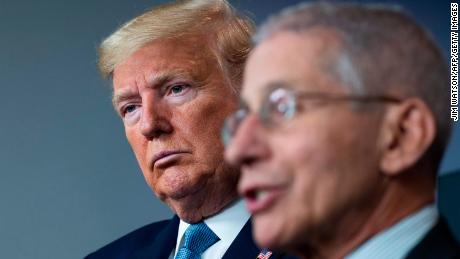
Trump, Bolsonaro and Putin all initially downplayed the risk of the coronavirus, experts say, even as they watched it overwhelm nations like Italy. Now, they are scrambling to appear in control, as the virus keeps transmitting and killing, exposing their weaknesses.
Keep calm and carry on
The denial of the coronavirus as a threat by the presidents in the US and Brazil inevitably led to foot-dragging in their governments. The consequences are serious — models are now emerging that show how swift action can save lives. A Columbia University model, for example, shows that if the US had imposed social distancing one week before authorities called for it, 36,000 lives could have been saved. The US’ death toll is now more than 100,000.
Like Bolsonaro, Trump continually dismissed the virus as similar to the flu, and repeatedly assured Americans that things were “under control” in the early months of the year. When it became clear they weren’t, Trump still signaled that everything would be OK.
“This was unexpected. … And it hit the world. And we’re prepared, and we’re doing a great job with it. And it will go away. Just stay calm. It will go away,” he said on March 10, as the number of US cases approached 1,000.
While the US imposed some travel restrictions early, beginning with banning flights to and from China from February 2, the US Centers for Disease Control and Prevention only issued its first social distancing guidance on March 15. Just six weeks later, the country surpassed 1 million infections.“Downplaying the virus was in defiance of all the evidence that we had from China, and then European nations, about what the effects could be. It unquestionably contributed to a weaker public health response. It has been left to local leaders to pick up the slack,” William Hanage, an epidemiologist from Harvard University, told CNN.
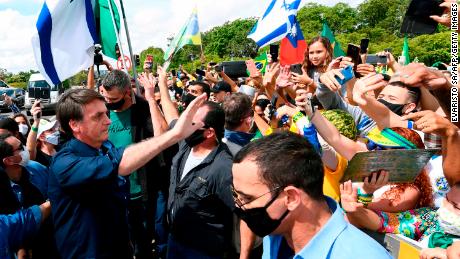
In Brazil, Bolsonaro not only implied that the virus would never be able to hurt him, he made similar claims about Brazilians in general.
“Brazilians should be studied, we don’t catch anything. You see people jumping in sewage, diving in it and nothing happens to them,” Bolsonaro said on March 26, as the number of cases in his country approached 3,000.
While Brazil took some early action, banning travelers from several affected countries and closing land borders, Bolsonaro has never supported closing businesses and schools and his government never issued any clear guidelines for states on how to implement social distancing.
In fact, the President has repeatedly undermined local leaders’ restrictions, even joining regular anti-lockdown rallies, often without a mask, shaking hands with people and hugging children.
“In terms of the response, he continues to deny the importance of the virus, he insists on still dismissing it — there has been no change in tone over time,” said Francisca Costa Reis, a doctoral researcher focusing on Brazil at the Leuven Centre for Global Governance Studies in Brussels.
“At least the President of the US now recognizes this is some sort of an issue or a problem. I don’t think Bolsonaro has really responded at all.”
And like Trump, Bolsonaro’s lax attitude toward the virus has caused rifts and chaos within his government. In April, he fired his health minister, Luiz Henrique Mandetta, one of Brazil’s biggest proponents of social distancing. A second health minister, Nelson Teich, recently quit, after criticizing Bolsonaro’s decree ordering beauty salons and gyms to reopen.
The President has since appointed a military general with no background in medicine or public health, Eduardo Pazuello, as an interim health minister to lead the response.
‘Everything is under control’
The story is a little different in Russia. The government there wasn’t particularly slow to act. It closed its border with China on January 30, the day before even reporting its first two infections, and announced its lockdown measures when it had was reporting less than 700 infections.
But there were mistakes. Russia missed a number of infections coming into the country from Italy and other parts of western Europe, and it has failed to stop its hospitals from becoming hotbeds for the virus. Poor messaging has also undone some of the gains from early interventions.
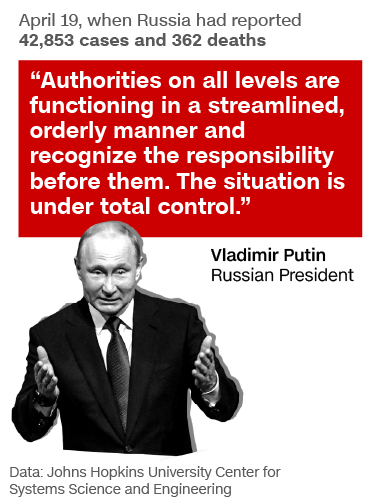
In the early stages of Russia’s outbreak, Putin told his people the situation was “under control,” and back then, it seemed it was. Russia enjoyed the whole month of February without reporting a single new infection, although questions have been raised over whether the country was dismissing some coronavirus cases as pneumonia. It wasn’t until March 2 that its two cases officially became three.
Putin’s language has been more measured than Trump’s and Bolsonaro’s. He regularly calls for caution, he describes the virus as a real threat, and he doesn’t deny the scientific facts of the virus. But he has stuck to his old tactics, which are beginning to backfire.
In late March, he visited a newly built hospital to respond to the virus, wearing a yellow hazmat suit, in a typically Putinesque PR stunt that was supposed to show an unruffled leader touring part of a well-operating health system.
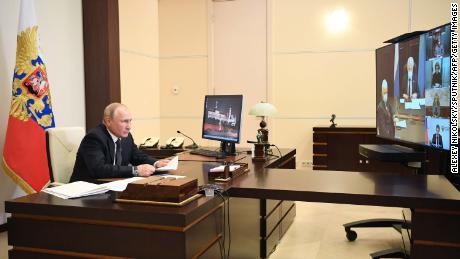
But the visit gave Russians little confidence. He was also photographed without his hazmat suit off, shaking hands with the hospital’s head doctor, who later tested positive for the virus. It only raised speculation that the President had been infected, and that he was self-isolating, as he gave weekly addresses via videoconference from his home.
It’s a suggestion the Kremlin has vehemently denied, with one spokesperson having to reportedly tell journalists that no, Putin was not hiding “in some bunker.” Either way, the whole affair ran counter to the strongman image Putin likes to project.
Putin’s visit also sat at odds with reports that soon followed of the dire situation in Russia’s hospitals. Many are overcrowded, and their staff are overworked and lack protective equipment. A viral video of nurses hooked up to drips in a hospital storage room in the city of Derbent in early May was a sign of just how bad things had become.
A patchwork problem
Many of Putin’s problems are of his own making. Russia was expected to vote in a referendum that could have cemented Putin’s power until 2036, and some of his decisions appear to be aimed at securing victory in that poll, observers say.
The vote has been postponed by the virus, a change that has taken some of the wind out of Putin’s sails.
But the vote is still on the horizon, and the President appears to be trying to distance himself from the crisis in the meantime, delegating the enforcement and easing of lockdowns to local leaders.
There are good arguments for devolving powers to the regions, but amid the successes have been failures. Putin announced extra money for frontline medical staff, for example, but it simply hasn’t reached everyone who were supposed to receive it.
He has tried to put a positive spin on his addresses to the nation, in late March announcing a week of “paid holiday,” choosing not to use words like “restrictions” or “lockdown.” But that too has backfired.
Russians in Moscow were seen soon after having barbecues in parks, there was a rush to book holidays and many people headed out of the cities to their summer homes — all activities that only helped the virus spread further across the country.
This paid holiday —which in practice was a “lockdown”— was extended several times. Putin called for an end to it on May 12, and Moscow plans to ease restrictions further on Monday. But the timing seems a bit back to front. When restrictions were imposed, case numbers were rising by around 1,000 infections a day. They are now rising by about 10,000 daily and Russians are being told to get back to work.
“By delegating the crisis response to lower levels, and not being clear in his own messaging, Putin did leave people to devise their own solutions in ways they felt responded to what Putin probably wanted. That kind of experimentation can be good, but is also meant there were a lot of mistakes made,” said Sam Greene, director of the Russia Institute at King’s College London.
“In some areas, there is endemic corruption and dysfunction. You could have known they were going to drop the ball. Investment wasn’t going to get where it needed to get.”
The same kind of patchwork response is playing out in the US and Brazil, and while it makes sense for different states to deal with their outbreaks differently, governors have at times pleaded for help with resources, like tests and protective equipment, in a situation that begs for some centralized leadership.
German Chancellor Angela Merkel, for example, has shown that even where states or regions hold power, strong federal leadership can bring about a well-coordinated response. Her decisions have been made largely with the input of state leaders, and as a result, many measures, such as mandatory mask wearing, have been enforced by all states, and clear guidelines on lifting lockdowns are being widely adhered to.
The invincible ‘strongman’
While Germany’s response to the virus has been heavily based on science, Trump and Bolsonaro continue to deny it.
Just as Bolsonaro continues to show up at rallies, or as Putin shook hands with the head doctor at a hospital treating coronavirus patients, Trump has repeatedly refused to wear a mask in public. For many weeks at the start of the outbreak, he too said he would continue to shake hands, against expert health advice.
Both Trump and Bolsonaro have touted the drug hydroxychloroquine, despite no significant scientific evidence it is effective in preventing or treating the virus. Some trials have shown the drug to be harmful in people with heart disease. Trump even announced in earlier this month that he was taking it, though he has since stopped, saying he had finished a two-week course.
In Brazil, that attitude could have graver consequences. Bolsonaro has had his health ministry include hydroxychloroquine in its guidelines for hospitals to use as a treatment in mild coronavirus cases.
This shirking of scientific advice speaks to a misguided sense of invincibility often seen in autocratic leaders, according to the University of Amsterdam’s Alessandro Nai, who has co-authored a study on the personality traits of strongmen.
“Strongmen tend to couple high confidence in themselves with impulsivity, with a disregard for the consequences of their actions. This seems to set up a persona of the ‘invincible and fearless leader’ that can solve issues by sheer willpower,” he said.
All data on cases and deaths are from Johns Hopkins University.
CNN’s Mary Ilyushina and Nathan Hodge reported from Moscow, Taylor Barnes reported from Atlanta and Maegan Vazquez reported from Washington, D.C. Visuals by CNN’s Gabrielle Smith.
SpaceX’s first Crew Dragon spaceship to carry astronauts slid into a dock at the International Space Station Sunday (May 31), concluding a historic 19-hour voyage to for its veteran NASA crew.
The arrival marked a major feat: the first docking of a crewed U.S. spacecraft at the station since NASA’s shuttle fleet retired in 2011. It’s also the first docking of a commercial spacecraft carrying humans, in this case astronauts Bob Behnken and Doug Hurley.
“It’s been a real honor to be just a small part of this nine-year year endeavor since the last time United States spaceship has docked with the International Space Station,” said Hurley, commander of the Dragon capsule, as he thanked the SpaceX and NASA teams.Â
Image 1 of 10SpaceX’s first Crew Dragon to carry astronauts is seen docked at the International Space Station on May 31, 2020 after a historic rendezvous in orbit. Click the arrows to see more images from docking. (Image credit: NASA TV)
Image 2 of 10
A (Image credit: NASA TV)
Image 3 of 10
(Image credit: NASA TV)
Image 4 of 10
(Image credit: NASA TV)
Image 5 of 10
(Image credit: NASA TV)
Image 6 of 10
(Image credit: NASA TV)
Image 7 of 10
(Image credit: NASA TV)
Image 8 of 10
(Image credit: NASA TV)
Image 9 of 10
(Image credit: NASA TV)
Image 10 of 10
(Image credit: NASA TV)
SpaceX launched Behnken and Hurley into space Saturday on a test flight, dubbed Demo-2, that lifted off from NASA’s Kennedy Space Center in Florida. Their Crew Dragon docked itself at the station 10:16 a.m. EDT (14216 GMT) as both spacecraft sailed 262 miles (422 kilometers) above the border of China and Mongolia.Â
“Dragon, arriving,” NASA astronaut Chris Cassidy said from inside the station as he range a traditional ship’s bell. “Bob and Doug, we’re glad to have you as part of the crew.”
While today’s docking was completely automated, Hurley did take manual control of the Crew Dragon spacecraft (which he and Behnken have christened Endeavour) during a final test. The ship handled just like the simulator, he said.Â
“It flew really well. Very crisp,” Hurley said.
Behnken and Hurley themselves haven’t quite made it into the space station, however; arriving is a long process. After Crew Dragon docking, the astronauts are scheduled to remain in the capsule for more than two hours as they conduct leak checks.Â
But the festivities will then begin as the pair join NASA colleague Chris Cassidy and Russian cosmonauts Anatoly Ivanishin and Ivan Vagner, who have been in orbit since April. The established residents will hold a welcoming ceremony for their new roommates this afternoon, NASA officials said.
Behnken’s and Hurley’s arrival brings the inhabitants of the U.S. side of the space station up to three astronauts, and the trio will hold a news conference tomorrow (June 1) at 11:15 a.m. EDT (1515 GMT).
The two new arrivals will spend up to four months living and working on the orbiting laboratory. NASA is seeking to maximize their time in orbit, since astronaut time is a precious commodity, while balancing the fact that Demo-2 is a test mission. SpaceX’s first full-fledged astronaut mission to the space station, Crew-1, can’t blast off until after Demo-2 smoothly returns to Earth.
Right now, the agency is targeting Aug. 30 for that launch, NASA Administrator Jim Bridenstine said during a news conference on May 26.
LG isn’t as much of a powerhouse in the Android phone market as they used to be. They’re still one of the top players, but their strategies and offerings have not propelled them into the lead. They obviously believe it’s time for a change, hence, we get to say goodbye to the G Series devices. That’s a long line of devices that shook the market in the early days, and maintained some of the best mobile audio offerings in the latter years.Â
LG maintained a lead in mobile audio by not only keeping the headphone jack on most devices, but also including their Quad DAC on many phones. Over-simplifying things, the Quad DAC enables LG devices to drive some serious headphones, the kinds of cans that other phones require an external amp to manage, making the LG G and V series phones ideal for wired headphone fans.
If you’ve jumped on the Bluetooth headphone bandwagon, LG’s Quad DAC technology is not an advantage for you. LG does well with Bluetooth audio, but with the increasing popularity of wireless audio, users are not intrigued by the G and V series selling point of superb wired audio. We hope LG continues to support quality wired audio, but for now we must say goodbye to the G series, and say hello to the new Velvet.
Speaking of things being discontinued at LG, we suspect one of their media divisions has lost their right to post on social media, if not their jobs. This after an embarrassing promotion using the LG V60 for upskirt photography. Stuff like this was never really appropriate, but companies can expect swift backlash from the global community for trying it again, and that’s probably a good thing.
That’s it, folks! We’ll have another giveaway and more top Android stories for you next week. To stay up to date on all things Android Authority in the meantime, be sure to subscribe to our newsletters at the link below.
We use cookies on our website to give you the most relevant experience by remembering your preferences and repeat visits. By clicking “Accept”, you consent to the use of ALL the cookies.
This website uses cookies to improve your experience while you navigate through the website. Out of these, the cookies that are categorized as necessary are stored on your browser as they are essential for the working of basic functionalities of the website. We also use third-party cookies that help us analyze and understand how you use this website. These cookies will be stored in your browser only with your consent. You also have the option to opt-out of these cookies. But opting out of some of these cookies may affect your browsing experience.
Necessary cookies are absolutely essential for the website to function properly. These cookies ensure basic functionalities and security features of the website, anonymously.
Cookie
Duration
Description
cookielawinfo-checbox-analytics
11 months
This cookie is set by GDPR Cookie Consent plugin. The cookie is used to store the user consent for the cookies in the category "Analytics".
cookielawinfo-checbox-functional
11 months
The cookie is set by GDPR cookie consent to record the user consent for the cookies in the category "Functional".
cookielawinfo-checbox-others
11 months
This cookie is set by GDPR Cookie Consent plugin. The cookie is used to store the user consent for the cookies in the category "Other.
cookielawinfo-checkbox-necessary
11 months
This cookie is set by GDPR Cookie Consent plugin. The cookies is used to store the user consent for the cookies in the category "Necessary".
cookielawinfo-checkbox-performance
11 months
This cookie is set by GDPR Cookie Consent plugin. The cookie is used to store the user consent for the cookies in the category "Performance".
viewed_cookie_policy
11 months
The cookie is set by the GDPR Cookie Consent plugin and is used to store whether or not user has consented to the use of cookies. It does not store any personal data.
Functional cookies help to perform certain functionalities like sharing the content of the website on social media platforms, collect feedbacks, and other third-party features.
Performance cookies are used to understand and analyze the key performance indexes of the website which helps in delivering a better user experience for the visitors.
Analytical cookies are used to understand how visitors interact with the website. These cookies help provide information on metrics the number of visitors, bounce rate, traffic source, etc.
Advertisement cookies are used to provide visitors with relevant ads and marketing campaigns. These cookies track visitors across websites and collect information to provide customized ads.