Wednesday, May 20, 2026

Europe Braces For Second Wave of Coronavirus Infections

0

After months under strict lockdowns, Europeans have finally begun to enjoy a sense of newfound freedom in recent days — drinking at cafes, visiting museums and spending time outdoors with friends and family.

The slow resumption of daily life represents a milestone in the fight against the coronavirus pandemic. But it also raises concerns about a second wave of infections, scientists warn. 

“The fear of a second wave is there, the risk of it coming is high,” epidemiologist Pier Luigi Lopalco told HuffPost Italy.

If infection rates start to tick upward again, recent images of people gathering together at bars and in parks could seem less like a sign of life returning to normal, and more like a harbinger of another deadly catastrophe.

The question of a second wave is “when and how big,” Andrea Ammon, director of the European Center for Disease Prevention and Control, told The Guardian.

“I don’t want to draw a doomsday picture, but I think we have to be realistic. That it’s not the time now to completely relax.”


Young women share an aperitif drink by the Colosseum in Rome on May 21, 2020, after the country eases its two-month lockdown.

The push to relax lockdown restrictions has been driven by a need to balance economic considerations with the risk to public health.

With businesses shuttered and millions of people unable to work, the European Union is facing the “deepest economic recession in its history,” a top official announced this month, meaning any decision to reimpose lockdowns could be contested by employers and difficult to enforce.

Already, however, the easing of restrictions in various parts of the world has led to some worrying developments.

In South Korea, a spike in coronavirus cases connected with a handful of nightclubs in Seoul has prompted health officials to test tens of thousands of people, in order to identify and isolate infected individuals. 

China reported a cluster of new cases in Wuhan this month as well, the first since the city’s lockdown was lifted on April 8.

Fears of a second wave have increased in Germany, too, where the coronavirus infection rate has risen slightly.
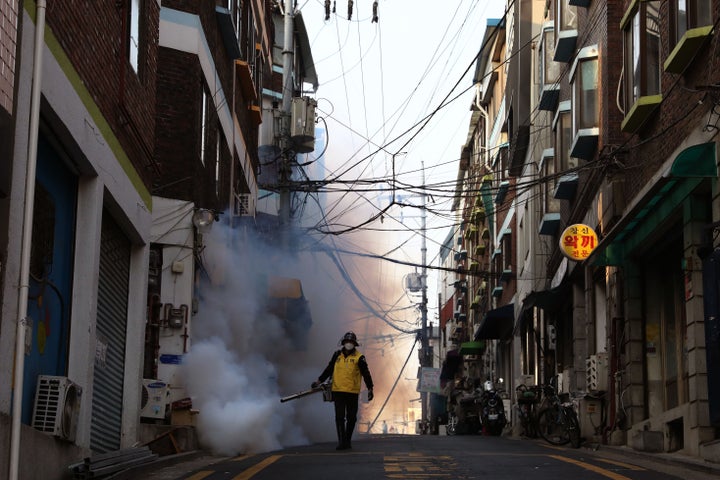
A South Korean man in Seoul disinfects an alley to prevent the spread of coronavirus, March 18, 2020.


A South Korean man in Seoul disinfects an alley to prevent the spread of coronavirus, March 18, 2020.

Brief increases in the number of coronavirus cases, however, aren’t necessarily cause for concern.

“Individual days are not a problem,” Lars Schaade, vice president of Germany’s Robert Koch Institute, said this month, noting that a real danger signal would be a sustained increase in the infection rate over a number of days.

German Chancellor Angela Merkel this month announced a new “emergency mechanism” that would allow the government to reimpose local lockdown restrictions if the number of infections exceeded a certain threshold.

“We have to be careful that this thing doesn’t slip from our grasp,” Merkel said.   

But the new outbreaks in Europe and Asia highlight how quickly the virus can reemerge after being beaten back. And they reinforce the need for people to remain vigilant and closely follow safety measures, such as hand-washing and social distancing.

“At this stage, more than ever before, even when we are outside, social distancing and the use of masks remains fundamental,” Italy Prime Minister Giuseppe Conte said this week, as the country began reopening bars, cafes, restaurants and shops. “Now is not the time for parties, nightlife and getting together in crowds.”

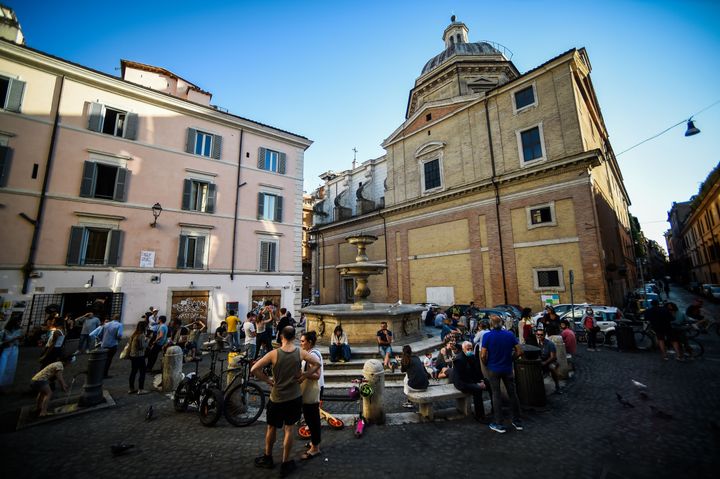
People drink in a square in Rome on May 21, 2020, despite government warnings that people should continue to respect social d


People drink in a square in Rome on May 21, 2020, despite government warnings that people should continue to respect social distancing rules.

As HuffPost Italy reports, however, photos and videos shared on social media this week have showed crowds of people ― particularly those in their 20s and 30s ― partying in streets and town squares across the country, often without masks, cocktails in hand.

“This is absolutely not good. It is clear that if this continues, we will be forced to stop those activities,” Attilio Fontana, the governor of Italy’s Lombardy region, said this week.

Local Italian officials are stepping up enforcement efforts. People who flout the current guidelines could be fined up to 3,000 euros ($3,270), HuffPost Italy reports.

“Those who make mistakes will pay,” Sergio Giordani, the mayor of Padua, in northern Italy, said this week. 

Padua is promoting a campaign to emphasize that “we only save ourselves together,” Giordani said. 

“What is needed is above all a sense of responsibility,” Antonio Decaro, the mayor of the southern Italian city of Bari, told HuffPost Italy.

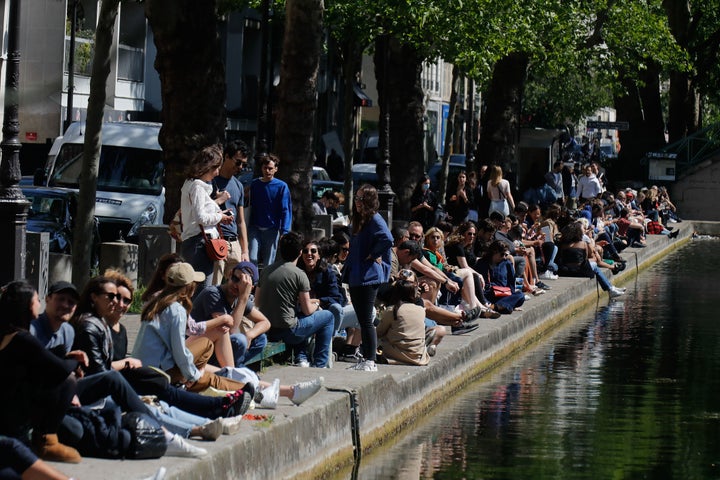
In France, police have dispersed crowds of Parisians who gathered in the city’s parks, and on the banks of the Canal Saint-Martin and the river Seine to celebrate last week’s easing of the country’s lockdown.

In the United States, President Donald Trump and other government officials have been eager for states to reopen, which could help revive the economy and save millions of jobs.

But researchers also worry that lifting lockdown restrictions could cause between 15,000 and 73,000 additional U.S. deaths by the end of July, according to a forecast from the University of Pennsylvania’s Penn Wharton Budget Model. If people fail to adhere to social distancing measures, the death toll could be even higher — rising by as many as 135,000 people by the end of July, the researchers found.

“Everyone wants us to talk about policy, but in fact personal behavior still matters a lot here,” Kent Smetters, the faculty director at the Penn Wharton Budget Model, told The New York Times.

The possibility of a second wave is “our greatest fear,” virologist Fabrizio Pregliasco, a researcher at the State University of Milan, told HuffPost Italy. “Everything will depend on our behavior. In this phase, individual responsibility remains fundamental.”

This has been the message in the United Kingdom as well, where Prime Minister Boris Johnson has called on the public to use “good, solid, British common sense” in obeying social distancing rules as lockdown restrictions are gradually relaxed.

Yet staving off a second wave of infections will require government action, in addition to a commitment from the public to avoid crowds and continue washing hands.

A robust system of tracking and tracing infected individuals, similar to the one currently in place in South Korea, is seen as crucial to preventing a deadly second wave of the outbreak — and thus getting the economy working again after the lockdown.

Britain’s testing capacity has been slow to ramp up, however, and a new smartphone contact tracing app developed by the National Health Service won’t be ready for some time. 

The NHS Confederation, a group that represents the U.K. health service’s organizations, said the country is at risk of a second jump in cases without clarity on government strategy.

“The relaxation of restrictions based on scientific advice is the right approach, but it must be accompanied by an effective test, track and trace strategy which enables us to monitor local spread of the disease,” the confederation said this week.

“To achieve this we must have national, local and cross-agency involvement. Without this, we do face the risk of a second wave of infections.”

In the United States, Anthony Fauci, director of the National Institute of Allergies and Infectious Diseases, similarly warned in Senate testimony last week that reopening too quickly could lead to a second wave.

If states “prematurely open up without having the capability of being able to respond effectively and efficiently, my concern is that we will start to see little spikes that might turn into outbreaks,” Fauci said. “The consequences could be really serious.”

People sit on a bank of the Canal Saint-Martin in Paris, on May 16, 2020, on the first weekend after France eased lockdown me


People sit on a bank of the Canal Saint-Martin in Paris, on May 16, 2020, on the first weekend after France eased lockdown measures.

Last week, the World Health Organization stressed that the coronavirus “may never go away.” 

The coming months and years, therefore, will likely see outbreaks cropping up from time to time across the world, as has happened this month in South Korea, China and Germany.

Going forward, the hope is that countries will have established policies and built up the infrastructure that will allow them to identify and contain these outbreaks quickly, without resorting to nationwide lockdowns.

After all, even with strong compliance from the public with regard to social distancing and other safety measures, periodic outbreaks are inevitable.

“Living with the virus,” Pier Luigi Lopalco told HuffPost Italy, “means accepting that some people will get infected.”

With reporting from HuffPost Italy, HuffPost France, HuffPost U.K., and Reuters.

A HuffPost Guide To Coronavirus


Source link

France sets date for second round of local elections

0

French Prime Minister Edouard Philippe announced the second round of French local elections for June 28 | Benoit Tessier/AFP via Getty Images

‘After weighing the pros and cons, we think that democratic life too should resume,’ says PM.

PARIS — France will hold the second round of local elections on June 28, coronavirus permitting, Prime Minister Edouard Philippe said Friday.

While there is “no consensus” among political parties on holding the vote at the end of June, Philippe said the government’s “careful, progressive and reversible” lockdown exit plan would allow it to be held in a safe way, just as economic and social life are slowly getting back to normal.

“After weighing the pros and cons, we think that democratic life too should resume,” Philippe said at a press conference.

However, he pointed out that the decision to hold the election is “reversible” depending on whether there is a resurgence of the epidemic.

Beyond health considerations, holding the election in June instead of postponing it until later in the year would allow President Emmanuel Macron to turn the page on an election in which his La République en Marche movement performed poorly in the first round, as he looks to reset his mandate post-coronavirus.

Philippe, who is in a run-off to be mayor of Havre in the north of the country, also benefits from holding the second round sooner rather than later. His approval ratings are currently among the highest they’ve been since the beginning of his tenure. If he wins the mayoral race, it would also give him a dignified landing place if the rumors about Macron wanting to sack him turn out to be true.

The vote was originally meant to be held on March 22, but had to be postponed because of the epidemic. Macron controversially insisted the first round of the election take place on March 15, even though he imposed a nationwide lockdown a day later.

Worries about voter turnout and the election’s credibility persist. Voter turnout during the first round was historically low at 45.5 percent, compared with 63.5 percent in the 2014 local elections.

On Tuesday, Macron spoke with two dozen, mostly opposition, mayors of some of the biggest cities in France and they were almost all in favor of holding the vote on June 28.

Postponing the election beyond the summer would legally require canceling the results of the first round and starting over. The majority of mayors across the country were elected in the first round but most mayors of big cities, including Paris, are in a second round run-off.

Nevertheless, Richard Ferrand, the speaker of the lower house of parliament and an LREM heavyweight close to Macron, voiced his opposition to holding the vote at the end of June, arguing that health conditions were suboptimal for proper campaigning.

“Democracy isn’t just voting. It’s campaigns that allow debates and [they] can’t be held, because gathering of more than 10 people are not allowed, and one can’t go door-to-door with a mask on,” Ferrand said, referring to current health guidelines.

Speaking alongside Philippe, Interior Minister Christophe Castaner pointed out that while campaigning will have to be adapted to respect health guidelines, candidates would have a month to campaign, which is considerably longer than the usual five days between the two rounds.

The scientific council advising the government through the epidemic said in a written opinion on Monday that for the second round to be held, strict health guidelines needed to be enforced, including social distancing while queueing to vote, making masks and face shields compulsory for polling station staff and recommending voters wear masks.

Reintroducing postal ballots and allowing multiple proxy votes are some of the measures being considered by the government to ensure that vulnerable voters can still take part.


Source by [author_name]

‘At least 2 may have survived Pakistan International Airlines crash’

At least two people are believed to have survived a Pakistan Airlines flight that crashed in the city of Karachi.

The city’s mayor, Wasim Akhtar, had earlier said all 107 passengers and crew of Flight PK803 were thought to have died.

But Pakistani civil aviation authorities believe there have been survivors.

Fire brigade staff try to put out fire caused by plane crash in Karachi, Pakistan. (AP)
An ambulance arrives near the scene of a passenger plane crash of state-run Pakistan International Airlines in Karachi, Pakistan. EPA/REHAN KHAN (EPA/AAP)

The Airbus A320 aircraft crashed into a crowded neighbourhood on the edge of the airport, destroying at least five or six houses, Akhtar said.

“At the moment we have the view that there will be no survivors from the plane itself but it is not confirmed,” Akhtar previously said by phone from the crash scene.

A transmission of the pilot’s final exchange with air traffic control, posted on the website LiveATC.net, indicated he had failed to land and was circling around to make another attempt.

“We are proceeding direct, sir — we have lost engine,” a pilot said.

“Confirm your attempt on belly,” the air traffic controller said, offering a runway.

“Sir – mayday, mayday, mayday, mayday Pakistan 8303,” the pilot said before the transmission ended.

Hospital staff prepare to receive the victims of the passenger plane crash of state run Pakistan International Airlines in Karachi, Pakistan, 22 May 2020. EPA/SHAHZAIB AKBER (EPA/AAP)

Flight PK803, which was carrying 99 passengers and eight crew members, took off from Lahore and was due to land at 2.30pm local time (7.30pm AEST) in Karachi but went missing from the radar, Pakistan Airlines spokesman Abdullah Khan told CNN.

“The last we heard from the pilot was that he has some technical problem,” Khan said in a video statement.

“He had been told both landing strips were available for his use but he preferred to use the go around landing route, we are looking into the technical issue.

“Our prayers for the lives that have been lost.

“It is a very tragic incident.”

The flight typically takes an hour and a half to travel from the northeastern city of Lahore, the capital of Pakistan’s most populous Punjab province, to the southern port city of Karachi, the largest city in Pakistan and the seventh largest in the world.

Airworthiness documents showed the plane last received a government check on November 1, 2019.

PIA’s chief engineer signed a separate certificate April 28 saying all maintenance had been conducted on the plane and that “the aircraft is fully airworthy and meets all the safety” standards.

Significant destruction to suburban streets in Karachi can be seen in the aftermath of the Pakistan International Airlines crash. (AP)
Dozens of local residents rushed to the crash site, in a small street in Karachi. (AP)
The wreckages of cars and buildings in the street have been left behind in the wake of the accident. (AP)

The Pakistani army said its quick reaction force and paramilitary troops had reached the site for relief and rescue efforts alongside civil administration.

A resident of the area, Abdul Rahman, said he saw the aircraft circle at least three times, appearing to try to land at the airport before it crashed into several houses.

The residential area on the edge of the airport known as Model Colony is a poor area and heavily congested.

Local television reports showed smoke coming from the direction of the airport. Ambulances were on their way to the airport.

What is Pakistan International Airlines’ safety record?

Since its establishment in 1946, Pakistan International Airlines has lost more than 30 aircraft as a result of flight crashes or other events, and another 20 incidents have been fatal in the past.

There have been four other accidents involving PIA planes over the last decade, with the most recent incident involving Flight 661 in December 2016 where a crashed in the city of Havelian killed 47 people on board.

Ten years before that, Flight 688 from Multan to Lahore crashed into a field and burst into flames minutes after takeoff, killing all 41 passengers and four crew members on the plane.

With the Associated Press & CNN.

Source by [author_name]

I Love My White Boyfriend But There’s One Thing He Can Never Understand

“Girl, I just need to say this out loud…”

I’m part of a group that meets every week. Four of us in the group are black women in relationships with white men. After the details of the March killing by police in Louisville, Kentucky, of Breonna Taylor in her home in a botched raid were brought to light last week, we held kind of emergency meeting. We needed to talk out our grief, anger and despair. And we need to ask some questions that we wouldn’t feel entirely safe posing in any other space. 

When black people are killed in incidents like this, how can we be angry or afraid of white people when the men that we love are white people? How can we properly mourn the loss of a black person who has lost their life or their freedom while sitting next to someone who can never know that deep-seated grief or that fear? How can we share these feelings with our men without alienating them or without them feeling like they need to fix or change anything for us?

Scott and I were bonded from the first hour that we met. Twelve years ago. While checking in to an Arizona rehab.

I was a wreck, unable to stop drinking and taking pills. I was also in the middle of a divorce and trying desperately to get well for the sake of my two young sons. He didn’t try to fix me. Rather, as a newly sober, divorced father of two young girls, his very presence simply validated what I was feeling.

Throughout each of our 28 excruciatingly long days there I leaned on him and he let me. A month or two after we’d each gone back to our respective homes (I live in Los Angeles, and at the time he lived in Park City, Utah), he started drinking again. This time he leaned on me until he was finally able to get sober a few months later.  

So many other things we’ve shared have solidified our bond ― sacred things. Like me standing sorrowfully at his side while watching both of his parents pass away a few years apart. And him, coming over during those first incredibly painful years after my divorce, making me laugh through my tears and holding me in his arms when I couldn’t stop crying.  

If our friends and families thought it strange to see a white, blond-haired, blue-eyed outdoorsman so indelibly connected with a black, natural-hair-wearing, former entertainment publicist, they kept it to themselves. Eventually, everyone seemed to accept without question what had become evident to Scott and me from the very beginning; despite outward appearances, we just fit together.

The way his eyes crinkle when he laughs is a salve for my soul. He is the kindest man I’ve ever met (sorry Daddy, but it’s true), and I rely on him wholly and utterly.

I don’t exactly remember the first time I sensed that societal divide in our relationship. Was it in 2012 when Jordan Davis was murdered in Jacksonville, Florida, by a white man for playing his music too loudly? Or it might have been in 2014 when Michael Brown was slain by a policeman in Ferguson, Missouri ― a killing that sparked widespread riots in the area.

With each passing incident, certain facts of our shared life begin to feel more important. The rooms of recovery where he and I have sought refuge for the past 12 years are primarily white spaces. Our shared friendships are mostly with white people. Our conversations and the codes that we use to communicate with each other are those commonly found in white American culture.  

The longer we are together and the more acts of violence that take place against black people, the more I’m surprised by how I want/need to share those experiences with someone who, like me, understands these injustices at a cellular level. I want that someone to be the man that I’ve chosen to spend the rest of my life with. And even though I know it’s not possible, I want that someone to be Scott.

I need to be clear here, this is not about how Scott reacts to these incidents. When black people are murdered and terrorized, Scott is outraged, defeated, and afraid. It’s not that we see these injustices differently. I have never needed to convince Scott that black lives matter or why such a movement is necessary in our country. When Ahmaud Arbery was killed in February in Georgia ― a shooting that only belatedly resulted in the arrest of two white men earlier this month, and than a thrid Thursday ― it was Scott, not me, who went for a run on Arbery’s birthday, posting the miles he ran on social media in solidarity. The more Scott listens patiently and tries to learn and understand how he can be an ally, my heart wants to burst open with pride and relief. He cares, he really does.  

But whether or not he cares doesn’t negate the fact that these acts of violence aren’t happening to him. When we see alcoholics being stigmatized, or divorced parents being villainized, we say, “Look at what’s happening to us!” But when it comes to matters of race, all at once, we can’t be a “we.”  

Whether I’m at home sleeping, walking, driving, shopping or working, being black in this country means risking my life daily. And while being white in America isn’t without risk, I have yet to see people here hunting down and murdering white people in cold blood because of their race. And even if it did happen, it is still different, because the system we live in is designed by and for white people. 

And to be honest, at times I’ve resented that Scott will never have to worry about the safety of his blond-haired daughters the same way I have to worry about the safety of my sons. And then, of course, I feel instantly guilty because it’s not Scott’s fault that we live in a country where two different realities exist for our families like ours. If I’m not careful, I know that these feelings could create a divide in our relationship that I won’t know how to bridge.

I’m grateful for my little affinity group, as I need to process these things as they come up. Otherwise, the fact that Scott and I don’t share a racial identity has the power to put us on separate sides of our sofa every time a tragic story about a black person is in the news.  

There are times when I’ve felt bad for white folks who have been chastised by black people for saying the “wrong thing” while trying to be supportive when racism rears its ugly head. Scott and I have never had the kind of relationship where we edit what we’re feeling.

Still, of late I can feel myself shutting down when I’m angry about the black shooting du jour. I need to be able to scream, sigh or cry when people who look like me get murdered. And whether Scott says the “wrong” thing or just puts his arms around me, I’d really like, as my friend Beverly says, to receive his efforts to connect. I want to keep leaning on him, just like I’ve done from the beginning.

Do you have a compelling personal story you’d like to see published on HuffPost? Find out what we’re looking for here and send us a pitch!


Source by [author_name]

Over 4,300 Coronavirus Patients Sent To New York Nursing Homes: AP

NEW YORK (AP) — More than 4,300 recovering coronavirus patients were sent to New York’s already vulnerable nursing homes under a controversial state directive that was ultimately scrapped amid criticisms it was accelerating the nation’s deadliest outbreaks, according to a count by The Associated Press.

AP compiled its own tally to find out how many COVID-19 patients were discharged from hospitals to nursing homes under the March 25 directive after New York’s Health Department declined to release its internal survey conducted two weeks ago. It says it is still verifying data that was incomplete.

Whatever the full number, nursing home administrators, residents’ advocates and relatives say it has added up to a big and indefensible problem for facilities that even Gov. Andrew Cuomo — the main proponent of the policy — called “the optimum feeding ground for this virus.”

“It was the single dumbest decision anyone could make if they wanted to kill people,” Daniel Arbeeny said of the directive, which prompted him to pull his 88-year-old father out of a Brooklyn nursing home where more than 50 people have died. His father later died of COVID-19 at home.

“This isn’t rocket science,” Arbeeny said. “We knew the most vulnerable ― the elderly and compromised ― are in nursing homes and rehab centers.”

Told of the AP’s tally, the Health Department said late Thursday it “can’t comment on data we haven’t had a chance to review, particularly while we’re still validating our own comprehensive survey of nursing homes admission and re-admission data in the middle of responding to this global pandemic.”

Cuomo, a Democrat, on May 10 reversed the directive, which had been intended to help free up hospital beds for the sickest patients as cases surged. But he continued to defend it this week, saying he didn’t believe it contributed to the more than 5,800 nursing and adult care facility deaths in New York — more than in any other state — and that homes should have spoken up if it was a problem.

“Any nursing home could just say, ‘I can’t handle a COVID person in my facility,’” he said, although the March 25 order didn’t specify how homes could refuse, saying that ”no resident shall be denied re-admission or admission to the (nursing home) solely based” on confirmed or suspected COVID-19.

Over a month later, on April 29, the Health Department clarified that homes should not take any new residents if they were unable to meet their needs, including a checklist of standards for coronavirus care and prevention.

In the meantime, some nursing homes felt obligated and overwhelmed.

Gurwin Jewish, a 460-bed home on Long Island, seemed well-prepared for the coronavirus in early March, with movable walls to seal off hallways for the infected. But after the state order, a trickle of recovering COVID-19 patients from local hospitals turned into a flood of 58 people.

More walls were put up, but other residents nonetheless began falling sick and dying. In the end, 47 Gurwin residents died of confirmed or suspected COVID-19.

The state order “put staff and residents at great risk,” CEO Stuart Almer said. “We can’t draw a straight line from bringing in someone positive to someone catching the disease, but we’re talking about elderly, fragile and vulnerable residents.”

The Society for Post-Acute and Long-Term Care Medicine, known as AMDA, had warned from the beginning that Cuomo’s order admitting infected patients posed a “clear and present danger” to nursing home residents. Now, Jeffrey N. Nichols, who serves on the executive committee of the group, said “the effect of that order was to contribute to 5,000 deaths.”

Nationally, over 35,500 people have died from coronavirus outbreaks at nursing homes and long-term care facilities, about a third of the overall death toll, according to the AP’s running tally.


FILE – In this April 17, 2020, file photo, a patient is loaded into an ambulance by emergency medical workers outside Cobble Hill Health Center during the coronavirus in the Brooklyn borough of New York. (AP Photo/John Minchillo, File)

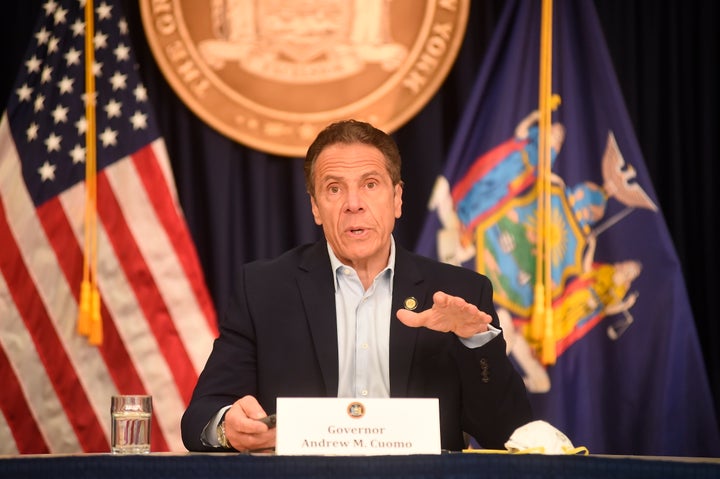
New York Gov. Andrew Cuomo briefs the media during a coronavirus news conference at his office in New York City, Saturday, Ma


New York Gov. Andrew Cuomo briefs the media during a coronavirus news conference at his office in New York City, Saturday, May 9, 2020. (John Roca/New York Post via AP, Pool)

Cuomo has deflected criticism over the nursing home directive by saying it stemmed from Trump administration guidance. Still, few states went as far as New York and neighboring New Jersey, which has the second-most care home deaths, in discharging hospitalized coronavirus patients to nursing homes. California followed suit but loosened its requirement following intense criticism.

Some states went in the opposite direction. Louisiana barred hospitals for 30 days from sending coronavirus patients to nursing homes with some exceptions. And while Louisiana reported about 1,000 coronavirus-related nursing home deaths, far fewer than New York, that was 40% of Louisiana’s statewide death toll, a higher proportion than in New York.

New York’s Health Department told the AP May 8 it was not tracking how many recovering COVID-19 patients were taken into nursing homes under the order. But it was at that very moment surveying administrators of the state’s over 1,150 nursing homes and long-term care facilities on just that question.

Those survey results have yet to be released. But regardless, the Health Department said, the survey had no bearing on Cuomo’s announcement May 10 that “we’re just not going to send a person who is positive to a nursing home after a hospital visit.”

Cuomo said such patients would be accommodated elsewhere, such as sites originally set up as temporary hospitals.

To some, the governor’s reversal came too late.

“It infected a great number of people in nursing homes who had no business getting infected, including short-term residents who were there for rehabilitation after surgeries,” said John Dalli, a New York attorney who specializes in nursing home cases.

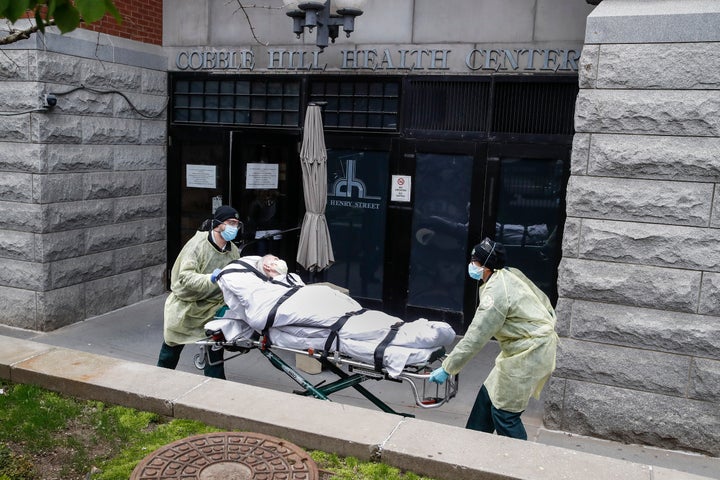
FILE - In this Friday, April 17, 2020 file photo, a patient is wheeled out of the Cobble Hill Health Center by emergency medi


FILE – In this Friday, April 17, 2020 file photo, a patient is wheeled out of the Cobble Hill Health Center by emergency medical workers in the Brooklyn borough of New York. The facility has listed dozens of deaths linked to the COVID-19 coronavirus pandemic. In New York state, the nation’s leader in nursing home deaths, the Greater New York Hospital Association lobbying group wrote the first draft of an emergency declaration making it the only state with protection from both civil lawsuits and criminal prosecution arising from the pandemic, with the order signed by Democratic Gov. Andrew Cuomo. (AP Photo/John Minchillo)

To be sure, incoming residents weren’t the only possible source of infection. Some homes believe a bigger contribution came from staffers and residents unaware they had the virus. And some say they would have taken on COVID-19 patients regardless of the state’s order.

“There were nursing homes that realized that there was a void,” said Sarah Colomello, a spokeswoman for Thompson House in Rhinebeck. The 100-bed facility set up an isolated unit where affiliated hospitals nearby have sent at least 21 patients. It has reported no deaths.

Cuomo administration officials say the original directive came when the governor feared the hospital system would be overwhelmed and was focused on creating as much hospital space as possible.

That was welcomed by one of the many hospital systems and nursing homes surveyed for AP’s count. Northwell Health said three of its medical centers were so overtaxed at one point they had to put some ICU patients in hallways. To relieve pressure, the company eventually sent more than 1,700 COVID-19 patients to nursing homes.

“Suffice it say, our hospitals were under stress,” spokesman Terence Lynam said.

Associated Press investigative researcher Randy Herschaft contributed to this report.


Source by [author_name]

Forecasters Predict Busy 2020 Atlantic Hurricane Season

FORT LAUDERDALE, Fla. (AP) — With forecasters predicting another intense Atlantic hurricane season with as many as 13 to 19 named storms, disaster preparedness experts say it’s critically important for people in evacuation zones to plan to stay with friends or family, rather than end up in shelters during the coronavirus pandemic.

“Shelters are meant to keep you safe, not make you comfortable,” said Carlos Castillo, acting deputy administrator for resilience at FEMA.

“Social distancing and other CDC guidance to keep you safe from COVID-19 may impact the disaster preparedness plan you had in place, including what is in your go-kit, evacuation routes, shelters, and more,” Castillo said. “With tornado season at its peak, hurricane season around the corner, and flooding, earthquakes and wildfires a risk year-round, it is time to revise and adjust your emergency plan now.”

Six to 10 of these storms could develop into hurricanes, with winds of 74 mph or more, and three to six could even become major hurricanes, capable of inflicting devastating damage.

“It is not possible to predict how many will hit land,” said Neil Jacobs, acting administrator of the National Oceanic and Atmospheric Administration’s Climate Prediction Center. The agency will update the forecast in August as the Atlantic region heads into its most active months.

The region has been a “high activity era” since 1995, with warmer ocean temperatures and stronger West African monsoons causing above-average activity, NOAA forecaster Gerry Bell said.

An average Atlantic season has 12 named storms, but last year was the fourth consecutive season to have more, with 18 named storms, including three intense hurricanes — Dorian, Humberto and Lorenzo. The only other period on record that produced four consecutive above-normal seasons was 1998-2001.

The season officially extends from June through November, but Tropical Storm Arthur jumped the gun last week off the eastern U.S. coastline.

“As Americans focus their attention on a safe and healthy reopening of our country, it remains critically important that we also remember to make the necessary preparations for the upcoming hurricane season,” said Secretary of Commerce Wilbur Ross. “Just as in years past, NOAA experts will stay ahead of developing hurricanes and tropical storms and provide the forecasts and warnings we depend on to stay safe.”


Source by [author_name]

Joe Biden Sympathizes With Pandemic-Hit Americans On ‘The Late Show’

Joe Biden reflected on his own grieving to empathize with Americans who’ve lost loved ones to the coronavirus in an emotional interview on Thursday’s broadcast of “The Late Show.”

Biden also slammed the Trump White House’s fumbled response to the pandemic.

The de-facto Democratic 2020 nominee, toward the end of a 50-minute chat with host Stephen Colbert, urged people who have been sucked into the pandemic’s “big black hole” of grief to remember that those who died were “still part of you, they’re your heart, they’re your soul.”

“It’s who you are, there’s this connection that is real, and the only way I know for me how to get through it is to find purpose,” he said. “What would the person you lost, what would they want you to doing? What can you do to make it better?”

Biden, whose first wife, Neilia, and their 1-year-old daughter, Naomi, were killed in a 1972 car crash, later recalled a promise his son Beau made him make just months before he died of brain cancer at age 46 in 2015.

“He said, ‘Dad, I know no one in the world loves me more than you do,’” remembered Biden. “‘But, Dad, I promise you, I’m going to be OK. My word, I’m going to be OK. But, Dad, promise me you’re going to be OK.’” 

“He was worried I would withdraw,” Biden explained, appearing to get visibly emotional. “I would go inside, because mourning in public is a lot different than being able to mourn in private. And he made me promise to stay engaged.”

“I’m sorry I get so personal,” Biden told Colbert after the candid discussion.

Earlier in the interview, Biden wondered why President Donald Trump wasn’t telling citizens the truth about the pandemic.

“They’re tough. They can handle it,” he said. “And tell them what’s going to happen and tell them how you’re going to get these things done. He’s done none of that.”

Check out the full interview here:

A HuffPost Guide To Coronavirus


Source by [author_name]

9 Miles, 7 Locations and a 3-Hour Ceremony

Dr. Huchuan Xia and his partner, Erik Lorenz, put their makeshift nuptials into another gear.

Dr. Xia, who is known as Cedric, and Mr. Lorenz were married May 10 in a Quaker self-uniting ceremony in Philadelphia. The couple cycled a total of three hours across nine miles to seven outdoor locations around their adopted city that were both photogenic and personally meaningful to them.

At each of these locations — or stations, as they called it — the freewheeling couple were joined by one or two friends to celebrate in keeping with rules to avoid large crowds during the coronavirus pandemic.

“By deconstructing a traditional wedding, we performed one wedding ritual at each station, drawn from either the German or Chinese traditions,” said Dr. Xia, 29, a trainee in psychiatry at the University of Pennsylvania, where he received a Ph.D. in neuroscience. He graduated from Washington University in St. Louis.

Dr. Xia was born in Sichuan, China, and raised in Shanghai; Mr. Lorenz, born and raised in Berlin.

At their first station, in Clark Park in West Philadelphia, Dr. Xia and Mr. Lorenz, 32, enjoyed their first dance, to a violin version of Elvis Presley’s “Can’t Help Falling in Love,” provided by a friend from Dr. Xia’s Ph.D. program.

“It was a beautiful moment,” said Mr. Lorenz, the host and founder of Weltwach Podcast, and Unfolding Maps. He graduated from Fontys University of Applied Sciences in the Netherlands and received a master’s degree in business and management from University of Plymouth in Britain.

They were soon back on their rented, Indego city bikes, the baskets in the front and rear of each decorated with tulips, lilies and chrysanthemum. As they headed to the second station on the University of Pennsylvania campus, the “Just Married” cans tied to the backs of each bike began making a ruckus to the delight of passers-by.h

Upon arrival in front of the Benjamin Franklin statue, the couple jumped across a simulated flame they constructed from tissue paper, a ritual from a traditional Chinese wedding, symbolizing the passion of a new marriage.

At the third station, the Promenade, near the Fairmount Water Works with a splendid view of the Boathouse Row, the couple sawed a small log into halves together, symbolizing marriage as teamwork.

They made their way to the fourth station, at the top of what Mr. Lorenz called “the Rocky steps,” made famous in the first “Rocky” film, starring Sylvester Stallone. Mr. Lorenz, a huge fan of the movies growing up in Berlin, chose that station as the place to exchange vows with Dr. Xia.

“We had family and friends watching our wedding via Zoom,” Mr. Lorenz said. “We learned that when we pushed our bikes to the top of the steps, and raised our arms in triumph like Rocky did in the movie, that many viewers, who likely interpreted that as the two of us celebrating our perseverance through Covid-19, started crying.”

The fifth station was the Love Park, situated under the big love sculpture of the City of Brotherly Love. There, the couple had to bite a dangling apple together, a popular wedding game in China.

The sixth station was at Independence Hall, where three pairs of friends lined up, at least six feet apart, and showered the newlyweds with rice.

When they arrived at the final station, the Race Street Pier by the Delaware River underneath the Benjamin Franklin Bridge, the couple enjoyed a champagne toast and home-baked cake. There, two of their friends, Sage Rush and Barbara Terzic signed as witnesses on the couple’s Quaker marriage license.

“In a world of uncertainty, we knew one thing for sure,” Dr. Xia said. “We knew that we wanted to be each other’s partner in life, for life.”

Source link

Hepatitis A outbreak among Vic drug users

There has been an outbreak of Hepatitis A in Victoria among drug users, particularly those who use needles, and people experiencing homelessness.

State Deputy Chief Health Officer Angie Bone advised on Friday there had been 56 confirmed cases since July 2019, with a further six cases yet to be confirmed by blood tests.

The Victorian government is offering free single-dose hepatitis A vaccinations to people who use drugs or are experiencing homelessness until 31 August 2020.

Vaccinations are available to GP clinics that provide a specialised service to these groups, as well as via a mobile outreach service.

Source by [author_name]

This isn’t Europe’s Hamilton moment

0

Sony Kapoor is managing director of Re-Define, an international think tank.

OSLO — The Franco-German plan for a €500 billion “recovery fund” has been welcomed with superlatives such as “Hamiltonian,” “stunning,” “a game changer” and the somewhat slightly less hagiographic “surprisingly ambitious.” In actual fact, it is just a damp squib.

The appropriate criteria by which to judge such a proposal are 1) Is it big enough? 2) Is it timely? 3) Does it set a powerful new precedent? 4) How does it fare in the context of the times? and the 5) What is its long-term impact? Sadly, the recovery fund falls far short of even “adequate” on all five.

Let’s start with the fund’s size. The coronavirus has trigged a global economic crisis in which the economies of some EU countries could shrink by between 10 percent and 20 percent. The recovery fund’s €500 billion amounts to a mere 3.5 percent of EU GDP to be distributed over three to four years. That’s not a game changer.

Nor are the countries that were hardest hit by the crisis likely to get the most money. Resistance from Northern and Eastern Europe make it highly unlikely that hard-it southern countries such as Italy or Spain will get more than twice their quota of about 1 percent of GDP per year. Is a 2 percent of GDP grant to Spain and Italy helpful? Yes. Is it macroeconomically significant? No.

In truth, the idea that this is the first step in the creation of a “fiscal union” is nothing but hyperbole.

The fund also fails the test of timeliness with disbursements unlikely to reach countries before next year. To offset the permanent economic damage being done by lockdowns, governments need money now.

While Germany has been able to act decisively with more domestic economic support than all the other EU countries put together, Italy and Spain have been more hesitant to act, because of their heavy debt burdens. Further delays in getting aid will leave even deeper scars in their economies that could have been prevented.

The picture is no better when it comes to setting a precedent. Even commentators who acknowledge the fund is far too small have waxed lyrical about how it “crosses the Rubicon,” “breaks taboos” or change the game the way the U.S. Revolutionary War hero Alexander Hamilton did when he federalized the debts of the various U.S. states in 1790.

In truth, the idea that this is the first step in the creation of a “fiscal union” is nothing but hyperbole.

First of all, there’s little here that’s actually new. The European Commission already has €52 billion of bonds outstanding, and cohesion and structural funds already entail transfers between EU countries. The European Stability Mechanism and the European Financial Stability Facility already saw EU governments band together to borrow to aid troubled members, albeit in the form of loans, not grants.

What the recovery fund does not do is make provisions for a permanent increase in the EU’s meager budget or give the Commission the ability to raise its own funds. Nor will existing debt be subsumed into a fiscal union as Hamilton did. Not even the responsibility for the new debt being created will be shared jointly among all EU countries, as the now abandoned initiative for “coronabonds” proposed. The recovery fund is a step toward a dead-end, not a fiscal union.

Put in the context of the time, the recovery fund looks even worse. The initiative can be seen as the German establishment’s attempt to make up for the sins of its constitutional court, which threw a Molotov cocktail into the EU’s legal and economic order in early May by challenging the actions of the European Central Bank and the Court of Justice of the European Union.

However the German court’s decision finally plays out, its immediate impact is to put a de-facto political constraint on the size and asymmetry of the ECB’s quantitative easing programs, thereby limiting the ability of the most effective institution in the eurozone to respond to a crisis with appropriate size and timeliness. Italy and Spain would have been better off with an unconstrained ECB and no recovery fund.

The longer-term consequences of the fund itself may also prove to be negative. It has killed any genuine prospect of a true, much-needed eurobond for good, leaving any “Hamiltonian moment” for future, potentially weaker, leaders. Even worse, absent future political agreements, the need to repay the debt incurred by the recovery fund will hollow out the already scarce EU budget.

EU politics is becoming more, not less contentious. If we can’t set aside our petty, parochial politics amid a global pandemic to move toward a fiscal union now, we never will.


Source by [author_name]