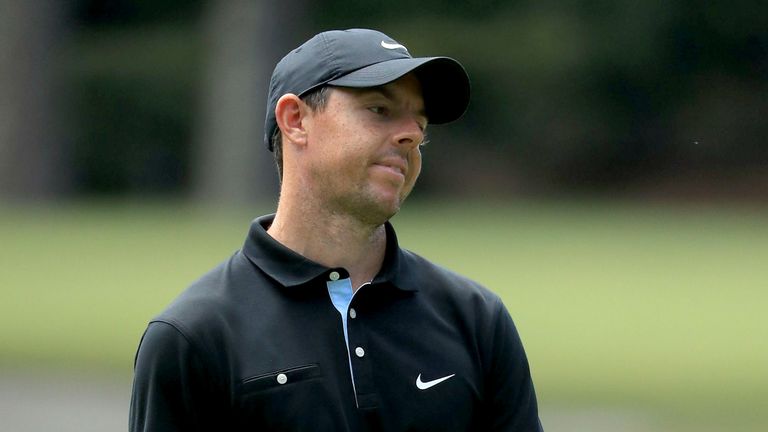
Rory McIlroy not comfortable at Harbour Town as he opens with 72 at RBC Heritage

0

Watch day two of the RBC Heritage live on Sky Sports. Featured Groups coverage begins at 11:45am on Sky Sports Golf

Last Updated: 18/06/20 6:24pm


Rory McIlroy was three over at the turn before recovering

Rory McIlroy admitted he felt out of his comfort zone as he made a poor start to the RBC Heritage with a one-over 72.

The world No 1 was hoping for a positive response to his frustrating final round at last week’s Charles Schwab Challenge, where he was three shots off the lead overnight but stuttered to the turn in 41 to take himself out of contention.
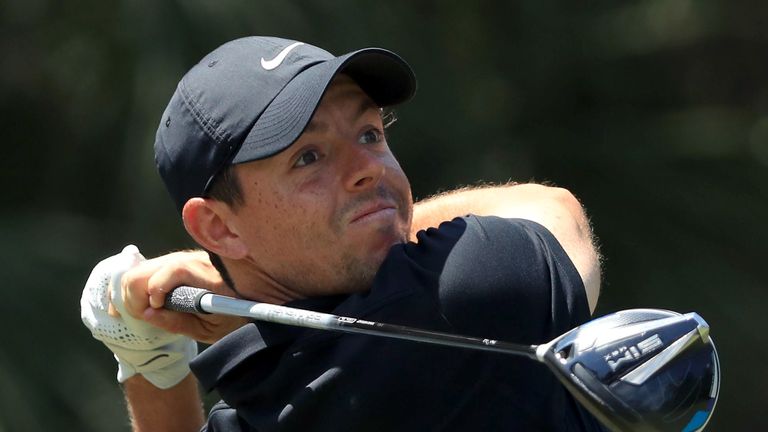
McIlroy hit only six fairways in his first round

McIlroy hit only six fairways in his first round

But McIlroy struggled to keep his ball on the short grass from the tee at Harbour Town, hitting only six fairways and slipping to three over par until he rallied with two late birdies to give himself a little momentum heading into round two.

McIlroy bogeyed the 11th, his second hole and then needed four shots to find the green at the par-five 15th and, although he did find the fairway at 18, he blocked his approach and failed to get up-and-down to avoid his third dropped shot of the back nine.

The cheapest way to watch Sky Sports

The wait is over. Save over 25% and grab a NOW TV Sky Sports Month Pass for just £25 a month for 3 months

He steadied the ship with a run of pars before a good sand-save at the long fifth earned him his first birdie of the day, and he finished on a bright note when he holed a 30-foot putt for a closing three at the ninth, although that left him eight shots adrift of early leader Ian Poulter.

“I’m missing my three-wood left and missing my driver right,” said McIlroy, who is making only his second appearance in the tournament, 11 years after his first. “I got a little better towards the end and hit some decent tee shots.
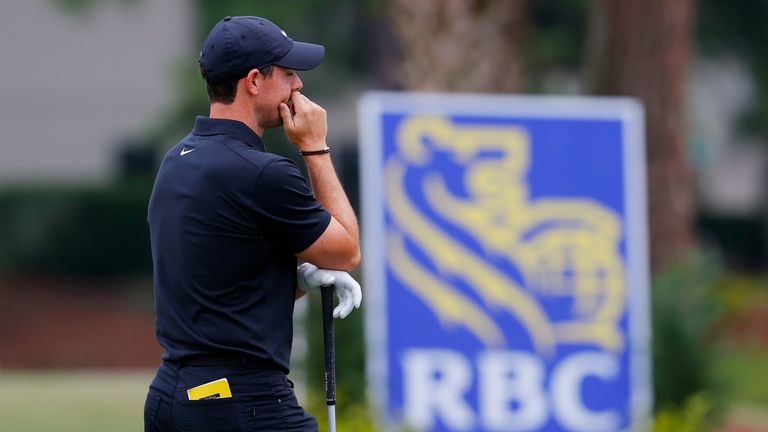
McIlroy admitted his lack of familiarity with the course was a problem

McIlroy admitted his lack of familiarity with the course was a problem

“If you’re in two minds about what to do off the tees around here and get a little bit sort of guidey, it can bite you. So I didn’t get it in play enough to give myself shots or looks at hitting it close into greens and making birdies. It was just a little bit of a struggle, so I’m going to work on it a little bit this afternoon and see if I can straighten it out.”

McIlroy also believes a lack of familiarity with the tight layout put him at a disadvantage, adding: “I wasn’t particularly comfortable out there. I played here once before in ’09, and I just can remember not being that comfortable around here then, and it’s still sort of the same.

Get the best prices and book a round at one of 1,700 courses across the UK & Ireland

“I’m just not comfortable and sort of trying to pick lines and really commit to shots. I just wasn’t as committed today as I need to be around here.

“There are a few holes, obviously, that are familiar, a few on the front side, obviously a few coming in as well. But there are a lot of holes around the turn that I didn’t really remember too well. I played a couple of practice rounds just trying to get lines off tees and get adjusted and feel comfortable with the clubs that you’re hitting.

“Then again, it’s a course that, once you do get it in play, you can give yourself plenty of chances.”

Live PGA Tour Golf

June 19, 2020, 11:45am

Live on



Source link

PG&E Ordered to Pay $3.5 Million Fine in Camp Fire Case

0

Philip Binstock recounted the life of his father, Julian, who grew up in a family of modest means but went on to attend Harvard and become a vice president at Warner Bros. He also angrily criticized PG&E for its failings.

“You had the capacity to know what you were doing would kill people,” Mr. Binstock said. “You knew what you were doing was wrong. And rather than reduce your bonuses, you allowed your failed equipment and your improper inspections to kill people.”

PG&E responded to survivors with a statement from William L. Smith, the company’s incoming interim chief executive, who promised to improve how the company operates.

“I hear their pain and anguish, and acknowledge the lasting impact that the fire will have on so many people in the Butte County community and far beyond,” Mr. Smith said. “We also heard profound disappointment and anger toward PG&E.”

State officials have required the company to make major changes. PG&E needed California’s support to exit bankruptcy, and Gov. Gavin Newsom demanded the utility reform its board, change its leadership structure, improve safety, compensate fire victims and exit bankruptcy by June 30.

Although the governor has no direct authority over the bankruptcy case, PG&E had to meet his requirements in order to participate in a $20 billion fund that will help cover liability utilities could face from future fires started by their equipment. PG&E needs access to the fund to convince stock and bond investors that it would not slip into bankruptcy again for starting fires.

U.S. Bankruptcy Judge Dennis Montali said in a memorandum on Wednesday that the company’s reorganization plan, which will provide $13.5 billion to wildfire victims, was feasible and the only one before the court. He has scheduled a hearing for Friday, at which he is expected to give his final approval to PG&E’s plan.

“All of the victims, all of the over sixteen million PG&E customers in Northern California, indeed all of Northern California if not the rest of the country, know the story,” Judge Montali wrote in his memo. “Leaving tens of thousands of fire survivors, contract parties, lenders, general creditors, allegedly defrauded investors, equity owners and countless others with no other options on the horizon is not an acceptable alternative.”

Source link

Where to Buy Face Masks That Are Stylish Online


Where to Buy Face Masks That Are Stylish Online | Entertainment Tonight


Source link

How a Raise for Workers Can Be a Win for Everybody

0

Two new studies show that giving pay raises to low-wage workers is good for consumers, too.

That finding could add momentum to efforts to help grocery store clerks, nursing home workers and delivery drivers who are being paid a minimum wage despite their efforts being so essential during the current pandemic.

The new research shows that raising the minimum wage improves workers’ productivity, which translates into businesses offering higher-quality service.

Because many customers are willing to pay more when quality improves, a company can raise its prices without losing sales volume. That means that profits need not suffer even though employee salaries increase.

Moreover, because companies are getting better performance from workers in return for paying them more, a higher minimum wage does not necessarily lead to fewer jobs. With a more productive work force, more economic value is being created and there is more money to go around, so a higher paycheck for one person does not imply another person’s loss.

The federal minimum wage of $7.25 an hour has not increased since 2009, though Democrats in the House of Representatives have tried to raise it. State and local governments can set their own minimum wage, provided that it is above the federal rate. For example, Ohio’s minimum wage is $8.70 an hour and New York state’s is $11.80. San Francisco’s is $15.59 an hour.

The two new studies, one focused on nursing homes and the other on department stores, looked at the effects of minimum wage changes made at various levels of government. While they are both still working papers and have not appeared in scholarly journals, they were conducted rigorously, by my estimation, and the evidence they offer deserves consideration in the debate on the minimum wage, particularly during our current health and economic crises.

The nursing home study, by the economist Krista Ruffini, a visiting scholar at the Minnesota Federal Reserve, has direct implications in the current pandemic. The improvements in quality it found may be a very a big deal: They imply fewer medical complications and, perhaps, a longer life for patients.

Ms. Ruffini analyzed hundreds of increases in the minimum wage across the United States from 1990 to 2017. In each case, she compared employment in neighboring counties that suddenly had different minimum wage levels.

Her method expands on a landmark study by David Card, an economist at the University of California, Berkeley, and Alan Krueger, the former presidential adviser and Princeton economist, who found no drop in fast-food employment when New Jersey raised its minimum wage in 1992 above the level paid across the state line in Pennsylvania.

Similarly, Ms. Ruffini found little change in employment levels in nursing homes. Many employees were paid the minimum wage or somewhat more than that. Even in cases of the workers — nursing assistants — who had been paid more than the minimum wage, an increase in that base wage rippled through the labor market and still raised their salaries.

Ms. Ruffini’s most startling finding was that higher minimum wages reduced mortality significantly among nursing home residents. Her research suggests that if every county increased its minimum wage by 10 percent, there could be 15,000 fewer deaths in nursing homes each year, or about a 3 percent reduction.

How did pay increases translate into better patient health and longer lives? It appears that with better pay, jobs in nursing homes became more attractive, so employee turnover decreased. Patients benefited from more continuity in their care.

In addition, the better paid employees may have simply worked harder, perhaps because they cared more about holding onto their jobs. Economists say they have been paid an “efficiency wage”: Employees become more productive when their wages are higher.

The higher wage may also have attracted more skilled or industrious people to the job, but this seems to account for at most a small portion of the improvements in patient health.

A crucial finding is that the benefits for workers and patients did not come with any apparent downside to nursing homeowners. Their profits remained steady because they were able to defray their increased costs by charging higher fees. That’s one reason these results might not apply in all industries. There are few alternatives to using a nursing home, so if the industry raises prices, it will not lose too many customers.

  • Updated June 16, 2020

    • I’ve heard about a treatment called dexamethasone. Does it work?

      The steroid, dexamethasone, is the first treatment shown to reduce mortality in severely ill patients, according to scientists in Britain. The drug appears to reduce inflammation caused by the immune system, protecting the tissues. In the study, dexamethasone reduced deaths of patients on ventilators by one-third, and deaths of patients on oxygen by one-fifth.

    • What is pandemic paid leave?

      The coronavirus emergency relief package gives many American workers paid leave if they need to take time off because of the virus. It gives qualified workers two weeks of paid sick leave if they are ill, quarantined or seeking diagnosis or preventive care for coronavirus, or if they are caring for sick family members. It gives 12 weeks of paid leave to people caring for children whose schools are closed or whose child care provider is unavailable because of the coronavirus. It is the first time the United States has had widespread federally mandated paid leave, and includes people who don’t typically get such benefits, like part-time and gig economy workers. But the measure excludes at least half of private-sector workers, including those at the country’s largest employers, and gives small employers significant leeway to deny leave.

    • Does asymptomatic transmission of Covid-19 happen?

      So far, the evidence seems to show it does. A widely cited paper published in April suggests that people are most infectious about two days before the onset of coronavirus symptoms and estimated that 44 percent of new infections were a result of transmission from people who were not yet showing symptoms. Recently, a top expert at the World Health Organization stated that transmission of the coronavirus by people who did not have symptoms was “very rare,” but she later walked back that statement.

    • What’s the risk of catching coronavirus from a surface?

      Touching contaminated objects and then infecting ourselves with the germs is not typically how the virus spreads. But it can happen. A number of studies of flu, rhinovirus, coronavirus and other microbes have shown that respiratory illnesses, including the new coronavirus, can spread by touching contaminated surfaces, particularly in places like day care centers, offices and hospitals. But a long chain of events has to happen for the disease to spread that way. The best way to protect yourself from coronavirus — whether it’s surface transmission or close human contact — is still social distancing, washing your hands, not touching your face and wearing masks.

    • How does blood type influence coronavirus?

      A study by European scientists is the first to document a strong statistical link between genetic variations and Covid-19, the illness caused by the coronavirus. Having Type A blood was linked to a 50 percent increase in the likelihood that a patient would need to get oxygen or to go on a ventilator, according to the new study.

    • How many people have lost their jobs due to coronavirus in the U.S.?

      The unemployment rate fell to 13.3 percent in May, the Labor Department said on June 5, an unexpected improvement in the nation’s job market as hiring rebounded faster than economists expected. Economists had forecast the unemployment rate to increase to as much as 20 percent, after it hit 14.7 percent in April, which was the highest since the government began keeping official statistics after World War II. But the unemployment rate dipped instead, with employers adding 2.5 million jobs, after more than 20 million jobs were lost in April.

    • Will protests set off a second viral wave of coronavirus?

      Mass protests against police brutality that have brought thousands of people onto the streets in cities across America are raising the specter of new coronavirus outbreaks, prompting political leaders, physicians and public health experts to warn that the crowds could cause a surge in cases. While many political leaders affirmed the right of protesters to express themselves, they urged the demonstrators to wear face masks and maintain social distancing, both to protect themselves and to prevent further community spread of the virus. Some infectious disease experts were reassured by the fact that the protests were held outdoors, saying the open air settings could mitigate the risk of transmission.

    • My state is reopening. Is it safe to go out?

      States are reopening bit by bit. This means that more public spaces are available for use and more and more businesses are being allowed to open again. The federal government is largely leaving the decision up to states, and some state leaders are leaving the decision up to local authorities. Even if you aren’t being told to stay at home, it’s still a good idea to limit trips outside and your interaction with other people.

    • What are the symptoms of coronavirus?

      Common symptoms include fever, a dry cough, fatigue and difficulty breathing or shortness of breath. Some of these symptoms overlap with those of the flu, making detection difficult, but runny noses and stuffy sinuses are less common. The C.D.C. has also added chills, muscle pain, sore throat, headache and a new loss of the sense of taste or smell as symptoms to look out for. Most people fall ill five to seven days after exposure, but symptoms may appear in as few as two days or as many as 14 days.

    • How can I protect myself while flying?

      If air travel is unavoidable, there are some steps you can take to protect yourself. Most important: Wash your hands often, and stop touching your face. If possible, choose a window seat. A study from Emory University found that during flu season, the safest place to sit on a plane is by a window, as people sitting in window seats had less contact with potentially sick people. Disinfect hard surfaces. When you get to your seat and your hands are clean, use disinfecting wipes to clean the hard surfaces at your seat like the head and arm rest, the seatbelt buckle, the remote, screen, seat back pocket and the tray table. If the seat is hard and nonporous or leather or pleather, you can wipe that down, too. (Using wipes on upholstered seats could lead to a wet seat and spreading of germs rather than killing them.)

    • Should I wear a mask?

      The C.D.C. has recommended that all Americans wear cloth masks if they go out in public. This is a shift in federal guidance reflecting new concerns that the coronavirus is being spread by infected people who have no symptoms. Until now, the C.D.C., like the W.H.O., has advised that ordinary people don’t need to wear masks unless they are sick and coughing. Part of the reason was to preserve medical-grade masks for health care workers who desperately need them at a time when they are in continuously short supply. Masks don’t replace hand washing and social distancing.

    • What should I do if I feel sick?

      If you’ve been exposed to the coronavirus or think you have, and have a fever or symptoms like a cough or difficulty breathing, call a doctor. They should give you advice on whether you should be tested, how to get tested, and how to seek medical treatment without potentially infecting or exposing others.


But, equally important, patients were not charged more for the same service: Quality improved in measurable ways as wages rose.

What unlocked these gains was government action: All nursing homes in a community had to pay employees more. That eliminated competitive disparities that might have made individual operators reluctant to raise wages unilaterally.

Similar effects turned up in a second study, this one focused on department stores. It found that a higher minimum wage increased employee performance, with no significant change in store profits. A team of economists — Decio Coviello at the University of Montreal and my colleagues, Erika Deserranno and Nicola Persico at Northwestern University — used data for 2012 to 2015 from a department store chain that operated 2,000 stores across the United States. They did not disclose the name of the chain. The researchers measured job performance directly by calculating sales revenue per hour.

Each week, an employee was paid either a commission, if her sales were good, or the local minimum wage. Most workers were paid the minimum wage at least some of the time. When the minimum wage increased, their job performance improved.

The study has an important implication during a crisis like this one: When the labor market was weakest, a higher minimum wage led to the biggest improvements in job performance. A period of economic distress is precisely when workers really want to hold onto their jobs, so the “efficiency wage” effect is large.

Supporters of raising the minimum wage usually make their case based on fairness and equity. That rationale is important, but the central finding of these studies — that a higher minimum wage can boost work force productivity and save lives — is a powerful one, too.

Seema Jayachandran is an economics professor at Northwestern University. Follow her on Twitter: @seema_econ


Source link

How Social Media Has Changed Civil Rights Protests

0

This article is part of the On Tech newsletter. You can sign up here to receive it weekdays.

Omar Wasow is steeped in both social media and the civil rights movement of the 1960s. And he marvels at how the two have melded in the current demonstrations against racial injustice and police brutality.

Wasow, a professor at Princeton University and co-founder of the pioneering social network BlackPlanet.com, said social media was helping publicize police brutality and galvanizing public support for protesters’ goals — a role that his research found conventional media played a half century ago. And he said he believed that the internet was making it easier to organize social movements today, for good and for ill.

Here are excerpts from our conversation.

How has social media changed, or not, civil rights protests today compared with the 1960s?

The 1960s civil rights leaders figured out that images in national media that showed the brutality of Jim Crow forced an often indifferent white America to take seriously the concerns of black citizens.

There’s a through line today. The video of George Floyd taken by Darnella Frazier is an echo of the bearing witness of the beating of Rodney King, and before that the images of Bloody Sunday in Selma [in 1965]. Part of what social media does is allow us to see a reality that has been entirely visible to some people and invisible to others. As those injustices become visible, meaningful change follows.

But racial inequality or police brutality didn’t end with Selma or Rodney King. Does the internet change that?

It’s obviously depressing how often excess force by police against African-Americans resulted in protest movements that didn’t ultimately fix the problem. But after Selma, public opinion on concerns for civil rights spiked dramatically. The Voting Rights Act was passed in five months.

The legal scholar Thomas Stoddard talked about cultural shifts leading to durable social change. I think you’re seeing that now with broad public support for the goals of the Black Lives Matter movement.

Are there ways in which meaningful protests are harder now?

Social media radically simplified organizing and coordinating large groups. The downside is there isn’t a deep well of trust among demonstrators, as there was among people who did the first sit-ins of lunch counters and all knew each other.

But if one way this movement has an impact is by having weaker ties but with broad reach, that is OK in some cases. And social media is enabling new kinds of protests. My wife has been doing activism around a chronic health issue, and many of those people are bed bound. Organizing online has been a way to raise consciousness and call attention to the health system’s failures.

Are there lessons from the social networks you ran 20-plus years ago to make today’s online hangouts healthier for the world?

When we launched what used to be called a bulletin board service in the 1990s, our slogan was “the mix is the message.” We were trying to get the variety of New Yorkers to talk to each other. Today there are places online where people can find others like them, and that’s good. But I wonder if there’s also more that could be done on sites like Facebook and Twitter to bring people together rather than sorting them into camps.


Any app maker that wants to sell a video game, a digital subscription or most other virtual goods in an iPhone app has a binary choice: Make people pay with Apple’s payment system and share revenue with Apple, or don’t allow any purchases at all in the app.

A lot of app makers chafe at this choice. It’s why you can’t buy a subscription to Spotify or Netflix from those companies’ iPhone apps. Spotify and Netflix refuse to give Apple a cut of sales, and Apple’s rules mean there’s no alternative.

I understand both sides here. Apple wants to be paid for keeping its app store appealing and safe. App makers say they feel it’s unfair to hand over a chunk of their hard-won sales in perpetuity.

But the status quo does more harm than good. It’s annoying to iPhone users, makes developers angry and risks getting Apple in trouble with regulators.

How about a middle ground: Give people multiple ways to pay.

What if people had the choice to pay for things in iPhone apps with either their Apple account or another payment method of the app maker’s choosing?

It would be easier for you to buy a Netflix subscription in the iPhone app with your fingerprint or face scan connected to your Apple account. If you do that, then Apple would get to take a slice of Netflix’s sales.

But Netflix could also let you create a new account and hand over your credit card details to Netflix. In that case, Netflix would keep all the money. This is similar to the approach on Android, where app makers have the option to let people pay them directly and not share revenue with Google.

This split-the-baby approach might not end all the fights about what Apple allows in its apps. I bet it would resolve a lot of disputes, though, and it would make many apps a bit less confusing for all of us.


  • What a mess: My New York Times colleagues looked into England’s system of humans and technology for tracking down people who had been exposed to the coronavirus. The results so far have not been promising, with some virus hunters filling their days with internet exercise classes and a government virus-tracking app hampered by fears about technical glitches and data breaches.

  • Soon every tech company will have a coronavirus-fighting product to sell: Verily, a Google sister company, is introducing an employee virus testing and health analysis service for businesses, my colleague Natasha Singer writes. She points out that many tech companies are now pitching products that promise to help businesses function safely during the pandemic. Some of these offerings may be ineffective or creepy — or both.

  • Yes to the Marie Kondo test for technology: A researcher of “smart cities” advocates for banning technologies that contribute to the perpetual surveillance of citizens, including facial recognition, ubiquitous cameras and predictive software. “Think of it as Marie Kondo, but for technology. Does this thing contribute to human well-being and/or social welfare? If not, toss it away!” he writes in OneZero.

This child is enjoying television’s hottest new drama: “Washer,” followed by an all new episode of “Dryer.”


We want to hear from you. Tell us what you think of this newsletter and what else you’d like us to explore. You can reach us at ontech@nytimes.com.

Get this newsletter in your inbox every weekday; please sign up here.


Source link

Jean Kennedy Smith, JFK’s Last Surviving Sibling, Dead At 92

0

Jean Kennedy Smith, who was the last surviving sibling of President John F. Kennedy and who as a U.S. ambassador played a key role in the peace process in Northern Ireland, has died, relatives said Thursday. She was 92.

Former U.S. Rep. Patrick Kennedy, Smith’s nephew, confirmed her death. She died Wednesday at her home in Manhattan, her daughter Kym told The New York Times.

Smith was the eighth of nine children born to Joseph P. and Rose Kennedy, and tragically several of them preceded her in death by decades. Her siblings included older brother Joseph Kennedy Jr., killed in action during World War II; Kathleen “Kick’ Kennedy, who died in a 1948 plane crash; the president, assassinated in 1963 and Sen. Robert F. Kennedy, slain in 1968. Sen. Edward Kennedy, the youngest of the Kennedy siblings, died of brain cancer in August 2009, the same month their sister Eunice Kennedy Shriver died.

Smith, who married Kennedy family financial adviser and future White House chief of staff Stephen Edward Smith in 1956, was viewed for much of her life as a quiet sister who shunned the spotlight. In her memoir “The Nine of Us,” published in 2016, she wrote that for much of the time her childhood seemed “unexceptional.”

“It is hard for me to fully comprehend that I was growing up with brothers who eventually occupy the highest offices of our nation, including president of the United States,” she explained. “At the time, they were simply my playmates. They were the source of my amusement and the objects of my admiration.”

Though she never ran for office, she campaigned for her brothers, traveling the country for then-Sen. John F. Kennedy as he sought the presidency in 1960. In 1963, she stepped in for a traveling Jacqueline Kennedy and co-hosted a state dinner for Ireland’s president. The same year, she accompanied her brother — the first Irish Catholic president — on his famous visit to Ireland. Their great-grandfather, Patrick Kennedy, was from Dunganstown in County Wexford in southeastern Ireland.

Three decades later, she was appointed ambassador to Ireland by President Bill Clinton, who called her “as Irish as an American can be.”

During her confirmation hearing, she recalled the trip with her brother, describing it as “one of the most moving experiences of my own life.”

As ambassador, she played a role in the Northern Ireland peace process. She helped persuade Clinton to grant a controversial visa in 1994 to Gerry Adams, chief of the Irish Republican Army-linked Sinn Fein party. The move defied the British government, which branded Adams as a terrorist.

Patrick Kennedy highlighted her role in the Irish peace process as the crux of her “enormous legacy.”

“She knew it was crucial to bring everybody in in order for there to be lasting peace,” Patrick Kennedy told the AP. “She took an enormous risk to her own reputation and stature as an ambassador.”

She later called criticism of her actions toward the IRA “unfortunate” and said she thought history would credit the Clinton administration with helping the peace process in Northern Ireland.

Irish Prime Minister Bertie Ahern said in 1998 that “it is not an understatement to say that if (the visa for Adams) didn’t happen at the time, perhaps other events may not have fallen into place.”

In 1996, though, Smith had been reprimanded by Secretary of State Warren Christopher for punishing two of her officers who objected to the visa for Adams.

In December 1998, Smith again risked controversy by taking communion in a Protestant cathedral in Dublin, going against the bishops of her Roman Catholic church.

Her decision was a strong personal gesture of support for Irish President Mary McAleese, a fellow Catholic who had been criticized by Irish bishops for joining in the Protestant communion service.

“Religion, after all, is about bringing people together,” Smith told The Irish Times. “We all have our own way of going to God.”

Patrick Kennedy, recalled his aunt’s popularity, accessibility and constant travel around Ireland when he visited there with a delegation of Irish Americans from his state of Rhode Island. The post, he said, allowed her to tap into her political side.

“It was like, all of the hidden, or pent-up desire to be a politician, which, of course ran through her as with every one of her siblings, she got to live that out,” he said.

When she stepped down as ambassador in 1998, she received Irish citizenship for “distinguished service to the nation.”

Diplomacy, along with politics, also ran in the Kennedy family. Her father was ambassador to the United Kingdom from 1938 to 1940. Niece Caroline Kennedy served as ambassador to Japan during the Obama administration.

“We’re the first father-daughter ambassadors,” Smith told The Irish Times in 1997. “So I can’t remember a time when we were not an actively political family.”

In 1974, Smith founded Very Special Arts, an education program that supports artists with physical or mental disabilities. Her 1993 book with George Plimpton, “Chronicles of Courage: Very Special Artists,” features interviews with disabled artists. The program followed in the footsteps of her sister Eunice’s creation of the Special Olympics for disabled athletes.

Smith and her husband had four children, Stephen Jr., William, Amanda and Kym. Her husband died in 1990.

Her son, Dr. William Kennedy Smith, made headlines in 1991, when he was charged with rape at the Kennedy estate in Palm Beach, Florida. He was acquitted after a highly publicized trial that included testimony from his uncle, Sen. Edward Kennedy, who had roused his nephew and son to go to some nightclubs that Easter weekend.

Among Smith’s other siblings, Rosemary died in 2005; and Patricia in 2006.

“Certainly a distinct characteristic of our family was its size,” Smith wrote in her memoir. “A child in a big family constantly feels surrounded and supported. For me, there was always someone to play with or someone to talk to just around the corner, out on the porch, or in the next bedroom. I never felt alone.”


Source by [author_name]

‘The Good Place’ producer apologizes for past offensive tweets

Megan Amram, a producer and co-writer on NBC’s “The Good Place,” has apologized for posting offensive tweets several years ago that have resurfaced.

“I would like to address some tweets from over the past decade that have been circulating recently. I fear this will not convey everything that I want it to, but I am speaking from the heart and trying my best to communicate my sincere regret. I am deeply embarrassed and more apologetic than you can ever know,” she wrote on Twitter Wednesday night.

Several Twitter users recently found tweets Amram made in the early 2010s, some making jokes about Asian Americans, Jewish people and people with disabilities.

Amram apologized to the Asian American community in her statement on Twitter.

“My instinct is to share the varying degrees of explanation for every tweet that has offended, but I know full well there are no excuses. I will be sorry for as long as I live that I have hurt even one person, and I very much understand why my words have hurt many more. Also, I specifically would like to apologize to the Asian American community, who I have hurt most with my tweets. I very much understand why you are hurt,” she wrote.

She added that as her platform grew, she made an effort to educate herself and support people of color and the LGBTQ community in the years since posting the tweets.

“As my platform grew, I learned the power I had to amplify voices and the responsibility that came along with it. My platform and jobs are meaningful tools to foster diverse writers, combat workplace discrimination, educate myself, donate and to consciously and vocally support BIPOC, LGBTQ people and more. Every day I go into my jobs, my life and my friendships trying to promote those ideals. I have been doing this work on myself and for others for years and can only promise that I will continue to do so, both publicly and privately. This is not lip service, it is something very important to the core of what I am trying to do with my life,” she wrote.

In addition to “The Good Place,” Amram has written for “Silicon Valley” and “Parks and Recreation” and created the comedy web series “An Emmy for Megan.”

“The bottom line is I tweeted some careless, hurtful things. I wish I could take them back, not to ‘get out of trouble,’ but because it is weighing heavily on my heart. But I can’t. So instead, I have spent the last decade attempting to unlearn the complicit racism I participate in as a white person and becoming the vocally supportive ally I think I am now,” she wrote. “I have been silent on this in the hopes that my current actions would speak louder than my past words, and that was my mistake, but I would like to make it very clear now how deeply sorry I am. I’m not posting the tweets here since I do not want to hurt people again with those words. But I want to be very clear: I am sorry. I mean it and I will prove that every day for the rest of my life.”

Follow NBC Asian America on Facebook, Twitter and Instagram


Source link

IOA VP Sudhanshu Mittal writes again to IOC Ethics Commission, accusing Narinder Batra of reinstating ‘tainted’ Lalit Bhanot – Firstpost

0

Continuing his campaign against Narinder Batra, IOA vice-president Sudhanshu Mittal has written to International Olympic Committee’s Ethics Commission chairman Ban Ki-moon, accusing the IOA President of “illegally” reinstating the “tainted” Lalit Bhanot into the national body.

Representative photo. Image credit: Twitter/@ioaindia

Mittal alleged that immediately after being elected as IOA president, Batra reinstated Bhanot in various capacities despite several cases of corruption related to the 2010 Commonwealth Games, pending against him in court.

“Dr Narinder Dhruv Batra, immediately after getting elected as President of the Indian Olympic Association on 14 December 2017, reinstated a person against whom charges are framed in court. Dr. Lalit Bhanot was appointed Chairman and member of key Committees.

“Till 22 May 2020, Dr. Bhanot was also a member of the IOA Legal Committee,” Mittal wrote in his letter to Ban Ki-moon, the former UN secretary-general.

“A complaint regarding the illegal appointment of Dr. Lalit Bhanot was mailed to the IOA Ethics Commission, of which I am a member, and the IOC Ethics Commission on 8 May 2020.”

The other portfolios which Bhanot holds in IOA are Preparation Committee (chairman), Sports Code Commission (chairman), National Games Format Review Committee (chairman), Co-ordination Commission (member), Sports Development Commission (member) and Core Committee (member).

Currently engaged in a bitter feud with Batra, Mittal had earlier demanded an IOC ethics commission inquiry into alleged irregularities in Batra’s election as IOA president in 2017, which the world body had rejected last week.
The rejection of his complaint forced Mittal to write to the IOC Ethics Commission once again on Tuesday and he “strongly denunciated” the quick dismissal.

“A rushed and tweaked response by a staff without referring the complaint to the Ethics Commission, when the concerned is a member of the International Olympic Committee by virtue of his role in a National Olympic Committee, that is due to host the Session of the International Olympic Committee, has conflict of interest marred all over it,” Mittal wrote in his fresh letter.


Source link

Barclays, HSBC and Lloyds among UK banks that had links to slavery

0

The slave trade was abolished in the British Empire in 1807 but it was not until 1833 that the Abolition of Slavery Act finally banned the ownership of other human beings. However, some 46,000 slave owners continued to benefit financially as the subsequent Slave Compensation Act provided for £20m in payments – a sum worth billions of pounds in 2020 terms. Despite the name of the act, the former slaves were not compensated.

University College London’s Legacies of British slave ownership project shows that 10% to 20% of Britain’s wealthy can be identified as having had significant links to slavery. The amount of money borrowed to pay off slave owners was so large that the government only repaid it fully in 2015. Companies with links to slavery in their past include:

Royal Bank of Scotland

The Royal Bank of Scotland was founded in Edinburgh in 1727, but among the hundreds of banks it later acquired some could trace their history as far back as the 1640s (in the case of Child & Co). A 2009 report funded by the bank found that directors of RBS predecessors had owned slaves, as well as giving loans and other support to plantation owners. Some 18 linked directors are referenced in the UCL database. The bank was bailed out by the UK taxpayer in 2009, and the government retains a 62% stake.

A spokeswoman said: “We have a strong multicultural network across the bank and have recently set up a taskforce led by our BAME [black, Asian and minority ethnic] colleagues which will look at what more we can do as a bank. This includes looking at making contributions to BAME groups.”

Barclays Bank

Barclays Bank traces its history back to two goldsmith bankers in London in 1690. The name of one of its 250 predecessors gives a clear indication of its role in the British empire: Colonial Bank finally merged with Barclays in 1925. Two managers, a subscriber and three directors are named on the UCL database as having been involved in the slave trade or received slave compensation.

A Barclays spokesman said: “The history of Barclays, like other institutions, is being examined following recent events. We can’t change what’s gone before us, only how we go forward. We are committed as a bank to do more to further foster our culture of inclusiveness, equality and diversity, for our colleagues, and the customers and clients we serve.”

HSBC

HSBC was founded in 1865 to finance trade between Europe and Asia, but its 1992 merger with the UK’s Midland Bank gives it earlier roots. Those include the London Joint Stock Bank, whose first manager, George Pollard, shared £2,416 (more than £230,000 today) in compensation for giving up 134 enslaved people in Nevis.

An HSBC spokeswoman declined to comment. HSBC is understood to be looking into the issue of its links to slavery.

Lloyds Banking Group

For its first 100 years Lloyds Bank operated from just one office in Birmingham. However, in the 1860s, Lloyds embarked on a period of rapid expansion. John White Cater, a director of one of the rivals it acquired, received compensation for five estates that enslaved 80 people at the time of abolition. Eight former companies associated with Lloyds have links to claimants or beneficiaries in the UCL database,.

A Lloyds spokeswoman said: “A lot has changed during the 300-year history of our brands and while we have much within our heritage to be proud of, we can’t be proud of it all. We stand against racism, slavery and discrimination in all its forms and truly believe that by reflecting, understanding, promoting and valuing the diversity of our colleagues, we will deliver better results. We can do more, we can do better and we will do it together.”

Lloyd’s of London

The insurance market started in a coffee house more than 330 years ago. By the 1730s it was dominating shipping insurance around the world, and playing a key role in the UK’s empire building. That meant it was also intimately involved in the slave trade. Simon Fraser, a founder subscriber member of Lloyd’s, held at least 162 people in slavery and was paid the equivalent of nearly £400,000 for ceding a plantation in Dominica. Descendants of slaves brought action for reparations against Lloyd’s in 2004.

Lloyd’s of London said the slave trade was “an appalling and shameful period of English history, as well as our own, and we condemn the indefensible wrongdoing that occurred during this period”. It now plans to provide cash help to organisations that support BAME groups and “invest in positive programmes to attract, retain and develop black and minority ethnic talent”.

Arbuthnot Latham

Both of the bank’s founders, Alfred Latham and James Alves Arbuthnot, were linked to the slave trade. Latham received compensation after the 1833 abolition of slavery, co-founding the bank in the same year. The bank grew into a major funder of Britain’s colonial exploits, including Cecil Rhodes’s gold fields in South Africa.

An spokesman said: “Arbuthnot Latham stands against racism and discrimination in all forms, and is committed to diversity across the bank.”

Greene King

Pub chain Greene King, which now runs 3,100 pubs, restaurants and hotels, has been brewing beer since 1799 when it was founded by 19-year-old Benjamin Greene. Greene went on to own cane sugar plantations in the West Indies where slaves worked, and he criticised abolition campaigners. He received nearly £500,000 in today’s money for three plantations in the West Indies.

“It is inexcusable that one of our founders profited from slavery and argued against its abolition in the 1800s,” said Nick Mackenzie, Greene King’s chief executive. The company plans to offer financial reparations.

Source link

Surprise! Raven-Symoné Marries Miranda Pearman-Maday in Intimate Wedding


Raven-Symoné Marries Miranda Pearman-Maday | PEOPLE.com


this link is to an external site that may or may not meet accessibility guidelines.

Source link