Faced With Crisis and Re-election, Senate Republicans Blame China

0

WASHINGTON — When Senator Martha McSally, one of the most politically endangered Republicans, was asked last month about reports that President Trump had brushed away warnings from his own aides about the looming threat of the coronavirus, she promptly pivoted.

“I learned the day I entered the military, never trust a communist,” Ms. McSally answered. “China is to blame for this pandemic and the death of thousands of Americans.”

Her campaign went further, turning the sound bite into a television advertisement that has blanketed airwaves across Arizona, where polls show her badly trailing her Democratic challenger, Mark Kelly. And the Senate Republican campaign arm has sought to portray Mr. Kelly as beholden to Beijing, broadcasting a commercial that features an announcer saying the Mandarin transliteration of his name as Chinese characters flash across the screen.

Fighting for their political lives amid twin domestic crises — a pandemic that has battered the economy — vulnerable Republican senators running for re-election are working to divert voters’ gazes half a world away and make their races a referendum on China. The tactic, party strategists say, is a way for Republicans to avoid defending the president’s handling of the virus, which has been met with widespread public disapproval, and instead offer up an alternative issue that already inspires fear and skepticism among voters.

Facing plummeting standing in the polls and few upbeat messaging options, Ms. McSally and several other Republicans have leaned heavily into the message. Senator Thom Tillis of North Carolina released a five-point strategy last month meant to hold the Chinese government accountable for its “lies, deception and cover-ups.” A video of him standing in front of a poster, labeled “the Tillis Plan” in all capital letters, breaks down each point. In Montana, Senator Steve Daines, who is facing a challenge from the state’s popular Democratic governor, Steve Bullock, unveiled a digital and television ad campaign centered on casting China as responsible for the virus. Senator Joni Ernst in Iowa posted on Twitter and Facebook condemning “so many bad actions out of China.”

“If only they had stood up and alerted the world much sooner, the pandemic could have been lessened,” she said.

The strategy comes as hawks, especially Republicans, are ascendant in Congress and jockeying for the role of lead China thought leader, and as national security experts in both parties warn a new era of great power competition between the two nations has begun. And while it is unclear whether an anti-China message will appeal to voters at a time of mounting domestic turmoil, some Republicans believe it may be the most effective message they have.

Neil Newhouse, a leading Republican pollster, said that both private and public polling indicated that Americans, regardless of political affiliation, had markedly negative feelings toward China over issues including trade and technology theft.

“It becomes an easy punching bag for politicians, both Republicans and Democrats,” he said in an interview.

For Republicans in particular, Mr. Newhouse said, the strategy “allows them to go on offense, to be aggressive, to take a strong position.”

The hope, according to strategists advising Senate campaigns, is that China will become a wedge issue, forcing candidates to take a position viewed through the lens of either strength or weakness, and putting America first — as Mr. Trump often frames it — or letting the nation lag as a global leader.

The strategy was devised, at least in part, by Brett O’Donnell, a veteran Republican strategist with ties to two of the party’s fiercest China hawks, Secretary of State Mike Pompeo and Senator Tom Cotton of Arkansas. In a 57-page memo circulated to candidates in April by the National Republican Senatorial Committee, Mr. O’Donnell outlined a coronavirus messaging strategy that focused on attacking China and largely avoided mention of Mr. Trump.

Predicting that candidates are likely to field questions about whether Mr. Trump was at fault for the nation’s response to the virus, Mr. O’Donnell advised: “Don’t defend Trump, other than the China travel ban — attack China.” The memo was first reported by Politico.

China hawks like Senator Josh Hawley, Republican of Missouri, argue that the message has long resonated with voters at home.

“The typical, ordinary, normal everyday voter in my state at least, in Missouri — if you ask them what they think about China, they’d say they think they’re a threat, they’re a competitor, they’re an opponent,” Mr. Hawley, who is among the lawmakers with rumored presidential ambitions jockeying to lead an aggressive China policy, said in an interview. “Working voters have been concerned for years about China cheating on trade, taking their jobs, and the military threat.”

Republican strategists carefully watched reaction to the House campaign of Kathaleen Wall, who ran in a Republican primary race in Texas to succeed Representative Pete Olson, who is retiring. Ms. Wall released a provocative advertisement that began “China poisoned our people” and called the country “a criminal enterprise masquerading as a sovereign nation” as a picture of President Xi Jinping of China flashed in the background. Strategists believe the breakout ad, which Democrats condemned as racist, vaulted her over the candidacy of Pierce Bush, the grandson of former President George H.W. Bush, and landed her in a runoff.

But that was a primary contest in a conservative part of Texas. Senator Cory Gardner of Colorado, who is also in a difficult re-election race in a state that has steadily trended more liberal, has largely stayed away from the strategy.

As the chairman of the Foreign Relations subcommittee on East Asia, Mr. Gardner has a clear record to praise of his efforts to press the Chinese government on human rights abuses, including legislation he championed urging Beijing to end the continued persecution of its own citizens through the use of intrusive mass surveillance.

No one has emphasized the anti-China message more than Ms. McSally, whose race has particularly troubled Mr. Trump’s advisers and the president himself, to the point where he repeatedly asked if her candidacy was hurting his own prospects in a state that has become more competitive.

“This election is going to be about who can stand up to China, the world’s communist bully,” Ms. McSally wrote on Twitter. “I will stand up for freedom and against the oppressive Chinese regime, which has wrought so much death in our world.”

Some members of the Trump administration have sought to give Ms. McSally a political lift by supporting the decision of a semiconductor manufacturing company in Taiwan, T.S.M.C., to locate a new factory in Arizona, according to a person familiar with the plans. The company announced May 14 that it would invest $12 billion over the next decade to build a chip making plant — a move that represented a serious challenge to China’s technology ambitions.

Ms. McSally lauded the announcement, which will create 1,600 jobs in her state, as “fantastic news for Arizona and America, and bad news for China.”

Party officials believe the message is especially potent for Ms. McSally because her opponent Mr. Kelly, a former astronaut, has business ties to China. A space exploration company that Mr. Kelly helped found, World View Enterprises, has received investment from the Chinese internet giant Tencent Holdings, among others. World View has said that Tencent does not play an active role in the company, and Mr. Kelly’s campaign has said that he views China as an adversary.

But Republican strategists still see an opening to negatively define Mr. Kelly, who has positioned himself as a bipartisan figure, hoping that playing the China card can pull in a portion of voters who support Mr. Trump but not Ms. McSally.

This month, the campaign arm of Senate Republicans released the advertisement accusing Mr. Kelly of “covering for China” on the coronavirus, featuring clips of him giving speeches there, complete with the audio overlay of his name in Mandarin.

Mr. Kelly’s campaign said that Ms. McSally was willfully misrepresenting his views on China, and noted that he had military experience in the region.

“Mark has long said that the Chinese government is an adversary, not because of how the political wind is blowing, but because he was stationed in the western Pacific and saw for himself how growing Chinese influence is a threat to American interests and our democratic partners,” a spokesman said.

But Ms. McSally’s advisers indicated that she would continue the China-related attacks, which they said had broad resonance in the race.

“Voters want China to be held accountable,” said Terry Nelson, a strategist advising Ms. McSally’s campaign. “You can pretty much go anywhere and there’s a concern.”

Ana Swanson contributed reporting.


Source link

How to Get Your Kids to Stay 6 Feet Away… From Everything

0

It’s hard enough for adults to maintain social distancing — you’ve seen those photos of crowded beaches and parks — but for young children? That’s a whole other challenge. Here are some tips for getting your kids (especially those under 5) to care about wearing masks and steering six feet away from strangers.

Children have vivid imaginations, and keeping them in the dark can cause them to dream up their own dire scenarios, according to Jacqueline Sperling, a clinical psychologist at Harvard Medical School. Too much detail, however, can lead to anxiety. The Centers for Disease Control and Prevention recommends explaining to children that Covid-19 is a new virus that has made a lot of people sick, but doctors think that most people will be OK, especially children. For kid-friendly explanations from Big Bird and Oscar the Grouch, watch “The ABCs of Covid-19,” a town hall hosted by Sesame Street and CNN. It also covers basics like hand- washing.

Stories grab children’s attention and make difficult concepts easier to grasp. To explain why social distancing is important, one mother in Los Angeles compared it to pulling to the side of the road to let an ambulance pass. If you’d rather outsource the storytelling duties, download “My Hero is You,” a free children’s book developed by the United Nations and other agencies about a girl named Sara who rides a winged creature named Ario to educate other children about social distancing and Covid-19 prevention.

Children are more apt to practice social distancing if it also somehow feels fun. That’s the thinking behind “Can You Save the World?,” a video game designed in part by a British psychology professor, where children learn to dodge people on crowded sidewalks, collect masks and avoid sneezes to earn points.

The C.D.C. recommends that children over two wear a cloth face covering in public, but getting them to keep the face covering on is hard. Borrow a page from Halloween and make them fun. Buy a cool superhero, cat, or dinosaur mask from Etsy. Or make one: YouTube has lots of how-to videos. It’s a craft project that protects your child and kills time during endless days at home. You might also consider bandannas and neck gaiters; they’re less fussy and easier for young ones to take on and off.

Debates about using rewards to motivate children are endless, but parents trade favors for obedience all the time. Even the C.D.C. signs off on rewarding good behavior (say, wearing a mask outside without fussing) with praise, a board game or an extra book at bedtime. For older children, a little money might help, at least in the short term, according to Emily Edlynn, a child psychologist and parenting columnist. And it’s really only bribery if you hand out the reward before the effort. Afterward? It’s reinforcement.

No one likes threats. Child psychology experts say that threats hurt motivation and undermine parent-child relationships. But you can still take away privileges for not following the rules (like wandering too close to strangers without a mask). Just make sure you explain the consequences beforehand and make the punishment fit the infraction, psychologists say. It’s likely that your child is getting plenty of iPad time in quarantine as it is. Is losing 15 minutes so bad?

It’s easy for children to get wrapped up in their own frustrations during quarantine. Try shifting the focus from their own problems to the needs of others. Psychologists encourage parents to help model empathy with their children, widening their “circle of concern.” Emphasize to children how keeping their distance is really just a favor to their friends, because it helps keep them and their families healthy. The point is to drive in a deeper point about sacrifice: You’re not alone here; we are all in this together.


Source link

How to Get Your Kids to Stay 6 Feet Away… From Everything

0

It’s hard enough for adults to maintain social distancing — you’ve seen those photos of crowded beaches and parks — but for young children? That’s a whole other challenge. Here are some tips for getting your kids (especially those under 5) to care about wearing masks and steering six feet away from strangers.

Children have vivid imaginations, and keeping them in the dark can cause them to dream up their own dire scenarios, according to Jacqueline Sperling, a clinical psychologist at Harvard Medical School. Too much detail, however, can lead to anxiety. The Centers for Disease Control and Prevention recommends explaining to children that Covid-19 is a new virus that has made a lot of people sick, but doctors think that most people will be OK, especially children. For kid-friendly explanations from Big Bird and Oscar the Grouch, watch “The ABCs of Covid-19,” a town hall hosted by Sesame Street and CNN. It also covers basics like hand- washing.

Stories grab children’s attention and make difficult concepts easier to grasp. To explain why social distancing is important, one mother in Los Angeles compared it to pulling to the side of the road to let an ambulance pass. If you’d rather outsource the storytelling duties, download “My Hero is You,” a free children’s book developed by the United Nations and other agencies about a girl named Sara who rides a winged creature named Ario to educate other children about social distancing and Covid-19 prevention.

Children are more apt to practice social distancing if it also somehow feels fun. That’s the thinking behind “Can You Save the World?,” a video game designed in part by a British psychology professor, where children learn to dodge people on crowded sidewalks, collect masks and avoid sneezes to earn points.

The C.D.C. recommends that children over two wear a cloth face covering in public, but getting them to keep the face covering on is hard. Borrow a page from Halloween and make them fun. Buy a cool superhero, cat, or dinosaur mask from Etsy. Or make one: YouTube has lots of how-to videos. It’s a craft project that protects your child and kills time during endless days at home. You might also consider bandannas and neck gaiters; they’re less fussy and easier for young ones to take on and off.

Debates about using rewards to motivate children are endless, but parents trade favors for obedience all the time. Even the C.D.C. signs off on rewarding good behavior (say, wearing a mask outside without fussing) with praise, a board game or an extra book at bedtime. For older children, a little money might help, at least in the short term, according to Emily Edlynn, a child psychologist and parenting columnist. And it’s really only bribery if you hand out the reward before the effort. Afterward? It’s reinforcement.

No one likes threats. Child psychology experts say that threats hurt motivation and undermine parent-child relationships. But you can still take away privileges for not following the rules (like wandering too close to strangers without a mask). Just make sure you explain the consequences beforehand and make the punishment fit the infraction, psychologists say. It’s likely that your child is getting plenty of iPad time in quarantine as it is. Is losing 15 minutes so bad?

It’s easy for children to get wrapped up in their own frustrations during quarantine. Try shifting the focus from their own problems to the needs of others. Psychologists encourage parents to help model empathy with their children, widening their “circle of concern.” Emphasize to children how keeping their distance is really just a favor to their friends, because it helps keep them and their families healthy. The point is to drive in a deeper point about sacrifice: You’re not alone here; we are all in this together.


Source link

Vet Your Social Media

0

With the combination of camera phones and social media, more people than ever are being made aware of incidents of police brutality and racial inequality, and of the protests they have touched off.But making sense of the deluge of posts in the present moment can be difficult.

Misleading posts and images can quickly go viral. For example, a widely shared photo on Twitter of a McDonald’s set ablaze was supposedly taken at the beginning of the Minneapolis protests after George Floyd’s death. But the picture was, in fact, of a restaurant that burned down in Pennsylvania four years ago.

And once an image has been shared countless times, its origin story becomes totally lost and the false narrative takes hold. So how can you judge an account’s accuracy and make sure it’s trustworthy?

To help judge the veracity of a text post or an image, go to the main page of the account in question, and read the bio and look at previous content. If an account seems to be posting at random, that should be an immediate red flag.

Focus on accounts that provide up-to-date and — even better — live content. Some accounts will “go live” during a protest, which can help you dodge the trap of viewing recently uploaded images that aren’t actually recent. Also take note of the account’s engagement with followers, which shows you how knowledgeable its creator is — and gives a sense of how essential he or she views the content to be.

Look for accounts that communicate new updates to followers, like changes on recent posts and breaking news. This often creates a beneficial feedback loop where the community keeps the account abreast of what’s happening, and then those updates will be relayed to followers.

One example of a reliable Instagram account is @JusticeForGeorgeNYC, which was created a few days after Mr. Floyd’s death. The page has quickly become known as a place to find accurate information about when and where marches and protests are happening in New York City.

As the account grew to have more than 180,000 followers, its creators realized that they had an immense responsibility to ensure that it only provided information that was helpful, empowering and authentic.

“We try to vet each event as carefully as possible,” a spokesperson for the group said in an email. “Like much of the movement, @JusticeForGeorgeNYC is a grass roots effort.” The creators have relationships with a range of organizations and individual activists who tell them of planned events; followers also send information about gatherings as they are planned. (You can also find @JusticeForGeorgeNYC on Twitter and Facebook.)

But systemic injustices, police brutality and racial inequities aren’t things that just started happening, of course. So when judging which accounts to follow, pay attention to those that have been doing the work before this moment. If you’re scrolling through an account and all you see is one or two posts about protests, you might want to rethink considering it as a dependable source.

Color of Change is an online group that started in 2005 whose strategy is to inform, contextualize, inspire and activate. In addition to its website, the group, which has 1.7 million members, is active on various social media platforms. One of its missions is to promote user-generated content on its YourVoice platform, a way for members to engage and elevate their voices around Color of Change’s campaigns. “Everything is vetted and discussed before it’s published,” a spokeswoman explained via email.

You can also follow noted educators and artists within a given movement. In this case, that could be Ibram X. Kendi, the author and the founding director of the Antiracist Research & Policy Center. As a historian, Dr. Kendi provides both in-depth information and explanation of complex issues that some readers may not fully understand or were never taught. (On Instagram, @ibramxk; on Twitter, @DrIbram.)

Or check out the photographer Laylah Amatullah Barrayn, who has been using her Instagram account, @laylahb, to capture moments from the protests in Minneapolis.

Black photographers like Ms. Barrayn act as the eyes of the movement, telling the story in ways that let followers comprehend the moments while highlighting communities and experiences that aren’t always shared.


Source link

‘The waste and excess is more visible’: how coronavirus is shaking up fashion

It was on the morning of 18 March, when Glastonbury was confirmed cancelled, that Sarah Gresty, BA course leader in fashion at Central Saint Martins (CSM), realised that the class of 2020 would be a graduating year unlike any other. “That was when we thought: OK, this is only heading one way. After that, everything happened really fast. That evening many of the international students started getting sent home, and were literally grabbing their things from the studios and heading to the airport.” Within days, all students were told that there would be no final show. “It was traumatic,” says Gresty. “For many of them, that show is a moment they had been dreaming about since they were children.”

I have spent the last week talking to class of 2020 graduates from all over the country, and a word I have heard time and again is “heartbreaking”. They made it all the way to the final year of fashion college, only to find themselves in the right place at the wrong time, with college paused before the show that was meant to launch them into the world. A final-year fashion show, after all, is a night like no other – think prom meets Absolutely Fabulous meets Frieze.

But there are other words I have heard a lot, too. Change. Opportunity. Sustainability. Reset. “I am proud to be part of the first generation of post-pandemic graduates,” CSM student Viktorija Kozorezova tells me from her bedroom, where she is producing the wearable sculptures she had been planning to produce in the college metal workshop, but out of DIY filling foam instead. Maisie Crome, from Kingston School of Art, has spotted craft and homemade projects “all over Instagram, the TV news, everywhere. I specialise in knitwear and I chime on about handmade, about UK-made, so I’m really excited to be part of that movement.” “I know for a fact,” says Hannah Eleri Russell of the University for the Creative Arts Epsom, “that this time has made me look at clothes in my wardrobe in a different way. Given the level of overproduction, I hope this is a chance to consider caring for our clothes better and to learn new ways to mend and make pieces.”


Have we kicked our fashion habit?: customers wait ahead of the Balmain x H&M launch on Regent Street, London, November 2015. Photograph: Ray Tang/Rex/Shutterstock

Fashion has been taken apart at the seams by the coronavirus crisis – and the class of 2020 could be the ones to redesign and remake it. Graduate-level jobs in the industry often mean a move to an atelier in Paris, Milan or New York. But the globalised supply chains on which mass fashion depends in order to serve customers with the speed and low prices they now expect have been severed, and a question mark hangs over whether they can ever be safely resurrected. Thousands of independent designer labels whose survival depends on the sale of clothes that have been sitting behind shuttered shop doors since March look set to go bust. The British Fashion Council has warned that without substantial support, half the country’s industry could be wiped out.

At a meta level, there is a sense of a spell having been broken. The carousel of seasonal fashion trends broke down just as the spring/summer ride was getting started, throwing everyone off, to stumble indoors to their homes and comfy clothes. There is no guarantee that consumers will automatically dance to the beat of trends again. Sale-of-the-century discounts are likely this summer as retailers rush to shift stock – but will anyone want an expensive keepsake of a season they spent indoors and anxious? How do we try on clothes safely? What happens to fashion week, now that squishing hundreds of people from all over the world on to packed benches so they can take pictures on their phones seems, well, loopy? And – biggest of all, this – how will this unexpected quarantine of shopping impact on consumer demand? Have we kicked our fashion habit? And what will that mean for a generation hoping to make a living creating clothes?

“Fashion will survive. Creativity will always find its way, I’m not worried about that,” says Jefferson Hack, co-founder and CEO of Dazed Media. Fashion, after all, was one of the first industries to repurpose itself, with designers pivoting to the production of masks and gowns for frontline workers. “What I am concerned about is the bad deal that young people get in this country. Long before coronavirus, the younger generation were being hung out to dry economically and politically. The generation Dazed is for have inherited a messed-up environment and an insecure economy. We need to build a new fashion system that is ethical and equal, and empowers young people.”

Many students tell me of jobs that had been advertised disappearing from recruitment websites. Some who planned to begin postgraduate courses in the autumn have deferred, waiting to see how the chips fall, while others who hoped to find employment are opting for further study. Many are wrestling with emotional fallout alongside the logistical issues. “I always felt left out by traditional educational methods,” says Thomas Robert, a fashion promotion student at Manchester Metropolitan University (MMU). “High school was tough and so was college. University has been the making of me as a person, and I feel deflated that I will not get to celebrate this amazing milestone in my life.” Another MMU student, Deanna Barber, says: “I know this won’t last for ever, but it feels like my goals have got much further away. A lot of uncertainty – about income, happiness, sense of achievement – has entered my life.”

That uncertainty is felt right up to the top of the fashion food chain. “I feel very strongly that when we come out at the other end, people’s values are really going to have shifted,” Anna Wintour said recently. “It is an opportunity for all of us to look at our industry… and really think about the waste and the amount of money and consumption and excess that we’ve all – and I obviously include myself in this – that we’ve all indulged in. We really need to rethink what this industry stands for.”

Fashion, after all, should be about change. “Positives can and will come out of this,” says Emma Hope Allwood, head of fashion at Dazed Digital. “We have been given what we never had before: time and distance to work out what we want our industry to look like. This crisis has made the waste and the excess more visible.”

The ingenuity required to complete studies during lockdown has prompted students to think outside fashion’s ribbon-tied box. One student, no longer able to source the buttons she wanted, went beachcombing for shells and used those instead. Another, who had planned to shoot her collection on a model friend in the city where she studied, found herself isolating in the country with her parents and had to switch to using her mother. Seeing the clothes on her mum unexpectedly made them look even stronger, she says.

When fashion students and established designers are canvassed about the future of fashion, a remarkable consensus emerges: almost everyone wants to ditch overproduction and waste. But almost everyone wants to save the fashion show.

Fashion has become bloated. Collections are too big and too frequent. “We have too much product,” as Joseph Altuzarra put it bluntly to Vogue recently, and it is produced to a trend cycle that has become unintelligible. Coats now have to go on sale in July to shift them before the sundresses hit the shop floor in November. The internal workings of a schedule yoked to outmoded department-store logic has come unmoored from common sense. Giorgio Armani has announced that his next haute couture collection will be seasonless, with pieces for all climates, and denounced the churn of high-speed fashion as “criminal” and “absurd”. Designers Dries Van Noten and Marine Serre, and retailers Selfridges in the UK and Lane Crawford in Hong Kong and mainland China, are among the signatories of an open letter proposing a “reset” to the seasons. They want collections to be on sale for longer, with less emphasis on the “extra” seasons of resort and high summer. The late Azzedine Alaïa, who refused to conform to Paris fashion week schedules and showed his collections as and when he felt they were ready and appropriate, is being hailed as ahead of his time. “I’ll wait four years for Frank Ocean to make an album,” notes Dazed Digital’s Hope Allwood. “I can wait more than three months for a brand to do a show.”

But the fashion show – for all its bad press as a gaudy totem of excess – still has a magic, one many designers want to rediscover in a new, more modern form. For the rest of 2020 at least, social distancing seems set to put paid to fashion weeks as we have known them. “It’s pretty clear that if the September shows do happen – and that’s a very big if at this point – they will be completely different,” says Imran Amed, founder and CEO of the Business of Fashion. “I look back to the shows in February, where we were all squeezed in like sardines, and that seems like another world. I don’t think fashion week will look the same this year – and then the question is, does that change become permanent?”

The fashion show at its best can be an electric collective experience, immersive theatre at its best. But in the last decade, Hollywood-scale set-building and guests flown in from all over the world have contributed to a spectacle of excess, pickled in champagne and reeking of carbon. There is a strong desire to bring back the magic, without the circus. For many labels, cost-cutting will be an economic necessity – and even for the luxury houses best placed to ride this out, there is the matter of tone. “The narrative of fashion as a symbol of excess isn’t always warranted,” says Hope Allwood, “but in a post-pandemic world brands will not want to be seen to embody it.”

This vintage of graduates are firmly generation Z, the first to have grown up fully digital native. They are perfectly poised to do what fashion designers have been attempting to do, but not quite pulling off, for the past two decades, and reinvent the fashion show as a digital-first event. “Until now, digital has always been peripheral to fashion week,” says Amed. “Digital has meant a show produced for a live audience and then broadcast. Or an Instagrammable moment – but that depends on a live audience who are there Instagramming it. This could be the moment when fashion week becomes, by necessity, created primarily for digital consumption.” Why stop at Instagram and YouTube: Fashion Week x Netflix, anyone?

The crisis has, Amed points out, broken down outmoded fashion snobberies toward digital. With conferences and shows cancelled, many of the grandest names have found their way on to less polished forms of communication. Marc Jacobs loves a Zoom chat; Olivier Rousteing, creative director of Balmain, is on TikTok. “There is an opportunity for young people here, because there are still so many brands who really have no idea when it comes to digital content. Now is the time for them to be working with the young trailblazers who understand how to create work that is fun and engaging. This is going to be a more marketable skill than ever before,” says Amed.

Many of this year’s graduates are ahead of this curve. Earlier this year, long before the logistical impact of the pandemic was being felt, Heriot-Watt University in Scotland had already decided to replace the traditional fashion show with a new, more sustainable format showing final work digitally through video, film and photography. At CSM, five of this year’s 109 graduates had opted for entirely virtual final collections before the crisis began to unfold. Scarlett Yang, a student who has been collaborating with brands on 3D animations and virtual reality showcases, tells me she now “has more offers of work than I had before”. Jessica Gray, 23, a matchesfashion.com scholar at CSM, says her final collection “represents the overwhelming effect of the screen interfering in our lives. If that wasn’t a premonition, I don’t know what is!”

The crisis has accelerated a shift towards a more waste-conscious mindset. One student who had had his heart set on a beautiful silk that ended up shuttered in a locked-down Italian factory has made his final collection using a bedsheet donated by his parents instead. Another, with bracing can-do spirit, is embroidering on to loo roll. And while some internships in Paris and Milan have been cancelled, others are happening online. The savings on travel and accommodation not only make for a smaller carbon footprint, but opportunities that are more accessible to students with less financial support, as Gresty points out.

The coming generation have the opportunity to make sustainability a core value. “Young people will emerge from this period wanting to buy for the future, to buy secondhand – just to make better choices, even if that’s buying something on Depop knowing you can flip it again later,” says Hope Allwood. “If your business doesn’t care about leaving the world in a better shape through your practice, you will make yourself irrelevant.”


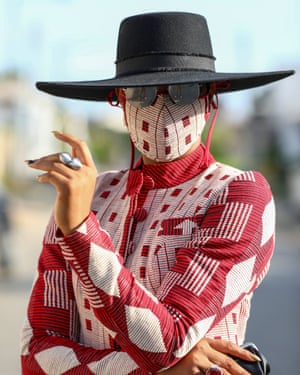
Nigerian influencer Angel Obasi wearing a face mask in Lagos, Nigeria May 2020


Nigerian influencer Angel Obasi wearing a face mask in Lagos, Nigeria May 2020. Photograph: Temilade Adelaja/Reuters

Today’s 20-year-olds, who have grown up with the climate emergency at the centre of their world view, see environmental impact as an essential part of thinking about fashion, rather than a notion at loggerheads with it. “I think the entire seasonal cycle should adapt itself to the climate crisis,” says Saskia Purr, a student at Nottingham Trent University. “Climate change is making our winters warmer and our summers longer.”

It is becoming fashionable, in industry circles, to propose that the way forward for fashion is to turn the clock back. “You know what fashion should have done? We should have stuck to our guns,” says Bebe Moratti, founder of the Italian ethical luxury brand Redemption. The fashion system, he says, should step away from the mass-consumption gravy train. “People say you can’t go back to the old ways, but that’s exactly what the brands that have survived the longest have done. Look at Hermès. That is what the dynamic of fashion should be – an investment in something that’s beautifully made, something that you love, a transaction that supports the person that made it. So, is my business model crazy, to go back to a place where we cherish what we buy, where we cherish the workers, where we cherish the environment? No. It’s not crazy at all. It works.”

“This crisis has made the nation less materialistic,” says Bournemouth student Ffion McCormick-Edwards. “We have stayed connected by talking about what we are looking forward to: things like a family barbecue, or a party with friends, or seeing our grandparents.”

Despite the blow of missing out on graduation, “I wouldn’t say this term has been all loss,” says fashion knitwear student Rhiannon Davies. “My collection has become a lot more authentic to me, because doing it at home has cut off the many voices that I would find distracting at university. Facing myself – and my own company – is something I don’t usually do a lot of. I almost feel I’ve found myself in the process.”

Still, the class of 2020 has been dealt a harsh blow. “I think the biggest loss is not the show itself, but the camaraderie around it,” says Gresty. “The last seven weeks before a show is sheer hard work, tears, panic, but also this amazing energy, supporting each other through the fatigue – and then coming together in celebration. Not having that is tough.” Despite the hardships of this term, she sees a bright future. “Students keep saying to me, ‘We’re so unlucky to be in this year – why us?’ and I say, ‘Are you joking? You are lucky. This is such a special year. This is the year that everyone will remember for ever.’”

Source link

Young, in love and running out of time: Indianapolis teenagers receive parents’ blessing to marry

CLOSE

Brad and Kelli Smith and Jeff and Jessica Mills talk about marriage of Chase and Sadie Smith. “They’re just better together,” said Sadie’s mother.

Indianapolis Star

INDIANAPOLIS – Chase Smith asked his parents to step out of the hospital room. He wanted to be alone with his doctor. He wanted to talk about life, his future, how much of it was left. It was late April and he had just learned that the tumors were back and had spread throughout his body.

Outside the room, Brad Smith waited anxiously, the idea swirling in his mind. Should he say it to Chase? Should he tell his son what he wanted to tell him?

When the door opened, Brad saw Chase standing there, just 18 but a man wise beyond his years. Brad had his answer.

He walked up to his son and whispered in his ear. “I’ll help you get a ring.”

“And I kind of got that look like, ‘How did you know?'” Brad said. “And I didn’t necessarily know that a wedding would entail in four days at that moment. I just knew from the get-go Sadie was his person. He never really told me that, but being a dad I could see it in his eyes. I knew that he would want to make that promise to her.”

A promise to love her forever — no matter how long forever was.

‘Better together’

Jeff Mills’ phone rang. His daughter Sadie was crying on the other end. The tumors that had spread in Chase’s body had a timeline. Doctors told Chase he likely had three to five months to live.

“Sadie is beside herself in tears,” Jeff said. “She’s telling me, ‘You know he’s my soulmate. We were going to get married.'”

‘I’m smiling under here’: Masks, plexiglass and questions the norm as hospitals lure patients back in COVID-19 era

Yes. He knew. Jeff and Jessica Mills both knew almost immediately that Chase was the one for Sadie.

“I told Chase way before any of this happened, ‘If I were to pick one person out in the whole world for her it would’ve been him,'” said Jessica.

Chase had been in Sadie’s heart for a long time, though she didn’t yet know him. At 13, the family was joking about what kind of man she would one day marry. Sadie is a perfectionist and has high standards.

She started listing her requirements: gorgeous, really smart, really mature, treats me like a princess and a super athlete.

“And I said, ‘Sadie, you need to lower your standards a little bit because I’m not sure you’re ever going to find that person,'” Jeff said. “Then I met Chase and I said ‘Holy cow, she was holding out for the right guy.’ Chase fits every one of those categories.”

‘Like a new diagnosis’: Cancer families struggle to continue treatment amid coronavirus pandemic

The two are identical in many ways, said Jessica. Competitive, loving and sometimes anxious. Chase has talked many times about how Sadie helps calm him down when he is in pain or when his mind goes to dark places.

“He does that for Sadie, too,” said Jessica. “I’m not sure what Chase does to her but he usually just puts his hands on both sides of her face and puts his forehead on hers and she’s just ready to roll.”

At the state diving competition, Sadie was warming up for her last three dives and she hit the board. Her nerves exploded. Would it happen again during competition?

She walked over to Chase. She put her hands up toward him and he put his hands on her.

“And ‘Bam’ she nailed it. He has a very calming effect on her,” said Jessica. “They are better together. They are. Who could stand in the way of that?”

‘How beautiful is that?’

The night after the devastating diagnosis up in his bedroom standing by his closet, Chase revealed the secrets of his heart to his mom, Kelli Smith.

“I need to ask you a question,” he said to her. “What do you think about me marrying Sadie?”

“I was like, ‘Oh how beautiful is that?'” Kelli said.

Kelli thought about all those firsts she had dreamed Chase would get to have after his first diagnosis with Ewing’s sarcoma at 13 — first date, first prom, getting a driver’s license. 

“And who doesn’t want their child to find their soulmate?” Kelli said. “We were on board 110%. It’s definitely a God thing they were brought together when they were. Not a minute before, not a minute later.” 

Kelli walked downstairs, her heart full. She told Brad: “Chase wants to marry Sadie. Now.”

Practicality set in. The logistics, making sure a marriage wouldn’t affect insurance for Chase, making sure a marriage wouldn’t take away Sadie’s diving scholarships to IUPUI.

“Sadie is a special, special person and I wanted to make sure she was taken care of,” said Kelli. “He may live three to five months, but I wanted to make sure she was taken care of after that.”

They told Chase to give them 24 hours. The parents went to work researching, making calls, looking through policies, asking questions. The next morning, they were satisfied.

“We gave him the thumbs up,” Brad said.

Now all that was left to do was up to Chase, asking Jeff for his daughter’s hand in marriage.

‘Of course you have my blessing’

The Smiths invited the Mills over for dinner. They’d met once at Sadie’s state diving championship. But it was casual conversation then. This night would be about deeper things, life things — the future of their children.

“We’re all just hanging out and Chase kicks everyone out of the room including Brad and Kelli,” said Jeff. “And I’m like, ‘I know what’s coming now.'”

From the day he had met Chase, Jeff noticed his maturity. It was like Chase was 30 years old. It was like talking to any of his other buddies, Jeff said. Chase’s old soul shined through that night as he poured his heart out to Sadie’s parents.

“He was very sincere. He told us how much he cared for her,” Jeff said this week, tearing up. “We all broke down into tears because of the situation, knowing his prognosis but just knowing he makes her so happy.”

Jeff wrapped Chase in a hug, looked into his eyes and told him, “Of course you have my blessing.” 

The wedding came together in less than a week. The day was filled with rain, from morning until night. Except for the 30 minutes Chase and Sadie stood in the spot where they shared their first kiss on Sadie’s driveway to say their vows.

One of the photos of Chase and Sadie under a tree shows the sun streaming down. Jessica says it was “God’s light shining down on them.”

“You would have no idea that four days prior we were given the news that our son had three to five months,” said Brad. “That’s how perfect that day was.” 

There have been naysayers, though few, who wondered why two high school seniors would marry. And people who say they only married because of Chase’s terminal illness. And those who ask how the parents could give their blessing.

“They got married because they wanted to and the love they have,” said Brad. “It wasn’t the cancer. Chase said, ‘Now is the time. Every day is a gift. I’m not going to waste another day without my bride.”

Hope they ‘rise together’

There were some mixed emotions for Jeff as he thought about the marriage. Sadie is his baby girl, after all. He worried about her heart, should something happen to Chase. He worried about how it might affect her future.

“I gave the blessing and I had a lot of time after to think about it,” he said. “And I never would take away the blessing because Chase is perfect for her but I had mixed emotions.” 

Sadie, who had always been a homebody, lives with Chase and his parents now. 

“That was sad for me,” said Jeff. “I teared up a lot in the last few months and I’m not a crier normally but then, you know.”

Sadie is so passionate and her devotion and commitment to Chase is intense. If Chase dies, Jeff wondered if Sadie would crumble.

“But the more I thought about it, she cares so deeply for him that I can see Sadie just elevating her life and making her standards that much higher just to honor Chase,” Jeff said. “I don’t see her crumbling. I see her rising.”

“My hope,” said Jessica, “is they rise together.”

Follow Dana Benbow on Twitter: @DanaBenbow. 

Read or Share this story: https://www.usatoday.com/story/news/nation/2020/06/13/2-teenagers-received-their-parents-blessing-marry-after-diagnosis/5345439002/


Source link

Finally, a Wedding. It Was About Time.

0

The author learned that loving is just as much about holding on as it is letting go.

Source link

Twinkle Khanna praises Dimple Kapadia’s performance in Tenet: Mother hits it out of the park once again

Image Source : INSTAGRAM/DIMPLEKAPADIA_FANPAGE

Twinkle Khanna reacts to Dimple Kapadia’s performance in Tenet

Twinkle Khanna is a proud daughter after watching her mother Dimple Kapadia’s performance in her upcoming Hollywood film Tenet. The actress will be making her Hollywood debut with the espionage thriller. While the release date of the film has been pushed forward, the trailer has already garnered much attention. Fans have been loving the veteran actress’s performance in the film. Now just fans, director Christopher Nolan and actor-filmmaker Kenneth Branagh have also sung praises for Dimple Kapadia.

Sharing a news piece in which Tenet actor John David Washington has described his experience of working with Dimple and complimented her acting skills, Twinkle wrote, “Mother hits it out of the park once again!”  The news piece read John saying, “There was a huge amount of excitement when we knew she was flying in and she pronounced herself very nervous. But then we heard about a rehearsal that she had with Christopher Nolan and John David Washington, and they both came away and said, ‘Well, if that’s nervous, I don’t know what calm is.”

He added, “Because she was perfect and quite awesomely brilliant as far as they were concerned and also completely gracious and delightful with the crew. So she made a tremendous impression.”

Directed by Christopher Nolan, Tenet also stars John David Washington, Robert Pattinson, Elizabeth Debicki, Kenneth Branagh, Aaron Taylor-Johnson, Michael Caine, Clemence Poesy and Himesh Patel. The espionage thriller was supposed to hit the theatres on July 17, it will now bow out on July 31, two weeks later.

“We’re especially thrilled, in this complex and rapidly changing environment, to be bringing Christopher Nolan’s ‘Tenet,’ a global tentpole of jaw-dropping size, scope and scale, to theaters around the world on July 31. It’s been longer than any of us could’ve imagined since we’ve seen a movie on the big screen, and to acknowledge Chris’ fans as we count down to ‘Tenet’’s” opening day, we are also excited to offer his masterpiece ‘Inception’ in theaters for its 10th anniversary on July 17,” Toby Emmerich, chairman of Warner Bros. Pictures Group said in a statement.


More Bollywood stories and picture galleries

For all latest news and updates, stay tuned to our Facebook page

Fight against Coronavirus: Full coverage


Source link

Thousands gather at Perth rally as handful turn up to banned Sydney protest

0

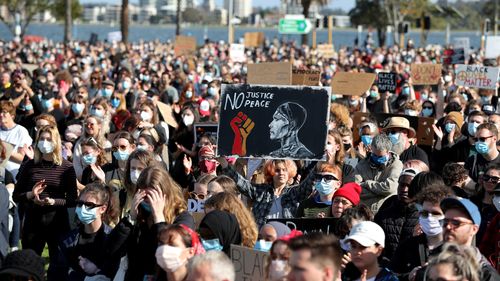
Thousands of people have gathered at a Black Lives Matter demonstration in Perth, as fewer numbers of people gathered for similar events in other cities, including for rallies not given permission to go ahead.

Deputy Prime Minster Michael McCormack had one last stab at trying to deter people from attending another series of protests across the country, fearing it could spark a second wave of the coronavirus

“These people who want to go into protest, they ought to think long and hard about their actions,” he said in Tumut, NSW, where he was on the Eden-Monaro by-election campaign trail with his Nationals candidate Trevor Hicks on Saturday.

Protesters show their support during the Black Lives Matter Rally at Langley Park, Perth. (Getty)
Protesters participate in a Black Lives Matter rally at Langley Park in Perth. The protest is to raise awareness of Aboriginal Deaths in Custody. (AAP Image/Richard Wainwright)

“The courts say no. The chief medical officer, Professor Brendan Murphy, says no. Common sense would dictate to them that they should be staying at home.”

His plea came as another five COVID-19 cases were reported in two states.

Prof Murphy has repeatedly urged people not to take to the streets after thousands turned out across the country last weekend for Black Lives Matter rallies, saying such events “really are dangerous”.

Despite health warnings over coronavirus, thousands have gathered in Langley Park for the city’s second Black Lives Matter protest. (AAP Image/Richard Wainwright)

Opposition Leader Anthony Albanese agreed, saying people shouldn’t protest in the current climate and should follow the health advice.

“There are a range of ways you can have your say without breaching the advice of the health experts,” he said in Queanbeyan on Saturday while also campaigning with Labor candidate Kristy McBain.

Despite health warnings over coronavirus, thousands have gathered in Langley Park for the city’s second Black Lives Matter protest.

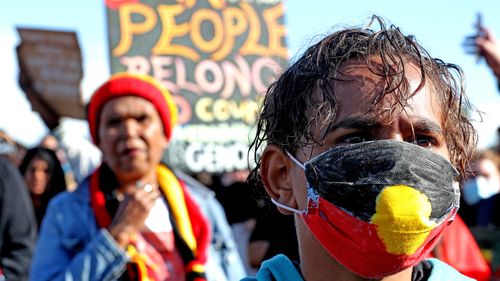
Aboriginal elders and leaders are among those who spoke to the crowd.

Brisbane asylum seeker protest

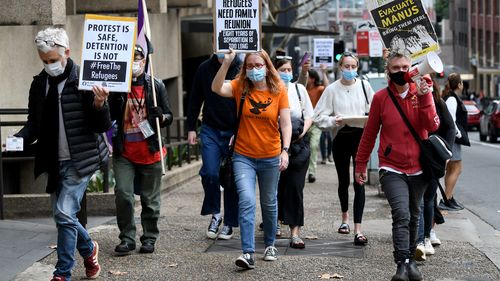
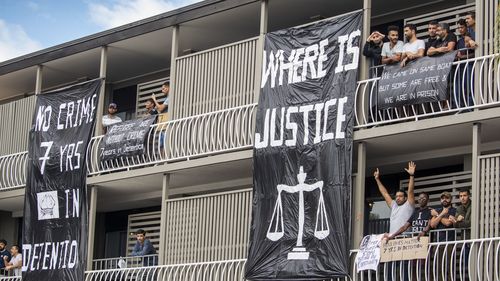
About 300 protesters have blockaded a Brisbane hotel, accusing the government of seeking to silence detained asylum seekers by moving them.

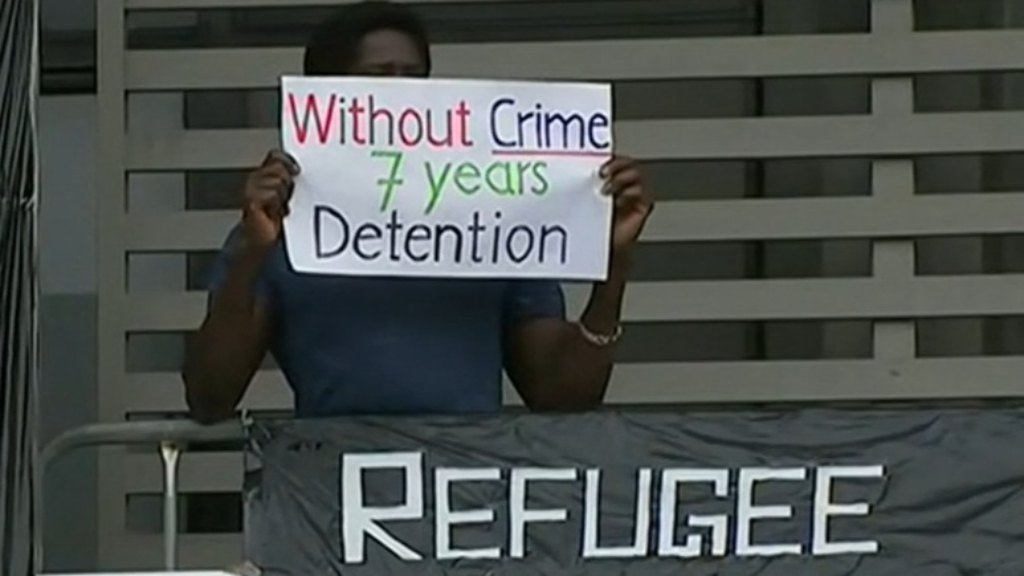
Asylum seekers watch from the balcony of the Kangaroo Point Cental Hotel as protesters participate in a “Free The Refugees” rally at Kangaroo Point in Brisbane. (AAP)

Supporters of about 120 detainees have vowed to continue preventing authorities from accessing the Kangaroo Point Central Hotel.

Protest organisers are demanding the government immediately cease transferring the asylum seekers and return people who’ve already been moved.

“The reason they are transferring them is because they have caused so much noise,” protest spokeswoman Ruby Thorburn told reporters on Saturday.

“It is really important that we continue to maintain that.”

Protesters claim authorities are intent on relocating asylum seekers who’ve staged a series of balcony protests over their long-term detention at the hotel.

About 40 men holding signs stood on the hotel’s balconies waving as the protest kicked off.

Some of those at the hotel have been in detention for years after coming to Australia for medical treatment.

The organisers are also demanding the men be granted freedom of movement.

“They cannot go out to exercise for their health. We demand they be allowed to walk around and get some fresh air,” protest spokesman Sam Watson said.

The protest commenced on Thursday night and continued on Friday.

The NSW Supreme Court on Thursday banned the Sydney protest following an application by NSW police citing significant COVID-19 health and safety concerns. (Getty)

Trucks and other vehicles leaving the hotel precinct were searched to ensure no asylum seekers were inside.

Premier Annastacia Palaszczuk previously warned people not to attend the rally due to coronavirus fears.

“It is essential we come out now. These men are in a dire situation. They are in a close confined place. They cannot socially distance,” Mr Watson said.

“The guards coming in and out are not isolating, so anything they pick up comes into the hotel and it spreads like wildfire.”

Ms Thorburn said organisers had negotiated with police and were handing out masks and hand sanitiser in an attempt to reduce transmission of the virus.

Deputy Prime Minster Michael McCormack had one last stab at trying to deter people from attending another series of protests across the country, fearing it could spark a second wave of the coronavirus (AAP Image/Bianca De Marchi)

“We are reminding people that we are in a pandemic and it is important to be mindful,” she said.

Melbourne refugee protests

Protesters have met across eight Melbourne locations to call for freedom for refugees stuck in indefinite detention.

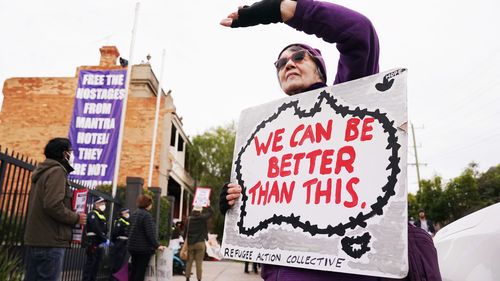
At a hotel in the northern suburb of Preston, Mantra Bell City, where some refugees have been held for at least seven months, up to about 30 protesters stood outside.

Protesters participate in a “Free The Refugees” rally at the Mantra Hotel in Melbourne, Refugee advocates are spreading themselves across Melbourne to avoid hefty fines for mass gatherings. (AAP Image/Michael Dodge)

Asylum seekers who were transported from Manus Island for medical treatment could be seen peering out of hotel windows to watch the rally.

A former refugee from Sri Lanka told the rally in a speech that detention centres and hotels housing asylum seekers are “basically prisons designed to inflict pain on people whose only crime is to seek asylum”.

The protesters have unfurled a banner off the side of a house facing the hotel which reads: “Free the hostages from Mantra Hotel, they are not criminals”.

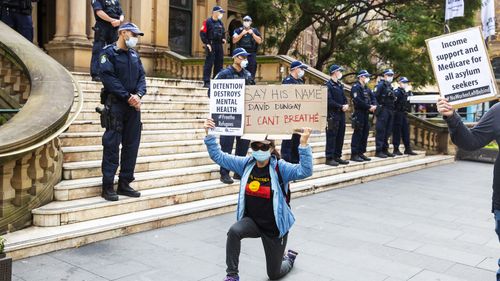
A protestor kneels in front of police officers at Sydney Town Hall. (Getty)

In Sydney, the Refugee Action Coalition attempted to flout a Supreme Court ban, defying a police warning they will be out in force if protests proceed.”

“Join an exercise protest by riding your bike, walking or jogging in small groups around the block around Sydney Town Hall,” RAC posted to Facebook.”…If people try to stop you and ask if you are part of the protest, you can tell them you are simply exercising, which is not illegal.”

A protester at Sydney Town Hall at a rally was organised to protest against the detention of refugees in Australia. (Getty)

However, the turnout was very small, and there was a large police presence at Sydney’s Town Hall.

Last night one person was arrested when a few hundred people who turned up at a rally were moved on by hundreds of police. Another person was arrested today.

Sydney held a massive BLM protest last week, which was allowed at the last minute.

Adelaide Black Lives Matter protests

A small number of South Australians have defied coronavirus restrictions by attending a Black Lives Matter rally despite the protest being cancelled after an exemption for the event was denied.

Police officers, mounted on horses, watched over Victoria Square in Adelaide’s CBD on a wet Saturday as about 30 protesters chanted while holding signs and wearing masks.

Protesters were even told to ‘wear activewear’ to go to the event in Sydney (AAP Image/Bianca De Marchi)

There was no indication that anyone was warned or fined as a result of their behaviour.

A protest has also been held in Darwin, in the Northern Territory, with hundreds of people attending.

Source by [author_name]

Coming of age during COVID-19

0

The challenges facing the class of 2020

Source by [author_name]