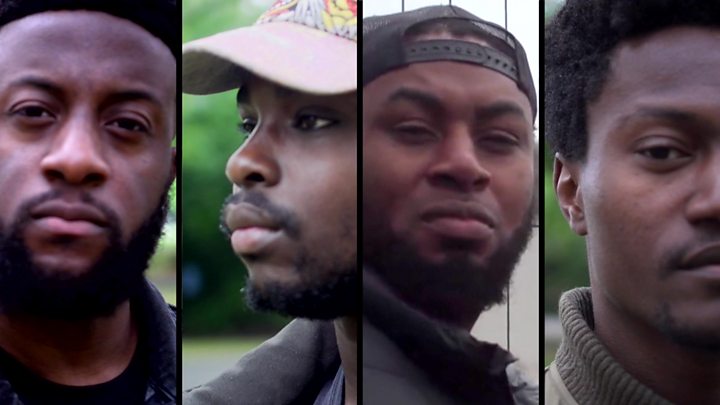
There is “much more that we need to do” to tackle racism but the UK should not try to “re-write the past” by removing historical symbols, the PM has said.
Writing in the Telegraph, Boris Johnson said he was setting up a commission to look at all “aspects of inequality”.
He said “no-one who cares about this country” could ignore the anti-racist demonstrations sparked by the killing of George Floyd in US police custody.
However, he added the UK’s heritage must be left “broadly in peace”.
Mr Johnson also condemned the “far-right thugs” involved in violent protests on Saturday, which saw more than 100 people arrested in London after thousands gathered saying they were protecting statues.
He said their mission was “utterly absurd” but he added that it was “deplorable” that Sir Winston Churchill’s statue had been in danger of attack.
It comes after the statue in Parliament Square was spray-painted with the words “was a racist” last weekend. In Bristol, anti-racism protesters pulled down a statue of slave trader Edward Colston.
Image copyright Reuters
The PM said he was setting up a commission to look at inequality as it was “no use just saying that we have made huge progress in tackling racism”.
He wrote: “There is much more that we need to do; and we will. It is time for a cross-governmental commission to look at all aspects of inequality – in employment, in health outcomes, in academic and all other walks of life.”
Mr Johnson said that “the serious points” being raised by the anti-racist demonstrators should be taken seriously.
However, he said that did not mean “wasting time” disputing the life and opinions of “every historical personality currently immortalised in bronze or stone”.
“Let’s fight racism, but leave our heritage broadly in peace. If we really want to change it, there are democratic means available in this country – thanks, by the way, to Winston Churchill,” he said.
‘Condescending’
But Labour’s shadow equalities secretary Marsha de Cordova criticised some of Mr Johnson’s words.
“We are in the midst of a global health pandemic that has sharply exposed deep structural inequalities which have long since needed urgently addressing,” she said.
“That the prime minister now says he wants to ‘change the narrative… so we stop the sense of victimisation and discrimination’ is condescending and designed to let himself and his government off the hook.”
Liberal Democrat equalities spokesperson Christine Jardine said the commission was a “welcome first step” and showed the Black Lives Matter protests were working.
But she added: “Its findings must not become simply another report on a shelf in Whitehall – the government must implement them without delay.
“Conservative ministers must not use this commission to avoid tackling racism and injustice right now. There are measures they could take tomorrow, such as scrapping their hostile environment policies or suspicion-less stop and search, that would begin to heal the divides and achieve true justice for BAME communities.”
The fatal police shooting of Rayshard Brooks, a black man who was found asleep in a car in a drive-through at a Wendy’s on Friday night in Atlanta, has reignited the debate over Tasers.
Mr. Brooks, 27, had fled from the police after failing a sobriety test, and grabbed a Taser from an officer during a struggle, the authorities said.
“During the chase, Mr. Brooks turned and pointed the Taser at the officer,†the authorities said, adding that “the officer fired his weapon, striking Brooks.â€
Kalfani N. Turè, an assistant professor of criminal justice at Quinnipiac University in Connecticut, said the shooting of Mr. Brooks was what was known in police circles as “lawful but awful.â€
That is, he said, officers are trained that they have the right to escalate their use of force if they believe someone is threatening to incapacitate them.
In the case of Mr. Brooks, Professor Turè said, other options were available to the officers: Identify Mr. Brooks through his car and track him down later, for instance, or call for backup to help apprehend him.
The episode has put a spotlight on a number of police tactics, including the use of Tasers. Here are some answers about the devices.
What is a Taser?
The devices, which have been used by law enforcement for decades, can temporarily immobilize a person — think of someone who is combative or resisting arrest, for instance — by jolting them with 50,000 volts of electricity.
A discharge, also known as a “cycle,†can last five seconds. The shock can cause pain that has been described as excruciating.
As Dennis J. Kenney, a professor at John Jay College of Criminal Justice in Manhattan, put it, “Your muscles freeze up, and down you go.â€
The makers of the Taser came up with the product name as an acronym loosely derived from a 1911 book, “Tom Swift and His Electric Rifle,†Professor Kenney said.
How do they work?
The device can be used from a distance or in “drive mode,†in which the charge is driven directly into a person’s body at close range, said Robert J. Louden, a professor emeritus of criminal justice and homeland security at Georgian Court University in New Jersey.
When a Taser is fired from a distance, prongs or darts connected by wires are discharged at a person. In those cases, Tasers have a reliable range of about 10 feet, Professor Kenney said, but beyond that, their effectiveness in hitting a target becomes spotty.
The largest number of Taser-related deaths were in California (92), Florida (65) and Texas (37).
“Even if deaths directly from Taser shocks are relatively rare, adverse effects can happen very quickly, without warning, and are impossible to reverse,†Kristina Roth, senior program officer for criminal justice programs at Amnesty International USA, said on Sunday.
The shock delivered to the chest by a Taser can lead to cardiac arrest and sudden death, according to a 2012 study in the journal Circulation.
The study looked at the records of eight people who went into cardiac arrest after they received shocks from a Taser X26 from a distance. Seven of the people died.
The maker of Tasers, Axon Enterprise, formerly known as Taser International, said in a statement on Sunday that “any loss of life is a tragedy regardless of the circumstance, which is why we remain committed to developing technology and training to protect both officers and the community.â€
Why were they developed?
Tasers were marketed as a “panacea,†one that would help officers deal with noncompliant individuals, said Professor Turè, who previously served in three law enforcement agencies in Georgia, including the State Police.
Tasers are a class of “less than lethal†tools designed to improve what Professor Kenney said were the “midrange options†for officers. Before Tasers, officers’ options were at the extremes — relying on verbal commands or the use of deadly force with a firearm.
Another approach, such as hand-to-hand combat, is a “perishable skill†that requires constant training, he said. “What are my options?†he said. “I would roll around on the ground with you: I’m going to lose as many of those as I’m going to win.â€
Are they effective?
Axon says the devices save lives and prevent injuries.
“Our mission is to protect life and we prioritize safety above all else,†the company said in its statement. “Taser weapons are not risk free but they are proven safer than batons, fists, take downs, tackles and impact munitions.’’
The company, which said it had sold approximately 700,000 Tasers to “public safety professionals†worldwide,estimated that more than 234,000 people had been saved from death or serious injury because “an officer used a Taser device to de-escalate the situation.â€
Do they de-escalate confrontations?
The devices can bring an abrupt halt to a confrontation and disable an uncooperative person, but if they are discharged and don’t work — or even when they do — sometimes the effect can be to make things worse.
If a person is angry, under the influence of alcohol or drugs, or has a mental illness, the use of a Taser can exacerbate those conditions and inflame a situation, said Joel Feinman, the chief public defender in Pima County in Arizona.
“When you look at who these things are being deployed against, this is a tool of escalation, not de-escalation,†Mr. Feinman said. “Now the police officer is thinking: ‘Now that didn’t work. Now I have to use the other tool attached to my belt, which is a 9-millimeter handgun.’â€
Police agencies in major cities have rated Tasers less than effective, according to “When Tasers Fail,†an investigation by American Public Media last year.
The site looked at 3,000 fatal police shootings between 2015 and 2017 that involved the use of a Taser and found that in 258 of the cases, a Taser “had failed to subdue someone before the police shot and killed them.â€
In addition, in more than a third of the cases, the person became more aggressive after the device was used, which may have contributed to an escalation of the incident.
What else can go wrong?
Professor Louden said a person’s physical stature — height and weight — and how amped up they might be on adrenaline can play a role in being resistant to the effects of less-than-lethal methods.
Professor Louden, a former hostage negotiator for the New York Police Department, recalled once trying to deal with a barricaded person with a mental illness who had a machete taped to his hand. Officers used mace, he said. “He took I don’t know how many canisters to the face, and it had no effect,†he recalled.
In the case of someone who is high on a mind-altering drug like PCP, also known as angel dust, Tasers are ineffective. “They walk right through it,†Professor Turè said.
Problems also surface even when the prongs successfully latch onto a person.
Tasers are most effective when connecting to light clothing but are less so with heavy winter gear, like a leather coat. Sometimes, only one prong will attach, and sometimes the devices are not properly charged, experts said.
Are there reforms being considered?
Part of the underlying problem is that the police culture does not emphasize methods to defuse situations, Professor Turè said. He said that in his 200 hours of training to become a police officer, 192 hours were dedicated to the use of force and only eight to de-escalation.
Police departments have their own policies and practices for when Tasers should be deployed, he said, and there is no reliable universal data tracking their use.
“Despite the choppy evidence of their effectiveness,†he said, “you have 18,000 police departments not really in any conversations with each other.â€
A 28-year-old has been charged after a photograph emerged of a man appearing to urinate next to a memorial for PC Keith Palmer, who was stabbed to death in the 2017 Westminster terror attack.Â
Andrew Banks, from Stansted in Essex, has been charged with outraging public decency and is set to appear at Westminster Magistrates’ Court on Monday, Scotland Yard said.
PC Palmer was killed three years ago by a terrorist who drove his car into pedestrians on Westminster Bridge before storming the gates near parliament.
The photograph of a man urinating was widely shared on social media and is believed to have taken place on Saturday afternoon during protests in Parliament Square.
More than 100 people were arrested during the protests on Saturday, which later descended into violence between rival protesters and police.
Corruption is mother of all evils. NAB was established in 1999 in order to eradicate corruption and to recover looted money from corrupt elements and deposit in the national exchequer. Honorable Justice Mr. Javed Iqbal, after assumption of his responsibilities as Chairman NAB more than two years ago has introduced a comprehensive and effective national anti corruption strategy “NAB’s Faith; Corruption-free Pakistan†which has started yielding excellent results.
Reputed national and International Organizations like Transparency International Pakistan, World Economic Forum, PILDAT, Mishal Pakistan have not only lauded NAB’s efforts for eradication of corruption but in the Gillani and Gallop Survey about 59 percent people have shown their confidence upon NAB as NAB under the dynamic leadership of Honorable Justice Mr. Javed Iqbal, Chairman NAB has not only recovered 178 billion from corrupt elements during his tenure which is remarkable achievement as compared to previous years of NAB. NAB has filed 600 corruption references in the respected accountability courts and conviction ratio of NAB in the Accountability courts is about 70 %. Currently, there are 1229 corruption references of NAB are under process in 25 respected Accountability courts and their total worth is more than Rs. 900 billion.
Today, eradication of corruption is the voice of the whole nation. Eradication of corruption from the country is the top most priority of NAB. NAB is role model for SAARC countries as NAB is Chairman of SAARC anti Corruption forum and is focal organization of Pakistan under United Convention against Corruption (UNCAC). Moreover, NAB is Chairman of SAARC anti Corruption forum. NAB is the only organization who has signed Memorandum of Understanding (MOU) with China in order to enhance cooperation in eradication of corruption. NAB has established state of the Art Forensic Science Laboratory in NAB Rawalpindi but also established its own Pakistan Anti Corruption Training Academy at NAB headquarters in order to equip its investigation officers with modern techniques to investigate white collar crimes cases. NAB has also signed Memorandum of understanding (MOU) with Higher Education Commission to aware students of Universities/Colleges about the ill effects of corruption at an early age as youth is our future. In this regard, more than 50 thousands Character Building Societies (CBS) have been established in Universities/Colleges throughout the country.
In line with its Enforcement Strategy, NAB has initiated complaint verifications, inquiries and investigations across the board on alleged allegations of corruption and corrupt practices. The indiscriminate actions of NAB have increased the prestige of NAB manifold against the mighty as the aim of NAB is to apprehend the corrupt elements and deposit the looted amount in the national exchequer.
Honorable Justice Mr. Javed Iqbal, Chairman NAB has rejuvenated NAB in order to eradicate corruption from Pakistan. Chairman NAB not only reviews progress of NAB headquarters but also of all the regional Bureaus on regular basis. The excellent performance of NAB under the leadership of Chairman NAB is indicative of the hard work, transparency being put in by all ranks of NAB staff in an atmosphere of renewed energy and dynamism, where fight against corruption is being taken as a national duty. On the directions of Chairman NAB, all complaints are being computerized and all DGs of Regional Bureaus are ensuring not only self respect of all the concomitants but also responded promptly to all the complaints of concomitants very expeditiously as per law.
Chairman NAB Justice Javed Iqbal has spent more than 40 years of his life in providing justice to people starting from Session Judge Quetta to Acting Chief Justice of Honorable Supreme Court of Pakistan and now Chairman NAB. He has an unmatchable and balanced personality with integrity, honesty, honor and dignity. He believes in self respect of humanity and does not believe in breaching self esteem of any person who comes in NAB. He always believes in law abiding and firmly believes in eradication of corruption by ensuring accountability to all. His performance for the last more than two years has proved without any iota of doubt that Chairman NAB Justice Javed Iqbal has proved true to his words indiscriminate accountability in order to make Pakistan corruption free. He believes that corruption is mother of all evils which is major cause of our problems and eating all our resources gradually.
Chairman NAB believes that Pakistani nation is the best nation in the world which has all the abilities to check corruption and corrupt practices. There is dire need to ensure merit and transparency so that the dream of eradication from Pakistan turned into reality. NAB is taking visible and indiscriminate actions against the corrupt elements. Corrupt elements are being probed by NAB as per law. All DGs of NAB have been directed to perform their duties in accordance with law under the leadership of Justice Javed Iqbal Chairman NAB. Due to this reason, sincere effects of NAB for eradication of corruption have started yielding excellent results under the dynamic leadership of Honorable Justice Mr. Javed Iqbal, Chairman NAB.
Some of the doctors, who have spoken on the condition of anonymity because of their employment, say the claims against them have been disproved or spurious, and are calling for a parliamentary inquiry into the hospital’s conduct.
They cite examples of complaints against them such as using the “f-word” in front of students, telling surgery interns they are “hopeless”, or being “clever but rude and condescending” and not being people junior staff wanted to work with because they “made life a misery”.
Instead of standing doctors down or embroiling them in dispute procedures that sometimes last for years, they say a system of mediation should be implemented.
Senior RPH doctors, including general, trauma and plastic surgeons, urologists, anaesthesiologists and emergency specialists, have left because of the problems.Credit:File
‘Stripping to his underwear’
One experienced surgeon faced years in dispute with hospital bureaucrats after a complaint about how he demonstrated the application of a tourniquet. The surgeon lay on a hospital gurney and had a student put it on his bare leg above the knee in front of his class.
He was penalised for “unacceptable behaviour” – for “stripping to his underwear” – and ordered to take a course called Teaching on the Run, despite having instructed students in the same way about 75 times over 15 years.
In response, 64 nurses signed a letter to hospital administrators protesting his treatment and dozens of other doctors provided letters of support. He has been told his contract will not be renewed when it expires in 2021.
The nurses said he could be firm, but that was because he “role models his expectation that we are to care for and to provide for our patients as if they were … our own family members”.
According to a WA Health document, many of the allegations boil down to senior consultants using “outdated methods of teaching including humiliation and demeaning tones”.
But one specialist, who resigned instead of fighting accusations he shouted at junior doctors, said stamping out bullying was their “big thing”, but in the process administration had become bullies themselves.
‘Outright lies’
“The worst allegations are the ones where they just outright lie,” he said.
“I don’t scream and yell at people, it’s just not what I do. But they say ‘you’re guilty’ because they have to protect the people who are bullied.
“You think, ‘hang on a minute – I worked for you tossers for 35 years, you’ve probably got to treat me with a bit of respect’.”
He said specialists still working at the hospital were afraid to speak up.
“That’s Soviet era stuff; the fear of persecution by an authority, that’s not meant to happen in a Western democracy,” he said.
“The administrators couldn’t give a s–t.”
Another specialist with 40 years experience at the hospital was ordered to undergo a psychological evaluation. This involved interviews with his colleagues where they were asked to assess his personality. He was barred from seeing patients while on full salary after a series of complaints, including one in which he was accused of being “undefendably seditious and argumentative”.
He said he felt he was targeted as a cost-savings measure.
“The system I encountered was appalling and it seemed to be targeted at consultants who maybe had been there a long period of time, and they felt that the time was right economically to get rid of them by means that were not procedurally fair and really damaging to the people who received that treatment,” he said.
He said there was “absolutely” an assumption he was guilty when he was accused of being disagreeable with colleagues.
“I just couldn’t prove or disprove my innocence,” he said.
“There was no procedural fairness in that whatsoever, despite my asking and sending emails to my colleagues, and asking whether any of them had issues, and they all denied that.”
Nonetheless, he was barred from treating patients and ordered to undergo a psychological evaluation before he could return to work.
AMA president Andrew Miller said a bad culture had arisen within the health department because of the inadequate complaints processes.Credit:Marta Pascual Juanola
System broken as generations clash
AMA (WA) president Andrew Miller said there was a clash of cultures between two generations of doctors which had not been well managed.
“There’s a problem, which is there’s a generational difference in expectations where we see a clash of an old-style culture which was very much a resilience culture with a new culture which is very much a collaborative based, empathetic culture,” he said.
“The younger practitioners are very good at admitting their vulnerabilities and knowledge gaps and having that treated sensitively, whereas the older practitioners came up in a system where you got the good stuff beaten into you.
“It’s been left to evolve on its own and then in comes a bureaucracy – and nothing good ever happens once the bureaucracy gets involved – and they impose a process which is very heavy handed and doesn’t recognise what the underlying problem is.”
In 2017 the Australian Medical Association wrote to the chairman of the East Metropolitan Health Service board, which runs Royal Perth Hospital, claiming the hospital administrators had denied doctors natural justice and procedural fairness.
“The lack of procedural fairness and denial of natural justice blatantly disregard WA Health’s Discipline Policy and Code of Conduct and ignore industrial principles established by case law over many years,” the letter from then executive director Paul Boyatzis said.
He set out seven cases relating to doctors to illustrate his concerns and warned they were not a “comprehensive list of all matters raised with the AMA by our members”.
It’s like Kafka’s Castle. It’s exactly like that. You can’t get any straight answer out of anyone and you realise their intention is to get rid of you slowly, by attrition, grinding you down.
Former RPH specialist
Sacked to save money?
WAtoday understands the doctors, who are all concerned about how administrators handle complaints, have banded together to raise the alarm, with some calling for an investigation into how the hospital has treated senior physicians.
“There should be a parliamentary inquiry into what has actually happened to the senior consultants in different hospitals and how they’ve been treated,” one doctor said.
“If it was an economic decision [to get rid of doctors], then they can be treated in a much more kindly manner and if they are reaching retirement age they can be offered whatever is appropriate.
“But to target them, to torment them, to harass them, to bully them is not the appropriate procedure.”
The doctors all spoke of the personal and professional costs of dealing with the complaints against them.
“It’s psychological torture for a lot of people,” a specialist said.
“It’s like Kafka’s Castle. It’s exactly like that.
“You can’t get any straight answer out of anyone and you realise their intention is to get rid of you slowly, by attrition, grinding you down.”
Dr Miller said a bad culture had arisen within the health department because of the inadequate complaints processes and a policy of keeping doctors on five-year contracts rather than making them employees.
This made it easier to tell doctors they wouldn’t be renewed rather than dealing with complaints appropriately or performance managing them. It also meant senior doctors were reluctant to raise issues with administrators.
“What this is feeding into is a reduction in quality, because if people say working in my field, if you’re working in anaesthesia and you identify a problem, and you take it to admin and say, ‘we really should be doing this’, it’s not worth the risk now,” he said.
“They can just smile at you and say, ‘yeah you know what, we don’t want to do that and by the way, when’s your contract up?’.”
But Dr Miller stopped short of supporting the doctors’ call for an inquiry and said the process needed to be immediately fixed so it was fairer and led to timely resolutions.
“The cupboards are full of inquiries into this sort of thing so what we want to see is some actual permanent change on the ground,” he said.
“I don’t want to see an inquiry as such, I think if there are individual instances they need to be managed in a fair way to both parties.
“Some of these issues have been hanging over people’s heads for years on end and then they never come to a satisfactory conclusion.
“I don’t want an inquiry, but I want them to tidy up those issues, institute a proper process and give people permanent jobs so that they can speak up without fear or favour.”
Department says ‘zero tolerance’ is fair and equitable
Health Minister Roger Cook said there had to be a “strong policy of zero tolerance to bullying and inappropriate behaviour”.
He said the complaints system was clear and the government had implemented a survey to identify workplace issues.
In a comprehensive statement, the Department of Health and East Metropolitan Health Service said the discipline and complaints system was “transparent and equitable” while being part of an “organisational culture where bullying and misconduct is not tolerated”.
“All staff members, including junior doctors, are encouraged to report inappropriate behaviour – to ensure it can be appropriately investigated, with disciplinary action taken as required.
“Each health service provider has integrity and misconduct processes in place to ensure staff feel supported and empowered to discuss any concerns.”
The spokeswoman said the department’s discipline policy must “ensure appropriate, reasonable, procedurally fair and timely management of suspected breaches of discipline.”
The doctors all spoke of the personal and professional costs of dealing with the complaints against them.Credit:File
“All senior medical practitioners on five-year contracts are WA health system employees and the provision of a contract should in no way be used to deviate from management obligations and responsibilities,” she said.
The East Metropolitan Health Service said staff were encouraged to “call out poor behaviour, and in the majority of instances, these complaints are handled informally by discussion or mediation processes”.
“Where allegations are of a more serious nature or repeated behaviour has occurred, these are managed in accordance with the Public Sector Commission’s Public Sector Standards in Human Resource Management, and the Department of Health Employment Policy Framework,” a spokeswoman said.
“These processes are consistent across the WA Health system and seek to ensure a fair and reasonable approach to the management of matters that may concern a breach of discipline.
“RPH has a proud history of teaching and training junior doctors for more than 100 years, and the overwhelming majority of consultants have always behaved exceptionally towards junior staff.”
Nathan is WAtoday’s political reporter and the winner of the 2019 Arthur Lovekin Prize for Excellence in Journalism.
Correction: An earlier version of this story misstated Juneteenth’s relation to slavery. It celebrates the Emancipation Proclamation, but the Emancipation Proclamation didn’t apply to all states in the USA. The 13th Amendment brought an end to slavery.
On June 19, Americans around the country will celebrate Juneteenth, a holiday commemorating the Emancipation Proclamation in the USA.
This year, the annual celebration of freedom comes as the country grapples with its long-standing history of systemic racism, as well as the fate of its Confederate monuments, flags and symbols amid nationwide protests against police brutality and racism after the death of George Floyd.
“Juneteenth is a unifying holiday. It is the completion of the celebration of freedom in America,” said Steve Williams, president of the National Juneteenth Observance Foundation.Â
Juneteenth is often celebrated with joyful community and family gatherings, but many of these events will probably go virtual this year because of the coronavirus pandemic.
Here is what you should know about Juneteenth:Â
What is Juneteenth?Â
On June 19, 1865, Maj. Gen. Gordon Granger informed a reluctant community in Galveston, Texas, that President Abraham Lincoln had freed enslaved Americans in rebel states two and a half years earlier. He pressed locals to comply with the directive.Â
Although Lincoln proclaimed the emancipation of slaves, effective Jan. 1, 1863, slave owners were responsible for telling their slaves that they were free, and some ignored the order until Union troops arrived to enforce it, according to Cliff Robinson, founder of Juneteenth.com. Texas was the last Confederate state to have the proclamation announced.
Though the story of Texas’ emancipation is the most widely known, Williams said, other significant events in the history of emancipation took place on and around that date. He said the first known Juneteenth celebrations began in 1866 and spread across the country as African Americans migrated to new cities.
Today, 47 states and Washington, D.C., recognize Juneteenth as either a state holiday or ceremonial holiday. Juneteenth celebrations have been seen in episodes of television shows such as “Black-ish” and “Atlanta”.
Activists push for wider recognition, including a designation as a national holiday and an acknowledgment by Wall Street and the New York Stock Exchange.
“Federal recognition is really what our job is,” Williams said.
Juneteenth is a combination of “June” and “nineteenth,” in honor of the day that Granger announced the abolition of slavery in Texas. The holiday is also known as Freedom Day or Emancipation Day.
How do people celebrate Juneteenth?Â
Juneteenth is typically celebrated with educational activities for children, parades, concerts, beauty pageants and readings of the Emancipation Proclamation, Williams said.
At cookouts, he said, red food and drink, such as strawberry soda and red velvet cake, are traditional. Red, white and blue are on the Juneteenth flag. The color red symbolizes that “from the middle passage to George Floyd, our blood has been spilled across America,” Williams said.
Williams said many events will be livestreamed online and in lieu of traditional parades, some organizers have planned caravans.
As states lift coronavirus-related restrictions, Robinson said, it’s possible people will still gather physically this year. He urged people to follow social distancing guidelines and wear masks if they do. Robinson said he believes the nationwide protests after Floyd’s death will draw more people.
“That certainly will allow and inspire more people to participate in Juneteenth celebrations,” Robinson said. “They just have to be made aware that the celebration exists.”
He noted that more companies have started to recognize Juneteenth amid the protests against racism. Jack Dorsey, CEO of Twitter and digital payment platform Square, said both companies will make Juneteenth a company holiday this year at all of their offices across the world.
Hulu is shifting the premiere dates for two original shows, “Love, Victor” and “Taste the Nation,” so as not to detract from Juneteenth. The company announced it is taking action to “fight against the injustice” and support the Black Lives Matter movement by donating $5 million to nonprofit organizations, including the NAACP.
“The date represents an important turning point for our nation and for human rights, and we believe that now, more than ever, it deserves to have its own day in the spotlight,” the tweet read.Â
President Donald Trump had planned to hold a campaign rally on Juneteenth in Tulsa, Oklahoma, the site of a massacre in 1921 when white men attacked and killed Black residents in a Black business district. Facing backlash over the date, Trump announced Friday night he would move the Tulsa rally one day later.
“We had previously scheduled our #MAGA Rally in Tulsa, Oklahoma, for June 19th – a big deal,â€Â he wrote on his Twitter account. “Unfortunately, however, this would fall on the Juneteenth Holiday. Many of my African American friends and supporters have reached out to suggest that we consider changing the date out of respect for this Holiday, and in observance of this important occasion and all that it represents. I have therefore decided to move our rally to Saturday, June 20th, in order to honor their requests.â€
Though Juneteenth marks the day Texas was informed of the Emancipation Proclamation, freeing the slaves there as it had in other secessionist states, it did not apply to Union states, such as Maryland, which had slaves but had not seceded in the Civil War. The Thirteenth Amendment, which was ratified in 1865, freed slaves everywhere in the USA.Â
Macron’s focus on social solidarity, eco-friendliness and ramped up national industrial capacities is a departure from his traditional policies and the clearest sign yet of how he plans to reinvent his political program to regain public support. The coronavirus crisis forced him to suspend some of his most emblematic economic reforms and exposed France’s dependence on China, which weakened its initial response to the epidemic.
Early on in his presidency, he had urged more European sovereignty on issues like military capabilities and the rollout of next-generation 5G mobile networks which he qualified as strategic, but the push for national industrial capacities in the medical field started during the crisis and is now being expanded.
Macron on Sunday also advocated again for the European recovery fund as set out by a Franco-German initiative, saying it would be “an unprecedented step in our European adventure and the consolidation of an independent Europe that gives itself the ability to affirm its identity, its culture, its singularity in the face of China, of the U.S. and the global disorder we are seeing.”
Macron also promised to grant more powers to local authorities, without going as far as explicitly mentioning decentralization, in a country with a hyper-centralized governance.
And he tried several times to defend his track record in managing the crisis and persuade the French people that the country had handled it well, arguing the government had taken unprecedented economic measures that most other governments can’t afford, such as pumping €500 billion into the economy under various schemes.
“I want you tonight to measure this fully. In how many countries was all this done? That’s fortunate and it shows the strength of our state and our social model,” Macron said. “We can be proud of what was done, and of our country.”
French President Emmanuel Macron | Pool photo by Ludovic Marin/AFP via Getty Images
French president sketches out the main themes of the next two years of his mandate.
PARIS — Emmanuel Macron sent strong signals on Sunday that he plans to reset his presidency by pivoting to more environmentally-friendly economic policies with more social welfare and less dependence on foreign production.
After announcing that all coronavirus related restrictions would be lifted across the country starting Monday, except for restrictions on large gatherings, Macron sketched out the main themes of the next two years of his mandate.
“Our first priority is to rebuild a strong, environmental, sovereign economy [with strong social] solidarity,” Macron said in a pre-recorded televised address on Sunday. “This economic, environmental reconstruction with social welfare will be the key to our independence.”
Macron’s focus on social solidarity, eco-friendliness and ramped up national industrial capacities is a departure from his traditional policies and the clearest sign yet of how he plans to reinvent his political program to regain public support. The coronavirus crisis forced him to suspend some of his most emblematic economic reforms and exposed France’s dependence on China, which weakened its initial response to the epidemic.
Early on in his presidency, he had urged more European sovereignty on issues like military capabilities and the rollout of next-generation 5G mobile networks which he qualified as strategic, but the push for national industrial capacities in the medical field started during the crisis and is now being expanded.
Macron on Sunday also advocated again for the European recovery fund as set out by a Franco-German initiative, saying it would be “an unprecedented step in our European adventure and the consolidation of an independent Europe that gives itself the ability to affirm its identity, its culture, its singularity in the face of China, of the U.S. and the global disorder we are seeing.”
Macron also promised to grant more powers to local authorities, without going as far as explicitly mentioning decentralization, in a country with a hyper-centralized governance.
And he tried several times to defend his track record in managing the crisis and persuade the French people that the country had handled it well, arguing the government had taken unprecedented economic measures that most other governments can’t afford, such as pumping €500 billion into the economy under various schemes.
“I want you tonight to measure this fully. In how many countries was all this done? That’s fortunate and it shows the strength of our state and our social model,” Macron said. “We can be proud of what was done, and of our country.”
Brandon Brown leads a pack of cars during the NASCAR Xfinity Series Contender Boats 250 at Homestead-Miami Speedway Sunday. The Cup Series race later on Sunday will be the first with fans in the stands since March.
Michael Reaves/Getty Images
hide caption
toggle caption
Michael Reaves/Getty Images
Brandon Brown leads a pack of cars during the NASCAR Xfinity Series Contender Boats 250 at Homestead-Miami Speedway Sunday. The Cup Series race later on Sunday will be the first with fans in the stands since March.
Michael Reaves/Getty Images
On Sunday, up to 1,000 South Florida service members, first responders and family members who came to Homestead-Miami Speedway are becoming the first fans to watch a NASCAR race from the stands since March.
“It’s huge,” driver Tyler Reddick told the Palm Beach Post. “I’m used to seeing crowds, literally right there. We were racing, it just felt like we were going out there to run some practice or tests. So I’m really glad we’re going to have some fans back.”
Fans are undergoing health screenings before entering and are required to wear face masks and socially distance by six feet at all times, according to NASCAR.com.
“The race-day experience will be different, it’s just different times, and fans will have to adjust [to] that,” Daryl Wolfe, NASCAR’s executive vice president and chief operations and sales officer, told the site. “We will have to adjust on how we’re addressing these issues for fans. We think we have a very, very good plan in place — a very detailed plan — but make no mistake, I’m sure there will be some key learnings coming out of Homestead that then we will reapply and adjust for Talladaga.”
Next Sunday, up to 5,000 fans will be allowed to attend the GEICO 500 at the Talladega Superspeedway in Alabama.
“It is so dependent on the local communities, advice from medical experts, working directly with governors’ offices,” Wolfe said. “Candidly, frankly, in some states there is more flexibility than in other states. ​Having said that, we can probably be more aggressive with some of these numbers, but we’re choosing not to. We want to start very small, learn and then adapt.”
The return to the stands comes as both Florida and Alabama work to reopen their states, despite COVID-19 cases continuing to increase across the country. Florida has had more than 73,000 cases and nearly 3,000 deaths; Alabama has had more than 25,000 cases and at least 773 deaths.
We use cookies on our website to give you the most relevant experience by remembering your preferences and repeat visits. By clicking “Accept”, you consent to the use of ALL the cookies.
This website uses cookies to improve your experience while you navigate through the website. Out of these, the cookies that are categorized as necessary are stored on your browser as they are essential for the working of basic functionalities of the website. We also use third-party cookies that help us analyze and understand how you use this website. These cookies will be stored in your browser only with your consent. You also have the option to opt-out of these cookies. But opting out of some of these cookies may affect your browsing experience.
Necessary cookies are absolutely essential for the website to function properly. These cookies ensure basic functionalities and security features of the website, anonymously.
Cookie
Duration
Description
cookielawinfo-checbox-analytics
11 months
This cookie is set by GDPR Cookie Consent plugin. The cookie is used to store the user consent for the cookies in the category "Analytics".
cookielawinfo-checbox-functional
11 months
The cookie is set by GDPR cookie consent to record the user consent for the cookies in the category "Functional".
cookielawinfo-checbox-others
11 months
This cookie is set by GDPR Cookie Consent plugin. The cookie is used to store the user consent for the cookies in the category "Other.
cookielawinfo-checkbox-necessary
11 months
This cookie is set by GDPR Cookie Consent plugin. The cookies is used to store the user consent for the cookies in the category "Necessary".
cookielawinfo-checkbox-performance
11 months
This cookie is set by GDPR Cookie Consent plugin. The cookie is used to store the user consent for the cookies in the category "Performance".
viewed_cookie_policy
11 months
The cookie is set by the GDPR Cookie Consent plugin and is used to store whether or not user has consented to the use of cookies. It does not store any personal data.
Functional cookies help to perform certain functionalities like sharing the content of the website on social media platforms, collect feedbacks, and other third-party features.
Performance cookies are used to understand and analyze the key performance indexes of the website which helps in delivering a better user experience for the visitors.
Analytical cookies are used to understand how visitors interact with the website. These cookies help provide information on metrics the number of visitors, bounce rate, traffic source, etc.
Advertisement cookies are used to provide visitors with relevant ads and marketing campaigns. These cookies track visitors across websites and collect information to provide customized ads.