A black Amazon driver is arrested after parking on wrong side of street

The arrest of a black Amazon driver after he parked on the wrong side of the street is under investigation by police in a Detroit suburb, according to NBC News Detroit affiliate WDIV.

Police in the city of Warren, about 20 miles north of Detroit, said the driver was arrested Tuesday after he failed to produce his driver’s license.

“The driver became argumentative and refused multiple requests for his license. In fact he refused 11 times,” Warren Police Commissioner Bill Dwyer said, according to WDIV.

Video captured of the incident shows an officer, whose name has not been released, tackling the driver to the ground.

Amondeuz Graham, a witness who recorded the arrest on his cellphone, told WDIV, “One of the ladies who lived at the residence came out and tried to explain to the cop, ‘Hey, that’s my friend’s house, he was just delivering a package,”

Graham said that by the time he started recording, the officer was already “on top of” the driver.

Police said they took the driver into custody and charged him with resisting and obstructing an officer, failure to obey a command, and failure to produce a driver’s license. He was also cited for illegal parking and has since been released on bond, Warren Police Commissioner William Dwyer said this week.

NBC News cannot confirm what occurred prior to the events shown in the video.

Warren police did not immediately respond to a request for comment on Thursday.

The officer was placed on paid leave pending an internal police investigation into the matter, according to WDIV.

Amazon condemned the incident in a statement to NBC News.

“We see what others see in these videos, and it’s unacceptable,” said Amazon spokesperson Deborah Bass. “We expect a swift investigation and full accountability for those involved.” Bass said the company will “represent and support” the driver.


Source link

How to Soothe ‘Re-Entry Anxiety’ As COVID-19 Lockdowns Lift

0

When COVID-19 began spreading in the U.S., Dan Kerber was drawn to the data. The 48-year-old from Plano, Texas read about case counts and projections every day, keeping his team at the telecommunications company Ericsson up to date on the latest news. So in May, when states including Texas began to reopen before the data showed it was time to do so, Kerber began to get nervous.

“If more people are out, does that mean my family and I are going to get it despite our precautions?” he thought. “Until there’s a vaccine or a treatment, I still worry about being in public.”

Kerber, who says he’s never struggled with anxiety before, now feels “underlying concern or unease” when he spends time in public, in large part because he has an autoimmune condition that makes him more susceptible to coronavirus. At the same time, he says, he’s anxious about the prospect of working and living remotely for months more, or longer. “I’m concerned about going into public, but now I’m also concerned about how long I can [last] without going out,” he says.

When COVID-19 lockdowns were first instituted, it felt, for many people, unfathomable to stay home nearly 24/7. But for people like Kerber, it now feels equally strange—and nerve-wracking—to do anything else after months cocooned inside. Psychologists have dubbed the phenomenon “re-entry anxiety.”

Lily Brown, director of the Center for the Treatment and Study of Anxiety at the University of Pennsylvania’s Perelman School of Medicine, says there are two distinct types of re-entry anxiety. Some people are anxious because they have a “lurking fear” of catching or spreading COVID-19, she says, while others have fallen out of practice socializing and are finding it difficult to resume.

Both types of anxiety are likely driven by uncertainty and a fear of unknown harm, Brown says. Ambiguous and ever-changing public-health advice likely doesn’t help, either.

Brown says some anxiety is probably healthy as society reopens, since the virus is still spreading and still poses health risks. A little bit of nervousness can motivate you to follow public-health guidance like social distancing and wearing a mask. But when anxiety starts to interfere with your day-to-day life, it may be a problem, Brown says.

If you’re struggling to find the right balance, try these expert-backed tips for combating re-entry anxiety.

Take baby steps

“Exposure therapy“—or safely confronting sources of fear—is the gold-standard treatment for many fear and anxiety disorders. The same tactic may help with re-entry anxiety, says Dr. Ryan Sultan, an assistant professor of clinical psychiatry at Columbia University’s Irving Medical Center in New York City.

“Don’t go from staying locked in your apartment to taking the subway,” Sultan says. Instead, set progressive small goals that will get you closer to behavior you find scary. For example, you could start with a walk in the park alone, then try chatting with a friend from your window and finally go for a walk together.

Related Stories

If you do feel yourself getting pulled into an anxiety spiral, focus on your breathing. “The simplest way to pull yourself back from that anxiety is to really concentrate on taking controlled, slow, deep breaths,” Sultan says.

Start soon

“Social isolation absolutely has short-term mental-health impacts,” Sultan says. “But it potentially also has long-term impacts, and they’re directly proportional to the duration. The longer people avoid things that are making them anxious, the harder they will be to overcome.”

That does not mean you should rush out and socialize just like you did before coronavirus. (Large social gatherings are still not condoned by health experts, and most recommend meeting up outdoors.) But think about what you can do safely right now—perhaps sitting with a friend in your backyard while wearing masks and staying six feet apart—and take steps to do it sooner rather than later.

But think long-term

Sultan says he’s seen multiple patients who are remaining more isolated than necessary because of re-entry anxiety. He asks them a simple question: “Is this the life that you want to live indefinitely?”

Almost invariably, he says, people realize they “miss being outside, seeing their friends, living their life.” Having that moment of realization can motivate people to start taking small steps back toward normal, Sultan says.

Be wary of crutches

Brown says it’s easy for recommended public-health practices, like washing your hands regularly, to spiral into “safety behaviors” that, consciously or subconsciously, you rely on to keep anxiety at bay.

Be honest about how these safety behaviors are affecting you. If wiping down your groceries “takes you five minutes and it really helps you,” it’s probably not a big deal, even if it’s not strictly recommended, Brown says. But if you’re spending hours a day cleaning your home, that could be a bigger issue. “It’s never really up to me to decide, ‘Is this behavior a problem?’” Brown says. Ask yourself, “Is it getting in the way of the life you want to be living?”

Recruit a partner

Like most behavior changes, quelling re-entry anxiety is easier with a buddy who can both support you and hold you accountable, Brown says.

Similarly, if someone if your life is struggling with re-entry anxiety, try to be their partner through it, Sultan says. “Ask them, ‘What would make you feel more comfortable doing this? Is there something I can do that would help you with that? What’s something you would feel comfortable with us doing?’”

Then, of course, actually accommodate their answers, rather than forcing the issue, Sultan says. If your loved one is too nervous to go to a busy park, try suggesting an early-morning visit to beat the crowds, rather than convincing them everything will be fine at midday, Sultan recommends. And remember that people may have COVID-19 risk factors that look different from yours. Respect that people are going to want to move at different paces, often by necessity.

Get help

One bright spot to the COVID-19 pandemic: it’s never been easier to connect with a mental health professional, thanks to an uptick in telemedicine services. If you’re struggling with anxiety, don’t hesitate to seek professional help, Brown says.

“I see people suffering with anxiety for years before they do anything about it,” she says. “We know that cognitive behavioral therapy is really effective in managing anxiety. My vote is always just reach out.”

If you don’t know where to get started, Brown says she and her colleagues can offer referrals. Contact them here. You can also call the Substance Abuse and Mental Health Services Administration’s hotline 24/7 at 1-800-662-4357.

Write to Jamie Ducharme at jamie.ducharme@time.com.

Source link

Kiara Advani shares how the ‘Kabir Singh’ backlash took a toll on her

0

 Kiara Advani expressed how she wishes the film would’ve been done a bit differently

Bollywood film Kabir Singh was perhaps one of the most controversial films made till date.

And while the stars of the film have addressed the controversy it stirred previously, Kiara Advani stepped forth once again expressing how she wishes the film would’ve been done a bit differently.

During an interview with Anupama Chopra, Kiara said: “Both Shahid and myself were well aware of the film (we were getting into), and everything that we knew would come with it.”

She further stressed how none of the characters she has ever played have mirrored her actual personality.

“And Kabir Singh was probably the hardest of them all, because anyone who knows me knows my thinking,” she said, terming the film ‘real and flawed.’

“So much was made out of it, and so much backlash happened, it was so exhausting. The director had his perspective, we had ours, and the audience theirs and that was divided, but I feel you can’t disrespect the intelligence of the audience.”

“On some level, there were things that were raised in the debate (around the film) that were actually healthy… Somewhere we get really hard on certain films, and I don’t know if it was that fair to be that hard on this film,” she went on to say.

“Sometimes I wonder had you seen Preeti’s life when she goes missing in the second half, maybe there would have been some sort of justification… Maybe had the audience seen what she went through when the separation happened would they have been so hard?” she added.

Source link

Kerry launches 13 new plant-based ingredients

0

Dive Brief:

  • Kerry introduced 13 new plant-based, allergen-free protein options made from pea, rice and sunflower protein sources. The ingredients are sold under the company’s Hyprol and ProDiem lines and can be used in a range of products, from infant formulas to senior protein beverages.
  • These plant-based options rival dairy in terms of nutritional, functional and taste comparisons, the company said. They have a “complete protein” profile with a Protein Digestibility Corrected Amino Acid Score (PDCAAS) of up to 100%.
  • The ingredients are designed to fulfill the needs of creating both vegan and traditional product choices, while at the same time offering solubility, dispersibility and neutral taste.

Dive Insight:

The continued growth in the plant-based market — which Kerry projects to hit $24.5 billion by 2026, at a compound annual growth rate of 9.1% — is driven in large part by increasing interest from consumers following flexitarian diets. Because of the growth of this crossover diet, plant-based protein options have exploded in popularity and have prompted companies to continually innovate the vegan protein options on the market to come closer to mimicking the taste, texture and nutritional profile of animal-based protein.

Kerry is committed to creating the ideal protein for a multitude of applications. It already has a sizable portfolio of plant-based protein options. Last year, Kerry launched its Radicle brand of plant-based ingredients for proteins and dairy alternatives. The company said the move was designed to boost nutrition in plant-based foods and result in more authentic tastes and cleaner labels. Earlier this year, Kerry acquired Pevesa Biotech, a Spanish company specializing in non-allergenic and organic plant protein ingredients for infant, general and clinical nutrition.

The company’s release of 13 new plant protein ingredients seeks to further improve the options that are already on the market. Its Hyprol and ProDiem lines fall into two buckets: functional beverages and food applications.

In the ProDiem line, taste is a particular focus. The nine protein options use Kerry’s flavor masking technology to reduce the characteristic off-notes traditionally associated with plant proteins. Additionally, the protein options in this line are made with smaller particles to reduce gritty texture and enhance the overall mouthfeel of products.

The Hyprol line is tailored for functional beverages and has a high solubility and pH stability to facilitate incorporation into beverages. In a recent white paper from the company, data show the functional beverage category is expected to exceed $1 trillion by 2022, which makes it a lucrative target for manufacturers looking to attract customers and trial plant-based protein options. Protein is a particularly profitable choice for manufacturers in the functional beverage segment, as trends indicate consumers are turning away from claims of wellness and overall health and returning to simpler additions with proven efficacy, such as omega-3s, zinc, calcium, potassium and vitamins.

Despite significant investment in the space, plant-based protein options still struggle with barriers to widespread adoption. Taste, nutritional profile, clean-label ingredients, protein content and a limited variety of items continue to present a challenge to plant-based manufacturers. But taste remains the number one barrier for plant-based substitutes. Kerry’s latest line hones in on those barriers of taste and nutrition to work on elevating its ingredients in the eyes of the consumer, and by extension, manufacturers developing products in the space. Plant-based manufacturers can take advantage of these ingredients’ enhanced nutritional and flavor profiles to share the values of the various proteins on product labels and pique consumer interest.

If Kerry’s latest line of ingredients is successful in delivering on its claims, they may have a chance at expanding out of a strictly plant-based niche and begin replacing more traditional protein sources such as whey or casein in fitness and wellness categories. Should the company’s ingredients take a foothold in that space, it would open the door to a whole new market of consumers, and perhaps even work toward normalizing plant-based options as just another protein source.

Source link

Kriti Sanon shares how she has been coping with isolation blues

0

Kriti Sanon reveals what thoughts have been invading her mind during lockdown

With the coronavirus pandemic nowhere near an end, a majority of the global population seems to be stuck in a similar situation within the confines of their home.

Bollywood star Kriti Sanon is also included as she shares her struggles of being stuck in quarantine and all the ways she has been dealing with the isolation blues.

“There hasn’t been anything new as such but what option do we have? It feels like time is just passing by. At times, I don’t even realise which day or date it is,” she said.

“For the first month or so, I was really chilling. But honestly, I now miss being on the sets and going through my ‘normal, daily’ routine,” she added.

“Surely, lockdown brought along tonnes of problems and difficulties for many people. But in hindsight, I feel even a busy city like Mumbai has been much calmer. You could see a clearer sky, and even hear birds chirping. That way, it has been great.”

Source link

Economic Survey reveals Pakistan’s literacy rate increased to 60%

0


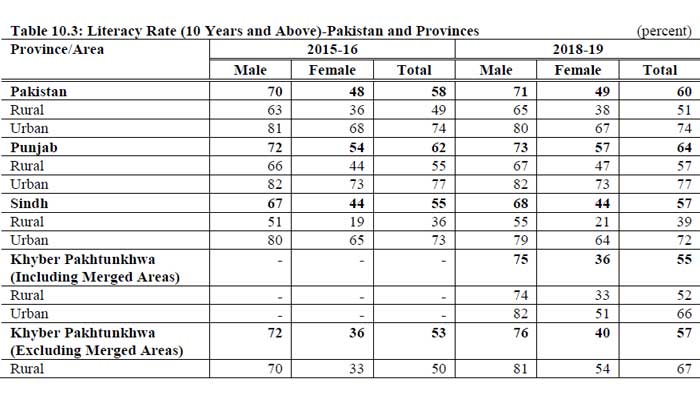
ISLAMABAD: The Pakistan Economic Survey revealed Thursday that the country’s literacy rate increased by two percent to 60% in 2018-19 from 58% in 2015-16.

The bump in the literacy rate was witnessed among the population aged 10 years and above, the survey said, noting that the literacy rate in the urban areas was higher at 74% as compared to the rural areas with a rate of 51%.

Pakistan Social and Living Standards Measurement (PSLM) conducted the survey during the term 2018-19.

Mentioning the province-wise break-up, the report said that Punjab led all the other provinces, with a 64% literacy rate followed by Sindh (excluding merged areas) with 57%, Khyber Pakhtunkhwa (including merged areas) with 55% and Balochistan with 40%.

Gross Enrollment Rates (GER) at the primary level excluding katchi (prep) for the age group 6-10 years at the national level during 2018-19 remained at 87% when compared to 2015-16. Province wise data suggests that Punjab showed improvement from 93% in 2015-16 to 95% in 2018-19, while Sindh remained stable with primary level GER at 78%.

Pakistan’s literacy rate. — Pakistan Economic Survey

Khyber Pakhtunkhwa (excluding merged areas) improved to 89% in 2018-2019 as compared to 88% in 2015-16, while Balochistan witnessed a decline from 59% in 2015-16 to 57% in 2018-19.

Meanwhile, the Net Enrollment Rates (NER) slightly improved at the national level from 65% in 2015-16 to 66% in 2018-19.

Province wise comparison reveals that Punjab witnessed an improvement in net enrollment, taking it to 73% in 2018-19 as compared to 71% in 2015-16.

Sindh showed an improvement of 58% in 2018-19 as compared to 56% in 2015-16. KP (excluding merged areas) witnessed a decline from 67% in 2015-16 to 66% in 2018-19, while Balochistan remained stable with primary level NER at 40%, the survey added.

Source link

NASA picks Astrobotic to land ice-hunting VIPER rover at the moon’s south pole

0

A Pennsylvania-based space company called Astrobotic has taken on a dramatic new task for NASA: deliver a VIPER to the moon.

Not a snake, of course. Astrobotic’s payload will be a large rover designed to sniff out water ice buried below the lunar surface, dubbed the Volatiles Investigating Polar Exploration Rover, or VIPER. The launch, which is currently scheduled for late 2023, is a keystone piece of NASA’s Artemis program to land humans at the moon’s south pole in late 2024.


Source link

Former DEA Spokesman Admits To Posing As ‘Deep-Cover’ CIA Agent In Fraud Scheme

0

WASHINGTON ― A former spokesman for the Drug Enforcement Administration pleaded guilty on Thursday to wire fraud, admitting that he pretended to be a covert CIA officer and scammed more than a dozen companies out of over $4.4 million.

Garrison Courtney, 44, acknowledged during a federal court hearing in Alexandria, Virginia, that he falsely claimed to be part of a “task force” that involved the CIA, other parts of the intelligence community and the Defense Department that aimed to enhance intelligence-gathering capabilities. He created a “commercial cover” to hide his false affiliation with the CIA, and had companies pay him with the expectation that they’d be reimbursed in the future.

Courtney, the government said, “went to extraordinary lengths to perpetuate the illusion that he was a deep-cover operative” by, among other things, making people sign fake nondisclosure agreements, searching them for electronic devices, telling them they were under foreign surveillance and threatening anyone who questioned him with criminal prosecution or the revocation of their security clearance.

An official with the U.S. attorney’s office said that Courtney had “masqueraded” as a covert CIA employee as part of his “ruse,” and managed to “dupe” both private companies and real public officials whom he’d use as “unwitting props in his fraudulent schemes.”

According to government documents, Courtney was given a conditional offer of employment by the CIA around 2005, but that offer lapsed in 2007. He never worked for the federal government after his departure from the DEA in 2009.

The government indicated that Courtney used a number of aliases, including “Glenn Nelson,” “Glenn Nielson,” “Gary Pierson” and “Garrison Pierson” in the course of his scheme. He referred to the fake task force he claimed to be on as “Alpha214” and “A214.”

As part of his cover, the government said, Courtney falsely claimed to have been involved in the Gulf War and that he “had hundreds of confirmed kills while in combat” and “sustained injuries to his lungs from smoke caused by fires set to Iraq’s oil fields.”

He also claimed that a “hostile foreign intelligence service attempted to assassinate him by trying to poison him with ricin” when, in fact, he went to the hospital for ordinary health issues. One company bilked by Courtney lost $1,933,500 to his scheme, according to the filings.

Courtney held his DEA position during President George W. Bush’s administration and previously worked for Republican Katherine Harris of Florida during part of her 2003-07 stint in the U.S. House. On LinkedIn, Courtney claimed to have worked for TMZ after he left the government.

This is a developing story and will be updated.


Source link

Single people in NI can stay indoors with loved ones

0

Image copyright
PA Media

Image caption

Executive ministers said they were conscious that families want to reconnect after more than 12 weeks apart

People living alone in NI will be able to stay at one other household as part of further easing of coronavirus restrictions.

First Minister Arlene Foster announced that, from Saturday, single adults can spend the night at another house in a “support bubble”.

The executive agreed to the move to “minimise the impact of loneliness and isolation”.

The relaxation does not apply to those who are shielding.

The executive met on Thursday and agreed to lift a number of lockdown measures, because the R-number – which measures the rate of infection – is currently estimated as being between 0.5 and 0.9.

‘Desire to return to normal life’

One further coronavirus-related death was recorded in Northern Ireland on Thursday, bringing the Department of Health’s total number of deaths to 538.

This figure is mostly focused on hospital deaths and where patients tested positive for the virus.

Speaking at Stormont’s daily press briefing on Thursday, Mrs Foster said ministers could not yet commit to allowing people who do not live alone to visit family and friends indoors, but said they hope to “take another step forward” next week.

Image caption

Arlene Foster and Michelle O’Neill made the announcements at the Stormont daily briefing on Thursday

“There’s a real desire amongst grandparents to see their grandchildren but it is important we take this on a step-by-step basis,” she added.

“We’re appealing to people not to return to normal behaviour – do not take things for granted and please don’t let your guard down,” said Deputy First Minister Michelle O’Neill.

What can people in NI do now?

Some of the measures agreed by the executive take effect from Friday 12 June.

Groups of up to 10 people who do not live together can meet outdoors, maintaining social distancing.

Ministers recognised there was a “strong desire to return to normal life”, said Mrs Foster.

All non-essential retail is due to open from Friday, but shopping centres will now also be permitted to open.

The executive has agreed to allow church halls and community centres to open from Friday to facilitate childcare for people who will have to return to work.

But ministers are carrying out work on reopening the childcare sector, with more details to be announced after discussions with the Department of Health on Friday.

Concerns have been raised about a lack of clear guidance for the sector, as more people with children prepare to return to work.

Ms O’Neill said work was under way to see if the executive could, from next week, begin to provide indicative dates for other sectors to reopen.

Northern Ireland’s five-stage recovery blueprint does not include a timetable for reopening, with ministers saying they would not be calendar-led.

However, the executive now wants to be able to “signpost” to people that they should get ready, added Mrs Foster.

House moves given green light

From Monday, people in Northern Ireland will be allowed to move house again, after the property market was paused following the imposition of lockdown in March.

However, Ms O’Neill said the process of finding and moving into a new home would be different.

Image copyright
Getty Images

“People will have to accept doing more of the processes online such as virtual viewings,” she added, as well as observing strict hygiene practices on visits in person.

Estate agent John Minnis told BBC Radio Ulster’s Evening Extra programme that it was “fantastic news” the sector could reopen.

“We can’t keep up with the level of interest, the appetite is definitely there which is very surprising,” he said.

“You’ll be asked to bring a mask and bring gloves, the estate agent will be in a face shield and they will bring you through the house without the vendor there and without touching anything.”

Elite athletes will also be allowed to begin using outdoor sports facilities to train again from Monday.

However, Mrs Foster said ministers had not reached agreement on whether to bring forward the date for hotels and other tourist accommodation to reopen.

It is scheduled for 20 July, but the executive has been facing calls to change it, with the sector in the Republic of Ireland due to open on 29 June.

Economy Minister Diane Dodds will bring a paper to the executive next week on the matter.

What is the social bubble model?

A bubble is defined as an exclusive group of people with whom you have close physical contact.

This can be friends or family.

Members of a bubble would be able to visit one another in their homes, but it would still be important to limit the risk of chains of transmission.

If Household A merges with Household B, Household B could not also link up with another group – Household C – because this would create a chain that could allow the virus to spread widely.

The bubble concept has already been used in New Zealand and is being adopted in England, to allow single people to form support bubbles from Saturday.

Source link