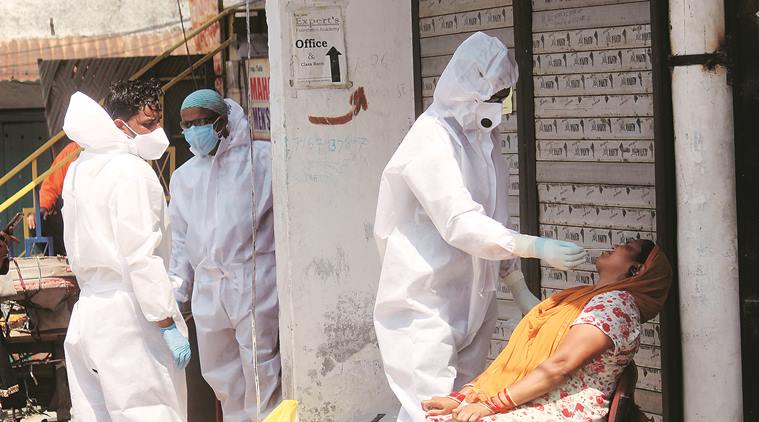
Dr Manish Mehta, Medical Superintendent of Rajkot civil hospital issued 13 doctors, who specialise in critical care, orders of posting in the Covid-19 hospital on Tuesday. (Representational)
As many as 13 members of Rajkot chapter of Indian Society of Critical Care Medicine (ISCCM) joined the team of doctors of Rajkot civil hospital treating Covid-19 patients on Tuesday.
A delegation of 19 members of ISCCM met Parimal Pandya, Resident Additional Collector of Rajkot, and offered their services on voluntary basis.
After this, Dr Manish Mehta, Medical Superintendent of Rajkot civil hospital issued 13 doctors, who specialise in critical care, orders of posting in the Covid-19 hospital on Tuesday.
“This team of experienced doctors associated with well-known hospitals of Rajkot will render services in the hospital as and when needed… available on call round the clock… They will visit the hospital to asses patients during the day and patients with severe infection of Covid-19 will get the benefit of services of… those specialising in medicine,†the medical superintendent was quoted as saying an official release on Tuesday.
In Thailand’s Malay Muslim-majority southern border provinces—the conflict-ridden region historically known as “Pataniâ€â€”mobile phone operators have reportedly shut down services for several users who failed to register their SIM cards in a government facial recognition system. This “two-shot identification†system scans and collects the facial data of each registered user. In June last year, the Internal Security Operations Command (ISOC) made registration mandatory for all persons using a mobile phone in the region as part of its counterinsurgency strategies.
According to ISOC spokesperson Colonel Pramote Prom-in, law enforcement authorities plan to use the data collected under this scheme to identify separatist insurgents who use phone-triggered improvised explosive devices in violent attacks. The registration deadline was set to 30 April 2020, and failure to comply has resulted in a temporary suspension of unregistered numbers.
Over the past few years, biometrics has emerged as a critical warfare tool used by the Thai government to fight the insurgency in the southern border provinces. Security forces actively harvest the local population’s biometric features, especially DNA profiles and facial data, as a surveillance tactic to distinguish insurgents hiding among civilians. Such tactics complement other conventional counterinsurgency strategies, such as setting up checkpoints, raiding houses and interrogating suspects for intelligence.
For the government, this advanced technology promises a quick fix for the decades-old conflict In the Deep South. However, the biometric collection projects have already began to heighten the local population’s distrust of the state and could eventually result in a counterproductive invigoration of the insurgency.
Panoptic Patani
Thailand’s use of biometrics in counterinsurgency strategies is not entirely new. In 2012, security forces in the southern border provinces began to use DNA profiling technologies to analyse DNA samples at crime scenes and find suspected insurgents with a genetic match. Security officers are tasked with creating a DNA databank that stores the genetic profiles of all potential insurgents to enhance the efficacy of these technologies.
Authorities have been actively collecting DNA samples from Malay Muslims during searches at military checkpoints and raids on houses or private religious schools, especially in the “red zones†where insurgents are supposedly influential. On 3 April 2015, several Malay Muslim activists and student leaders were allegedly subject to such arbitrary DNA tests. A month later, the United Nations’ Committee on the Elimination of Racial Discrimination issued a letter to the Thai government expressing serious concerns that forced DNA collection carried out by the Thai security forces “could amount to ethnic profiling.â€
The practice of forced DNA collection was officially institutionalised in April 2019 when the Royal Thai Army decided to incorporate DNA collection as part of the annual military conscription process for “national security purposes.†This policy was applied exclusively to the provinces of Pattani, Yala and Narathiwat, as well as the four Malay Muslim-majority districts of Songkhla, which include Saba Yoi, Tepa, Natawee and Chana. An inevitable consequence of the policy is the overrepresentation of Malay Muslim DNA profiles in the official database, which allows security agencies to undertake targeted surveillance on this population.
The government launched its mandatory SIM card registration policy only two months after the incorporation of DNA collection in military conscription. Later, on 20 January 2020, Deputy Prime Minister General Prawit Wongsuwan visited the Pattani Municipal Office’s CCTV Control Center and announced that the government would integrate artificial intelligence (AI) into at least 8,200 surveillance cameras in the southern border provinces. Reportedly, the AI software will increase the efficacy of the authorities’ “monitoring and risk notification system†to ensure the local population’s safety. To date though, it remains unclear whether there will be any synchronisation between the AI technology to which General Prawit referred and the “two-shot identification†facial recognition system.
The haunting history of GT200
Such dragnet biometric collection is a strategy based on the presumption of guilt of all persons in the Malay Muslim-majority region, the “enemy†population. The rapid rise of biometrics illustrates the Thai state’s political fantasy of dominating this population by creating a voyeuristic regime of power built upon in-depth knowledge about it. It seems almost as though the authorities are constructing a renewed, (bio)data-driven version of Jeremy Bentham’s Panopticon prison in the southern border provinces. Unlike Bentham’s clueless inmates though, most local people know well that they are being watched by prison guards in green uniforms.
Contrary to Foucault’s interpretation of the Panopticon in Discipline and Punish, the establishment of a panoptic regime in Patani has not always produced “docile subjects†perfectly disciplined under state authorities. For some, being subject to biometric monitoring has sparked a new political consciousness that resists the longstanding, abusive exercise of state powers in this region.
“I will never register my SIM card. The mandatory facial scan measure reminds me of the GT200 scandal,†said Abdullah (pseudonym), a young political activist based in Songkhla. He was referring to the faulty bomb detectors which the Thai national security authorities used to identify traces of explosive substances on the bodies of alleged insurgents in the southern border provinces from 2007 to 2010.
In 2007, the security forces used the GT200 detectors to search houses and arrest more than 400 young Malay Muslim men for alleged involvement in the insurgency. These men were then forced to attend ‘vocational training’ in upper southern provinces at what were, in reality, re-education camps. Later on 19 March 2008, Imam Yapa Kaseng, a 56-year-old man in Rue Soh District of Narathiwat, was arrested and detained at the 39th Task Force Camp during a military operation to search for insurgents in his village using the GT200 devices.  He was then tortured and murdered by interrogation officers while he was in detention.
Only two years later, in 2010, the Ministry of Science and Technology tested the GT200 device and found that it had only a 20 per cent success rate in detecting explosive substances. According to this finding, any legal actions that were previously based on a GT200 reading are highly likely to be groundless or scientifically inaccurate. The government eventually abandoned the device and investigated the corrupt purchase deal behind it. However, the victims of human rights violations due to the GT200-led COIN operations did not receive any reparations, and their perpetrators have not been to justice.
“How could I trust that the government will use our data properly? It is hard to believe that state officials will not take advantage of this measure and enforce it with the same ethnic prejudice again,†said Abdullah.
As biometrics start to take center stage in the government’s counterinsurgency strategies, the history of GT200, deeply entangled in corruption, ethnic prejudice and a culture of impunity, has returned to haunt the Thai state. Instead of fostering docility, the biometric collection project is forging a new type of subjects resistant against state abuses.
Biometrics in the time of COVID-19
Negative sentiments among locals towards biometric collection have escalated during the COVID-19 outbreak. As the public heeds the recommendations of public health organisations to practice physical distancing, ISOC continues to collect people’s DNA during house raids and suspend unregistered mobile phone numbers. These measures have been criticised because they make the local population even more vulnerable to the current public health crisis. DNA collection, for instance, forces officials and villagers to physically interact, exposing each other to risks of infection. Furthermore, mobile service shutdown means people may not receive urgent medical or humanitarian assistance because they lack access to telecommunications services.
On 1 May 2020, the Barisan Revolusi Nasional (BRN), the main insurgent group in the region, issued a press statement condemning the Thai military’s counterinsurgency operations, including “forced DNA collection,†during the COVID-19 crisis. This statement might seem ironic given the BRN’s record of violating international humanitarian rules in indiscriminate attacks against civilians. However, the BRN’s condemnation of forced DNA collection demonstrates that the movement has picked up on public frustrations with biometric warfare, leveraging these grievances to decrease the government’s political legitimacy in the eyes of the local population. Instead of enhancing the efficacy of counterinsurgency strategies, the new biometric regime has carved out yet another contentious space amidst the conflict.
During this sensitive time, the government needs to re-think its counterinsurgency approach carefully. The establishment of a biometric-led surveillance superstructure in the southern border provinces will inevitably come at the cost of increasing public resistance and decreased legitimacy for the state and military presence in this region. Biometric technologies might help law enforcement agencies catch some insurgents, but this will only serve a short-term purpose of suppressing the violence. Instead, the government should consider shifting its priorities from day-to-day suppression of insurgent activities to addressing the causes of the conflict in the region. These are rooted in rampant human rights violations, structural inequalities, and the imbalance of power between Bangkok and Patani.
Site tells users to ‘get the facts about mail-in ballots’ on tweet claiming California’s mailed votes likely to be ‘substantially fraudulent.’
WASHINGTON — Twitter for the first time added fact-check labels to a pair of tweets by U.S. President Donald Trump that boosted unsubstantiated claims about voting fraud on Tuesday, a move that comes as the social media network faces intense scrutiny of its handling of the president’s feed.
Twitter’s label does not directly declare the tweets false, but points anyone reading them to news reports that contradict the president’s assertions.
The action comes as the tech company faces rising pressure to crack down on the president’s Twitter account, which in recent days has posted a flurry of baseless tweets riling fears about widespread voter fraud and a series of posts stoking conspiracy theories about the death of a former staffer to MSNBC host Joe Scarborough when he served in Congress. Twitter said earlier Tuesday that it would not take down the tweets about the deceased staffer.
The two missives — in which Trump claimed earlier Tuesday without evidence that mail-in ballots in California are likely to be “substantially fraudulent†— now display a notice directing Twitter users to “Get the facts about mail-in ballots.†The label links to a Twitter events page that notes that Trump’s claims “are unsubstantiated,†citing news outlets including CNN and the Washington Post, and adds, “Experts say mail-in ballots are very rarely linked to voter fraud.â€
Twitter spokesperson Katie Rosborough said in an email to POLITICO that the posts “contain potentially misleading information about voting processes and have been labeled to provide additional context around mail-in ballots.†Rosborough confirmed it is the first time the company has added such a message to any Trump tweets.
The Trump campaign put out a statement calling the move evidence of “political bias.”
“We always knew that Silicon Valley would pull out all the stops to obstruct and interfere with President Trump getting his message through to voters,” said Trump campaign manager Brad Parscale in the statement. “Partnering with the biased fake news media ‘fact checkers’ is only a smoke screen Twitter is using to try to lend their obvious political tactics some false credibility. There are many reasons the Trump campaign pulled all our advertising from Twitter months ago, and their clear political bias is one of them.“
In the case of the former Scarborough staffer, the widower of the woman called on Twitter CEO Jack Dorsey in a letter last week to take down the president’s tweets which suggested falsely the MSNBC host was involved in her death. Twitter said in a statement that the company is “deeply sorry about the pain these statements, and the attention they are drawing, are causing the family.†But the company said it will not be removing the posts at this time.
Twitter has repeatedly taken heat for what critics see as a failure to enforce its policies against misinformation, targeted harassment and more against the commander-in-chief, who routinely assails the tech company over allegations it is biased against conservatives.
The company announced this month it is expanding its policy for labeling tweets to include posts related to Covid-19 that include “statements or assertions that have been confirmed to be false or misleading by subject-matter experts.” The company said last year it would begin labeling tweets by global leaders that may run afoul of its policies.
US Ambassador to Germany Ric Grenell with German Chancellor Angela Merkel | Sean Gallup/Getty Images
He is expected to take a senior role on the 2020 team focused on fundraising and strategy.
U.S. Ambassador to Germany Ric Grenell is set to join U.S. President Donald Trump’s 2020 campaign amid a broader shakeup that saw the promotion of two other campaign officials on Tuesday, according to two people familiar with the matter.
The addition of Grenell, a trusted Trump ally who recently stepped down as acting director of national intelligence, comes as the president faces sliding poll numbers nationally and in a handful of key battleground states. AÂ Fox News survey conducted May 17-20 found presumptive Democratic presidential nominee Joe Biden defeating Trump 48 percent to 40 percent five months out from Election Day.
A person familiar with the move said Grenell will take a senior role inside the Trump campaign, where he will be involved in fundraising and strategy. It was not immediately clear what his title will be or whether he will work from the campaign’s Northern Virginia headquarters. Grenell was seen entering the White House Tuesday afternoon, shortly after the Trump campaign announced its promotion of senior political adviser Bill Stepien to serve as deputy campaign manager.
Grenell is the latest longtime Trump ally to be installed in a senior role that ensures deep involvement with the president’s reelection operation and communications strategy. Trump recently brought former White House communications director Hope Hicks back into the West Wing, and promoted his former body man John McEntee to head the Office of Presidential Personnel after he rejoined the administration last December.
“He wants to bring the band back together,†said a senior administration official familiar with Trump’s thinking.
Grenell, who is expected to step down as ambassador to Germany in a few weeks, has long been a forceful personality on Twitter — one of the president’s preferred platforms for taking on political opponents and communicating with supporters. His social media activity sometimes rankled diplomatic colleagues and career State Department officials, who worried about straining U.S. relations with Germany.
Grenell was a strong advocate of Trump’s nationalist policies, which at times didn’t play well with his German hosts. And during his short tenure as the nation’s top intelligence official, Grenell presided over a number of changes at the Office of the Director of National Intelligence, including slightly reducing the size of the National Counterterrorism Center and having the National Counterintelligence and Security Center, which is part of ODNI, take over election security briefings.
Grenell, who’s openly gay, also said that the Trump administration could potentially cut back on the sharing of intelligence with countries that have criminalized homosexuality and urged U.S. intelligence agencies to do a better job of preventing discrimination against gay, lesbian and transgender employees.
In 2012, Grenell briefly served as a spokesman for Republican presidential nominee Mitt Romney’s campaign. He resigned under pressure from social conservative groups who were critical of the campaign’s employment of an openly gay man. Throughout his tenure in the Trump administration, he repeatedly denounced countries that continue to outlaw homosexuality and once met with European LGBTQ activists to discuss his push to decriminalize homosexuality abroad.
Grenell also served as a spokesman at the U.S. mission at the United Nations during the George W. Bush administration. Prior to joining the Trump administration, he worked in media and public affairs consulting.
Neither the Trump campaign nor Grenell immediately responded to requests for comment.
The country on Tuesday became the first in Central America to legally recognize same-sex marriage.
“Today, Costa Rica officially recognizes same-sex marriage,” President Carlos Alvarado Quesada wrote on Twitter.
“Today we celebrate liberty, equality and our democratic institutions. May empathy and love be the compass that guide us forward and allow us to move forward and build a country that has room for everyone.”
The move to marriage equality follows an August 2018 ruling by the country’s Constitutional Court, which ruled that laws preventing same-sex marriage were unconstitutional.
The court gave the legislature 18 months to enact marriage equality, or have the ruling recognizing same-sex marriages automatically go into effect once the deadline expired.
Costa Rica’s decision also follows an opinion issued by the Inter-American Court of Human Rights in January 2018. The Central American country had asked the court to determine whether it was obligated to extend property rights to same-sex couples.
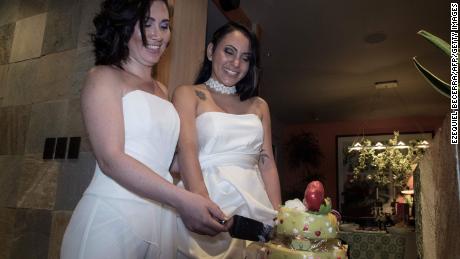
Couples celebrated the country’s decision by holding weddings overnight.
Alexandra Quiros and Dunia Araya were among the lovebirds who tied the knot on Tuesday, holding a marriage ceremony in Heredia.
LGBTQ advocacy organizations also celebrated the move.
“Costa Rica is celebrating today: marriage equality has become a reality in the country – the first one in Central America!” the International Lesbian, Gay, Bisexual, Trans and Intersex Association (ILGA World) said. “We rejoice with you: congratulations to all those who worked so hard to make it happen!”
The Human Rights Campaign also cheered the decision, though it added that more work needed to be done to achieve marriage equality around the world.
“Today, Costa Rica has made history, bringing marriage equality to Central America for the first time,” HRC President Alphonso David said in a statement. “Costa Rica’s LGBTQ community has worked tirelessly for years to make today a reality. This victory is theirs, and it inspires the entire global LGBTQ community to continue fighting to move equality forward.”
CNN’s Maija Ehlinger, Tatiana Arias and Gerardo Lemos contributed to this report.
MILAN — Since the start of the coronavirus pandemic, the Italian region of Lombardy has made headlines for all the wrong reasons: overwhelmed hospitals, health care workers performing wartime-like triage, caretakers struggling to bury the dead.
The richest region in Italy, vaunted for its state-of-the-art health care system, has recorded more than 15,500 deaths within its borders since February 21 — half the number of total fatalities country-wide.
And now, as the country starts lifting lockdown restrictions, it still counts the highest number of cases per capita.
Why has the region performed so badly in comparison to others? The question of what went wrong — and continues to go wrong — in Lombardy has become a source of major political controversy and a potential stumbling block on the way to opening the entire country back up to a new normal.
Faced with mounting criticism, regional governor Attilio Fontana insists there is nothing he would have done differently.
“Those who irresponsibly celebrate nightlife are betraying the sacrifices made by millions of Italians.†— Francesco Boccia, Italy’s minister for regional affairs
“I got thrown into a hurricane that no one had prepared us for, and made choices aimed at securing our citizens’ health,” Fontana said in an interview.
“Unlike other places, we had an immediate exponential increase — after 10 days we had almost 1,000 positive cases, of which about half were hospitalized.â€
The public health catastrophe and human tragedy that followed could not have been avoided, according to Fontana, a member of the far-right League party.
Critics disagree, saying a difficult situation was made worse by poor decision-making. In recent days, a series of political gaffes have exacerbated the lack of trust in the regional government’s abilities and increased fears that official incompetence could lead to a second wave of infections and undermine efforts to contain the virus elsewhere.
Over the weekend, the region’s health and welfare minister Giulio Gallera attracted widespread mockery after claiming in an interview that — with the virus’ reproduction rate now at 0.5 in Italy — a person would need to come into contact with two infected people at the same time to fall ill themselves. “It’s not that easy,†he said.
Gallera’s lack of understanding of the so-called R rate prompted a flurry of criticism on social media from people concerned that the official coordinating the region’s health response did not grasp the science behind the virus’ transmission.
On Sunday, Fontana added fuel to the fire when he announced there were no new COVID-19 deaths, but it later emerged his report was flawed as a result of a miscommunication between hospitals and regional authorities.
Meanwhile, images of the streets of Milan and other cities full of people flouting social distancing rules as they gathered outside bars and restaurants also drew condemnation.
“If this continues, we risk not being able to open the borders between regions,” Francesco Boccia, Italy’s minister for regional affairs, said in an interview with La Stampa.
“We must not forget that we are still in the COVID-19 pandemic, and those who irresponsibly celebrate nightlife are betraying the sacrifices made by millions of Italians.â€
 * * *
There’s no easy answer for why Lombardy became a hotspot of the coronavirus in Italy. Some have pointed to factors that may have made it particularly vulnerable: It is densely populated (with more than 10 million inhabitants) and its high level of economic activity means residents — who also skew older than in the rest of the country — are exceptionally mobile.
Still, critics argue that the catastrophe that struck the region could have been avoided had it not been for errors of judgment, government incompetence and failures in the health care system.
The biggest mistake was Lombardy’s management of health care resources, said Massimo Galli, the head of the infectious diseases department of the Sacco hospital in Milan.
“All attention was focused on hospitals, which became breeding grounds for the virus, and primary care physicians were left behind without proper help to treat people at home,†he said. That meant that many people died at home without being tested, as the virus spread through families uncontroled.
Health care is a regional competency in Italy, meaning there is no unified system. In Lombardy, which has been governed for the past 25 years by either the far-right League or the center-right Forza Italia, authorities focused on building private health care institutions that deliver profitable services such as complex surgical operations and specialist treatments.
A man does kayaking as people stroll along a canal in the Navigli district of Milan on May 21, 2020 | Miguel Medina/AFP via Getty Images
Less attention was paid to the broader public health system, which dealt with the unprofitable side of things: emergency services, general care and geriatrics.
Weakened by years of cuts and staff shortages, the public system was quickly overwhelmed by the treatment required for COVID-19 patients, which fell under “standard administration,†rather than specialized services offered at the region’s wealthy clinics.
To Stefania Carrara, whose stepfather died of COVID-19 in hospital in March, the region’s reputation for “excellence†in health care increasingly seems like a bad joke.
“We are so excellent that almost two months after Carlo’s death, I am the only one in my family that has had a serological test, and that’s thanks to my employer,” according to Carrara, who said that although everyone in her family fell ill, nobody was able to get tested for the virus.
In Bergamo, one of the cities hardest hit by the health crisis, a Facebook page for families of deceased COVID-19 patients called “Noi denunceremo†(“We will sue youâ€) garnered likes from some 54,000 people.
A lack of testing has been a persistent problem. In the region of Veneto, authorities were successful in slowing the spread of the virus by rolling out blanket testing, which enabled them to better trace infections.
Lombardy started at a disadvantage — with a higher population density and more initial cases than in Veneto — Galli conceded, but its lack of testing at the start of the epidemic had a substantial effect on the virus’ spread.
“The problem with the swab tests is that the government sent us 3.5 million, but it did not send the necessary chemicals to process them,†said Fontana.
The region has increased its number of laboratories able to process the tests from three to 45 since the start of the epidemic, according to Fontana. But even so, “it is not possible to process more than 15,000-16,000 a day, due to the lack of chemical supplies.â€
 * * *
The dramatic course the virus took in Lombardy and the mixed messages coming from governor’s office has made people fearful of plans to reopen the region to economic activity.
“It hit us very hard here,†said Chiara Filicetti, who owns a bistro in Treviglio, a town in the province of Bergamo, one of the hardest hit parts of Lombardy. “Many of our customers have lost their parents and grandparents. We’re not in sunny skies yet.â€
Milan, the region’s economic center, is eager to reopen, Giuseppe Sala, the city’s mayor said. He expects authorities to shed light on what happened in nursing homes and to issue clear guidance on swab tests and antibody tests in order to make sure the region can resume economic activity safely, he said.
People relax and have a drink by a canal in the Navigli district of Milan | Miguel Medina/AFP via Getty Images
The biggest mistake, according to Sala, was “an initial lack of clarity†that has to be corrected if the region is going to resume its activities along with the rest of Italy.
“It led to all of us, including myself, to underestimate the danger and created a lot of confusion, which helped fuel the pandemic.â€
Fontana, in response to the criticism that followed images of people gathering in Milan, insisted he was ready to tighten the rules again if need be.
In the meantime, the rest of Italy is watching the region nervously. The southern regions, starting with Sicily and Sardinia, have pushed for a health passport for those who want to travel to the islands this summer, aimed mainly at tourists from northern Italy.
Unless numbers improve, people in Lombardy — along with residents of Piedmont and possibly Emilia-Romagna — also risk finding themselves confined to their home turf beyond June 3, when the government is set to allow travel between regions.
A postponed reopening would be yet another headache for the beleaguered local government, already straining under heavy criticism from residents increasingly worried about the future — and how they’ll rejoin the rest of Italy on its road to recovery.
Twitter labeled two of President Donald Trump’s tweets with a fact-check label on Tuesday for the first time.
The social media platform applied the label on two of Trump’s tweets that made claims, without evidence, that voting with mail-in ballots would be “substantially fraudulent.†The Twitter labels say “Get the facts about mail-in ballots†and direct users to a collection of news reports and articles debunking the tweets.
Near the top of Twitter’s fact-check page, a statement reads: “Trump falsely claimed that mail-in ballots would lead to ‘a Rigged Election.’ However, fact-checkers say there is no evidence that mail-in ballots are linked to voter fraud.â€
The president has ramped up his attacks to discredit the integrity of mail-in voting in recent weeks, despite substantial evidence to the contrary.
Twitter spokesperson Katie Rosborough said the tweets were labeled because they contain “potentially misleading information about voting processes and have been labeled to provide additional context around mail-in ballots.â€
Twitter
Twitter applied fact-check labels to two of Trump’s tweets about mail-in ballots.
The platform rolled out a new policy earlier this month that it would label misleading information about COVID-19. The company said at the time it would potentially expand this effort to other areas.
“Moving forward, we may use these labels and warning messages to provide additional explanations or clarifications in situations where the risks of harm associated with a Tweet are less severe but where people may still be confused or misled by the content,†a company post read at the time.
Twitter said this would make it easier for users to “find facts and make informed decisions†about what they see on the platform.
Rosborough said Tuesday’s move was in line with the new policy.
Calling all HuffPost superfans!
Sign up for membership to become a founding member and help shape HuffPost’s next chapter
A shock new Twitter strategy is threatening to nullify one of Donald Trump’s most potent weapons.
For the first time, Twitter has flagged some of Mr Trump’s tweets with a fact-check warning.
The move by Twitter, Mr Trump’s preferred way to speak with his base, comes just five months out from the US election.
The new warning labels appeared under two of Donald Trump’s tweets today, signalling Twitter will be fact-checking the president’s claims on the social media platform. (Twitter)
Two unusual warnings appeared underneath two of Mr Trump’s tweets today, signalling Twitter’s new tactic.
The two tweets from Mr Trump called mail-in ballots “fraudulent” and predicted that “mail boxes will be robbed”, among other things.
Under the tweets, there is now a link reading “Get the facts about mail-in ballots” that guides users to a Twitter “moments” page with fact checks and news stories about Mr Trump’s unsubstantiated claims.
The move comes after years in which Twitter has declined to apply its community guidelines and other rules of the road to the 45th US president.
It’s too soon to tell whether this action represents a turning point for Twitter in its treatment of Mr Trump.
But the warning labels suggest that the president has finally crossed a line that the company was not willing to move for him.
Earlier today, Mr Trump had drawn intense criticism over a barrage of baseless tweets suggesting that a television host he has feuded with committed murder.
The husband of a woman who died by accident two decades ago in an office of then-GOP Rep. Joe Scarborough is demanding that Twitter remove the president’s tweets suggesting Scarborough, now a fierce Trump critic, killed her.
“My request is simple: Please delete these tweets,” Timothy J. Klausutis wrote to Twitter CEO Jack Dorsey.
President Donald Trump answers questions from reporters in the Rose Garden at the White House. (AP / Evan Vucci)
The body of Lori Kaye Klausutis, 28, was found in Scarborough’s Fort Walton Beach, Florida, congressional office on July 20, 2001.
Mr Trump has repeatedly tried to implicate Scarborough, a host of MSNBC’s Morning Joe show, in the death even though Scarborough was in Washington, not Florida, at the time.
Mr Klausutis wrote in his letter that he has struggled to move on with his life due to the ongoing “bile and misinformation” spread about his wife on the platform, most recently by Mr Trump.
His wife continues to be the subject of conspiracy theories 20 years after her death.
Mr Klausutis said in the letter, sent last week, that his wife had an undiagnosed heart condition, fell and hit her head on her desk at work.
He called her death “the single most painful thing that I have ever had to deal with” and said he feels a marital obligation to protect her memory amid “a constant barrage of falsehoods, half-truths, innuendo and conspiracy theories since the day she died.”
Mr Trump’s tweets violate Twitter’s community rules and terms of service, he said.
“An ordinary user like me would be banished,” he wrote.
There is no mystery to the death of Lori Klausutis.
Medical officials ruled that the aide, who had a heart condition and told friends hours earlier that she wasn’t feeling well, had fainted and hit her head. Foul play was not suspected.
Mr Trump, however tweeted this month: “When will they open a Cold Case on the Psycho Joe Scarborough matter in Florida. Did he get away with murder? Some people think so. Why did he leave Congress so quietly and quickly? Isn’t it obvious? What’s happening now? A total nut job!”
He echoed that “cold case” allegation in a new tweet on Tuesday.
Mr Trump also has asked via Twitter if NBC would fire the political talk show host based on the “unsolved mystery” years ago in Florida. “Investigate!” he tweeted in 2017.
Scarborough has urged the president to stop his baseless attacks.
CELEBRITIES BORN ON THIS DAY: Adam Carolla, Joseph Fiennes, Vincent Price, Henry Kissinger, Louis Gossett Jr., Todd Bridges, Isadora Duncan.
ARIES (March 21-April 19): Watch the spending today; a ‘who-cares’ attitude is likely to cause more trouble than it’s worth. Whatever it is that has caught your eye will still be there tomorrow. By resisting temptation and by drawing on all your reserves of willpower you’re likely to spare yourself unnecessary worry!
TAURUS (April 20-May 20): If you plan the day well, then you should be able to get the best of both worlds! But the moon suggests that you’ll need to be pretty firm with yourself when a chance to visit the mall comes your way, because it’s likely to come at an inconvenient or bad time. Postpone or reschedule any plans to spend your cash!
GEMINI (May 21-June 20): Don’t rely too much on your instinct or intuition over a certain matter today, because minor but unhelpful aspects from the moon are likely to misguide you. Getting too involved in the matter will complicate things even more, while trying to remain detached will actually help clarify the facts!
CANCER (June 21-July 22): Don’t put off today what you think you can leave until tomorrow. Today the signs are looking good for getting ahead of yourself in terms of work or school, so take advantage, because tomorrow it looks as though there’ll be an unforeseen increase in your workload. Don’t rest on your laurels today!
LEO (July 23-Aug. 22): You’re likely to have one of those incredibly brisk and efficient days, where you’ll manage to achieve more than you set out to do. If you’re facing a mountain of work don’t despair; you’ll get through it with no problem, but don’t forget to take some time to recharge your batteries this evening!
VIRGO (Aug. 23-Sept. 22): Romance is likely to dominate the day, thanks to the moon, but don’t allow it to obscure other possibilities and opportunities, because your relationships in general are very well aspected. You can afford to grasp the nettle over an emotional matter, but it’s important you keep your cool!
LIBRAÂ (Sept. 23-Oct. 22):Â Communications are very favorably aspected through the first half of the day, which is just as well, because a confusing matter is likely to require a lot of concentration to unravel. Driving you forward will be your boundless fiery enthusiasm, but holding you back will be a short attention span!
SCORPIO (Oct. 23-Nov. 21): A couple of challenging influences suggests that you’ll either get the wrong end of the stick, or you’ll get some disappointing news today. Generally communications aren’t well aspected, but someone’s utter faith or trust in you will be the thing to make you feel good again!
SAGITTARIUS (Nov. 22-Dec. 21): The minor but taxing planetary aspect that disrupted your finances will shift by the late afternoon. So you may wake up feeling a little low and listless, but decide that you will accept any invitations out anyway, because by the time the evening comes you’ll be primed and ready for a fun time!
CAPRICORN (Dec. 22-Jan. 19): A slow, sluggish mood is not what anyone might expect from an agile, sure-footed Goat, but when people look to you for results, solutions, or answers they might need to perhaps consider whether their expectations are a little too much. Don’t feel bad: it won’t hurt others to do the legwork!
AQUARIUS (Jan. 20-Feb. 18): Good news on the financial front is more likely to come in the morning rather than the afternoon. Conversely, minor calculation errors in your budget, or a surge of spending, is more likely to occur in the afternoon. It’s easy to avoid being slightly down on the deal by the end of the day – just avoid the mall!
PISCES (Feb. 19-March 20): Watch the cash-flow today; if you’re tempted to borrow a little from a friend or relative to see you through a lean week, then make sure you’re able to pay it back! On the other hand it won’t hurt to be a little cautious if someone asks you for some financial help, because business transactions aren’t favorably aspected!
FOR THOSE OF US BORN ON THIS DAY: Happy Birthday! The months ahead are likely to start with a surge of energy, which will motivate you nicely in any new projects or assignments. June will be an excellent time for starting new interests or activities. July, on the other hand, could be a more complicated month, with both your finances and your love-life in need of an overhaul. August will most likely see a change of career or school plan, while September looks sizzling in terms of a new romance. September also offers a boost or reward in terms of work or school! There will be a definite focus on the home in October, with some positive changes on the horizon, while the run up to Christmas will be fun, but you’ll need to watch the spending! Planetary shifts after the New Year indicates a whole new avenue opening up for you!
CELEBRITY GOSSIP: Joanna Krupa has made a name for herself as the most popular of the ‘real’ housewives of Miami, but the planets tell us that she is now keen to try and find a more substantial basis for her fame. Unfortunately, they also suggest that she is unlikely to succeed!
Today’s lucky numbers
ARIESÂ Â 3, 5, 17, 21, 30, 49
TAURUSÂ Â 4, 18, 22, 26, 34, 43
GEMINIÂ Â 1, 8, 13, 25, 35, 42
CANCERÂ Â 7, 12, 23, 31, 38, 45
LEOÂ Â 6, 14, 21, 32, 41, 47
VIRGOÂ Â 3, 11, 26, 34, 39, 43
LIBRAÂ Â 7, 12, 25, 32, 38, 41
SCORPIOÂ Â 9, 14, 26, 34, 43, 47
SAGITTARIUSÂ Â 2, 7, 15, 25, 32, 48
CAPRICORNÂ Â 3, 11, 20, 32, 39, 43
AQUARIUSÂ Â 7, 15, 24, 26, 38, 40
PISCESÂ Â 9, 14, 17, 28, 33, 47
TODAY’S CHINESE PROVERB: To see and listen to the wicked is already the beginning of wickedness.
TODAY’S MOTIVATIONAL QUOTE: If your house is on fire, warm yourself by it. – Spanish Proverb.
TODAY’S WISDOM FROM AROUND THE WORLD: Two watermelons can not be held under one arm. – Turkish proverb.
A new study reported that white supremacist groups are “thriving†on Facebook, despite repeated assurances from the company that it doesn’t allow extremists on its platform.
The watchdog group Tech Transparency Project released a study Thursday that found more than 100 white supremacist groups had a presence on Facebook. Â
Project researchers identified 221 white supremacist groups — using information collected by Southern Poverty Law Center and the Anti-Defamation League, two of America’s most prominent anti-hate organisations — and searched for those groups on Facebook.Â
About 50% of the groups were present on the platform, the study said.Â
Of the 113 white supremacist groups the project found on Facebook, 36% had pages or groups created by active users. The remaining 64% had a page auto-generated by Facebook itself.Â
“With millions of people now quarantining at home and vulnerable to ideologies that seek to exploit people’s fears and resentments about COVID-19, Facebook’s failure to remove white supremacist groups could give these organisations fertile new ground to attract followers,†TTP’s study said. Â
Tech Transparency ProjectA screenshot of a white supremacist group’s Facebook page from the study by the Tech Transparency Project.
The study comes after years of rising white nationalism in the US and heightened scrutiny over social media companies’ role in providing online spaces for hate groups to spread their propaganda, to organize and to recruit. Â
There was a Facebook event page, after all, for the deadly 2017 white supremacist rally in Charlottesville, Virginia. And a white supremacist gunman live-streamed on Facebook as he massacred 51 people at two New Zealand mosques early last year. (The company later said it had removed 1.5 million videos of the mass shooting.)Â
Facebook has since taken a more aggressive stance in banning white supremacist activity but has been criticised for what extremism researchers describe as a whack-a-mole approach to hate on the platform. The company often takes down content only after inquiries from journalists.Â
After HuffPost emailed a Facebook spokesperson about TTP’s report this week, project researchers noticed the company had removed pages for 55 white supremacist groups identified in its report.
“We are making progress keeping this activity off our platform and are reviewing content in this report,†a Facebook spokesperson said in a statement to HuffPost, adding that the company has “banned over 250 white supremacist organisations and removed 4.7 million pieces of content tied to organised hate globally in the first quarter of 2020, over 96% of which we found before someone reported it.â€Â
Facebook has a team of 350 people working to develop and enforce its Dangerous Individual and Organisations policy, under which hate and terror groups are banned, the spokesperson added.Â
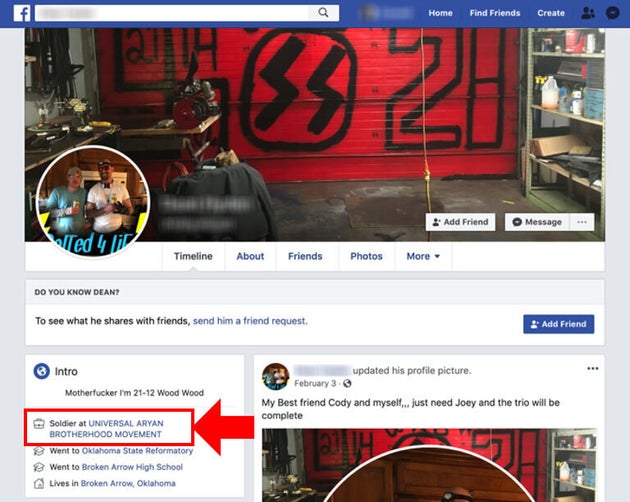
Tech Transparency ProjectA screenshot by the Tech Transparency Project shows how Facebook auto-generates pages for white supremacist groups.
Of the 113 white supremacist organisations that the project found on Facebook, 64% had pages that had been created by Facebook itself. Such auto-generated pages occur when an individual user lists a job in his or her profile that doesn’t have a corresponding business page. If one or more users list the Universal Aryan Brotherhood Movement as an employer, Facebook creates a page for the neo-Nazi group.Â
Auto-generated pages don’t have administrators who can use the pages to communicate with followers, Facebook’s spokesperson said.
An anonymous whistleblower filed a complaint with the Securities and Exchange Commission about Facebook auto-generating pages for hate and terror groups. Sometimes such pages earn thousands of likes, offering hate groups a ready-made recruiting pool, the whistleblower argued.
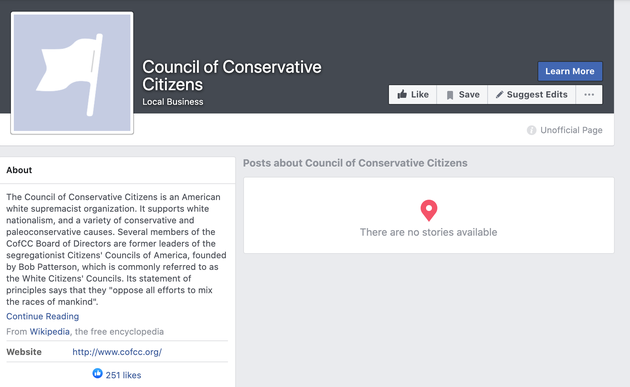
More than 250 people liked the auto-generated page for the Council on Conservative Citizens — whose white supremacist propaganda inspired Dylann Roof to massacre nine black parishioners at a Charleston, South Carolina, church in 2015.Â
That page, which included a link to the group’s website, appeared to have been removed by Facebook on Friday.Â
HuffPostA screenshot showing another auto-generated white supremacist page.
Facebook also appeared Friday to have removed auto-generated pages for the white nationalist website VDare and the violent neo-Nazi group Northwest Front, both of which were mentioned in TTP’s report.Â
A user-created page for the neo-Nazi group Aryan Nations, which had been active for just over 10 years, was also removed on Friday.Â
Still, many white supremacist organisations identified in TTP’s report remain on Facebook. One user-created page for Arktos Media  — the fascist European publishing house with close ties to American white supremacist Richard Spencer — is still active. More than 42,000 people have liked the page.Â
A page for the hate group Fight White Genocide, which has more than 1,000 likes, is still active. A trio of years-old pages or groups called Right Wing Death Squad are also still online.Â
Facebook has an extensive process — including consultations with academics and various organisations — for developing criteria to determine which groups are considered hate groups, the company’s spokesperson told HuffPost.
But the company does not follow any one organisation’s list of hate groups and so may not always agree with hate group identifications made by the Southern Poverty Law Center, the Anti-Defamation League or TTP, the spokesperson added.
Tech Transparency ProjectA screenshot shows how users can be directed to visit other hate pages.
TTP’s report raises an alarm about the function of so-called related pages on Facebook, which it said can push users into a white supremacist echo chamber.Â
“TTP’s investigation found that among the 113 hate groups that had a Facebook presence, 77 of them had Pages that displayed Related Pages, often pointing people to other extremist or right-wing content,†the report said. “In some cases, the Related Pages directed users to additional SPLC- or ADL-designated hate groups.â€Â
The user-created Facebook page for American Freedom Union, for example, included a link to a page for the book “White Identity: Racial Consciousness in the 21st Century,†by Jared Taylor, another prominent US – based white supremacist.Â
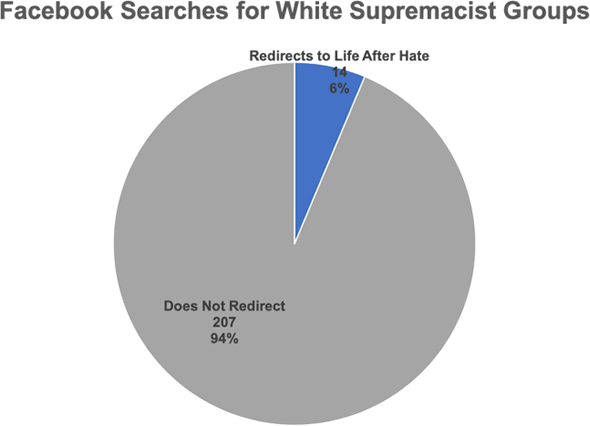
Tech Transparency ProjectRedirects to Life After Hate surfaced in only 6% of searches for white supremacist content.
“Searches for terms associated with white supremacy will surface a link to Life After Hate’s page, where people can find support in the form of education, interventions, academic research and outreach,†the company said at the time.
But TTP’s study found that the Life After Hate link only surfaced in 6% of its 221 searches for white supremacist groups.Â
“One factor may be that not all of the hate groups listed by SPLC and ADL make their ideologies obvious in their names,†the TTP report conceded, a reference to how fascist groups sometimes use coded language to hide their true motives.Â
But the project said its researchers were rarely redirected to Life After Hate even when searching obvious white supremacist terms.  Â
“Of 25 groups with ‘Ku Klux Klan’ in their official name, only one triggered the link to anti-hate resources,†the report found.Â
We use cookies on our website to give you the most relevant experience by remembering your preferences and repeat visits. By clicking “Accept”, you consent to the use of ALL the cookies.
This website uses cookies to improve your experience while you navigate through the website. Out of these, the cookies that are categorized as necessary are stored on your browser as they are essential for the working of basic functionalities of the website. We also use third-party cookies that help us analyze and understand how you use this website. These cookies will be stored in your browser only with your consent. You also have the option to opt-out of these cookies. But opting out of some of these cookies may affect your browsing experience.
Necessary cookies are absolutely essential for the website to function properly. These cookies ensure basic functionalities and security features of the website, anonymously.
Cookie
Duration
Description
cookielawinfo-checbox-analytics
11 months
This cookie is set by GDPR Cookie Consent plugin. The cookie is used to store the user consent for the cookies in the category "Analytics".
cookielawinfo-checbox-functional
11 months
The cookie is set by GDPR cookie consent to record the user consent for the cookies in the category "Functional".
cookielawinfo-checbox-others
11 months
This cookie is set by GDPR Cookie Consent plugin. The cookie is used to store the user consent for the cookies in the category "Other.
cookielawinfo-checkbox-necessary
11 months
This cookie is set by GDPR Cookie Consent plugin. The cookies is used to store the user consent for the cookies in the category "Necessary".
cookielawinfo-checkbox-performance
11 months
This cookie is set by GDPR Cookie Consent plugin. The cookie is used to store the user consent for the cookies in the category "Performance".
viewed_cookie_policy
11 months
The cookie is set by the GDPR Cookie Consent plugin and is used to store whether or not user has consented to the use of cookies. It does not store any personal data.
Functional cookies help to perform certain functionalities like sharing the content of the website on social media platforms, collect feedbacks, and other third-party features.
Performance cookies are used to understand and analyze the key performance indexes of the website which helps in delivering a better user experience for the visitors.
Analytical cookies are used to understand how visitors interact with the website. These cookies help provide information on metrics the number of visitors, bounce rate, traffic source, etc.
Advertisement cookies are used to provide visitors with relevant ads and marketing campaigns. These cookies track visitors across websites and collect information to provide customized ads.

 Dr Manish Mehta, Medical Superintendent of Rajkot civil hospital issued 13 doctors, who specialise in critical care, orders of posting in the Covid-19 hospital on Tuesday. (Representational)