Bernd Leno: Arsenal players are idols and role models for equality

0

Bernd Leno: “It is sad in 2020 we are still discussing these things, but this is the reality and we have to keep pushing on this.”

Last Updated: 12/06/20 8:30pm


Bernd Leno says everyone at Arsenal must pull together as role models

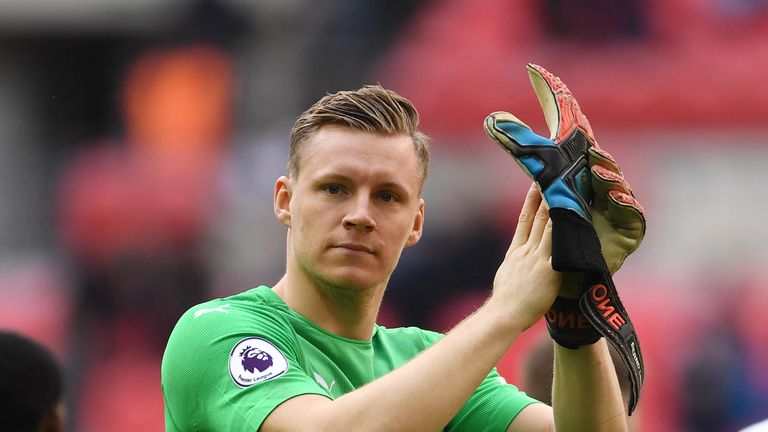
Bernd Leno has urged Arsenal’s players to show support for all races and creeds as role models for equality and inclusion.

Athletes across the world, including Premier League footballers, have joined in support of protests triggered by the death of unarmed black man George Floyd in US police custody last month.

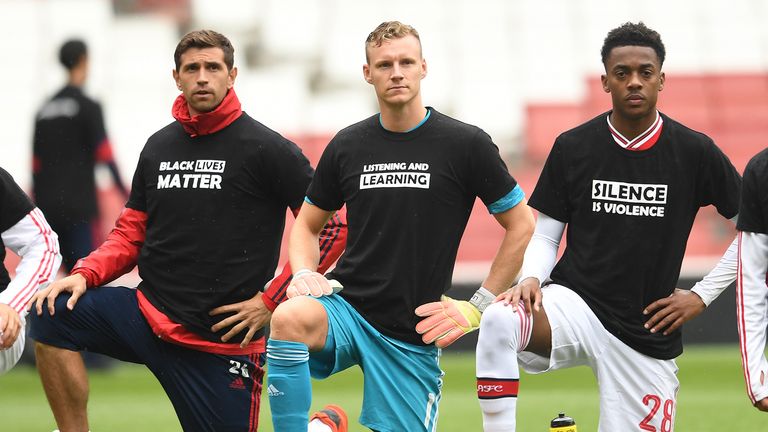
German goalkeeper Leno was among the Arsenal players who took a knee and wore Black Lives Matter T-shirts before the friendly against Brentford earlier this week.

Leno told Sky Sports News: “We as players have so many people looking up to us as idols.

“We have to show, as Arsenal, that we support you; it doesn’t matter if you are black or white, or what your religion is.

Arsenal took a knee and wore Black Lives Matter T-shirts ahead of their friendly against Brentford

Arsenal took a knee and wore Black Lives Matter T-shirts ahead of their friendly against Brentford

“It is sad in 2020 we are still discussing these things, but this is the reality and we have to keep pushing on this.

“It doesn’t matter if you are black or white, we have to respect each other and everybody should have the same chances in life.”

Speaking ahead of Arsenal’s return to Premier League action on Wednesday against Manchester City, Leno said: “Everyone is getting more excited [about the season beginning].

“I’m looking forward and probably everybody in the world is looking forward that Premier League football is going back at least to something like normal.

“Everything will be new at the beginning with the match-day protocols. But it was the same with training and you get used to it. And we’re all glad we can do what we love and play football again.

“I’m sure that everything will go in a good way and that everything will go smoothly like in Germany. We as players have a good feeling that everything is safe.”

Arsenal can move sixth and close the gap to fourth-placed Chelsea to five points if they beat City in what is a game in hand on the rest of the pack, and Leno is confident despite the threat of losing home advantage without fans in the Emirates.

“We are prepared for the situation without the fans, we have worked during the break on our mindset and our leadership,” he said.

“We can surprise City because nobody has the rhythm. I’m sure we can have a good start. Mikel (Arteta) knows every player and he knows the manager better than anyone.

“I think Mikel will have a good game-plan and at this level we think we are a very good team.”

Super 6: Bayern to sail past Gladbach?

Do not miss your chance to land the £50,000 jackpot on Saturday. Play for free, entries by 2:30pm.


Source link

WATCH: Aerial footage of 64 000 turtles converging on Aussie island

0

Australian marine scientists have released remarkable footage showing 60 000-plus sea turtles gathering on the Great Barrier Reef as they wait to go ashore and lay their eggs.

The green sea turtles go each year to the remote Raine Island, about 600km northeast of the Queensland city of Cairns, and in recent years conservation efforts have seen their numbers grow significantly.

However, trying to accurately count tens of thousands moving turtles from a moving boat in the sometimes turbulent ocean is not a simple task. So at the end of last year the scientists from the Queensland Government’s Department of Environment and Science embraced modern drone technology to help them gather the data.

The idea worked, a new scientific paper has just been published detailing the findings, and nature-lovers around the world have been treated to spectacular aerial visuals of an estimated 64 000 turtles gathering around the island.

View the footage here:

Named for greenish colour of their cartilage and fat

Green sea turtles are named for the greenish colour of their cartilage and fat and are found mainly in tropical and subtropical waters. They will travel significant distances as they migrate between their feeding and nesting grounds.

The green sea turtle is classified as an endangered species by the Red List of Threatened Species published by the International Union for Conservation of Nature. The biggest threats to the population are overharvesting of their eggs, loss of nesting beach sites, hunting and being caught in fishing nets.

Although precise population numbers are unknown, it is believed there are between 85 000 and 90 000 nesting females alive today, based on nesting beach monitoring reports tracked by the Sea Turtle Conservancy.

According to the National Wildlife Federation, nesting occurs in over 80 countries. There are populations with different colourings and markings in the Atlantic, Indian and Pacific oceans.

Largest remaining green turtle nesting location

Raine Island is considered to be the largest remaining green turtle nesting location in the world and is a protected national park not accessible to the public. The Raine Island Recovery Project is working to protect and restore the island’s green sea turtle habitat.

Scientists with a turtle on Raine Island. Photo credit: Great Barrier Reef Foundation

“We’re seeing the world’s largest aggregation of green turtles captured in these extraordinary drone images that are helping to document the largest turtle numbers seen since we began the Raine Island Recovery Project,” Great Barrier Reef Foundation Managing Director, Anna Marsden, said.

“This important research combines science and technology to more effectively count endangered green turtles.”

DMCA.com Protection Status


Source link

Amitabh Bachchan says the prosthetics for Gulabo Sitabo took four-five hours each day : Bollywood News – Bollywood Hungama

Amitabh Bachchan is quite the legendary actor who has managed to woo us with his performances in every film. While at his age it would be easier to go for the conventional roles, he never ceases to amaze us with his ability to try new things every time. For Shoojit Sircar’s Gulabo Sitabo, Amitabh Bachchan had to play the role of Old Mirza and even had to change his walking posture to make it look extremely realistic.

Speaking of his role, the veteran actor said that every role comes with a challenge for those that agree to work on it and Gulabo Sitabo was no less. He revealed that he had to sit for a good four to five hours each day for the prosthetics in the month of May and had to get the posture for his role correct. But if he wishes to call himself a professional then he has to accept the challenges and enjoy it.

Amitabh Bachchan surely redefines professionalism for us.

Also Read: From fan-boying over Amitabh Bachchan in Hum to starring in Gulabo Sitabo, Ayushmann Khurrana sums up his journey

More Pages: Gulabo Sitabo Box Office Collection , Gulabo Sitabo Movie Review

BOLLYWOOD NEWS

Catch us for latest Bollywood News, Bollywood Movies update, Box office collection, New Movies Release & upcoming movies info only on Bollywood Hungama.

Loading…

Source link

Ranveer Singh, Deepika Padukone, Priyanka Chopra’s Bajirao Mastani gets stage revamp, Rajneish Duggal to play Peshwa Bajirao : Bollywood News – Bollywood Hungama

0

Back in 2015, filmmaker Sanjay Leela Bhansali directed Bajirao Mastani which was fronted by Ranveer Singh, Deepika Padukone, and Priyanka Chopra. Now, it is getting a revamp with a stage musical with Kathak legend Pandit Birju Maharaj as the creative director.

The musical, based on Sanjay Leela Bhansali’s movie Bajirao Mastani, will be directed by Maitreyee Pahari. Actor Rajniesh Duggal is stepping into the shoes of Peshwa Bajirao with Kathak dancers Shailja Nalwade and Anusua Majumdar playing Mastani and Kashibai respectively.

Rajniesh was quoted saying, “I am extremely glad to have been trained under the guidance of Pandit Birju Maharaj ji for the musical. This is something I have never done before. While initially, the plan was to take it to different cities and countries there is a possibility that it will go online. The talks are still on.”

The musical features nine-ten musical sequences with 50 dancers and 12 actors from all across the country. Including ‘Malhari’, they have retained seven of the original songs from the film.

ALSO READ: Deepika Padukone’s weekend plans are all about the self-care and self-love

More Pages: Bajirao Mastani Box Office Collection , Bajirao Mastani Movie Review

BOLLYWOOD NEWS

Catch us for latest Bollywood News, Bollywood Movies update, Box office collection, New Movies Release & upcoming movies info only on Bollywood Hungama.

Loading…

Source link

Christopher Nolan’s Tenet and Gal Gadot’s Wonder Woman 1984 postponed by Warner Bros : Bollywood News – Bollywood Hungama

The Coronavirus outbreak has hit showbiz. Productions have been halted and films have been postponed amid this pandemic. After shutting down the productions of several films, two more films have been delayed by Warner Bros. The highly awaited film Tenet, helmed by Christopher Nolan, is being pushed back from its original release date. The tentpole film, which was earlier scheduled for July 17, will now release two weeks later on July 31. Interestingly, the film will now release on the 10th anniversary of Nolan’s critically acclaimed film Inception.

“We’re especially thrilled, in this complex and rapidly changing environment, to be bringing Christopher Nolan’s Tenet, a global tentpole of jaw-dropping size, scope, and scale, to theaters around the world on July 31,” said Toby Emmerich, chairman of Warner Bros. Pictures Group to Variety. “It’s been longer than any of us could’ve imagined since we’ve seen a movie on the big screen, and to acknowledge Chris’ fans as we count down to Tenet’s opening day, we are also excited to offer his masterpiece ‘Inception’ in theaters for its 10th anniversary on July 17.”

Warner Bros. has also once again delayed Gal Gadot starrer Wonder Woman 1984. Earlier, it was scheduled for June release. Then, it was given a new date, August 15. The Patty Jenkins directorial will now hit the theatres on October 2, 2020. “The new release date for WW84 is 10.2.20. Wow, it’s finally happening, & I couldn’t be more excited!To all the fans that stuck w/ us through this time, thank u so much! We couldn’t have done this w/o you.I’m so excited for you to get to see this #WW84, it will be worth the wait,” Gal wrote on Twitter.

ALSO READ: Robert Pattinson says Christopher Nolan’s Tenet is quite complicated and he was clueless during the shooting

BOLLYWOOD NEWS

Catch us for latest Bollywood News, Bollywood Movies update, Box office collection, New Movies Release & upcoming movies info only on Bollywood Hungama.


Source link

Q&A: What are the guidelines on childcare now?

0

Image copyright
Getty Images

The coronavirus lockdown forced many people in Northern Ireland to work from home – but with schools closed, a lot of parents have also had to look after their children at the same time.

With some sectors of the economy now reopening, what childcare is available for parents who are expected to return to their place of work?

Here’s a guide to the latest guidance in Northern Ireland, and what it means for parents and providers.

Who can access childcare in Northern Ireland?

At the start of the pandemic, some schools and other childcare settings stayed open on a limited basis, for parents classed as key workers, and vulnerable children.

Those restrictions have not changed, but last week the definition of a key worker was widened by the Departments of Health and Education.

This was to pre-empt more parents returning to jobs in retail, with the sector allowed to fully reopen from 12 June.

The full list of key workers can be seen here.

With more parents now being defined as key workers, demand for childcare is set to rise – but providers are having to significantly change how they operate.

The Department of Education said “extensive work is under way between the relevant departments” to plan for “adequate and appropriate childcare as we move through the phased recovery plan”.

Image copyright
PAcemaker

Image caption

Life is beginning to return to streets which were empty for weeks

What’s the situation for day-care centres and nurseries?

Not all of them can open yet.

There are 344 day nurseries in Northern Ireland, about 80% of which are private businesses, according to the Early Years Organisation.

It is estimated more than nine in 10 nurseries and day-care providers closed in late March, because of the reduction in numbers of children attending.

To reopen, centres must have demand for at least 25% of the overall number of registered places or 15 vulnerable children or those of key workers.

There are also restrictions on group sizes to minimise the spread of the virus.

What will day-care centres look like now?

The Departments of Health and Education, which both have responsibility for childcare, have advised day-care centres to organise children in “play pods”.

These should be as small as possible, limited to 12 children and with the same members of staff assigned each day.

Lynda Courtney runs a day-care centre in Moygashel, County Tyrone, which is preparing to reopen in the next fortnight.

Image copyright
Kids and Bibs/Mark and Lynda Courtney

Image caption

Day-care centres have been advised to organise children into “play pods”

She said she feels very positive about resuming business, but advised parents that the centres will look different.

“We’ve had to remove soft furnishings and some toys, and there are now more entrances and exits,” said Mrs Courtney.

“A lot of parents are anxious that their child can’t be lifted up or even touched, but the play pods will make it feel like they’ve their own little family in day care.

“We’ve had to think outside the box and look at ways of changing, but we’ve adapted.”

Image copyright
Kids and Bibs/Mark and Lynda Courtney

Are childminders available?

Yes, but they can also only accept vulnerable children and those of key workers.

There are about 2,700 self-employed, registered childminders in Northern Ireland. Just over 1,100 continued to work during the lockdown.

Currently, they can look after the children of three families at one time, according to government guidance.

Image copyright
Pacemaker

Image caption

With retail reopening, more people are having to return to work and are struggling to access childcare in a short space of time

This can increase to four families at the one time in July, and to five families in August – but the Departments of Education and Health say it is subject to medical and scientific advice.

Patricia Lewsley-Mooney of the Northern Ireland Childminding Association welcomed that decision, but said more still needs to be done.

“We need to be talking to the Department for the Economy with regard to employers being a bit more understanding when it comes to employees’ access to childcare,” she said.

“We’re hearing anecdotally that some parents are being told if they do not go back to work by Monday, there could be disciplinary processes in place.

“It’s not that they don’t want to go back to work, but it may be too short notice, or they’re not on a childminder’s list or their childminder can’t take more kids.”

What if I can’t access a childminder or day care centre?

From 12 June, places of worship and community centres have been allowed to open to provide childcare, following a decision taken by the executive.

But questions remain about staffing of the facilities, and how many hours they will open per day.

Stormont ministers met on Friday as part ongoing efforts to find a permanent solution for the childcare sector, but those talks are expected to roll into next week.

Can grandparents look after children?

Pre-lockdown, many parents would have relied on grandparents for help with childcare.

Families are still not permitted to visit each other indoors, so many people will not be able to go down this route.

However, so-called support bubbles for adults who live alone in Northern Ireland can start from Saturday.

A grandparent who lives alone could potentially form a bubble with one of their children, which means they could go to see them and interact with their grandchildren.

How many people in Northern Ireland rely on childcare?

About 350,000 workers in Northern Ireland have dependent children, according to the Nevin Economic Research Institute (NERI).

Its research suggests 70% of them are likely to have “intensive childcare requirements”.

Childcare was not specifically mentioned in the executive’s five-step Pathway to Recovery plan, but Ms Lewsley-Mooney said she recognised the executive is now focusing on the issue.

“Childcare is a lynchpin for the whole economy,” she added.

What other information is available?

The Departments of Health and Education say parents seeking childcare should consult the Family Support NI website to find out what is available in their area.

A Department of Education spokesperson said: “Childcare is a crucial part of our recovery from coronavirus and a key priority for the executive.

“The first minister and deputy first minister met with the health and education ministers on plans to ensure the provision of adequate and appropriate childcare as we move through the phased recovery plan.

“Extensive work is under way between the relevant departments to progress this and guidance issued to the childcare providers and parents earlier this week.

“The wider issue of both formal and informal childcare provision will be discussed again by the executive next week.

“Ministers understand the urgency of this and will provide further updates for parents and professionals as soon as possible.”

A helpline is also available on 0808 8020 400, where an early years team within the local health trust can provide advice on childcare solutions in a parent’s area.

Source link

Legends repositioned: Liverpool’s electric Michael Owen would tear defences apart from the left wing – Sport360 News

0

Football is constantly evolving and with data plus in-depth analysis growing exponentially in the modern game, new tactical innovations are made with increasing frequency.

As a result, formations are being manipulated in more creative ways and players of a particular skillset are being used in roles they perhaps wouldn’t be in previous decades.

Philipp Lahm was an ideal example. Renowned as one of the best right-backs around for most of his career, Pep Guardiola deployed him in midfield as the central cog in a possession-based system.

How many other players from the past would thrive in different positions in today’s game? How many more goals would Ryan Giggs score as an inverted winger in a front three? Could Fernando Redondo have been a stylish centre-back on the left side of a back three bringing the ball out and even attacking on the overlap?

In this series, we look at past legends and theorise the possible new positions within the tactics of the modern game.

This edition sees us explore a new role for an electric Michael Owen…

LEGEND: MICHAEL OWEN | STRIKER

Position in modern game: Left Wing
Point of reference: Raheem Sterling

Keep in mind, we’re talking about a teenage Michael Owen here, one who would likely leave even Raheem Sterling in his wake.

That raw pace and acceleration is key to his success as a left-sided winger, which can even be loosely classed as an inside forward in the modern game.

If you consider how Sterling has developed under Pep Guardiola, it’s easy to see why Owen would be an excellent option in a similar position.

The likes of Cristiano Ronaldo, Sadio Mane and Kylian Mbappe have also racked up numbers to prove that such an attacking left-sided role can contribute significantly to the goals column.

Owen’s speed would naturally make him a threat out wide in any team on the break but he also has the qualities to thrive in a possession-based system like Manchester City’s.

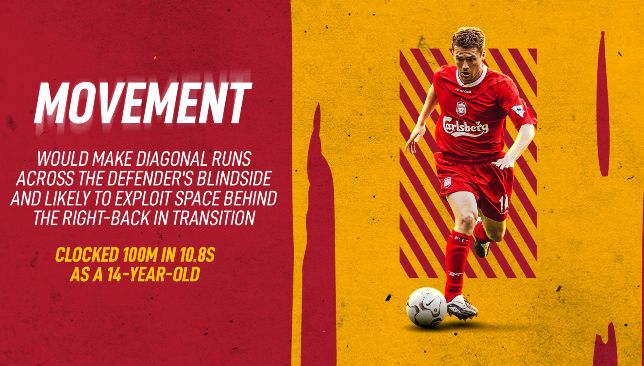
Movement

Michael Owen Movement

In his early years, Owen was a nightmare for centre-backs with his searing pace a constant threat in behind. He ran the channels relentlessly and was devastating in the transition.

As a left winger today, he’d remain a key man on the counter-attack and may even be afforded more space to exploit given the modern full-back’s liability to being caught up the pitch during a turnover. He’d also have the chance to receive possession in the half spaces where he would have time to turn and tear into defences with direct runs.

His ability to time his movements to perfection would wreak havoc from the left by making those out-to-in diagonal runs, darting across the defender’s blindside.

And in a team like City who often find themselves camped in the opposition’s final third, Owen’s clever and sharp movement inside the box would be priceless.

Creativity

Michael Owen Creativity

When he first burst onto the scene at Liverpool everything Owen touched turned to goals, including his passes. He never earned recognition as a provider but in his first full season, he made an impressive 10 assists in the Premier League to compliment his 18 goals that won him the Golden Boot.

With his willingness to run the channels and stretch defences, he could sometimes find himself in wide positions and had the ability to find teammates in the middle. It stands to reason then that Owen would retain the capacity to do that, perhaps with even greater frequency, from a wider role in the modern game.

Of course, injuries impacted him early on in his career and he was no longer capable of being this all-action breed of centre forward. But for a brief spell in the beginning, Owen proved he could be both scorer and provider.

Finishing

Michael Owen Finishing

There’s a level of freedom that comes with operating as an attacking winger that someone like Owen would thrive on. He would have the option to take up a position inside the box during spells of possession but could even try to make late runs and arrive unmarked.

For a finisher of his calibre, the possibility of being spared relentless man-marking is an absolute gift. He would have the opportunity to ghost in at the far post or pop up around the penalty spot for the cut-back with centre-backs preoccupied with the striker.

Even when he lost his pace and mobility, Owen continued to be an elite striker owing to his anticipation and clinical finishing. His appetite for goals coupled with the freedom of a wide role would see him devour defences.

Know more about Sport360 Application


Source link

Don’t stop them now: Rocket Lab launches 5 satellites to orbit

0

Rocket Lab’s 12th mission finally got off the ground early this morning (June 13), after a 2.5-month delay caused by the coronavirus pandemic.

A two-stage Electron booster rose off the pad at Rocket Lab’s New Zealand launch site at 1:12 a.m. EST (0512 GMT; 5:12 p.m. local New Zealand time), carrying five satellites aloft, including three payloads for the U.S. National Reconnaissance Office (NRO).


Source link

Global report: Fauci voices Covid-19 fears for Trump rally as São Paulo faces cemetery crisis

Dr Anthony Fauci, a senior US infectious disease official, has warned of the dangers of holding Trump election rallies during the pandemic, adding that rising coronavirus hospitalisations in some states could get out of control unless robust contact-tracing regimes were in place.

Fauci warned there was a risk of either “acquiring or spreading” the virus for those who attend the president’s planned rally in Oklahoma next week, although he said he had not raised the issue with him.

“I have not specifically spoken to him about that, but the principles that I have been espousing hold true,” he told CNN, urging anyone attending to wear a mask at all times.

Globally, there are now more than 7.6 million cases, with more than 425,000 deaths recorded, according to the Johns Hopkins tracker. In the US, there have been 2,048,986 cases and 114,669 deaths.

In a separate interview with Yahoo, Fauci raised the risks at Black Lives Matter protests. “You’re having crowds, and we recommend not to go in crowds. Physical distancing is impossible,” Fauci said. “When people get animated, they get involved in the demonstration, they start chanting and shouting and screaming, very often they take their mask off.”

Texas and North Carolina on Friday reported their highest hospitalisation rates since the pandemic began. Officials in both states pointed out they also had among the lowest death rates.

Fauci underscored that increased hospitalisations was a worrying trend, however, and a sign that “maybe we need to slow down a little” on reopening the US.

“But when you start seeing more hospitalizations, that’s a sure-fire sign that you’re in a situation where you’re going in the wrong direction,” Fauci said.

Texas has been at the forefront of state efforts to reopen their economies and governor Greg Abbott on Friday said it would remain that way “because we have so many hospital beds available to anybody who gets ill”.

“For every person in a hospital bed, there are 10 open, available hospital beds available for them,” Abbott said. “So there’s plenty of hospital capacity to be able to deal with Covid-19.” He added that there was “no real need to ratchet back the opening of businesses in the state”.

In Brazil, the city of São Paulo has said it will exhume bodies buried years ago and store their bagged remains in large metal containers in a bid to free up space during the crisis.

The municipal funeral service said in a statement on Friday the remains would be placed in numbered bags, then stored temporarily in 12 containers it has bought. The containers would be delivered to several cemeteries within 15 days.

The country marked a grim milestone the same day, overtaking the UK to become the country with the second-highest Covid-19 death toll in the world.

In Argentina, a pastor turned his church into a bar in protest at the uneven easing of restrictions in his Santa Fe province. Church leaders were dressed as waiters carrying Bibles on their trays in a mock service. Pastor Daniel Cattaneo said: “So, apart from the breaded veal headed for table four, here goes the word of God.”

China reported 11 new cases on Saturday, including six domestic cases in the capital, Beijing, that raised concerns about a resurgence. Most of China’s cases in recent months have been overseas nationals tested as they returned home. The new cases have prompted Beijing officials to delay the return of students to primary schools and suspend all sporting events and group dining. City authorities on Friday also closed two markets visited by one of the known cases.

The first new case in Beijing after two months – who had no recent travel history outside the city – was reported on Thursday, and authorities confirmed two more infections the next day. The other five cases reported Saturday were brought in from overseas.

New Zealand has now gone for 22 days in a row without recording a new case. Following the recovery of an Auckland woman on Monday, it has no known active cases of Covid-19, and no one is in hospital with the virus.

Source link

Hizbul Mujahideen is marching to its grave: Kashmir’s once-feared terror group is roiled by infighting, low on resources and lacking local leadership – Firstpost

0

From his home in the little mountain village of Liver, Naseer Ahmad Khan has begun gathering an army: Porters, carpenters, masons, mule-drivers, who will later this month march into the great mountains above Pahalgam to the ring of remote military outposts set up to guard the pilgrimage to the Amarnath shrine.

The work is hard — and dangerous. Labour contractors like Naseer Ahmad are seen by jihadists as collaborators; some have been tortured, even executed.

But Naseer Ahmad is different: his father is Ghulam Nabi Khan, the military chief of the Hizbul Mujahideen, once Kashmir’s largest jihadist group. From his home in Rawalpindi, in Pakistan, Khan has presided over the Hizb’s war against India since 2008,  the last man standing, almost, of a generation of jihadists who once came close to seizing Kashmir.

The strange story of father and son helps us understand why, even as a new generation of Kashmiris is joining the jihad, the Hizb is marching towards its grave.

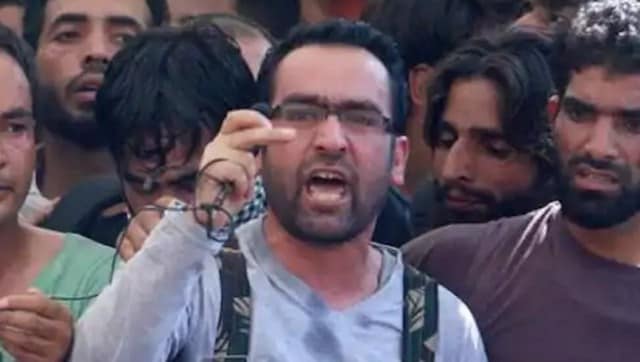
File image of former Hizbul Mujahideen commander Riyaz Naikoo. News18

In the past two weeks alone, a record numbers of Hizbul cadre — many young recruits who have joined in recent months — have been killed in police-led operations.

New Delhi is cheering, but this might not prove to be good news for India.

Born around 1950 the village of Liver, near Pahalgam, to orchard-owning farmers, Khan was part of the first generation of Kashmiri Muslims to be empowered by State-provided public education.

Following an education at a government-run high school in Sirigufwara, not far from Liver, Khan went on to earn a Bachelor’s degree in the Arts from the Government Degree College in Khanabal, near Anantnag.

To most local people, he seemed destined for a job as a petty bureaucrat, a coveted position. Then, the course of his life changed.

Islamism had, in the 1970s, begun to emerge as a language of protest against India and the increasingly kleptocratic political system it sustained in Kashmir.

Kashmir’s Jamaat-e-Islami, scholar Yoginder Sikand has recorded, used networks of schools and mosques to propagate the idea India was determined “to destroy the Islamic identity of the Kashmiris, through Hinduising the school syllabus and spreading immorality and vice among the youth.”

In the summer of 1973, the discovery of a dusty colonial-era encyclopedia in Anantnag’s public library, bearing an archangel Gabriel dictating the text of the Quran to the Prophet, sparked off widespread rioting. Local clerics demanded its its author be hanged, a demand hard to meet, scholar Katherine Frank wryly observed “since Arthur Mee had died in England in 1943.”

For Khan, the riots marked the beginning of a lifelong involvement in Islamist politics. Though he does not appear to have joined in Jamaat-e-Islami organisational politics, he became active in Islamist opposition circles in southern Kashmir.

Then, in 1987, the National Conference — with then prime minister Rajiv Gandhi’s blessings — rigged state elections to ensure the defeat of the new Islamist-led Opposition coalition, the Muslim United Front (MUF). Khan was among many MUF activists — alongside his boss in the Hizb, Muhammad Yusuf Shah — who ended up in prison.

Emerging from jail in 1989, Khan crossed the Line of Control (LoC) to train at the many Inter-Services Intelligence (ISI) Directorate-administered camps which had sprung up in Pakistan-occupied-Kashmir (PoK). His brother, Nisar Ahmad Khan — slain in 1999 — also travelled to the camps for training.

Khan returned in 1990, now using the alias “Saifullah Khalid.” Ten years later, he was commanding the Hizbul Mujahideen’s operations across Kashmir.

The ground beneath Khan’s feet, though, had begun to shift. In 1997, the head of the Jamaat-e-Islami, Ghulam Muhammad Bhat, called for an end to “gun culture”, using language that spoke for the growing frustration of Islamists with a war that had reached a grim, pointless cul-de-sac.

Fair elections and democratic politics had resumed in Kashmir in 1996. Large numbers of yesterday’s jihadists — once politicians themselves — wanted a deal with India.

In the autumn of 2000, then prime minister Atal Bihari Vajpayee’s government ordered the Research and Analysis Wing to begin secret peace negotiations with senior Hizb commander Abdul Majid Dar. Politicians like secessionist leader Abdul Gani Lone — legislator Sajad Lone’s father — quietly helped the process along.

Khan had very personal reasons to resist the peace process: in 1999, his son Abdul Hamid Khan, the fourth of five, had been tortured and killed, in what the family alleges was an extra-judicial execution by Indian forces.

The following year, as the dialogue process unfolded, Khan fled back across the LoC to Pakistan, fearing for his own life. He played a key role, though, in the ISI’s campaign to stamp out the peace process, organising the assassination of key pro-dialogue commanders like Abdul Hamid Tantray. Lone was assassinated in 2002; the Hizb’s Dar was himself executed by a jihadist hit-squad in 2003.

Killing off the dialogue process, though, proved tougher than expected. General Pervez Musharraf’s regime, under pressure from the United States after 9/11 and eager to avoid crisis with India, threw its weight behind a new peace process from 2003.

Former chief minister Mufti Muhammad Saeed’s People’s Democratic Party government, moreover, provided the Jamaat rank-and-file with patronage, and reached out to ground-level Hizb commanders, hoping to win them back to democratic politics.

In the mid-2000s, demoralised cadre at the Hizb’s camps began returning home, often with families in tow, travelling home through Kathmandu with the tacit backing of India’s intelligence services.

Inside Kashmir, the senior Hizb leadership’s families set about making their own peace. Hizb chief Shah’s youngest son Syed Abdul Wahid landed a medical degree — and then a job at a prestigious government medical hospital — with a little help from the Intelligence Bureau, according to former Research and Analysis Wing chief AS Dulat. Two of Wahid’s siblings, Syed Shahid Yousuf and Syed Shakeel Yusuf, also landed government jobs.

Like Khan’s labour-contractor son, the children and grandchildren of jihad commanders and secessionist politicians chose Indian capitalism over their parents’ Islamism. Barring Junaid Sehrai, son to Jamaat leader Muhammad Ashraf Khan, no child of a prominent Islamist joined a terrorist group.

The Hizb seemed headed, inexorably, towards the dustbin of history.

Kashmir’s Islamist patriarch, Syed Ali Shah Geelani, responded to this crisis by bypassing the Jamaat, and reaching out to new youth cohort that had grown up amidst Kashmir’s long jihad. Led by politicians such as Masrat Alam Bhat, Asiya Andrabi and Ashiq Husain Faktoo, the New Islamists successfully repackaged Jamaat ideology for an online generation.

Prostitution, drug and alcohol use, migrant workers, women’s freedoms: these were India’s weapons, to destroy Islam and Kashmiris, the New Islamists claimed.

“I caution my nation,” Geelani warned in 2006, “that if we don’t wake up in time, India and its stooges will succeed and we will be displaced.”

Geelani and his lieutenants received none-too-tacit support from chief minister Saeed, who hoped to use them to destabilise his arch rival and successor, Congress politician Ghulam Nabi Azad.

Feuds between the PDP and National Conference fuelled the crisis. “We politicians set about pulling each other down”, recalled former Kashmir minister Imran Ansari, “and ended up bringing the roof down on our heads.”

In the summer of 2008, the New Islamist movement exploded into murderous street battles with police. The Hizb found itself on the sidelines, lacking the kinds of charismatic leadership needed to reach out to young people. The slogans of young Islamist protestors increasingly invoked the Lashkar-e-Taiba and Jaish-e-Muhammad—not the Hizb.

Even though he flatly refused to return home, Khan was now given charge of rebuilding the organisation. Funds flowed to local commanders, but the task proved hard, mainly because the considerable daylight that lay between aspirations of young jihadists and the Hizb’s leadership.

From 2010, bitter feuds broke out between Hizb leadership and north Kashmir commander Abdul Qayyum Najjar, culminating in a series of savage killings. Najjar was called back to Pakistan, and a truce worked out. The deal didn’t last, though, and both sides were soon trading allegations of treason — and bullets.

Burhan Wani, held out as a poster boy for the Hizb in a social-media driven age, further embarrassed the Hizb by decrying its traditional ethnic-religious nationalism, and vowing to fight “until a caliphate is established over the entire world.” Hizb leaders were also acutely aware of western pressures on their Pakistani patrons to distance themselves from global jihadist organisations like Al-Qaeda.

Wani’s successor Zakir Rashid Bhat went even further, threatening to “chop the heads off” secessionist politicians should they stand in the way of the jihadist struggle for an Islamic State. Inside months, Bhat broke with the Hizb, and set up an Al-Qaeda wing in Kashmir.

Finding himself running short of leadership candidates after Bhat’s defection, Khan turned to Sabzar Ahmad Khan, a one-time criminal and drug addict from Tral who had acquired a significant social-media profile. Sabzar Khan rein, though, turned out to be ineffective — and short lived.

Late in 2016, Khan finally found a commander who understood the need to keep the Hizb’s language distinct from global jihadism, and avoid alienating the bourgeois base of the Jamaat-e-Islami. Through his almost four-year run as the Hizb’s Kashmir chief, one-time schoolteacher Riyaz Naikoo significantly toned down the organisation’s polemic.

“We have no enmity with people of India, he proclaimed on one occasion, “Our fight is with those who commit cruelty against our people.”

In one 2018 speech that irked many young Islamists in Kashmir, Naikoo even assured migrant workers and Amarnath pilgrims: “You have no threat from us.”

Last year, though, after Article 370 was revoked, Naikoo found himself struggling to rein-in field units which unleashed an assassination campaign targeting the apple industry. Though young jihadists were determined to sabotage the harvest, and thus demonstrate the limits of India’s power, the Hizb command understood this would serve only to alienate ordinary Kashmiris.

Following Naikoo’s killing last month, the Hizb is again facing a leadership crisis. His successor Saifullah Mir, an Industrial Training Institute-educated pharmacologist, is believed to rarely leave his home district of Pulwama.

There’s little sign Mir — or his boss in Rawalpindi — will succeeding in addressing the Hizb’s chronic capacity issues. Lacking weapons and ammunition, as well as even rudimentary training, over two dozen recruits who joined the Hizb have been killed in police-led operations since March.

This hemorrhage, unprecedented in the Hizb’s history, makes it probable young Islamists will look elsewhere to pursue their jihadist pulses.

Ethnic Kashmiri jihadists have found growing space in better-resourced and disciplined organisations such as the Lashkar and Jaish. In December 2017, teenager Fardeen Khandey and 21-year-old Manzoor Baba participated in a suicide-squad attack on a Central Reserve Police Force complex in Pulwama, becoming the first known ethnic Kashmiris to have carried out such a strike.

Adil Dar, the 20-year-old who carried out the 2019 Jaish-e-Muhammad suicide-bombing in Pulwama, who began in the Hizb — but soon looked elsewhere. “By the time this video reaches you,” he said in a suicide video, “I will be frolicking in paradise.”

Adil Hafiz, another young jihadist who began his journey in the Hizb, is believed by police to have signed up for a similar bombing last month.

Even though anti-Pakistan organisations such as Al-Qaeda and the Islamic State have been crippled by the same logistical challenges as the Hizb, they have also continued to attract some numbers of new recruits. Kashmiri jihadists linked to these global organisations have begun to argue that the war of attrition in Kashmir is unwinnable — and advocate, instead, for attacks on cities and business across India

Ghulam Nabi Khan’s jihad was intended to supplant the political order India had built in Kashmir with one led by the Jamaat-e-Islami, and backed by Pakistan. The political circumstances, and hopes, it was predicated on no longer exist.

In its place, a new kind of jihadism has risen from the dark soil laid by a decayed political system, a jihadism which, inspired by global projects, is driven by a millenarian impulse hostile to all forms of politics, and even the idea of accommodation itself.


Source link