Tuesday, June 2, 2026

De Blasio Expects New York City To Head Back To Work Next Month

Vehicles move through a nearly empty Times Square earlier this month in New York City. On Thursday, Mayor Bill de Blasio laid out his plans for reopening the city after weeks of sweeping measures to try to contain the coronavirus outbreak.

Frank Franklin II/AP


hide caption

toggle caption

Frank Franklin II/AP

Vehicles move through a nearly empty Times Square earlier this month in New York City. On Thursday, Mayor Bill de Blasio laid out his plans for reopening the city after weeks of sweeping measures to try to contain the coronavirus outbreak.

Frank Franklin II/AP

Mayor Bill de Blasio expects up to to 400,000 New York City residents to head back to work in the first half of next month, as the city prepares to begin lifting some of its most stringent coronavirus restrictions. That’s the upshot of the mayor’s news conference Thursday at City Hall, during which he laid out what to expect from a city that emerged weeks ago as the epicenter of the outbreak in the U.S.

“Because we’re in the great unknown — we’ve never been through a pandemic like this, certainly not in the last hundred years — we can only give you a range to begin, but we’re going to know really soon what the truth is,” de Blasio said. “But even if you say 200,000 people, that’s a lot of employees coming back to work. So we want to make sure it’s done the right way, and we want to emphasize safety throughout.”

To date, New York City has reported nearly 200,000 confirmed cases of the coronavirus and a death toll north of 16,600 — more deaths linked to COVID-19 in just New York City, in other words, than all but six countries around the world.

Even as regions throughout the rest of New York — including neighboring Long Island, which officials are treating separately from New York City in this instance — have begun the first phase of the state’s reopening plan, the city of some 8 million people remains behind the starting gate not having hit the necessary benchmarks to open.

But de Blasio doesn’t expect the city to need much more time to satisfy the criteria, such as reduced infection rates and ramped-up testing capacity. He told reporters Thursday that “all indicators suggest it’ll be announced in the first or second week in June.”

After that, four principal sectors of the city’s economy will be able to return to work, de Blasio said: construction, manufacturing, wholesale and retail that to this point has been deemed nonessential. These include sellers of clothing, furniture and other items, provided that sales are done through pickup.

“These sectors, as you can imagine, tend to be the sectors where you need people in person. But on top of that, they were chosen because there are sectors where you can create a lot of physical separation,” he said, noting that social distancing regulations will remain in effect. “You can make sure that people are safe.”

At a separate news conference Thursday in Brooklyn, Gov. Andrew Cuomo announced that he had signed an executive order allowing businesses statewide to refuse entry to people not wearing face masks. And he made clear that ultimately, the decision about when New York City will reopen will be made in Albany.

“We’re on totally the same page, because there’s only one page: There’s state guidelines, period,” Cuomo said of himself and de Blasio, adding: “The mayor has his schedule. I have my schedule. I talk to him all the time. But there’s only one page.”


Source link

George Floyd’s Death Resurfaces Amy Klobuchar’s Tough-On-Crime, Easy-On-Cops Record

The death of George Floyd, a black man who died after a Minneapolis police officer kneeled on his neck earlier this week, has resurrected Democratic Sen. Amy Klobuchar’s record as a prosecutor in the state ― including her tense relationship with the Black community there ― at the politically sensitive time that she’s being considered by Joe Biden to be his running mate. 

“There is absolutely no way that she is qualified to become Biden’s VP nominee,” said Nekima Levy Armstrong, a civil rights lawyer who served as head of the Minneapolis NAACP from 2015 to 2016.

Kenza Hadj-Moussa, a spokeswoman for the progressive group Take Action Minnesota said Klobuchar’s actions as a prosecutor “caused trauma that’s been long lasting.”

“With everything that’s happened in Minneapolis and across the country,” she said, Klobuchar would put Biden at even more of a “disadvantage” politically.

“This does not work in Amy’s favor because she had such a strained relationship with that community for years,” added a prominent Democrat. 

Four Minnesota police officers were fired this week after video emerged showing one of the men, a white officer, kneeling on Floyd’s neck as he pleaded for help, saying ”I can’t breathe.” They detained him Monday evening on suspicion of trying using a fake $20 bill at a convenience store. Floyd was declared dead shortly after arriving at the hospital. 

Two days of protests in Minneapolis have followed, with police using rubber bullets and tear gas to disperse crowds. 

Klobuchar received her start in politics right there, in Hennepin County, where she served as the top prosecutor for eight years, beginning in 1999. She employed a tough-on-crime approach, pushing, among other things, more convictions of minor offenses like graffiti and school truancy.

Klobuchar’s methods were not exceptional for the time period, when cities were struggling to reduce the high crime rates of the 1980s and ’90s. 

But reformers now blame the techniques that she and others adopted for swelling the country’s disproportionately non-white jail and prison populations.

“Minnesota leadership has really supported police and the expansion of policing,” said Isabela Escalona, a spokesperson for the Centro de Trabajadores Unidos en Lucha, a worker center that has fought against increases in Minneapolis’ police budget. “She’s a part of the problem and we must find community solutions to safety beyond police.”

During her presidential campaign, Klobuchar faced deep skepticism from many Black voters, in part because of her record in Hennepin County. “As a prosecutor in heavily white Minnesota, Amy Klobuchar declined to go after police involved in fatal encounters with black men,” read the headline of a Washington Post article in March 2019 that examined her record on criminal justice. 


As county attorney in Hennepin County, Amy Klobuchar had a tense relationship with the Black community for her refusal to bring charges against police officers in certain cases.

According to The Washington Post, Klobuchar chose not to bring charges against officers in more than two dozen cases where people were killed in police encounters. 

Throughout her presidential campaign, and as recently as this week, Klobuchar has said she believes prosecutors — and not grand juries — should ultimately decide whether or not to charge police officers. In many of the cases cited in the Post, grand juries ultimately decided not to hand up charges.

“I think it just makes for much more responsibility if you basically make the decision yourself,” she told CNN’s Chris Cuomo in an interview earlier this week. “Back then it was thought, let the community help decide how these cases should be handled.”

As a presidential candidate, and before that as a Senate candidate, Klobuchar cited the prosecution of the alleged perpetrators of a 2002 shooting that killed 11-year-old Tyesha Edwards as evidence that her prosecutorial style came in response to genuine concern from the state’s Black community about gun violence plaguing urban neighborhoods.

But an investigation by The Associated Press in February found that there were many outstanding questions about the evidence that Klobuchar’s office used to convict Myon Burrell, who was 16 at the time of the shooting and is serving a life sentence. His co-defendants now deny that he participated in the shooting. 

Protesters angered by the case stormed the stage ahead of a planned rally in a Minneapolis suburb two nights before Super Tuesday in early March. The demonstration prompted Klobuchar to cancel the rally; she dropped out of the presidential race the next day. 

The Burrell case looms large for activists wary of Biden picking her as a running mate. 

Biden “uses all the language of [Black Lives Matter] and liberal racial justice advocates but you look at what a person does,” said a Minneapolis progressive strategist, who asked for anonymity to speak freely. “Picking Klobuchar, given the record she has, especially in this moment, seems like nothing less than an admission that he doesn’t seriously care about these issues.”

“The Black community in Minnesota has consistently expressed concern about Amy Klobuchar’s prosecutorial record and her involvement in prosecuting Myon Burrell, an innocent Black teenager whose case was used by her for political gain, including during her campaign for President,” Levy Armstrong said. “Another deeply troubling aspect of Klobuchar’s record was her failure to hold a single officer accountable for police shootings, dozens of which happened on her watch.”

Klobuchar has called for an independent investigation into Burrell’s case, a move that drew praise from an attorney for the Burrell family and Leslie Redmond, the head of the Minneapolis NAACP who has protested Klobuchar in the past.

Klobuchar’s office declined to comment on the record for this story.  

Minnesota Attorney General Keith Ellison, who is Black and a former criminal defense attorney, defended Klobuchar’s prosecutorial record, maintaining that she was “not unusually tough” and has since become a “voice for criminal justice reform in the context of race.” 

Derek Chauvin, the police officer seen kneeling on Floyd, had previously been involved in two other violent incidents with civilians. One happened in late October 2006, when he and five other officers shot and killed a man who they said aimed a shotgun at them. Only days later, Klobuchar was elected to the Senate and remained Hennepin County district attorney for two more months. In 2007, a grand jury declined to bring charges against Chauvin and the other officers.

Klobuchar put out a statement on Floyd’s death, describing it as a ”horrifying and gut wrenching instance of an African-American man dying.” She also called for a “complete and thorough outside investigation into what occurred, and those involved must be held accountable.” 

Her office did not return a request for comment for this piece. 

Biden has publicly said he is going to choose a woman as his running mate and that Klobuchar is someone he is considering. But he has also been under significant pressure to choose a woman of color.

Biden’s campaign looked like it was over, until South Carolina voters ― primarily, Black voters in the state ― delivered him a knock-out victory. In recognition of that support, many Democrats have urged him to choose a woman of color ― or, at the very least, not to pick someone who has had such a strained relationship with the Black community. 

In a recent Washington Post op-ed, a group of six Black female activists specifically named Klobuchar as an unacceptable vice presidential option if he wants to win over Black voters: “Biden, the presumptive Democratic nominee, does not need help winning white, working-class voters — he serves that function himself. A choice such as [Klobuchar], who failed to prosecute controversial police killings and is responsible for the imprisonment of Myon Burrell, will only alienate black voters.”

Last week, Biden made supporters cringe when he told Charlamagne tha God, a popular Black radio host, “If you have a problem figuring out whether you’re for me or Trump, then you ain’t Black.” He apologized later that day in a call with Black business leaders, saying he was “too cavalier” and did not take the Black vote for granted. 

The prominent Democrat who spoke with HuffPost said the comments underscored why Biden needed to choose a woman of color ― or someone who can help him talk to voters of color.

“There are a couple of things that I think are going to hurt her,” they said of Klobuchar. “One was Biden’s real big gaffe, which now I think forces his hand in more ways than one to pick a woman of color. But two, now this [Floyd killing] is going to raise all the issues, particularly with the Minneapolis NAACP and the African-American community. It’s going to dredge all that back up again.”

Ellison, who supported Vermont Sen. Bernie Sanders’ presidential run, said he does not think Biden should be limited to choosing a woman of color as his running mate. 

Klobuchar would “make a great vice president. She’d be a tireless campaigner too,” he said. “She’ll help us win the upper Midwest.”

Biden released a statement on Floyd on Wednesday, saying it was “not an isolated incident, but a part of an ingrained systemic cycle of justice that still exists in this country.” 

The former vice president is set to deliver a keynote at the Minnesota Democratic-Farmer-Labor Party’s state convention on Sunday, introduced by Klobuchar. His team has not yet released his remarks, but some allies have urged him to address Floyd’s death.

Biden has enjoyed high support among older Black voters, but has struggled with young voters of all races, who typically have more progressive views on a host of issues. Hillary Clinton’s failure to generate higher turnout among Black voters in general, and young Black voters in particular, is widely considered a key reason for her loss to Donald Trump in the 2016 presidential race.

Those younger voters are looking for a vice presidential pick who demonstrates that Biden is committed to a world with fewer deaths like George Floyd’s, according to Hadj-Moussa.

“There’s an incredible amount of pain and we have an opportunity to not go back to the way things were, but to create a better future,” she said. “If I was advising Vice President Biden, I would not point to Sen. Klobuchar as a vice presidential pick who could stand next to him and be part of building a new future.” 

Kevin Robillard contributed reporting. 


Source link

EU Confidential #154: Commission’s €750B recovery plan — Battles ahead — Making ‘Parlement’ funny

0

Listen to the podcast on Spotify | Apple | Google | Soundcloud | Stitcher

The European Commission this week unveiled a sweeping €750 billion proposal to get the EU’s economies back on track. POLITICO’s budget guru Lili Bayer, along with Andrew Gray, Matthew Karnitschnig and Rym Momtaz break down the plan and preview the battles ahead. We assess the mood in Commission HQ and around the Continent, and ask whether Ursula von der Leyen and her team have emerged strengthened from the skirmishes so far.

Noé Debré, the creator of “Parlement,” a TV comedy set in the European Parliament, is our special guest. POLITICO’s Cristina Gonzalez and Maïa de La Baume get the behind-the-scenes scoop on how the show came about, how it’s been received inside the Parliament and what makes EU lawmaking funny.


Source by [author_name]

How Russia made Hemeimeem air base its African hub

The satellite images published on May 26 by U.S. African Command (AFRICOM) appear to confirm reports that Russian MiG-29 jet fighters had flown to Libya. At least one of the aircraft, never before deployed to the country, was spotted at the al-Jufra air base. It may well be that, as some reports suggest, the aircraft were acquired from Belarus and operated by Belarussian and Serbian pilots, not Russians. Having said that, however, Russia can no longer deny it knows about the deployment of military equipment to Libya and argue, as it did, that the hardware was procured through dummy firms in Serbia without Moscow’s knowledge. In fact, the MiG-29s travelled to Libya via Russia’s Hemeimeem air base in Syria, by way of Iran’s Hamadan air base and Russia’s Privolzhsky airfield, and were accompanied by a Tu-154M military aircraft. As this latest episode makes clear, Hemeimeem air base plays a central role in Russia’s growing involvement in both the Mediterranean and Africa.

Russia’s presence in the Mediterranean

Prior to 1991, the Fifth Operational Squadron was the Soviet Navy’s permanent operation force in the Mediterranean theater and served as a counterweight to the United States Sixth Fleet. Unlike the Americans, however, the Soviets never established a permanent naval base in the Mediterranean. Instead, they relied on facilities in Syria, Algeria, and Yugoslavia to repair and resupply their vessels and rest their crews. Following the collapse of the USSR, the Russian naval facility in Tartus became the country’s only support point for long-range trips to the Atlantic and Indian oceans. At the time, the Russian government, faced with chronic economic problems, struggled to commit substantial resources to projecting power abroad, including in the Mediterranean. Thus, in 2012 the Tartus facility consisted of just a pier and two small buildings on the coast, and the apparatus of Russia’s chief military adviser in Syria, for all practical purposes, was disbanded. In 2013 Russia even had to evacuate its officers from Syria, fearing the risks posed by the ongoing civil war.

The situation changed dramatically in 2015 when Russia decided to actively intervene in the Syrian conflict. The Russian military began to refer to the Tartus facility as a military base, equipped with own repair shop and able to accommodate 11 warships, including nuclear-powered ones. The Russia-controlled Hemeimeem air base has also been modernized and expanded since the start of Moscow’s campaign. Thanks to the construction of a second landing strip, it can now service more types of planes, including heavy aircraft such as the Tu-142M3 and missile carriers. Prior to this Russian strategic bombers like the Tu-95MS and Tu-160 had to carry out cruise missile strikes against Syrian rebel forces and ISIS fighters from Russia’s Mozdok and Olenya air bases, refueling in mid-air. The Russian military has also eyed the Kuweires air base in Aleppo as a location to deploy MiG-31 interceptor aircraft, which would be able to reach Malta and Gibraltar within an hour and fire long-range missiles.

This level of Russian presence is adequate to the tasks Moscow has set for itself in Syria, namely waving the Russian flag in the Mediterranean and showcasing the county’s return to the Middle East and North Africa. Beyond those symbolic aims, however, Russia’s real capabilities in the region, although significantly greater than they were a decade ago, are not as vast as they might appear on first glance. Even if Moscow wanted to deploy thousands of troops in Syria on short notice, it would struggle to do so for technical reasons. Russia lacks ships capable of operating in long-distance maritime and oceanic zones and only has a modest array of military transport aircraft, two factors that limit Moscow’s ability to conduct large-scale operations in a distant theater. Whatever Russia lacks in pure military power, however, it aspires to make up for with the appeal of its ideas by promoting its vision for an alternative, multipolar geopolitical order. Under this order, Moscow would serve as one of several poles, while regional players in Africa and the Middle East would have greater leverage in negotiations with larger powers, especially the West.

Pivot to Africa

Africa has taken on a growing importance for Russia since the outbreak of the Ukraine crisis, which further accentuated Moscow’s aspirations to become a global power, as opposed to an isolated, besieged fortress. To this end, Russia made a fresh bid to diversify its diplomatic and economic relations to make sure it could face the West on equal terms, circumvent sanctions, and solicit support from Middle Eastern and African countries in multilateral institutions such as the UN.

To build ties with African states, Russia has been engaged in diplomacy on two tracks. The utility of official diplomatic channels is limited by the cumbersome nature of Russian bureaucracy, which often lacks the initiative to take on responsibility and risks. Therefore, Moscow has sought to cultivate relations with local African players using quasi-governmental actors such as businessmen and private military companies. This informal diplomacy is carried out under the guise of Russia’s official advisers and is apparently overseen by its special services. The Hemeimeem air base in Syria serves as a logistical hub servicing flights to Libya, Central African Republic (CAR), and Sudan, where Russian non-government players are reportedly operating.

Russia’s reliance on this system of “parallel diplomacy” provides flexibility but also has its drawbacks in an unstable political setting. Russia has often lacked a strong military presence on the ground to protect friendly African regimes from coups or domestic upheaval. Thus, while this parallel diplomacy strategy could help to obscure Russia’s dealings in Africa and shield its reputation, it is by no means foolproof.

The ousting of the former Sudanese leader Omar al-Bashir in 2019 is a case in point. Before he was deposed by a coup d’etat after months of popular protests, al-Bashir had been building ties with Moscow. In 2017 the Russian private military firm Wagner Group reportedly opened a camp in Sudan to train local army recruits and soldiers to serve in the Central African army. Sudan also became an object of commercial interest for Russian businessman Yevgeny Prigozhin, the reputed owner of the Wagner Group. A Russian mining company linked to Prigozhin, M Invest, was reported to have gained access to Sudan’s goldmines and dispatched more than 50 experts to the country. Moscow also used its relationship with al-Bashir to lend additional support to Syrian President Bashar al-Assad. While most of the contacts between Moscow and Khartoum went through unofficial channels, it was a Hemeimeem-based aircraft that reportedly carried the Sudanese leader to Syria in 2018 in an attempt to boost Assad’s diplomatic profile and mend his ties with the League of Arab States.

With al-Bashir ousted, however, the once burgeoning Russia-Sudan alliance is now under strain. The country’s caretaker leader and the chief of Transitional Military Council (TMC), Lt. Gen. Abdel Fattah Abdelrahman Burhan, was quick to begin efforts to improve ties with the West, a move that may come at the expense of its partnership with Moscow in the military sphere.

Russia’s pivot to Africa has yielded more lasting results with governments that have a firmer grip on power. One example is the regime of Central African President Faustin-Archange Touadera, who has managed to stay in power despite the continuing UN arms embargo and the loss of French support. The Russian government exploited the opening left by the withdrawal of French forces by sending ammunition and military and civilian advisers to CAR. In so doing it also provided a convenient cover for the presence of private contractors in the African country, something Russia has consistently denied — even after three Russian journalists were murdered there while making a documentary about paramilitary groups. In addition to using sea routes to reach African countries, Russia has also transported supplies and personnel to CAR via Sudan using the Hemeimeem air base.

One important piece in Russia’s African puzzle has been the Kremlin’s growing partnership with Egyptian President Abdel-Fattah el-Sisi. This helped Moscow solidify its position within the network of regional alliances and, to an extent, use the Libya portfolio as leverage in its discussions with Turkey on Syria. It was hardly by accident that Moscow’s consultations on Libya came on the same day that the head of the Syrian regime’s National Security Bureau, Ali Mamlouk, held talks with Turkish intelligence chief Hakan Fidan.  

Optimizing geopolitics

Hemeimeem has also been instrumental in servicing Russian air traffic to Benghazi and al-Watiya air base in Libya. The latter had been used by Moscow to fly aircraft to Venezuela before Khalifa Hifter’s forces lost control of the base. Meanwhile, it is still difficult to ascertain the degree of Russian involvement in recruiting Syrians to fight on Hifter’s side. However, recent reports at the very least support the thesis that Hemeimeem is used as an assembly point from which Syrian recruits are transported to Libya. And even if this assistance is part of a bilateral arrangement between Assad and Hifter, Russia must have acted as a broker — especially given reports that the fighters transported to Libya included not just pro-regime militiamen from the National Defense Forces, but also ISIS prisoners.

Russia has once again displayed its pragmatism in using its facilities in Syria and links to private military groups for geopolitical maneuvering at little financial cost. The deployment to Libya has also showcased Moscow’s role not so much as a direct participant in the country’s conflict as a facilitator of a burgeoning alliance between Assad and Hifter.


Anton Mardasov is a non-resident scholar in MEI’s Syria Program and a non-resident military affairs expert at the Russian International Affairs Council (RIAC) focusing on Syria, Iraq, and extremist organizations. The views expressed in this piece are his own.

Photo by MAXIME POPOV/AFP via Getty Images

Source link

14 Million People In Latin America, Caribbean At Risk Of Hunger, U.N. Report Says

People in the Andean city of Puno, Peru, lined up earlier this month to withdraw funds from their pensions. The World Food Programme says the number of people experiencing severe food insecurity in Latin America and the Caribbean could quadruple.

Carlos Mamani /AFP via Getty Images


hide caption

toggle caption

Carlos Mamani /AFP via Getty Images

People in the Andean city of Puno, Peru, lined up earlier this month to withdraw funds from their pensions. The World Food Programme says the number of people experiencing severe food insecurity in Latin America and the Caribbean could quadruple.

Carlos Mamani /AFP via Getty Images

The coronavirus pandemic has put nearly 14 million people in the Caribbean and Latin America at risk of missing meals, according to a report released Wednesday from the U.N.’s World Food Programme.

The virus has spread quickly in the region in recent weeks, with Latin America surpassing Europe and the United States in its daily numbers of new coronavirus cases reported.

The Americas have become the “epicenter of the COVID-19 pandemic,” the Pan American Health Organization said earlier this week.

Health officials have even warned of a potential humanitarian crisis in Haiti due to a rising number of cases.

Brazil, the largest country in Latin America, now has the second-highest number of coronavirus cases in the world.

The White House recently restricted travel from Brazil into the United States. The country’s health minister resigned from his post earlier this month amid disagreements with the president on how to handle the crisis.

Financial hardship is increasing throughout the region, including in Colombia. As John Otis reported for NPR, residents in a slum near Bogotá are hanging red cloth from their homes to signal to neighbors that they need food.

The WFP estimates that the number of people experiencing severe food insecurity in the region will increase from 3.4 million to 13.7 million over the course of 2020.

This is likely to hit those who rely on daily earnings in the informal sector hardest. The report points out that in Bolivia, that group comprises about 60% of the population.

The region’s economy is expected to contract by 5.3% this year, according to a recent report from the Economic Commission for Latin America and the Caribbean.

A WFP survey of nine countries in the region showed that around 69% of people in the region have seen a drop in their income because of the pandemic. Roughly the same number said they are worried about not having enough food.

The impact in urban areas is expected to be particularly brutal. Seventeen percent of respondents in urban areas said they were having one meal per day or less.

In Haiti alone, the WFP says in its report that the number of people experiencing severe food insecurity could more than double — rising from 700,000 to 1.6 million. And hurricane season is just around the corner.

Source link

Why Twitter should ban Donald Trump | Julia Carrie Wong

Trump’s executive order on social media would undermine free speech – and probably go nowhere – but it’s an effective distraction. Still, Trump’s abuse of Twitter means it’s time to close his account. Here’s why:

More than 100,000 people in the United States have died of Covid-19, more than any other nation in the world. The figure is probably an undercount.

More than 1.7 million people in the US have had confirmed cases of Covid-19, more than any other nation in the world. The figure is almost certainly an undercount.

The US federal government completely botched the rollout of testing for the coronavirus at the beginning of the pandemic, and continues to lag in providing adequate testing for its populace.

Related: As 100,000 die, the virus lays bare America’s brutal fault lines – race, gender, poverty and broken politics

Continue reading…

Source link

‘No Mask – No Entry,’ Cuomo Says As He Allows Businesses To Insist On Face Coverings

Face masks are effective in slowing the spread of the coronavirus, New York Gov. Andrew Cuomo says. His message was bolstered by Rosie Perez and Chris Rock, who joined Cuomo at a Thursday news conference in Brooklyn.

Spencer Platt/Getty Images


hide caption

toggle caption

Spencer Platt/Getty Images

Face masks are effective in slowing the spread of the coronavirus, New York Gov. Andrew Cuomo says. His message was bolstered by Rosie Perez and Chris Rock, who joined Cuomo at a Thursday news conference in Brooklyn.

Spencer Platt/Getty Images

New York businesses can refuse entrance to anyone who doesn’t wear a face mask, Gov. Andrew Cuomo said Thursday under his executive order that gives store owners the authority to decide whether patrons must wear a mask or other face coverings to enter.

Face masks are “amazingly” effective in slowing the spread of the coronavirus that causes COVID-19, the governor said.

“People have a right to jeopardize their own health (I don’t recommend it),” Cuomo said via Twitter. “People don’t have a right to jeopardize other people’s health.”

Summing the order up in another tweet, he said, “No Mask – No Entry.”

YouTube

New York, which has suffered the worst effects of the COVID-19 pandemic, has been requiring people to wear face masks in public since the middle of April. The order covers any situation in which people wouldn’t be able to maintain social distance, such as walking on a busy street or going to a grocery store or pharmacy.

The state is in the reopening stage, and Cuomo said store owners have the right to protect themselves and other patrons.

“You don’t want to wear a mask — fine,” he said at a news conference Thursday. “But you don’t have a right to then go into that store if that store owner doesn’t want you to.”

New York continues to see promising statistics about its fight against COVID-19. The number of new daily hospitalizations due to the disease dropped to 163 — “the lowest that it’s been,” Cuomo said. The number of lives lost has also declined over the past week, with 74 deaths reported Wednesday.

The state has delivered 8 million face masks to neighborhoods in New York City and was delivering another 1 million Thursday, the governor said.

As Cuomo prepared to sign an executive order allowing businesses to require face masks, New York lawmakers were working to undo a long-running state law that made it illegal for people to wear masks when they gather in public or loiter. That law, which has been in effect since the 1800s, was originally meant to target farmers who wore masks and attacked police to express their anger over low wheat prices.

The potential legal conflict was highlighted last month by New York Attorney General Letitia James, who noted that while it was difficult to imagine the old law being vigorously applied during the pandemic, a change would lay the matter to rest once and for all.

“Wearing masks in public remains necessary for the health and safety of New Yorkers. But there was a clear conflict of law, and repealing this outdated provision is commonsense policy,” James said as the State Assembly approved the legislation repealing the law.


Source link

Punjab fee hike: ‘Does govt want to make MBBS unaffordable for poor?’

0

By: Express News Service | Amritsar, Chandigarh |

Published: May 29, 2020 1:03:00 am


The state Council of Ministers on Wednesday gave its nod for fee hike in cabinet meeting on Wednesday. (Representational Photo)

THE PUNJAB government’s decision to hike the MBBS course fee in its medical colleges by nearly 80 per cent has met with sharp criticism from the medical fraternity, which said the move is “aimed at benefitting private players” and making medical education “unaffordable” for aspirants from lower middle and middle classes.

The critics also lashed out at the decision to increase the fee at a time when doctors are at the frontline fighting the Covid-19 pandemic, calling the move “shameful”.

The state Council of Ministers on Wednesday gave its nod for fee hike in cabinet meeting on Wednesday.

The fee in government medical colleges in the state has been hiked from Rs 4.4 lakh to Rs 7.8 lakh, an increase of 77.2 per cent, for the full course. The fee for government quota MBBS seats in private colleges has been increased from Rs 13.4 lakh to Rs 18.6 lakh, a nearly 39 per cent increase and for management quota in such colleges, the fee has been hiked from Rs 40.3 lakh to Rs 47 lakh, an increase of nearly 17 per cent.

Three government medical colleges in the state — in Patiala, Amritsar and Faridkot — have 225, 250 and 125 MBBS seats respectively. From this session, the Government Medical College at Mohali will also offer 100 MBBS seats, taking the total MBBS seats in four government colleges in the state to 700.

Six private medical colleges in the state have a total of 775 seats. In the private colleges, 50 per cent of the seats are reserved for government quota, 35 per cent for management quota and 15 per cent for NRIs. In addition, there are 50 MBBS seats at the All India Institute of Medical Sciences (AIIMS) Bathinda, run by the Centre.

The fee hike will not be retrospective and will be applicable only for admissions into the MBBS course from this session. Hence, it will not have any impact on students enrolled in the course already.

Well thought-out decision: Minister

Medical Education and Research Minister O P Soni said the decision to hike the fee was “well thought-out” as per the recommendations by a committee of experts. He added that the increased fee was for the “full course” and the hike was affected “after a long time”. Dismissing allegations that the fee hike was aimed at benefiting private players, Soni said Adesh Medical College, which was charging a much higher fee, was also on a level playing field now with Punjab notifying The Punjab Private Health Sciences Educational Institutions (Regulation of Admission, Fixation of Fee, and Making of Reservation), Amendment Act, earlier.

According to a spokesperson of the chief minister’s office, the fee for the MBBS course in the state for government medical colleges was last notified in 2015 and for private medical colleges in 2014. “With the massive surge in the price index in the years thereafter, these colleges are facing fiscal problems and are unable to meet the norms of the Medical Council of India, thus necessitating a fee hike. These colleges had, in fact, been seeking fee hike for a long time as they were facing hardships to provide good infrastructure and impart quality education to the students at the current fee rates,” said the spokesperson.

‘Not justified’

However, there was widespread criticism of the government decision.

“We condemn the fee hike. It is getting out of reach for the common man. For lower middle class or middle class, it is now very difficult to study. On one side we need doctors and we have to improve health services, on the other side there is a decision to increase fee. At a time of pandemic when health sector should be a priority, it is a bad decision. At least in government colleges, the medical education should be affordable. Fees in Punjab are already on higher side as compared to other states,” said Punjab PCMS Association president Dr Gagandeep Singh.

“This is not justified. The hike is aimed at benefiting private players. In 1970s, there was a fee of Rs 400 for the MBBS course. Now it is Rs 7.8 lakh. This much increase has not happened in salaries. In Arts stream the tuition fee is Rs 12 since 1964. Today, a lecturer gets paid on par with a doctor. Punjab is already short of specialist doctors. The fee hike would make things worse,” said Panjab University Faculty of Medicine dean and former registrar of Baba Farid University of Health Sciences Dr Pyare Lal Garg.

Garg added, “There are Supreme Court judgments which say that fee can be hiked once in three years and the hike cannot be more than 15 per cent. During the previous government also [when SAD-BJP combine was in power] the fee was increased to benefit private players. At that time, the fee of management quota seats in private medical colleges was first increased from Rs 20 lakh to Rs 30 lakh and after five months, it was increased from Rs 30 lakh to Rs 40 lakh per seat.”

Resident Doctors Association of Punjab (RDAP), Government Medical College Amritsar, president Dr Jaspinder Partap Singh said, “The government can keep the fee in government colleges affordable by managing these institutions better. However, it is more interested in allowing private colleges to hike the fee.”

“Some states have 15 medical colleges and Punjab is not able to run three government medical colleges without shifting burden on medical students. The recent decision of fee hike will break the backs of students from middle and lower middle class. It seems government wants only the rich to study medical. They want to make it unaffordable for poor students,” said Jaspinder.

He added, “The government’s move is only to allow private colleges to raise the fee. The fee structure of private colleges is already out of middle class’ reach. They want to make it impossible for poor students to study in private colleges. If PGI can be run with decent fee structure, why can’t the Punjab government do it ? It is clear mismanagement and dishonesty to help private colleges from back door.”

Jaspinder further said, “It is a conspiracy against the people. Government must take this hike back. It must not turn medical education into a business for the public sector too. It is already a business for private sector. We will protest against it. The doctors are at the forefront in fight against coronavirus. It is shameful that government has made this decision when students in medical colleges are not in position to oppose it due to the ongoing pandemic. ”

 MBBS seats in private medical colleges

Christian Medical College, Ludhiana: 75

Dayanand Medical College, Ludhiana: 100

Punjab Institute of Medical Sciences, Jalandhar: 150

Adesh Institute of Medical Sciences and Research, Bathinda: 150

Sri Guru Ram Das Institute of Medical Sciences and Research, Amritsar: 150

Gian Sagar Medical College, Banur: 150

📣 The Indian Express is now on Telegram. Click here to join our channel (@indianexpress) and stay updated with the latest headlines

For all the latest India News, download Indian Express App.

© The Indian Express (P) Ltd

Source link

Turkey readies for ‘new normal’ after declaring success against coronavirus

May 28, 2020

The government appears keen to kickstart the economy quickly after a two-month interruption of economic activity that has hit Turkish manufacturing and all but stalled its services sector.

A total of 124,369 people have recovered out of the 160,979 people who contracted COVID-19, the disease caused by the SARS-CoV-2 virus, Health Minister Fahrettin Koca said on Twitter. On Thursday, another 1,182 people were diagnosed with the disease and 30 people died, bringing the death toll to 4,461 — far below other countries with similar caseloads.

Turkey introduced strict measures even before it became a Middle East hotspot for the coronavirus pandemic last month. But new infection rates have slowed to their lowest levels since March, soon after the virus reached Turkey, prompting a senior Erdogan adviser to tweet last week, “#MissionAccomplished.”

“We now have the opportunity to take necessary steps toward the period we call ‘the new normal,’” Erdogan said after a four-hour cabinet meeting at his Istanbul residence. “Turkey’s thwarting of the outbreak and the loss of life and its attainment of a position that makes it an example to the world is a collective success for all 83 million of us.”

The ban on intercity travel will be “completely lifted” June 1, he said, but added it could be reintroduced for some provinces if required. Preschools, daycare centers, sports facilities, restaurants, cafes, open-air concert halls, museums, beaches and national forests are also permitted to re-open next week.

Stay-at-home orders for people age 65 and up and 18 and under will continue, with exceptions made for a few hours each week, he said. Residents in 15 provinces, including Istanbul and the capital Ankara, will be under curfew again this weekend before the easing begins on Monday, according to an Interior Ministry statement.

The government had already eased some rules, allowing hairdressers and shopping malls to reopen on May 11. Friday prayers will be allowed for the first time in two months this week at more than 1,900 of the country’s mosques, and the head of religious affairs said 1,003 animals will be sacrificed to celebrate the resumption of congregational prayers.

Separately, Erdogan announced that the triumphant Sura al-Fath from the Quran will be read from Hagia Sophia on Friday, the anniversary of the 1453 conquest of Istanbul by Ottoman forces. The Istanbul monument was an Orthodox church for nearly a millennium before its conversion to a mosque following the fall of Istanbul, then became a museum in 1935 in what is widely seen as a symbol of Turkish secularism. Certain religious groups have since called for it to be reopened as a mosque.

Some experts are warning that physical distancing rules are being loosened too soon in Turkey and that allowing public gatherings could affect the decline. Caghan Kizil, a professor of medicine at Dresden University in Germany who has closely followed the outbreak in Turkey, said on Twitter that Turkey may be pursuing a kind of herd-immunity strategy unless it sees a sharp rise in new infections, when it could reintroduce restrictions.

“It wouldn’t be wrong to say that the accelerated shift to normalization after a desired but debatable success story shows decisions rest more on political preferences then scientific figures,” Kizil tweeted.

Turkey had only just returned to rapid economic growth when the pandemic threw the global economy into a tailspin. The hit to Turkey’s economy is likely to be a 3% contraction this year, Fitch Ratings said this week.

But Finance Minister Berat Albayrak, who is Erdogan’s son-in-law, insisted the economy will expand this year. “When compared with the rest of the world, Turkey is among countries least affected, from growth to unemployment to many other fields,” he said on Wednesday. Turkey will release gross domestic product figures for the first quarter on Friday that are expected to show an expansion of 4.9% before the impact of the coronavirus restrictions were largely felt, according to a Bloomberg poll.

One side effect of the outbreak has been the proliferation of conspiracy theories across social media as well as in some nationalist newspapers that minorities, especially Jews, were somehow behind the outbreak, which emerged in China at the end of 2019. A man who set fire to an Armenian church door in Istanbul earlier this month reportedly told police he was angry because he believed Armenians caused the contagion.

This week, security footage showed a man climbing the gates of another Armenian church to tear down a cross. No arrests have been made in connection with the attack, which is the third against a church in one month, Garo Paylan, an opposition lawmaker who is of Armenian descent, told a news site.

It was unclear if the latest vandalism was sparked by misplaced anger over the coronavirus. But critics have warned that politicians’ recent rhetoric targets Turkey’s small communities of non-Muslims and has made them vulnerable.

Earlier this month, Erdogan said “Armenian and Rum lobbies” were among the “evil forces” conspiring against Turkey. (Rum is a term used for the tiny population of ethnic Greeks still living in Istanbul, as well as Greek Cypriots.) He also referred to militants in the outlawed Kurdistan Workers Party as “remnants of the sword,” a pejorative for survivors of the World War I-era genocide of Armenians by Ottoman forces.

“The administration’s spokesmen themselves have used hate speech that incites polarization and discrimination,” wrote lawmaker Tuma Celik, who is a Syriac Christian, in a parliamentary question submitted on Thursday following the latest attack on a church. “We could easily see serious damage caused by hate speech and actions in Turkey’s near future.”


Source link

Trump Officials Defend Their Handling Of Worker Safety During Coronavirus

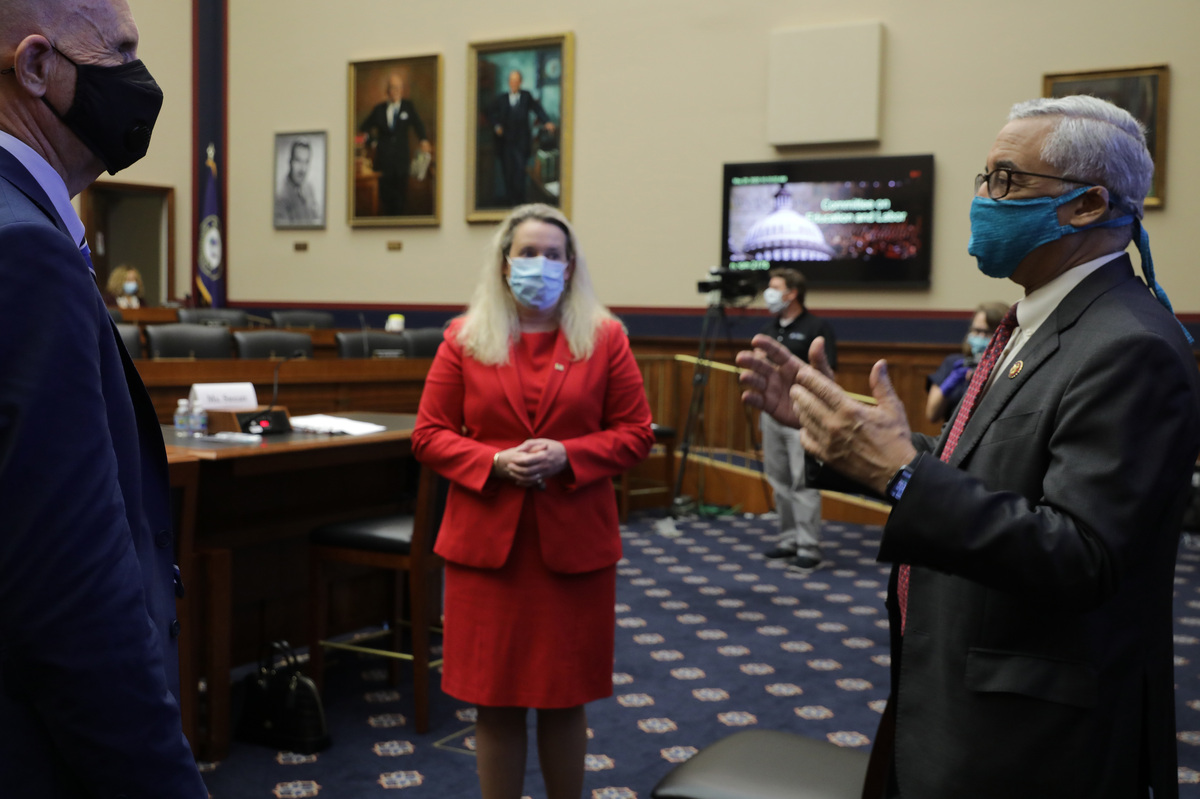
Occupational Safety and Health Administration Principal Deputy Assistant Secretary Loren Sweatt (C) and National Institute for Occupational Safety and Health Director John Howard (L) talk with House Education and Labor Committee Chairman Bobby Scott (D-VA) before a hearing about the federal government’s role in protecting workers during the novel coronavirus pandemic on Capitol Hill on Thursday.

Chip Somodevilla/Getty Images


hide caption

toggle caption

Chip Somodevilla/Getty Images

Occupational Safety and Health Administration Principal Deputy Assistant Secretary Loren Sweatt (C) and National Institute for Occupational Safety and Health Director John Howard (L) talk with House Education and Labor Committee Chairman Bobby Scott (D-VA) before a hearing about the federal government’s role in protecting workers during the novel coronavirus pandemic on Capitol Hill on Thursday.

Chip Somodevilla/Getty Images

Trump administration officials defended their handling of worker safety during the COVID-19 pandemic at a congressional hearing Thursday in Washington, D.C. But they acknowledged a grim new tally of deaths among doctors and nurses is “likely to be an underestimate,” according to testimony from Dr. John Howard, head of the National Institute for Occupational Safety and Health, a division of the Centers for Disease Control and Prevention.

This week the CDC raised dramatically its assessment of healthcare worker infections to more than 62,000, with at least 294 medical industry deaths linked to the coronavirus. Howard said federal officials still aren’t able to track the number of workers getting sick from the coronavirus in any industry or region of the country “due to data collection challenges arising from the pandemic.”

Still, Loren Sweatt, head of the Occupational Safety and Health Administration, told lawmakers federal agencies have reacted swiftly, offering updated safety guidelines to employers ranging from hospitals and nursing homes to meat-packing plants and warehouses.

“OSHA quickly pivoted to focus intensely on giving employers and workers the guidance they need to work safely in this rapidly changing situation,” Sweatt said.

OSHA is currently investigating more than 5,000 complaints from workers linked to COVID-19 risks in the workplace. Sweatt testified her agency has focused largely on convincing employers to resolve safety problems quickly and voluntarily. Only one company has been cited for wrong-doing since the outbreak began.

One focus of Thursday’s hearing was a set of new infectious disease regulations, designed to better protect workers during a pandemic like this one. The Trump administration shelved those proposed standards in 2017. Sweatt said existing rules and voluntary guidance measures already give federal agencies enough tools to protect workers.

She also suggested the regulations had “languished” previously under the Obama administration. But a review of federal documents by NPR found Obama-era officials worked steadily on new infectious disease standards for airborne and contact pandemics, following the standard process for implementing new regulations.

Work on the rules stopped after President Trump took office.

Republicans on the House Labor and Education committee praised that decision, suggesting the new rules would place an undue burden on business owners during an economic crisis. Rep. Virginia Foxx of North Carolina said companies are already doing their best to protect people on the job. “Every employer wants his or her workers kept safe, they are their most valuable assets,” she said.

But as the country moves to reopen and more Americans head back to work, Democrats on the panel argued infectious disease ruled should be adopted quickly as an emergency order. “Deep into this pandemic OSHA still hasn’t developed any enforceable standards for employers to follow that can protect workers from airborne transmission,” said Rep. Alma Adams (D-NC).

The lack of regulatory standards meant the Trump administration was able to relax voluntary safety guidelines repeatedly as the coronavirus spread and shortages of personal protective equipment became dire. Many hospitals, nursing homes and other workplaces were allowed to ration and reuse equipment even as workers got sick.

In his testimony, Howard acknowledged the CDC’s decision to allow hospitals and other workplaces to force workers to reuse personal safety equipment wasn’t based on conclusive evidence they would be protected from infection.

“The science about decontamination is relatively new and I mean very new,” he told lawmakers, suggesting the practice should only be used as a last resort.

Source link