this link is to an external site that may or may not meet accessibility guidelines.
this link is to an external site that may or may not meet accessibility guidelines.
Zoom said on Wednesday that it had temporarily shut down a US account belonging to activists who held an online discussion to mark the anniversary of China’s 1989 crackdown on peaceful protesters in Tiananmen Square, raising alarm about free speech.
US-based rights campaigners turned to Zoom, which has become a way of life for many people during the coronavirus lockdown, to connect more than 250 people to remember the brutal crushing of the weeks-long protests on June 4.
The group, Humanitarian China, said it had brought in numerous participants from inside China, which has tried to erase all memory of the bloodshed, and that its paid Zoom account was shut down without explanation one week later.
The shutdown was first reported by the news site, Axios.
Zhou Fengsuo, a co-founder of the group who was number one on Beijing’s most-wanted list after the Tiananmen crackdown, told AFP that the Zoom account was re-activated on Wednesday.
Zoom acknowledged that it had shut down and restored the account.
“Just like any global company, we must comply with applicable laws in the jurisdictions where we operate,” a Zoom spokesperson said.
“When a meeting is held across different countries, the participants within those countries are required to comply with their respective local laws.
“We aim to limit the actions we take to those necessary to comply with local law and continuously review and improve our process on these matters.”
The activists voiced outrage, saying that the company may have been under direct pressure from China’s communist leaders.
“If so, Zoom is complicit in erasing the memories of the Tiananmen Massacre in collaboration with an authoritarian government,” Humanitarian China said in a statement.
It called Zoom an “essential” resource in reaching audiences inside China, which enforces rigorous censorship.
Beijing has developed the so-called “Great Firewall” that is designed to keep out news that could be damaging to the leadership.
Authorities go to extraordinary lengths each year to ban commemorations of the Tiananmen massacre, in which the military killed hundreds of unarmed protesters – by some estimates, more than 1,000 – who had packed the capital to seek reform.
The restrictions are being lifted slowly after two and a half months of lockdown in the country due to coronavirus outbreak. While safety measures are being taken, actor Shahid Kapoor has urged all to take necessary precautions in order to fight COVID-19 together.
Taking to Twitter, Shahid Kapoor wrote, “With the country slowly opening up, we must take all precautions as we step out. Just as how the security forces fight for us at the border, it is time we all fight Covid-19 together along with the Central and State Governments. RESTART.REBUILD. Safely but surely.”
With the country slowly opening up, we must take all precautions as we step out. Just as how the security forces fight for us at the border, it is time we all fight Covid-19 together along with the Central and State Governments. RESTART.REBUILD. Safely but surely.
— Shahid Kapoor (@shahidkapoor) June 10, 2020
Meanwhile, Shahid Kapoor will next star in Jersey, Hindi remake of Telugu sports drama which is helmed by Gowtham Tinnanuri. The film will also star his father Pankaj Kapur and Mrunal Thakur. The film’s Chandigarh schedule was called off in March due to the coronavirus outbreak.
Catch us for latest Bollywood News, Bollywood Movies update, Box office collection, New Movies Release & upcoming movies info only on Bollywood Hungama.
Loading…
Highlights of this day in history: Alabama Gov. George Wallace makes a symbolic stand against racial integration; A Buddhist monk immolates himself in South Vietnam; Oklahoma City bomber Timothy McVeigh executed; Actor John Wayne dies. (June 11)


“You guys with all your masks, you look very different than you used to,†he said, not wearing one himself.
“We’re just trying not to die,†replied Jake Sherman, a reporter for Politico.
Dr. Deborah L. Birx still coordinates the task force from her office in the West Wing, regularly updates senior staff members and still meets often with Vice President Mike Pence, according to one official, but appears only occasionally to present and discuss new virus data with reporters. Mr. Pence met Wednesday with Trump campaign workers, who posed for a photo, huddling together, thumbs up, their faces bare.
And Adm. Brett P. Giroir, who has been the administration’s point person overseeing coronavirus testing, told colleagues in an email that he was resuming his regular duties as the assistant secretary for health.
“While I remain committed to the fight against Covid-19, and will spend a portion of my time in direct support of the pandemic response,†he wrote, “I feel personally compelled to continue our office’s leadership in childhood vaccination, combating substance misuse, ending the H.I.V. epidemic in America, and improving the lives of all living with sickle cell disease.â€
For nearly two weeks now, the nation has been convulsed by the twin crises of the coronavirus and the civil unrest that followed the death of Mr. Floyd, a black man who gasped for air with his neck under the knee of a police officer. Congress continues to address the coronavirus crisis — in addition to Wednesday’s health committee hearing, Mr. Mnuchin appeared before the Senate Small Business Committee, where he defended the administration’s decision to reopen the economy.
But the big news on Capitol Hill on Wednesday was the testimony of Mr. Floyd’s brother, Philonise Floyd, before the House Judiciary Committee. “I’m here to ask you to make it stop,†he said, asking lawmakers to make sure that his brother “is more than another face on a T-shirt.â€
Senator Lamar Alexander of Tennessee, the chairman of the Committee on Health, Education, Labor and Pensions, convened a virtual hearing Wednesday on how to overcome obstacles — like creating social distance and a “mask-wearing culture†— to getting children back to school.
ISLAMABAD – A large number of Pakistanis are visiting the Pakistani embassy in Riyadh for consular services and purchasing tickets for special repatriation flights.
Due to restrictions imposed by the Saudi government, the Diplomatic Quarters police are allowing entry of the service seekers in batches of 50 Pakistanis each. The sudden surge in the number of visiting Pakistanis is because of the sale of PIA tickets in the embassy premises and resumption of consular services after almost three months of lockdown by Saudi government, Saudi Gazette reported.
The embassy is providing all possible assistance to the Pakistani nationals outside the Diplomatic Quarters as well, including by deputing of officials, provision of water bottles and moving all services related to passports in order to facilitate large public visiting for passport related services outside. Meanwhile, Pakistan International Airlines (PIA) operated special repatriation flight from Jeddah to Peshawar on Monday (June 8).
Consul Press Arshad Munir, Commercial Consul Waheed Shah and Consul Welfare Majid Memon were present at Jeddah airport to bid farewell to the passengers on behalf of the Consul General of Pakistan. After suspension of routine international commercial flights due to the outbreak of COVID-19, the government of Pakistan had started special PIA flights to repatriate stranded Pakistanis from different countries including Saudi Arabia. Over 2,200 Pakistanis have so far been repatriated from Jeddah region since the start of these special PIA flights. Similar special PIA flights are also being operated from Riyadh region. The Embassy in Riyadh and the Consulate General at Jeddah, in close cooperation with the PIA, are coordinating arrangements of these special flights in their respective jurisdictions.
Nationwide anger over police brutality and systemic racism has turned toward symbols of America’s troubled past still scattered across the country: statues honoring Confederate figures and colonizers that have long invited heated debate.
In Portsmouth, Virginia, protesters covered a large Confederate monument dating to the 1800s with trash bags and spray paint on Wednesday. A crowd of largely celebratory demonstrators later took bolt cutters and sledgehammers to the heads of the statues, removing them as a marching band blasted triumphantly in the background.
In Richmond, Virginia late Wednesday, demonstrators removed a statue of Confederate President Jefferson Davis:
Outside the Minnesota state Capitol, a statue of Christopher Columbus was pulled down with ropes as protesters cheered. And in other cities this week, similar monuments were beheaded, toppled into lakes, spray painted or ordered removed by local lawmakers.
The demonstrations began after the death of George Floyd, a Black man who was killed by a white police officer in Minneapolis last month. But they’ve since grown to nationwide and global calls for change and an end to violent policing tactics.
The destruction of the controversial monuments adds to an ongoing reckoning with America’s fascination with symbols long affiliated with racism. On Wednesday, NASCAR, which has a loyal fan base of largely white, Southern viewers, banned the Confederate flag at its events and properties a day after the racing body’s only full-time Black driver said it should be prohibited.
 “The presence of the confederate flag at NASCAR events runs contrary to our commitment to providing a welcoming and inclusive environment for all fans, our competitors and our industry,†the company said.Â
The U.S. Marine Corps also banned its troops from displaying the flag earlier this month, saying the symbol had often been co-opted by “violent extremists and racist groups.â€Â
Lawmakers have treated such calls with vastly different levels of support. House Speaker Nancy Pelosi (D-Calif.) said Wednesday she supported the immediate removal of 11 Confederate statues from the U.S. Capitol, calling them “monuments to men who advocated cruelty and barbarism to achieve such a plainly racist end.â€
“Their statues pay homage to hate, not heritage,†she wrote in a letter.
President Donald Trump, on the other hand, said he would “not even consider†renaming a slate of Army bases that honor Confederate generals amid reports the Pentagon was open to doing just that.
“My Administration will not even consider the renaming of these Magnificent and Fabled Military Installations,†he wrote on Twitter. “Our history as the Greatest Nation in the World will not be tampered with. Respect our Military!â€
Calling all HuffPost superfans!
Sign up for membership to become a founding member and help shape HuffPost’s next chapter

Visitors to the River Walk pass a restaurant that has reopened in San Antonio, Texas, on May 27. Texas continues to reopen in the wake of the COVID-19 pandemic.
Eric Gay/AP
hide caption
toggle caption
Eric Gay/AP

Visitors to the River Walk pass a restaurant that has reopened in San Antonio, Texas, on May 27. Texas continues to reopen in the wake of the COVID-19 pandemic.
Eric Gay/AP
The U.S. has reached another dire landmark in its fight against COVID-19, surpassing 2 million confirmed cases on Wednesday. New coronavirus infections are rising in at least 20 states, even as restrictions on daily life continue to ease across the country.
More than 112,000 people have died from COVID-19 in the U.S. — the most fatalities reported by any nation, according to a tracker from Johns Hopkins University. And most experts believe those numbers underestimate the true toll.
The latest data also reflects the difficulty of quashing the coronavirus. While some early hot spots such as New York state have seen a sustained drop in new cases, COVID-19 hospitalizations have swelled recently in places like Texas, Arizona, Arkansas and California.
Texas set new records for COVID-19 hospitalizations on three consecutive days this week, with a total of 2,153 hospitalized patients on Wednesday. The state was among the first to start the reopening process, and Gov. Greg Abbott is moving forward with plans to raise occupancy limits for bars, restaurants, amusement parks and other businesses.
Florida is seeing its own new surge, with more people testing positive for the coronavirus on Saturday than any day in the past two months. Since June 2, the state has reported more than 1,000 new cases every day, even as the number of COVID-19 deaths has dropped to double-digits.
Arizona has reported an average of more than 1,000 new cases every day this week — the highest per capita rate in the U.S. Underscoring the crisis, the health department said Tuesday that only a quarter of the state’s beds in intensive care units are currently available.
Public health experts say these surges should not be dismissed as a result of more testing.
“It’s very clear that it’s a real increase in community spread,” Will Humble, executive director of the Arizona Public Health Association, tells member station KJZZ in Phoenix. “It’s not some artifact of additional testing.”
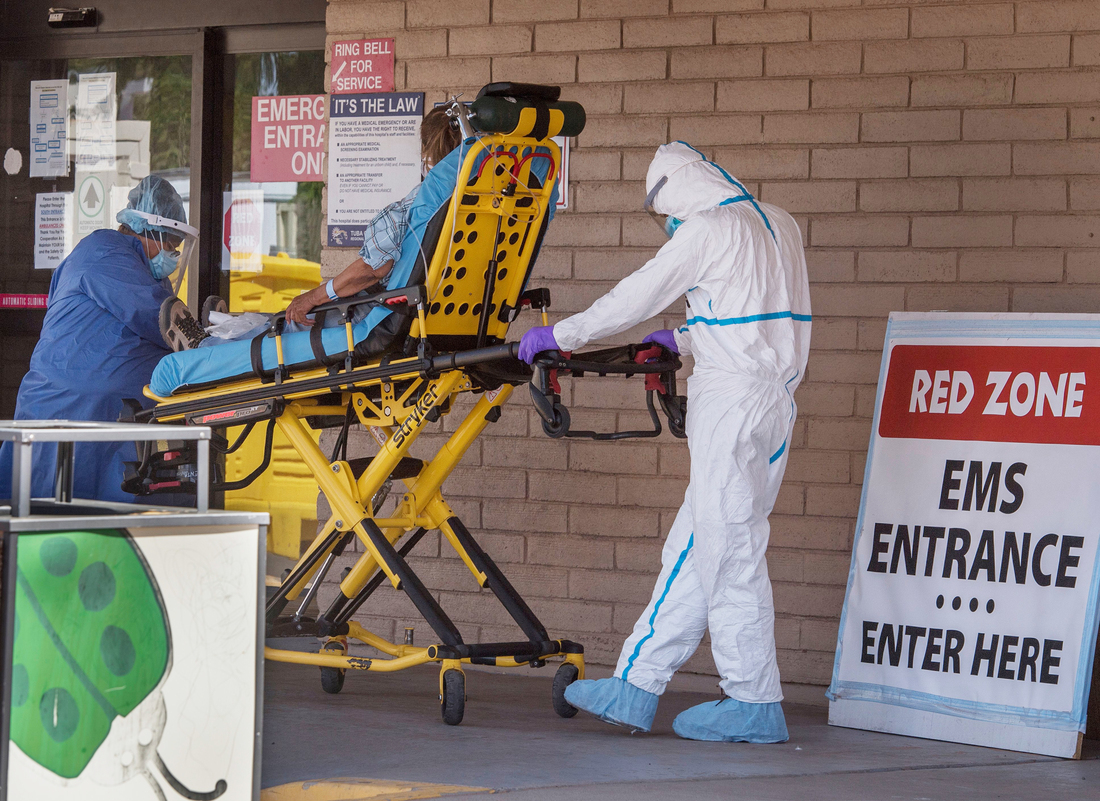
A patient is taken from an ambulance to the emergency room of a hospital in the Navajo Nation town of Tuba City, Ariz., on May 24. Weeks of delays in delivering vital coronavirus aid to Native American tribes exacerbated the outbreak, according to Navajo Nation President Jonathan Nez.
Mark Ralston/AFP via Getty Images
hide caption
toggle caption
Mark Ralston/AFP via Getty Images
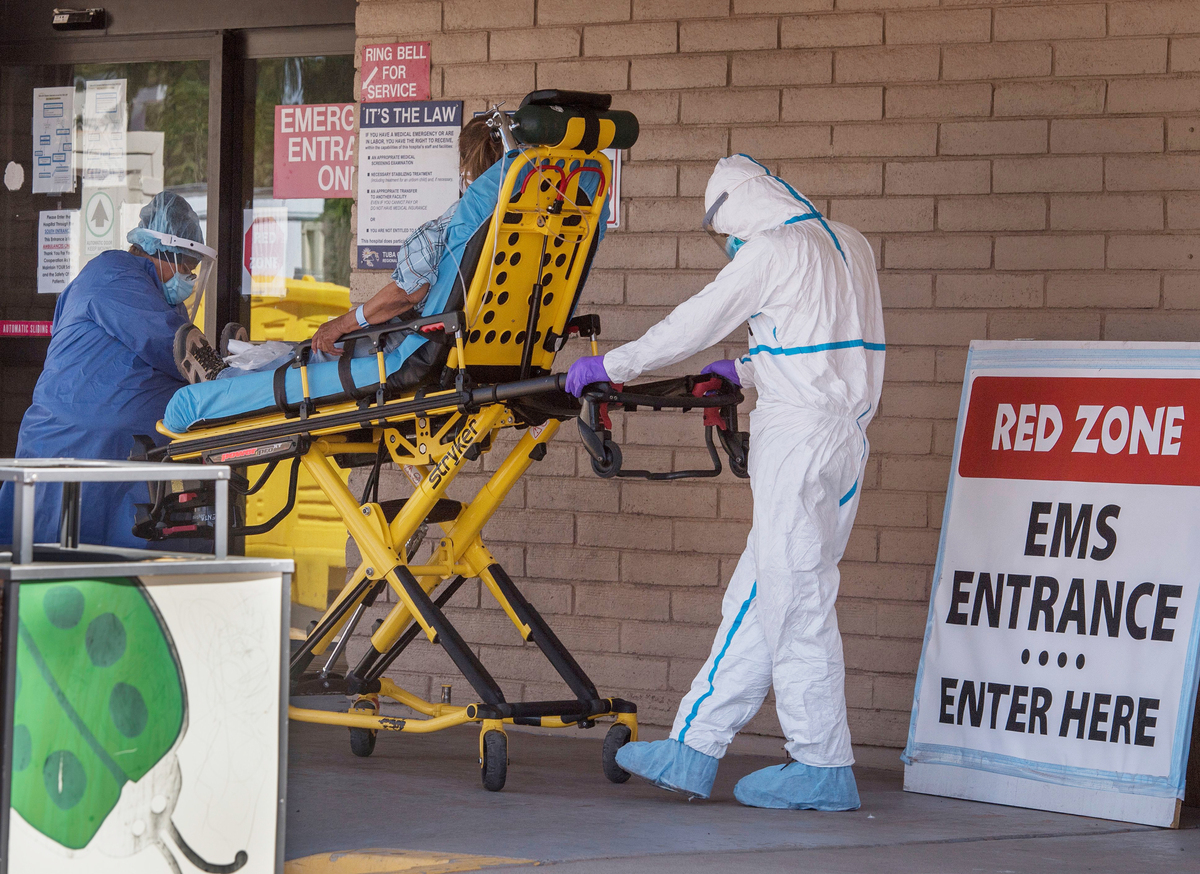
A patient is taken from an ambulance to the emergency room of a hospital in the Navajo Nation town of Tuba City, Ariz., on May 24. Weeks of delays in delivering vital coronavirus aid to Native American tribes exacerbated the outbreak, according to Navajo Nation President Jonathan Nez.
Mark Ralston/AFP via Getty Images
Ashish Jha, director of the Harvard Global Health Institute, says that nationwide, “we’re identifying between 20,000 and 25,000 new cases a day, and about 800 to 1,000 people a day are dying of this virus.”
The national numbers remain stubbornly high. Often, when one state gains a measure of control over COVID-19, another seems to report a new spike.
Maryland, for instance, hasn’t reported more than 1,000 daily cases on average in at least three weeks. But North Carolina is now averaging more than 1,000 cases daily — well above its daily average of 517 just three weeks ago.
Even in states with smaller overall numbers of cases, such as Oregon, South Carolina and Alaska, the rate of new infections has risen by more than 100% in the past two weeks. That is driving concern that the loosening of virus controls is driving a second wave.
All 50 U.S. states had begun easing their restrictions as of last month. By early June, only a few states still had stay-at-home orders in place. And Americans have eagerly returned to some of their old routines — a development backed by cellphone data.
The data suggest people in the U.S. are moving around at a level that’s up to about two-thirds of what it was before shutdown rules were implemented. This supports the idea that the new increases are real, not just a result of more testing. Since late May, thousands of people have left their homes to go back to work, to shop, to socialize and visit bars and restaurants. And that’s how the virus can spread.

A visitor takes a selfie at Universal Studios theme park on June 5, the first day of the park’s reopening during the coronavirus pandemic in Orlando, Fla.
Gregg Newton/AFP via Getty Images
hide caption
toggle caption
Gregg Newton/AFP via Getty Images

A visitor takes a selfie at Universal Studios theme park on June 5, the first day of the park’s reopening during the coronavirus pandemic in Orlando, Fla.
Gregg Newton/AFP via Getty Images
As states continue to loosen limits, health experts are urging people not to become complacent — to follow habits that help to slow the coronavirus, such as washing hands, maintaining a physical distance of at least six feet from others, and wearing a face mask when in close contact.
“It seems that we, the U.S., has given up and accepted this disease as a facet of life,” says Jeffrey Shaman of the Columbia University School of Public Health. “It didn’t have to be this way, and it still doesn’t going forward.”
The national tally of 2 million cases includes nearly 525,000 people who have recovered from the disease. But the U.S. total represents more than 25% of the world’s cases — an outsize impact on a country with less than 5% of the world’s population.
It’s a drastic change from March, when 90% of the world’s COVID-19 cases were reported in just four countries: China, Italy, Iran and South Korea.
Since then, the pandemic has hit the U.S. hard. And with states now pushing to return to normal, public health experts are concerned.
“I’m definitely worried,” says Dr. Bill Miller the senior associate dean for research at Ohio State University’s college of public health. “As places have been opening up, many people are taking it as a message that everything is OK and back to normal.”
He adds: “I’m definitely worried that we’re going to see some upswings, maybe not everywhere, but in many places across the country.”
Visitors to the River Walk pass a restaurant that has reopened in San Antonio, Texas, on May 27. Texas continues to reopen in the wake of the COVID-19 pandemic.
Eric Gay/AP
hide caption
toggle caption
Eric Gay/AP
Visitors to the River Walk pass a restaurant that has reopened in San Antonio, Texas, on May 27. Texas continues to reopen in the wake of the COVID-19 pandemic.
Eric Gay/AP
The U.S. has reached another dire landmark in its fight against COVID-19, surpassing 2 million confirmed cases on Wednesday. New coronavirus infections are rising in at least 20 states, even as restrictions on daily life continue to ease across the country.
More than 112,000 people have died from COVID-19 in the U.S. — the most fatalities reported by any nation, according to a tracker from Johns Hopkins University. And most experts believe those numbers underestimate the true toll.
The latest data also reflects the difficulty of quashing the coronavirus. While some early hot spots such as New York state have seen a sustained drop in new cases, COVID-19 hospitalizations have swelled recently in places like Texas, Arizona, Arkansas and California.
Texas set new records for COVID-19 hospitalizations on three consecutive days this week, with a total of 2,153 hospitalized patients on Wednesday. The state was among the first to start the reopening process, and Gov. Greg Abbott is moving forward with plans to raise occupancy limits for bars, restaurants, amusement parks and other businesses.
Florida is seeing its own new surge, with more people testing positive for the coronavirus on Saturday than any day in the past two months. Since June 2, the state has reported more than 1,000 new cases every day, even as the number of COVID-19 deaths has dropped to double-digits.
Arizona has reported an average of more than 1,000 new cases every day this week — the highest per capita rate in the U.S. Underscoring the crisis, the health department said Tuesday that only a quarter of the state’s beds in intensive care units are currently available.
Public health experts say these surges should not be dismissed as a result of more testing.
“It’s very clear that it’s a real increase in community spread,” Will Humble, executive director of the Arizona Public Health Association, tells member station KJZZ in Phoenix. “It’s not some artifact of additional testing.”
A patient is taken from an ambulance to the emergency room of a hospital in the Navajo Nation town of Tuba City, Ariz., on May 24. Weeks of delays in delivering vital coronavirus aid to Native American tribes exacerbated the outbreak, according to Navajo Nation President Jonathan Nez.
Mark Ralston/AFP via Getty Images
hide caption
toggle caption
Mark Ralston/AFP via Getty Images
A patient is taken from an ambulance to the emergency room of a hospital in the Navajo Nation town of Tuba City, Ariz., on May 24. Weeks of delays in delivering vital coronavirus aid to Native American tribes exacerbated the outbreak, according to Navajo Nation President Jonathan Nez.
Mark Ralston/AFP via Getty Images
Ashish Jha, director of the Harvard Global Health Institute, says that nationwide, “we’re identifying between 20,000 and 25,000 new cases a day, and about 800 to 1,000 people a day are dying of this virus.”
The national numbers remain stubbornly high. Often, when one state gains a measure of control over COVID-19, another seems to report a new spike.
Maryland, for instance, hasn’t reported more than 1,000 daily cases on average in at least three weeks. But North Carolina is now averaging more than 1,000 cases daily — well above its daily average of 517 just three weeks ago.
Even in states with smaller overall numbers of cases, such as Oregon, South Carolina and Alaska, the rate of new infections has risen by more than 100% in the past two weeks. That is driving concern that the loosening of virus controls is driving a second wave.
All 50 U.S. states had begun easing their restrictions as of last month. By early June, only a few states still had stay-at-home orders in place. And Americans have eagerly returned to some of their old routines — a development backed by cellphone data.
The data suggest people in the U.S. are moving around at a level that’s up to about two-thirds of what it was before shutdown rules were implemented. This supports the idea that the new increases are real, not just a result of more testing. Since late May, thousands of people have left their homes to go back to work, to shop, to socialize and visit bars and restaurants. And that’s how the virus can spread.
A visitor takes a selfie at Universal Studios theme park on June 5, the first day of the park’s reopening during the coronavirus pandemic in Orlando, Fla.
Gregg Newton/AFP via Getty Images
hide caption
toggle caption
Gregg Newton/AFP via Getty Images
A visitor takes a selfie at Universal Studios theme park on June 5, the first day of the park’s reopening during the coronavirus pandemic in Orlando, Fla.
Gregg Newton/AFP via Getty Images
As states continue to loosen limits, health experts are urging people not to become complacent — to follow habits that help to slow the coronavirus, such as washing hands, maintaining a physical distance of at least six feet from others, and wearing a face mask when in close contact.
“It seems that we, the U.S., has given up and accepted this disease as a facet of life,” says Jeffrey Shaman of the Columbia University School of Public Health. “It didn’t have to be this way, and it still doesn’t going forward.”
The national tally of 2 million cases includes nearly 525,000 people who have recovered from the disease. But the U.S. total represents more than 25% of the world’s cases — an outsize impact on a country with less than 5% of the world’s population.
It’s a drastic change from March, when 90% of the world’s COVID-19 cases were reported in just four countries: China, Italy, Iran and South Korea.
Since then, the pandemic has hit the U.S. hard. And with states now pushing to return to normal, public health experts are concerned.
“I’m definitely worried,” says Dr. Bill Miller the senior associate dean for research at Ohio State University’s college of public health. “As places have been opening up, many people are taking it as a message that everything is OK and back to normal.”
He adds: “I’m definitely worried that we’re going to see some upswings, maybe not everywhere, but in many places across the country.”
