Plans to reopen English primary schools before summer in disarray

0

Plans to push ahead with reopening schools in England are in disarray, after the government admitted that not all primary school pupils will be able to return to the classroom before the end of summer.

Boris Johnson last month said his aim was “to get primary pupils back into schools, in stages,” as he announced the opening of primary schools to pupils in reception, year one and year six from 1 June.

But government sources now acknowledge that – with little more than six weeks remaining before schools close for summer – the practicalities are too difficult for all children to return.

Gavin Williamson, the education secretary, is to give an update on the progress of schools reopening on Tuesday, and is expected to concede publicly that many primary pupils will not return to their classrooms until the new school year in autumn.

The acknowledgement was welcomed by school leaders, with Paul Whiteman, general secretary of the National Association of Head Teachers, saying: “If confirmed, we’re pleased to see the government will not force the impossible. Schools will continue to use their flexibility, intelligently, to deliver the very best for all the pupils in their school.”

Attendance statistics collected by the Department for Education to be published on Tuesday are likely to confirm that only half of pupils in the three eligible year groups returned to school last week.

The attendance figures represent a setback for Johnson’s efforts to use schools as a lever to revive the economy. Johnson’s “roadmap” for exiting the lockdown, published last month, stated: “The government’s ambition is for all primary school children to return to school before the summer for a month if feasible, though this will be kept under review.”

But Johnson’s announcement of a 1 June return was greeted with scepticism by parents and opposition from school unions and local authorities, wary of the health and safety difficulties for both staff and pupils in England’s ageing and cramped classrooms.

Whiteman, who represents leaders in the majority of England’s primary schools, said: “Throughout lockdown, school leaders and their teams have worked hard to meet the needs of all their pupils. This term, they must be given flexibility they need to balance the needs of the pupils coming back and the children continuing to learn at home.

“Returning all pupils before the end of this term will present unsolvable practical barriers if the hierarchies of control are to be maintained. Year groups have had to be split into groups of 15, using up other classrooms and occupying teachers from other years.”


In a further confirmation of the difficulties that teachers face, Matt Hancock hinted at Monday’s Downing Street press briefing that even a full return in September may be difficult.

Hancock said that for secondary schools, September was the “current working plan”; but it would require “ingenuity”. Johnson has said he would like to see the 2-metre distancing rule altered, although Department for Education guidance already states that young children need not socially distance within the small groups, or “bubbles”, in which they are taught.

Scotland and Northern Ireland have already said that their schools will not reopen more widely until after the summer holidays, with Scotland saying that schools will use a flexible mix of in-person and remote learning for the foreseeable future. Schools in Wales are to partially reopen later this month for a brief period.

Schools in all parts of the UK have remained open for the children of key workers and vulnerable pupils, with many operating throughout the Easter and half-term holidays.

Source link

Cambodian Court Denies Bail for 10 Jailed Opposition Officials

0

An appellate court in Cambodia Monday denied the bail request of 10 officials of the banned opposition Cambodian National Rescue Party who were jailed in January on charges of being complicit in treason.

The chief of the appellate council, Sous Sam Arth, said the continued detention of the 10 is necessary for the investigation.

An attorney representing the CNRP officials condemned the decision.

“For my clients, the court’s judgment this afternoon is unacceptable and unfair,” Sam Sok Kong, who represents several of the defendants, told RFA’s Khmer Service.

“They are all ordinary people who have no influence [over anyone] that could obstruct [justice] or create obstacles to their investigation.”

In September 2017 CNRP President Kem Sokha was arrested over an alleged plot to overthrow the government and the party was dissolved by the Supreme Court in November that year for its supposed role in the scheme.

The move to ban the CNRP was part of a wider crackdown by Hun Sen on the political opposition, NGOs, and the independent media that paved the way for his ruling Cambodian People’s Party (CPP) to win all 125 seats in parliament in the country’s July 2018 general election.

A few among the ten-opposition officials are Sok Chantha, Nhem Vien, Chun Chan, Khut Chreb, Keo Thai and Khem Pheana. Along with the treason charge, they are accused of inciting the army to disobey orders from superiors and other crimes. They all are in Phnom Penh’s Prey Sar prison.

Sam Sok Kong said that he will visit his 10 clients in the prison to discuss their legal options to file an appeal.

Sam Chenda, the wife of Keo Thai, told RFA her family was disappointed with the court’s decision.

“My husband did nothing wrong, but the court committed injustice to him. It is really painful to my family,” she said.

Seoung Sen Karona of the local rights organization ADHOC said the 10 detainees have legitimate rights and reasons to be on bail. He said the court’s rejection will backfire because it will convince the public that the 10 are political prisoners.

”If the political situation continues like this, the [opposition] political activists will be endlessly persecuted. So political persecution will only subside only when the political heat cools down,” he said.

Eng Chhai Eang, Deputy President of CNRP condemned the decision.

“No Cambodian is surprised at all by Hun Sen’s aggressive and tyrannical behavior. There is nothing new about it. He used to be a senior cadre of the Khmer Rouge so he is used to persecuting and terrifying people. It is in his nature. Period,” said the deputy president.

“More people are speaking up against his dictatorship. As Hun Sen gets more paranoid he continues to round up more innocent and desperate people. However, no tyrant can rule eternally. His regime will collapse. It is just a matter of time when people rise up to hold Hun Sen accountable for abusing human rights and undermining democracy,” he told RFA’s Khmer Service.

Since the beginning of the year nearly 20 CNRP opposition officials or activists were arrested and thrown in prison, most without arrest warrants.

During the same period, 17 former and active CNRP officials and supporters were beaten or otherwise attacked from behind by unidentified men, who have yet to be identified by the police.

Prime Minister Hun Sen last week publicly threatened that the arrests will continue as long as exiled active-CNRP President Sam Rainsy continues to incite people inside Cambodia by encouraging them not to pay off their debts to the banks and microfinance institutions.

Sam Rainsy recently said that poor people with debts, who are unable to pay their debts because of the economic impact of COVID-19, should not sell their land or home to get money to pay back their debtors.

Reproted by RFA’s Khmer Service. Translated by Sum Sok Ry. Written in English by Eugene Whong.


Source link

Boxed Lunches and Plexiglass Will Welcome Back Wall Street’s Workers

Grab-and-go packaged meals may replace midday generous buffets and three-figure lunches. Plexiglass could divvy up trading floors the size of football fields. Heat maps, accessible on a mobile app, will help identify the restrooms with the smallest crowds.

But when Wall Street reopens its doors to employees, the talent will only trickle in.

New York is starting to ease restrictions on businesses, and the world’s biggest financial firms are preparing to bring thousands of employees back to their offices starting this month. But even with sophisticated face-mask sensors in the lobby, temperature checks and touch-free elevator rides, it will be well into next year before most workers are back at their desks and the center of global finance begins to feel like its old self again.

“We’ve really underscored to people that returning to the office will be different from what they’ve left,” said Andrew Komaroff, chief operating officer of the asset management firm Neuberger Berman, where in the coming weeks, about 150 workers are expected to voluntarily return to the firm’s New York headquarters, which normally has 1,400. “It’s not going back to where we were at the end of February.”

Even as Wall Street has evolved away from frantic traders clutching bits of paper, it has maintained its raucous energy. Hordes of workers stream from packed subway trains and ferry terminals each morning to shout and cajole their way through complex transactions with big money on the line. But the post-virus financial industry is likely to lose some of its thrum, not only because of its trickle of returning employees but because of the added inconveniences they’ll face.

At Goldman Sachs, which is expected to bring back a first wave of employees to its downtown Manhattan headquarters this month, workers with a body temperature of more than 100.4 degrees will not be allowed to work from the office. At Citigroup, which plans to bring back a small cohort as early as July, workers will be required to stand six feet apart while waiting for the elevator. And at the Midtown offices of Neuberger Berman, conference room seats have been removed and additional hand sanitizer dispensers have been plastered to walls and entryways.

“There’s a high degree of anxiety, as you can imagine,” said Scott Rechler, chief executive of the real estate company RXR Realty, which counts UBS, Bank of America and other financial services firms in New York as tenants. To help reorient employees on their return to the office, Mr. Rechler’s firm has established an app to coordinate workdays and arrival times with its tenants to minimize social contact. It has also shot videos of planned arrival procedures, including temperature scans and Bluetooth-powered elevator programming, to help workers understand what to expect.

“Officing is going to be different than it was before,” Mr. Rechler said.

Mr. Komaroff of Neuberger Berman and executives at other large financial firms say the first wave of returning workers will be small and composed primarily of those who cannot do their jobs at home easily. There are many: stock and bond traders accustomed to tracking fast-moving markets on multiple screens, bankers working on complex bond underwriting deals that require interacting with hundreds of investors, and treasury workers who oversee their firms’ own financing by managing a complex network of creditors, bonds and other cash sources.

There may also be some employees whose jobs do not demand the office environment but who are feeling pent up or distracted at home.

Firms including Citi and Goldman Sachs say the refilling of office desks is voluntary and cuts across seniority levels. Employees who feel uncomfortable going in, the firms said, will have the option to decline without consequences. (That has not uniformly been the case. Some traders at Bank of America have said they felt pressured to be in the office throughout the pandemic, even as colleagues on their Midtown trading floor were stricken with Covid-19.)

But as the virus’s death toll climbs in the United States — even as it recedes in New York — many of Wall Street’s workers are likely to avoid the office for months to come.

The city’s biggest banks and investment firms typically house 350,000 workers in New York, according to the Partnership for New York City, a nonprofit group that works with businesses to stoke the city’s economy. In a recent partnership poll, respondents from dozens of companies — more than a third of which were in the financial sector — predicted that just 10 percent of their employees would return to city offices by Aug. 15. A mere 29 percent would return by Dec. 31.

It will be a “very gradual return,” said Kathryn Wylde, the group’s president and chief executive. “There’s a sense that a significant portion of workers will continue to work remotely.”

The well-compensated work force of Wall Street, accustomed to Hamptons beach houses and spacious home offices, has an easier time working from home than employees in less affluent industries. But if distance working continues over the long term, traders, analysts and money managers think that management and employee development — recruiting, hiring, training and mentoring — are likely to suffer. Seasoned employees say they know how to navigate their firms’ cultures and systems but worry for junior colleagues just coming on board.

The problems and preparations are complex.

One of the biggest concerns is just getting to the office. The virus is far from eliminated, and it can spread easily in the close quarters of mass transit. The Centers for Disease Control and Prevention has suggested that companies pay employees’ parking costs to encourage them to avoid buses and commuter trains. Employees at Bank of America and Morgan Stanley say they have been offering some employees a workaround: reimbursement for private transportation, like Uber. And Citi has been exploring the possibility of renting office space in suburbs on Long Island and in Westchester County to better accommodate employees who live in those areas.

Once workers are at the office, firms will be trying to space people out in cafeterias, elevators and cubicle zones. Restrooms will pose a particular challenge, especially on trading floors where hundreds of people work shoulder to shoulder. To mitigate the problem, RXR Realty’s new tenant app will allow workers to view heat maps of restrooms to avoid those with higher traffic. Workstations will also be tagged with QR codes that employees can scan if they want to request a deep cleaning.

  • Updated June 5, 2020

    • How does blood type influence coronavirus?

      A study by European scientists is the first to document a strong statistical link between genetic variations and Covid-19, the illness caused by the coronavirus. Having Type A blood was linked to a 50 percent increase in the likelihood that a patient would need to get oxygen or to go on a ventilator, according to the new study.

    • How many people have lost their jobs due to coronavirus in the U.S.?

      The unemployment rate fell to 13.3 percent in May, the Labor Department said on June 5, an unexpected improvement in the nation’s job market as hiring rebounded faster than economists expected. Economists had forecast the unemployment rate to increase to as much as 20 percent, after it hit 14.7 percent in April, which was the highest since the government began keeping official statistics after World War II. But the unemployment rate dipped instead, with employers adding 2.5 million jobs, after more than 20 million jobs were lost in April.

    • Will protests set off a second viral wave of coronavirus?

      Mass protests against police brutality that have brought thousands of people onto the streets in cities across America are raising the specter of new coronavirus outbreaks, prompting political leaders, physicians and public health experts to warn that the crowds could cause a surge in cases. While many political leaders affirmed the right of protesters to express themselves, they urged the demonstrators to wear face masks and maintain social distancing, both to protect themselves and to prevent further community spread of the virus. Some infectious disease experts were reassured by the fact that the protests were held outdoors, saying the open air settings could mitigate the risk of transmission.

    • How do we start exercising again without hurting ourselves after months of lockdown?

      Exercise researchers and physicians have some blunt advice for those of us aiming to return to regular exercise now: Start slowly and then rev up your workouts, also slowly. American adults tended to be about 12 percent less active after the stay-at-home mandates began in March than they were in January. But there are steps you can take to ease your way back into regular exercise safely. First, “start at no more than 50 percent of the exercise you were doing before Covid,” says Dr. Monica Rho, the chief of musculoskeletal medicine at the Shirley Ryan AbilityLab in Chicago. Thread in some preparatory squats, too, she advises. “When you haven’t been exercising, you lose muscle mass.” Expect some muscle twinges after these preliminary, post-lockdown sessions, especially a day or two later. But sudden or increasing pain during exercise is a clarion call to stop and return home.

    • My state is reopening. Is it safe to go out?

      States are reopening bit by bit. This means that more public spaces are available for use and more and more businesses are being allowed to open again. The federal government is largely leaving the decision up to states, and some state leaders are leaving the decision up to local authorities. Even if you aren’t being told to stay at home, it’s still a good idea to limit trips outside and your interaction with other people.

    • What’s the risk of catching coronavirus from a surface?

      Touching contaminated objects and then infecting ourselves with the germs is not typically how the virus spreads. But it can happen. A number of studies of flu, rhinovirus, coronavirus and other microbes have shown that respiratory illnesses, including the new coronavirus, can spread by touching contaminated surfaces, particularly in places like day care centers, offices and hospitals. But a long chain of events has to happen for the disease to spread that way. The best way to protect yourself from coronavirus — whether it’s surface transmission or close human contact — is still social distancing, washing your hands, not touching your face and wearing masks.

    • What are the symptoms of coronavirus?

      Common symptoms include fever, a dry cough, fatigue and difficulty breathing or shortness of breath. Some of these symptoms overlap with those of the flu, making detection difficult, but runny noses and stuffy sinuses are less common. The C.D.C. has also added chills, muscle pain, sore throat, headache and a new loss of the sense of taste or smell as symptoms to look out for. Most people fall ill five to seven days after exposure, but symptoms may appear in as few as two days or as many as 14 days.

    • How can I protect myself while flying?

      If air travel is unavoidable, there are some steps you can take to protect yourself. Most important: Wash your hands often, and stop touching your face. If possible, choose a window seat. A study from Emory University found that during flu season, the safest place to sit on a plane is by a window, as people sitting in window seats had less contact with potentially sick people. Disinfect hard surfaces. When you get to your seat and your hands are clean, use disinfecting wipes to clean the hard surfaces at your seat like the head and arm rest, the seatbelt buckle, the remote, screen, seat back pocket and the tray table. If the seat is hard and nonporous or leather or pleather, you can wipe that down, too. (Using wipes on upholstered seats could lead to a wet seat and spreading of germs rather than killing them.)

    • Should I wear a mask?

      The C.D.C. has recommended that all Americans wear cloth masks if they go out in public. This is a shift in federal guidance reflecting new concerns that the coronavirus is being spread by infected people who have no symptoms. Until now, the C.D.C., like the W.H.O., has advised that ordinary people don’t need to wear masks unless they are sick and coughing. Part of the reason was to preserve medical-grade masks for health care workers who desperately need them at a time when they are in continuously short supply. Masks don’t replace hand washing and social distancing.

    • What should I do if I feel sick?

      If you’ve been exposed to the coronavirus or think you have, and have a fever or symptoms like a cough or difficulty breathing, call a doctor. They should give you advice on whether you should be tested, how to get tested, and how to seek medical treatment without potentially infecting or exposing others.


Most banks and investment firms say that many different safety measures are under review, and that the details of their new office protocols have not been completed. But many will no doubt require six-foot buffer zones at the elevator banks. Some firms will mandate that masks be worn in all common areas.

The logistical headaches and continued safety concerns have some companies thinking it’s just not worth hurrying. In some cases, firms are postponing reopening at least until September, and maybe even further. The private equity firm TPG expects to keep employees based in New York, San Francisco and London at home until after Labor Day. The hedge fund Point72 has decided to keep its New York and Stamford, Conn., offices essentially closed until further notice, as well as the fund’s satellite office near the beach in East Hampton. The private equity firm Carlyle Group, based in Washington but with a large office in Midtown, is also on a post-Labor Day timetable, and the Boston-based private equity firm Bain Capital has not yet set a return date for its offices in the United States or in London.

For some workers, there’s no rush. As in many other industries, meetings have moved to Zoom and other video platforms. And banking executives say that because of reductions in travel — both daily commutes and trips to client meetings that could be halfway around the world — they are able to connect virtually with a wider network, sometimes holding a meeting every hour, on the hour. Some say they appreciate the extra time to catch up on emails and other administrative work.

“I was definitely concerned about the workability of working from home,” said Jen Roth, who runs Goldman Sachs’s currencies and emerging markets business in the United States. “I have been shockingly surprised.”

Matt Phillips and Edmund Lee contributed reporting.

Source link

Are players happy with the MLB’s latest offer? | Instant Analysis – Sportsnet.ca

0

{* mergeAccounts *}


Source link

Saints’ Michael Thomas helping erase medical debt for Louisiana residents – Sportsnet.ca

0

New Orleans Saints All-Pro receiver Michael Thomas has joined with a non-profit group to help relieve $2.3 million in health care debt for Louisiana residents.

Thomas contributed $20,000 to the group RIP Medical Debt, which works with individual donors and organizations to purchase medical debt at steep discounts for people whose bills exceed their ability to pay.

"I hope these families get a little relief in knowing their medical bills have been taken care of during these very difficult times," Thomas said.

Thomas, who set an NFL record with 149 catches last season, also recently bought lunch for medical personnel at a New Orleans hospital.

Since the COVID-19 pandemic spread into the United States earlier this year, Louisiana has had more than 43,000 cases and at least 2,831 related deaths.

Source link

Pyongyang Attack on Anti-Kim Leaflets Makes North Koreans Notice Exiled Critics

0

Citizens of Pyongyang were mobilized to denounce North Korean defectors and refugees in South Korea in a rally following rare public acknowledgment by the sister of Kim Jong Un of anti-regime leaflets floated over the border by exile groups, sources in the country said Monday.

Launching leaflets and small gifts by helium balloon across the Demilitarized Zone from South Korea is a common tactic of Kim regime opponents and human rights groups in the South. They contain information that the Pyongyang government withholds from its citizens, as well as items such as U.S. dollars or USB flash drives containing videos that are banned in North Korea.

Kim Jong Un’s sister Kim Yo Jong, a close confidant of her brother who some observers believe is next in line in the ruling family, made a statement about the propaganda leaflets to the state-run Rodong Sinmun newspaper last week – a rare case in which state media acknowledged the leaflet campaigns.

She referred to those former North Koreans sending the leaflets from the rival South as “human scum little short of wild animals who betrayed their own homeland,” and “mongrel dogs who bark where they should not.”

She also called on the government of South Korea to prevent further releases of propaganda leaflets into North Korea.

After her public statement, the authorities in the capital Pyongyang organized the anti-escapee rally and ordered everyone to participate on Saturday, according to local sources.

After the rally, a resident of Pyongyang who asked not to be named for security reasons told RFA’s Korean Service that the event backfired in the view of many people in Pyongyang – calling attention to freedoms absent in the North.

“The fact that the North Korean defectors’ groups in South Korea frequently send propaganda leaflets criticizing the North Korean regime shows how South Korean society guarantees freedom in their activities,” the source said.

“It’s totally obvious. The authorities organized the rally so [the protestors] are just shouting. They may outwardly say ‘Death to defectors!’ but inside everyone is probably saying, ‘If only I could go to South Korea,’” said the source.

The source said that the North Korean government is approaching this problem in ways that worked only in earlier eras when the country was more isolated from outside influences.

“The people of North Korea are awake. They know what the rest of the world is doing, but the Central Committee [of the Korean Workers’ Party] doesn’t know that,” the source said.

“They are under the illusion that people are [still] extremely loyal to the Kim family, just like in past eras,” said the source.

The source said the Central Committee was now out of touch with how people think and is relying too much on their assumed loyalty.

A North Korean escapee who arrived in South Korea last year, Han Sun-hee, told RFA that the Pyongyang demonstration on Saturday is a typical forced mobilization event.

“If Pyongyang citizens do not attend such [forced events], they will be immediately subject to self-criticism, so they must participate in the event no matter what,” she said.

Self-criticism, or saenghwal chonghwa, is a regular act by which the citizens report to the authorities on any shortcoming they personally have regarding loyalty to the state.

“We always have to participate in these events. [Pyongyang] and all areas under the city are subject to a quota system, so each neighborhood is bound to contribute a certain number of people,” said Han.

Forced mobilization typically involves impressing the citizenry into providing free labor on farm or construction projects. But this type of forced event is paid and transportation is provided, according to Han.

“They don’t have to participate in construction, but instead they have to attend all these events. [Authorities] pay them 100,000 North Korean won [U.S. $12.50]. People take buses to come. They have no choice but to be dragged around because it’s not something they can complain about,” Han said.

“It’s not that they are at the rally because it’s good. If they don’t participate, there will be self-criticism,” she added.

Kim Yo Jong condemns leaflets

The protest rally against escapees followed Kim Yo Jong’s statement two days earlier condemning South Korean leaflets – a public acknowledgement of the leaflet campaigns that puzzled many North Koreans, an official in Pyongyang who asked not to be named told RFA.

“Today’s Rodong Sinmun had a report [which included Kim Yo Jong’s statement] about North Korean defectors in South Korea sending anti-Pyongyang leaflets into North Korea, and the residents are surprised to hear the news,” the official said.

“Whether the party intended it or not, the Rodong Sinmun has explained the North Korean defectors’ activities in detail,” he said.

“The strong statement against South Korea was issued because the anti-Pyongyang leaflets directly criticize Kim Jong Un. However, I don’t understand at first glance what it was that they intended by publishing it in the Rodong Sinmun,” said the official.

According to the official, residents were unsure why the country’s leadership was so concerned about the leaflets this time around.

“Disillusioned with the hereditary rule of the Kim family, young people are eager to find out how the South Koreans criticize Kim Jong Un’s maladministration in the leaflets,” he said.

Another source, an official from North Hamgyong province who requested anonymity for legal reasons, confirmed to RFA that the citizens there were also scratching their heads over the report on escapees’ activities in South Korea.

“The Rodong Sinmun suddenly published a statement by Kim Yo Jong, the First Deputy Director of the Workers’ Party of Korea,” said the second official.

“Although [she] is criticizing the defectors’ activities and the South Korean authorities [for allowing such activities], this is the first time that news of defectors [in South Korea] has been reported in Rodong Sinmun,” said the second official.

The North Hamgyong official said that news of the leaflets came at a time when many citizens are already griping about their government.

“These days, the coronavirus crisis has caused residents to complain about the authorities,” the second source said.

“In the midst of this, Kim Yo Jong’s statement was posted in the Rodong Sinmun, which revealed to the world the contents of the anti-North Korean leaflets, and the efforts of North Korean defectors to bring information into the North,” the second source said.

Following Kim Yo Jong’s statement, South Korean President Moon Jae-in’s administration quickly told the North that those who released the leaflets would be restrained and Seoul would try to reduce future leaflet drops.

The Blue House in a statement said that releasing leaflets into North Korea is “an activity that is truly good for nothing.”

The South’s Unification ministry also appealed to civic groups to stop releasing leaflets, but in the past, these groups have ignored similar appeals, citing their right to free speech.

Reported by Jieun Kim for RFA’s Korean Service. Translated by Leejin Jun. Written in English by Eugene Whong.


Source link

China Works On Undersea Cables Between Paracel Island Outposts

0

A Chinese ship appears to be laying undersea cables between Chinese outposts in the disputed Paracel Islands, vessel tracking software and satellite imagery shows. Experts say the cables will likely have military uses and could potentially strengthen China’s ability to detect submarines.

The cable ship began operations in the area nearly two weeks ago after departing from a shipyard in Shanghai. If the expert assessment of the intention is correct it could signal another step by China to militarize the South China Sea.

RFA and BenarNews spotted the activity when viewing high-resolution commercial satellite imagery of the Paracels, which are also claimed by Vietnam and Taiwan. Three U.S.-based maritime experts who have viewed the imagery agreed that the ship was doing something related to undersea cables, although exactly what is unclear from the imagery. It could be laying new cable, or repairing or upgrading existing cable, although none of the experts were aware of an existing cable network in the spots the ship is operating in.

Vessel tracking software shows the Chinese ship Tian Yi Hai Gong sailed to the Paracels on May 28. The imagery appears to show it laying cables between at least three different Chinese-occupied features: Tree Island, North Island and China’s main base in the Paracels, Woody Island.

The ship sailed southwest on June 5, visiting Drummond Island, Yagong Island and Observation Bank. As of Monday morning, it was operating on the northeast side of Observation Bank. It’s not clear if the Tian Yi Hai Gong has been laying cables at those features too, but its pattern of movement is similar to at the other features. All of the features host small, remote outposts for China and its military.

The last known instance of China laying underwater cables in the area was reported by Reuters in 2016, connecting the city and military base at Woody Island to the island of Hainan, China’s southernmost province off the coast of the mainland.

While it isn’t clear from the imagery what the function of new undersea cables would be in the Paracels, two of the experts told RFA that fiber optic connections between such Chinese-occupied features are likely meant for military purposes.

James Kraska, a professor at the U.S. Naval War College, said they are probably for encrypted military communications between China’s various outposts, and will connect to the hardened undersea cable system already built along China’s east coast.

“The other thing that they could be doing is that they’ve got a SOSUS-type of network, an underwater sound surveillance system, to listen for adversary submarines,” he said. “So it could be passive listening for surface ships or submarines coming into the area.”

SOSUS refers to a passive system of sonars the U.S. Navy uses to track undersea activity. China has long planned a listening network inspired by this system for use in the East and South China Seas. The state media reported in 2017 that the government has invested in research and development in undersea observation centers.

Bryan Clark, a senior fellow at the Hudson Institute, a Washington-based think tank, also suspects that the cables could be for undersea surveillance.

“A sonar system would be important north of Woody Island because the PLAN’s South Sea Fleet submarine base is on Hainan Island at Yulin,” he said.

Yulin, according to Clark, is one of the most sophisticated bases for the People’s Liberation Army Navy (PLAN), replete with underground tunnels and maintenance pens for the PLAN’s growing number of nuclear submarines. It is located on the southern tip of Hainan Island.

“A seabed sonar between Woody Island and Hainan Island would help find U.S. submarines that might be coming to spy on the base or its submarines in peacetime, or that may attack PLAN submarines during wartime,” Clark said. He also said such an array would be useful for ensuring PLAN submarines aren’t being followed as they leave their home base.

U.S. Indo-Pacific Command, which is based in Hawaii, did not immediately respond to a request for comment on Monday.

There is no record of the Tian Yi Hai Gong’s operator in the International Maritime Organization’s database, save for information that it was built in early 2020 and flagged by China. There is similarly no record of it with the International Cable Protection Committee, a U.K.-based standards-setting and advocacy group for the submarine cable industry.

However, vessel tracking data shows it originally left from a shipyard in Shanghai on May 18. That same shipyard houses a different cable-layer, the Bold Maverick, which is owned and operated by S. B. Submarine Systems Co., Ltd. That company calls itself “China’s leading provider of subsea cable installation services and one of the key submarine cable installers in Asia” on its website.

Multiple companies in China work in the undersea cable industry, and frequently partner with People’s Liberation Army research centers and national defense universities. China Telecom laid fiber optic cables between Fiery Cross Reef, Subi Reef, and Mischief Reef in the Spratlys in 2017, state media reported. Chen Ying-yu, a senior official at China Telecom and a representative to the National People’s Congress, called on China’s government to better expand, protect and strengthen its submarine cable network at the 20th National People’s Congress held in late May.

The People’s Liberation Army operates its own cable ships as well, launching the first in 2015.

Kraska did not think it mattered who was responsible for installing the cables, as it would be ultimately done at the behest of the Chinese government.

He said the transformation of remote Chinese outposts into a surveillance network was yet another indication of China entrenching its military presence on disputed rocks and reefs in the South China Sea, and seeking to control everything above and below them.

“This is further solidifying their ability to control what’s going on in what they define as the ‘near seas’,” Kraska said.

China claims virtually all of the South China Sea, including waters, islands and reefs close to the coasts of Brunei, Malaysia, the Philippines, Taiwan and Vietnam. China says it has “historic rights” for its sweeping claims, a stance unsupported by international law.


Source link

Despite Recession, Stock Markets Turn Positive for the Year

After an initial few weeks of volatility, when the market dropped 34 percent, it has become inured to the near-daily drumbeat of bad news. When the Commerce Department announced on April 29 that the economy shrank at a nearly 5 percent annual rate, its fastest drop since the 2008 recession, stocks rose 2.7 percent. A month ago, when the Bureau of Labor Statistics published what was essentially the worst employment report on record — showing that more than 20 million jobs disappeared in April as unemployment surged to 14.7 percent, the highest since the Great Depression — stocks rose 1.7 percent.

So, why is the market behaving this way?

In large part, it was the actions of the federal government. Early on, the Federal Reserve stretched its financial safety net wide, announcing it would provide a backstop by using its emergency lending powers to buy assets — from municipal to corporate debt — with newly printed money. Also, it began snapping up government-backed bonds through a newly unlimited buying campaign. That had the effect of keeping bond prices up and yields, which move in the opposite direction of prices, low. And so investors, looking for better returns, began putting their money into the stock market instead, creating upward pressure on prices.

“It’s the only way that you can kind of explain what’s going on, is that people really do believe that there is no downside in equity ownership,” said James Montier, a member of the asset management team at Grantham, Mayo, Van Otterloo & Company, a Boston-based asset management company.

Since March 23, the Dow Jones industrial average has soared 48 percent. The Nasdaq composite index, which is heavily weighted toward technology, is up 45 percent and closed at a record high on Monday, as investors bet that tech behemoths like Amazon and Microsoft were well positioned to benefit from stay-at-home orders around the country. The S&P 500 is also up nearly 45 percent.

“I understand fully the recovery in the market, I just think it’s ahead of schedule,” said Leon Cooperman, the founder of the hedge fund Omega Advisors, which in 2018 announced it would convert to a family office to mainly manage the billionaire’s personal fortune. “It’s ahead of schedule because of the government’s policy of giving out free money.”

Source link

Coronavirus: Kate urges struggling addicts to seek help during COVID-19 lockdown

0

The Duchess of Cambridge has urged people struggling with addiction to seek help, as new research revealed a quarter of UK adults are drinking more in lockdown.

Kate made a virtual visit to Clouds House, a rehab centre in Wiltshire run by Action on Addiction, in her role as patron of the charity.

In a video call from her family home, the duchess talked to staff about how they have adapted their services, taking them online and reconfiguring the entire centre to allow 10 residential clients to be able to isolate for two weeks.

She also discussed fears that more people will need treatment as the coronavirus lockdown eases.

Image:
The duchess was given a virtual tour of the centre

Kate said: “The worrying thing is, it is all those people who aren’t necessarily reaching out who are struggling, who perhaps don’t feel they can reach out.

“Or the fact that maybe they haven’t realised that addictive behaviours have sort of established, particularly if it’s the first time – and it’s those people who aren’t necessarily being vocal about it.

“It’s making sure that they know they can reach out and that you are there to help and support them in this very difficult time.”

More than a third of people, 39%, with a history of addiction have reported a recurrence of their addictive behaviour or have recently relapsed while in recovery.

The statistics from a YouGov poll for the charity Action on Addiction also showed an increase in addictive behaviour in young adults and children as young as 12, during the COVID-19 crisis.

Some 4% of those questioned have a close relative between the ages of 12 and 25 for whom this is the case, which the charity said would amount to more than two million children and young people on a national scale.

Kate was given a briefing on the new research and spoke to clinical lead Dr Simone Yule about whether she had noticed a difference in the number of people contacting them for emergency help.

Dr Yule said: “We are seeing more alcohol issues and in the community.

“I think definitely we know alcohol sales have gone up exponentially, so the rise in people that are now starting to seek treatment with lockdown gradually lifting, I think that is going to have a big impact.”

She also spoke with former Clouds House residents Claire and Chris, who are currently in the centre’s aftercare programme.

Chris told the duchess how emerging from rehab into lockdown had been a “blessing in disguise” as it made him “feel safe again”, and how he had been using Zoom to connect with the centre.

“It was a gentle stepping stone back into reality. It kind of took away all of my temptations, the accessibility, the associations I had with friends.

“There’s always the fear of missing out and that kind of got taken away in a sense, so it was really nice for me, it felt gentle.”

Source link

The Fall Of America’s Monuments To Racism

Nationwide protests over the racism of America’s present have also reignited furor against the most powerful symbols of its racist past: the roughly 1,700 Confederate monuments and symbols that still dot the nation’s landscape.

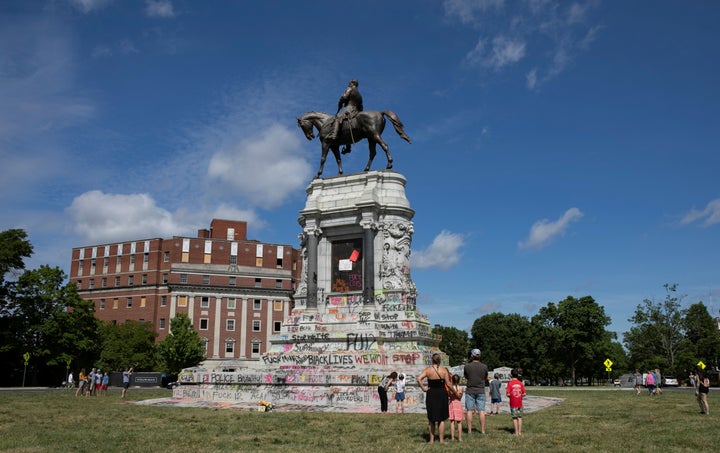
Since a Minneapolis police officer killed George Floyd, protesters have graffitied and toppled Confederate monuments across the American South, including in Richmond, Virginia, the former capital of the Confederacy, and Birmingham, Alabama, in the still-beating heart of Dixie. Local leaders have backed efforts to remove statues in both cities, and in states like Kentucky, Indiana and others that never left the Union. The U.S. Marine Corps banned its troops from displaying the Confederate battle flag, and on Monday, a U.S. Army official told Politico that the Pentagon may consider changing the names of military bases named for Confederate generals.

The effort to reckon with slavery and the men who fought to preserve it has even gone global: On Sunday, demonstrators in the United Kingdom tore down the statue of a prominent slave trader in Bristol, then ceremoniously dumped it into a nearby river.

The renewed push to rid American public squares of the racist symbols of the Confederacy came as activists and protesters scored major policy and political victories, including pledges to cut police budgets, electoral wins for candidates who support police divestment, and a promise from the Minneapolis City Council that it would dismantle and rebuild the local police department in the wake of Floyd’s killing. 

Next to drastic efforts like that, tearing down the memorials to long-dead traitors may seem like a mostly symbolic act. But the fight against Confederate monuments, activists and historians say, is as necessary as any reform effort during a moment of deep national reckoning. 

“The symbols help sustain racist policies and racist policies help sustain the symbols,” James Grossman, the executive director of the American Historical Association, said of the statues. “Those statues legitimate racism. They legitimate violence against Black people, because slavery was a system of violence against Black people. To take down those statues is to make a statement about how a community’s values are changing.”


A monument of Confederate president Jefferson Davis in Richmond, Virginia, was marked during widespread civil unrest following the death of George Floyd.

The number of Confederate memorials to go by the wayside will only grow in the coming months, after Virginia Gov. Ralph Northam (D) signed a law in April allowing localities to remove many of the more than 200 Confederate memorials and symbols still standing across his state.

But with protesters targeting monuments nearly a month before the law goes into effect on July 1, Northam last week pledged to tear down Richmond’s century-old statue to Robert E. Lee “as soon as possible.” Richmond Mayor Levar Stoney, meanwhile, last week introduced a resolution to take down four other Confederate statues that line the city’s Monument Avenue, one of the most striking memorials to the Confederacy in the nation.

No state has more Confederate monuments than Virginia, and Northam’s decision could mark a “tipping point” for the effort to protect the honorifics, said W. Fitzhugh Brundage, a history professor at the University of North Carolina. 

“I anticipate that in the next six months or a year, we’ll see them come down all over Virginia,” Brundage said. “That’s the most significant Confederate commemorative landscape in the South. The tipping point has been reached.”

Nearly all of America’s Confederate monuments were built in the late 1800s or early 1900s, during the Lost Cause Era efforts to mythologize the Civil War and the South’s reason for seceding to fight it. Statues went up across the South, in an effort to obscure the war’s roots in the effort to preserve slavery, and to remind Black Americans during the Jim Crow years that they were still subject to violent and oppressive white supremacy. Another wave of statues were erected in the 1950s, in response to desegregation efforts and calls for civil rights. They spread across the nation to reinforce the same message even in states that hadn’t seceded.

Black Americans have targeted the monuments for decades because of their symbolic power, turning them into flashpoints for activism when protests over racial injustice break out. 

There were similar sudden efforts to erase signs of the Confederacy after Dylann Roof, a white nationalist, killed nine people at a Black church in Charleston in 2015, and after the “Unite the Right” rally in Charlottesville inflamed the country in 2017. (The rally took place amid efforts to remove Charlottesville’s Robert E. Lee statue.)

More than 100 Confederate monuments and symbols fell between 2015 and 2018, according to the Smithsonian, but at least 1,700, including nearly 800 monuments, remained.

And even as cities pushed to enact policies aimed at curbing the disparities between Black and white residents, the statues’ continued existence served as a barrier to real change ― an ugly reminder of how the country’s racist past continued to thwart progress in the present day, said Wes Bellamy, a former member of the Charlottesville City Council who has long argued for the removal of the Lee statue. 

I can have sweeping legislation, but people still have to walk by and see something painful like a 28-foot statue in their public park. That sends a very strong message: You may have the policy, but we control the land.
Wes Bellamy, former member of the Charlottesville City Council

“We know that these are symbolic, but symbols matter,” Bellamy said. “You cannot deny just how important these racist symbols are, even when you’re looking to address things like affordable housing, education and criminal justice reform. I can have sweeping legislation, but people still have to walk by and see something painful like a 28-foot statue in their public park. That sends a very strong message: You may have the policy, but we control the land.”

The speed with which tearing down the monuments has won the backing of political leaders, though, may be an indication that the message has begun to sink in with white Americans, as the protests and the police killings that led to them have made it impossible to ignore the realities facing Black people.

“The connection between slavery, Jim Crow and ongoing systemic racism in American society is much more familiar than it was three or five years ago,” Brundage said. “It’s so much easier for Americans, and particularly white Americans, to connect the dots from slavery to the current-day problems.”

That those attitudes are changing has shown up in polls and at protests: A majority of Americans have said the demonstrations are justified, and for the first time, more than half of Americans now agree that police treat Black and white people differently. Approval for the police has fallen to near-record lows, while calls to “defund the police” ― or devote less public money to police budgets while spending more on social services and other violence prevention efforts ― have reverberated across the country.

People visit a monument of Confederate general Robert E. Lee on June 5 after Virginia Governor Ralph Northam ordered its remo


People visit a monument of Confederate general Robert E. Lee on June 5 after Virginia Governor Ralph Northam ordered its removal after widespread civil unrest.

On Sunday, Sen. Mitt Romney (R-Utah) joined a demonstration in Washington, D.C. New York Times editor James Bennet, meanwhile, resigned amid criticism ― largely from Black journalists on the paper’s staff ― for publishing Sen. Tom Cotton’s (R-Okla.) opinion piece calling for President Donald Trump to mobilize the military in cities where protests were taking place.

Previous efforts to take down monuments have faced stern backlash from opponents who have argued that activists want to erase history. State lawmakers and local residents have passed legislation and filed lawsuits to block efforts to remove the memorials. 

Although the Virginia GOP opposes the removal efforts, there has been less blowback overall so far this time around, which both Brundage and Grossman said is likely a product of continued activism against the memorials and the increased awareness that has resulted from the spread of videos documenting both police officers’ and ordinary white Americans’ racist treatment of Black people.

“Defenders of these monuments are truly on their back foot,” Brundage said. “This is a different moment.”

As the monuments continue to fall, they have taken on a different symbolic power for Black Americans like Bellamy, who kept pushing for the removal of Charlottesville’s statue of Robert E. Lee even as he faced death threats and doubters who told him it would never fall, and that the laws protecting it would never change. 

“We’re in a new era in which the impossible is possible,” he said. “There’s an opportunity here for us to be able to push legislation and policy that create change. Now, we can actually say that this stuff works.”

Bellamy went on his normal morning jog Monday, through downtown Charlottesville and past the statue of Lee that likely won’t stand much longer. 

“Goliath,” Bellamy thought, “meet David.”


Source link