PlayStation 5: Sony shows off its next console

0

Media playback is unsupported on your device

Media captionWATCH: PlayStation 5 console and games revealed

Sony has given gamers a first look at the design of its next console as well as some of the titles it will play.

The PlayStation 5 has a black core surrounded by curved white edging, and a blue glow.

Two sequels to bestselling PS4 releases were among the standout games announcements – Spider-Man: Miles Morales, and Horizon: Forbidden West.

Sony’s machine will launch alongside Microsoft’s rival Xbox Series X before the end of the year.

Image copyright
Sony

Image caption

Miles Morales takes over the lead role from Peter Parker in the latest spin-off for Marvel’s crime-fighter

“While there’s still a lot of unanswered questions about the PS5, namely price and release date, I think Sony did exactly what they needed to with this reveal event,” commented Laura Kate Dale, a freelance games critic.

“It showed off an hour of games, mixing sequels to popular titles, and new franchises from its biggest first-party studios, for a solid hour.

“People on Twitter are very split on whether they like or hate the look of the box, but overall Sony spent an hour getting people excited.”

So many people remarked that the console looked like a “wi-fi router”, that the term trended on Twitter shortly after the event.

More than two dozen new games were shown off in total.

Other highlights included a first look at Sony’s racing game Grand Turismo 7 and a brief look at Capcom’s zombie horror game Resident Evil 8.

Image copyright
Sony

Image caption

Resident Evil 8’s reveal was full of dim lighting – and reflections

It was not always clear during the event which titles were PS5 exclusives and which were not.

Pre-recorded show

The PlayStation 5 is set to go on sale later this year, seven years after the PS4.

In addition to being able to deliver improved visuals, the new machine also has a customised hard drive that will make it possible to radically reduce load times.

Sony is building a library of launch titles that will only be available on its next-generation machine. This contrasts with Microsoft’s approach, which is to initially release new first-party games on both its current and next-gen consoles.

Image copyright
Sony

Image caption

Gran Turismo 7 brings Sony’s driving video game back to the race track

Sony opted to stream a pre-recorded video rather than a host a live event because of the coronavirus pandemic.

The video was broadcast at 1080p resolution, much lower than the PS5 is capable of.

The PS4 outsold the Xbox One globally by more than a 2:1 margin, although the gap was much closer in the US.

In advance of Thursday night’s event, one industry insider said there were two things he was most excited about.

“The first is the new controller – the adaptive triggers offer deeper and more meaningful feedback for gameplay,” explained Robert Karp, development director at UK developer Codemasters.

“The other is the super-fast loading. On PS5, waiting to get into the action is a thing of the past.”

Image copyright
Sony

Image caption

Horizon: Forbidden West sees Aloy travel westwards across a far-future version of the United States

Returning heroes

The new Spider-Man game acts as a follow-up to 2018’s action-adventure game based on the Marvel superhero.

But this time round the protagonist is the Afro-Latino teenager Miles Morales rather than Peter Parker. The brief trailer showed him fighting and web-slinging through New York, showing off snow and electricity particle effects that would not have been possible in such detail on the PS4.

Image copyright
Sony

Image caption

The Spider-Man: Miles Morales teaser showed off a range of lighting and particle effects

Several of the other reveals reintroduced familiar characters.

Aloy is back in the follow-up to Horizon: Zero Dawn.

In Forbidden West, the heroine was shown swimming underwater as what appeared to be a robot crocodile passed overhead, and battling against robot dinosaurs.

Assassin Agent 47 returned in Hitman III, IO Interactive’s stealth series. It is not due to go on sale until January 2021, however, so will miss out on launching alongside the PS5.

Ratchet and Clank: Rift Apart marked a return to Insomniac Games’ cartoon-like third-person action franchise.

Image copyright
Sony

Image caption

Ratchet and Clank return for the first time since their 2016 PS4 reboot

Oddworld: Soulstorm was a surprise, bringing back the former slave turned hero Abe, in a series that dates back to the original PlayStation.

And Sackboy also returned for more platforming in A Big Adventure, a follow-up to the earlier Little Big Planet Games.

There was also a first look at some new intellectual property, including:

  • Project Athia, which features a female protagonist on an alien planet who has to survive in a world populated by strange creatures
  • Deathloop, which centres on two competing assassins battling within a “time loop”, which is being developed by Arkane Lyon, the makers of the Dishonored series
  • Pragmata, a sci-fi adventure whose trailer showed a robot girl and a man in a flying suit tackling a space ship that had reversed gravity, which ends up transporting them from planet Earth to the Moon. It is not due for release until 2022
  • Returnal, a moody space horror game in which a female astronaut crash lands on a world containing shadowy angel-like creatures and a floating orb

Image copyright
Sony

Image caption

Pragmata showed a post-apocalyptic world filled with advanced technology

“What I found particularly great was the push on new IP,” gaming presenter Shay Thompson told the BBC.

“Many of the protagonists featured were women or girls, which is a huge deal. That would’ve been a pipe dream, even 10 years ago.”

There was no mention of any virtual reality games, however. Nor was was there any mention of a PlayStation 5 version of The Last of Us 2.

Coronavirus challenge

Sony also highlighted new features of the PS5’s hardware including 3D Audio and a 4K Blu-ray player. It also said the the new console would be released in a version that lacked a disc drive.

While Sony and Microsoft’s next-generation consoles will battle for sales, they both face the challenge of launching at a time when the coronavirus pandemic may not be over.

Image copyright
Sony

Image caption

A new version of the 2009 classic Demons’ Souls was also shown

Although both firms have said that production is on track for winter 2020 releases, it is unclear what level of demand there will be.

“Console gaming has proven to be resilient to economic downturns because it continues to offer good per-hour entertainment value,” Piers Harding-Rolls wrote in a research note for Ampere Analysis.

“Even so, the recession and growing unemployment in key sales territories will undermine adoption – less so at launch [but] more significantly after mid-2021.”

Analysis: By Marc Cieslak, BBC Click

Image copyright
Annapurna Interactive

Image caption

One of the more unusual games was Stray, a third-person cat adventure set in a neon-lit cyber-city

A confident introduction to the PlayStation 5 from Sony, letting the games do the talking, with a varied mix of big-name fan favourites and a lot of new titles from smaller studios.

The event lacked the fevered energy that a live showcase generates, but it managed to settle into a comfortable groove as games like the new Ratchet and Clank allowed us to see what the PS5’s solid state drive (SSD) can do to reduce or almost eliminate load times.

Rather than a quantum leap, this next generation looks like it might be built around lots of smaller improvements in areas like audio, with 3D sound and improved haptic feedback in the controller.

Beyond better visuals and faster loading times, what does the next generation actually mean when it comes to games though?

On this evidence more of the same: shooters, racers, third-person adventure titles and sports games. Things we already have, but graphically improved.

PlayStation and Xbox have both struggled to communicate what the next-gen really has to offer.

But at least fans have now had a glimpse of some games and finally clapped eyes on the PS5’s curvy physical case.

It’s enough, perhaps, to whet gamers appetites for what’s to come.

Source link

PlayStation 5 console and games revealed

0

Sony has given gamers a first look at the design of its next console as well as some of the titles it will play.

The PlayStation 5 has a black core surrounded by white edging, and was pictured in a vertical position.

Sony’s machine will launch alongside Microsoft’s rival Xbox Series X before the end of the year.

Read more:Sony gives first look at the PS5 console and games

Source link

Florida And S.C. Report New Spikes In Coronavirus Cases

0

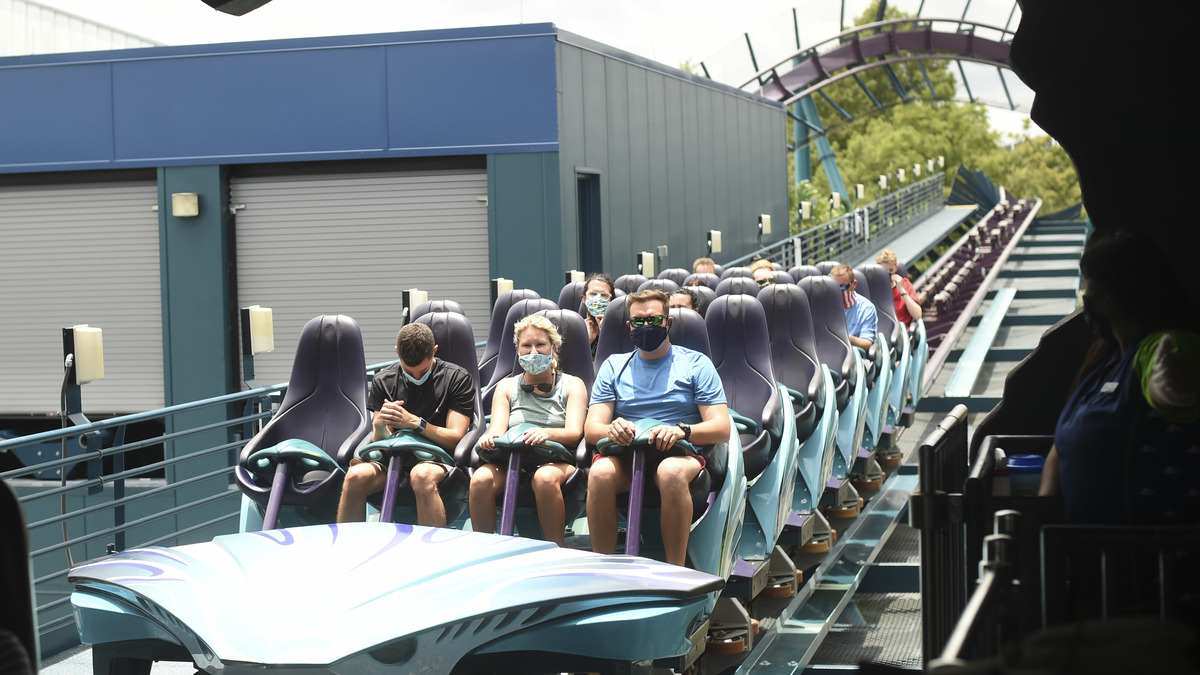
Visitors wear face masks while riding a roller coaster Thursday at the SeaWorld amusement park in Orlando, Fla. SeaWorld is reopening this week after being closed due to the COVID-19 pandemic. Florida and more than 20 other states continue to see a rise in new daily cases.

Zack Wittman/Bloomberg via Getty Images


hide caption

toggle caption

Zack Wittman/Bloomberg via Getty Images

Visitors wear face masks while riding a roller coaster Thursday at the SeaWorld amusement park in Orlando, Fla. SeaWorld is reopening this week after being closed due to the COVID-19 pandemic. Florida and more than 20 other states continue to see a rise in new daily cases.

Zack Wittman/Bloomberg via Getty Images

A record high in South Carolina. A two-month high in Florida. Record hospitalizations in Texas. Several states that were among the first to reopen their economies are now reporting spikes in new coronavirus cases, driving an alarming trend that has propelled the U.S. to 2 million cases.

Florida reported nearly 1,700 new cases Thursday morning — “the biggest jump since March,” as NPR member station WLRN reported. Hours after the state published that data, Gov. Ron DeSantis unveiled his plan to reopen schools in August, urging local governments to aim for “full capacity” when they resume classes.

“As you’re testing more, you’re going to find more cases,” DeSantis said when asked about the high number. “We’re doing 30,000-plus tests a day.”

But some public health experts said the current rise in cases in many U.S. states is the result of community transmission, not a boost in testing. As he discussed Florida’s numbers, DeSantis added, “We also do have … outbreaks in agricultural communities,” saying the coronavirus has spread rapidly in some rural areas.

Similar scenarios are playing out in at least 25 U.S. states and territories, with new cases and/or hospitalization rates spurring fears that many parts of the country are still yet to reach their peak.

Arizona reported 1,412 new coronavirus cases Thursday — far above its recent average of 1,071, which was already a 200% change from two weeks ago. Nearly 80% of the state’s intensive care unit beds are in use. On April 11, the state’s ICU bed occupancy rate was at 66%.

Texas has seen more people in the hospital due to COVID-19 this week than it has at any time during the pandemic. The figure fell to 2,008 on Thursday after soaring past the 2,000 mark for the first time earlier this week.

South Carolina announced nearly 700 new cases on Thursday, far outpacing its previous record high of 540 set earlier this week. The state’s positive test rate is just over 14%, its health department said.

South Carolina allowed beaches and some businesses to reopen in late April. Restaurants were able to serve patrons in their dining rooms (at limited capacities) as of May 11.

“We began to see the first increasing trends several days after the Memorial Day weekend,” said Dr. Linda Bell, the state epidemiologist, adding that incubation times and delays in testing would account for why those cases are turning up now.

“It’s not unexpected,” Bell added. “We saw lots of activity with large gatherings, no social distancing, very rare use of masks. So these findings are not unexpected.”

About 73% of South Carolina’s hospital beds were occupied as of Thursday morning, the state said — but it added that of the roughly 7,600 beds in total, 494 are “occupied by patients who have either tested positive or are under investigation for COVID-19.”

Concerns about the negative trends in the fight against the coronavirus contributed to a devastating day for stock prices, with the Dow Jones Industrial Average experiencing “one of the worst one-day drops in history,” as NPR’s Jim Zarroli reported.

Source link

Florida And S.C. Report New Spikes In Coronavirus Cases

Visitors wear face masks while riding a roller coaster at the SeaWorld amusement park in Orlando, Fla., on Thursday. SeaWorld is reopening its parks this week, after being closed for months due to the COVID-19 pandemic. Florida and more than 20 other states continue to see a rise in new daily cases.

Zack Wittman/Bloomberg via Getty Images


hide caption

toggle caption

Zack Wittman/Bloomberg via Getty Images

Visitors wear face masks while riding a roller coaster at the SeaWorld amusement park in Orlando, Fla., on Thursday. SeaWorld is reopening its parks this week, after being closed for months due to the COVID-19 pandemic. Florida and more than 20 other states continue to see a rise in new daily cases.

Zack Wittman/Bloomberg via Getty Images

A record high in South Carolina. A two-month high in Florida. Record hospitalizations in Texas. Several states that were among the first to reopen their economies are now reporting spikes in new coronavirus cases, driving an alarming trend that has propelled the U.S. to 2 million cases.

Florida reported nearly 1,700 new cases Thursday morning — “the biggest jump since March,” as member station WLRN reports. Hours after the state published that data, Gov. Ron DeSantis unveiled his plan to reopen schools in August, urging local governments to aim for “full capacity” when they resume classes.

“As you’re testing more, you’re going to find more cases,” DeSantis said when asked about the high number. “We’re doing 30,000-plus tests a day.”

But many public health experts say the current rise in cases in many U.S. states is the result of community transmission, not a boost in testing. As he discussed Florida’s numbers, DeSantis himself added, “We also do have … outbreaks in agricultural communities,” saying the coronavirus has spread rapidly in some rural areas.

Similar scenarios are playing out in at least 25 U.S. states and territories, with new cases and/or hospitalization rates spurring fears that many parts of the country are still yet to reach their peak in COVID-19 cases.

Arizona reported 1,412 new coronavirus cases on Thursday – far above its recent average of 1,071, which was already a 200% change from two weeks ago. Nearly 80% of the state’s intensive care unit beds are currently in use. On April 11, the state’s ICU bed occupancy rate was at 66%.

Texas has seen more people in the hospital due to COVID-19 this week than it has at any time during the pandemic. The figure fell to 2,008 on Thursday, after soaring past the 2,000 mark for the first time earlier this week.

South Carolina announced nearly 700 new cases on Thursday, far outpacing its previous record high of 540 which was set earlier this week. The state’s positive test rate is just over 14%, its health department says.

South Carolina allowed beaches and some businesses to reopen in late April. Restaurants were able to serve patrons in their dining rooms (at limited capacities) as of May 11.

“We began to see the first increasing trends several days after the Memorial Day weekend,” State Epidemiologist Dr. Linda Bell said, adding that incubation times and delays in testing would account for why those cases are turning up now.

“It’s not unexpected,” Bell added. “We saw lots of activity with large gatherings, no social distancing, very rare use of masks. So these findings are not unexpected.”

About 73% of South Carolina’s hospital beds were occupied as of Thursday morning, the state says – but it adds that of the roughly 7,600 beds in total, 494 are “occupied by patients who have either tested positive or are under investigation for COVID-19.”

Concerns about the negative trends in the fight against the coronavirus contributed to a devastating day for stock prices, with the Dow Jones Industrial Average experiencing “one of the worst one-day drops in history,” as NPR’s Jim Zarroli reports.

Source link

Why we topple statues

0

Jean-François Manicom is curator of transatlantic slavery & legacies at the International Slavery Museum in Liverpool.

LIVERPOOL — The Egyptian pharaohs Hatshepsut and Akhenaten. The Roman emperors Nero, Domitian, Gallienus, Aurelian, Probus, Geta and Macrinus. Dictators like Napoleon Bonaparte, Francisco Franco, Joseph Stalin, Vladimir Lenin, François Duvalier and Saddam Hussein. History has seen a great many leaders toppled from their plinths.

It’s a tradition we seem to have rediscovered in recent weeks, as demonstrators across the world have made new additions to the list of victims of what the ancient Romans called Damnatio Memoriae — the damnation of memory.

Protesters in Martinique toppled two statues of the 19th-century abolitionist Victor Schoelcher last month, condemning him for authoring a decree that compensated slave owners for their losses. In Bristol, a statue of the 17th-century slaver Edward Colston was dumped into the harbor. A monument in Antwerp honoring Leopold II, the Belgian king who plundered the Congo, will be relocated to a museum after it was defaced by demonstrators. And in the United States, statues honoring the explorer Christopher Columbus and the Confederate President Jefferson Davis were among those that were pulled down or, in Columbus’ case, beheaded.

In Roman antiquity, Damnatio Memoriae was the punishment applied to political figures who were condemned post mortem by the senate. Their statues were knocked over. Coins bearing their visage were melted. Their names were erased from the public space. Records of their lives and deeds were destroyed. Even poets and historians were prevented from naming them or refer to them in any way.

Toppling statues is also undeniably a violent act, an assault on a realistic and symbolic replica of a person.

Throughout human history, toppling a statue has always meant a break from old beliefs. Damnatio Memoriae was intended to enable a society to rid itself of its past, to obliterate whatever was found to be objectionable — or too painful to consider.

Christians systematically destroyed idols and statues representing pagan gods, as they saw them as representing savagery. The end of communism was accompanied by the tumbling of Lenins and Stalins across the former Soviet Union. At its best, expunging the past is a recognition by a society that it is hoping to finish one cycle and enter another, more enlightened, one.

But toppling statues is also undeniably a violent act, an assault on a realistic and symbolic replica of a person. In Ancient Egypt, sculptors were called “the guardians of life,” because the role of the statue in a tomb was to keep the dead alive by serving as a spiritual avatar of their mortal remains.

The society that produces such images is, by definition, a violent one. The past from which people are trying to get justice is a violent past. The legacy of Colston’s slave trading, everyday racial discrimination, poverty and disproportionate vulnerability to the coronavirus among minorities are all violent realities.

When we see Colston’s statue rolling down the streets of Bristol, it is hard not to think about the bodies of the enemies rolled into dust during gladiator games or dragged by the Greek chariot of war. We are not that far from a physical urge to kill a body that belongs to the past. Symbolic lynchings, it would seem, are still necessary to move from one epoch to another.

But there’s a cost to that violence, no matter how legitimate and true the struggle might be, how sincere and strong the wish to better the world might be, how outstanding and honorable the motivation of the activists.

Memory, when damned, ends up rotten. It contaminates the body that expelled it. Its banishment allows for human denial and historical falsehoods.

At the International Slavery Museum in Liverpool, where I work, we take another approach. Where museums were once considered as places to store, conserve and display memory, we are becoming active makers of the future.

Memory needs to be addressed and looked right into the eyes — to be domesticated like a wild and dangerous animal. Our weapons are education and knowledge. Our tools are human resilience and understanding. Knowledge about the traumas of our past empowers us to change the future. Let us not damn memory but tame it.


Source by [author_name]

Scientist says we haven’t found ET yet because we’re doomed to destroy all life

0

A group of physicists working on the atomic bomb program at Los Alamos Research Laboratory in 1950 were having a discussion about aliens over lunch one day. The general consensus was that the reason humans hadn’t yet met any was because life was scarce in the universe and we just hadn’t been lucky enough to encounter them.

One of the physicists, Italian researcher Enrico Fermi, scoffed at this notion. He did some math and came up with a number to dispute the other researcher’s conjectures. In Fermi’s estimation, if aliens existed they should have already visited us by now. This became known as the Fermi paradox.

At it’s most basic, it goes like this: If life isn’t unique to our planet, and the universe is infinite, then the odds of it being flooded with life are great. And if it’s flooded with life, the odds are great that at least one of those life forms should have visited us by now. So the most simple explanation – the one Occam would approve of – is that aliens don’t exist because life is really special.

This doesn’t bother enthusiasts. An alien enthusiast will look you straight in the eye and declare no less than 12 excellent reasons why aliens exist but either don’t want to visit us or can’t. And it’s incredibly hard to argue with the suggestion that they know we’re here but are pretending not to see us. We’re not exactly putting our best foot forward as the “intelligent” life forms of planet Earth right now.

None of these arguments are new. And Fermi wasn’t the first person to dispute the fact that aliens exist by pointing out there’s absolutely no evidence for them. But Alexander Berezin, a researcher from the National Research University of Electronic Technology in Russia, has a new spin that could put both camps in their place.

What if aliens do exist, but the reason we haven’t found them yet is because we’re doomed to destroy them? Berezin says the simplest way to resolve the Fermi paradox is a “first in, last out” solution:

I argue that the Paradox has a trivial solution, requiring no controversial assumptions, which is rarely suggested or discussed. However, that solution would be hard to accept, as it predicts a future for our own civilization that is even worse than extinction.

… what if the first life that reaches interstellar travel capability necessarily eradicates all competition to fuel its own expansion?

The crux of the situation, they argue, is that it doesn’t really matter whether aliens exist or not but only if we can observe them.

If we assume the reason we don’t observe aliens is because they’re on one of the infinite planets surrounding one of the infinite stars that isn’t our sun, then the important bit is whether or not we or any of the potentially infinite aliens have developed interstellar travel yet. And, whoever does develop it first, will probably just destroy all the other lifeforms in the universe.

Berezin isn’t saying that Trump’s Space Force is going to go out and kill all the aliens for their resources (although they don’t explicitly rule it out). The point of the paper is that some unintended ripple effect could have imperceptible consequences throughout the universe. They write:

I am not suggesting that a highly developed civilization would consciously wipe out other lifeforms. Most likely, they simply won’t notice, the same way a construction crew demolishes an anthill to build real estate because they lack incentive to protect it. And even if the individuals themselves try their best to be cautious, their von Neumann probes probably don’t.

As far as we can tell, Berezin’s basically saying that if we assume the most probable scenarios are true, then it’s likely that aliens exist all over the universe but the first ones to achieve interstellar travel will inadvertently destroy all the others. Yikes!

And how will this happen? Artificial intelligence, probably. If it doesn’t kill all humans, apparently it’ll just kill all… everything else. Berezin writes:

This problem is similar to the infamous “Tragedy of the commons”. The incentive to grab all available resources is strong, and it only takes one bad actor to ruin the equilibrium, with no possibility to prevent them from appearing at interstellar scale. One rogue AI can potentially populate the entire supercluster with copies of itself, turning every solar system into a supercomputer, and there is no use asking why it would do that. All that matters is that it can.

The good news is that, based on the fact nobody’s accidentally deleted us yet, it’s a near certainty that we’re the ones who’ll the destroying.

Read the whole paper here.

H/t: Peter Dockrill, Science Alert

Published June 11, 2020 — 23:29 UTC


Source link

Rally at your own risk: Trump campaign’s coronavirus disclaimer to supporters

President Donald Trump is set to resume his campaign rallies next week — but attendees have to agree not to hold his campaign liable if they get the coronavirus in the 19,000-seat arena.

An invitation for the June 19 event in Tulsa, Oklahoma asks people to register online for the event —and waive their rights to sue if they get sick.

“By clicking register below, you are acknowledging that an inherent risk of exposure to COVID-19 exists in any public place where people are present. By attending the Rally, you and any guests voluntarily assume all risks related to exposure to COVID-19 and agree not to hold Donald J. Trump for President, Inc.,” the rally site or organizers “liable for any illness or injury,” the form says.

The rally is being held in the Bank of Oklahoma Center and comes as the city is in phase three of reopening from the coronavirus pandemic.

“Under Phase 3, businesses may resume unrestricted staffing at their worksites by observing proper CDC-recommended social distancing protocols and are recommended to continue increased cleaning and disinfecting practices,” Gov. Kevin Stitt’s office said in a May 29th statement.

A Trump campaign official said there would be health precautions in place at the event but did not elaborate. White House press secretary Kayleigh McEnany told reporters on Wednesday she didn’t have specific information but said “we will ensure that everyone who goes is safe.”

Stitt, a Republican, has hailed the Trump event. “The President is making Oklahoma his first campaign stop since March 2, and his visit here confirms Oklahoma is the national example in responsibly and safely reopening,” he said Wednesday.

The event had already been controversial because of the site and the date. Tulsa is the site of the Greenwood massacre, where a white mob killed an estimated 300 black people and torched the neighborhood’s “Black Wall Street” in 1921, and the 19th is also known as Juneteenth, a holiday that marks the end of slavery in the United States.

Source link

Here’s What Your Trans-Tasman Travel Bubble Trip To New Zealand Will Actually Look Like

0

With Europe summer trips cancelled and no long-haul flights on the agenda for the foreseeable future, many Aussies are banking on the pending trans-Tasman travel bubble.

Both the Ardern and Morrison governments have promised it’s something they’re working on.

The Tourism Restart Taskforce wants trial flights to start in July while New Zealand prime minister Jacinda Ardern said September was a more reasonable timeframe.

While it’s hard to book and plan anything until there is an official announcement, we can start dreaming and researching our trips across the ditch.

Although all COVID-19 restrictions have been lifted in NZ, experts on the ground in New Zealand warn holidays won’t be exactly the same as pre-pandemic.

Here’s what you need to know:

Cathedral Cove is a natural coastal arch on the Coromandel Peninsula, north island, New Zealand. It is an area of outstanding beauty and is designated as a marine reserve. The reserve was set up in 1992 with snorkelling as one of the key activities.

When will it happen?

If it was up to Deputy Prime Minister Winston Peters, Kiwis and Aussies would already be able to fly across the Tasman Sea.

“The trans-Tasman bubble should have been open, like level one, yesterday,” he told Stuff while citing Australia’s interstate border closures as the reason for the delay. Queensland, Tasmania and Western Australia are still banning visitors from other states.

“As soon as they say we are ready to go, we are off,” he said.

The Safe Border Group – made up of experts and representatives from Australia and New Zealand – has delivered a blueprint for the travel bubble to both prime ministers. Prime Minister Ardern recently said travel could resume in September.

New Zealand's Prime Minister Jacinda Ardern. (Julian Smith/Pool Photo via AP)

New Zealand’s Prime Minister Jacinda Ardern. (Julian Smith/Pool Photo via AP)

Will things be open?

New Zealand has zero live cases of COVID-19 and this week lifted all coronavirus restrictions for the first time in more than three months, while much of the rest of the world is still grappling with the pandemic.

The country’s official tourism board said it expects to see a boost in domestic travel followed by Aussies being allowed to visit.

“We are seeing a steady increase of operators reopening their doors and we expect this to continue into the later half of 2020,” Andrew Waddel, General Manager at Tourism New Zealand – Australia told HuffPost Australia.

“Lots of operators are back online with Wildwire Wanaka offering great deals and offers.”

The government’s Alert Level One means there are no more limits on people in cafes, malls, stadiums, night clubs or public and private gatherings.

Life, for the most part, is back to normal.

What about wineries?

Many wineries, such as the picturesque Mudbrick Vineyard and Restaurant on Auckland’s famous Waiheke Island, are hosting hourly tastings to cater for post-COVID vino cravings.

“Lots of New Zealand wineries have already opened their cellar doors and restaurants for New Zealanders wanting to explore their own backyard and look forward to welcoming Aussies, Waddel said.

“Additionally the majority of New Zealand’s 32 luxury lodges will be open by October 1st”.

Will adventure tourism still be a thing?

New Zealand ski fields are gearing up for the 2020 season, with slopes opening from late June-July, confirmed Waddel.

“The Remarkables and Coronet Peak in Queenstown, and Mt Hutt in Christchurch-Canterbury are scheduled to open for the 2020 winter season,” he said.

“In Wanaka, heli-ski operations are looking to take flight in mid to late-June, Snow Farm’s scheduled opening day is June 19, and both Cardrona and Treble Cone are set to open on the last weekend of June, which is all extremely positive news for Australian visitors.”

Off-the-grid experiences will certainly be open in Auckland, Steve Armitage, General Manager at Destination at Auckland Tourism, Events and Economic Development (ATEED) told HuffPost Australia.

“There’s Great Barrier Island – the world’s first island to receive the dark sky sanctuary status.

“Auckland Museum, Art Gallery and the Zoo are preparing to welcome visitors again. The popular Auckland to Rangitoto Island ferry service resumed in May, which transports you to the heart of the Hauraki Gulf where there is a range of activities to explore.”

Regional flights or just driving?

Long before COVID, Australians were big fans of hitting the road in NZ. We know 70% of Aussies take part in a self-drive holiday when visiting New Zealand.

“The revived appreciation for the outdoors and life’s simple pleasures means a New Zealand road trip is the best way to experience our people and place,” Waddel said.

“My favourite road trip is from Christchurch to Queenstown which travels through Tekapo. Following all that Wanaka and Queenstown has to offer, head up the West Coast of the South Island. It weaves you through from mountain to rainforest and rugged coastline.”

Will there be good deals?

Australians make up almost 40% of international arrivals to New Zealand so there is incentive to lure travellers back over the ditch to get the economy moving once borders open.

There have already been great deals to boost domestic tourism.

“We’ve started to see some fantastic deals,” ATEED’S Armitage said.

“Such as Waiheke Island’s recent campaign called ON THE HOUSE where visitors to the island can rent one of the participating properties over a weekend in June, and homeowners will let them stay ‘on the house.’

“The rental fee will be passed on and converted into ‘Waiheke dollars’, a spending credit for goods and services redeemable across the island.”

What will the flight be like?

“I think everyone needs to realise that it’s going to be very, very different than what they’re used to,” Jeremy Tarr, digital editorial director of Fodor’s Travel told HuffPost.

“It’s going to feel weird, it might feel uncomfortable, and, depending on the person, it might feel really scary.

“Research what your airline has done before you book your flight and especially before you board.”

Qantas, for instance, from June 12 will provide masks and cleaning wipes to ensure safe travel and give passengers peace of mind during the pandemic, but will not leave middle seats empty as it will be impossible to turn a profit.

“Social distancing on an aircraft is impractical,” Qantas boss Alan Joyce said.

He said the airline will simplify catering, step up aircraft cleaning and ask passengers to limit movement around the cabin once seated.

Masks will not be mandatory but Qantas will recommend passengers wear them in the interest of everyone’s peace of mind, in a measure that is unlikely to be needed over the longer term, Qantas Medical Director Ian Hosegood said.

He confirmed data showed the risk of catching coronavirus on a plane is extremely low and there are no documented cases of transmission, including on recent lengthy Qantas repatriation flights from London and Los Angeles that lacked social distancing.

The adventure capital of the world, Queenstown is home to many thrills and exciting activities.

The adventure capital of the world, Queenstown is home to many thrills and exciting activities.

What about neighbouring countries?

South Pacific island nations are campaigning for a South Pacific travel bubble with Australia and New Zealand.

Tourism delegates from New Caledonia, Papua New Guinea, Solomons and Tahiti have formed a working group to help the proposed South Pacific travel bubble become a reality.

The group submitted a letter to the offices of both the Australian and New Zealand prime ministers to urge negotiations around potentially opening borders.

“The concept of a South Pacific bubble is of great importance to many people – and not just those desperate to get back to a tropical island, which I think many of us are dreaming of right now,” Caroline Brunel, Account Director at Tahiti Tourisme, Australia and New Zealand told HuffPost Australia.

“Tens of thousands of Australians rely on outbound travel for their jobs, and tourism is the life blood of entire nations in the South Pacific.

“Collectively, the nations of the South Pacific have done an incredible job of flattening their respective COVID curves, if not eradicating the virus all together.”

There have been 88 cases of COVID-19 and zero deaths across the four nations.


Source by [author_name]

The hidden detectors looking for guns and knives

0

Image copyright
Evolv Technology

Image caption

Scanners were used to screen VIPs at this year’s Brit Awards at London’s O2 centre

Peter George calls it the protection paradox. People want to have safety, but they don’t want to spend a long time queuing for a security inspection.

He is the chief executive of Evolv Technology, a US business based just outside Boston that is developing systems to search for firearms at major public events, and perhaps one day look for symptoms of Covid-19.

Evolv has been asked if it can build arches into doorways and the company is examining ways to widen the space between sensors to allow larger crowds to go through more quickly.

Mr George has a background in cybersecurity work that he says qualifies him for finding needles in haystacks. Evolv sells security arches that contain a combination of electronic surveillance and AI software to sift through signals and spot one gun-toting individual among thousands of people filing into a rock concert.

This discreet technology was used to screen VIPs at this year’s Brit Awards at London’s O2 centre.

Traditional metal detectors throw up a lot of alarms for innocent metallic objects, creating a chokepoint for paying customers who just want to get to their seat in a stadium or concert hall.

Image copyright
Evolv Technology

Image caption

Peter George is hoping to solve the protection paradox

This very high alarm rate prompted Evolv to blend AI software with radar to cut down on false alerts and keep the crowds flowing into a venue without irksome interruptions.

This is not just looking for the shape of a gun as defined by the software, but also for small shards of metal packed into a confined space to create shrapnel around an explosive device as was tragically demonstrated in the 2017 Manchester Arena bombing.

Evolv’s software engineers have written algorithms that interpret shapes as signatures, with the outlines of knives and guns catalogued as reasons to alert an operator.

The density of metal is one key indicator of a weapon’s presence and Mr George says his colleagues have programmed the system to react in 1/38th of a second.

The AI software analyses the results it gets from each crowd and this is uploaded automatically into Evolv’s own database.

Every arch sold is plumbed into Evolv’s home archive via the internet. So it gets updated from other scanners. The system evolves as the user base grows, or as Mr George puts it, “we can make everybody smarter as we share the data we collect.”

Evolv hopes to add thermal imaging capabilities to its scanners in the course of 2020. In theory that could detect people with high temperatures, one of the symptoms of Covid-19.

Dr Simon Worrell is an immunologist specialising in pandemic planning who works for health and security advice firm Collinson. He says the use of AI to assess human scans “sounds good, but I just don’t know how effective it will be”.

Taking paracetamol, for example, will lower the temperature of a Covid-19 carrier. And basic precautions are still paramount. “Physical distancing is important.”

Image copyright
Getty Images

Image caption

Experts says temperature checks alone are not enough to spot Covid-19

He thinks that adhering to layers of protection, temperature checks, masks and staying apart, is the way to beat the virus.

Canadian threat protection specialist Patriot One Technologies has directed its AI team to research how its existing systems, built to identify one person carrying a gun in a crowd, can be tuned to pick up people with raised temperatures.

But Martin Cronin, chief executive of Patriot One and a former British Foreign Office diplomat, urges caution. “It’s not that easy to detect temperatures. You can’t just point a thermal camera at a crowd. Factors like the ambient temperature or whether someone has a raised temperature due to exercise can undermine the accuracy of scanning devices. People should be wary of bold claims to have answers to temperature scanning.”

Part of the challenge is tuning AI software to ignore such distractions and isolate the indicators that are important to keeping virus carriers out of crowded places. Patriot One wants to pin down a range of anomalies, including the absence of approved face masks, that mean a visitor merits further attention.

It’s been difficult enough training the systems to look for concealed weapons.

Patriot One found that radar did a fine job of peeking underneath coats and jackets to find what it thought were weapons. Unfortunately the number of false alerts was unreasonably high.

Image copyright
Patriot One

Image caption

Patriot One’s system can be disguised beneath plant pots

AI was drafted in to help, in the form of machine-learning technology that could sort out the shapes caught on the radar scan and assess whether they really represented a threat.

With a boost from AI the success rate rose, but it still wasn’t up to a stage where it could be unleashed on the public without common objects getting confused with the tools of a terrorist.

The system was only working well in some environments, while in others the signals became cluttered by outside elements such as emissions from consumer electronics.

More Technology of Business

The answer was yet more technology. Patriot One bought several companies, with additional AI and detection expertise.

Video images of guns and knives were fed into the AI software teaching it to discriminate between different objects.

And the company has connected its surveillance technology to security cameras suspended in familiar transparent bulges from corridor ceilings in customer sites.

Mr Cronin brought the AI ingredients together, pooling the data from different systems. He likens it to the way humans combine all of their senses to understand the world around them.

Image copyright
Getty Images

Image caption

AI can monitor information from multiple sources

He claims the AI software has now eliminated interference from building noise and electronic signals, deleting the false positives that dogged early trials. And he presents the technology as leaving individuals anonymous. “We look for objects, not people.”

But the algorithms that underpin smart systems can be foxed by mundane events.

At one high school campus in the US a gun detection scanner was perplexed by the sudden appearance of umbrellas on a day of heavy rain. Retrained to identify an umbrella as a non-threatening object the software could then be updated across Patriot One’s user network.

Different societies throw up different problems. In North America the priority is to detect guns. For prospective UK users the system may be looking for knives. But in both cases the idea is to install unobtrusive security architecture.

So the next time you stroll into a corporate reception area or the entrance of a public building, cast a glance at those big planters that frame the door as you walk in. You might just have been checked out for weapons. Or perhaps, one day, a virus.

Source link

Justin Rose and Harold Varner tied at the top on first day of PGA Tour action since March

0

Watch day two of the Charles Schwab Challenge live on Sky Sports. Featured Group coverage starts at 12:45pm on Sky Sports Golf and Sky Sports Main Event.

Last Updated: 12/06/20 12:52am


3:31

Paul McGinley and Sarah Stirk look back at the best of the opening-round action from the Charles Schwab Challenge, the first PGA Tour event since mid-March.

Paul McGinley and Sarah Stirk look back at the best of the opening-round action from the Charles Schwab Challenge, the first PGA Tour event since mid-March.

Justin Rose and Harold Varner III shared the spoils on the opening day of golf’s return to competition on the PGA Tour, 91 days after The Players Championship was abandoned.

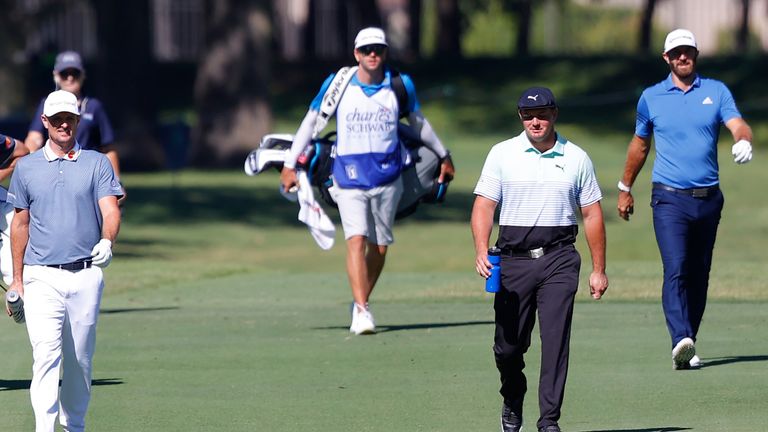
The Charles Schwab Challenge might be out of bounds to spectators, but neither the eerie atmosphere or the lengthy break in tournament golf seemed to have an adverse effect on the scoring at Colonial Country Club, with Rose and Varner leading the way after seven-under 63s.

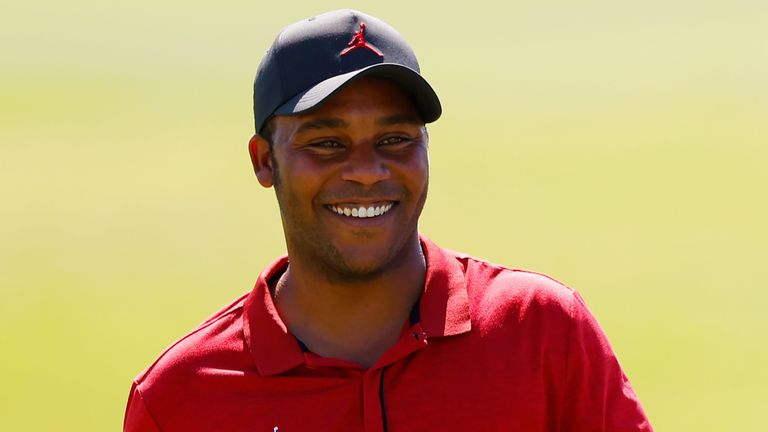
Harold Varner is tied at the top after a 63

Harold Varner is tied at the top after a 63

Justin Thomas was among a group of four players just one off the lead overnight, while it was a steady, if unspectacular, start from the world’s top three players as Rory McIlroy and Brooks Koepka handed in 68s, with Jon Rahm slipping to one under after he bogeyed the last.

Colonial member Ryan Palmer had the honour of hitting the first tee shot to herald a welcome return to competitive live golf on Sky Sports, but it was Rose who soon set the early pace as he looks to rebuild his FedExCup campaign after a torrid opening to the year.

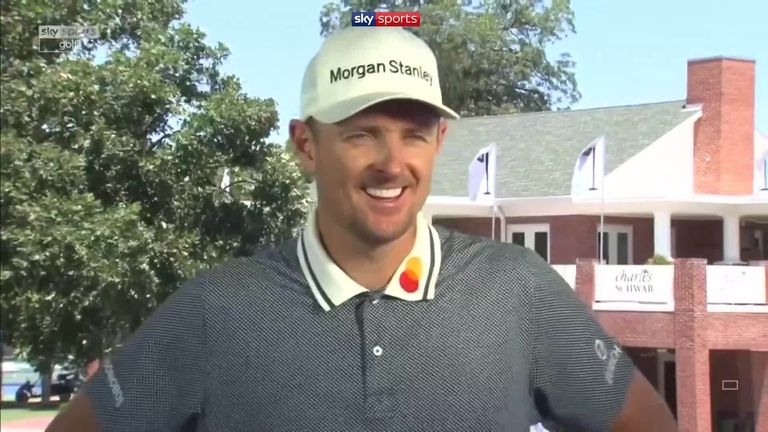
The former world No 1 had missed the cut in three of his first four starts of 2020 on the PGA Tour, his lone weekend resulting in a meagre tie for 56th at the Genesis Invitational, but three birdies over his first four holes went a long way to proving he had been working hard on his game during the enforced break.

2:12
Justin Rose was delighted to get off to a hot start after a 91-day break in PGA Tour competition as he reflected on his first-round 63 at Colonial Country Club.

Justin Rose was delighted to get off to a hot start after a 91-day break in PGA Tour competition as he reflected on his first-round 63 at Colonial Country Club.

Three consecutive birdies from the first lifted him into the outright lead, and six closing pars kept him at seven under to earn a clubhouse lead he would enjoy or most of the afternoon, with Varner the only player among the later starters to match the Englishman’s 63.

Varner, one of only a handful of prominent black professional in the United States, has been the focus of attention on the PGA Tour since the killing of George Floyd in Minneapolis sparked worldwide outrage and a number of protests in almost every major city around the globe in support of the Black Lives Matter campaign.

But the charismatic 29-year-old showed the quality of his golf matched his diplomacy and class in speaking out against matters of racial injustices, keeping a clean seven-birdie card although he admitted he was “in the gym” when play was halted for a minute’s silence in memory of Floyd at 8:46am, local time.

1:40
Harold Varner III let his golf do the talking on the first day of PGA Tour action for 91 days as he fired a seven-under 63 to share the lead with Justin Rose at Colonial Country Club.

Harold Varner III let his golf do the talking on the first day of PGA Tour action for 91 days as he fired a seven-under 63 to share the lead with Justin Rose at Colonial Country Club.

“If I’m thinking about winning a golf tournament right now, I’ve probably lost it,” said Varner, who held long discussions on racial inequality issues with PGA Tour commissioner Jay Monahan which were filmed and later published on the PGA Tour digital platforms.

“I know what’s going on, but when I’m on the golf course, I’m trying to play well. The reason I have a platform is because I’m really good at golf. I just need to focus on that, and to be honest with you, being on the golf course, it helped me. It’s my getaway, I guess.

Get the best prices and book a round at one of 1,700 courses across the UK & Ireland

“But I didn’t think it would be like that until I got on the first hole and I hooked one super far left and I was pissed, like it was good. Those juices are awesome.”

World No 4 Thomas was also bogey-free for the first day in a 64 which matched the earlier efforts of Abraham Ancer, Jhonattan Vegas and Collin Morikawa, while the surprise name in the group at five under was undoubtedly Tom Lehman, the 61-year-old proving that age is no barrier on one of the shorter, more traditional layouts on Tour.

1:08
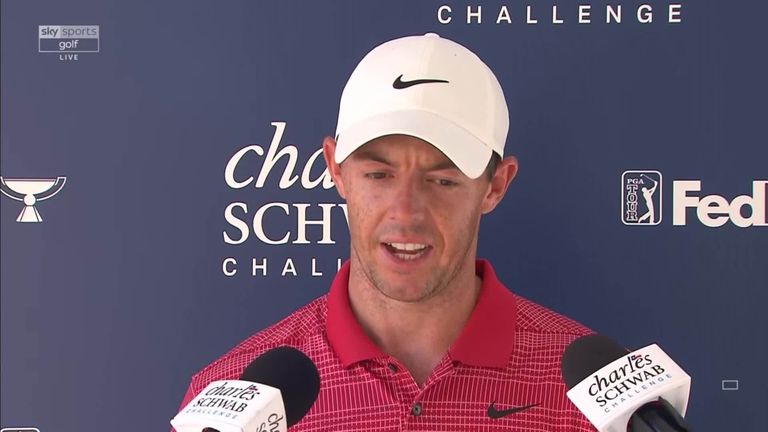
Rory McIlroy reflects on an opening-round 68 at the Charles Schwab Challenge and explains the impact the lack of spectators had on the event.

Rory McIlroy reflects on an opening-round 68 at the Charles Schwab Challenge and explains the impact the lack of spectators had on the event.

American Ryder Cup hopefuls Bryson DeChambeau, Gary Woodland, Xander Schauffele and Jordan Spieth are also just two off the pace overnight, while a “refreshed” Ian Poulter carded a 66 despite two blemishes over the second half of his round which cost him the chance to join long-time friend Rose at the top of the leaderboard.

McIlroy, making his debut at Colonial, began with a confident birdie and hit back from a mistake at the sixth with back-to-back birdies at eight and nine, but he found chances hard to come by on the inward nine and parred nine straight holes to stay at two under alongside playing-partner Koepka.

Live PGA Tour Golf

June 12, 2020, 12:45pm

Live on


Source link