Miriam Makeba: 9 passports, no pass – The Mail & Guardian

Passport number 1

According to Dr Vincenza Di Saia, a physician at the Pineta Grande private clinic near Naples, Italy, Miriam Makeba collapsed as she was leaving a stage where she had been performing in a benefit concert. The concert was held for Roberto Saviano, a writer who had been on the receiving end of numerous death threats after writing about organised crime. The details are unclear. Makeba collapsed in the wings after stumbling off stage, mid-song. She collapsed on stage after singing Pata Pata, her hand clutching her heart clutching home. She was still alive in the ambulance. She was still alive in the hospital. Time of death is listed as midnight. Cause of death: cardiac arrest. 

Passport number 2

In a 1988 interview with Roger Steffens, when asked about her calling, the interlocutor (perhaps in playful facetiousness) asks whether she can see into the future. 

Miriam Makeba: “I try to see the future. I may be wrong but I try. And for me, the future is, it has to be, that I will return home. My people will be free and we shall live like human beings, like all other people in the world. Because if I ever stop thinking that way, or looking into the future that way, then it would be very detrimental to me. I may just lay down and die.” 

In another interview: “I will probably die singing”. 

Passport number 3 

You’ve heard this one many times before. Zenzile Miriam Makeba was born on the 4th of March 1932 to Christina and Caswell Makeba. A mere 18 days after the birth of her daughter, Miriam, Christina is arrested for illegally selling umqombothi and is sentenced to six months imprisonment. Christina waits out the entirety of the term with her newborn daughter. At the age of 17, Miriam marries into an abusive, violent union that will give her her only child, daughter Sibongile Angela Makeba. She was conceived the first time Miriam lies with her husband; Miriam is in labour for a full week before baby Bongi appears. Her husband, James Kubay, will beat her; when she catches him in bed with her sister, she leaves, never to see him again.

 Also at age 17, some bumpy uneven lumps are found in Miriam’s mammary tissue. She’s diagnosed with breast cancer. She opts for treatment from her mother, a sangoma.

 James Hall authored her as-told-to autobiography, Makeba: My Story. In a book that is published years later, Sangoma: My Odyssey Into the Spirit World of Africa, he recalls a conversation between the two of them sometime in 1986, when he lived with her for two months in Conakry, Guinea. 

“We sat in the rock garden of her small house as I conducted interviews for her as-told-to autobiography, which I was to write … Miriam’s face, capable of such emotion when she sang, became inscrutable and her large brown eyes focused far away. ‘My mother was special. She could see.’ 

“Something mysterious had come over Miriam, and I proceeded carefully. ‘How?’ ‘She was what we call a sangoma. She had powers. People came to her with problems, and she told them what they were. Then she cured them… She trained to be a healer in Swaziland [Eswatini]. She had no choice but to become a sangoma. The lidlotis – the spirits – wanted her.’”

 These spirits will guide Christina’s hands over her child’s breasts. Kneading, rubbing, praying. Curing. 

1969. Miriam leads in the hit musical theatrical production King Kong. In the same year, she has a bit part in the anti-apartheid film, Come Back Africa. The next year, two of her relatives are murdered in the Sharpeville Massacre. Her mother will also die that year and, while trying to return home for the funeral, Miriam will learn that her passport has been cancelled, effectively banning her from her home country; displacing her, for the second of many times in her life. This is also the year that a nine-year-old Bongi Makeba moves to the United States to join her mother. 

Passport number 4

Miriam Makeba on May 13 in 1964 at the Olympia in Paris. (AFP)

Here there are two canvases. The one is a drum. Hollow. Percussive. A drum is nothing without an instrument to strike it. To beat into it sound. To batter it into aliveness. Dathini Mzayiya provokes the canvass to wakefulness.

 There are fine, fine patches where you can’t see the paint, or the spray or the brush, and then vicious lines chopping through the evenness, just slashing and slashing and panga and machete into the black, and then another black and then a black another. 

On a screen strewn together from the printed dailies, Miriam speaks, her face as now, as it is then. Current affairs, because the newsprint that stains her face tells us so. Current because the context doesn’t change. Because those in power. Because black souls never rest in peace, only pieces. 

Her thesis.  

“There is really no difference in the struggle of the people you have mentioned because we are all Africans. We were just put in different countries by white people who took people from Africa and spread them out. It is true that our problems are the same.” 

It is a face. It is always a face. Slash slash slash for eyebrows. Slash on the left and slash on the right. A curved line made of many tangents. Of explosions. Straight here forming an angle, the line swelled full of itself, distended, and where it should have burst; stopped, slid sanguine back down. 

The lines again. Hacking and hewing and a brush has been used here. Hewing and chopping to say: this is the face of a man who has a difficult life. Look how it has dug into his face. Chisel and hammer. Nail and hammer. Pestle and mortar and hammer. 

Passport number 5

Westwind blow ye gentle
Over the shores of yesterday.
My sun is brown and over
Here within my heart they lay, they lay.
Westwind with your wisdom
Gather all the young for me.
Black cloud hanging over
Nest your bosom strong and free.
So Westwind with your splendour
Take my people by the hand.
Spread your glory sunshine
And unify my promised land.
Unify us, don’t divide us
Unify my promised land
— Nina Simone, Westwind 

Sibongile Angela Makeba was born to her mother when Miriam was about 17 or  18 years old. At the age of 34, Bongi has a stillbirth. Ill-treatment at the hospital and close family ties with the embattled, outgoing president of Guinea, Ahmed Sékou Touré, will drive Bongi out into the streets in a hospital gown, bleeding oceans, searching for the child she lost. She dies there. Miriam buries her, mostly alone. Herself. Her daughter. And a handful of journalists.

Roger Steffens: “Now your mother received two years of instruction in Swaziland (referring to intwaso). You in effect, are a graduate of the instruction, just by the mere fact of your career and are often, as you have said, taken by the spirits in performance, so that you are satisfying the needs of the spirits.” 

Miriam: “I guess so, If I didn’t have that outlet, I’d probably have to go through what she [my mother] had to go through or have some kind of … misfortune.”

Roger: “Do you think your daughter was affected by the fact that she didn’t take instruction?”

Miriam: “I have been told so. She didn’t want to do that and she sang sometimes but she was doing it as a … just whenever she feels like performing. She sang very well. She wrote most of the songs I sing. She used to write beautiful things for me….” 

Among the songs penned by Bongi Makeba are “Westwind”, “A Luta Continua”, “Lumumba”, “Quit It” and “Do You Remember Malcolm?”. 

Passport number 6

Miriam Makeba during a performance in Zurich, 1969 (Getty Images)

The mic’d up canvas. A make-shift border in black. In school we had projectors. We’d pull the screen and secure it in a place by wrapping a loose string attached to its handle around a hook or a nail. A sticker affixed to the screen cautioned when to stop pulling. It read: “Pull until black appears on top”. 

“Now saying that they are a minority, this really means nothing because the white man, wherever he is, whether he is in the majority or the minority, he rules. It just proves to everyone that we just have to keep fighting. We just have to fight that much more. Because it doesn’t matter if he’s in the majority, or the minority, he’s always on top.” 

Before it is a face it is white with a perimeter of black. Black on top, but also on the bottom. Black on both sides. Mzayiya runs his fingers over the body of the blank, the mics pick on the strokes, make each graze a raze in the ground. Each molehill a mountain. This is what they mean when they say amplification. The process of making something more significant, more marked. More more. 

“More more more future”, is a piece by Congolese dancer and choreographer Faustin Linyekula and Studios Kabako located in Kisangani, Democratic Republic of the Congo. Writer Stacy Hardy describes this work as “somewhere between a scream and lullaby”. Linyekula, in his corporeal poetry searches for, in his own words, “other ways of breathing”.
“In the Congo, we like to lose ourselves in music. In the ndombolo, this bastard music, strong of traditional rhythms, comes from both rumba and pop. A big sound that makes the Congolese dance and numbs them, putting on the poverty glitter, of which nothing remains in the morning.”

“Today in my country,” says Linyekula, “we need to dream. Music was one of those spaces. But today I look at Werrason, Fally Ipupa, Koffi Olomidé, Mpiana — all the big shots. They think that the answer is to show off. To say, ‘I am the richest around’ — to sell that dream … Musicians become beggars; glittery beggars, but beggars. Then you realise how tragic our situation is. When you see the moral, intellectual, material misery of the people who should make us dream, then you understand how much shit we are really in. Then you ask yourself what can be the future … ” 

Makeba’s future, the one she dared herself to envision, saw her coming home. Saw her people free. Her idea of personal freedom was inextricably linked to the liberation, of not just the Black people of South Africa, but Black people the world over. Into her songs she imbued not just a future, but a challenge to the future to be more. 

“It will depend on them. We are just worried about ourselves. It is our country. They came from Europe to invade our country. They took it. They have made us suffer. So we don’t have to worry thinking about what will we do to them. What will happen to them. It will be up to them to see fit what they can do when we have won. Just like they see what to do fit right now while they are on top.” 

Passport number 7

It is Christina Makeba, Miriam’s mother, who beat her into life when life tried to beat itself out of her. 

When it mestatised and multiplied in her breasts, it was Christina who crushed herbs for her daughter to drink and drown — to emerge from these fragrant waters on the other side. In The Emperor of All Maladies, Siddhartha Mukherjee writes, “If we seek immortality, then so, too, in a rather perverse sense, does the cancer cell.” Understanding that we are born, not immortal in a sense that we can never die, but rather, in that we can never stop living, Christina pulled the hard forever-afters from her daughter’s chest, to give her a longer life here. 

When Miriam’s policeman husband tries to shatter his will and dominance into her face, it is Christina who tells her to move to Johannesburg. 

It is Christina who takes her body on the stage, sings with her voice till she, trance-like, escorts us all into a world that tastes like freedom. 

“The strength, I get it from my people. I get it from my mother. My ancestors. Because to us, even those who have died are still with us. They live among us. We talk to them. When I am in deep trouble I kneel down, I say to my mother and my father and my grandmother ‘you’ve gone to the other side. Wherever you are, ask the superior being to help me, and help me to be strong’. And that’s what I do all the time, I think [I] get my strength from that.”

 Was Christina there when her daughter gasped in pain in the dying notes of Pata Pata? Did she walk her into the wings, rubbing her brow as the ambulance cried in mourning through the rough-hewn, cobbled streets in Italy?

 Did she tell her: “It is okay, my child. This death is not one you have to fight. We will fight from the other side.” 

Passport number 8

Miriam Makeba circa 1970. (Michael Ochs Archives/Getty Images)

I have become intimately involved with violence. She has decided to be my constant companion. Often I find myself crying, “Why me?” Always I hear myself responding, “But then who?” 

The political is deeply personal. Today, like yesterday, I fight for my life. I take my medicine in the form of words and herbs.
1) From water, I learn to soak in herbs and wash away grey things. From water, I learn that sometimes I might be required to live there, in the underneath.

2) In the library of the University Currently Known as Rhodes I find a book on a shelf on the third floor. It’s a little bruised, a little tattered, pages dog-eared and ink running thin. It’s an anthology by one Jerome Rothenberg, titled the Technicians of the Sacred: A Range of Poetries from Africa, America, Asia, Europe and Oceania; a collection of texts that dances at the intersections of engineering , language and spirituality.

3) From the writer Daniel Borzutsky I learn that there is no technology outside ourselves to interpret the screams of others. To interpret the screams of others I become not the other, but the scream. He says, “To be alive is a spiritual mission in which you must get from life to death without killing yourself.” I share this joke with my supervisor but she doesn’t find it funny. He says “You can die from so many stories.”

4) I am always dying.

5) Selah Saterstrom is a writer and hoodoo card reader. One day we’re sitting on a bed with white sheeting, when she says to me I have wounds that are not my own. I am dying from so many stories.
A friend texts me and asks If I’ve ever heard of umkhokha?

“What I mean is, has anyone in your family ever had the experience of being robbed, of being killed in a robbery?”
There is uncle. Stabbed footsteps from his house, the unintelligible story writ in blood from the gatepost to the street. A 30cm incision from below his third rib bone pouring down. The men in my family have strange ways of dying and the setting rarely ever changes. Always almost home, but never quite. Always a shebeen a stumble away. In the street, alone, no one to catch the final wheezing, to give that breath a direction, a way home. 

6) There is uncle. There is me. There are others. 

7) He explains that umkhokha is like a recurring family incident. A trauma that plays itself in sets and loops, travelling by genome and bloodstream. “You have to do a ceremony yokuvala umkhokha; you have to close the loop.” 

Passport number 9

Now without a mother, the mother of a daughter she committed to soil and ash, we scream at her from stadiums and headlines, “Mama Africa”. 

She explains: “I often wonder why they call me that. It was, I think, in Guinea. Some Swiss people came to do a profile. No. In Europe they have, in the French-speaking countries, they have every year, they have a French television show from either Switzerland, France, Montreal … all the French-speaking countries in Europe … They choose one French-speaking country in Africa to do a film, on something. And they take those films to a competition. And this particular year, the Swiss-Roman Television came to Guinea and they chose me as the subject, to do a film on how I live in Guinea. And when they asked people and children what they thought of me, the people said that I am/was Mama Africa. When that film was shown all over French-speaking Africa, it was called Mama Africa.” 

The madonna-whore complex is one of few theories forwarded by Sigmund Freud that hasn’t been dismissed for its (concerning, with reference to) blatant misogynoir. Which is not to say that it isn’t patriarchal, but that the ways in which society reinforces this prejudicial concept remain unchanged and largely unchallenged outside feminist circles. This concept describes a system of hostile compartmentalisation that dichotomises womanhood. The woman is either the saintly feminine archetype (madonna) or the perceived opposite: lustful, depraved and un-nurturing (whore).

By bestowing her this title, did we leave Miriam sexless? The curves of her chest places for us to suckle, homes for cancer, robbed of any sensuality? 

This piece was initially commissioned for herri.org.za.


Source link

If cannabis becomes a problem: How to manage withdrawal – Harvard Health Blog

0

Proponents of cannabis generally dismiss the idea that there is a cannabis withdrawal syndrome. One routinely hears statements such as, “I smoked weed every day for 30 years and then just walked away from it without any problems. It’s not addictive.” Some cannabis researchers, on the other hand, describe serious withdrawal symptoms that can include aggression, anger, irritability, anxiety, insomnia, anorexia, depression, restlessness, headaches, vomiting, and abdominal pain. Given this long list of withdrawal symptoms, it’s a wonder that anyone tries to reduce or stop using cannabis. Why is there such a disconnect between researchers’ findings and the lived reality of cannabis users?

New research highlights the problems of withdrawal, but provides an incomplete picture

A recent meta-analysis published in JAMA cites the overall prevalence of cannabis withdrawal syndrome as 47% among “individuals with regular or dependent use of cannabinoids.” The authors of the study raise the alarm that “many professionals and members of the general public may not be aware of cannabis withdrawal, potentially leading to confusion about the benefits of cannabis to treat or self-medicate symptoms of anxiety or depressive disorders.” In other words, many patients using medical cannabis to “treat” their symptoms are merely caught up in a cycle of self-treating their cannabis withdrawal. Is it possible that almost half of cannabis consumers are actually experiencing a severe cannabis withdrawal syndrome — to the point that it is successfully masquerading as medicinal use of marijuana — and they don’t know it?

Unfortunately, the study in JAMA doesn’t seem particularly generalizable to actual cannabis users. This study is a meta-analysis — a study which includes many studies that are deemed similar enough to lump together, in order to increase the numerical power of the study and, ideally, the strength of the conclusions. The authors included studies that go all the way back to the mid-1990s — a time when cannabis was illegal in the US, different in potency, and when there was no choice or control over strains or cannabinoid compositions, as there is now. One of the studies in the meta-analysis included “cannabis dependent inpatients” in a German psychiatric hospital in which 118 patients were being detoxified from cannabis. Another was from 1998 and is titled, “Patterns and correlates of cannabis dependence among long-term users in an Australian rural area.” It is not a great leap to surmise that Australians in the countryside smoking whatever marijuana was available to them illegally in 1998, or patients in a psychiatric hospital, might be substantively different from current American cannabis users.

Medical cannabis use is different from recreational use

Moreover, the JAMA study doesn’t distinguish between medical and recreational cannabis, which are actually quite different in their physiological and cognitive effects — as Harvard researcher Dr. Staci Gruber’s work tells us. Medical cannabis patients, under the guidance of a medical cannabis specialist, are buying legal, regulated cannabis from a licensed dispensary; it might be lower in THC (the psychoactive component that gives you the high) and higher in CBD (a nonintoxicating, more medicinal component), and the cannabis they end up using often results in them ingesting a lower dose of THC.

Cannabis withdrawal symptoms are real

 All of this is not to say that there is no such thing as a cannabis withdrawal syndrome. It isn’t life-threatening or medically dangerous, but it certainly does exist. It makes absolute sense that there would be a withdrawal syndrome because, as is the case with many other medicines, if you use cannabis every day, the natural receptors by which cannabis works on the body “down-regulate,” or thin out, in response to chronic external stimulation. When the external chemical is withdrawn after prolonged use, the body is left in the lurch, and forced to rely on natural stores of these chemicals — but it takes time for the natural receptors to grow back to their baseline levels. In the meantime, the brain and the body are hungry for these chemicals, and the result is withdrawal symptoms.

Getting support for withdrawal symptoms

Uncomfortable withdrawal symptoms can prevent people who are dependent or addicted to cannabis from remaining abstinent. The commonly used treatments for cannabis withdrawal are either cognitive behavioral therapy or medication therapy, neither of which has been shown to be particularly effective. Common medications that have been used are dronabinol (which is synthetic THC); nabiximols (which is cannabis in a mucosal spray, so you aren’t actually treating the withdrawal); gabapentin for anxiety (which has a host of side effects); and zolpidem for the sleep disturbance (which also has a list of side effects). Some researchers are looking at CBD, the nonintoxicating component of cannabis, as a treatment for cannabis withdrawal.

Some people get into serious trouble with cannabis, and use it addictively to avoid reality. Others depend on it to an unhealthy degree. Again, the number of people who become addicted or dependent is somewhere between the 0% that cannabis advocates believe and the 100% that cannabis opponents cite. We don’t know the actual number, because the definitions and studies have been plagued with a lack of real-world relevance that many studies about cannabis suffer from, and because the nature of both cannabis use and cannabis itself have been changing rapidly.

How do you know if your cannabis use is a problem?

The standard definition of cannabis use disorder is based on having at least two of 11 criteria, such as: taking more than was intended, spending a lot of time using it, craving it, having problems because of it, using it in high-risk situations, getting into trouble because of it, and having tolerance or withdrawal from discontinuation. As cannabis becomes legalized and more widely accepted, and as we understand that you can be tolerant and have physical or psychological withdrawal from many medicines without necessarily being addicted to them (such as opiates, benzodiazepines, and some antidepressants), I think this definition seems obsolete and overly inclusive. For example, if one substituted “coffee” for “cannabis,” many of the 160 million Americans who guzzle coffee on a daily basis would have “caffeine use disorder,” as evidenced by the heartburn and insomnia that I see every day as a primary care doctor. Many of the patients that psychiatrists label as having cannabis use disorder believe that they are fruitfully using cannabis to treat their medical conditions — without problems — and recoil at being labeled as having a disorder in the first place. This is perhaps a good indication that the definition doesn’t fit the disease.

Perhaps a simpler, more colloquial definition of cannabis addiction would be more helpful in assessing your use of cannabis: persistent use despite negative consequences. If your cannabis use is harming your health, disrupting your relationships, or interfering with your job performance, it is likely time to quit or cut down drastically, and consult your doctor. As part of this process, you may need to get support or treatment if you experience uncomfortable withdrawal symptoms, which may make it significantly harder to stop using.

Source link

Mogherini approved as College of Europe rector

0

Federica Mogherini when she was the EU’s foreign policy chief | Olivier Hoslet/EPA-EFE

The College of Europe appointed former EU foreign policy chief Federica Mogherini as its new rector, the College announced Tuesday.

An “overwhelming majority” of members of the College’s administrative council approved Mogherini’s appointment, according to one person with knowledge of the meeting. The College confirmed to POLITICO that Mogherini’s candidacy was “approved by all participants, except one abstention.”

The school’s highest decision-making body, which is chaired by former European Council President Herman Van Rompuy and features a handful of ambassadors and College staff, approved Mogherini’s candidacy despite cries of cronyism from alumni, professors and EU officials. They believed Mogherini, a former MP who briefly served as Italian foreign affairs minister, was not qualified for the post, did not meet the criteria and entered the race months after the deadline.

Tuesday’s decision took place weeks after the College’s academic council recommended Mogherini’s candidacy to the administrative council after she was presented as the only candidate. She will be the first female rector of the College, which is based in the Belgian city of Bruges and also has a campus in Poland.

Last year, about 30 candidates applied for the rectorship of the College, which offers master’s degrees in various subjects for fees of €25,000 per year covering tuition, board and lodging. Mogherini’s interest in the position first came to light after the European Commission published official approval of her application on April 22.

Critics say the College’s process of selecting its next leader has not been transparent.

Critics say the College’s process of selecting its next leader has not been transparent, and that Mogherini, who has a degree in political science from Rome’s La Sapienza University, did not fit the job description published by the College. Many point the finger at Van Rompuy, a former prime minister of Belgium, who led the selection process.

An open letter expressing “concern and regret about the way the procedure to recruit a new Rector of the College has been handled and communicated” drew over 150 signatories, most of whom state they are alumni of the College.

The outcry over her candidacy prompted counter-protests, including an online petition (which had 51 signatures at the time of publication) defending the College’s selection process. It claims the criteria laid out in the job description should not be considered as “rigid check-box-style rules that inhibit the selection process.” It states that Mogherini’s “contribution to development of the European Union external policy and the legacy she left … within the EU system are the key proof of her high-qualifications for the position in question.”

Mogherini will start her new role on September 1.


Source by [author_name]

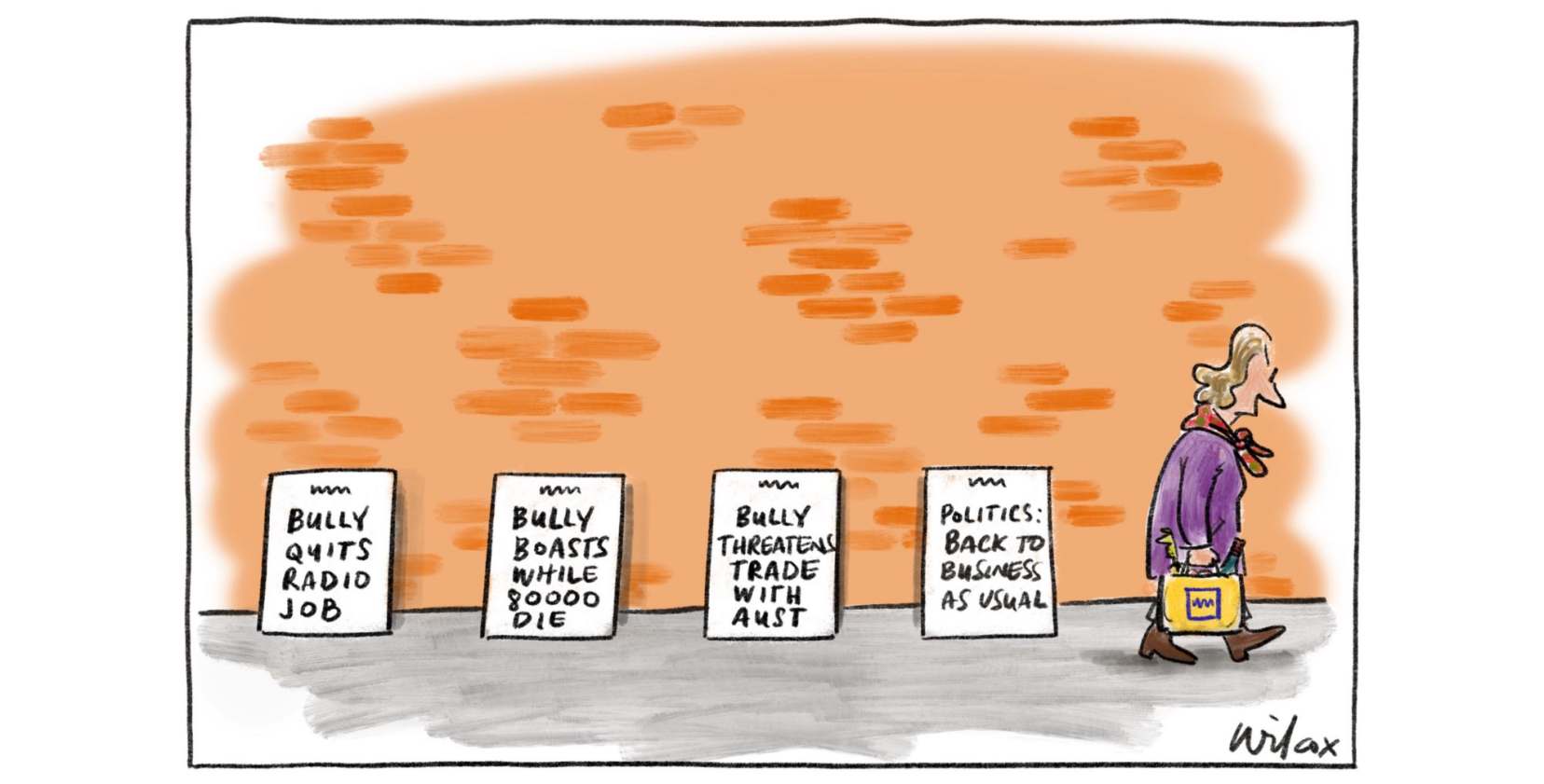
The latest illustrations from artist Cathy Wilcox

The latest illustrations from artist Cathy Wilcox

30 Images

The latest work by Sydney Morning Herald editorial cartoonist Cathy Wilcox.

1/30

Long and winding.

2/30

Nothing to see here.

3/30

Carbon capture.

4/30

Chinese diplomacy.

5/30

‘Over reaction wrecks economy’.

6/30

Back to the future.

7/30

Teen target.

8/30

Bully for us.

9/30

Mundey mourning.

10/30

Reasons why.

11/30

Eden-Monaro campaigning.

12/30

Aged care.

13/30

Pompeo.

14/30

National cabinet harmony.

15/30

The arts go viral.

16/30

Acceptable.

17/30

On track.

18/30

Options.

19/30

Better conversations.Credit:Cathy Wilcox

20/30

Stockpiling.

21/30

Brace position.

22/30

Health workers.

23/30

Politician tracking app.Credit:

24/30

The view from there.

25/30

Endorsed.

26/30

He’s a keeper.

27/30

Spreading the ball.

28/30

On the rise.

29/30

The burden.

30/30

Full-time occupation.

Source by [author_name]

Coexisting with Covid-19: Saving lives and the economy in India – The Mail & Guardian

SPONSORED

Experts at India’s Ministry of Health and Family Welfare published a paper on April 9 2020, looking at 41 sentinel sites across the country. It revealed that of the 5 911 severe acute respiratory illness (SARI) patients tested since February 15, 1.8% have tested positive for Covid-19. Of those who tested positive, 39.2% did not report international travel or any history of contact with a known patient — clearly indicating that at least parts of India are likely to be in the stage of community transmission. By itself, this is neither unusual nor surprising — it is indeed the nature of pandemics to take root in communities over time.

A total of 179 374 samples from 164 773 individuals have been tested as of April 11 2020.

Just around 7 703 individuals have been confirmed Covid-19 positive. India is testing just over 17 000 samples per day, which is inadequate given the vastness of the country and the current spread covering almost half the districts. This means that the true scale of spread remains unknown and most areas remain potential breakout zones. The spurts that we are witnessing in cities like Mumbai, Delhi, Jaipur, Indore and Ahmedabad are cause for deep concern.

Workers make face masks to prevent the spread of the Coronavirus on the outskirts of Srinagar, India. (Waseem Andrabi/Hindustan Times via Getty Images)

Despite efforts over the past few weeks to give it a boost, India’s healthcare delivery capacity remains limited. According to the government, an order for 49 000 ventilators has been placed in view of the low numbers that exist within the system, but it is unclear by when they will arrive and be distributed among the special centres created for Covid-19 patients. The government has acknowledged the need for “rapidly ramping up” the number of corona-testing facilities, personal protective equipment (PPE), isolation beds, ICU beds, ventilators, and other essential equipment.

This only serves to highlight the fact that the current levels of healthcare facilities will not stand a chance of coping with a sudden and huge surge. Hence, a national lockdown was, and remains, the only option since any widespread community breakout will overwhelm medical infrastructure.

If we go by what has been officially stated, more than half of India’s districts are yet to record a single case of Covid-19. But the virus may have made its way to many of these districts. Whether or not this is true will only be known through increased testing, which has not happened and is something that needs to be rectified with alacrity.

India has no doubt responded strongly and decisively to the crisis by opting for a countrywide lockdown. According to the Oxford Covid-19 Government Response Tracker (OxCGRT) database’s Stringency Index, on March 25, India was the sixth country to opt for a complete lockdown and achieve a stringency index score of 100.

Yet, the fact remains that the lockdown is a blunt instrument. A country like India cannot afford to indefinitely extend it across regions when a clear assessment of the risk of community spread is impossible for lack of information.

India remains under an unprecedented lockdown due to Covid-19. (Yawar Nazir/Getty Images)

The lockdown, as we have it now, has virtually brought the national economy to a grinding halt. This hurts the informal workforce, micro businesses, and unorganised labour the most, and is bound to have long-lasting implications. The use of a nationwide lockdown, instead of a fine-grained approach, was a forced hand because of the impossibility of conducting local-level assessments of the spread. The cost of not testing smartly or widely enough — whatever the reason — is unfortunately being borne disproportionately by daily wagers and vulnerable groups.

We can only hope that the experts the government is consulting have briefed the political leadership about the lessons learnt — nationally and globally — over the past few months. And that in the next week or two, we will not be blinded by lack of information or intent, or be limited by tentativeness of action. One must make it clear that full marks need to be given for the stringent 21-day lockdown: It was the need of the hour.


Capitalising on the lockdown

However, as of now we have failed to capitalise on the time advantage the lockdown has given us. We need to think on our feet, tap into every resource possible, and formulate an exit strategy rather than make the poor pay for an overburdened system’s lack of agility. We also need to prevent value destruction on account of unimaginative policy.

This is the moment to embrace talent from outside the confines of government and infuse economic policy with ideas to reignite the Indian economy and tell the world that the India story is far from over. Prime Minister Narendra Modi must seize the moment.

Various assessments of the post-pandemic world suggest that there is a real threat of gains in poverty reduction being reversed on account of Covid-19’s impact on the global economy. India would not remain untouched if this were to happen. We need to act now to mitigate the impact of the blow even if we cannot avoid it entirely.

India is an outlier in terms of the scale and extent of the lockdown. Over the next fortnight, we should aggressively try and map the spread of the virus using methods such as countrywide sample testing or pooled testing. It is encouraging that states like Maharashtra are currently considering such strategies. We need to come up with a blueprint for a staggered approach to get us out of the unsustainable country-level total lockdown.

India cannot be a country in suspended animation, waiting for a miracle to happen. For a miracle won’t happen, no matter how hard we pray for it. That is not how killer viruses run their course. That is definitely not how the Covid-19 pandemic is playing out globally. A pragmatic and scientific approach is the only way out of this seemingly impossible maze; that’s how you win a game of Chinese Checkers.

Three stark comparisons have emerged in the past two weeks. Statistically, despite its limited health infrastructure, India has done better than most others — especially advanced nations in Europe and America with fabled health services — in terms of infections, hospital admissions, ICU crowding, and fatalities.

Second, India has witnessed strong co-operation between the union government and state governments (health is a State List subject, a fact often forgotten or unknown to commentators) and there has been bipartisan support for the measures initiated by the prime minister. In other democracies, bitter partisan politics over Covid-19 have been on display.

Third, India is the only large economy where a lockdown has been accompanied by the near shutting down of the national economy, resulting in an unprecedented disruption in jobs, productivity, and revenue.

If prevention is the primary tool India has adopted, then a blanket lockdown cannot be the only instrument we use. Tech and data-driven mapping of senior citizens and those people suffering from non-communicable diseases (NCDs) has to be extensively conducted. Everything from Aadhar and municipal data to digitised hospital records need to be scanned to figure out exactly who must stay home — and will need to be assisted in this regard — and who can be permitted to return to a less restrictive, soft-lockdown work environment. Community health workers must be deployed for aggressive mapping of villages and urban settlements for the invisible elderly and chronically ill. Finding those who do not exist in any current electronic health record is key. Of course, this has to be a “privacy sensitive” exercise.

We have seen a skilful deployment of the lockdown by all, but this policy hammer has not been accompanied by a sharp economic respite. Experts from India and abroad seem to converge on the idea that spending is necessary and that money deployed must reach its intended goal within a specified timeframe. These goals must include lifeline protections, support for supply chains and demand stimulation, and wealth protection. While the central government must focus on the macro instruments and agencies, its energy must now also be directed towards protecting capital. The state governments must partner with specialised institutions to respond to local challenges that are contextual and individual and, in such instances, community programmes must be implemented.

It could be argued, and correctly so, that human lives matter more than the economy, which can be rebuilt. While this sentiment may sustain popular support for strong measures to control and roll back the pandemic, it will not obviate the need to address serious concerns linked to the economy, which sustains livelihoods and, hence, life itself.

Omandurar Medical College hospital staff gesture as an Indian Air Force helicopter drops flower petals to pay tribute to those involved in the fight against Covid-19 in Chennai in May 2020. (Arun Sankar/AFP via Getty Images)

This is why a staggered exit from the lockdown, accompanied by stepped-up testing to cover every district, is necessary. A containment policy has been drafted and is already being implemented by several states after identifying “hot spots”. There is across- the-board agreement on what must not be done — namely, resumption of inter-state travel by plane, train, or bus.

What we need now is an agreement on what can be done. This list must include the immediate resumption of agricultural activity (harvesting cannot wait for too long); the restarting of certain micro, medium, and small enterprises so that the impact on jobs and income disruption is minimal; and the resumption of basic economic activities like reviving stalled supply lines and retail services to ensure the looming crisis of essential goods is avoided while “social distancing” remains in place. In the next stage, the resumption of other activities like construction and the reopening of some commercial and trading entities can be considered. Industries must then begin to operate under a special safety protocol, which will ensure protection.

If the challenge of shutting down India was huge, the challenge of reopening India will be bigger. But India cannot, and must not, remain shut down for longer than what it takes to get its act together. Lives matter; so does the economy. Let’s not force ourselves into a corner where we have to make a false choice. — Professor Samir Saran

Source: www.orfonline.org/

This article can be read on https://bit.ly/3gjBF4H


Source link

What Africa can learn from Cuba in combating the Covid-19 pandemic – The Mail & Guardian

SPONSORED

It is close to four months since the first case of Covid-19 was reported in China, and today the world is facing one of the worst health, humanitarian and economic crises in modern history. The pandemic not only threatens to take hundreds of thousands of human lives, but also to drive the global economy into recession and render millions of people unemployed.

The crisis triggered by Covid-19 is voracious to the extent that highly industrialised countries which constitute the centre of the global economy, such as the United States of America (US), the United Kingdom (UK), France and Germany, are some of the worst affected, with health systems that are failing to cope.

A number of analysts have argued that Covid-19 represents the failure of the global capitalist system, which survives on greed and the plundering of resources and the ecosystem (see Shivji 2020; Editorial 2020). In essence, this may mean the collapse of the system. The Covid-19 outbreak is a long-anticipated signal that has called for a rethink of a broader economic trajectory and policy frameworks to liberate people in peripheries from a hierarchical globalised capitalist system that has plunged the people of the South into deteriorating living conditions.

For example, the African continent has borne the brunt of the globalised capitalist system, as shown by the below-substandard, life-threatening healthcare system. To date, there are countries in the South that have been able to contain and deal with the pandemic, and this article draws lessons, inspiration and courage from Cuba and Venezuela. In what follows, the paper discusses policy frameworks, the importance of solidarity and other crucial interventions that African countries can immediately implement in the short to medium term to contain Covid-19 and eliminate poverty.

Covid-19 and neoliberal capitalism

There is no doubt that the spread of Covid-19 is directly linked to neoliberal capitalism, a global economic system that has been dominant over the past four decades. The effect of neoliberal capitalism on the health system has been a retreat of the state in providing basic healthcare services in many African countries, and this has seen the privatisation of the healthcare sector.

Globally, this phenomenon has resulted in a catastrophe, particularly during Covid-19, where access to healthcare has been the preserve of the rich.

Many African countries have, since their transition from colonialism, been unable to fully develop their public health systems due to fiscal constraints imposed by World Bank and International Monetary Fund (IMF) prescriptions centred on limiting government expenditure in the public health sector.

Cuban doctor Liz Caballero and two medical students go door-to-door looking for possible cases of Covid-19 in Havana in March 2020. (Adalberto Roque/AFP via Getty Images)

The privatisation of the health sector now manifests itself in the inability to absorb the growing number of Covid-19 victims not only in the metropolis, but in peripheral countries as well. The failure to provide free or affordable tests, and the shortages of personal protective equipment (PPE) for health workers who are leading the fight against this pandemic are all indicators of a capitalist system that has failed to deliver in this neoliberal era.

Amidst crisis there is hope. Despite attempts by neoliberal apologists and the mainstream international media to project capitalism as the only solution to the crisis we are facing, Cuba has made advances in fighting this pandemic and there are specific features inherent in this country and others that we must closely analyse. These include development paths pursued by such countries that place emphasis on egalitarianism, complete repudiation of the capitalist path, strong investments in public healthcare systems, internationalism, solidarity and voluntarism.

It is important to state at this point that in spite of sanctions and other economic and political destabilisation tactics employed by the US and its key allies against Cuba for close on six decades, the number of Covid-19 fatalities it has recorded is among the lowest worldwide. Cuba’s Minister of Public Health, Dr Jose Angel Miranda, reported that by March 29 2020, a total of 139 cases and three deaths had been recorded. This is in contrast to the USA which, despite its wealth, had over 100 000 Covid-19 cases and more than 4 000 fatalities at the end of March with the fatality level surpassing 800 on some days.

This present Covid-19 lethality in the capitalist system calls for analysis as it defies the common narrative that a privatised healthcare system is efficient and accessible when services are required. Thus, the capitalist system’s touts — under the so-called banner of the invisible hand — that it can sort out any demand and supply challenges, defies logic. And so we discuss the health sector in Cuba.

Socialising the healthcare system

It is important at this stage to acknowledge the wisdom of Fidel Castro, the former leader of Cuba, who saw through the evils of privatisation and commodification of the public health sector. Unlike many countries in the North and the South that privatised their public health systems, Castro did the opposite by ensuring that support for this sector was increased and made available to all members of the society.

Although faced with an economic embargo, it must be emphatically stated that the country has been a shining star in the fight against Covid-19. Quite clearly, the successes are rooted in the universal healthcare system and tough measures put in place by former president Raul Castro. These measures include the declaration of a health emergency, home visits to all citizens suspected to be infected and offering free treatment. This is unlike many countries, where such services could only be accessed after payment of a certain fee.

Patnaik (2020a) notes that the current crisis has brought about: “The socialisation of healthcare and production of some essential services, which departs from the capitalist norm; and the more severe the crisis, the greater is the degree of socialisation.”

There is no doubt that the socialisation and nationalisation of healthcare services is something that was learnt from countries such as Cuba. This phenomenon has advanced with varying intensity in highly capitalist countries such as Spain, the UK and the USA. It is an approach which must be emulated by African countries in the fight against Covid-19.

When we talk of Africa, we must however, take into account its historical and present realities. Colonialism, neoliberalism and, in some cases, poor leadership have rendered African states almost incapable of resolving some of these emerging issues. The plausible way forward is to rethink development models best suited for the continent instead of adopting prescriptions from the Bretton Woods institutions that have stalled development on the continent. Key in this will be a reversal of privatisation and the adoption of universal healthcare.

The continent, alongside other developing regions, has experienced a brain drain in the health sector, and the time to put this to an end is now. The presence of healthcare workers is critical in minimising the damage in times of outbreaks such as Covid-19.

As Max Ajl (2020) notes: “Training excellent nurses and doctors can be done extremely cheaply, part of the reason Cuba has a world-class medical system. But if wrenched from a nation through the quiet inducement of market coercion or the louder process of social dislocation/primitive accumulation on a national scale, the commonwealth resource of medical training can become a resource to be pillaged.”

The loss of health personnel to the metropolis is not only a loss of human personnel but also of financial resources for peripheral states. This is so because underdeveloped countries pour resources into training health personnel for the benefit of developed countries; this is

an important indicator highlighting new forms of imperialism under global contemporary neoliberal capitalism. Although recognising that it is almost impossible to halt the brain drain given the unequal power relations on the world stage, it is equally important for developing countries to put in place mechanisms to slow this brain drain.

Another key lesson to be drawn from Cuba in the face of a massive skills haemorrhage, is the use of an important untapped resource in the form of medical students and volunteers who can be equipped to work under supervisors in times of outbreaks such as Covid-19. The story of Cuba’s containment of Covid-19 would be incomplete without mentioning the role of volunteers in spreading the message and door-to-door treatment of affected and infected people. This can only happen when there is a sense of patriotism which compels everyone to save people and the nation.

Venezuela has also shown that the issuing of food packs, which is a socialist approach, can, despite the battering of its economy, help during times of a disaster such as Covid-19. This is a recognition that during disaster-enforced lockdowns, most people are unable to work and fend for their families. A food distribution programme, if implemented alongside suspension of payment of rentals and protection of worker rights, can go a long way in protecting Africans during these difficult times. This is an important lesson to be drawn from Venezuela.

International solidarity

One of the major failures of neoliberal capitalism at this current juncture has been its resort to inward-looking strategies and the practice of “new nationalisms” (see Shivji 2020) and fascism (Patnaik 2020b; Yeros and Jha, 2020). By this we make reference to what we have seen of late in developed countries, with the exception of Portugal, where the state has turned against immigrants in offering health and other social services. This phenomenon has also been witnessed in some countries located in the South. Instead of sending medical supplies to rescue a continent that has been ravaged by imperialism for over a century, Western countries are sending aeroplanes to evacuate their nationals, as if Covid-19 originated from Africa. The metropolis has been found wanting when it comes to international solidarity.

Turning to Cuba, we learn a number of lessons. Despite having its own challenges whose origins are rooted in the international onslaught led by the US, Cuba is currently present in 13 countries, which include Andorra, Italy, Spain, China, Venezuela and Caribbean nations, to help fight Covid-19. Turning to Africa, there is clearly a need for close co-operation among African states at this stage and it is surprising that since the outbreak, there has been no notable collective action or statement coming from the leadership of the African Union on how it proposes to tackle the pandemic. The continent can build on the already existing sub-regional blocks to launch an offensive against the pandemic.

Conclusion

To end, emphasis must be placed on the need to abandon the neoliberal path in economic development and social service provision for the continent to be able to deal with Covid-19 and other health system challenges that are likely to emerge in future. Apart from denouncing the privatisation agenda of health and other social services, it is also important to socialise the health services and the production of essential services.

The need to utilise the untapped resource of medical students and volunteers while dealing with the brain drain in the health sector cannot be overemphasised. Lastly, as already highlighted, international solidarity is critical when dealing with global challenges such as Covid-19.

The African Union and sub-regional bodies must step up and be counted in critical times like these. Covid-19 is a real test for the African leadership and an opportune platform for charting a new pro-poor development path. — Freedom Mazwi

References related to the feature are available on request: contact [email protected]

This article can be read on https://bit.ly/3gjBF4H


Source link

Widower Pleads With Twitter To Delete Trump’s Conspiratorial Tweets About Late Wife

Timothy Klausutis, the widowed husband of the woman who Donald Trump has baselessly suggested was killed by MSNBC’s Joe Scarborough, has written a powerful letter to Twitter CEO Jack Dorsey calling for the deletion of the president’s tweets promoting the conspiracy theory.

Trump has this month insinuated in multiple tweets that Scarborough, a former GOP representative, may have been responsible for the 2001 death of Lori Klausutis, when she was an intern in his congressional office.

Authorities ruled 28-year-old Klausutis’ death an accident: She hit her head on a desk after collapsing from a previously undiagnosed heart condition. No foul play was suspected.

“My request is simple: Please delete these tweets,” Timothy Klausutis wrote in his letter to Dorsey last week that Kara Swisher, a New York Times opinion writer, shared online Tuesday alongside her latest column, headlined “Twitter Must Cleanse the Trump Stain.”

In the letter to Dorsey, Klausutis lamented the “constant barrage of falsehoods, half-truths, innuendo and conspiracy theories” surrounding the death of his wife.

He also slammed conspiracy theorists, including Trump, who “continue to spread their bile and misinformation on your platform disparaging the memory of my wife and our marriage.”

Klausutis acknowledged he is “a research engineer and not a lawyer,” but said Trump’s unfounded accusations were in violation of Twitter’s terms of service.

“An ordinary user like me would be banished from the platform for such a tweet,” he noted. “But I am only asking that these tweets be removed.”

I’m asking you to intervene in this instance because the President of the United States has taken something that does not belong him — the memory of my dead wife and perverted it for perceived political gain. I would also ask that you consider Lori’s niece and two nephews who will eventually come across this filth in the future. They have never met their Aunt and it pains me to think they would ever have to about her this way. My wife deserves better. Thank you for your consideration.

“We are deeply sorry about the pain these statements, and the attention they are drawing, are causing the family,” a Twitter spokesperson said in a statement to HuffPost. “We’ve been working to expand existing product features and policies so we can more effectively address things like this going forward, and we hope to have those changes in place shortly.”

Trump’s unfounded tweets about Scarborough, who has been a fierce critic of the president, have drawn widespread ire from both sides of the aisle.

Rep. Adam Kinzinger (R-Ill.) on Sunday told Trump to “just stop” promoting the “completely unfounded conspiracy.”

“Just stop,” he tweeted. “Stop spreading it, stop creating paranoia. It will destroy us.”

Mika Brzezinski, Scarborough’s wife and “Morning Joe” co-host, on Wednesday slammed Trump as “a sick person,” later claiming she was in talks with Dorsey about the issue.

Brzezinski and Scarborough on Tuesday tweeted excerpts from the letter:

Trump, meanwhile, indicated on Tuesday morning that he would not be giving up promoting the theory anytime soon. He launched a renewed attack on Scarborough, describing him as “a total Nut Job.”


Source by [author_name]

Road to recovery for the tourism sector: The South African perspective – The Mail & Guardian

SPONSORED

The travel and tourism industry has already suffered the most devastating setbacks since the outbreak of the Covid-19 pandemic, yet its full impact on this sector is still unknown.

The United Nations World Tourism Organisation (UNWTO) estimates that international tourist arrivals could decline by 20% to 30% in 2020. This would translate into a loss of $300-billion to $400-billion in international tourism receipts in the worst-case scenario.

Similarly, analysis by the World Travel & Tourism Council (WTTC) shows a sharp escalation in the economic loss to the world economy, up to $2.7-trillion of GDP. This will put almost 75 million jobs at risk in G20 countries alone.

It is not hard to predict that in our country, the sector’s contribution to the GDP for this year will be very low and that the sector will incur severe job losses. This is because the lockdown which we imposed to contain the spread of the virus curtailed both the supply and the demand side of the tourism market. In essence, the lockdown rendered the tourism sector totally inactive.

Minister of Tourism Mmamoloko Kubayi-Ngubane. (Jeffrey Abrahams)

However, we must appreciate and applaud the fact that thus far, our efforts to contain Covid-19 have resulted in the slowing of the spread of the virus. At the same time, the need to avoid the loss of jobs and the destruction of livelihoods is a top priority. Thus, there is a need to keep a delicate balance between protecting people from the Covid-19 virus and avoiding economic devastation. Accordingly, our government has adopted the Risk Adjustment Approach, which consists of a sequenced, phased-in opening up of key sectors and priority areas while intensifying the fight against Covid-19 and rebuilding our economy.

Because the tourism sector thrives on social interaction, it will take longer for businesses in the sector to return to full operation. In the meantime, we need to create mechanisms to protect the most vulnerable segments of the sector such as SMMEs, those who are self-employed, women and the youth.

Belinda Scott, Durban's deputy mayor and Nomusa Dube-Ncube, MEC KwaZulu-Natal Economic Development, Tourism and Environmental Affairs hand over sanitisers, masks and sanitary packs in Umlazi township on April 09, 2020 in Durban. (Darren Stewart/Gallo Images)
Belinda Scott, Durban’s deputy mayor and Nomusa Dube-Ncube, MEC KwaZulu-Natal Economic Development, Tourism and Environmental Affairs hand over sanitisers, masks and sanitary packs in Umlazi township on April 09, 2020 in Durban. (Darren Stewart/Gallo Images)

Saving the sector

The Tourism Relief Fund, which we introduced to assist small businesses in the sector, has thus far received more than 10 000 applications. This R200-million fund is a once-off assistance package capped at R50 000 per entity and it is aimed at assisting entities to cover fixed costs, operational costs, supplies and other pressure cost items.

Entities in the following categories of the tourism value chain are eligible to apply:

• Accommodation establishments: hotels, lodges, bed and breakfast establishments (B&Bs), guest houses and backpackers.

• Hospitality and related services: restaurants (not attached to hotels); conference venues (not attached to hotels), professional catering; and attractions.

• Travel and related services: tour operators; travel agents; tourist guiding; car rental companies; and coach operators.

We acknowledge that the fund is not enough. We therefore encourage businesses in the sector to apply to other relief schemes that have been made available by our government.

Government has introduced a R200-billion loan guarantee scheme in partnership with the major banks, national treasury and the South African Reserve Bank. The initial phase of this scheme is for companies with a turnover of less than R300-million a year. Since most of the tourism businesses fall within this category, we encourage them to utilise this opportunity. This will help them to reduce the burden of operational costs, such as salaries, rent and the payment of suppliers.

We have also been working in close collaboration with the department of labour and employment, labour formations and the Tourism Business Council of South Africa (TBCSA) to expedite Unemployment Insurance Fund applications for tourism businesses. So far, we have received more than 25 000 applications and we believe this will also assist in saving jobs in the sector.

Sandton has empty streets due to the Coronavirus lockdown

Global co-ordination effort

While it is important to support the sector so that it can weather the storm, there is also a need to start planning for the recovery of the sector in the post-Covid-19 period. The global nature of the pandemic means that the measures to curb the spread of Covid-19, such as travel restrictions and border closures, have been imposed worldwide. This means that any recovery planning that is not in line with a globally co-ordinated effort will be a futile exercise. Regarding global co-ordination, we have participated in conferences and engagements with global institutions such as the African Union, the G20 ministerial meeting, the UNWTO and the WTTC to look at how we can develop a global approach to the recovery of the tourism sector. The AU convened the first meeting of the Bureau of the Subcommittee on Tourism for the Specialised Technical Committee on Transport, Transcontinental and Interregional Infrastructure, Energy and Tourism (STC-TTIIET) on April 21 2020. The purpose of the meeting was to exchange ideas on a response and recovery plan for tourism in relation to the Covid-19 pandemic.

On April 14, the UNWTO convened a virtual conference on Policies for Inclusive Recovery in Global Tourism, in collaboration with the Mastercard Center for Inclusive Growth. The conference provided a platform to discuss how governments, institutions and companies can protect vulnerable populations during the Covid-19 outbreak. The meeting also discussed measures that countries can put in place to accelerate their recovery.

The G20 Presidency (Kingdom of Saudi Arabia) convened a Tourism Ministers’ Virtual Meeting on 24 April. The purpose of the meeting was to discuss the tourism sector’s response to the Covid-19 pandemic as well as to formulate a recovery plan supporting the long-term resilience of the sector. Specifically, the meeting was aimed at facilitating collaborative action to protect tourism businesses and jobs, and to support visitors throughout the outbreak. Given that the tourism sector will play a crucial role in economic recovery, the G20 Tourism Ministers Meeting provided a platform to reinforce global co-operation with other international organisations in order to mitigate the impact of the pandemic and lay the foundation to accelerate recovery.

For its part, the WTTC has proposed to G20 tourism ministers to “… fully jointly commit with the private sector to four key principles to achieve a faster recovery. This would involve including the private sector in the coordinated response, ensuring all measures put the traveller at the heart of their actions. This would include a seamless traveller journey with enhanced health security standards enabled through technology, developing joint public-private and G20-wide health protocols, as well as ongoing support packages for the tourism sector beyond lifting of lockdown and into the recovery”.

The consistent theme emerging from these global institutions is that countries should develop a globally co-ordinated approach for the recovery of the tourism sector. Additionally, countries are encouraged to commit to supporting the sector during the crisis to save businesses and jobs, developing a framework to advance sustainable tourism, investing in market intelligence systems and digital transformation, and developing a governance framework for tourism at all levels.

In the end, each country is expected to develop its own recovery plan that is informed by the prevailing conditions in that particular country. Based on the Covid-19 pandemic’s expected trajectory in South Africa, the best-case scenario is that the tourism sector’s recovery will only begin, in earnest, towards the end of this year. The first phase of the recovery will be driven by domestic tourism followed by regional tourism. International tourism will only start coming into operation next year.

The Risk Adjusted Approach gives us a framework within which we can carve out a path towards recovery for the tourism sector in South Africa. Working in collaboration with the private sector, we are developing a recovery plan that will form a launch-pad for the tourism recovery efforts in South Africa. We are confident that the sector will overcome the current challenges and emerge even stronger in the post-Covid-19 period. — Minister of Tourism Mmamoloko Kubayi-Ngubane

This article can be read on: https://bit.ly/3gjBF4H


Source link

Two dead in new ANC KwaZulu-Natal killings – The Mail & Guardian

Two ANC leaders have been gunned down in separate incidents in KwaZulu-Natal since the weekend, sparking fears that the drop in political killings in the province may have been temporary.

Police officials said two men fired more than 20 bullets at Mtubatuba councillor and ANC chief whip Phillip Mkhwanazi, who is also an induna at Khula village in St Lucia.

Mkhwanazi, who was also one of only five black tour operators in the iSimangaliso Wetland Park, was attacked at about 11am on Monday while he was waiting outside his home for his car to be repaired.

His killing followed that of Thengazakhe Maphanga, a former Inkatha Freedom Party councillor and community leader in the Dukuduku forest area next to Khula village. Maphanga was shot on May 2.

According to the police, the two men had approached Mkhwanazi and asked for proof of residence documents from him and then opened fire on him. They took his cellphone and fled the scene.

No arrests have been made in connection with his killing.

Also on Monday, an eThekwini ANC Youth League branch secretary, Thamsanqa Gcabashe, was shot dead at the home of another youth league member in the Hammarsdale area.

Gcabashe, who led the Ward 91 branch in the west of the city, died about 20 metres from his family home, according to a source in the area.

The youth league’s eThekwini regional secretary, Thinta Cibane, called on residents to assist the police in finding the killers of Gcabashe, who he described as a “community servant” in his ward.

“This is another reminder of the onslaught meted out against young revolutionaries in this part of the world. Another young man lies lifeless and we are left wondering what could have been the reason,” Cibane said.

He said the murder of Gcabashe appeared to have been an assassination. “We urge law enforcement agencies to investigate this senseless killing and to bring to justice those found to be implicated both in its planning and its execution.” 

Police comment on Gcabashe’s death was not available at the time of publication.

KwaZulu-Natal had been plagued by a wave of political killings, which began after the change in the ANC leadership in the province in 2015 and the build-up to the 2016 local government elections. 

These killings prompted the province to appoint the Moerane Commission of inquiry into the killings. The commission identified competition over council posts, tenders and resources to be a key driver of the violence, which appeared to have tapered off after a series of high profile arrests ahead of the 2019 provincial and national elections.


Source link

ABC News Reporter’s Question About Biden’s Coronavirus Mask Does Not Go Well

ABC News senior national correspondent Terry Moran faced fierce blowback on Twitter late Monday for asking this question about former Vice President Joe Biden:

Biden, the presumptive Democratic 2020 nominee, wore a face mask while laying a wreath at Delaware Memorial Bridge Veterans Memorial Park on Memorial Day.

Critics turned the tables on Moran, suggesting it was a bad look for him to be posing such a question. Many people noted how Biden was adhering to Delaware’s state rules of wearing a mask in public — unlike President Donald Trump, who has repeatedly refused to wear a mask.

One Twitter user, author Don Winslow, described Moran’s question as “staggeringly stupid.”

“It’s not a fashion accessory. It literally saves lives,” Winslow tweeted.

Many others argued the same:

A HuffPost Guide To Coronavirus


Source by [author_name]