Welcome to Our Surprise Zwedding

Brian Clarke was exhausted the first time he met Mariana Ranz in 2015. By the time they were married on May 11, he had cause to feel frazzled again.

On May 8, two days before their surprise Zoom wedding planned in Central Park, they hit a snag securing an online marriage license through New York City’s “Project Cupid.” So instead of throwing one socially distant wedding, they scrambled to put together two: A ceremonial one in the park, and a legal one a day later.

Ms. Ranz, 34, is the community arts partnership manager at Ballet Hispanico, a New York City dance company. Mr. Clarke, 37, is a financial analyst at Deutsche Bank. Their first date, on May 8, 2015, was an attempt by Mr. Clarke to regain some energy after a week of 14-hour workdays in a city then unfamiliar. “I had only been at Deutsche Bank a couple of weeks when they sent me to New York to take on a two-week training assignment,” said Mr. Clarke, a native of Jamaica who was living in Jacksonville, Fla. A former roommate, Shirley Godefroy, connected them. “She knew I needed a break and someone to show me around.”

Ms. Godefroy, who had grown up with Ms. Ranz in Bolivia, wasn’t playing cupid. “She’s just a connector,” Ms. Ranz said. “We both knew that, so we had no expectations, and that made it a lot lighter and a lot easier to get to know each other.” Over drinks at Tao Downtown, they talked about their love of food, family and their experiences as immigrants. By midweek, after back-to-back get-togethers before Mr. Clarke’s May 15 return trip to Florida, their dates were becoming marathons.

He was enchanted by Ms. Ranz, then a dance teacher. But “I thought she was way out of my league. She’s got a much better personality than I do, and she’s way better looking.” He hid his feelings.

“I was getting the feels for him, but he would not give me any sign at all,” Ms. Ranz said.

The night before he flew home, she kissed him in a photo booth at the Standard Hotel. A New York-Florida romance was born, and lasted until 2017, when Mr. Clarke successfully petitioned his bosses to move him to New York. Weeks after his arrival, Ms. Ranz left her home in Inwood and moved in with him to an apartment in Hell’s Kitchen, where they still live. On May 10, 2019, a proposal on the High Line sealed the deal.

Then came March, and social distancing, and uncertainty about whether to cancel the wedding in Santa Cruz, Bolivia, that they had planned for a year to the day after their engagement.

“My dad is almost 90,” Ms. Ranz said. “I didn’t want to postpone.” They decided to keep the date, with a twist. With a wedding planner she had already hired in Bolivia, Ms. Ranz cooked up a surprise wedding for the couple’s 80 guests disguised as a Zoom happy hour.

At 5:05 p.m. on May 10, after all their guests had logged in, Ms. Ranz’s cousin, Natalie Robbins, made an announcement on the Zoom call. In both Spanish and English, she said, “It is my honor to welcome you to Brian and Mariana’s wedding.” Though the union, which took place in Central Park at Hallett Nature Sanctuary and led by their friend Anthea Song, wasn’t legal, the gasps and tears of their loved ones as they said their “I do’s,” watched later that night via recording, made it feel like nothing was missing, Ms. Ranz said.

Securing their license and filing the paperwork one day later with the help of a different officiant, Joshua Alex Preston, a friend ordained through the Universal Life Church, was less romantic but a relief. “This definitely wasn’t what we planned,” Ms. Ranz said. “But we did it. And it exceeded our expectations.”

Source link

‘Space junk’ lights up regional Victorian sky

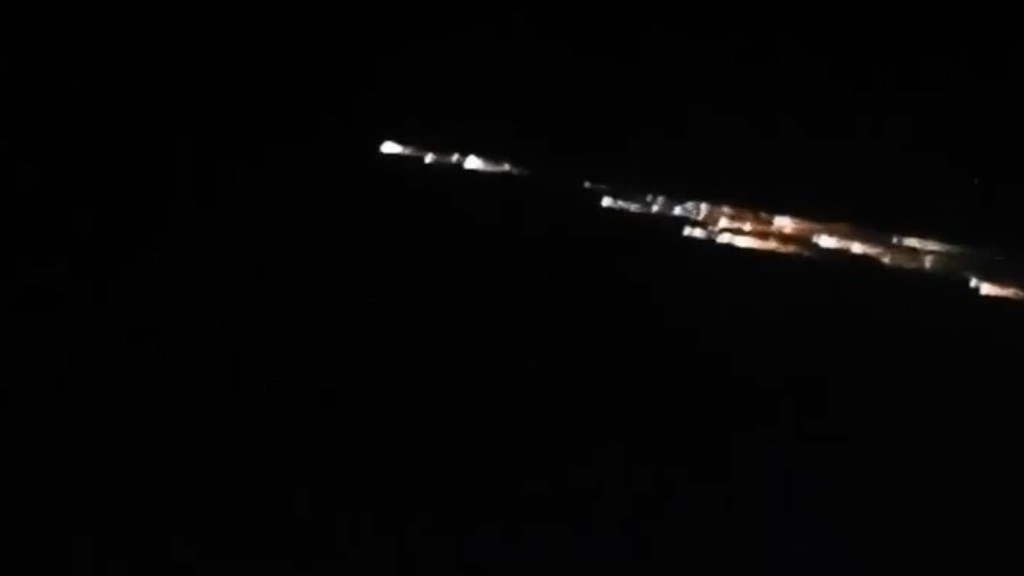
Residents in regional Victoria have flocked to social media to share their videos of an unidentified flying object, believed to be a piece of space junk, soaring across the night’s sky.

The object which was seen over Ballarat and spotted as far as Colac heats up as it enters the atmosphere, leaving a trail of bright fluorescent light behind it.

The object could also be a meteor caught in the pull of Earth’s gravitational system.

A still image of the meteor seen against a dark night sky in Ballarat. (Twitter)

It appears the unidentified, glowing object may have been seen across the skies from as far away as northern Tasmania.

While there is yet no confirmation as to what the object may have been, some took to social media to speculate that it was a disintegrating satellite, shooting star or the product of another life form.

“Space rocks” ranging in size and have generally collected their size from comets, other asteroids or moons and planets are only given the name meteorites after they enter the Earth’s atmosphere, NASA says.

“When meteoroids enter Earth’s atmosphere, or that of another planet, like Mars, at high speed (they) burn up,” according to NASA.

“This is also when we refer to them as ‘shooting stars’.

“Sometimes meteors can even appear brighter than Venus – that’s when we call them ‘fireballs’.

“Scientists estimate that about 44,000 kilograms of meteoritic material falls on Earth each day.”

For breaking news alerts and livestreams straight to your smartphone sign up to the 9News app and set notifications to on at the App Store or Google Play.

Source by [author_name]

Vintage photos show British vacationers gone wild

0

Written by Oscar Holland, CNN

Butlin’s vacation resorts were an institution in post-war Britain. The self-contained camps — where guests were housed in wooden chalets, fed and entertained on-site — provided a new kind of inexpensive luxury for working families.

At a time when few could afford overseas travel, the resorts offered “a week’s holiday for a week’s pay,” as they were first advertised.

Beyond the likelihood of rain, Butlin’s summer vacations were a uniquely British proposition.

Exuberant in-house entertainers, known as Redcoats, hosted singalongs, pantomimes and rounds of bingo. They held “glamorous grandmother” competitions, and “knobbly knees” contests to see which guest had the lumpiest legs. Ringo Starr’s band (no, not that one) even played residencies there in the early 1960s, before he was invited to join the Beatles.

By the time photographer Barry Lewis arrived in the 1980s, however, the camps were “getting a little bit seedy,” as he put it.

There were fewer families and more singles, with plenty of sex and alcohol mixed in with the entertainment, Lewis said. But the 71-year-old still recalls the resorts’ glamorous early reputation.

“When I was a kid, Butlin’s was seen as very grand, but my parents could never afford to go,” he said in a phone interview. “It was made to sound amazing — you’d have top stars performing, everything was free and there were fairgrounds.”

Launched by Billy Butlin in 1936, the camps’ initial popularity was bolstered by the UK government’s Holidays with Pay Act, which gave workers the right to paid leave for the first time. A site was opened in Skegness, on Britain’s east coast, though more than half a dozen more would be built in British seaside towns over the next three decades.

The camps boomed after World War II, welcoming more than a million annual visitors in their mid-1960s heyday. Upon taking a teenage summer job at a Butlin’s kitchen in 1966, Lewis found them to be “enclosed, hermetic worlds” equipped with theaters, recreation halls, ballrooms, pools, funfairs, boating lakes, hair salons and even churches.

“You were in this enclosed system,” he recounted. “You went to this other world. Russia could have invaded America and we wouldn’t even have known about it — there were no TVs in the chalets.

“But there was actually something wonderful about it. You felt you’d joined this weird club. It was very clever in making you feel (as if you were) part of a family.”

Warts and all

Lewis’ teenage experiences hint at the wilder behavior he would later encounter. This “enclosed fantasy world” (as the photographer describes it in his new book) was also equipped with bars, discos and betting shops.

“I served breakfasts and learned about becoming a man. I was desperate to fall in love, and all the stuff that goes with leaving home for the first time,” he said, adding that he often “served breakfast on a hangover” after late-night attempts to meet women. “To be completely frank, I was trying to get laid most of the time.”

After going on to university and establishing himself as a professional photographer, Lewis returned to Butlin’s in 1982 on assignment for the UK’s Observer newspaper. Then aged 34, he was initially astonished at how little had changed.

Many of his images are alive with the communality and good cheer he’d remembered — kids enjoying activities and parents singing and dancing in the entertainment halls. But things, he said, had become more salacious.

“There was a whole sex thing that was never really talked about. A lot of people went there to get laid, so there was quite a lot of sexism,” Lewis said. “Alcohol was the drug of choice and people got hammered. Absolutely.

“If you were trying to be part of the gang, you drank with (the Redcoats). They were young lads, but they were adored and they loved that.”

The photographer’s fondness for the camps is nonetheless apparent (he describes the images as “warts and all, but in a loving way”). He took an immersive approach to the assignment — which meant partying and drinking with the other campers. “That’s how we worked,” he said, referring to the journalist he accompanied, Ian Walker. “We’d integrate ourselves.”

Yet, Lewis also acknowledges there was a certain “darkness” to it all.

An image from the book shows a Redcoat pinching a female guest’s breast. Another shows male judges keeping an uncomfortably close eye on a participant in a “miss lovely leg” contest. Elsewhere, an employee is pictured asleep on the lobby floor after a heavy night, while Walker wrote in the Observer at the time that “two skinheads started smashing up glasses,” in a resort bar in the early hours.

An unlikely renaissance

In one of Lewis’ most striking photos, he captured a man frozen mid-air just before splashing into an outdoor pool. Huge letters behind spell out one of the camps’ slogans: “Our true intent is all for your delight.”

That Billy Butlin might use a quote from “A Midsummer Night’s Dream” speaks of his lofty ambitions for the resorts. But in the 1980s, the glamour was fading. Package trips to Europe had become affordable, dampening the prestige of domestic vacations. Butlin’s went into economic decline, and a number of its camps closed in the years that followed.

Yet, if the Butlin’s of the 1980s differed from that of previous decades, then today’s is perhaps less recognizable still. The company has since changed owners and rebranded itself, its resorts fitted with new water parks and subjected to multi-million-dollar expansions. As such, the camps are undergoing something of a renaissance, Lewis ventured.

“I think, now, it’s booming again,” he said. “With Brexit coming up, and the currency weakened — and also with Covid-19 — people aren’t going to travel abroad as much.

“There is something nice about not having to think about (your vacation). You just book and that’s it, whereas a lot of trips are just full of planning. People like that everything’s laid on.”

In a statement to CNN, Butlin’s said: “Butlin’s has always been a family brand and we’ve been delighting families for decades. We can’t wait until we can reopen our resorts and welcome our guests back to Butlin’s for a much needed holiday.”

Butlin’s Holiday Camp 1982,” published by Hoxton Mini Press, is available now.

Source link

Texas Court Holds First U.S. Jury Trial Via Videoconferencing

DALLAS (AP) — The potential jurors popped onto the screen one by one. They confirmed their names and told the judge how they were connecting to the court: on laptops, tablets and iPhones.

There were some wireless issues and camera problems, but eventually 26 Texans in separate boxes raised their hands for the judge and together swore the juror’s oath, beginning the experiment of conducting a civil jury trial entirely over Zoom.

The coronavirus pandemic has crippled courts nationwide, putting many cases on indefinite hold and leaving judges trying to manage some hearings via videoconferencing. The delays have kept some defendants in jail longer, exposing them to possible outbreaks. And the virus even upended how the Supreme Court operates, with the justices hearing oral arguments by phone for the first time in the court’s history.

The test jury-trial-by-video that was held in suburban Dallas this week could reveal a possible path forward in which jurors are kept safely distanced while cases are allowed to proceed until the coronavirus threat has receded enough to resume some semblance of normal life.

It also raises complex questions about security, a person’s right to a fair trial and whether virtual deliberation might prevent 12 people from forming the bonds needed to hash out justice.

“No one is saying tomorrow we’re going to start trying serious felonies over Zoom,” said District Judge Emily Miskel, who coordinated technology for the trial. “But I think there are many civil trials where parties might agree that this is a good way to resolve it given the uncertainty of when you’re ever going to get an in-person civil jury trial.”

The Collin County court held the so-called summary trial — a one-day civil proceeding with a non-binding verdict — on Monday as an experiment in restarting parts of the justice system that ground to a halt because of the coronavirus. It was over a disputed insurance claim that was originally set to be heard in-person in March. According to the National Center for State Courts, which has tracked court functions during the pandemic, it’s the first remote jury trial ever in the United States.

Those involved seemed pleased with the process.

Jury selection was streamed live on YouTube, but most of the rest was private because summary trials are confidential civil proceedings meant to give the parties the option of settling before an actual trial.

During jury selection, lawyers for both sides asked people on the call to raise their hands in response to questions about potential bias. When a hand popped onto the screen, the lawyers would ask follow-ups or note the juror’s number.

Matthew Pearson, a San Antonio lawyer for the plaintiff, said the comfort of their homes seemed to make the jurors more responsive to questions. They were attentive as he presented evidence by sharing his computer screen over Zoom, Pearson said, and his firm saved money because it didn’t have to fly an expert witness in from Minneapolis.

“Overall, it was a better experience than I was expecting,” he said.

Deliberation proved a little more tricky.

The jurors were broken into two groups of six and put in separate virtual rooms where they could talk privately and look at evidence in Dropbox folders. They ultimately returned two verdicts meant to give the parties more information to assess whether to go to trial.

At one point, things were delayed a few minutes when a juror who’d stepped away to make a phone call during a break couldn’t hear the judge calling him back to his computer. The same type of thing happens in the courthouse, Keith Dean, the retired judge who presided over the trial, told the others.

Miskel, the other judge, joined the deliberation “rooms” a couple times to help jurors access evidence, which she said would normally cause attorneys to “freak out.” Normally, jurors send notes asking the judge for help and a member of the staff goes into the jury room with pieces of evidence.

But lawyers worry that virtual deliberation cuts out the casual interaction among jurors that some see as essential to building group trust. And defense attorneys are especially skeptical of e-court for criminal cases, where they already struggle to speak privately with their clients during routine hearings held remotely.

“It would just be too difficult, too many constitutional hurdles to clear for a defendant to be brought to a virtual trial,” said Randy Gioia of Massachusetts’ public defender agency. “There is no substitute for an in-person, face-to-face three dimensional hearing with a judge.”

Security is a concern too. As tens of millions of people have turned to video conferencing to stay connected during the pandemic, hackers have derailed many calls with threats, bigoted comments and pornographic images.

If more courts turn to video trials, ensuring people with poor or no wireless could serve as jurors would also be a challenge. Rare cases that require juries to be sequestered might have to take place in-person.

Even when cases do return to the courthouse, the virus may have changed things. Cross examinations will be different if attorneys and witnesses are wearing masks. And Miskel suggested courts might blend in-person and online — doing trials over video but bringing jurors into to court to deliberate.

Dean reminded jurors at the start of the proceedings that the online setting made their duties no less important.

“The courthouse came to you,” he said. 

Associated Press writer Alanna Durkin Richer in West Harwich, Mass., contributed to this report.

Follow Jake Bleiberg: https://twitter.com/jzbleiberg

A HuffPost Guide To Coronavirus


Source by [author_name]

UK extends mortgage holiday by three months

0

The headquarters of the Bank of England in London | Adrian Dennis/AFP via Getty Images

Borrowers in difficulty get extra time but Treasury encourages others to resume payments.

By

Updated

The U.K. Treasury instructed banks Friday to extend mortgage holidays for another three months for people still struggling with the impact of the coronavirus.

Banks should contact existing beneficiaries to give them a chance to extend the payment suspensions put in place since March, which are due to begin expiring in June.

For borrowers who can resume payments, “it is in their best interest to do so,” the Treasury said.

Lenders will keep the window of applications open for customers to request deferrals until October 31, under related guidance from the Financial Conduct Authority. The FCA extended its ban on home repossessions until then.

“Anyone who continues to need help gets help,” the regulator said.

Nonpayment of a mortgage under a moratorium is not to be treated as a bad loan, the Bank of England said, reiterating its March guidance on the application of capital, provisioning and accounting rules.

Banks should revise payment schedules according to how much a borrower can afford to pay. For those unable to resume full payments on those terms, banks should distinguish between those temporary cash shortfalls versus people facing longer-term trouble, such as permanent loss of a job.

Lenders would then take a “proportionate approach” to assessing the likelihood of repayment, considering the underlying reasons for the financial distress. The BoE said this can be done “without detailed quantitative analysis.”

“Firms are reminded to apply sound risk management practices regarding the identification of defaults,” the central bank added Friday to extend mortgage holidays for another three months for people still struggling with the impact of the coronavirus.

This article is part of POLITICO’s premium policy service: Pro Financial Services. From the eurozone, banking union, CMU, and more, our specialized journalists keep you on top of the topics driving the Financial Services policy agenda. Email pro@politico.eu for a complimentary trial.


Source by [author_name]

China’s proposed national security law could end Hong Kong as we know it

0

Long before the Umbrella Movement or last year’s sustained political unrest, this reputation was cemented in 2003, when mass marches against a proposed anti-sedition law known as Article 23 succeeded in forcing the government to shelve the legislation. In the 17 years since, despite promises to do so and much prodding from Beijing, no Hong Kong administration has dared restart this process.
This week, Beijing’s patience ran out. On the back of more than six months of often violent pro-democracy protests in Hong Kong last year, the National People’s Congress (NPC), China’s rubber-stamp parliament, put forward plans to introduce a national security and anti-sedition law on the city’s behalf, bypassing Hong Kong’s legislature via a rarely used constitutional backdoor.

The details of the proposed law go far beyond what was put forward in 2003. As well as criminalizing “treason, secession, sedition (and) subversion” against the central government, it will also enable Chinese national security organs to operate in the city “to fulfill relevant duties to safeguard national security in accordance with the law.”

Expected to be passed by the NPC later this month and promulgated in Hong Kong soon after, the law will have drastic effects on whole swaths of Hong Kong society, from the city’s garrulous and defiant political sphere to media, education and international business.

Broad application

Hong Kong has always prided itself on following the rule of law, with an independent judiciary and civil liberties far beyond what is allowed across the border in mainland China. The type of arbitrary punishment, secret detention and nakedly political prosecution common in the mainland is almost unheard of in the city.

These rights are enshrined within the Basic Law — the city’s de facto constitution — and guaranteed (in theory) by an agreement between China and the United Kingdom when Hong Kong was handed over to Chinese rule in 1997. Hong Kong, unlike China, is also party to international treaties guaranteeing various civil liberties.

The new law challenges all of this. By criminalizing such a broad swath of ill-defined acts, it could give the authorities leeway to go after the city’s opposition as they see fit.

In China, sweeping national security laws have been used to target human rights activists, lawyers, journalists and pro-democracy campaigners. Nobel Peace Prize laureate Liu Xiaobo, who died in 2017 after more than a decade behind bars, was convicted of “inciting subversion of state power.”

Permitting China’s security apparatus to operate in the city also raises the specter of extralegal persecution. Dissidents and activists in China are often disappeared by the authorities or threatened with arrest around sensitive events, and many journalists and lawyers are dragged in to “take tea” with the security services, during which they receive thinly-veiled threats about the potential consequences of their work.

Speaking at a news conference called by opposition lawmakers on Friday, Democratic Party legislator Helena Wong said that even the local government “will not be able to regulate what the agents do in Hong Kong.”

Her colleague Claudia Mo told CNN that the news was proof that Beijing “will do anything to rein in Hong Kong at any cost.”

“It’s clear Beijing couldn’t care less anymore what people think,” she added.

Implementation of the law in Hong Kong could also prove to be a nightmare for the city’s courts — which operate separately to the Chinese legal system and free of the political pressures put on mainland judges.

This does not mean the law is at much risk of being overturned, however. The NPC is the court of final appeal in Hong Kong and can issue an “interpretation” of any constitutional issue, essentially rewriting the Basic Law on the fly.

But the confusion and uncertainty the new rules may create, and a potential prolonged fight in the courts, could pose a major blow to the city’s reputation for upholding the rule of law, which has long been seen as vital for Hong Kong’s position as an international finance and business hub.

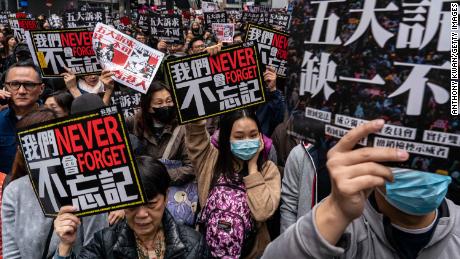
Pro-democracy supporters hold placards and shout slogans as they take part in a march during a rally on New Years Day on January 1, 2020 in Hong Kong, China.

Chilling effect

Unlike the proposed extradition bill that kicked off last year’s unrest, the scope and effects of the anti-sedition law could be broad and society-wide. A major chilling effect can be expected on the city’s media and political spheres — journalist groups have long warned of increasing self-censorship as pressure from Beijing has increased and newspapers and television stations came under the control of Chinese owners.

The fate of the city’s large international press corps is unclear. At present, foreign journalists are free to work in Hong Kong unimpeded by the type of visa and other restrictions imposed on colleagues in China, but ahead of the new law there were already indications that this was coming to a close. New controls on reporting in Hong Kong could see many media organizations relocate from the city, traditionally a base for reporting on the wider Asia region.

A crackdown on the city’s legislature, where pro-democracy lawmakers hold around a third of seats, could also be a result. In recent years, lawmakers have been expelled from the body and some candidates have been barred from standing on political grounds. The new law could give Hong Kong authorities a broader remit to remove obstructive lawmakers from their positions or even prosecute them for blocking key legislation, particularly on national security grounds.

The effects of the proposed change will likely be felt outside the city too. US Senators are due to issue an assessment under the Hong Kong Democracy and Human Rights Act (HKDA) on whether the city remains sufficiently autonomous from China to justify its special trading status. It’s difficult to see how Beijing bypassing Hong Kong’s parliament and legislating on its behalf won’t shape this decision.

Late Thursday, several US lawmakers promised to impose sanctions against Chinese and Hong Kong officials responsible for imposing the law, which they described as a “gross violation” of China’s agreement with the UK to preserve the city’s freedoms when it assumed sovereignty in 1997.

Beijing may be counting on the fact that the coronavirus pandemic has weakened the ability and determination of the international community to pressure it over Hong Kong — the UK in particular, newly outside of the European Union, is dependent on increased trade with China to boost its flagging economy.

With the new rules being imposed from on high, leap-frogging Hong Kong’s legislature, it is unclear what protesters or opposition lawmakers can do to prevent them becoming law. Legislators succeeded in filibustering a proposed law criminalizing any insult of China’s national anthem for years, while protesters physically blocked the parliament last year and prevented further discussion of the loathed extradition bill. Neither tactic would work against the new national security law.

The timing, coming as coronavirus restrictions are still in place in Hong Kong, which is only just getting its domestic epidemic fully under control, could mean that people are less willing to join mass protests than they were last year.

Nevertheless, amid widespread despair late Thursday night, Nathan Law, a former lawmaker and leader of the 2014 protests, called on people not to give up entirely: “At this time last year, didn’t we all think the extradition law would definitely be passed? Hong Kong people can always create miracles.”

Source link

A Michigan County Was On Coronavirus Lockdown. Then The Dams Broke.

The first emergency alerts sounded in the wee hours of Tuesday morning, when small-town residents near two lakes strung together by Michigan’s Tittabawassee River were told to seek higher ground.

First responders went door to door in the riskiest places, startling some people awake with an unpleasant message: Days of heavy rain had put too much stress on nearby Edenville Dam, which held back the rising waters of Wixom Lake above. The dam was expected to break. 

Shortly before 6 p.m. Tuesday, it did just that ― water began gushing from the lake down into the river valley. Local pilot Ryan Kaleto captured the disaster from the sky in footage posted to Facebook that shows a powerful current felling trees and swallowing them whole. 

“Wixom Lake will be gone by tomorrow,” Kaleto predicted. 

The water kept going, feeding into Sanford Lake, held back on its southern end by the Sanford Dam. By 7 p.m., that failed, too, and Sanford Lake began draining into the Tittabawassee River, flowing downstream to Midland, Michigan, a city of around 42,000 best known as the longtime international headquarters of the Dow Chemical Company. 

Video of Sanford Lake posted Tuesday evening shows a pontoon careening across a seemingly calm surface of water that had risen nearly to the underside of a bridge, reflecting a pinkish-purple sunset. In under 10 seconds, the boat meets the bridge and holds still for a breath before an unseen current grabs hold and drowns it. 

“Are you kidding me?” a voice says. 


Connie Methner, owner of CJ’s Hairstyling, wades through the mud covering the inside of her salon in Sanford, Michigan, on May 21, 2020. 

Midland County is no stranger to flooding, but this week’s event was historic. The Tittabawassee crested at 35.05 feet, topping the previous record of 33.94 feet set during a major flood in 1986. The state’s Democratic governor, Gretchen Whitmer, declared a state of emergency Tuesday night, urging residents in the flood zone to seek shelter with family or friends or head to one of several shelters set up in schools that have been closed for weeks.

It’s an economic and humanitarian disaster. And then, of course, there’s the pandemic.

“This is truly a historic event that’s playing out in the midst of another historic event,” Whitmer said at a press conference on Tuesday. 

In the Midland area, the effects of COVID-19, the illness caused by the coronavirus, have been relatively mild. Cases in the county have flattened over the past several weeks, currently standing at a total of 76, with eight deaths and 49 recoveries, according to Johns Hopkins University.

The same is not true of communities in the southeastern part of the state, including Detroit, with some of the highest COVID-19 mortality rates in the nation. Whitmer enacted precautionary stay-at-home orders statewide to ensure no other region sees such a spike in cases.

A Perfect Storm

The Midland area’s economic situation is direr given the statewide order to keep theaters, restaurants and bars closed through May 28.

Miranda Hess, a legal assistant in Midland, described surveying damage to one relative’s hard-hit home in Sanford. The water had reached the top of the steps to the second floor before it receded, leaving a crumbling first-floor ceiling and a 4-inch layer of mud and dirt “everywhere inside and out,” she said. Only the belongings on the upper floor could be salvaged. The hot tub was missing.

Other things vanished, too.

“There was a red house, it was an old farmhouse just across the Curtis Road Bridge,” said longtime resident Alice Such, who served as Edenville Township supervisor for several years until the mid-2000s. “You would never know a house was there.”

“It’s just heartbreaking, you know,” she told HuffPost, adding that her household was lucky not to have lost more than a pontoon boat and a shed ― in other words, “just stuff.”

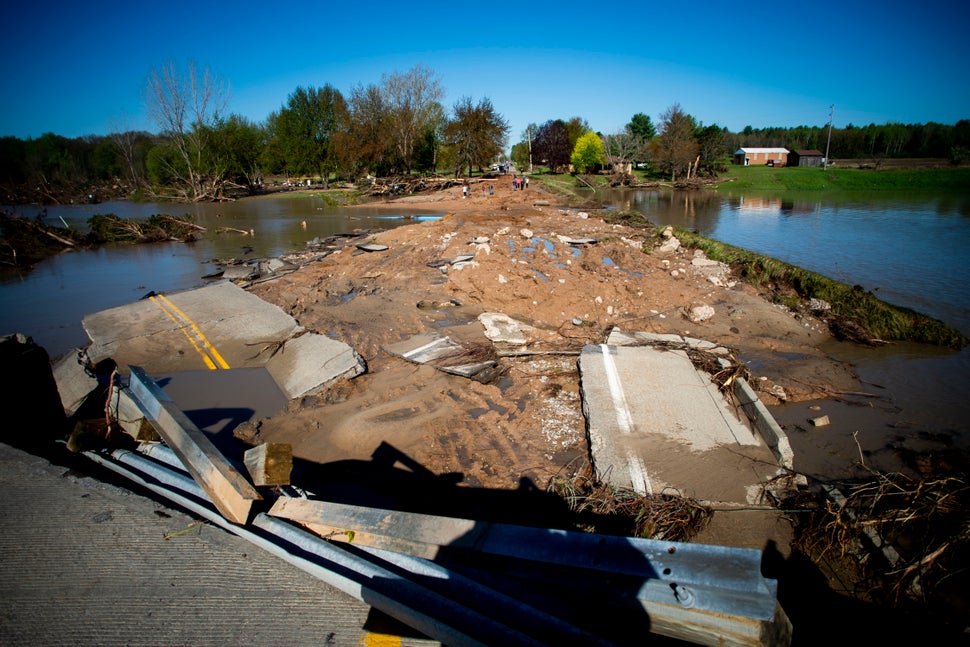
Ruins of the Curtis Road Bridge lie asunder as waters continue to roil on May 20, 2020, in Edenville Township north of Midlan


Ruins of the Curtis Road Bridge lie asunder as waters continue to roil on May 20, 2020, in Edenville Township north of Midland. After two days of heavy rain, the Edenville Dam failed and floodwaters rushed south, ravaging the landscape in its path. 

No fatalities or injuries have been reported. Many people in the sprawling neighborhoods east of the river were spared, while others were left dealing with basements that had flooded to varying degrees. (At least one person found a live fish in their home floodwaters.) Around 10,000 people in Midland, however, were forced to flee their homes, alongside close to 1,000 people from nearby towns, including Sanford and Edenville. 

In Sanford, Hess said, businesses were already struggling with closures due to the coronavirus. She is “very concerned about their ability to rebound” from the added economic stress.

Armin Mersmann, an artist living in Midland with his wife, was among those spared the worst of the flooding just blocks away ― his home sits on an elevated street. Another artist he knows wasn’t so lucky; with studio space in the flood zone, the man lost 50 years’ worth of work and supplies. Many people haven’t been able to access their homes to assess the damage, he said. 

As people come together to deal with the impact of the flooding, Mersmann worries about the harm a spike in coronavirus cases would do to the community.

“All of a sudden, people forgot about this virus,” he said, having seen a lot of maskless people checking out damage around town. 

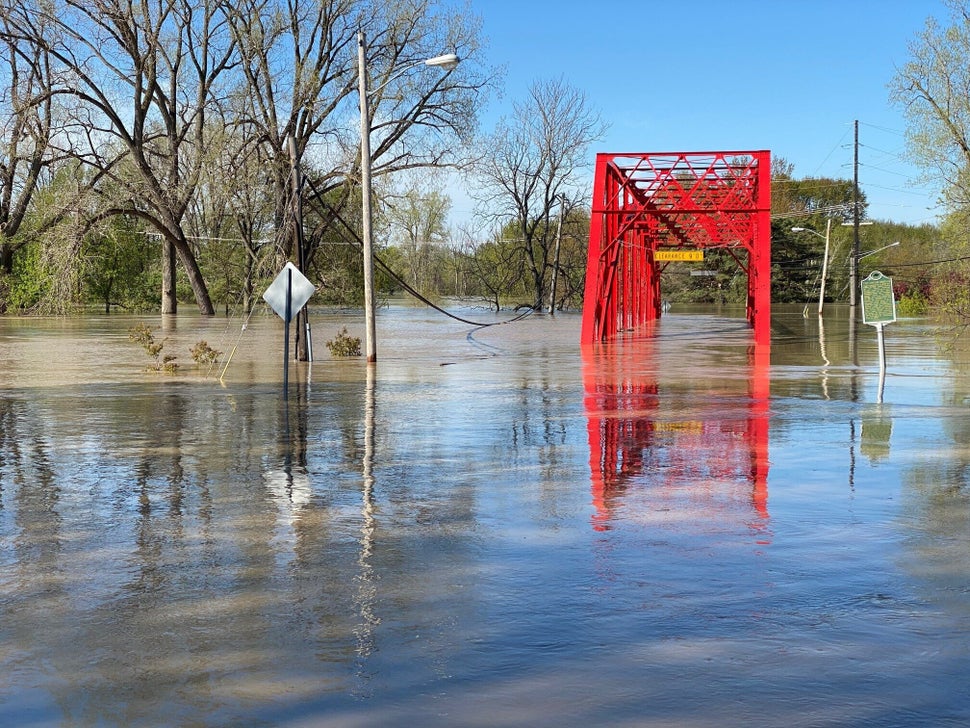
Floodwaters overwhelm a bridge two blocks from the home of Armin Mersmann, a Midland-based artist.


Floodwaters overwhelm a bridge two blocks from the home of Armin Mersmann, a Midland-based artist.

‘We’re Just Trying To Help Each Other Out’

Whether or not a deadly virus is spreading, neighbors want to help neighbors. A Midland realtor, Badger Beall, told HuffPost Wednesday that he’d spent the morning helping a business partner move some of her belongings to safety. 

“I guess we’re all just trying to help each other out. Some people are doing astronomical amounts, and some people are just doing their little share all over the place,” Beall said.

Whereas the 1986 flood was a “100-year event,” Midland City Manager Brad Kaye told reporters, a flood like this only comes along every 500 years.

“We have never been through an event such as the one we’re experiencing today,” Kaye said at a press conference. 

Wednesday’s weather became oddly cheery. A main Midland thoroughfare, M-20, stood covered in mud-colored water sparkling against a perfectly clear sky. 

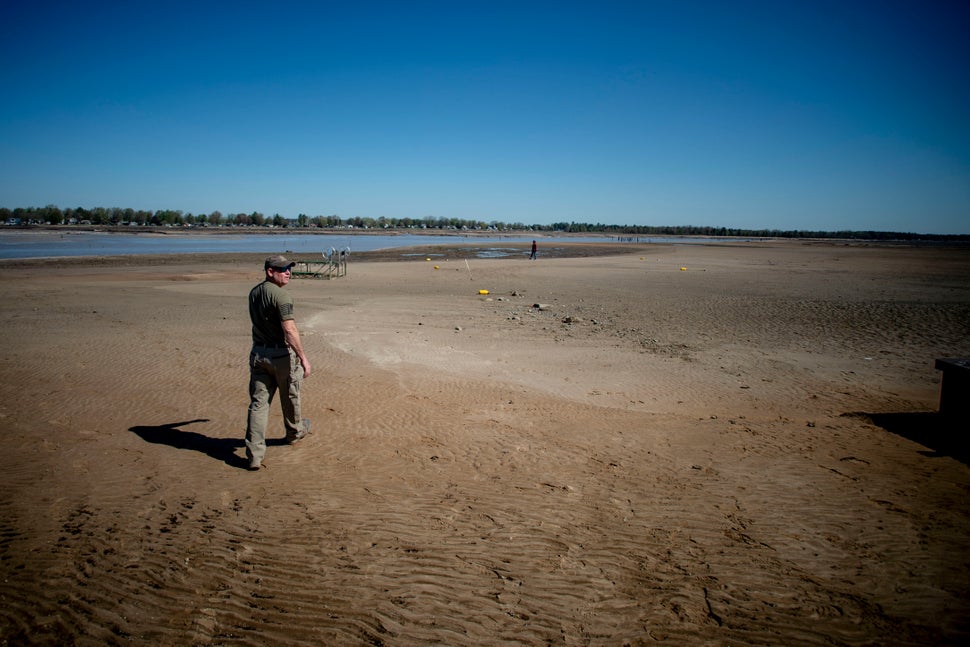
Kaleto’s prediction turned out to be correct: Photos showed Wixom Lake looking like a craggy desert, leaving boat docks out to dry. Downstream, more photos showed Sanford Lake nearly completely empty, revealing a golden sandy bottom dotted with sticks and debris.

Warning Signs 

Both lakes were popular warm-weather destinations for fishing and boating ― particularly the unmoving variety, where everyone hangs out on the water enjoying the sun. They formed in the 1920s when the dams went up, providing hydroelectric power to the region. 

By this year, standing at nearly 100 years old, both dams were well known to have structural deficiencies. Due to their private ownership, Such said, there was little local government officials could do. Only in the past few years was a plan concocted to transfer ownership of four local dams, including Sanford and Edenville, to a quasi-governmental group called the Four Lakes Task Force to spend up to $35 million bringing the structures into the 21st century.

Records with the Federal Energy Regulatory Commission show that the dams’ owner, a company called Boyce Hydro, had been neglecting them for years, repeatedly missing deadlines to comply with safety regulations to prevent overflow. 

Sanford resident Clint Clark, 44, walks out into what was once the bottom of Wixom Lake after water washed out due to the fai


Sanford resident Clint Clark, 44, walks out into what was once the bottom of Wixom Lake after water washed out due to the failure of the Edenville Dam on May 20, 2020.

Boyce Hydro kept saying it could not make the improvements due to “financial hardship” while refusing to provide documentation of any such problems. In a 2018 order revoking the company’s license to operate the dams, the FERC replied “as sarcastically as a regulatory agency can,” as Slate’s Ben Mathis-Lilley put it. 

“The Commission will not rely on factual representations regarding Boyce Hydro’s financial status when it later claims evidence regarding those representations is not germane to the matter at hand,” said the FERC.

Last spring, both sides reached a tentative agreement to transfer ownership to the task force. At the time of the dams’ failure, however, Boyce Hydro was still the technical owner. 

There is also some evidence, Kaye told HuffPost, that the Smallwood Dam ― upstream of both Sanford and Edenville ― may have overflowed and set off the disaster in the first place. The Smallwood structure is also owned by Boyce Hydro.

Whitmer has promised that the state will “pursue every line of legal recourse” against those responsible for the dam failures. 

Crumbling infrastructure is hardly unique to Michigan. Some 1,680 dams across the U.S. are in bad condition, putting an unknown number of homes and businesses in danger of potentially life-threatening flooding, according to an Associated Press investigation released in November. Many are at least a half-century old and no longer prepared to face the challenges of more extreme weather brought on by a warming climate. 

The destruction in the Midland area might even represent a best-case scenario, considering how quickly local authorities responded to give residents time to get out. Sometimes, dams fail without warning.

“They just fail, and suddenly you can find yourself in a situation where you have a wall of water and debris racing toward your house with very little time, if any, to get out,” a former Federal Emergency Management Agency official told the AP.

Although the floodwaters were still receding around mid-Michigan on Thursday, some locals have already taken an optimistic view. 

Tony Stamas, president and CEO of the Midland Business Alliance, pointed out that the floodwaters hadn’t damaged downtown Midland’s Main Street, which sits on a hill. His group will now help local businesses navigate “parallel paths” through the coronavirus and flooding crises, he told the Detroit News. 

The City of Midland also appears to have been spared potentially worse damage. Although water escaped the Sanford Dam and caused massive flooding, the structure appears at least partially intact. Officials will not know the extent of the damage until floodwaters recede. 

“Midland County is a very generous, heartwarming, giving community,” Such said. “We will rally, and we’ll get through this.”


Source by [author_name]

The CNN Travel quiz: Who, what, why, when and where in the world?

0

(CNN) — We all know that travel broadens the mind. Thanks to that place on the seafront that sells delicious gelato, it has a tendency to broaden other body parts too.

We can’t deliver you two scoops of pistachio, but we can keep flexing those brain cells while your next trip across the world is on hold.

CNN Travel’s experts have been compiling some tricky questions to test your knowledge of the planet and to kindle your curiosity for more.

Think you can outsmart us? Try answering the following without resorting to Google. By all means hop on a video call to get family and friends in on the challenge.

There’s a link out to the answers at the end. We trust you not to do any peeking!

1. Which of these cities has not hosted the Summer Olympics?

a. Amsterdam; b. Madrid; c. Helsinki; d. Tokyo; e. Rome

2. Can you identify the city from its skyline?

Getty Images

3. The London Underground, or Tube, is the world’s oldest metro rail system. Which city has the second oldest electrified system?

4. Some nations have more than one capital city. Can you identify these countries by their perhaps lesser known capitals?


a. Brno; b. Sri Jayawardenepura Kotte; c. Putrajaya; d. Valparaíso

5. In which city is the world’s tallest building?

6. Can you name the city from these landmark places of worship?

Getty Images

7. Which city has the world’s oldest Chinatown?

a. San Francisco; b. London; c. Manila; d. Jakarta; e. Toronto

8. Can you identify the city from the name of its airport?

a. General Edward Lawrence Logan; b. Hamad International; c. O.R. Tambo International; d. Soekarno-Hatta International

9. Name the world’s highest capital city

10. Which three destinations are widely recognized as the world’s only three sovereign city states?

1. Which famous aircraft made its last flight on November 26, 2003?

2. Before the Covid-19 pandemic, what was the world’s busiest airport in terms of passengers?


a. Beijing Capital; b. London Heathrow; c. Amsterdam Schiphol; d. Los Angeles, e. Hartsfield-Jackson Atlanta

3. Identify the airlines by their tailfin logos

4. What type of airplane is the US President’s Air Force One?

a. Gulfstream III; b. Boeing VC-25; c. Airbus A320; d. Boeing 777-300ER; e. Antonov An-148

5. Which two countries were connected by the Kangaroo Route?

6. Which direction — north, east, south or west — would you travel between these airports identified only by their codes? (Five bonus points if you can identify all the cities)

a. LAX to HNL; b. LGA to MCO; c. LHR to JNB; d. BKK to PVG; e. ARN to SVO

7. Match the massive airplane to its nickname

Getty Images

a. Whale; b. Queen; c. Dream. d. Superjumbo

8. Which airline had the most aircraft at the beginning of 2020?

a. Delta Airlines; b. American Airlines; c. Cathay Pacific; d. Virgin Atlantic; e. JetBlue

9. Why is three the magic number for the following aircraft?

Hawker Siddeley HS-12, the Tupolev Tu-154, the Lockheed L-1-1011, Boeing 727?

10. What aviation first did Amelia Earhart achieve in 1928?

1. Where in the world can you find these pyramids?

Getty Images

2. What is the world’s largest island?

3. Which country is home to Europe’s largest natural desert?

4. Match the image to the US national park?

Getty Images

a. Canyonlands; b. Yellowstone; c. Grand Canyon; d. Yosemite

5. Can you name the oceans that make up the so-called seven seas?

6. What links Java Trench, Challenger Deep, Molloy Deep, South Sandwich Trench, Puerto Rico Trench?

7. Match these desert oddities to the locations below

Getty Images/Plan South America/Barry Neild

a. Qatar; b. Chile; c. Texas; d. Namibia

8. Which is the only one of the world’s 10 longest rivers to flow northward?

9. Where can you no longer see the Azure Window?

10. Which place receives the most annual rainfall?


a. Manchester, England; b. Mawsynram, India; c. Seattle, Washington; d. Quibdó, Colombia

1. Which two Asian destinations separated by the sea were linked by 55 kilometers of bridge and tunnel in 2018?

2. Match the image to the New York bridge

Getty Images

a. Manhattan; b. Queensboro; c. Williamsburg; d. Brooklyn

3. Which towering French engineer designed the Bolivar Bridge in Peru, the Truong Tien Bridge in Vietnam and the Imbaba Bridge in Egypt?

4. Which country is home to the world’s longest bridge?

5. Match the image to the London bridge

Getty Images

a. Millennium; b. Hammersmith; c. Tower; d. Westminster

6. What would happen if you tried to cross France’s Rhône River on the Pont d’Avignon?

7. Can you identify the following famous bridges?

Getty Images

8. Which two continents are connected by the Yavuz Sultan Selim Bridge?

9. What caused part of the Pont Des Arts bridge in Paris to collapse in 2015?

10. Which country is home to this handy structure?

LINH PHAM/AFP/AFP via Getty Images

1. Which city has the most Michelin stars?

2. Mirazur was named top of the World’s 50 Best Restaurants list in 2019. In which country is it?

3. Can you identify the country from the classic dessert?

Shutterstock

4. What are the bubbles commonly made of in bubble tea?

5. The world’s “happiest country” also consumes the most coffee per capita. Name the country?

6. Which antipodean dessert is named for a ballerina?

7. Can you match these four British dishes to their names (without laughing)?

Suzanne Plunkett

a. Eton Mess; b. Toad in the hole; c. Scotch egg; d. Spotted dick

8. Kartoffelknoedel, xiaolongbao, manti and pierogi are all types of what?

9. What color or colors is Neapolitan ice-cream?

10. Chef Mary Mallon worked in kitchens in New York and Long Island in the early 20th century. By what unhygienic name is she better known?

1. What do Colombia, Sao Tome & Principe, Gabon, Uganda, Maldives and Kiribati all have in common?

2. Which three Asian countries topped the list in April 2020 for the most powerful passports for visa-free travel, according to the Henley Passport Index?

3. Which country has the most official languages?

4. Four red, white and blue flags, four different countries. Name them

Getty Images

5. What happened in Samoa and Tokelau on December 30, 2011?

6. Which country changed its name to eSwatini in 2018?

7. Identify these countries from their outlines

8. Which is the world’s newest country?

9. These frontiers divide areas claimed by which pairs of countries?

a. The Line of Control; b. The Demilitarized Zone; c. The 49th Parallel

10. Which country is surrounded to the north, east and south by Senegal?

1. Name the protagonist in Jules Verne’s 1872 novel “Around the World in 80 Days”

2. Which four destinations have Steve Coogan and Rob Brydon visited in four series of “The Trip?”

3. Who led this ill-fated Antarctic expedition?

Hulton Archive/Getty Images

4. Whose fictional crusade took him from Utah to Portugal, Venice, Austria, Berlin and then Petra?

5. What record did US journalist Nellie Bly break in 1890?

6. Where did Anthony Bourdain have lunch with former US President Barack Obama?

Zero Point Zero for CNN

7. Norwegian Thor Heyerdahl conquered what personal fear to cross the Pacific Ocean on his Kon-Tiki balsa wood raft in 1947?

8. What have John “Wedge” Wardlaw, Mark Rumer-Cleary, Dallas Burney, John Molony and John Dickson done every five years since 1982?

9. Why doesn’t Dora the Explorer wear Boots?

10. Here she is in India in 1983, but which country has Queen Elizabeth II visited more times than any other?

Fox Photos/Hulton Archive/Getty Images

1. Actor Stanley Tucci has proved his awesomeness by showing the Internet how to make the perfect Negroni. His recipe calls for double the usual quantity of which liquor?

2. In “The Devil Wears Prada,” Tucci’s character Nigel is overlooked for the job of Runway magazine’s creative director. Which city is he in when he finds out?


a. Paris; b. New York; c. Milan; d. Pittsburgh

3. Tucci has been involved in making a new travel series with CNN looking at the food of which country?


a. France; b. The United States; c. Italy; d. Croatia

4. In the 2004 movie “The Terminal,” Tucci plays Frank Dixon, the customs chief trying to prevent Tom Hanks’ character from living in his airport. Which airport is the movie set in?

5. Does Tucci prefer his Negroni straight up or on the rocks?

Instagram

That’s it. You made it to the end. Now fix yourself a drink and click the link below to see the answers and find out how you did.

Source link

Baltimore Mayor To Trump: Don’t Come Here During Lockdown

Baltimore Mayor Bernard “Jack” Young (D) has urged President Donald Trump to cancel his scheduled Memorial Day visit to the city, which remains under a stay-at-home order amid the coronavirus pandemic.

“Please stay home!” Young tweeted at Trump on Thursday.

In a statement shared on Twitter, Young said Trump was sending “the wrong message to our residents, many of whom have been disproportionately impacted by the COVID-19 virus” with his planned trip to the Fort McHenry National Monument and Historic Shrine.

“I wish that the President, as our nation’s leader, would set a positive example and not travel during this holiday weekend,” Young added.


Baltimore Mayor Bernard “Jack” Young is urging President Donald Trump to cancel his scheduled Memorial Day visit to the city.

He also argued against the high cost the city would incur from the presidential visit. Baltimore is “still dealing with the loss of roughly $20 million in revenue per month” because of the public health crisis and “simply can’t afford to shoulder” the price tag that would accompany Trump’s trip, he wrote.

“I would hope that the President would change his mind and decide to remain at home,” added Young. “If he decides, however, to move forward with his scheduled trip to Baltimore we will, of course, be prepared for his visit.”

Young early last year slammed Trump over his criticism of the city, during which the president attacked the late Rep. Elijah Cummings (D-Md.), calling the congressman who died in October a “brutal bully” and describing his majority-black Baltimore district as a “rodent-infested mess.”

“If you want to help us, help us. Don’t talk about us. Send the resources that we need to rebuild America,” Young fired back at Trump at the time. “He’s talking about he wants to make America great again. Put the money in the cities that need it the most, and that way you can make America great again.”

Michigan Attorney General Dana Nessel (D), meanwhile, has also said Trump is now unwelcome in the state after the president refused to wear a face mask in front of reporters during Thursday’s visit to a Ford plant. He did briefly don a mask.

“The president is a petulant child who refuses to follow the rules, and I have to say, this is no joke,” Nessel told CNN.

Check out Nessel’s comments here:

A HuffPost Guide To Coronavirus


Source by [author_name]

Remember Brexit? Why Britain could really struggle to dig itself out of recession

0

Yet the United Kingdom is also racing toward a self-imposed deadline to construct a post-Brexit trade agreement with the European Union, its single biggest market for exports, by the end of the year. Talks are not going well — raising the possibility of another major shock just as the expected economic recovery gains momentum.

“The whole of the advanced world is in recession because of the coronavirus,” said Kallum Pickering, senior economist at Berenberg Bank. “But the UK has an additional problem of the UK-EU negotiations in the second half of the year.”

Even without considering the implications of Brexit, the UK economy is in dire straits.

The Bank of England said earlier this month that the economy could shrink by 14% this year. That would be the biggest annual contraction since a decline of 15% in 1706, based on the bank’s best estimate of historical data. GDP could fall by 25% in the three months to the end of June.

Data released by the UK government in recent days has been harrowing. Claims for unemployment benefits soared by 69% to almost 2.1 million last month. Inflation in April, meanwhile, declined for its third consecutive month to 0.8%, raising concerns that prices could be entering a damaging downward spiral.

Restaurants and non-essential shops remain closed, and economists aren’t confident that activity will pick up right away once they reopen.

The grim mood was reflected Wednesday when the UK government sold its first bond ever with a negative yield. This indicated demand was so high that investors were essentially willing to pay the British government to lend it money.

Gilts, as they’re known, are considered a safe-haven asset, alongside US, Japanese and German government bonds; elevated demand signals that investors are worried economic growth will remain depressed.

“The markets are reflecting the economic reality, which is that the economy has collapsed,” said Robert Wood, chief UK economist at Bank of America.

The British pound has dropped more than 8% since the start of the year to less than $1.22, and has also fallen more than 5% against the euro. The FTSE 100 (UKX) index in London has lost more than 21% year-to-date, compared to nearly 9% for the S&P 500, while the FTSE 250 index of midsize British companies is down more than 26%.

Attempting to stem the vast economic damage, the UK government borrowed £62.1 billion ($75.7 billion) in April, the highest level since records began in 1993. The government now projects it will need to borrow £298.4 billion ($363.3 billion) through March 2021, almost twice as much as at the height of the global financial crisis.

And Bank of England Governor Andrew Bailey even hinted this week that official interest rates — currently 0.1% — could go negative for the first time in British history. His comments have encouraged speculation that the bank could opt for negative rates in 2021, should the economy need another shot in the arm then.

“What the Bank of England has done is remove the floor on policy rates, so you can’t assume they will definitely not cut” below zero, Wood said. “That said, clearly negative rates are one of the last resorts here.”

Brexit clock ticking

The risk they may be needed is rising because UK Prime Minister Boris Johnson has committed to nailing down the terms of the UK’s new relationship with the European Union by the end of 2020, following its exit from the bloc in January.

Failure to reach an agreement could subject UK companies to steep new tariffs, threaten their supply chains and make their products and services more expensive at the worst possible moment. The United Kingdom has until June 30 to ask for an extension to the deadline, but the Johnson government has consistently said it does not want to do this.

Talks are not going well, however. Michel Barnier, the EU’s chief Brexit negotiator, said last week that he was “not optimistic” about reaching a deal with the United Kingdom, adding that the EU will step up preparations for the year to end without new terms of trade in place.

The UK’s chief Brexit negotiator, David Frost, said in a letter to Barnier on Tuesday that the EU was offering up “a relatively low-quality trade agreement.”

Without a deal, industries that have already been hit hard by the pandemic would be battered even more.
David Henig, a former trade negotiator and director of the UK Trade Policy Project at the European Centre for International Political Economy, said on Twitter Thursday that a 10% tariff on cars shipped to the European Union would kick in if an agreement isn’t reached, threatening at least £15 billion ($18.3 billion) in exports.

Pickering of Berenberg Bank is concerned that the running clock on Brexit talks could create problems for the United Kingdom in the second half of the year, when economic growth is meant to be picking back up.

Household spending, which makes up around 70% of GDP in the UK, will determine the trajectory of the UK’s recovery, he said. As the lockdown ends, the worry is that Britons will keep saving their money due to anxiety about their jobs or a second wave of infections, limiting the impact of government and central bank relief efforts.

Uncertainty tied to Brexit will only encourage that excessive saving, according to Pickering.
UK car sales fall 97% in worst month since 1946

Even if the United Kingdom does reach a new trade agreement with the European Union, it won’t be as favorable as the old regime. Johnson is pushing for a deal that would allow the United Kingdom to also strike an agreement with trading partners such as the United States.

In the draft proposal released by the UK government this week, Britain reaffirmed that it does not want to be part of the EU single market, and is instead seeking a deal in line with what the bloc has in place with Canada or Japan.

“Worsening your trade terms with the destination for nearly half your exports will be an economic negative,” Bank of America’s Wood said. “[It’s] another reason to expect the recovery from this crisis to be a very elongated U [shape], and not a V.”

Irish Prime Minister Leo Varadkar echoed this view on Thursday.

“Brexit will further complicate matters,” Varadkar said. “As I said a few months ago, Brexit’s not over. It’s only halftime.”


Source link