With Haftar in retreat, France hedges its bets in Libya

0

PARIS — The collapse of Libyan strongman Khalifa Haftar’s offensive against the capital Tripoli thanks to Turkish military intervention has exposed Europe’s inability to shape the conflict at its borders and left France trying to hedge its bets.

On Friday, Haftar suffered his most significant defeat since the beginning of his military campaign in April 2019. It took the U.N.-recognized Government of National Accord (GNA), backed by Turkey, only a few hours to oust Haftar’s troops from the town of Tarhuna, southeast of Tripoli, the last town in the west of the country that he controlled.

“It’s very symbolic that Tarhuna fell,” said Tarek Megerisi, a policy fellow specializing in Libya at the European Council on Foreign Relations. “It wasn’t much of a fight and that’s significant because it’s the end of this chapter, there is no more offensive in western Libya.”

France had backed Haftar, putting Paris at odds with its EU partners.

But as the tide starting turning in recent weeks, France tried to coax the mercurial and overreaching Haftar to engage in the cease-fire talks set out at a Berlin peace conference in January, before he lost all his military gains.

“There is a Libyan crisis that is getting increasingly complex because of foreign interventions” — Official in French President Emmanuel Macron’s office

“There is a Libyan crisis that is getting increasingly complex because of foreign interventions,” an official in French President Emmanuel Macron’s office said. “If the Russians intervene on the side of Haftar and the Turks on the side of the GNA, there’s a worse-case scenario which is that they agree on a political framework on their conditions.”

But some remain dubious about France’s newfound enthusiasm for the Berlin peace process.

“The question on everybody’s lips is: are the French panicking because it seems like Turkey and Russia will divide up the country between them and it will be cut out or is France trying to salvage its image and lock in a cease-fire before Haftar completely collapses?” Megerisi said.

The Libyan conflict poses vital security and geopolitical risks for Europe. But with nothing more than an understaffed and slow naval mission to police the arms embargo in place and the Berlin-launched political process in limbo, the EU has barely been able to weigh in on the conflict.

Instead it is Turkey, and to a lesser extent Russia, that seized the moment by deploying personnel and weapons.

France has adopted an ambiguous position, as it worried about a spillover effect from Libya into the Sahel, where French forces lead a long-running counterterrorism mission.

“Counterterrorism has been the general framework of French foreign policy in the region since 2015,” said Virginie Collombier, who specializes in Libya at the European University Institute, in reference to the 2015 terrorist attacks in Paris and France’s counterterrorism mission in the Sahel region.

In addition, France is keen to preserve its strategic partnership with the United Arab Emirates, host of a French military base and the second-largest purchaser of French arms, and to block increasingly assertive Turkish moves in Libya and the Eastern Mediterranean.

“So for the past few years, France has both been supporting the U.N.-led process [to broker a political solution between the warring sides] while also providing Haftar with support,” Collombier said, since Haftar is perceived as a strongman who is able to keep jihadists at bay.

But Haftar’s claim to be a vanguard against jihadism fell apart on Friday evening.

“This is no longer a fight against terrorism or extremism, this is now a fight for holy jihad,” Haftar’s spokesman said.

A street in Tarhuna, Libya, on June 5, 2020 | Mahmud Turkia/AFP via Getty Images

U.S. Ambassador to Libya Richard Norland told reporters on Thursday that Macron had been in touch with Haftar. An Élysée official said Macron had “worked a lot” on the resumption of cease-fire talks but refused to answer whether there had been a recent call between the two, only referring to a conversation they had in March.

The official did acknowledge that France is in touch, at various levels, with Haftar and his entourage, as they are with Libyan Prime Minister Fayez al-Sarraj, who Foreign Minister Jean-Yves Le Drian spoke to on May 31.

On Friday, a U.N. Security Council resolution renewing the legal framework for the EU’s Operation IRINI — which is meant to enforce the arms embargo — was expected to be adopted unanimously.

Over the past two weeks, diplomats have been trying to assuage Russian objections and worries about the mission. On Tuesday, the European External Action Service provided details of the scope of the mission in a closed briefing to the U.N. Security Council at the request of Russia, in addition to diplomatic contacts between Paris, Berlin and Moscow, according to a European UNSC diplomat.

“It tickles [Russia] a bit to authorize a European military operation … and there’s the complicated relationship they have with the EU since they are under EU sanctions since their annexation of Crimea, so for them to say yes to the EU it’s not natural,” the diplomat said.

France has refrained from condemning the latest Russian escalation, though Macron publicly condemned Turkey for doing the same back in January.

Meanwhile, Russia has ramped up its military presence in Libya by reportedly sending Syrian mercenaries and up to 14 of its fighter jets to back Haftar, giving its air force a foothold in Libya that can directly threaten Europe’s southern borders.

France has refrained from condemning the latest Russian escalation, though Macron publicly condemned Turkey for doing the same back in January.

“Everything is not comparable in Libya,” the official in Macron’s office said.

He went on to say that “Turkey’s overall behavior,” including in Libya and on maritime borders in the Eastern Mediterranean, creates “facts on the ground at the borders of Europe that expose our security.”

Jacopo Barigazzi contributed reporting. 


Source by [author_name]

Virginia lawmaker who said white history is being erased is slammed by state GOP leaders

A Republican state senator in Virginia known for courting controversy and who is running for governor in 2021 is facing backlash from members of her own party after she said that the removal of Confederate statues is an “overt effort to erase all white history.”

Sen. Amanda Chase, whose majority-white district is just west of the capital, Richmond, made related comments in a fundraising email and a video shared Wednesday on Facebook live — a day before Gov. Ralph Northam, a Democrat, announced that statues of Gen. Robert E. Lee and four other Confederate leaders along Richmond’s Monument Avenue will be dismantled.

His decision came amid a longstanding debate about whether Confederate symbols should be taken down because they represent a racist legacy and a divided nation or if they have historical and cultural significance worth preserving. Following national unrest related to the death of George Floyd, a black man in Minneapolis, cities like Birmingham and Mobile in Alabama moved swiftly to remove such statues.

During a five-minute video on Facebook, Chase said Virginia’s “Socialist Democrats” were making a mistake if they did something similar.

“There is an overt effort here to erase white history. That’s what they’re looking on doing,” Chase said. “Listen, our grandfathers were guilty of slavery, and that is wrong. And I denounce that. I feel like slavery is wrong, it is evil. We should never own another human being. But that’s not the only thing that Lee and others are known for. They did other things.”

Full coverage of George Floyd’s death and protests around the country

She went on to say that the removal of monuments is a First Amendment issue and represent artistic expression, and that she is forced to stand by while Democrats allow art that she believes is pornographic to be taught in public schools. She was accused last summer of going on a “censorship crusade.”

“I think it’s racially insensitive and racist in itself not to respect the history of all Americans,” Chase said, adding :”It’s all about shoving this down people’s throats and erasing the history of the white people. And I think it’s wrong. I would never do that to another person, another culture.”

She also shared a petition on Facebook to save the monument, writing that “removing the Robert E. Lee statue is a cowardly capitulation to the looters and domestic terrorists.”

Protesters sit near the statue of Robert E. Lee on Monument Avenue in Richmond, Va., Wednesday, June 3, 2020.Bob Brown / AP

Virginia Senate GOP leaders, including Minority Leader Thomas Norment Jr., denounced Chase’s comments in a statement Thursday while also supporting her larger message that the monuments must remain.

“Attempts to eradicate instead of contextualizing history invariably fail,” Senate GOP leaders wrote. “And because of this Governor’s personal history, the motivations of this decision will always be suspect. Like Senator Chase’s idiotic, inappropriate and inflammatory response, his decision is more likely further to divide, not unite, Virginians.”

Requests for comment to Chase’s office and campaign were not immediately returned Friday.

Chase, who took office in 2016, is a vocal proponent of gun rights, proudly wearing a holstered pistol on her hip during this year’s General Assembly session, and says she unabashedly supports President Donald Trump. Her Facebook page includes screengrabs about antifa, the leftwing anti-fascist movement, during recent protests, which have been discredited as misinformation and tagged by Facebook as “false information.”

Chase has also clashed with her own party. In March 2019, she was accused of chastising and hurling profanities at a Capitol Police officer who told her she couldn’t park in an area outside of Capitol Square, leading the GOP to write a letter of support to police. Chase also later apologized. She was also expelled from the Chesterfield GOP last fall and declined to be a member of the Senate GOP caucus, saying her party needed new leadership after the state Senate and House flipped in favor of the Democrats for the first time in a generation.

The Virginia House GOP caucus has not commented specifically on the removal of the statues, but criticized Northam’s handling of the recent protests, as well as the looting and violence, in parts of Virginia, including Richmond.

Governors of Virginia cannot serve consecutive terms, and Northam’s time in office has been gripped by scandal over racist photos on his medical school yearbook page from decades earlier.

Chase, so far, is the only Republican to announce a gubernatorial campaign. Potential Democratic rivals include former Gov. Terry McAuliffe, Lt. Gov. Justin Fairfax and Attorney General Mark Herring, both of whom were swept into their own scandals amid the fallout from the Northam controversy.

Northam’s office did not return a request for comment about Chase’s remarks.

The Virginia Legislative Black Caucus, which has about two dozen lawmaker members, released a statement in support of the governor’s decision, saying its “long overdue removal … is an important step towards honestly and clearly addressing our Commonwealth’s and our country’s past.”

“These structural and monumental symbols have been extremely offensive to Black America and others,” Delegate Delores McQuinn, a longtime Democratic leader from Richmond, said, adding that the statue represents an “inhumane cause” that remains “so offensive and so hurtful.”

Download the NBC News app for full coverage and alerts on this story

At a news conference Thursday, he said that Virginia will “no longer preach a false version of history” and “in 2020, we can no longer tolerate a system that was based on buying and selling of people.”

The Rev. Robert W. Lee IV, a distant nephew of the Confederate general, told reporters that he supports the removal of the statue, which went up in 1890 and is part of a historic landmark in Richmond.

“We have created an idol of white supremacy,” the Rev. Lee said, adding that “I don’t see it as an erasure at all. I see it as the time to do what’s right.”

It is unclear when the Lee statue and others would be removed, although the Democratic-controlled House and Senate approved a bill this year allowing communities, beginning in July, to decide for themselves if they want to remove Confederate monuments. Northam said the community will help determine what should be done with the monument to Lee.

Source link

Live news updates: Trump invokes George Floyd’s name to boast of jobs

Former Vice President Joe Biden sharply criticised President Donald Trump for invoking George Floyd’s name as the President was taking a victory lap over lower unemployment numbers.

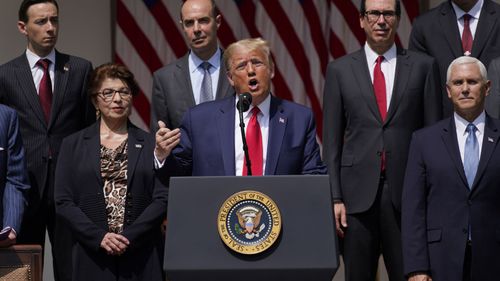
During remarks at the White House Rose Garden on Friday, Trump said, “Hopefully George is looking down and saying this is a great thing that’s happening for our country. (It’s) a great day for him. It’s a great day for everybody.”

Later that day, the presumptive 2020 Democratic nominee called Trump’s comments “despicable”.

Democratic presidential candidate, former Vice President Joe Biden speaks during an event in Dover, Del., Friday, June 5, 2020 (AP)

“George Floyd’s last words — ‘I can’t breathe, I can’t breathe’ — have echoed all across this nation, quite frankly, all around the world. For the President to try to put any other words in the mouth of George Floyd, I frankly think it’s despicable,” Biden said, speaking from Delaware State University, a public historically black university in Dover.

The former vice president continued, “And the fact that he did so on the day when black unemployment rose, Hispanic unemployment rose, black youth unemployment skyrocketed, tells you everything you need to know about this man and what he really cares about.”

Biden’s remarks come hours after a new jobs report was released that showed the US unemployment rate fell from April to May and that the job market may be recovering well ahead of schedule.

President Donald Trump speaks during a news conference in the Rose Garden of the White House, Friday, June 5, 2020, in Washington. (AP)

The President took credit for the surprising economic rebound, and called the jobs report “an affirmation of all the work we’ve been doing” over the course of his administration.

Biden said Friday he was “disturbed” to see Trump “crowing this morning, basically hanging a ‘Mission Accomplished’ banner out there, when there’s so much more work to be done. So many Americans are still hurting.”

Source by [author_name]

Facebook to apply state media labels on Russian, Chinese outlets

0

SAN FRANCISCO (Reuters) – Facebook Inc (FB.O) will start labeling Russian, Chinese and other state-controlled media organizations, and later this summer will block any ads from such outlets that target U.S. users, it said on Thursday.

FILE PHOTO: A Facebook sign is seen at the second China International Import Expo (CIIE) in Shanghai, China November 6, 2019. REUTERS/Aly Song

The world’s biggest social network will apply the label to Russia’s Sputnik, Iran’s Press TV and China’s Xinhua News, according to a partial list Facebook provided. The company will apply the label to about 200 pages at the outset.

Facebook will not label any U.S.-based news organizations for now, as it determined that even U.S. government-run outlets have editorial independence, Nathaniel Gleicher, Facebook’s head of cybersecurity policy, said in an interview.

Facebook, which has acknowledged its failure to stop Russian use of its platforms to interfere in the 2016 U.S. presidential election, has since stepped up its defenses and imposed greater transparency requirements for pages and ads on its platforms.

The company announced plans last year to create a state media label, but is introducing it amid criticism over its hands-off treatment of misleading and racially charged posts by U.S. President Donald Trump.

The new measure comes just months ahead of the November U.S. presidential election.

Under the move, Facebook will not use the label for media outlets affiliated with individual political figures or parties, which Gleicher said could push “boundaries that are very, very slippery.”

“What we want to do here is start with the most critical case,” he said.

Chinese foreign ministry spokesman Geng Shuang told reporters during a daily briefing in Beijing on Friday that social media companies should not selectively create obstacles for media agencies.”We hope that the relevant social media platform can put aside the ideological bias and hold an open and accepting attitude towards each country’s media role,” he said.

Sputnik in a statement shared with Reuters urged governments “to regulate Facebook when it tries to impose U.S.-inspired suppression of the freedom of speech.”

Facebook is not the first company to take such action.

YouTube, owned by Alphabet Inc’s Google (GOOGL.O), in 2018 started identifying video channels that predominantly carry news items and are funded by governments. But critics charge YouTube has failed to label some state news outlets, allowing them to earn ad revenue from videos with misinformation and propaganda.

In a blog post, Facebook said its label would appear on pages globally, as well as on News Feed posts within the United States.

Facebook also said it would ban U.S.-targeted ads from state-controlled entities “out of an abundance of caution” ahead of the November presidential election. Elsewhere, the ads will receive a label.

Reporting by Katie Paul; additional reporting by Huizhong Wu in Beijing; Editing by Leslie Adler, Mark Potter and David Gregorio

Source link

Saudi Arabia puts Jeddah under 15-day curfew after virus spike

Jun 5, 2020

Saudi Arabia has reinstated a 15-day curfew in the city of Jeddah beginning tomorrow, from 3 p.m. to 6 a.m., the state-run SPA news agency reported.

In addition to the curfew, the Saudi government reimposed several other restrictions on the Red Sea city. Citing an official with the Interior Ministry, SPA reported prayers in mosques, dining in restaurants and in-person attendance at workplaces are suspended for the next two weeks. Gatherings of more than five people are also banned. 

The country began easing restrictions in late April to coincide with the Muslim holy month of Ramadan. As cases surged in May, the kingdom introduced a 24-hour curfew during the five-day Eid al-Fitr holiday. 

On Friday, the Health Ministry acknowledged 2,591 new coronavirus cases and 31 more deaths, bringing the total number of infections to 95,748 and the death toll to 642. 

Saudi Health Ministry spokesman Dr. Mohammed Al-Abd Al-Aly said Tuesday he had seen an “alarming” rise in the number of critical COVID-19 patients in recent days. Those patients were mostly elderly or had chronic illnesses and tended to be from Jeddah or the capital Riyadh. 

“We should take a moment to reflect on our behavior and how it may affect the health of our mothers and fathers and our loved ones surrounding us,” Al-Aly said. 

To further prevent the spread of the virus, the country’s Interior Ministry announced hefty fines for quarantine violators in early May and the formation of a special police unit to enforce the new regulations. 


Source link

Turkey’s Erodgan cancels weekend curfew despite spike in cases

Jun 5, 2020

Turkish President Recep Tayyip Erdogan reversed course Friday and did not reimpose the country’s weekend lockdowns as expected amid a spike in novel coronavirus cases. 

Turkey has lifted restrictions on intercity travel and allowed a number of businesses such as restaurants and cafes as well as parks and sports facilities to reopen. This week, Turkey reopened two border crossings with Iraq and Iran. 

The easing comes as the Health Ministry reported a spike in infections that many officials had feared was coming. Compared to the previous daily average of 700, the number of cases jumped Thursday to nearly 1,000. In total, Turkey has reported more than 167,000 cases and at least 4,630 deaths since March. 

Turkey, which began weekend lockdowns April 11, was set to continue them amid the surge in new cases. But hours after the Turkish Interior Ministry announced a weekend curfew for 15 cities, Erdogan called it off, citing “social and economic consequences.” 

On Twitter, Erdogan explained the need to return to a “new normal” and prevent the country from going “through another plight after they were resuming their daily life after a break of two and a half months.” He called on Turkish citizens to continue wearing masks, practice social distancing and observe good hygiene. 

A near total lockdown remains in place for citizens aged 65 and older. With the exception of business owners, the elderly are under a curfew introduced March 21 but are allowed to leave their home for six hours on Sundays. 

The Turkish economy is struggling with high inflation and unemployment after months of virus-related restrictions on business. The government said Friday it would release a comprehensive “employment shield” package to support workers, the state-run Anadolu Agency reported. 


Source link

Iran dismisses Trump’s offer for talks

Jun 5, 2020

Iran has shrugged off US President Donald Trump’s attempt to engage the Islamic Republic into new talks with his administration for a “big deal” by renegotiating the nuclear accord signed during the term of his predecessor, Barack Obama.

Trump made the offer after the two sides implemented their latest prisoner swap deal June 4. The US president expressed his gratitude to the Iranian side for releasing US Navy veteran Michael White in an exchange that also saw Iranian Dr. Majid Taheri freed from US custody.

“Don’t wait until after US Election … I’m going to win. You’ll make a better deal now!” Trump tweeted, once again suggesting that the Obama-era agreement, which he has slammed as the worst deal in US history and scrapped in 2018, needs to be restructured from scratch.

In response, Iran’s Foreign Minister Mohammad Javad Zarif, the architect of the original nuclear deal — known as the Joint Comprehensive Plan of Action (JCPOA) — made it clear that the Iranian position remains unchanged. Zarif threw the ball into Trump’s court to “fix” the accord by reinstating rather than renegotiating it. “We had a deal when you entered office. … Your advisors — most fired by now — made a dumb bet.” The top Iranian diplomat also stressed that the prisoner swap was a humanitarian deal achieved despite efforts by Trump’s “subordinates” to block it.

A hard-line media outlet run by Iran’s state-funded broadcaster attributed Trump’s move to his failure to address multiple crises at home and abroad, arguing that “he is now resorting to negotiations with Iran … which may come to his rescue.”

In the past two years, the US president has made similar overtures to Tehran, all dismissed by the Iranian leadership. Trump has also tried mediation, most notably through Japan’s Prime Minister Shinzo Abe, whose message delivered in Tehran was rejected by Iran’s Supreme Leader Ayatollah Ali Khamenei. On several occasions since, Khamenei has asserted that a breakthrough with the current US administration is impossible.

Nevertheless, a tweet from the Iranian supreme leader last month suggested that he might be rethinking his rigid policy. Khamenei lauded the “bravery” and “sacrifices” by a holy Shiite figure who “gave in to peace” with his enemies for the sake of “expediency.” The message has been interpreted as preparation for more “heroic flexibility,” a notion Khamenei introduced in 2013. It served as the green light for Iranian negotiators to engage with Western powers including the United States in talks that culminated in the JCPOA in 2015.

Iran’s Thursday confirmation of the American prisoner’s release ended speculation that had gained momentum after Iranian scientist Sirous Asgari was seen greeting his family at Tehran’s Imam Khomeini International Airport. Both Iran and the United States have denied that Asgari’s release had anything to do with that of Michael White.

Iran’s Foreign Ministry spokesman Abbas Mousavi insisted that White was flown home in exchange for Taheri. The Iranian official also appeared to suggest that White’s release was not a swap and occurred only after he “managed to obtain the consent of the private plaintiffs … And as for other charges, he was treated with Islamic compassion,” a term recurrently used by Iranian officials in reference to parole granted to some prisoners.

The explanation was also reminiscent of the Iranian judiciary’s statements following the release last June of Lebanese national and US green card holder Nizar Zakka. Back in Beirut, however, Zakka infuriated Iranian authorities by denying their side of the story and recounting mistreatment he said he had suffered while serving time in Iran.


Source link

Facebook limits spread of ‘Boogaloo’ groups amid protests

0

SAN FRANCISCO (Reuters) – Facebook Inc is making it harder to find user groups associated with the term “Boogaloo,” which refers to a potential U.S. civil war or the collapse of civilization, the company said on Thursday.

FILE PHOTO: Facebook symbol is seen on a motherboard in this picture illustration taken April 24, 2020. REUTERS/Dado Ruvic /Illustration/File Photo

Facebook will no longer recommend such groups to members of similar associations, a spokeswoman for the world’s largest social media network said.

At least two of three men charged on Wednesday with plotting violence at a Las Vegas anti-racism protest participated in Boogaloo groups on Facebook, according to an FBI criminal complaint.

Facebook said it made the changes early in the week. “We felt we needed to take this action given discussions of potential use of violence,” the spokeswoman said on condition she not be named.

A series of reports this year by researchers and media have drawn attention to the loose movement and its propagation on social media. In April, an advocacy group called the Tech Transparency Project warned that Boogaloo followers were discussing taking up arms while promoting protests to “liberate” states from coronavirus restrictions.

On May 1, Facebook banned the use of Boogaloo and related terms when they accompany pictures of weapons and calls to action, such as preparing for conflict.

The specific terms Facebook is acting against on its namesake platform and Instagram unit are evolving, the company said. To evade scrutiny, some Boogaloo groups have switched to terms such as “Big Igloo” or “Big Luau” while maintaining the same discussions about weaponry, future wars and conspiracy theories.

Many Boogaloo participants identify with white nationalist groups or militias, researchers say. Others are gun-rights advocates or oppose what they see as government overreach and some even support Black Lives Matter protests against police brutality.

Facebook said the politics of Boogaloo members it looked into “ran the gamut” from right to left.

One of those charged Wednesday, Stephen Parshall, had publicly “liked” several Boogaloo-themed groups, his personal page showed until Facebook closed it after the case was filed. He had also posted a picture of a Confederate battle flag.

Reporting by Joseph Menn; Editing by Greg Mitchell, Richard Chang and David Gregorio

Source link

Home Prices Are Rising, Along With Post-Lockdown Demand

Here are some questions and answers about the spring home-buying market:

What’s happening with mortgage rates?

One bright spot for shoppers is that mortgage interest rates are near historic lows, which is helping buyers afford those pricier homes. The average rate on a 30-year, fixed-rate mortgage was 3.18 percent for the week that ended Thursday, up from 3.15 percent the previous week, according to Freddie Mac, the mortgage finance giant. A year ago, the average was 3.82 percent.

The low rates have increased the number of mortgage applications, but some borrowers may find it difficult to qualify for a home loan as banks raise their standards amid the economic turmoil of the pandemic. Borrowers can generally expect banks to require higher minimum credit scores and larger down payments, said Guy Cecala, publisher of Inside Mortgage Finance, a trade publication.

The situation is particularly challenging for first-time home buyers, who are more likely to use Federal Housing Administration loans that allow lower down payments and credit scores. The F.H.A. insures loans for borrowers who put down as little as 3.5 percent if they have credit scores of at least 580. But lenders may set stricter standards, and some are requiring higher minimum scores and 10 percent or 20 percent down, Mr. Cecala said.

Terms may also be tougher for borrowers at the other end of the spectrum — those seeking “jumbo” loans. While banks sell most mortgages to investors, jumbo loans are typically held by the original lender. With many demands being made on their funds in an uncertain economic environment, banks are being cautious.

“Banks are stretched,” said Mike Fratantoni, chief economist with the Mortgage Bankers Association.

Because many people have lost jobs or been furloughed, lenders are now typically doing a second employment verification just before the closing to be sure the buyer can afford to repay the loan.

  • Updated June 5, 2020

    • How many people have lost their jobs due to coronavirus in the U.S.?

      The unemployment rate fell to 13.3 percent in May, the Labor Department said on June 5, an unexpected improvement in the nation’s job market as hiring rebounded faster than economists expected. Economists had forecast the unemployment rate to increase to as much as 20 percent, after it hit 14.7 percent in April, which was the highest since the government began keeping official statistics after World War II. But the unemployment rate dipped instead, with employers adding 2.5 million jobs, after more than 20 million jobs were lost in April.

    • Will protests set off a second viral wave of coronavirus?

      Mass protests against police brutality that have brought thousands of people onto the streets in cities across America are raising the specter of new coronavirus outbreaks, prompting political leaders, physicians and public health experts to warn that the crowds could cause a surge in cases. While many political leaders affirmed the right of protesters to express themselves, they urged the demonstrators to wear face masks and maintain social distancing, both to protect themselves and to prevent further community spread of the virus. Some infectious disease experts were reassured by the fact that the protests were held outdoors, saying the open air settings could mitigate the risk of transmission.

    • How do we start exercising again without hurting ourselves after months of lockdown?

      Exercise researchers and physicians have some blunt advice for those of us aiming to return to regular exercise now: Start slowly and then rev up your workouts, also slowly. American adults tended to be about 12 percent less active after the stay-at-home mandates began in March than they were in January. But there are steps you can take to ease your way back into regular exercise safely. First, “start at no more than 50 percent of the exercise you were doing before Covid,” says Dr. Monica Rho, the chief of musculoskeletal medicine at the Shirley Ryan AbilityLab in Chicago. Thread in some preparatory squats, too, she advises. “When you haven’t been exercising, you lose muscle mass.” Expect some muscle twinges after these preliminary, post-lockdown sessions, especially a day or two later. But sudden or increasing pain during exercise is a clarion call to stop and return home.

    • My state is reopening. Is it safe to go out?

      States are reopening bit by bit. This means that more public spaces are available for use and more and more businesses are being allowed to open again. The federal government is largely leaving the decision up to states, and some state leaders are leaving the decision up to local authorities. Even if you aren’t being told to stay at home, it’s still a good idea to limit trips outside and your interaction with other people.

    • What’s the risk of catching coronavirus from a surface?

      Touching contaminated objects and then infecting ourselves with the germs is not typically how the virus spreads. But it can happen. A number of studies of flu, rhinovirus, coronavirus and other microbes have shown that respiratory illnesses, including the new coronavirus, can spread by touching contaminated surfaces, particularly in places like day care centers, offices and hospitals. But a long chain of events has to happen for the disease to spread that way. The best way to protect yourself from coronavirus — whether it’s surface transmission or close human contact — is still social distancing, washing your hands, not touching your face and wearing masks.

    • What are the symptoms of coronavirus?

      Common symptoms include fever, a dry cough, fatigue and difficulty breathing or shortness of breath. Some of these symptoms overlap with those of the flu, making detection difficult, but runny noses and stuffy sinuses are less common. The C.D.C. has also added chills, muscle pain, sore throat, headache and a new loss of the sense of taste or smell as symptoms to look out for. Most people fall ill five to seven days after exposure, but symptoms may appear in as few as two days or as many as 14 days.

    • How can I protect myself while flying?

      If air travel is unavoidable, there are some steps you can take to protect yourself. Most important: Wash your hands often, and stop touching your face. If possible, choose a window seat. A study from Emory University found that during flu season, the safest place to sit on a plane is by a window, as people sitting in window seats had less contact with potentially sick people. Disinfect hard surfaces. When you get to your seat and your hands are clean, use disinfecting wipes to clean the hard surfaces at your seat like the head and arm rest, the seatbelt buckle, the remote, screen, seat back pocket and the tray table. If the seat is hard and nonporous or leather or pleather, you can wipe that down, too. (Using wipes on upholstered seats could lead to a wet seat and spreading of germs rather than killing them.)

    • Should I wear a mask?

      The C.D.C. has recommended that all Americans wear cloth masks if they go out in public. This is a shift in federal guidance reflecting new concerns that the coronavirus is being spread by infected people who have no symptoms. Until now, the C.D.C., like the W.H.O., has advised that ordinary people don’t need to wear masks unless they are sick and coughing. Part of the reason was to preserve medical-grade masks for health care workers who desperately need them at a time when they are in continuously short supply. Masks don’t replace hand washing and social distancing.

    • What should I do if I feel sick?

      If you’ve been exposed to the coronavirus or think you have, and have a fever or symptoms like a cough or difficulty breathing, call a doctor. They should give you advice on whether you should be tested, how to get tested, and how to seek medical treatment without potentially infecting or exposing others.


“It’s hard to get a handle on someone’s job situation,” Mr. Cecala said.

He advises borrowers to shop around by checking loan terms at traditional banks, finance companies like Quicken Loans and credit unions.

How is being preapproved for a mortgage different from being prequalified?

It’s more important than ever to be preapproved for a home loan — not just prequalified — when shopping in many markets, agents say. Preapproved means you have submitted income information and undergone a credit check, and have been given the green light to borrow a specific amount of money. Being prequalified is more of an estimate.

Source link

As Images of Pain Flood TV, ‘Where Is Our Leader?’

After the tear gas was deployed and the protesting Americans muscled away from Lafayette Square just in time for Monday’s evening news, President Trump walked from the White House Rose Garden to St. John’s Church, took a Bible from his daughter’s luxury handbag and … just held it.

As the Rev. Al Sharpton would say later in the week: “I’ve been preaching since I was a little boy. I’ve never seen anyone hold the Bible like that.”

I’m not sure I’ve even seen anyone hold a book like that. Mr. Trump glowered and hefted the Holy Writ as if he meant to swat a fly with it. With the attention of a pandemic-, unemployment- and unrest-plagued country, he delivered the visual message, “This is what a Bible looks like.”

The surreal dissonance of the gesture was summed up when a reporter asked the president if the book was his Bible. “It’s a Bible,” he responded.

Just so, this was not the cathartic moment that the country, torn open after the police killing of George Floyd, may have been looking for. But it was a moment. And it was one that summed up how the veteran TV performer has and hasn’t been willing to perform his job.

There has been, especially in the television era, a eulogistic, ministerial aspect of the presidency, the call to give voice to the country’s grief in dark moments. Think Barack Obama singing “Amazing Grace” in Charleston or Ronald Reagan reciting poetry after the explosion of the space shuttle Challenger.

Mr. Trump has scratched that part out of the job description. His visual vocabulary, since his 1980s tabloid-feud days, has always been limited to pantomimes of dominance. Yet the week began, for him, with a kryptonite image of weakness: the White House dormant and dark, amid reports that he had been hustled into a bunker.

That Monday morning, he lashed out during a conference call with a group of governors, demanding they flood the streets, and thus the media, with shows of strength. He wanted the state executives to “dominate” the protesters, whom he called “terrorists.”

If they would not give him the show of force he wanted, then the president — who in 1990 praised the Chinese government’s “strength” at Tiananmen Square — would answer this problem like he had so many: by creating a TV show. It was dominance theater, a Tianan-mini Square in which the sight of federal forces strong-arming peaceful demonstrators was as much a part of the photo op as the Bible-brandishing.

And posing outside the church was on brand for a president who is neither much of a churchgoer nor very conversant with what’s between the Bible’s covers, but who once reminisced about watching Billy Graham “for hours and hours” on TV with his father.

In place of words of comfort, we got apocalyptic televangelism. The White House Twitter account quickly slathered the footage in syrupy orchestration and packaged it into a propaganda video.

But for once, this was a political event bigger than Mr. Trump and his theatrics. Distilled images of pain were everywhere: the video of George Floyd’s killing, the TV-news wallpaper of buildings burning and batons raining down, the eyewitness footage on Twitter and TikTok.

Video has been a weapon itself this week. For protesters, cameras have been a means of self-defense, for capturing scenes of brutality. On Thursday, video captured the moment when police in Buffalo pushed down an elderly man and walked over him as he bled from his ear. (Police initially claimed that the man “tripped and fell.”)

For the authorities, it could be a cudgel, as when the White House tweeted a video, later deleted, that dishonestly implied that a set of security barriers outside a Los Angeles synagogue was a cache of stones to be hurled by “Antifa and professional anarchists.”

For images of empathy and connection, you had to look everywhere else. The national accounting of America’s racial record reached even to late-night, where Jimmy Fallon apologized for playing Chris Rock in blackface in a 2000 “Saturday Night Live” sketch.

“I realized,” he said, “that the silence is the biggest crime that white guys like me and the rest of us are doing.”

Mr. Fallon, whose show has always been militantly un-heavy, spent the week turning his quarantine-based “Tonight” into “a different kind of show,” interviewing guests like the N.A.A.C.P. president Derrick Johnson and the rapper-activist Talib Kweli.

Of course, on TV, Very Special Weeks have a way of coming and going. Another rapper-activist, Killer Mike — whose anguished speech to Atlanta was maybe the signal video of a week of unrest — got at this when Stephen Colbert asked him what white Americans could do right now. Part of it, Killer Mike said, was to “understand that right now is always.”

As the week went on, Mr. Trump’s dominance theater gave way to images of the White House vanishing behind a vast perimeter of fencing. By Friday, Mr. Trump was in front of cameras in the Rose Garden again, but only to trumpet an unemployment report that he hoped Mr. Floyd was “looking down” on in approval.

His challenger, former Vice President Joseph R. Biden Jr., emerging from his quarantine campaign — his home-garden backdrop replaced by a traditional line of flags — gave an address calling the presidency “a duty to care.” Barack Obama, at a virtual town hall addressing issues of police violence, spoke directly to young black viewers: “I want you to know that you matter. I want you to know that your lives matter.”

Of course there are politics in all of this, implicit and explicit. Mr. Biden’s address, beyond any specific criticism or proposal, was asking viewers to imagine an alternative presidency that engaged with the language of caring.

But it wasn’t only politicians who were looking at America and seeing an empathy desert. That message came, of all places, from the Instagram feed of the wrestler-turned-Hollywood-star Dwayne Johnson, also known as the Rock.

In his video, Mr. Johnson is somber, yet as pained and vulnerable as a man-mountain in a muscles-bulging T-shirt can be. “Where is our leader?” he asks, in an extended, sometimes halting monologue that never mentions Mr. Trump by name but addresses only a conspicuous “You.”

“You would be surprised,” he says, “how people in pain would respond when you say to them, ‘I care about you.’”

The caring would instead have to be outsourced. It came from Meghan Markle, the African-American actress and Duchess of Sussex, in a video to the graduating class of her old high school. The duchess, the object of racist sniping in Britain, spoke to the agony of her home country, reciting a list of black victims of official violence: “George Floyd’s life mattered and Breonna Taylor’s life mattered and Philando Castile’s life mattered and Tamir Rice’s life mattered.”

The caring came, most cathartically, from a Thursday memorial service for Mr. Floyd in Minneapolis, a kind of national pastoral moment that sharply contrasted with Monday’s violently stage-managed Crusade at Lafayette Park.

Family members recalled private moments; Mr. Floyd’s nephew, Brandon Williams, remembered how his uncle, a LeBron James fan, would celebrate little triumphs by saying, “I feel like I just won a championship.” Mr. Sharpton built his own eulogy on a fiery metaphor, instantiating centuries of African-American oppression in Mr. Floyd’s final dying minutes.

“George Floyd’s story has been the story of black folks,” he said. For 400 years, “you had your knee on our neck.”

But the broadest, most powerful statement out of the service was no statement at all: Eight minutes and 46 seconds of silence, to match the time that Mr. Floyd had the breath of life crushed out of him.

For almost nine minutes amid a week of fury, TV went quiet. Most of the major news networks (CNN cut to commentators) and the broadcast networks, in special-report mode, held the silence. The broadcasters cut between the mourning of George Floyd’s family and live, quiet footage of protesters in Minneapolis, in the capital, streaming over the Brooklyn Bridge.

It was only a pause, not an end. But it was something. Three days after the chilling theatrics in front of St. John’s, Americans had finally, collectively, if briefly, gone to church.


Source link