New President honoured to lead RCSI during crisis

Prof Ronan O’Connell replaces outgoing President, Mr Kenneth Mealy, following the RCSI’s biennial Council Elections

The newly elected President of the Royal College of Surgeons in Ireland (RCSI) has said it was a great honour to be asked to lead the College during the unprecedented challenge of Covid-19.

Prof Ronan O’Connell takes up office following the College’s biennial Council Elections.

He replaces outgoing President, Mr Kenneth Mealy.

“It is my great honour to be elected as President of the Royal College of Surgeons in Ireland,” Prof O’Connell said.

“My presidency of RCSI will be like no other in our 236-year history as the Covid-19 pandemic has presented our surgical community with unprecedented challenges that will shape the future of surgery for years to come,” he continued.

“Covid-19 may at present keep us apart physically but as a community of surgeons we are united in the task of re-establishing safe, timely and equitable access to elective surgery.

“I look forward to working with our community of 9,500 Fellows and Members across 86 countries as we face the challenges ahead, to sharing our expertise and to building a virtual network for continuing surgical education.”

Prof O’Connell is Emeritus Professor of Surgery at University College Dublin (UCD) and Consultant Surgeon at St Vincent’s University Hospital (SVUH).

An international leader in the field of colorectal surgery, he is also the incoming President of the European Surgical Association (ESA).

“I am particularly conscious of supporting our surgical trainees whose training has been disrupted by the Covid restrictions,” Prof O’Connell continued.

“RCSI will use the excellent facilities of the National Clinical and Surgical Skills Centre at 26 York Street to provide innovative ways of training to compliment hospital experience. I will advocate on behalf of our trainees and will work with the Irish Medical Council and sister colleges to ensure training and career progression is secure.”

Educated at Terenure College and Trinity College Dublin, Prof O’Connell’s surgical training in Dublin and Cork was followed by specialist training in Colon and Rectal Surgery in the United States at the Mayo Clinic, Minnesota.

He previously held the roles of Consultant /Senior Lecturer at the London Hospital and Consultant Surgeon at the Mater Misericordiae University Hospital. In 2002, he became a Newman Clinical Professor in UCD and in 2007 moved to SVUH as Professor of Surgery and Head of Subject in UCD.

Since his election to the Council of the RCSI in 2008, he has served on multiple committees and working groups within the College including: Chair of the Audit Committee; Irish Surgical Postgraduate Training Committee (ISPTC); and the Court of Examiners. He is an elected member of the Society of Pelvic Surgeons, ESA and the International Surgical Group. He is a former Secretary and President of the European Society of Coloproctology.

Prof O’Connell has published widely in the areas of inflammatory bowel disease, pelvic floor physiology and colorectal cancer, authoring more than 300 publications. He was Editor of the British Journal of Surgery from 1999 to 2006. He is the RCS England Hunterian Orator for 2019-2020.

He has been awarded Honorary Fellowships of the Royal College of Physicians and Surgeons of Glasgow, the Royal College of Surgeons of Edinburgh, the Royal College of Surgeons of England, the College of Surgeons of Hong Kong, the American Surgical Association and the American Society of Colon and Rectal Surgeons.

Prof Laura Viani, Consultant Otolaryngologist and Neurotologist at Beaumont Hospital and the Children’s University Hospital Temple Street, has been elected as the new Vice-President.

She is Director and Professor of the National Cochlear Implant Programme and Hearing Research Centre.

peter.doyle@imt.ie

Source link

Too soon to hold large events — Chief Medical Officer

Dr Tony Holohan has reacted to Black Lives Matter march held in Dublin this week

The Chief Medical Officer has strongly advised against mass gatherings while Covid-19 restrictions are being relaxed.

Dr Tony Holohan was speaking after it emerged a Black Lives Matter march held in Dublin earlier this week may have been in breach of current physical distancing guidelines.

Approximately 1,000 people assembled in O’Connell Street on Monday afternoon (June 1) to protest march 3km to the American Embassy in Ballsbridge in a protest over the death of George Floyd, who died in police custody in Minneapolis, United States (US), last week.

A police officer has since been arrested and charged with Floyd’s third-degree murder and manslaughter.

The incident has sparked violent protests across the US, while solidarity marches have been organised in cities across the world including Dublin.

Gardaí said Tuesday night they were investigating whether the protest here was in breach of Regulation 5(1)(a) of the Health Act 1947 (Section 31A-Temporary Restrictions) (Covid-19) (Amendment) (No.3) Regulations 2020, which places restrictions on holding large events during the pandemic.

Speaking on Tuesday night at the National Public Health Emergency Team (NPHET) briefing, Dr Holohan said it was too early for large outdoor events to be held after restrictions were initially eased on May 18.

“In general terms, the reason we have advice in place against mass gatherings is to stop transmission of the virus,” he said.

He also warned that new cases of the virus were being reported across Ireland.

“Over the past week there have been approximately 500 new cases of Covid-19 notified, 54 per cent of which are aged between 24-55 years old,” he said.

“Incidences of these cases are spread across 21 counties in Ireland. While we are doing well, the potential for spread remains present across all regions of the country.

“NPHET will meet on Thursday 4 June and submit further recommendations to the Government for consideration.”

Newly published HPSC data also showed there have now been a total 1,658 Covid-19 related deaths in Ireland after another eight people with the disease died.

The Health Protection Surveillance Centre also said that as of midnight May 31 it had been notified of 10 more people diagnosed with Covid-19 and that there were 25,066 confirmed cases of the virus in Ireland.

Latest figures also revealed that as of midnight May 31, when there were 25,056 cases, 57 per cent were female and 43 per cent male.

The median age of confirmed cases was 48 years, 3,292 cases (13%) have been hospitalised, and 7,986 cases were associated with healthcare workers.

Of those hospitalised, 408 cases have been admitted to intensive care.

Dublin has the highest number of cases at 12,090 (48% of all cases) followed by Cork with 1,517 cases (6%) and then Kildare with 1,419 cases (6%).

Of those for whom transmission status was known community transmission accounted for 39 per cent, close contact for 58 per cent, and travel abroad for 2 per cent.

peter.doyle@imt.ie

Source link

‘He tries to divide us’: Former Defense Secretary Mattis compares Trump’s protest response to Nazi tactics

Former Defense Secretary James Mattis on Wednesday slammed President Donald Trump’s response to the protests over the death of George Floyd, saying the president “tries to divide us” while calling his “bizarre photo op” in front of St. John’s Episcopal Church “an abuse of executive authority.”

“Donald Trump is the first president in my lifetime who does not try to unite the American people — does not even pretend to try. Instead, he tries to divide us,” Mattis wrote in a statement published by The Atlantic.

“Instructions given by the military departments to our troops before the Normandy invasion reminded soldiers that ‘The Nazi slogan for destroying us … was ‘Divide and Conquer.’ Our American answer is ‘In Union there is Strength.’ We must summon that unity to surmount this crisis — confident that we are better than our politics,” Mattis wrote.

In the stunning rebuke of his former boss, Mattis, a retired general, said he’d promised to defend the Constitution when he was sworn into the Marine Corps “some 50 years ago.”

“Never did I dream that troops taking that same oath would be ordered under any circumstance to violate the Constitutional rights of their fellow citizens — much less to provide a bizarre photo op for the elected commander-in-chief, with military leadership standing alongside,” Mattis wrote, referring to Monday night’s federal show of force to clear protesters from the front of the White House.

After they were cleared, Trump walked across Lafayette Square with Defense Secretary Mark Esper, Army Gen. Mark Milley, chairman of the Joint Chiefs of Staff, and others to pose for a picture with a Bible in front of the church, which had been damaged in a riot Sunday night. The photo opportunity came minutes after Trump announced that he was prepared to call in the military to handle unruly protesters around the country.

“We know that we are better than the abuse of executive authority that we witnessed in Lafayette Square. We must reject and hold accountable those in office who would make a mockery of our Constitution,” he wrote.

“We do not need to militarize our response to protests. We need to unite around a common purpose,” wrote Mattis, whom Trump would often refer to as “Mad Dog,” a nickname Mattis didn’t like.

Trump, he said, is a divider, and the country is “witnessing the consequences of three years of this deliberate effort.”

“We can unite without him, drawing on the strengths inherent in our civil society. This will not be easy, as the past few days have shown, but we owe it to our fellow citizens,” he wrote.

Reacting to Mattis’ decision to speak out publicly against Trump, Senate Minority Leader Chuck Schumer, D-N.Y., said in a statement, “That Secretary Mattis, someone who President Trump used to hail as ‘Mad Dog Mattis’, felt so strongly the need to speak up today further underscores how devastatingly destructive Donald Trump is to our country as president.”

Full coverage of George Floyd’s death and protests around the country

Mattis resigned in December 2018, suggesting in his resignation letter that Trump wasn’t treating allies with respect and hadn’t been “clear-eyed” about U.S. enemies and competitors. The president, he said, should have a defense chief who shares his views.

Trump wound up sending Mattis packing two months before his scheduled resignation date and later called him “the world’s most overrated general.”

Trump tweeted that insult again along with some new ones on Wednesday night after the Atlantic story was published.

“I didn’t like his ‘leadership’ style or much else about him, and many others agree. Glad he is gone!” Trump tweeted.

He also claimed he created the moniker “Mad Dog,” which Mattis had been called since at least 2004 — over a decade before he met Trump.

Mattis told The Atlantic last year that he had no plans to speak out against the administration, saying, “You need to give the people who are still there as much opportunity as possible to defend the country.”

But he added: “There is a period in which I owe my silence. It’s not eternal. It’s not going to be forever.”

That period came to an end this week.

“I have watched this week’s unfolding events, angry and appalled. The words ‘Equal Justice Under Law’ are carved in the pediment of the United States Supreme Court. This is precisely what protesters are rightly demanding,” Mattis said.

Earlier Wednesday, top Army and Navy brass released statements acknowledging the pain caused around the country by Floyd’s death. National Guard Bureau chief Gen. Joseph Lengyel — whose troops were involved in Monday night’s forcible dispersal of protesters in front of the White House — issued his own statement Wednesday night, saying he was “sickened by the death of George Floyd.” “We must be better,” he said.


Source link

Act to avert national mental health crisis, campaigners warn

The current public health crisis could create a crisis in mental health — Irish campaigners

Fiona Coyle, Mental Health Reform (MHR) CEO

The Government must implement its revamped mental health strategy as soon as possible to prevent the current public health crisis from creating a crisis in mental health, Irish campaigners have warned.

Mental Health Reform (MHR), the national coalition on mental health which represents more than 70 organisations, also stated it was imperative that the policy document ‘A Vision for Change’ was published as soon as possible so post-Covid-19 mental health planning could begin.

MHR’s Chief Executive Fiona Coyle said the current crisis was placing a significant burden on people’s mental health and well-being and this would continue well into the future.

“The pandemic is already resulting in increased demand for mental health services and supports across the country,” she said.

“If the public health crisis is not to give way to a national mental health crisis, it is imperative that the Government prepare for a surge in demand for mental health services and this should be reflected in the prospective Programme for Government.”

Last week, Irish Medical Times (IMT, 28/05/2020, ‘TDs: Publish new mental health strategy document’) reported that a cross-party group of TDs had signed a joint letter to Minister for Health Simon Harris and Minister of State for Mental Health and Older People Jim Daly, calling for the immediate publication of ‘A Vision for Change’.

The letter was signed by James Browne, Fianna Fáil; Pat Buckley, Sinn Féin; Róisín Shortall, Social Democrats; Ossian Smyth, Green Party; and three Independents Mattie McGrath, Denis Naughten, and Carol Nolan.

“To support preparation and planning to protect people’s mental health in the months ahead, the Government must immediately publish the refresh of ‘A Vision for Change’, Ireland’s new national mental health policy, and appoint an implementation group for this policy, capable of developing a mental health recovery plan for the country,” Coyle continued.

“It is also essential that the Government commit to protecting mental health funding and invest in services so that they are quick and easy to access for people, if and when they need them.”

peter.doyle@imt.ie

Source link

St Petersburg death tally casts doubt on Russian coronavirus figures

New mortality data from Russia’s second-largest city has reignited questions about whether the country’s official tally has discounted thousands of deaths tied to the coronavirus outbreak.

St Petersburg issued 1,552 more death certificates this May than in the previous year, a nearly 32% rise that indicates that hundreds of deaths tied to the pandemic are not reflected in the city’s official coronavirus death toll for the month of 171.

It is not clear how many of those people had tested positive for the novel coronavirus or were suspected to have been infected. But statisticians and doctors have previously told the Guardian that 75% or higher of “excess deaths”, the number of deaths exceeding what would regularly be expected, are likely to be tied to the coronavirus outbreak. That means potentially 1,000 additional deaths in St Petersburg in May tied to the pandemic.

The new data, released by the city on Wednesday and first reported by Reuters, further indicates how Russia’s conservative account of its coronavirus death toll may be missing out thousands of deaths, while feeding political talking points and informing policy decisions about tackling the outbreak and reopening the country.

Russia has reported a 1.2% mortality rate from the disease, while Brazil and the US have reported higher than 5.6% and 5.8%, respectively, according to Johns Hopkins University. France posted a 15.4% mortality rate and Italy has posted a 14.4% mortality rate. But experts have said that comparing national mortality rates is misleading when reporting standards vary widely and that excess deaths are likely to give a clearer picture of the death toll from the disease.

Russian officials have aggressively denied that the data on coronavirus deaths is being massaged. Even if corrected upward to reflect likely deaths from coronavirus, the death toll in cities such as Petersburg or Moscow will probably remain far lower than in cities such as New York and London.

Still, data posted in recent weeks by St Petersburg, Moscow and in regions such as Dagestan, has caused scandals, showing that deaths from pneumonia likely tied to the outbreak could be far higher than the official coronavirus death toll, sometimes by a factor of 10. In many other regions, data on total mortality for May and April remains unavailable, making it difficult to corroborate the government’s official tally of deaths from coronavirus.

Russian coronavirus deaths, according to Johns Hopkins

The government’s handling of the outbreak, including the economic backlash from tough self-isolation measures, has become a sensitive political issue. Amid economic difficulties, Vladimir Putin’s approval ratings reaching their lowest point in 20 years in early May, the independent Levada Centre reported.

Russian officials have told the public to expect a sharp rise in mortality from Russia’s coronavirus outbreak, the third largest in the world after the US and Brazil. But Russia’s state statistics agency postponed plans to release April’s mortality data for the whole country, saying it needed extra time because of closures of local registration offices. The data will be released on 15 June.

St Petersburg’s governor, Alexander Beglov, said in mid-May that 694 people had died of pneumonia since the coronavirus outbreak began, while the city had tallied just 63 deaths from the disease. Russia’s conservative reporting standards require an autopsy to show that patients died of coronavirus, rather than simply that they died while infected with the disease, unlike countries in western Europe.

The St Petersburg data showed that the city issued 6,427 death certificates in May of this year, a rise of 1,552 recorded deaths from last May and 1,400 deaths higher than the average for that month over the previous decade. More deaths were recorded in May 2020 than in any month over the previous decade. Death rates have spiked in winter and early spring, occasionally to over 6,000, as recently as 2018.

Source link

WWE announce new Vice President & General Manager of MENA region – Sport360 News

0

WWE has a major footprint now in Saudi Arabia and the wider Middle East.

WWE today announced the appointment of Bandar Al Mashhadi as Vice President & General Manager, Middle East & North Africa.

In his new role, Al Mashhadi will lead WWE’s strategic business initiatives and day-to-day operations in the MENA region and work with partners across all of WWE’s lines of business, including television, live events, marketing, sponsorship, advanced media, licensing and merchandising. He will also manage local operations for the company’s 10-year partnership with the Saudi General Entertainment Authority.

“We are excited to welcome Bandar to our international leadership team and confident that his experience in managing successful partnerships in Saudi Arabia and the Middle East will have a significant impact on WWE’s continued growth,” said James Rosenstock, WWE Executive Vice President, International. “We look forward to Bandar leading WWE’s efforts in this important region for our company.”

Al Mashhadi has more than 20 years of experience as an executive at blue chip companies based in Saudi Arabia with a proven track record in delivering business growth.

He spent the past six years at OSN, most recently as Managing Director, leading implementation of the broadcaster’s corporate strategy in Saudi Arabia. During this time he also served a one-year deployment as Advisor to the Minister of Media in Saudi Arabia, leading multiple Vision 2030 initiatives including the privatization of the Saudi News Network.

Know more about Sport360 Application


Source link

George Floyd live updates: Memorial in Minneapolis on Thursday; Barack Obama pushes police reform; Mattis blasts Trump

CLOSE

Officer Derek Chauvin will now face second-degree murder charges, while Officers Thomas Lane, J.A. Keung and Tou Thao will face charges, as well.

USA TODAY

Protests across the U.S. remained large but were more subdued Wednesday night ahead of the first of multiple memorial services for George Floyd, the handcuffed black who died after a white police officer knelt on his neck.

On Wednesday, Minnesota Attorney General Keith Ellison said that the charges for Derek Chauvin have been upgraded to second-degree murder. Ellison also said the three other officers at the scene when Floyd died last week have been charged with aiding and abetting a murder.

The topic of police reform is top of mind, with former President Barack Obama urging mayors to commit to changes during a town hall Wednesday. 

A closer look at some recent developments:

  • Former Defense Secretary James Mattis denounced President Trump as a threat to democracy for failing to unite the country as protests erupted after George Floyd’s death. 
  • In Virginia, the statue of Gen. Robert E. Lee and other Confederate monuments on Richmond’s prominent Monument Avenue will be removed.
  • Two Florida workers were fired Tuesday for making “hateful, racist” comments about Floyd demonstrators demanding better policing as part of nationwide protests.

Wednesday’s protests: Here’s a city-by-city look at the latest developments.

Our live blog will be updated throughout the day. For first-in-the-morning updates, sign up for the Daily Briefing. Here’s the latest news:

Barack Obama urges mayors to commit to police reform

Former President Barack Obama hosted a town hall Wednesday urging mayors in the country to commit to police reform in the wake of George Floyd’s death that triggered protests nationwide.

“What are the specific steps you can take?” Obama asked. The steps, he said, include reviewing their law enforcement’s use-of-force policies with community members, and committing to report on any needed changes. Obama said his administration created a task force in 2014 after the shooting of Michael Brown in Ferguson, Missouri, that produced many reforms. 

Obama also supported protesters demanding police reforms and justice for Floyd. “We both have to highlight a problem and make people in power uncomfortable, but we also have to translate that into practical solutions and laws that could be implemented and monitored and make sure we’re following up on.”

‘Unprovoked attack on a defenseless police officer’ in NYC

A day that began with hope that New York City was beginning to find a way out of the crisis caused by the coronavirus and a week of angry demonstrations over police brutality ended Wednesday with more violence.

Peaceful protests over the death of George Floyd drew thousands of people in New Yotk City, but police broke them up after shortly after an 8 p.m. curfew. Police said not long after that, a man ambushed officers on an anti-looting patrol in Brooklyn, stabbing one in the neck. The attacker was shot by responding officers and was in critical condition.

Two officers suffered gunshot wounds to their hands in the chaos, but all three wounded officers were expected to recover.

Police Commissioner Dermot Shea called it “a completely, cowardly, despicable, unprovoked attack on a defenseless police officer.” While he declined to say what motivated the attack, he drew a line to the heated rhetoric of the past week and angry crowds decrying police violence that have sometimes turned violent.

Mattis blasts president as a threat to American democracy

Former Defense Secretary James Mattis denounced President Donald Trump Wednesday in an statement that hammered his former boss as a threat to American democracy. 

He took aim at the White House’s decision Monday to forcibly clear protesters from a park in front of the White House, so Trump could walk across the street and pose with a Bible in front of a historic church. Mattis called it an abuse of power. 

He also said Trump is needlessly dividing the country and “militarizing” America’s response to the protests, Mattis wrote in a statement published by The Atlantic magazine. 

“Donald Trump is the first president in my lifetime who does not try to unite the American people – does not even pretend to try. Instead he tries to divide us,” he wrote.

– Deirdre Shesgreen

2 Florida workers fired for ‘hateful, racist’ comments about protesters

A Florida Highway Patrol trooper and a Tallahassee employee of the Department of Highway Safety and Motor Vehicles have been fired for making “abhorrent” comments about George Floyd protesters, the department said. 

The two workers had directed “hateful, racist and threatening remarks” toward Florida demonstrators calling for better policing as part of nationwide protests in the wake of Floyd’s death in police custody on Memorial Day in Minneapolis.

In an official tweet, DHSMV said it found remarks by Trooper Daniel Maldonado and William Henderson, who worked at the agency’s Tallahassee headquarters, “abhorrent and reprehensible.” Their comments were made via text message and social media. 

“Their conduct is not in any way reflective of the troopers and employees of the Florida Department of Highway Safety and Motor Vehicles,” the agency in announcing their termination Tuesday night.

– James Call, USA TODAY Network-Florida Capital Bureau

Minnesota AG: Three officers will be charged; Derek Chauvin faces second-degree murder

Minnesota Attorney General Keith Ellison said arrest warrants were issued Wednesday for former Minneapolis police officers J. Alexander Kueng, Thomas Lane and Tou Thao, adding that they have been charged with aiding and abetting a murder. Ellison also announced that charges against former officer Derek Chauvin have been upgraded to second-degree murder from third degree.

All four policemen were fired the day after Floyd’s killing May 25, but only Chauvin had been charged until Wednesday. Floyd’s deadly arrest, captured on video, has sparked protests against police brutality and racism across the nation.

In the video, Lane and Keung can be seen on top of Floyd, while Thao is standing by.  According to a criminal complaint filed Wednesday, Thao stood by as Floyd repeatedly said he could not breathe. Court papers describe Thao as being more concerned about controlling the nearby crowd than Floyd’s welfare.

“The family of George Floyd watched the video in agony,” family lawyer Benjamin Crump said. “We cannot have two justice systems in America, one for black America and one for white America.”

Robert E. Lee statue, other Confederate monuments to be removed in Richmond

Virginia Gov. Ralph Northam is expected to announce plans Thursday for the removal of an iconic statue of Confederate Gen. Robert E. Lee from Richmond’s prominent Monument Avenue, a senior administration official told The Associated Press.

The Democratic governor will direct the statue to be moved off its massive pedestal and put into storage while his administration seeks input on a new location, according to the official, who spoke on condition of anonymity because the official was not authorized to speak before the governor’s announcement.

“That is symbol for so many people, black and otherwise of a time gone by of hate and oppression and being made to feel less than,” said Del. Jay Jones, a black lawmaker from Norfolk. 

Also on Wednesday, Richmond Mayor Levar Stoney announced plans to remove the other Confederate monuments along Monument Avenue, which include statues of Confederate President Jefferson Davis and Confederate Gens. Stonewall Jackson and J.E.B. Stuart. Those statues sit on city land, unlike the Lee statue, which is on state property.

3 held on terror charges in right-wing conspiracy to spark violence during protests in Las Vegas

Three Nevada men with ties to a loose movement of right-wing extremists advocating the overthrow of the U.S. government have been arrested on terrorism-related charges in what authorities say was a conspiracy to spark violence during recent protests in Las Vegas.

Federal prosecutors say the three white men with U.S. military experience are accused of conspiring to carry out a plan that began in April in conjunction with protests to reopen businesses closed because of the coronavirus. Prosecutors say the men later sought to capitalize on protests over George Floyd’s death.

They were arrested Saturday on the way to a protest downtown after filling gas cans at a parking lot and making Molotov cocktails in glass bottles, according to a copy of the criminal complaint.

– Ed Komenda, Reno Gazette Journal

More news about the George Floyd protests

George Floyd’s son visits site of father’s death in Minneapolis

George Floyd’s son knelt and prayed at the spot where his father was killed, making his first public appearance Wednesday. Quincy Mason Floyd, 27, was trembling when he first saw the spot on Chicago Avenue where his father, George, died May 25 while handcuffed and in police custody.

“I appreciate everyone showing support and love,” Quincy Mason Floyd said.

The first of three memorial services for Floyd is scheduled for 1 p.m. Thursday.

– Mark Emmert, Des Moines Register

Contributing: The Associated Press

Autoplay

Show Thumbnails

Show Captions

Read or Share this story: https://www.usatoday.com/story/news/nation/2020/06/04/george-floyd-updates-minneapolis-memorial-protests-police-reform/3137971001/

Source link

Latest retreat by Swiss prosecutors in high profile money laundering case raises key administration of justice questions: are they up to the job?

0

Swiss legal authorities have been forced into a climbdown over one of the country’s highest-profile money laundering cases, an investigation focused on the alleged theft of $176 million from Russia’s Otkritie bank, writes James Wilson.

It has been reported that the three defendants have been offered four and five month suspended sentences by prosecutors and a SFr3000 fine, in “ordinances” seen by the Financial Times. The newspaper also reported that this proposed settlement has been rejected by lawyers representing the individuals accused. The Financial Times noted that this is a significant reversal of approach by Swiss legal authorities, who had earlier sought prison sentences of up to five years in this nine-year investigation. According to Sam Jones of the Financial Times, the potential collapse “marks the latest blow to the reputation of Switzerland’s rule of law in complex financial cases”.

Otkritie’s London lawyer, Neil Dooley of Steptoe and Johnson, said the Swiss prosecutor’s offer was “astounding” and added: “Does the Swiss Ministry of Justice really want to send a signal to fraudsters and money launderers that they should bring their business to Switzerland, where they risk little more than a slap on the wrist and don’t have to disgorge stolen funds?”

A UK high court ruled in 2014 that the alleged theft of $173m from Otkritie was a “cunning and well-orchestrated fraud” driven by “blatant dishonesty . . . and simple greed”. A British criminal case followed and led to the group’s ringleader, Georgy Urumov, a British resident, being sentenced to 12 years in prison. Sergey Kondratyuk, one of the five, pled guilty in 2013 and was sentenced to three years in prison. The four remaining — Ruslan Pinaev, his wife Marija Kovarska, Yevgeny Jemai and his mother Olessia Jemai — contested the Swiss case against them, however.

Swiss prosecutors are allowed to propose their own unilateral judgments on cases through ordinances if the sanction they attach is minor enough. Defendants then have ten days to accept or reject the ordinance. If rejected, the prosecutor must decide whether to undertake the lengthy process of pursuing the case further in court or drop the charges entirely. The Financial Times article also noted that in investigating the Otkritie fraud, Swiss authorities also declined early on to take any action against Swiss institutions embroiled in the case, such as the Swiss private bank Bordier & Cie. Bordier & Cie had facilitated a number of transactions before finally raising concerns with authorities only after Pinaev tried to close his account with the firm.

The ruling in the British fraud case’s 2014 high court judgment asserted that the bank initially took delivery of $120m allegedly connected to the London fraud from a Latvian bank, via a Panamanian shell company, without probing the superficial origin story given for the money. Bordier & Cie also later agreed at short notice to the withdrawal of $109m in cash by Urumov, Pinaev and Kondratyuk. The cash was immediately redeposited, via Bordier, in three separate entities . Bordier & Cie said the bank does not comment on proceedings in which it is not an involved party. “Bordier & Cie scrupulously respects all legal and regulatory obligations applicable to it”. Lawyers for Messrs Pinaev and Jemai and Ms Jemai said their clients have rejected the conclusions of the ordinances, and therefore remain innocent of any wrongdoing. They said they were ready to fight the case further in court should the prosecutor decide to proceed further.

The Financial Times reported Mr Pinaev’s lawyer, Alexis Meleshko, as saying the case against his client was based on a simplified and one-sided reading of an “extremely complex” financial process that Swiss prosecutors had repeatedly failed to grasp. Mr Meleshko said he had never known a case to drag on for so long: “It is a ridiculous proceeding,” he said. Miguel Oural, Mr Jemai’s lawyer, and Jean-Marc Carnicé, Ms Jemai’s lawyer, said their clients had rejected the prosecutor’s ordinances.

“The Swiss justice system is in a bit of a crisis at the moment,” said Mark Pieth, professor of criminal law at the University of Basel, as quoted in the Financial Times. “It’s not the law itself. It’s the institutions — the prosecutors, the courts . . . are they up to their task?”

Source by [author_name]

Hong Kong Outlaws Insulting China’s National Anthem

0

HONG KONG (AP) — Hong Kong’s legislature approved a contentious bill Thursday that makes it illegal to insult the Chinese national anthem.

The legislation was approved after pro-democracy opposition lawmakers tried to disrupt the vote. The bill was passed with 41 lawmakers voting for it and just one voting against. Most of the pro-democracy lawmakers boycotted the vote out of protest.

The pro-democracy camp sees the anthem bill as an infringement of freedom of expression and the greater rights that residents of the semi-autonomous city have compared to mainland China.

The pro-Beijing majority said the law was necessary for Hong Kong citizens to show appropriate respect for the anthem.

Those found guilty of intentionally abusing the “March of the Volunteers” face up to three years in prison and a fine of up to 50,000 Hong Kong dollars ($6,450).

The legislative debate was earlier suspended after pro-democracy lawmakers staged a protest, with one dropping a pot of pungent liquid in the chamber.

Raising a sign that said “A murderous regime stinks for ten thousand years,” lawmaker Ray Chan walked to the front with the pot hidden inside a Chinese paper lantern. When security guards tried to stop him, he dropped the lantern and the pot, and was ejected from the meeting. Another lawmaker who accompanied him was also ejected.


Pan-democratic legislator Chan Chi-chuen, holding a placard reading “A murderous regime stinks for ten thousand years,” scuffles with security guards at the main chamber of the Legislative Council on June 4, 2020. 

The chamber was evacuated and police and firemen were called in to investigate the incident.

When the meeting resumed, pro-democracy lawmaker Ted Hui again splashed some liquid at the front of the meeting room and was escorted out. Legislative Council President Andrew Leung called such behavior irresponsible and childish, before calling for the vote.

The contentious debate over the bill comes after China’s ceremonial national legislature formally approved a decision last week to enact a national security law for Hong Kong that could see Chinese security agents posted in the city.

The national security law is aimed at curbing subversive activity, with Beijing pushing for it after a monthslong pro-democracy protest movement at times saw violent clashes between police and protesters.

While experts have warned that the law could imperil Hong Kong’s status as one of the world’s best places to do business, at least two banks with a strong Asian presence have publicly backed the decision.

HSBC said in a Chinese social media post that it “respects and supports all laws that stabilize Hong Kong’s social order,” while Standard Chartered said it believed the national security law would “help maintain the long-term economic and social stability of Hong Kong.”

Opponents of the anthem bill and the national security law see them as signs of Beijing’s tightening control over the territory.

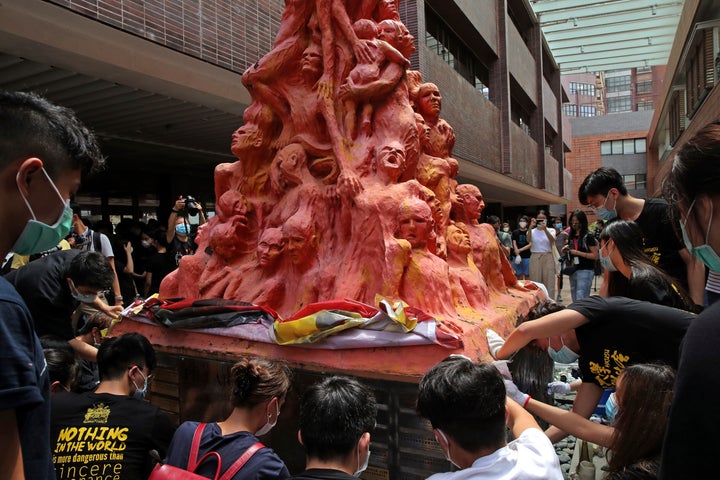
University students clean the "Pillar of Shame" statue, a memorial for those killed in the 1989 Tiananmen crackdown, at the U


University students clean the “Pillar of Shame” statue, a memorial for those killed in the 1989 Tiananmen crackdown, at the University of Hong Kong, on June 4, 2020. 

Beijing began pushing for the anthem law after Hong Kong soccer fans jeered the national anthem at international matches in 2015. As anti-government protests engulfed Hong Kong last year, thousands of fans booed loudly and turned their backs when the anthem was played at a World Cup qualifier match against Iran in September. FIFA later fined the Hong Kong Football Association over the incident.

The legislative session on Thursday coincided with the 31st anniversary of China’s bloody crackdown on pro-democracy protests in Beijing’s Tiananmen Square.

Before debate began, pro-democracy lawmakers stood in silence to mark the anniversary and put up signs on their desks that said “Do not forget June 4, the hearts of the people will not die.”


Source link

Research shows impact of Covid-19 on mental health in North

The study found that 30 per cent in Northern Ireland were displaying symptoms of anxiety

One-third of people in Northern Ireland are showing signs of depression as a result of the pandemic, new research shows.

During a recent month-long study, researchers from Queen’s University Belfast (QUB) also found another 30 per cent were displaying symptoms of anxiety, while one in five met the criteria for post-traumatic stress disorder (PTSD).

The survey of 470 individuals which was carried out during the lockdown was led by Prof Chérie Armour and researchers from the Stress, Trauma and Research Conditions (STARC) research lab at QUB.

Commenting on the findings, Prof Armour said the rates of self-reported anxiety, depression, and Covid-19-related symptoms during the first month of lockdown were “quite striking”.

“They are comparable yet slightly higher than the rates reported in United Kingdom [UK] studies,” she added.

“This is understandable since Northern Ireland has previously reported a 25 per cent higher prevalence of mental ill health compared to England and our results have shown those with pre-existing mental health conditions are most at risk.”

To investigate the impact the Covid-19 outbreak was having on mental health in the North, the STARC research team collected data via an online survey of more than 2,500 people across the UK, including 470 from the North.

It is the largest data collection exercise on Covid-19-related mental health in the North to date.

Results revealed that the groups most at risk from suffering poor mental health were those with pre-existing mental health conditions, key workers, those who consumed a high volume of Covid-19-related information via the media, younger people, and those who were highly concerned about infection.

Researchers also found that almost three-quarters (72%) of participants stated that they were highly concerned about the ability of the health service to care for Covid-19 patients if the situation was to worsen, while 49 per cent expressed concerns regarding the British Government’s ability to manage the crisis.

One in two reported concerns about the financial implications of the outbreak and one in five (21%) said they knew someone who had been diagnosed with the virus.

Only two people, however, reported having been diagnosed themselves; while 68 per cent of respondents who were non-keyworkers said they were self-isolating.

“Given the pressure on keyworkers during these uncertain times we expected to find that being a keyworker would increase the risk for mental health outcomes and the data supports this,” added Prof Armour.

“Other groups such as younger people were also shown to be at risk. Government bodies, mental health support organisations and relevant decision-makers must be mindful of these at-risk and potentially hard to reach groups when managing the Covid-19 response.”

“Based on the figures reported in this study related to mental ill health during lockdown and our understanding that many people may be experiencing psychological distress but not meet the criteria for mental ill health currently, funding should be provided for an uplift to the mental health workforce to support the potential influx of individuals needing mental health support.”

peter.doyle@imt.ie

Source link