New York hospital staff applaud George Floyd protesters, who shout back “Thank you”

Protesters demonstrating against the death of George Floyd and hospital workers still battling the COVID-19 pandemic expressed their mutual admiration on the streets of New York City on Tuesday.

A video posted to Twitter shows a crowd of nurses and doctors in personal protective equipment gathered outside a hospital, which appears to be a location of NYU Langone Health, cheering as a group of protesters pass through the street. Many of the protesters, almost all wearing face masks, can be seen cheering the hospital workers in return, with some shouting “thank you.”

Newsweek reached out to NYU Langone Health for comment. This article will be updated with any response.

Not long ago, a large number of New York residents gathered outside their homes to cheer in support of health care workers, who have been under unprecedented strain due to the pandemic.


A large group of demonstrators gather at New York City’s Foley Square to protest the killing of George Floyd on June 2, 2020.
Ira L. Black/Corbis/Getty

Protesters are seeking justice in May 25 death of Floyd, a black man who died in Minneapolis, Minnesota after a white police officer kneeled on his neck for an extended period while ignoring his calls for help. Demonstrations grew throughout the U.S. and around the world after viral video of the killing sparked widespread outrage.

Health care workers have cheered on protesters in multiple locations, with New York’s Memorial Sloan Kettering Cancer Center the site of one gathering on Tuesday. Another video posted to Twitter shows a group of nurses outside Washington, D.C.’s Howard University Hospital applauding passing protesters on Saturday.

Medical professionals standing outside New York’s Mount Sinai West and Houston’s Texas Medical Center showed their support by observing 8 minutes and 45 seconds of silence—the amount of time former police officer Derek Chauvin had his knee pressed against Floyd’s neck, according to the criminal complaint charging Chauvin with Floyd’s murder and manslaughter.

In addition to offering their collective support, some hospital staff members have reportedly followed up long shifts caring for COVID-19 patients by traveling directly to demonstrations to aid protesters injured by police tear gas or rubber bullets. Others have offered online medical advice for protesters.

Several leading organizations representing the U.S. medical community have suggested Floyd’s killing was the product of a public health crisis brought on by racism and police brutality. The American Medical Association (AMA), the largest group representing doctors, was one of many to recently condemn the killing and express support for racial justice.

“Excessive police force is a communal violence that significantly drives unnecessary and costly injury, and premature morbidity and death,” AMA President Dr. Patrice Harris and Board Chair Dr. Jesse Ehrenfeld said in a statement on Friday. “Our country—our society—demands more.”

Source link

How can we reimagine the arts post-Covid when we’re all so bone-achingly tired? | Zohar Spatz

I

read my children a book called Have You Filled A Bucket Today? almost every night. Carol McCloud’s book is one of my family’s favourites and teaches us how easy and rewarding it is to fill someone’s “bucket” with kindness, positivity and love.

The Covid-19 crisis has made me deeply conscious that as an arts leader, I need to be a bucket-filler within my workplace, my sector and my community.

People need hope.

I’ve spent the past few months working with my colleagues and peers to dream up a whole new vision of what my theatre company, La Boite, and the broader arts and entertainment industry, could be. I’m planning contingencies to cover every possible situation for my organisation and my industry, all the way from plan A to plan Z. In my head, I’m playing out 10 different scenarios concurrently, without knowing which one I will ultimately run with to keep the company, and the industry, alive.

And you know what? I’m tired. Bone-achingly tired. My own bucket is empty.

The constantly shifting sands that underscored the early stages of this pandemic have stilled. Yet the fear, the adrenaline and the sense of not knowing continue to dominate every aspect of my life, and the lives of everyone who operates in this sector.

We’re all spent and having our own little meltdowns behind closed doors.

We struggle and juggle and try to manage the overwhelming exhaustion and chaos of the unknown that lies before us, and to somehow find some space in it all to be imaginative and revolutionary.

People who work in the arts are deeply empathetic, it’s one of our most powerful tools in this job. Collectively, we need to mobilise that empathy to honour our very real moral duty and care for the artists and the arts community.

But we were dealt a debilitating body-blow at the very beginning of this pandemic; a stinging reminder of how poorly represented the arts is as a sector and how devalued we are as artists, creators and bloody hard workers.

It is demoralising, particularly when the arts community has a long and demonstrated history of springing into action during times of crisis.

Artists are quick to lend support at every opportunity, to advocate, raise awareness and spearhead fundraising endeavours when our audiences are devastated by the likes of natural disasters, tragedy and personal or financial setbacks.

Yet, unlike so many other industries, the current crisis facing our sector doesn’t have an end date or a three-stage action plan. However, if we don’t allow ourselves the time and space away from the chaos, we’ll miss the opportunity to explore and create what the new future should look like.

A scene from La Boite and Dead Puppet Society’s production of Laser Beak Man. Photograph: Dylan Evans Photography/Brisbane festival

The situation for the arts before Covid-19 was hardly stable or ideal. This pandemic has given arts leaders a huge opportunity to reflect and initiate sector-wide change. It has forced us to re-evaluate, reset and recreate an industry, not just so it can survive, but so it can thrive.

The arts sector needs big ideas and out-of-the-box thinking. But we’re not going to find the space for creation, imagination and innovation while we’re exhausted, depleted and operating in survival mode.

We can’t create anything when every ounce of our energy is expended on simple survival and we need the courage to carve out space for that. We need freedom and stillness for imagination to take over.

Transformation, and art itself, requires risk-taking, exploring the unknown and experimentation.

I keep hearing the word “resilience” bandied around. To build a resilient arts sector – and in my specific and immediate circumstances, a resilient theatre company – I need to first rest, recover, find my resolve and reconnect.

It’s OK to stop for a bit. It’s OK to read a children’s book every night. It’s OK to turn your phone off for a week if that’s what you need to do. Sometimes I need to be told that, too. It’s not weak to rest: it’s necessary in order to be strong, and to find space within the heavy load of chaos and exhaustion to be imaginative. 

So I’m going to take a page from my children’s book and keep my own bucket topped up.

Yes, I’m trying to fix a broken system, keep a theatre company afloat, look after my family and lead my community but I will fill my bucket with positivity and hope. I am privileged to work in a sector, for a company and with people I admire and respect deeply. I am grounded by a loving family and network of friends, and I have a rare opportunity to lead audacious change.

If I wasn’t this exhausted, I’d be worried.

• Zohar Spatz is the executive director of Queensland’s La Boite Theatre Company

Source link

Australia’s GDP falls 0.3 per cent as COVID-19 economic damage looms

Australia’s economy contracted 0.3 per cent in the March quarter, according to official figures that mostly predate the economic damage from the COVID-19 lockdowns.

Gross domestic product grew just 1.4 per cent in the 12 months to March 31 as the economy took a hit from the bushfires and the beginning of the coronavirus crisis, the Australian Bureau of Statistics said today.

“This was the slowest through-the-year growth since September 2009 when Australia was in the midst of the global financial crisis and captures just the beginning of the expected economic effects of COVID-19,” ABS chief economist Bruce Hockman said.

Public demand contributed 0.3 per cent percentage points to GDP, driven by a 1.8 per cent rise in public spending as governments responded to the bushfires and the COVID-19 pandemic.

Private demand subtracted 0.8 percentage points from GDP, driven mostly by a 1.1 per cent fall in household spending as air transport stopped and hotels, cafes and restaurants closed.

Source by [author_name]

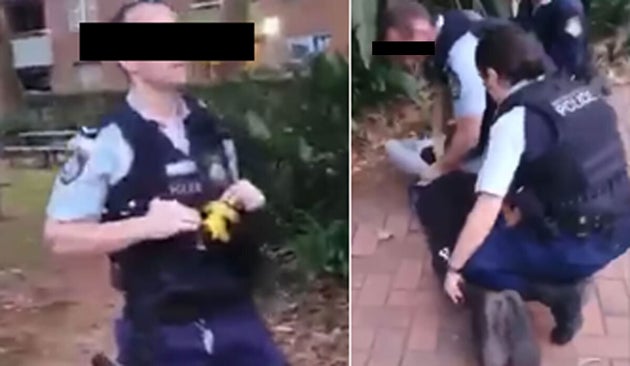
NSW Police Boss Says Officer Who Slammed Indigenous Teen To The Ground ‘Had A Bad Day’

The New South Wales Police Commissioner said an officer that kicked the legs of an Indigenous teenager and slammed him to get ground “had a bad day.” 

Viral video of a white junior constable, who is now under review, shows the officer using force to arrest a 17-year-old in the inner-city Sydney suburb of Surry Hills.

Speaking on 2GB radio on Tuesday, Commissioner Mick Fuller said the police could have “handled the situation better” but the officer, to his knowledge, has not had prior blemishes against his name.  

“The fact that this officer doesn’t have a chequered history and he’s been in for three and a half years,” he said. 

“You would have to say he’s had a bad day and I’m sure most of the community wouldn’t want to see someone sacked after making such a commitment to the community.”

The filmed incident happened on Monday and resulted in the teen being placed in holding cells at Surry Hills Station before he was taken to St Vincent’s Hospital via ambulance.  

The police officer has been placed on restricted duties and is being internally investigated by the Professional Standards Command, police told HuffPost Australia. 

New South Wales Premier Gladys Berejiklian on Wednesday weighed in on the footage saying “we still have a long way to go.”

“What happened in the US is a good wake-up call for all of us, and I think that all of us have our hearts breaking as to what’s happening in the United States,” Berejiklian added. 

“And we have to ensure that we can do what we can in our own country to protect all of our citizens.” 

The teen’s sister told Triple J’s Hack radio show on Tuesday the footage made her angry. 

“To see my brother treated like that, to have his liberty taken away from him. It’s upsetting,” she said.   

Since George Floyd, a Black man, died in Minnesota after a white police officer knelt on his neck for more than eight minutes, cities across the US and world have protested against police brutality and racial inequality. 

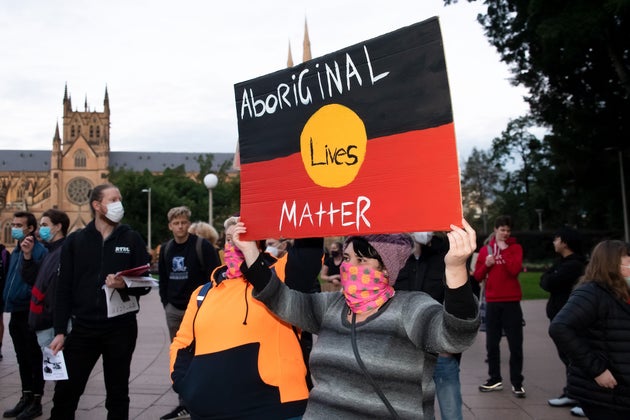
A Black Lives Matter protest in Sydney saw a turnout of thousands on Tuesday, as Australians rallied in solidarity with protesters in the US but also to raise awareness of Australia’s own history with police killings. 

The Guardian’s special 2018 Deaths Inside report used 10 years of coronial data to find that 407 Indigenous Australians had died in police care since the end of 1991’s royal commission.


Source by [author_name]

Hackers and hucksters reinvigorate ‘Anonymous’ brand amid protests

0

SAN FRANCISCO (Reuters) – The amorphous internet activist movement known as Anonymous staged an online resurgence in the past week on the back of real-world protests against police brutality.

A man wears an “anonymous” mask on the fourth and final day of the Firefly Music Festival in Dover, Delaware U.S., June 17, 2018. REUTERS/Mark Makela

Born from internet chat boards more than a dozen years ago, the collective was once known for organizing low-skill but effective denial-of-service attacks that temporarily shut down access to payment processors that had stopped handling donations to the anti-secrecy site WikiLeaks.

But accounts using variations of the Anonymous name recently claimed credit for temporarily knocking a Minneapolis police website offline and, inaccurately, for hacking police passwords.

At the same time, millions of Twitter accounts began following longstanding Anonymous posters and retweeting them, helping boost Anonymous into Twitter’s Trending column and greater attention. Many of the boosted tweets opposed police actions, defended Black Lives Matter or faulted President Donald Trump.

It is unclear who or what is driving the resurgence, and exactly why. McGill University anthropology professor Gabriella Coleman, who wrote a book on Anonymous, said she was told by insiders that some key figures from a decade ago are involved and they are being assisted by mechanical amplification.

“The ability to create so many new accounts is classic Anonymous social-technological hacking,” Coleman said. “It’s low-hanging fruit.”

Even one of the heavily boosted old accounts, YourAnonNews, tweeted that it had no idea what was going on. It experimented by tweeting nonsense and asking not to be retweeted, only to see those tweets repeated hundreds of thousands of times.

A Twitter spokeswoman said the company had seen no evidence of “substantial coordinated activity” among longstanding Anonymous accounts, but deleted one spammy new one brought to its attention by a researcher Tuesday.

“We have seen a few accounts change their profile names, photos, etc. in an attempt to visibly associate with the group and gain followers,” said Twitter spokeswoman Liz Kelley.

Anyone can call themselves a member of Anonymous and adopt its Guy Fawkes mask, other imagery and slogans, such as “we are legion.” It has no acknowledged leaders, making it more of a brand than an ordinary assemblage.

One account with 120,000 followers, AnonNewz, had deleted all prior tweets before June 1, when it started promoting protests. But it had neglected to delete its old “likes,” which were about Korean pop music, and it had interacted in the past with other K-pop fans touting giveaways.

After researcher Marcus Hutchins of cybersecurity company Kryptos Logic tweeted about the account, Twitter suspended it.

Twitter told Reuters it removed AnonNewz for “spam and coordination with other spammy accounts.”

Reporting by Joseph Menn; Editing by Greg Mitchell and Leslie Adler

Source link

The Funniest Tweets From Parents This Week

We’re here to guide you through the coronavirus lockdown. Check out HuffPost LIFE for daily tips, advice, how-tos and escapism.

Kids may say the darndest things, but parentstweet about them in the funniest ways. So each week we round up the most hilarious quips via Twitter from mums and dads to spread the joy.

Scroll down to read the latest batch, and follow @HuffPostParents on Twitter for more!


Source by [author_name]

Record coronavirus daily death toll in Brazil: Live updates

Hello and welcome to Al Jazeera’s continuing coverage of the coronavirus pandemic. I’m Kate Mayberry in Kuala Lumpur. 

  • Brazil reported 1,262 deaths from COVID-19 in the 24 hours to Tuesday night, another daily record.

  • South Africa has said it has taken note of a High Court judgement declaring its coronavirus restrictions unconstitutional and is studying the judgement. The lockdown will remain in force for now.

  • More than 6.3 million coronavirus cases have been confirmed around the world, according to data from Johns Hopkins University. More than 378,000 people have died, including more than 106,000 in the US. More than 2.7 million have recovered from the disease.

Here are the latest updates:

Wednesday, June 3

02:00 GMT – UK government says traveller quarantine crucial to stop second wave

The UK government says the 14-day traveller quarantine it plans to introduce on June 8 is crucial to stop a second wave of coronavirus hitting the country.

Home Minister Priti Patel and Transport Minister Grant Shapps confirmed the plan – despite criticism from airlines, business groups and some members of their own party – in an article published in the Daily Telegraph late on Tuesday.

The two ministers said travel details and contact information would need to be provided, and there would be spot checks and fines to ensure compliance. There had been a lot of “misinformed speculation” about the measures, they added.

The quarantine will apply to all international arrivals including citizens. The UK has the most deaths in the world from coronavirus, after the United States.

International arrivals at London’s Heathrow Airport last month. From June 8, all travellers from overseas including British citizens will have to complete a 14-day quarantine [Toby Melville/Reuters] 

01:25 GMT – Malaysia locks down housing estate near Kuala Lumpur airport

Malaysia has imposed a “semi-enhanced” lockdown in two housing estates near the Kuala Lumpur International Airport (KLIA), according to Malaysiakini.

The two housing areas are surrounded by razor wire and the local health authorities will screen all residents for COVID-19 by Friday.  

Malaysiakini said the move was believed to be linked to a cluster of 28 coronavirus cases among cleaners working at KLIA.

01:05 GMT – Bolivia feels coronavirus strain as cases exceed 10,000

Authorities in Bolivia are making door-to-door checks in regions with severe coronavirus outbreaks to try and stem the spread of COVID-19.

The landlocked country registered its first novel coronavirus cases on March 10, and until May 21 had reached 5,000 cases. That number has since doubled, government data shows.

More on that story here.

00:00 GMT – Brazil sets another daily record for coronavirus deaths

Some 1,262 people in Brazil died from coronavirus in the 24 hours to Tuesday evening, the country’s Health Ministry said.

It’s another daily record for the South American country where the outbreak shows no sign of slowing down.

Brazil also confirmed 28,936 additional cases of the disease, bringing the total to 555,383. A total of 31,199 people in Brazil have died from coronavirus.

COVID-19 began in the country’s wealthy neighbourhoods and large cities where there were links with international travellers, but the virus is now making its way to poorer and more isolated areas to devastating effect. You can read more on that here.

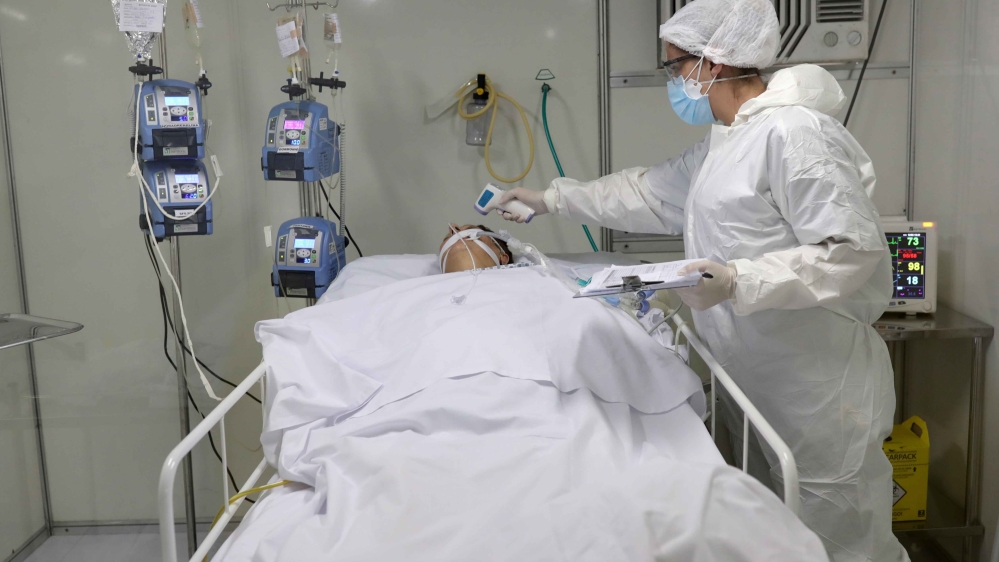
Brazil Hospital

A patient being treated for coronavirus in the intensive care unit (ICU) of a field hospital in Guarulhos, Sao Paulo state, Brazil [Amanda Perobelli/Reuters] 

23:30 GMT (Tuesday) – Lancet raises new questions about hydroxychloroquine study

The Lancet has commissioned an independent audit of the data behind a study it published last month that found hydroxycholorquine increased the risk of death in COVID-19 patients.

The May 22 study was based on data provided by healthcare analytics firm Surgisphere and not a traditional clinical trial that would have compared hydroxychloroquine to a placebo or other medicine.

The editors of the British medical journal said serious scientific questions had been brought to their attention.

Several clinical trials into the use of the drug, including one by the World Health Organization, were suspended after the paper was published. Hydroxychloroquine is usually prescribed for illnesses such as malaria or lupus, but has been trumpeted as a COVID-19 treatment by US President Donald Trump and other right-wing leaders.

—-

Read all the updates from yesterday (June 1) here.


SOURCE:
Al Jazeera and news agencies


Source link

Zuckerberg Says Trump’s Inflammatory Facebook Post Doesn’t Incite Harm: Report

Facebook CEO Mark Zuckerberg once again defended his decision to let an incendiary post by President Donald Trump stay up on his platform, saying on a staff-wide call leaked to the press that his post suggesting looters would be shot was not inciting violence.

Zuckerberg held the call after employees staged a virtual walkout after his decision to leave up Trump’s post from last week, which called police brutality protesters “THUGS” and warned, “when the looting starts, the shooting starts.”

In a call with about 25,000 employees Tuesday, according to ReCode, Zuckerberg said the company looked into the phrase Trump used and found it didn’t call for people to attack protesters and therefore did not violate the company’s policies.  

“We basically concluded after the research and after everything I’ve read and all the different folks that I’ve talked to that the reference is clearly to aggressive policing — maybe excessive policing — but it has no history of being read as a dog whistle for vigilante supporters to take justice into their own hands,” he said on the call, which was also leaked to Bloomberg News.

Facebook did not immediately return HuffPost’s request for comment on the call.  

The phrase in question, “When the looting starts, the shooting starts,” originated with a combative Miami police chief during the height of civil rights protests in the 1960s. He uttered the threat while trashing the young, largely Black, people involved in the movement, saying his officers “don’t mind being accused of police brutality.” Trump has denied that repeating the language was a threat and says he was “misunderstood.”

Zuckerberg issued a lengthy statement last week saying that, although “the post had a troubling historical reference, we decided to leave it up because the National Guard references meant we read it as a warning about state action, and we think people need to know if the government is planning to deploy force.”

Civil rights activists have denounced the innocent interpretation, and several of them issued a joint statement saying Zuckerberg “is setting a very dangerous precedent for other voices who would say similar harmful things on Facebook.”

The decision has also outraged several Facebook employees, one of whom reportedly challenged Zuckerberg on Tuesday’s call to say how many Black people were involved in the decision. He answered that there was one, global diversity officer Maxine Williams, among about six people who made the final call.  

At least one Facebook employee, an engineer who worked to stop the spread of misinformation on the platform, has resigned in response to Zuckerberg’s stance on Trump’s post. 

Twitter has set itself apart from Facebook by flagging Trump’s post, which he also posted to that platform, by marking it with a warning that it is “glorifying violence.” In order to see the post, users have to click through and remove the warning. Trump claimed the move suppressed his free speech and soon thereafter signed an executive order weakening legal protections for social media companies. But without congressional approval to regulate tech companies, the policy is likely unenforceable. 


Source by [author_name]

When Did Instagram Go Dark?

Jamila Thomas and Brianna Agyemang, two black women who work in music marketing, proposed that the music industry hold a day of reflection on Tuesday after the death of George Floyd.

But what began as a targeted effort quickly morphed into the sea of black boxes you see on Instagram and other social platforms under the banner #blackouttuesday, posted by creatives, musicians, brands and everyday individuals who wanted to show solidarity for racial justice.

While some vowed to “mute” themselves online for the rest of the day, or week, as part of the blackout, others voiced concern that silence was not the answer, and that the use of the hashtag #blacklivesmatter in the posts was doing more harm than good, drowning out other postings under the same slogan. By afternoon, many were deleting their posts.

At Styles, we spend a lot of our days chatting with each other about things we see online, trying to make sense of it all. Here, four women of color — Jasmine Howard, an operations manager; Tariro Mzezewa, a travel reporter; Lindsey Underwood, a Styles editor; and Caity Weaver, a Styles reporter — talk about the blackout on Instagram.

Lindsey: I don’t post on Instagram often, but today I felt a pull to post. My feed was flooded with black squares, but I just couldn’t pull the trigger. I felt conflicted about seeing so many of my white friends — who may have great intentions — posting the blackout. I just imagine some level of satisfaction they may feel that they “spoke out,” but I’m not sure what it really accomplishes.

Jasmine: I think most of them feel they should, or have to, so they’re not singled out for being the only ones not posting.

Tariro: We’ve all seen performative and insincere allyship in the days since George Floyd died in police custody, and some of us may come at something like this with some degree of skepticism.

I think it’s great that people want a visual uniting symbol of solidarity, but I can also see how people who haven’t said a word in the past — or in the past week — feel like they’ll look bad to their followers if they don’t post. So they post, but with no real intention of listening, learning, donating, protesting or helping beyond the post. The post makes them feel like they’ve done their part.

Jasmine: I’ve seen a few posts where I’m like, “I would’ve rather you’d done nothing.”

Tariro: Yes! You say you’re posting to not take up space, but you’re still taking up space. Might as well use that to share resources and info, no?

Jasmine: Definitely — I’ve also gotten a lot of “I love you” or “tell me how to be better” texts from white friends attempting to be allies. Some of it seems sent with the expectation that I will immediately respond and acknowledge that they’ve made the effort and checked on their black friend. It’s still asking me to do the work.

Caity: My initial reaction was: This feels sort of empty. A couple of my black friends posted the squares, but the vast majority of people who did it on my feeds were white. Non-black people of color seemed to be split.

I started texting with a few friends — some black, some other POC — and the reaction from them, and from a lot of black people I follow on social media and whose judgment I tend to trust, was that they didn’t like the squares. But! Jasmine is also someone whose judgment I trust, who is vocal about activism on Instagram, and she posted a square. So I am eager to hear all her thoughts on it.

Jasmine: One friend flat out told me she’s happy I still love her.

Tariro: It feels like it’s a way for white people who aren’t comfortable talking about racism to avoid doing so entirely, while acting like they are doing something. Instead of having to confront this thing that makes you so uncomfortable, you can now post a square and feel like you did something.

Caity: I think it all gets back to meaning well versus doing well.

I have a white friend who, on Monday, posted videos of herself at a protest and shared information and links about activism in her Instagram Stories. It’s not her usual tone on Instagram. And I was genuinely touched by it. It made me feel happy and supported and loved.

(And she wasn’t tagging her black friends in these posts, mind.)

Early in the day I checked to see if she had done a black square post, and she hadn’t. So I sent her a note to say that I really appreciated all the other stuff she was doing, and to let her know, just in case she was wondering about it, that I personally was not loving the black squares. I wanted to make it clear her other actions mattered more to me.

I have felt overwhelmed by the news but also invigorated by all the people sharing ways to be helpful. To have huge black voids suddenly appear on Instagram was jarring. I don’t begrudge any black person, especially, posting the black box. Cardi B posted one, and she’s a super-vocal advocate.

Her account also highlights what I perceive as one of the flaws. She posted the box on her main feed and later uploaded an Instagram Story where she apologized for breaking the blackout to share information about voting in primary elections. And it’s like, oh, Cardi, please don’t apologize!

Tariro: I think that might be the only thing I’ve posted: someone else’s post urging people to vote. Also, guys, BRANDS! Brands love the square!

Caity: I love holding brands accountable financially. I’m glad record companies are making donations today. But also: I don’t look to brands for inspiration, news or guidance.

Gene Demby from NPR has been doing a Twitter thread of brands’ well-meaning but often tone-deaf responses. Seeing them in aggregate is surreal.

Did we need to hear this from a Garfield-themed food app?

Jasmine: LOL, we definitely did not. Also, WHERE HAVE YOU ALL BEEN THE LAST 60 YEARS?! Like, Land O’Lakes just took the Native woman off of their packaging. The Cleveland Indians are still the Cleveland Indians. So much wrong and you all think one black square makes you Malcolm X.

Caity: One brand that is actually helpful is Ben & Jerry’s. They are doing things like reminding voters in Montana to apply to vote by mail. They are not posting platitudes.

Tariro: I did a casual scroll-through some of my favorite beauty and clothing companies’ Instagrams yesterday. Crickets for a week. Today, the square. I always try to buy from black businesses, but I do think this has really made it a priority for me.

Caity: Yes! And in a month, I will still feel positively toward Ben & Jerry’s. I will not remember that a makeup brand posted a black square. Because Ben & Jerry’s is putting in the work regularly and not making a huge deal about it. I think people are rushing to seem profound, to show how deeply they are affected right now. But, really, the best thing for a brand to do is to throw money at important causes.

Tariro: Use that money and donate more than $50, brands.

Jasmine: Just pay.

Caity: Pay!

Jasmine: That’s really all any of them can do for us anyway. That’s why I post places to donate.

Caity: Look at it this way: You are paying for the pass that allows you to say nothing. This is your awkward-statement-avoidance tax.

(This conversation has been edited.)


Source link

JAY-Z Buys Full-Page Ads Across the U.S. in Dedication to George Floyd


JAY-Z Buys Full-Page Ads Across the U.S. in Dedication to George Floyd | Entertainment Tonight


Source link