Experts fear Yemen could suffer one of the world’s worst coronavirus outbreaks

0

The cuts came after UN appeals for $2.42 billion in funding fell short by about 50% this week.

“In the countdown to closure there will have to be much wider cuts to Yemen at a time when the country is now facing the growing impact of the virus pandemic on people who are already badly malnourished and ill equipped to cope with it,” Lise Grande, the head of the UN’s Office for the Coordination of Humanitarian Affairs told CNN, in a phone call from Sana’a on Wednesday, the capital of the divided nation.

“General health services in 189 of the country’s 369 hospitals start to close in three weeks. Water and sanitation services for 8.5 million people, including 3 million children, close in three weeks. Nutrition support for 2.5 million malnourished starving children will start to close in eight to 10 weeks,” she warned.

On Tuesday this week donors pledged $1.35 billion of the $2.42 billion the UN said Yemen needed in a virtual conference. “The worst-case scenario — which is the one we’re facing now — means that the death toll from the virus could exceed the combined toll of war, disease and hunger over the last five years [in Yemen],” Grande told CNN.

According to Armed Conflict Location and Event Data Project, just over 112,000 people have been killed in Yemen’s civil war over five years — among the dead are 12,690 civilians.

Estimates for the numbers of people who have died from disease and malnutrition in the country have varied widely. But the UN and other aid organizations are delivering humanitarian assistance to 10 million Yemenis. A cholera epidemic has, the UN believes, already infected 110,000 people this year.

Four out of five Yemenis need “lifesaving aid,” UN Secretary-General Antonio Guterres said at the conference on Tuesday, adding that Yemen faced one of the highest death tolls in the world from Covid-19. The country has a negligible capacity to test for coronavirus but medical aid agencies also believe the scale of infections could be vast.

This week health services for women giving birth in 150 hospitals supported by the UN were closed in the first wave of the cuts after the funding conference.

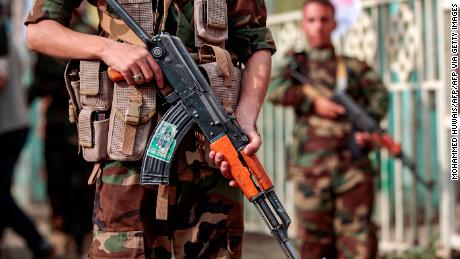
Yemen’s five-year civil war has pitted Houthi rebels against the internationally recognized government, which has been backed by the UAE and Saudi Arabia.

Earlier this year the Emiratis pulled their military out of the conflict but continues to back the government, which is in exile in Saudi Arabia. Riyadh, meanwhile, has continued to back and fund tribal militias and its air force has had a punishing effect on the ground.
Much of the shortfall in new funding is being blamed on the apparent failure of Saudi Arabia, the United Arab Emirates and Kuwait to come forward with a combined pledge which, in previous years, has been for about $1.5 billion. This year the UAE and Kuwait did not offer any funds to the UN effort and Saudi Arabia offered $500 million of which $300 million was to be earmarked specifically for the UN.

Saudi Arabia has been keen to get out of the quicksand since late last year. The war has undermined support for Saudi Arabia in Washington, where renewed arms supplies to the Kingdom from the US have only been possible as a result of the Trump administration’s use of emergency powers to get around a block on arms exports to Saudi Arabia imposed by Congress.

Some diplomats believe that the cut in funding to the UN by Gulf countries may be, in part, an attempt to force the Houthis to peace talks.

Aid to areas under Houthi control has frequently been diverted and manipulated by the rebel administration in Sanaa. The UN’s World Food Programme has frequently complained about the Houthis’ diversion of food — and the US cut funding to the program to force improvement.

The US support, $225 million, to the WFP was only returned recently after the Houthis agreed to stop aid workers from being harassed and a wide range of “taxes” on aid coming into the area under their control.

Saudi Arabia and the UAE say they want to continue to help Yemen with aid — but insist it should not be diverted to the Houthi war effort. In the Emirates it is understood that the government is trying to find ways to continue to fund aid operations.

“The UAE has spared no effort in providing medical assistance to support countries affected by Covid-19 by cooperating with international organizations, wherein UAE assistance amounted to $135 million from the beginning of March until the end of May,” Reem al Hashimy, the Emirati minister for international cooperation said in a statement to CNN.

“Moreover, the UAE Red Crescent continues to work in Yemen to provide a helping hand to our Yemeni brothers, and we deeply regret the loss of two of its staff killed by terrorists in March. However, this will not deter us from delivering upon our mission and humanitarian duty,” al Hashimy added.

But it is not clear to UN officials how that “duty” can be fulfilled while, as one senior UN official put it, “our operations go into near collapse.”

Source link

Astronauts ‘capture the flag’ for SpaceX in race to reach space station

0

“Congratulations SpaceX, you got the flag.”

Just one day after riding SpaceX’s Crew Dragon “Endeavour” to a historic docking with the International Space Station, spacecraft commander Doug Hurley held out a small American flag for the company behind his and fellow NASA astronaut Bob Behnken’s arrival at the orbiting complex.


Source link

COVID-19 latest: Confirmed cases in SA increase by 3 267, total deaths now at 848

It’s day four of Level 3 lockdown and Health Minister Zweli Mkhize warned South Africans who are returning to their workplaces “not to forget basic COVID-19 prevention measures.

He shared two graphics on Twitter showing two ways to prevent the spread of COVID-19 the workplace: By ensuring workplaces are clean and hygienic, and by regularly wiping surfaces and objects with disinfectant.

Image via Twitter: @DrZweliMkhize
covid 19 workplace prevention measures 2
Image via Twitter: @DrZweliMkhize

COVID-19 update: Thursday, 4 June 2020

Health Minister Zweli Mkhize announced on Twitter that the number of COVID-19 cases in South Africa now stands at 40 792; an increase of 3 267 since Wednesday, 3 June 2020.

An additional 56 deaths were reported, bringing the total to 848. Minister Mkhize also confirmed that 21 311 people have recovered from COVID-19. He said:

The recoveries to date are 21 311, this translates to a recovery rate of 52.24%.

Health Minister Zweli Mkhize

Breakdown of new confirmed COVID-19 cases

New cases, deaths and recoveries by province

The confirmed COVID-19 cases per province is as follows:

Province Total Cases Deaths Recoveries
Gauteng 4 845 33 2 222
Western Cape 27 006 651 14 917
KwaZulu Natal 2 869 55 1 260
Free State 322 9 128
Eastern Cape 4 936 95 2 460
Limpopo 206 3 3
Mpumalanga 144 0 86
North West 364 1 59
Northern Cape 95 1 33
Unallocated 5 0 0

Tests and screening

As of today, a total of 820 675 tests have been conducted, of which 34 696 were done in the last 24 hours. The total number of tests conducted in the private sector stands at 402 188, of which 13 886 were done in the last 24 hours.

In addition, 418 487 tests were conducted in the public sector, with 20 810 being done within the last 24 hours.

Global COVID-19 news: Total cases, US protests

At the time of publishing, global figures exceeded 6.6 million confirmed cases – 6 627 331 to be exact – with the death toll now standing at 389 251 and 3 201 016 recoveries.

The USA still has the most confirmed cases as it nears a cumulative of 2 million. Currently: 1 909 472 cases, 109 394 deaths and 690 457 recoveries. The country currently has 16 947 critical cases.

Brazil has the second-most cases, globally, with 590 485 confirmed cases, 32 688 deaths and 266 132 recovered, while Russia has 441 108 confirmed cases, 5 384 deaths and 2016 623 recoveries.

Sweden’s COVID-19 strategy

In other news, experts are questioning whether Sweden’s COVID-19 strategy backfired. Sweden’s chief epidemiologist, Anders Tegnell, acknowledged the county’s high death toll. .

According to Statista, Tegnell said during a radio interview that if they had to encounter the same disease again, they’d need to change the strategy a bit:

“Knowing exactly what we know about it today, I think we would settle on doing something in between what Sweden did and what the rest of the world has done.”

‘The situation is still serious’

The latest data from Johns Hopkins University shows that as of 1 June 2020, Sweden had 43.24 deaths per 100 000 of its population, while Denmark and Finland recorded less than 10 deaths per 100 000 inhabitants.

Minister for Financial Markets Per Bolund said on Thursday that Sweden will provide free testing for anyone showing COVID-19 symptoms and conduct contact tracing for those who are infected. Prime Minister Stefan Lofven added:

“The situation is still serious. This announcement doesn’t mean that the danger has passed. It doesn’t mean life returns to normal.”

covid-19 sweden
Image via Statista


Source link

‘The president has clearly forgotten how it actually happened’: John Kelly defends Mattis

The Trump administration and U.S. Park Police have denied using tear gas despite evidence that it was, in fact, deployed.

“Donald Trump is the first president in my lifetime who does not try to unite the American people — does not even pretend to try. Instead he tries to divide us,” Mattis said in the statement, which also chastised military officials for taking part in Trump’s church photo-op. “We are witnessing the consequences of three years of this deliberate effort. We are witnessing the consequences of three years without mature leadership.”

Trump responded on Twitter later Wednesday night, claiming he asked for Mattis’ letter of resignation and labeling the retired Marine Corps general “the world’s most overrated General.”

“The president did not fire him. He did not ask for his resignation,” Kelly, who was Trump’s chief of staff when Mattis departed the administration, told the Washington Post. “The president has clearly forgotten how it actually happened or is confused.”

Trump on Thursday evening again tweeted that he’d fired Mattis, and laid into Kelly.

“John Kelly didn’t know I was going to fire James Mattis, nor did he have any knowledge of my asking for a letter of resignation,” he wrote in a two-part post. “Why would I tell him, he was not … in my inner-circle, was totally exhausted by the job, and in the end just slinked away into obscurity. They all want to come back for a piece of the limelight!“

In December 2018, Mattis resigned while citing differences in views with Trump. The move coincided with Trump’s announcement that the U.S. would withdraw nearly all of its military forces from Syria. Trump then appointed Patrick Shanahan acting secretary of Defense on Jan. 1, 2019, cutting Mattis’ tenure short by two months.

While Wednesday’s statement marks the first time Mattis has spoken out publicly against the president, Kelly delivered sharp criticism of Trump in February. The Atlantic reported that Kelly defended Lt. Col. Alexander Vindman, a key figure in Trump’s impeachment who was removed from the White House, while also diverging from the president’s disparaging comments on migrants.

Kelly and Mattis, both retired four-star Marine Corps generals, were subjects of early infatuation for Trump, who bragged often about stocking his initial cabinet with military brass. The president has since soured on the two generals, both of whom have broken with the president on high-profile issues since departing the administration.


Source link

George Floyd’s life honored at memorial service in Minneapolis

The memorial service was held at North Central University in Minneapolis. Floyd was killed on May 25 after a Minneapolis police officer knelt on his neck.


Source link

Didiza must investigate ‘paralysed’ Ingonyama Trust Board – Parliament – The Mail & Guardian

Parliament wants the land reform department to investigate the labour disputes that have “paralysed” the Ingonyama Trust Board and come up with a solution within three months.

Parliament’s agriculture, land reform and rural development committee wants Minister Thoko Didiza to continue to hold back R22-million in funding until the board presents plans that will materially benefit people living on land falling under its control.

The committee also wants the board to amend its budget – which was submitted late after key staff were put on special leave – to reflect programmes aimed at benefiting people living on land under its jurisdiction.

The committee made these recommendations in its report on the department’s 2020-2021 budget, which was submitted to Parliament this week. 

Once the report is adopted by the National Assembly, it will go to Didiza, who must respond to its recommendations within three months.

Earlier this year, board chairperson Jerome Ngwenya placed the board’s chief executive officer, Lucas Mkhwanazi, chief finance officer Amin Mia and four other executives on special leave. 

Seven other staff have been on paid special leave since 2018. The group went to the labour court this month to force Ngwenya, who had stopped their salaries, to pay them.

The board was set up to administer more than 2.8-million hectares of land in KwaZulu-Natal, which falls under traditional authorities, on behalf of King Goodwill Zwelithini. 

It is also facing a high court challenge to its residential lease programme from residents on board land and nongovernmental organisations, whose date is to be set by the KwaZulu-Natal judge president. A hearing set for late March was abandoned because of the Covid-19 outbreak.

In its report, the parliamentary committee recommended that the board amend its budget to “‘reflect the purpose for which [it] was established”, ensuring that the administration of the land “is for the material benefit to the traditional communities residing on the land in question” and recommended that funding should be held back until there is evidence of this and the board’s “stability and accountability”. 

The department should, it said, investigate the underlying causes of the multiple labour disputes between the board and many of its senior managers, which have paralysed the entity and affected its efficiency. 

A report, including proposed interventions, should be wrapped up in three months.

The committee also noted Didiza’s failure to provide the report by an inter-ministerial committee appointed by President Cyril Ramaphosa to make recommendations on the board’s future. 

Ramaphosa appointed the inter-ministerial body to deal with issues regarding the Ingonyama Trust Board after there was no action on a report of Parliament’s high-level panel, which recommended that it should be reformed or dissolved.

The parliamentary committee noted that there was “no indication of support to communities in line with the [Ingonyama Trust] Act” or for youth, women and people with disabilities.

The board had also failed to develop policies and continued to reflect targets of the 2019 financial year.

“It was, therefore, clear that there was little or no progress with regard to policy formulation by the [board, which] lacks adequate human resources capacity. It also did not indicate plans and targets for filling vacant posts,” the report said.

Ngwenya had not responded to requests for comment from the Mail & Guardian at the time of writing.

Reggie Ngcobo, the spokesperson for Didiza, undertook to comment on the report’s recommendations. He had not done so at the time of publication.


Source link

Everything you need to know about a virtual graduation

The pandemic has stopped a bunch of 2020 plans and among these was the Autumn Graduation. This is the one day students get to celebrate their accomplishments with friends, family and colleagues.

The Autumn Graduation usually takes place from late March into early May, but due to COVID-19, the Autumn Graduation 2020 has been cancelled and in some cases postponed.

This season, graduates across the country will not be able to walk the stage and receive their qualifications in the traditionall ceremony.

These varsities chose virtual route

However, certain universities decided to hold a virtual graduation to celebrate the graduates’ accomplishments.

So far the University of Johannesburg, University of Pretoria, University of The Western Cape, Stellenbosch University and the University of KwaZulu-Natal have conducted virtual graduations and the Durban University of Technology is set to hold their virtual graduation next week.

Here’s what you need to know about virtual graduations.

In absentia

All virtual graduation ceremonies will be conducted “in absentia”. This usually happens when a graduate is unable to attend the ceremony, but due to the national lockdown where large gatherings are prohibited, all graduates will be graduating in absentia by default.

Streamed videos

Universities will be uploading their virtual graduation videos on YouTube and the university website which will be available for students to stream.

Degree certificates made available

The universities will provide graduates with their actual certificates of their qualifications. There will be different options for this, graduates can receive an electronic copy of their certificate or the university can courier the certificates to the graduate’s home.

Actual virtual ceremony

All the formalities of a traditional ceremony will take place whereby the authoritative figures still deliver their speeches. This is the legality of a degree being conferred in a ceremony.

Each university builds on this differently, like the University of KwaZulu-Natal who partnered with SABC3.


Source link

Here Are The Best Sunscreens Of 2020, According To Consumer Reports

0

HuffPost may receive a share from purchases made via links on this page. Prices and availability subject to change.

Sun’s out and so is Consumer Reports’ annual list of the best sunscreens. Hint: The best one that you can actually find online is $8, and it’s on Amazon.

This summer might be different than the ones of yesteryear, but you should still slather on the sunscreen now that the summer is nearly here — even if you’ll mostly be wearing your sunscreen indoors.

But the sun’s not the only thing that’s out these days. Consumer Reports list of the best sunscreens for 2020 is now here, and there are some interesting changes from last year.

Each year, the product testing and review experts at Consumer Reports put top sunscreens to the test to see how they stack up. Consumer Reports only tests water-resistant sunscreens with a listed SPF of at least 30. Their experts are rating sunscreens on three key criteria: SPF (or sun protection factor), variation from SPF and UVA protection. They also consider how the sunscreens smell and feel on the skin.

The Best Spray Sunscreen Of 2020

This year, Consumer Reports rated 53 sunscreens. For the fifth year in a row, Trader Joe’s Spray Sunscreen SPF 50+ topped the list with a perfect score of 100, making it the best spray sunscreen of 2020, according to Consumer Reports.

Unfortunately, it’s not easy to find online. Unless you live near a local Trader Joe’s, you’ll end up paying pretty pricey shipping costs from third parties for a bottle of it.

The Best Lotion Sunscreen Of 2020

Instead, you might turn to the second-highest rated sunscreen this year. Coppertone’s Ultra Guard Sunscreen Lotion SPF 70 received a 94 rating from Consumer Reports this year (same score as last year), and is only $8 at Amazon.

It’s the top-rated lotion sunscreen Consumer Reports tested this year.

Coppertone’s Ultra Guard Lotion SPF 70 is one of Consumer Reports' best sunscreens for 2020. 

Coppertone’s Ultra Guard Lotion SPF 70 is one of Consumer Reports’ best sunscreens for 2020. 

The Coppertone sunscreen received an “excellent” mark on both UVA protection and SPF and a “very good” rating for its variation from SPF (meaning that the listed SPF wasn’t much different from what the SPF showed in testing). Consumer Reports’ rating mentioned that Coppertone’s sunscreen has retinyl palmitate, which pregnant women might want to avoid.

Why Isn’t La Roche-Posay’s Sunscreen On The List?

Interestingly, La Roche-Posay’s Anthelios Melt-In Sunscreen Milk, which has been a Consumer Reports top-rated lotion sunscreen for several years in a row, wasn’t on the list for 2020 sunscreen recommendations.

Some sunscreens —including La Roche-Posay’s Anthelios Melt-In Sunscreen Milk — have been reformulated to remove ingredients such as oxybenzone and octinoxate, according to Trisha Calvo, the deputy health and food editor at Consumer Reports.

Oxybenzone and octinoxate are two controversial sunscreen ingredients that aren’t good for coral reefs. Both Hawaii and Key West, Florida, have already banned the use of sunscreens with the two ingredients.

HuffPost Finds found that Amazon, Ulta and Dermstore now carry an oxybenzone-free version of La Roche-Posay’s Anthelios Melt-In Sunscreen Milk . La Roche-Posay’s website also says the sunscreen is now oxybenzone- and octinoxate-free.

We advise doing your research and skimming the ingredients list before you buy, especially if you’re trying to avoid certain ingredients.

La Roche-Posay said in a statement to HuffPost Finds that the brand decided to reformulate all of its sunscreens that launched before 2016 without oxybenzone. That includes the Anthelios 60 Melt-In Milk Sunscreen. All sunscreens in the Anthelios line are formulated without octinoxate in them, La Roche-Posay said.

“Our highest priority with any reformulation is to ensure that a product is safe, effective and continues to meet our consumers’ expectations for experience and performance,” according to the statement.

As for how the new formula holds up to testing, we might have to wait another year to find out. According to Calvo, Consumer Reports experts couldn’t get their hands on some of the newly formulated sunscreens to test them this year. That’s why you won’t see La Roche-Posay and a few other well-known brands on their 2020 sunscreen buying guide.

One thing that hasn’t changed is the price. La Roche-Posay’s Melt-In Sunscreen Milk remains one of the pricer sunscreens out there at $36 for a 5-ounce bottle and $22 for a 3-ounce one.

More Top-Rated Sunscreens For 2020, Including Mineral And Reef-Safe Sunscreens

<a href="https://fave.co/3gSLMhc" target="_blank" rel="noopener noreferrer">Neutrogena&rsquo;s Beach Defense Water + Sun Protection Spray SPF 70</a>&nbsp;has an "excellent" rating for SPF and is "very good" for&nbsp;UVA protection.&nbsp;

Neutrogena’s Beach Defense Water + Sun Protection Spray SPF 70 has an “excellent” rating for SPF and is “very good” for UVA protection. 

Consumer Reports rated far more lotion sunscreens, saying that “it’s easier to make sure you’re getting adequate coverage with a lotion than with a spray because you can see how much you’re applying.”

Still, if you’re looking for a spray sunscreen, Hawaiian Tropic’s Island Sport Ultra Light Spray SPF 30 and Alba Botanica’s Hawaiian Coconut Clear Spray SPF 50 are among the other top-rated spray sunscreens this year and are available on Amazon.

As for those sunscreens that have the words “mineral” and “natural” on them? Consumer Reports, as it has found in previous years, said that mineral sunscreens don’t perform so well in its tests. If you absolutely insist on a mineral sunscreen, Consumer Reports recommends Badger’s Active Natural Mineral Cream SPF 30 — just keep in mind that Consumer Reports says this sunscreen lacks in protective power.

You can check out Consumer Reports’ full ranking of sunscreens for 2020 here.

*Editor’s note: This article was updated to include a statement from La Roche-Posay after publication.


Source link

Fury as three Turkish lawmakers stripped of seats

Jun 4, 2020

Turkey’s parliament stripped three opposition lawmakers of their parliamentary status in a stormy session today after their convictions on assorted terror charges were upheld by an appeals court. Leyla Birlik and Musa Farisogllulari of the Kurdish-friendly People’s Democratic Party (HDP) and Enis Berberoglu of the main secular opposition Republican People’s Party (CHP) lost their seats in the 600-seat legislature.

The move is widely seen as part of the government’s ongoing efforts to divide and neuter the opposition. Human Rights Watch Turkey director Emma Sinclair-Webb described the move on Twitter as “another sign of the relentless assault on elected opposition parties” and said the three had been subjected to “politically motivated trials in which legal activities were criminalized.”

The chamber is dominated by Turkish President Recep Tayyip Erdogan’s Justice and Development Party (AKP) and his far-right allies from the Nationalist Action Party, which together command 340 seats, giving them a simple majority. The chamber’s power has ebbed ever since Turkey’s executive presidency concentrating power in the hands of Erdogan came into effect in 2017. But changes to the constitution, for example, still require the approval of a two-thirds majority in the parliament. Hence, the opposition still has some teeth and Erdogan appears bent on removing them.

Human rights lawyer Erdal Dogan noted in a telephone interview with Al-Monitor, “In so far as the parliament exists to represent the will of the people, it could have waited for the appeals process to fully play out — that is, for the constitutional court, which also reflects the will of the people, to deliver its verdict on the lawmakers before stripping them of their immunity.” The fact that the AKP and its nationalist allies had not done so amounted to a “rape of justice,” charged CHP lawmaker Engin Altay as the chamber erupted in howls of protest, opposition deputies banging on their lecterns and shouting “Down with fascism.”

Altay was referring in particular to Berberoglu, who was tried and has already served time for espionage for allegedly leaking images to an opposition newspaper that showed Turkey’s national intelligence agency smuggling weapons to Syrian rebels. His case is being reviewed by the constitutional court.

 The HDP lawmakers, from the party’s more Kurdish nationalist wing, are accused of membership of the outlawed Kurdistan Workers Party. The militants are waging an armed campaign for self-rule against the Turkish state. The HDP’s  moderate co-chair Mithat Sincar lambasted the stripping of their seats as a “palace coup against the popular will” and vowed to pursue “struggle for freer tomorrows and our democratic future.”

The ejection from the parliament provides further ammunition to HDP hard-liners who say the party should walk out of the parliament altogether. They oppose the party’s efforts under its jailed former leader Selahattin Demirtas to expand from its narrow focus on Kurdish rights to responding to the needs all Turkish citizens.

The change allowed the HDP to broaden its voter base and helped to catapult it over the minimum 10% of national votes needed to win seats in the parliament in June 2015, denting the AKP’s majority for the first time. The elections had to be repeated after Erdogan torpedoed his own party’s efforts to form a coalition with the CHP. The government has since determinedly criminalized the HDP, sending scores of lawmakers and democratically elected mayors to jail on thinly evidenced terror charges.

Erdogan now wants to shatter the new and fragile alliance that emerged last year when the CHP joined forces with the HDP, the right-wing nationalist Iyi Party and the pro-Islamic Saadet to unseat long reigning AKP mayors in Ankara and Istanbul. Kurdish votes proved critical in tipping the balance in the opposition’s favor.

The more radical the HDP grows, the harder it gets for the mainstream opposition to justify cooperating with the Kurdish-led group. And that is what Erdogan is betting on.

At the same time, Erdogan is seeking ways to subvert any further broadening of the alliance through the addition of two new parties that broke away from his own led by the former economy czar, Ali Babacan and former Prime Minister Ahmet Davutoglu.

“I believe we have entered a new phase in the consolidation of the one-man regime,” said Nesrin Nas, an economist and former leader of the center-right Motherland Party.

Nas told Al-Monitor in emailed comments, “All the institutions that form the backbone of a representative democracy, be they to advance civil rights, women’s rights, voters’ rights or labor rights, are perceived by the government as directly challenging its authority.” As such, its main imperative is not to “manufacture public consensus” but to “bring any public resistance under control,” Nas contended. “As matters currently stand, remaining in the Turkish Parliament serves only to legitimize the regime the government wants to install.”


Source link

Vulnerable UK MPs to be allowed to vote from home

0

British MPs queue up in a courtyard on the parliamentary estate to vote in the House of Commons in London June 2, 2020 | Justin Tallis/AFP via Getty Images

Proxy voting system won’t cover all MPs not attending Westminster.

British MPs have approved plans to allow vulnerable members to vote via proxy due to the coronavirus, two days after MPs voted to reinstate a physical parliament.

The partial climbdown from the government came as Business Secretary Alok Sharma awaited the results of a coronavirus test, having fallen ill while in the chamber on Wednesday. Shortly after Thursday’s vote, Sharma announced he had tested negative for the virus.

The government remains accused of attempting to “silence” some parts of the country since the proxy voting won’t cover all MPs not attending Westminster.

Jacob Rees-Mogg, the leader of the House of Commons, has been heavily criticized after ending remote voting procedures on Tuesday in favor of an in-person “conga”-style queuing system. Rees-Mogg initially declined to endorse a proxy voting system, instead telling members “there are well-established procedures for people who cannot be here being paired,” to ensure absences don’t affect the outcome of the vote.

Labour leader Keir Starmer told Prime Minister Boris Johnson on Wednesday, “If any other employer acted like this it would be a clear and obvious case of indirect discrimination under the Equalities Act.”

“I know it is difficult and I apologize to all of those who are shielding or are elderly,” Johnson said.

The motion approved Thursday without opposition allows proxy voting for members “at high risk from coronavirus.” Those MPs will also be allowed to participate in some debates virtually.

Jamie Stone, the Liberal Democrat MP for Caithness, Sutherland and Easter Ross in northern Scotland, will not be able to use the proxy system, since he is not personally at high risk but is at home caring for his wife. Writing for the House Magazine Thursday, Stone said: “They still want to silence me and my constituents.”

“It seems to me desperately unfair that my personal circumstances should preclude me from voting,” he said.

Another Liberal Democrat MP, Alistair Carmichael, told MPs during a debate Thursday that the queuing voting system resembled “exercise hour in a category C prison.”

His request for an emergency debate was granted for Monday morning, setting up the next showdown between MPs and Rees-Mogg over how parliament should sit.


Source by [author_name]