Valerie Plame Went Viral. That Might Not Be Enough In New Mexico.

Former CIA operative Valerie Plame’s run for a Congressional seat in northern New Mexico had all the ingredients for Democratic success in the Trump era: Fame from a GOP administration’s persecution, a woman with a national security background and a viral campaign video to entice small-dollar donors.

But by the time Plame’s launch video — which featured her driving a sports car backward while recounting how the George W. Bush administration had ended her career as an undercover agent, racking up 1.9 million views — went viral in September 2019, one of her opponents had already started lining up the support that would turn the battle for the Democratic nomination for New Mexico’s 3rd congressional district into a neck-and-neck race.

Teresa Leger Fernandez, a longtime in-state activist, lawyer and lobbyist, had locked down the endorsement of EMILY’s List, the the powerful group backing Democratic women, a month earlier. And Leger Fernandez would soon consolidate even more support, and use it to highlight her roots in this diverse and solidly Democratic district. 

As the June 2 primary nears, a once-crowded contest has narrowed down to Leger Fernandez and Plame, according to Democratic operatives tracking the race, pitting Plame’s fundraising prowess, national security experience and celebrity in liberal circles against Leger Fernandez’s longtime local ties, history of work on progressive issues and support from a host of D.C.-based outside groups eager to elect a Latina to Congress. The race is a vivid display of how, even in the most nationalized era in modern political history, some districts can still require a local touch.

“I have lived through the Bush-Cheney machine and came out the other side, and I want to be able to take that searing life experience and put it to good use for my community,” Plame said in a phone interview. “I have this national name recognition now, but it’s not something I wanted or I asked for. And if I can use that to focus on issues that I care about passionately, that’s OK. To use a cliche, I want to make lemonade out of lemons.”

But Leger Fernandez argues Plame ― who has lived in Santa Fe for more than a decade ― doesn’t understand the district in the same way she does. The daughter of a local state senator, Leger Fernandez has worked for years with the Native American tribes in the region, building rural health centers and affordable housing, and boasts of speaking “perfect New Mexican Spanish.”

“Valerie Plame has her own attributes, but she doesn’t have her own understanding of the district. And that’s what I bring to the table,” Leger Fernandez said. “I understand the district intimately, not because it’s campaign stop, but because it’s my life’s work.”

Since Leger Fernandez won the Democratic convention in the district with 42% of the votes in March, operatives tracking the race have believed she held a slight lead over Plame. A poll released Tuesday, paid for by EMILY’s List and conducted by Clarity Campaign Labs, seems to confirm that: It showed Leger Fernandez leading Plame 33% to 24%, with the remaining candidates all in single digits. The survey of 661 voters, conducted last week, has a margin of error of plus or minus 3.8 percentage points.

Outside interventions from groups like EMILY’s List have helped shape the race, mostly to the benefit of Leger Fernandez, who has benefited from television ads backing her from BOLD PAC ― the political arm of the Congressional Hispanic Caucus ― and from other groups that don’t have to disclose their donors.

But a digital ad that began running earlier this week attacking Plame for tweeting links to an anti-Semitic website has shaken up the contest, drawing condemnation from seemingly everyone involved in the race. The Alliance to Combat Extremism, a little-known nonprofit that does not disclose its donors, paid for the ad, which features Plame’s pupils replaced by spinning swastikas and alleges she is a white supremacist.

“It’s awful. It’s a terrible ad. They need to take it down,” said Rep. Deb Haaland (D), who represents an adjacent district centered around Albuquerque and is supporting Leger Fernandez.

While there’s been little public polling of the race, the winner is effectively guaranteed a seat in Congress: Six-term Rep. Ben Ray Luján, a Democrat who left the seat open to run for Senate, won by 32 percentage points in 2018.

The sprawling district is roughly equal in size to New Jersey, and covers all of Northern New Mexico, including a slew of rural counties with major Hispanic populations; the ski town of Taos; the state capital of Santa Fe, where a combination of retirees and artists mean white progressives dominate local politics; Los Alamos, where federal research jobs have created one of the nation’s wealthiest communities; and in the west, the Navajo Nation reservation, where the ravages of the coronavirus pandemic have only exacerbated the long-standing abject poverty faced by the Native American population.

The primary electorate is almost certain to be majority-Hispanic, with white progressives making up the other key voting bloc in the district. While about one-fifth of the district’s population is Native American, the coronavirus is likely to drive the Native population’s already-low turnout rates even lower.

“The strongest candidate will be the one that can combine the Anglo liberal vote in Santa Fe with the Hispanic vote,” said former New Mexico Gov. Bill Richardson (D), who was the first person to ever hold the district and won reelection seven times.

The divide between the candidates might be best illustrated by their fundraising bases: Plame’s fame in liberal circles ― the Bush administration leaked her identity to a conservative journalist after her then-husband, Amb. Joseph Wilson, questioned the intelligence used to justify the war in Iraq ― has helped her raise over $2 million. (Scooter Libby, a top aide to then-Vice President Dick Cheney, was eventually convicted of perjury and obstruction of justice in relation to the investigation. Trump pardoned Libby in 2018.)

Leger Fernandez, meanwhile, has banked just under $1.3 million. But while Plame has raised the overwhelming majority ― roughly 89%, according to OpenSecrets ― of her money from out-of-state, Leger Fernandez has raised about two-thirds of her cash from New Mexicans.

With the candidates unable to engage in a typical schedule of parades, meet-and-greets and in-person forums, Plame has used her cash advantage to air more ads than the other candidates, often highlighting her CIA background. One shows her completing an obstacle course.

“We need her national security experience to fight the coronavirus,” her brother says as footage of Plame vaulting over obstacles and crawling under barbed wire appears on-screen.

Plame also argues her political celebrity could help her bring back federal cash to a state with the 47th-highest median income in the country. “I’ll get my phone calls returned,” she said. “I know how Washington works and how it doesn’t work.”

In a state where Hispanics and Native Americans often trace their ancestry back hundreds of years ― Haaland said she was a 35th-generation New Mexican ― Leger Fernandez, the daughter of a state senator, hasn’t been shy about highlighting her status as a lifelong New Mexican.

“Like many, my family has been making tamales for generations,” Leger Fernandez says at the start of one ad. Another ad highlights her work as an Acequia commissioner, helping manage community-built irrigation systems critical to farming and ranching systems in the state.

At the same time, Leger Fernandez also has the endorsements of a slew of Democratic interest and advocacy groups, many of them eager to elect an additional Latina to Congress. The Sierra Club, the Working Families Party, Planned Parenthood Action Fund and End Citizens United have all endorsed Leger Fernandez. Support from these groups, and especially television ads form BOLD PAC, has kept Plame from gaining a dominating edge over Leger Fernandez on television.

But the ad that has generated the most controversy in the race hasn’t aired on television at all. The 45-second spot from the Alliance to Combat Extremism, a nonprofit founded by a Democratic operative who previously worked at The Israel Project, ran on Facebook last week and rehashed a controversy over Plame linking to a white supremacist website that alleged Jewish involvement in the Sept. 11 terrorist attacks. Plame has apologized for sharing the links.

“It’s vile. It’s disgusting,” Plame said of the spot. Of allegations she was anti-Semitic, Plame responded: “They’re completely false, and I’ve addressed them multiple times in multiple forums.”

Ian Sugar, the group’s executive director, declined to be interviewed. “We decided to become involved because Valerie Plame poses a real unique threat — combining bigotry with celebrity,” he wrote in an email. “Moving forward in accordance with our mission, we may become involved in other races where extremist candidates traffic in bigotry, intolerance, and hate.” (Facebook’s ad archive indicates the group has also run ads criticizing Democratic Reps. Alexandria Ocasio-Cortez, Ilhan Omar and Rashida Tlaib.)

The ad, which Facebook removed over the weekend, has frustrated allies of Leger Fernandez, who believe the over-the-top nature of the ad made it more difficult to effectively attack Plame on the issue. Last week, a top official at BOLD PAC appeared to signal to outside groups to attack Plame on the topic.

Leger Fernandez took a careful approach. She called the ad “extremely offensive and sexist,” but said it was fair to question Plame about her past anti-Semitic comments.

“I think the press and others have the right to ask her about that, and to raise those issues in a way that is respectable,” Leger Fernandez said.

Daniel Marans contributed reporting.


Source link

All nursery and primary schools in Belgium to reopen in June

0

Children line up to wash their hands as students return back to school while the COVID-19 lockdown restrictions are slowly being lifted | Tim de Waele/Getty Images

Classes start on June 2 for children at nursery schools, and a week later for primary schools.

By

Updated

Belgium will move to the next stage of reopening schools at the beginning of June, Prime Minister Sophie Wilmès announced Wednesday after coordinating with the regional governments, which are responsible for education.

Classes resumed on May 18 for certain grades at both primary and secondary schools. As of June 2, nursery schools will fully reopen, Wilmès announced. Social distancing will not be required.

Children of all grades at primary schools will resume classes as of June 8. Teachers are encouraged to wear a face mask if social distancing is not guaranteed. Children will remain with their own class throughout the school day, including in playgrounds.

The further opening of secondary schools will be discussed at a later date but if more classes are allowed to return, it would only be for a couple of days a week.


Source by [author_name]

Poll Shows Only A Quarter Of African Americans Plan To Get Coronavirus Vaccine

Dr. Rhonda Flores looks at protein samples on March 20 at Novavax labs in Gaithersburg, Md., one of the labs developing a vaccine for the coronavirus.

Andrew Caballero-Reynolds/AFP via Getty Images


hide caption

toggle caption

Andrew Caballero-Reynolds/AFP via Getty Images

Dr. Rhonda Flores looks at protein samples on March 20 at Novavax labs in Gaithersburg, Md., one of the labs developing a vaccine for the coronavirus.

Andrew Caballero-Reynolds/AFP via Getty Images

As the federal government, public health experts and scientists push toward a coronavirus vaccine, a new survey suggests only about half of Americans say they will get one when it becomes available.

The poll by The Associated Press-NORC Center for Public Affairs Research finds 49% of Americans overall say they plan to get a vaccination, while 31% of respondents say they are unsure if they will get vaccinated. The survey found 20% of respondents flat out said they will not.

When broken down by age and race, other disparities begin to emerge.

“Older Americans, and those who worry that they or someone in their household could be infected with the virus are more inclined to say they will get a coronavirus vaccine once it becomes available,” researchers said.

“Black Americans are more likely than other racial and ethnic groups to say they do not plan to get the vaccine if it becomes available.”

Sixty-seven percent of Americans age 60 and older say they will get vaccinated, compared 40% among those 59 years old or under.

The survey also found white Americans lead the way as far as willingness to get the vaccine, outpacing black Americans, 56% to 25%. The study found 37% of Hispanics say they will get a vaccine if it is available.

As NPR and other outlets have reported, the coronavirus has disproportionately ravaged black and Latino communities. The early hypothesis as to why that is points to long-standing health challenges, particularly among African Americans.

“Health disparities have always existed for the African-American community,” Dr. Anthony Fauci, director of the National Institute of Allergy and Infectious Diseases, said in an interview with NPR last month.

He added that the crisis is “shining a bright light on how unacceptable that is.”

There also is a history of mistrust between black Americans and public health, perhaps most notably after the Tuskegee experiment of the 1930s.

That’s where researchers and the federal government duped hundreds of black men into thinking they were receiving medical treatments for “bad blood” when in reality the scientists were allowing them to die of untreated syphilis.

The Centers for Disease Control and Prevention points out the experiment was slated to last for six months but it went on for 40 years.

Of the overall respondents that say they will not get the vaccine, 70% raise concerns about the side effects and 42% say they are fearful of contracting the virus from the vaccine.

It is important to note that the best estimates for any COVID-19 vaccine becoming available is still months away, so the 1,056 adults surveyed are responding to what is still a hypothetical scenario.

Some experts suggest aiming for hundreds of millions of doses of the eventual vaccine to be ready for distribution in the United States by January 2021.

The survey was conducted May 14-18 and has a margin of sample error of 4.2 percentage points.

Source link

Protester Who Hanged Effigy Of Kentucky Governor Fired From Job

An anti-quarantine protester seen hoisting an effigy of Kentucky Gov. Andy Beshear (D) at the state Capitol in Frankfort last weekend has been dismissed from his job. 

Frankfort’s Neil Huffman Auto Group on Tuesday tweeted that a company employee had been terminated following an internal investigation, noting, “There is no place for hate or intolerance at any of our dealerships.” 

By Wednesday, the Louisville Courier-Journal identified the employee as Terry Bush, president of the Kentucky Three Percenters group. 

Though Bush had no comment on the matter, his wife Patsy Kays Bush told the newspaper, “He was fired because this governor is more important than the regular joe out in this state trying to put food on their tables.”

According to the group’s website, the Three Percenters are “committed to standing against and exposing corruption and injustice.” The Southern Poverty Law Center identifies the anti-government, pro-gun organization as part of the right-wing militia movement.

Patsy Kays Bush said the group was not involved in the creation of the effigy, though her husband helped hang it from a tree. 

Sunday’s protest had been promoted as a “Patriot Day 2nd Amendment Rally,” drawing demonstrators angered by restrictions Beshear implemented to curb the spread of COVID-19, the disease caused by the coronavirus. 

Photographer Gerry Seavo, who covered the protest, said the effigy was brought out by the event’s organizer, Ben Kennedy. 

“It was eerie to me because as an African American, there’s these intergenerational trauma triggers,” he told HuffPost. “It’s a lynching. It’s a lynching. That popped into my mind and I thought, ‘What am I doing here?’”

The act was lambasted by Beshear, who called it a “celebration of assassination on our capitol grounds.”

Lawmakers on both sides of the political aisle felt similarly. 

“Doing this in front of our Capitol, just a short walk from where the Governor, First Lady, and their two young children live, is an act that reeks of hate and intimidation and does nothing but undermine our leading work to battle this deadly disease and restore our economy safely,” Kentucky state House Democrats said in a statement.

Meanwhile, the state’s Republican Party said in a statement that it “strongly condemns the violent imagery against the Governor.”

A HuffPost Guide To Coronavirus


Source link

Coronavirus updates LIVE: Global COVID-19 cases surpass 5.6 million as Australian death toll stands at 103

If you suspect you or a family member has coronavirus you should call (not visit) your GP or ring the national Coronavirus Health Information Hotline on 1800 020 080.

Source by [author_name]

Losing Rhoda: Chicago family struggles over weeks to grieve matriarch, friends taken by the coronavirus

CLOSE

America hit a somber benchmark in the coronavirus pandemic, with the U.S. death toll reaching 100,000.

USA TODAY

CHICAGO – As Easter approached, the Rev. Marshall Hatch anticipated a joyful season of rebirth, celebration and reunion for his family. Instead, it was a time of death, confusion and isolation as four people in his world died in one week after contracting the coronavirus.

On April 1, Hatch lost his best friend of 45 years to COVID-19, as well as a beloved member of his congregation. Three days later, he lost his older sister in the early morning. That afternoon, a man who did construction work at the church died.

Over Easter weekend, Hatch buried his parishioner and his sister. That Sunday, he preached a virtual service at his Baptist church on the city’s West Side, with light from the towering stained glass windows falling on rows of empty pews.

A few days later, his wife was diagnosed with the coronavirus. She recovered but has remained in her bedroom, quarantining.

“It was crazy. The whole thing was crazy,” Hatch said. Even seven weeks later, “it’s still all one blur of a reality.”

Mourning under coronavirus: Religions alter death and burial rituals

With more than 100,000 deaths from the coronavirus in the U.S., millions of friends and relatives are working through a sense of suspended grief. They can’t clasp their loved one’s hands by their bedside. They can’t hold one another at the cemetery. There’s no ceremonial closure, no supporting embrace.

Members of the Hatch family are finding their own ways, alone, to process the losses.

Oldest of eight siblings was a maternal figure

Marshall’s younger sister, Josephine, 55, sat with her son in her late sister’s apartmentseven weeks after her death.

Rhoda Jean Hatch, 73, had lived in a four-unit building occupied exclusively by family members – a dormitory of sorts where no one locks their doors. Her bedroom was sparse and neat. Family pictures sat on the mantle along with artifacts from Kenya. Rhoda liked to travel light.

“When we walked in the door, we both said it smells like Rhoda’s here. Her presence is still here,” Josephine said. She had just helped her 68-year-old sister, Jennie, back to her unit upstairs and stopped by Rhoda’s apartment for a moment of peace.

There once were eight Hatch siblings – seven sisters and one brother, though several died before the pandemic. The family grew up in public housing and lost their parents at an early age. 

Timeline: How COVID-19 has unfolded in the US, four months in

“I was only 2 years old when our mom died, so I don’t even really have memories of her. And my dad died when I was 16,” said Josephine, the youngest surviving sibling. “So Rhoda, being the oldest, that’s who she was for me, a maternal figure.”

Rhoda was a trailblazer. The first to move out of the home. The first to graduate from college. The first to go to Africa. A scholar. An anti-war activist. A lifelong public school teacher. An avid Scrabble player and the church organist.

“Losing Rhoda in 2020 is really unreal. I’ve been trying to wake up from this nightmare for two months,” said Jennie, a retired customer service professional. “My brother and I took her to the hospital on that Wednesday. In a matter of days she was gone.”

Marshall said he kept up with news of the disease’s arrival in Washington state in January, then the outbreak in Italy in late February. By early March, he stopped doing funerals. By mid-March, he stopped holding in-person church services.

That’s when Rhoda fell sick, thinking it was another asthma attack.

The last time Marshall spoke to his sister, it was the evening before she was intubated – a decision he plays over and over in his mind. The last time he saw her alive, he and Rhoda’s son Joel donned gowns, gloves, face masks and shields and entered the hospital’s COVID floor.

“It was more like a space suit. Not very intimate,” Marshall said. “She was heavily sedated. There was no response. It was a ‘say goodbye’ moment.” 

When the family learned she had died, “we were all standing in different corners of the room. We couldn’t console each other. Everyone just stood in their own grief,” Josephine said.

Marshall recalled Rhoda’s comforting touch when their sister Nancy died in 2009. As they stood at the casket, Rhoda looked up at Marshall with “that proud mother smile,” he said, and stroked his face from his forehead to his cheeks. 

“She says, ‘Marshall, you look nice,'” he said, taking a deep breath and tearing up. “Boy, that was about as close to maternal as I’d been. … She was the matriarch.”

100,000 lives lost: Taking a moment to honor those who’ve died from COVID-19

Cases by ZIP code: Coronavirus spares one neighborhood but ravages the next

Funeral amid coronavirus stirs tension, confusion

Rhoda’s funeral planning sparked disagreements among the family.Should it be online? Who could attend? “Finally, we just shut it down and ended up going with a visitation and burial,” Marshall said.

He performed a funeral for his parishioner and “church mother,” Daisy Gee, in the same chapel where his sister lay the next day for her visitation. On the day of her visitation, Marshall sat with his sister late that night for a final moment alone.

As five cars pulled up to the cemetery for Rhoda’s burial the next day, Marshall panicked and got back into his car, calling on the family to return to their vehicles until they could agree who was allowed to exit.

“All these tensions, people not knowing what to do and looking lost,” Marshall said. “I looked like I lost it, but I just needed people to get back in their cars because it was looking like it was going out of control.”

Josephine recalled standing at a distance from her family at the grave. “We haven’t even been able to hug each other,” she said.

‘It’s carnage’: Crematoriums run around the clock to meet demand from coronavirus

No time ‘to process my own emotions’

The loss of Marshall’s best friend, Larry Harris, 62, compounded the family’s grief. Larry grew up in public housing across the street from the Hatches and went to high school and college with Marshall. He worked as a cop and security guard. He was Marshall’s best man twice, when he got married and when he renewed his vows.

“He would always come over to watch Bears or Bulls games. He was just a comedian of the family. He would effortlessly make us laugh,” said Marshall Hatch Jr., who sang at Larry’s 10-person funeral service.

Marshall Jr., the 32-year-old reverend’s son, runs a community program for at-risk young men on the West Side. For him, the quick succession of losses made it even more difficult to support his father – let alone grieve himself.

“I didn’t really have time to process my own emotions. I was trying to be supportive,” he said. “You understand within yourself that it will take a while until you realize who you’ve lost – the voids that are in you as a result of those two individuals being gone.”

When his mother tested positive days later, Marshall Jr. was terrified.

“She had very mild symptoms, fortunately. I don’t know what I would have done if she had shared the same fate as Rhoda and Larry,” he said. “It would have been too much. It would have been an avalanche.”

‘I don’t know if that’s grief’

Marshall Sr., who has taken three trips to the same cemetery in the past two months to bury coronavirus victims, said he hasn’t been able to fully grieve for the people he has lost. He’s not quite sure what that would look like.

“There are deep phases of reflection that I’ve been in, but I don’t know if that’s grief or if that’s processing,” he said.

He has found some solace in cooking, prayer and Aretha Franklin. He shares photos of his sister with his son and recounts Larry’s old jokes. He keeps their eulogies close.

‘They all need to be remembered’: Coronavirus robbed my family of the opportunity to mourn our brother’s death

Josephine is honoring Rhoda by continuing her work as a public school teacher. She’s reading “A Raisin in the Sun” aloud with her eighth-grade class over video, trying to envision Rhoda as she reads the lines of Lena “Mama” Younger, the mother and guiding light in the Chicago-based play.

As a child, Josephine saw Rhoda perform the role of Mama. “Reading along with the students, I almost became her in the characterization I saw when I was younger,” she said.

Marshall Hatch Jr. is honoring Rhoda’s legacy by diving into the family’s history.

“She was, to me, the holder of sacred stories for the family. She was really like our grail,” he said.

Marshall Jr. is building on Rhoda’s work of sankofa – a Ghanian principle of learning from the past – by becoming the family’s keeper of tales. How the siblings’ grandparents met below Chicago’s elevated train tracks. How their relatives moved to the city from Mississippi during the Great Migration, when millions of African Americans left the South in the mid-1900s.

Marshall Jr. recently stumbled across records that confirm an ancestor fought for the Union during the Civil War. He enlisted just after the Emancipation Proclamation.

Learning that spurred “a huge sense of pride. I don’t even think Aunt Rhoda knew that,” he said. “That new discovery has given us some type of strength in a strange way. We all knew that we had a liberation impulse in all of us.”

‘We hear you, Dad’: A daughter stays on phone for hours as her father dies alone

‘Now she becomes part of this memorial tour’

Rhoda always encouraged the family to visit their ancestors’ graves on Memorial Day. Her son, Wesley, fought in the Gulf War. He was stationed in Texas when he was killed in a random act of violence on Mother’s Day in 1992. 

“This year, it’s really, really going to be hard because now she becomes part of the visitation,” said Josephine after returning from a trip to buy flowers, gardening tools and American flags. “That seems a little surreal even saying it out loud right now. Now she becomes part of this memorial tour.

“I’m bringing my children,” she said, “so that another generation will come this year to carry on the tradition of remembering.”

Opinion: We need to mourn coronavirus losses, not just track the grim tally of deaths

As they celebrate those who came before, the Hatches are also celebrating life. Marshall Jr.’s daughter, Sofia, turned 1 year old on Thursday. The aunts drove by the house and played music as Sofia danced outside. The parents had a mini photo shoot.

Marshall Jr. spoke to USA TODAY in his living room just after Sofia finished smashing her birthday cake. He held a small folder on his lap – a collection of documents that Rhoda’s sisters had found in her room.

“Aunt Jennie began to put together what she thought Aunt Rhoda wanted to give to me. She gave that folder to me today, on Sofia’s birthday,” Hatch said.

Inside the folder, Marshall Jr. found a hand-drawn family tree. On the final branch, in Rhoda’s handwriting, was one last name: Sofia.

“I know our story is not unique,” Josephine said. “I feel like we’re all part of this tragic story, and it’s important for us to draw strength from each other. Eventually, this will end. But it feels sometimes like you’re digging out of a tunnel.”

Follow Grace Hauck on Twitter @grace_hauck.

Autoplay

Show Thumbnails

Show Captions

Read or Share this story: https://www.usatoday.com/story/news/nation/2020/05/27/coronavirus-deaths-family-grieves-sister-lost-covid-19/5238683002/

Source link

Approval rating for Modi govt 2.0 falls to 62% from 75% last year: Survey

0


In spite of a pandemic and the countrywide lockdown, the Narendra Modi government’s popularity remains high as it completes one year of its second term in office. A recent survey shows that the government enjoys the support of 62 per cent of respondents, which is lower than year.


According to the survey, conducted by LocalCircles in first half of May among 65,000 citizens in 280 districts, 62 per cent of respondents felt the government either exceeded or met their expectations in the past year. While 26 per cent said it exceeded expectations, 36 per cent felt it managed to meet expectations.


The government’s handling of the Covid-19 pandemic, however, got the highest approval rating, with 90 per cent of respondents saying they were satisfied with its efforts. While 59 per cent said the handling of the situation was very effective, 31 per cent felt it was somewhat effective, and 10 per cent felt it was ‘not effective’ or of ‘quite poor’.


ALSO READ: With attractive deals, real estate becomes buyers’ market amid Covid-19


The survey suggests that four factors have worked in the government’s favour. Its tough stance on terrorism, efforts to improve relations with other countries, smooth passage of legislative Bills in Parliament, and promptness in taking tough steps to control Covid-19. However, even though the government enjoyed popularity six years after it first came to power in 2014, data showed the approval rate had fallen compared to last year (at 75 per cent). In 2019, only 25 per cent felt unsatisfied by its overall performance, against 38 per cent now. Of the 15 parameters in the survey, the government’s rating improved in only one —its handling of Parliament and passage of key Bills — from 65 per cent in 2019 to 79 per cent in May 2020. The ratings fell significantly on key economic parameters, like addressing unemployment, ease of doing business, reduction in cost of living and start-up environment.


ALSO READ: Coronavirus LIVE: Two passengers on board SpiceJet flight test positive


In the latest survey only 29 per cent said India had been able to address the unemployment situation, the number was 48 per cent a year ago. In 2020, only 43 per cent felt doing business was easier, compared to 63 per cent in 2019.


Last year 57 per cent of respondents felt cost of living had come down and prices of essential commodities had fallen, the figure was 36 per cent in the latest survey. Only 37 per cent now believe establishing, operating and growing a start-up has become easier, compared to 66 per cent in 2019.


ALSO READ: Govt extends Bharat Petroleum privatisation bid deadline to July 31


Approval fell on other parameters, too, even though ratings remained well above 50 per cent. Nearly 73 per cent Indians believe the government has been efficient in handling terrorism and reduced in-land terrorist activities in the past year, compared to 85 per cent earlier.


In 2020, 69 per cent Indians are optimistic about their future and that of their families’, down from 82 per cent. And 56 per cent felt the government’s handling of issues related to communalism were satisfactory, compared to 69 per cent in 2019. Only on the parameter of reducing corruption (49 per cent), it failed to achieve the support of the majority.


India’s foreign affairs strategy and its status on the global arena played a crucial role in the citizens’ positive feedback. A whopping 79 per cent of respondents said India’s image and influence in the world had improved in the last year — nine percentage points lower than 2019.


Source link

Coronavirus Has Renewed Our Addiction To Plastic

As the global death toll from the coronavirus pandemic has risen above 350,000, it has been tempting to look for a silver lining in the environmental changes that the crisis has caused.

Global carbon emissions have plummeted to record lows as a result of strict lockdown measures imposed around the world, with industries halted and cars and planes brought to a near-standstill.

Major cities are reimagining their transportation networks and exploring ways to limit car use while encouraging alternate forms of transportation, like walking and cycling.

And with humans largely out of the way, wildlife is thriving in some areas. Wild goats roamed free in a Welsh town, while packs of boar have been spotted in Barcelona.

In the United States, the Centers for Disease Control and Prevention warned this month of “aggressive” rats on the loose in some communities, searching for new sources of food because restaurants have largely shut down.

Nature is healing indeed.

Even as the pandemic sparks hope of a green revolution, however, there are signs that the crisis could cause lasting harm to the environment.

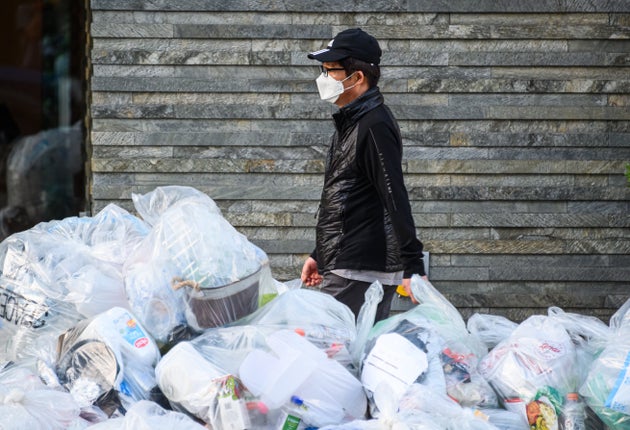
Plastic is making a major comeback, thanks to increased demand for packaged food and disposable shopping bags, the installation of plexiglass dividers in shops and offices, and the widespread use of gloves and protective masks.

In France, 40% of the use of plastic is devoted to packaging, HuffPost France reports. At the end of March, as the coronavirus crisis ramped up, Elipso, the professional federation of the plastic packaging sector, recorded a 30% increase in production, mainly in the food, hygiene and detergents sectors.

Part of the reason for the increase, according to Emmanuel Guichard, Elipso’s general manager, is that suppliers have largely had to shift away from selling to restaurants and toward serving home consumers.

Items that, prior to lockdown, were sold in bulk to restaurants and cafeterias are now sold in smaller containers in supermarkets, Guichard told HuffPost France. “That means more packaging.”

The explosion of online ordering and in-store collection also explains why consumers, including those who were sensitive to the issue of packaging before the crisis, are less attentive. 

According to a study carried out at the end of April by the Kantar Institute and PricewaterhouseCoopers, 24% of French people did their food shopping via “click and collect” during confinement, in order to limit human contact.

In these cases, “your strawberries will necessarily be in plastic, in case they end up under your laundry,” Guichard said.

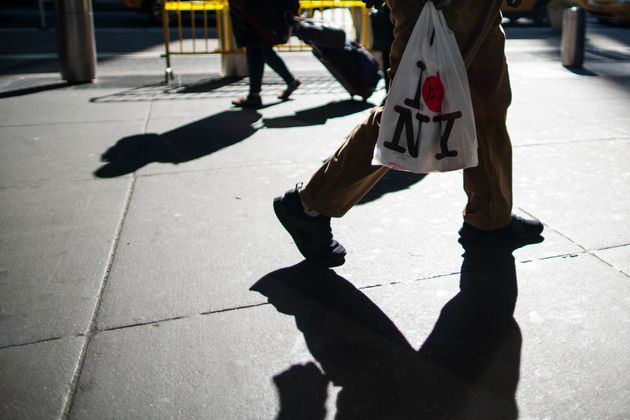
The pandemic has also caused cities and states in Europe and the U.S. to pause or roll back bans on single-use plastic bags, due to fears that reusable shopping bags could more easily spread the coronavirus. 

The UK the government suspended the charge on single-use plastic bags at shops and grocery stores at the end of March. In April, California lifted its ban on single-use plastic bags for 60 days.

“It is critical to protect the public health and safety and minimize the risk of COVID-19 exposure for workers engaged in essential activities, such as those handling reusable grocery bags,” said an order announcing California’s move.

Environmentalists have argued, however, that there is little evidence that reusable shopping bags carry a greater risk of spreading the coronavirus.

They say that the plastics industry is taking advantage of the crisis to promote their products and demonize reusables — despite studies that suggest that the coronavirus can live for days on plastic surfaces.

Indeed, right-wing think tanks have published articles arguing in favor of plastic bags, and the plastics industry has lobbied the Trump administration to help overturn plastic bag bans across the United States.

“We ask that the department speak out against bans on these products as a public safety risk and help stop the rush to ban these products by environmentalists and elected officials that puts consumers and workers at risk,” Plastics Industry Association CEO Tony Radoszewski wrote to Health and Human Services Secretary Alex Azar in March.

This month, the CDC issued guidance for restaurants and bars that encouraged the use of disposable utensils and single-use condiment packets.

“The plastic industry has really treated the COVID-19 emergency as an opportunity and is preying on people’s fear to scare them into believing that single-use plastic is the best way to stay safe,” John Hocevar, director of Greenpeace’s oceans campaign, recently told Vox. “And so far, there isn’t any independent scientific research that supports that.”

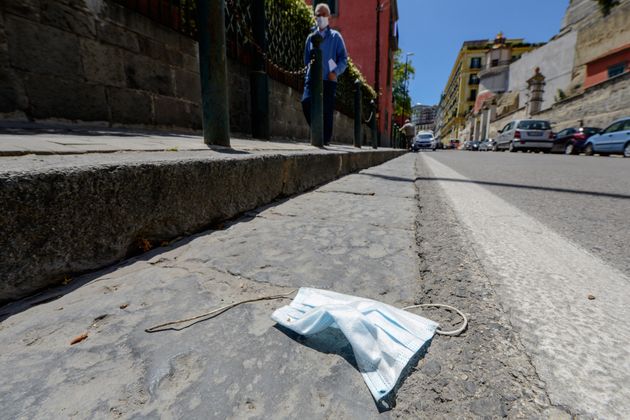
Another symbol of the pandemic has been the number of gloves and masks littering city streets. 

In hospitals, used masks are considered hazardous waste and are sent for incineration. But there is no such system for the general public.

Used masks and gloves should be disposed of in the trash, but many cities have experienced a rise in personal protective equipment litter since the pandemic began.

This litter represents not just a threat to the health of the people who encounter it and clean it up, but also to the environment as a whole.

Medical-grade masks are commonly made from polypropylene, a very dense thermoplastic, which is non-biodegradable and non-recyclable.

“It is not the worst polymer, but it is generally estimated that solid polypropylene takes around 500 years to degrade,” Etienne Grau, a teacher-researcher at the University of Bordeaux, told HuffPost France.

In France, divers say that they have seen an uptick in “COVID pollution” in the sea and other waterways.

“First it was the gloves,” one diver said in a video that has gone viral online this month. “Then we started to find masks three or four days ago. … This is just the beginning of the COVID waste.”

This week, Virginia Raggi, the mayor of Rome, announced a 500-euro fine for anyone who fails to properly dispose of masks and gloves. 

“The use of masks and gloves is essential in this critical moment: However, they must not be thrown on the ground under any circumstances,” Raggi said, according to HuffPost Italy.

“Let me be clear: There must be zero tolerance against those who throw this kind of waste on the street.”


Source by [author_name]

Historic SpaceX Launch Postponed Because Of Stormy Weather

CAPE CANAVERAL, Fla. (AP) — The launch of a SpaceX rocket ship with two NASA astronauts on a history-making flight into orbit has been called off with 16 minutes to go in the countdown because of the danger of lightning.

Liftoff is rescheduled for Saturday.

The spacecraft was set to blast off Wednesday afternoon for the International Space Station, ushering in a new era in commercial spaceflight and putting NASA back in the business of launching astronauts from U.S. soil for the first time in nearly a decade.

Ever since the space shuttle was retired in 2011, NASA has relied on Russian rockets to carry astronauts to and from the space station.


Source by [author_name]

COVID-19 Latest: Confirmed cases up by 803 with 27 more deaths

The Health Ministry announced that South Africa’s COVID-19 caseload increased by 1 673 over the last 24 hours, bringing the total to 25 937. SA’s caseload was 24 264 on Tuesday 26 May 2020.

Health Minister Dr Zweli Mkhize also confirmed that the latest death toll now stands at 552; which is an increase of 28. The total number of recoveries to date is 13 451.

COVID-19 update: South Africa, Wednesday 27 May 2020

As of yesterday, 128 cases in South Africa are treated as critical.

We wish to express our condolences to the loved ones of the deceased and thank the health care workers who treated these patients.

Health Minister Zweli Mkhize

Breakdown of new confirmed COVID-19 cases

COVID-19 cases by province

The following confirmed COVID-19 cases per province is as follows:

Province Total Cases New Cases Total Deaths Total Recoveries
Gauteng 3 167 31 1 955
Western Cape 16 893 391 8 504
KwaZulu Natal 2 186 49 1 180
Free State 221 6 123
Eastern Cape 3 047 70 1 491
Limpopo 141 3 67
Mpumalanga 106 0 62
North West 128 1 39
Northern Cape 48 1 30

Tests and screening

As of today:

  • A total of 634 996 tests have been conducted, of which 29 005 were done in the last 24 hours.
  • The total number of tests conducted in the private sector stands at 309 990, of which 10 940 were done in the last 24 hours.
  • In addition, 325 006 tests were conducted in the public sector, with 18 065 being done within the last 24 hours.

Global COVID-19 statistics

As of today, confirmed global cases stand at 5 722 643 and 353 580 deaths. More than 2 457 960 people have recovered from the virus, which was declared as a worldwide pandemic in January 2020.

The USA currently has the most cases – 1 730 479 confirmed cases and 100 825 confirmed deaths; a total of 480 321 citizens have recovered. Out of the 1 149 333 active cases, 17 158 are critical.

Brazil is now the second most-affected country after overtaking Rusisa, with 394 507 confirmed cases and 24 953 deaths. While 158 593 patients have recovered, about 2 300 of the 211 321 active cases are critical.


Source link