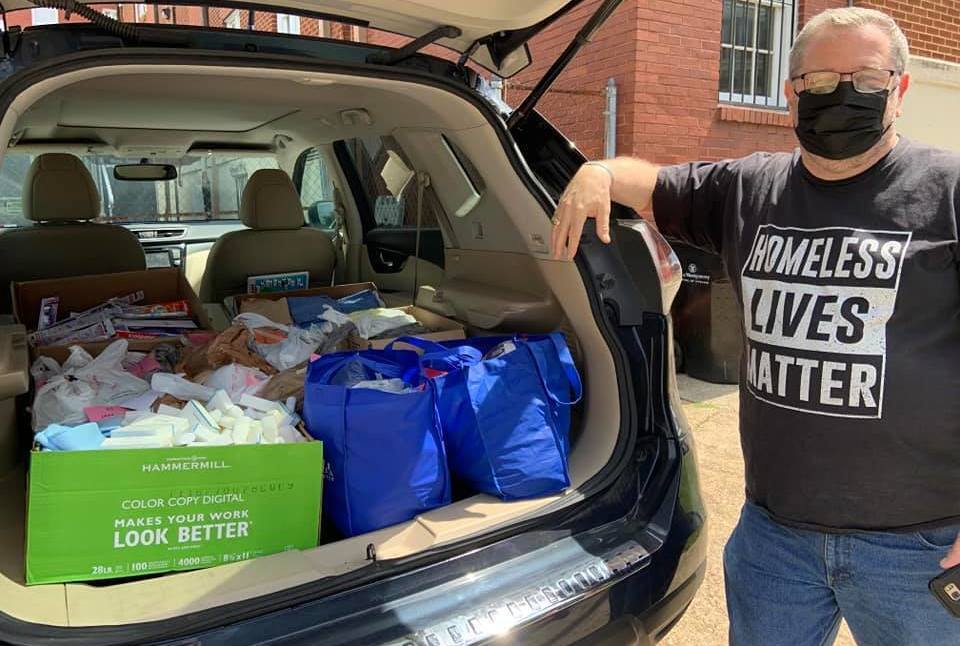
Patrick Aitken, missions coordinator at the River City Church in Montgomery, Ala., is concerned that the city’s already vulnerable homeless population will be forgotten during the coronavirus pandemic.
Mary Joyce McLain
hide caption
toggle caption
Mary Joyce McLain
Patrick Aitken, missions coordinator at the River City Church in Montgomery, Ala., is concerned that the city’s already vulnerable homeless population will be forgotten during the coronavirus pandemic.
Mary Joyce McLain
In Montgomery, Ala., just down the road from where Martin Luther King Jr. once preached, a noisy trailer sits in a tiny church parking lot.
The trailer is like a mini laundromat, equipped with three washers and dryers and two shower stalls. Every week, it serves a homeless congregation at River City Church — even through a pandemic.
Patrick Aitken, the church’s missions coordinator, calls the trailer “The Clean Machine.” For the small crowds that pass through the parking lot to pick up their laundry and a hot meal, Aitken is a familiar face; always in a t-shirt with bold lettering that reads Homeless Lives Matter. Aitken is concerned that the city’s already vulnerable homeless population will be forgotten.
“I dare say half of our congregation is homeless or formerly homeless,” Aitken says during the church’s recent Loads of Love event, where volunteers wash clothes and offer showers to those in need. “We did it before COVID-19 and we’ll continue to serve our homeless friends after COVID-19.”
He devotes himself to outreach in his community, though it comes with plenty of risk. The Alabama Department of Public Health announced the state’s biggest single day increase in COVID-19 cases this week, and Montgomery County has emerged as a coronavirus hotspot.
“We need to take the steeple to the streets,” Aitken says. “We’ve got to go where the people are. If that means going out at 10 o’clock at night to take someone some supplies that they called and said they desperately needed, that’s what we’re going to do.”
Along with shoes, clothing and food, River City Church now supplies care packages with hand sanitizer and hygiene products.
“I see the tears in their eyes when they look at me, and they hug me, and they shake my hand, and they say thank you,” Aitken says, acknowledging that he doesn’t always follow social distancing guidelines during his ministry. “For me to pull back and say, ‘Please don’t touch me,’ that just hurts them to their core. I’m not going to deny them a hug if they want to hug me.”
Aitken says a man in his congregation recently described his own experience in the pandemic this way:
“He said, ‘People have always looked down on me, but right now, they look down on me even more. I’m not allowed to come inside a restaurant, I’m not allowed to come inside a gas station to wash my hands or use the bathroom, people avoid me like the plague when I’m walking down the sidewalk.’ It breaks my heart,” Aitken says.
A group of researchers at the University of Maryland claim that they have developed a diagnostic test that can detect the COVID-19 causing virus within 10 minutes and the results will be visible with naked eyes.
The authors have already published their research in the peer-reviewed journal of the American Chemical Society, ACS Nano.
Representational image. Pixabay/Masum Ali
According to the study, early and quick detection of COVID-19 is said to be crucial to contain the spread of the disease. However, most tests either require sophisticated machinery and take some time before giving the results. Also, a majority of tests fail to give reliable results when the viral load is low.
In a press release, Dr Dipanjan Pan, the lead author of the study and professor of diagnostic radiology and nuclear medicine and paediatrics at the University of Maryland School of Medicine, said that the test can probably detect viral RNA on day 1 of the infection. However, more studies would be needed to confirm this.
The test
The test is a simple colourimetry-based assay that uses gold-nanoparticles (AuNPs) capped with the nucleic acid sequence of the nucleocapsid phosphoprotein of the SARS-COV-2 virus.
To conduct the test, the nasal or oral swab from a patient is taken and viral RNA is isolated from it. This process takes about 10 minutes. Once the RNA is isolated, the capped gold nanoparticle is used to detect the protein. The particle goes and binds to the target protein and as a result, forms masses (agglomerate). This leads to a colour change in the solution from purple to blue.
When an enzyme called RNase H is added to the solution then, it separates the viral RNA from DNA, which then precipitates at the bottom of the tube due to the mass agglomeration.
Dr Pan stated in the press release that he is going to have a meeting with the US FDA soon to get emergency use authorization (EUA) for the test. This will allow them to market the product without having to go through the various stages of clearance as long as the test meets the FDA’s efficiency and reliability criteria needed for the EUA.
He further added that the test wouldn’t be very expensive and be made available at various daycare centres, nursing homes and other facilities to test for COVID-19.
Health articles in Firstpost are written by myUpchar.com, India’s first and biggest resource for verified medical information. At myUpchar, researchers and journalists work with doctors to bring you information on all things health.
Khamis Makaranga did not intend to cause a diplomatic incident. He just wanted to deliver the tomatoes in the back of his truck.
Makaranga plies the highway between Dar es Salaam and Nairobi. Those tomatoes, from Tanzania’s central Iringa region, were destined for a market in Kenya’s capital city. They never arrived.
When he got to the Namanga border post, Makaranga saw hundreds of trucks waiting to cross into Kenya. Thanks to new Covid-19 restrictions, the backlog was even bigger than usual. Every truck driver entering the country is being tested by Kenyan authorities, adding days to their journeys.
Makaranga was tested for the coronavirus with a cotton swab pushed to the back of his throat. Last week, his result came back: he was positive. “I didn’t agree with the medical result from the Kenyans,†he tells the Mail & Guardian, as he didn’t show any symptoms. In total, 19 Tanzanian truck drivers tested positive, and Kenya would not allow them in.
Makaranga and other drivers complained to the Arusha regional commissioner, Mrisho Gambo, who gave an explosive press conference on May 20. Gambo said a Tanzanian laboratory had tested the drivers, and all came back negative. He accused Kenya of deliberately falsifying the results in order to sabotage Tanzania’s tourism industry.
Within hours, a furious Kenya had shut its land border, with Tanzania threatening to follow suit. It took personal interventions from President Uhuru Kenyatta and President John Magufuli to defuse the tensions — but not before Makaranga’s tomatoes had turned rotten in the back of his Truck.
Trucks wait in a line on the road to enter Uganda in Malaba, a city bordering with Uganda, western Kenya, on April 29, 2020. – All truck drivers ferrying goods crossing the border from Kenya must take a test for the Covid-19 (the novel cornovairus) by Ugandan health officials and wait 24 hours to get the result. After entering Uganda, the driver must stay inside the truck, only allowed to get off to unload at the destination. (Brian ONGORO / AFP)
The road is long and full of terrors
Most countries have shut down their borders in an attempt to contain the spread of the coronavirus. But trucks and truck drivers are a special case: they need to move between countries to deliver essential goods like food, petrol and cleaning products. Without them, supermarket shelves would be empty and market stalls would have little to sell.
This is especially true for landlocked countries in East Africa. Goods arrive at the ports of Dar es Salaam and Mombasa, and from there an army of trucks moves them along more than 5,000km of sprawling highways. These roads connect Tanzania and Kenya with Burundi, Democratic Republic of Congo, Ethiopia, Rwanda, South Sudan, Sudan, Uganda and Zambia.
Even in more normal times, truck drivers do not have it easy. The hours are long and the challenges many, Anthony Wasilwa tells the M&G from a truck compound in Kampala. As a truck driver from Kenya, he spends most of the month away from his wife and five children.
His usual route takes him from Mombasa to Kampala, passing through Nairobi, Nakuru, Eldoret, Busitema, Musowa, Bugiri Iganga, Jinja and Mukono along the way. Traffic jams are a constant headache, as are the thieves who steal cargo or fuel if he does not pay attention.
Whenever possible, he parks his truck in government-run parking yards overnight instead of roadside truck stops, where prostitution and drug use is rife. “A lot of the old-time drivers, even some of the new guys, are a little disgusting and the truck stops can smell like urine and drugs.â€
Covid-19 has made things much harder. It now takes three to four days to cross into Uganda at the Malaba border post instead of three to four hours, thanks to screening measures. The journey from Mombasa to Kampala now takes 12 days instead of seven.
Wasilwa worries that, as truck drivers wait, they may spread the disease into the community — and to other truckers. So he has taken his own protective measures. He installed a 5kg gas cylinder and a hot plate in the cab of his truck, so he can cook all his own food, and he has a supply of groceries with him. There is a jerrycan of sanitiser by his side, and he wears gloves and a face mask when interacting with others.
Going up against the pandemic as well as hostile attacks, truck drivers are risking their lives to keep economies going.
“I am a sole bread earner for the family, so I have to avoid interacting with my fellow truckers,†Wasilwa says. This makes his journey lonely and boring – when it isn’t dangerous. “You cannot stop anywhere,†he says. “People point fingers and threaten to stone your truck for fear of spreading Covid-19 to them.â€
‘Stopping cargo is suicidal’
There is no doubt the virus can travel along the same transnational networks used to distribute goods. It’s happened before: trucking corridors have long been identified as a major vector for HIV/Aids.
Last month, Uganda said up to half of new Covid-19 cases in the country came from infected truck drivers. But in a public address, President Yoweri Museveni stressed that these same drivers were vital to the country’s economy, and should not be harassed.
“I appeal to Ugandans to swallow your anger and employ amagezi [wisdom],†he said. “Stopping cargo is … suicidal because if we stop cargo, how will our coffee and cotton, tea, milk, cement from the factories, and food move?â€
Nonetheless, truckers have reported a sharp rise in tensions in the towns they pass through. Many, like Wasilwa, refuse to leave their cabs.
“We can’t socialise or interact with members of the local communities because people fear us,†says Isaac Lumago, a driver on the Mombasa-Juba route. “It makes us fear for our lives, too.â€
Lumago and other drivers interviewed by the M&G in Juba in South Sudan are scared of contracting the virus — and if they were to contract it, they are not sure they would receive proper medical attention. South Sudan does not provide support to drivers who test positive and need to Self-isolate.
Driving itself has become more dangerous. “Turn-boys†— backup drivers who travel along on long trips — are being denied entry at South Sudan’s border with Uganda. With just a single exhausted driver at the wheel, the risk of accidents soars.
There are other dangers on the road. From the Ugandan border to Juba, a distance of just 200km, at least 10 illegal checkpoints have been set up. These are usually manned by soldiers — or thieves in soldiers’ uniforms — who demand hefty bribes.
“They will either beat you or take all the money your boss gave you for the whole trip … you can lose your job, too, if your bosses think you stole the money,†says Simon Jamus.
Jamus and his fellow drivers don’t see things improving any time soon. “It should not be truck drivers who are blamed for carrying the disease,†said Amule Mustafa, another Juba-based driver. “Even us, we contract the
virus by mistake like anyone. And we are afraid.â€m— Additional reporting and editing by Simon Allison.
Recently, a hard-hitting video went viral on social media of a migrant worker’s child from Muzaffarpur Railway Station. The incident shook the nation and brought the woes of migrant workers to light. Moved by the heart-wrenching video, Shah Rukh Khan and his Meer Foundation have offered help and financial support to the child who will be taken care of by the grandparents.
Meer Foundation also shared, “#MeerFoundation is thankful to all who helped us reach this child, whose heart-wrenching video of trying to wake his mother disturbed all. We are now supporting him and he is under his grandfather’s care.â€
Thank you all for getting us in touch with the little one. We all pray he finds strength to deal with the most unfortunate loss of a parent. I know how it feels…Our love and support is with you baby. https://t.co/2Z8aHXzRjb
The video showed a half-naked baby seen tugging a sheet partially covering its dead mother at the Muzaffarpur Railway Station in Bihar. The woman said to be Arvina Khatun, 35, is seen lying dead on the platform, with two bags stuffed with her belongings kept away from her. The woman and her two small children had arrived by a Shramik Special train on May 25 from Ahmedabad.
Shah Rukh Khan is at the forefront during these perilous times that the nation is facing by helping those in need. Recently, Kolkata was affected by the Amphan cyclone and Shahrukh Khan along with wife Gauri Khan came in to support people once again with their team Kolkata Knight Riders.
The actor’s group of companies, Kolkata Knight Riders, Red Chillies Entertainment, Meer Foundation and Red Chillies VFX also announced several initiatives to support the efforts of the Government in its COVID-19 fight. The actor also provided 25,000 PPE kits to the frontline medical workers in Maharashtra fighting to contain the novel coronavirus pandemic in the state.
With this recent development, the actor has truly come in support of those segments of the society who are suffering during the lockdown, with his noble initiatives.
Neighbourhood watch and farm watch groups who have been “chomping at the bit†to get back to work can now do so, after Level 3 lockdown restrictions saw the bans placed on them lifted.Â
The groups were deeply aggrieved when it was announced during Levels 4 and 5 that they would have to down tools as they were not contracted by the Disaster Management Act to enforce law and order in their communities, and launched several bids most notably supported by the Freedom Front Plus (FF Plus) to have the band lifted, to no avail.Â
Back to work Â
There are still some caveats that will dictate the way in which Neighbourhood watch and farm watch groups can operate in their communities under Level 3 guidelines, but they have essentially been given the green-light to get back to work.Â
“The Minister of Community Safety, Albert Fritz, welcomes feedback received from the National Secretary of Police that Neighbourhood Watches (NHW) may now operate under Alert Level 3,†the Western Cape Community Safety cluster said in a statement on Monday 1 June.Â
“During a meeting today between officials of the Department of Community Safety (DoCS) and the National Secretary of Police, it was confirmed that the restrictions placed on NHWs have been lifted under Alert Level 3.â€
They said that the groups would be put to work in COVID-19 hotspots to assist with efforts to stem the spread of the virus there.Â
“Within the targeted COVID-19 hotspot areas, NHWs will be deployed to assist in:Â
• Promoting adherence to regulations in terms of social distancing at places of gathering and queueing;
• Sharing communications as prescribed by DoCS, acting as a nodal point of information for DoCS; and
• Patrol in their community.
The Department of Community Safety will ensure that measures are in place to prevent the spread of COVID-19 amongst NHW members, including:
• The provision of cloth masks and hand sanitisers when operating;
• Setting the number of those who are permitted to operate and encouraging self-distancing between volunteers; and
• Ensuring that those who show symptoms or who have been in contact with someone with COVID-19 are not permitted to operate. They should quarantine at home for 14 days, and be guided by advice of our dedicated COVID-19 Provincial Hotline.
Community Safety Minister in the Western Cape, Albert Fritz, said that the move would go a long way to enforcing law and order in communities across the country.Â
“The presence of NHWs will serve to prevent crime. During the lockdown, we have seen an increase in vandalism of schools and shop robberies, in rural and urban communities alike. I have heard the call of the many NHWs and Community Police Forums (CPFs) who have raised their hands and offered their support during this difficult period and am pleased to announce that NHW may now operate.â€Â
He added that now was the right time to investigate a way in which to resume work in Community Policing Forums (CPFs), which have disbanded during the lockdown too.Â
“As it stands, Community Policing Forums (CPFs) which have not yet held their electoral AGMs have been dissolved by the SAPS. My Department will engage with the Provincial Commissioner to expedite the outstanding elections.â€Â
Neighbourhood, Farm Watch groups ‘chomping at the bit’Â
One group that was prevented from working during the initial lockdown stages was the Drakensberg Farm Watch, which has at its disposal monitoring resources as well as a fully fledged fire department and medical team.Â
Founder Daan van Leeuwen Boomkamp told The South African that he was delighted to learn that he and his team could get back to work.Â
“If the can operate it is great news, they have an important role to play in community policing.â€
“We were very upset that we had to cease our operations because we are a full blown entity registered as a non-profit company. It was legally not correct and they never got back to us which was incredibly frustratingâ€.â€
He said that the laws had prevented the from assisting in a nearby shack fire in Chicago, and this had led to the death of several people.Â
“Last week there was a massive fire in Paarl and six people died. We were told by police they will arrest us if we go there.â€
He added that he and his team were ready to get out and contribute to crime fighting efforts right away.Â
“We will 100% get out and resume our community service. We serve our clients and on top of that we serve the greater public.â€
The City of Cape Town’s Mayco Member for Safety and Security, Alderman JP Smith, said that the move was incredibly positive.Â
“Now this almost 50 000 strong force for good can start protecting their communities again. They have been chomping at the bit for weeks.â€
British Prime Minister Boris Johnson | Chris J Ratcliffe/Getty Images
Boris Johnson’s spokesperson says UK will not support move unless Moscow ‘ceases aggressive and destabilizing activity.’
LONDON — Any push by Donald Trump to readmit Russia to the G7 gathering of economically advanced nations would be vetoed by the U.K., Boris Johnson’s official spokesperson said Monday.
Speaking to journalists at a daily briefing, Johnson’s spokesperson said that while it was up to host nations to decide which countries could be invited as guests, the U.K. would not support Russia being “readmitted as a member of the group.â€
Decisions on G7 membership are subject to the unanimous backing of all members. Russia was ejected from the group — previously the G8 — after its annexation of Crimea in 2014.
Johnson’s spokesperson said the U.K. would not support Russia’s return to the G7 fold “unless it ceases aggressive and destabilizing activity that threatens the safety of U.K. citizens and the collective security of our allies,” adding: “We are yet to see evidence of changed behavior.â€
The U.K.’s position does not rule out Russian President Vladimir Putin being invited to the summit as a guest. While it is not unusual for host nations to ask representatives of non-G7 countries to attend summits, an invitation to Putin would prove highly controversial. The U.K. has taken a particularly firm stance on Moscow since blaming Russia for the 2018 nerve agent poisoning of a former Russian double agent in Salisbury, England.
Trump’s decision to postpone the G7 summit came after German Chancellor Angela Merkel declined his invitation to attend in person due to the coronavirus pandemic. However, Johnson had been prepared to make the trip, Downing Street said.
“The prime minister and President Trump spoke on Friday and the prime minister said that if possible, he would like to attend in person,” Johnson’s spokesperson added. “Subsequent to that, the president spoke about potentially holding it later in the year rather than in June.â€
Every time she has to buy groceries lately, Lily Marquez gets worried. She lives in a two-bedroom apartment in San Francisco with her two young children, her husband, her chronically ill mother-in-law, and her husband’s grandmother. Both of the older women are at high-risk of becoming severely ill if they get COVID-19, and she doesn’t want to be the one to infect them.
But while many Americans have switched to online grocery shopping to avoid crowded spaces during the ongoing coronavirus pandemic, that’s not an option for Marquez—or the millions of other low-income women and children who rely on the Special Supplemental Nutrition Program for Women, Infants and Children, better known as WIC. The federal program requires that WIC participants, or their designated proxies, complete their purchases in person, in front of a cashier.
“At Safeway, I went in and out because it was just literally chaotic,†Marquez says. “I’m like, there’s no way that I could do that because when I go out, I don’t take the kids so I have to leave the kids with the elderly and my husband is trying to work. So I’m trying to just be quick about it.â€
Anti-hunger organizations and advocates for low-income families have been working toward making online grocery shopping possible for WIC families for years, and as the coronavirus spread this spring, those efforts accelerated. Federal lawmakers have backed the idea, and the U.S. Department of Agriculture has granted a number of waivers allowing state agencies to issue WIC benefits and conduct other operations remotely during the pandemic. But even as most states imposed stay-at-home orders this spring, the USDA hasn’t budged on the rule requiring beneficiaries to purchase their groceries in person, citing concerns about fraud.
Advocates aren’t buying it. “It’s an equity concern,†says Melissa Cannon, a senior policy advocate at California Food Policy Advocates who has been working on the issue. “It’s challenging for anyone to go to the grocery store right now, given that social distancing rules are in place. You might have to wait in line for a long period of time. Those challenges are heightened for any mom who’s going in with young children.â€
On May 8, nearly 100 members of Congress, led by Michigan Rep. Andy Levin and Wisconsin Rep. Gwen Moore, wrote a letter to Food and Nutrition Service (FNS) Administrator Pam Miller, whose department oversees WIC, asking her to waive the requirement that participants enter their PIN or use vouchers in front of a cashier. Miller recently responded to Levin saying that “FNS is actively reviewing requests for waivers of the requirement that WIC transactions occur in the presence of a cashier in order to allow for a contactless transaction.â€
Related Stories
Levin says he’s “very unhappy†about FNS’s failure to act. “I don’t understand what their rationale would be,†he said in an interview with TIME. “I mean, they almost act as if poor people, working class people, can’t be in the 21st century with others.â€
The WIC program helps women who are pregnant, postpartum or breastfeeding and children up to age five. To qualify for the benefit, a family must be at or below 185% of the federal poverty level. Extensive data has now shown that low-income areas are being hit hard by the coronavirus pandemic, and Hispanic and black Americans, who make up a significant share of WIC participants, are getting sick at higher rates.
FNS officials did not answer specific questions TIME asked about online shopping access or when the agency might change the requirement that WIC participants complete purchases in front of a cashier. A spokesperson for the agency said that removing the requirement could have a “significant negative impact on program integrity.†In a statement to TIME, USDA Secretary Sonny Perdue said that “USDA is maximizing our services and flexibilities to ensure children and others who need food can get it during this Coronavirus epidemic.â€
The National WIC Association, the nonprofit that works on education and advocacy around the federal program, has taken a leading role in pushing for online purchasing. As the pandemic exploded this spring, USDA allowed a growing number of states to enter a pilot program that allows SNAP recipients to use food stamps to shop online. WIC advocates argue that a similar switch could happen in the WIC program too. WIC transactions are more complicated than using food stamps since they require stores’ computer systems to recognize the food items that individual participants are allowed to buy, so there are some technological hurdles to work out. But advocates say it can be done.
“An administration that was proactive, recognizing the problems and consequences and risks, particularly to pregnant women, babies and young children, would have been on top of this and moved aggressively to allow maximum flexibility for participants in the program,†says Douglas Greenway, executive director of the National WIC Association.
Instead, Greenway’s organization has been coordinating its own working groups and holding meetings with state WIC agencies, retailers and other organizations for months, even as the USDA issued guidance again on May 11 reiterating that WIC purchases must be completed in front of a cashier.
In the meantime, FNS told TIME that administrators are working with states to explore other options. For example, current regulations allow WIC participants to place orders online, but they still must show up in person to complete their purchases. In theory, states could allow mothers to select food items online and then pay in person during a curbside pickup, or when they receive a delivery.
But Elisabet Eppes, the director of program innovation at the National WIC Association, says no such program currently exists. No retailers have the technology to accept WIC payments outside of their stores, she says, and they have very little financial motivation to update their systems. While regional grocery chains and some national retailers including Walmart, Target and Kroger are participating in the National WIC Association’s working group, progress is slow. With no federal approval for an online-purchasing program and WIC representing a fairly small customer base—there are just over six million WIC participants—Eppes says it has been tough to get big retailers excited about investing time and money in new technology.
Given that delay, some states are trying to submit requests that would allow for more limited changes to speed up the process. Minnesota, for example, requested on April 15 that FNS waive the cashier requirement so that WIC participants could purchase groceries over the phone and then pick them up curbside without entering a store. The state has not yet heard back from Washington, according to Minnesota WIC Director Kate Franken.
Still, advocates say, the fight rages on. The San Francisco-based mother, Marquez, said a recent shopping trip took much longer than it should have—she had to go to four different stores before finding one that was not too crowded. As California, like most states, has moved into a period of reopening, Marquez says she’s seen longer lines, and fewer shoppers adhering to precautions about mask-wearing and social distancing.
“It’s been crazy because I’ve been trying not to go out,†Marquez says. “I don’t want to lose the WIC benefits because, you know, we need it for now during this hard time. So now it’s just like, I wish they could transition to online because that’s less exposure right now during these crazy scary moments.â€
The Coronavirus Brief. Everything you need to know about the global spread of COVID-19
Thank you!
For your security, we’ve sent a confirmation email to the address you entered. Click the link to confirm your subscription and begin receiving our newsletters. If you don’t get the confirmation within 10 minutes, please check your spam folder.
The Queensland man thought to be Australia’s youngest Covid-19 victim has tested negative to the virus after his death.
Nathan Turner’s death last week had baffled authorities and placed residents in his central Queensland town of Blackwater on notice after an initial coronavirus test following his death returned a positive result.
But a workmate of Turner’s fiancee on Monday revealed a second test conducted after his death came back negative.
“We have just got word from our staff member Nathan’s partner that his autopsy report has come in and Nathan has been CLEARED as COVID 19 NEGATIVE,†Kelly Bunyoung posted on Facebook.
“Blackwater can now rest easy.â€
Queensland Health later confirmed the negative test.
“The coroner tonight advised that further tests have returned negative for Covid-19. He is yet to determine the man’s cause of death,†the state’s chief health office Jeannette Young said in a statement.
Turner, 30, had serious underlying health issues before experiencing coronavirus symptoms in the weeks before he died and was not tested while alive.
As Turner had not worked for six months or left the mining town since February, authorities were unsure how he contracted the virus.
Hundreds of Blackwater locals were tested and Queensland Health even had the town’s sewage tested to try and determine the source of his Covid-19 infection.
His death also led to an unnamed nurse, who has been suspended after she continued to show up for work at a Rockhampton nursing home, being the subject of an investigation into the source of the supposed infection.
She took a sightseeing road trip to Blackwater during the lockdown.
Meanwhile, tourism chiefs believed allowing Queenslanders to travel throughout the state will flush tourism towns with cash and get the sector back on the move after months of Covid-19 lockdown.
With the state’s borders still closed to interstate travellers, Tourism Tropical North chief executive Mark Olsen has welcomed the government’s announcement on Sunday that internal travel is back.Â
“It’s going to inject an extra $50 million into this economy,†he declared on Monday.
“Our industry is ready to go, we are here, ready to receive the calls.â€
Phones have been ringing non-stop over the past 24 hours with hopeful travellers from the southeast corner confirming accommodation and activities, Olsen added.Â
They will face stiff competition from the Gold Coast, where businesses have been hit hard by a border closure that blocks southern neighbours seeking warmth during winter.Â
However, Destination Gold Coast chair Paul Donovan said he supports the border being reopened only when it’s safe to do so.
A marketing campaign that has laid dormant will now get into full swing to coax Queenslanders to tourism pockets across the sunshine state.Â
“Businesses are grateful that they can open their doors again,†Donovan said.
“Many have already started taking bookings from visitors throughout Queensland who are keen to come and visit the Coast.â€
The enthusiasm from tourism businesses comes as the state celebrates a fourth consecutive day of zero coronavirus cases.
From Monday, Queenslanders can gather in groups of 20 in pubs, gyms and even travel throughout the state, but the borders will remain closed through June.Â
However, Queensland’s Chief Health Officer Dr Jeannette Young said travel restrictions regarding remote and vulnerable Indigenous communities remained in place.
Hindustani Bhau, aka Vikas Fhatak, has become a social media sensation for calling out the bullies in his own special way. With just a couple of videos on his YouTube channel, Hindustani Bhau shot to fame in no time and was also a contestant on Bigg Boss 13. He recently took to his Instagram to share a video of himself saying that he has lodged a complaint against producers Ekta Kapoor and Shobha Kapoor.
Ekta Kapoor has also ventured in web series after ruling the television industry. However, her recent show, XXX Uncensored, has irked Hindustani Bhau. In a particular episode of the said show, a woman is seen having an extra marital affair while her husband, who works for the Indian Army heads out. The episode is said to have shown the female lead tearing the uniform off her boyfriend. Hindustani Bhau found it offensive and disrespectful and hence has lodged a complaint against the producers in Khar Police Station.
Take a look at the video.
The police have said that they will keep him updated about the said complaint.
U.S. President Donald Trump | Tasos Katopodis/Getty Images
‘This is not about censorship. This is about flagging verifiably false or misleading information that may cause public harm,’ Věra Jourová says.
European Commission Vice President for Values and Transparency VÄ›ra Jourová backed Twitter’s content moderation policies today amid an escalating fight between the social media platform and U.S. President Donald Trump.
“I support Twitter in their efforts to develop and implement a transparent, clear and consistent moderation policy. This is not about censorship. This is about flagging verifiably false or misleading information that may cause public harm, linking to reliable information, or flagging content violating their policies,” Jourová told POLITICO in a statement.
For the first time last week, Twitter labeled a pair of Trump tweets with a fact-checking notice, triggering furor in the White House. The U.S. president then signed an executive order that he said would “defend free speech,” by asking regulators to reinterpret a law that shields internet companies from lawsuits over content on their sites.
Since then, Twitter has run a warning label on a tweet by Trump, then on a similar one published from the White House’s official account, arguing they violate the company’s policies on “glorifying violence.”
The Commission on the other hand encourages platforms to moderate content on their platforms. Google, Facebook and Twitter have signed a code of practice on disinformation online and the EU’s executive arm is expected to present later this year the European Democracy Action Plan with further rules on the dissemination of fake news.
“The role of public authorities is not to interfere with content policies of private companies but to ensure that fundamental rights are protected online as well as offline — rights such as freedom of expression and information, non-discrimination, right to security,” Jourová said.
She added: “These rights protect all citizens, not only those in power. As politicians, we have to be held to account, and answer to criticism with facts, not with threats and attacks.”
Want more analysis from POLITICO? POLITICO Pro is our premium intelligence service for professionals. From financial services to trade, technology, cybersecurity and more, Pro delivers real time intelligence, deep insight and breaking scoops you need to keep one step ahead. Email pro@politico.eu to request a complimentary trial.
We use cookies on our website to give you the most relevant experience by remembering your preferences and repeat visits. By clicking “Accept”, you consent to the use of ALL the cookies.
This website uses cookies to improve your experience while you navigate through the website. Out of these, the cookies that are categorized as necessary are stored on your browser as they are essential for the working of basic functionalities of the website. We also use third-party cookies that help us analyze and understand how you use this website. These cookies will be stored in your browser only with your consent. You also have the option to opt-out of these cookies. But opting out of some of these cookies may affect your browsing experience.
Necessary cookies are absolutely essential for the website to function properly. These cookies ensure basic functionalities and security features of the website, anonymously.
Cookie
Duration
Description
cookielawinfo-checbox-analytics
11 months
This cookie is set by GDPR Cookie Consent plugin. The cookie is used to store the user consent for the cookies in the category "Analytics".
cookielawinfo-checbox-functional
11 months
The cookie is set by GDPR cookie consent to record the user consent for the cookies in the category "Functional".
cookielawinfo-checbox-others
11 months
This cookie is set by GDPR Cookie Consent plugin. The cookie is used to store the user consent for the cookies in the category "Other.
cookielawinfo-checkbox-necessary
11 months
This cookie is set by GDPR Cookie Consent plugin. The cookies is used to store the user consent for the cookies in the category "Necessary".
cookielawinfo-checkbox-performance
11 months
This cookie is set by GDPR Cookie Consent plugin. The cookie is used to store the user consent for the cookies in the category "Performance".
viewed_cookie_policy
11 months
The cookie is set by the GDPR Cookie Consent plugin and is used to store whether or not user has consented to the use of cookies. It does not store any personal data.
Functional cookies help to perform certain functionalities like sharing the content of the website on social media platforms, collect feedbacks, and other third-party features.
Performance cookies are used to understand and analyze the key performance indexes of the website which helps in delivering a better user experience for the visitors.
Analytical cookies are used to understand how visitors interact with the website. These cookies help provide information on metrics the number of visitors, bounce rate, traffic source, etc.
Advertisement cookies are used to provide visitors with relevant ads and marketing campaigns. These cookies track visitors across websites and collect information to provide customized ads.