Solidarity protests over George Floyd death take place in cities around the world

LONDON — After violence erupted at demonstrations in U.S. cities over the death of George Floyd in Minnesota, several more peaceful protests have taken place in cities around the world.

Hundreds of people gathered in London’s Trafalgar Square on Sunday, following demonstrations in the German capital Berlin and Toronto, Canada.

“Say his name,” some shouted in London, while other held placards reading “I can’t breathe,” the last words uttered by Floyd, 46, before he died as former police officer Derek Chauvin kneeled on his neck on Monday.

Chauvin was charged with third-degree murder and manslaughter on Friday, but riots across the U.S. have continued over the weekend. The violent scenes have made the headlines in countries across the globe.

Demonstrators block a road near the U.S. Embassy in London in protest over the death of George Floyd on Sunday. Justin Tallis / AFP – Getty Images

In London, protesters defied laws banning large crowds gathering during the ongoing coronavirus pandemic and many protesters were not social distancing, although a large number were wearing protective facemasks.

The anger was palpable.

At least three more solidarity protests have been planned in the British capital over the next week, one outside the U.S. embassy, while other locations in the city’s center are also being earmarked for demonstrations. .

Sunday’s protests in London followed demonstrations on Saturday in Berlin, where thousands of protesters gathered on Saturday outside the German capital’s U.S. embassy.

Some held up signs that read “Black Lives Matter,” “Justice for George Floyd” and “I Can’t Breathe.”

In Canada, thousands also turned out in Toronto’s Christie Pitts Park on Saturday, before they marched to police headquarters.

As well as protesting Floyd’s death, many vented their anger at the death of Regis Korchinski-Paquet, who died last week after falling from her 24th-floor balcony after police officers were called to her home.

Toronto Police are investigating the incident.

Elsewhere, popular critics of the U.S., China, Iran and Russia have vocalized some support for the protesters.

In China, state media have highlighted the “double-standards” of U.S. support for pro-democracy demonstrators in Hong Kong, while quelling unrest in the United States.

The Russian ministry of foreign affairs tweeted: “American police commit high-profile crimes all too often … U.S. authorities should meticulously investigate the murder of George Floyd.”

Iran’s foreign minister Javad Zarif also shared a satirical post on Twitter, crossing out accusations towards Iran in a U.S. press release with red ink and redirecting them back towards America.

The president of the African Union, Moussa Faki Mahamat, also said in a statement that he condemned “in the strongest terms the murder of George Floyd at the hands of law enforcement officers in the United States of America.”

Reuters contributed to this report.

Amin Hossein Khodadadi contributed.


Source link

Trump, Putin and Bolsonaro find their populist playbooks are no match for coronavirus

0

Much to their frustration, the macho leaders of these countries are finding the virus immune to their playbooks. Intimidation, fear-mongering and propaganda just aren’t working. Being guided by science, communicating transparently and long-term planning are proving the sharper tools.

Trump, Bolsonaro and Putin all initially downplayed the risk of the coronavirus, experts say, even as they watched it overwhelm nations like Italy. Now, they are scrambling to appear in control, as the virus keeps transmitting and killing, exposing their weaknesses.

Keep calm and carry on

The denial of the coronavirus as a threat by the presidents in the US and Brazil inevitably led to foot-dragging in their governments. The consequences are serious — models are now emerging that show how swift action can save lives. A Columbia University model, for example, shows that if the US had imposed social distancing one week before authorities called for it, 36,000 lives could have been saved. The US’ death toll is now more than 100,000.
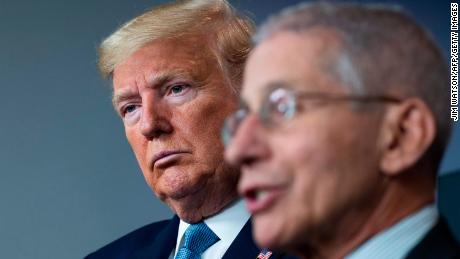
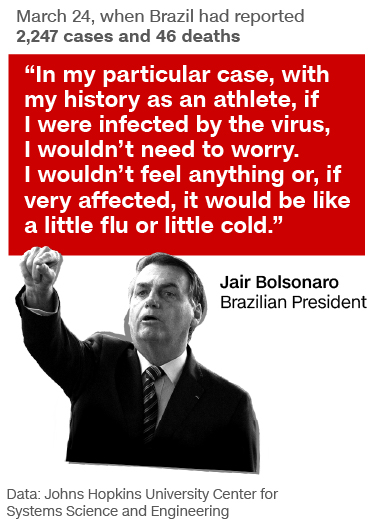
Like Bolsonaro, Trump continually dismissed the virus as similar to the flu, and repeatedly assured Americans that things were “under control” in the early months of the year. When it became clear they weren’t, Trump still signaled that everything would be OK.
“This was unexpected. … And it hit the world. And we’re prepared, and we’re doing a great job with it. And it will go away. Just stay calm. It will go away,” he said on March 10, as the number of US cases approached 1,000.
While the US imposed some travel restrictions early, beginning with banning flights to and from China from February 2, the US Centers for Disease Control and Prevention only issued its first social distancing guidance on March 15. Just six weeks later, the country surpassed 1 million infections.“Downplaying the virus was in defiance of all the evidence that we had from China, and then European nations, about what the effects could be. It unquestionably contributed to a weaker public health response. It has been left to local leaders to pick up the slack,” William Hanage, an epidemiologist from Harvard University, told CNN.

In Brazil, Bolsonaro not only implied that the virus would never be able to hurt him, he made similar claims about Brazilians in general.

“Brazilians should be studied, we don’t catch anything. You see people jumping in sewage, diving in it and nothing happens to them,” Bolsonaro said on March 26, as the number of cases in his country approached 3,000.

While Brazil took some early action, banning travelers from several affected countries and closing land borders, Bolsonaro has never supported closing businesses and schools and his government never issued any clear guidelines for states on how to implement social distancing.

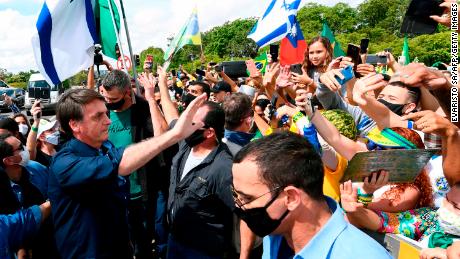
Brazilian President Jair Bolsonaro waving at supporters at Planalto Palace in Brasilia, on May 24.
In fact, the President has repeatedly undermined local leaders’ restrictions, even joining regular anti-lockdown rallies, often without a mask, shaking hands with people and hugging children.

“In terms of the response, he continues to deny the importance of the virus, he insists on still dismissing it — there has been no change in tone over time,” said Francisca Costa Reis, a doctoral researcher focusing on Brazil at the Leuven Centre for Global Governance Studies in Brussels.

“At least the President of the US now recognizes this is some sort of an issue or a problem. I don’t think Bolsonaro has really responded at all.”

And like Trump, Bolsonaro’s lax attitude toward the virus has caused rifts and chaos within his government. In April, he fired his health minister, Luiz Henrique Mandetta, one of Brazil’s biggest proponents of social distancing. A second health minister, Nelson Teich, recently quit, after criticizing Bolsonaro’s decree ordering beauty salons and gyms to reopen.

The President has since appointed a military general with no background in medicine or public health, Eduardo Pazuello, as an interim health minister to lead the response.

‘Everything is under control’

The story is a little different in Russia. The government there wasn’t particularly slow to act. It closed its border with China on January 30, the day before even reporting its first two infections, and announced its lockdown measures when it had was reporting less than 700 infections.

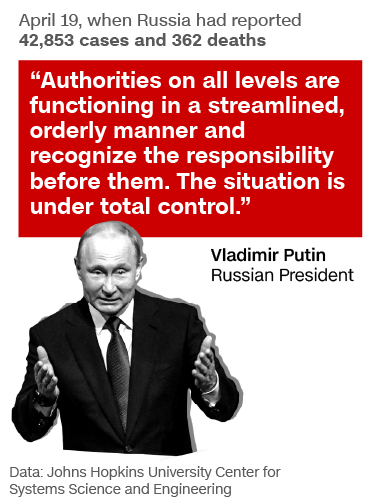
putin quote

But there were mistakes. Russia missed a number of infections coming into the country from Italy and other parts of western Europe, and it has failed to stop its hospitals from becoming hotbeds for the virus. Poor messaging has also undone some of the gains from early interventions.

In the early stages of Russia’s outbreak, Putin told his people the situation was “under control,” and back then, it seemed it was. Russia enjoyed the whole month of February without reporting a single new infection, although questions have been raised over whether the country was dismissing some coronavirus cases as pneumonia. It wasn’t until March 2 that its two cases officially became three.

Putin’s language has been more measured than Trump’s and Bolsonaro’s. He regularly calls for caution, he describes the virus as a real threat, and he doesn’t deny the scientific facts of the virus. But he has stuck to his old tactics, which are beginning to backfire.

In late March, he visited a newly built hospital to respond to the virus, wearing a yellow hazmat suit, in a typically Putinesque PR stunt that was supposed to show an unruffled leader touring part of a well-operating health system.

But the visit gave Russians little confidence. He was also photographed without his hazmat suit off, shaking hands with the hospital’s head doctor, who later tested positive for the virus. It only raised speculation that the President had been infected, and that he was self-isolating, as he gave weekly addresses via videoconference from his home.

Russian President Vladimir Putin, right, shaking hands with Denis Protsenko, the head of a new hospital treating coronavirus patients in Moscow on March 24.
It’s a suggestion the Kremlin has vehemently denied, with one spokesperson having to reportedly tell journalists that no, Putin was not hiding “in some bunker.” Either way, the whole affair ran counter to the strongman image Putin likes to project.
Putin’s visit also sat at odds with reports that soon followed of the dire situation in Russia’s hospitals. Many are overcrowded, and their staff are overworked and lack protective equipment. A viral video of nurses hooked up to drips in a hospital storage room in the city of Derbent in early May was a sign of just how bad things had become.

A patchwork problem

Many of Putin’s problems are of his own making. Russia was expected to vote in a referendum that could have cemented Putin’s power until 2036, and some of his decisions appear to be aimed at securing victory in that poll, observers say.

The vote has been postponed by the virus, a change that has taken some of the wind out of Putin’s sails.

But the vote is still on the horizon, and the President appears to be trying to distance himself from the crisis in the meantime, delegating the enforcement and easing of lockdowns to local leaders.

There are good arguments for devolving powers to the regions, but amid the successes have been failures. Putin announced extra money for frontline medical staff, for example, but it simply hasn’t reached everyone who were supposed to receive it.

He has tried to put a positive spin on his addresses to the nation, in late March announcing a week of “paid holiday,” choosing not to use words like “restrictions” or “lockdown.” But that too has backfired.

Russians in Moscow were seen soon after having barbecues in parks, there was a rush to book holidays and many people headed out of the cities to their summer homes — all activities that only helped the virus spread further across the country.

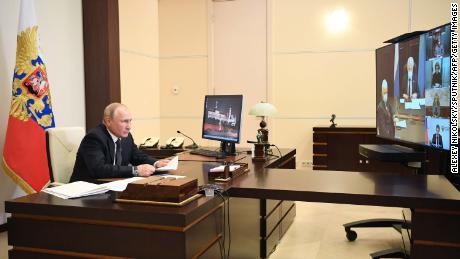
Russian President Vladimir Putin holds a coronavirus videoconference with officials from Dagestan on May 18.

This paid holiday —which in practice was a “lockdown”— was extended several times. Putin called for an end to it on May 12, and Moscow plans to ease restrictions further on Monday. But the timing seems a bit back to front. When restrictions were imposed, case numbers were rising by around 1,000 infections a day. They are now rising by about 10,000 daily and Russians are being told to get back to work.

“By delegating the crisis response to lower levels, and not being clear in his own messaging, Putin did leave people to devise their own solutions in ways they felt responded to what Putin probably wanted. That kind of experimentation can be good, but is also meant there were a lot of mistakes made,” said Sam Greene, director of the Russia Institute at King’s College London.

“In some areas, there is endemic corruption and dysfunction. You could have known they were going to drop the ball. Investment wasn’t going to get where it needed to get.”

The same kind of patchwork response is playing out in the US and Brazil, and while it makes sense for different states to deal with their outbreaks differently, governors have at times pleaded for help with resources, like tests and protective equipment, in a situation that begs for some centralized leadership.

German Chancellor Angela Merkel, for example, has shown that even where states or regions hold power, strong federal leadership can bring about a well-coordinated response. Her decisions have been made largely with the input of state leaders, and as a result, many measures, such as mandatory mask wearing, have been enforced by all states, and clear guidelines on lifting lockdowns are being widely adhered to.

The invincible ‘strongman’

While Germany’s response to the virus has been heavily based on science, Trump and Bolsonaro continue to deny it.

Just as Bolsonaro continues to show up at rallies, or as Putin shook hands with the head doctor at a hospital treating coronavirus patients, Trump has repeatedly refused to wear a mask in public. For many weeks at the start of the outbreak, he too said he would continue to shake hands, against expert health advice.

Both Trump and Bolsonaro have touted the drug hydroxychloroquine, despite no significant scientific evidence it is effective in preventing or treating the virus. Some trials have shown the drug to be harmful in people with heart disease. Trump even announced in earlier this month that he was taking it, though he has since stopped, saying he had finished a two-week course.

In Brazil, that attitude could have graver consequences. Bolsonaro has had his health ministry include hydroxychloroquine in its guidelines for hospitals to use as a treatment in mild coronavirus cases.

This shirking of scientific advice speaks to a misguided sense of invincibility often seen in autocratic leaders, according to the University of Amsterdam’s Alessandro Nai, who has co-authored a study on the personality traits of strongmen.

“Strongmen tend to couple high confidence in themselves with impulsivity, with a disregard for the consequences of their actions. This seems to set up a persona of the ‘invincible and fearless leader’ that can solve issues by sheer willpower,” he said.

Leaders in parts of the world who are succeeding through this crisis are showing that the answer is far more complex than that.

All data on cases and deaths are from Johns Hopkins University.

CNN’s Mary Ilyushina and Nathan Hodge reported from Moscow, Taylor Barnes reported from Atlanta and Maegan Vazquez reported from Washington, D.C. Visuals by CNN’s Gabrielle Smith.


Source link

SpaceX’s 1st Crew Dragon with astronauts docks at space station in historic rendezvous

0

SpaceX’s first Crew Dragon spaceship to carry astronauts slid into a dock at the International Space Station Sunday (May 31), concluding a historic 19-hour voyage to for its veteran NASA crew.

The arrival marked a major feat: the first docking of a crewed U.S. spacecraft at the station since NASA’s shuttle fleet retired in 2011. It’s also the first docking of a commercial spacecraft carrying humans, in this case astronauts Bob Behnken and Doug Hurley.


Source link

This week in Android: RIP LG G series, Xiaomi Mi 10 review, Galaxy S20 giveaway

0

Photo of the LG Quad DAC setting on an LG V60 tips

RIP LG G series

LG isn’t as much of a powerhouse in the Android phone market as they used to be. They’re still one of the top players, but their strategies and offerings have not propelled them into the lead. They obviously believe it’s time for a change, hence, we get to say goodbye to the G Series devices. That’s a long line of devices that shook the market in the early days, and maintained some of the best mobile audio offerings in the latter years. 

LG maintained a lead in mobile audio by not only keeping the headphone jack on most devices, but also including their Quad DAC on many phones. Over-simplifying things, the Quad DAC enables LG devices to drive some serious headphones, the kinds of cans that other phones require an external amp to manage, making the LG G and V series phones ideal for wired headphone fans.

If you’ve jumped on the Bluetooth headphone bandwagon, LG’s Quad DAC technology is not an advantage for you. LG does well with Bluetooth audio, but with the increasing popularity of wireless audio, users are not intrigued by the G and V series selling point of superb wired audio. We hope LG continues to support quality wired audio, but for now we must say goodbye to the G series, and say hello to the new Velvet.

Speaking of things being discontinued at LG, we suspect one of their media divisions has lost their right to post on social media, if not their jobs. This after an embarrassing promotion using the LG V60 for upskirt photography. Stuff like this was never really appropriate, but companies can expect swift backlash from the global community for trying it again, and that’s probably a good thing.


Here are the top 10 Android stories of the week

From around the network


Deals of the week:


Samsung Galaxy S20 international giveaway

Samsung logo Galaxy S20 2

This week, we’re giving away a brand new Samsung Galaxy S20 smartphone. Enter this week’s Sunday giveaway for your chance to win! Courtesy of the AA Deals Store.


Don’t miss these videos


That’s it, folks! We’ll have another giveaway and more top Android stories for you next week. To stay up to date on all things Android Authority in the meantime, be sure to subscribe to our newsletters at the link below.

Source link

Safa welcomes Nathi Mthethwa’s call on contact sports

The South African Football Association (Safa) has welcomed the clarity given by Sports Minister Nathi Mthethwa on how Level 3 lockdown regulations affect various sporting codes.

The country is set to enter relaxed social distancing restrictions from Monday, with non-contact sports given the green light to resume training.

Green light to resume training

During his briefing on Saturday, Mthethwa said contact sports such as football would remain prohibited from resuming play under Level 3, although athletes are allowed to return to the training ground under strict social distancing measures.

Safa has welcomed this call by the minister, saying it will comply fully with the regulations.

“We welcome the fact that athletes can start training under strict specific conditions. Furthermore, there are requirements for a thorough monitoring of all athletes to ensure full compliance.

“It is also clear that contact sport like football and rugby among others cannot resume competitively under alert Level 3 from the Minister’s briefing on Saturday,” said SAFA Acting CEO, Tebogo Motlanthe.

Tebogo Motlanthe, Safa Acting CEO

How local soccer has been implemented by the lockdown

There has been no top-level action in the South African soccer fraternity since early March, when the Premier Soccer League (PSL) decided to suspend amid the growing spread of the global pandemic.

The hiatus has not only affected domestic fixtures but also national teams – most notably Bafana Bafana, who had a busy schedule in 2020 due to involvement in the 2021 Afcon and 2022 Fifa World Cup qualifiers.

Safa – along with the PSL and other stakeholders – have previously met with Mthethwa regarding the conditions under which play can resume.

Mthethwa said he was open to further engagement from various sports federations on the matter.

“Safa welcomes such continued engagements, mindful of the negative financial impact COVID-19 has had on sport in general. Football, rugby and cricket are amongst the major sporting codes that have been heavily impacted by the pandemic,” added Motlanthe.

Tebogo Motlanthe, Safa Acting CEO


Source link

Protesters and outdoor cinemas: best photographs of the weekend

The Guardian’s picture editors select photo highlights from around the world

Continue reading…

Source link

Russian space agency says SpaceX launch “should have happened long ago,” describes Trump praise as “hysteria”

A spokesperson for Russia’s space agency took a dig at the U.S. after the successful launch of two U.S. astronauts aboard a SpaceX craft bound for the International Space Station (ISS)–while also describing President Donald Trump’s praise of the successful mission as “hysteria.”

“The hysteria raised after the successful launch of the [SpaceX] Crew Dragon spacecraft is hard to understand,” Vladimir Ustimenko, a spokesperson for Roscosmos, wrote on Twitter, referring to Trump’s statement.

“What has happened should have happened long ago. Now it’s not only the Russians flying to the ISS, but also the Americans. Well that’s wonderful!” he added.

NASA had relied on Roscosmos, Russia’s space agency, to transport American astronauts to the ISS since the U.S. space agency’s final space shuttle flight in 2011. Since then, the U.S. had been working with SpaceX and Boeing to end its reliance on Russia for transport into space.


The SpaceX Falcon 9 rocket with the manned Crew Dragon spacecraft attached takes off from launch pad 39A at the Kennedy Space Center on May 30 in Cape Canaveral, Florida
Joe Raedle/Getty

On Saturday, SpaceX, which is owned by billionaire Elon Musk, successfully launched to astronauts from a NASA launchpad in Florida, which previously served as the launch point for the historic Apollo and space shuttle missions. The Crew Dragon attached to the Falcon 9 rocket took off at 3:22 p.m. after a previous launch was aborted last Wednesday due to poor weather conditions. On Sunday, the Crew Dragon arrived and docked at the space station.

Newsweek has reached out to NASA and the Russian embassy in Washington, D.C. for further comment.

NASA Administrator Jim Bridenstine said after the Crew Dragon launch, that NASA and Roscomos would likely maintain positive ties moving forward.

“They [Roscosmos] believe in the partnership and so I think it’s going to remain strong,” Bridenstine said.

Trump hailed the launch as major progress in space exploration by the U.S.

“Today, the groundbreaking partnership between NASA and SpaceX has given our nation the gift of an unmatched power — a state-of-the-art spaceship to put our astronauts into orbit at a fraction of the cost of the space shuttle. And it’s much better,” Trump said Saturday, praising the launch of the Crew Dragon.

The president said the astronauts aboard the SpaceX craft had now joined “the ranks of just seven prior American astronauts who have made the perilous maiden voyage to test a new class of spacecraft.”

“From now on, the United States will leverage the fast-growing capabilities of our commercial sector and the finest pieces of real estate on Earth, which you need very badly, to send U.S. astronauts into space,” Trump added. “Today’s launch makes clear that the commercial space industry is the future.”

The U.S. and Russia, formerly the Soviet Union, have been competitive about space exploration for decades. The Soviet Union kicked off the space race by becoming the first nation in the world to send a man-made satellite, Sputnik 1, into outer space in 1957. They then sent the first human into space to orbit the Earth, Russian Lt. Yuri Gagarin, a few years later in 1961.

Alan Shepard was the first American to fly into space one year later in 1962, while the first U.S. satellite, Explorer 1, launched into space came in 1958. Although Russia initially led the space race, the U.S. became the first country to land a man on the moon in 1969.

Source link

Retail Therapy: Zappos Offers to Listen to Pandemic Worries

When Rose Wang called the customer service line at Zappos, all she wanted was a quick confirmation that a gift receipt was included with the hot pink Crocs she had ordered for her mother for Mother’s Day.

But a few minutes into the call, Ms. Wang, 33, realized something felt different.

After helping her with the gift receipt, the customer service representative, who was based in Las Vegas, started making small talk. In a calming voice that reminded Ms. Wang of a grandmother, the representative told her that she, too, found it nearly impossible to buy gifts for her mother.

Amid the isolation of the coronavirus pandemic, Ms. Wang was willing — eager, actually — to chat. The two women ended up discussing mother-daughter relationships, a favorite Brazilian restaurant in Las Vegas and a girls’ trip to Hawaii.

The conversation lasted nearly 45 minutes.

“To hear someone on the West Coast commiserate with me and talk about their plans and what they wanted to do after the quarantine — it felt very connecting,” Ms. Wang, who lives in New York, said.

Customer service representatives, even on the best of days, typically field a lot of complaints — missing deliveries, unsatisfied customers and other gripes. But these days, with people grappling with financial insecurity, separation from their friends and family, and uncertainty, the tone has changed. Rather than viewing calls as a form of drudgery, some people seem to relish having a person on the other end of the line to talk with.

Sensing the shifting need, and wanting to make use of customer service representatives whose call volume was down, Zappos, the online merchant best known for its shoes, in April revamped its customer service line: People could call just to chat — about their future travel plans, Netflix shows or anything on their minds.

“Sure, we take orders and process returns, but we’re also great listeners,” Zappos said in a statement on its website. “Searching for flour to try that homemade bread recipe? We’re happy to call around and find grocery stores stocked with what you need.”

“We’re seeing signals that this is something we may want to maintain as the world reopens,” he said. Even before the new service line officially started, Zappos had said its customer service representatives were available just to chat. One call, several years ago, lasted nearly 11 hours, the company said.

People have called to have conversations about their life stories. Single parents at home with small children have called, grateful to speak with another adult. Teenagers have called asking for homework help.

The most common questions, Mr. Kalma said, are where to find a nearby medical center or how to find household supplies that are out of stock at local stores.

But the new line is good for more than helping to stock toilet paper.

In mid-April, around the time when coronavirus patients were filling New York City hospitals and equipment was in short supply, David F. Putrino, the director of rehabilitation innovation for the Mount Sinai Health System, reached out to Zappos looking for pulse oximeters, devices that indicate blood oxygen level and heart rate.

The devices were sold out or on back-order everywhere he looked. To his amazement, Zappos was able to locate the devices. Within days, the company had shipped 500 oximeters to Mount Sinai — and later donated an additional 50.

“It was, like, unbelievable from our perspective,” he said.

Crystal Mouzon, the Zappos customer service representative who spoke with Ms. Wang, the woman in New York, said customers regularly told her that her voice was soothing.

“I bring ’em on in,” Ms. Mouzon, 60, said. “If they have an anxiety, I just calm them down, and we just talk about anything.” She said she chatted with callers as if they were her friends.

“We laughed and talked about so much,” Ms. Mouzon said of her conversation with Ms. Wang. “Every time she was going to hang up, she would ask me something else, and then we laughed and talked about that.”

Source link

Ferguson Police Take A Knee In Honor Of George Floyd

Protesters demanding justice and change in the wake of the latest police killing of a Black man were joined in solidarity on Saturday by officers in Ferguson, Missouri, where Michael Brown, a Black teen, was killed by police in 2014.

Ferguson Police Chief Jason Armstrong, who joined the department last year, took a knee in honor of George Floyd, who died after a Minneapolis police officer knelt on his neck while Floyd was restrained on the ground. 

Videos posted to Twitter captured Armstrong at one point marching with protesters who were chanting “hands up, don’t shoot,” as well as several Ferguson police officers kneeling on the pavement to applause from the crowd.

Armstrong and his officers joined about 500 people that had gathered outside of the police department in protest, the St. Louis Post-Dispatch reported.

For weeks in August 2014, Ferguson was the scene of violent protests after a white police officer fatally shot Brown, who was unarmed, for what he claimed were self-defense reasons. 

Ferguson “was a wake up call to law enforcement. It definitely got my attention. It forced me to look at what (police) were doing,” Armstrong, who is Black, told the Post-Dispatch. “It opened my eyes to be a leader, to build that change and build better relationships.”

The Ferguson police department on Saturday was later partially evacuated after protesters smashed its windows with bricks and other heavy debris, according to the St. Louis County Police Department, which said it was assisting the situation.


Source by [author_name]

SpaceX’s Crew Dragon successfully docks with the space station

0

This morning, SpaceX’s new Crew Dragon capsule successfully docked with the International Space Station, bringing the company’s first crew to the orbiting outpost. Their arrival marks another major milestone for SpaceX’s first crewed mission of the Crew Dragon, which successfully took off yesterday, May 30th, from Cape Canaveral, Florida.

Now, the Crew Dragon’s passengers — NASA astronauts Bob Behnken and Doug Hurley — are set to begin an extended stay on board the ISS that could last up to four months. They will join three crew mates already living on board the station: NASA astronaut Chris Cassidy and Russian cosmonauts Anatoly Ivanishin and Ivan Vagner.

“It’s been a real honor to be a small part of this nine-year endeavor since the last time a United States spaceship docked with the International Space Station,” Hurley said after docking completed. “We have to congratulate the men and women of SpaceX, at Hawthorne McGregor and at Kennedy Space Center. Their incredible efforts over the last several years to make this possible can not go overstated.”

The Crew Dragon’s docking showcased one of the biggest features of SpaceX’s capsule: its automated docking system. The vehicle is designed to autonomously approach the ISS and latch on to a standardized docking port, without any input from its human passengers. SpaceX successfully showcased this ability last year when the company sent a test version of the Crew Dragon to the space station without a crew on board. But this time, the company needed to prove that the Crew Dragon could deliver when it had its most precious cargo on board.

This automated docking capability is a significant upgrade for the Crew Dragon. The predecessor to the capsule, SpaceX’s cargo Dragon, did not have this capability when it delivered supplies and food to the ISS. For all of those cargo missions, astronauts on board the ISS had to use the station’s robotic arm to grab hold of an approaching cargo Dragon and bring it onto a docking port. That technique is known as berthing, and it requires a lot of work from the astronauts on board the ISS. The Crew Dragon’s automated capabilities should help free up time for the astronauts to work on other things when new crews arrive.

The Crew Dragon as seen from the space station, about two hours before the capsule docked with the ISS.
Image: NASA

Astronauts flying inside the Crew Dragon still have the capability to take over manual control of the vehicle if necessary. In fact, Behnken and Hurley tried out some manual flying during their time in space — once after launching and a second time during their approach to the space station. Flying the vehicle manually involves interfacing with the Crew Dragon’s sleek interior touchscreen displays. The gloves of SpaceX’s pressure suits are touchscreen-compatible, allowing the astronauts to interact with the screens while suited up if necessary. When the crew got to 220 meters out from the ISS, Hurley demonstrated that he could fly the vehicle while gloved before the automatic docking system took over. The plumes from the capsule’s tiny thrusters could be seen from the space station’s cameras as the vehicle inched toward the ISS.

Plumes as Endeavour approaches the ISS.
Image: NASA / SpaceX

Their docking comes after the astronauts spent about 19 hours inside Crew Dragon orbiting around Earth, following Saturday’s launch. After reaching orbit, Behnken and Hurley announced that they had named their capsule Endeavour. “We chose Endeavour for a few reasons: one, because of this incredible endeavor NASA, SpaceX, and the United States has been on since the end of the Shuttle program back in 2011,” Hurley said during an event right after launching to space. “The other reason we named it Endeavour is a little more personal to Bob and I. We both had our first flights on Shuttle Endeavour, and it just meant so much to us to carry on that name.”

During the journey in space, Behnken and Hurley got some shut-eye before approaching the ISS to get a better sense of what sleeping on the Crew Dragon is like. It turns out, it’s a comfortable place for a nap. “We had a good night’s sleep last night,” Behnken said during an event before arriving at the ISS. “We were surprised, I think, in how well we actually slept aboard the vehicle — a little bit quieter than the Space Shuttle, a little bit more environmentally controlled.” The Crew Dragon also sports a toilet in case they needed to use the facilities during the trip (though the crew did not say if they used it).

Docking took place around 10:29AM ET this morning, and now it’s a little bit of a wait before Behnken and Hurley exit the vehicle. The astronauts will open the hatch of the Crew Dragon at around 12:45PM ET. The crew will then host a small welcoming ceremony about 30 minutes later.

Now that Behnken and Hurley have arrived at the ISS, it’s unclear when they’ll be coming home. The two are expected to stay somewhere between six and 16 weeks on board the ISS. It all depends on how much work NASA wants them to do while they’re up there. At some point, NASA will decide when to bring the duo home. That’s when Behnken and Hurley will climb back inside the Crew Dragon and take the plunge back to Earth.

Endeavour in the shadow of the ISS.
Image: NASA / SpaceX

The Crew Dragon is equipped with a heat shield to protect astronauts from the scorching trip through Earth’s atmosphere. It also sports four parachutes designed to help lower crews gently down into the Atlantic Ocean, where they’ll be recovered by a SpaceX vessel. That intense journey will be the final test of the Crew Dragon for NASA as part of the agency’s Commercial Crew Program, the initiative to fly NASA astronauts on private vehicles to and from the space station.

For now, SpaceX and the Crew Dragon get a slight reprieve as the first half of this crucial test mission is complete. The crews will perform checks of the Crew Dragon while it’s docked at the ISS, but it will mostly remain inert, like a parked car in a lot. When the time comes for Behnken and Hurley to return home, all eyes will be on the Crew Dragon’s performance once again.

Source link