Guy Who Suggested Injecting Lysol Is Trying To Make Opponent’s Gaffes A Big Deal

WASHINGTON – Less than six months from Election Day, the Trump campaign is deeply concerned that the president of the United States next year could be suffering from dementia.

No, not the 73-year-old who confuses his father and his grandfather, claims his actions during the pandemic have saved “billions” of Americans and even suggested people should inject themselves with disinfectants to cure the coronavirus.

It’s the other guy, 77-year-old presumed Democratic nominee Joe Biden, whose gaffes and verbal miscues are apparently proof that he is not mentally fit to occupy the nation’s highest office.

“I don’t think he remembers what he did yesterday,” Trump said of Biden in a recent interview with Sinclair Broadcasting. “He’s not mentally sharp enough to be president.”

The strategy is obvious, said David Axelrod, who led former President Barack Obama’s 2008 campaign. “He can’t win a referendum on his own performance and so he has to try and disqualify Biden,” he said. “And his fundamental argument appears to be that Biden lacks the mental acuity and physical stamina to lead the country and restore the economy.”

Biden, for his part, has laughed off the suggestion that he has “lost a step.” In a CNN interview Tuesday, Biden turned the question back toward Trump: “Talk about a guy who’s missing a step. He’s missing something.”

Trump campaign officials would not respond to queries about their efforts to question Biden’s mental fitness, which has been a major component of their overall attack against the former vice president ever since Trump himself recycled the “Sleepy Joe” insult he had originally used against former Indiana Sen. Joe Donnelly.

He can’t win a referendum on his own performance and so he has to try and disqualify Biden.
David Axelrod, leader of Barack Obama’s 2008 campaign

On May 15, Trump campaign staffer Abigail Marone ridiculed Biden’s interview on Snapchat in a press release. “He can barely get through an appearance without getting lost or telling people not to vote for him,” she wrote.

On April 28, the Trump campaign’s rapid response director Matt Wolking posted a video clip of Biden’s interview with a Miami television station in which he states: “My son’s business dealings [in China] were not anything what everybody that he’s talking about, not even remotely.” Wolking added the comment: “I’ve watched this approximately 15 times now and it cracks me up every. single. time.”

In an April 23 interview on Fox News, Trump campaign manager Brad Parscale called Biden a “gaffe machine” and claimed he couldn’t remember when the Sept. 11 attacks had taken place. “We almost can’t decide what gaffes to put up every day, there are so many of them,” Parscale said.

As it happens, April 23 was also the day of Trump’s infamous soliloquy from the White House briefing room in which he suggested that injecting disinfectants and inserting lights into a COVID-19 patient might cure the disease.

“So, supposing we hit the body with a tremendous — whether it’s ultraviolet or just very powerful light — and I think you said that that hasn’t been checked, but you’re going to test it. And then I said, supposing you brought the light inside the body, which you can do either through the skin or in some other way,” Trump said. “And then I see the disinfectant, where it knocks it out in a minute. One minute. And is there a way we can do something like that, by injection inside or almost a cleaning. Because you see it gets in the lungs and it does a tremendous number on the lungs.”

Trump initially received a bump in his approval rating as the pandemic struck the country, but his remarks that day were followed by a quick decline. His approval ratings are now back to the low 40s, where they have been much of his presidency.

The Lysol and lights comments, though, were just the most well-known in a large and growing collection of nonsensical and erroneous statements he has made about COVID-19.

On April 1, Trump said, “Other countries tried to use the herd mentality,” when he likely meant “herd immunity.”

The next day, he stated: “I think also in looking at the way that the contagion is so contagious, nobody’s ever seen anything like this where large groups of people all of a sudden have it just by being in the presence of somebody who has it. The flu has never been like that.”

On April 15, he said his favored drug, hydroxychloroquine, “prevents the immune system from overreaching to the virus.”

On May 8, he expressed surprise at how a medical test might show different results at different times. “Katie, she tested very good for a long period of time and then all of the sudden today she tested positive,” Trump said of press aide Katie Miller. “This is why the whole concept of tests aren’t necessarily great.”

And through the whole period, he has continually referred to the 1918 Spanish Flu pandemic as having taken place in 1917.


President Donald Trump speaks with members of the coronavirus task force in the James S. Brady Press Briefing Room at the White House on Friday, April 10, 2020.

Trump’s misstatements, of course, began long before the coronavirus outbreak. He has repeatedly claimed his father was born in Germany, when in fact it was his paternal grandfather. He called the CEO of Apple “Tim Apple” during a White House meeting, rather than Tim Cook, and then spent days claiming he had not made a mistake but was just using shorthand. Another time, he appeared unable to say the word “origins” correctly, continually pronouncing it “oranges.” He has claimed that wind turbines cause cancer and that the F-35 fighter plane is literally invisible, when in fact it is merely difficult to see on radar.

Related reports of Trump’s inability to focus or understand details about topics even led him to take an Alzheimer’s screening test during his 2018 physical exam, which he then claimed he had aced with a perfect score. The White House did not mention Trump retaking that screening at his 2019 physical in February or during his sudden, unexplained visit to Walter Reed National Military Medical Center in November.

Rick Tyler, a Republican political consultant who worked on Texas Sen. Ted Cruz’s presidential campaign in 2016, said medical tests are not necessary to see what’s plainly visible each time Trump speaks. “Trump is not only in physical decline, which is obvious, he is in mental decline. He’s not sharp. He gets details wrong,” Tyler said.

He lies and projects because that’s what narcissistic psychopaths do. Fish swim, dogs bark, and Trump lies and projects.
George Conway

George Conway, the husband of a top White House aide to Trump and himself a prominent Trump critic, said the president’s attacks on Biden’s mental acuity should not be considered a strategy because Trump is not capable of one. “I wouldn’t call it a tactic. He lies and projects because that’s what narcissistic psychopaths do,” Conway said. “Fish swim, dogs bark, and Trump lies and projects.”

Indeed, that Trump “projects” his own failings on his rivals and critics has been a widespread observation for years. Despite keeping the lightest campaign schedule of any of the Republican candidates running in 2016, Trump called former Florida Gov. Jeb Bush — known for his 16-hour workdays — “low energy.” Despite running a charity that enriched himself and facing numerous lawsuits for fraud, Trump called Democratic nominee Hillary Clinton “crooked.” And despite near-daily dishonesties on matters large and small, Trump called Cruz “Lying Ted.”

Cruz addressed that himself the day he ended his presidential candidacy in 2016. “Whatever he does, he accuses everyone else of doing,” he said in an extended critique. “This man is a pathological liar, he doesn’t know the difference between truth and lies. … In a pattern that is straight out of a psychology textbook, his response is to accuse everyone else of lying.”

Trump’s attacks against his opponents appeared to work for him in the 2016 primary and general election, but it is unclear whether attacking Biden for his verbal slips is helping Trump or having the opposite effect.

Recent polling shows Trump losing support from voters over 65, particularly among women in that cohort. Trump comfortably carried that age group against Clinton in 2016, 53% to 44%.

“If the Trump campaign thinks the answer to their precipitously falling support is to bank on a smear that’s failed for over a year and double down on the subject of mental acuity after all of this, then frankly, maybe it’s not just Donald Trump who’s ‘missing something,’ as the vice president said yesterday,” said Biden campaign spokesperson Andrew Bates.

And former Obama aide Axelrod said all of the time and energy Trump has invested in questioning Biden’s mental sharpness could be quickly undone.

“Biden can pull the rug out from under him with active appearances, sharp media and strong debate performances,” Axelrod said. “It also may be hard for a president who touts disinfectant as a COVID-19 treatment and regularly says bizarre things to hold himself up as the portrait of coherence.”


Source link

Report: Kayleigh McEnany Voted By Mail 11 Times In Last 10 Years

Like her boss, President Donald Trump, Kayleigh McEnany has been speaking out against letting Americans vote by mail in the next election.

And like her boss, the White House press secretary has protested against mail-in votes despite doing it numerous times in the past.

Florida voting records show that McEnany, a native of Tampa, has voted by mail in 11 elections in the last 10 years, The Tampa Bay Times reported.

This revelation came on Tuesday, the same day that McEnany took to Twitter to list what she claimed were problems with mail-in ballots.

It was also the same day that the president got in a tizzy after Twitter added fact checks to his tweets, flagging his incorrect information about mail-in voting.

McEnany did not respond to HuffPost’s inquiry about her extensive experience with voting by mail.

Last week, McEnany attempted to justify the president’s own mail-in voting history by saying he “had to” because he was unable to cast his ballot in Florida, which he lists as his official residence and frequently visits. 

Trump has threatened to withhold federal funds from Nevada and Michigan if they send citizens applications to vote by mail, citing without evidence a risk of voter fraud. “Fox News Sunday” host Chris Wallace said on the show that “there really is no record of massive fraud or even serious fraud from mail-in voting.”


Source link

US COVID-19 death toll exceeds 100,000, states continue to reopen

The coronavirus death toll in the United States surpassed 100,000 on Wednesday, according to the Johns Hopkins University tally, making the US the first country to reach the six-figure, grim milestone. 

The US leads the world in both deaths and infections, with at least 100,047 deaths and more than 1.69 million confirmed cases.

More:

Still, President Donald Trump is continuing to pressure state governors to reopen their economies and allow the “transition to greatness” he has adopted as a new campaign slogan to proceed full speed ahead.

Trump bragged on Twitter about early gains in the US stock market indices and insisted that, “there will be ups and downs, but next year will be one of the best ever!”

All 50 states have started relaxing coronavirus restrictions to varying degrees. In Illinois and New York, among other states, restaurants are still closed to in-person dining and hair salons are shuttered. Many southern states have seen most businesses are open, with restrictions on capacity.

Trump was largely silent on coronavirus deaths on Wednesday, choosing instead to rail against Twitter for alleged censorship and “Obamagate“, an unproven idea that former President Barack Obama with his then-Vice President Joe Biden and a collection of intelligence operatives concocted the theory that Trump was colluding with Russia in order to win the 2016 election.

Trump several months ago likened the coronavirus to the flu and dismissed worries that it could lead to so many deaths. The administration’s leading scientists have since warned that as many as 240,000 Americans could die in the country’s outbreak.

‘Tempting fate’

Wednesday’s stark reality came as only half of Americans said they would be willing to get vaccinated if scientists are successful in developing a vaccine, according to a new poll released Wednesday from The Associated Press-NORC Center for Public Affairs Research. A vaccine is still 12-18 months away, according to many health experts.

Dr Anthony Fauci, the nation’s top infectious disease expert, issued a stern warning after viewing video showing crowds gathered at a pool party in Missouri over the weekend.

“We have a situation in which you see that type of crowding with no mask and people interacting. That’s not prudent and that’s inviting a situation that could get out of control,” he said during an interview Wednesday on CNN.

“Don’t start leapfrogging some of the recommendations in the guidelines because that’s really tempting fate and asking for trouble.”

Other public health experts cautioned that even more deaths are expected.

“Despite the terrible losses seen and the many difficulties Americans have faced to date in this pandemic, we’re still probably only in the early stages,” said Josh Michaud, associate director of global health policy with the Kaiser Family Foundation in Washington. “In the US, we could be looking at a long pandemic summer with a slow burn of cases and deaths. There’s also reason to be concerned about a new wave of infections in the fall. So, we’re definitely not out of the woods yet.”

Worldwide, the virus has infected nearly 5.6 million people and killed more than 350,000, according to a tally by Johns Hopkins University of government reports, which experts have said does not show the entire scope of the pandemic.

Most people who get COVID-19 have mild cases and recover. However, the coronavirus has been seen attacking in far stealthier ways, from blood clots to heart and kidney damage. 


SOURCE:
Al Jazeera and news agencies

Source link

‘We’re Running Out Of Time’: Census Turns To Congress To Push Deadlines

People walk past posters encouraging participation in the 2020 census in April in Seattle. A group of House Democrats have introduced a bill that would grant the U.S. Census Bureau’s request to delay major deadlines for delivering results of the count because of the pandemic.

Ted S. Warren/AP


hide caption

toggle caption

Ted S. Warren/AP

People walk past posters encouraging participation in the 2020 census in April in Seattle. A group of House Democrats have introduced a bill that would grant the U.S. Census Bureau’s request to delay major deadlines for delivering results of the count because of the pandemic.

Ted S. Warren/AP

A group of House Democrats introduced a bill Wednesday that would push back major deadlines for the 2020 census as requested by the U.S. Census Bureau because of the coronavirus pandemic.

While the bureau has collected responses from some 89 million households so far, primarily online, officials at the bureau say they will not be able to deliver to the president by the end of this year the latest state population numbers used to redistribute congressional seats and Electoral College votes among the states as required by federal law.

“We have passed the point where we could even meet the current legislative requirement of Dec. 31. We can’t do that anymore,” Tim Olson, the head of field operations for this year’s national head count, said Tuesday during a webinar organized by the National Congress of American Indians. “We’re hopeful Congress will take action.”

Last month, bureau officials told members of the U.S. Congress they also need more time to prepare the detailed census data currently due to state redistricting officials by March 31, 2021.

Four-month deadline extensions were included in the latest coronavirus relief package the House passed earlier this month.

But with bipartisan talks with the Republican-led Senate and the Trump administration stalled, Rep. Jimmy Gomez, D-Calif., says he helped introduce the new House bill Wednesday to try to get clarity about the census timeline sooner.

Gomez tells NPR he’s worried that negotiations over the next relief package could spill into late June or early July, and he has been “in conversations” with counterparts in the Senate to encourage the other side of Capitol Hill to introduce a similar bill.

“We’re running out of time,” Gomez says. “If we don’t get our act together, the states are going to have some serious problems moving forward.”

The National Conference of State Legislatures’ executive director, Tim Storey, flagged the “conundrum” facing many states in a letter this week to Census Bureau Director Steven Dillingham.

“Census delays present serious hurdles for states constrained by state constitutional and statutory requirements for districting and elections,” Storey wrote.

For now, the Census Bureau says it’s planning to keep counting for the 2020 census through Oct. 31, although it has yet to announce any new plans for going door to door to complete the count in some American Indian tribal territories that remain on lockdown, or for counting people experiencing homelessness.

This week, a group of Senate Democrats led by Sen. Dianne Feinstein of California asked Dillingham to provide by June 2 a detailed explanation of the bureau’s next steps for counting the homeless population.

As of Tuesday, the national self-response rate was a sliver of a percentage point away from the bureau’s pre-pandemic benchmark of 60.5%. Bureau officials were hoping to reach that rate by the end of April before sending door knockers out to visit unresponsive homes that had been asked to fill out forms themselves but hadn’t done so yet.

The coronavirus has forced the bureau to delay the start of that door knocking until Aug. 11. This month, the bureau started sending out census workers again to some rural areas, as well as communities in Puerto Rico, that have been waiting for months to have paper forms left outside of their front doors.


Source link

China Building Its Biggest Search and Rescue Ship Yet For South China Sea

0

China says it is nearing completion of a 450-foot-long search and rescue ship, the largest such vessel in its fleet, that will enter service with the Ministry of Transport’s South China Sea Rescue Bureau.

The ship will dwarf coastguard vessels from other nations in those disputed waters, where accidents at sea are increasingly common, and China’s maritime presence looms increasingly large.

A subsidiary of state-owned China State Shipbuilding Corporation announced the completion and installation of stabilizer components for the search and rescue (SAR) ship Monday.

A contract to construct the ship itself was signed between the South China Sea Rescue Bureau and a subsidiary of Hong Kong-based China Merchants Group in November according to a release on the China Merchant Industrial Holdings’ website. The signing ceremony was overseen by the South China Sea Rescue Bureau’s Party Secretary, Zhuang Zeping.

According to the original tender put out by the Ministry of Finance, the design and technical plans for the ship should be done by this month, leaving only construction of the ship left. The tender doesn’t specify when construction should be complete.

The SAR ship is simply called the 14,000 Kilowatt Large Cruiser Rescue Ship. If the dimensions specified under the original tender and in the China State Shipbuilding Corporation release are accurate, this would indeed be the largest and most powerful ship operated by China’s search and rescue service.  It would be roughly 450 feet long, 88 feet wide, and 36 feet deep. In comparison, the ship’s predecessor and China’s current largest, most powerful SAR vessel, the Dong Hai Jiu 101, is 360 feet by 54 feet, with a depth of 25 feet.

China says it will be the world’s largest search and rescue vessel – a claim that RFA could not immediately confirm. It would certainly be significantly larger than any other SAR ships in the region, and larger than any coastguard ships owned by other claimants in the South China Sea.

China’s Ministry of Transport operates many “rescue bureaus” under its SAR agency, the China Rescue Service (CRS). The South China Sea Rescue Bureau is based at Haikou, Hainan province, and has set up regional rescue centers on disputed rocks and islands in the South China Sea: one on Fiery Cross Reef in the Spratlys, and one on Woody Island in the Paracel Islands. Even where there are no formal centers, SAR ships have been permanently based at such artificial islands as Subi Reef.

The Large Cruiser Rescue Ship is set to be the most advanced SAR ship in China’s fleet, capable of hauling shipwrecks out of the deep sea with a 133-ton crane. However, no rescue mission practiced by the CRS in the South China Sea to date has necessitated such a vessel. The original tender elaborates on the rescue ship’s purpose, stating it will be used for “search and rescue of people, ships, and aircraft in distress in the South China Sea, participate in international rescue operations,” and “maintain national rights and interests.”

The CRS is not part of the China Coast Guard (CCG) and solely focuses on maritime rescue or salvaging after accidents at sea involving other ships or civilians. It has been increasingly active in disputed waters, where Chinese fishermen and maritime militia are encouraged to operate to assert China’s sweeping maritime claims. According to Chinese state media, since the establishment of the rescue center on Fiery Cross, four rescue missions have been completed.

Most recently, the CRS rescued the crew of a fishing boat grounded in the Paracel Islands on May 21, Chinese state media reported. The rescue took place after China declared its annual summer fishing moratorium north of the 12th parallel in the South China Sea on May 1 – a unilateral ban that has drawn protests from Vietnam and the Philippines over China’s assertion that it has jurisdiction over the area. The Paracels falls within the zone covered by the moratorium but it wasn’t clear from the report whether the boat in question was on a fishing expedition.

The CRS was not folded into the coastguard along with other agencies and bureaus in the 2013 reform process that created the China Coast Guard as it is today. This could be because of the aggressive purpose of the China Coast Guard in pressuring other claimants in the South China Sea, which precludes its ability to function as a ‘normal’ coastguard. However, CRS vessels have been accompanied by the CCG in the past when working. China’s State Council issued new guidelines for the CRS in December 2019, emphasizing the importance of maritime SAR capabilities as economic activity increases in Chinese waters.


Source link

House Passes Uighur Human Rights Bill, Prodding Trump to Punish China

0

WASHINGTON — The House voted overwhelmingly on Wednesday to pass a measure that would punish top Chinese officials for detaining more than one million Muslims in internment camps, sending President Trump a bill intended to force him to take a more aggressive stand on human rights abuses in China.

The bipartisan vote, 413 to 1, cleared legislation that would compel Mr. Trump to impose sanctions on Chen Quanguo, the top Communist Party official in Xinjiang, where the camps are, and mandate that the director of national intelligence produce a list of Chinese companies involved in the construction and operation of the camps.

The bill’s passage reflected broad congressional support to punish Beijing for its ruthless campaign against Uighurs, Muslim ethnic minorities, and to press the administration into action to condemn China’s mass detentions. The Senate passed the legislation, which was sponsored by Senator Marco Rubio, Republican of Florida, earlier this month.

“With this overwhelming bipartisan legislation, the United States Congress is taking a firm step to counter Beijing’s horrific human rights abuses against the Uighurs,” Speaker Nancy Pelosi said. “We must continue to raise a drumbeat and shine the light of abuse perpetrated by Beijing against the Uighurs whenever we can, from this House floor to the State Department to other multilateral institutions.”

Representative Thomas Massie, Republican of Kentucky, was the sole lawmaker to oppose the bill.

The drive to pass the legislation has been a yearlong effort by lawmakers on both sides of the aisle, especially China hawks, who have grown frustrated at the administration’s reluctance to punish human rights abuses by Beijing despite damning reports outlining a brutal indoctrination campaign against Uighurs.

Tensions have since risen with China during the coronavirus pandemic, and Mr. Trump’s campaign aides in recent weeks have taken up a partywide strategy of attacking Beijing, in part to divert from the administration’s own handling of the health crisis.

China has vehemently denied reports of abuses in Xinjiang, and has described the camps as corrective facilities aimed at training workers. But overwhelming evidence, including official documents, news reports and testimony from released detainees, shows the country’s most sweeping internment program since the Mao era.

On the House floor on Wednesday, Representative Christopher H. Smith, Republican of New Jersey and one of the sponsors of the bill, recounted one such story that he heard from a released detainee who came before the House to detail her experience in one of the camps.

“She broke down weeping, telling us that she pleaded with God for her life, and her Chinese jailers restrained her to a table, increased the electrical currents coursing through her body and mocked her belief in God,” Mr. Smith said.

“We cannot be silent,” he continued. “Xi Jinping is smashing and obliterating an entire people.”

Last year, Congress unanimously passed legislation supporting the Hong Kong protests, forcing Mr. Trump to sign the bill. Mr. Trump, who had previously said he was “standing with” Mr. Xi, the Chinese leader, risked being overruled by Congress and criticized as weak on China if he had vetoed the measure. But when he signed the bill, he issued a statement saying he would “exercise executive discretion” in enforcing its provisions.

The focus on human rights in Congress has extended beyond China, with some Republicans breaking from Mr. Trump to support other human rights causes. Last year, over the administration’s objections, lawmakers passed legislation recognizing as a genocide the 1915 killings of an estimated 1.5 million Armenians, and another bill, included in the annual defense policy bill, that imposed sanctions on Syrian officials responsible for human rights violations during the nation’s civil war.

Source link

Jason Chaffetz Finds His COVID-19 Calling

Fox News pundit and former Utah congressman Jason Chaffetz appears to have found his cause during the deadly coronavirus pandemic: ensuring that America’s national parks are open and packed full of people.

On May 7, as the U.S. death toll from COVID-19 topped 75,000, Chaffetz penned an op-ed blasting the Interior Department for keeping dozens of popular parks shuttered ― closures that local park superintendents made in an effort to slow the spread of COVID-19. He argued that “perhaps there is no better way to be socially distant than going into the mountains” and ― falsely ― that shutting them down is “counter to science and common sense.” 

“If I stay 300 feet from a bear and six feet from other people, why should it remain closed?” he asked of Yellowstone, adding that he goes there to “enjoy the beauty and get away from people.”

As Yellowstone’s partial reopening less than two weeks later highlighted, people inevitably won’t stay six feet apart or keep their distance from dangerous wildlife. Crowds of out-of-state visitors, few of them wearing masks, flocked to Old Faithful geyser, and a woman was “knocked to the ground and injured” by a bison when she approached the animal. 

Memorial Day weekend drew large crowds to popular national parks like Yellowstone, Zion and Great Smoky Mountain. The scenic drive in Zion filled up so quickly on Sunday that authorities had so close access by 6:30 a.m., the Las Vegas Journal-Review reported. 

As a resident of Utah, which is home to five iconic national parks known as the “Mighty Five,” Chaffetz ought to know that there are scores of park visitors who never hike a remote trail or camp in the backcountry. Instead, they stick to roads and create bottlenecks at easily accessible attractions and trails. Yet Chaffetz has emerged as one of the loudest voices demanding President Donald Trump immediately reopen parks and monuments amid a pandemic that has already claimed nearly 100,000 American lives. 

“It is bizarre. It’s a really odd fixation for Chaffetz to have right now considering a lot of these small towns in Utah are totally unprepared and would be unable to handle a resurgence of COVID-19,” said Aaron Weiss, media director at Colorado-based conservation group Center for Western Priorities. “He knows full well there is no way to socially distance in Zion.” 

“I don’t know why Chaffetz in particular is on this tear,” Weiss added, “but it truly is going to endanger the lives of Utah residents.” 

In a May 15 letter, House Natural Resources Chairman Raúl M. Grijalva (D-Ariz.) urged Interior and the National Park Service “to exercise extreme caution” in reopening sites. “Ensuring the safety of NPS employees, visitors, and gateway communities is your responsibility, and human safety must take precedence over any politically motivated decisions to reopen national park sites,” he said.

In his op-ed, Chaffetz offered this advice for gateway towns: “If a restaurant, hotel or local business feels the risk is too high, then don’t open, but denying Americans access to their parks is fundamentally wrong and counter to the goal of socially distancing.”

It is clear that Trump and his team have felt the pressure from Chaffetz and other conservative lawmakers and talking heads. 

“Nothing like the great outdoors!” Interior Secretary David Bernhardt wrote in an April 22 tweet responding to Chaffetz calling for parks to reopen. “We are working to keep your public lands accessible to you and the American people.”

Earlier that same day, Trump addressed the issue during a speech on the White House lawn, saying “we will begin to reopen our national parks and public lands for the American people to enjoy.” And in a statement on April 25, Bernhardt announced that Interior and the National Park Service would begin working closely with state governors to “reopen the American people’s national parks as rapidly as possible.”

Unsatisfied with the speed at which that’s played out, Chaffetz has continued his public campaign. He’s tweeted about it more than a dozen times in recent weeks. “Except most of them are closed,” he wrote in response to a video Bernhardt posted May 7 about First Lady Melania Trump’s anti-bullying campaign and the importance of children experiencing the outdoors. “Why are you doing these videos when you should be opening our National Parks?” The post kicked off a testy exchange between Chaffetz and Interior’s press office. 

That Chaffetz suddenly fancies himself a champion of public access to federally controlled lands is ironic. In 2017, while still in Congress, Chaffetz reintroduced legislation to sell off 3.3 million acres of public land in 10 western states that he said had “been deemed to serve no purpose for taxpayers.” He ultimately pulled the bill less than two weeks later in response to backlash from conservationists, hunters, anglers and outdoor enthusiasts. 

As the powerful chairman of the House Oversight Committee, Chaffetz showed little interest in holding the Trump administration accountable. He declined to investigate Michael Flynn’s contact with the Russian government or Trump’s many financial conflicts of interest, but in early 2017 vowed to probe a tweet from Bryce Canyon National Park welcoming Utah’s Bears Ears National Monument ― and a second Obama-era monument in Nevada ― to the National Park Service family. He told the Salt Lake Tribune at the time that he suspected Bryce Canyon officials may have had advanced knowledge of the monument’s designation, of which Chaffetz was a staunch critic. 

Chaffetz had an abysmal 2% lifetime score from the League of Conservation Voters. 

It’s unclear why Chaffetz is so motivated to carry this torch during the COVID-19 crisis, or if he’s considered what reopening park sites too soon could mean for the health and safety of workers, visitors and neighboring communities. He did not respond to HuffPost’s request for comment. 

But Jayson O’Neill, director of public lands watchdog group Western Values Project, has a theory.  

“He’s auditioning for secretary of the Interior on Trump’s favorite state-controlled news station,” he said. The extent to which Fox News influences Trump’s thinking is no secret.

The Trump administration appears to have decided that the optics of having iconic national parks closed is too much to bear, even though reopening them too soon could cost lives. Additional national parks, including Rocky Mountain in Colorado and Arches and Canyonlands in Utah, are slated to start welcoming back visitors this week.

During the month of May, Interior has issued three separate press releases titled “In Case You Missed It: Interior Continues to Safely Restore Access to Public Lands.”

A HuffPost Guide To Coronavirus


Source link

At Least 100,000 People Have Now Died From COVID-19 In The U.S.

The confirmed COVID-19 death toll in the United States has surpassed 100,000, according to a tally by Johns Hopkins University.

The development falls in line with a Centers for Disease Control and Prevention projection in mid-May that the U.S. would reach that milestone by June 1. 

Three New York City counties with a combined total of more than 13,000 deaths round out the top of JHU’s list. 

The U.S. continues to have the greatest coronavirus death toll of any country in the world — around triple that of the United Kingdom, which ranks second in total deaths.

Though the U.S. ranks ninth in deaths per capita, varying methodology between countries may obscure the real picture. Belgium, which has reported the greatest mortality rate, is including all deaths suspected of being linked to the COVID-19 in its tally, regardless of whether the deceased patient was tested for the virus. 

Less than four months ago, President Donald Trump baselessly claimed that the coronavirus ― then concentrated in China’s Wuhan province ― would probably disappear “in April as the heat comes in.” Infectious disease experts warned him not to be so sure. Nearly 59,000 Americans died from COVID-19 during the month of April alone.


Workers move a deceased coronavirus patient in New Jersey. 

The president has repeatedly revised his predictions of the U.S. death toll upward as the pandemic sweeps the country, an act that’s allowed him to boast of the job he’s doing regardless of how bad things get. A New York Times analysis of all Trump’s public comments on the pandemic from March 9 to April 17 found that he congratulated himself on the U.S. response to coronavirus roughly 600 times. He rarely expresses any empathy for the victims but dedicates lots of time to attacking his critics.

The U.S. would not be hitting 100,000 deaths this soon had it acted earlier, one analysis concluded. A recent Columbia University study found that if the country had put broad social distancing measures in place just a week earlier than it did in March, roughly 36,000 deaths could have been prevented. 

The Trump administration is under more fire than ever for brushing off the advice of medical experts early on before the disease began spreading on U.S. soil. Rick Bright, the recently ousted government vaccine official, testified before Congress this month that he “pushed for our government to obtain virus samples from China and to secure more funding … to get started quickly on the development of critical medical countermeasures,” only to be fired from his job. 

The 100,000 deaths milestone comes as Trump, public health officials and state leaders remain divided on how quickly to reopen the economy. While some governors have heeded advice from infectious disease experts and are taking a slower approach to reopening their states, others have resumed more normal business operations with encouragement from Trump. 

A HuffPost Guide To Coronavirus


Source by [author_name]

More than 100,000 people have died of coronavirus in the United States

The COVID-19 death toll in the U.S. surpassed 100,000 Wednesday as the number of cases around the world inched closer to 5.7 million.

The U.S. has led the world in the number of positive cases since late March, when it surpassed the case count in Italy, an early COVID-19 hot spot, and China, where the virus was first reported. By Wednesday, over 1.6 million cases had been reported in the U.S., according to a virus tracker created by Johns Hopkins University. Brazil and Russia followed as the countries with the second and third-highest case counts, with fewer than 400,000 cases reported in each country.

The U.S. also leads the world in the number of COVID-19 deaths, with the United Kingdom following far behind at fewer than 40,000 deaths and all other countries reporting even fewer virus-related fatalities.

Though the 100,000 death count marks a grim milestone for the U.S., federal officials have predicted the numbers of COVID-19 cases and fatalities will continue to rise. According to death rate projections shared by the Centers for Disease Control and Prevention (CDC) last week, as many as 110,000 Americans are expected to die from COVID-19 by June 13. The death rate projections have fluctuated since the pandemic began, with some early estimates predicting fewer deaths than have currently been reported and others saying the U.S. could see more than 240,000 fatalities.


A 911 Memorial with the American Flag seen flying at half-mast in Morris Plains, New Jersey. On April 3, Governor Phil Murphy requested all flags will be lowered to half-staff immediately and indefinitely to honor all who have died from coronavirus in New Jersey. On May 21, President Donald Trump ordered all national flags be flown at half-staff for three days as the number of lives lost in the U.S. during the pandemic neared 100,000.
Ira L. Black/Corbis/Getty

Even so, states across the country have begun the process of reopening their local economies and lifting restrictions put in place when the pandemic began.

New York, which has been the hardest hit state in the U.S. with more than 364,000 cases and nearly a quarter of the entire country’s deaths by Wednesday, began allowing some regions to reopen earlier this month using a slow, phased approach. On the opposite coast, California has also begun lifting restrictions for regions that qualify for early phases of reopening, despite reporting more than 96,000 cases and 3,800 deaths on Tuesday.

Places of worship in the U.S. also began to reopen to congregants last week. Though they were initially discouraged from holding in-person services due to the CDC’s restrictions on groups of 10 individuals or more, President Donald Trump last Friday announced he was adding places of worship to the federal list of essential services and called for governors to reopen them immediately.

Schools have also presented a question for states unsure of how to plan for the start of the next academic year in the fall. While some governors decided early they would keep schools closed to in-person instruction through the end of the academic year, Trump on Sunday said in a tweet that schools “should be opened ASAP.”

While many health experts have advised caution as states begin pulling back their pandemic restrictions, some of the nation’s top COVID-19 advisors have said in recent days that they believe it is time for the country to begin moving forward.

During meetings with the press last week, Dr. Anthony Fauci, the director of the National Institute of Allergy and Infectious Diseases and member of the White House’s coronavirus task force, said for the first time he thought many states were ready to begin reopening.

While he said there was a possibility outbreaks would continue to pop up during the reopening process, he said responsible strategies for resuming some aspects of normal life would be key to keeping new case counts low and stifling outbreaks when they occurred.

Source link

Scenes from inside Brazil’s worst-hit city

0

It’s unclear how coronavirus — what Bolsonaro called a “little flu” — made it to this remote place in the Amazon. It tore through the rich areas, and then moved on to the poorer. Now it is hitting the indigenous communities that live in the suburbs and slums.

Here are some of the people we met recently and their stories.

The doors on each side of the plane gape open, as hazmat-suited medics clamber inside to reach the seriously ill patients, hurrying them into an ambulance. Manaus is not a city that you want to be rescued to — it’s the hardest-hit city in Brazil from coronavirus — yet it still offers hope for the most acutely ill across the Amazon area.

This flight brought two people from down the river in Parintins, a city with a population of just over 100,000 about 230 miles (370 km) away. They need the medical care Manaus can provide. One of the patients, a man, is able to move himself with the help from medics onto a stretcher. The only motion from the other patient, a woman, is the slow heave of her chest.

Waiting ambulances take the two away. The crew begin cleaning and refurbishing the plane. This team never lost a patient in flight, although they have had to intubate one midair.

Dr. Selma Haddad is part of a team that flies the sickest patients to Manaus.

Dr. Selma Haddad climbs out of her protective clothing on the tarmac and inhales. “It’s very hard. You carry a weight that you don’t see. Every time I carry this weight.”

Constant stream of grief

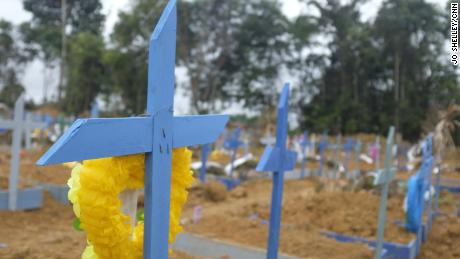
Workers have made hundreds of crosses to mark new graves at the Parque Taruma Cemetery.

At the Parque Taruma Cemetery, more than 1,500 graves have been dug since the pandemic came to the Amazon. Men and heavy machinery sometimes work at night to meet the demand, opening up large trenches as mass graves.

Five coffins that arrive in just two hours get placed in a group grave.

Pedro Chaves said it was distressing to not only lose his mother but to have to wait for her to be buried.

Standing in mourning for his mother is Pedro Chaves, angry that he has to wait for the trench to be full before the coffin is covered. “We are here around 30 minutes waiting for more bodies,” he says. “I just want to put my Mum there and finish this. My family doesn’t need this.”

Chaves says his mother died from complications of diabetes, not the virus. Others say Covid-19 was not to blame for their losses. With so little testing, it is impossible to know for sure.

As a constant parade of angry, grief-stricken locals passes through the cemetery, workers sit in a corner, hammering makeshift crosses and grave boundaries together in the Amazonian humidity.

Indigenous people pack field hospital

Across town, at the newly built Gilberto Novaes field hospital, a stream of new patients arrives. A dozen indigenous people from the outer limits of the city stagger breathless from the ambulances into wheelchairs and straight to the ICU.

Health workers and patients fight coronavirus in the ICU of Gilberto Novaes hospital.

The ICU is frenetic, packed with the sick and those trying to save them.

Circulating among the beds is Miqueias Moreira Kokama, the head of the Kokama indigenous community. He was appointed just two weeks ago when his father died from coronavirus.

“I took my father into hospital where he was intubated for 5 days,” he says. “Now we have 300 with symptoms and 30 in hospital.”

Deathly quiet in the slums

In the Kokama community itself, the virus has emptied the streets. Resident Vanda Ortega Witoto points at each house on one road, ticking off the families that are now self-isolating.

At the next street, she explains that the deathly silence stems from everyone being in hospital.

Miqueias Moreira Kokama lost his father to coronavirus and then had to lead his community.

At first they felt their distance from the city gave them protection. But then the first symptoms appeared and the slum’s poor sanitation helped the virus take hold.

Yet help did not come, Witoto says, with local officials saying it was the duty of the federal government to help the indigenous people and the federal government doing nothing.

So when a relative was coughing, in pain and unable to get out from a hammock, she donned a mask and gloves to drive them herself to the hospital. “It was a very difficult moment, to expose myself and seek help for her.”

The Kokama feel doubly under threat, from the pandemic and the actions of the government whom they accuse of threatening their very existence.

Witito says Bolsonaro “has been behaving in this pandemic by attacking our territory, expelling the indigenous people from their territories and opening our lands to agribusiness.”

At the end of the day, a moment of hope warms the community. Witoto’s mother, Brazileia Martiniano Barrozo, has been released from the hospital and returns to streets now echoing with celebratory fireworks and cheers from neighbors.

A city caught by the President’s rhetoric

Manaus Mayor Arthur Virgilio Neto isn’t just fighting the spread of Covid-19, he’s also caught in a row with President Bolsonaro who called him a “piece of sh**” in a cabinet meeting, the recording of which the Supreme Court released last week.

Virgilio Neto told us he felt Bolsonaro’s “dream is to be a dictatorship but he’s too stupid.”

He added the President should “shut up and stay at home,” and was partially responsible for Brazil’s rising death toll because of the way he had dismissed the danger as a “little flu.”

Source link