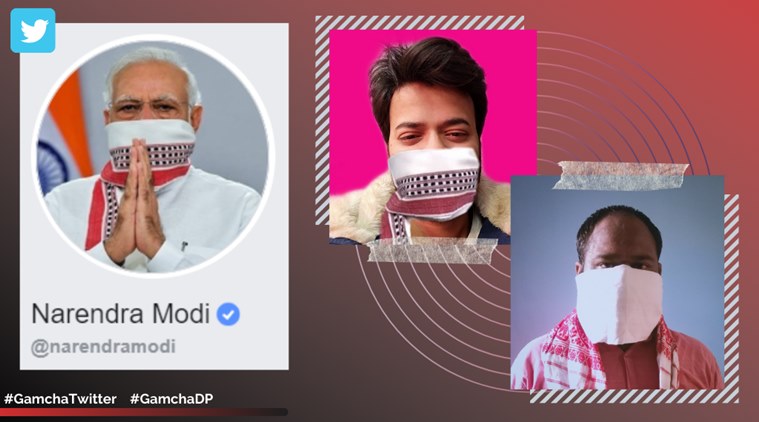
UP town mass-produces ‘Modi gamcha’, angry Manipur seeks Union textile ministry’s intervention

0

Written by Jimmy Leivon
| Imphal |

Published: May 31, 2020 11:22:26 pm


“The emotions of people of Manipur ran beyond imagination,” said the director, in the letter addressed to the development commissioner of the Ministry.

After news reports of Barabanki in Uttar Pradesh mass-producing the ‘gamcha mask’ sported by Prime Minister Narendra Modi, the Handloom and Textiles department of Manipur — where the gamcha is a traditional garment – is up in arms.

The department has sought the intervention of the Union Ministry of Textiles, to take necessary steps to ‘immediately stop the production of gamchha face mask in UP’, citing “emotional discontentment” amongst the public, including weavers, in Manipur.

K Lamlee Kamei, Director of the Handloom and Textiles department, in the letter to the Ministry said objections have been raised from different sections of the state, including the weaver community, over the mass production of the traditional Manipur handloom cloth in UP on powerloom.

ALSO READ | PM Modi dons ‘gamcha mask’ in new profile picture, others follow suit

“The emotions of people of Manipur ran beyond imagination,” said the director, in the letter addressed to the development commissioner of the Ministry.

Civil bodies of Manipur, like the ACOAM-Lup, Kangleipak, AMESCO and HERICOUN, among others, had in a joint statement lambasted the department of Handloom and other handloom clusters over their ‘long negligence of the value of the traditional muffler’.

The civil bodies stated that when Modi wore the ‘leirum phee’ (the gamcha), different sections spoke of the recognition of Manipur’s culture by the PM. But the department concerned never thought of protecting it, and now a textile unit in Barabanki was mass-producing it as ‘Modi Gamsha’.

The directorate of handloom and textiles, Manipur, has convened a meeting on Monday to discuss the prevailing situation and the registration of ‘leirum phee’ under Geographical Indication of Goods (Registration and Protection) Act, 1999.

It claimed that the ‘legyan’ (muffler) sported by Modi was designed from a traditional cloth, ‘leirum phee’, of Manipur.

In the letter to the Union ministry, the textile department said the traditional ‘leirum phee’ was first produced in the 9-10 century without a flower design, and with flower design during the reign of Manipur king Loyumba in 1074-1112 AD.

The cloth was woven by the Shachilan clan at that time, purely on handloom and used mandatorily during marriage ceremonies of the Meitei in Manipur, said the director.

The letter further claimed that the production of the ‘lengyan’ was started in 2004 following a joint meeting of the sub-committee in September.

Accordingly, the ‘lengyan’ with ‘leirum design’ was officially used in the 1st India ASEAN Motor Car rally (November 22 to December 6, 2004) and became the symbol of Manipur on every occasion, it said.

📣 The Indian Express is now on Telegram. Click here to join our channel (@indianexpress) and stay updated with the latest headlines

For all the latest North East India News, download Indian Express App.

Source link

Jake Paul filmed looting, but denies being a part of it

0

Jake Paul is denying that he took part in looting captured on video at an Arizona mall after backlash about his appearance sprung up online.

In multiple videos posted to Instagram and Twitter, Paul and members of his crew are seen outside and inside an Arizona mall where looting is taking place. It remained unclear from the videos whether Paul and his team were actively involved in any looting, but commenters on social media, including prominent members of the YouTube community, criticized Paul for his appearance at the scene regardless. Paul’s new statement claims that “neither I, nor anyone in our group, was engaged in any looting or vandalism.”

“We filmed everything we saw in an effort to share our experience and bring more attention to the anger felt in every neighborhood we traveled through; we were strictly documenting, not engaging,” Paul wrote in a statement posted to Twitter. “I do not condone violence, looting, or breaking the law; however, I understand the anger and frustration that led to the destruction we witnessed, and while it’s not the answer, it’s important that people see it and collectively figure out how to move forward in a healthy way.”

Paul’s statement is already being met with pushback. People brought up important questions about Paul’s actions, including why Paul decided to focus his filming on looting happening at a mall in Arizona as opposed to other protests being held around the city that shine a better light on what people are fighting for this weekend?

Paul notes in his statement that “we are all doing the best we can to be helpful and raise awareness,” but choosing to focus on an activity that other protesters have condemned around the country is where a number of people are taking issue. American musician David Lee Crow (better known as Ghastly) tweeted, “Jake Paul came to my state last night to not peacefully protest in downtown (where it was organized by BLM) but went directly to the looting in Scottsdale and brazenly bragged about it on his socials.”

“This is an opportunity to change our world not grow your dog shit brand,” Crow tweeted.

Even if Paul wasn’t actively looting, the fact that he can potentially use footage he captured for his own gain, including the promotion of his own channel, is offensive to people around the world, protesters in cities across the country, and other YouTubers. This isn’t the first time that Paul has caught flack for seemingly using news stories that center on human suffering as “content fodder for his channel” either, reporter Abby Ohlheiser pointed out.

“Jake Paul looting and using the death of unarmed black men by police for vlog views is disgusting but it’s exactly who he is,” Zach Sang, a popular interviewer and personality, tweeted. “He didn’t march in solidarity with anyone he showed up hours after to loot a mall for views. Jake cares about no one but himself [and] money. He needs help.”

Jake Paul is a YouTube creator and influencer with a massive audience — he has over 20 million subscribers on YouTube, 3.7 million followers on Twitter, and over 13 million followers on Instagram. It’s an empire that’s helped Paul generate tens of millions of dollars over the last several years. Many people on Twitter are now asking for YouTube to take action against Paul.

Paul also has the privilege of reaching an audience that mainstream news networks like CNN or the New York Times might not; typically a younger audience who tunes in to watch whatever he posts. Shedding light on what’s happening around the world is a big responsibility, and foregoing that responsibility to hone in on just one part of what people are seeing — again, condemned by protesters in every city — is why so many people are outraged.

“Jake Paul (a white millionaire) using the BLM protests to loot for his own gain,” YouTuber and podcast host Jack Dean tweeted.


Source link

The Guardian view on lockdown choices: who to trust? | Editorial

Across Europe, the start of June marks a new phase in the coronavirus response. In the coming days, new measures will take effect in Italy, France, the Netherlands, Greece, Spain and Estonia, as well as the UK. Several countries are preparing to reopen restaurants, cafes and theatres, as well as schools. It is a measure of how poorly the UK government has managed the pandemic that even the more limited easing of the lockdown that is due to take place in England inspires more fear than relief.

As it is, the week ahead will confront parents of school-age children, 2.2 million people who have until now been “shielding” at home, and millions more adults who have been told they can return to work, with an impossible choice. Should they do what the government says, and begin to let down their guard against the risk of catching the virus? Or should they heed the warnings of the five members of Sage (the Scientific Advisory Group for Emergencies) who believe the lifting of lockdown is premature, and the deputy chief medical officer for England, Professor Jonathan Van-Tam, who on Saturday described the present moment as “very dangerous”?

The Guardian does not ask such questions lightly. That they cannot be passed over is a measure of the parlous position England is now in (the governments of Scotland, Wales and Northern Ireland are all taking a more cautious approach, although some easing of rules is also taking place). The foreign secretary, Dominic Raab, on Sunday described the government’s approach as slow and steady. But ministers appear to be in a rush, and determined to avoid falling further behind our recovering European neighbours. Why else declare their “five tests” to have been met, when the official Covid-19 alert level has not yet fallen to the level (3) said in May to be a condition for restrictions to be relaxed?

Even the announcement was over-hasty, with new rules on social gatherings that should have been spelled out on Sunday instead offered up on Thursday, despite the obvious danger that this would lead to increased socialising and transmissions over the weekend. This, it appears, was judged a price worth paying by a prime minister determined to change the subject after days of public fury about his rule-breaking adviser, Dominic Cummings.

The effect of warm weather on the virus is one of many things that scientists and the rest of us are still learning. If we are lucky, the calculated risk being taken by the government in the interests of the economy and its own reputation will pay off. No one is arguing that the lockdown can last indefinitely. If the tools existed to enable any new outbreaks to be quickly dealt with, then the plans could be judged right.

The problem is that the evidence points to this not being the case. Design flaws as well as delays in the national testing and tracing system are one cause for concern. Another is the systemic weakness of English local government. Where other large European countries are adjusting rules on a regional basis, city leaders including Andy Burnham have voiced doubts about the viability of the area-specific lockdowns proposed by ministers as a remedy for new outbreaks (while Scotland, Wales and Northern Ireland have all gone their own way).

Besides such practical considerations, the disdain for public opinion shown by the prime minister and his colleagues over the past week inspires the opposite of confidence. June is an unnerving prospect.

Source link

Nazi or Hero? Historian Looks at the Stories a German Consultant Told of His Father

FRANKFURT — Weighing in on an issue that revived questions about the role of German business in World War II, a historian has partly confirmed and partly refuted reports that a well-known consultant falsely portrayed his father as a Nazi resister when in fact he was head bookkeeper for the Hitler Youth.

Roland Berger suffered significant damage to his image as consigliere to chancellors and to chief executives after The New York Times and other news media outlets reported last year that he had constructed a legend about his father that was at best incomplete.

Mr. Berger, who was a child during the war, defended himself by saying that he had believed the stories his father told him. He hired Michael Wolffsohn, author of numerous books on German and Jewish history, to investigate. Mr. Wolffsohn’s report, which was published online on Sunday, made it clear that Mr. Berger’s father was no war criminal but also not the hero that his son had often portrayed.

Georg Berger, the father, was an early member of the Nazi party who profited from the regime and had held several influential jobs, including a high-ranking post at the Hitler Youth. But he later fell out of favor and suffered Nazi injustice, including several months in a Gestapo jail, according to Mr. Wolffsohn.

“Georg Berger definitely did not have blood on his hands and was, in that respect, not a criminal,” Mr. Wolffsohn wrote. At the same time, he said, Georg Berger “was not a man of the resistance.”

“He was not, as Roland Berger often falsely asserted, a victim of Nazi persecution,” Mr. Wolffsohn said.

Roland Berger, who is 82 and no longer manages the consulting firm that bears his name, declined to comment for this article.

German corporations have often had to apologize for using slave labor or providing Hitler’s war machine with money and weapons. Mr. Berger’s case was unusual because he was a young boy during the war. His father’s past only became an issue because he often cited him as an inspiration and a role model.

In Mr. Berger’s telling, his father had joined the Nazi party in the early 1930s but quit in disgust after Kristallnacht, an orgy of anti-Semitic violence in November 1938, revealed the party’s malevolent intentions. Georg Berger then became a target of Nazi prosecution, according to his son.

Roland Berger also told of heartbreaking visits to his father in Gestapo detention and said his father was later held at Dachau, the notorious concentration camp near Munich.

Parts of that story were true, and some were not, according to Mr. Wolffsohn.

Georg Berger did not resign his post with the Hitler Youth until September 1939, nearly a year after Kristallnacht. After a stint managing a factory that produced a kind of cracker, Mr. Berger became director of Ankerbrotfabrik, at the time Europe’s largest bakery, in Vienna. The appointment in 1941 was an indication that Mr. Berger was still well regarded by the regime. The bakery, as well as a villa in Vienna rented by the Berger family, had earlier been seized from Jewish owners.

Mr. Wolffsohn said that Georg Berger played no role in stealing Jewish property and, on the contrary, had tried to protect the interests of the former owners of the bakery, who were members of a Jewish family who had fled to Switzerland.

The owners sold their shares in the bakery to a German businessman living in Switzerland. The businessman was in all likelihood a frontman for the original owners, Mr. Wolffsohn said, and after the war sold the bakery company back to the family for a modest price.

Georg Berger resisted attempts by local Nazis to take full control of the bakery, though it was unclear whether his motives were altruistic or tactical. But Mr. Berger’s stance appears to have angered the party. In 1942, he was fired as head of the bakery after the Gestapo searched the family residence and accused Mr. Berger of hoarding rationed items like butter, eggs and soap.

Mr. Wolffsohn said that the accusation of hoarding was probably a pretense. Denunciation was a commonly used weapon in the bureaucratic power struggles that permeated the Nazi regime.

Mr. Wolffsohn also found documents to bolster a poignant story that Roland Berger often told about visiting his father on his birthday in a Gestapo jail in Munich.

Georg Berger also, as his son had claimed, spent several months in Russian prisoner of war camps after Germany’s surrender in May 1945, Mr. Wolffsohn said. Reporting by the newspaper Handelsblatt, quoted by The Times, cast doubt on whether the elder Berger had ever been incarcerated by the Gestapo or the Russians.

Georg Berger also spent time at Dachau, but only after the war when it was being used by the Americans as an internment center and not during the war when it was a brutal Nazi concentration camp, according to Mr. Wolffsohn.

Mr. Wolffsohn, who was highly critical of media reporting on the case, was inclined to give Roland Berger the benefit of the doubt. “Every son tells or writes his own father’s story,” Mr. Wolffsohn wrote. “Rarely is the perception and portrayal of the son identical to the reality of the father.”

Source link

George Floyd attorney calls for first-degree murder charge against Derek Chauvin, says officer knew who the victim was

The attorney representing George Floyd’s family in their case against the Minneapolis Police Department said heightened criminal charges are warranted for Derek Chauvin, one of four officers whose actions led to Floyd’s death on Monday.

Addressing the case during CBS News’ Face the Nation on Sunday morning, civil rights lawyer Benjamin Crump discussed the possibility that Chauvin and Floyd had interacted prior to last week’s fatal arrest.

“We believe he knew who George Floyd was,” Crump said in reference to Chauvin, adding that the new information could upgrade the charges currently filed against the fired officer to first-degree murder.

Four days after video footage of Floyd’s death was first released, Hennepin County attorney Mike Freeman announced Chauvin had been taken into custody and faced third-degree murder and manslaughter charges for his role in the killing. The video showed Chauvin kneeling on Floyd’s neck for close to 10 minutes, as Floyd repeatedly said he was struggling to breathe before eventually falling unconscious.

Chauvin, in addition to three other officers involved in the violent exchange, were fired from the Minneapolis Police Department on Tuesday.

Charges for third-degree murder and manslaughter are similar, although they carry a lengthier maximum prison sentence when applied jointly than individually. Both indicate the individual charged with the death of another did not intend to take that person’s life.

Chauvin’s charges were issued ahead of reports that surfaced later on Friday, which cited comments from a former Minneapolis club owner who said both Floyd and the officer were employed by the venue. Chauvin had been the establishment’s resident off-duty officer for the better of two decades, while Floyd had periodically worked as a security guard over the past year.

In his Face the Nation comments on Sunday, Crump explained that Chauvin and Floyd’s shared employment potentially indicated the murder was premeditated, and therefore justified first-degree charges.


Attorney Benjamin Crump speaks during a news conference following unarmed teenager Michael Brown’s death by Missouri police in 2014. Crump, now representing the family of George Floyd in their case against the Minneapolis Police Department, said the officer arrested for Floyd’s death should be charged with first-degree murder during an interview on Sunday.
Michael B. Thomas/Getty

“They had to overlap,” the attorney said of Chauvin and Floyd’s respective work shifts. He suggested the scene captured on video was evidence enough of the officer’s intent to cause serious bodily harm.

“We think that he had intent based on, not the one minute, two minute, but over eight minutes, almost nine minutes he kept his knee in a man’s neck that was begging and pleading for breath,” he said. “George Floyd died because of the knee being shoved into his neck, and he could not breathe.”

Newsweek reached out to Crump’s office and the office of Chauvin’s attorney for additional comments but did not receive replies in time for publication.

Source link

FBI’s Top Lawyer Leaving Bureau Amid Conservative Criticism Over Russia Probe

WASHINGTON (AP) — The FBI’s top lawyer, Dana Boente, who has spent nearly 40 years with the Justice Department but has been targeted for criticism over the last year by some conservative commentators and supporters of President Donald Trump for his role in the Russia investigation, is leaving the bureau.

Boente has most recently served as the FBI’s general counsel but has held a variety of roles in his 38-year Justice Department career, including acting attorney general in the early days of the Trump administration, a United States attorney in Virginia and the acting head of the department’s national security division.

The FBI said that Boente had given notice on Friday that he intended to retire effective June 30, the bureau said.

“Throughout his long and distinguished career as a public servant, Dana has demonstrated a selfless determination to ensure that justice is always served on behalf of our citizens,” FBI Director Christopher Wray said in a statement announcing Boente’s departure. “We should all be grateful for his dedication to the Department of Justice, the FBI, and the American people.”

Boente became acting attorney general in early 2017 after Sally Yates, a holdover from the Obama administration, was fired after refusing to defend the president’s travel ban, and remained in that role until Jeff Sessions was installed.

As a top Justice Department official, he approved one of three applications to renew secret surveillance warrants targeting former Trump campaign adviser Carter Page. A Justice Department inspector general report from December said those applications to the Foreign Intelligence Surveillance Court had significant errors and omissions that cut against the FBI’s premise that Page, who was never charged with any wrongdoing, was an agent of a foreign power.

The report said that Boente and other Justice Department officials “did not have accurate and complete information” from the FBI at the time they approved them.

Even so, Boente has nonetheless been criticized by conservative figures for his involvement in the Russia probe.

A Facebook post in February from the conservative group Judicial Watch announced that its president, Tom Fitton, would appear on Fox Business News with host Lou Dobbs to discuss topics including “the discovery that the FBI’s Chief Legal Counsel, Dana Boente, participated in fraudulent FISA warrants on Carter Page.”

In April, Dobbs himself alleged that Boente and Wray were blocking the disclosure of “exculpatory” information about former Trump national security adviser Michael Flynn. The FBI and Justice Department denied that that was the case.

NBC News first reported Boente’s departure and said he had been asked to resign by the Justice Department. Wray’s statement made no mention of that. The Justice Department declined to comment Saturday.


Source link

Mapping US police killings of Black Americans

Between 2013 and 2019, police in the United States killed 7,666 people, according to data compiled by Mapping Police Violence, a research and advocacy group. On May 26, 2020 at 9:25pm (02:25 GMT, May 27), George Floyd, a 46-year-old resident of Minnesota, became yet another victim of police brutality as he was killed in police custody while unarmed. Floyd’s death has prompted thousands of protesters to march in cities around the country demanding justice and an end to police violence. 

The number of police killings in the US disproportionately affects African Americans. Despite only making up 13 percent of the US population, Black Americans are two-and-a-half times as likely as white Americans to be killed by the police. 

The map below shows how disproportionate these killings are across the US’s 50 states.

Unsurprisingly, the three largest states – California, Texas and Florida – have the highest total number of killings of Black people by police officers. Once these figures are adjusted for the population size and demographics, in nearly every state, African Americans face a significantly higher risk of being killed by police officers than white Americans.

In Utah, the African Americans comprise just 1.06 percent of the population but they accounted for 10 percent of police killings over the past seven years – a disproportional rate of 9.21 times. In Minnesota, Black Americans are nearly four times as likely to be killed by law enforcement, with Black victims comprising 20 percent of those killed, despite comprising only 5 percent of the overall population.

Source link

Hannah Brown Just Issued an On-Camera Apology for Using the N-Word

0


Hannah Brown Just Issued an On-Camera Apology for Using the N-Word | InStyle


this link is to an external site that may or may not meet accessibility guidelines.

Source link

Rugby Australia to announce first phase of restructuring this week

Rugby Australia will reportedly announce the first phase of a wholesale organisational restructuring this week.

The reports come after Rugby Australia lodged their 2019 financial report that provisionally flagged a $9.4 million loss.

The long hard road for Rugby Australia

Interim chief executive Rob Clarke has the unenviable task of steering the embattled organisation through wholesale changes in the midst of planning a domestic Super Rugby return in July and attempting to secure a broadcast deal beyond this year.

Clarke confirmed the next steps for Rugby Australia this weekend.

“The audited and signed accounts have been submitted today, and our 2019 annual report will be published in the coming days,” Clarke said.

“This week we will also announce the first phase of an organisational restructure of the Rugby Australia business, which we are in the final stages of completing.”

Rugby Australia were forced to retrench more than 100 staff to cope with the financial losses associated with the ongoing global pandemic, while former CEO Raelene Castle exited amid a mountain of criticism against the game’s administration.

Not all doom and gloom

The organisation will hope that they have staved off complete collapse and that stop-gap competitions will prevent further losses.

A Bledisloe Cup series against the All Blacks is in the works and Australia are considering a Trans-Tasman franchise series at some point, while South Africa may be forced to reevaluate their partnership with their Southern Hemisphere rivals.

Australia’s Super Rugby clubs have been forced to cut staff as well, though the proposed five-team domestic franchise tournament looks likely to go ahead soon.

The competition, set to feature the recalled Western Force, will be known as Super Rugby AU, is expected to kick-off on July 3. 

Rugby Australia have work to do

Rugby Australia are believed to be considering whether to implement any of World Rugby’s ten optional temporary law amendments designed to help reduce the risk of transmission of the virus, in the competition.

World Rugby’s executive committee approved the optional law trials which cover scrum, tackle, ruck and maul situations in May and issued them alongside guidelines for the return to play.

National Unions can apply to implement one or more of the temporary law amendments in domestic trials in line with the World Rugby’s return to play guidance.

Rugby Australia still have plenty of hoops to jump through before they can get players back on the field which will involve discussions with World Rugby, broadcasters and SANZAAR.


Source link

Drive-in theatres see revival amid lockdowns

Going to watch a movie or a concert under the stars is back in fashion as cinemas remain closed because of coronavirus restrictions.

Source link